
Insights and Stories from Sapa and the Northern Borderbelt provinces of Vietnam.
A Smile Across the Mountains
In the misted highlands of Vietnam, two La Hù sisters spent sixteen years apart, their reunion arriving not in person but through a single photograph. This is a story of memory, resilience and love that travelled further than any road.
The Sisters Who Waited for Time to Catch Up
Though separated by less than five miles of steep terrain, sisters Lý Ca Su and Lý Lỳ Chí had not seen one another for over sixteen years. Their final years unfolded in quiet solitude, filled with longing, memory, and the ache of distance. The eldest sister had long since passed away, lost to hunger during a time of great scarcity; a sorrow that lingered in every conversation that followed.
The sisters belonged to the La Hủ ethnic group, one of Vietnam’s smallest and most secluded communities, numbering fewer than ten thousand. For generations, the La Hủ lived as semi-nomadic hunters, following the forest’s rhythm across the misted highlands of the far northwest. Change came suddenly in 1996, when hydroelectric projects and government reforms encouraged the community to settle permanently. The forest paths gave way to villages and fields. The transition was uneasy, as traditions adapted and some, quietly, faded.
A Life Divided by Mountains
Lý Lỳ Chí left her childhood home at seventeen. She married early and settled in a neighbouring valley. For many years, the two sisters would make the long, arduous trek along a narrow mountain path to visit each other, their journeys a thread of connection between ridges. But time is unrelenting. Age weakened their steps, and the trail grew quiet. Sixteen years passed without reunion.
By ninety-three, Lý Ca Su had gone completely blind. Her younger sister, at one hundred and three, could still see, but her hearing had faded almost entirely. With no literacy, there were no letters. With no electricity, no phones. The silence between them stretched impossibly wide.
Progress Arrives Too Late
In 2019, a new road was completed linking their villages. What had once taken days could now be done in two hours. Yet for the sisters, it changed nothing. Neither could ride a motorcycle, and there were no cars or buses. Even electricity remained a rumour. The distance was only five miles, but it might as well have been a hundred.
And still, life has its small mercies.
The Photograph That Crossed Mountains
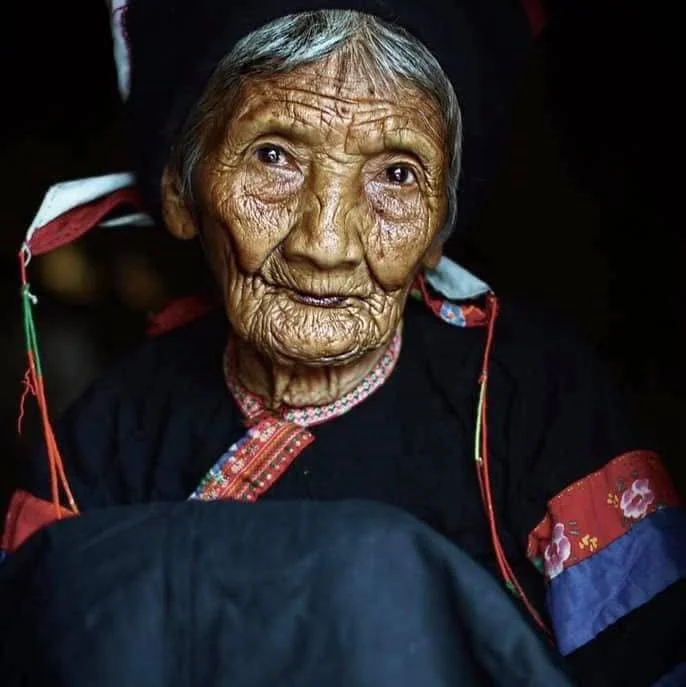
Two years earlier, photographer Réhahn had taken a portrait of Lý Ca Su. Her face, deeply lined, seemed to hold entire lifetimes. Her smile was gentle; the kind that hums quietly rather than shouts. When ETHOS visited the La Hủ villages, they carried that photograph with them and showed it to Lý Lỳ Chí.
For a brief, trembling moment, her eyes brightened. Recognition flickered. The years fell away. She saw her sister’s face again, if only in an image. Tears came, soft and sudden. There was reunion — not in person, but in spirit.
What Remains
Now both sisters have passed beyond this world, and that single photograph holds what words cannot. A connection unbroken by mountains or silence. A reminder that love, in its simplest form, can travel further than any road.
Sometimes, the distance between two hearts is measured not in miles, but in memory.
Thank you to Rehahn for the wonderful photo. To see this and many other portraits, please considering visiting the Precious Heritage Museum in Hoi An.
The Evolving Art of Hmong Textiles in Northern Vietnam
The Hmong of Vietnam are known for expressive textiles full of history, identity, and artistry. Today these traditions are evolving. Are they being protected or transformed?
The Evolving Art of Hmong Textiles in Northern Vietnam
The Heritage of Hmong Clothing
The Hmong people of Vietnam have a long history of creating clothing that reflects their identity and traditions. Textiles are more than fabric. They are a visual language that shows who someone is and where they come from.
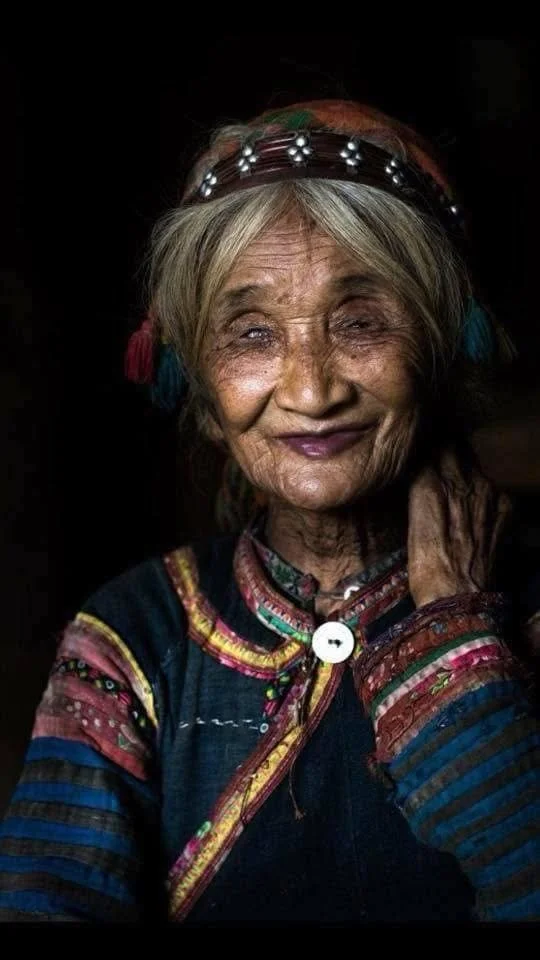
Each Hmong subgroup has its own recognisable style. White, Black, Flowery, Red, and Blue Hmong communities are known for different colours, patterns, and decorative techniques. Women’s pleated skirts often include detailed embroidery, batik designs, and appliqué. Blouses and aprons are bright and full of symbolic motifs. Men’s clothing is simpler but still carries meaningful tradition.
Crafting Textiles by Hand
For centuries, Hmong families have relied on handwoven hemp and natural indigo dye. Every step was done by hand. Growing and processing hemp took great effort. Embroidery was slow and highly skilled work passed down from mothers to daughters.
These garments were more than clothing. They showed cultural knowledge and community belonging. Each stitch was carefully placed with purpose.
Modern Influences and Adaptations
Change is happening. Many Hmong households now use commercial cotton and some synthetic materials because they are affordable and easy to work with. This allows clothes to be made more quickly and sold in markets or to tourists.
Some subgroups are responding in a different way by adding more embroidery and creativity than ever before. Their designs are more detailed and far more time consuming to make. Clothing has become a canvas for new artistic expression.
Tourism has created economic opportunities but also brought challenges. Traditional hemp skirts are becoming rare in some villages. Yet hemp fabrics and indigo dyeing are still practised and remain a strong part of cultural identity.
What Textiles Tell Us
When you visit Hmong communities in northern Vietnam, take time to notice the details. Clothing can show migration stories, family history, resilience, and pride in heritage. Patterns and colours protect against misfortune and honour ancestors.
Buying directly from local artisans supports families and helps preserve skills that have lasted for generations.
A Question for You
As traditions evolve, what should stay the same?
Should Hmong textile makers embrace new materials and markets, or is there a risk that important cultural knowledge will be lost?
I would love to hear your thoughts.


