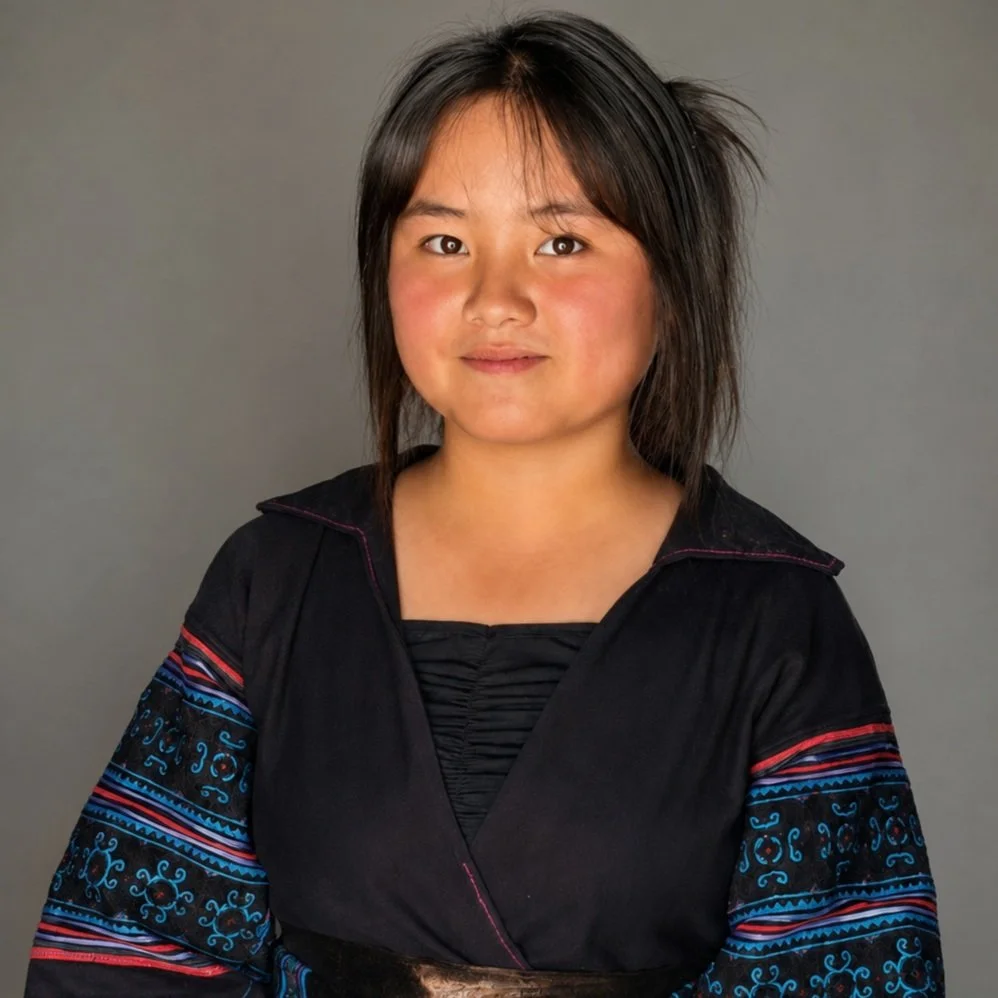
A Path Beyond the Mountain
The story of Lý Thị Pằng
My name is Lý Thị Pằng, although most people call me Pang. I am seventeen years old and I am Black Hmong. I come from a small, high mountain village called Pa Cheo in Bát Xát District, around two hours from Sa Pa by motorbike.
The journey is long and the road becomes increasingly rough as it climbs towards our home. Our village lies at approximately 1,400 metres above sea level, only a little lower than Sa Pa. In winter, the temperature can fall to around freezing. Ice sometimes forms on the higher mountain behind the village, especially close to Tết.
Our house is a traditional wooden Hmong home. It is comfortable during the summer, but the cold enters easily in winter. The house represents something important to my family because my parents made a considerable sacrifice to build it.
When I was in Class One, my younger brother was only about two years old. My parents left us in the care of our grandmother and travelled to China to work. They picked bananas and did other agricultural labour so that they could save money to improve our home. They were away for approximately two years. During that time, I saw them only a few times. When they returned, they usually stayed for just one night before leaving again.
My earliest home had been very small and made largely from bamboo. After working in China, my parents had saved enough money to build the larger wooden house in which we live today. At the time, I was too young to understand fully what their absence meant. I lived with my grandmother and helped care for my little brother. Looking back, I recognise how difficult the decision must have been for my parents. They spent almost two years away from their children because they wanted to create a safer and better home for us.
Childhood in the village
One of my clearest early memories is of travelling with my parents to a market in China. At that time, there was no border fence in the area and crossing was much easier than it is today. I was around seven or eight years old, and it was my first journey in a car. Unfortunately, I became terribly travel sick. I remember almost nothing about the market itself, but I still remember how ill I felt during the journey.
When my parents were working away, an ordinary school day began early. I usually woke at around five or half past five, washed my face and cleaned my teeth. My grandmother prepared breakfast, which was often rice, corn and sometimes dried fish. The food was plain and repetitive, and we rarely had meat, but we normally had enough to feel full.
After breakfast, I walked to school. There were few manufactured toys in our village, but we created our own games. My friends and I dug in the earth and built small houses. We made imaginary food and potions in mud kitchens using leaves, berries and anything else we could find.
My younger brother loved climbing trees. He collected eggs or young birds from nests and was very skilled with a slingshot. We sometimes tried to care for the birds until they were able to fly. I once raised some small birds, but eventually they grew up and disappeared into the forest.
Foraging was also part of childhood. My friends and I collected wild fruits from the surrounding mountains. One of my favourites was a dark purple fruit, probably rose myrtle. It was sweet and soft, and eating it stained our mouths. If we ate enough, our tongues became almost black, which we found extremely funny. We also found wild guava and small yellow or pink berries that looked a little like raspberries. We collected edible ferns and dug beneath sword ferns for tiny tubers, each about the size of a grape. The hairy outer covering had to be cleaned away before they could be eaten.
The rice terraces provided other foods. There were snails, eels, fish, frogs and grasshoppers. These were not unusual or exotic foods to us. They formed part of the knowledge children acquired from their families and from one another.
Living from the land
My parents are farmers. Our family grows rice and corn mainly for our own consumption. We also grow yacon, a plant with large, sweet roots that can be eaten raw or cooked. For income, my parents grow sa nhân, an aromatic plant related to cardamom. Buyers come to the village to purchase the crop. The family previously planted a small pear orchard, but we were unable to find a reliable market for the fruit, so the idea was not successful.
Farming in the mountains is uncertain. Caterpillars can damage the yacon crop, while the amount of rice we harvest depends heavily on water and weather conditions. In recent years, the weather has become drier and our rice yields have fallen. My father believes that floods have washed away some of the soil and that rainfall patterns are changing. A flash flood recently damaged around half of one of our rice fields. The loss affected not only the rice crop but also the frogs, fish and other foods that could be collected from the terraces.
Some of our fields lie below the village and are difficult to reach. There is a narrow trail that can sometimes be used by motorbike, but travelling along it is not easy. Other fields are farther away, close to a small mountain shelter used when the family is working there. Water is now one of my greatest concerns. Some of our terraces have not had enough water to produce a reliable crop for several years. My father would like to buy better-watered rice fields from another family, but suitable land is extremely expensive. He has talked about land costing close to 300 million Vietnamese đồng, which is far beyond what our family can easily save.
I worry about how my parents will continue farming if the water supply becomes worse. Farming has always sustained our family, but the land is becoming less dependable.
Knowledge inherited from my parents
Although my parents received very little formal education, they have taught me skills that are essential to life in our community. My mother never attended school. My father studied only as far as Class Three and cannot read or write. Despite this, they built a home, raised two children and ensured that we had food. They have worked hard to give me opportunities that they never received themselves.
They taught me how to plant rice and corn, gather firewood, cook, light a fire and recognise edible plants in the forest. I have helped when chickens were prepared for food, and although I have not yet killed one by myself, I believe I could do it if necessary. My mother taught me embroidery and how to use a sewing machine. Our family continues to grow hemp, which has traditionally been used by Hmong families to produce cloth. I have learnt how to plant the hemp, cut it, dry it and peel away the fibres. I am still learning some of the more complicated stages, such as joining and twisting the fibres correctly.
We also grow indigo to dye our clothing. These processes require patience, knowledge and a great deal of work. In the past, Hmong families could not simply buy all the clothes they needed. They grew the fibre, made the cloth, dyed it and decorated it themselves.
I recognise that these are valuable skills. Many young people from towns and cities would not know how to start a fire, grow rice, identify food in a forest or make cloth from a plant. Even some Hmong students at my school no longer know every stage of the traditional process. I am proud that this knowledge remains within my family, although I also know that I still have much to learn.
The only girl who continued
Education has been one of the most important and difficult parts of my life. Until the end of Year Nine, I studied at a school closer to my home. Even then, I stayed in boarding accommodation because the distance was too great to travel each day. I first began living away from home when I was around ten years old.
At weekends, I often walked between school and the village. The journey took approximately two hours and involved steep mountain paths. My parents did not yet have a motorbike or driving licence, so walking was sometimes the only option. Travelling alone could be frightening, particularly when I was younger. Later, I attended high school in Mường Hum. By motorbike, the journey from my home took approximately forty minutes, and my father transported me when possible.
I shared a boarding room with around ten students. The facilities were basic but usable, with a bathroom connected to the room. The school provided lunch and dinner, but we had to arrange breakfast ourselves. Most mornings, we ate instant noodles or bread because these were the cheapest options available. Students at the school came from several ethnic communities, including Hmong, Red Dao, Giáy, Tày and Hà Nhì families. My favourite subject was literature. Mathematics was far more difficult and usually gave me a headache.
The greatest challenge was not academic. It was the feeling that I was moving along a path almost no other girl from my village had taken. Most girls in the surrounding villages finished school after Year Nine. Some parents believed that further education was unnecessary for a daughter who would eventually marry, raise children and manage a household.
When I entered Year Nine, there were only two girls from my area continuing at that level. Later, my friend left school to marry. She had a baby shortly before our classmates graduated. After she left, I questioned myself. Why was I still studying? Why was I the only girl from my village continuing? Was I making the right decision?
There were moments when even my parents hesitated. Remaining in school cost money. Although education itself might be subsidised, my family still had to pay for food, transport, clothes and other necessities. If I had left school, I could have worked or helped my parents on the farm. By continuing, I remained an expense to a family with very little spare income. I remember crying because I wanted so much to continue. When my father saw how important education was to me, he supported my decision. His encouragement made an enormous difference. After holidays, he made sure that my brother and I prepared to return to school. Whenever I felt unmotivated, he pushed me to attend. Throughout my education, I missed only two days of school.
I became the only girl from my village to complete high school.
Uncertainty after graduation
Finishing school was an achievement, but it did not provide an obvious answer about what to do next. I considered university. Government support can reduce tuition fees for ethnic minority students, but university still involves substantial costs. A student must travel, find accommodation and pay for food, books, clothing and daily necessities.
I estimated that completing a four-year course might cost between 200 and 400 million Vietnamese đồng. My family could not afford that. The greatest difficulty was not simply money. It was uncertainty.
I am naturally cautious. Before I try something unfamiliar, I think carefully about what could go wrong. I worried that I might begin a course and lose my commitment halfway through. I wondered whether I was capable enough and whether studying would eventually lead to stable employment.
As the eldest child, I also felt responsibility towards my younger brother. If I continued studying but failed to find meaningful work, my parents might conclude that further education had not helped me. My experience could then influence whether they allowed my brother to continue. I did not have an older sibling or role model who had already followed this path. I did not know what to study, where to begin or how education could be turned into a livelihood.
Finding an opportunity
I first learnt about the ETHOS apprenticeship programme through Facebook. I saw a post containing some English words and photographs. I stopped, read it carefully and decided to send a message to Miss Hoa.
Many young people and parents from different provinces had expressed interest in the programme. Some came from as far away as Hà Giang, Tuyên Quang and Đắk Lắk. I knew there would be considerable competition. Sending the message required courage. Speaking to Miss Hoa by telephone and taking part in the interview made me nervous, but she spoke gently and I gradually became more comfortable.
When I told my father about the opportunity, he was understandably cautious. Young Hmong women from northern border communities face genuine risks of deception and trafficking. My father wanted to know who was organising the programme, where I would live and whether I would be safe. He travelled to Sa Pa to meet the ETHOS team and inspect the environment himself. I respected him for doing this. His questions were not a sign that he wanted to prevent me from leaving. They showed that he took my safety seriously.
In September, I will move to Sa Pa to begin studying and working alongside two other young women. I have spent much of my life in boarding schools, so living away from home is not completely unfamiliar. Even so, this experience will be different. I am not particularly worried about meeting new people. I have done that before. One concern is language. Although the other apprentices are also Hmong or Red Dao, Hmong dialects can differ considerably between areas. When I first attended boarding school, there were Hmong students whose speech I could barely understand.
I may also miss my family. When I feel sad or homesick, I do not always tell my parents. I tend to keep those feelings to myself. However, I know that my family supports me, and I know that I can return home during breaks. This opportunity will allow me to improve my English, gain practical skills, learn about tourism and experience places beyond my own village.
Looking forward
I do not yet have a single, clearly defined career in mind. Until recently, I did not know what possibilities existed beyond farming, marriage or finding basic labouring work. My dream is still taking shape.
I want to learn. I want to become more confident and discover what I am capable of doing. I hope to find work that allows me to support myself and help my family. I would like my parents to see that the sacrifices they made for my education were worthwhile. I also want younger girls to understand that continuing their education can lead somewhere.
My advice to them is simple: try hard and continue studying. The knowledge carried by my parents remains an important part of who I am. I am proud to know how rice is planted, how food is found in the forest, how hemp becomes cloth and how indigo gives Hmong clothing its deep colour. Education does not require me to turn away from those things.
Instead, I hope it will help me understand their value more clearly and find new ways to use what I know. My parents once crossed the border and spent two years working away from their children so that they could build a stronger house. Now, I am preparing to leave that house for a while and begin building something different.
I am trying to build a future.