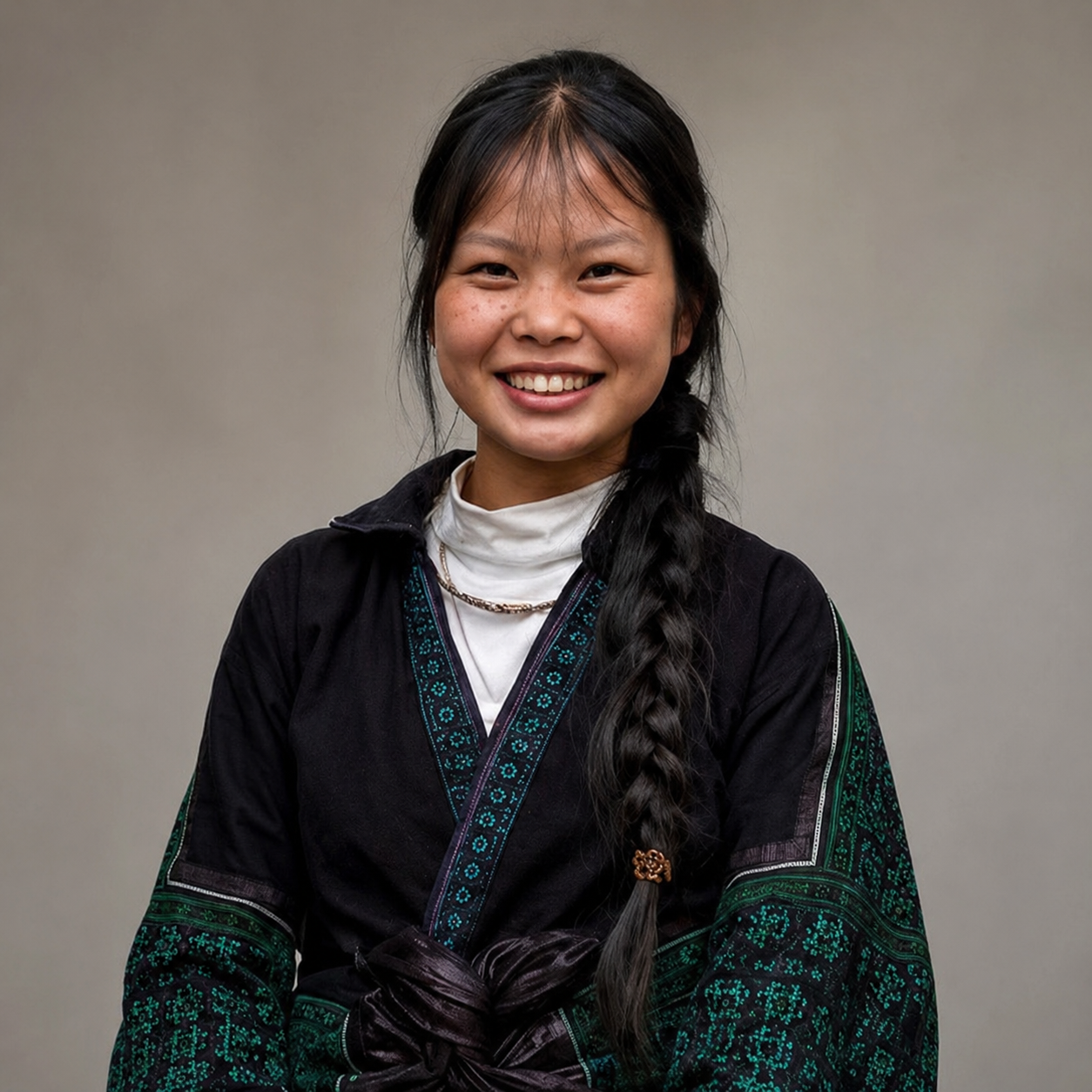
A Future Rooted in the Mountains
My Story, by Sùng Thị Sinh
My name is Sùng Thị Sinh. I am 17 years old, I am Black Hmong, and I come from Sử Pán, a mountain village in Sa Pa.
I am the eldest of three children. My younger brother is 14 and my younger sister is ten. We live with our parents in a wooden house on a steep mountainside. I was born at home while my parents were still living with my grandparents. Later, they built a small home of their own. Our house is still mainly wooden, although we recently repaired it, painted parts of it and added brick around the lower section.
Until recently, I did not have a proper room. I slept in a small space divided from the rest of the house. Before Tết, we repaired the house and I finally received a room of my own. It is very small and contains only a bed, but it is my own space. Our home is simple. We do not have a television, washing machine or many modern appliances. We wash our clothes by hand using water from the mountain streams. We have electricity, but when I was younger it was unreliable. When the power failed, we used battery-powered torches at night.
My family’s life is closely connected to the land. My parents grow rice and maize, but we keep everything we produce because we need it to feed the family. There is not enough left to sell. We also raise animals. We once had three pigs, but they all died during an outbreak of disease. We still have a buffalo. My grandmother usually looks after it when my parents are busy. When I am at home, I help with household work and climb the mountain to cut grass for it.
When I was younger, my mother and I collected firewood together. We walked uphill from our house to find it. Firewood remains important for cooking and for keeping the house warm during winter. My parents also grow cardamom in the mountains, as well as collecting wild aromatic litsea and I sometimes go with them when they work there. Following my parents into the fields and forests was a normal part of my childhood. Some of our food also comes from the land around us. I have eaten frogs, eels, crickets and snails. I cannot eat crabs from the rice paddies or mountain streams because they make me feel sick.
Life was harder for the generations before me. My grandparents never attended school. My parents have told me that when they were young, their families sometimes did not have enough food. My own childhood was still difficult, but we normally had enough to eat.
My father studied until Year 11 and can read and write. My mother attended school until approximately Year 5. They did not receive the educational opportunities that I have, but they have always encouraged me to study. When I told them I wanted to continue my education, they told me to keep trying. Their support is very important to me.
As the eldest child, I know that my choices may influence my brother and sister. I hope that when they see me studying and learning new skills, they will also want to continue their education. I want to be a good example for them.
Going to school was not always easy. When I was younger, I walked along steep mountain paths between my home and school. From Class 4, I began boarding because the daily journey was difficult, particularly in winter. During high school, I travelled from home each morning and returned in the evening.
School was important because it allowed me to meet children of my own age. There were not many living close to my house.
I enjoyed skipping and playing a traditional game with a shuttlecock. I was good at both. I did not have many toys, so I made things from stones, leaves, mud and whatever else I could find. I also made dolls from maize cobs. My mother did not want me to waste the maize, but sometimes I took a few anyway. I find that funny now, although she probably did not at the time.
One of my closest friendships began during childhood. My friend and I studied together in secondary school, but we attended different high schools. We have not studied together for three years, yet we remain friends. Now that we have completed high school, our lives are beginning to move in different directions. Some young people continue studying. Others look for work, marry or become farmers.
I hope more young Hmong women remain in education for longer. When I was in Year 10, one girl in my class left school to get married. Other friends continued studying and have not yet married. I believe attitudes are changing. Society is developing, and teachers speak to students about the consequences of early marriage. They encourage girls to continue learning and not to marry too young.
When a girl marries early, she may lose the chance to study, travel and make her own choices. She may immediately become responsible for a husband, children and a new family. I believe it is better to study, gain experience and understand more of the world before getting married. Marriage can come later. Educational opportunities may be much harder to recover once they have been lost. I want young women to have a genuine choice about their futures.
One of my family’s greatest challenges is that our income is not stable. My mother sometimes follows visitors and tries to sell goods to them. The work is uncertain. On some days she finds customers, but on others she sells nothing. She must also work in the fields, so she cannot always go out to sell. My father accepts temporary work when someone needs him. When work is available, he earns money. When it is not, he stays at home and works for the family. We grow rice and maize, but we need the harvest ourselves. We cannot depend on selling it for income.
When uncertainty has always been part of life, it can begin to feel normal. Even so, I understand that an unreliable income places pressure on my parents. This is one reason I decided to work during the summer after completing high school. I want to help them, even if I can contribute only a small amount.
I begin work at approximately eight o’clock in the morning. I work until the morning customers leave and return at around five o’clock for the evening shift. Some nights I finish at eleven or twelve. When there are many customers, I may work even later. I normally receive only two days off each month.
The work is tiring, but it teaches me responsibility and independence. When I was younger, my parents and teachers guided me. As I grow older, I am learning to find work, earn money and look after myself. When I can support myself, I can begin to support my parents too. That is what I want to do.
Money is not the only source of uncertainty. Our home stands in a wooded area beneath steep mountain slopes. The land is vulnerable to rockfalls and landslides, particularly during heavy rain.
Approximately two years ago, a major landslide struck close to our house. I heard it, but thick mist covered the mountain and I could not see what had happened. Some of my relatives lived near the affected area. They were killed and buried beneath the mud. After that, the danger no longer felt distant. A mountainside may appear secure because it is covered with trees and vegetation, but the earth beneath it can still collapse without warning. During the rainy season, we sometimes leave our house when the risk becomes too great. We wait somewhere safer until we believe we can return.
My family has considered moving permanently, but we do not own suitable land elsewhere. The lower and safer areas already belong to other Hmong families. Knowing that your home is dangerous does not mean you can simply leave when you have nowhere else to build. During heavy rain, we remain alert and hope nothing happens. It is difficult to sleep peacefully when you know what the mountain can do. Sometimes hope is all a family has when there is no immediate solution.
This is another reason I want to study. If I gain skills and find stable work, I hope that one day I can help my family move to a safer place. I do not want to abandon the mountains or leave my village. I want my family to have a home where they do not need to fear every season of heavy rain.
Although mountain life brings difficulties, it also gives me my culture, identity and the knowledge passed through my family. I am proud to be Hmong.
My mother began teaching me traditional textile skills when I was about ten. I learned embroidery and some of the processes used to prepare hemp cloth. I know how to strip fibres from hemp plants, although I am not yet skilled in every stage of making cloth or dyeing it with indigo. There is still much for me to learn.
What makes me especially proud is that Hmong women can create their clothing from beginning to end. They grow and prepare the hemp, make the fibres, produce the cloth, dye it and decorate it by hand. This clothing cannot be made quickly. It requires knowledge, patience and many different skills. Each stage is passed from one generation to the next.
When I think about what I most want to introduce to an international visitor, I think first about our traditional clothing. I want visitors to understand how it is made and why it matters. Our clothing is not simply something colourful to photograph. It represents work, family knowledge and identity. It shows where we come from and connects us with the women who came before us.
Traditional responsibilities are often different for Hmong women and men. Women are closely associated with growing hemp, making cloth, dyeing fabric and embroidery. Men traditionally learn other practical skills, including blacksmithing and knife-making.
If I have children in the future, I want them to learn about Hmong culture. I do not want our knowledge and traditions to disappear. When people ask whether I feel more Hmong or more Vietnamese, I feel most strongly Hmong. I am Vietnamese, but my daily life is shaped by the Hmong language, clothing, family traditions and mountain home. Being Hmong is the identity I feel most closely.
I have not travelled to many places. I have visited Lào Cai and once travelled to Vĩnh Phúc. I found Vĩnh Phúc extremely hot. I am accustomed to the cool mountain climate, so the lowland heat was difficult for me. There are many places I would like to see. I particularly want to visit Phú Quốc Island because I have never seen the sea.
My home is surrounded by mountains, streams, forests and rice terraces. The sea is completely different from anything I know. I want to stand beside it and experience that landscape for myself. Wanting to travel does not mean that I want to leave home permanently. I want to see other places, learn from them and use those experiences in my own life and work.
In the future, I want to become a tourism guide or open a homestay. Both dreams would allow me to remain connected to my family, culture and community while earning a more stable income. I understand that becoming a guide requires more than knowing the paths around my village. I must learn to communicate clearly, understand visitors, speak English, manage risks and explain my culture responsibly.
Opening a homestay would also require many skills. I would need to understand hospitality, food safety, financial management and marketing. I would also need to offer visitors a genuine experience without turning my culture into a performance. These ambitions will not be easy to achieve. My family does not have much money, and many of the skills I need are still unfamiliar. I must learn patiently and continue even when the work becomes difficult.
Joining the ETHOS Apprenticeship is a major change in my life. For the first time, I am preparing to live away from my family for an extended period. I will share a house near the ETHOS office with the other apprentices. My village is not far away, and I can return on some days off, but I know I may still feel homesick.
The programme combines online college education with practical training. I will study English, tourism, communication, photography, video and design. We will use computers, complete college assessments and practise our skills in villages and real working situations. Some parts will be difficult. I must organise my time, complete coursework and become accustomed to living and studying with other people.
I know I will not learn English immediately. I will need to listen, practise and communicate repeatedly. The same is true of photography, design and tourism. These abilities develop gradually through study and experience.
I will not face these challenges alone. My parents support my decision, and the ETHOS team will guide me throughout the programme. My parents can visit and see where I will live, where I will study and what the apprenticeship requires. I want them to understand the programme so they can feel confident about my decision.
I also understand that accepting this opportunity requires commitment. It is not something I should begin and abandon when it becomes difficult. I want to complete the full course and make the most of the opportunity I have received. For me, the apprenticeship is about more than finding a job. I want to create a stable future. I want to help my parents. I want my brother and sister to see that education can create new possibilities. I also want to remain connected to Sử Pán and to the culture my mother is teaching me.
The mountains shape every part of my life. They give my family land to grow food, forests where we collect firewood and a community where our Hmong language and traditions remain alive. They also bring isolation, uncertain employment and the danger of landslides. I cannot stop the rain or make the mountains safe. I cannot immediately create stable work for my parents or find new land for our house. What I can do is study, develop new skills and prepare myself for the future.
My dream is not to leave the mountains behind. I want to build my life here. I want to create opportunities for myself, support my family and share my culture responsibly with others. I want to carry Hmong knowledge forward while helping my family live with greater safety and security.
This is the future I hope to create: one shaped by new opportunities, but firmly rooted in home.