
Needs Must: Understanding Why Some Hmong Children Sell in Sapa
Important note: This is a true account of a family ETHOS know personally. Every event, circumstance, relationship and age described in this case study is factual. Nothing has been invented, exaggerated or combined from different families, however, all names have been changed and some precise identifying details have been withheld to protect the family’s privacy. The names used throughout this article are pseudonyms.
Setting the Scene
In Sapa, young children can frequently be seen selling goods, dancing or asking tourists for money, despite warning signs, loudspeaker messages and regular enforcement patrols.
Vietnam has made significant progress in reducing child labour, with official figures showing a fall from 5.3% in 2020 to 1.7% in 2023. However, more exploitative practices, including forced begging, remain harder to eradicate. Most child labourers are from rural and mountainous areas, and although some reports state that authorities in Sapa have used fines, school-enrolment campaigns, family support and public-awareness measures, the problem has persisted. Numbers reportedly fell sharply during enforcement campaigns in 2024 and 2025, but by 2026 concerns were again being raised that child begging and street selling were returning.

An AI overview describes child labour in Sapa as forced labour and shows little empathy towards the realities many familes face.
In their 2026 article titled “Who Is To Blame For Child Begging At Vietnam’s Tourism Hubs?”, Vietcetra International state that:
“Tourists are urged not to give money to children, with warnings delivered through loudspeakers, patrols and direct messages. However, these efforts cannot completely solve the issues”.
Vietnam.vn goes a step further by stating that:
“Upon receiving complaints from tourists, the People's Committee of Sa Pa town directed the Sa Pa ward to investigate, review, and handle the violations” in their 2025 article.
In 2021, Hoang Thi Vuong, head of Sa Pa’s bureau of culture and information, said local authorities have stepped in to address the issue of street vendors harassing tourists for several years, but their efforts have not paid off. According to Vuong, officials in the town have implemented a long-term strategy, with the promotion of sustainable business practices to ethnic minority communities being the bottom line.
“We are listening to the wishes of each household. If they want to do retail, we will provide them with locations and capacity training. We will also build policy to support other households who wish to get livelihoods from brocade weaving, artisanal crafts, and tourism,” Vuong explained.
Some local women have since been allocated designated spaces from which to sell, which represents an important step towards creating more formal opportunities. However, questions remain about how accessible the most commercially valuable locations are to the families these policies were intended to support, and whether the promised training and livelihood development have been delivered at a scale capable of creating lasting change. Where public authorities have the power to shape access, opportunity and the distribution of tourism income, it is reasonable to ask not simply what policies have been announced, but what measurable difference they have made to the households most affected.
It is also worth asking how the most commercially valuable spaces are allocated. One prominent central location is now associated with a business in which Vuong is reported to have an ownership interest alongside other partners, while many informal sellers continue to operate in areas with considerably lower footfall. This does not in itself demonstrate wrongdoing, but it does raise legitimate questions about transparency, access and whether the families most dependent upon small-scale selling are receiving a fair share of the opportunities created by tourism.
When Advice Becomes Judgement
A recent Facebook post about Hmong street sellers in Sapa was highly critical of street sellers and reveals another problem in the way child selling is often discussed. The author attempts to communicate through written Google Translate messages, yet many of the older Hmong women who sell in town have extremely limited literacy and some cannot read Vietnamese at all. Showing them translated text on a phone may therefore create the illusion of communication without any real understanding taking place.
What is more striking is the lack of empathy. The sellers are treated primarily as a problem to be corrected, with little consideration of their education, family circumstances, economic pressures or the limited choices that may shape their lives. ETHOS share serious concerns about children selling, but concern should not remove the need to understand why the street selling happens. This is central to our wider argument. It is easy for a visitor to tell a family what they should do but far harder to ask what realistic alternatives exist. Too few travellers consider what a small amount of income means within that household, and what would need to change before a child’s contribution was no longer necessary. Without those questions, advice quickly becomes judgement.
When Tourism Changes the Economic Equation
Tourism introduces cash into communities where much of everyday life may traditionally have revolved around agriculture, family labour, craft production, local exchange and irregular employment. It also places people with dramatically different levels of disposable income within very close proximity to one another.
A visitor can leave an international hotel, travel into a village and enter a household such as this within a relatively short period of time. The physical distance may be small, but the economic distance can be enormous. This matters immensly because an amount such as 50,000 or 100,000 đồng can occupy very different places within two household economies. For an international traveller it might disappear almost unnoticed within the cost of a day. Within another family it can represent a meaningful contribution towards food, fuel, transport, school-related expenditure, medicine or another ordinary household need.
If a child discovers that a small item can be sold to a visitor for an amount of money that has genuine value once it reaches home, the economic logic is not particularly difficult to understand. If families know that tourists are willing to buy handicrafts or souvenirs, then tourism has created an opportunity. We may wish children were not part of that transaction, but wishing away the economic incentive does not make it disappear.
But Perhaps We Are Starting this Story in the Wrong Place
So let’s take a step back…
There is a tendency when people talk about children selling in Sapa to begin the story in the town centre as that where it seems to be most prevelent. Travellers might first witness child vendors outside a café or restaurant. Perhaps the child approaches a visitor carrying bracelets, embroidery or another small item for sale. We likely witness the exchange because it happens directly in front of us. We see the child and the tourist and perhaps we see the money that eventually changes hands. From those few visible minutes, people begin constructing an explanation for what they think is happening.
Why is the child not at home? Why are the parents allowing or even encouraging this? Why is the child not playing? Why should tourists be placed in the uncomfortable position of deciding whether to buy?
These are understandable questions, but they are incomplete because they begin with the part of the child's life that happens to be visible to us. The child standing in Sapa has come from somewhere. Long before they entered the town, they woke within a household surrounded by parents, grandparents, siblings or other relatives, and by the ordinary responsibilities and concerns of family life. When they disappear from the tourist's view later in the day, that household continues to exist. Its needs, relationships, work and financial realities continue regardless of whether anybody visiting Sapa ever sees them.
If we genuinely want to understand why some Hmong children sell, perhaps we need to travel backwards. We need to move away from the restaurants, hotels and brightly lit shops of central Sapa and spend some time considering the homes from which some of those children come.
One such home is the house in these photographs.
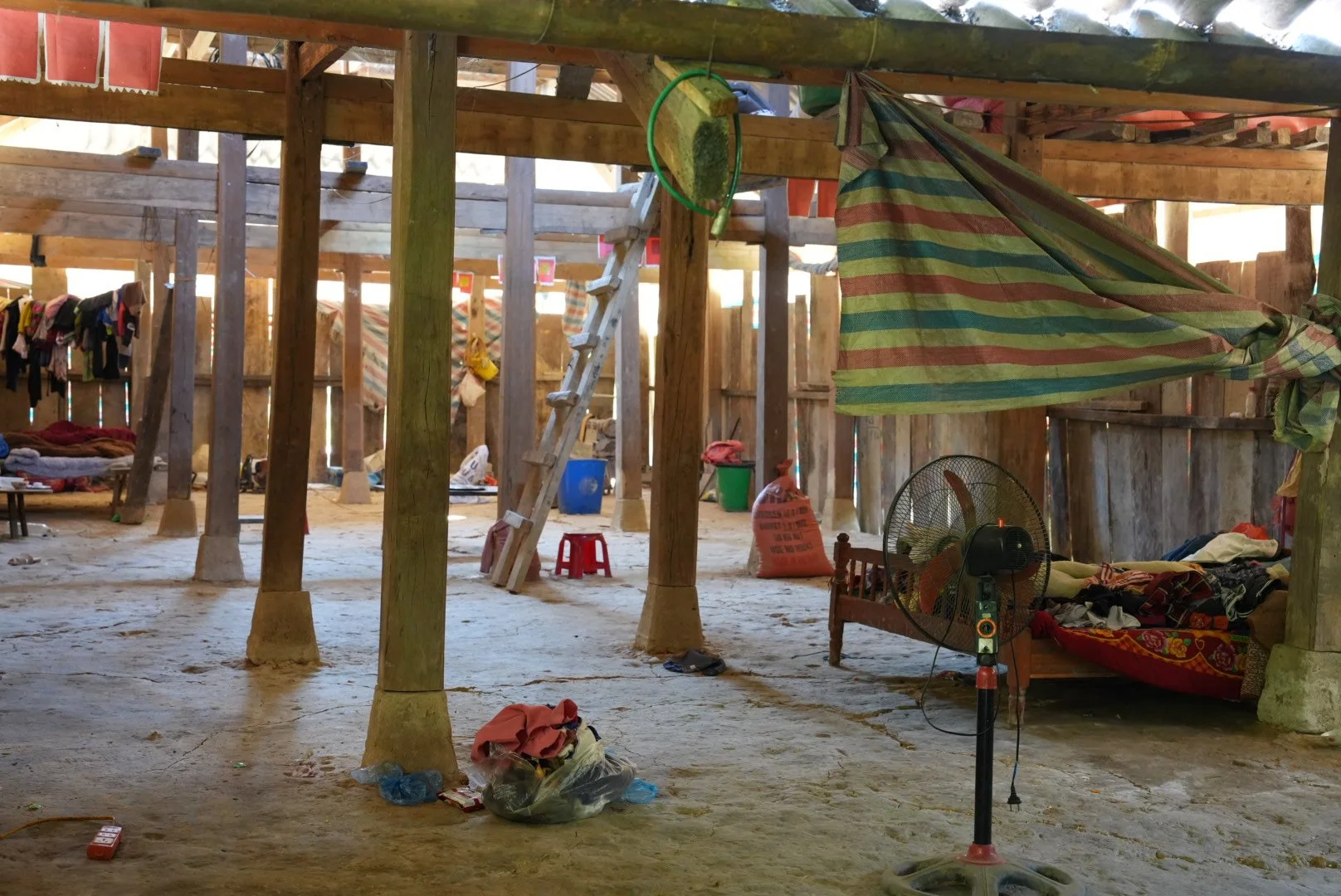
Photographs of a rural Hmong family home in the mountains near Sapa, showing both the simple timber interior. The image accompany a case study examining the family circumstances behind child selling in Sapa.
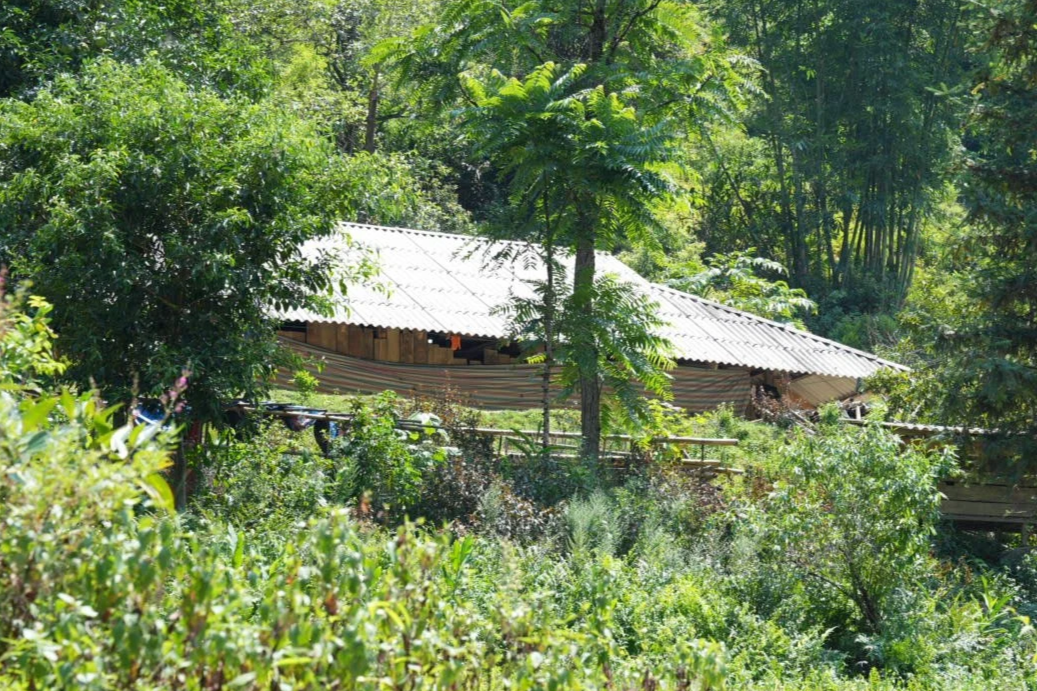
Rural Hmong family home near Sapa, showing the house surrounded by mountain vegetation.
To understand why Minh, aged 11, sometimes sells in Sapa, we need to travel away from the town and back towards the house he returns to afterwards.
The family's home is approximately an hour from Sapa town, although distance measured in kilometres tells us relatively little about the journey. The road becomes increasingly rough as it moves into the mountains, eventually giving way to a difficult back road where rain, mud and the condition of the surface can dramatically change the journey. The final section cannot be reached by vehicle at all. Travelling into Sapa is not simply a matter of leaving the house and driving into town. Weather matters and the ability to return safely late at night matters. At the end of that journey is the house shown in these photographs.
A Home Before It Is Anything Else
For many visitors encountering this house for the first time, the immediate temptation would probably be to describe it through what it lacks. There are no plastered interior walls, fitted kitchen units, tiled floors or neatly separated bedrooms. In fact there is very little at all and certainly little of the domestic infrastructure that many of us have come to regard as ordinary. Their two most valuable items are an electric fan and a small rice cooker. There are no toys, games or furnature other than the two beds that accomodate six people.
It is a large structure in terms of its footprint, although very little of the interior is divided into what many of us would recognise as conventional rooms. Heavy wooden uprights support an exposed roof. Timber boards, corrugated sheets and tarpaulins form walls and partitions, while daylight enters through gaps between the materials. Beds, storage areas, cooking spaces and the ordinary workings of family life occupy the same broader interior, sometimes separated by little more than cloth hung between wooden posts.
There is something visually striking about the way the light enters, but we should be careful not to allow the beauty of a photograph to obscure the reality of living there. The gaps through which sunlight passes are also gaps through which cold air and fog can easily travel. The rough timber and corrugated surfaces that create atmosphere in an image still have to protect a family through Sapa's damp weather and colder winter months. What looks beautiful through a lens may feel very different when it is where you sleep, cook and raise children throughout the year.
Inside the house, different aspects of family life overlap. There is no clear architectural point at which sleeping ends and living begins, or where storage becomes work space. Beds occupy part of the larger interior, with pieces of fabric suspended around some of them to create privacy and a greater sense of enclosure. Clothes, blankets and possessions are stored close to where they are used. Plastic stools, baskets, containers, tools and bags occupy whatever spaces are most practical.
A standing fan sits beside one of the beds. Fabric is tied between timber uprights. Household objects hang from beams and posts. There is no sense that anything has been rearranged because visitors are present. The house remains what it is when nobody from outside is there to photograph it. That matters because travel imagery so often encourages us to search for something picturesque. Scenes like this can easily be romanticised as rustic, traditional or untouched but there is little value in romanticising the conditions in which another family lives. A smoke-darkened kitchen can be visually compelling while still being a smoke-filled place in which people cook every day. Rough timber walls can produce beautiful textures while still offering limited protection from the climate outside.
The cooking fire sits directly on the floor beneath a simple metal frame. Firewood and split lengths of bamboo are kept close enough to feed the flames, while kettles and pots bear the accumulated soot of repeated use. Smoke moves upwards through the house and around food positioned above the fire, where it also serves a practical role in preservation. A small gas stove provides another option for cooking, but the open fire remains important, particularly because it provides warmth as well as a means of preparing food.
Firewood, consequently, is not incidental to this family's life. Somebody has to find it, cut it and bring it home. This is shared work, as is much of the labour required to keep the household functioning. Children grow into these responsibilities gradually, contributing according to their strength and ability rather than suddenly becoming responsible at an arbitrary age. Foraging is learnt in a similar way. Children accompany adults into the surrounding landscape and learn which plants, fruits and other resources can be gathered, where they are found and how they are used. In a household where the surrounding land contributes directly to food and fuel, this knowledge is not a quaint cultural activity performed for visitors. It can be essential practical knowledge.
This distinction matters because discussions about children and work can become remarkably blunt. There is an important difference between exploiting a child and teaching a child the skills necessary to participate in family and community life. Collecting firewood, gathering food, caring for younger siblings, helping with cooking or contributing to agricultural work may look demanding when viewed from the outside, but within many rural households they form part of a much broader principle: those who are able contribute.
Childhood, Responsibility and Contribution
That principle becomes particularly visible when we look at Minh carrying his two-year-old sister, Linh.
This photographs captures this particularly clearly. An older child is eating while carrying a considerably younger child securely against their back, held in place with cloth in a way that is obviously familiar to them both. The younger child appears completely at ease, while the older child smiles towards the camera and continues eating.
He carries her securely on his back while eating, walking and going about the rest of his day. The photograph is affectionate, but it is also revealing. Caring for a younger sibling is not treated as an extraordinary achievement requiring adult praise. It is part of family life. Minh is a child, but he is also a brother and a member of a household in which responsibilities overlap.
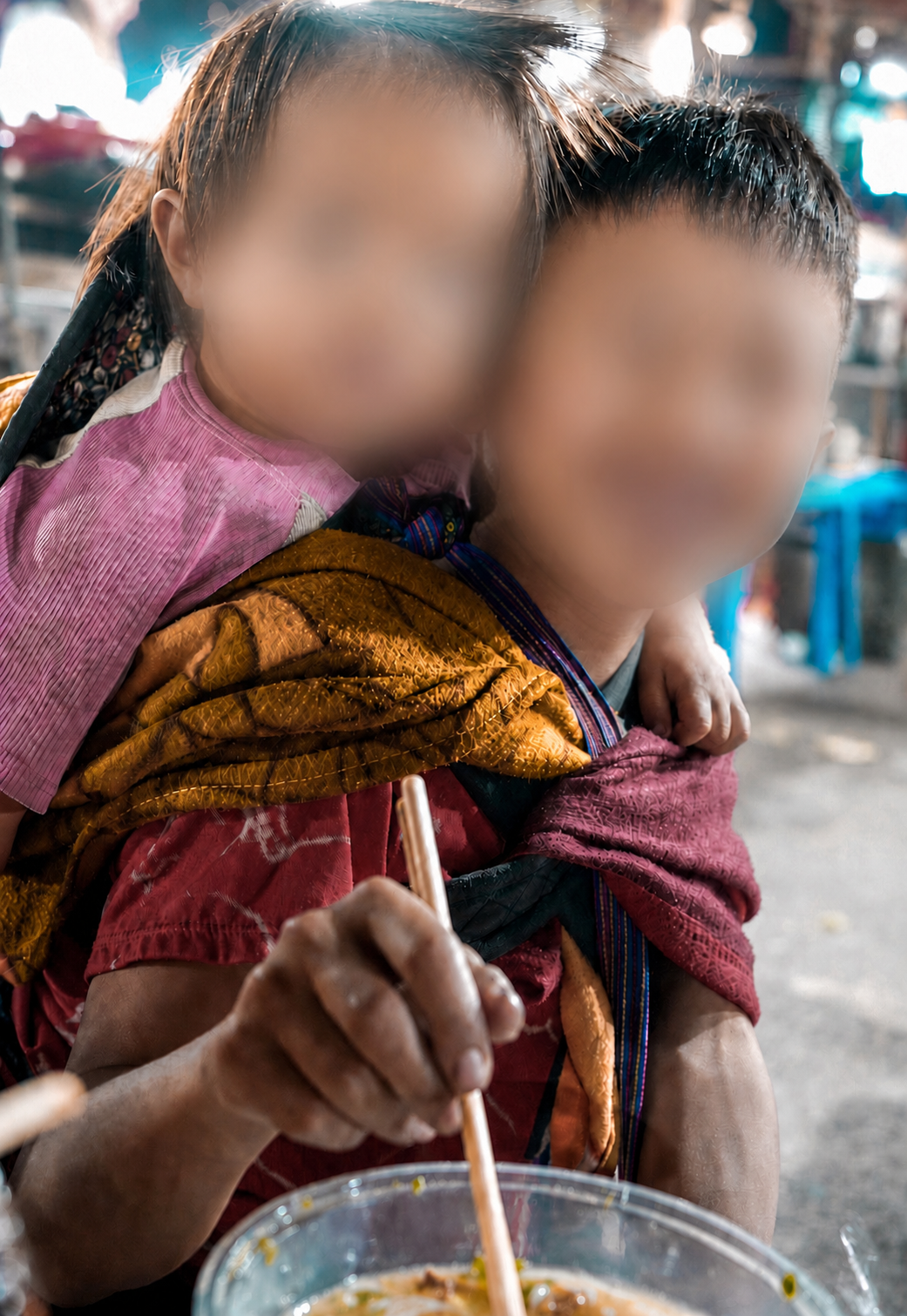
Firewood collection and foraging are also shared family responsibilities, with children learning from an early age how to gather fuel, identify useful plants and contribute according to their ability. In this context, participation is not simply a form of child labour or exploitation, but part of the practical knowledge and collective effort required for the household to function, with everyone who is able expected to contribute.
What This Family Has Already Survived
The circumstances surrounding this particular family make those responsibilities considerably more important. Their home is situated close to steep and unstable mountain terrain, around 200 metres downstream from a hydroelectric dam. During Typhoon Yagi in September 2024, a violent overnight combination of floodwater, rocks and mud struck the area around the house. The family had to escape during the night while their home and possessions were badly damaged.
For people watching images of typhoons or landslides on television, the event has a beginning and an end. The storm passes, the news cycle moves elsewhere and rebuilding begins. For a family with very limited disposable income, however, rebuilding does not necessarily mean restoring everything that was lost. It can mean repairing what is essential first, salvaging what remains useful and gradually trying to find money for everything else. The family repaired the house, only for another landslide to strike in 2025.
That history changes the way we should look at the building today. The patched walls, basic materials and unfinished improvements contain the history of damage, rebuilding and the constant knowledge that another severe rainy season may bring further problems.
There is another event that profoundly altered the household economy. Around two years ago, father Lâm, aged 33, went into the forest to collect firewood. When he failed to return after darkness fell, his wife, Mai became concerned and went looking for him. She found him seriously injured after he had fallen while carrying a heavy load. He had sustained severe injuries to his face, lost his front teeth and shattered his ankle. For many months he has been unable to walk properly or ride a motorbike. Even now, the injury has left him walking with a limp and reduced the amount of heavy physical work he can undertake.
Again, it is worth thinking beyond the immediate accident. In a household dependent upon physical labour, the consequence of a shattered ankle is not confined to the person who suffers it. A father who can no longer undertake the same agricultural or casual labour represents lost earning capacity for the entire family. Work that he previously completed still has to be done, while cash that he might once have earned elsewhere becomes harder to replace.
This is where Mai, aged 30, becomes central to the story. She travels into Sapa when circumstances allow and tries to earn money by selling. The journey, the condition of the road, her responsibilities at home and the weather mean she cannot simply do this every day. In practice she may manage around eight to ten nights in a month. When she makes the effort to travel into town, there is therefore considerable pressure to make the journey worthwhile. She will often continue selling until around 11pm before beginning the long journey home, rarely arriving before midnight.
Eleven year old Minh and two year old Linh usually travel with her. While their mother sells from her small rented space, Minh carries Linh and walks through the busy night-market area offering key rings to visitors. To somebody encountering him for the first time, the image can appear straightforward: a child carrying a toddler while trying to sell souvenirs late at night. It is easy to look at that scene and conclude immediately that it should not be happening.
We would agree that a child should not have to spend their night trying to earn money before going to school the following morning. Where our position becomes more complicated is in asking why it is happening, because once we know the family, a simple accusation of parental exploitation becomes much harder to sustain. The money Minh earns from selling key rings often contributes towards the petrol required to get the family into Sapa. His selling therefore helps cover the cost of accessing the very place where his mother has an opportunity to earn cash for the household.
While he is in town, he also watches restaurant tables for uneaten food. When people leave meat or other food behind, he may ask for it or collect what would otherwise be discarded. Foods such as meat are not available with the same regularity at home, and what appears to a tourist as unwanted leftovers can have completely different value to a child from a household where food choices are constrained by income.
There is something profoundly uncomfortable about that contrast. On one side of the table is enough disposable income to order food and leave part of it uneaten. On the other is a child for whom what remains may be worth carrying home. This is not written to make visitors feel guilty for eating in restaurants. Guilt is not particularly useful but understanding through context is essential for empathy.
The difficulty becomes even greater when Minh eventually returns home. A night spent selling does not remove the expectation that he attends school the following morning. After the journey back, washing and eventually getting into bed, he may have fewer than five hours of sleep before waking again. School itself is around 35 minutes from the family home in good weather conditions. He is expected to arrive before seven in the morning.
Unsurprisingly, there have been occasions when Minh has fallen asleep during lessons. This has contributed to him being regarded as lazy and undisciplined by his teachers. According to Minh, he has been punished at school and struck with rulers for falling asleep.
It is here that the story becomes particularly difficult for us. A teacher sees a child asleep at his desk and may interpret this as poor behaviour. A visitor sees the same child selling late at night and may see irresponsible parents. A tourist being approached repeatedly may simply see an irritating street seller. Each person observes a real part of the story, yet none necessarily sees enough of it to understand the whole.
Minh only travelled with his mother because tourism provides one of the few accessible opportunities for the family to earn cash. The money matters because the family is still trying to maintain and rebuild a home damaged by landslides, because their father can no longer perform the same physical work after a serious accident, because agriculture provides food but not necessarily sufficient cash, and because every journey into town itself costs money.
None of this makes it desirable for Minh to sell. That distinction is essential. He would much prefer to remain at home and play like an ordinary child. At times he does play. He build treehouses or makes stone towers by the river. He plays hide and seek with his friends whil ethey collect firewood or he hops from buffalo to buffalo while looking after their small herd of four.
Understanding why something happens is not the same as arguing that it should happen. We would rather Minh slept properly, went to school rested and had the same freedom to separate childhood from household economics that many children elsewhere enjoy. We would rather his mother had sufficient earning opportunities that the small amount her son brings home did not matter. We would rather his father's accident had not diminished the family's earning capacity and that two landslides had not forced them repeatedly to repair their home. But saying what we would prefer does not alter the circumstances in which the family is currently living.
This is where the expression “needs must” begins to mean something. Within a household such as this, decisions are rarely made in the abstract. Mai does not have the luxury of separating every choice into what would be ideal and what would not. She has to work with what is available and if selling in Sapa generates money, she sells. If the journey costs petrol, that cost has to be found somewhere. If Minh can sell enough key rings to help cover that petrol, his contribution has value. If Linh needs caring for while the family is in town, somebody carries her. If food is left behind that would be useful at home, it may be collected rather than wasted.
Viewed individually, each decision can be criticised. Viewed together, they begin to reveal a household constantly adapting to constraint. This does not mean children in Hmong families should automatically be expected to work because contribution is culturally normal. Nor should child selling be defended simply because a family is poor. There are genuine concerns surrounding education, exhaustion, safety, exposure to strangers and the possibility that tourism can create financial incentives that draw children into commercial activity.
Those concerns still remain but what changes when we understand this family's story is our willingness to reduce the issue to parental failure. If we tell Mai that Minh should not sell, what happens next? The petrol still has to be purchased if she is to reach Sapa. The family's damaged home still needs work. Lâm's physical limitations remain. The road remains difficult. Household expenses remain, while the family's access to reliable cash income does not suddenly improve because a visitor has decided that a child should not be selling. The argument therefore cannot end with telling Minh to go home. We actually need to ask what awaits him when he gets there.
This is also why the way some visitors communicate with sellers troubles us. For those of us whose lives provide a reasonable degree of financial security, it is easy to think in terms of what should happen. A child should be learning. A child should be playing. Adults should provide the household income. Parents should be able to protect childhood from the pressures of family finances. It seems evident that Australian citizen, Claire Bear thinks this from screeshots included in her FaceBook post from 2025.

A Google Translate message written in English and translated into Vietnamese, asking a street seller to accept that the visitors do not wish to buy anything and to allow them to eat and drink in peace.
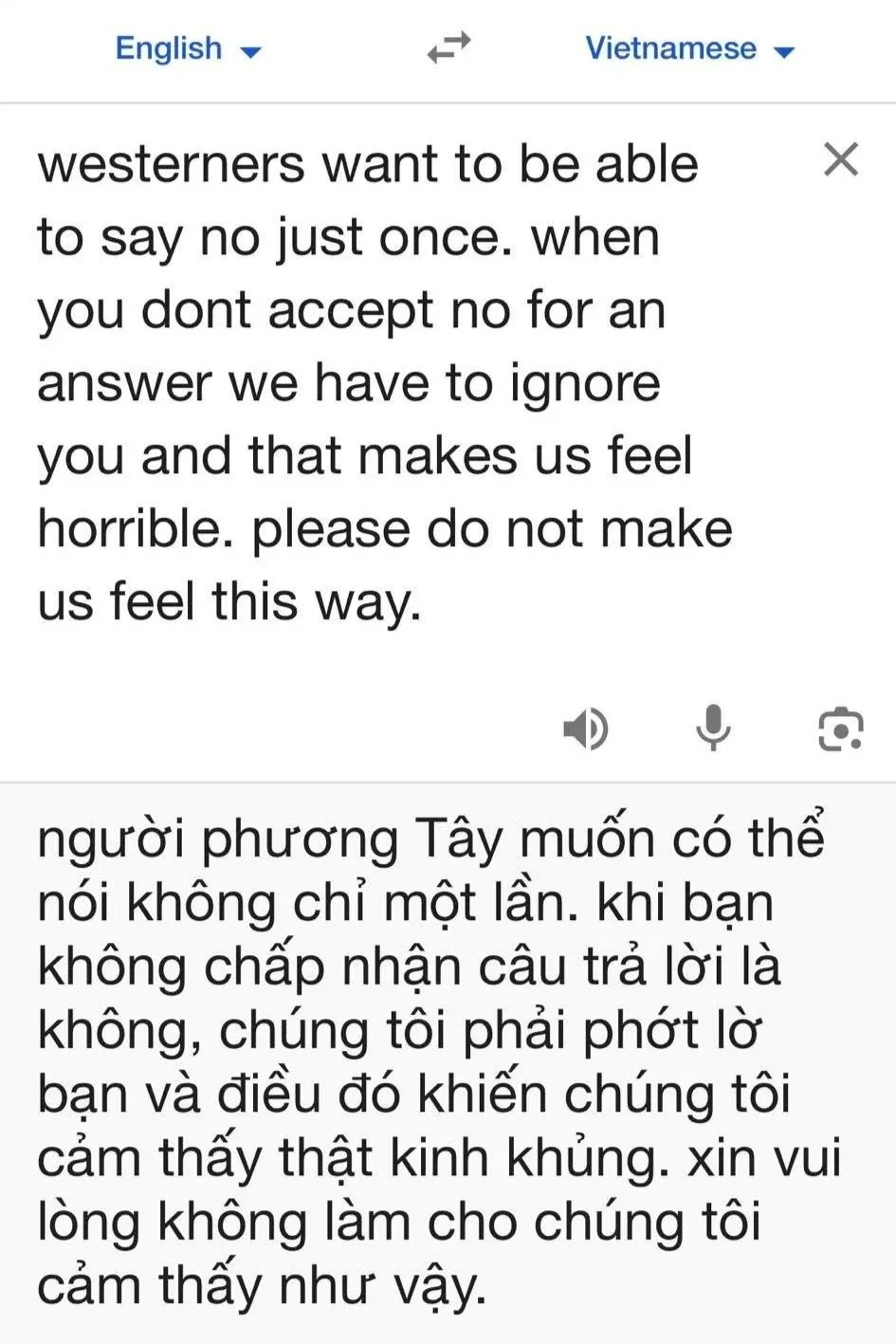
A Google Translate message directed towards local sellers, stating that “westerners want to be able to say no just once” and explaining that repeated approaches make visitors feel uncomfortable.
There is nothing unreasonable about wanting to decline a sale or eat without interruption. The problem begins when the visitor’s discomfort becomes the centre of the encounter, while the circumstances of the person selling are barely considered.
One message reads: “No thank you. We don’t want to buy anything. Please leave us to our food and drink in peace.” Another goes further: “Westerners want to be able to say no just once... we have to ignore you and that makes us feel horrible. Please do not make us feel this way.”
For us, this is a clear example of how privilege can obscure empathy. The focus is on how the seller makes the visitor feel, rather than on why the seller may be so determined to make a relatively small sale. We want to make it very clear that we are not arguing that visitors should accept harassment or feel unable to say no but we do feel that boundaries can be maintained without losing sight of the wider reality. When our own basic needs are secure, it is easy to judge persistence as an inconvenience. It is much harder to ask what that sale might mean within another household, or what circumstances have made earning that money important enough to keep trying.
It is easy to imagine poverty only through moments of emergency, but for many families the greater challenge is the long continuity of everyday costs. There is rarely a single expense that explains everything. Instead, one need follows another, and small decisions accumulate until contribution from every available source begins to matter.
What We See in Sapa and What We Do Not
The child selling in central Sapa is visible. Almost everything surrounding that child is not.
The visitor sees a bracelet, a piece of embroidery, perhaps a conversation and ultimately a transaction. They do not see the house into which the money might return. They do not know what has happened within the family that month, how secure the household income is, whether agricultural work has been productive, what expenses have arisen or what other employment has been available. They do not see the cooking fire, the shared sleeping spaces, the younger siblings, the work being completed elsewhere or the continual calculations involved in managing limited resources.
Because we see the transaction but not the household economy behind it, it becomes very easy to place the entire moral weight of the situation upon the visible participants. We ask why parents permit their children to sell, but perhaps we should also ask what realistic alternatives exist for that particular family. If an adult is expected to replace the child's contribution, where will that additional work come from? What will it pay? Is it available throughout the year? What skills or transport does it require? If adults spend longer away from home, who assumes the childcare and household responsibilities left behind? If tourism offers one of the few accessible ways of converting time, craft or personal interaction into cash, how realistic is it to expect every financially constrained household simply to reject that opportunity?
These questions do not excuse harmful practices but they do assure that judgement be accompanied by context.
What We Mean When We Say “Needs Must”
This is where “needs must” becomes less a phrase and more a way of understanding constrained choice.
Many of the older Hmong women involved in street selling have had extremely limited formal education and, in our experience, almost all within this particular group have very limited literacy. Some would be completely unable to read a Vietnamese paragraph presented to them through Google Translate. Holding a telephone in front of an illiterate woman may therefore look like communication to the person holding the phone while conveying almost nothing to the person expected to read it.
Let’s read those quotes again but now with greater context. “No thank you. We don't want to buy anything. Please leave us to our food and drink in peace,” is a perfectly reasonable expression of a boundary. “Westerners want to be able to say no just once... we have to ignore you and that makes us feel horrible. Please do not make us feel this way.” shows a lack of care that runs far deeper. We understand the frustration. Persistent selling can be uncomfortable and nobody is obliged to purchase something simply because they have been approached but there is something revealing about placing the visitor's emotional discomfort at the centre of the encounter.
For somebody else, the most important issue may be making one more sale before going home and both experiences can exist at the same time. Respecting the visitor's boundary does not require us to stop asking why the seller is persistent, just as understanding the seller's circumstances does not require the visitor to buy.
This is why we believe conversations around child selling in Sapa need considerably more empathy and considerably less certainty. The child visible in the street is the easiest part of the problem to see. The damaged house is elsewhere. T he injured father is elsewhere. The difficult road, the fuel cost, the cooking fire, the search for firewood, the foraging, the younger sibling, the early school morning and the household calculation that gives value to a handful of key-ring sales are largely invisible, yet all of them are present in that encounter.
Tourism Has to Ask More Difficult Questionsand the Questions Need to Change
Once we have spent time inside a home such as Minh’s, it becomes much harder to imagine that the story begins when we encounter a child in Sapa. Sapa generates substantial income from landscapes, cultural diversity, ethnic minority villages, local knowledge, traditional clothing, food, agriculture and the image of mountain life itself. Hmong communities are central to much of what visitors come to experience and it is therefore reasonable to ask how much of that economic value reaches the households whose culture and communities form such a significant part of Sapa's tourism identity.
If tourism creates secure, dignified and fairly paid work for adults, then the economic importance of children's earnings can diminish. If tourism money circulates locally through guides, families, homestays, craft producers, farmers and community businesses, households gain more choices. If most of the value is captured elsewhere, then the families who remain culturally visible within tourism may not necessarily become economically secure because of it.
This is why the question cannot be confined to whether an individual tourist should buy a bracelet. The deeper question concerns what kind of tourism economy we are helping to create.
When we know Minh's story, the question “Why is this child selling?” begins to feel too simple. The more meaningful question is what circumstances have made the money he earns sufficiently valuable that his family accepts the compromises involved.
Then we need to go further still and ask what would have to change before his contribution was no longer necessary. That is a much harder question because it takes us beyond individual behaviour and into access to adult employment, education, infrastructure, safe housing, reliable transport, tourism income and the vulnerability of families whose economic security can be dramatically altered by one injury, one failed harvest or one night when the mountainside gives way.
For us, that is what “needs must” means in this story. It is not a defence of children working late into the night, and it is not an attempt to romanticise poverty or hardship . It describes the narrowing space between what a family might ideally choose for its children and what the realities of everyday life sometimes allow.
Why “Just Don't Buy” Is Not the Whole Answer
There are legitimate reasons to be concerned about children selling to tourists. Children spending long periods in commercial environments can be exposed to strangers, traffic, weather and pressures that should not form a major part of childhood. Selling can interfere with school, rest and play, and tourism can reinforce the practice when visitors repeatedly reward it economically.
Simply buying from children because we feel sympathy is therefore not an adequate response. Neither, however, is refusing to buy and assuming that the underlying problem has been solved.
If the financial reason for selling existed before the tourist declined the purchase, it will probably still exist afterwards. The child may disappear from our view, but the family circumstances do not disappear with them. The household still has to negotiate the same economic pressures, only without that particular source of income. This is where the discussion becomes more difficult, because neither purchasing nor refusing to purchase allows the visitor to step outside the wider economic system.
If we genuinely want fewer children selling in Sapa, then our concern has to extend beyond the moment when a child approaches us. We need to ask what economic opportunities exist for adults, how tourism income is distributed, what barriers exist to education and employment, whether families have reliable alternatives and how the enormous disparity in spending power between visitors and many rural households influences behaviour.
These questions are harder because they do not give us the immediate satisfaction of a simple rule. They ask us to look beyond the individual child and consider the wider system in which that child, their family and the visitor are all participating. For us at ETHOS, that means supporting forms of tourism that create more meaningful opportunities for local families, keep more income within communities and value local knowledge rather than simply consuming it. You can read more about our approach here: About ETHOS
Understanding Is Not the Same as Excusing
The parents within this story are not abstract figures standing somewhere behind the child. They are people making decisions about their family within the circumstances available to them. They can care deeply about their children while also depending upon their contribution. They can value education while simultaneously facing immediate household needs. They can hope for greater opportunities for their children while still having to negotiate the realities of the present. Those positions are not contradictory but many outsiders sometimes behave as though they must be.
We can fall into the assumption that sufficiently loving parents should somehow be able to prevent economic circumstances from touching their children. In reality, limited opportunity reduces the number of choices available to a household. Families may find themselves deciding not between one obviously right option and one obviously wrong one, but between several imperfect possibilities, each carrying consequences.
That is the deeper meaning of “needs must” within this story. It does not suggest that people stop caring about what would be best. It describes what happens when what would be best and what is immediately possible are no longer the same thing.
One Family Cannot Represent an Entire Community
It is important to be equally clear about what this case study does not tell us. This family does not explain every Hmong child who sells in Sapa, and we would never suggest that it does. Hmong families are diverse, economically, socially and individually. Some households have far greater financial security than others. Different families hold different attitudes towards education, tourism, work and children's responsibilities. Not every child living in circumstances resembling those described here will sell, and not every child who sells will come from a household like this.
One family's circumstances should never become a stereotype for an entire ethnic group. The purpose of this story is much narrower and, we hope, more useful. It demonstrates why the visible act of a child selling cannot always be understood in isolation from the household and economic environment surrounding them. It asks us to resist simple explanations.
Beyond the Street: Understanding Why Children Sell
A 2017 study examining the impact of tourism on street children in Sapa found that tourism creates both opportunity and risk. Children may earn money, develop language skills and contribute to household income, but these short-term benefits can come at a considerable cost, particularly when selling begins to interfere with education, family life and childhood itself.
The report also highlights the vulnerability of children who spend long periods in tourist areas. Time away from home can weaken parental supervision and expose children to exploitation, abuse and other forms of harm. Crucially, however, the study also recognises that poverty, limited livelihood opportunities and the value of even relatively small amounts of tourist income are central to understanding why children become involved in selling in the first place.
This links directly to the argument we are making here. The child seen selling in central Sapa is only the most visible part of a much larger story. If we focus only on removing children from the streets, without addressing the economic pressures within their households, we risk treating the symptom rather than the cause. The question is not simply why a child is selling, but why their contribution has become important enough for the family to need it. That is where the idea of “needs must” becomes central to understanding the issue.
