
Why AI Shouldn’t Yet Be Trusted to Plan Your Travels in Northern Vietnam
Over the past 12 months, travel has well and truely been struck by the Artificial intelligence bandwagon. AI has fustratingly become one of the most influential travel-planning tools in the world, and for many travellers AI’s have already replaced the trusty Lonely Planet guidebook, specialist travel agents and, increasingly, the patient process of researching a destination thoroughly.
A traveller can now ask an AI to create a three-day itinerary for Sapa, Hanoi, Ninh Binh, Ha Giang or almost anywhere else in the Vietnam, and within seconds receive a generic list of copybook attractions, Instagrammable cafés, viewpoints, transport options and activities that comes over as authoritative, comprehensive and carefully considered. The difficulty for many is that a genereated itinerary can look extremely convincing without demonstrating any meaningful understanding of the place it describes or the people who are travelleing. AI will not factor in that most travellers have widely different interests, budgets or travel plans unless the user specifically stipulates these contraints. Most don’t and continue to use AI like a typical internet search.
Needless to say, AI is very good at finding patterns in enormous amounts of information, but AI has not spent years walking through a landscape, getting to know families, watching villages change, understanding which paths fail after weeks of rain, observing how tourism pressure affects a community, or learning which experiences visitors remember long after the photographs have been forgotten. Large Language models (LLM’s) work with what has been written down, photographed, uploaded, indexed and repeated online, which means that digital visibility can easily become confused with knowledge. Likewise, the influencers and experiences receiving the greatest amount of online attention are increasingly treated as the most important.
In places such as Sapa, that creates a serious distortion because some of the people with the deepest knowledge of the landscape may have almost no digital presence at all. Many ethnic minority Dao and Hmong people have historically had limited access to formal education and many do not read or write fluently in Vietnamese or English, yet they can possess extraordinary expertise in medicinal plants, wild foods, farming, soil, weather, building techniques, textiles, clothing production, livestock, forests and the seasonal rhythms of the mountains. Much of this knowledge has traditionally been learnt through observation, practice and oral transmission rather than through books, websites or formal qualifications, which means that some of the most knowledgeable people in the region may leave almost no searchable record of what they know. LLM's haven’t yet got access to oral histories and traditional experitise and long may this continue.
This situation creates an uncomfortable imbalance in the modern information economy because knowledge that is not written down is almost invisible, while confidence that is photographed, captioned and published can become disproportionately powerful. A farmer who has watched the same valley through forty harvests may have no website, no YouTube channel and no searchable article explaining when the rice turns golden, while an influencer who has spent four hours in the area can publish a polished video, confidently describe the season, recommend where everybody should go and immediately become a source that thousands of people can find. The first person possesses lived expertise but very little digital authority, while the second may possess almost no meaningful local knowledge but considerable digital authority. This is turning travel into a hollow shadow of what it once was.
We believe that this is unfair because it is a fundamental weakness in the way modern travel information is being produced and consumed. A person can visit a destination for a few hours without understanding its language, culture, climate, agricultural calendar, social relationships, religious practices or recent history, yet return home and publish an “ultimate guide” that may rank more prominently online than the knowledge of people who have lived there their entire lives. Their confidence easily disguises the limits of their experience, particularly when attractive photography, professional editing and a large following create the appearance of expertise. The result is a digital tourism landscape in which the ability to publish can carry more authority than the ability to know.
Artificial intelligence then inherits this imbalance because it cannot distinguish between somebody who has spent decades learning from a place and somebody who has passed through it with a camera, particularly when the temporary visitor has produced far more machine-readable content. If hundreds of bloggers and influencers repeat the same shallow claim while local knowledge remains oral, fragmented or unpublished, algorithms interpret repetition as fact and visibility as credibility, even when the people closest to the subject know that the information is wrong. This is one of the most serious dangers in AI-led travel research because it risks creating a hierarchy of knowledge where those with the strongest internet presence speak loudest, while those with the deepest relationship to the land, culture and community are barely heard. AI therefore begins to actively reinforce the conditions that pushed that expertise to the margins in the first place.
We can use May Linh, a 45 year old Red Dao woman from Sapa as an example of this. May Linh is married to a shaman who’s knowledge of traditional, spiritual culture has been passed down orally for millenia. Meanwhile, May Linh herself forages, farms, weaves cloth and embroiders using skills she has learn from observing others. This is generational knowledge and something she is incredibly proud of. For travellers lucky enough to learn from May Linh, the experience can be quite profound. Karen, a traveller to Sapa in early 2026 wrote of her experience:
“It felt fantastic and so genuine. Travel organizations always advertise with “authentic, local, not touristy” etc., but here it is truly the case (really!) We were part of family life, talked for days with our guide May Linh, and did not meet any other tourists”.
For destinations such as Sapa, the consequences of people like May Linh not having an “online voice” are profound. It seems obvious that the people who know the mountains best should not merely be treated as background characters in somebody else's travel content. ETHOS believe that their knowledge should sit at the centre of how the destination is understood, particularly when travellers are making decisions about where to go, how to behave and whose livelihoods their money will support. The question travellers increasingly need to ask is therefore not simply, “What does the internet say about this place?”, but something much more important: Who actually really knows about this place? For travel, the distinction between visible and valuable knowledge matters enormously.
AI Often Recommends What Is Easiest to Find Rather Than What Is Worth Finding
Consider a typical AI-generated Sapa itinerary that recommends Fansipan, Cat Cat Village, the Muong Hoa funicular, Sun World, a glass bridge, an alpine coaster, a series of photogenic cafés, a rainbow slide, traditional-costume photographs, Starbucks and several other commercial attractions. We’ve included a ChatGTP generated itinerary shared to Facebook by a traveller looking for the cheapest offer.
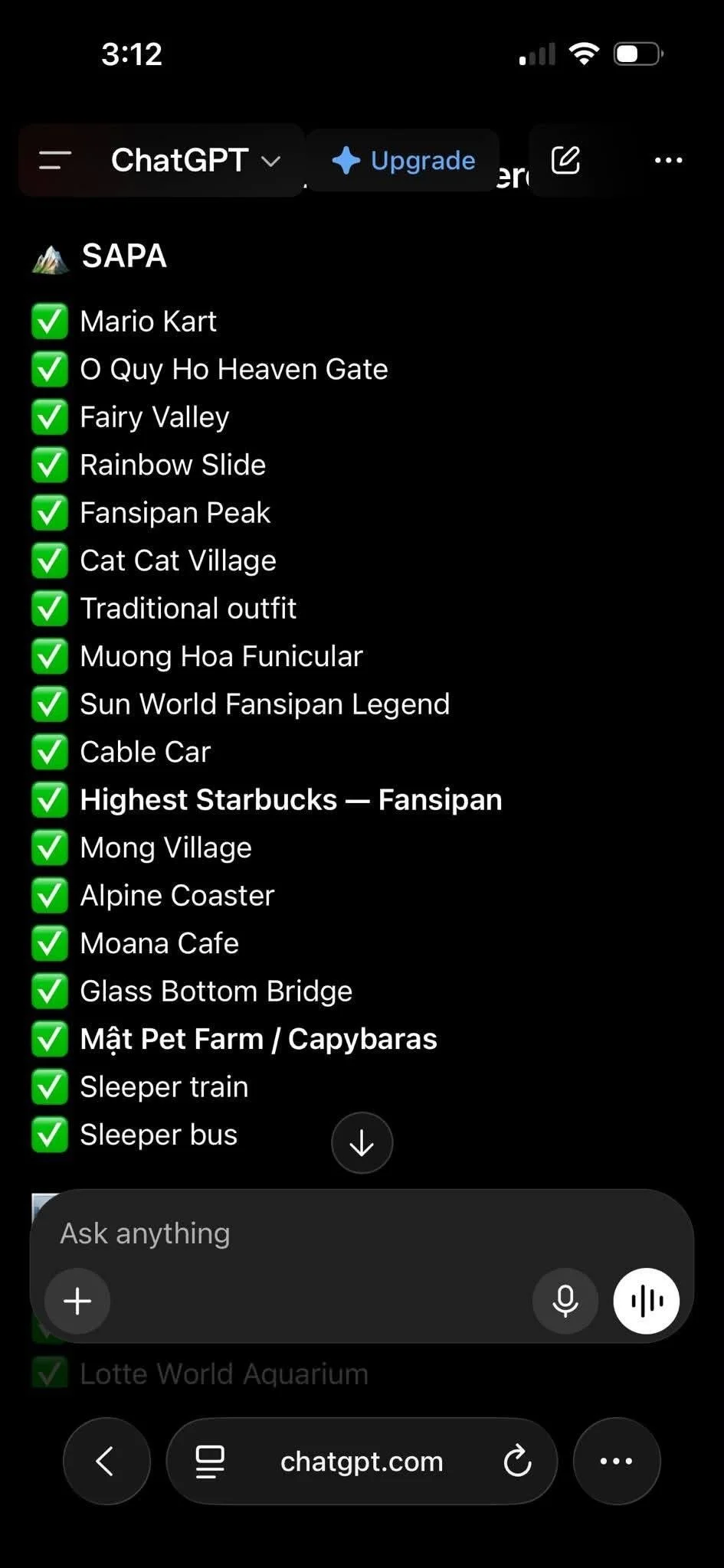
A generic AI-generated list of things to do in Sapaa, dominated by famous attractions, commercial experiences and heavily visited locations. The list illustrates how AI can reduce a complex destination to a checklist of the most visible and frequently mentioned places online, while overlooking quieter communities, locally led experiences and forms of travel that are harder to package or rank.
Whilst there is nothing inherently wrong with any of these places, and some visitors will genuinely have a good time at some of them, when almost the entire destination is represented through a collection of famous attractions, the itinerary reveals something important about the way AI understands travel. AI understands discrete objects very well. For instance, Mount Fansipan has a memorable name, a specific location, tens of thousands of photographs and a plethora of reviews. It is easy to access ticket information, transport information and an enormous number of online references, while Cat Cat, Sun World and major commercial attractions generate similarly clear digital footprints that can be easily recognised and placed into an itinerary. These are extremely convenient pieces of information for an algorithm because they can be identified, compared and ranked without requiring any deeper understanding of the social or cultural context surrounding them.
A day spent walking through a Hmong farming community is much harder to describe in the same way because the most important parts of that experience may not exist as identifiable attractions at all. A visitor might spend an hour discussing rice cultivation with their guide, stop because somebody is preparing indigo dye beside a house, learn why a particular plant is collected for medicine, meet relatives of the guide along the route, talk about marriage or education, or change direction completely because the weather has made another trail more interesting. From the perspective of an itinerary generator, very little may appear to have happened because the traveller has simply been “trekking” for a day, yet from the perspective of the traveller the experience may have contained far more discovery, learning and human connection than visiting six individually named attractions. Take this comment from Alex who visited Sapa in July 2026.
“Our guide Ta May was absolutely fantastic over our two-day trek. We elected to take the option focused on herbalism and medicine in which Ta May’s depth of knowledge was truly astounding. From foraging fruits and vegetables to eat, to learning about the traditional synthesising of medicines even to the significance of certain insect sounds - her knowledge was as profound as it was broad and it was truly a pleasure to share in it with her. That is also not to mention she was just a joy to be around! Being each others company for most of the trip, our conversations never felt forced and the laughter came easily - a testament to the kind of people employed at Ethos, which I will say more about later”.
The internet is exceptionally good at recording places where somebody can buy a ticket, take a photograph and leave a review, but it is considerably less effective at recording knowledge, relationships and the value of spending time with people who actually belong to the place being visited.
Popularity Can Become a Self-Reinforcing Cycle
Inevitably, the places receiving the greatest numbers of visitors naturally produce the greatest numbers of photographs, reviews, social-media posts, booking pages and travel articles. Search engines encounter this huge volume of information and consequently make those places easier to discover. Add to that all of the bloggers and travel websites looking at existing search behaviour and producing more content about the destinations already attracting attention. Artificial intelligence then enters an information environment in which the same small collection of attractions appears repeatedly, and when asked what somebody should do in Sapa it reasonably concludes that these must be the essential experiences because almost everything it can see appears to confirm their importance. The recommendation then produces another visitor, who creates another photograph, review, blog post or social-media video, adding still more evidence to the same digital narrative. Popularity, therefore, begins to feed on itself. Travellers become clones, and meaningful experiences are consigned to history.
More and more people now seem to travel with the primary aim of producing content. Sometimes this means collecting visual proof that they have been somewhere, or eaten something. The journey becomes centred less on discovery and more on the individual, with value measured by the ability to show others that they were there and did the thing. Because the content itself becomes the proof, these travellers naturally create a much larger online footprint. This creates a particularly difficult problem for small-scale tourism organisations because the organisations deliberately working with fewer visitors will naturally generate less online material than attractions processing thousands of people every day. The sustainable operator therefore becomes less visible precisely because it has chosen not to maximise visitor numbers, while the high-volume attraction becomes increasingly prominent because every additional visitor strengthens its digital presence. In this environment, the amount of information about something can easily become confused with the quality of the experience itself.
Many experiential travellers are almost the opposite. They travel to learn, to observe, to meet people and to be present in the experience itself, often without feeling any need to turn every encounter into a selfie, a reel or a permanent online record. Their journeys may be richer in understanding and more meaningful on a personal level, yet leave far less digital evidence behind. That creates a strange imbalance, because the travellers who are most visible online are not necessarily the ones who know a place best, while locals and those who travel most thoughtfully can remain almost invisible to the algorithms that increasingly shape future travel plans.
Adventure Travel Is Slowly Being Replaced by Itinerary Consumption
Adventure travel has traditionally contained uncertainty, and much of its value has always come from not knowing exactly what will happen. A traveller might hear about a road from somebody they meet over breakfast, follow the suggestion of a local guide, change their plans because of the weather, stay somewhere longer because a conversation becomes interesting, or discover a place that never appeared in the guidebook. A traveller journey therefore evolves organically through experience rather than simply following a sequence that somebody else has already designed. Kayla who visited Sapa in 2025 wrote:
“The trek was absolutely beautiful despite having colder/foggier weather and I really enjoyed spending time with the Hmong and Dao people. Our guide, Máy Siêu, was very friendly and explained local life along with anything we foraged for along the way. We enjoyed meals in her home and the homes of her family members and ended the first day with a very relaxing traditional herbal bath. I really appreciated the women teaching me how to embroider with them around the fire. My friends and I enjoyed the harder sections of the trek”.
Of course, travellers have always relied on recommendations, whether from guidebooks, local people, guesthouse owners or fellow travellers, but those recommendations came with an important human filter. You could listen to the person giving the advice, understand something about their interests and priorities, and decide whether their idea of a good experience was likely to match your own. A recommendation from somebody who loves long walks, quiet places and local food may carry much more weight if you value the same things, while advice from somebody whose perfect day involves shopping centres, taking selfies and highly stage-managed attractions can be politely ignored without either person being wrong.
That process involves judgement, personality and context. In these instances, travellers are not simply receiving information, but assessing the person behind it and deciding whether their values, interests, ethics and style of travel are close enough to your own for their recommendation to be useful. The conversation itself may reveal as much as the recommendation, because you can ask what they liked, what they disliked, how crowded somewhere was, whether local people were involved, whether the experience felt commercial, and whether they would genuinely choose to do it again.
AI removes the human filter. A recommendation may be presented in a polished and confident way without giving the traveller any meaningful sense of whose judgement sits behind it, what values shaped it, or whether the people whose opinions were absorbed into the answer travel anything like they do. Hundreds of completely different preferences can be blended into a single apparently authoritative suggestion, leaving the traveller with a recommendation that may represent an online average rather than anybody they would actually have chosen to ask. Travel was historically about finding information, deciding whose judgement you trust, whose curiosity resembles your own, and whose idea of a worthwhile journey feels close enough to yours to be worth following.
The modern digital itinerary encourages almost the opposite behaviour because travel is increasingly presented as something that can be completed through a predetermined collection of recommended experiences. Visit the famous viewpoint, take the expected photograph, drink at a Starbucks, wear the traditional costume, ride the cable car, move to the next attraction and continue until enough boxes have been ticked to demonstrate that the destination has been successfully experienced.
Travel Bloggers Create the Illusion of Expertise
Travel blogging originally offered something extremely valuable because independent travellers could describe places that conventional guidebooks ignored, while knowledgeable writers could publish detailed accounts of destinations they genuinely understood. Some travel writers continue to produce exceptional work based on long-term research, cultural sensitivity and repeated visits, and those writers remain extremely valuable sources of information. However, online publishing has also created a strange version of expertise in which somebody can arrive in a destination, spend two days following the standard tourism route and then publish “The Ultimate Guide to Sapa” before leaving for the next country.
Take the blog “17 Things To Do In Sapa Town And Beyond” by James Fahey - who describes himself as “A traveller who loves exploring new places, creating content and helping others get the key info they need before they set foot on an aeroplane”!
The blog is a well-produced, SEO-optimised short-stay travel article that turns one traveller’s five-day experience of Sapa into a much broader statement of destination expertise. The article is not worthless and it is clearly based partly on things the author actually did. There are first-hand observations, practical prices, photographs and personal reactions. However, the underlying perspective is extremely narrow. The author explicitly says he spent five days exploring the region, yet repeatedly uses authoritative language such as “best things to do”, “do not skip”, “authentic”, “remote villages” and “the best time to visit”.
It is almost a textbook example of what travel writing has become. In it, Sapa is interpreted principally through recognisable attractions, photo opportunities, convenience and consumption: Moana, Cat Cat, Fansipan, Heaven Gate, the Glass Bridge, the Lonely Tree, cafés and viewpoints. Moana is praised partly for its giant hand, “gate to heaven”, piano display and opportunities for “excellent photos”, while the Lonely Tree is described as a “perfect photo opportunity”.
The cultural treatment is considerably thinner. The article describes villages as offering “authenticity”, refers to Hmong people largely in connection with trekking, homestays, photographs and souvenir selling, and even uses the dated expression “hill tribe communities”. That is very different from understanding these places as living communities with complex histories, economies, social structures and knowledge systems.
His reference to the so-called “Sapa Love Market” is an even better example of the problem. James describes it as a place “across from Sapa Square”, suggests that “locals come here to buy and sell”, says it is “usually open every Saturday evening from 6:00 pm to 7:00 pm”, and then admits that he did not actually experience it himself. That is a remarkably confident summary of something he missed, and it also gets the meaning of the Love Market badly wrong. As we explain in our own article, the Love Market was never truly a market in the commercial sense. It was historically a social and courtship gathering for Hmong and Dao young people, centred around music, encounter and community, not a weekly tourist attraction where people simply came to buy and sell things. Today, what visitors see in central Sapa is largely a staged performance shaped by tourism rather than a living continuation of the original tradition. Presenting it as a straightforward Saturday-evening attraction flattens something culturally specific and historically complex into yet another item on a tourist checklist. For anyone wanting a more accurate explanation of what the Love Market was, what it became and what it means now, we would point readers instead to our article here: https://www.ethosspirit.com/sapa-love-market
Commercially, it is also important to understand what kind of publishing model James’ blog is. The article openly contains affiliate links from which the author may earn commission, repeatedly directs readers towards bookable tours and accommodation, and links extensively to his other Vietnam itineraries. There is nothing inherently improper about affiliate marketing, but it helps explain why this kind of content is highly structured, highly searchable and exceptionally legible to Google and AI systems.
Overall, it is a strong example of the difference between digital authority and local expertise. When we reached out to James about the article, he was quick to point out that “ I rank number one on Google”. Google ranking tells us that the article performs successfully within an online information system. It tells us absolutely nothing about whether someone who spent five days in Sapa understands the destination better than guides, farmers, tourism professionals and residents who have lived within it for decades.
It is important to note that this form of tourism is not inherently wrong, and some travellers genuinely prefer the security and convenience of knowing exactly what they are going to do. However, it does become problematic when the same highly structured model is presented as the definitive way of understanding a place. Once that happens, adventure gradually becomes itinerary compliance, discovery becomes content collection and culture risks becoming another product positioned between a café and a cable car. The traveller may technically visit more attractions while experiencing considerably less of the place.
Influencers Have Made the Problem More Visual
Social media has strengthened this process because tourism now has additional value when an experience can be communicated immediately through a photograph or a short video. A brightly coloured rianbow slide or carefully designed viewpoint works exceptionally well in this environment because the viewer can understand the experience within a few seconds. The image communicates where somebody went, what they did and perhaps what photograph the viewer might create if they followed them.
A four-hour conversation with a local guide about farming and village life or medicinal plants does not fit so easily into the same format, even though the traveller experiencing that conversation may remember it for the rest of their life. The result is a tourism economy increasingly influenced by what performs well online rather than by what feels meaningful when somebody is actually present.
Businesses naturally respond to this demand by building places that photograph well, while visitors increasingly travel to locations because they have already seen other visitors photographed there. The journey gradually begins to reproduce the content that inspired it, and eventually thousands of people arrive at the same viewpoint hoping to recreate essentially the same experience. At that point travel has stopped being discovery and has started becoming repetition.
AI Then Learns From This Distorted Version of Travel
Artificial intelligence does not create this problem independently because it learns from an online tourism landscape that has already been heavily shaped by search engines, bloggers, booking platforms and social media. A blogger visits Sapa briefly and writes about the most famous attractions, an influencer follows the same route and creates videos, thousands of travellers reproduce those experiences and upload similar photographs, booking platforms create products around the resulting demand, and travel websites publish more articles because those attractions generate search traffic. AI then encounters an internet saturated with references to the same places.
When somebody asks, “What should I do in Sapa?”, the system does not necessarily discover what makes Sapa interesting and unique, but instead identifies what the internet has repeatedly decided to talk about. This creates the appearance of consensus because hundreds or thousands of sources may appear to confirm the same recommendation, although many of those sources ultimately derive from the same narrow tourism pattern. The machine may therefore sound extraordinarily knowledgeable while essentially summarising a simple echo.
A Simple Sapa Example: When Is the Rice Actually Golden?
A good example of this problem can be found in something as basic as asking AI when to see the golden rice terraces in Sapa.
The reality on the ground is that the golden rice season generally begins during August and runs into early September. The precise timing varies slightly according to elevation, location and weather conditions, but by late September many fields have already been cut and the landscape can look very different from the sweeping golden terraces a visitor may have travelled thousands of kilometres expecting to see.
Ask an AI system, however, and it may confidently repeat information gathered from travel blogs and other online sources stating that “early September to late September is generally considered the peak of the Sapa golden rice season”, sometimes going further and claiming that the terraces are fully ripened throughout this period. The problem is not simply that the information can be wrong but the over confidence with which it is presented.
Meanwhile, in his blog, James Fahey insist that “The best time to visit Sapa and Sapa Town is between September and October, when the rice fields turn golden and trekking conditions are ideal”, despite the harvest across much of Sapa taking place from August into early September. He makes that claim confidently after visiting in July.
A traveller planning an expensive journey from Europe, Australia or North America may reasonably assume that a Blogger or an AI system has checked the information before presenting it as fact. They might therefore deliberately book their trip for the final week of September, only to arrive and discover that many of the terraces they expected to photograph have already been harvested.
This is exactly how false expertise becomes established online. One travel writer publishes an inaccurate seasonal guide, another blogger repeats it, tourism websites copy similar dates, social-media accounts reinforce the message and eventually AI encounters dozens of apparently independent sources saying essentially the same thing. Rather than recognising that the information may all originate from the same misunderstanding, the system sees repetition and interprets it as evidence.
Meanwhile, the people who actually live in the valleys, farm the rice, guide visitors through the landscape and watch the harvest take place every year may be telling travellers something quite different.
That distinction matters because seasonal knowledge is local knowledge. Rice does not ripen according to a generic travel calendar, and neither do flowers, waterfalls, farming activities, festivals, road conditions or mountain weather. These things are affected by altitude, rainfall, temperature and what is actually happening in a particular community at a particular time.
This is why experienced local advice still matters. A guide who walked through the valley yesterday can tell you what the rice looks like today, while an AI may confidently tell you what hundreds of webpages have been repeating for the last ten years. For a traveller, the difference between those two sources of information can be the difference between arriving for the experience they imagined and arriving several weeks too late.
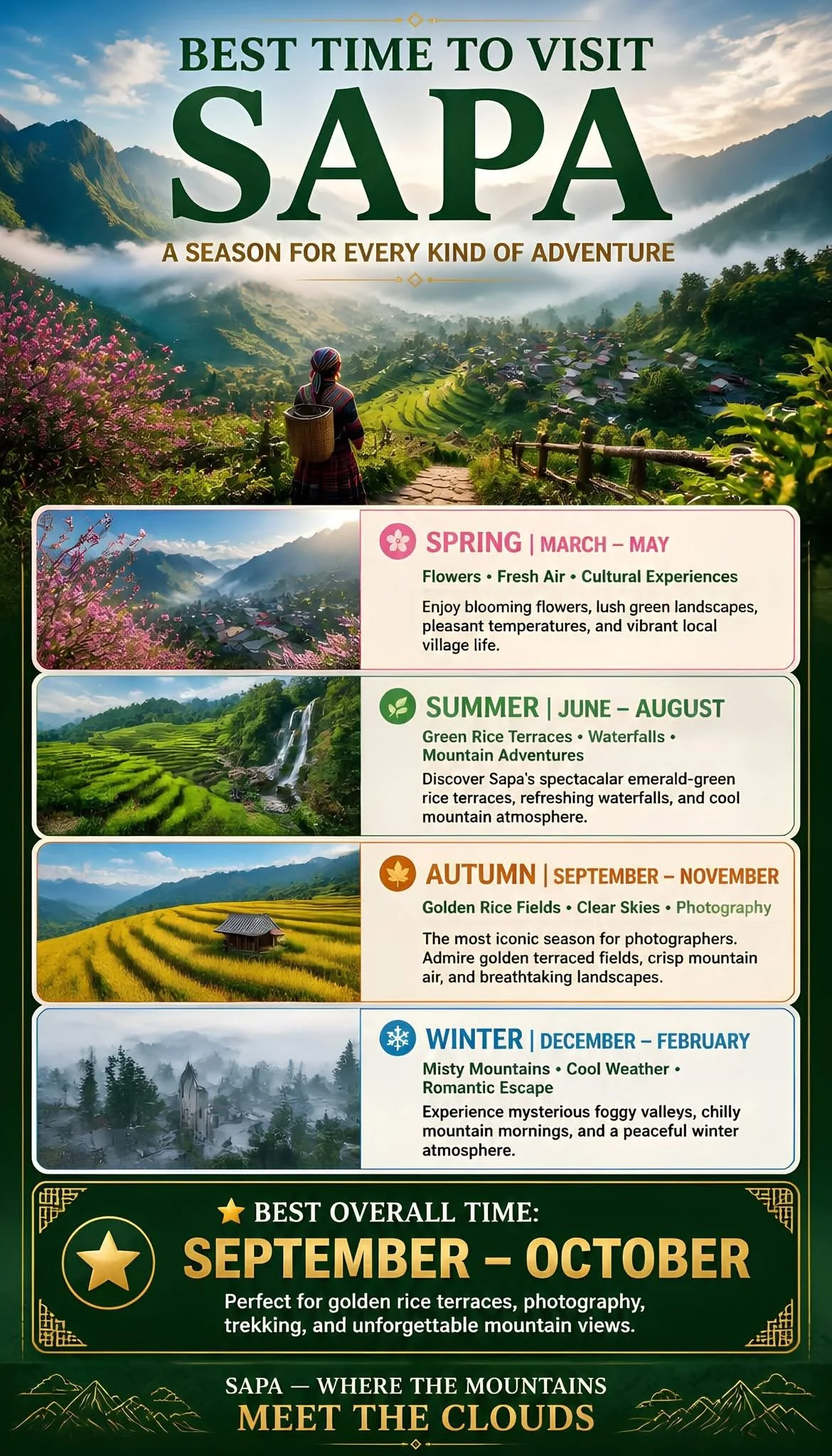
This AI-generated travel graphic produced by Happy Vietnam Tours is visually convincing, but contains several inaccurate or misleading claims about Sapa’s seasons, including the timing of the golden rice harvest. Presented with confidence and professional design, information like this is easily accepted as fact, copied by other websites and social media accounts, and then repeated again by AI. This is how travel misinformation can quickly become established as “common knowledge”, even when people living and working in the destination know it to be wrong.
This Is How Tourism Becomes Concentrated
The consequences extend far beyond whether somebody receives an unimaginative itinerary because recommendation systems influence where visitors physically go. When millions of travellers receive similar advice, tourism becomes concentrated into an increasingly narrow corridor of destinations, attractions and routes. This creates the familiar problems of overtourism, including traffic congestion, pressure on infrastructure, trail erosion, waste, noise, pressure on water supplies and increasing competition for land. It can also change communities themselves as restaurants, accommodation, shops and entertainment businesses begin replacing activities that previously served local residents.
There is also another form of carrying capacity that is sometimes overlooked, which is the capacity of the visitor experience itself. A mountain viewpoint may remain physically capable of receiving another thousand people while becoming considerably less enjoyable because every visitor is surrounded by hundreds of others. A village may still function while residents increasingly experience tourism as an interruption to everyday life, while a trail that originally offered quiet walking through agricultural landscapes can gradually begin to feel like a queue moving between commercial stops.
The number of visitors that can physically fit somewhere is therefore not the same as the number that can visit without changing the character of the experience. This is particularly important in Sapa because travellers frequently arrive expecting mountains, agricultural landscapes, village life, cultural learning and a sense of exploration, only to follow exactly the same routes as thousands of other people who have received almost identical advice.
They may subsequently conclude that Sapa itself is overcrowded, commercialised or no longer authentic when in reality they have experienced only a very small tourism corridor within an enormous and culturally diverse region. The destination has not necessarily reached its carrying capacity but the widely recommended version of the destination has.
Traveller Satisfaction Eventually Begins to Decline
There is a contradiction at the centre of mass tourism because the more successfully a place becomes promoted as a “must-see” destination, the greater the risk that the qualities making it desirable will eventually be damaged. A quiet mountain viewpoint becomes crowded, a village becomes a tourist attraction, a traditional house becomes a photograph opportunity, a walking trail becomes commercialised and a cultural interaction gradually becomes something repeated hundreds of times every day. Travellers then begin complaining that the destination has become too touristy, while continuing to follow the same recommendations that create the conditions they dislike.
Artificial intelligence accelerates this process because it allows travellers to receive very efficient answers without necessarily challenging the assumptions behind them. If the machine identifies the most famous attractions and constructs a logical route between them, the itinerary looks excellent from an information-management perspective even when it reproduces exactly the tourism concentration that is reducing visitor satisfaction. The system has successfully optimised the itinerary while potentially diminishing the journey. Travel suffers and experiences become less meaniful.
The Organisations Missing From AI Itineraries Tell Us Something Important
One of the most interesting features of Sa Pa tourism is that organisations such as ETHOS and other locally led trekking operators can receive consistently exceptional feedback from travellers while remaining absent from many generic AI itineraries.
This apparent contradiction becomes much easier to understand when we consider what these organisations actually provide. Our value is rarely based on moving the greatest possible number of people through the greatest possible number of attractions. Instead, our strongest experiences frequently depend upon local guides, smaller groups, personal relationships, flexibility, quieter routes, community knowledge and the ability to respond to what is happening on a particular day.
A good local guide will change the route because the weather has changed, spend longer somewhere because the traveller has become interested in a particular subject, introduce people encountered naturally along the way and explain details of the landscape that would otherwise appear completely ordinary. A rice terrace stops being simply a beautiful photograph and becomes part of a farming system. A village stops being an attraction and becomes somewhere people actually live. A Hmong or Dao guide stops being part of the visitor experience and becomes the person interpreting their own community. This produces a form of tourism that can be extraordinarily satisfying precisely because it remains difficult to standardise.
Small-Scale Tourism Has a Digital Disadvantage
There is therefore a troubling irony in the way artificial intelligence may influence future tourism. A sustainable tourism organisation can deliberately avoid large groups, limit the number of visitors entering particular communities, change routes to reduce pressure and distribute economic benefits across many families, yet every one of those decisions potentially reduces the amount of digital content the organisation generates.
The mass attraction receiving thousands of people produces thousands of photographs, reviews, social posts and booking transactions, while the organisation working with a handful of travellers in a quiet community generates relatively little online noise. The internet can consequently reward scale even when scale is precisely the problem that responsible tourism is attempting to manage.
There is also a classification issue because an AI system may easily understand that Fansipan is an attraction while categorising ETHOS as a business providing tours. When asked for “things to do”, the system may therefore prioritise places rather than the people capable of creating the experience. The traveller believes they asked for the best way to experience Sapa, while the machine may effectively answer with a list of the easiest Sa Pa entities to identify. Those are not remotely the same question.
Responsible Tourism Requires Better Questions
Artificial intelligence should not be dismissed as useless for travel because it can be extremely powerful when the traveller understands how to question it. The problem begins when somebody assumes that a generic question will produce a thoughtful answer.
If a traveller asks, “What are the best things to do in Sapa?”, the system is likely to rely heavily on popularity, visibility and conventional tourism information because it knows almost nothing about the values of the person asking. A more thoughtful traveller might instead ask for locally owned experiences, quiet villages, small-scale tourism, private guiding, cultural learning or alternatives to overcrowded attractions. They might ask which organisations employ guides from the communities being visited, how tourism income reaches local families, whether strangers are combined into large groups or how a company prevents particular villages and trails from receiving excessive numbers of visitors.
The quality of the answer can change dramatically because the traveller has changed the criteria by which the journey is being judged. This means the future travel skill may not simply involve knowing where to search, but knowing how to question the systems doing the searching.
Adventure Requires Leaving Space for the Unexpected
There is something deeply contradictory about travelling thousands of kilometres to encounter another culture while allowing an algorithm to decide exactly where we should stand, what we should photograph, what we should eat and how long we should spend in each place.
The uncertainty that modern travel technology increasingly attempts to eliminate has always been part of what made travelling interesting. Some of the experiences people remember most clearly were never included in an itinerary because they emerged from circumstances that could not have been planned in advance. A conversation lasted longer than expected, the weather changed, somebody suggested another route, a meal became an invitation, a road disappeared into somewhere interesting or the guide simply knew something better than the internet. These moments matter because they remind us that a destination is not a collection of products waiting to be consumed. It is a living place containing people, relationships, knowledge, histories and landscapes that existed before the traveller arrived and will continue after they have gone.
When AI, bloggers and influencers repeatedly direct visitors towards the same carefully packaged version of a destination, we risk losing more than quiet places because we gradually remove the uncertainty from travel itself.
The Answer Is Not to Stop Using AI
Artificial intelligence is not going to disappear from travel research, nor should it, because it can organise information brilliantly and make unfamiliar destinations much easier to understand. The challenge is knowing where its knowledge ends. A system capable of analysing millions of webpages may know considerably more facts about Sapa than any individual person, while still understanding substantially less about what it feels like to live, work and travel within the region. That distinction will become increasingly important as travellers place greater confidence in AI-generated itineraries.
For organisations such as ETHOS, the response will never be to imitate the mass-tourism model simply because that model performs well online. Small-scale, locally led and community-based tourism has value precisely because it resists some of the pressures created by volume, standardisation and concentration.
The challenge is therefore to make those alternatives easier for travellers and artificial intelligence to discover without turning them into the very products they were created to avoid. Travellers may choose continue using AI, but they might use it as the beginning of their research rather than the end of it, while remaining prepared to question recommendations, look beyond the most frequently mentioned attractions and seek knowledge from people who have actually spent enough time in a place to understand it.
The greater danger is that millions of people will receive increasingly similar recommendations, travel increasingly similar routes and eventually mistake that repetition for exploration. If that happens, destinations may become easier than ever to visit while becoming progressively harder to discover.
Real Travel Needs a Kickback
If this trend is going to change, travellers need to push back against the idea that the most visible, most photographed and most frequently recommended experiences are automatically the best ones. For a concientious travellers, they are almost certainly not. AI, influencers and travel blogs are increasingly sending people towards the same places, using the same sources and repeating the same recommendations. Reversing that trend requires travellers to become more critical and stop treating digital visibility as expertise. Spending two days in a destination and publishing an “ultimate guide” does not create local knowledge, while a large social-media following does not make somebody an authority on the culture, environment or communities they are describing. Real expertise comes from time, relationships, repeated experience and a willingness to understand complexity.
Travellers can help protect that expertise by deliberately searching for local guides, community organisations, independent businesses and people who have long-term knowledge of a destination. When those experiences are good, thoughtful reviews and recommendations matter because they help genuine local voices remain visible in a digital environment that naturally favours scale and repetition.
Most importantly, leave some space in the journey for things that were never included in the original plan. A good local guide should be able to change the route, recommend somewhere better or introduce an experience that an algorithm could never have predicted. Real travel will survive if travellers choose depth over volume, local knowledge over online popularity and genuine discovery over another recycled checklist.
If we want travel to remain adventurous, meaningful and worth doing, we need to stop allowing algorithms and temporary visitors to decide what a place is for us.
When “Instagrammable” Became a Travel Value
Few words reveal more about the direction modern travel has taken than the adjective “Instagrammable”. It appears constantly in travel blogs, social-media posts, hotel descriptions and destination guides, usually presented as though it were an entirely positive quality, yet the word itself deserves far more scrutiny because it reduces a place to a single question: how effectively can this location be used as a backdrop for somebody else’s image?
From our perspective at ETHOS, it is one of the laziest and most superficial words in contemporary travel writing because it tells us almost nothing about the place itself. It does not tell us whether somewhere is historically important, culturally significant, environmentally interesting, locally owned, ethically managed or even genuinely enjoyable to visit. It simply tells us that somebody believes the location photographs well on a particular social-media platform.
There is something almost insulting about reducing a destination in this way because the word quietly shifts attention away from the place and towards the person standing in front of it. The landscape, building, village or cultural setting stops being the subject and becomes scenery, while the traveller becomes the centre of the experience and the value of the location is increasingly judged according to how successfully it can support a photograph of them.
That shift matters because describing somewhere as “Instagrammable” does not merely report what visitors are already doing. It helps attract a particular type of behaviour. Once a place becomes known primarily as somewhere to create beautiful social-media content, increasing numbers of people arrive with the photograph already imagined before they have even seen the location for themselves. Their principal objective is no longer necessarily to understand where they are, but to reproduce the image that convinced them to come.
The photograph then becomes both the product and the proof. It demonstrates that the traveller was there, that they had access to the experience and, increasingly, that their life contains the sort of moments other people are expected to admire. Social media has made this kind of validation extraordinarily powerful because travel can now be performed publicly, with destinations used as evidence of lifestyle, status, beauty, freedom or success.
There is nothing wrong with wanting a good photograph, and almost everybody who travels takes pictures they are proud of, but there is an important difference between photographing an experience and travelling primarily in order to manufacture the photograph. When the latter becomes the dominant purpose, the destination risks becoming secondary to the image created there.
Moana May Be Sapa’s Clearest Example
Moana provides perhaps one of the clearest examples of this form of tourism in Sa Pa because much of its appeal is built around constructed photographic opportunities rather than any particular relationship with the history, landscape or culture of the region.
On a busy weekend, visitors can negotiate traffic congestion simply to reach the attraction, queue to purchase an entrance ticket and then join another queue for one of a number of carefully designed selfie locations. At the front of each line is essentially the same promise: stand in the designated position, find the correct angle, adopt the right pose and produce the photograph that brought you there in the first place. What makes the experience particularly strange is that almost everybody waiting is preparing to make essentially the same image as the person immediately ahead of them, while the person behind them is waiting to do exactly the same thing again.
There is very little discovery involved because the photograph has already been conceived, composed and demonstrated online thousands of times before the visitor arrives. The location tells them where to stand, social media has shown them how other people posed, and the queue confirms that the same image continues to be desirable. What presents itself as individual expression therefore becomes something remarkably close to mass replication.
The visitor takes the photograph and then moves to the next constructed photo opportunity, where another queue has formed and another almost identical process begins. A few metres later there may be another platform, sculpture, viewpoint or installation, followed by another pause while everybody waits for their turn to create the next piece of content.
These people are, quite literally, queuing for content.
The irony is difficult to ignore because social media is supposed to allow people to express something individual about their lives, yet the pursuit of the perfect travel image increasingly produces exactly the opposite. Everybody searches for the unique photograph by standing in the same place, following the same pose, using the same composition and reproducing the same visual language as thousands of people before them. The result is not individuality but conformity presented as individuality.
What Has the Place Itself Got to Do With It?
The deeper concern is what disappears when this becomes a dominant way of travelling. A location may have extraordinary histories, communities, agricultural systems, languages, beliefs, traditions and relationships with the surrounding landscape, yet none of those things are necessary for an “Instagrammable” attraction to succeed. In fact, the attraction can function perfectly well without them because its purpose is not necessarily to help visitors understand the destination. It needs only to provide an attractive background.
This is particularly striking in Sa Pa, where the surrounding mountains contain generations of knowledge relating to farming, textiles, medicinal plants, forest use, water management, architecture, religion and community life. A visitor could spend days asking questions and still understand only a fraction of what they were seeing, yet an entire tourism experience can instead be constructed around a handful of artificial photographic sets that require almost no engagement with any of it. A traveller can consequently return home with hundreds of attractive photographs of Sa Pa while having learnt almost nothing about Sa Pa. That should concern anybody who believes travel has value beyond entertainment.
The Algorithm Loves This Kind of Tourism
The most troubling part is that this behaviour is exceptionally well suited to the digital systems now shaping travel. An attraction designed around photographs generates photographs. Those photographs generate posts. The posts generate engagement. Engagement generates visibility. Visibility creates more visitors. Those visitors create more photographs, and the cycle begins again.
From the perspective of an algorithm, the attraction looks extraordinarily important because it generates an enormous amount of measurable activity. It appears repeatedly in photographs, captions, videos, blogs, reviews and travel itineraries, giving artificial intelligence an ever-growing volume of evidence suggesting that this must be one of the essential things to experience in Sa Pa.
Meanwhile, a visitor who spends six hours walking through a farming community with a local guide may take relatively few photographs and publish nothing at all. They may learn about rice cultivation, medicinal plants, family relationships, land use, migration, language and cultural change, yet almost none of that experience becomes visible to the systems measuring what travellers apparently value.
The shallow experience therefore leaves an enormous digital footprint, while the deeper one may leave almost none. This is precisely why online popularity should never be confused with significance.
When Validation Becomes the Destination
Perhaps the hardest question is why so much effort is being invested in proving that we have experienced something rather than simply experiencing it. Travel has always contained an element of status, and people have always returned home with photographs and stories, but social media has transformed that impulse into a permanent public performance in which every journey can be evaluated through likes, comments, followers and engagement.
For some travellers, the destination increasingly becomes a stage upon which a carefully edited version of their life is performed. The photograph says that they were adventurous, successful, attractive, cultured or free, while the audience provides the validation that gives the image value. Once that becomes the objective, the quality of the actual experience becomes strangely secondary. A person can spend forty minutes in traffic, another twenty minutes purchasing a ticket and another twenty waiting in line for a photograph that takes thirty seconds to create, yet consider the experience successful because the final image performs well online.
There is an uncomfortable absurdity in that exchange because enormous amounts of time, energy and infrastructure are being devoted to creating evidence of an experience rather than to making the experience itself worthwhile.
Surely Travel Can Still Mean More Than This
None of this is an argument against photography, social media or enjoying beautiful places. It is an argument against allowing the photograph to become more important than the place, and against allowing a destination to be judged principally according to how efficiently it can be converted into content.
At ETHOS, we still believe there should be room in travel for places that are difficult to photograph, conversations that are never recorded, experiences that cannot be compressed into fifteen seconds and moments that remain valuable even when nobody else knows they happened. There should still be value in travelling somewhere because we are curious rather than because we already know what photograph we want to bring home. There should still be value in leaving a destination knowing more than we did when we arrived.
When thousands of people are prepared to queue to reproduce exactly the same photograph at exactly the same constructed location, before moving onwards to queue for the next one, it is reasonable to ask whether something important has been lost in our relationship with travel. If the ultimate ambition is simply to stand where everybody else has stood, pose how everybody else has posed and produce the same proof that everybody else has already produced, then perhaps the question is not whether a place is sufficiently “Instagrammable”. Perhaps the more important question is whether this is really the best use we can make of the extraordinary privilege of being able to travel at all.
If You Want to Experience Sapa Differently
For travellers who recognise themselves in this argument, the answer is not necessarily to avoid the famous places or reject technology altogether, but to make room for experiences that are shaped by people who actually know the landscape. This means looking beyond the standard itinerary and seeking out local guides, community organisations and smaller operators who can respond to weather, seasons, farming activity, local events and the interests of the people travelling with them.
This is the approach we have followed at ETHOS for many years. Rather than building experiences around a fixed checklist of attractions, we work with local guides and families to create private journeys through northern Vietnam that can involve walking, motorbike travel, homestays, textiles, food, farming, traditional knowledge or simply spending time with people and understanding the places through which you are travelling. Our current experience programme is deliberately built around the idea that a journey should begin with curiosity rather than a list of compulsory stops, with options ranging from quiet treks and homestays to textile workshops, food experiences and longer journeys through lesser-visited parts of northern Vietnam.
If that is the kind of travel you are looking for, you can explore the different ways of travelling with ETHOS here: Create Your ETHOS Experience
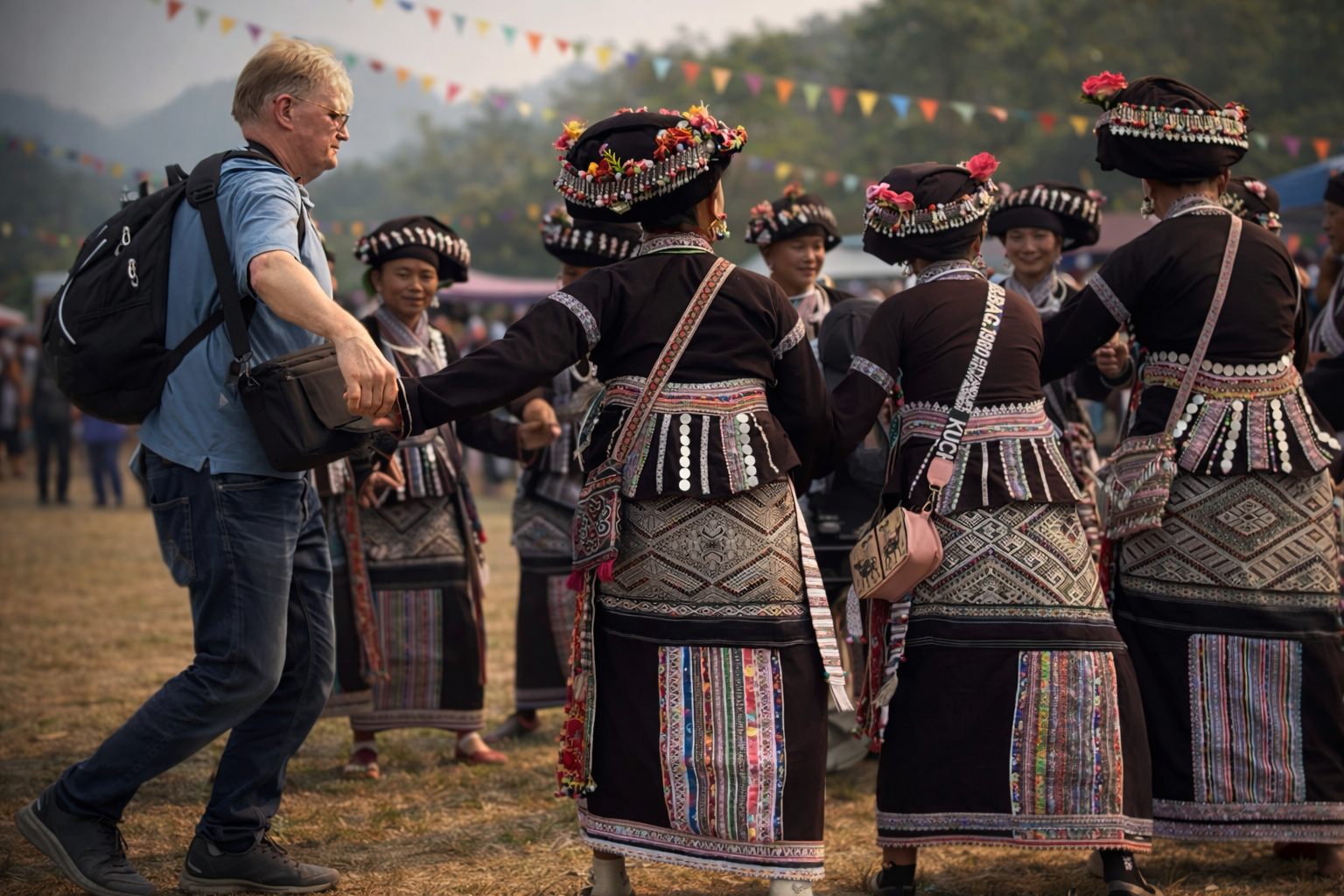
British traveller, Edward joins members of a Lao ethnic community during an annual traditional dance festival in northern Vietnam. Experiences like this rarely appear in standard itineraries, travel blogs or AI-generated guides because they are not packaged as permanent tourist attractions. They depend on local relationships, timing and knowledge of what is actually happening within a community, which is precisely why meaningful travel cannot always be planned from the most visible information online.
