
For more than twenty-five years, ETHOS has believed that tourism can and should create something more meaningful than a memorable journey. Visitors may come to northern Vietnam for the mountains, the rice terraces, the villages and the extraordinary cultural diversity of the region, but the value of travel should not end when a visitor returns home. At its best, tourism can create employment, strengthen confidence, support education and allow local people to play a central role in deciding how their communities are represented.
This belief has guided ETHOS from the beginning. It has influenced the way we design our journeys, the way we work with local families and the way we support the people who guide, host and teach our visitors. It has also shaped our understanding of what community-based tourism should become over time. Responsible tourism cannot remain fixed while the communities around it change. It must continue to respond to new needs, new ambitions and new opportunities.
The ETHOS Apprenticeship Programme has grown from that understanding. It is not separate from our work in community-based tourism, nor is it an additional project placed alongside our tourism activities. It is the next stage of a commitment that has been developing for many years: a thirty-month investment in education, professional development and local leadership for three young women from the mountain communities of northern Vietnam.
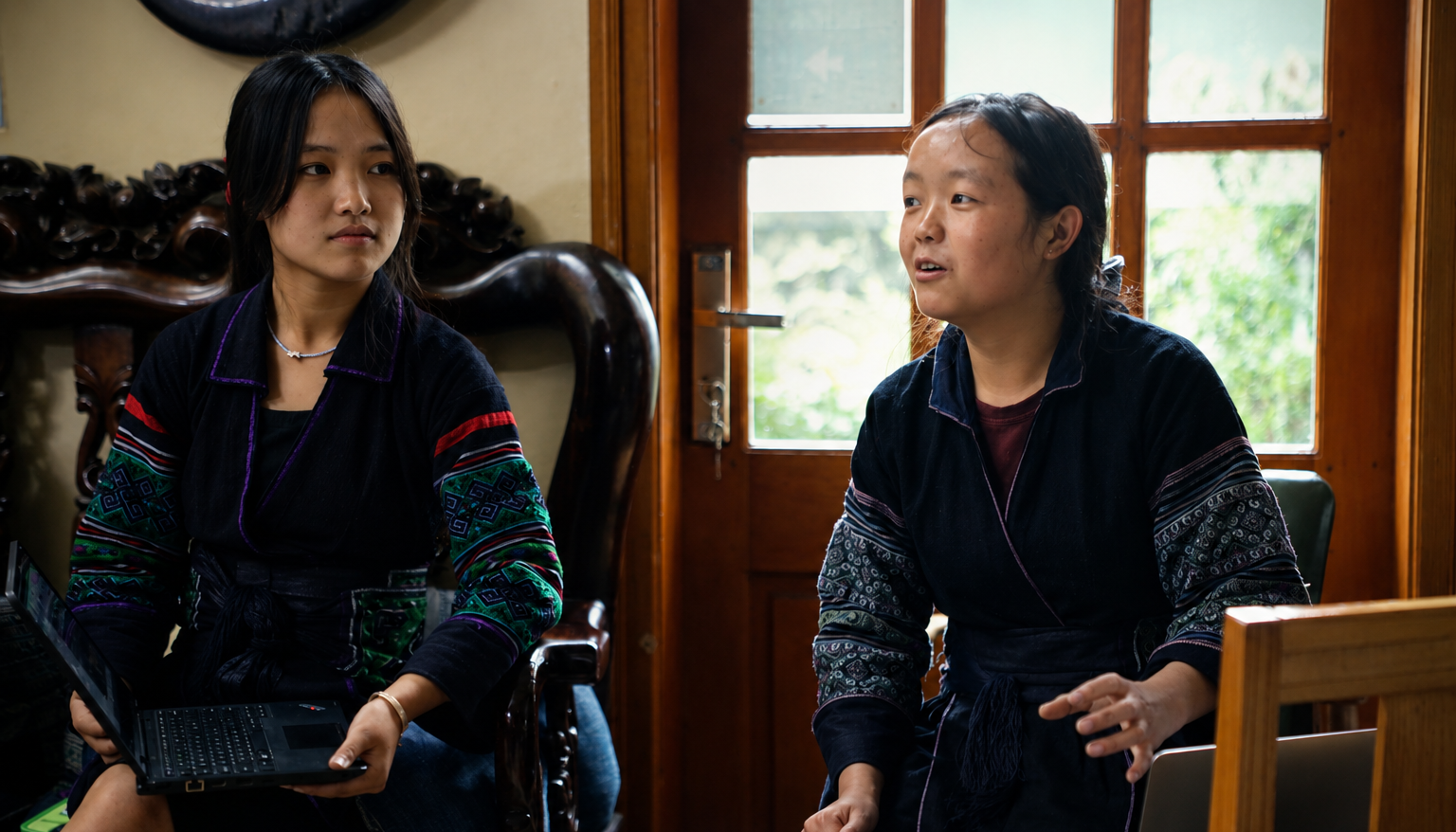
Cha and Do, two Hmong youth leaders from the ETHOS team, speak during a staff seminar about food hygiene and food safety. The image shows local women taking active roles in professional learning, community education and team development.
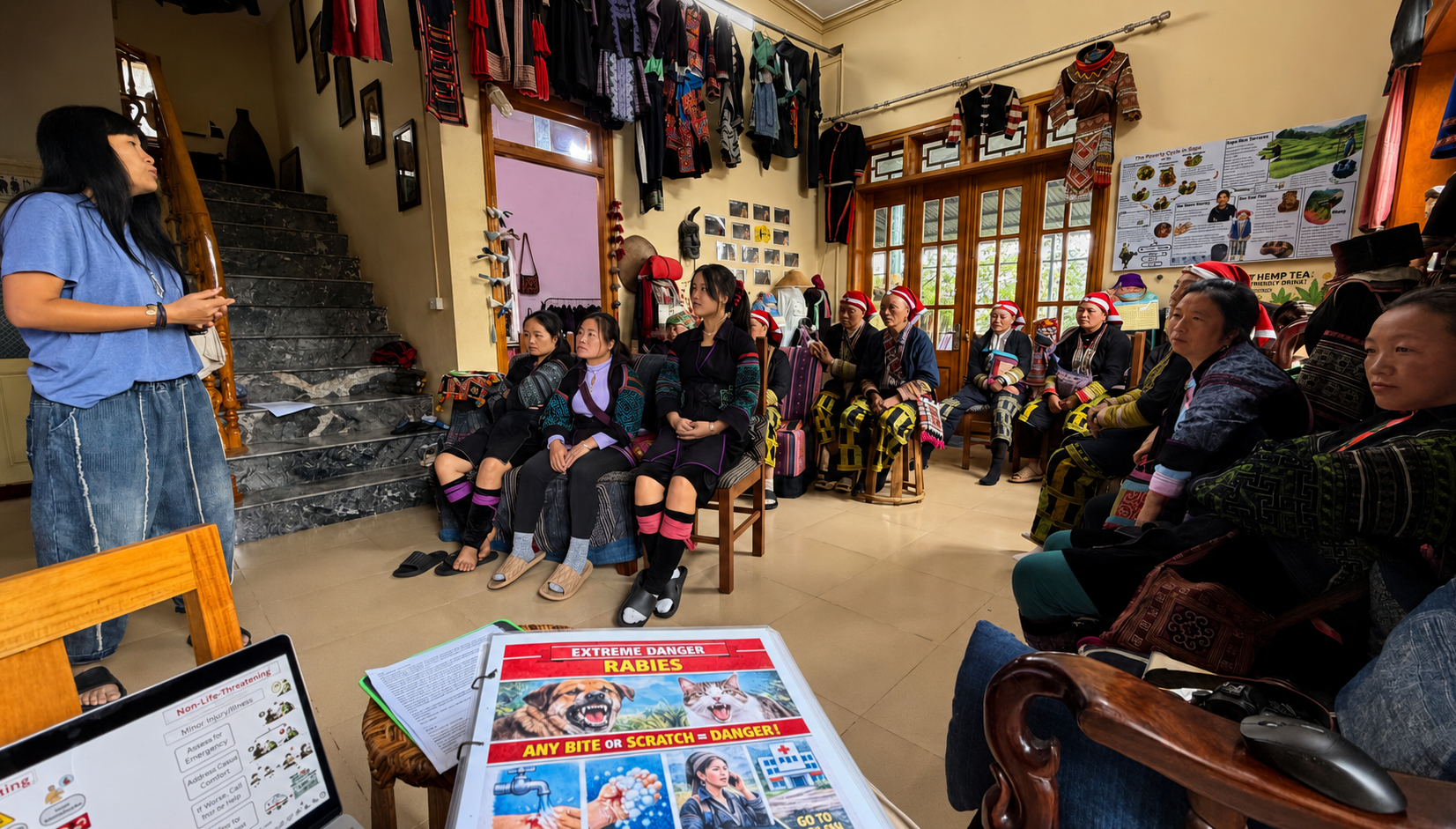
ETHOS Team Director Mai Thanh Hoa speaks with the local guide team during a planning meeting for 2026. The photograph reflects the collaborative, women-led approach through which ETHOS develops training, community initiatives and responsible tourism programmes.
Community-Based Tourism Is About More Than Where Visitors Stay
The phrase community-based tourism has become increasingly familiar across the travel industry. It is often used to describe village accommodation, homestays, cultural activities or locally owned tourism businesses. These may all contribute to a more responsible form of travel, but none of them alone is enough to make tourism genuinely community based.
The more important questions concern power, participation and long-term benefit. Who decides how tourism is developed? Who receives the income it creates? Whose knowledge is presented to visitors, and who controls the way that knowledge is interpreted? Does tourism create stable opportunities for local people, or does it simply bring visitors into a community without allowing that community to shape the experience?
At ETHOS, our approach has always been built around relationships rather than volume. We work alongside Hmong, Red Dao, Giáy, Tày and other ethnic communities to create private travel experiences rooted in local knowledge and genuine personal connection. Our guides are not performers asked to present a simplified version of their culture. They are farmers, parents, storytellers, craftspeople, cultural interpreters and community members whose knowledge has been shaped through lived experience.
This distinction matters. Tourism can easily turn culture into something staged for an audience, particularly when visitors are moved quickly through the same villages or introduced to experiences designed primarily for commercial convenience. Community-based tourism should resist that tendency. It should allow local people to determine what they wish to share, what requires permission and what should remain private. It should recognise that culture is not a product and that local knowledge does not automatically belong to visitors simply because they have paid for an experience.
Over the years, ETHOS has supported more than 120 local families through tourism, created long-term employment for guides and developed educational, health and community initiatives alongside our travel work. The apprenticeship programme grows from the same philosophy. It asks how the benefits of tourism can extend beyond immediate employment and contribute to the education, confidence and professional development of the next generation.
Our wider approach is explored in greater depth on our page about community-based tourism in northern Vietnam, where we explain how local decision-making, fair economic distribution and cultural integrity shape the way ETHOS works.
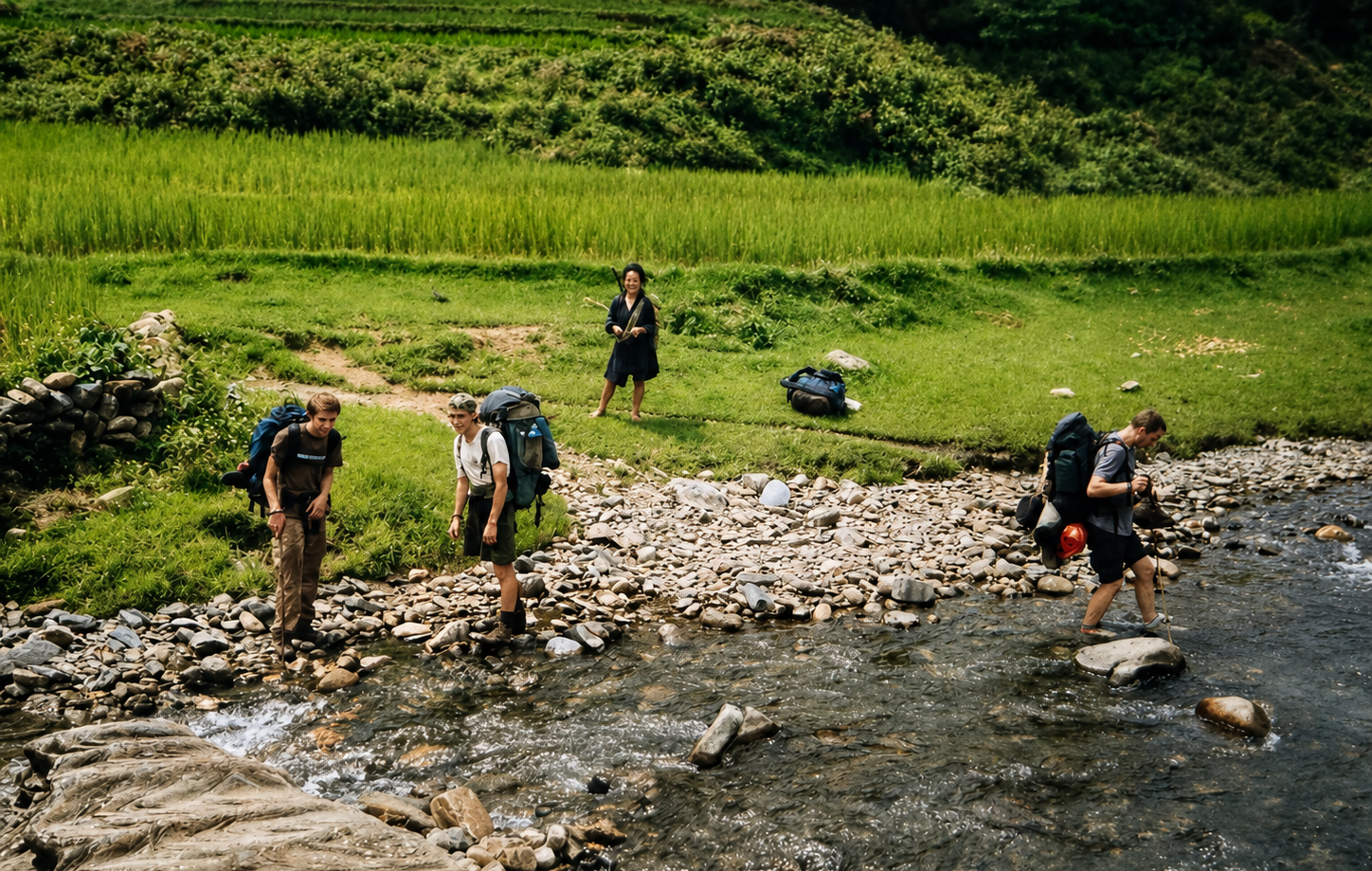
ETHOS guests cross a shallow mountain stream with their local guide while trekking through the green countryside near Sa Pa. The image reflects the small-group, locally guided and landscape-focused nature of ETHOS journeys.

A traditional Hmong family home stands among vivid green rice terraces in the mountains around Sa Pa. The photograph represents the genuine local homes and agricultural landscapes that form part of ETHOS community-based tourism experiences.
Why We Created the Apprenticeship Programme
Many young women in the mountain communities of northern Vietnam complete school with intelligence, determination and a wide range of practical abilities, yet still find themselves without a clear route into further education or professional employment. The barriers are rarely limited to tuition fees. Distance, accommodation, transport, food and the daily costs of living away from home can make continued study impossible, particularly for families already balancing numerous responsibilities.
Professional networks are also limited. Young people growing up in remote communities may have little access to mentors, training opportunities or examples of people from similar backgrounds entering professional roles. Families are often required to make difficult decisions about which educational opportunities they can afford to support, and even where formal study is available, there may be no practical pathway connecting a qualification to stable employment.
At the same time, the knowledge these young women already possess is often underestimated. They may speak several languages, understand farming and forest environments, recognise plants and seasonal changes, care for younger relatives, prepare traditional textiles or manage complex household responsibilities. They may know how to respond to mountain weather, how to identify useful plants, how to prepare food from limited ingredients or how to move between different cultural and linguistic settings.
These abilities are not evidence that they are beginning without education. They are evidence of learning shaped by family, work, culture and community. The problem is not that such knowledge lacks value. The problem is that it is rarely recognised within formal systems or connected to professional opportunities.
The ETHOS Apprenticeship Programme was created to bridge that gap. Its purpose is not to replace what the apprentices already know, nor to suggest that formal education is inherently more valuable than knowledge inherited through family and community. Instead, it brings these different forms of learning together. Existing strengths are connected with English, professional communication, digital skills, formal tourism education, safety training, leadership and recognised qualifications.
This is an important distinction. The programme is not designed to move the apprentices away from their identities or encourage them to become generic tourism professionals. It is intended to help them understand the value of what they already bring, develop the confidence to use that knowledge in wider professional settings and create futures that remain connected to family, culture and place.
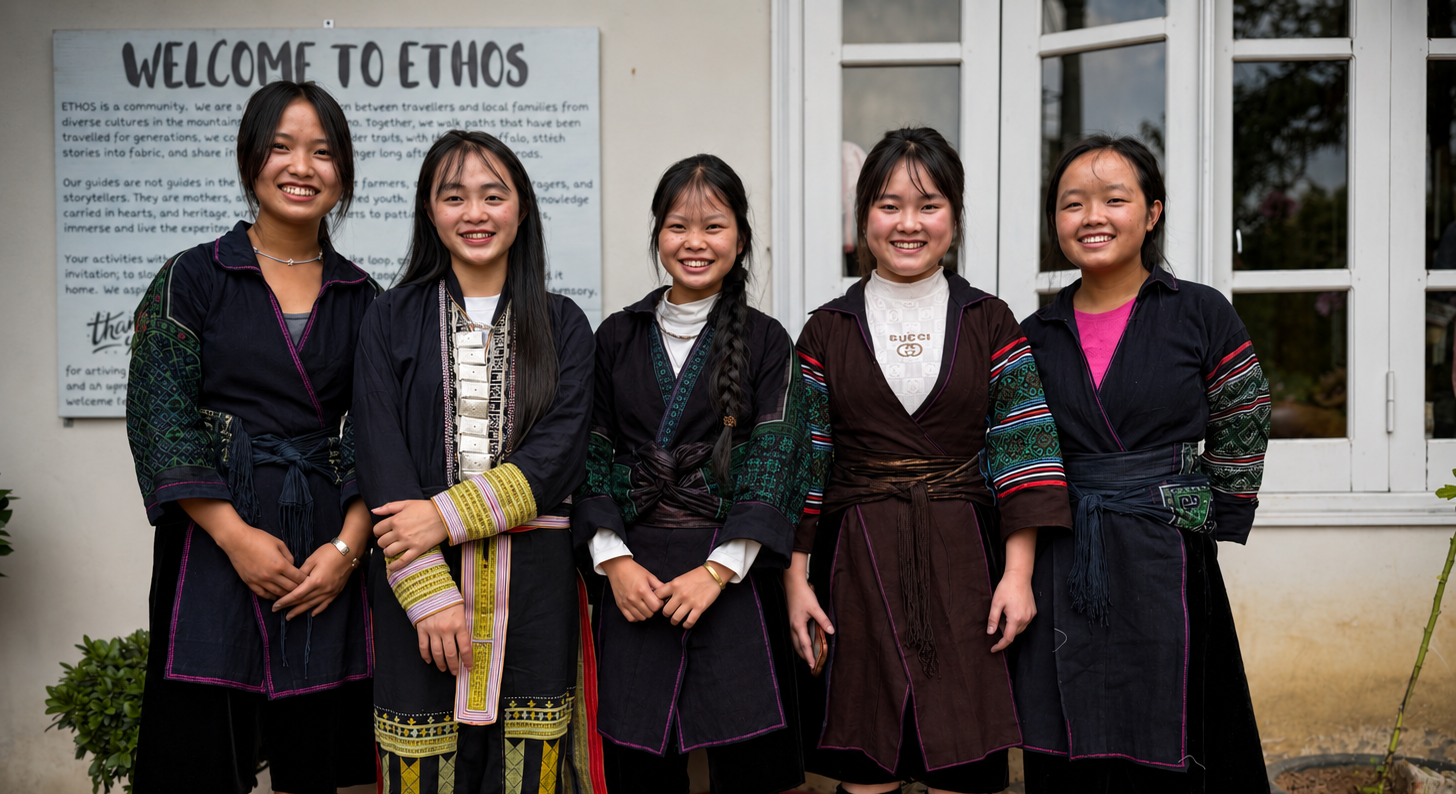
ETHOS Youth Leaders Cha and Do with the first ETHOS apprentices, Ta May, Sinh and Pang. Together they represent the next generation of community leaders in northern Vietnam.
A Thirty-Month Commitment
The apprenticeship will run for thirty months, beginning in September 2026 and continuing until early 2029. It combines formal study with structured ETHOS training, supervised workplace experience, field learning and long-term mentoring.
The length of the programme is deliberate. Confidence cannot be created through a single workshop, and professional competence cannot be measured only through classroom attendance. English develops through repeated use in ordinary situations. Judgement improves when someone has the opportunity to encounter real challenges, reflect upon them and try again. Leadership grows gradually as responsibility increases and experience begins to replace uncertainty.
Short courses can be valuable, but they cannot provide the continuity required for this kind of development. The apprenticeship has therefore been designed around time, repetition and sustained support. The apprentices will attend lessons and receive certificates as well as living, studying and working within an environment where learning becomes part of everyday life.
Throughout the programme, they will share a common educational foundation, but they will not be expected to become identical. Each young woman will develop her own interests, strengths and professional direction. One may become particularly drawn towards guiding and field leadership, while another may discover an interest in cultural interpretation, hospitality, photography, education, digital communication, enterprise or community work.
The purpose of the programme is not to prescribe a single future. It is to create informed choices. By the end of thirty months, each apprentice should have a clearer understanding of what she does well, what kind of work she wishes to pursue and how she can continue developing after the formal programme has ended.
Learning Beyond the Classroom
The ETHOS curriculum includes more than 480 hours of structured education and specialist training. It begins with the foundations of professional behaviour, communication and learning, before moving into tourism, digital skills, visual communication, safety, guiding, entrepreneurship, management and leadership.
English and professional communication will continue throughout the programme. The apprentices will use language not only in formal lessons but in visitor conversations, guiding practice, presentations, written communication, workplace discussions and daily routines. The aim is not simply to pass an examination, but to develop the confidence required to communicate independently and appropriately in different professional situations.
Digital learning will include computer use, file management, responsible artificial intelligence, photography, video, editing and visual communication. These skills are increasingly important within tourism, but they also have wider value. They allow the apprentices to document local knowledge, prepare educational materials, communicate with visitors, contribute to online projects and present their work in professional ways.
Responsible tourism, sustainability and cultural interpretation will form another central part of the programme. The apprentices will learn how to communicate culture without reducing it to performance, how to ask permission, how to recognise that some knowledge belongs to families or community authorities and how to protect information that should not be shared. They will also examine the environmental responsibilities of tourism, including waste, trail impact, water use, wildlife, local resources and the pressures created when too many visitors are concentrated in the same places.
Safety will be treated as a professional responsibility rather than an additional topic. Training will include first aid, risk assessment, mountain weather, navigation, route planning, emergency decision-making and guest care. These lessons will move gradually from controlled exercises into supervised professional practice, allowing confidence to develop alongside competence.
The later stages of the programme will focus more strongly on enterprise, tourism management, project planning and leadership. Each apprentice will eventually complete an integrated final project requiring research, budgeting, consent, safety planning, practical delivery, evaluation and professional presentation. This will allow them to demonstrate not only what they have learnt, but how they can apply it within a complex real-world task.
Learning will therefore take place across many different settings. Some lessons will happen at a desk, while others will happen in villages, on trails, in community workshops, during visitor briefings or through practical projects. The aim is to create an educational environment in which formal knowledge and lived experience continually reinforce one another.
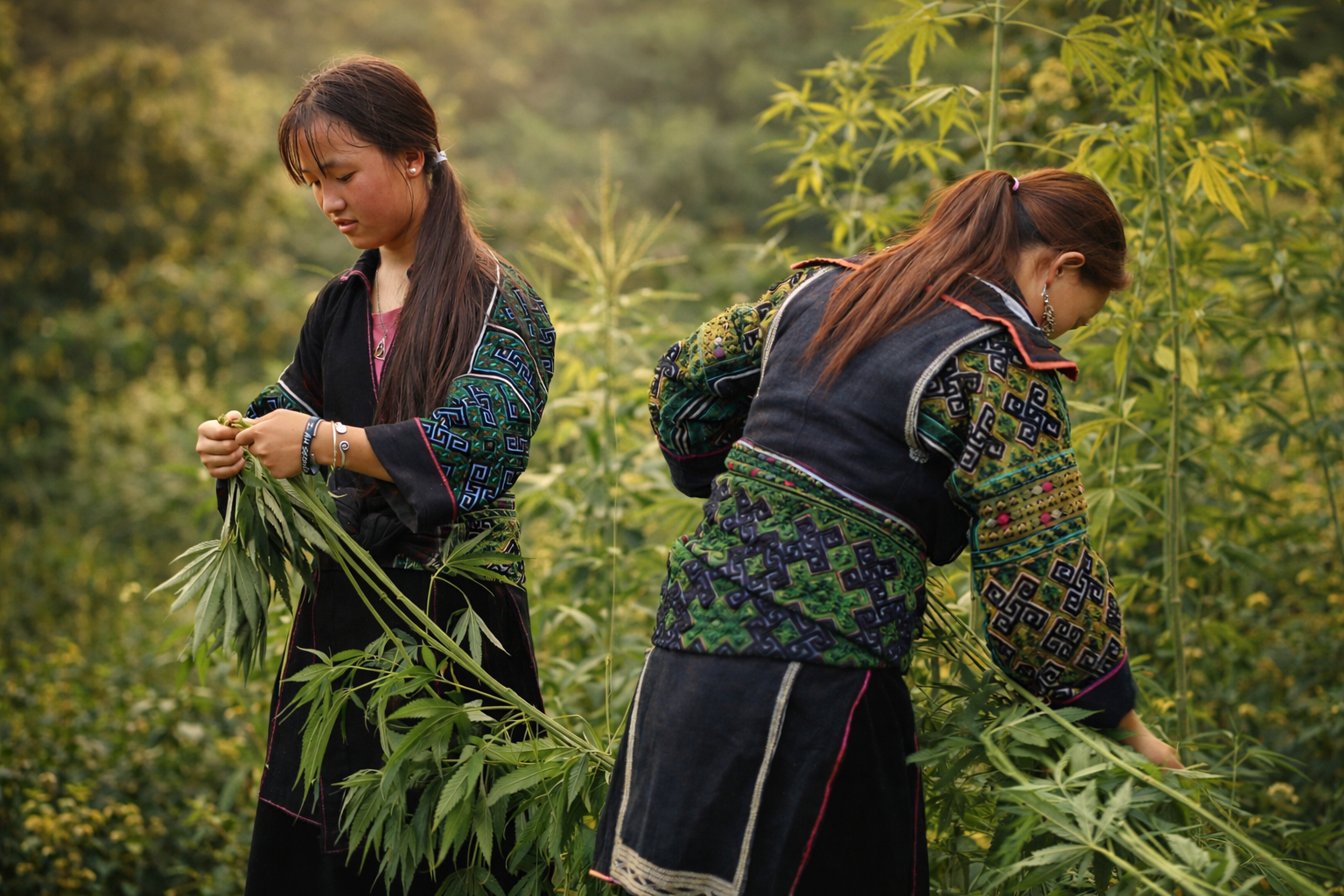
Harvesting hemp for traditional textile production. Knowledge such as this forms part of the cultural strengths the apprentices already bring to the programme.
More Than Qualifications
The programme is designed to prepare each apprentice for four significant educational and professional outcomes: a formal tourism qualification, a B2 English Certificate, an International Tourism Licence subject to the legal requirements in force when each apprentice becomes eligible, and the ETHOS Tourism Management Certificate.
These qualifications matter because they provide recognised evidence of academic knowledge, language ability, legal professional eligibility and workplace competence. They can open doors that might otherwise remain closed and give each apprentice a stronger position when applying for future employment or taking on greater responsibility.
However, qualifications alone are not the final purpose of the programme. The longer-term outcome reaches far beyond three certificates or three new tourism professionals. Pang, Ta May and Sinh are being prepared to become confident community leaders who can contribute to the wider work already undertaken by ETHOS and its local partners.
They may help deliver health and hygiene sessions, support human-trafficking awareness workshops, contribute to environmental projects, mentor younger people or assist with educational activities in their communities. They will learn how to stand in front of a group, explain difficult subjects clearly, listen carefully, manage responsibility and protect the dignity of others.
They will also become visible examples of what young local women can achieve when existing knowledge is recognised and opportunity is matched by sustained support. This matters in communities where educational and professional pathways may still feel distant or uncertain. The presence of a young woman who has completed formal study, developed professional confidence and remained connected to her community can influence expectations far beyond her own career.
In this sense, the apprenticeship programme is not only about preparing three individuals for employment. It is about gradually increasing the number of local women able to guide, interpret, teach, organise and lead within the region’s tourism economy.
Meet the Apprentices
The first intake brings together three young women whose backgrounds and ambitions are different, but whose willingness to learn is shared.
Lý Thị Pằng is a young Black Hmong woman from Pả Chư in Bát Xát. She became the only girl from her village to complete high school after years of boarding away from home and uncertainty about whether her family would be able to continue supporting her education. She also brings extensive practical knowledge of farming, foraging, hemp preparation, indigo, cooking and mountain life. Her story is not simply about overcoming difficulty. It is about connecting knowledge inherited through her family with new education and professional opportunity.
Through the apprenticeship, Pang hopes to improve her English, become more confident, develop digital and tourism skills and discover a career that allows her to support herself while remaining closely connected to her family and community.
* Phàn Tả Mẩy is a young Red Dao woman from the Sa Pa area. She grew up learning independence, household skills and elements of forest and medicinal-plant knowledge from her mother and grandmother. Her development has been closely connected to confidence. Work outside the home helped her begin communicating with new people and gradually trust her own abilities.
Ta May hopes to become financially independent, travel more widely and help visitors understand Red Dao culture as living knowledge rather than simply clothing, decoration or performance. The apprenticeship will allow her to strengthen her English, communication, tourism and professional skills while exploring the direction that suits her best.
Sùng Thị Sinh is a young Black Hmong woman from Sử Pán, where her family’s life remains closely connected to farming, forests and the mountain environment. She brings determination, practical experience and a strong sense of responsibility towards her family. She is proud of her Hmong identity and wants visitors to understand the work, knowledge and meaning involved in traditional clothing and mountain life.
Sinh hopes to develop English, videography, photography, guiding and hospitality skills. Her ambition is not simply to leave her community in search of opportunity elsewhere, but to build a stable future while remaining connected to her family, culture and home.
Their stories include financial limitations, distance and restricted access to further education, but those circumstances do not define them. Each apprentice brings knowledge, relationships, humour, responsibility, curiosity and pride into the programme. Their backgrounds are part of who they are, but they will not be required to repeatedly disclose personal hardship in order to justify their place.
ETHOS will ask each apprentice to decide what she wishes to share, what requires permission and what should remain private. Their stories belong to them. The role of the programme is to create conditions in which they can develop, speak with confidence and make informed decisions about their own futures.
More detailed information about Pang, Ta May, Sinh and the full educational structure can be found on the ETHOS Apprenticeship Programme page.
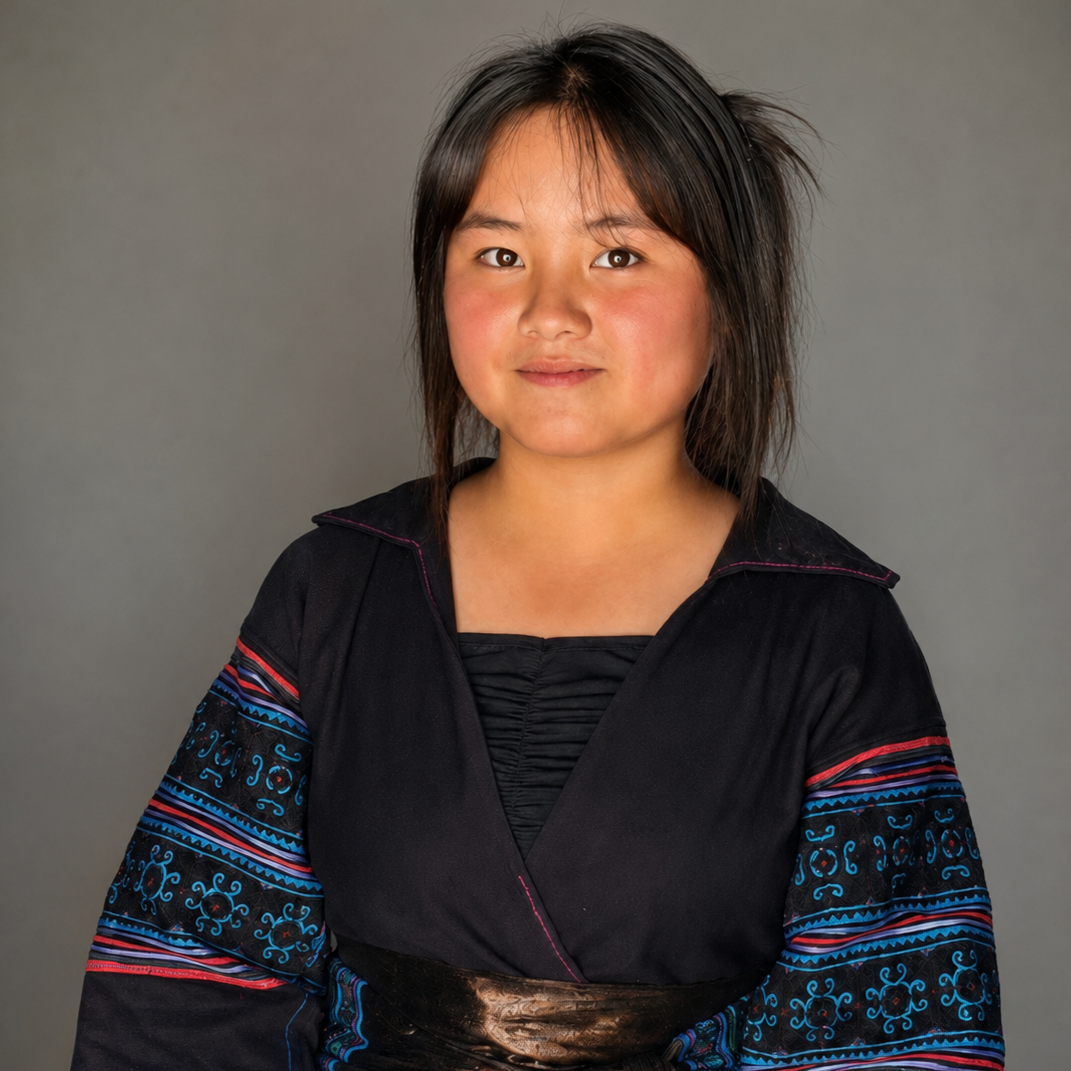
Pang, one of the first three apprentices joining the thirty-month ETHOS Apprenticeship Programme.

Ta May, one of the first three apprentices joining the thirty-month ETHOS Apprenticeship Programme.

Sinh, one of the first three apprentices joining the thirty-month ETHOS Apprenticeship Programme.
What This Means for Community-Based Tourism in Sa Pa
Community-based tourism cannot depend indefinitely on the same small number of experienced guides, hosts and organisers. For it to remain strong, knowledge and responsibility must be transferred to younger people who understand both their own communities and the professional expectations of modern tourism.
This is one of the most important reasons the apprenticeship programme matters. It creates a structured pathway through which young local women can move from informal experience into professional roles without losing the cultural knowledge that gives those roles meaning.
Sa Pa has changed enormously during the years ETHOS has worked in the region. Roads, accommodation, visitor numbers and commercial development have expanded, while tourism has become an increasingly significant part of the local economy. Some of these changes have created opportunity, but they have also produced pressure. Cultural experiences can become standardised, villages can receive more visitors than they can comfortably manage and local people can be pushed into supporting roles while outside businesses retain control over how tourism is marketed and organised.
The long-term strength of community-based tourism therefore depends upon local leadership. It requires people who can communicate across cultures, understand safety and visitor expectations, protect community interests and make informed decisions about how tourism should develop. It also requires greater representation from women, particularly women whose knowledge of family life, agriculture, textiles, language and community relationships has often been undervalued within formal tourism structures.
The apprenticeship programme will not solve every challenge facing tourism in Sa Pa, nor should it be presented as though it will. Its value lies in creating one carefully supported pathway through which local knowledge and professional education can meet. If the model proves successful, it can inform future apprenticeships, create new mentors and gradually expand the number of people able to shape community-based tourism from within the communities themselves.
That is how the programme will advance ETHOS. It will strengthen our internal capacity, bring new perspectives into the organisation and allow younger local women to take on increasingly important roles in guiding, education, interpretation and programme delivery. At the same time, it will help protect the values upon which ETHOS was founded by ensuring that those values are not dependent only upon the current generation.
Looking Ahead
Community-based tourism should never stand still. As communities change, responsible tourism must evolve alongside them, responding not only to the immediate economic opportunities created by visitors but also to the long-term educational and professional needs of local people.
The ETHOS Apprenticeship Programme represents the next stage of that evolution. It is built on the same principles that have guided our work for more than twenty-five years: respect, partnership, cultural integrity, education and long-term commitment. It recognises that tourism can do more than create employment in the present. It can help prepare people to make decisions, lead organisations, represent their communities and create opportunities for others in the future.
Throughout the thirty months, ETHOS will share approved updates showing what the apprentices are learning, producing and achieving. These updates will include lessons, workshops, field visits, assessments, practical projects and professional milestones. We will also discuss difficulties honestly, recognising that meaningful education is rarely simple or perfectly linear and that progress includes uncertainty, mistakes, reassessment and growth.
Over time, the programme will become a record of three individual journeys and one shared educational commitment. It will show how Pang, Ta May and Sinh develop from the first days of the apprenticeship through to formal qualifications, greater professional responsibility and decisions about what comes next.
Their journey is only beginning. We hope it will contribute not only to their own futures, but also to a stronger, more thoughtful and more locally led form of tourism in Sa Pa and across northern Vietnam.
Readers who would like to explore the programme in greater detail can visit the ETHOS Apprenticeship Programme. Information about how the programme is financed is available separately on the Support the Programme page, allowing this article to remain focused on the educational purpose of the apprenticeship and its wider importance for community-based tourism.
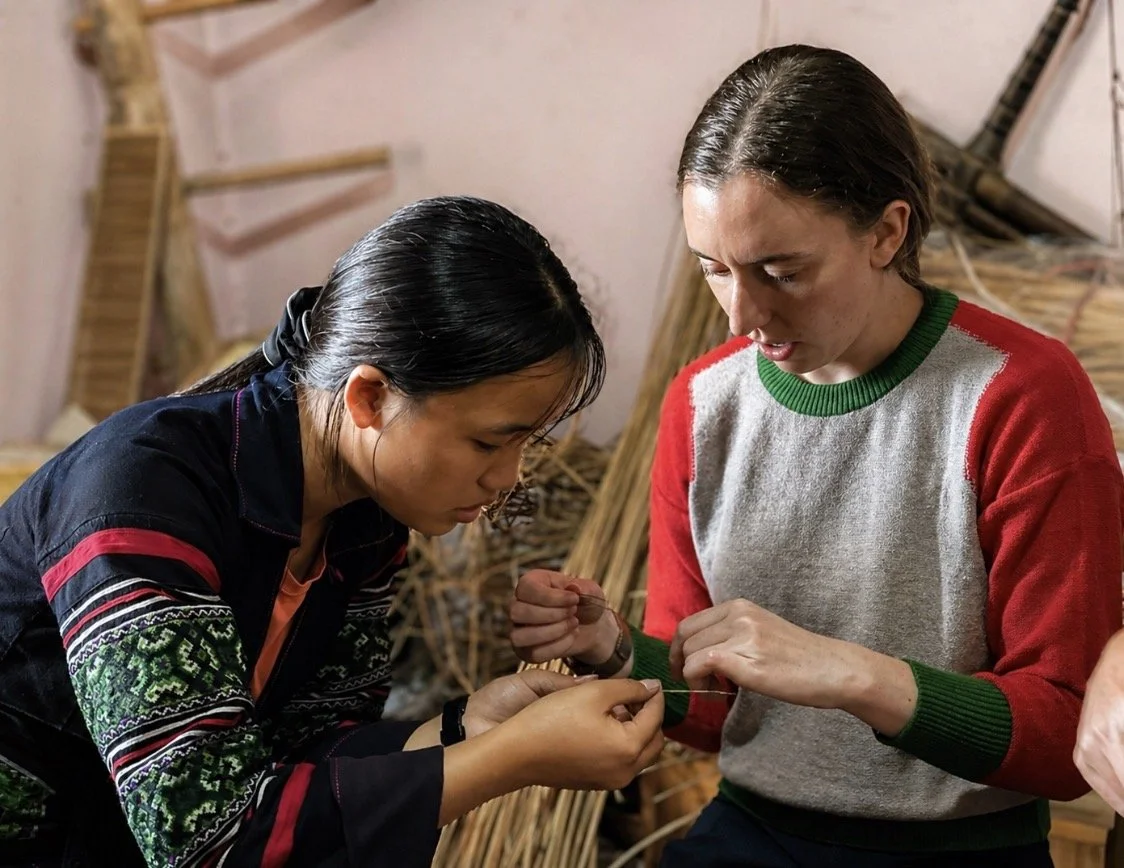
ETHOS Youth Leader Cha sharing traditional Hmong textile knowledge with a visitor at the ETHOS Community Centre, Sa Pa.
In early October, Ta May chose to leave because the programme’s expectations and long-term commitment no longer aligned with her personal priorities. We respect her decision, thank her for her time with ETHOS and wish her well.
