
Beyond Rice in Sapa’s Terrace Ecosystems
Sapa’s rice terraces are often photographed as if they were simply grand scenery, a series of green or golden steps folded into the mountains, luminous in the rain and glowing at harvest. Yet for the Hmong and Dao communities who have shaped, tended and lived with these landscapes over generations, a terrace has never been only about a single rice crop. Local communities see the terraces as a living, layered food system. This relies on the connection between water and soil, labour and season, between the forest above and the village below.
To look closely at a terrace is to begin noticing all that exists beyond the rice itself. There are the human made pools that are home to edible insects, snails, frogs, eels and fish. Then are the damp edges where herbs thrive in seepage and soft mud. There are the bunds and narrow paddy walls where greens are gathered on the way home. There are the irrigation channels carrying mountain water from one field to the next, sustaining aquatic plants and tiny wetland habitats. There are forest margins that feed the terraces with leaf litter, moisture, bamboo shoots, fungi and shade. There are the overlooked foods that appear quietly in daily life, not as luxuries, but as part of the intelligence of mountain subsistence.
In this sense, the terraces of Sapa are not monocultures in the industrial sense at all. They are agroecological worlds. Rice may remain the central staple, the grain around which the agricultural calendar turns, yet rice alone does not nourish a household. Hmong and Dao ways of farming have long understood that survival in the mountains depends on more than one harvest. It depends on recognising that a terrace can feed people in many forms, through many species, at many moments of the year.
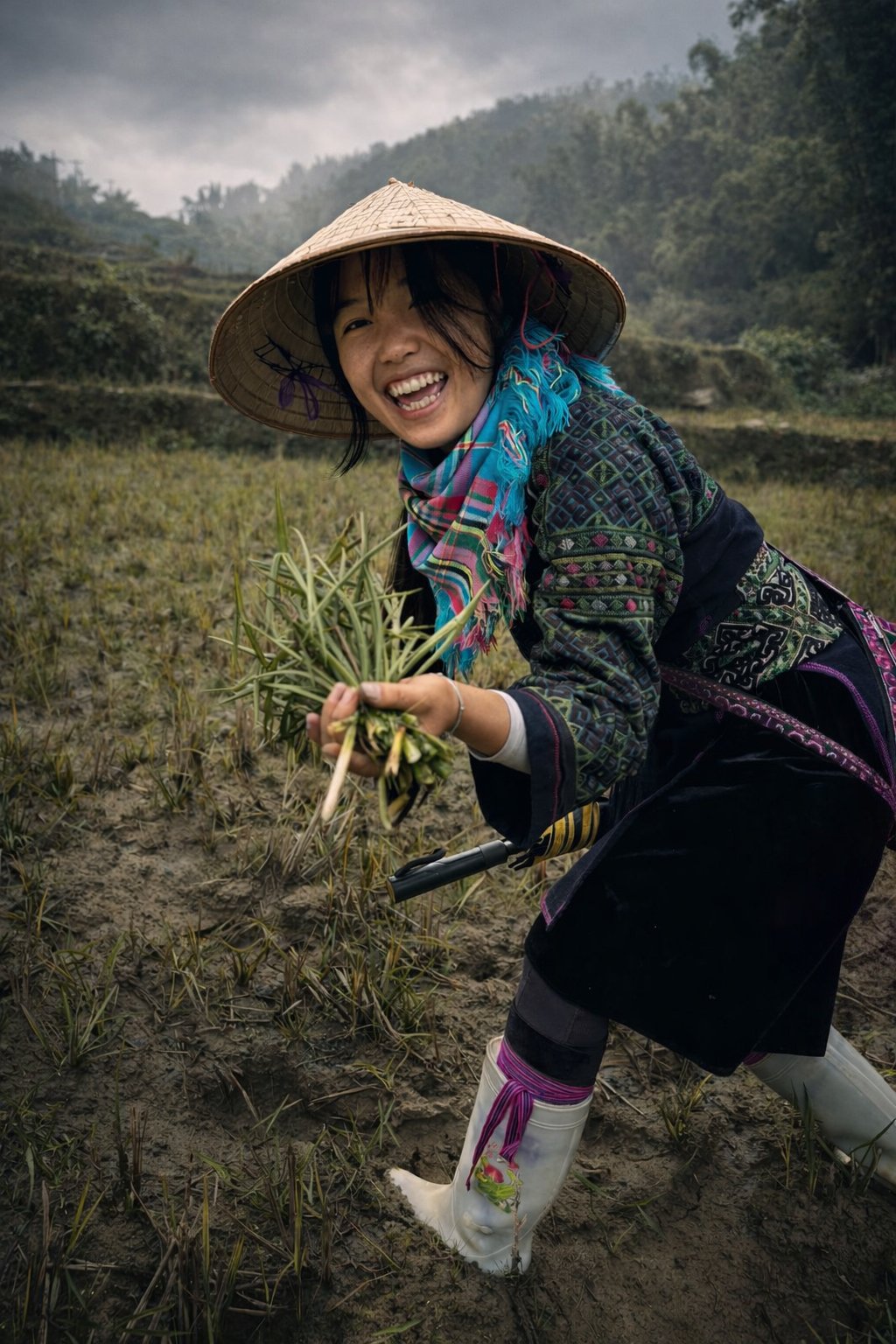
Harvesting wild taro from with a fallow rice paddy.
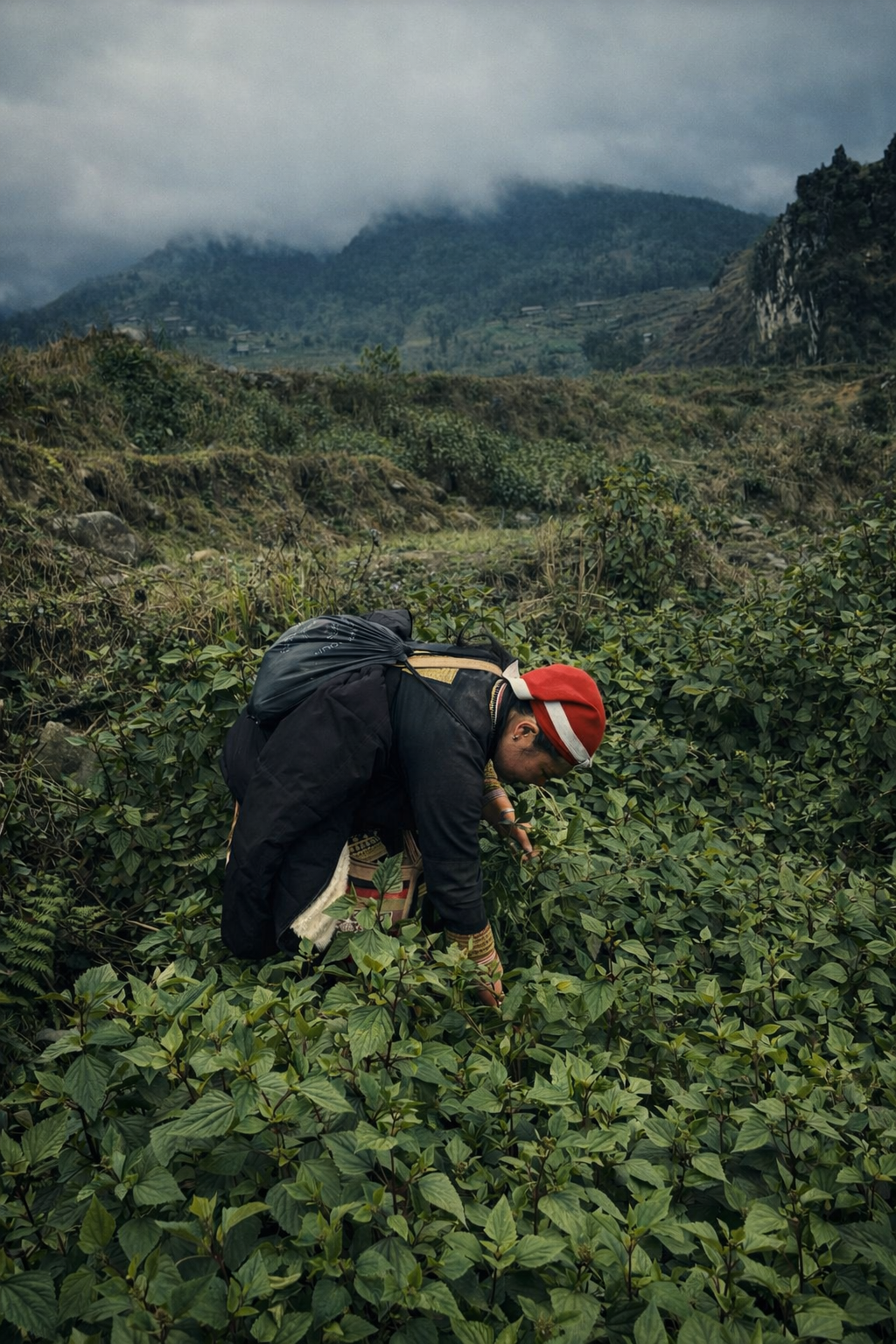
Foraging medicine for use in Red Dao herbal baths.
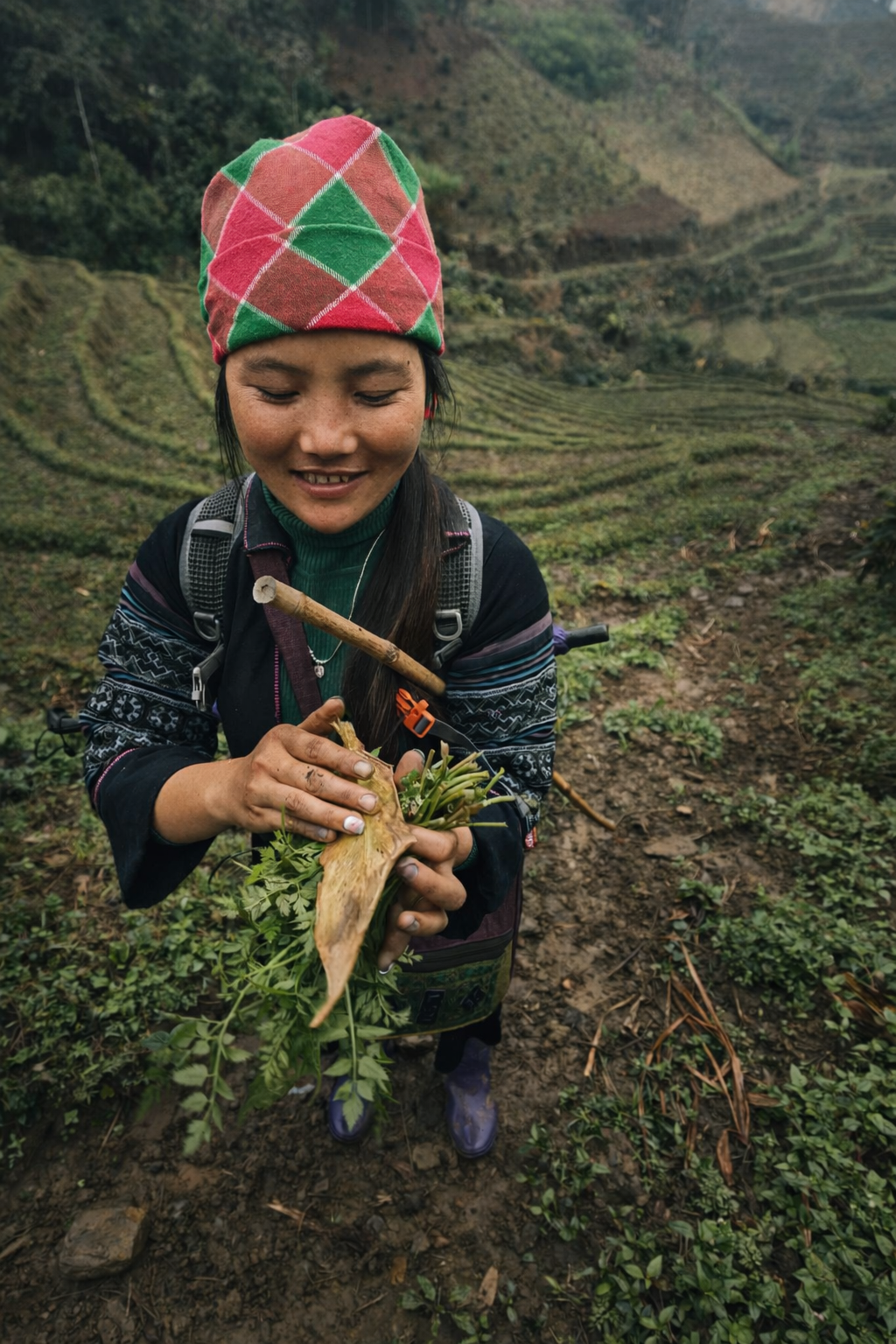
Wild celery harvesting.
A terrace is a mosaic, not a single field
What visitors often see as one continuous landscape is, on the ground, a patchwork of connected micro-habitats. Flooded paddies hold water during the growing season, then soften into muddy fallows after harvest. Bunds and terrace edges catch sediment, support spontaneous greens and become pathways for both people and plants. Irrigation channels and spring-fed ditches remain wet even when fields are drained, offering refuge for edible herbs and water-loving species. Beyond them lie forest edges and agroforestry patches that anchor the terraces ecologically, slowing erosion, protecting springs and supplying food and materials that are essential to village life.
This is part of what makes Sapa’s terrace systems so ecologically rich. Water is guided by gravity rather than forced through large-scale extraction. Soil is held in place by structure, roots and repeated care. Nutrients move through the landscape in loops, not simply through purchased inputs. Even the steepness of the mountains plays a role, creating slight differences in temperature, moisture and exposure from one level to the next. Each terrace holds its own conditions. Each edge becomes an opportunity.
For Hmong and Dao households, this means that farming is never only about the rice standing in the middle of a paddy. It is also about everything that grows beside it, under it, after it and because of it.
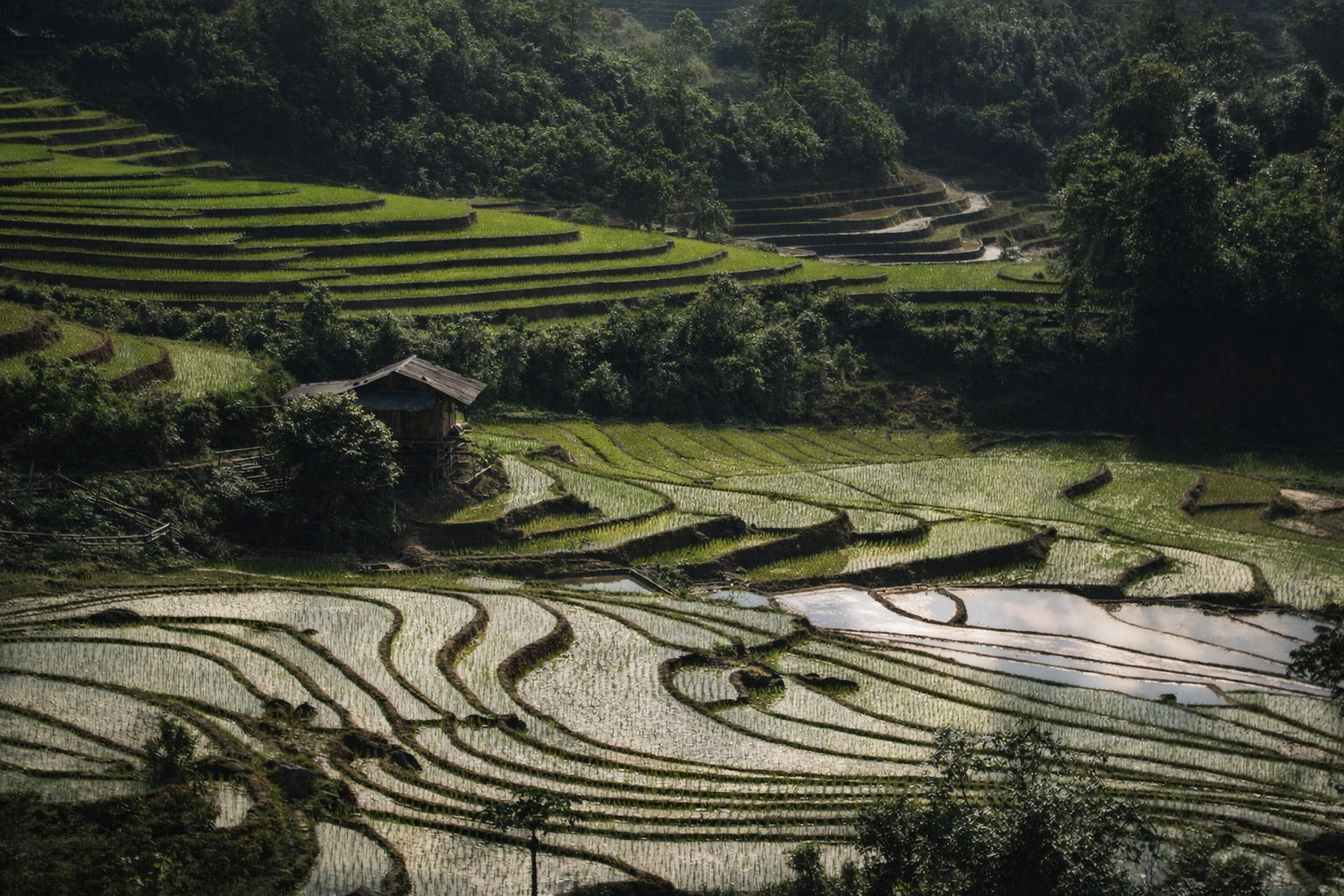
The mosaic of rice terraces in June
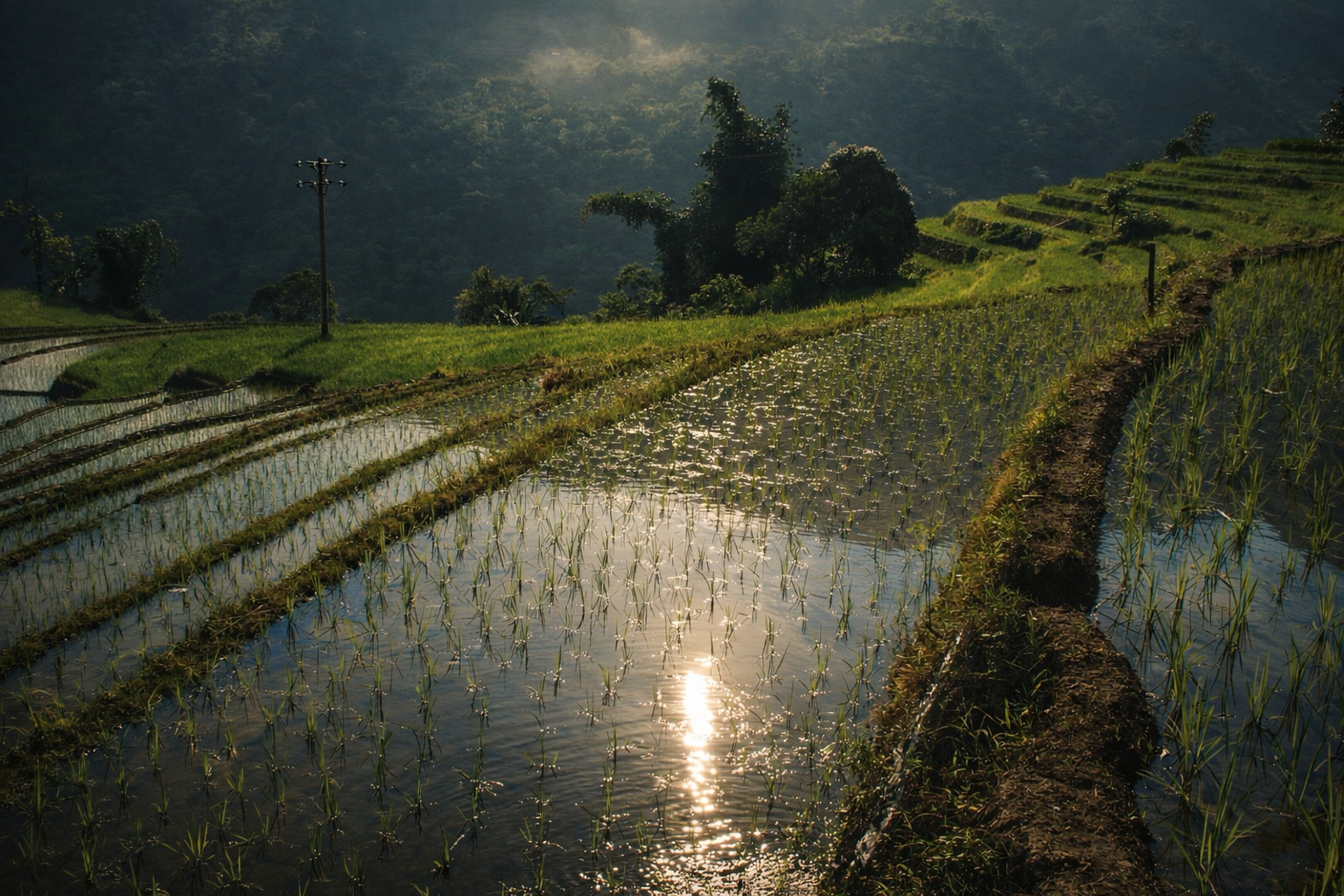
The flooded terraces become home to a variety of unique aquaculture.
Beyond the single rice crop
Mountain households in Sapa have often worked with small landholdings, where farming remains deeply tied to household consumption rather than purely commercial output. That reality shapes the terrace ecosystem profoundly. A field must do more than produce grain once a year. It must help sustain a family across seasons of abundance and leaner months alike.
Rice provides the foundation, the dependable carbohydrate that underpins daily meals and ceremonial food alike. Yet within a rice-based diet there are always nutritional gaps that must be filled by other foods. The terrace ecosystem helps answer that need. Wild and semi-managed greens contribute vitamins and minerals. Wetland herbs bring freshness, scent and medicinal value. Crabs, eels, fish, snails or other opportunistic proteins enrich broths and sauces. Bamboo shoots, mushrooms and taro offer seasonal diversity and resilience when stored grain begins to thin.
Seen this way, the terrace is not organised around a single yield, but around continuity. The goal is not only to harvest rice, but to sustain life. Hmong and Dao ecological knowledge has long been rooted in this broader understanding, where farming is measured not only by how much grain comes in, but by whether the land continues to support many forms of nourishment without being exhausted.
For travellers, many of these foods remain unfamiliar, sometimes even overlooked in favour of the more recognisable or the expected. Yet it is precisely within these lesser-known ingredients that the deeper story of the terraces begins to reveal itself. The textures of water snails gathered by hand, the clean bitterness of freshly cut greens, the earthiness of mushrooms dried and carried through the seasons, all speak of a relationship between people and landscape that is both practical and deeply sensory.
Those who wish to experience this more closely can step into it through our Sapa food tour. Led by local Hmong experts, these journeys move through fields, kitchens and village paths, not as a tasting of dishes alone, but as an introduction to the living food system behind them. Each ingredient is encountered in context, gathered, prepared and understood within the rhythms of the terraces themselves.
What begins as a meal becomes something far richer, a way of seeing how diversity sustains life in the mountains, and how much lies beyond the rice that first draws the eye.
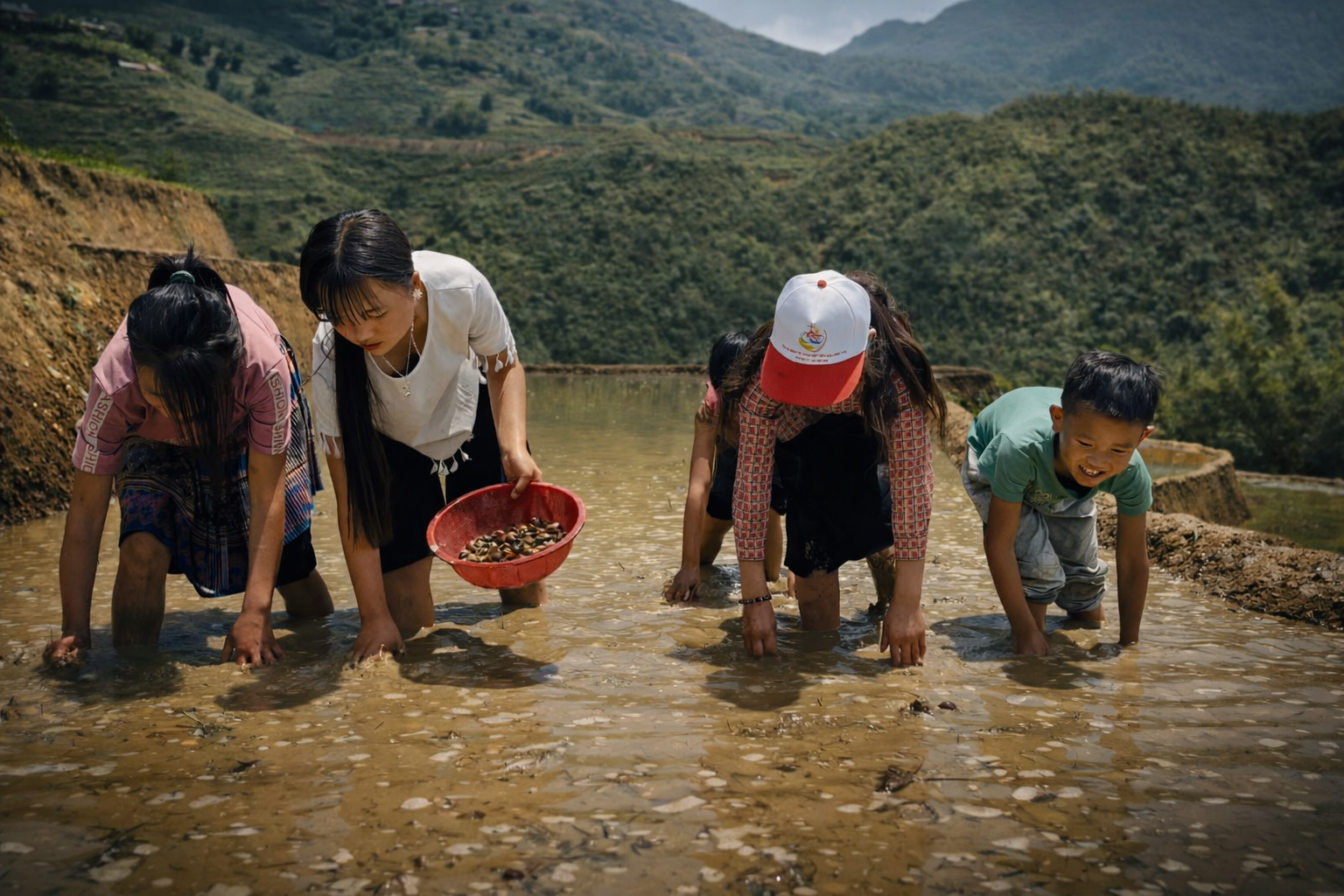
Hmong children collecting snails in the rice paddies.
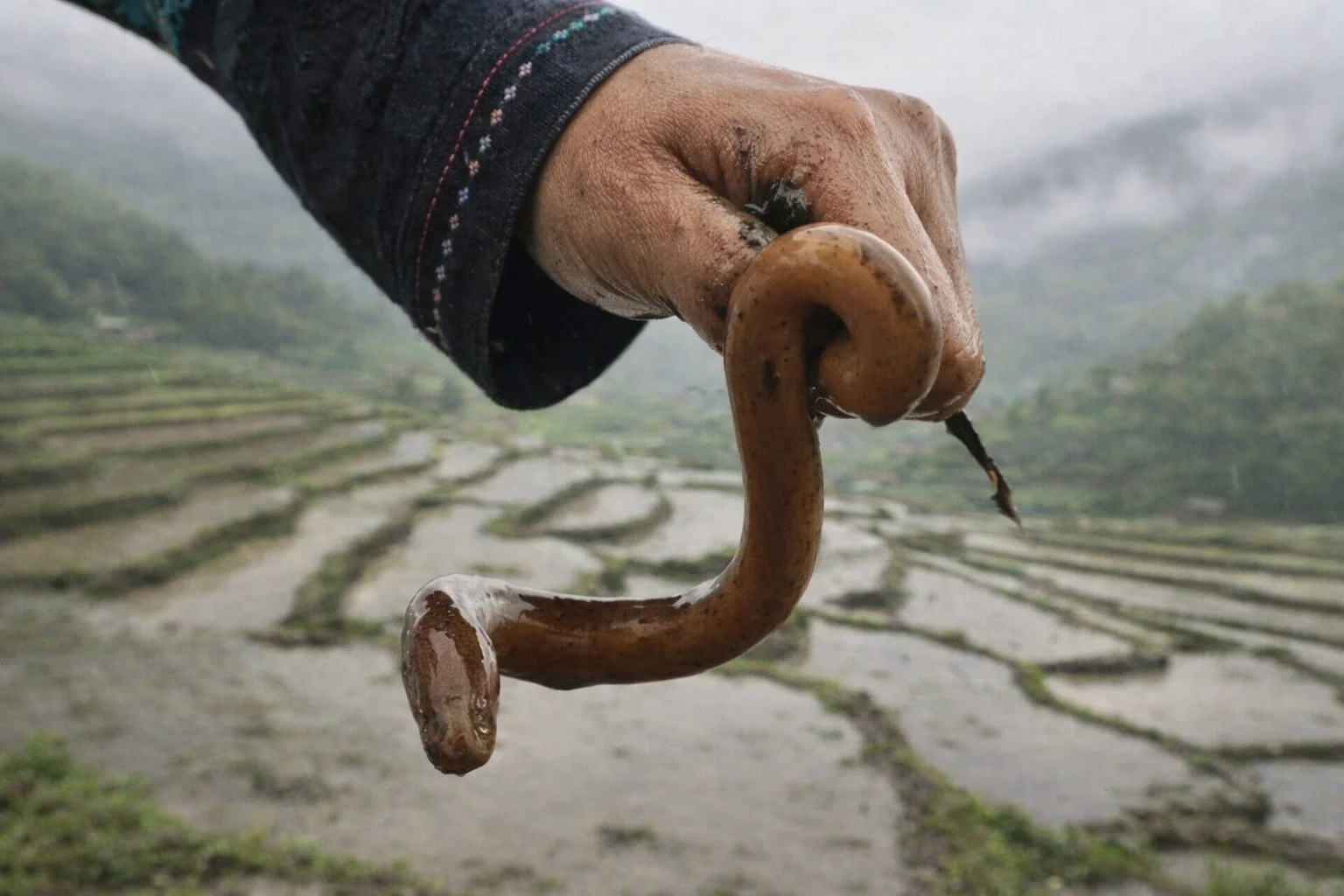
A rice paddy eel. When collected in large numbers, the eels can be prepared as a meal.
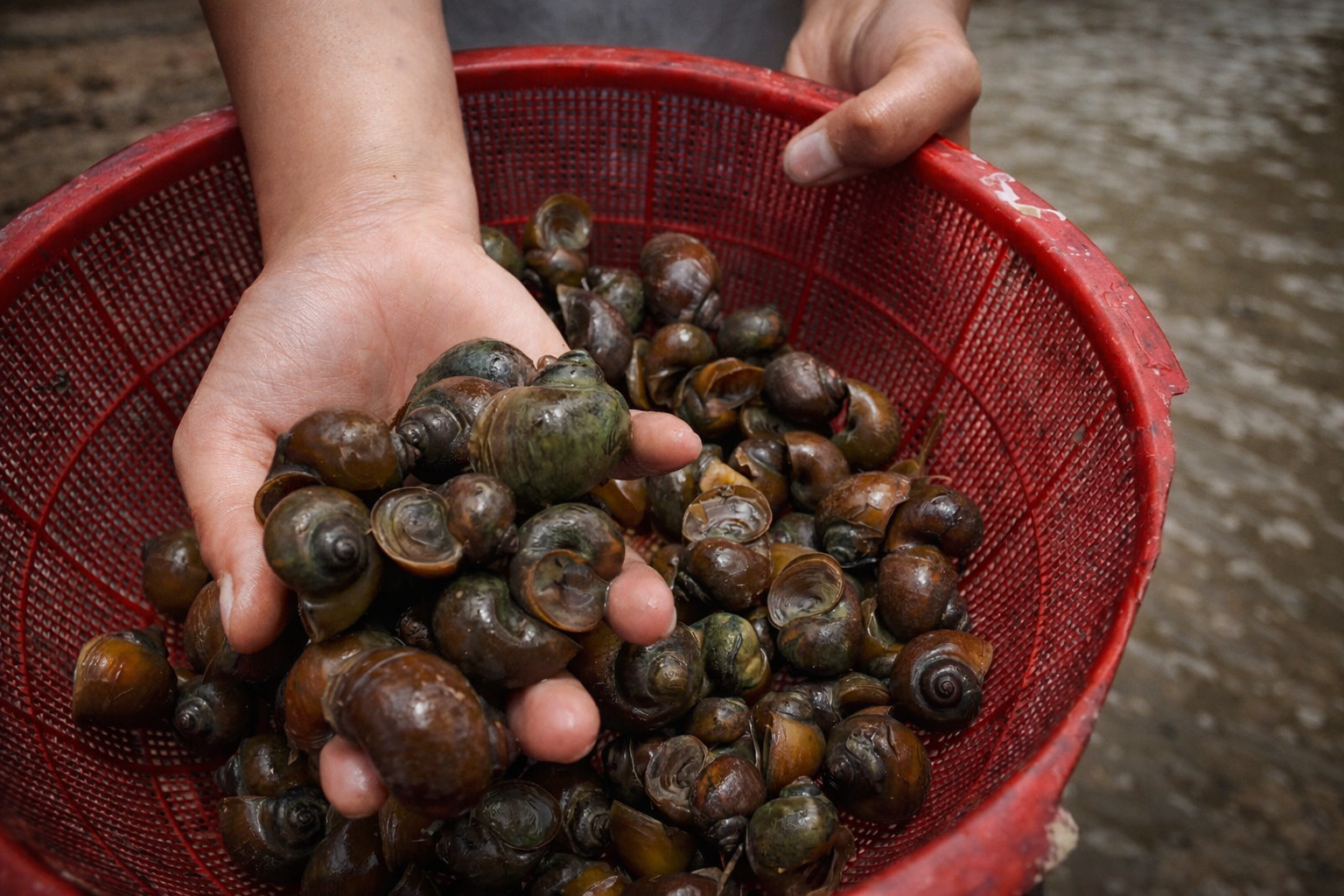
Rice paddy snails collected for food.
The foods hidden in water, mud and terrace edges
One of the quiet lessons of Sapa’s terraces is that food often lives in places outsiders overlook. In the warm, shallow water, edible herbs and semi-aquatic greens thrive with little need for extra land. These plants may be gathered while checking water flow, walking between plots or tending the edges of a field. They are woven into the rhythm of labour itself.
Rice paddy herbs, water-loving greens and other edible plants found in these wet spaces matter because they bring something rice cannot. They offer vitamin C, mineral richness, flavour and medicinal qualities that brighten and balance a meal. They are especially valuable in a highland subsistence system where daily access to diverse vegetables cannot always be taken for granted. Rather than being separate from rice farming, these greens are part of its ecology.
Rice terrace walls play their own role as food margins. These narrow structures are not merely agricultural infrastructure. They are often some of the most diverse parts of the entire system, catching splashed sediment, holding moisture and creating space for spontaneous or lightly managed growth. Here, people distinguish carefully between plants that threaten rice, plants that can be eaten and plants worth leaving because they help stabilise soil or support insect life. This practice of selective tolerance is one of the deepest expressions of terrace agroecology. Removing everything that is not rice is counterproductive when many of the plants that grow naturally have a purpose themselves.
Knowledge carried in the act of gathering
To understand how these landscapes sustain life, it is necessary to move beyond the visible and into the realm of practice. Among Hmong and Dao communities, knowledge is not abstract or separate from daily life, but embedded in movement, in gesture, in the quiet decisions made while walking a terrace edge or bending to harvest a plant. What appears simple to an outsider often conceals a depth of ecological reading shaped over generations.
A woman gathering greens along a bund is not merely collecting what is available. She is reading the condition of the soil, the recent flow of water, the stage of regrowth and the needs of her household. She selects with intention, leaving certain plants to recover, taking others at their peak, recognising which will nourish and which will heal. The act is at once practical and deeply attuned, shaped by memory, taste and an understanding of tomorrow as much as today.
This knowledge extends across the landscape. Men and boys may move through the wet fields in search of eels or small fish, reading the water with equal familiarity, while forest edges are approached with an awareness of seasonality that determines when shoots are tender or when fungi will emerge after rain. Food, in this sense, is never separate from place. It is a dialogue between people and terrain, carried out through attention and care.
The terrace as living wetland
During the growing season, the terraces transform into a sequence of shallow wetlands, each holding water that moves slowly from one level to the next. This movement is neither hurried nor wasteful. It follows gravity, guided by human hands yet aligned with the natural contours of the mountain, creating a system that is both cultivated and ecological.
Within this watery world, life gathers in quiet abundance. Aquatic plants root themselves in the soft mud, insects skim the surface, and the edges of each paddy become zones of fertility where moisture lingers and diversity thrives. The mud itself is alive with microbial activity, breaking down organic matter and returning nutrients to the soil, sustaining fertility without reliance on external inputs.
What emerges is not a field in the conventional sense, but a layered environment where water, soil and living organisms interact continuously. The terraces hold, slow and distribute resources, allowing each level to benefit from what passes through it. Their productivity lies not in intensity, but in balance, in the ability to sustain multiple forms of life within a carefully managed system.
A kitchen shaped by the landscape
If the terraces are read through the rhythms of daily life, their diversity becomes most visible in the kitchen. Rice remains central, steady and essential, yet it rarely stands alone. Around it gathers a shifting constellation of foods that reflect the season, the weather and the labour of the household.
There may be tender greens gathered that morning, still carrying the cool dampness of the field. There may be bamboo shoots sliced and prepared with care, their bitterness softened through knowledge passed down over time. Mushrooms, collected in moments of abundance, might be dried and stored, later rehydrated to bring the scent of the forest into a quieter season. Taro, lifted from moist soil, provides a reserve that speaks of foresight and resilience.
Occasionally, the wet fields themselves offer small additions, a crab, a handful of snails, something that deepens the flavour of a broth and adds substance to a meal. None of these elements dominate, yet together they create a sense of completeness, a meal that is balanced not through excess, but through diversity.
What becomes clear is that nourishment here is cumulative. It emerges from many small contributions, gathered across spaces and moments, rather than from a single source. The terrace feeds not only through rice, but through everything that surrounds and accompanies it.
Where terraces meet forest
The terraces do not exist in isolation. Above them, the forested slopes hold the sources of water that feed the entire system. Springs emerge, channels carry their flow, and the paddies receive and redistribute what begins higher in the mountain. Leaf litter, shade and the stability of rooted slopes all contribute to the health of the terraces below.
From these forest margins come foods that complete the picture. Bamboo shoots push through damp soil after rain, mushrooms appear in shaded ground, spices such as black cardamom grow in the understory. These are not separate from terrace life, but part of the same ecological continuum, linking cultivated land with wilder spaces.
To care for the terraces is therefore to care for the forest. The relationship is reciprocal, each depending on the other for continuity and resilience. This understanding is rarely articulated in formal terms, yet it is present in the way land is used, respected and maintained.
Seeing beyond the view
For those who arrive in Sapa, the terraces often first appear as a spectacle, an unfolding pattern of green or gold across the mountainside. Their beauty is immediate, yet it is only an entry point into a far deeper story.
Walking slowly through these landscapes begins to reveal another layer. The scent of wet earth rises after rain. Herbs release their fragrance underfoot. Smoke drifts from a kitchen where gathered greens are being prepared for the evening meal. A basket rests at the edge of a field, filled not only with rice, but with the quiet harvest of everything that grows alongside it.
To experience the terraces in this way is to move beyond observation into encounter. It is to recognise that each element, each plant, each movement of water carries meaning shaped by those who live here. It is also to understand that such knowledge is not readily visible from a viewpoint, but shared through time, trust and presence.
This is the spirit in which we invite travellers to walk with us at ETHOS. Through our treks, journeys unfold alongside Hmong and Dao partners who open their fields, kitchens and stories with generosity and care. These are not routes designed simply to pass through a landscape, but to dwell within it, to listen closely, and to encounter the terraces as living worlds shaped by human knowledge and mountain ecology.
In choosing to travel this way, the terraces begin to shift from scenery into relationship. What once seemed distant becomes immediate, textured and human, offering not only a view, but an understanding that lingers long after the path has ended.
A more complete understanding of abundance
What these landscapes ultimately offer is a different understanding of abundance. It is not defined by scale or uniformity, but by diversity and continuity. It is found in the ability of a place to provide across seasons, through variation, through attention to detail rather than simplification.
Rice remains at the centre, steady and indispensable. Yet it is supported by a wider system that ensures life continues even when conditions shift. Greens, herbs, shoots, fungi and preserved foods all contribute to a form of resilience that is both practical and deeply rooted in knowledge.
The terraces endure not because they produce one thing efficiently, but because they sustain many things carefully. They are shaped by people who understand that survival in the mountains depends on relationship, on reading the land closely, on working with its rhythms rather than against them.
To see this clearly is to understand that these landscapes are not only beautiful, but profoundly intelligent. They are living systems, held together by care, memory and an enduring conversation between people and the mountains they call home.
