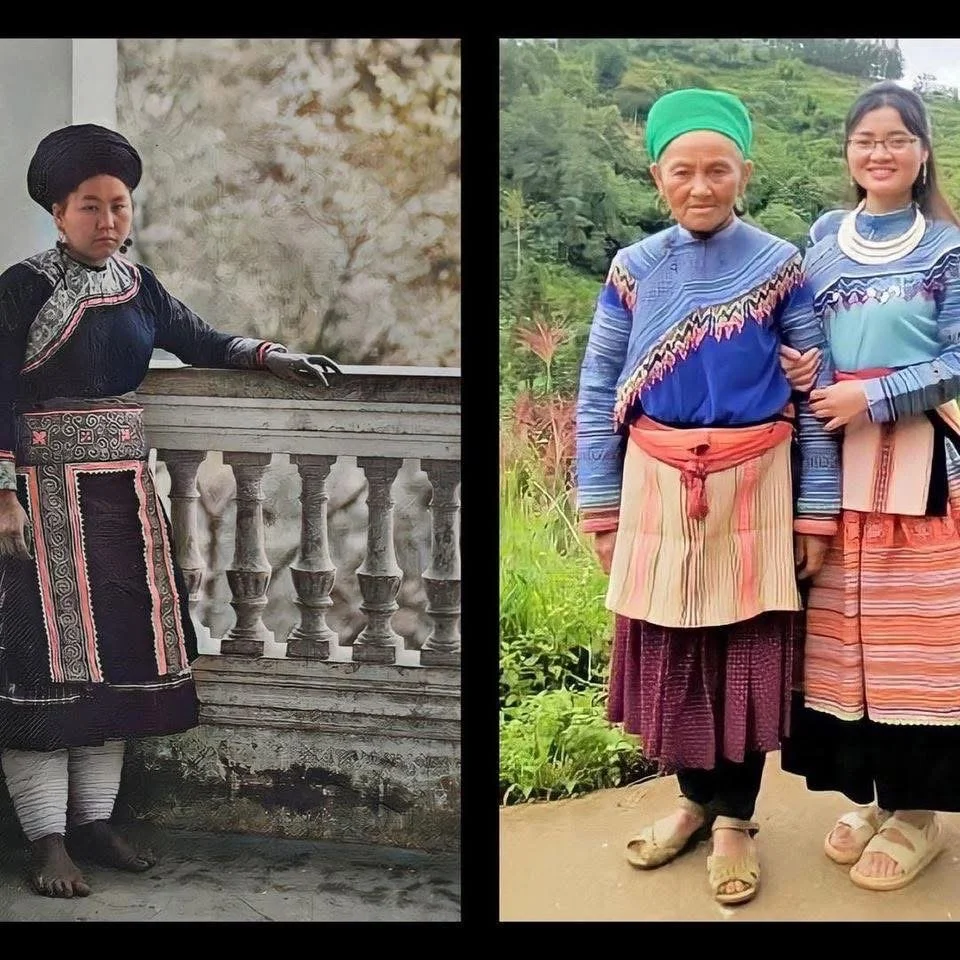
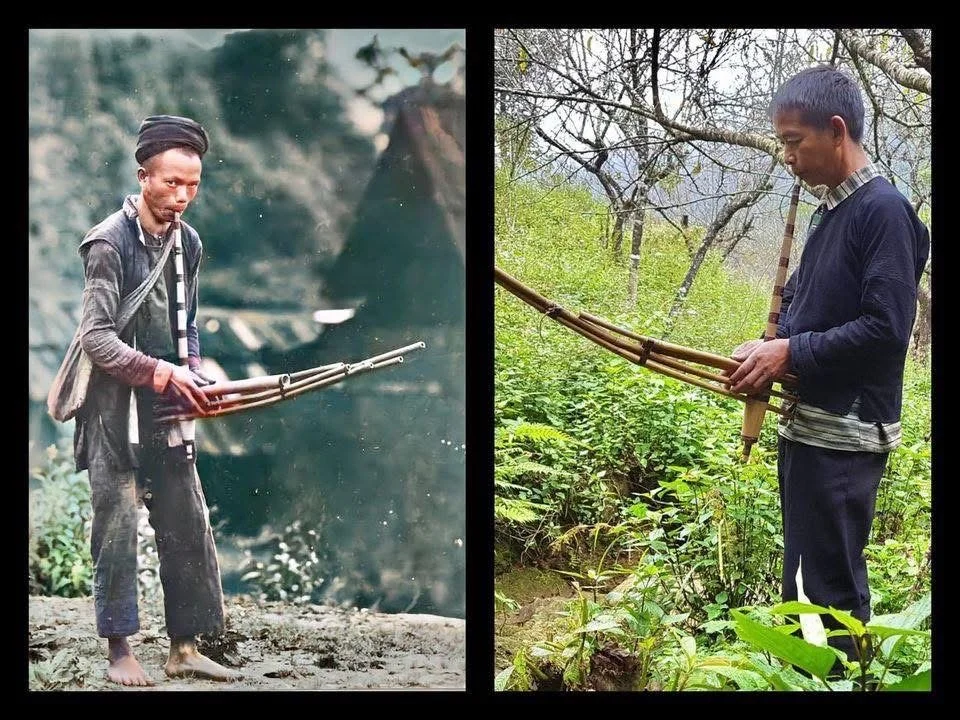
Insights and Stories from Sapa and the Northern Borderbelt provinces of Vietnam.
The Sapa I First Knew: Memories from a Mountain Town in 1998
Before expressways, cable cars and crowded viewpoints, Sapa was a quiet mountain town where the rhythms of life followed the seasons rather than tourism. I first arrived in 1998 as a young research assistant working with Frontier, The Society for Environmental Exploration, on biodiversity surveys that would later help inform the creation of Hoàng Liên National Park.
Over the following thirteen weeks, I lived under canvas, crossed rivers on foot, shared meals with Hmong families, explored forests few foreign visitors had seen and discovered that the greatest lessons often came not from scientific fieldwork, but from the people who welcomed us into their world. This is a personal account of a very different Sapa, where the market still served mountain communities, children came to camp to practise English and friendships formed in the rain have endured for nearly three decades.
Long before the global recognition, cable cars and crowded check in sites, Sapa was a quiet mountain town where livestock wandered the streets, the market belonged to local families, and days were measured by the weather. I arrived as a young environmental scientist expecting to study forests, but instead, I found friendships and memories that have stayed with me for nearly three decades.
Arriving at the End of the Road
Most travellers reached Sapa in those days aboard the overnight train from Hanoi. They would wake to the rhythmic clatter of train wheels as dawn broke over the Red River Valley before stepping onto the platform at Lào Cai, where battered minibuses and ageing Russian UAZ-469 “jeeps” waited for the slow climb into the mountains. For many, that journey became part of the romance of visiting Vietnam's northern frontier.
Our journey was rather less romantic. Instead of boarding the train, our small team climbed aboard an elderly DeSoto bus in Hanoi. Time had not been especially kind to it. I remember joking that it had more breakdowns than functional windows, although by the end of the journey that no longer felt like much of an exaggeration. The timetable confidently promised we would reach Sapa in around twelve hours. Twenty-two hours later, we finally did. Progress was measured less by kilometres than by mechanical failures. Every few hours the engine would begin protesting on another long climb. Steam escaped from beneath the bonnet, the driver would ease the bus onto the roadside with a resigned expression, and we would all climb out while he disappeared beneath the engine with an assortment of spanners and remarkable optimism. Nobody seemed especially surprised. Passengers stretched their legs, wandered around nearby villages or simply sat in the shade waiting for another improvised repair.
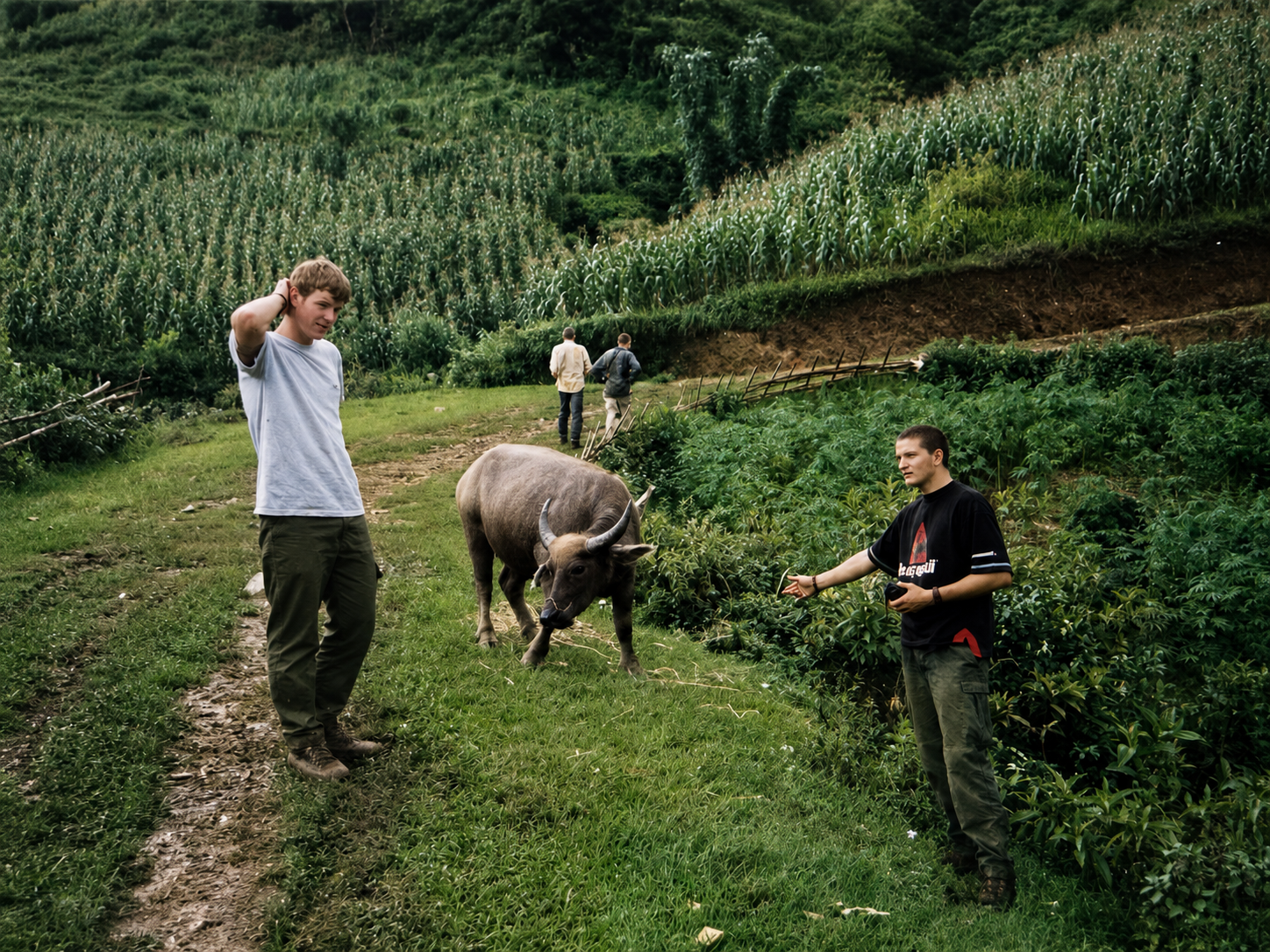
As the hours drifted by, the mountains ahead drew steadily closer. Roads became narrower and rougher, twisting above deep valleys where clouds hung low over rice terraces. Water buffalo wandered across the road with complete indifference to our presence, while small landslides from the previous night's rain occasionally forced another unscheduled stop. The journey seemed to settle into its own unhurried rhythm with the mountains dictating the pace. By the time we eventually reached Sapa, I was dusty, stiff and sleep deprived. A dense mist had settled over the town like a blanket. I stepped down from the bus, took a deep breath of cold mountain air scented with damp earth and immediately forgot how long the journey had taken.
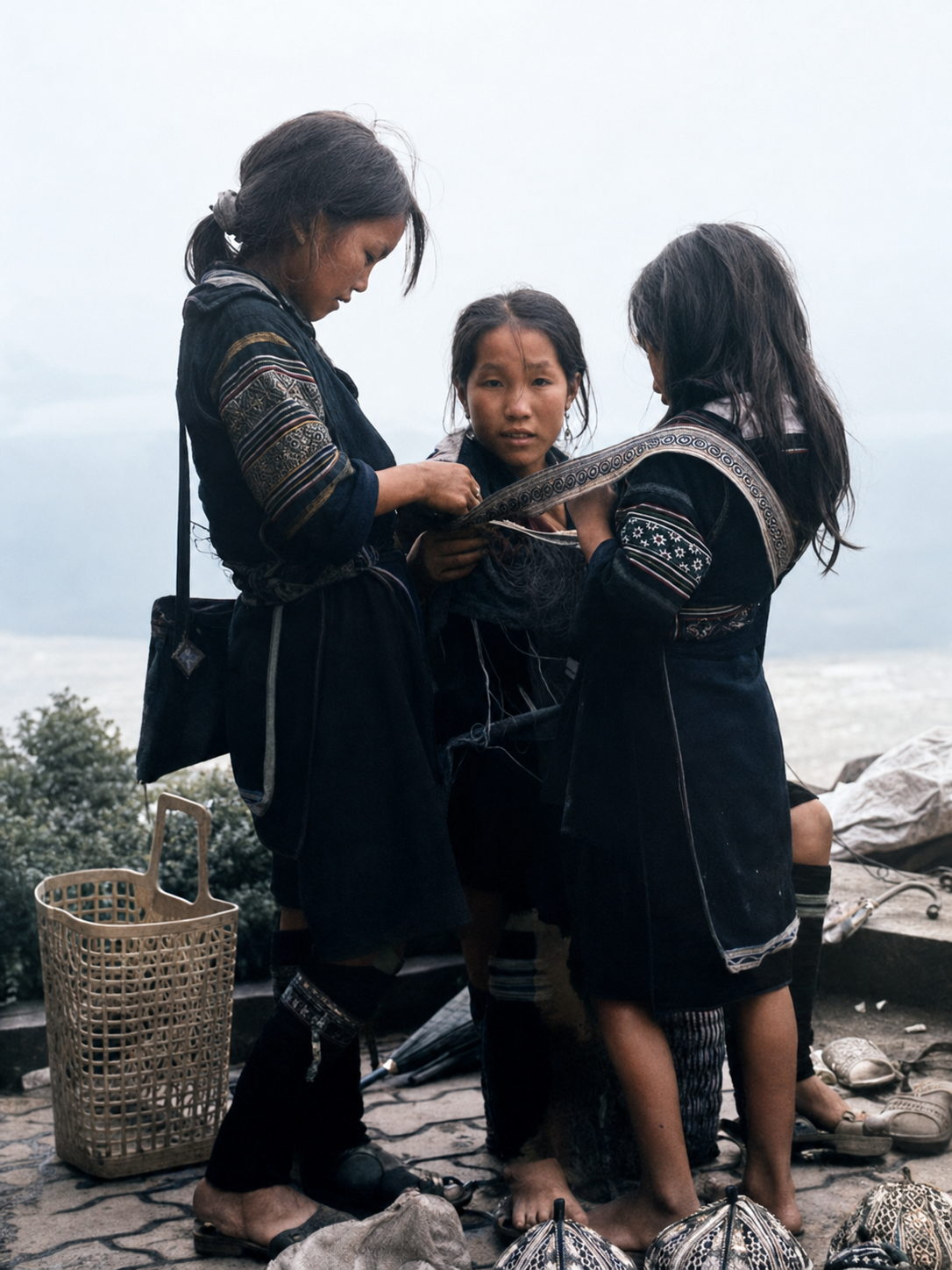
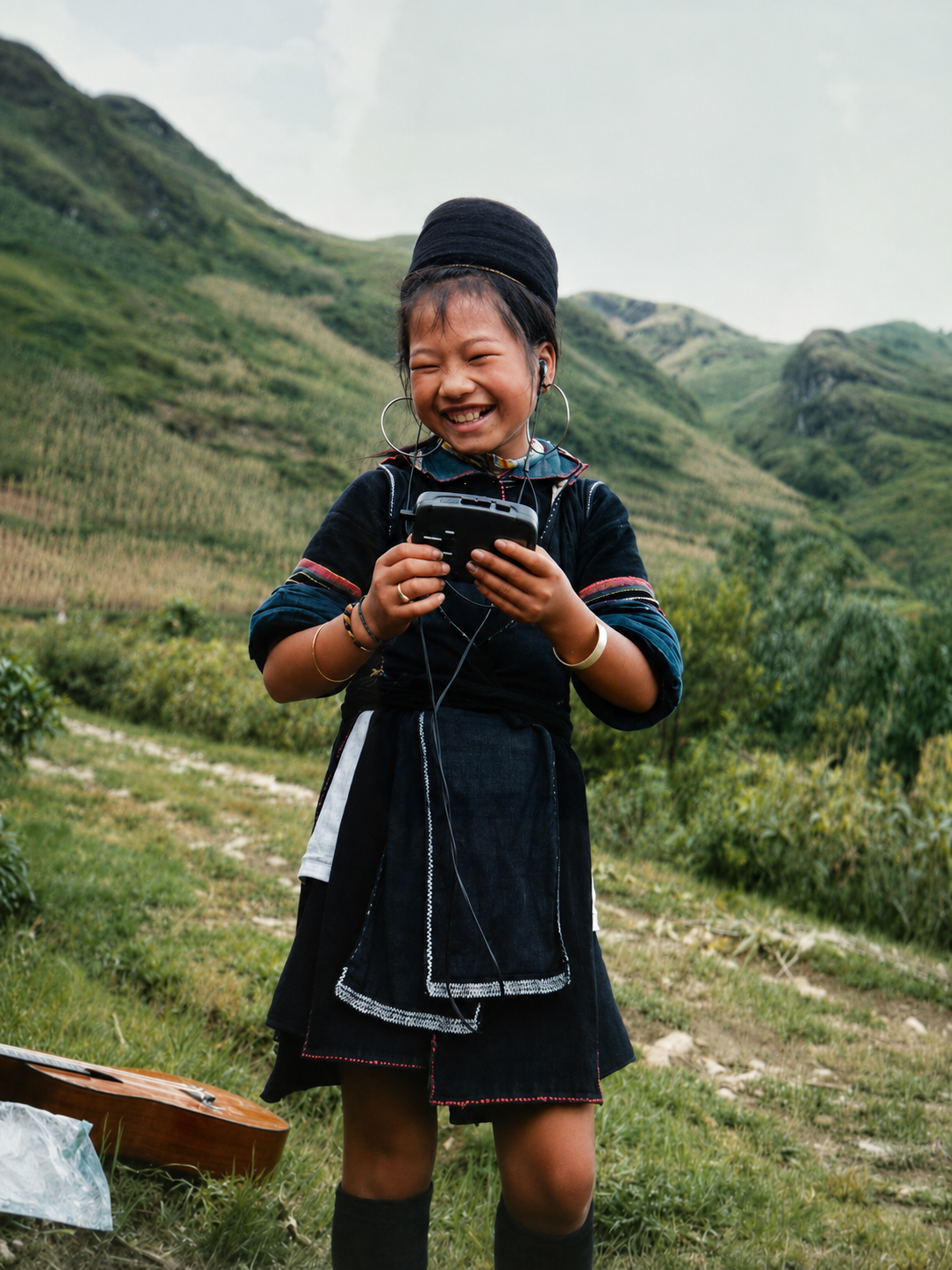
The first people to welcome us were not hotel staff or officials, but a small group of Hmong girls who emerged from the mist with bright smiles and an eagerness to practise their English. Their vocabulary consisted of only a handful of phrases, learned from passing travellers but their confidence was infectious. Before I had even found my bearings, they wanted to know my name, where I had come from and whether I would be staying for long. As it turned out, I would.
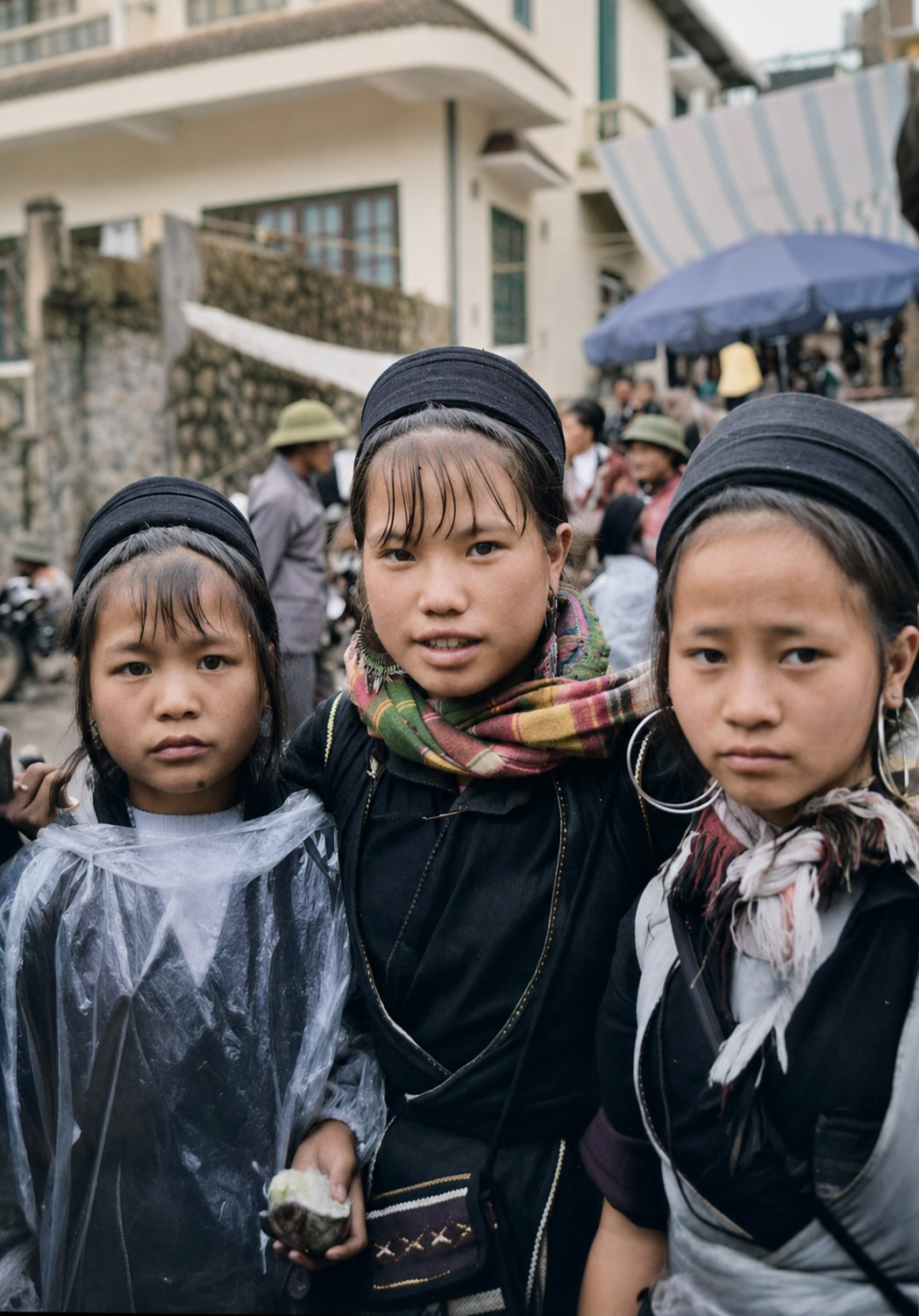
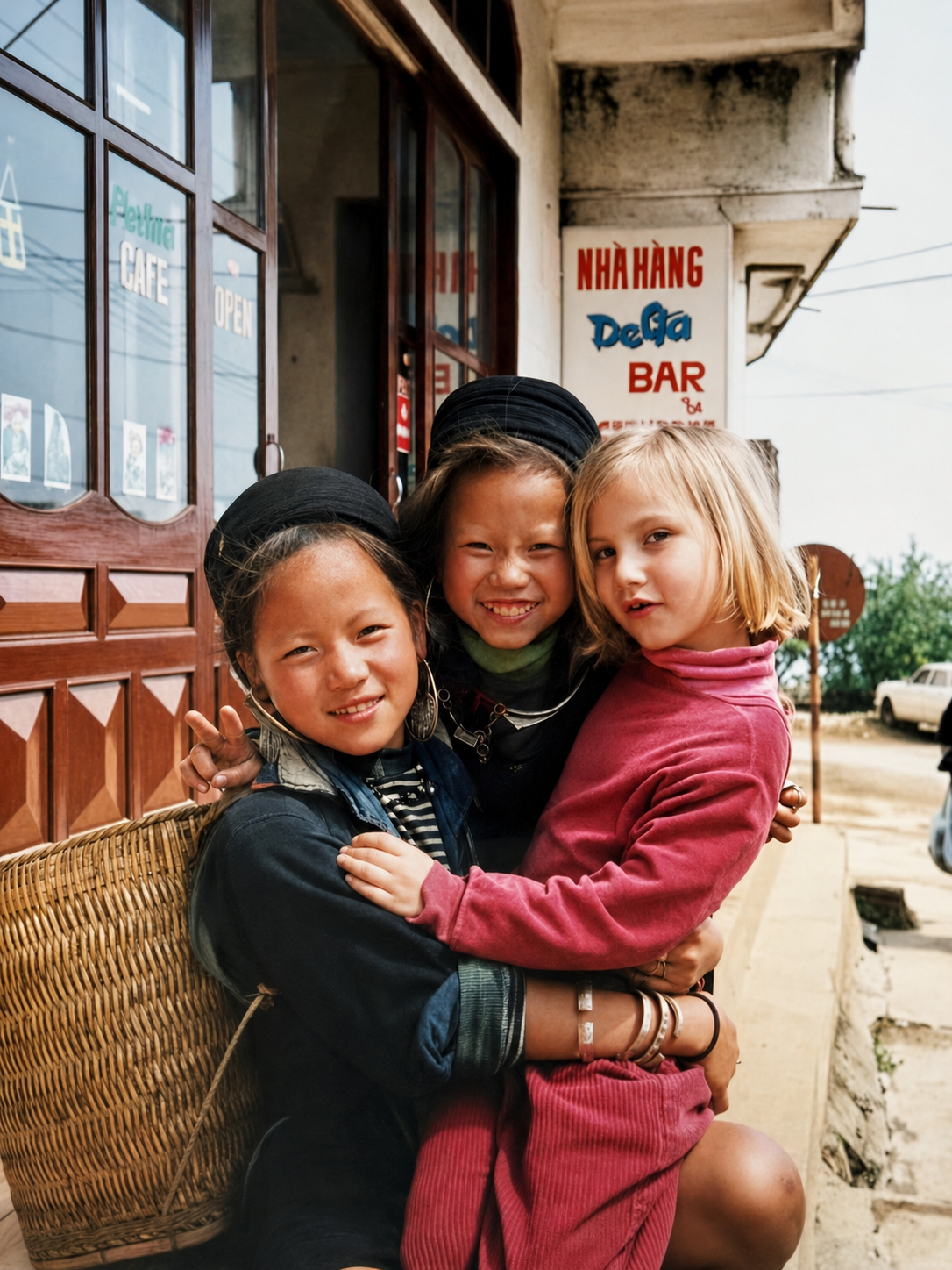
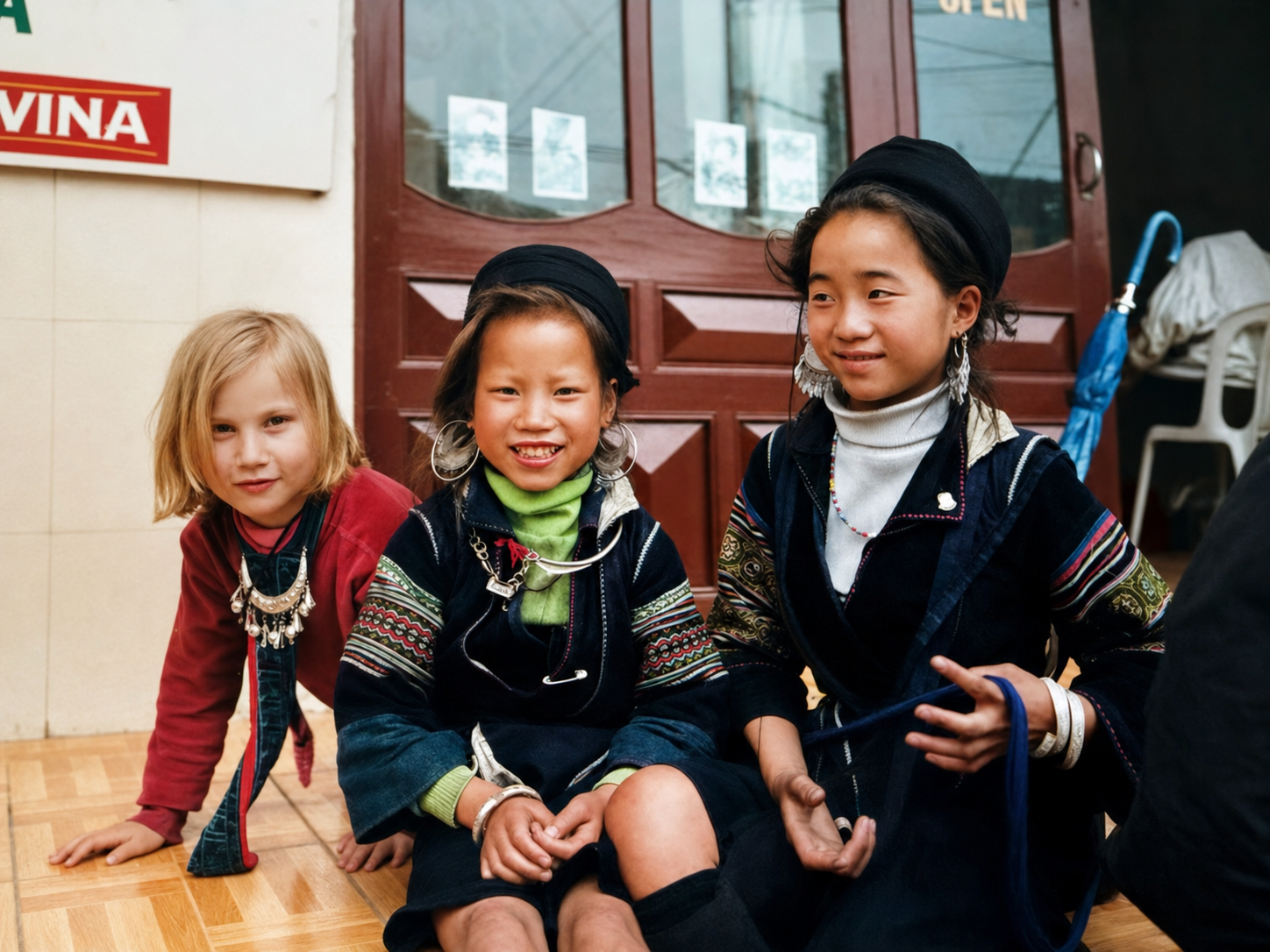
Three young Hmong girls at Sapa Market in 1998. For many children, market day was as much a social occasion as a commercial one, bringing together friends and families from villages scattered across the surrounding mountains. Image courtesy of Sean Adams ©
I had arrived in Sapa as a young environmental scientist and research assistant with Frontier, The Society for Environmental Exploration. Our team was working alongside Vietnamese and other international scientists on one of the first comprehensive modern biodiversity surveys of the Hoàng Liên Nature Reserve, documenting the remarkable forests and wildlife that would later help inform the creation of Hoàng Liên National Park. At the time, though, I wasn't thinking about history or conservation policy. I was simply a young man with a rucksack full of clothes, standing in a mountain town unlike anywhere I had ever seen before.
My first clear landmark was the old stone church, grey against an even greyer sky. Long before it became the polished focal point of a busy tourist town, the church stood weathered and worn, with loose masonry and piles of stone scattered beside its entrance. Everything beyond the church seemed softened by cloud. Little shopfronts, narrow lanes, grazing horses and figures wrapped in indigo appeared briefly before dissolving into the morning. There was no grand entrance, no busy transport hub and certainly no sense that I had arrived somewhere famous. The overwhelming feeling was simply one of distance. It seemed as though I had travelled to the end of the road, and would very soon be travelling a little beyond it.
That sense of remoteness is what I remember most vividly. Before I knew the names of villages, before I understood the forests or met the people who would become lifelong friends, Sapa introduced itself through silence, mountain air and the reassuring feeling that life here followed rhythms very different from those I had left behind.
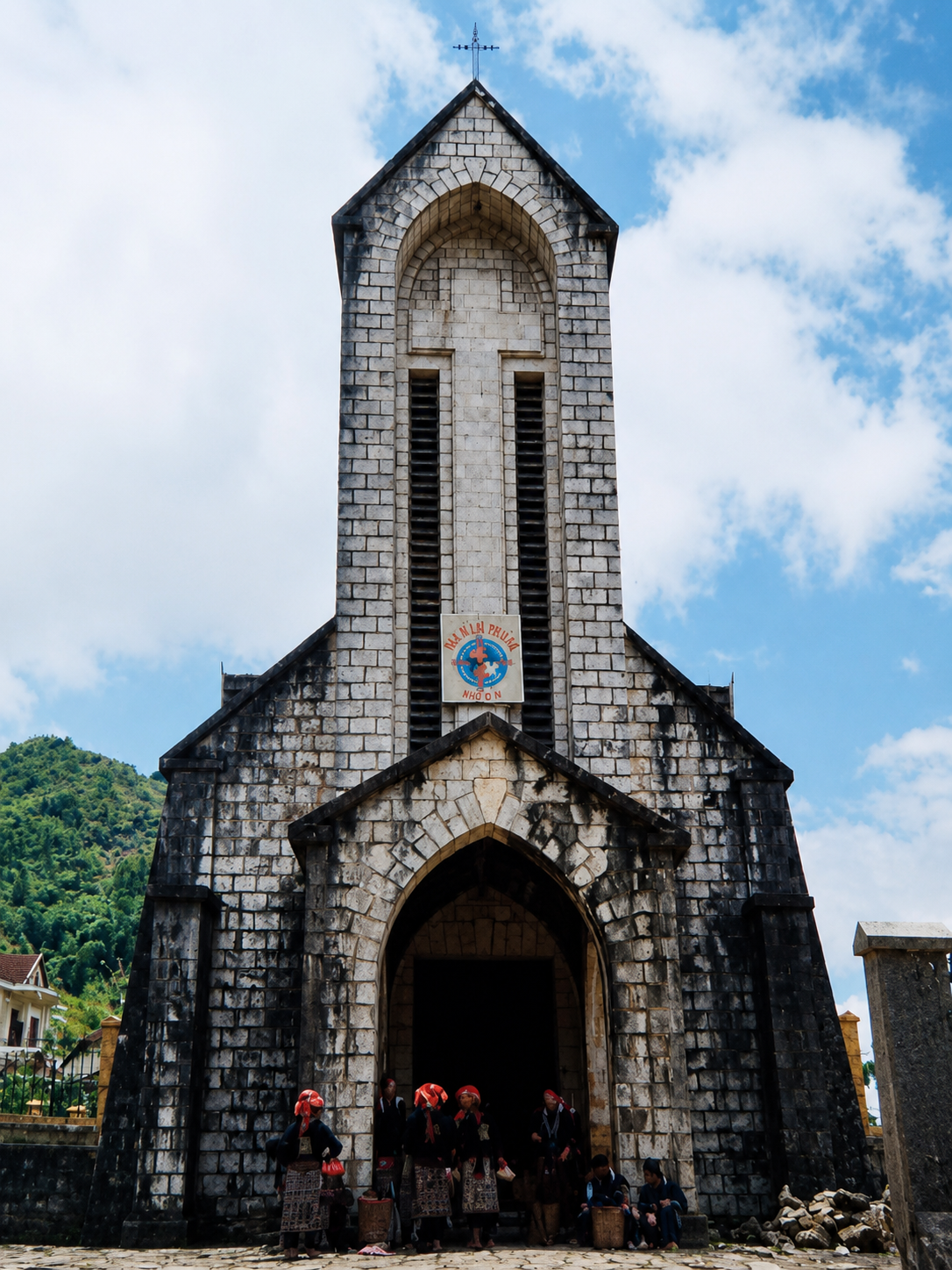
The old stone church photographed in 1998. Time and the mountain climate had left their mark, with weathered masonry and rubble lying beside the entrance, reflecting a building that served a small mountain community rather than the centrepiece of a major tourist destination.
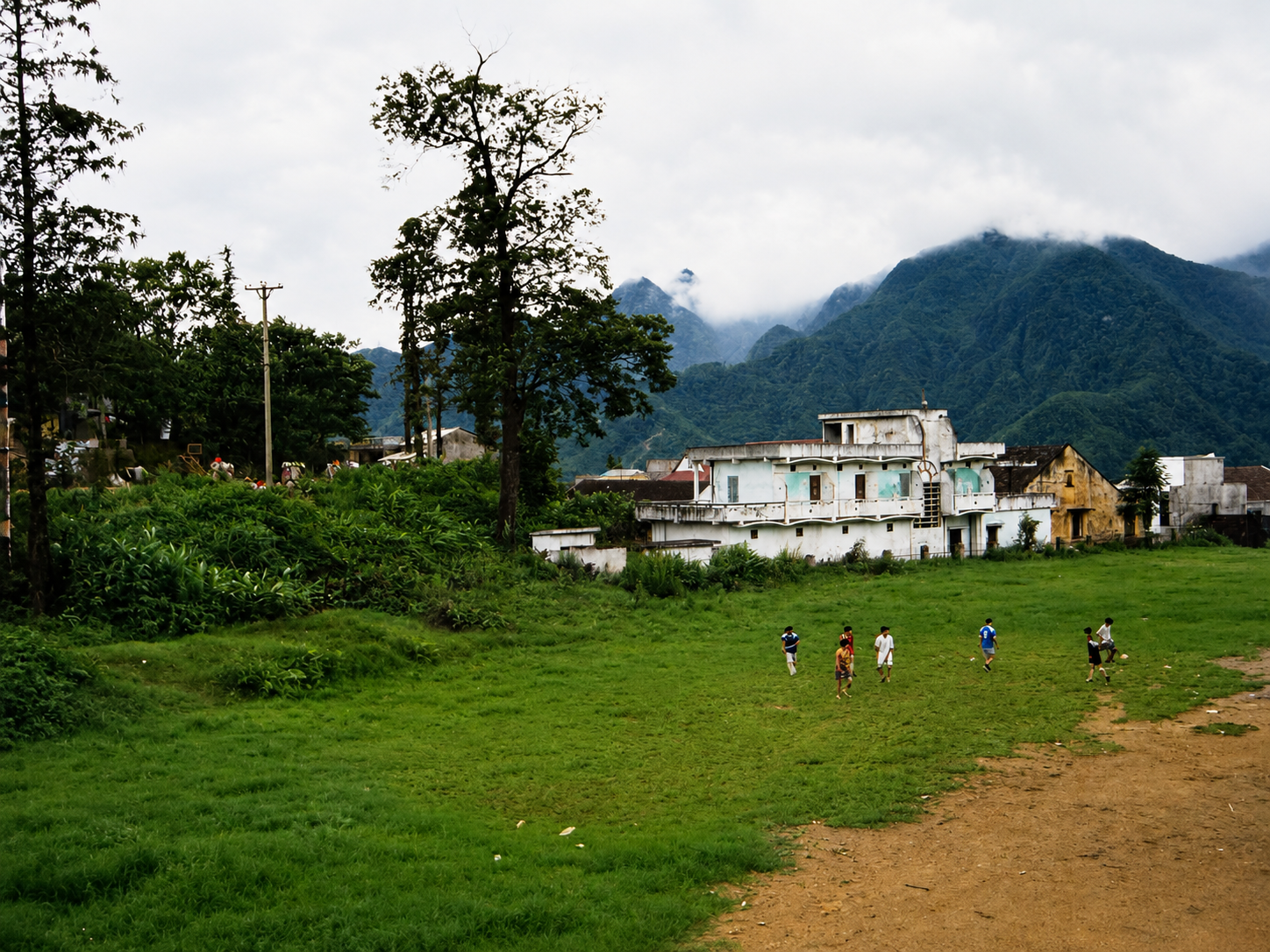
Long before it became Sapa's main public square, this open field served far more practical purposes. Horses and buffalo grazed here, while the town's young people occasionally transformed the rough ground into an improvised football pitch.
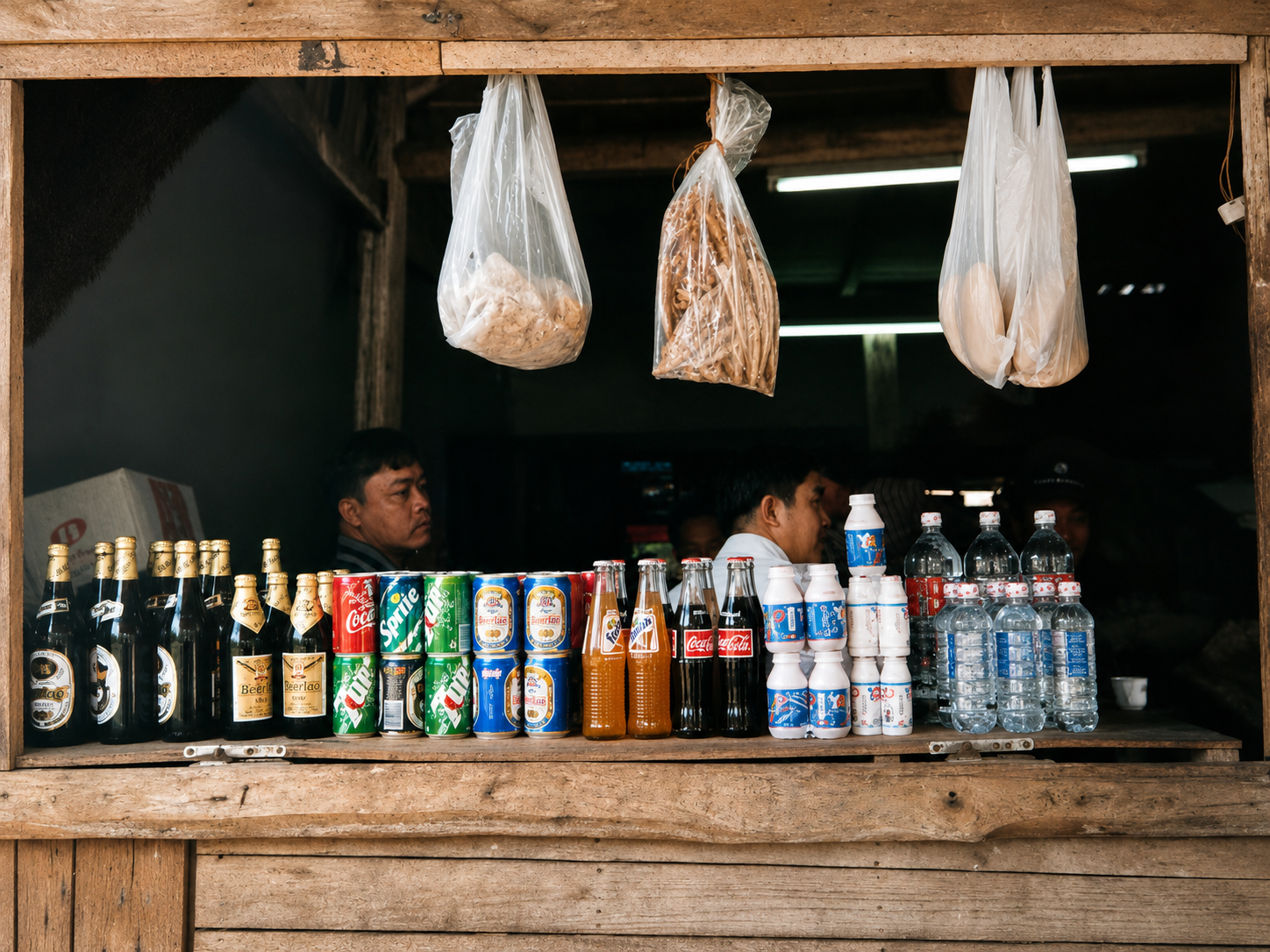
A simple family-run shop in Sapa displaying drinks, snacks and everyday essentials. Small businesses like this supplied local families, researchers and the handful of visitors who passed through town, offering a glimpse into everyday life long before modern convenience stores and cafés appeared.
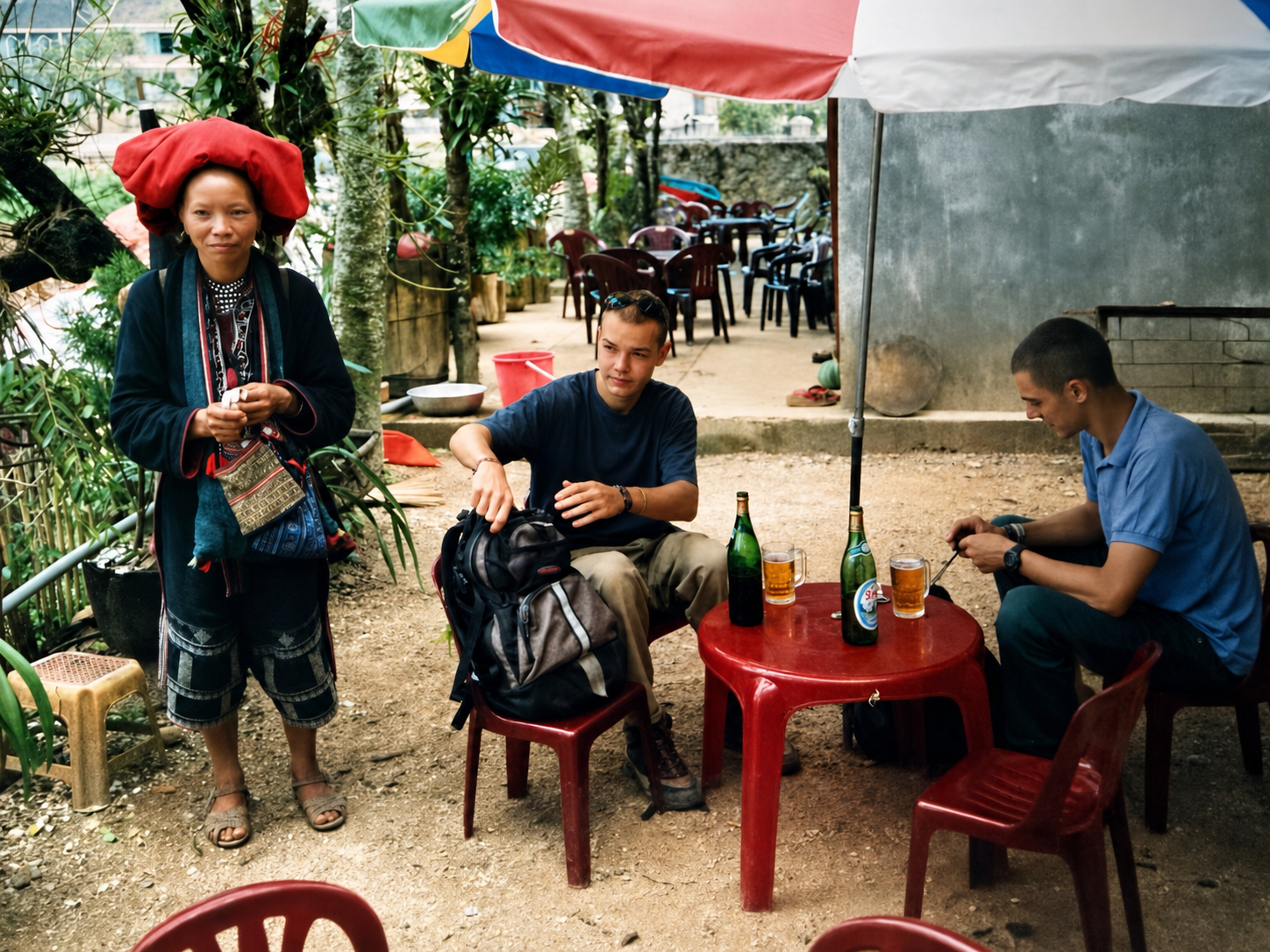
A chance encounter outside a small café in Sapa. In 1998, it wasn't unusual for local Dao people and foreign visitors to stop and chat over a bottle of Lào Cai beer or a cup of tea. With so few tourists in town, conversations often happened naturally, driven more by curiosity than commerce.
A Town That Could Fit in a Single Walk
It is difficult to explain to first-time visitors today just how small Sapa once felt. Within a few days I realised I could wander from one end of town to the other in less than ten minutes. There were no sprawling streets, no rows of hotels climbing the hillsides and no streams of coaches arriving throughout the week. The town occupied a modest shoulder of the mountain, surrounded almost immediately by rice fields, woodland and villages connected by narrow footpaths.
Accommodation was surprisingly limited. The Phương Nam Hotel became something of a sanctuary for our research team whenever we escaped the forest long enough to enjoy a hot shower. Auberge de Chapa welcomed adventurous travellers willing to linger for a few days, while Cat Cat Hotel offered simple rooms overlooking the valley. Scattered among them were a handful of modest guesthouses, many family-run and seldom mentioned in guidebooks. Above the town, builders were still at work on the Victoria Sapa Resort. Even then there was quiet anticipation surrounding the project, its elegant colonial-inspired architecture hinting at a different future for the mountain town.
The streets themselves belonged as much to animals as they did to people. Water buffalo ambled through gravel lanes with complete confidence and horses grazed on the rough grass where Sapa Square now hosts festivals and performances. Back then it was little more than an uneven football field. We even organised a match there against a team from Bắc Hà, whose players travelled for hours through the mountains only to face a ragtag collection of conservationists wearing hiking boots. Most of the local team played barefoot. A handful of amused spectators watched from the sidelines while horses grazed nearby, seemingly unimpressed by the quality of football on display.
The old stone church stood quietly at the heart of everything. It was less an active place of worship than a natural meeting place where people paused, waited for friends and watched the life of the town unfold around them. Around its weathered walls, clusters of Hmong and Red Dao women of every generation gathered with woven baskets filled with beautifully embroidered textiles, indigo hemp clothing and small handcrafted items fashioned from old garments that had been carefully repurposed rather than discarded. Even to my inexperienced eyes, the quality of the embroidery was unmistakable. Every stitch seemed impossibly neat, every pattern carefully considered, reflecting skills that had been passed from mother to daughter over countless generations. Unlike today, very little of what they carried had been made specifically for visitors. Much of it had been created for everyday use or family life, and only later found a second purpose as something travellers admired and wished to buy. Nearby, the market spilled across its familiar site, just as it had for decades, drawing families from the surrounding mountains who came not for visitors but for trade, conversation and the weekly exchange of news.
Modern conveniences barely existed. Electricity faltered often enough that nobody seemed surprised when the lights disappeared for an evening. Internet cafés had yet to arrive. Information travelled by conversation rather than screens, and people measured time by market days, changing weather and the agricultural calendar.
Most remarkable of all was the absence of crowds. During the weekend we might pass only a handful of foreign visitors, many of whom stayed close to the town before continuing elsewhere. Once you left the church behind and followed the footpaths into the valleys, it was expected that we would spend the whole week without encountering any others travellers at all and this proved the case for the three months I stayed in Sapa. Looking back now, it feels almost impossible that the town I crossed in less than ten minutes would one day become one of Vietnam’s busiest mountain destinations.
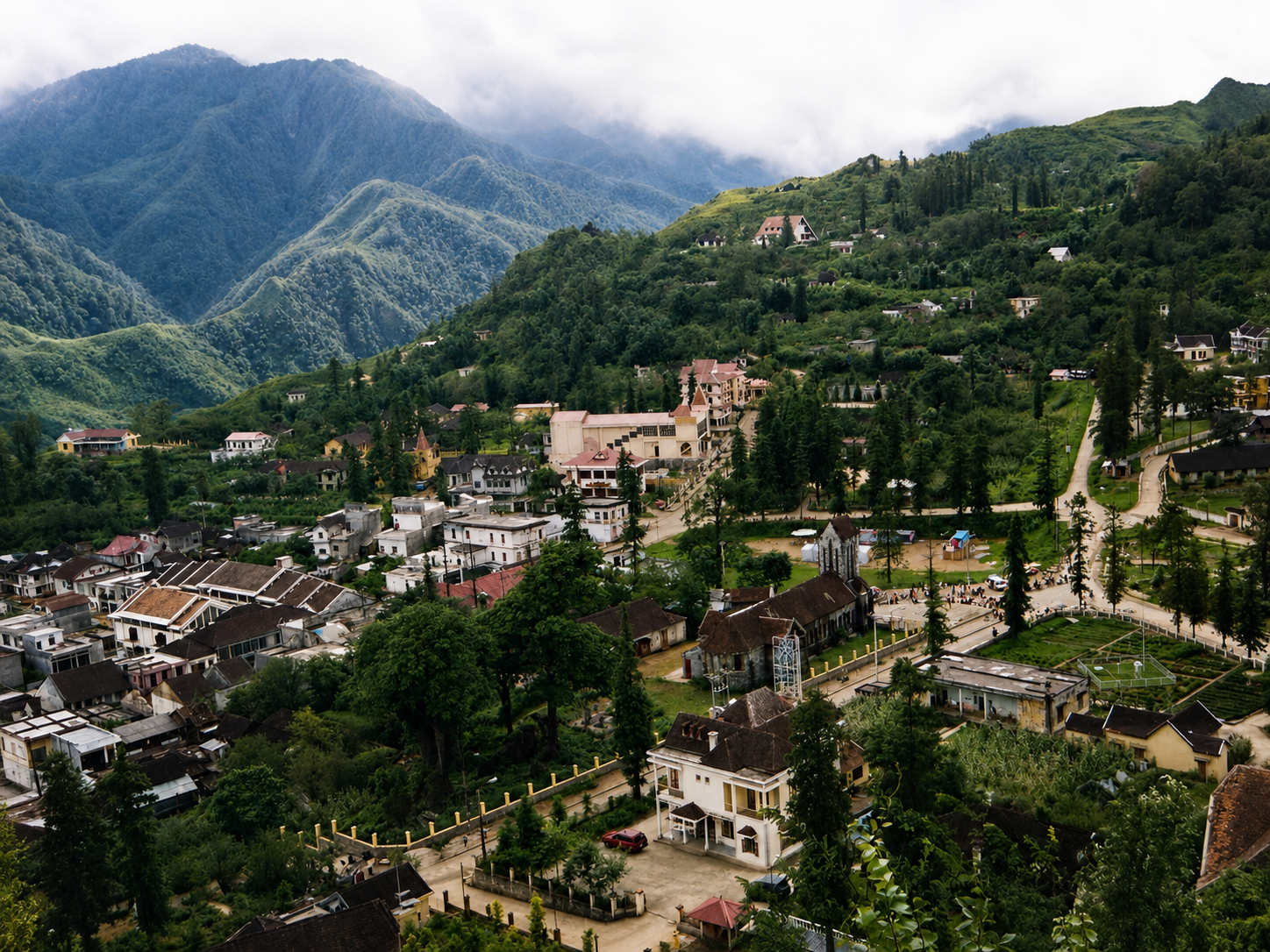
Seen from Ham Rong Mountain, it is striking how little of the landscape Sapa occupied. Homes clustered around the old stone church before giving way to gardens, fields and steep forested hillsides. The town existed within the mountains rather than replacing them, and the surrounding greenery was valued not simply for its beauty, but as the source of clean water, fresh air, fertile soils and livelihoods for the communities who called these mountains home.
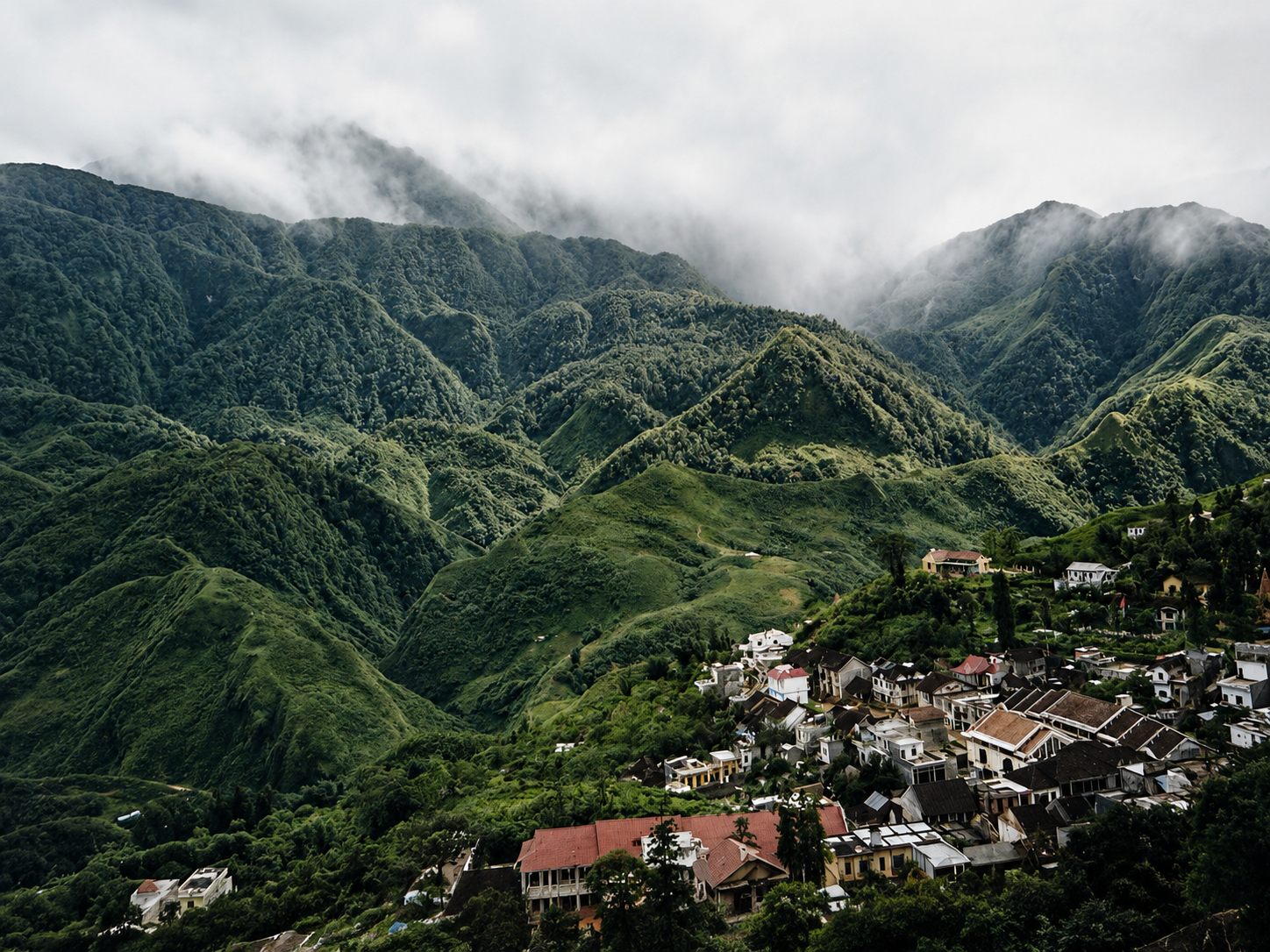
In 1998, Sapa remained a remarkably small mountain town. Beyond its handful of streets, the built landscape dissolved almost immediately into rice terraces, villages and the forests of the Hoàng Liên mountains. Nature was never something to escape to, it was simply part of everyday life, shaping the air people breathed, the food they grew and the rhythms by which they lived.
Living Under Canvas
Although Sapa became our base, I spent surprisingly little time sleeping in the town itself. Home was a cluster of Vango canvas tents pitched in the yard of a disused Hmong house on the edge of Cát Cát village. The weathered wooden building quickly became far more than a convenient shelter. It served as our kitchen, equipment store, laboratory, dining room and, most importantly, the social heart of the expedition. Local guides wandered in for tea, neighbours stopped to see what we were doing, children arrived to satisfy their endless curiosity and, after long days in the forest, it became the place where stories were exchanged, specimens examined and friendships quietly took root. Looking back, it felt less like a research camp and more like a small community that happened to revolve around biodiversity surveys.
Each morning began with the same reassuring ritual. The cold mountain air crept through the canvas before sunrise, leaving sleeping bags damp with condensation and boots chilled enough to make the first few steps distinctly uncomfortable. Someone would already be coaxing reluctant flames from the previous evening's embers while a blackened kettle balanced over the fire. Before long the smell of wood smoke drifted lazily through camp as breakfast came together, notebooks appeared on the table, equipment was checked and the day's survey plans gradually took shape. By the time the mist began lifting from the surrounding hillsides, our quiet little camp was already alive with conversation.
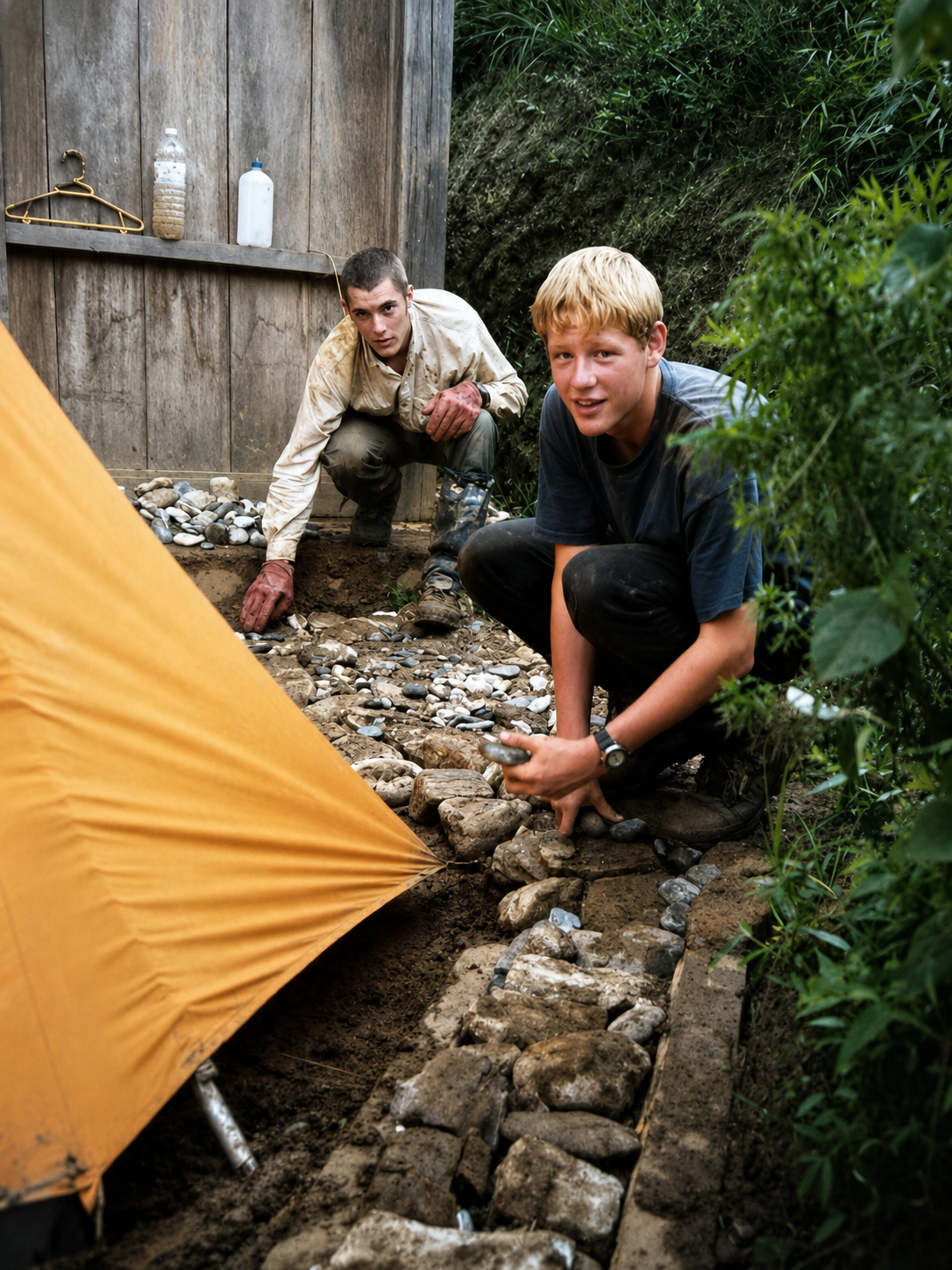
Mountain weather demanded constant improvisation. After heavy rain, digging drainage channels around the tents became as important as collecting scientific data, if we wanted to stay dry enough to sleep.
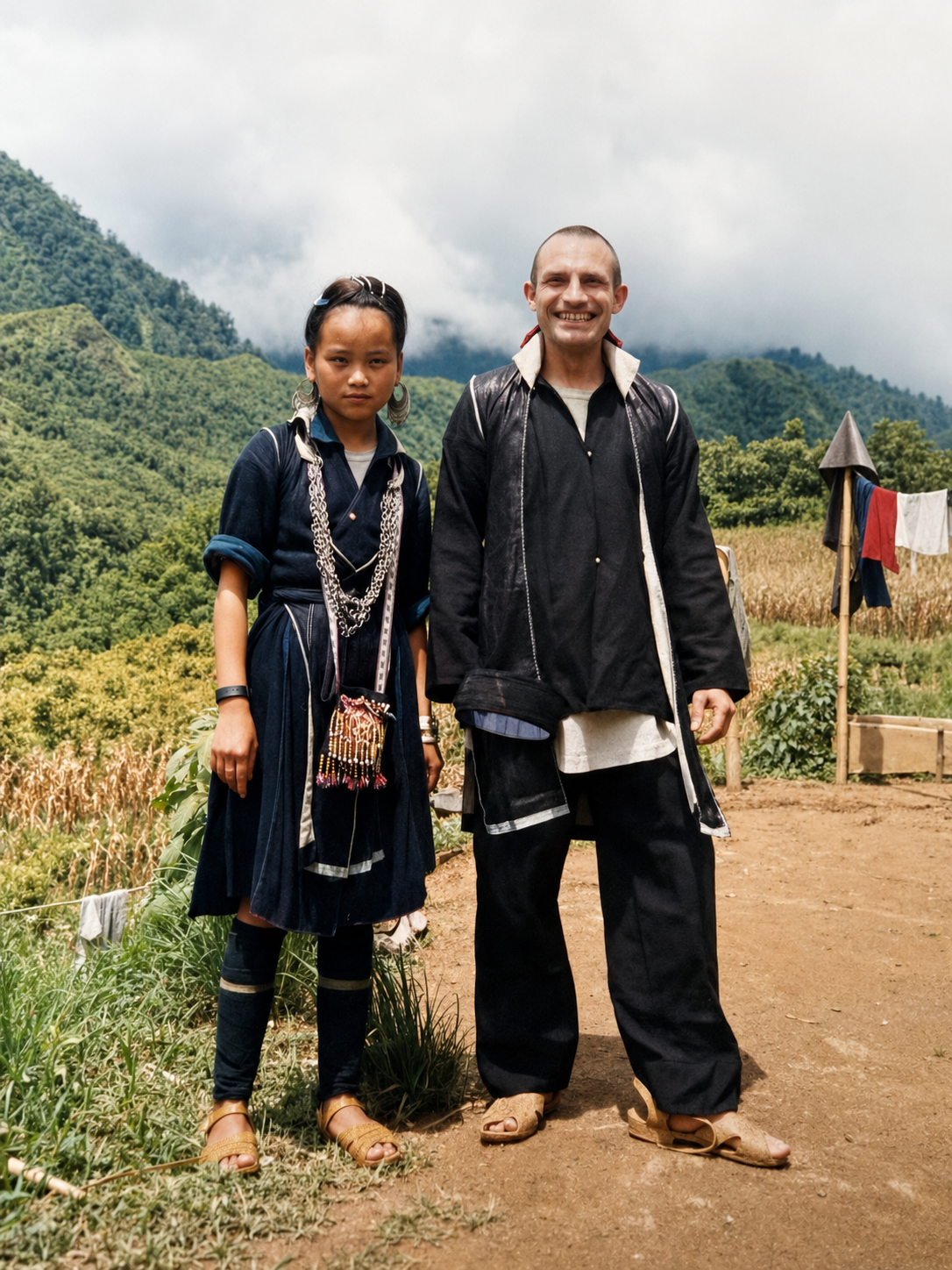
The greatest privilege of working in the Hoàng Liên mountains was never simply the wildlife we documented, but the friendships we formed with the people who welcomed us into their communities. Nearly three decades later, many of those relationships continue to shape both my life and the values that define ETHOS today.
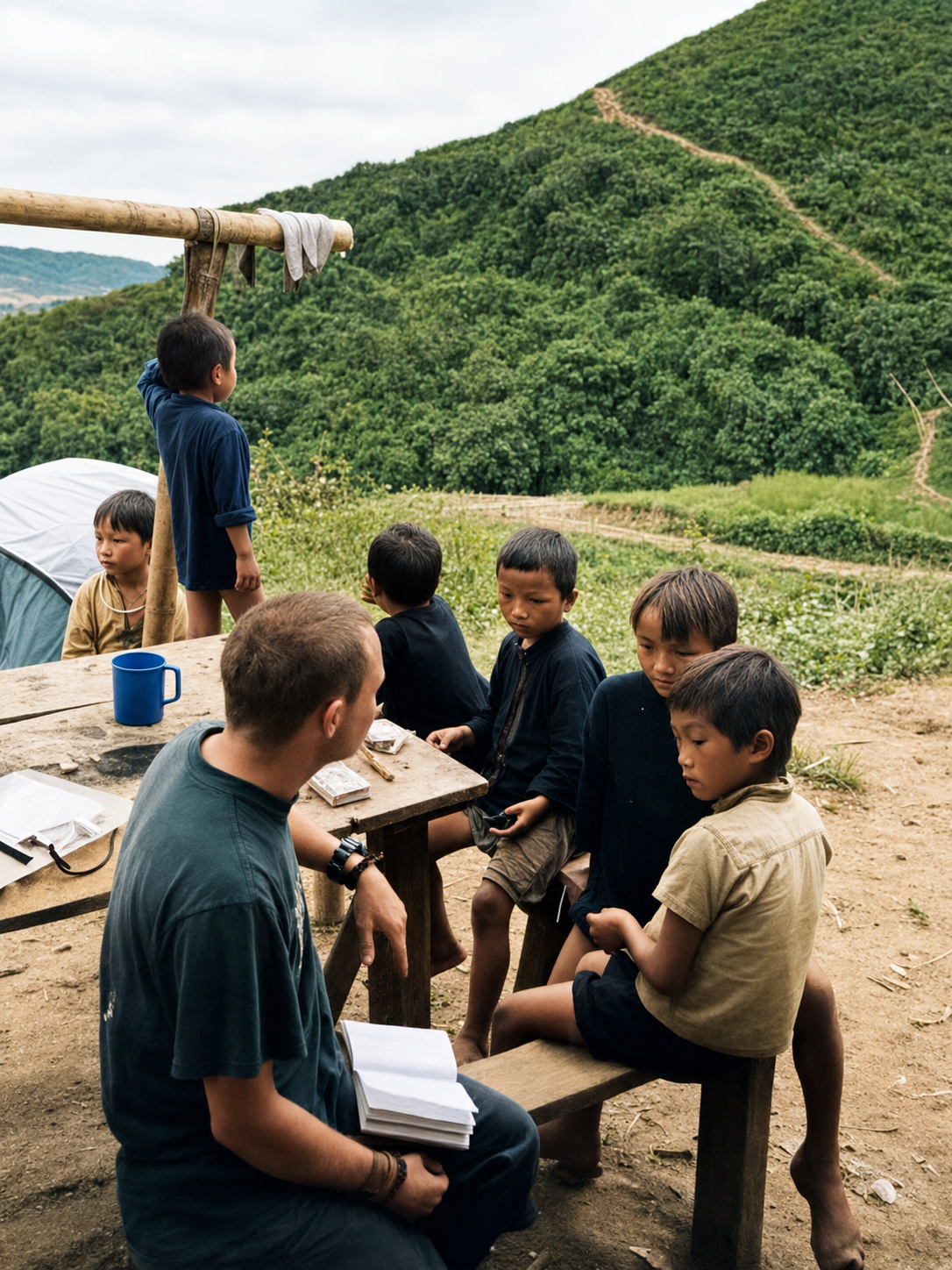
Evenings at base camp rarely felt lonely. Research notes, shared meals, music and laughter often brought together our Frontier team, local guides and children from nearby villages. Long before the phrase "community tourism" became fashionable, our camp had quietly become part of the local community.
Drinking water came directly from the streams tumbling down from the mountains. This was also where we bathed. It was astonishingly clear and painfully cold. Some days, washing your face demanded determination. Bathing required considerably more courage. By the end of each week we found ourselves inventing increasingly creative reasons to make the uphill walk into town, where a hot shower at Phương Nam Hotel felt every bit as luxurious as any five-star spa could today.
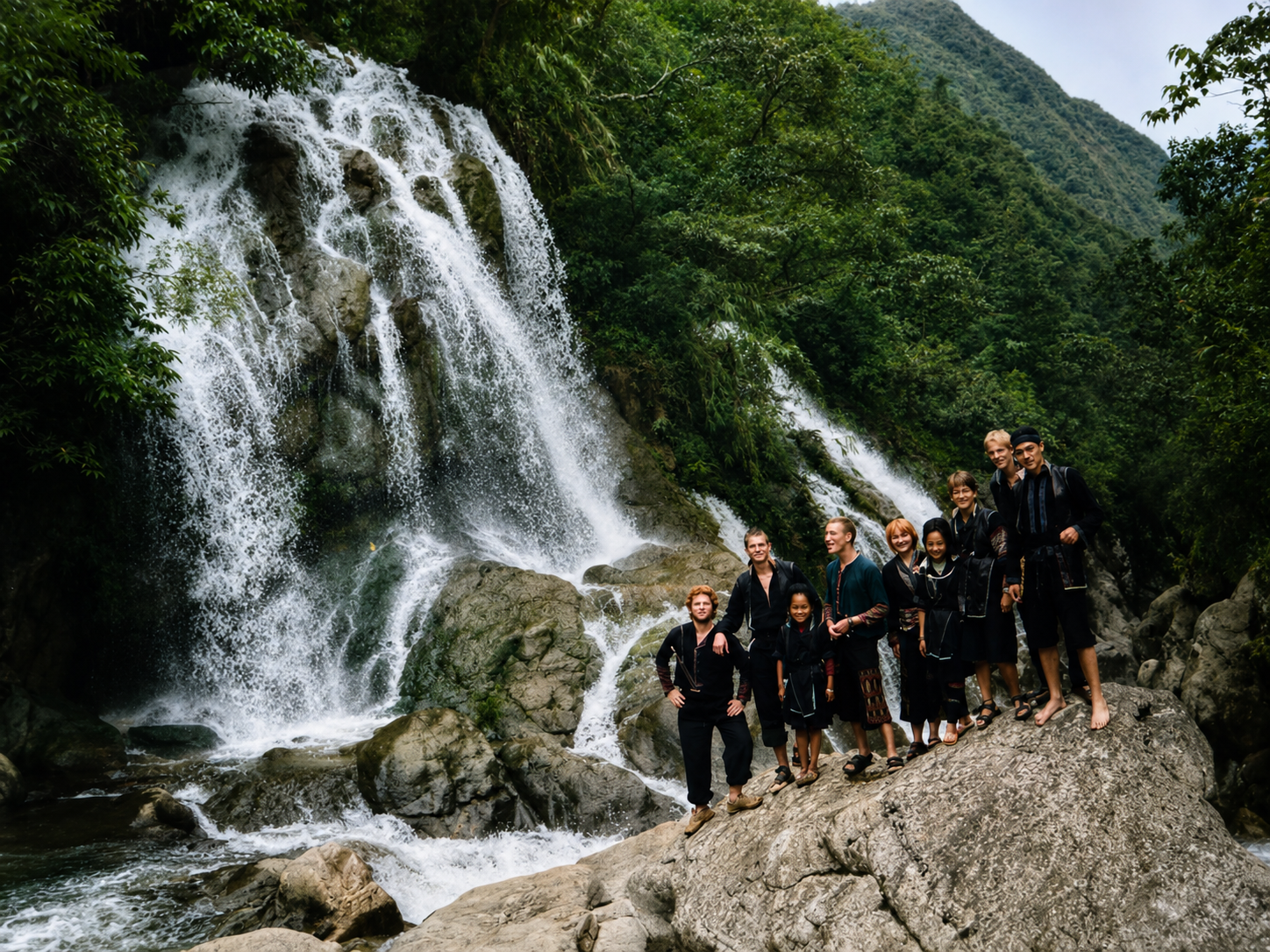
The mountain streams that tumbled through the Hoàng Liên foothills sustained both our expedition and the communities around us. Their crystal-clear waters provided our drinking supply, a place to wash away the day's mud and, after long hours in the forest, an invigoratingly cold mountain bath.
Our work regularly took us deeper into the surrounding valleys and forests, which meant dismantling camp, loading tents, food and scientific equipment into our rucksacks, and setting off on foot. Finding somewhere suitable to spend the night was often harder than reaching the survey site itself. Flat ground was surprisingly scarce in such steep country. Hillsides dropped away almost everywhere, while the valley floors were usually occupied by flooded rice terraces that offered perfect conditions for growing rice but hopeless conditions for pitching tents.
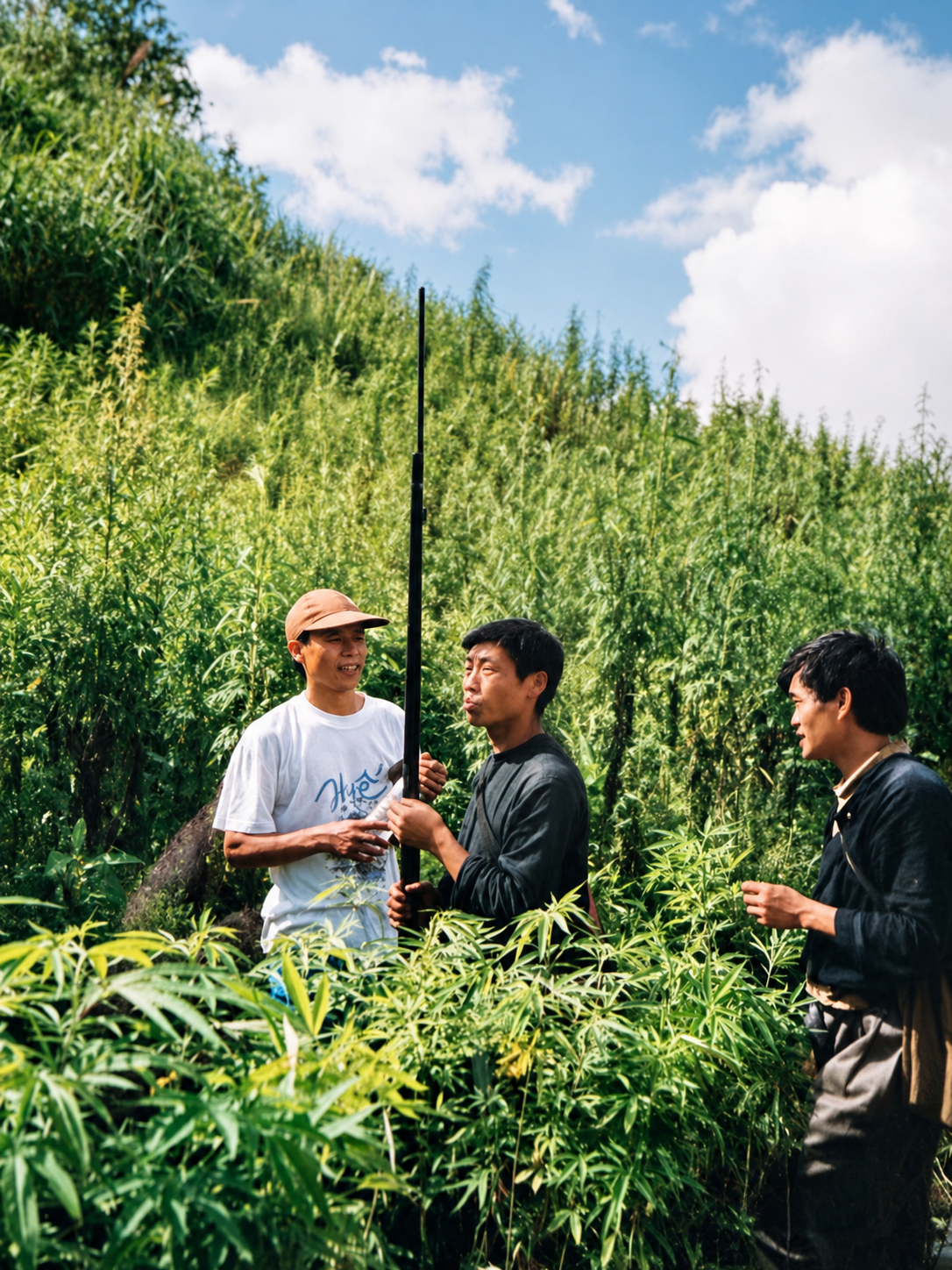
One satellite camp saw us make shelter inside the wooden walls of a village school that stood empty because no teacher was available to work there. The packed clay floor allowed us to drive tent pegs into the ground after several nights wrestling with rocky slopes. On another expedition, local Hmong farmers smiled as they watched us search unsuccessfully for somewhere level before kindly allowing us to clear a small patch within a hemp field. A few carefully cut plants created just enough room for our tents, and by dusk our tiny camp had become part of the landscape.
Life under canvas stripped away routine and replaced it with something simpler. Days were governed by weather, daylight and the distance still left to walk. Evenings ended around shared meals cooked over open fires, damp clothes hanging wherever they might dry, and notebooks slowly filling with observations gathered from the forests around us. At the time it felt entirely ordinary. Looking back now, those months remain some of the richest of my life.
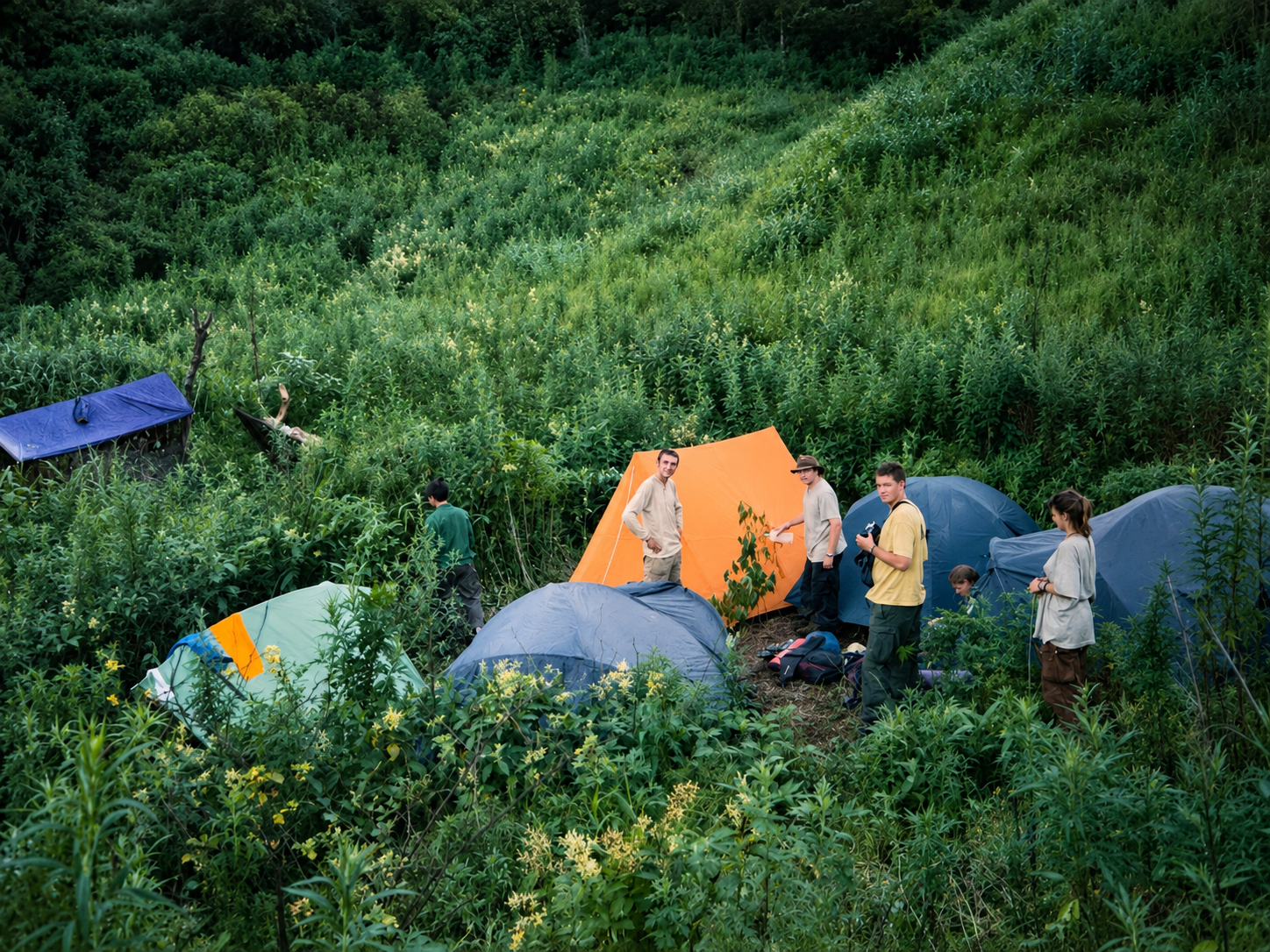
Our Frontier research team's satellite camp, pitched in a hemp field near the remote Hmong village of Dền Thàng during a biodiversity expedition in 1998. From camps like this, we spent days surveying the surrounding forests and documenting the wildlife that would later help inform the creation of Hoàng Liên National Park.
The Work That Brought Me Here
People often assume I first came to Sapa because I loved mountains but in truth, I arrived because of forests. I had joined Frontier, The Society for Environmental Exploration, as part of a biodiversity conservation project working alongside Vietnamese scientists from the Institute of Ecology and Biological Resources. Our task was both straightforward and immensely ambitious. We were helping document the remarkable diversity of the Hoàng Liên Nature Reserve, recording everything from flowering plants and ancient trees to mammals, birds, reptiles, amphibians and butterflies. Much of the area had received remarkably little modern scientific study since the French colonial period, despite its reputation among botanists and conservationists as one of Vietnam’s most important mountain ecosystems.
The work itself was rarely glamorous. Long days were spent walking steep forest trails, setting survey lines, recording observations and carrying equipment through terrain that seemed determined to test every muscle. Leeches were an inevitable companion during the wetter months, notebooks rarely remained dry for long, and every sample or observation represented another careful piece of a much larger picture.
What made the experience extraordinary was not simply the wildlife we encountered but the people we worked beside. Vietnamese scientists shared knowledge generously, local guides navigated forests that would have defeated us alone, and families welcomed us into villages where conversations often continued long after notebooks had been put away for the evening. Scientific research and local knowledge never felt like separate worlds. Each strengthened the other.
Only years later did I fully appreciate the significance of what we had been contributing towards. The surveys carried out during those seasons helped demonstrate the exceptional ecological importance of the Hoàng Liên mountains, while Frontier’s long partnership with Vietnamese researchers supported biodiversity monitoring, conservation training and protected area management. When Hoàng Liên National Park was officially established in 2002, it reflected the work of countless individuals over many years. Knowing that our muddy boots, damp notebooks and long days beneath the forest canopy formed one small part of that larger story remains one of the quiet privileges of my life.
At the time, however, none of us spoke much about legacy. We simply woke each morning, packed our rucksacks and disappeared once more into the mountains, believing that understanding a landscape was the first step towards protecting it.
Six Days of Rain
One of our satellite camps took us high into the mountains above what is now the O Quy Hồ Pass, close to where the Rong Mây Glass Bridge now welcomes thousands of visitors every year. In 1998 there was nothing but a gravel road climbing the pass, no viewpoints and certainly no cafés selling coffee to passing tourists. There was only dense montane forest, thick bamboo and a narrow footpath disappearing into the cloud.
Our objective sounded wonderfully ambitious. We hoped to record the presence of the elusive Ward's Trogon, one of Vietnam's most sought-after forest birds, while also collecting moths and butterflies to help build a more complete picture of the reserve's biodiversity. It was exactly the sort of expedition I had imagined when I first volunteered to work in northern Vietnam.
Nature, however, had other ideas. The rain began almost as soon as we pitched our tents and then it simply refused to stop. Hour after hour, day after day, the rain hammered against the canvas with a persistence that became almost hypnotic. Thick fog wrapped itself around the mountainside, reducing visibility to little more than a few metres. There was no possibility of spotting birds among the dripping forest canopy, and moths and butterflies had wisely chosen to remain hidden. Even the forest itself seemed to retreat into silence beneath the relentless downpour.
Eventually there was little left to do except wait. Apart from the occasional dash into the undergrowth for a toilet break, we were effectively prisoners inside our tiny two-man tents. At one point my tent mate and I spent almost three full days and nights inside without venturing further than a few metres from the entrance. Cabin fever arrived surprisingly quickly. Out of sheer boredom we invented increasingly ridiculous ways to pass the time. Our favourite involved deliberately unzipping the tent door just enough to invite mosquitoes inside before attempting to catch them with chopsticks. Looking back, I cannot remember who won. I only remember laughing far more than the game deserved.
Life became steadily more complicated. The small stream we had crossed so casually on our way into camp was now an angry torrent, making any attempt to leave distinctly unwise. Thunder rolled endlessly across the mountains, punctuated by violent cracks of lightning that echoed through the valley with such force they seemed to shake the ground beneath us. During the worst nights conversation became impossible until each deafening torrential downpoor slowed a little.
Our food presented another challenge. Without dry firewood it became impossible to light a cooking fire. Our carefully planned rations consisted largely of dried rice, dried noodles and dried fish, none of which were especially appealing in their uncooked state. Hunger, however, is remarkably effective at lowering culinary standards. We experimented with combinations that would undoubtedly horrify any chef. Dried noodles spread with strawberry jam became one reluctant favourite. On more extravagant evenings we added wedges of Laughing Cow cheese with jam and crushed noodles to make a kind of “mountain cheesecake”. It was hardly fine dining, although nobody complained very loudly.
On the sixth morning, almost as suddenly as it had begun, the rain eased. We packed our soaked tents, shouldered waterlogged rucksacks and cautiously began the descent towards the valley. What awaited us was almost beyond comprehension. The gentle stream we had crossed less than a week earlier had become a raging river. Entire sections of mountainside had collapsed. Massive landslides had torn through the forest, snapping ancient trees like matchsticks and scattering boulders the size of houses across the valley floor. Familiar landmarks had vanished altogether, leaving us to pick our way carefully through a landscape that looked as though it had been rearranged overnight. It was a sobering reminder that these mountains, beautiful as they are, exist on nature's terms rather than ours.
By the time we eventually arrived back into Sapa, exhausted, damp and thoroughly hungry, even the simplest hot meal felt like a feast. Looking back, we returned with remarkably little scientific data from that expedition. There were no Ward's Trogons, very few insects, mesquitoes aside, and scarcely any observations worth recording. Instead, the mountains gave us something altogether different. They showed us their power, taught us patience, humility and the curious ability of shared hardship to forge friendships that can last a lifetime.
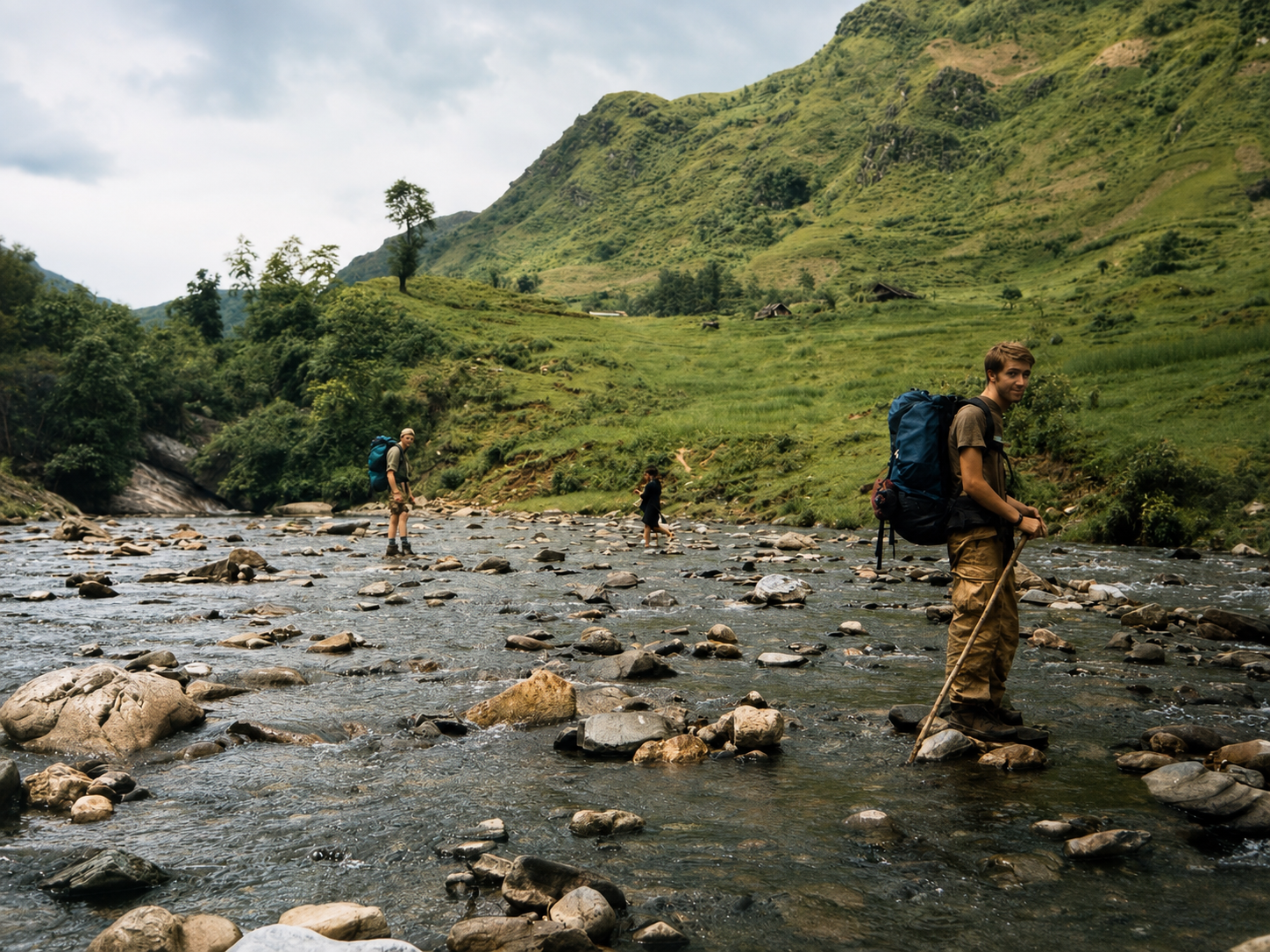
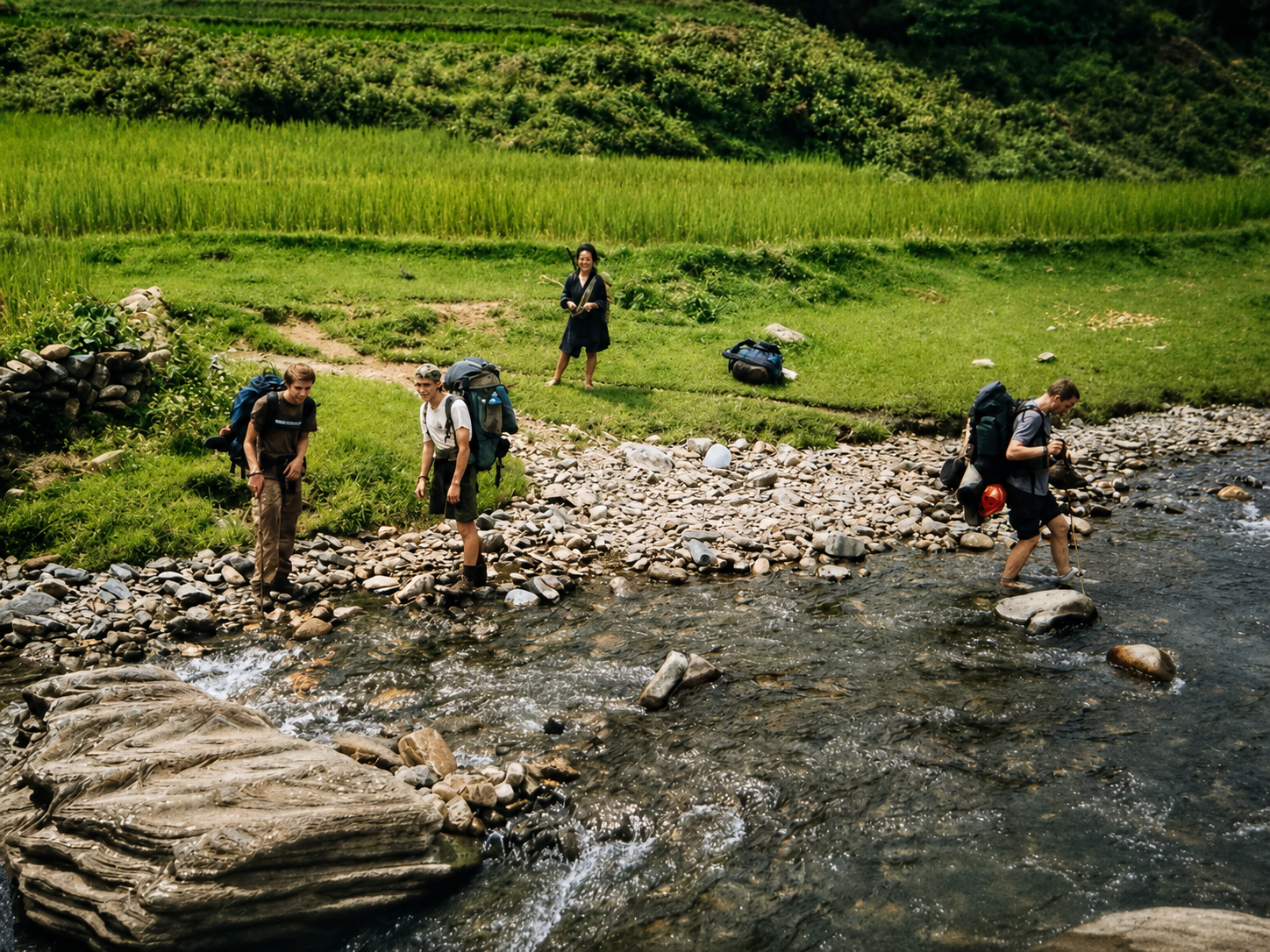
Crossing a mountain stream during one of our biodiversity surveys in the Hoàng Liên Mountains. River crossings like this were a routine part of fieldwork, often repeated several times a day as we followed wildlife through forests and remote valleys where no roads existed.

A small selection of moths recorded during our biodiversity surveys in the forests around Sapa. Each specimen helped build a better scientific understanding of the remarkable insect diversity found in the Hoàng Liên Mountains, research that contributed to the knowledge of an area later protected as Hoàng Liên National Park.
The Tiger That Wasn't
During our time in Sapa, reports began circulating through the surrounding villages that a water buffalo in Tả Phìn Village had been attacked, killed and partially eaten. Before long, people were quietly speculating that a tiger might still be living somewhere in the forests surrounding Fansipan. A few days later, the rumours gathered further momentum when what were believed to be tiger footprints were discovered in the foothill forests. Everyone seemed to have heard the story, and almost everyone knew somebody who knew somebody who had either seen the animal or heard it calling somewhere in the mountains.
As exciting as these accounts were, our work demanded a more cautious approach. Local knowledge was invaluable and often guided us towards places that deserved closer investigation, but rumours alone could never become scientific evidence. If our research was to contribute meaningfully to the future protection of the Hoàng Liên Nature Reserve, every observation had to withstand scrutiny. A footprint might prove useful if it could be properly documented. Hair samples, scat, photographs or an unequivocal sighting would all have been immensely valuable. Stories, however sincerely told, remained just that. We could not include them in our data simply because we wanted them to be true.
With the possibility of tiger activity now firmly in everyone's minds, we established another satellite camp high on the slopes of Fansipan. Officially, the expedition was no different from any of the others. We were there to continue documenting the reserve's biodiversity, recording birds, amphibians, butterflies, moths and anything else that might contribute to a better understanding of these remarkable forests. Unofficially, I suspect every member of the team quietly hoped we might stumble across the piece of evidence that would confirm tigers still survived in these mountains.
A couple of days into the expedition, two members of our team returned to camp visibly excited after hearing what they were convinced had been the unmistakable roar of a tiger echoing through the forest. Around the evening fire we discussed it at length, replaying every detail as scientists inevitably do. How far away had it sounded? Which direction had it come from? Could another animal have produced a similar call? The excitement was genuine, but so too was our frustration. Once again, we had an intriguing story but no evidence strong enough to support it.
By the final evening our notebooks contained a satisfying collection of observations. We had documented numerous species of birds, butterflies, moths and amphibians, yet the tiger remained as elusive as ever. Accepting that this particular mystery would remain unresolved, we turned in for the night beneath the forest canopy, already looking forward to returning to Sapa the following day.
Sometime after midnight I was woken abruptly by a scream so piercing and so utterly human that it cut straight through the forest silence. My tent mate and I both sat bolt upright, instantly awake. Within moments we could hear movement outside the tent, first as faint rustling among the undergrowth and then as unmistakable footsteps drawing steadily closer. Instinct took over. We reached for the Hmong hunting knife we had been carrying throughout the expedition to clear vegetation and cut firewood, neither of us saying a word as we listened to whatever was circling outside.
Then the tent zip began to move. Even now, nearly thirty years later, I can remember the peculiar mixture of fear and anticipation that filled those few seconds. Rationally, I knew perfectly well that tigers are not renowned for operating zips. At the time, however, rational thought had deserted me completely. All I could hear was the slow, deliberate sound of the zip opening from the outside while every frightening possibility raced through my mind.
The tent flap finally opened just wide enough for a face to appear. It was Rob. His face was completely smeared with something bright red and, for one fleeting but unforgettable moment, I genuinely thought we were looking at the aftermath of the tiger we had spent the previous week searching for.
Then he broke into a broad grin. "Come on, lads," he whispered. "It's our last night up here. You're missing the rice liquor and the chilli sauce fight!" The blood-red face was nothing more sinister than crushed chillies, and the terrifying predator outside our tent turned out to be an overenthusiastic colleague determined that nobody should miss the celebrations. The relief was almost impossible to describe, although I confess the thought of using that Hmong knife on Rob for frightening us quite so thoroughly crossed my mind for the briefest of moments.
We left the mountain the following morning without the evidence we had hoped to find. There were no photographs, no verified tracks and no scientific proof that tigers still inhabited the Hoàng Liên mountains. Looking back, I have come to appreciate that outcome almost as much as if we had found them. Conservation depends upon honesty as much as discovery, and the integrity of our research lay not in proving what we hoped was true, but in faithfully recording what we could genuinely demonstrate. The tiger remained a mystery, but the lesson has stayed with me ever since.
Walking Before There Were Roads
The easiest way to understand Sapa back then is to forget almost everything you know about travelling here today. There were no marked day hikes, no fleets of waiting minibuses and certainly no network of roads reaching every village. Beyond the edge of town, the mountains were connected by footpaths. If you wanted to go somewhere, you walked.
For us, that was exactly the point. Every survey began on foot, our rucksacks laden with tents, notebooks, collecting equipment and enough food to last until we returned. We left Cát Cát at first light, climbing narrow paths that had connected villages, fields and forests for generations, long before anyone thought of calling them trekking routes. These were not trails created for visitors. They were simply the everyday arteries of mountain life.
Some sections were little wider than a buffalo track winding through rice terraces before disappearing beneath dense forest. After heavy rain they became ribbons of slippery clay where every step demanded concentration. Rivers were crossed on narrow wooden bridges that bounced gently beneath our weight, or by carefully picking our way across polished stones while cold mountain water rushed around our boots. By the time we reached the higher forests, our trousers were usually soaked, whether from rain, river crossings or the morning dew clinging stubbornly to waist-high vegetation.
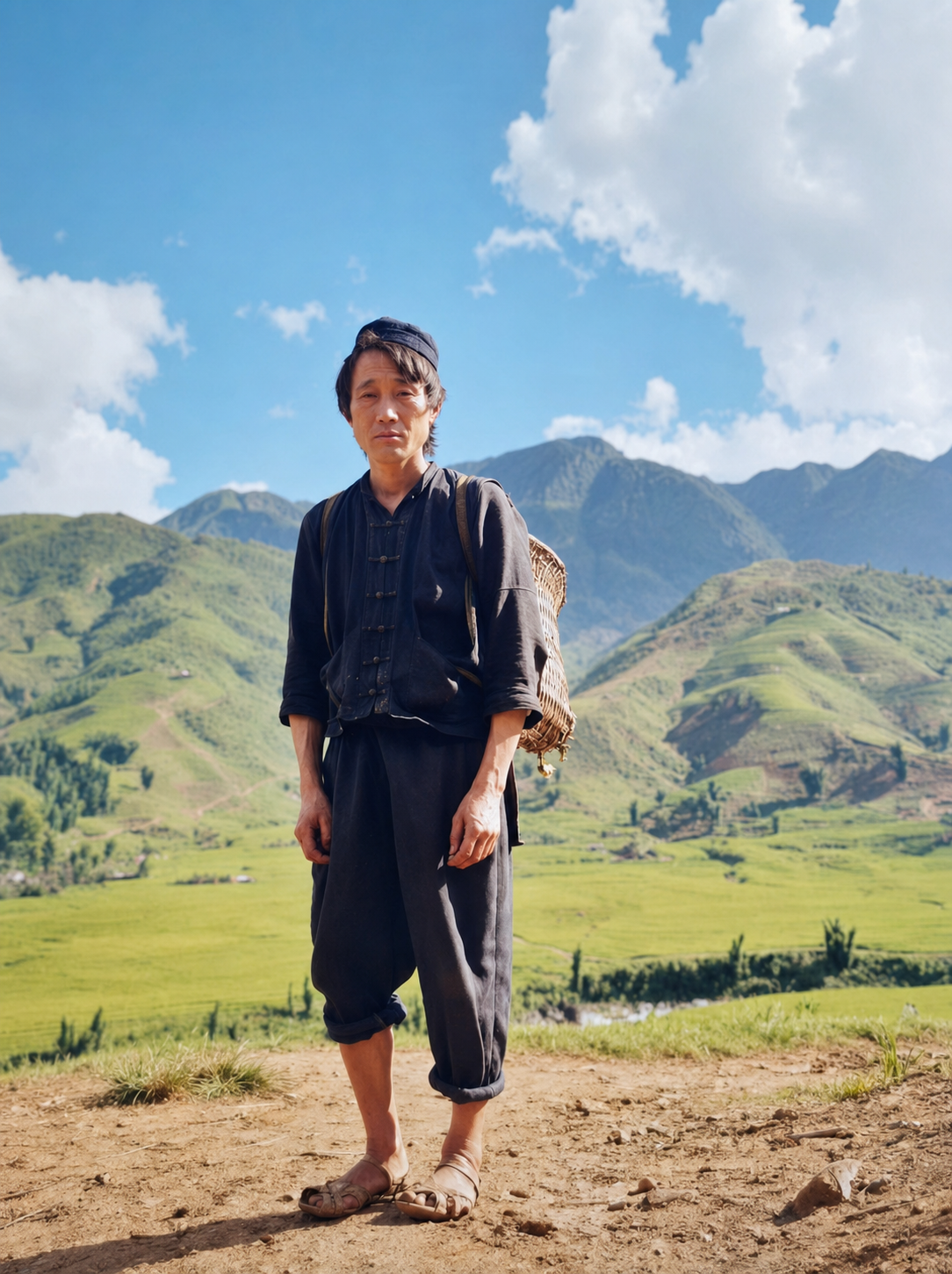
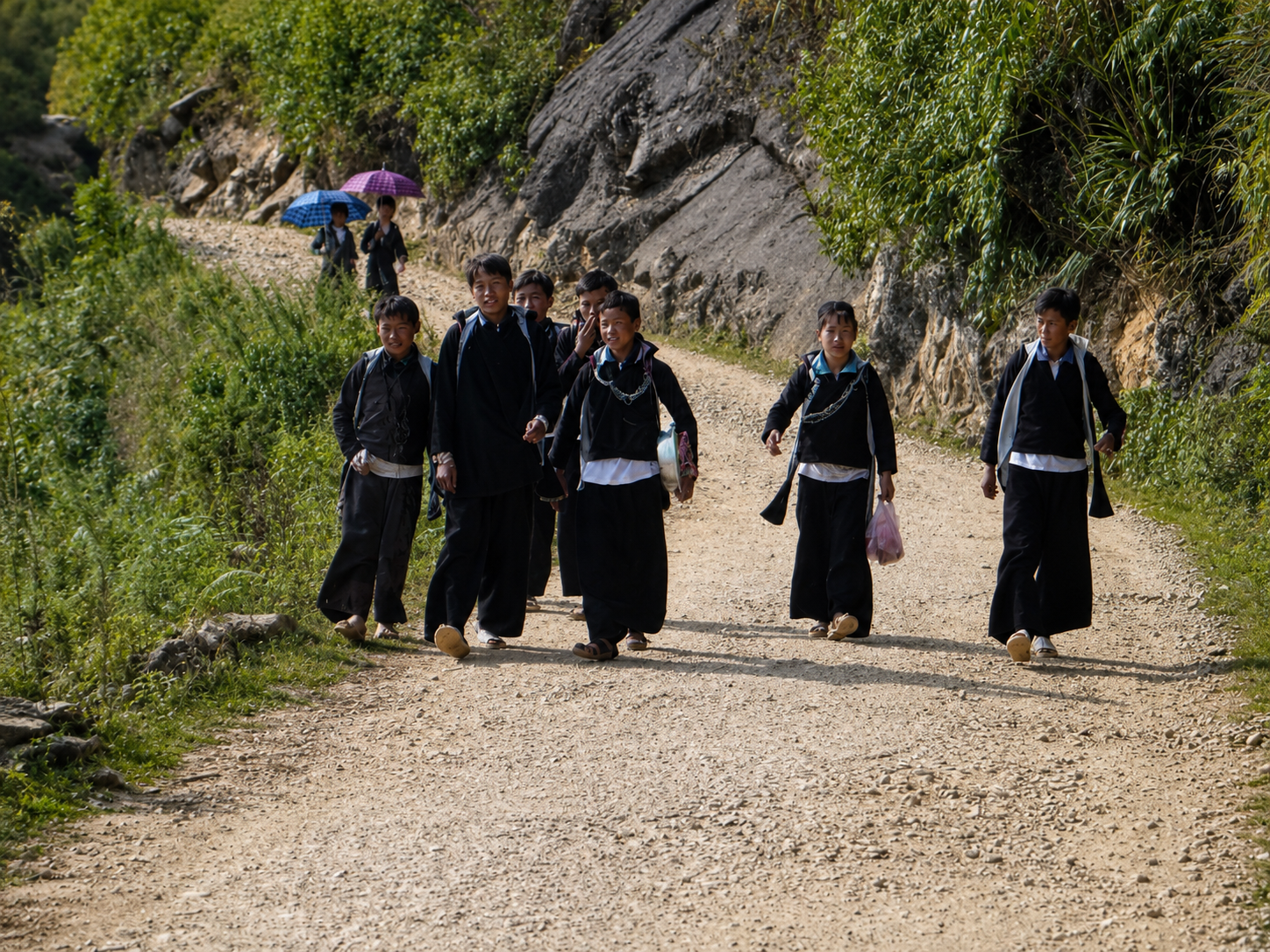
Yet while we struggled beneath heavy rucksacks, sturdy leather boots and several days' worth of camping equipment, the people we met moved through the same landscape with remarkable ease. Elderly women carried baskets laden with vegetables or firewood, balancing astonishing weights with effortless grace. Children laughed as they hurried to school, often overtaking us on steep climbs. Men led water buffalo between fields or returned from the forest carrying freshly cut timber across their shoulders. Many of the Hmong we met wore little more than worn rubber sandals, while some still walked barefoot. Whether travelling to market, visiting neighbouring villages or climbing to distant fields, they carried little, moved swiftly and negotiated steep, muddy mountain paths with a confidence that left us quietly humbled. These journeys were not adventures to them. They were simply everyday life.
Motorcycles were still exceptionally rare in the surrounding villages. Most families did not own one, and in many places there would have been nowhere to ride it even if they had. The mountains determined the routes, not machines. Walking was woven into daily life in a way that is difficult to imagine today.
Perhaps the greatest gift of travelling that way was the silence. Entire days could pass without seeing another foreign visitor. Occasionally we might encounter a lone backpacker heading towards Cát Cát, guided by an enterprising Hmong teenager who had realised that visitors were willing to pay for company on the short walk from town. Beyond that, the mountains belonged almost entirely to the people who lived there. Every encounter felt spontaneous and every greeting felt genuine. These paths had carried farmers, neighbours and families for generations before they ever carried tourists.
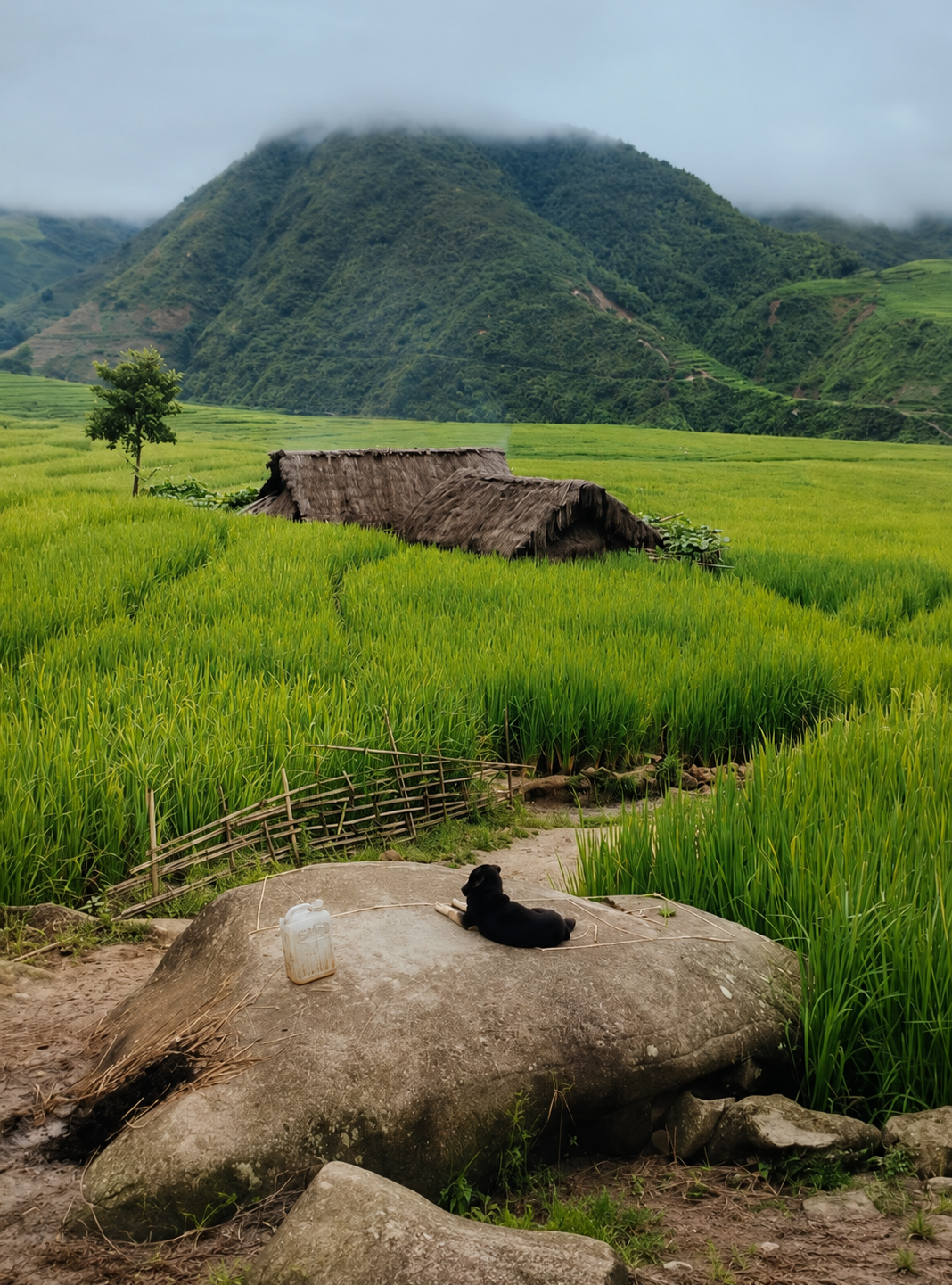
A traditional Hmong home in Lao Chai Village surrounded by rice paddies in a mountain valley near Sapa. Long before roads reached many villages, families relied on footpaths linking their homes, fields and neighbouring communities. Image courtesy of Sean Adams ©
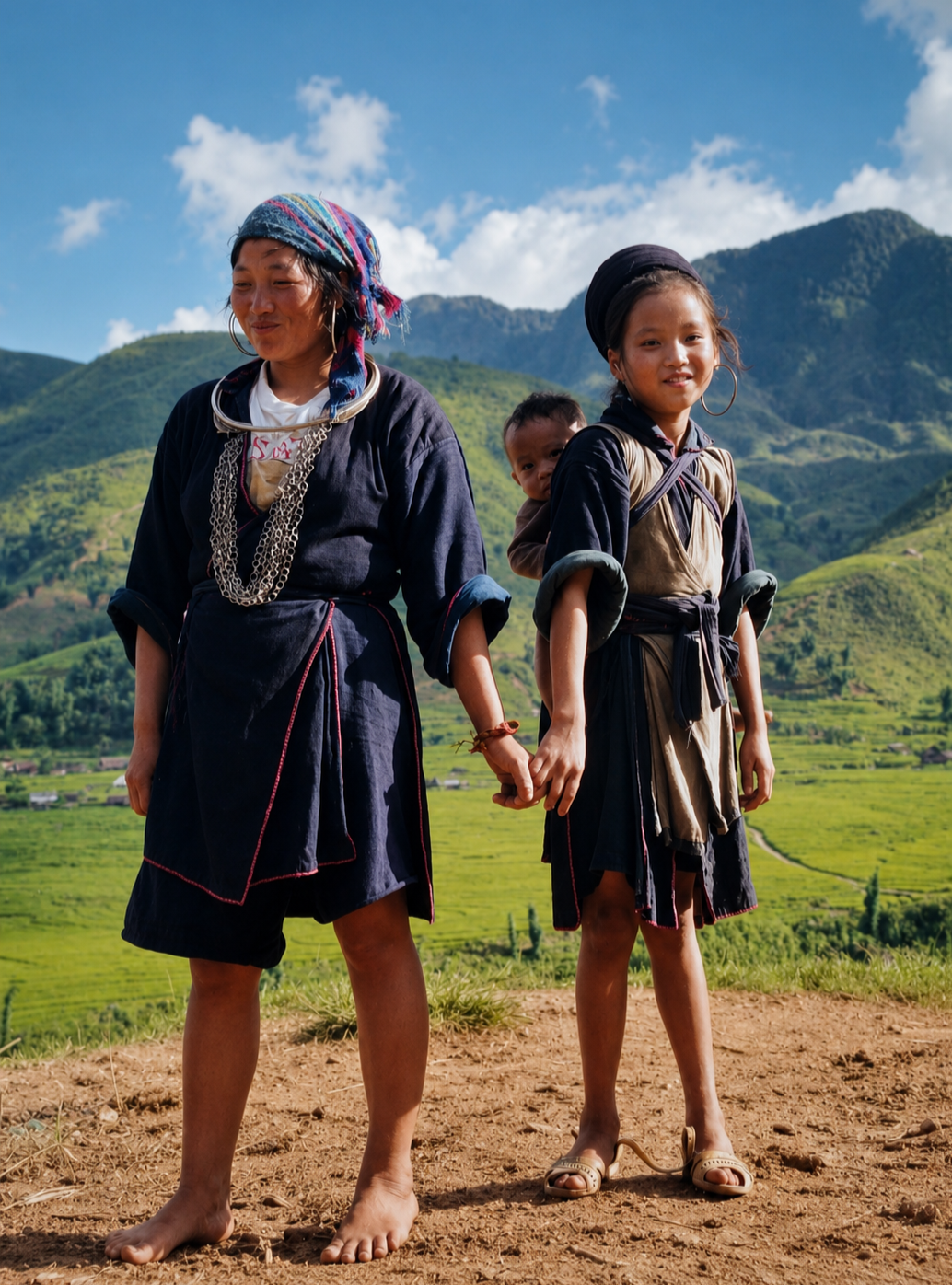
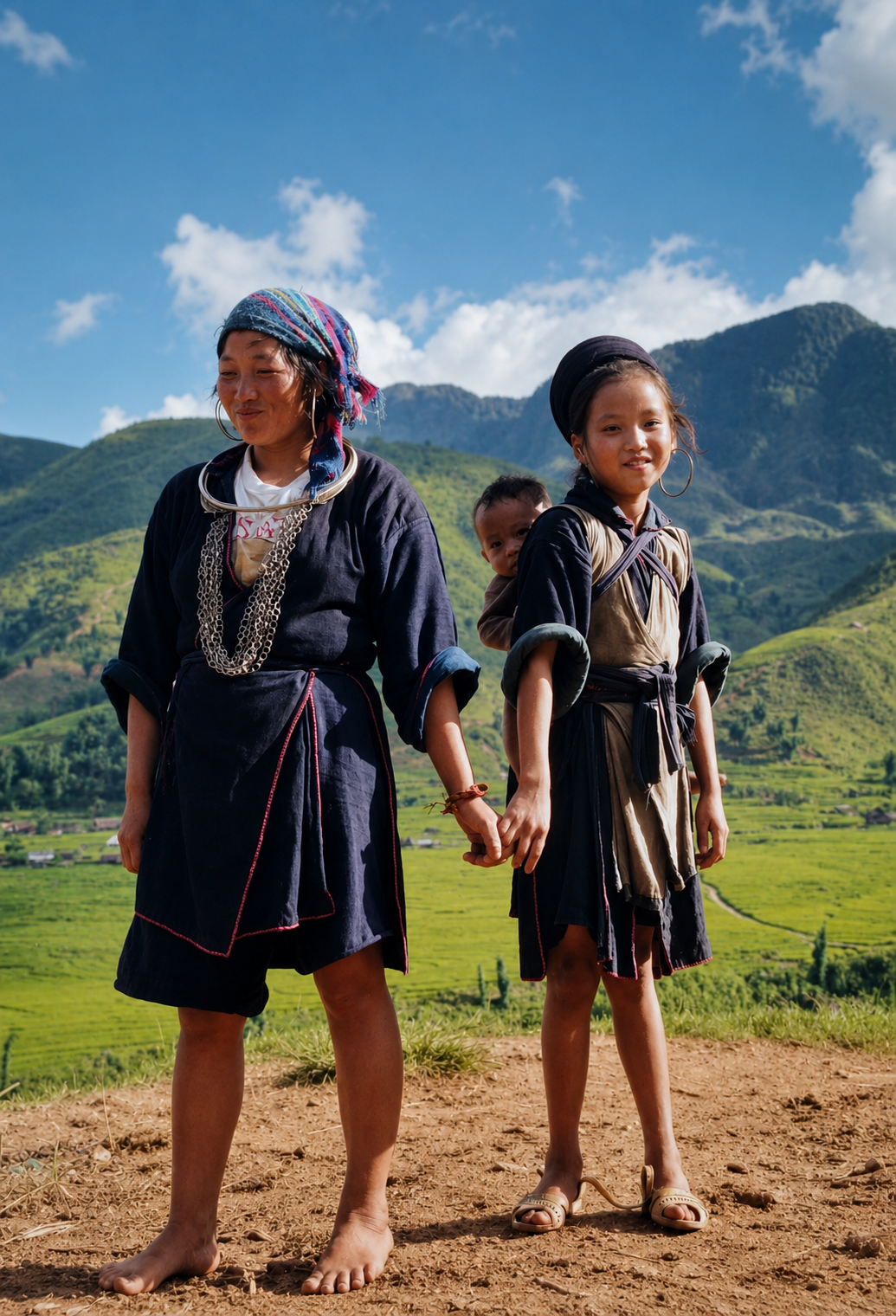
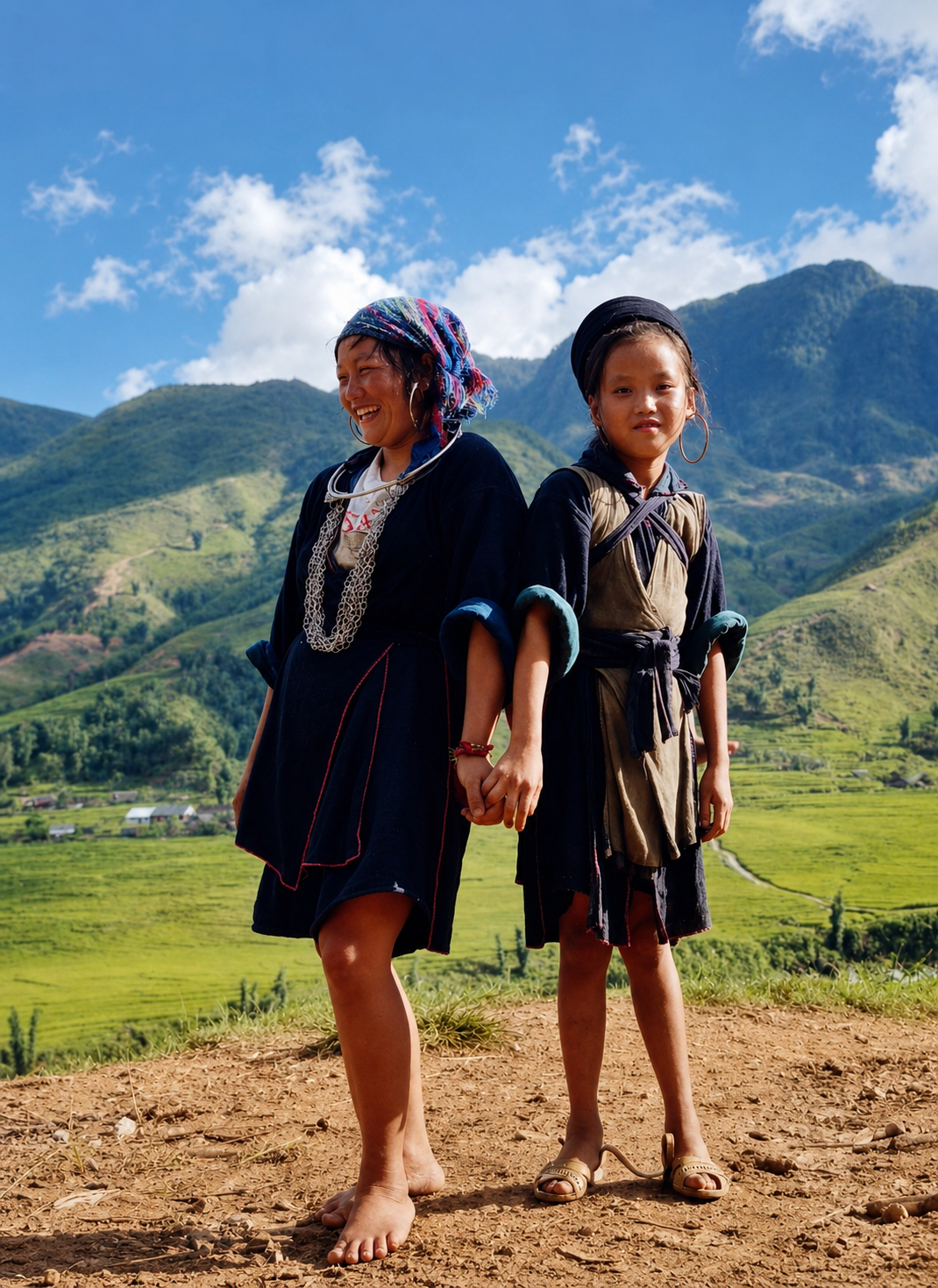
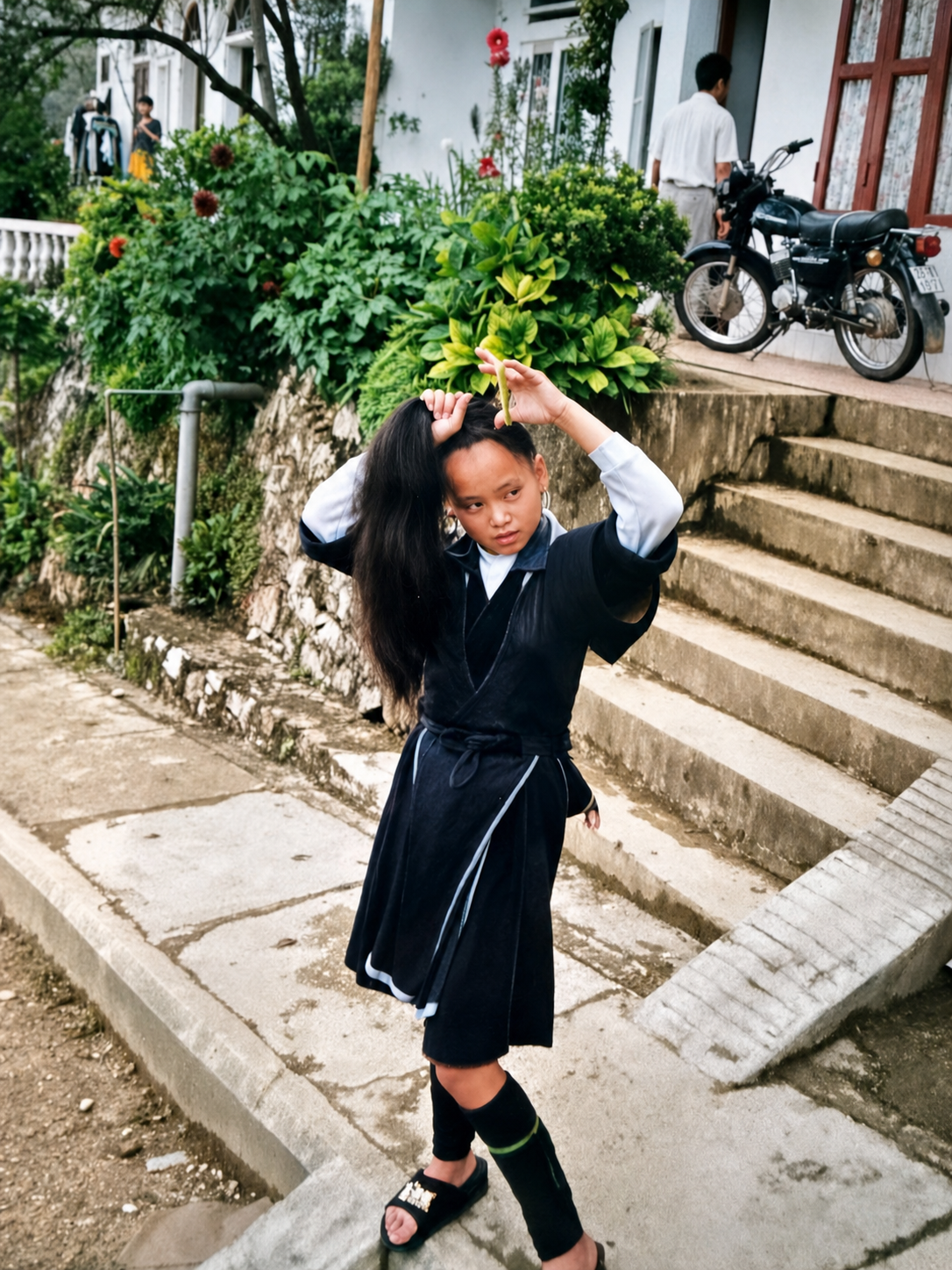
A Hmong mother and daughter walking barefoot through their village. Walking was simply part of everyday life, whether travelling to market, visiting neighbours or working in the surrounding fields. Image courtesy of Sean Adams ©
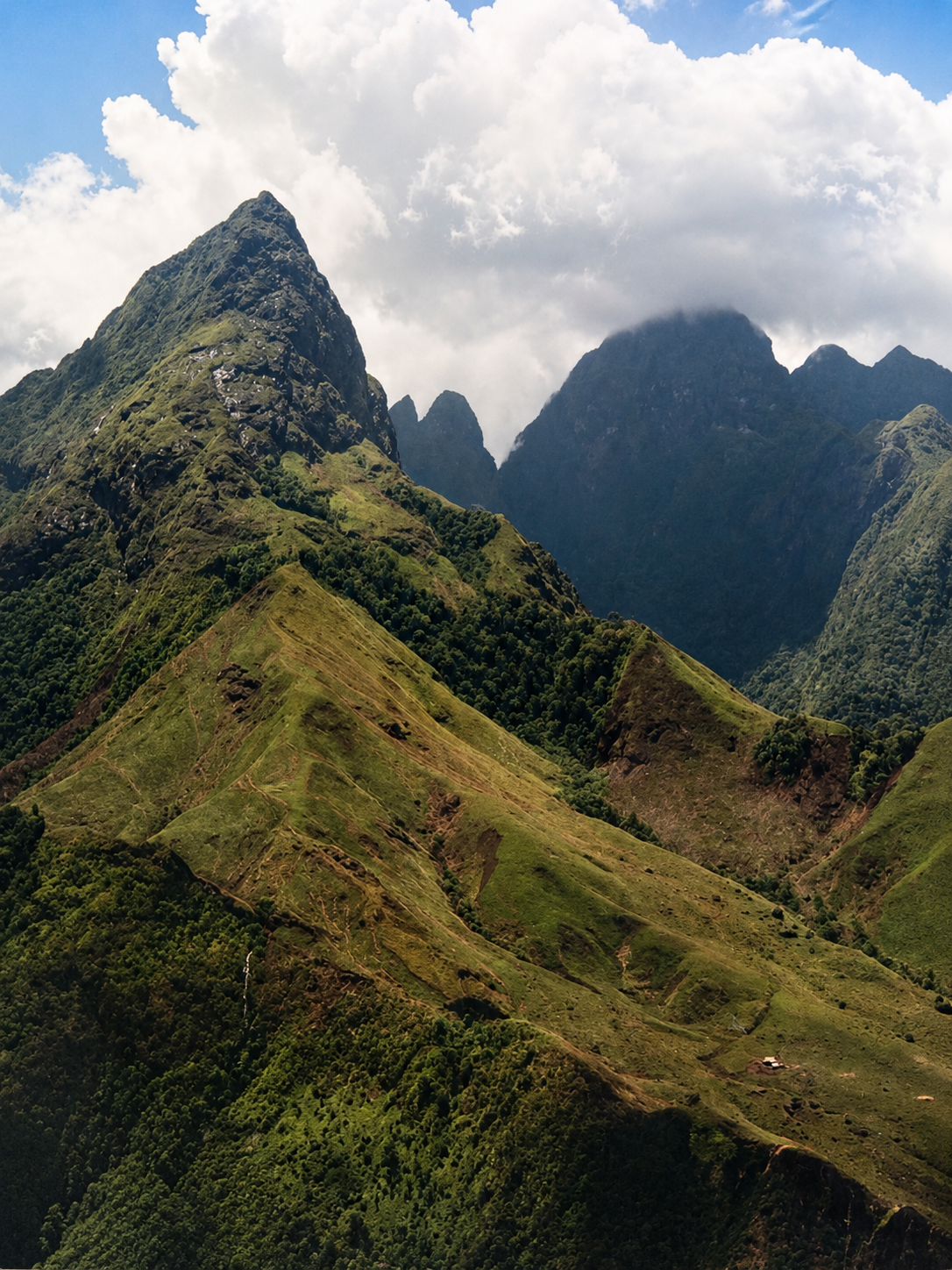
Chu Va Mountain. Narrow mountain paths followed the ridgelines and valleys, connecting villages that were inaccessible by road. Every journey demanded time, endurance and an intimate knowledge of the landscape.
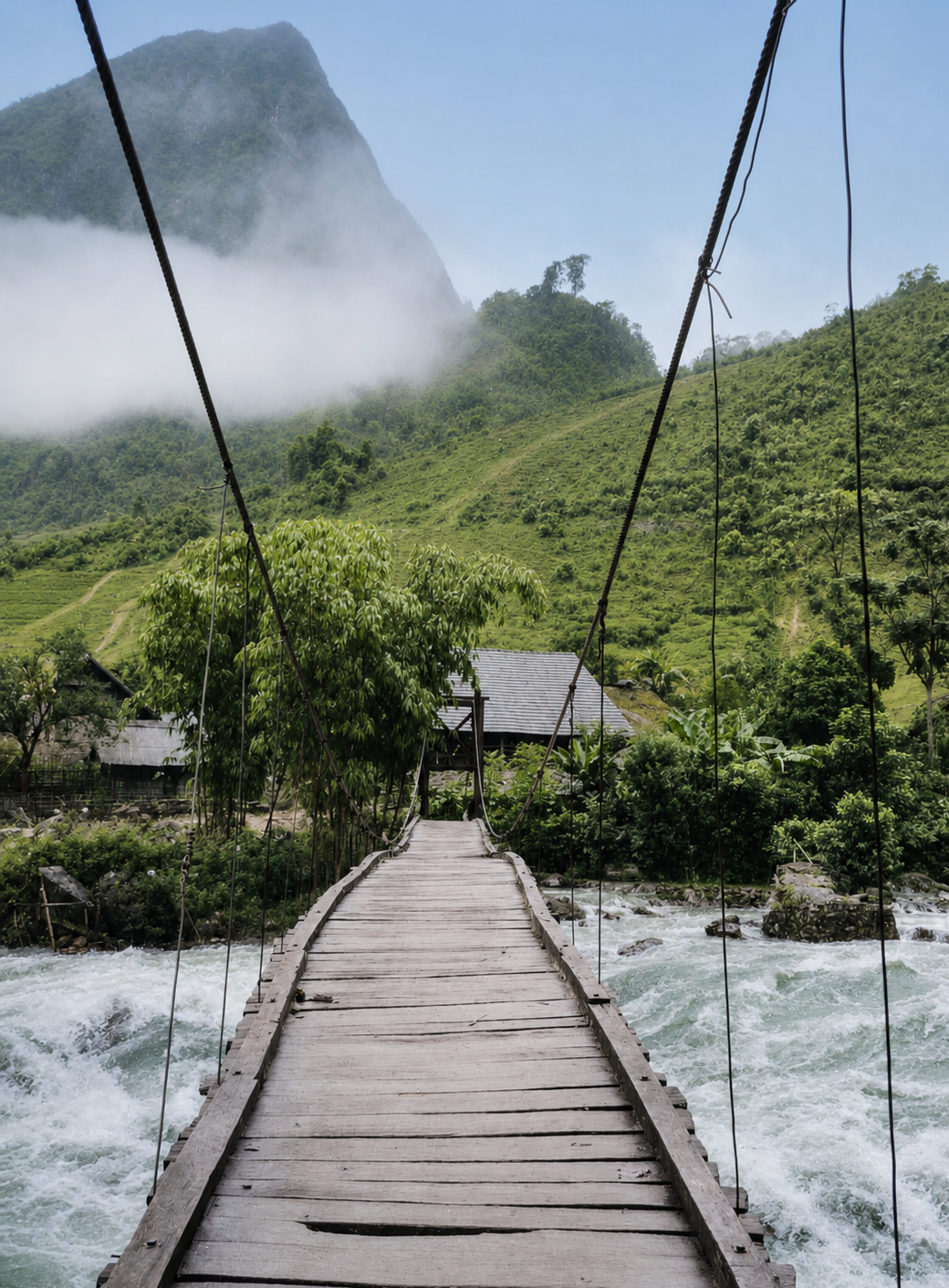
Simple suspension bridges linked communities separated by fast-flowing mountain rivers. Crossing them was an ordinary part of daily life for local families and researchers alike. Image courtesy of Sean Adams ©
The Girls Who Came Every Morning
Whenever we returned to our base camp near Cát Cát, another ritual quietly resumed. Not long after the first light of day and sometimes earlier, a small group of Hmong girls would appear at the edge of camp. They arrived almost without announcement, smiling shyly at first before curiosity inevitably overcame hesitation. All of them arrived eager to talk.
“Hello,” one would say carefully. “How are you?” The phrases were familiar, repeated countless times until confidence replaced uncertainty. They had learned much of their English simply by listening to passing travellers and practising with anyone willing to slow down long enough for a conversation. Their pronunciation was often better than they realised, although every new word was greeted with infectious excitement. Our conversations soon wandered far beyond greetings.
They asked about England, trains, snow and football. They wanted to know whether everyone really drank tea every day. They laughed at my hopeless attempts to pronounce Hmong words correctly and found endless amusement in my inability to carry a basket with anything approaching their balance or grace. In return they spoke about school, family life, farming and the changing seasons. Their questions revealed thoughtful, enquiring minds and an eagerness to understand a world extending far beyond the surrounding mountains. They were intelligent, perceptive and wonderfully mischievous, never allowing an opportunity for gentle humour to pass unnoticed.
Looking back, I realise those mornings reminded me that curiosity runs in every direction. I may have arrived believing I was there to study forests, but I found myself learning just as much from children whose generosity with time and conversation far exceeded anything I could offer in return. Nearly three decades have passed since those mornings beside our tents. Some of those girls are now mothers while others are tragically no longer with us. Some have become guides, entrepreneurs, artisans and respected members of their communities and several remain dear friends. Whenever we meet, we still laugh about those early English lessons beneath the mountains, although now our conversations are conducted with a fluency neither of us could have imagined back then.
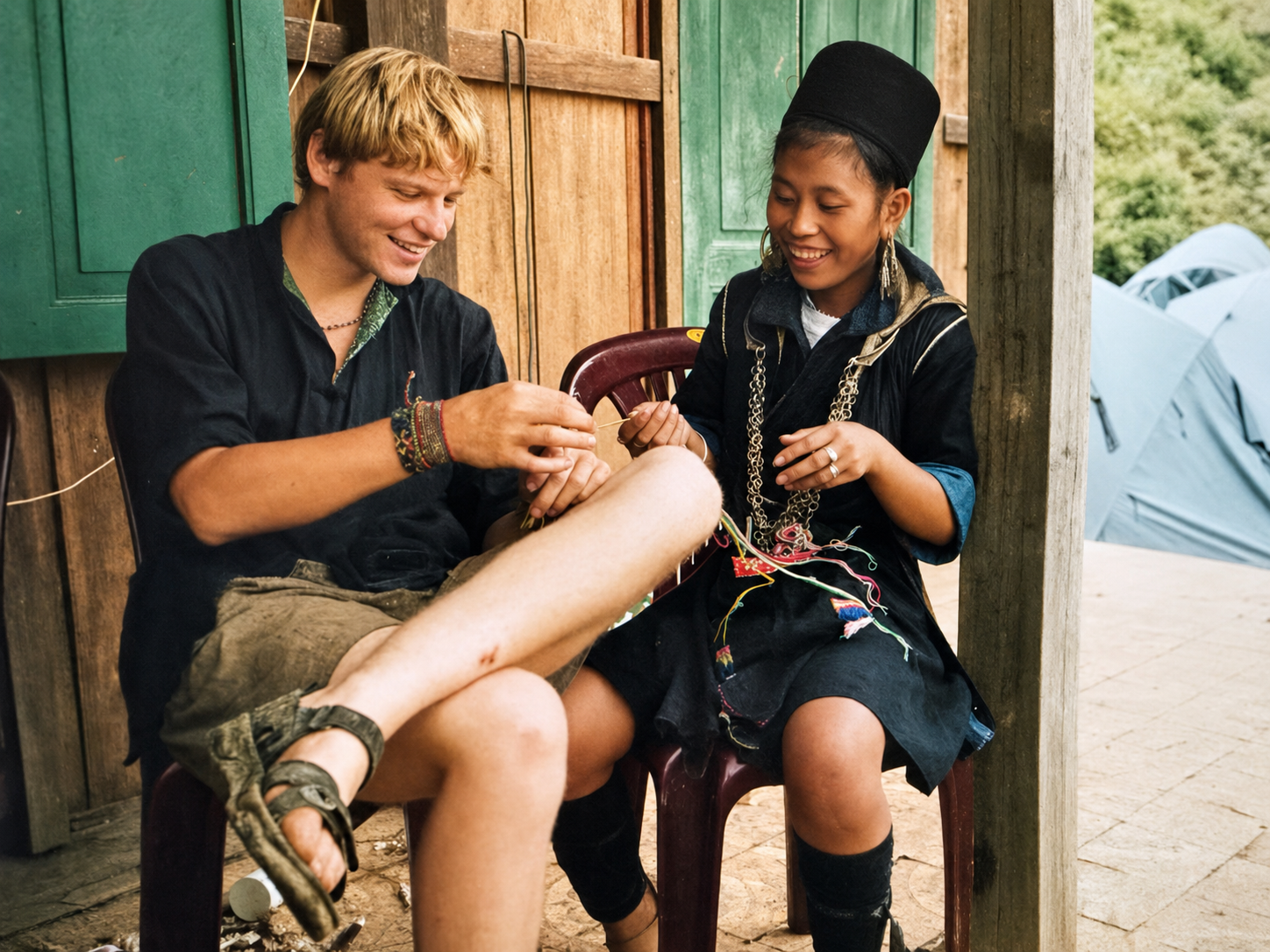
Learning traditional Hmong weaving techniques from my friend My in 1998. What began as a lesson in textile craftsmanship became the beginning of a friendship that lasted many years. My's warmth, patience and generosity remain among my strongest memories of those early days in Sapa. She sadly passed away in a tragic accident many years later, but this photograph remains a treasured reminder of the time we shared together.
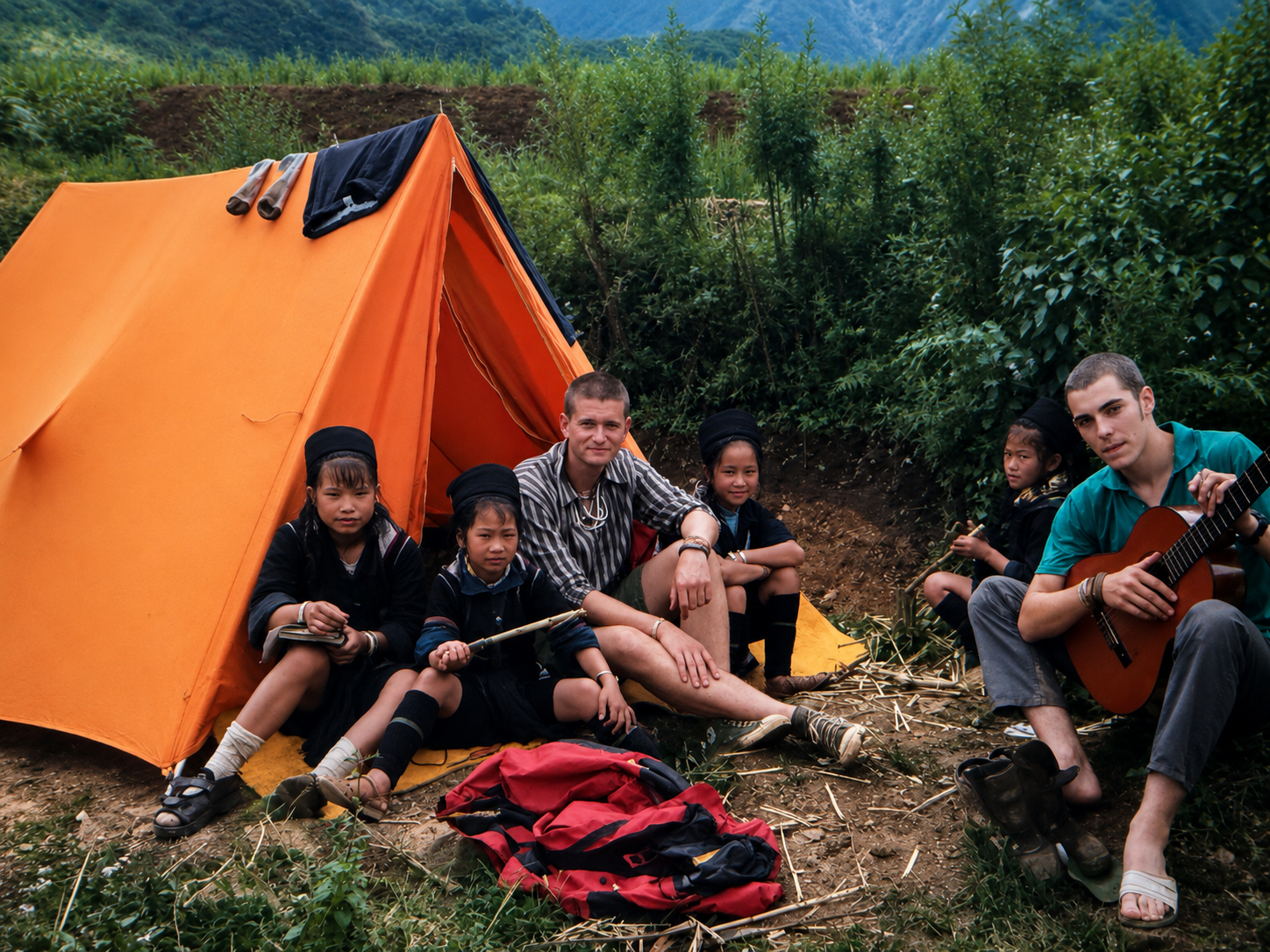
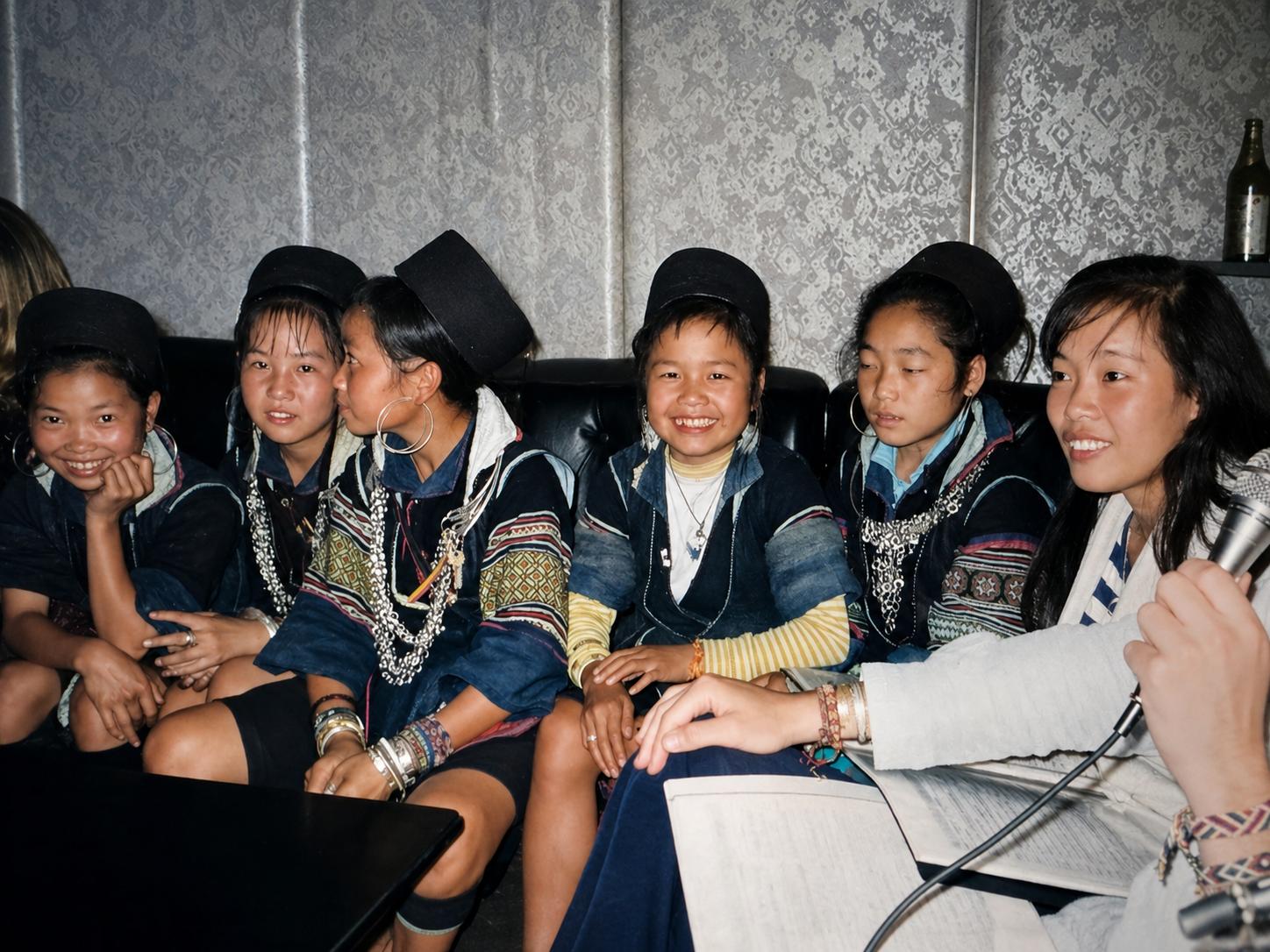
Our base camp became much more than a place to sleep. Almost every morning, local Hmong children wandered over to practise their English, ask endless questions and share stories about life in the surrounding villages. We arrived hoping to study the forests, but those conversations taught us just as much as any scientific survey ever could.
Returning to Town
Every week or so, after days spent beneath dripping forest canopies and nights under canvas, we would shoulder our packs once again and make the long climb back into Sapa. By then our clothes carried the unmistakable smell of wood smoke and damp earth, our boots had acquired another layer of mountain mud and every one of us had begun quietly dreaming about the same two luxuries. The first was a hot shower. The second was food that wasn’t rice.
Phương Nam Hotel became our unlikely oasis. We would arrive looking more like a group of weary mountaineers than scientists, grateful simply to stand beneath steaming water for a few glorious minutes. It is difficult to explain just how extraordinary that felt after washing for days in streams fed directly from the mountains. The water in those streams was crystal clear, wonderfully pure and cold enough to make your teeth ache.
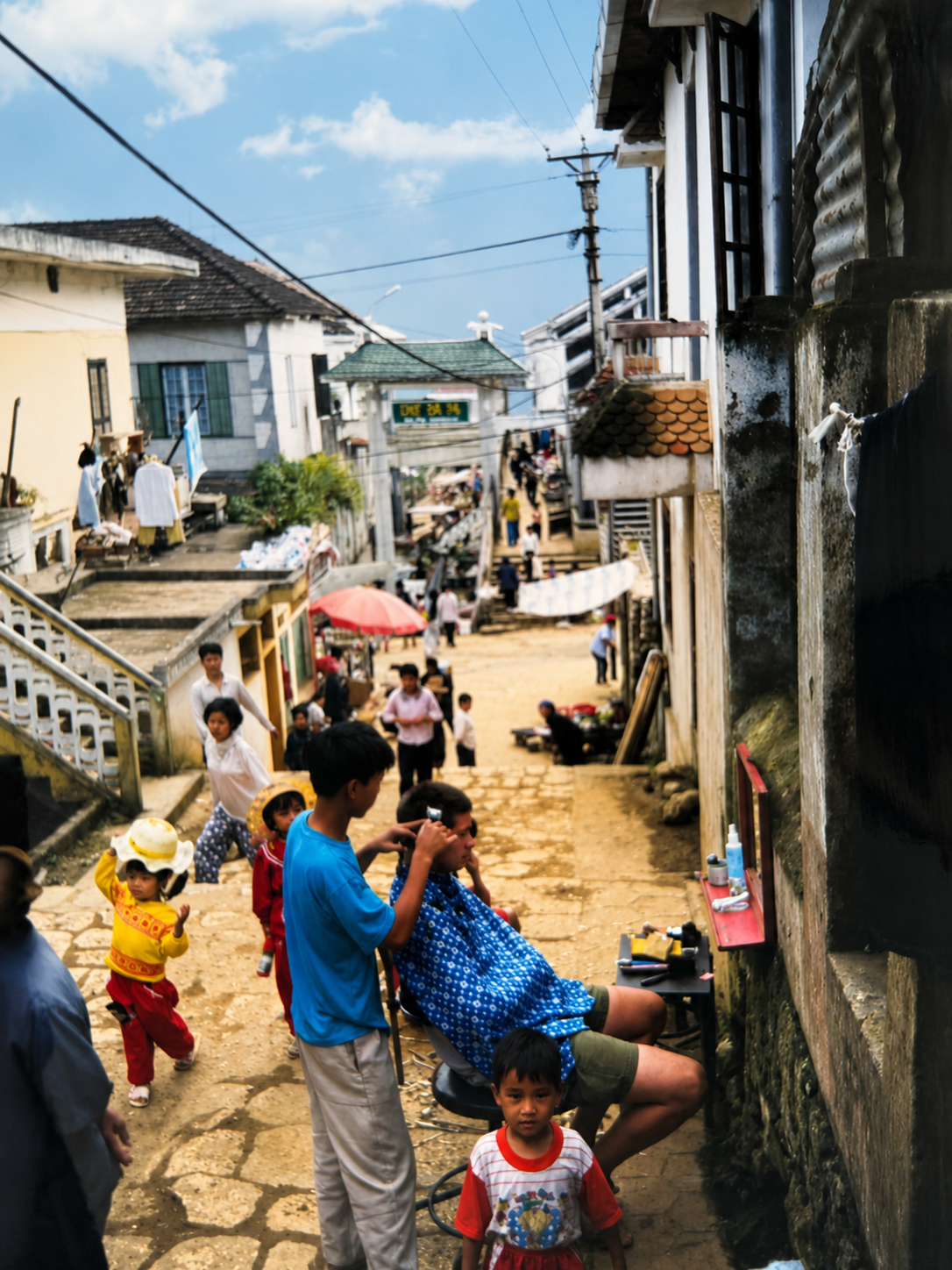
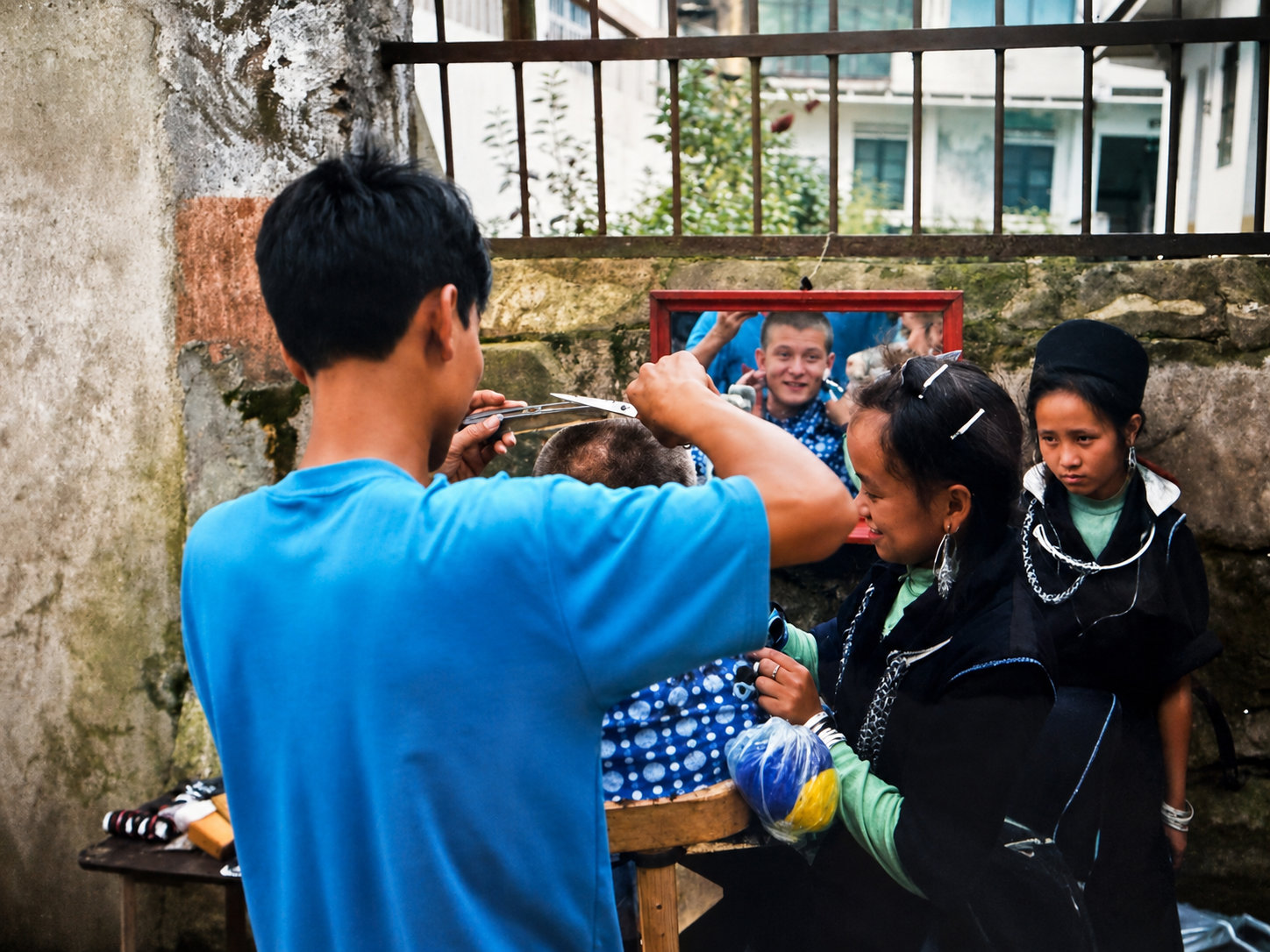
Freshly washed and feeling almost civilised again, we were in no great hurry to leave town. Sapa was where we caught up with friends from other expeditions, exchanged stories from the field over bottles of cold Lào Cai beer and enjoyed the simple pleasure of sitting still for an afternoon. If someone looked particularly scruffy after a week or two in the mountains, a visit to one of the barbers on the market steps was almost inevitable. Their “salons” consisted of little more than a wooden chair, a pair of scissors and a mirror propped against the wall. Formal qualifications appeared entirely optional. The resulting haircuts varied considerably in quality, although nobody complained. After days spent living under canvas, a fresh haircut, however uneven, somehow felt perfectly appropriate.
Sapa Town was also where I searched for fresh rolls of 35 mm film, an expensive commodity that could be surprisingly difficult to find. Every photograph in this article was taken on those precious rolls of film. With only twenty-four or thirty-six exposures in each camera, every frame had to count. There was no screen on the back of the camera to check the result, no second chance and no guarantee that the image had even worked until the film was developed months later.
After a hot shower and errands, our thoughts soon turned to food, and we would wander across town to the Camelia Restaurant. Sapa’s dining scene was wonderfully uncomplicated in those days. Most visitors ate wherever they were staying, and restaurants were few. Camelia had recently introduced something rather exotic to its modest menu. Pizza! News of this culinary revolution spread through our camp with remarkable speed. After another week of rice, vegetables and whatever else the villages had generously placed before us, the thought of pizza assumed almost mythical proportions. We talked about crisp bases, bubbling mozzarella and fragrant herbs all the way into town, each of us unknowingly describing a meal we were not about to receive.
What eventually arrived bore only the faintest family resemblance to anything found in Naples. The base was a piece of flatbread. Thick slices of fresh tomato had been carefully arranged across the top. Instead of melted mozzarella, two or three wedges of Laughing Cow cheese sat proudly in the centre, softening gently in the heat. There may have been a scattering of herbs, although memory is less certain on that particular detail. We looked at one another in complete silence before someone burst into laughter. It was nothing like pizza. Although after another week of rice and forest camps, none of us complained. To this day I cannot see a wedge of Laughing Cow cheese without thinking of Camelia Restaurant, damp boots drying beneath the table and a group of exhausted conservationists convinced they were enjoying the height of international cuisine.
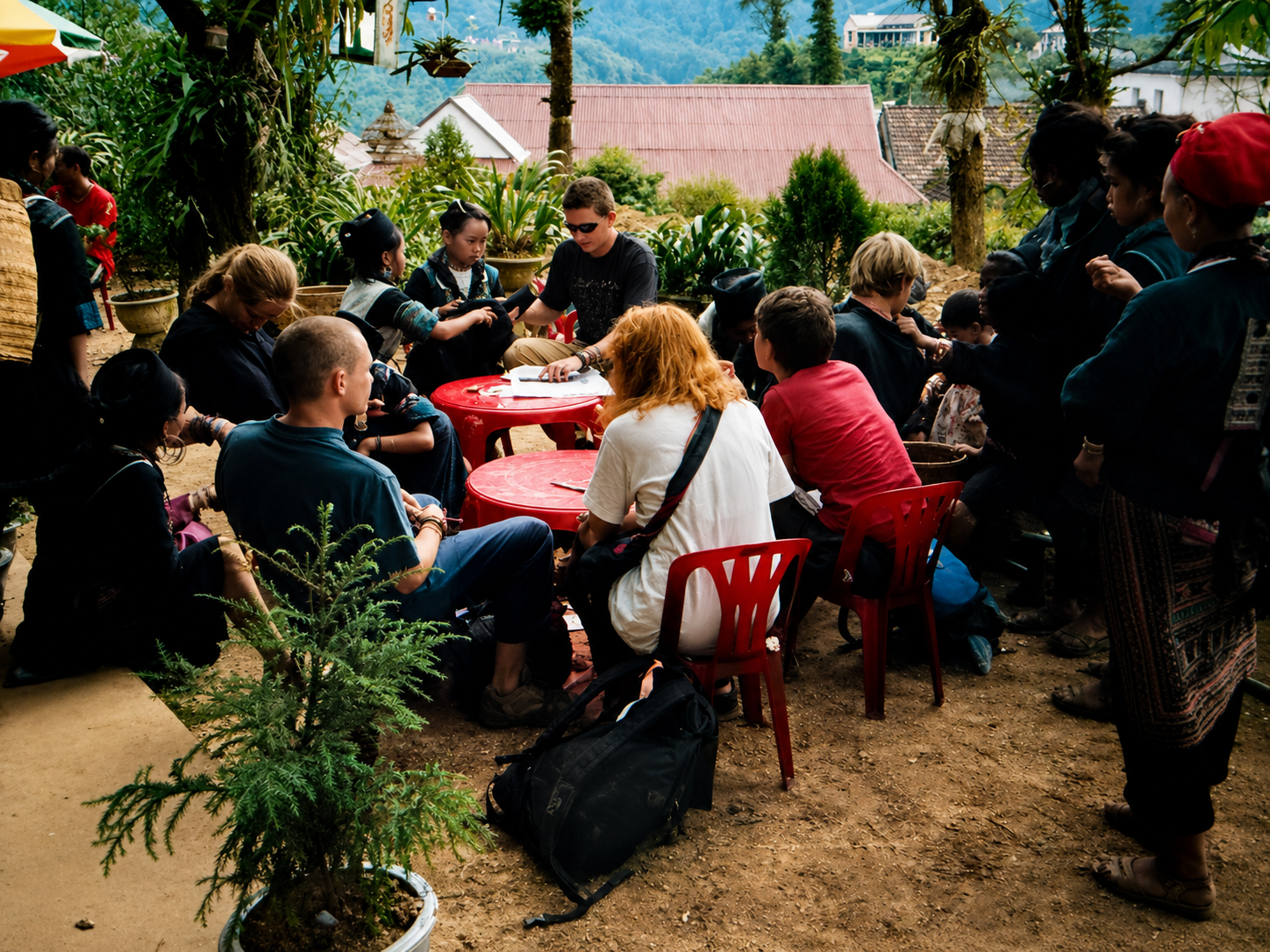
Our Frontier team enjoying a well-earned break after returning from the mountains. After days of rice, forest camps and muddy boots, good food, conversation and a cold beer felt like the greatest luxuries imaginable.
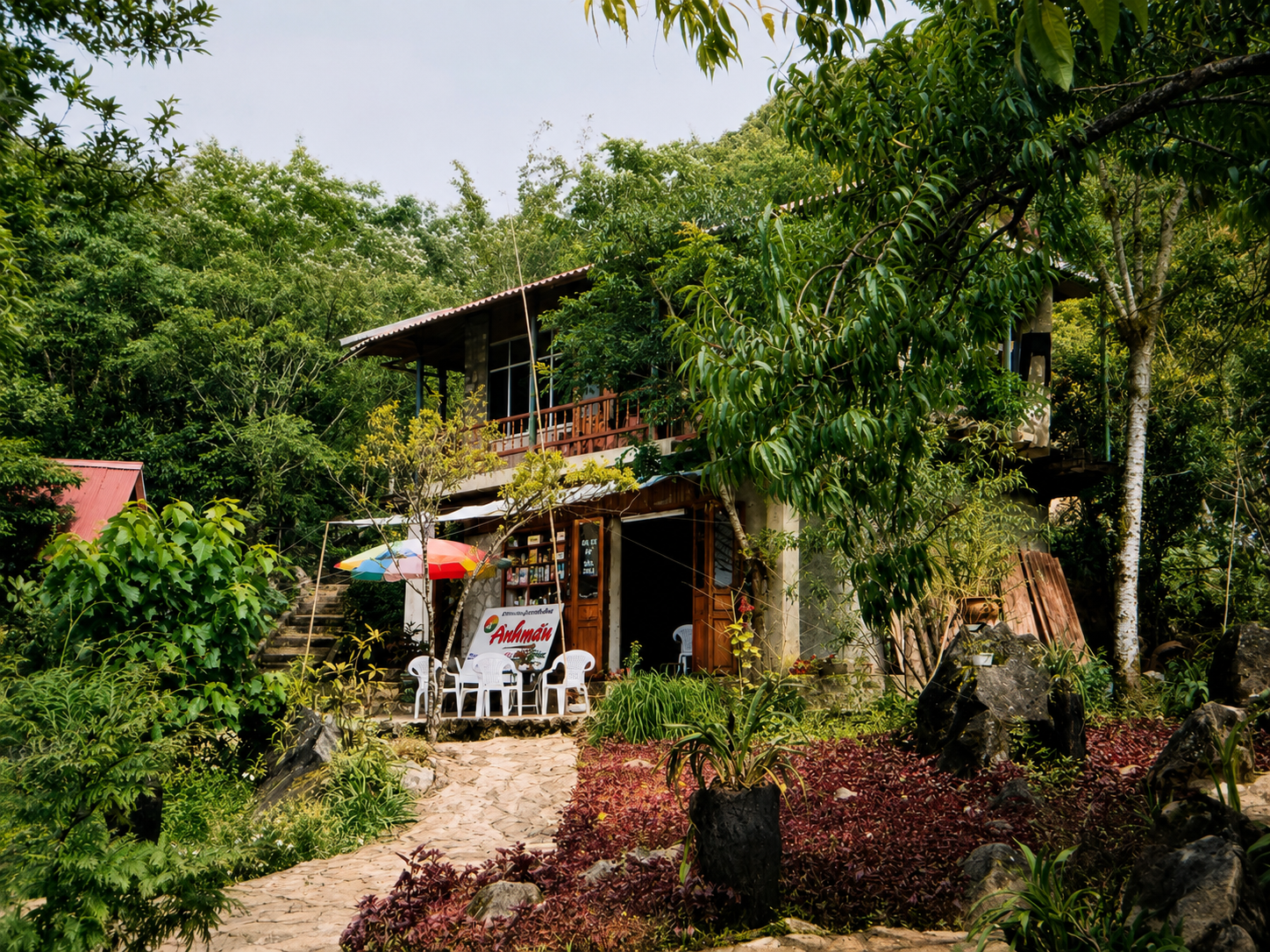
A small family-run shop near the entrance to Hàm Rồng Mountain. Places like this sold simple snacks, soft drinks, beer and everyday essentials, providing a welcome stop for locals, researchers and the handful of travellers passing through Sapa.
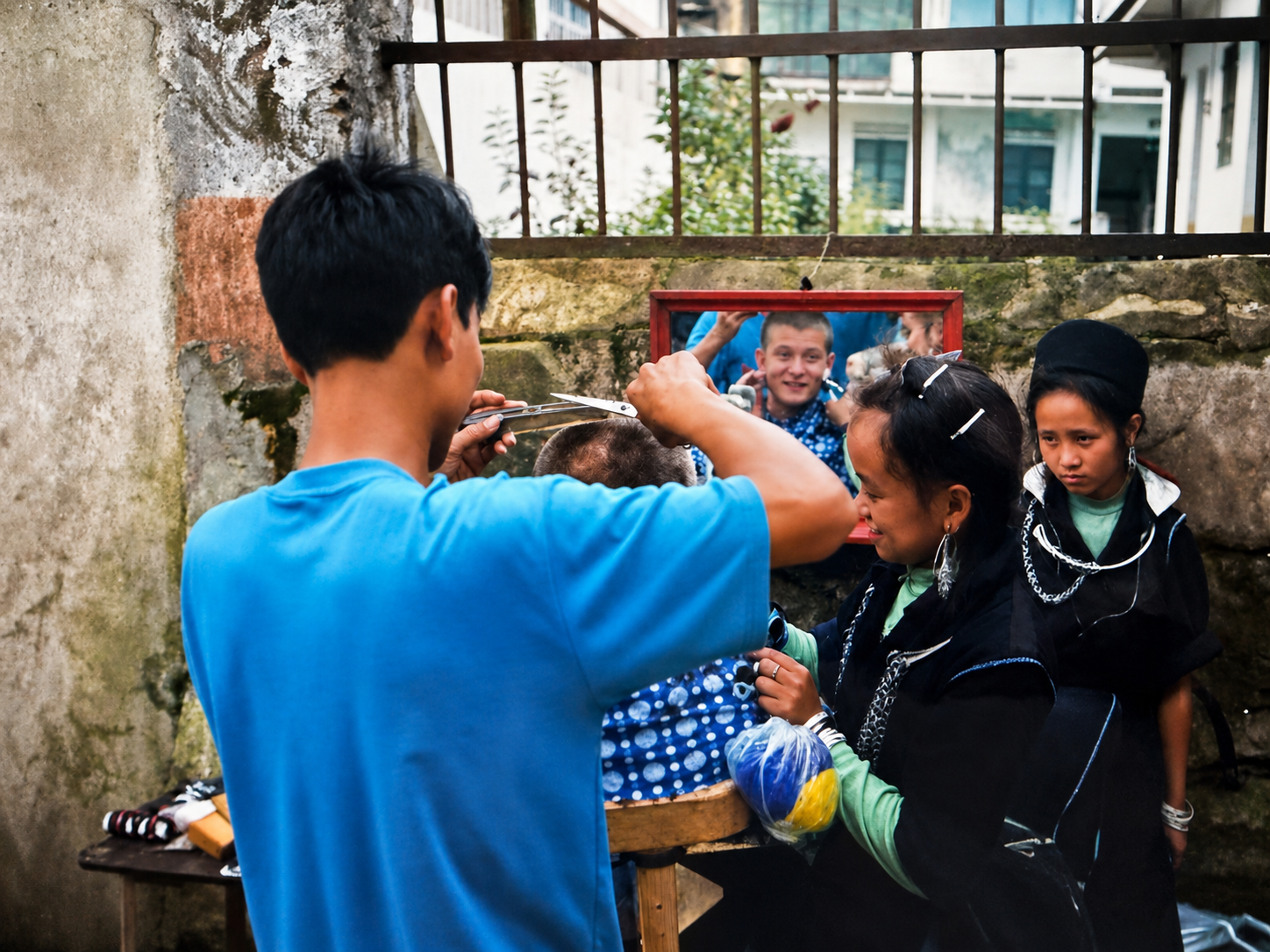
An impromptu haircut on the market steps. Armed with little more than a chair, a pair of scissors and a mirror, Sapa's street barbers offered affordable trims to anyone willing to take a chance on the result.
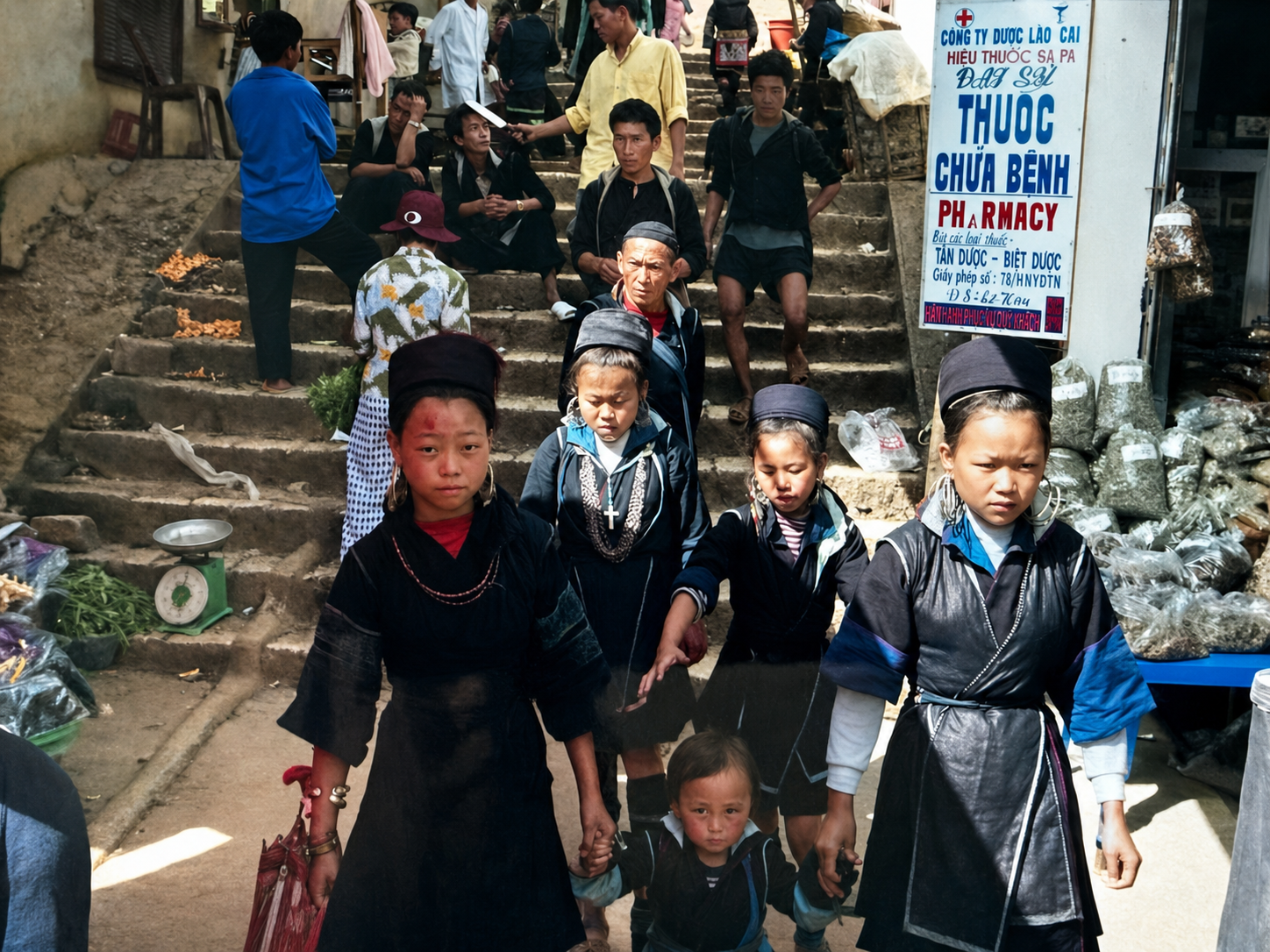
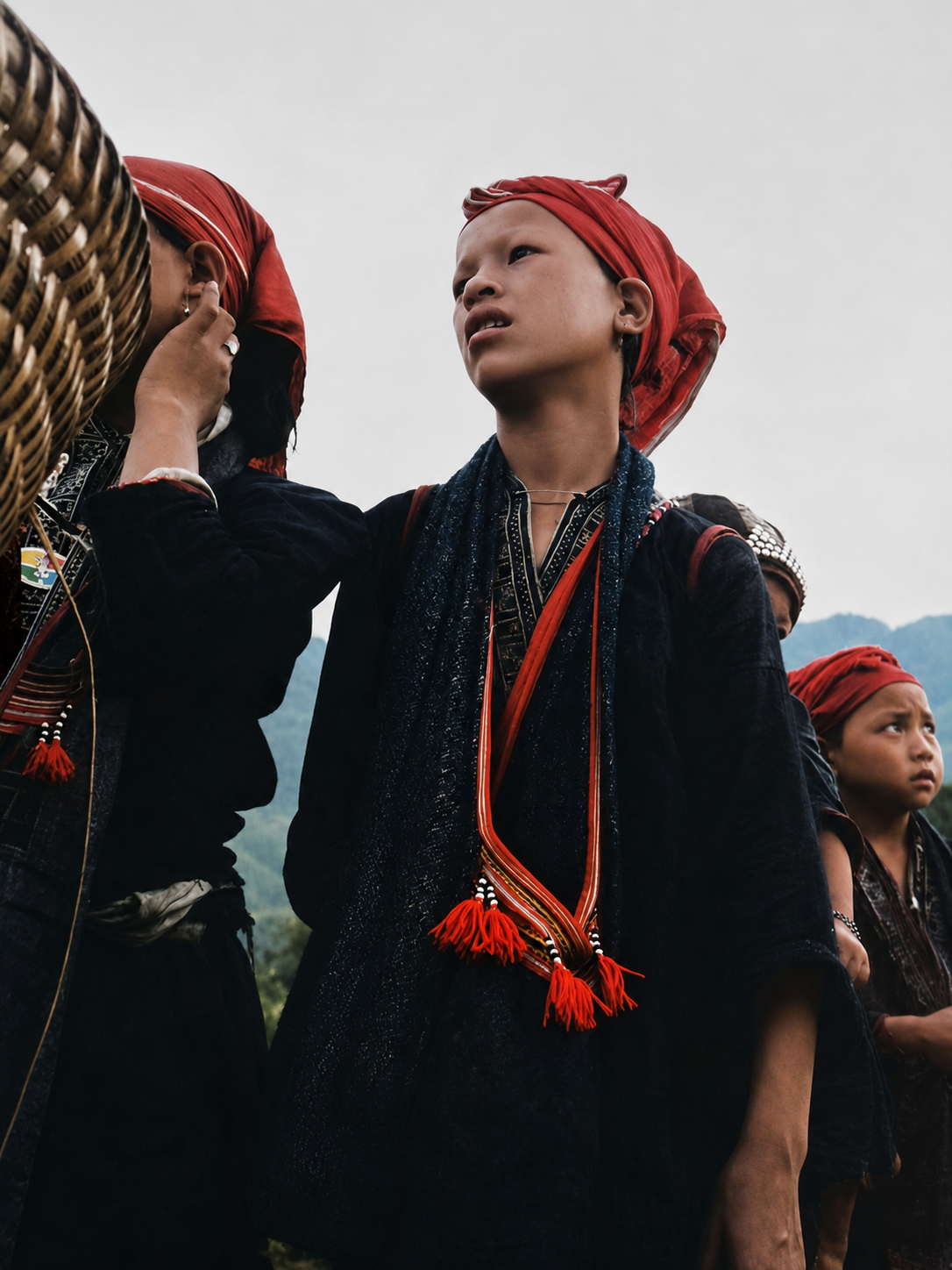
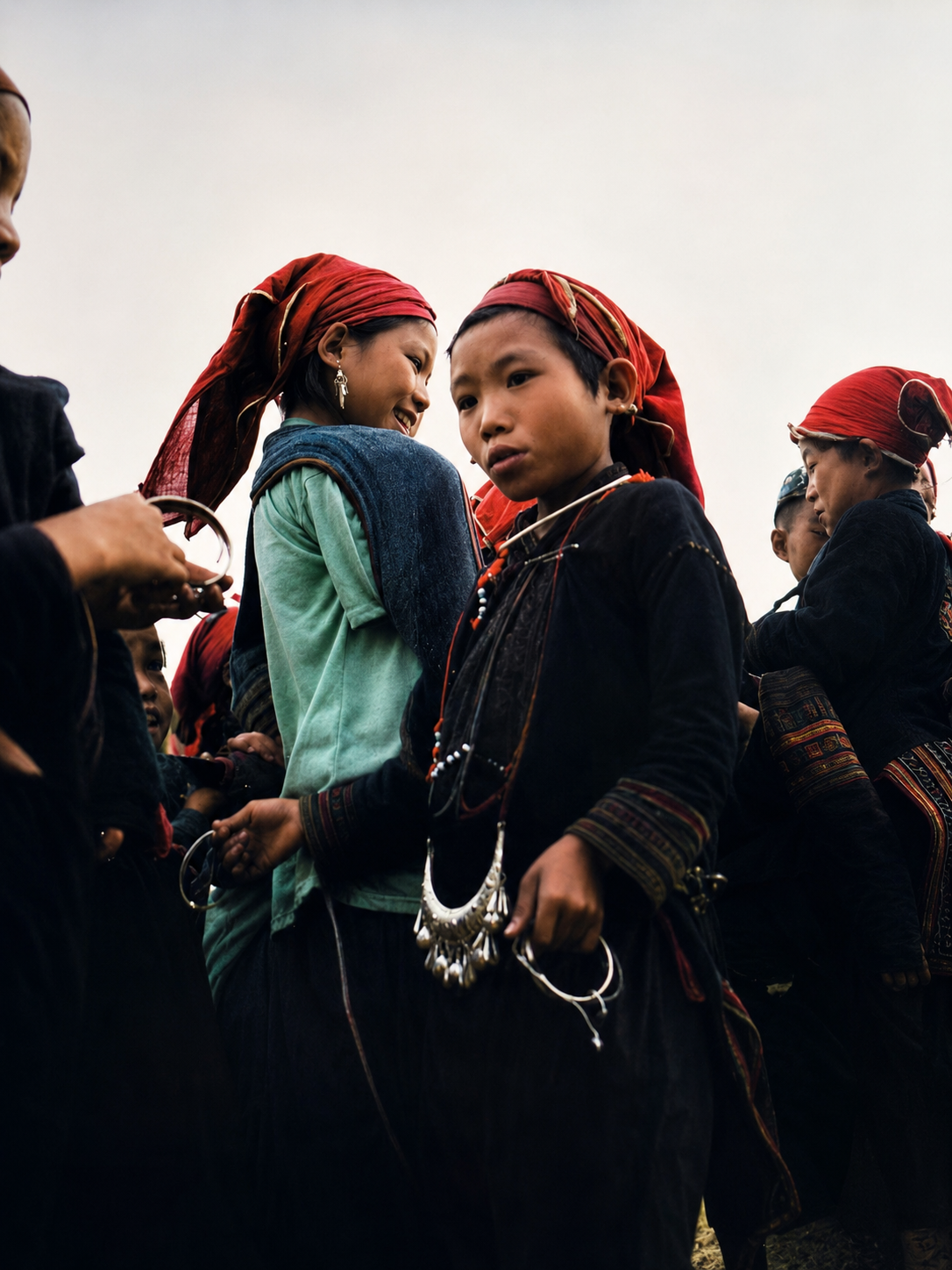
Hmong children arriving at Sapa Market with their families. Market day was about far more than buying and selling; it was an opportunity to meet friends, exchange news and strengthen connections between villages scattered across the mountains.
Around Town
Although Sapa in 1998 was nothing like the busy tourism centre it would later become, it rarely felt quiet. Life spilled naturally onto the streets, and there always seemed to be something drawing my attention. Schoolchildren walked to class in cheerful groups, sometimes marching together behind teachers for school events or local celebrations. Farmers arrived carrying baskets of produce, elderly neighbours paused in conversation beneath the shade of roadside trees, while horses, pigs and the occasional water buffalo wandered through the town with far greater confidence than any motor vehicle.
There was no need to plan an afternoon's entertainment. Simply sitting outside with a beer was enough. Every few minutes another small scene unfolded. Children chased one another along muddy lanes. Someone wheeled a bicycle piled impossibly high with sacks of rice. Market traders packed away the last of their goods before stopping to chat with friends they had not seen since the previous week. Laundry fluttered from balconies, radios drifted through open windows and the sound of hammers echoed from houses being repaired after another mountain winter.
Looking back at these photographs now, what strikes me most is not what they contain, but what they do not. There are almost no coaches, souvenir shops or crowds of visitors. The streets belonged overwhelmingly to the people who lived there. Tourism was already beginning to arrive, but it remained a quiet presence alongside the ordinary business of mountain life. Simply wandering through town for half an hour often revealed more about Sapa than any guidebook ever could.
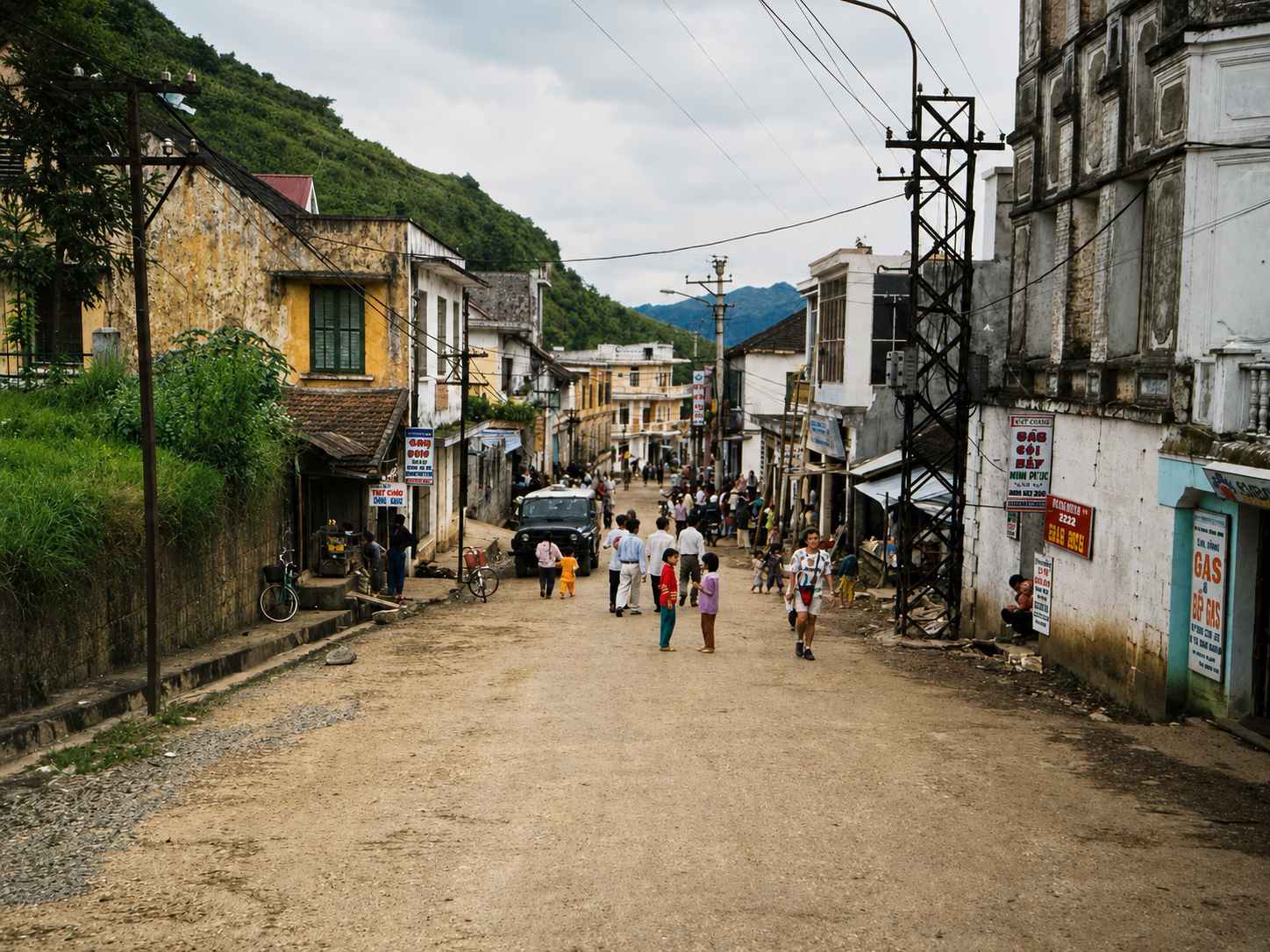
Sapa's main street in 1998. The town was small enough to cross on foot in a matter of minutes, yet there was almost always something happening. Farmers, traders, schoolchildren and local families shared the same muddy streets, each going about the routines of everyday mountain life.
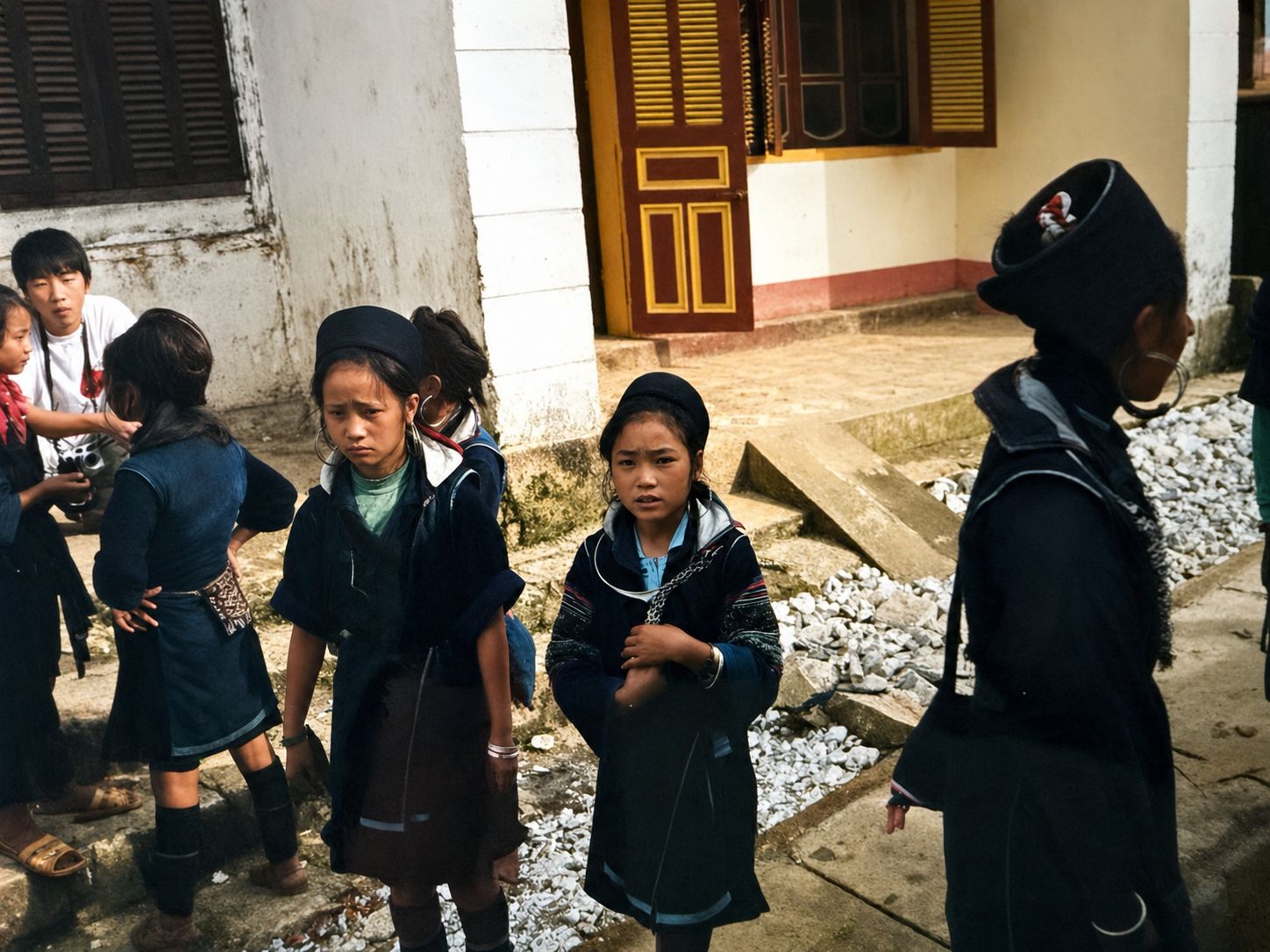
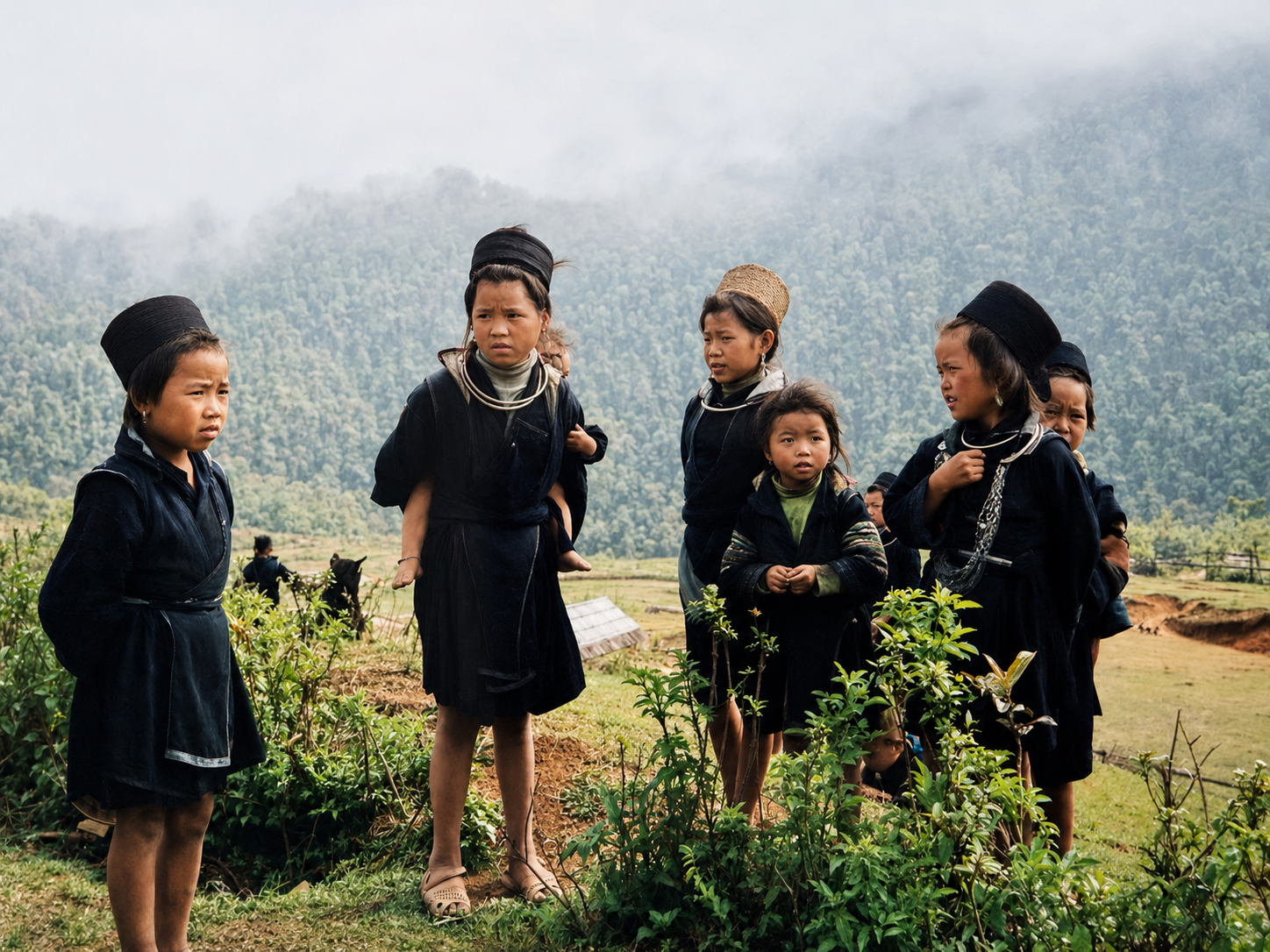
A group of young Hmong children gathered in town hoping to meet newly arrived travellers. Even in 1998, many had already recognised that learning a few words of English could open conversations, friendships and opportunities far beyond their mountain villages.
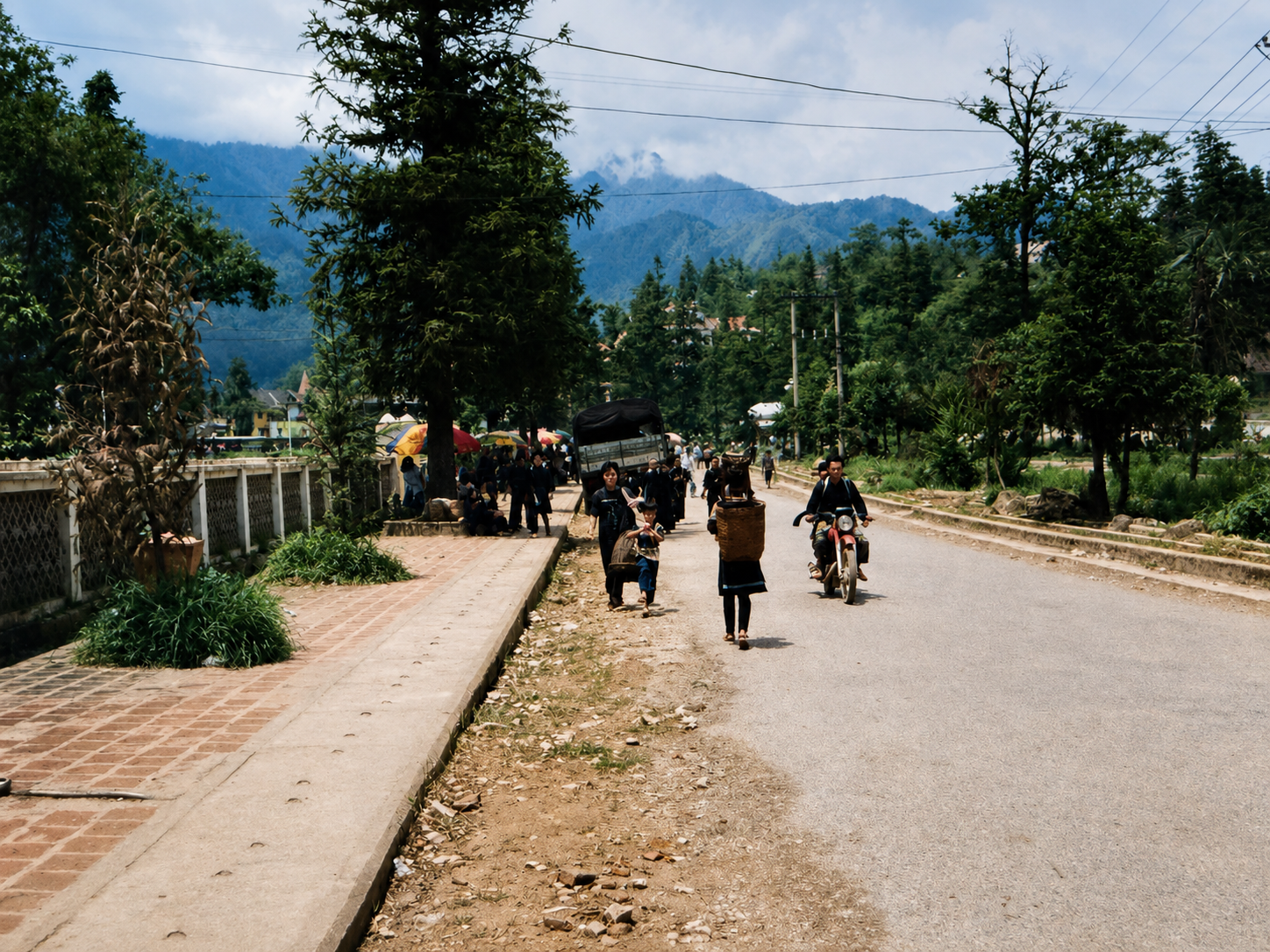
A quiet afternoon near the old stone church. With few vehicles and no crowds, walking was simply the natural way to move around town, offering endless opportunities to stop, chat and watch daily life unfold.
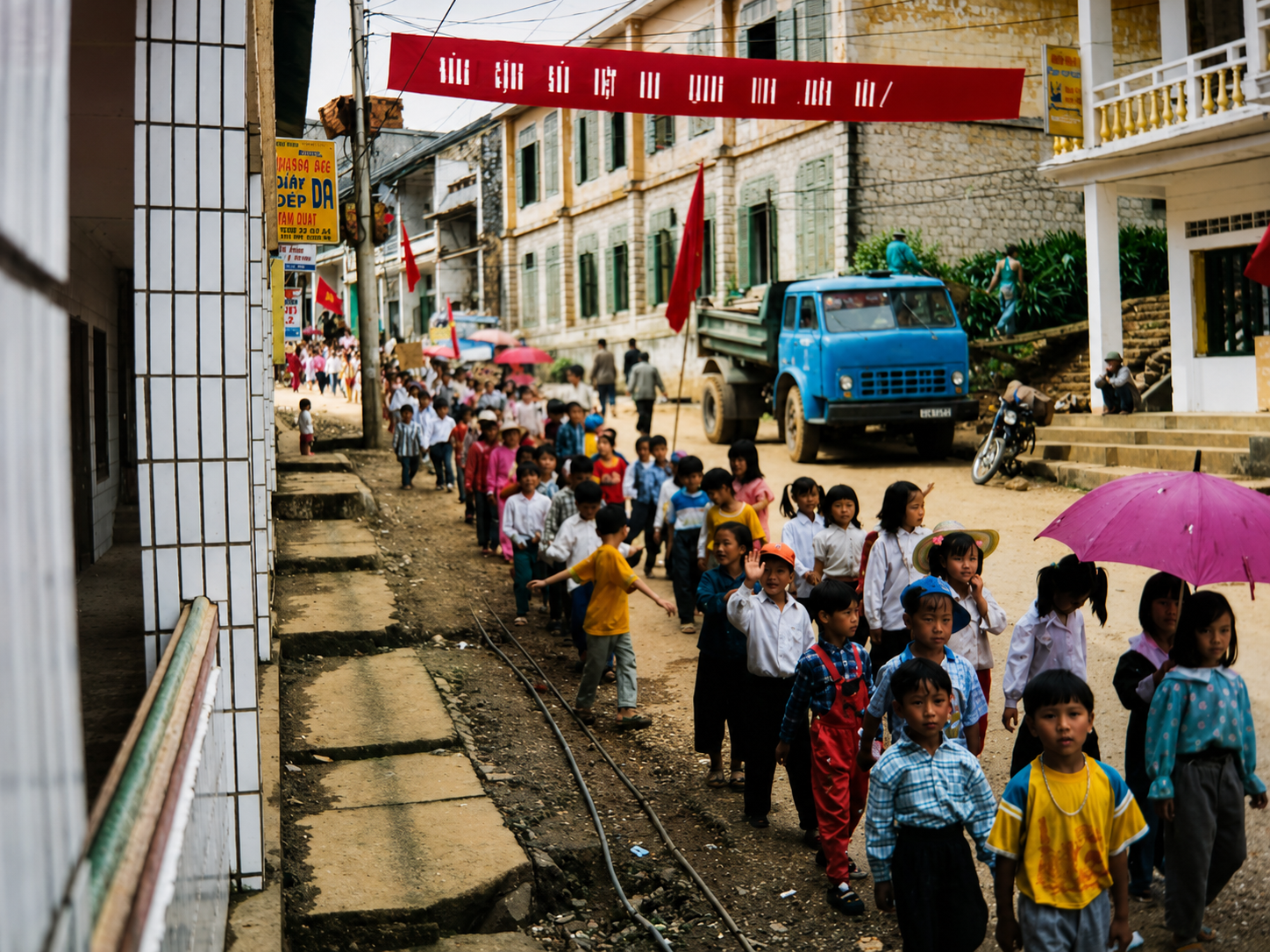
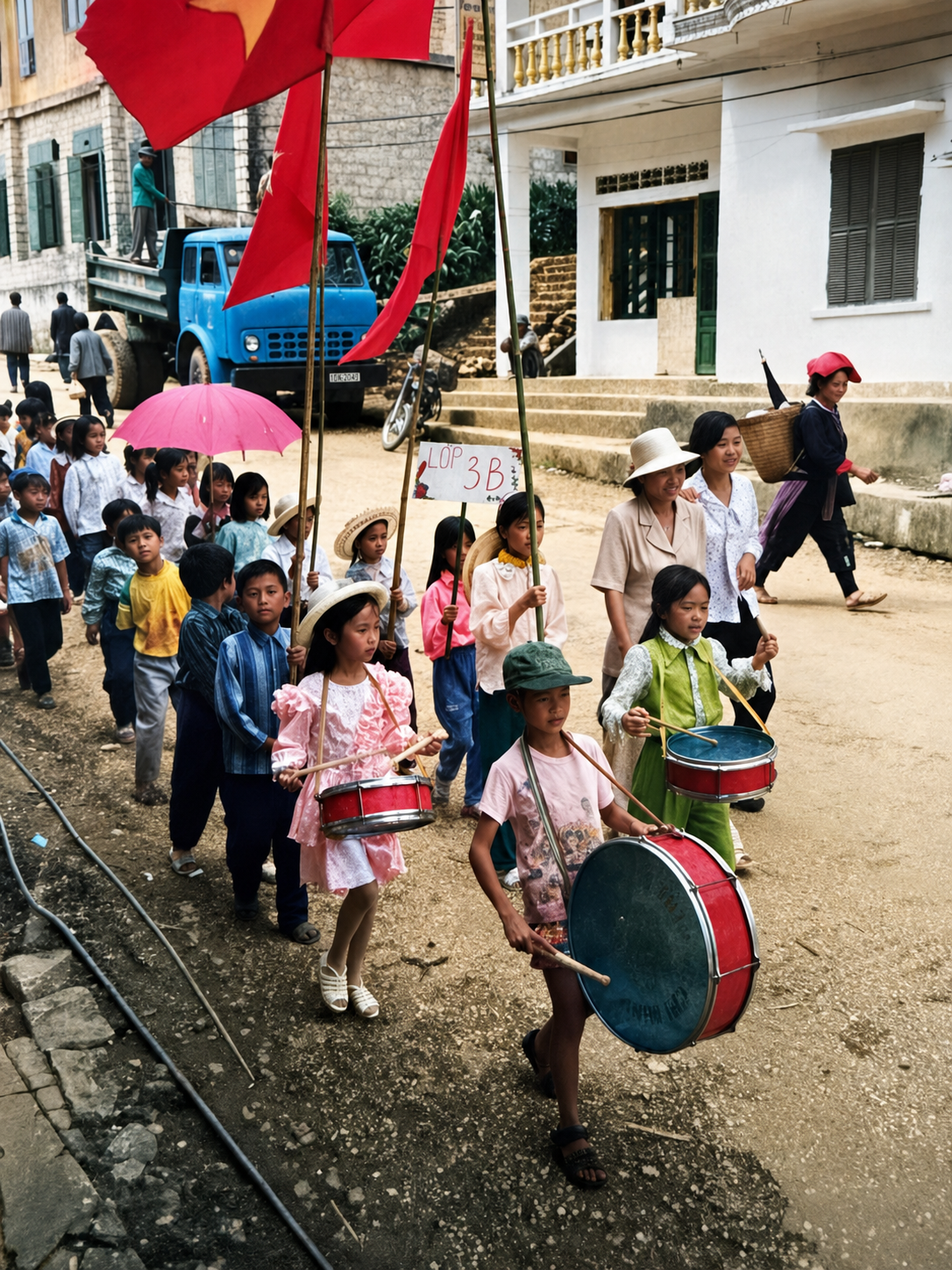
Schoolchildren gathered along the roadside during a local school event. Moments like these were part of the gentle rhythm of everyday life in Sapa, where the whole town often seemed to share in community celebrations.
Sapa Market - The Heartbeat of the Town
Saturday mornings always began before sunrise. Long before the first bowls of phở were ladled into waiting hands, the roads and footpaths leading towards Sapa filled with people who had already been walking for hours. Families descended from villages scattered across the surrounding mountains, woven baskets strapped across their backs. Some carried vegetables fresh from their gardens, while others led buffalo or pigs. Children skipped alongside their parents, somehow finding endless reserves of energy despite the distance already travelled.
By the time the market stirred fully awake, the whole town seemed to breathe a little differently. The smell reached you before the noise. Coal and wood smoke drifted from charcoal stoves where great pots of broth simmered gently beside bunches of fresh herbs, spring onions and rice noodles. Steam rose into the cool mountain air as cooks assembled bowl after bowl of fragrant phở. I still remember standing with cold hands wrapped around warm porcelain, watching the market come alive while sipping broth that somehow tasted richer after days in the forest than any meal I have eaten since.
A bowl of steaming phở cost around 2,000 đồng, making it one of the best breakfasts imaginable after days in the mountains. A bottle of Coca-Cola or Fanta cost about the same, although imported brands were still something of a novelty and far less common than they are today. Cigarettes reflected a similar contrast. A packet of Vinataba might cost around 7,500 đồng, while local brands such as Sapa or Du Lịch (Tourism) sold for closer to 2,000 đồng. Beyond those few familiar products, however, the market remained overwhelmingly local. Stalls overflowed with freshly butchered chicken and pork, mountain vegetables, herbs, mushrooms, fruit, woven baskets, livestock and practical household goods, supplying almost everything local families needed from one week to the next.
The market itself unfolded around the familiar stone steps, much as it had since the French established the hill station decades earlier. It was never designed around visitors and existed because mountain communities needed somewhere to trade. Villagers greeted one another after weeks apart, while relatives exchanged family news. Farmers compared harvests and tools changed hands. Bundles of medicinal plants were inspected with practised eyes. Fresh bamboo shoots lay beside baskets of mushrooms gathered from the forest only hours earlier. Nearby, pigs protested noisily as buyers negotiated prices, while buffalo stood with the quiet patience of animals entirely accustomed to attracting crowds. Chickens fluttered indignantly from wicker baskets. Somewhere a child laughed. Somewhere else somebody called out to an old friend across the square.
Colour seemed to flow through every corner of the market. Indigo hemp jackets embroidered with intricate bands of red, green and pink moved steadily between the stalls. Red Dao women adjusted richly decorated headscarves while examining silver jewellery. Giáy and Tày families sold vegetables, rice and household goods, while traders from near the Chinese border unpacked tools and practical everyday items that had made their way across the frontier.
Rain often arrived without much warning. Tarpaulins appeared almost instinctively above stalls while conversations continued as though nothing unusual had happened. People simply waited together until the shower passed, sharing tea, exchanging stories or carrying on negotiations interrupted only briefly by the weather. A thin scattering of foreign visitors wandered quietly through the crowds, although we remained observers rather than participants. Tourism still occupied the edges of market life. The market belonged first and foremost to the people who depended upon it each week, and that quiet confidence gave the whole place an atmosphere that is difficult to recreate.
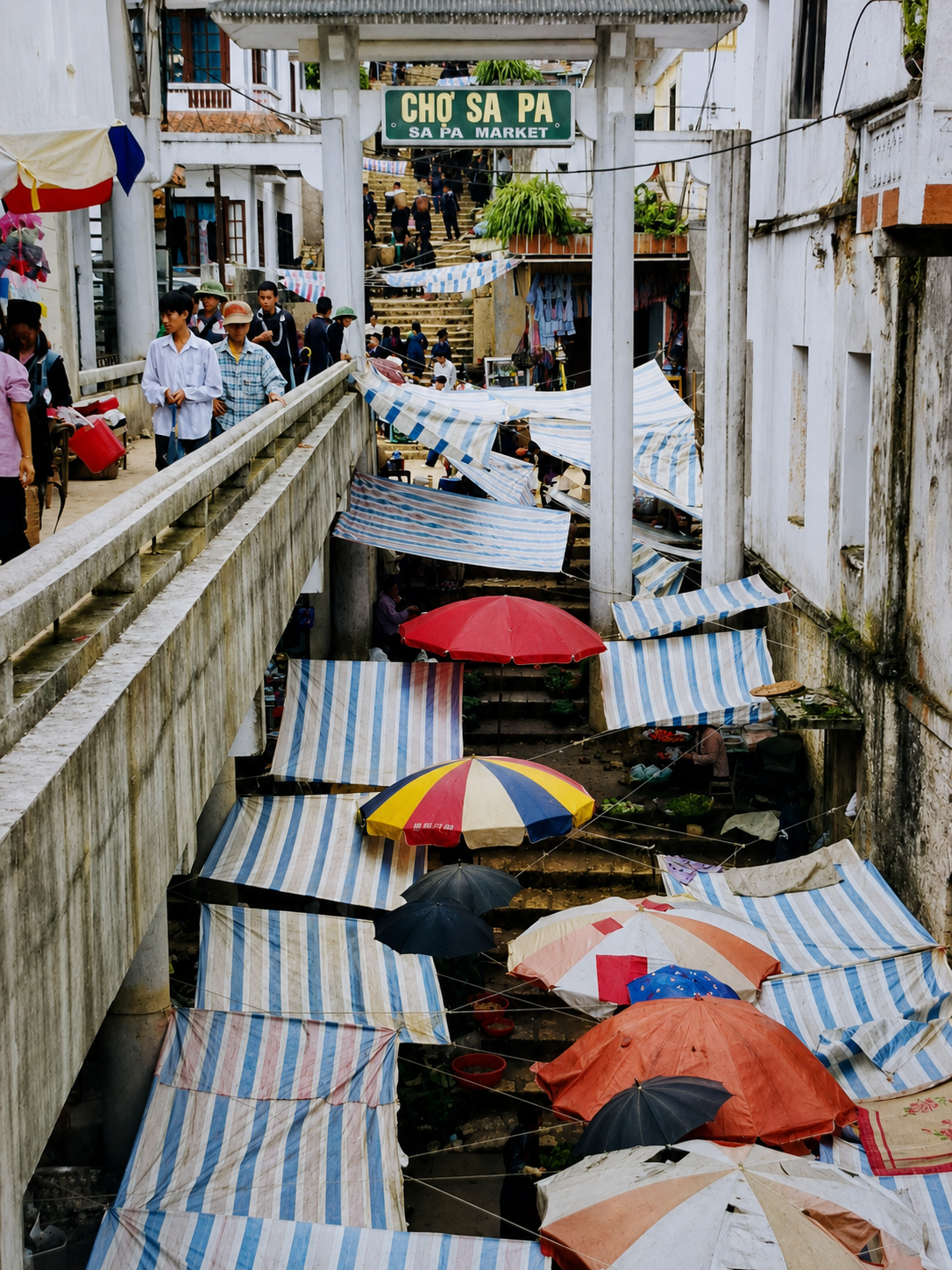
The entrance to Sapa Market in 1998. Beneath a patchwork of striped tarpaulins, traders sold fresh vegetables, meat, clothing, household goods and everyday essentials to families who had often walked for hours from surrounding villages. Before tourism transformed the town, the market existed first and foremost for the people who lived and worked in the mountains. Image courtesy of Sean Adams ©
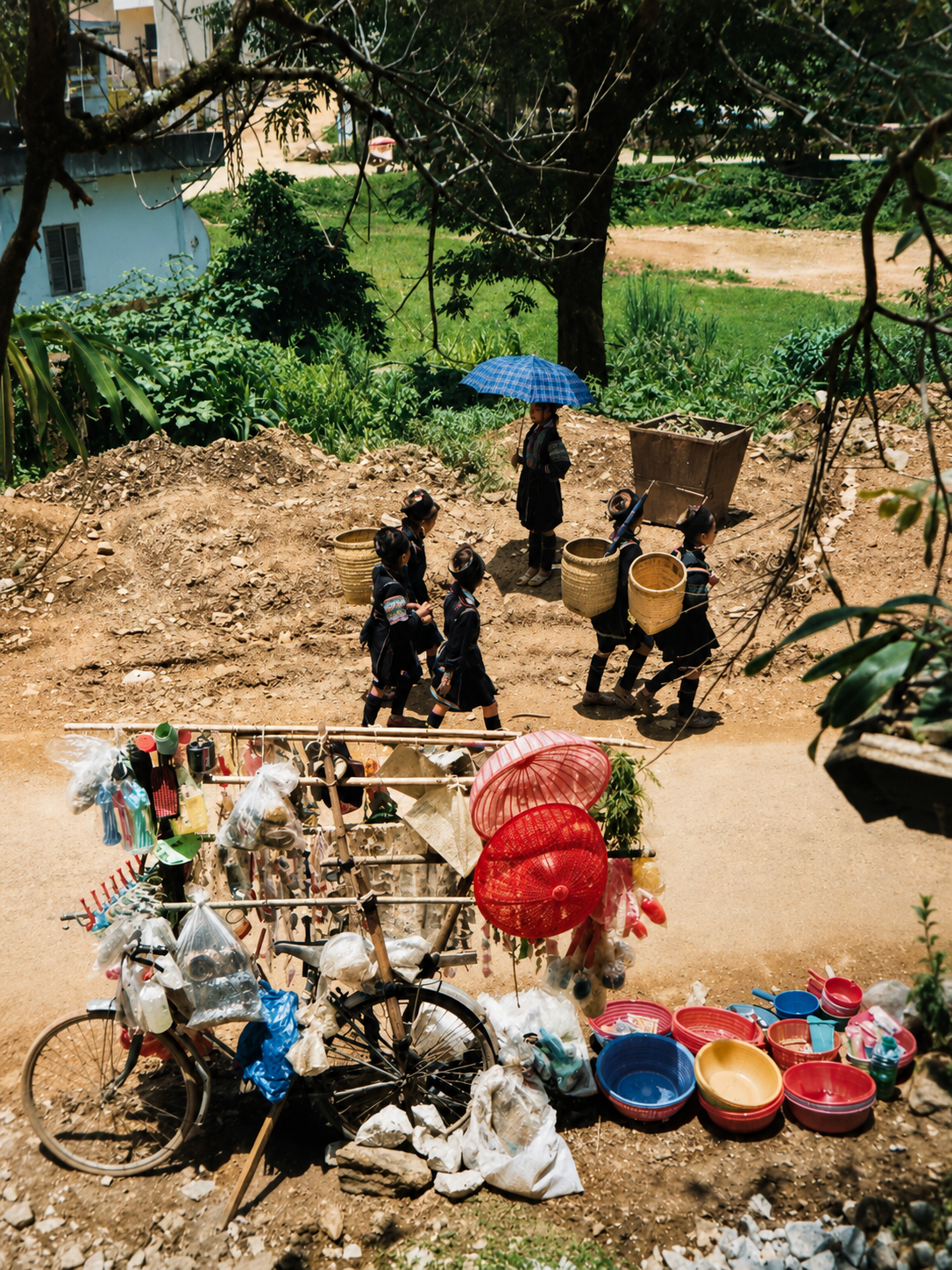
Families heading towards Sapa Market carrying woven baskets filled with produce and household goods. For many people, market day began with a walk of several hours, bringing together communities from across the surrounding mountains.
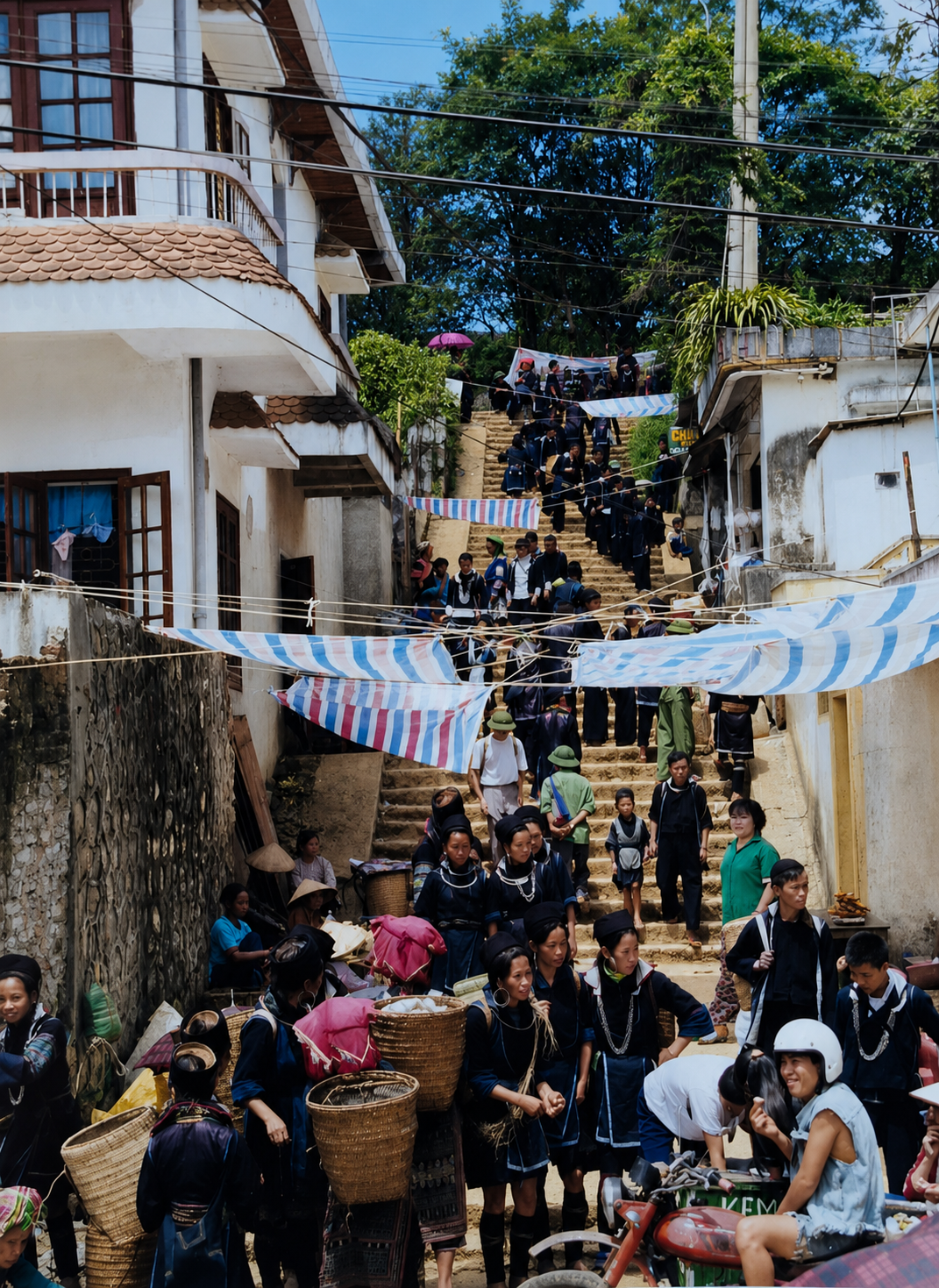
The market spilled through the centre of town, filling every available space with traders, woven baskets, textiles and the conversations that made Saturday the social highlight of the week. Image courtesy of Sean Adams ©
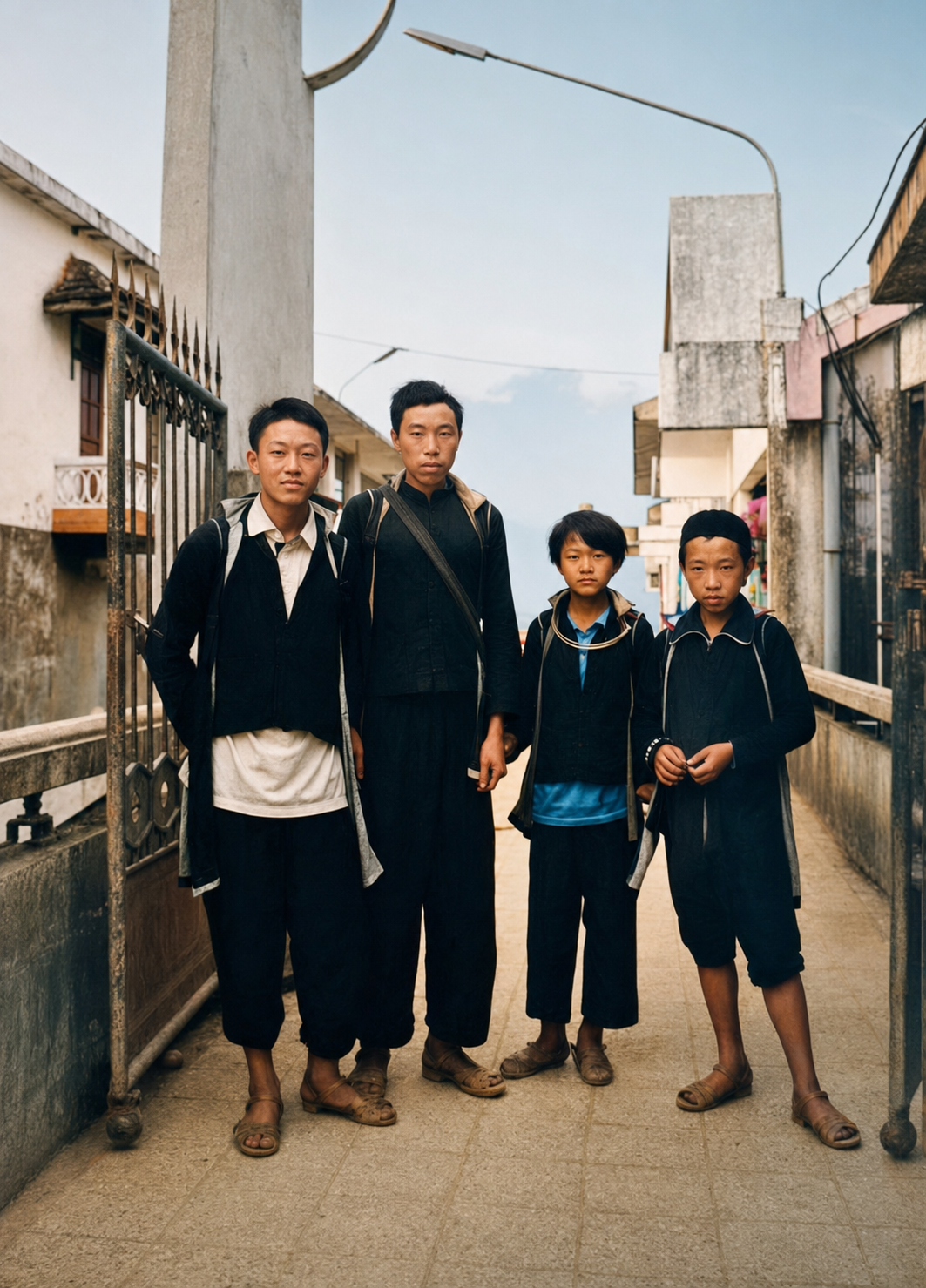
Market day was rarely just about buying and selling. Entire families made the journey into town together, combining trade with the opportunity to visit friends, exchange news and spend time in one of the few places where communities from across the mountains regularly came together. Image courtesy of Sean Adams ©
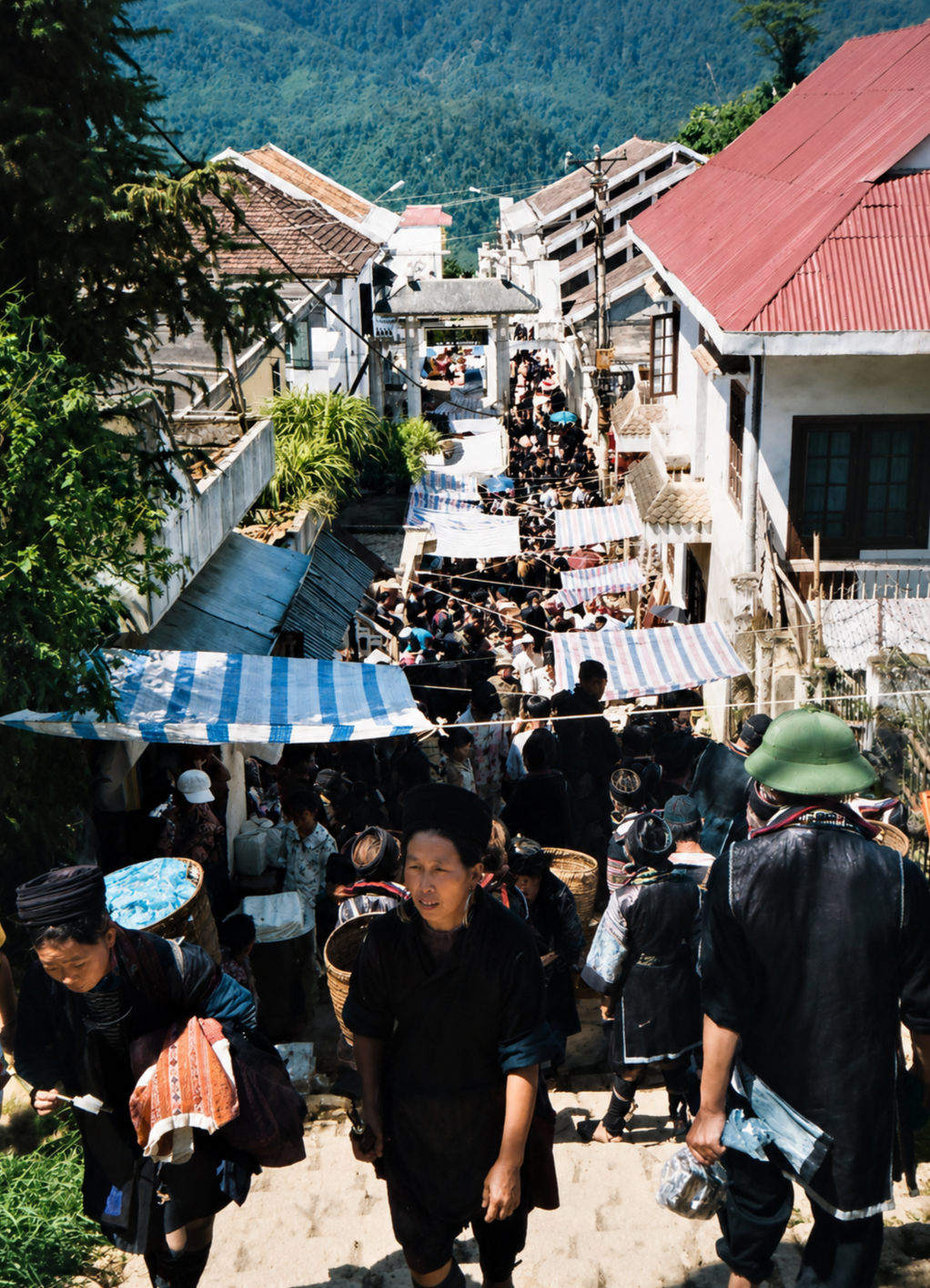
On market days, Sapa's narrow lanes became crowded with people arriving from every direction to trade, meet relatives and stock up on supplies before beginning the long walk home.
Saturday Night and the “Love Market”
As evening settled over Sapa each Saturday, the town seemed to undergo a gentle transformation. The traders who had spent the day buying, selling and catching up with neighbours did not all return home immediately. Many villages lay several hours away on foot, making the journey impractical until morning. Families stayed overnight with relatives or friends, while younger people gathered naturally around the old stone church at the centre of town. This was the gathering visitors later came to call the Love Market.
The name always struck me as slightly misleading. There was no organised event, no performance and certainly nothing staged for outsiders. What unfolded each Saturday evening was simply part of social life in a region where villages could be separated by mountains, rivers and long hours of walking. Market day offered a rare opportunity to see friends, renew acquaintances and, for some young people, begin relationships that might eventually lead to marriage.
Music carried much of the conversation. Young Hmong men played the qeej, its haunting notes drifting softly through the cool night air. Others carried bamboo flutes or mouth harps, using music where words sometimes felt inadequate. Young women responded through songs, conversation, smiles and the quiet language of familiarity that needs no translation. Groups formed and dissolved around the church, laughter rising above the gentle murmur of voices while children chased one another across the open ground.
Visitors often watched with fascination, although it never felt as though we had been invited to spectate. We simply happened to be present while mountain communities continued traditions that belonged entirely to them.
Beyond the Town
Although Sapa itself fascinated me, it was in the surrounding villages that I felt most at home. I had travelled halfway around the world because I wanted to study forests. I imagined my memories would be filled with rare birds, towering trees and scientific discoveries. Instead, it was the people who quietly changed the direction of my life.
Beyond the last houses of town, the landscape opened into a world that seemed governed entirely by the mountains. Rice terraces followed every fold of impossibly steep hillsides before giving way to forests that climbed towards the cloud-shrouded peaks of the Hoàng Liên Sơn. Villages appeared wherever families had found enough level ground to build a home and cultivate the land around it. Houses were constructed from timber cut from nearby forests, many roofed with hand-split pơ mu shingles that gradually weathered to soft shades of silver and grey. They looked as though they had grown naturally from the landscape itself.
The roads that exist today were, for the most part, still years away. A handful of wider gravel tracks reached some villages, but beyond them almost every journey continued on foot. Narrow trails wound through rice terraces, crossed streams on simple log bridges and disappeared into forests before climbing over ridges towards another valley. We walked because our work demanded it. Local families walked because there was no alternative. Children walked to school. Farmers walked to their fields. Families walked to market, often leaving before dawn and returning long after dark with baskets full of supplies balanced across their backs.
Life revolved around the agricultural calendar. Rice remained the foundation of almost every household, supplemented by maize, vegetables, hemp, livestock and whatever the surrounding forests could provide. There was very little waste because there was very little to spare. Every terrace represented countless hours of labour. Every harvest mattered.
It would be dishonest to write about village life in 1998 without acknowledging the poverty that many families experienced. These were not communities trapped in the past or unwilling to embrace change. They were communities living with profound geographical isolation and generations of limited opportunity. Roads were few, healthcare was basic, secondary education remained beyond the reach of many children and markets for agricultural produce were difficult to access. Tourism was only just beginning to appear and had yet to bring meaningful economic opportunities to most villages.
For many families, life remained precariously balanced. When the previous year's rice harvest had been eaten and the next crop was still months from maturity, hunger was an accepted, if unwelcome, companion. I remember being told that some children tied lengths of hemp cord tightly around their waists because the pressure helped ease the discomfort of an empty stomach. Nobody spoke about it dramatically. It was simply one of many practical ways people coped during the hardest weeks of the year.
What struck me most, however, was that hardship never defined the people I came to know. The villages were full of laughter. People shared food they could scarcely spare, welcomed strangers into their homes without hesitation and possessed a generosity that often left me feeling I had received far more than I could ever hope to repay. Knowledge flowed effortlessly between generations. Children learned to recognise medicinal plants, read the weather, care for livestock and navigate mountain paths long before they reached adulthood. The forests that I had come to study were not simply habitats for wildlife. They were pharmacies, supermarkets, workshops and places of spiritual significance woven into everyday life.
Somewhere during those thirteen weeks I realised that my notebooks were no longer filled solely with observations about birds, butterflies and forests. Increasingly they contained people's names, stories and conversations. I had arrived in northern Vietnam hoping to understand one of Southeast Asia's most remarkable mountain ecosystems. Without really noticing it happening, I found myself captivated by the people who had shaped that landscape for generations. I came for the forest, but it was the people who won my heart.
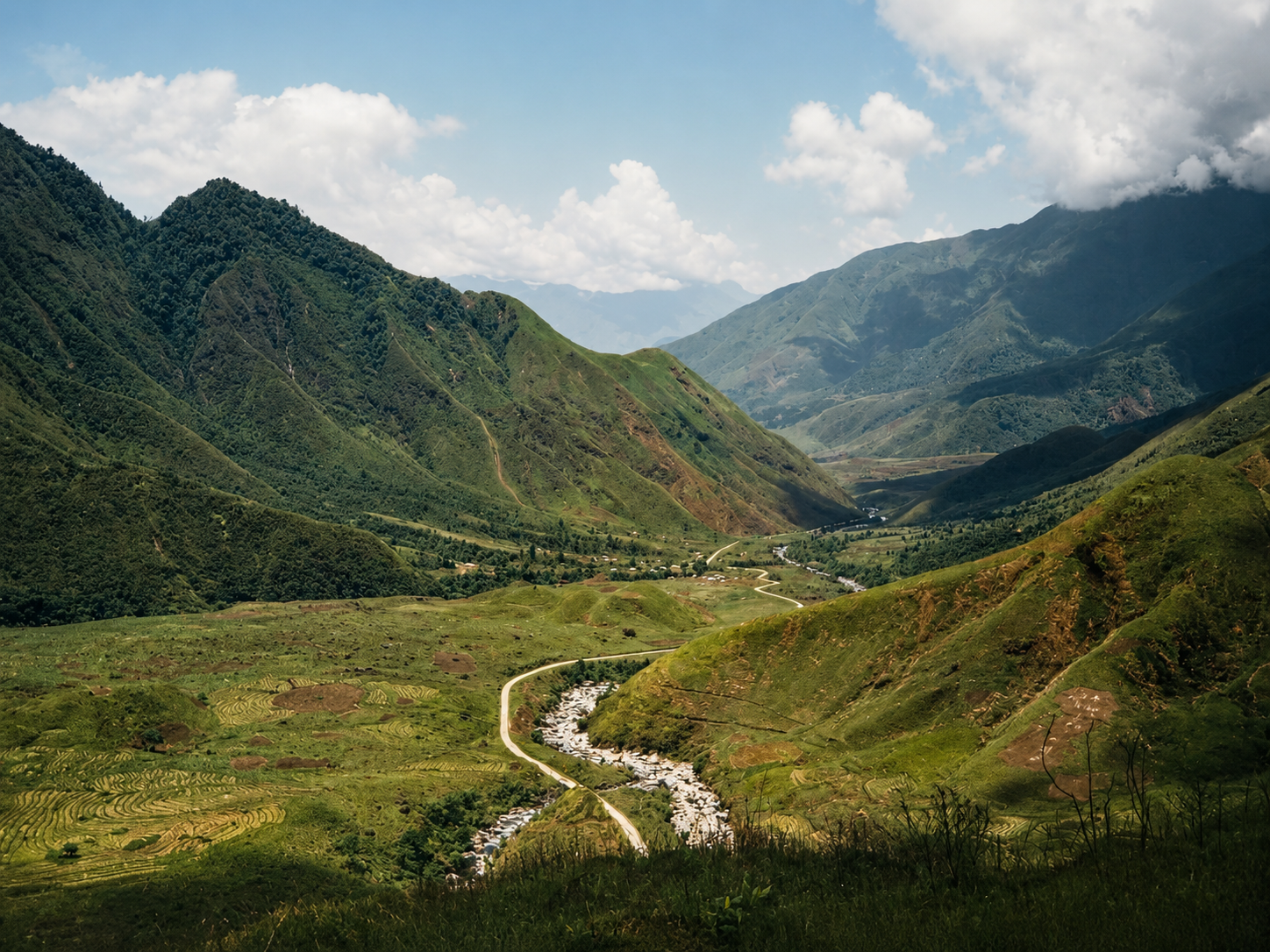
A neighbouring valley near Chu Va in Lai Châu Province. Beyond Sapa, the mountains stretched across northern Vietnam in an almost unbroken landscape of forests, rivers and terraced fields, where villages remained connected by little more than narrow mountain trails.
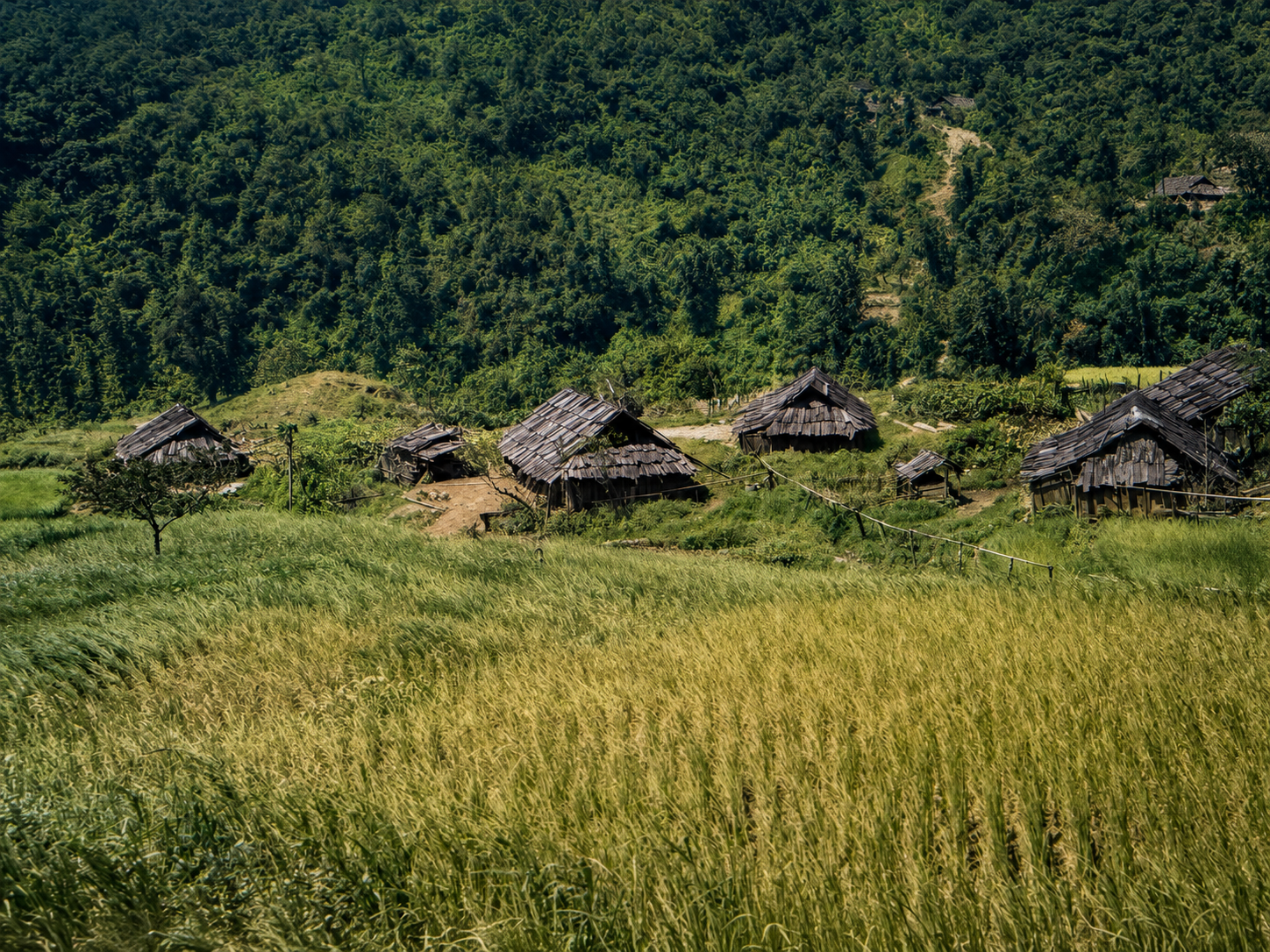
A small Hmong village (Sin Chai) nestled among the rice terraces. Houses were built from locally sourced timber and roofed with hand-split pơ mu shingles, materials that blended naturally into the surrounding landscape and reflected generations of mountain craftsmanship.
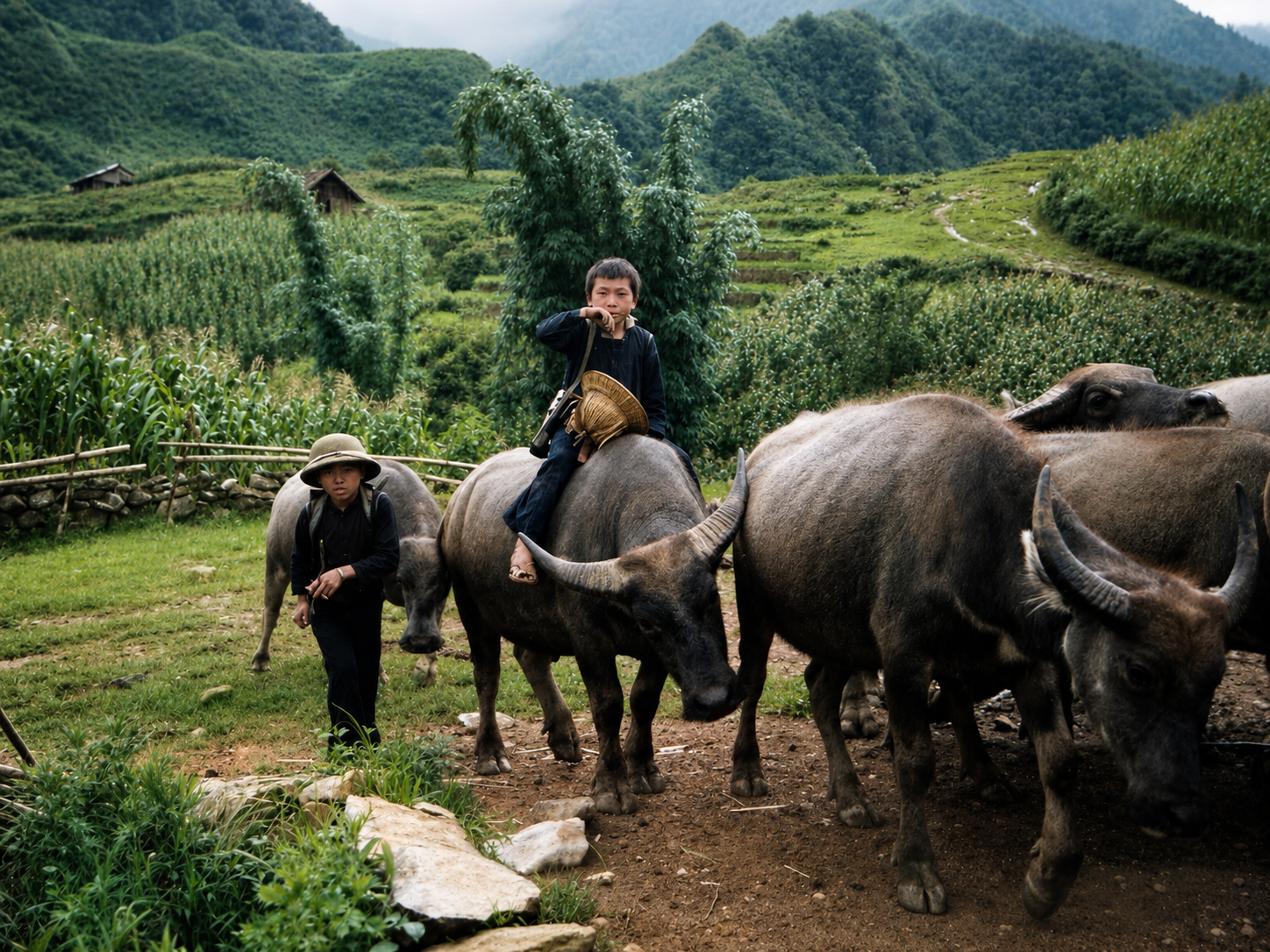
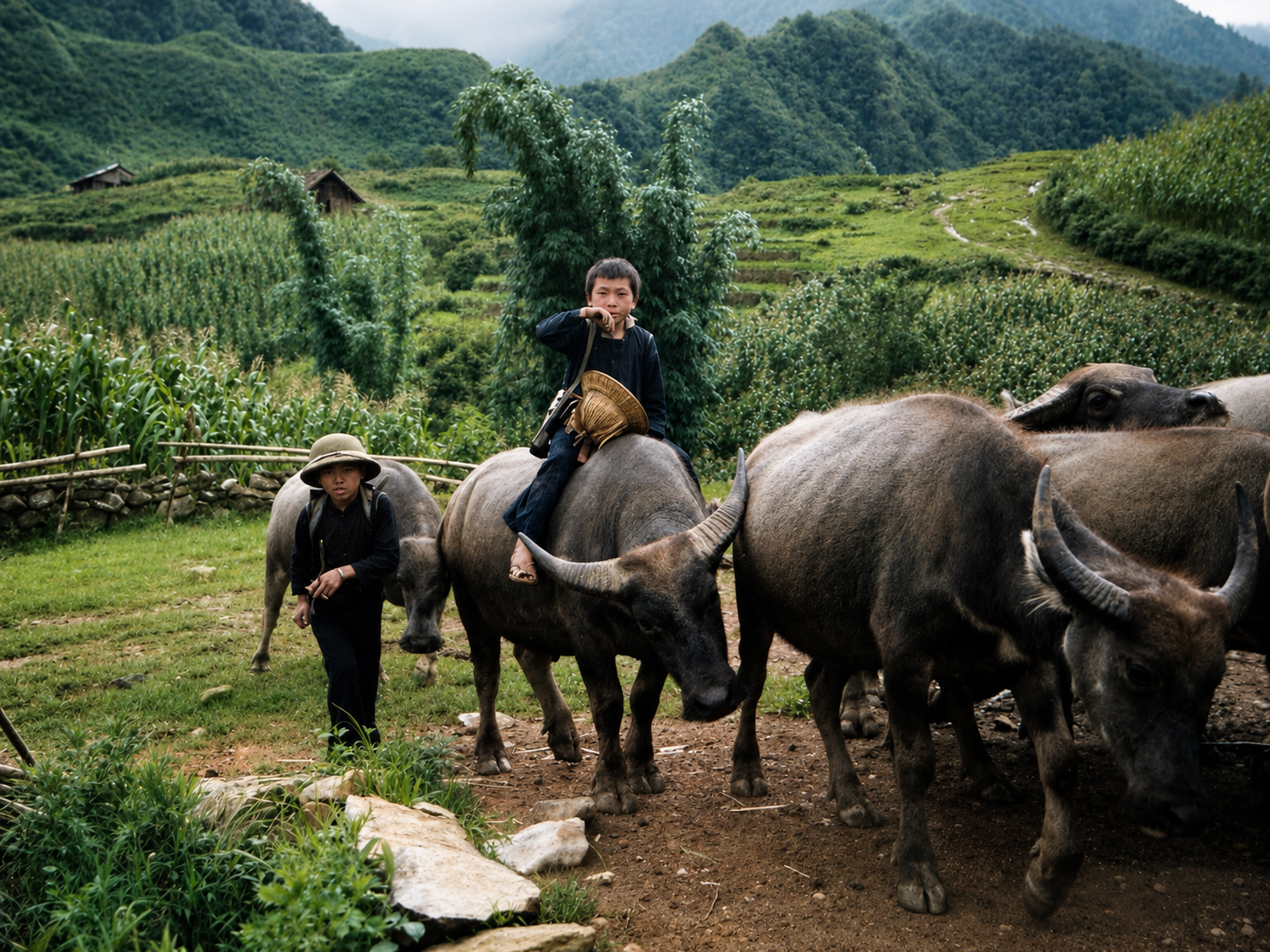
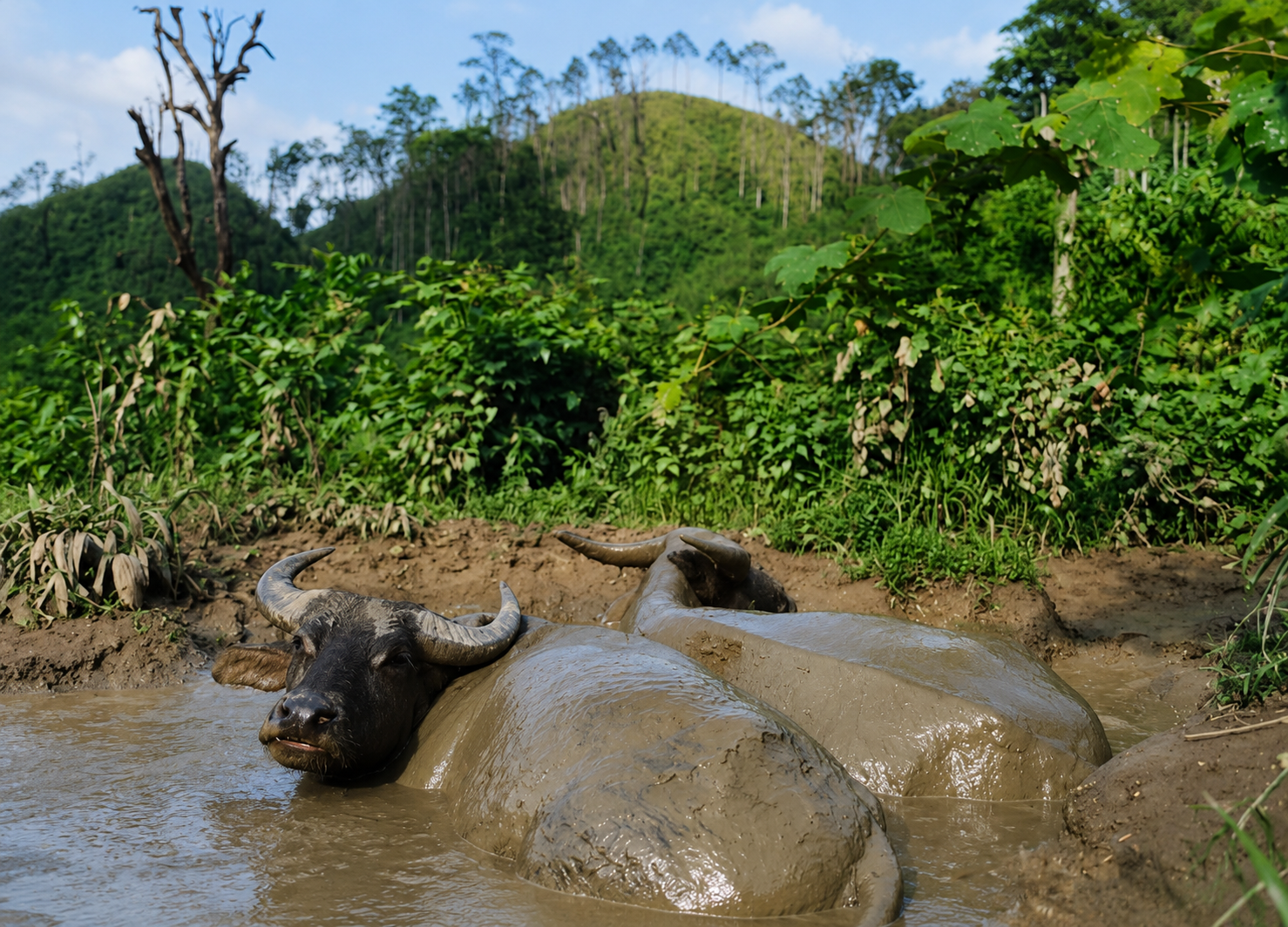
Water buffalo were at the heart of village life, providing the strength to plough steep terraces that could never be worked by machinery. During planting season they were among a family's most valuable possessions.
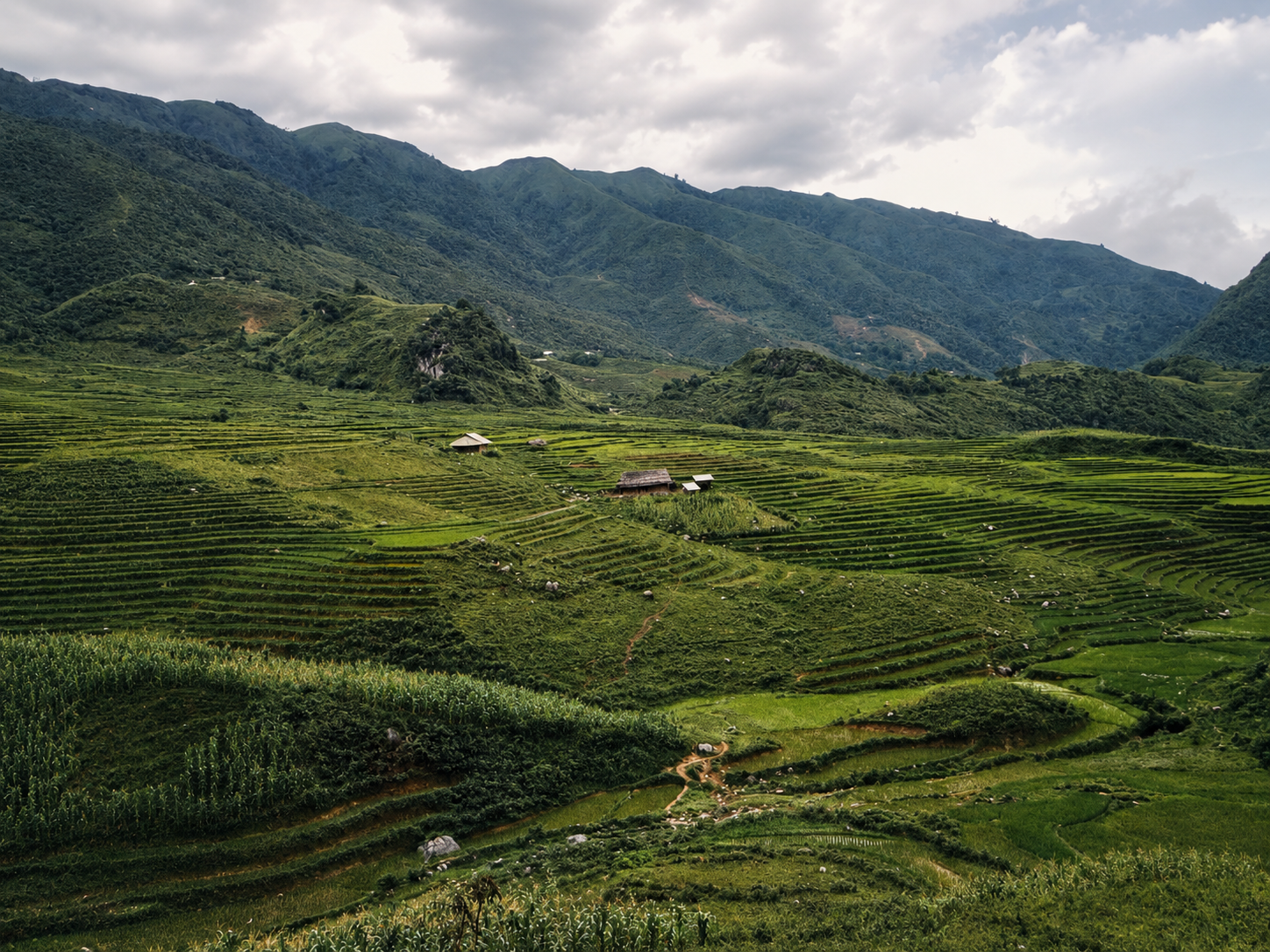
Rice terraces shaped almost every hillside around Sapa. These, in Ta Phin were built and maintained by hand over generations, they transformed some of the steepest mountain slopes in Vietnam into productive farmland and remain one of the region's defining landscapes.
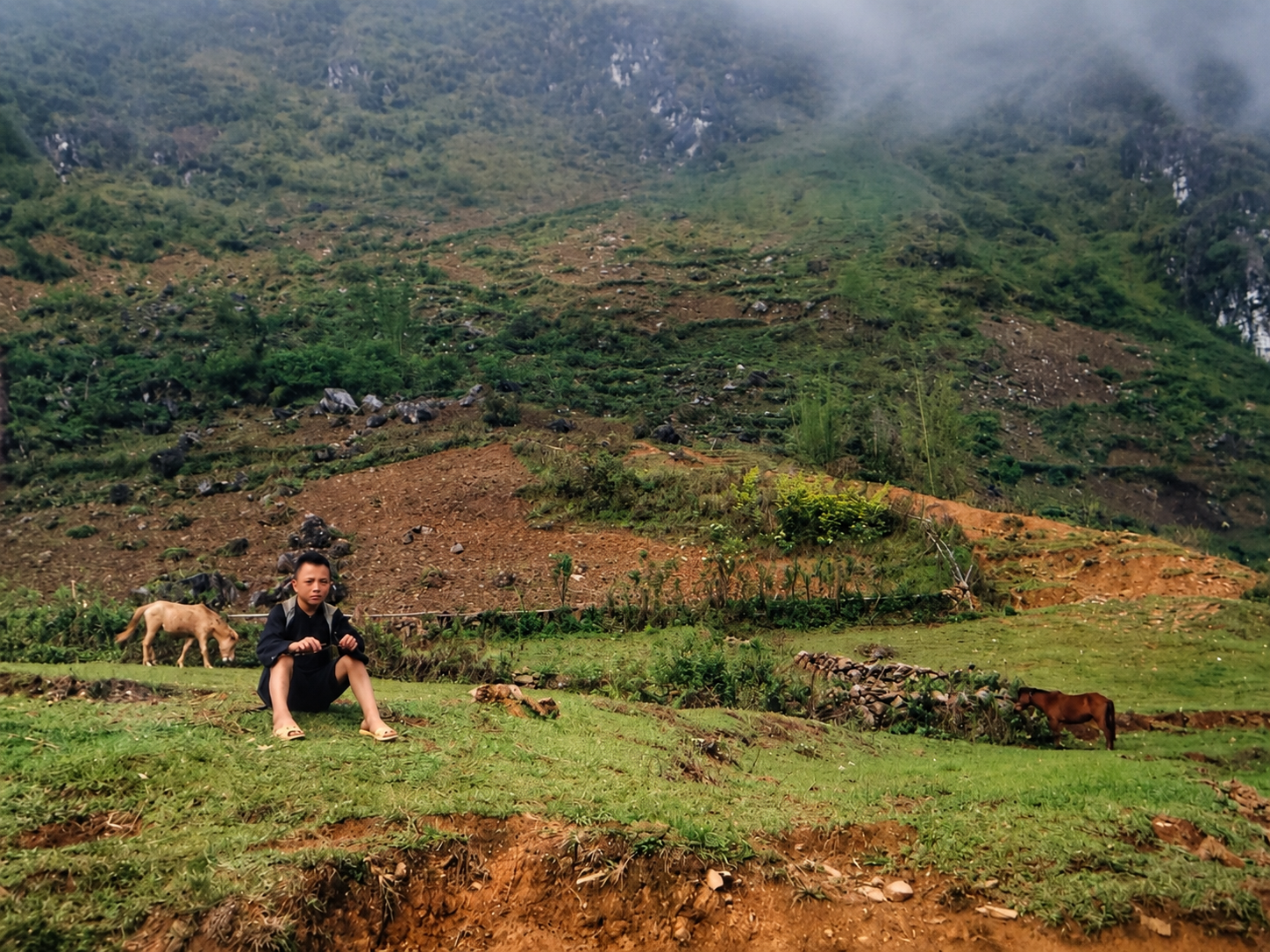
One of countless moments spent simply watching village life unfold. Much of our work involved long walks between settlements, and it was during these journeys that I came to appreciate not only the forests, but also the resilience and generosity of the people who called these mountains home.
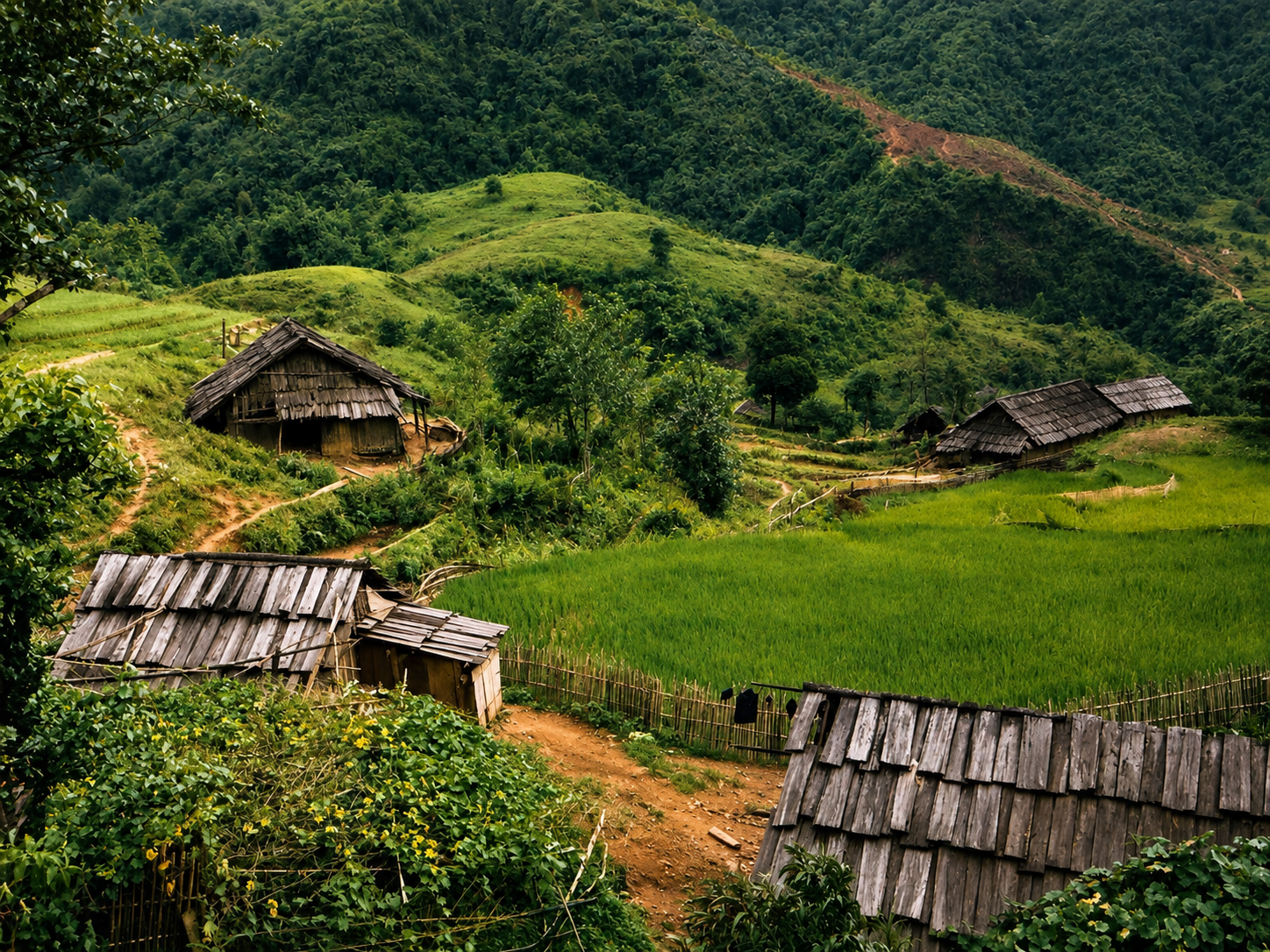
Homes, fields and footpaths formed a closely connected landscape. Every terrace represented years of labour, while the surrounding forests supplied timber, firewood, medicinal plants and countless other essentials for daily life.
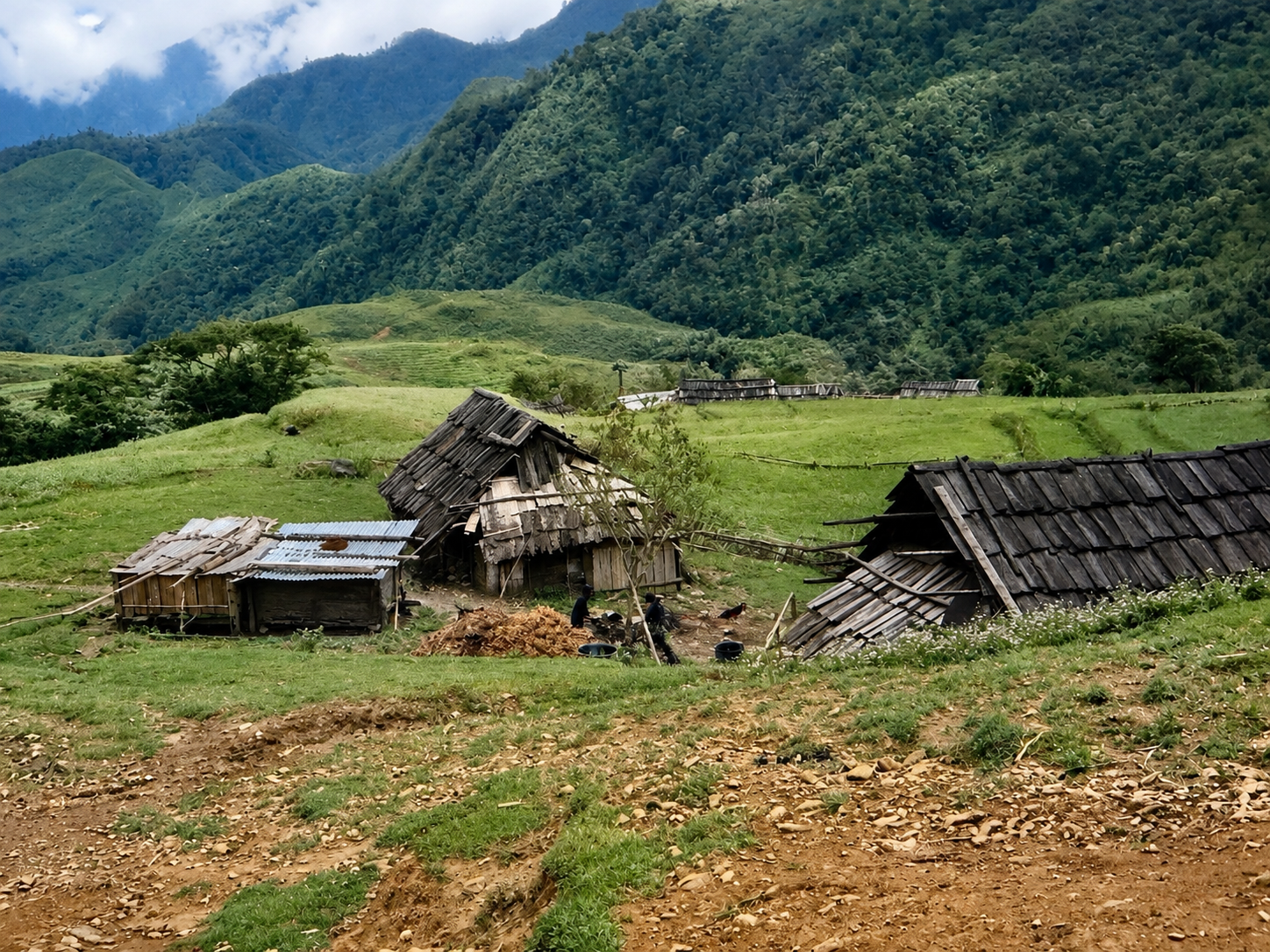
Traditional Hmong homes overlooking their rice fields. In 1998, many villages remained largely self-sufficient, with families relying on agriculture, livestock and the surrounding forests to meet almost every aspect of daily life.
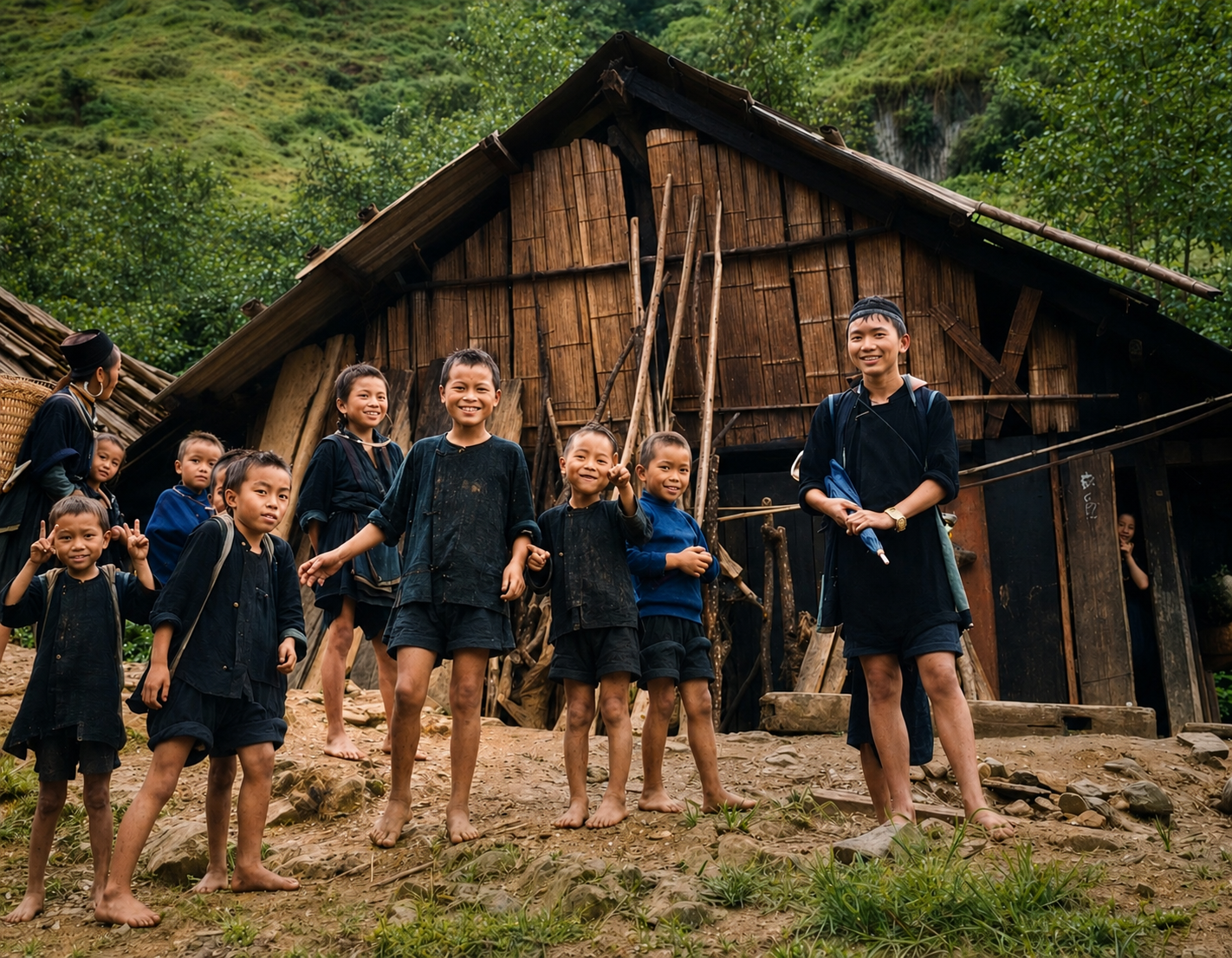
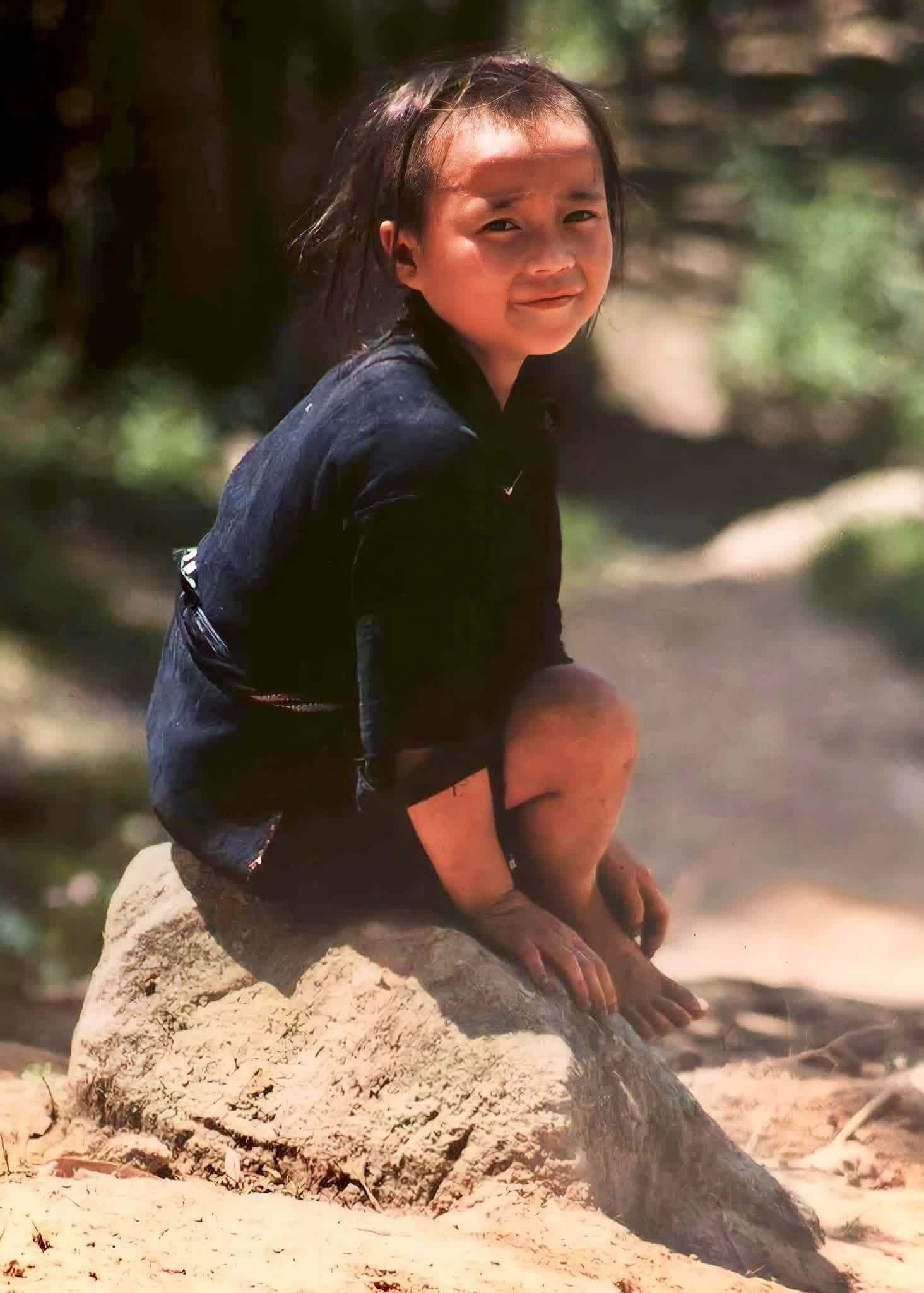
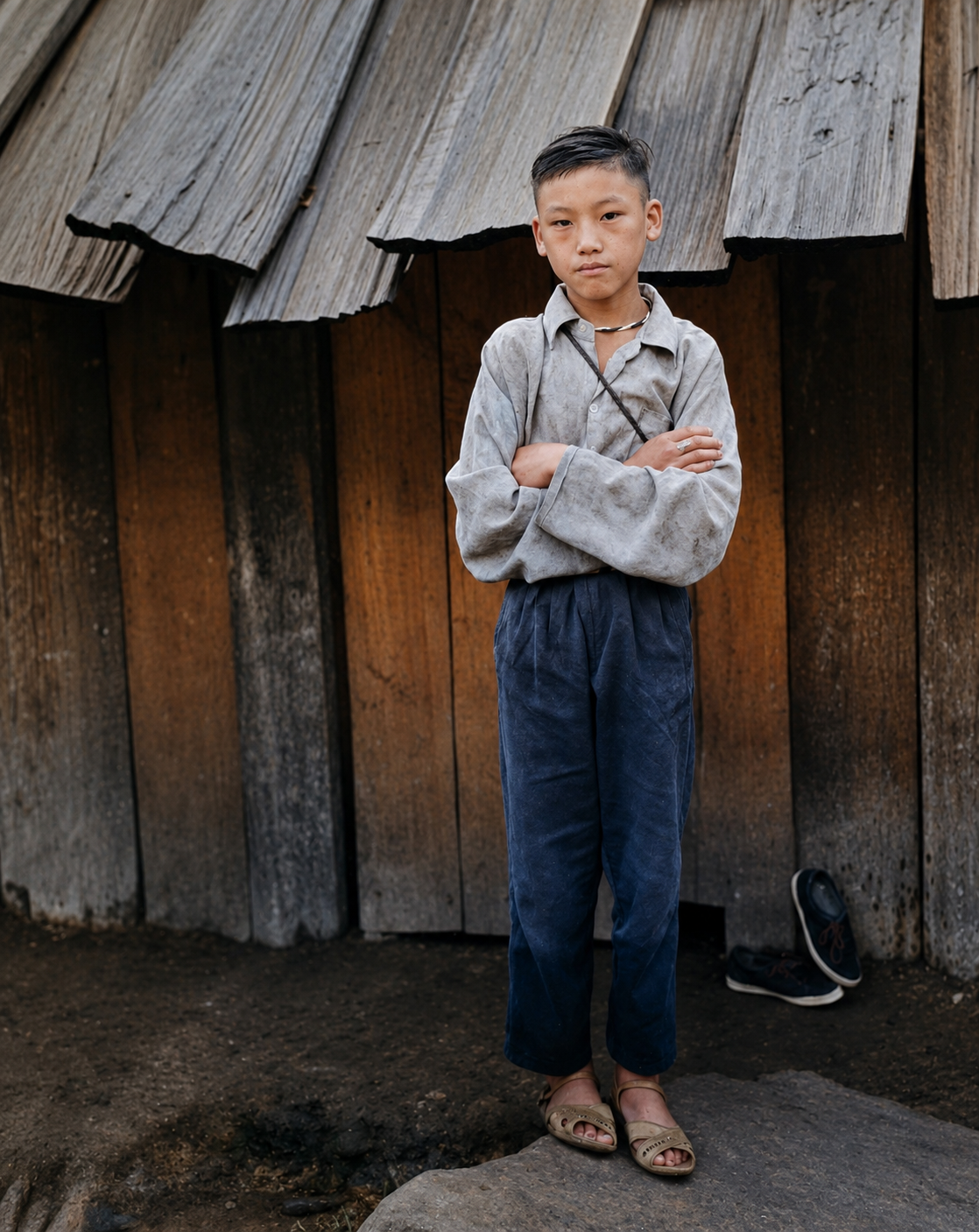
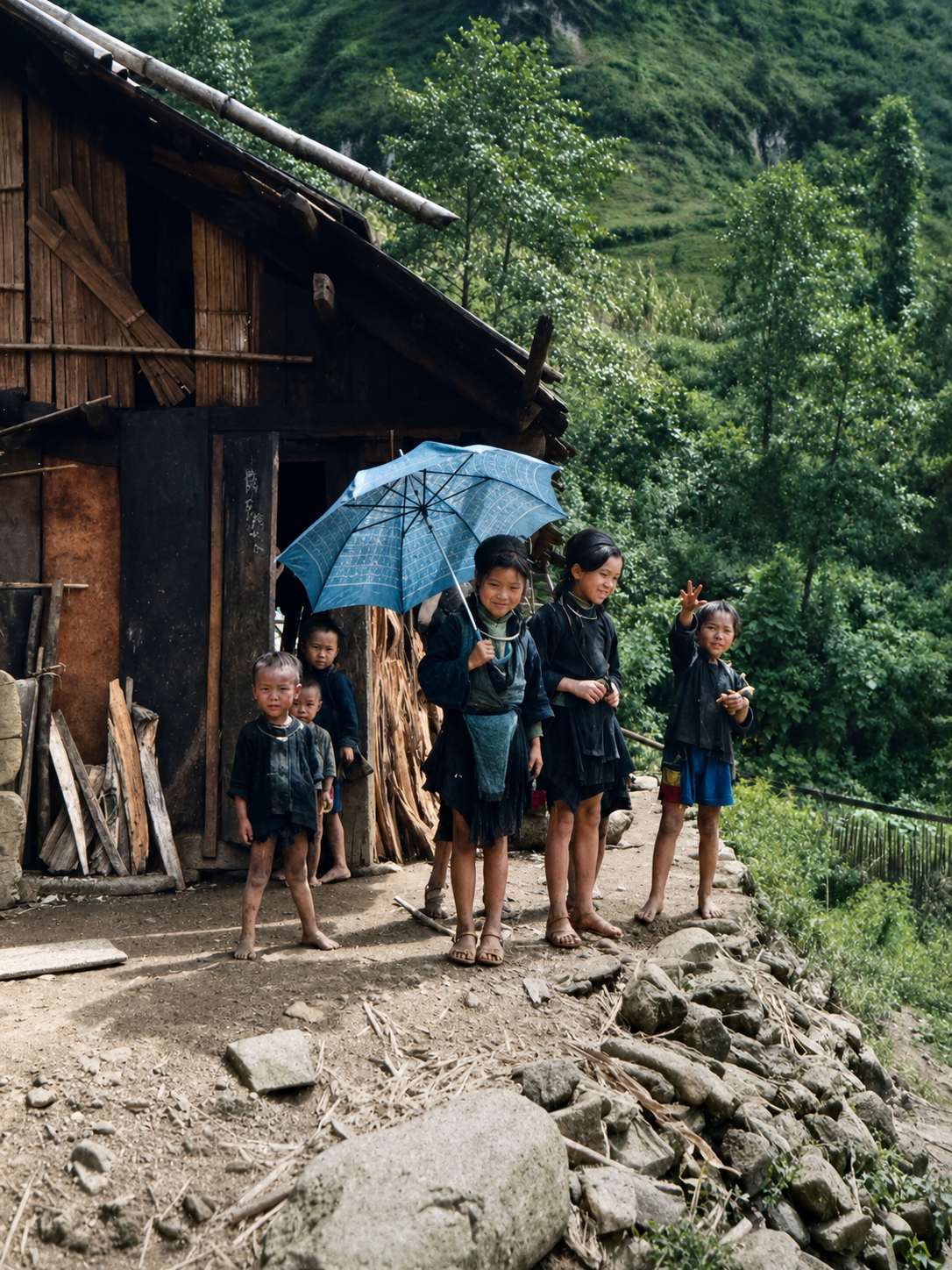
Children outside a traditional Hmong home. Encounters like these became some of my strongest memories of Sapa. Their curiosity, warmth and generosity transformed what began as a scientific expedition into friendships that have lasted a lifetime. Image courtesy of Sean Adams ©
One of the greatest privileges of those thirteen weeks was the opportunity to share everyday life with people whose experiences were so different from my own. We arrived with scientific knowledge, maps and notebooks, but we learned just as much from the communities who welcomed us into their homes and patiently shared their language, traditions and understanding of these mountains. It was never a one-way exchange. We laughed together, worked together, solved problems together and, in doing so, discovered that curiosity and kindness transcend culture, language and nationality. Many of the friendships that began during those weeks have endured for nearly three decades.
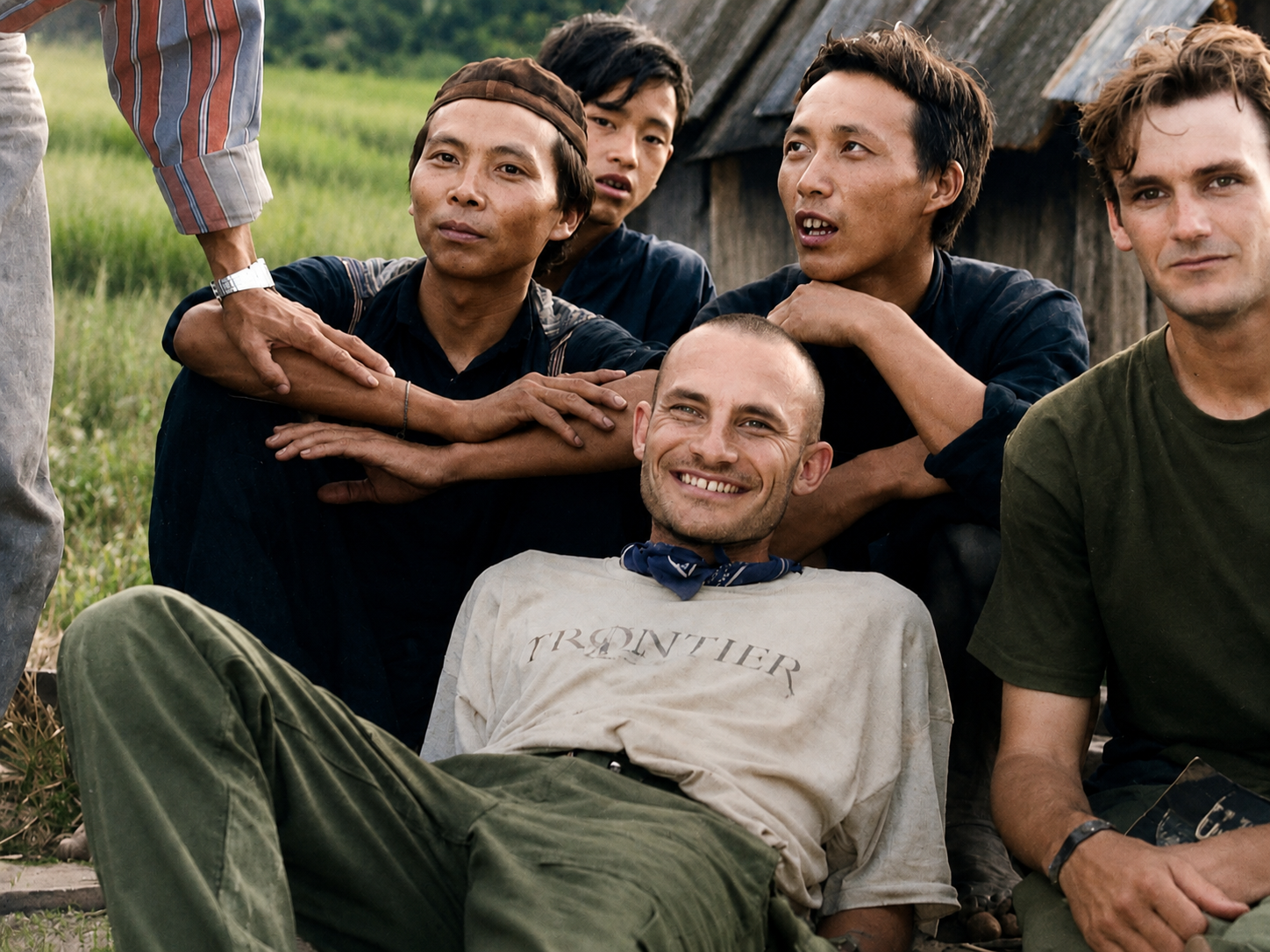
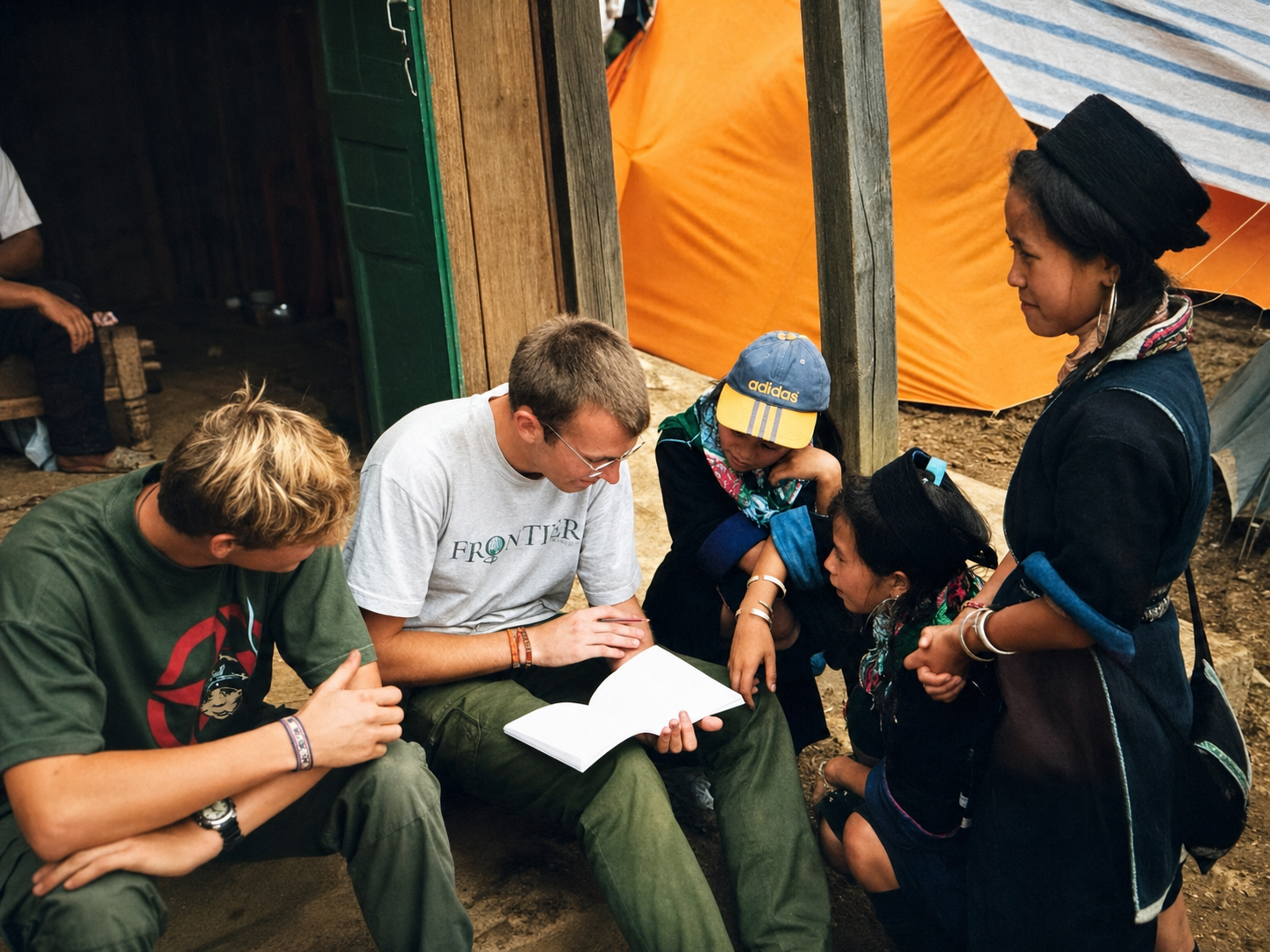
Sharing stories after a day's fieldwork. Some of the strongest memories from the expedition were not made while surveying wildlife, but during simple moments spent talking, laughing and learning from one another. Image courtesy of Sean Adams ©
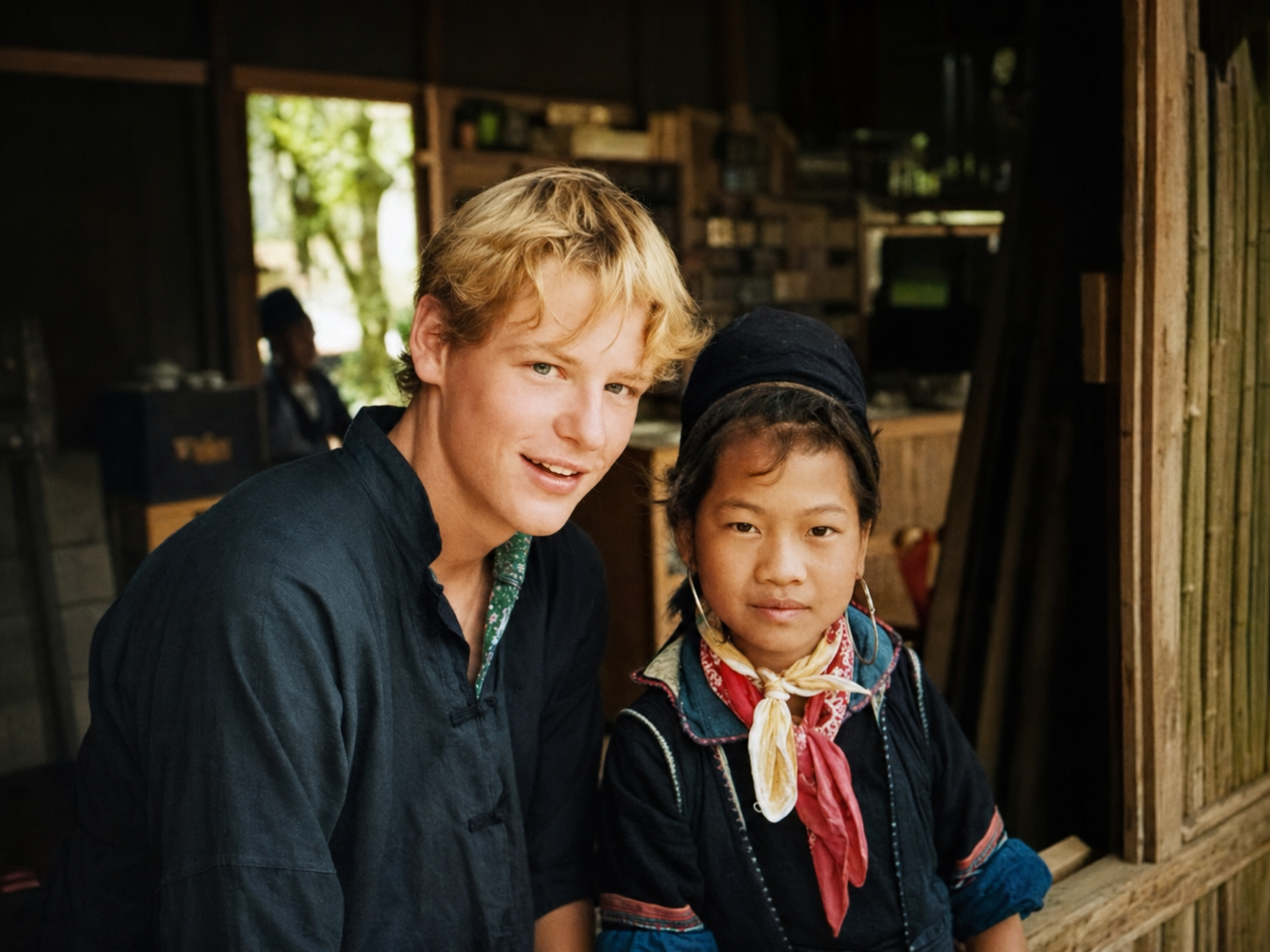
Friendship has no common language. Through gestures, smiles, patience and a growing vocabulary of shared words, we gradually learned about one another's very different worlds.
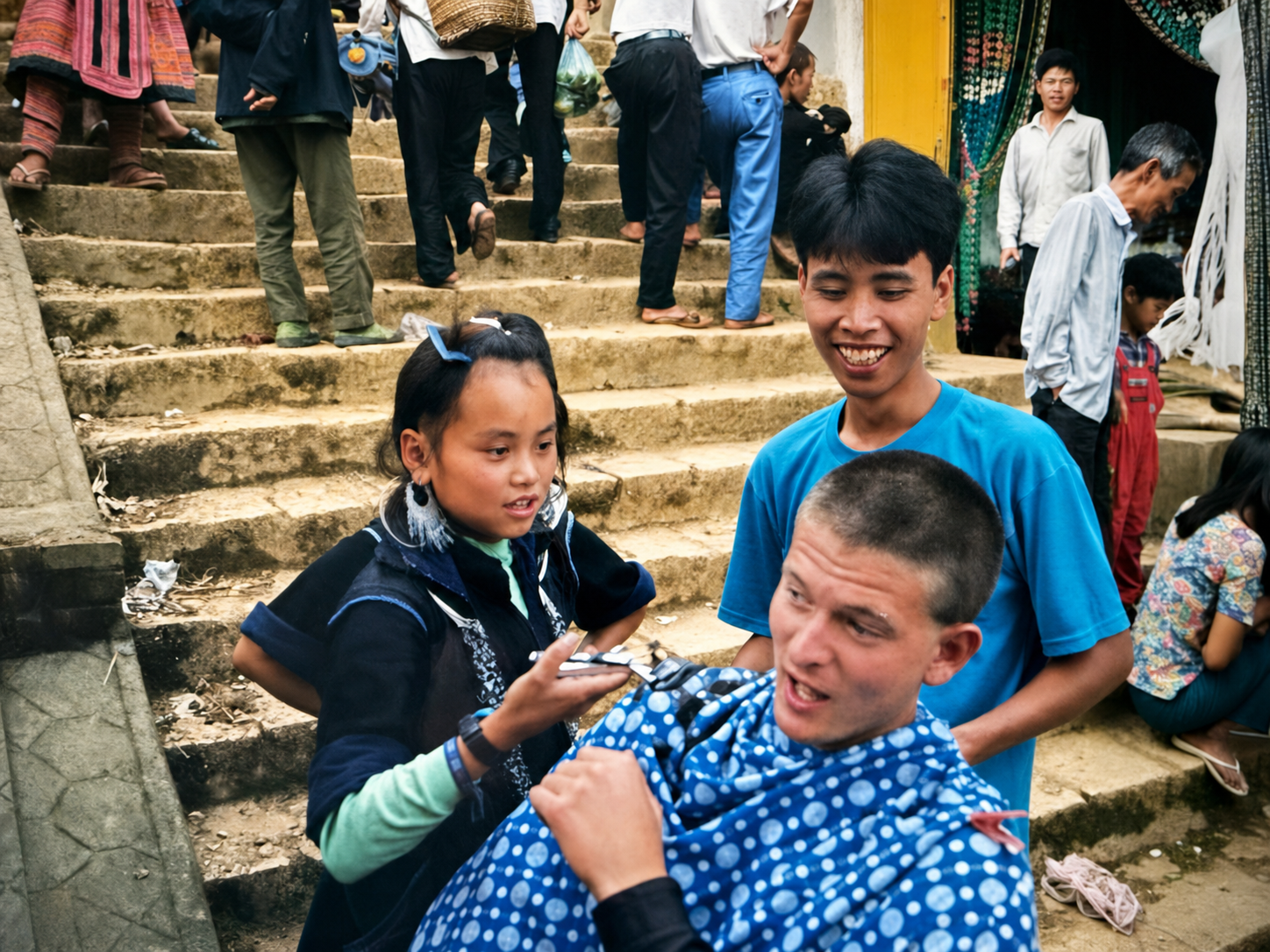
An impromptu haircut in the middle of Sapa. Everyday moments like these often drew a crowd, creating plenty of laughter and reminding us that curiosity flowed in both directions.
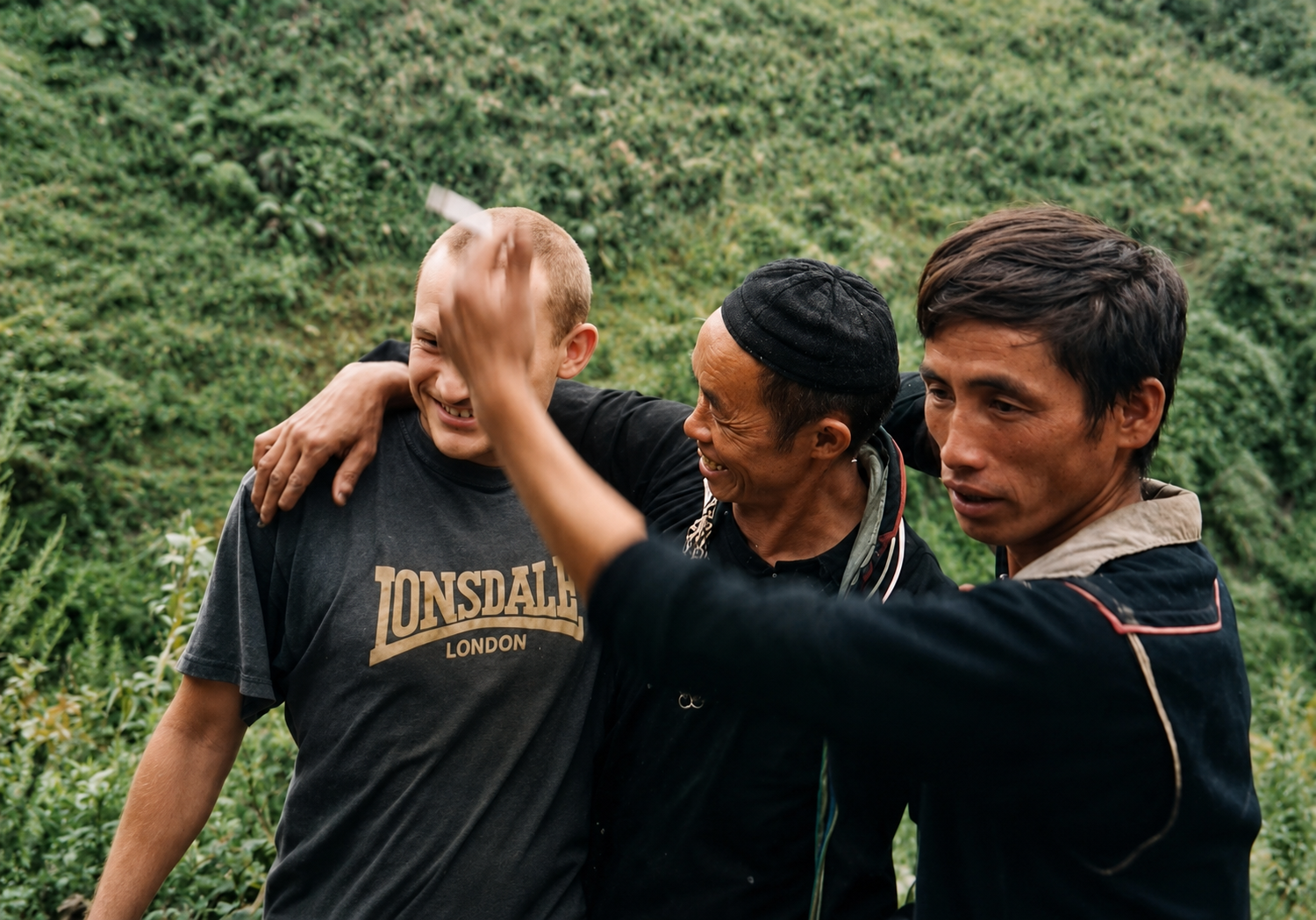
Some photographs tell a story better than words ever could. A hug, a joke, a plume of cigarette smoke and three smiling faces remind me that the greatest discoveries of those thirteen weeks were never recorded in my field notebooks. Image courtesy of Sean Adams ©
Looking Back
When people ask whether Sapa was better in 1998, I always hesitate and find myself wondering, "Better for whom?"
Lived in places are not museum pieces. They change because the people who live within them change too. The children I knew have become parents and grandparents. Farmers also now guide travellers on treks. Dirt tracks have become roads and great forests have gained Nation Park staus and therefore protection. New opportunities have appeared alongside new challenges. It is tempting to compare one era with another, although doing so rarely tells the whole story.
For many Hmong families, living standards have improved beyond anything we might have imagined in the late 1990s. School attendance, once below ten per cent in some of the most remote communities, is now approaching universal levels. Electricity has reached villages that were once lit only by candles and cooking fires, while improved roads have made healthcare, education and markets far more accessible. Infant mortality has fallen, life expectancy has increased and the annual hunger that once accompanied the months before the rice harvest has, for most families, all but disappeared. Life in the mountains remains demanding, and poverty has by no means vanished, but the progress over the past three decades has been extraordinary and unmistakable.
Vietnam's economic transformation has not benefited everyone equally, and inequalities remain both between and within communities. Yet one of the country's greatest achievements has been the improvement in the lives of many of its poorest citizens. Material standards have risen, opportunities have expanded and, perhaps most strikingly, there is a tangible sense of optimism that crosses social and economic boundaries. It is a quality I encounter time and again in villages, towns and cities alike, and one that continues to shape how I see Vietnam today.
The forests we walked so carefully while carrying notebooks and survey equipment are now protected within Hoàng Liên National Park. That alone feels deeply significant. The friendships formed during those months have endured far longer than I ever expected. Some of the young girls who once practised English beside our tents now welcome visitors with remarkable confidence, run businesses, raise families and continue shaping the future of their communities in ways that would have seemed unimaginable to all of us back then.
Despite living in Sapa full time these days, I still catch myself searching for the Sapa I first met. Sometimes I find it in the smell of wood smoke drifting through an early morning market. Sometimes it appears in an old footpath climbing towards the forest, or in the laughter of friends whose children now walk beside us. Places change because people live in them. Memories, though, have a remarkable habit of preserving their own landscapes.
That, perhaps, is what continues to draw me in after all these years. Not a longing for a vanished past, but gratitude for having known these mountains through the generosity of the people who call them home. At ETHOS, those same values continue to shape every walk we share with travellers today. We do not go in search of yesterday. We walk to understand the present, to listen a little more carefully, and to remember that the finest journeys have always begun with curiosity, shared conversation and the kindness of strangers who rarely remain strangers for very long.
Where the Story Led
When I packed my rucksack and left Sapa at the end of those thirteen weeks, I assumed I was closing one chapter of my life. I had come to northern Vietnam to help document one of the country's most remarkable mountain ecosystems, and I left with notebooks full of observations, muddy boots and memories I knew I would never forget. What I didn't realise at the time was that I would spend much of the next three decades returning to and eventually living full time in these mountains.
Many of the people I first met during that expedition became lifelong friends. Some of the curious children who wandered into our camp grew into confident adults with families of their own. Others became guides, community leaders, artisans and entrepreneurs. Several would eventually become integral members of the ETHOS team, helping shape the organisation in ways neither they nor I could possibly have imagined back in 1998.
Looking back now, I can see that those thirteen weeks laid foundations far deeper than a scientific survey. They taught me that conservation is ultimately about people as much as landscapes, and that the strongest protection for culture and nature comes when local communities have genuine opportunities to shape their own future. Those lessons became the philosophy upon which ETHOS was built and continue to guide everything we do today. You can read more about my personal journey here.
If you've enjoyed these memories and would like to understand how they grew into the organisation that ETHOS has become, I'd love to invite you to read more about our story on the About ETHOS page. Many of the friendships that began around a smoky campfire or on a muddy mountain trail nearly thirty years ago continue to shape the journeys we share with travellers today.
History of Sapa, Vietnam: Ethnic Traditions, French Legacy & Modern Tourism
Sapa’s history is written in its landscapes, its people, and its living traditions. To learn more, you can read here.
A Town That Never Stops Transforming
For an even more detailed deep dive into Sapa, its history and its people, you can read our Blog Post “The Beating Heart of the Highlands”
A Note About the Photographs
The photographs throughout this article were taken by Phil Hoolihan and Sean Adams during our time in Sapa in 1998. Originally captured on 35 mm colour film, they have been carefully digitised and professionally restored using modern archival techniques to remove dust, scratches, fading, colour shifts, scanning artefacts and other age-related deterioration. Every effort has been made to preserve the original composition, people, landscapes, colours and documentary integrity of each photograph. Nothing has been added, removed or altered. The images remain faithful historical records of Sapa and the surrounding mountains as we experienced them nearly three decades ago.
These photographs are shared here to preserve and celebrate that history. They remain the copyright of Phil Hoolihan and Sean Adams and may not be copied, reproduced, published, distributed, modified or used in any form without prior written permission from the copyright holders.
© 1998–2026 Phil Hoolihan & Sean Adams. All rights reserved.

The Sacred Books of the Red Dao: Ritual Manuscripts, Handmade Paper and Living Knowledge
Hidden within the mountains of Sa Pa, the Red Dao preserve a remarkable literary and spiritual tradition. Their handwritten ritual books, created on handmade paper and passed from teacher to student for generations, remain central to ceremonies, healing and community life. Discover how these unique manuscripts are made, who can read them and why they continue to play such an important role in Red Dao culture today.
Written and researched by Phil Hoolihan. Photography: Phil Hoolihan (all rights reserved)
In mountain villages surrounding Sapa town, some Red Dao (Iu Mien) families still preserve small, handwritten books made from coarse, yellow-brown paper. Other Dao subgroups in other regions also follow similar traditions. The pages of these excuisite books are filled with vertical columns of unfamiliar characters, carefully written in black ink. During important ceremonies, a ritual master opens one of these manuscripts and begins to chant.
To an outsider, the book may appear ancient and mysterious, yet it is better understood as part of a living system of knowledge. These manuscripts help Red Dao ritual specialists remember prayers, sacred narratives, ceremonial instructions and the names of spiritual beings. They also connect present-day practitioners with generations of teachers, ancestors and family members who came before them.
The knowledge contained within the books is old, but this does not necessarily mean that every surviving manuscript is itself ancient. A book may have been copied relatively recently from a much older text. For centuries, ritual knowledge was preserved by repeatedly copying manuscripts by hand and passing them from one generation to the next.
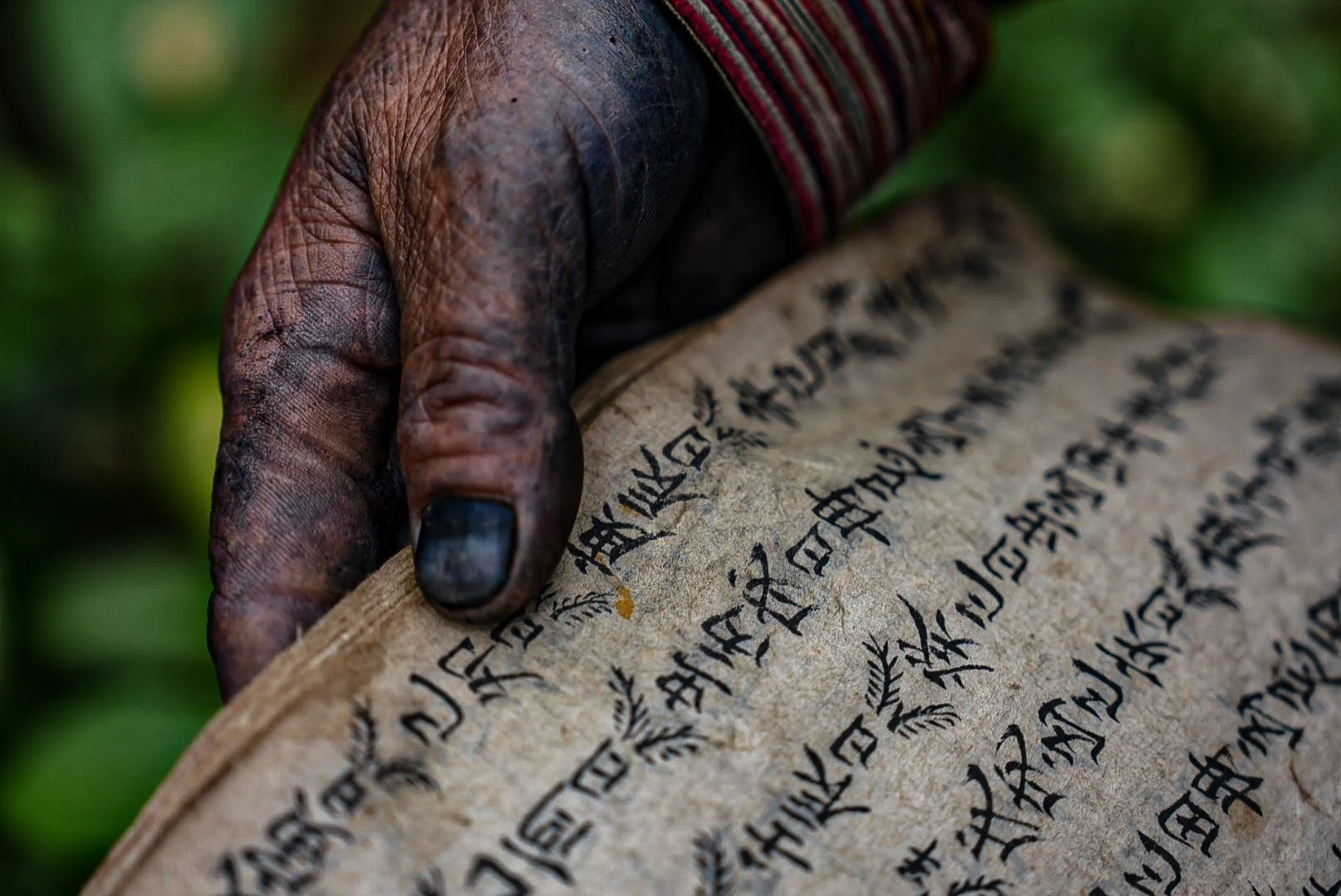
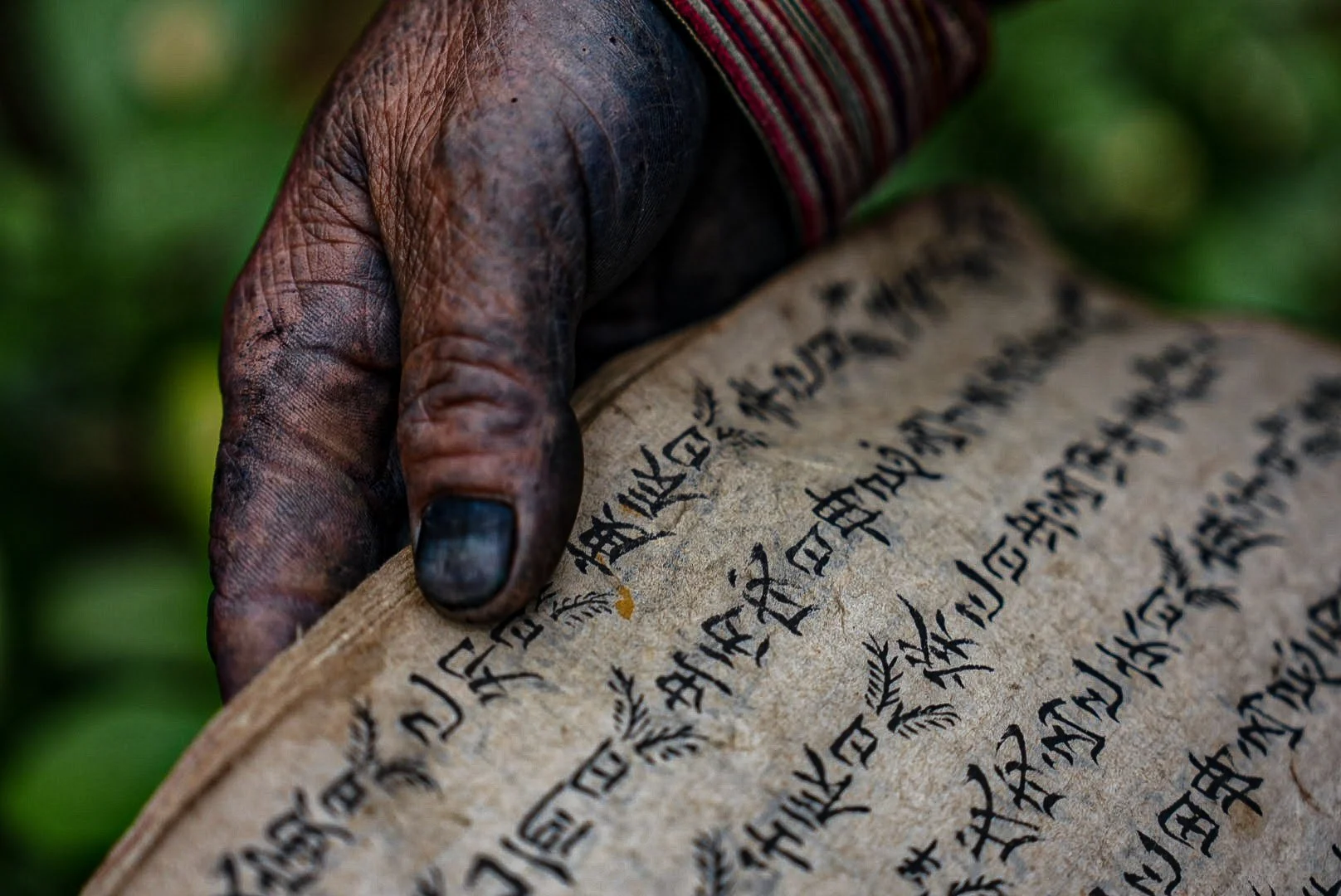
Indigo stained hands of a Red Dao (Iu Mien) woman carefully holds an ancient bamboo paper manuscript in Sapa.
What Are Red Dao Ritual Books?
Red Dao ritual manuscripts are often described in Vietnamese as sách cúng, meaning ceremonial or worship books, or more generally as sách cổ, meaning old books. They are not ordinary books intended for everyday reading. Most were created for use during religious ceremonies, ancestral rites, funerals, healing rituals, divination, initiation ceremonies and other important community events.
A single ritual specialist may possess a collection of different manuscripts. Each book, or section of a book, may have a particular purpose. One might contain prayers inviting ancestors to attend a ceremony while another might explain how to guide the spirit of a deceased person. Others may contain purification formulas, accounts of important deities, ceremonial songs or instructions for making offerings. The books are therefore best understood as a combination of scripture, ceremonial guide, historical record and technical manual.
What Is Written Inside the Books?
The manuscripts are usually written using a character system commonly known in Vietnam as chữ Nôm Dao. It is based largely on traditional Chinese characters, but it also includes regional forms, altered characters and symbols used to represent Dao words and concepts. This does not mean that the books can simply be read as ordinary Chinese. A reader who knows modern Mandarin may recognise some characters but still be unable to understand or pronounce the text correctly. Red Dao ritual specialists use a specialised ceremonial language that differs from everyday spoken Dao and from modern standard Chinese.
The correct reading of a manuscript depends upon more than recognising individual characters. The reader must also understand the traditional pronunciation, rhythm, sequence and ritual meaning of the words. The contents may include prayers, invocations, stories of gods and ancestors, moral teachings, genealogies, migration histories, calendars, divination methods, funeral instructions and ceremonial formulas. Some collections also preserve songs, herbal knowledge and accounts of King Pan, who is regarded as an ancestral figure by many Dao communities. The manuscripts are therefore far more than collections of spells. Together, they form a written archive of religious belief, history, ethics and cultural memory.
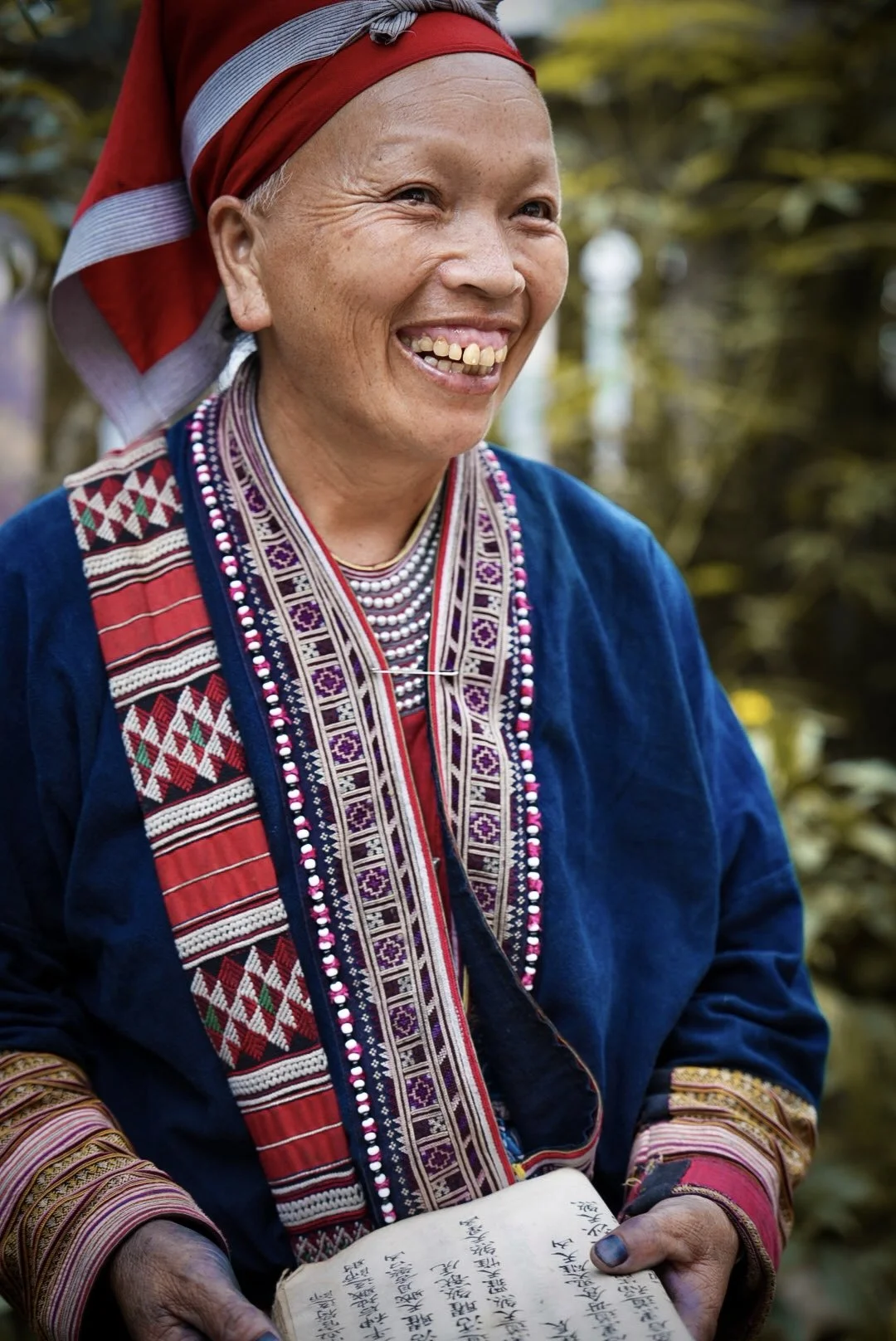
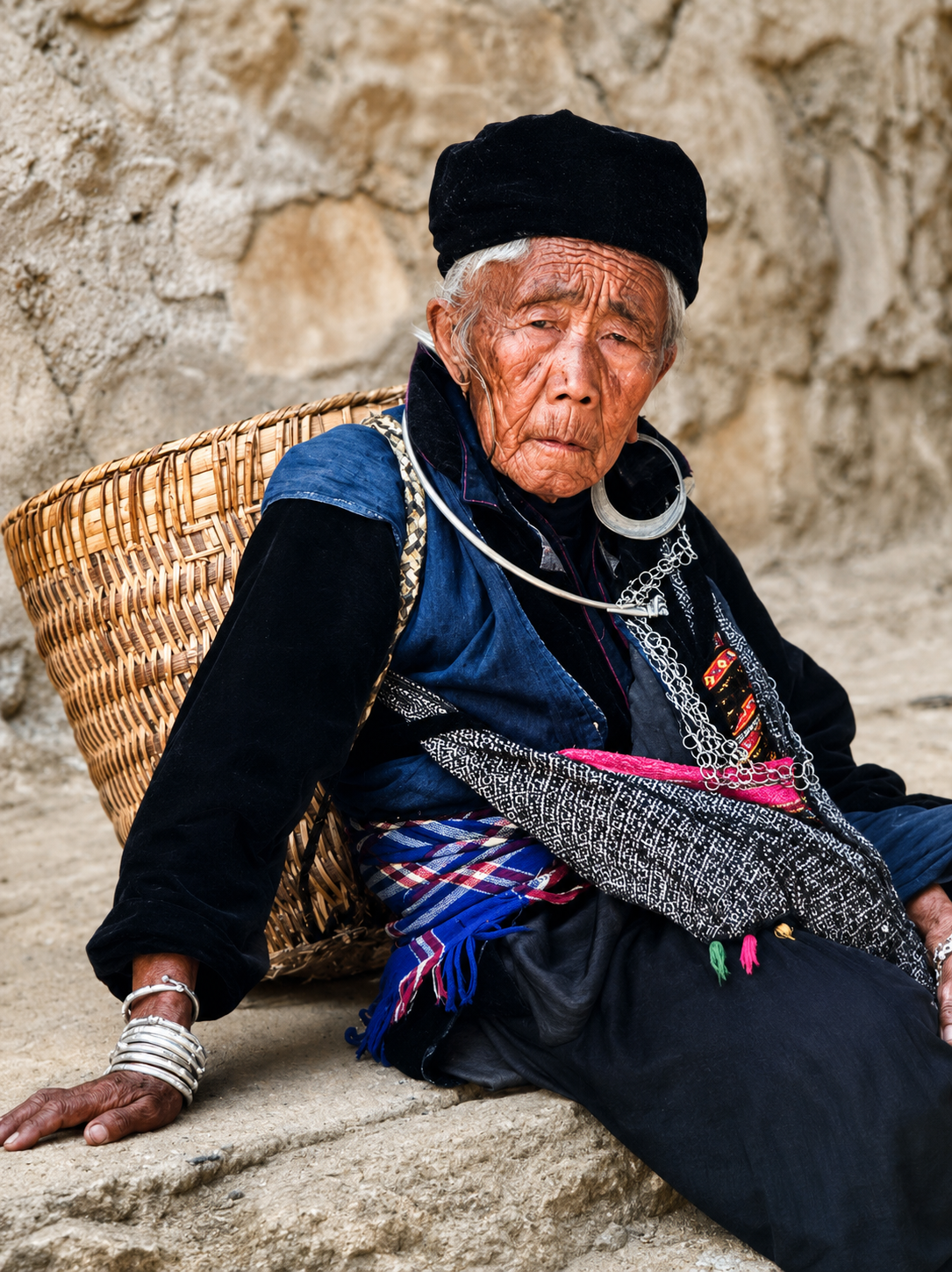
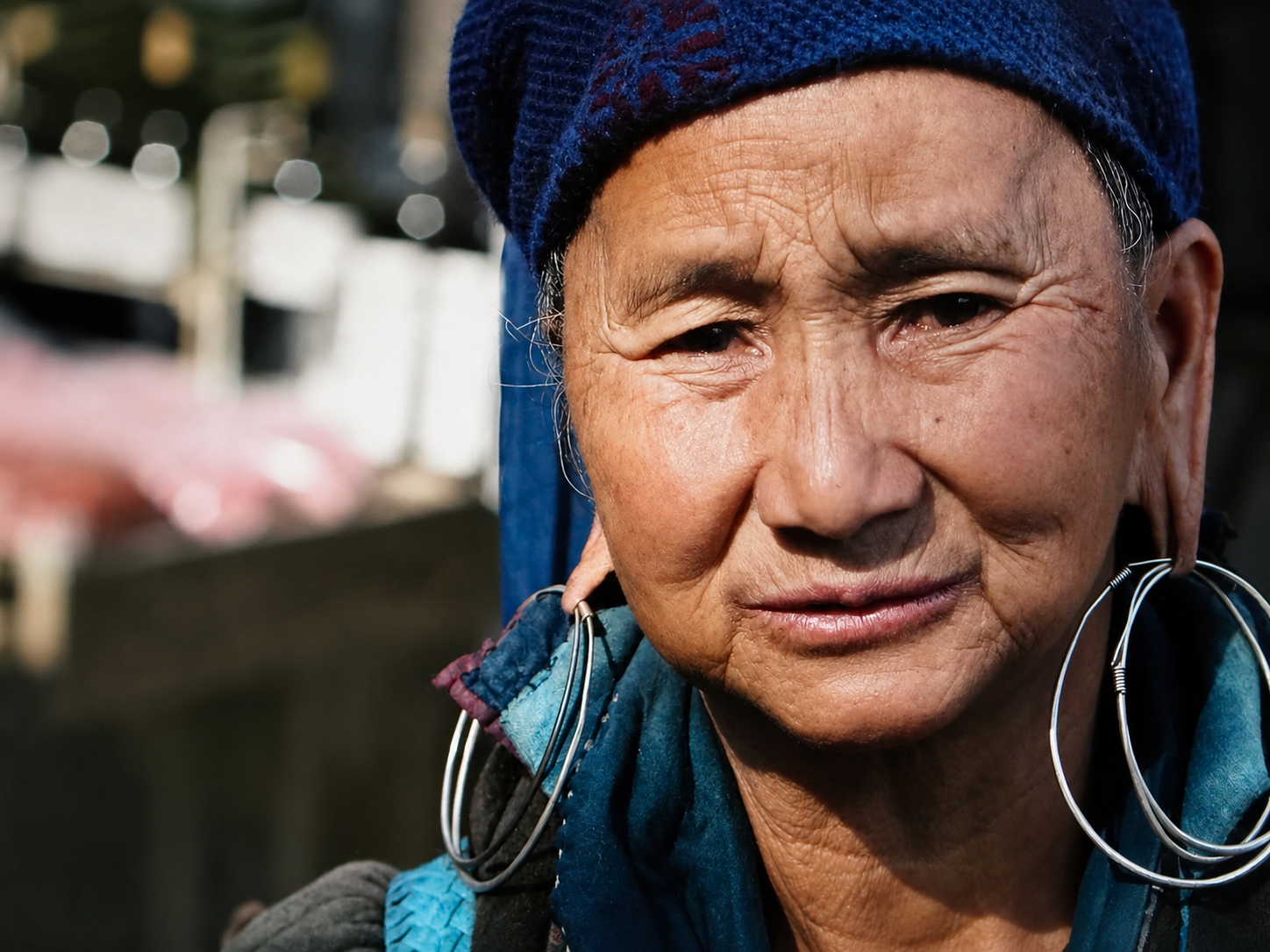
A Red Dao (Iu Mien) woman in Sa Pa holding a treasured family ritual manuscript passed down through generations.
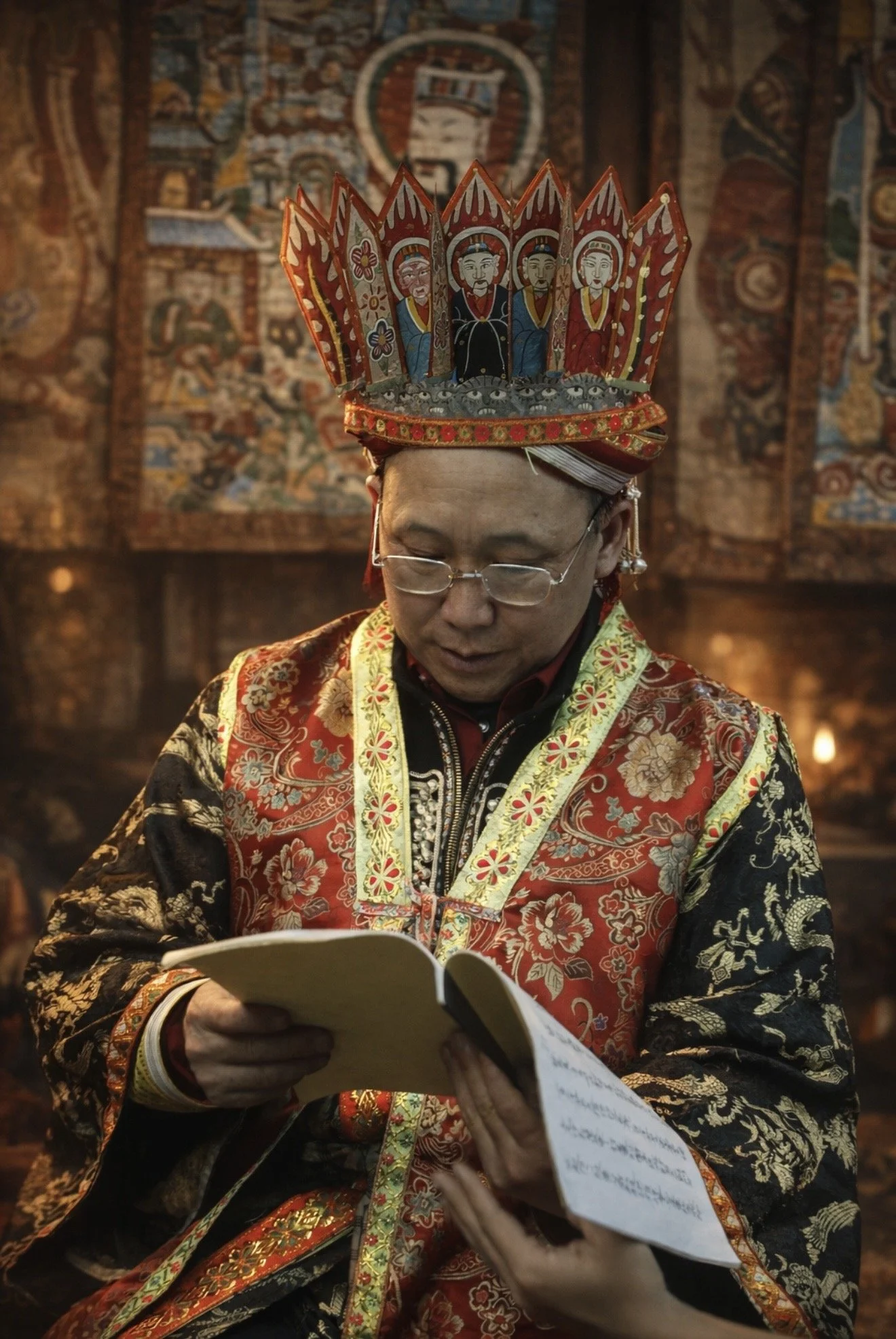
A Red Dao ritual master reading from a handwritten ceremonial manuscript during a traditional religious ceremony.
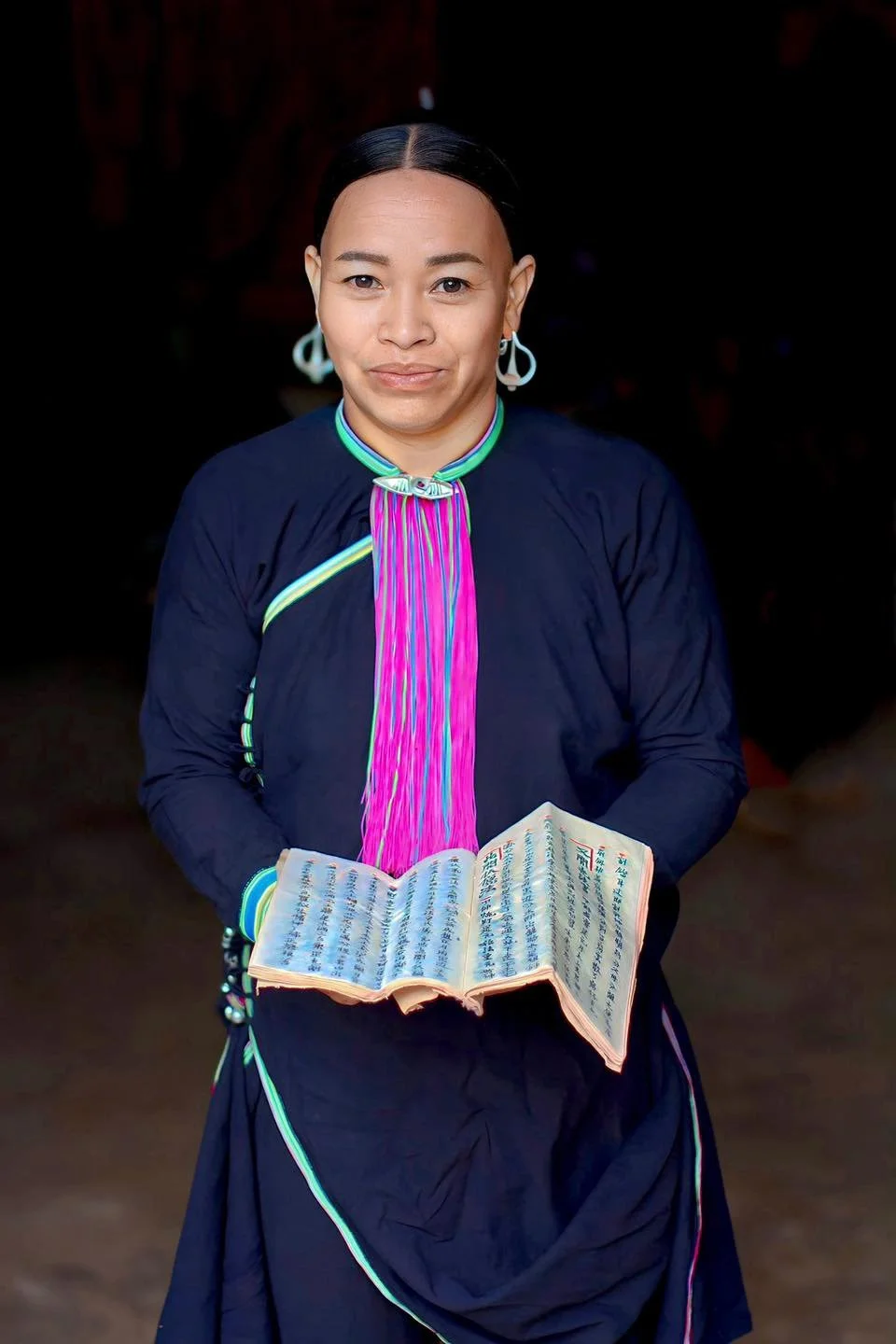
A Dao woman in Điện Biên proudly displaying a handwritten ritual manuscript belonging to her husband's ceremonial collection.
Why Are the Books Written in Vertical Columns?
Like many traditional Chinese and Dao manuscripts, the characters are usually arranged in vertical columns. The reader follows each column from top to bottom before moving to the next column. The precise direction in which the columns are followed may depend upon the manuscript and the tradition of the person who copied it. The writing is normally applied with black ink. Some manuscripts are carefully and evenly written, while others contain additions, corrections, notes or sections copied by different hands.
These differences can tell us something about the history of a book. A manuscript may have been used, repaired and expanded over several generations. Names of owners, teachers or students may also have been added to its pages.
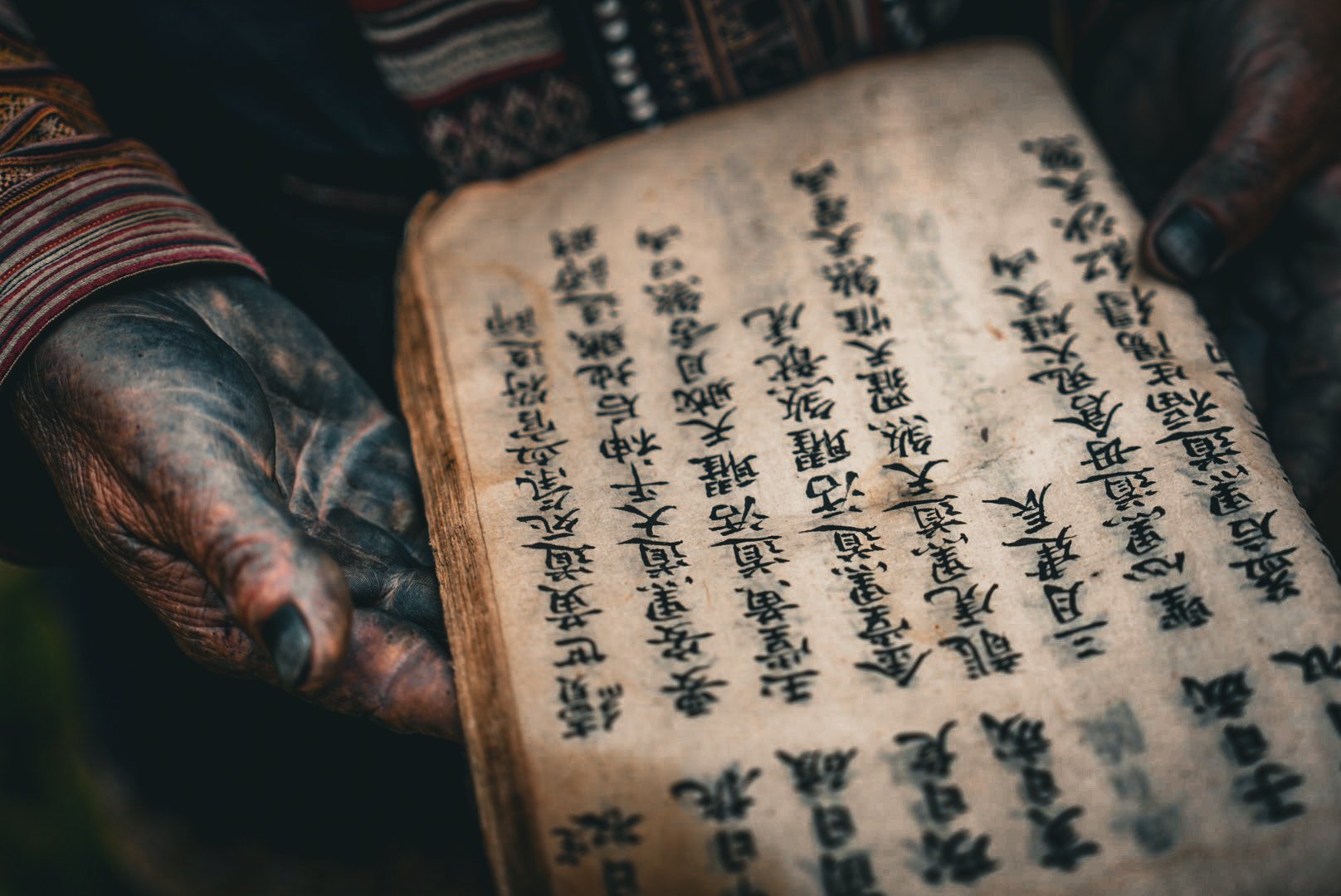
Indigo-stained hands of a Red Dao (Iu Mien) woman carefully holding a traditional handwritten ritual manuscript on handmade paper in Sapa.

Close-up of a Red Dao ritual manuscript showing handwritten annotations and additions made by successive owners or teachers.
How Is the Traditional Paper Made?
The paper used for Red Dao ritual books is often known as giấy bản, a general Vietnamese term for handmade traditional paper.
In the Sa Pa region, the paper may be made from young bamboo or related forest plants such as nứa, mai or vầu. For this reason, it is often described in English as bamboo paper. However, different Dao communities use different plant materials, so not every traditional Dao manuscript is made from exactly the same fibre.
Making the paper requires time, skill and access to clean water. Young bamboo or suitable plant stems are selected and cut into smaller pieces. The material is then soaked or boiled, often with lime, to soften the fibres and break down the harder parts of the plant. Once softened, the material is washed and pounded until it becomes a fine pulp. The pulp is mixed with water, sometimes together with a natural binding substance made from forest bark or vines. This helps the fibres remain evenly distributed. The liquid pulp is spread across or lifted onto a fine screen. Water drains away, leaving a thin layer of interwoven fibres. The new sheet is then pressed or dried in the sun before being carefully removed.
The finished paper is usually pale cream, beige or yellow-brown. It may contain visible fibres, small marks and variations in thickness. These irregularities are part of its handmade character. Although the surface appears rough, good-quality traditional paper can be remarkably durable. When protected from dampness, insects, smoke and careless handling, it may survive for many decades.
To understand more of the paper making process, the video below shows a Dao family in Tuyên Quang who skillfully create the hand made paper using skills passed own from generation to generation.
How Is a Ritual Manuscript Created?
Once the paper has been prepared, it is cut, folded or assembled into narrow pages or booklets. A knowledgeable copyist then reproduces the text by hand, usually using an older manuscript as the model. Copying a sacred book requires both literacy and familiarity with the ceremonial tradition. The copyist must understand where one passage ends and another begins, which characters have ritual significance and how the text should be read aloud. Small errors may change a name, instruction or ceremonial formula.
However, the process is not always simple word-for-word duplication. A copyist may combine material from several older books, add local explanations or include oral knowledge taught by a ritual master. For this reason, two manuscripts with similar titles may not be identical. A book may also record the name of the person who copied it, commissioned it or inherited it. Later owners may add their own names and annotations. Over time, the manuscript can become a record of the family or teaching lineage through which the knowledge has travelled.
The Red Dao Ritual Sound Instrument
Among the ceremonial objects owned by many Red Dao ritual masters is a distinctive forged iron implement that is sometimes mistakenly described as a ritual knife. Although its shape resembles a narrow blade, it was never intended to function as a cutting tool. The iron is relatively thin, there is no sharpened edge, guard or handle, and the object cannot be comfortably held like an ordinary knife. Instead, the blade is suspended from a series of hand-forged twisted iron rings, allowing it to swing freely during ceremonies.
These twisted rings are an important part of the instrument’s design. Rather than serving simply as a means of suspension, they create flexibility and movement. When shaken, the rings and blade strike against one another, producing a distinctive metallic ringing or clinking sound. This immediately suggests that the object was designed primarily as a ritual sound instrument rather than as a weapon or cutting implement.
Sound occupies an important place within Red Dao religious practice. Ritual masters use bells, gongs, wooden percussion instruments and other ceremonial objects to announce the beginning of rituals, invite protective deities and ancestral spirits, mark transitions during chanting, purify sacred spaces and drive away harmful spiritual influences. This forged iron implement appears to fulfil a similar role, contributing sound as an active element within the ceremony.
One aspect of Red Dao ritual that is often overlooked is that writing itself is regarded as a sacred act. When a ritual master prepares talismans, petitions to heaven, initiation certificates, funeral texts or spirit registers, he is not simply writing words onto paper. Instead, the act of writing is understood as communication with the spiritual world. During these ceremonies, the ritual master may alternate between chanting, writing, burning incense, making symbolic gestures and shaking ritual sound instruments. The rhythmic metallic sound is believed to help maintain the spiritual purity of the ritual space while sacred texts are being created or recited.
This iron implement is normally only one component of a much larger ceremonial collection owned by an experienced ritual master. A complete ritual kit may include handwritten manuscripts, wooden ritual seals, bells, divination blocks, handwritten talismans, incense implements, ritual paintings and altar furnishings. Each object has a specific ceremonial purpose, and together they support a highly choreographed sequence of movement, sound, chanting and sacred writing that has been transmitted through generations.
Examples such as this are becoming increasingly uncommon. While ritual manuscripts are occasionally encountered, the smaller ceremonial implements that accompany them are far less frequently documented. As older ritual masters retire or pass away, complete ceremonial collections are often dispersed, making surviving sets of manuscripts and ritual instruments an increasingly valuable record of Red Dao religious heritage.
Like the manuscripts themselves, these objects are not decorative artefacts or historical curiosities. They remain practical ceremonial instruments that continue to play an important role in the religious life of many Red Dao communities throughout northern Vietnam.
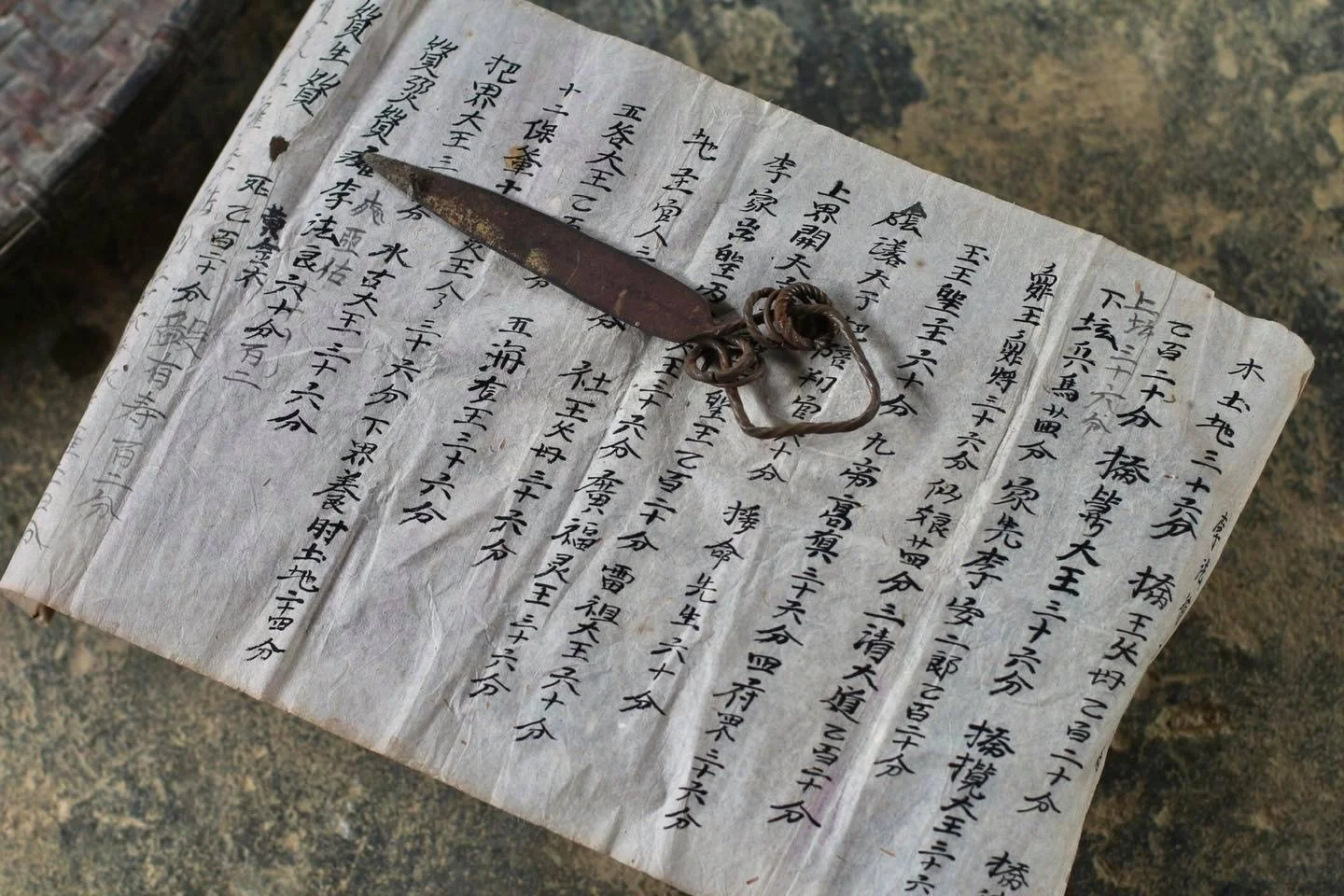
A traditional Red Dao ritual knife resting on a handwritten ceremonial document. The knife is a sacred ceremonial implement used by ritual masters during initiation, healing, ancestral and protective ceremonies.
Keeping the Tradition Alive
Although the number of experienced ritual masters has declined in some villages, there are encouraging signs that Red Dao cultural knowledge continues to be valued by younger generations. In Tả Phìn Village, just outside Sapa, respected ritual masters and community elders organise classes where children and young adults can learn the traditional Dao script, study ceremonial texts and gain a deeper understanding of their cultural heritage.
These classes are not intended simply to teach reading and writing. They help preserve a unique religious tradition, strengthen community identity and ensure that the knowledge needed to conduct ceremonies, interpret sacred manuscripts and pass on oral traditions is not lost. The initiative demonstrates that many Red Dao families see their written language and ritual practices as a living inheritance rather than a museum piece.
Who Is Allowed to Read the Books?
The principal readers are traditionally male Red Dao ritual specialists, commonly called thầy cúng in Vietnamese. The English word “shaman” is often used, but it does not describe every aspect of their role. A Red Dao ritual master may conduct ancestral ceremonies, funerals, healing rites, divination, household rituals and initiation ceremonies. He may communicate with spiritual beings, but he must also understand ceremonial procedures, sacred texts, calendars, offerings and community customs.
For this reason, terms such as ritual master, ceremonial priest or ritual specialist may provide a fuller description. Not every man who can recognise some characters is authorised to perform important ceremonies. Reading the books is only one part of a much larger system of training.
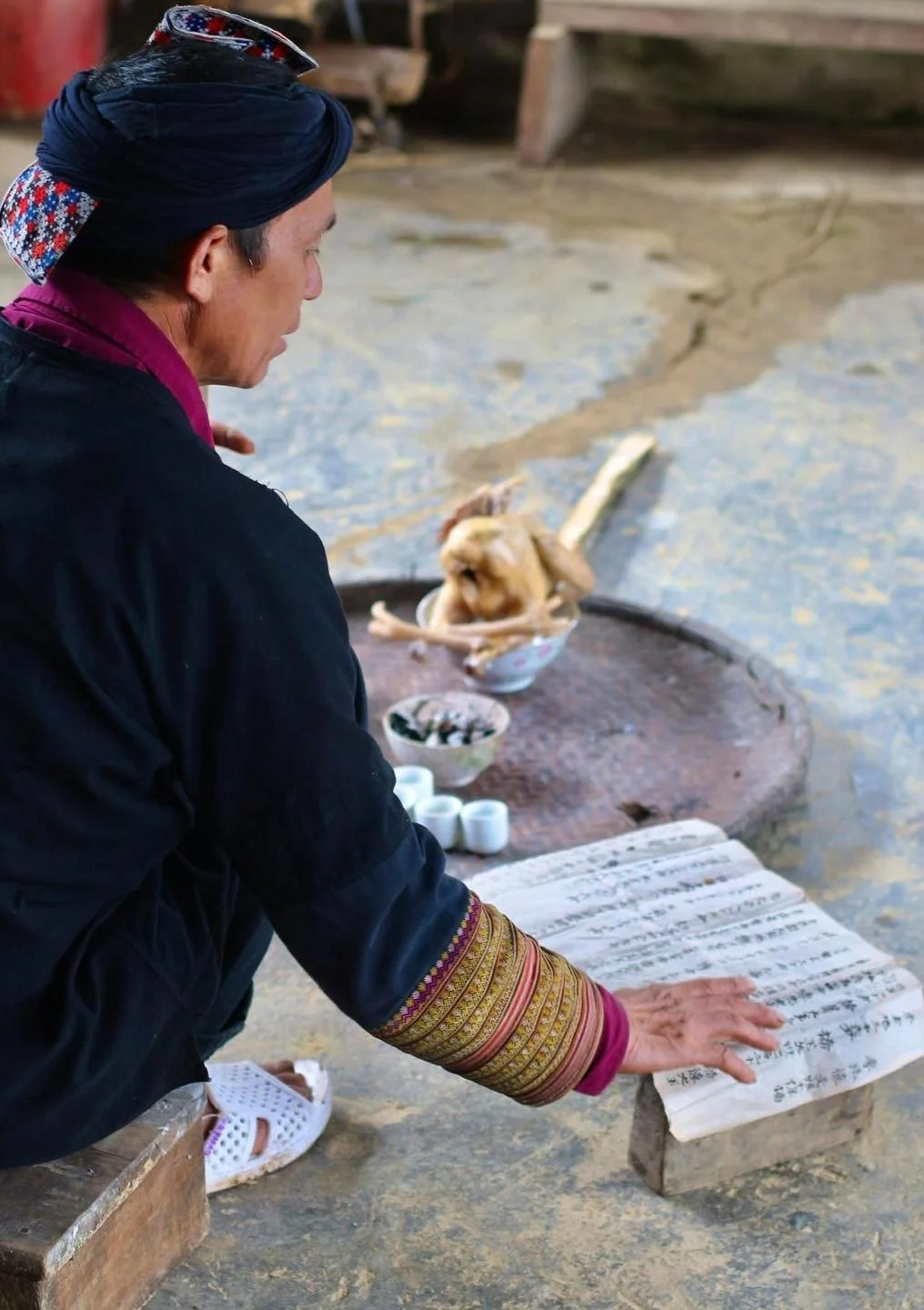
A Red Dao ritual master reads from a handwritten ceremonial manuscript during a traditional religious ceremony in Sapa, Vietnam.
How Does Someone Become a Ritual Master?
Training often begins under the guidance of an older relative or an established ritual master. A student may first learn individual characters, traditional pronunciation and basic moral or ceremonial texts. He must then study the order of rituals, the meanings of offerings, the use of ceremonial objects and the correct way to address particular gods or ancestors. This process can take many years.
Much of the learning happens through observation and repetition. A student may accompany his teacher to ceremonies, help prepare offerings, listen to recitations and gradually learn to perform particular sections. The ability to read a manuscript does not by itself make someone a recognised ritual master. Authority also depends upon apprenticeship, lineage, ceremonial knowledge and initiation.
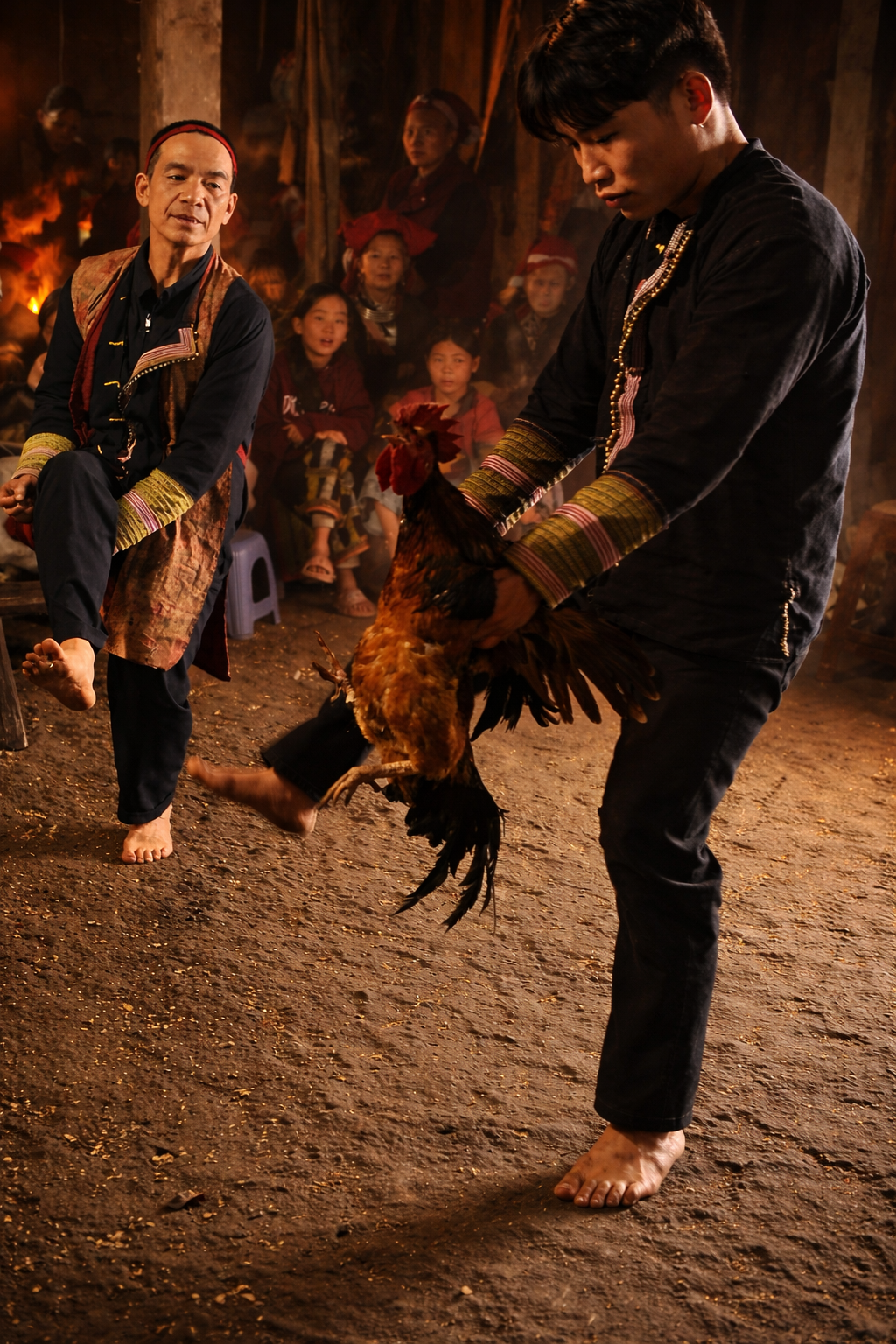
A Red Dao ritual master guides an apprentice during a traditional ceremony. Ritual knowledge is transmitted through years of observation, practice and participation.
The Importance of the Cấp Sắc Ceremony
One of the most important religious events in Dao culture is the cấp sắc ceremony. The details vary between different Dao groups and local traditions, but the ceremony generally gives a man a religious name and establishes his formal relationship with spiritual teachers, ancestors and protective forces. It may also give him authority to participate in or conduct particular ceremonies.
The ritual can include sacred paintings, lamps, drums, bells, offerings, handwritten documents and extended periods of chanting. Senior ritual masters guide the initiate through a complex series of actions and teachings. Ritual manuscripts are closely connected with this system of authority. A person may understand parts of a book, but the right to use certain texts in major ceremonies normally depends upon recognised training and initiation.
How Are the Books Used During Ceremonies?
During a ceremony, the ritual master selects the manuscript appropriate to the occasion. He may sit or stand in front of an altar while holding or resting the book before him. He then chants the text using its traditional ceremonial pronunciation. This recitation is not usually performed in the manner of an ordinary conversation. The words may be melodic, rhythmic and repetitive. Some passages may be spoken quietly, while others are chanted more forcefully.
The text may announce the name of the family, explain the purpose of the ceremony, invite ancestors or gods to attend, present a request, guide a soul, describe an offering or order harmful forces to leave. At particular points, assistants may light incense, present food or rice wine, strike a drum, ring a bell, burn ritual paper or rearrange objects on the altar. The manuscript helps preserve the correct sequence of events. It ensures that important names, instructions and formulas are not forgotten.
Which Ceremonies Require the Books?
Different manuscripts are used for different purposes. They may be consulted during funerals, ancestral rites, healing ceremonies, weddings, New Year observances, prayers for health and safety, divination and cấp sắc initiation ceremonies. Funeral manuscripts may contain instructions concerning the journey of the soul and its relationship with the ancestors. Healing texts may identify spiritual causes of illness or contain prayers requesting protection and recovery.
Other books may be used to choose an appropriate date for a ceremony or important family event. Calendrical and divination knowledge can therefore be closely connected with the religious manuscripts. Not every ceremony requires the same level of knowledge. Some household rites may be relatively simple, while major funerals or initiation ceremonies can require several ritual specialists and many different texts.
Are Women Involved in the Manuscript Tradition?
Sacred ritual authority has traditionally been transmitted primarily through male teaching and family lineages. The main ceremonial manuscripts are therefore most commonly read by men. However, this does not mean that women have no role in Red Dao religious and cultural life. Women may perform important ceremonial songs, prepare offerings, preserve oral histories and participate in rituals in ways that are essential to their success. Some women may also possess songbooks or other written materials.
The exact division of roles differs between families, villages, generations and Dao subgroups. It is therefore important not to assume that every Red Dao community follows precisely the same practice.
Are the Books Considered Sacred?
Many ritual manuscripts are treated with considerable respect. Their significance does not come only from their age. A book may be important because it contains sacred knowledge, belonged to an ancestor or teacher, or demonstrates the owner’s connection to a recognised ritual lineage. Some manuscripts may be shown openly to learners, researchers or visitors. Others may contain restricted material that the owner does not wish to display, translate or photograph.
Visitors should therefore always ask permission before touching or photographing a manuscript. Pages should not be turned without the owner’s agreement, and a ritual book should never be treated simply as an attractive souvenir or decorative object. Buying an old manuscript can also be ethically problematic. Removing it from its family or village may separate the book from the lineage and knowledge that give it meaning.
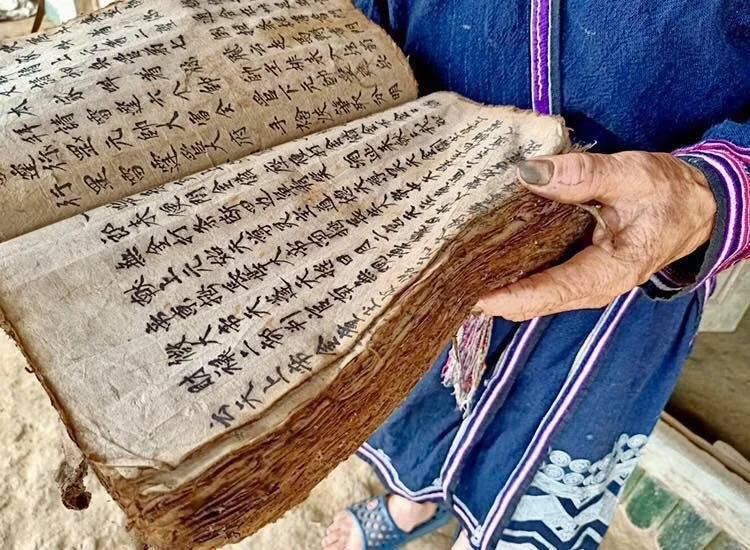
A treasured Red Dao family manuscript showing generations of careful use and preservation. Many ritual books remain within the families and lineages that have safeguarded them for decades.
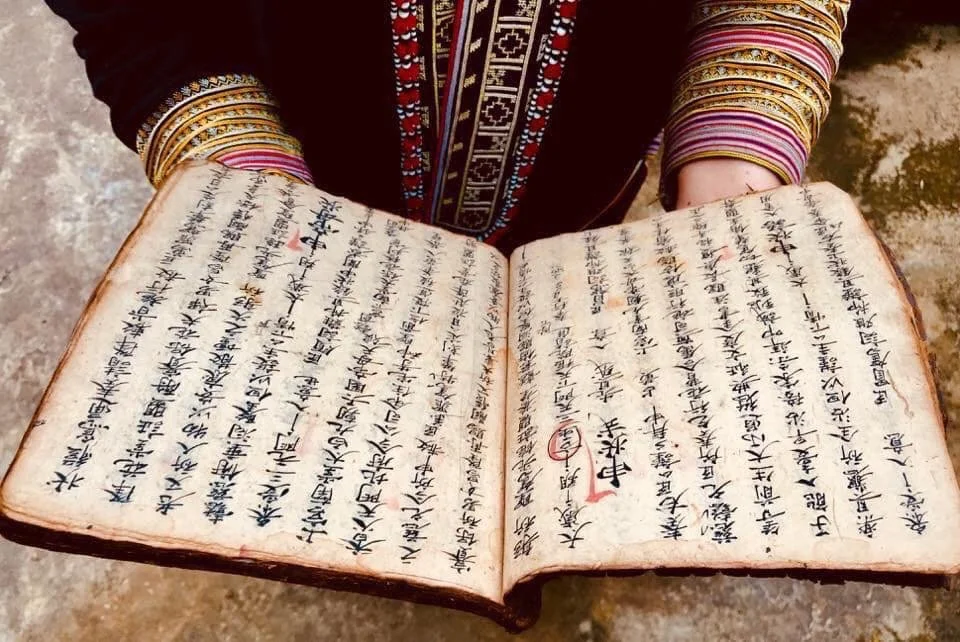
An open Red Dao ritual manuscript written on traditional handmade paper. Such books preserve centuries of religious knowledge, ceremonial practice and family tradition.
Ancient Knowledge in a Living Tradition
Red Dao ritual books are sometimes presented as relics from a disappearing past. This description can be misleading.
The tradition has undoubtedly faced serious pressures. Younger generations attend Vietnamese-language schools, families move away from villages and fewer people have the time required to master complex ceremonial writing. Handmade paper has also become less common as commercially produced paper has become easier to obtain. Nevertheless, the books remain part of a living tradition.
They may still be copied, studied, inherited and used during ceremonies. Ritual masters continue to interpret their words, while families continue to rely upon them during some of the most important moments of life and death. A manuscript does more than preserve a fixed text. It links a student to a teacher, a family to its ancestors and a present-day ceremony to generations of earlier practice.
Seeing the Books with Respect
For visitors to Sapa, encountering one of these manuscripts can provide a rare insight into the intellectual and spiritual depth of Red Dao culture. The book should not be understood simply as an exotic object filled with mysterious symbols. Each page represents specialised education, careful craftsmanship and knowledge transmitted across generations.
The handmade paper reflects an intimate understanding of local plants and natural materials. The handwritten characters preserve a sophisticated literary and religious tradition. The recitation connects the visible ceremony with an unseen world of ancestors, teachers, deities and protective spirits. Together, these elements make the Red Dao ritual manuscript one of the region's most remarkable forms of living cultural heritage.
While these sacred ceremonies are private and are not performed as tourist attractions, spending time in Red Dao communities with knowledgeable local guides can provide a far deeper appreciation of the culture, history and traditions that surround them. Walking the mountain trails, learning about medicinal plants, sharing meals with local families and hearing these stories from the people who continue to live them offers an understanding that extends far beyond what can be found in a museum or guidebook.
If you would like to explore this remarkable landscape with respect for the people who call it home, our Highland Herbs Trek & Red Dao Homestay offers the opportunity to walk with local Red Dao guides, forage for medicinal plants, share traditional meals and spend the night with a Red Dao family. The experience has been designed to encourage genuine cultural exchange while directly supporting local communities and helping to preserve the living heritage that makes the mountains around Sapa so special.
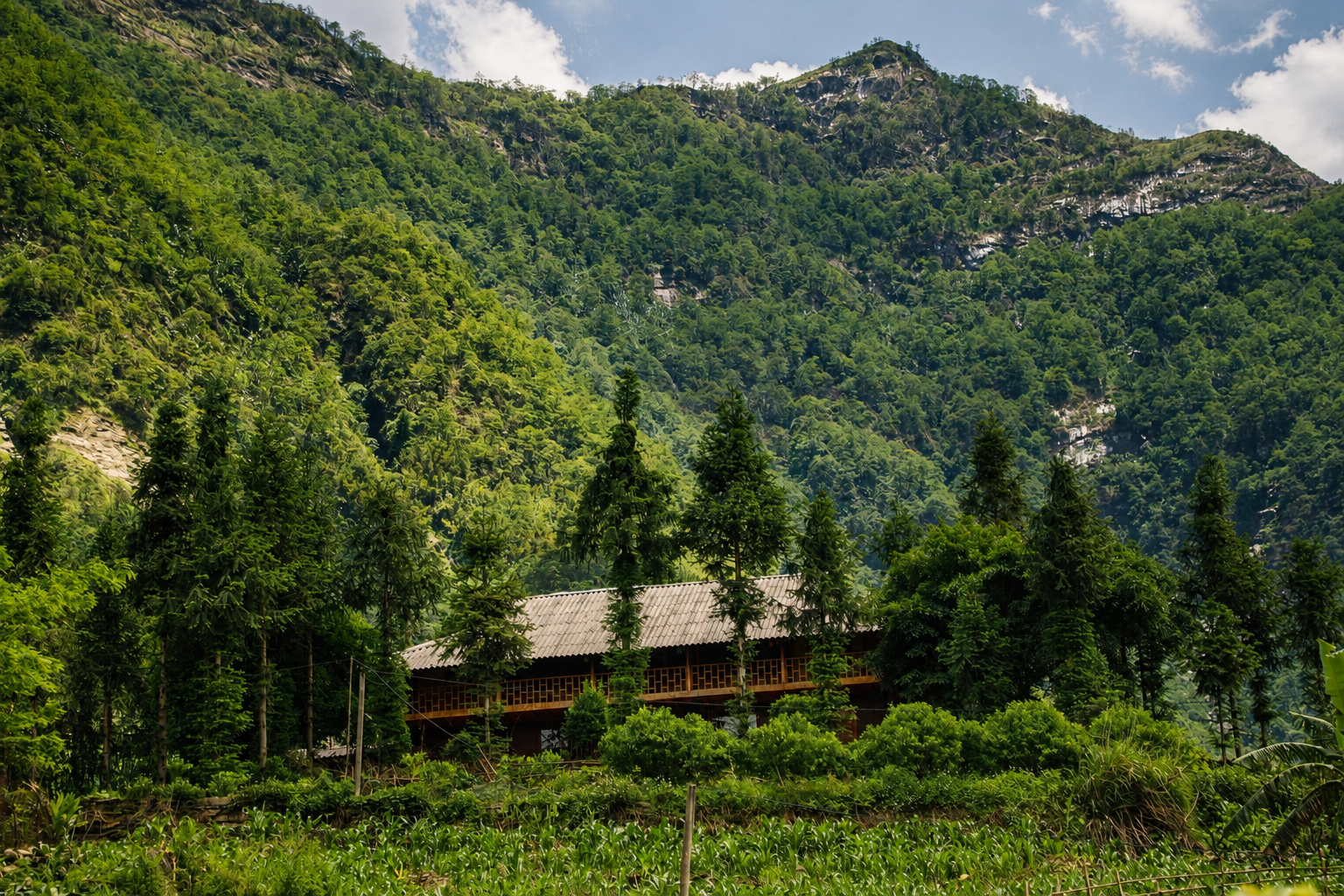
When Beauty Becomes Backdrop: Traditional Villages and the Future of Sapa
Beyond the bright lights and rapid construction of Sapa town lies a very different landscape. Across the wider valleys of Sapa district, traditional Hmong, Dao, Tày, and Giáy communities still live among rice terraces, rivers, forests, and mountain paths shaped by generations of careful adaptation to the land. Their homes were never built to dominate the mountains, but to belong within them.
This article explores the remarkable architecture and cultural traditions of northern Vietnam’s mountain villages, from smoke-darkened timber homes and flowing kitchen water systems to open-door hospitality and communal building practices. It also examines the growing tension between landscape-sensitive design and the rise of oversized tourism developments that increasingly threaten to overwhelm the natural beauty and cultural identity of the Muong Hoa Valley.
A Landscape Once Built in Conversation With Itself
For centuries, the valleys surrounding Sapa evolved slowly and almost quietly, shaped not by masterplans or speculative investment but by the rhythms of weather, farming, migration, and communal life. Villages appeared gradually along ridgelines and river valleys where water flowed cleanly, terraces could be carved into mountain slopes, and timber could be gathered sustainably from nearby forests. Homes did not seek attention. They belonged to the landscape rather than competing with it.
This relationship between settlement and environment is one of the reasons the Muong Hoa Valley became so internationally admired in the first place. Traditional Hmong and Dao villages never attempted to dominate the mountains. Their houses sat low against the earth beneath bamboo groves and fruit trees, partially hidden within mist, terraces, and forest edges. Rooflines followed the contours of hillsides. Building materials weathered naturally into the surrounding terrain. Smoke drifted gently from darkened roofs during cold evenings while water channels moved quietly through kitchens and gardens. What visitors experienced here was was harmony. Architecture, agriculture, spirituality, and ecology existed in conversation with one another.
Today, however, that relationship is under increasing pressure. The mountains themselves are not disappearing, nor are the communities who continue to live among them. What is increasingly at risk is the sense of balance that once defined the valley, as natural beauty becomes steadily swamped by commercial spectacle, oversized tourism developments, and architecture designed more for visibility and prestige than belonging. Across Sapa, enormous tourism developments are transforming valleys once defined by subtlety and restraint into landscapes increasingly shaped by spectacle, prestige, and commercial ambition. Concrete ridgelines rise above terraces. Mega-projects compete for visual dominance. Mountain views become marketing assets rather than shared cultural landscapes. Yet this is not a simple story of old versus new. Sapa does not need to remain frozen in time. Good contemporary architecture is entirely possible here. Some newer homestays, ecolodges, and community-led projects are attempting to build differently, designing structures that still respect scale, terrain, local material traditions, and the visual integrity of the mountains themselves.
The real question is therefore not whether development should happen, but what kind of development deserves to shape the future of the valley. How can Sapa thrive as an example of top level Community-based tourism experiences in Northern Vietnam?
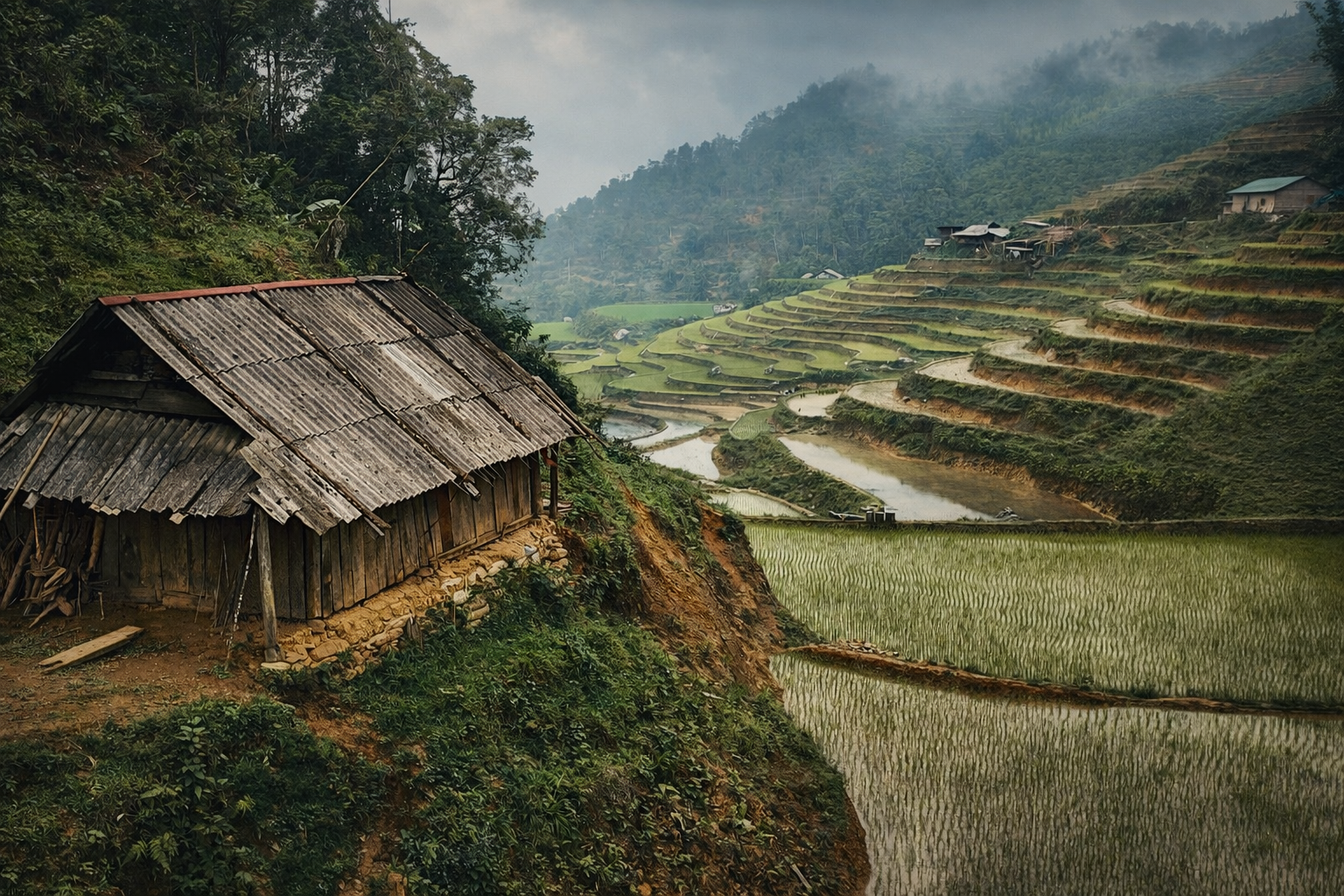
Traditional Hmong house in Sapa.
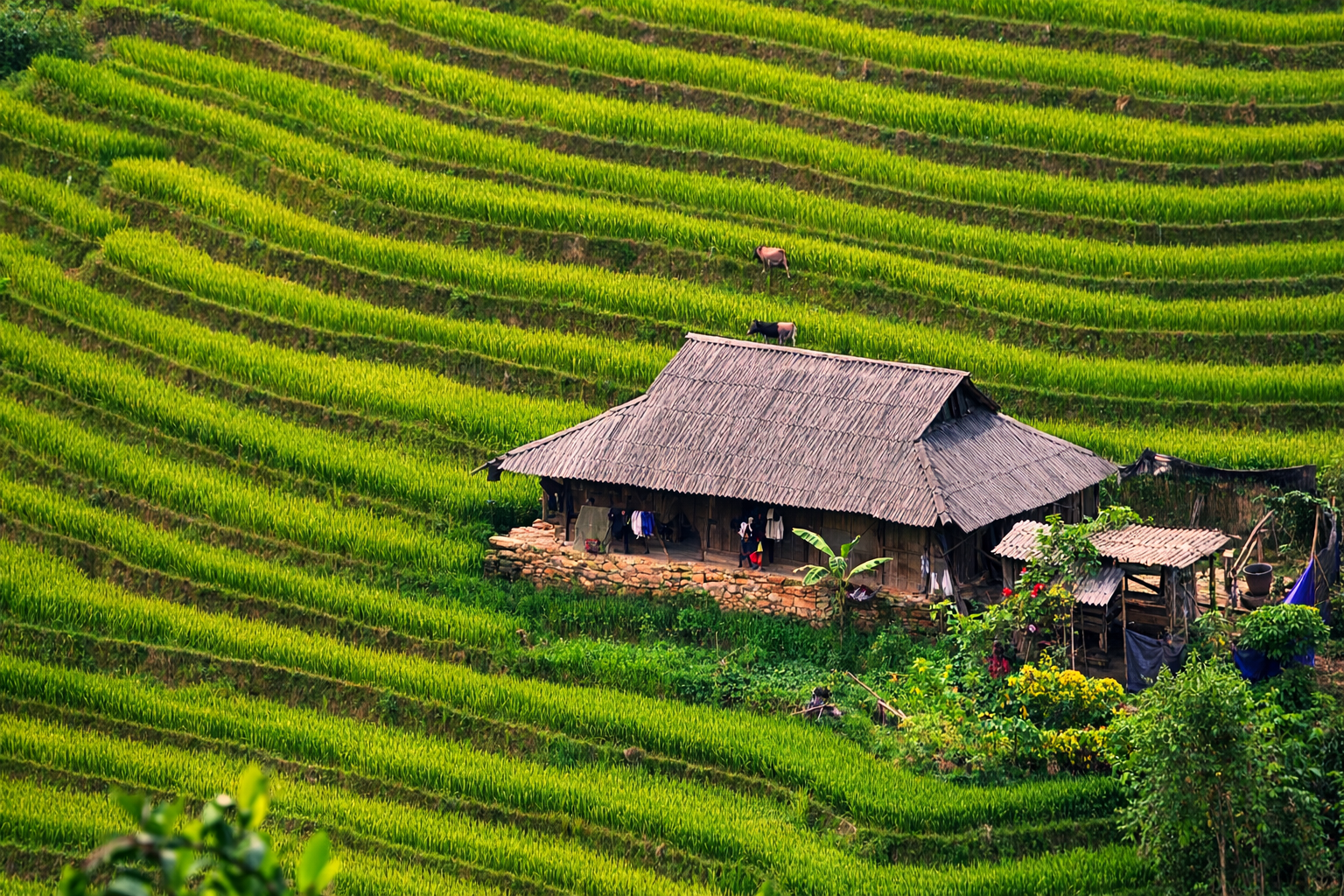
Traditional Hmong house in Sapa.
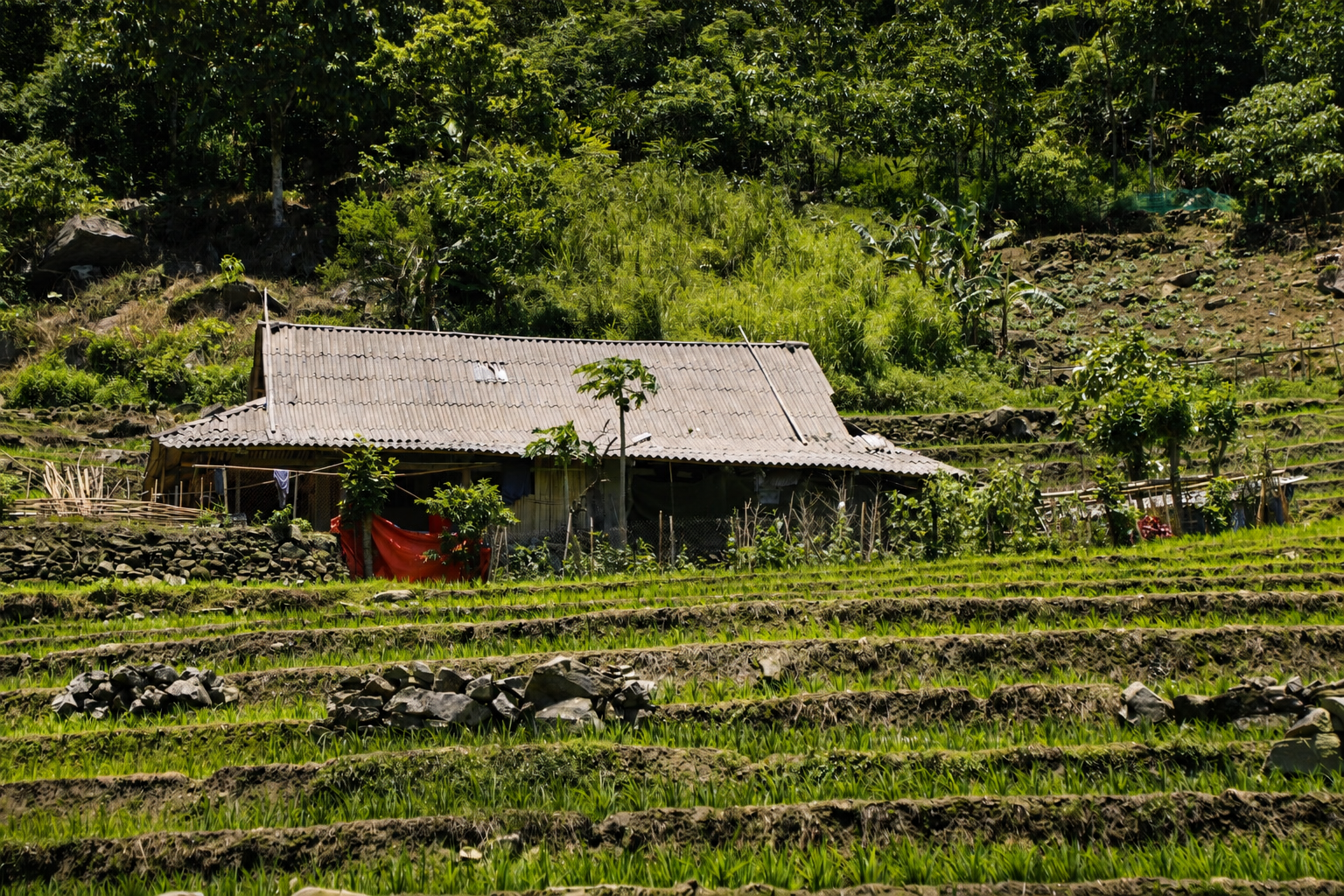
Traditional Hmong house in Sapa.
Sapa Town Is Not the Same as Sapa’s Mountains
Part of the confusion surrounding development in Sapa comes from the fact that many visitors experience only Sapa town itself, rather than the far larger district that surrounds it. The urban centre of Sapa has already become a busy mountain tourism hub filled with hotels, cafés, karaoke bars, illuminated façades, traffic, construction, and increasingly dense commercial infrastructure. Bright lights, large buildings, and rapid development are now firmly part of the reality of the town.
Yet Sapa district extends far beyond the urban centre. Beyond the busy streets lie vast areas of forest, terraced rice valleys, rivers, streams, and mountain communities spread across wards including Cầu Mây, Hàm Rồng, Ô Quý Hồ, Phan Si Păng, Sa Pa, and Sa Pả, alongside rural communes such as Bản Hồ, Hoàng Liên, Liên Minh, Mường Bo, Mường Hoa, Ngũ Chỉ Sơn, Tả Phìn, Tả Van, Thanh Bình, and Trung Chải. Across these valleys and mountain slopes sit approximately one hundred smaller hamlets, many still defined by traditional Hmong, Dao, Tày, and Giáy homes surrounded by terraces, bamboo groves, medicinal gardens, grazing buffalo, and flowing mountain water.
This distinction matters enormously. Much of what people imagine when they think of Sapa; the layered rice terraces disappearing into mist, small villages scattered along ridgelines, children walking narrow mountain paths, water buffalo crossing streams, smoke drifting from timber roofs during cold evenings still exists outside the urban core. The wider district remains an extraordinary cultural and ecological landscape whose value lies precisely in the relationship between communities, agriculture, forests, rivers, and mountains.
The concern many residents and observers now share is not that Sapa town itself contains development or modern infrastructure. Towns naturally evolve, gentrify, grow and sometimes decline. The concern is that the aggressive commercialisation and oversized architectural ambitions increasingly visible within the urban centre are beginning to spread outward into landscapes that have historically remained far quieter, more ecologically fragile, and more culturally rooted.
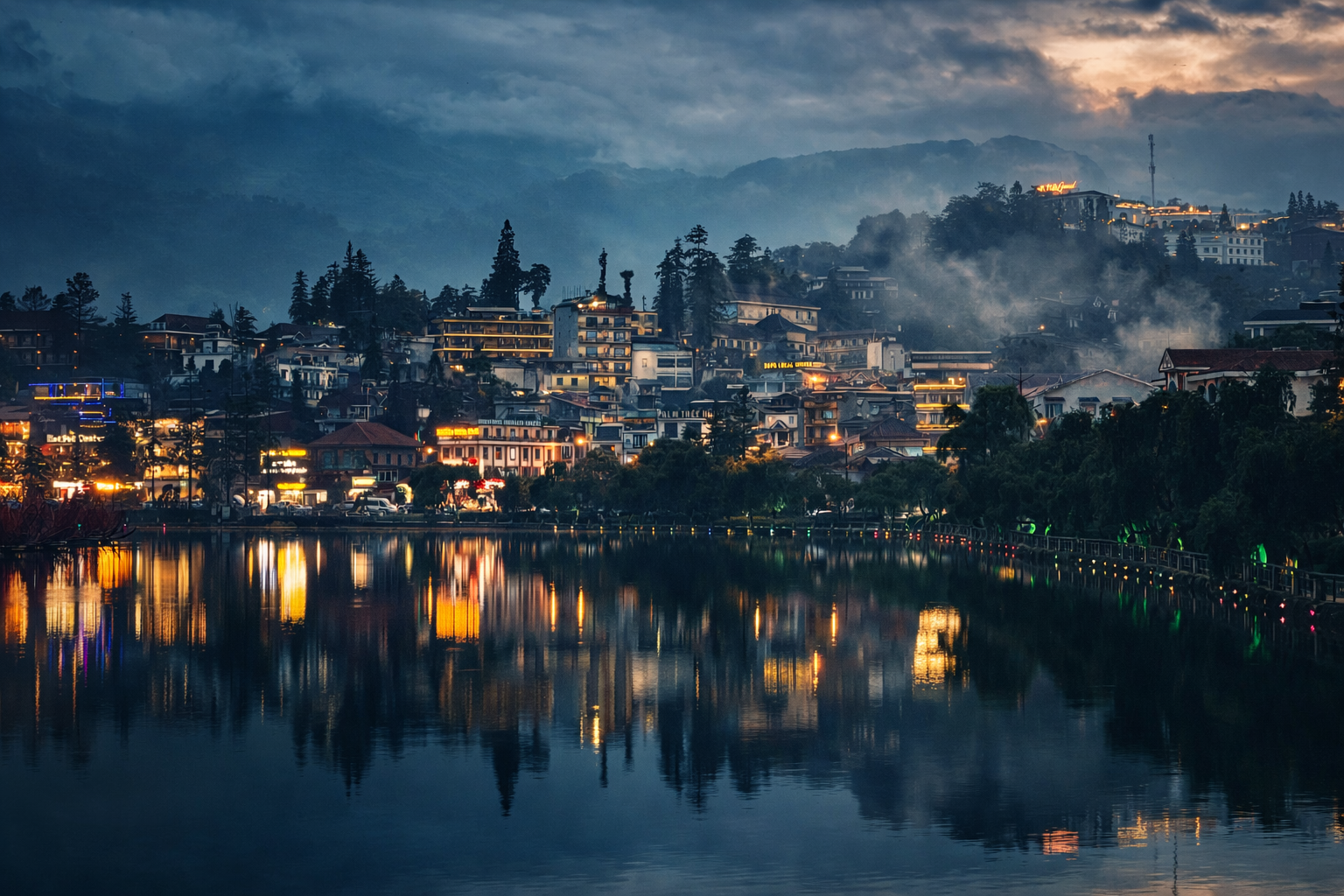
Sapa town view from across the lake.

Aerial view of Sapa town.
Homes Designed to Belong to the Mountains
Across the mountains surrounding Sapa, traditional Hmong and Dao homes sit quietly against terraced hillsides, partially hidden beneath bamboo groves, plum trees, and drifting mountain fog. Their smoke-darkened walls, dense thatched roofs, and low silhouettes seem almost absorbed into the landscape itself. These are not houses designed for prestige, visibility, or permanence but are homes shaped by centuries of adaptation to climate, farming life, spirituality, and communal survival.
Every aspect of their design reflects practicality and restraint. Timber from nearby forests forms the structural frame. Bamboo becomes partitions, woven panels, water channels, and animal pens. Stone anchors foundations into steep terrain while packed-earth floors absorb warmth from the hearth and slowly release it during freezing mountain nights. Unlike the raised stilt houses common in hotter lowland regions, many Hmong homes sit directly against the earth, helping interiors remain warm and sheltered during Sapa’s cold, damp winters.
At the centre of most homes sits the fire, functioning not only as a place to cook but as the emotional and spiritual heart of family life. Families gather around the hearth to prepare food, embroider textiles, repair tools, share rice wine, and tell stories long after darkness settles across the valley. In many Dao homes, ancestral altars occupy protected central positions within the house, reflecting how architecture, spirituality, and lineage remain deeply intertwined.
The homes themselves are remarkably sophisticated despite their apparent simplicity. Builders traditionally rely upon mortise-and-tenon joinery, wooden pegs, and rattan lashings rather than nails, allowing structures to flex subtly with shifting mountain soils and seasonal moisture. Entire villages often participate in construction, meaning a house embodies relationships and communal labour as much as architecture.
Many homes incorporate gravity-fed stream water systems that channel fresh mountain water directly through kitchen spaces before flowing back into gardens and terraces below. Visitors are also often surprised to discover the absence of chimneys. Smoke from the hearth rises slowly into the roof space before escaping through gaps in timber and thatch, preserving wooden beams against insects and damp while slowly curing hanging maize, herbs, medicinal plants, and strips of meat suspended above the fire.
Flexibility and renewal remain central to the architecture itself. Wall panels are often constructed on runners or slotted systems that allow sections to be dismantled, repaired, replaced, or even transported if necessary. Above the living space, mezzanine grain stores suspended beneath the roof provide dry storage for rice, seeds, textiles, tools, and medicinal plants, preserved by the warm smoky air rising from below.
Perhaps most importantly, these homes were designed around community rather than status or privacy. In many villages, doors remain open during meals, and anyone passing by may be invited inside to share food, whether neighbour, traveller, friend, or stranger. Hospitality in the mountains has historically been tied to survival itself. The house therefore functions not simply as shelter, but as a place of welcome, memory, reciprocity, and belonging.
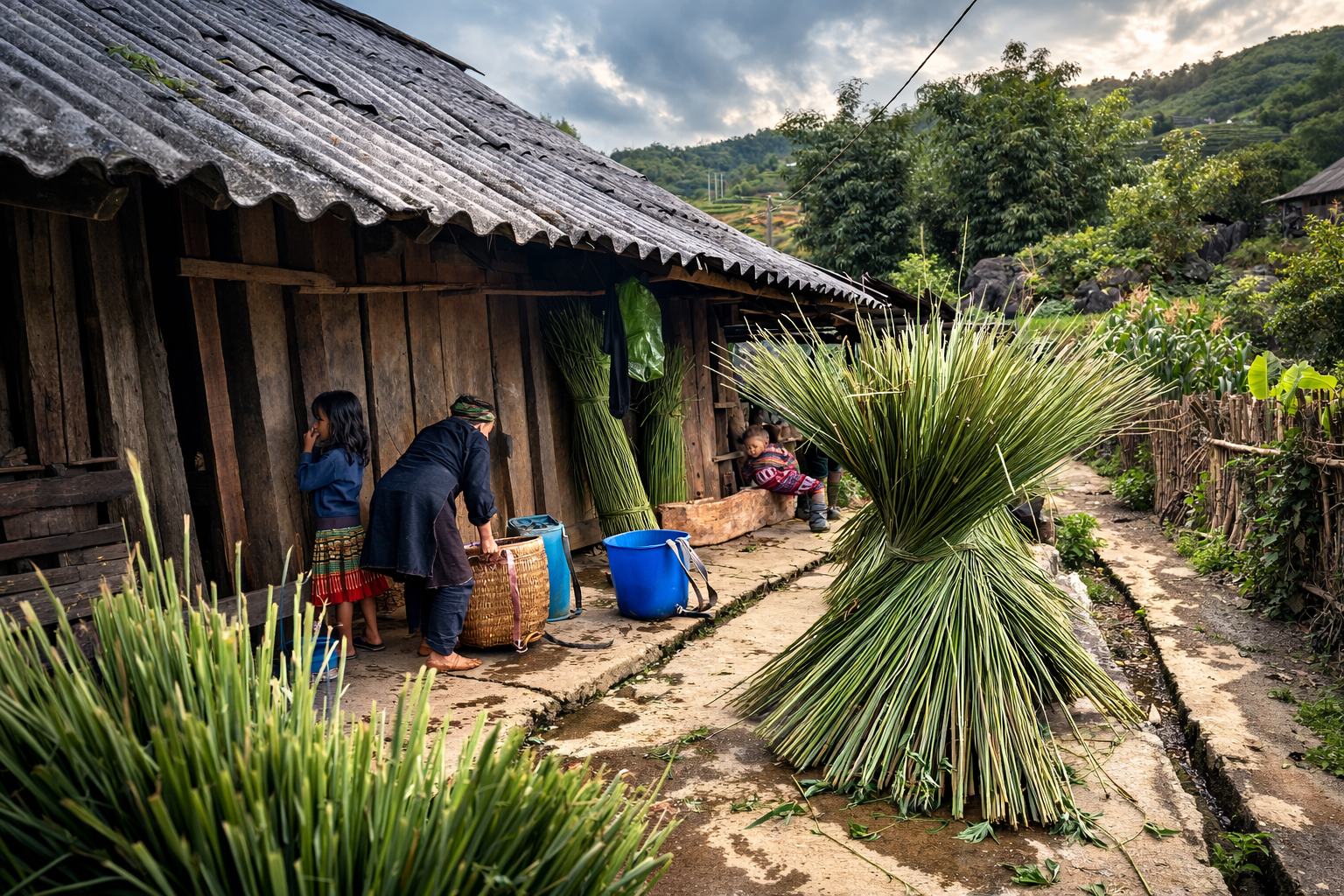
Hemp drying outside the house.
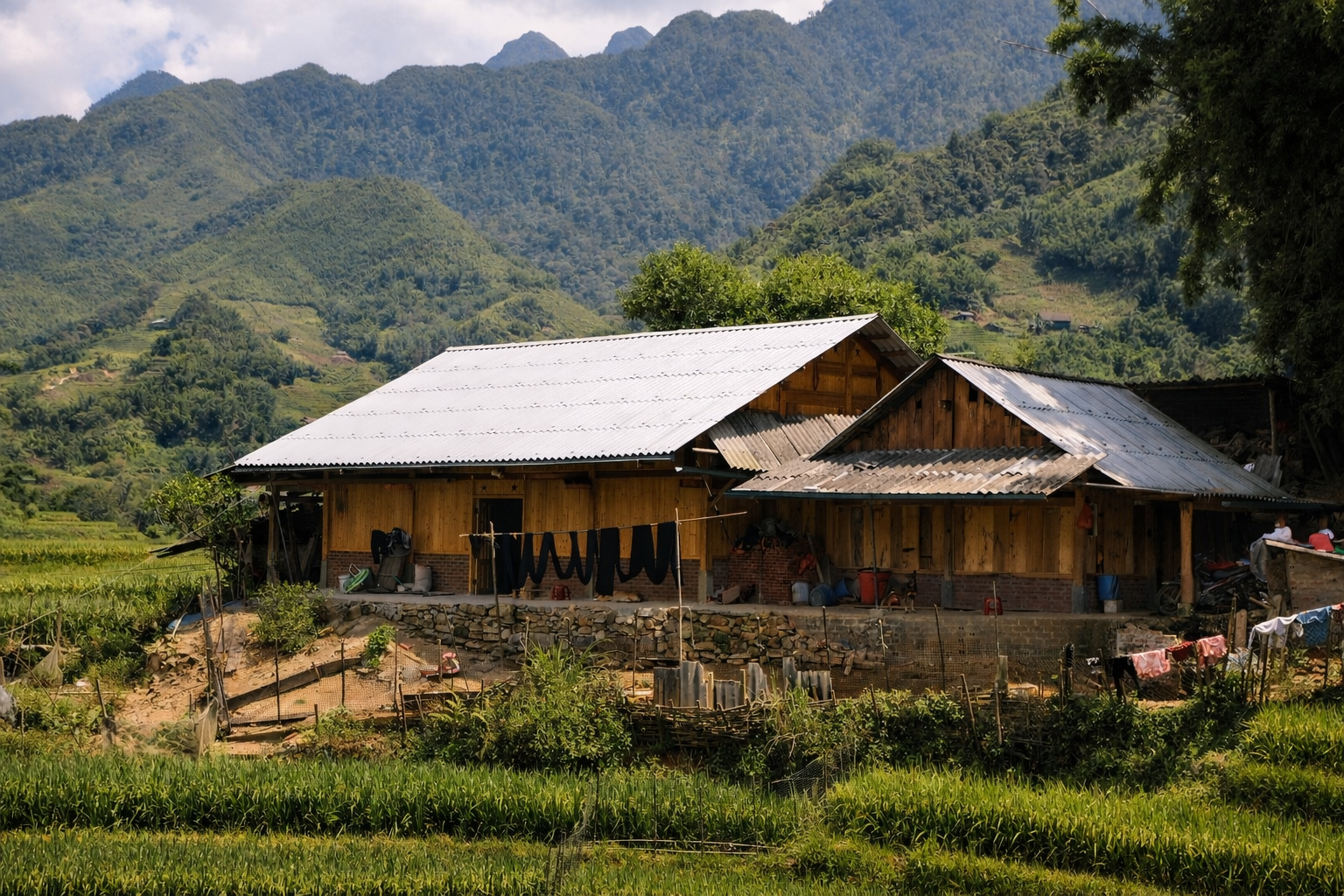
Indigo dyed fabrics outside the house.
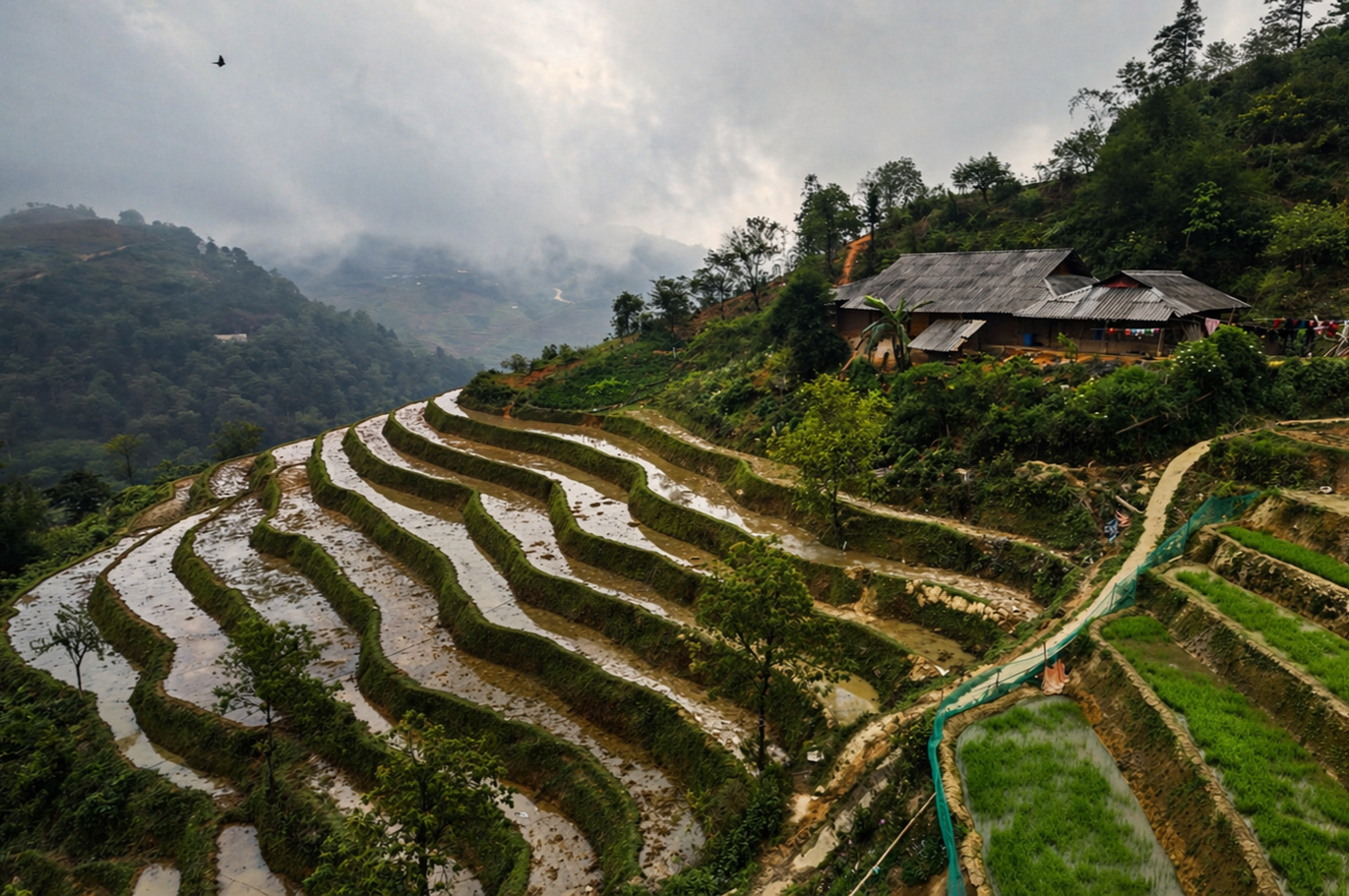
Rice terraces in Sapa.
The Difference Between Building Within a Landscape and Building Over It
As tourism expands rapidly across Sapa, traditional architectural landscapes face increasing pressure. Concrete hotels now rise along ridgelines once occupied by terraced fields and scattered wooden homes. Large-scale developments increasingly dominate valleys historically defined by subtle integration between settlement and landscape.
Not all modern development is harmful. Some newer homestays and ecolodges thoughtfully reinterpret vernacular architectural principles using local timber, restrained building heights, natural materials, and sensitive positioning within the terrain. The most successful examples understand that good mountain architecture should feel embedded within the landscape rather than imposed upon it.
There are encouraging examples of contemporary projects that preserve low visual impact, incorporate traditional rooflines, support local craftsmanship, and avoid overwhelming surrounding villages. Tasteful architecture in Sapa does not require imitation or pastiche. It requires humility towards the landscape and respect for the communities whose cultural identity shaped it.
Unfortunately, other projects move in the opposite direction.
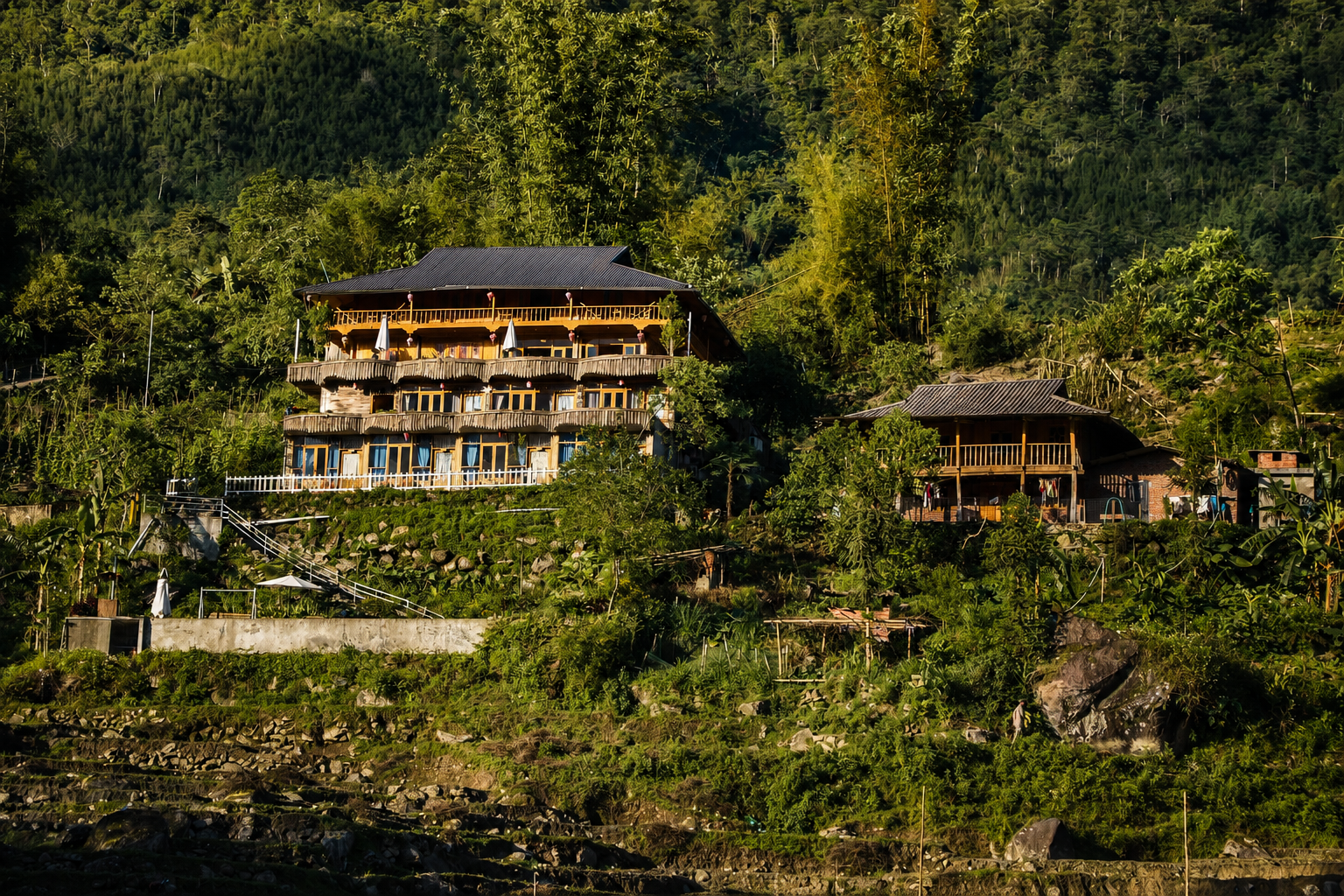
Vietnamese owned homestay with some sympathetic design.
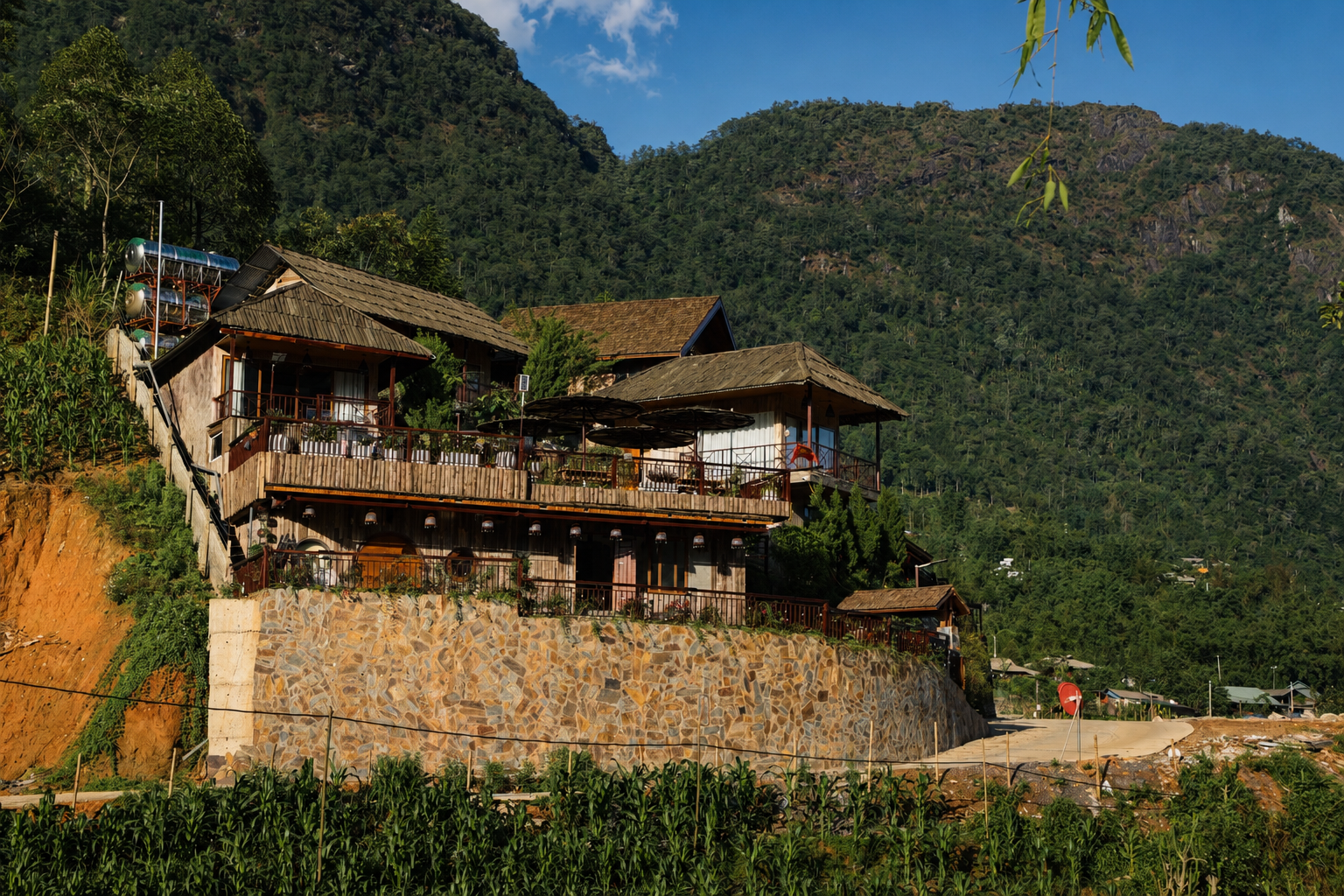
Vietnamese owned homestay with some sympathetic design.
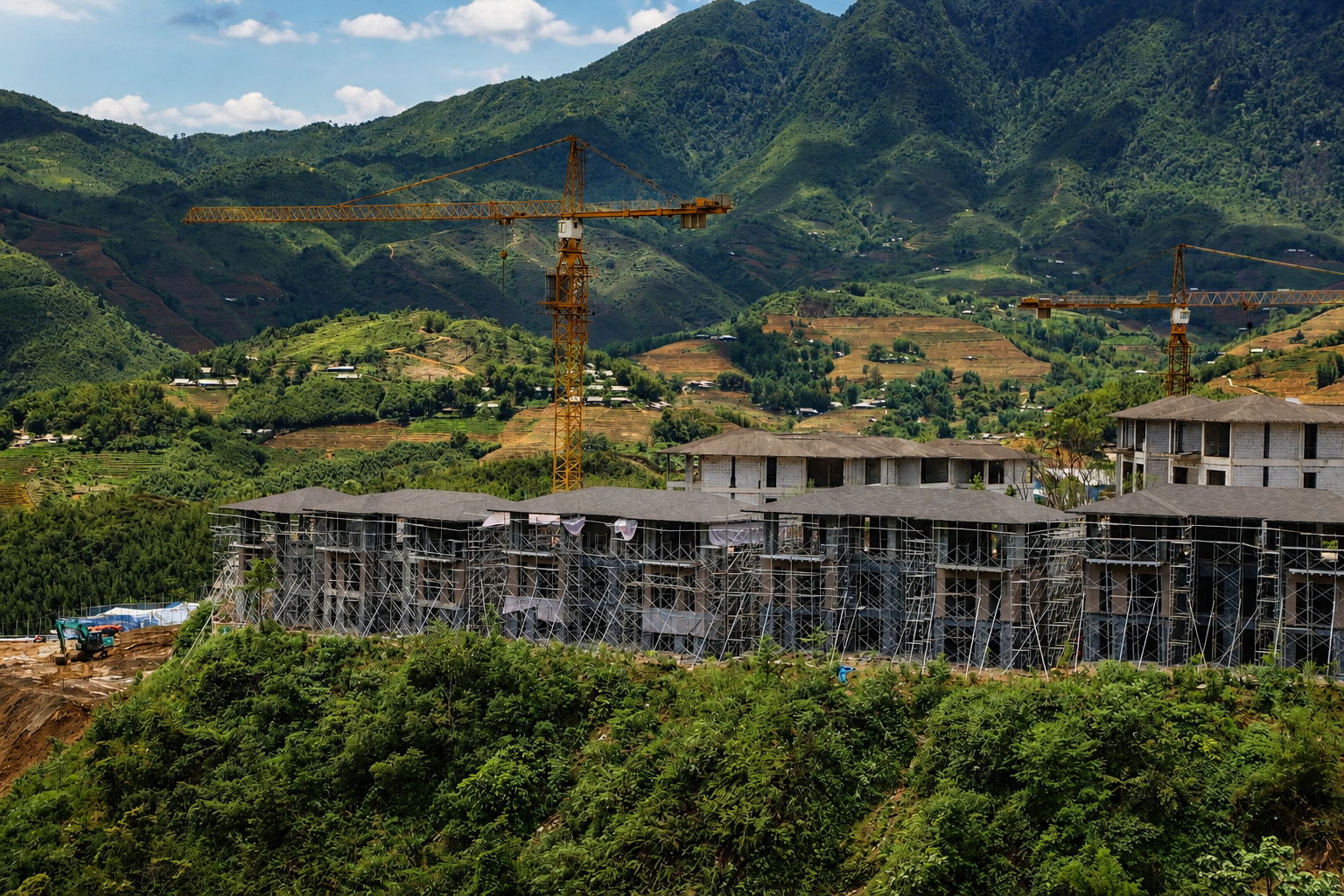
New hotel complex in Sapa.
Ban Mong Resort — When Architecture Stops Listening to the Landscape
Few developments in the wider Sapa region better symbolise the growing tension between profit-driven tourism expansion and the preservation of cultural landscape than the enormous Ban Mong Resort project overlooking the Muong Hoa Valley. To many residents, guides, farmers, and long-term visitors, the development has become emblematic of a style of construction that prioritises scale, prestige, and commercial spectacle above environmental sensitivity, architectural restraint, or meaningful connection to place.
From across the valley, the complex appears less like an extension of the mountain landscape and more like an imposition upon it. Its sheer scale dominates ridgelines that were once defined by layered rice terraces, scattered timber homes, and the shifting textures of forest and mist. Where traditional Hmong and Dao architecture settles quietly into the contours of the land, Ban Mong Resort announces itself aggressively. It demands attention. It overwhelms the eye and transforms what was once an organically evolving cultural landscape into a backdrop for oversized commercial ambition.
For many locals, this is not simply a question of aesthetics but more a question of respect. The architecture of the Muong Hoa Valley historically evolved through generations of practical adaptation to climate, terrain, spirituality, agriculture, and communal life. Traditional homes were never designed to dominate the mountains but to coexist with them. Ban Mong Resort represents the complete inversion of that philosophy. Rather than responding humbly to the landscape, the landscape itself appears forced to submit to the scale of the project.
The visual impact is impossible to ignore. Visitors trekking through the valley frequently describe the development as jarring, intrusive, and deeply out of character with its surroundings. Its massive concrete presence interrupts panoramic views that once carried an extraordinary sense of openness and continuity between terraces, villages, rivers, and forested slopes. The development looms over nearby communities with a heaviness that many feel fundamentally misunderstands the character of the highlands themselves.
What makes this particularly frustrating for many observers is that Sapa does not inherently oppose modern architecture or tourism investment. Sensitive contemporary design is entirely possible here. There are smaller lodges, homestays, and community-based projects across the region that successfully reinterpret vernacular forms through thoughtful use of local materials, restrained scale, and careful positioning within the terrain. Good architecture in mountain environments requires humility. Ban Mong Resort instead projects excess.
The development also raises wider questions about who tourism is ultimately being built for. Increasingly, parts of Sapa risk becoming shaped less around the realities of local communities and more around the expectations of short-term mass tourism markets seeking spectacle, status, and curated luxury. In this model, the mountains themselves become scenery to monetise rather than living cultural landscapes deserving stewardship and protection.
Projects of this scale can permanently alter not only visual identity but also ecological systems, water drainage patterns, traffic pressure, waste management demands, and long-term land values that affect surrounding villages. Once landscapes are transformed at this scale, they are extraordinarily difficult to restore. Concrete ridgelines do not easily return to terraced hillsides.
Perhaps most painfully, developments like Ban Mong Resort risk eroding the very qualities that made the valley internationally admired in the first place. People did not travel to Muong Hoa to experience generic resort urbanism transplanted into the mountains. They came for the quiet relationship between architecture, agriculture, mist, river, and community life that evolved slowly over centuries. They came because the valley still felt alive rather than manufactured.
When buildings become monuments to profit and prestige rather than thoughtful responses to place, the landscape inevitably pays the price. In the case of Ban Mong Resort, many locals and visitors alike increasingly feel that price has already become painfully visible across the valley.
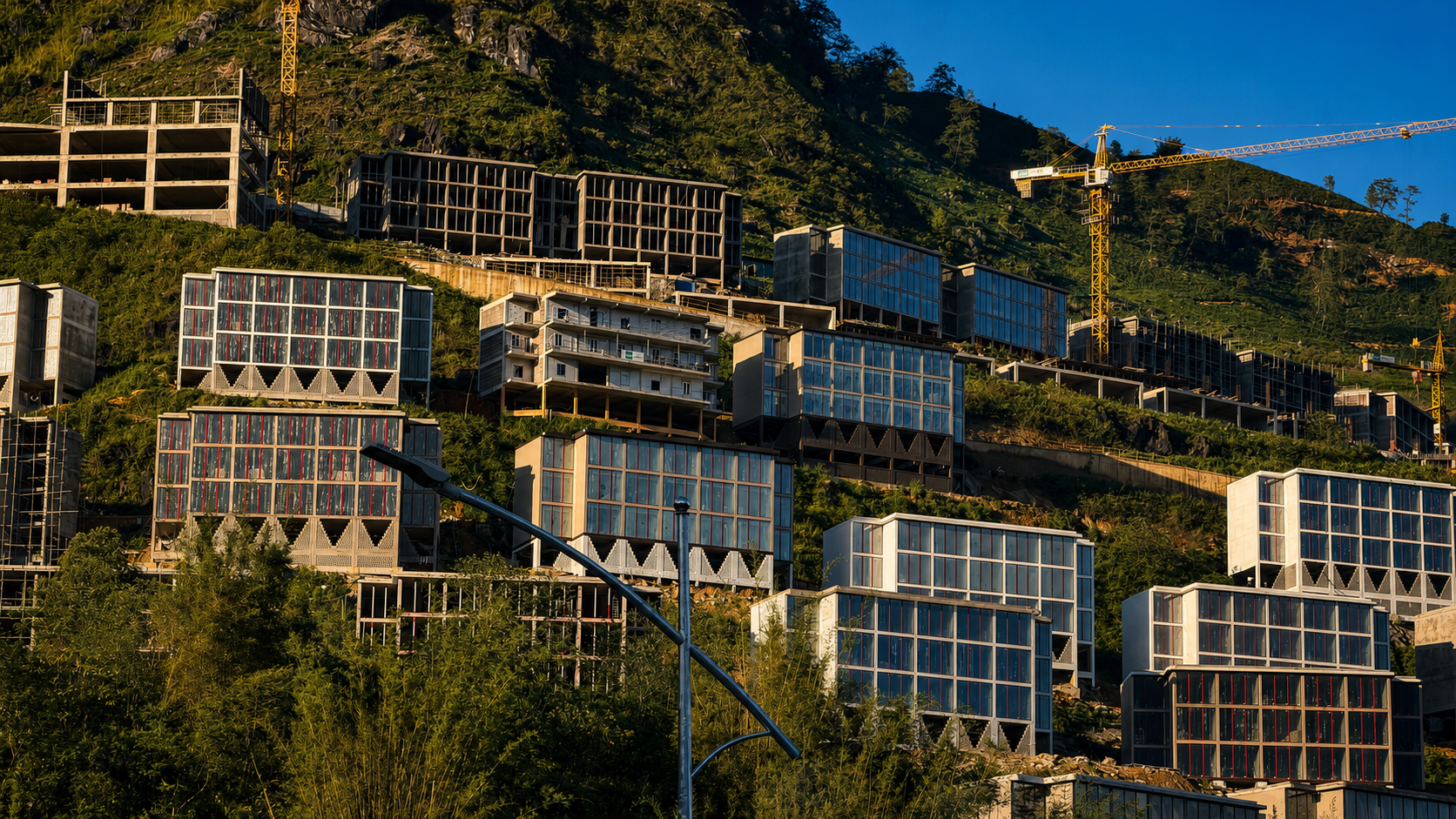
Controvertial hotels springing up in the Sapa mountains.
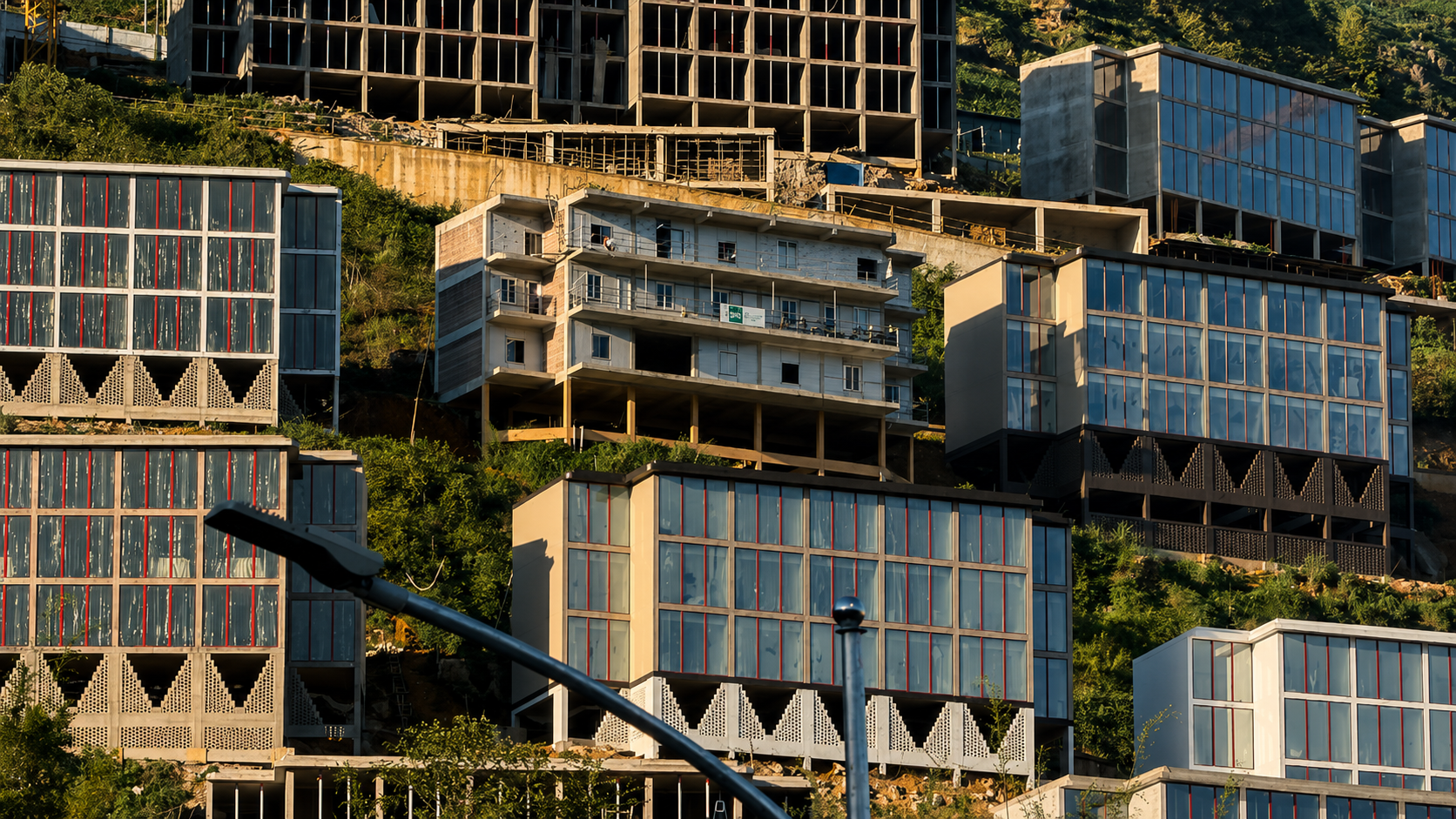
Controvertial hotels springing up in the Sapa mountains.
Colonial Nostalgia and the Packaging of “Indochine”
Another tension shaping modern Sapa emerges through the commercial repackaging of colonial aesthetics within luxury tourism branding. Perhaps the clearest example is the Hotel de la Coupole Sapa – MGallery, which presents itself through the language of “Haute Couture Meets Hill Tribe Artistry”, blending imagined French Indochine glamour with stylised representations of ethnic minority cultures.
Visually, the property is undeniably dramatic. Yet its atmosphere reflects not preserved colonial heritage but a contemporary luxury interpretation of what “Indochine” is imagined to have looked like. Unlike surviving colonial churches, villas, or administrative buildings physically connected to the history of French occupation in the highlands, this is a newly constructed fantasy aesthetic designed primarily for commercial consumption.
The danger lies in how colonialism becomes transformed into atmosphere rather than history. Refined interiors, couture references, and nostalgic imagery can risk presenting colonial rule as elegant and harmonious while obscuring the violence, extraction, taxation, frontier militarisation, and unequal power structures that shaped life across northern Vietnam during the colonial era.
French expansion into the highlands involved systems of governance built around strategic control, labour extraction, land management, and opium monopolies that financed much of colonial Indochina. Highland communities were surveyed, classified, taxed, displaced, and incorporated into systems designed primarily around imperial interests rather than local wellbeing.
When colonial imagery becomes detached from these realities, heritage risks becoming selective memory. The appearance of colonialism is preserved while its consequences fade quietly into the background.
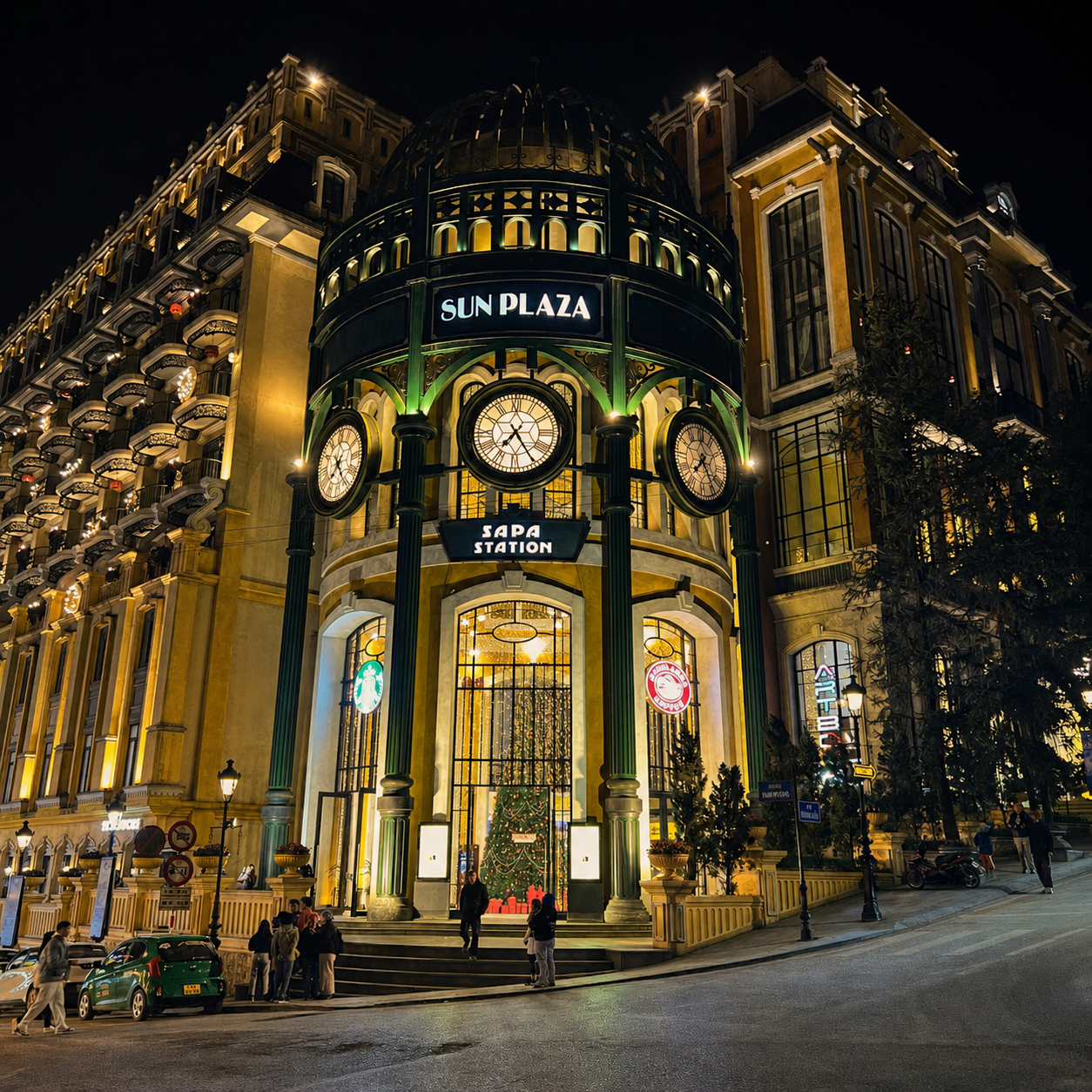
Modern grand attempt at post colonial architecture that never really existed in Sapa
The grand interior of the Hotel de la Coupole, Sapa

The grand swimming pool in the Hotel de la Coupole, Sapa
Why Sapa Needs Stronger Environmental Impact Assessments
The speed and scale of development now transforming Sapa raises urgent questions regarding environmental governance and long-term sustainability. Mountain ecosystems are inherently fragile. Landslides, water scarcity, erosion, biodiversity loss, and infrastructure strain can escalate rapidly when development proceeds without rigorous oversight.
This is precisely why far more comprehensive Environmental Impact Assessment processes are needed across the region. An effective EIA is not merely bureaucratic paperwork but a systematic process designed to identify, predict, and evaluate the environmental, social, cultural, and economic consequences of proposed developments before approval is granted.
In sensitive landscapes such as the Muong Hoa Valley or areas bordering protected forests, EIAs should examine far more than simple construction feasibility. They should analyse visibility from key viewpoints, architectural compatibility with local vernacular traditions, drainage systems, flood risks, biodiversity impacts, wildlife corridors, groundwater vulnerability, traffic pressures, noise pollution, wastewater management, and long-term effects upon local communities and cultural heritage.
Public consultation must also play a genuine role. Highland communities should not simply witness transformation happening around them after decisions have already been made elsewhere. Their knowledge of local ecosystems, weather patterns, farming systems, and sacred landscapes forms an essential part of responsible planning.
Good development is possible. Tourism can absolutely support livelihoods, preserve craft traditions, and strengthen local economies when approached thoughtfully. Yet mountain landscapes cannot absorb unlimited expansion without consequence.
Sapa’s greatest beauty has never come from spectacle alone. It comes from the extraordinary relationship between people, architecture, agriculture, forests, rivers, and mountains that evolved here slowly across generations. Traditional Hmong and Dao homes embody that relationship perfectly. They remind us that architecture can exist not as domination of landscape, but as participation within it.
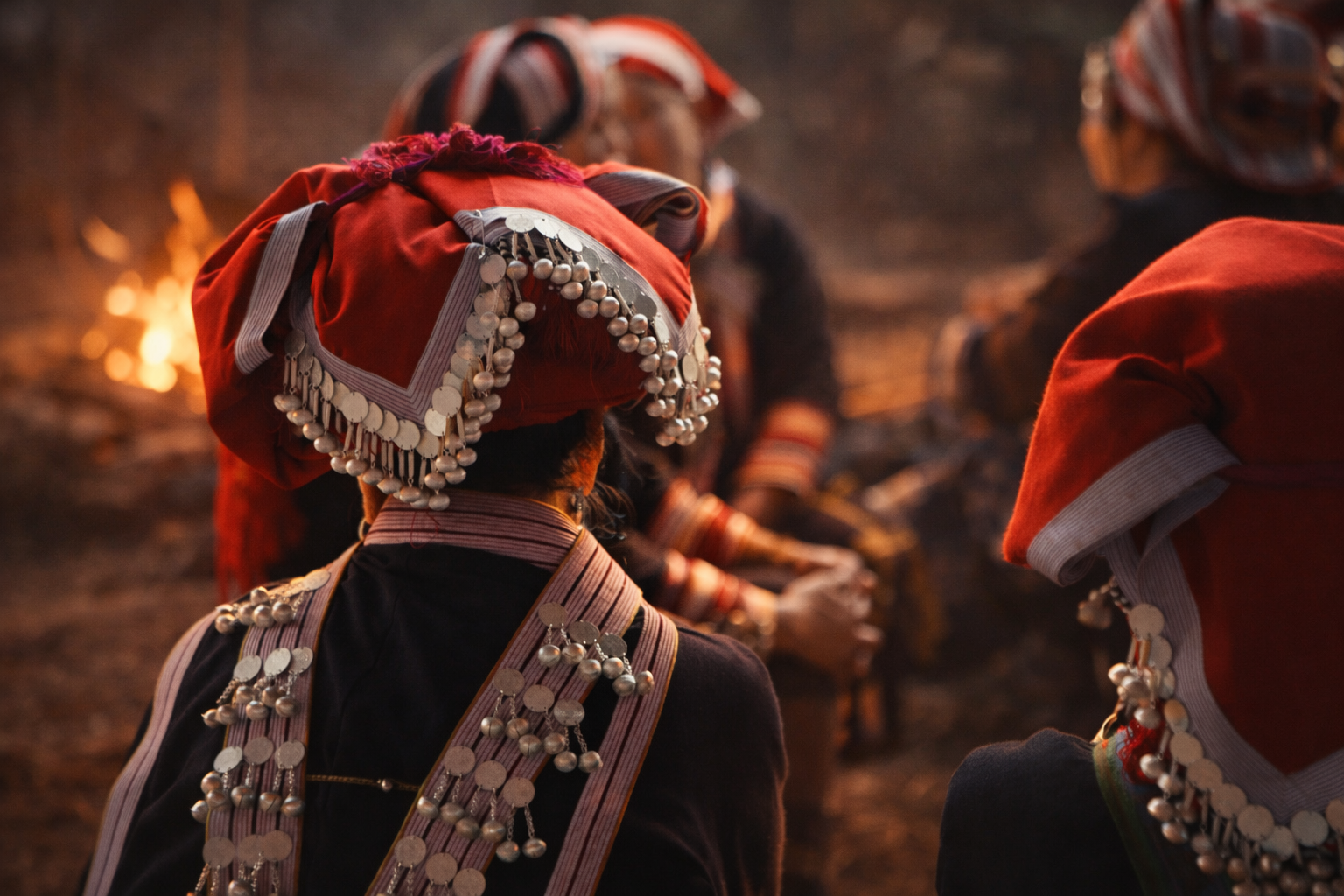
Red Dao shamanic ritual in Sa Pa, northern Vietnam
The Cấp Sắc ceremony is the most significant rite of passage among the Red Dao people of northern Vietnam. Held once in a lifetime, this elaborate shamanic ritual marks an individual's transition into full spiritual and social adulthood. Through sacred chants, ancestral invocations, ritual music, and community participation, Cấp Sắc formally connects participants to the Dao spiritual hierarchy and remains a defining expression of Red Dao identity today.
Shared core across Dao groups
Among Dao communities in northern Vietnam, the largest and most significant ritual performed in an individual’s lifetime is commonly known as Cấp Sắc. It is often translated as a conferral of ordination or a bestowal of ritual status, and it marks a decisive transformation in a person’s social and spiritual standing.
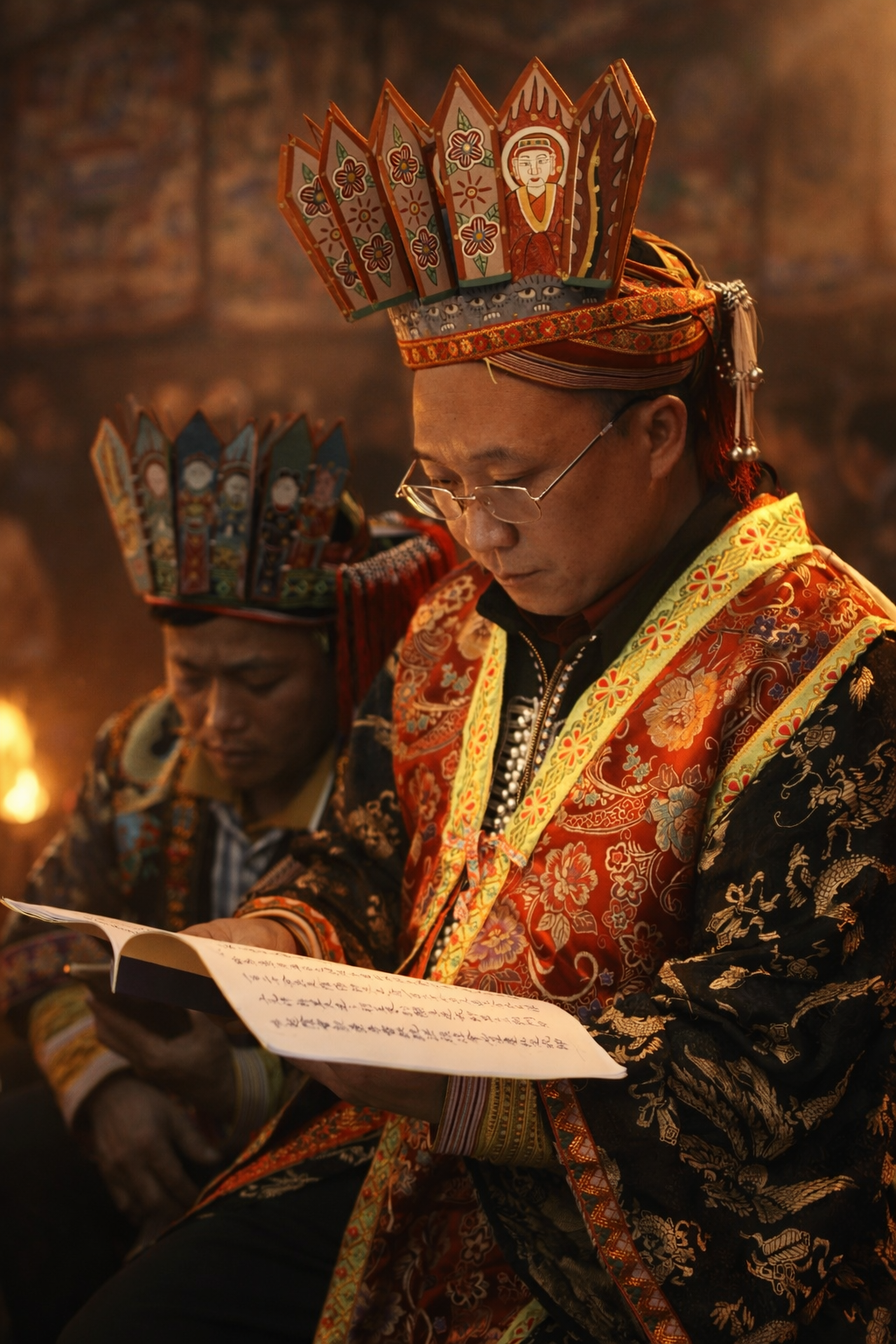
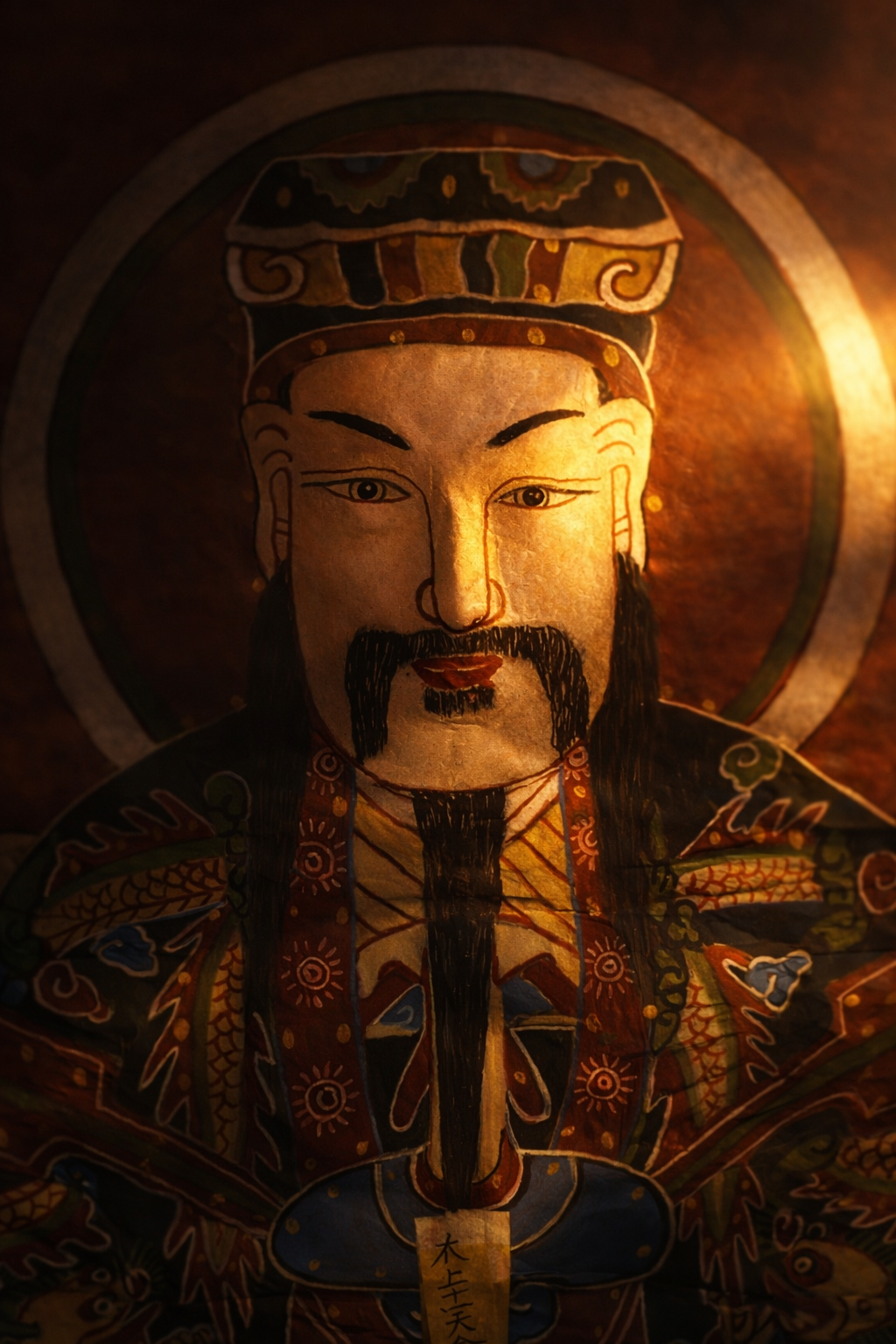
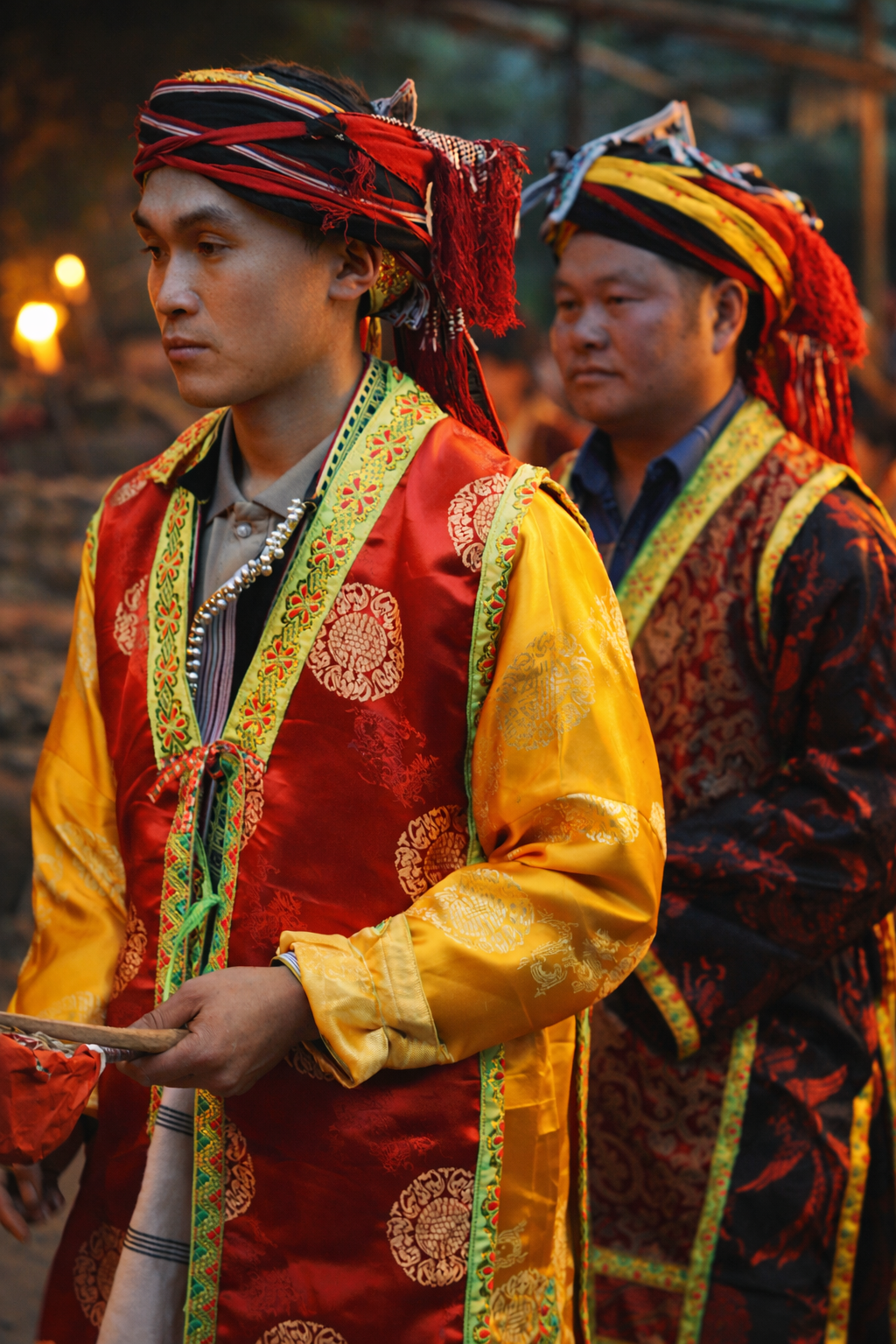
Frequency and Meaning
Cấp Sắc is generally performed only once in a person’s life and most often for men. It formally recognises the participant as a complete social and spiritual adult. Without undergoing this ritual, a person is considered spiritually incomplete regardless of age or family position. Only those who have completed Cấp Sắc are fully acknowledged by ancestors and spirit authorities after death. For participants, it is the most important shamanic and cosmological event they will ever experience. Many families save for years, and sometimes decades, in order to finance it. Those who are unable to afford the ceremony may save across several generations so that a single Cấp Sắc can eventually be held.
The ceremony is typically larger and longer than other Dao rituals. Depending on local tradition and lineage, preparation may take weeks, while the ritual itself can last for several days. It often involves several senior shamans who chant at length and play ritual trumpets. In this particular ceremony, thirty-one families were involved, with many additional community members and visitors attending over the course of the event. Ritual activity continues day and night, supported by temporary bamboo longhouse-style structures built to accommodate shamans, assistants and guests.
At its core, Cấp Sắc functions as an ordination into the Dao spiritual bureaucracy. Participants are symbolically given a ritual name, assigned a spirit guardian, granted permission to communicate with ancestors and deities, and formally registered within a celestial hierarchy. This registration is believed to be permanent and to hold authority across both the human and spirit worlds.
The ritual is overseen by a senior master shaman, supported by several other officiating shamans. They chant from extensive ritual texts that recount cosmic journeys, ancestral genealogies and the administrative procedures of the spirit realm. Instruments such as trumpets, bells and swords are used to mark transitions and to assert ritual authority. At key moments, particularly during spirit registration, oath-taking and the formal recognition of status, all shamans act in unison. These moments are regarded as especially powerful and irreversible.
Cấp Sắc has profound social as well as religious implications. Its completion confirms an individual’s moral responsibility to their ancestors, their eligibility to conduct family rituals, their full authority to marry within Dao norms and their right to be buried according to proper rites. Failure to complete the ceremony is believed to result in spiritual vulnerability during life and uncertainty after death.
While other large communal rituals, such as seven-day ceremonies, are intended to address collective misfortune or imbalance, Cấp Sắc is transformative at the level of the individual. It permanently alters a person’s status in both society and the cosmos. For many Dao participants, all other rituals undertaken during life are understood as preparatory or supplementary to this single defining event.
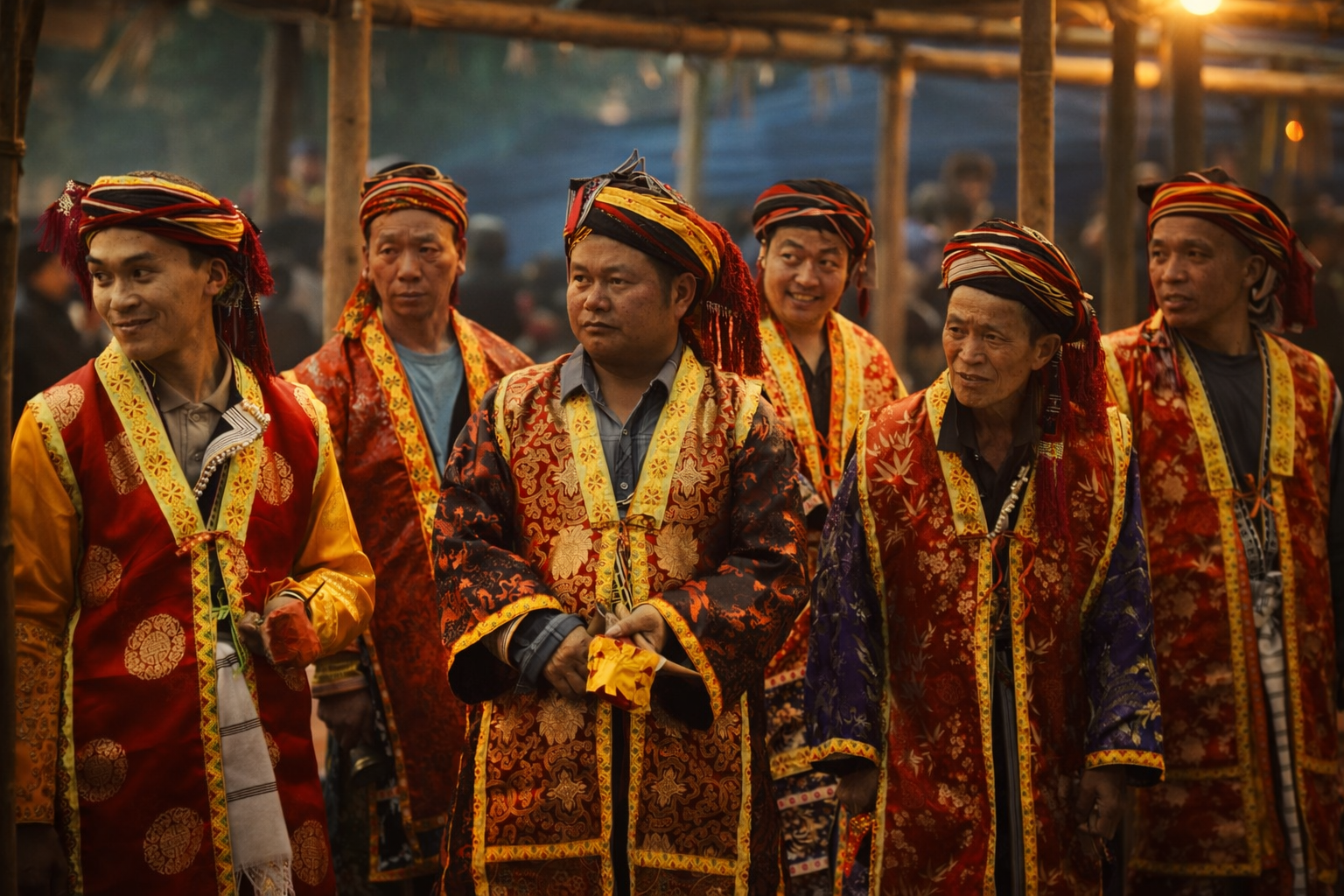
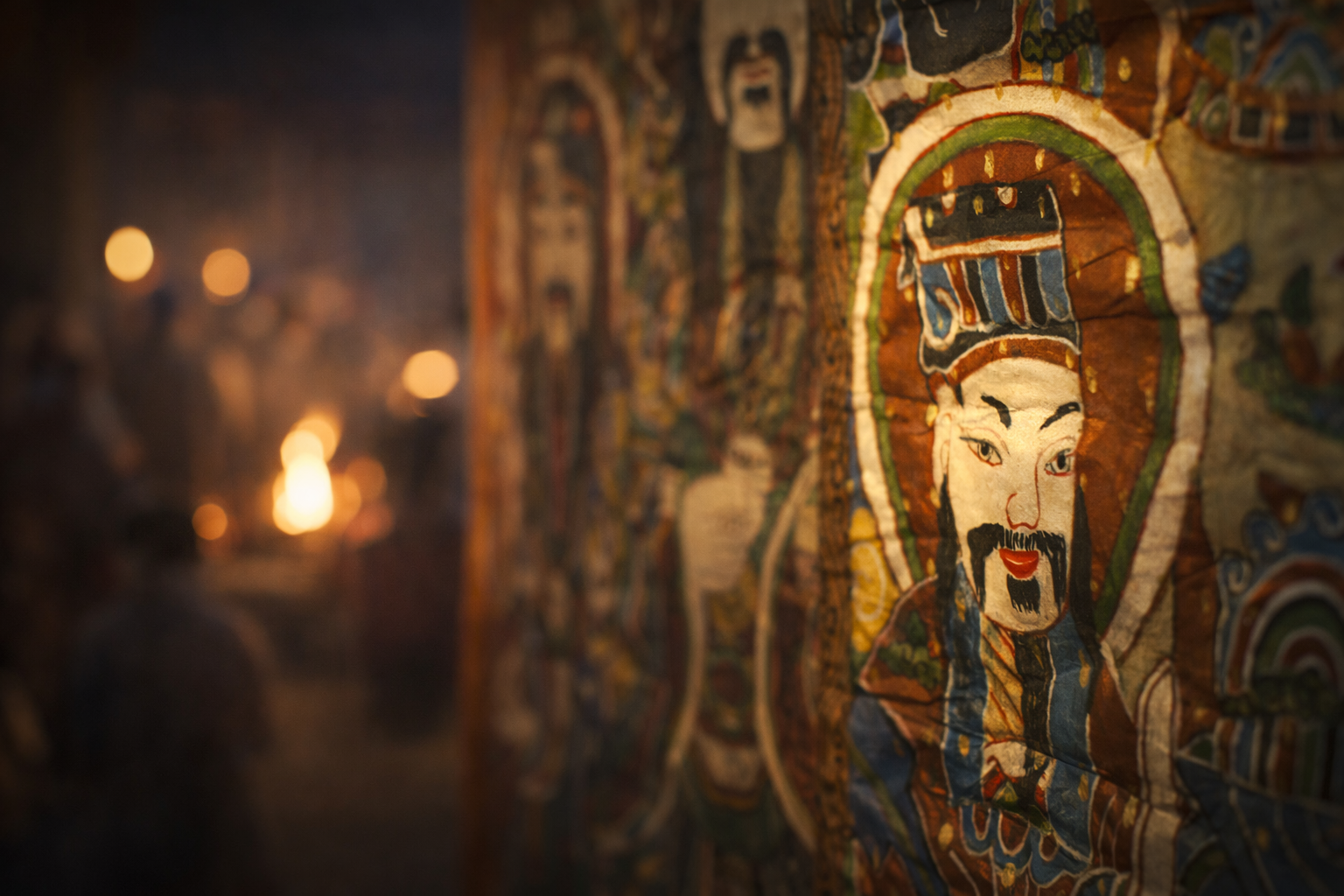
Position in the Modern World
Today, Cấp Sắc continues to be practised, although its scale is sometimes adjusted in response to economic constraints. Despite these changes, it remains central to Dao identity and is widely regarded by Dao communities themselves as the most consequential ritual commitment a person can make. Among the Red Dao in particular, Cấp Sắc is typically large in scale and highly collective. It often resembles an extended communal ritual but carries a greater sense of symbolic finality. Strong collective chanting in unison, the prominent use of trumpets and percussive instruments, the visual dominance of red ritual textiles and paper, and the construction of temporary ceremonial architecture all reinforce its gravity. For Red Dao participants, the ceremony definitively establishes a person’s standing with ancestors and spirits, and failing to complete it is believed to shape one’s fate after death.
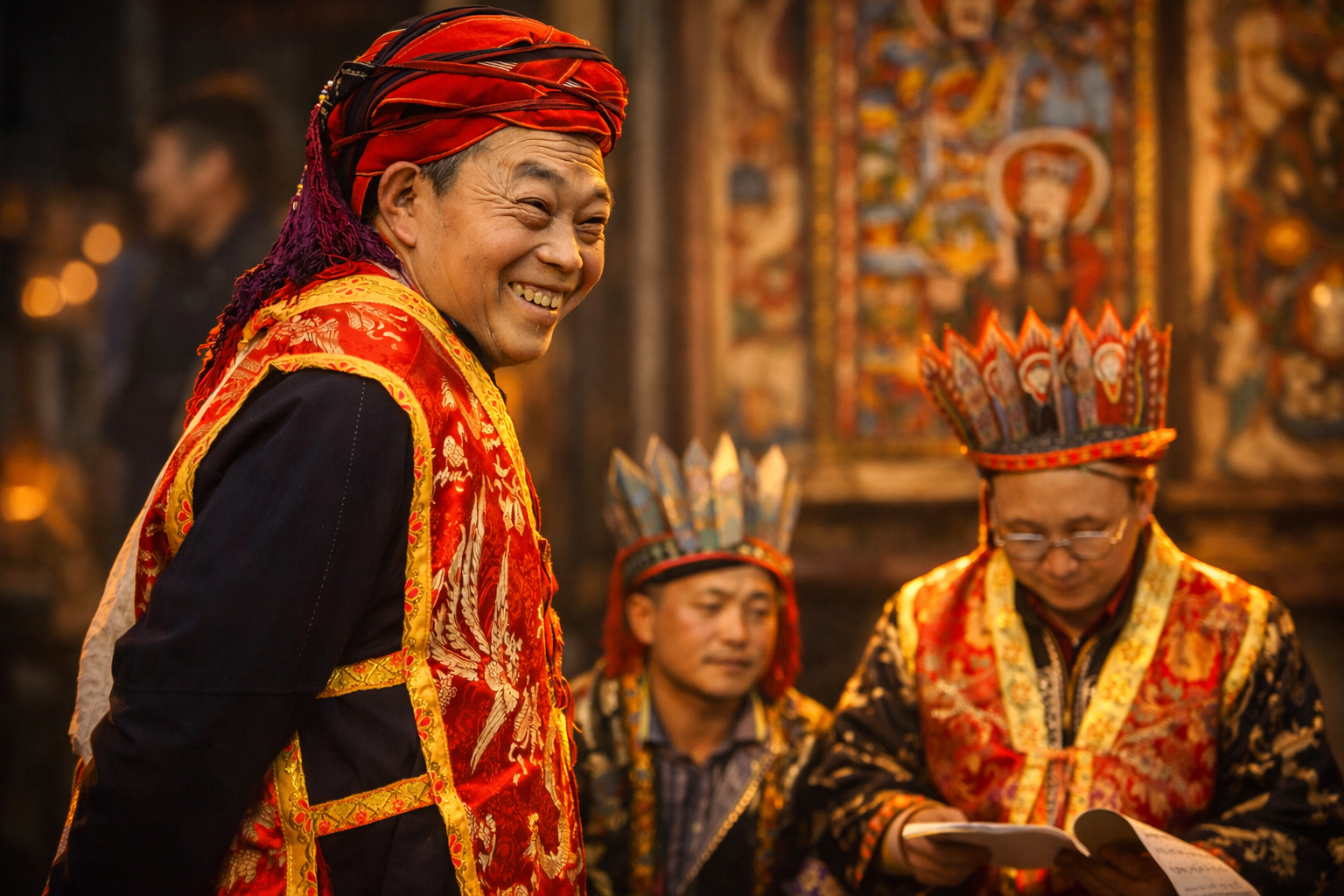
From Mountain Knowledge to International Standards: A Shared Achievement
Behind every safe and authentic ETHOS trek lies years of work, training, and collaboration. This is the story of how local knowledge and modern safety systems have been brought together through dedication, trust, and shared purpose.
Work That Cannot Be Seen at First Glance
What visitors experience on the trails with ETHOS often feels effortless. We hope that the pace feels natural, the route intuitive, and that decisions appear to be made with quiet ease. Beneath that simplicity sits an enormous body of work, built over years, that has required patience, persistence, and a deep respect for the people at its heart.
Creating a system that meets international safety standards while remaining rooted in local knowledge has not been straightforward. It has demanded a complete rethinking of how training, communication, and decision-making can function in environments where literacy cannot be assumed, yet expertise is undeniable. This has not been an adaptation of existing models, but the creation of something entirely bespoke, shaped from the ground up.
Bridging Two Worlds
At the centre of this work lies a fundamental challenge. On one side sits a literate office team, operating within frameworks of well planned government legislation, documentation, and compliance. On the other stands a network of Hmong and Dao guides whose knowledge is profound, precise, and field-tested, yet largely unwritten and passed down through experience rather than formal education.
Bringing these two worlds together has required trust, time, and the development of tools that function across very different ways of understanding. Visual systems, icon-based decision booklets, and scenario-driven training have been designed to remove ambiguity and create clarity in moments that matter. Each element has been tested in theory and then honed in the realities of rain, mud, fatigue, and time pressure. The result is a system that does not diminish local expertise, but elevates it, allowing it to operate confidently within international expectations.
Layers of Training, Built for Reality
Our training programmes themself are not a single intervention, but a layered and evolving process. Foundational sessions introduce core safety concepts, followed by practical field applications where guides work through real scenarios. These are reinforced through repetition, discussion, and reflection, ensuring that knowledge is not only understood but retained and applied.
Certification in first aid, risk assessment, and food hygiene represents a significant achievement within this structure. These are qualifications to be obtained and skills to be embodied. Treating an injury on a remote hillside, assessing changing river conditions, or managing hygiene in a village kitchen are all situations where theory must translate seamlessly into action. What has emerged within ETHOS is a standard of guiding that is both rigorous and deeply practical, combining formal training with instinctive understanding.
Full team training session for the ETHOS guides within the ETHOS Community Centre in Sapa
Learning From Medical Professionals on the Front Line
One particularly important stage of our ongoing training programme involved a dedicated wellbeing and emergency response workshop delivered in partnership with Hung Thinh General Hospital. Three medical professionals travelled from Lào Cai to Sapa to work directly with both ETHOS guides and the office team, bringing frontline medical experience directly into the mountains where our guides operate every day.
The session was led by Vũ Minh Nghĩa, who currently works within the Intensive Care and Emergency Department at Hung Thinh General Hospital. Rather than relying on abstract theory or generic classroom examples, the training focused heavily on real-world trekking scenarios that guides may genuinely encounter in the field across northern Vietnam.
Together, guides and staff worked through practical discussions surrounding dehydration, slips and falls on steep terrain, heat exhaustion, allergic reactions, river crossings, delayed evacuation challenges, and communication during incidents involving international guests. The emphasis was always on early recognition, calm decision-making, and understanding how relatively small problems can escalate quickly if not managed correctly in remote environments.
After exploring risk identification and mitigation strategies, the training moved into practical emergency response. Guides practised CPR techniques, casualty positioning, wound care, emergency assessment, and first aid procedures through hands-on exercises designed to build both confidence and familiarity. For many of the guides, this represented one of the first opportunities to work directly alongside hospital emergency professionals in such a structured environment.
What stood out most throughout the sessions was the level of engagement from the guides themselves. Questions continued long after exercises had finished, with many guides eager to relate the training back to real situations they had experienced personally on the trail. The atmosphere was serious and focused, yet also deeply collaborative, with local experience and professional medical expertise constantly informing one another.
This kind of partnership represents an important part of how ETHOS approaches safety development. We do not see training as a one-time requirement or a box-ticking exercise but do see it as an ongoing process of learning, reflection, and improvement that combines lived mountain experience with evolving professional standards and medical best practice.
Mai Thanh Hoa - ETHOS Director introducing a training session led by Hung Thinh General Hospital
ETHOS Red Dao guides practicing CPR
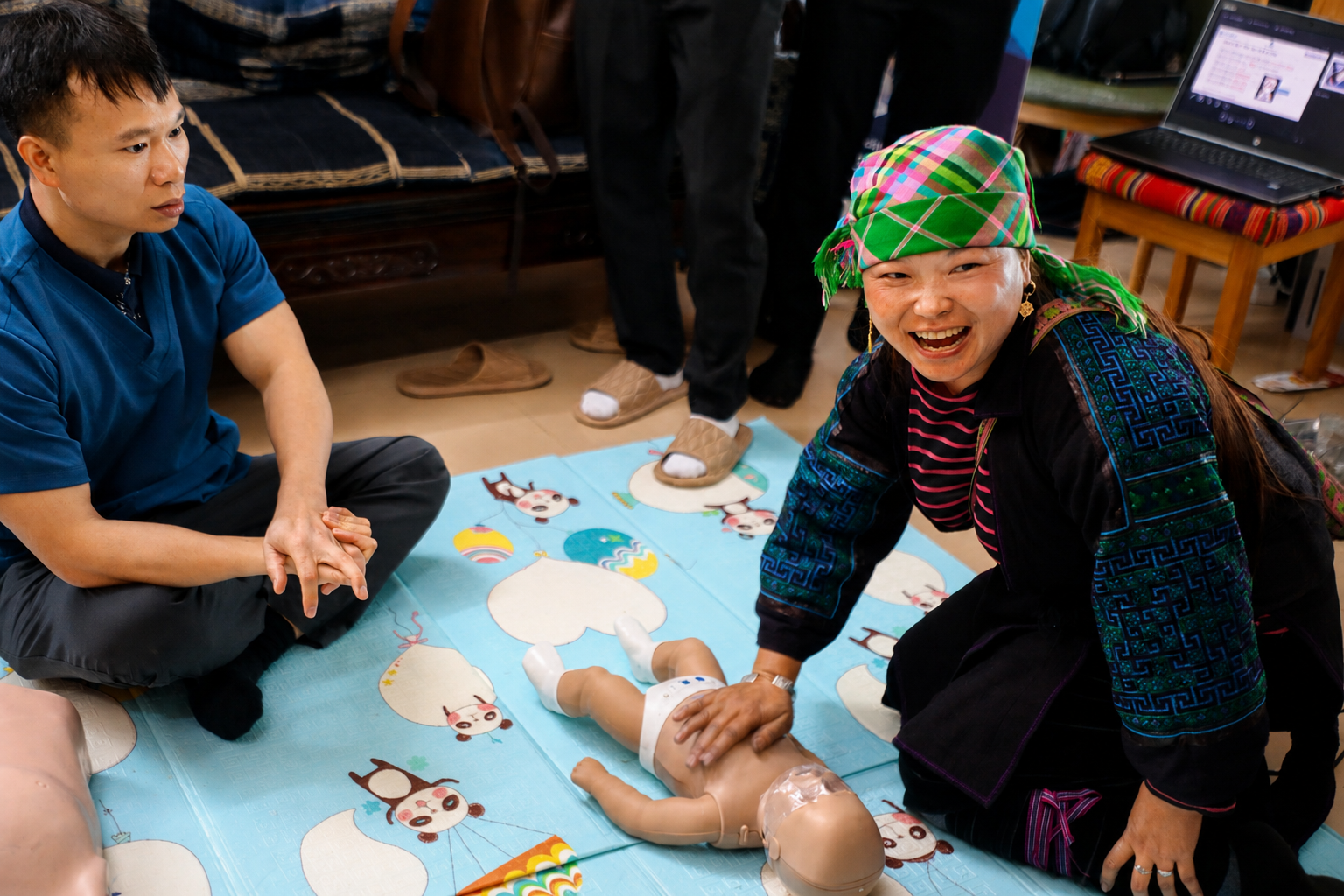
Hmong guide undertaking first aid training in the ETHOS Community centre, Sapa.
Training Beyond Certification
Safety training is often misunderstood within tourism. Many people imagine that once a certificate is awarded, the process is complete. In reality, meaningful safety culture develops through continual repetition, discussion, reflection, and practical experience over time.
At ETHOS, training extends far beyond simply completing courses. Our guides participate in ongoing learning focused on first aid, risk assessment, food hygiene, communication, guest welfare, weather interpretation, emergency escalation, and route management. Much of this training is scenario-based, designed around realistic situations guides may genuinely encounter in the mountains.
Guides work through situations such as responding to guest exhaustion during extreme heat, navigating rapidly changing weather conditions, managing swollen rivers after heavy rain, dealing with slips and falls on steep terrain, recognising dehydration symptoms, adapting routes due to landslide risk, or supporting nervous or overwhelmed guests during difficult sections of trail.
Particular emphasis is placed on communication and decision-making. Calm leadership can often prevent small problems from escalating into larger ones. Guides practise how to explain route changes clearly, reassure anxious travellers, maintain group confidence, and communicate effectively even when language barriers exist. They also understand that decision-making does not happen in isolation. The office team remains constantly available to support guides during treks whenever conditions become uncertain or additional assistance is required.
Watching guides who once lacked confidence in structured learning environments now confidently discussing emergency procedures, food safety standards, or route management systems has been incredibly rewarding. What makes this especially meaningful is the enthusiasm the guides themselves bring to the process. There is a genuine eagerness to learn, improve, and develop professionally. Training sessions are filled with discussion, curiosity, humour, and shared problem-solving. Guides actively contribute their own experiences, challenge ideas, and help shape how systems evolve over time.
A Strong Record Built Through Consistency
Perhaps the clearest reflection of all this work is seen not in paperwork or certificates, but in the experiences of the guests themselves. Over many years of operating treks throughout the mountains surrounding Sapa, ETHOS has built an exceptionally strong track record for both guest safety and guest satisfaction, something achieved not through luck, but through consistency, preparation, communication, and the professionalism of the guides leading every trek.
Safe and rewarding trekking experiences are created long before guests ever step onto a trail. They are created through route planning, weather assessment, guide communication, group management, local decision-making, and the quiet confidence that comes from deep familiarity with the landscape itself. They are strengthened further by the willingness of guides to slow down, adapt plans, change routes, or seek support whenever conditions demand it.
Many of the trails used by ETHOS guides are not formally marked or documented on tourist maps. They exist instead within a living network of local knowledge passed between families, villages, and generations. Combined with structured training, international safety frameworks, and strong communication between guides and office staff, this allows treks to remain adventurous and authentic while still operating within clear safety protocols.
Guest feedback consistently highlights not only the warmth and knowledge of the guides, but also the calm and reassured feeling people experience while trekking with them. Visitors often arrive expecting beautiful scenery, yet leave speaking just as much about the professionalism, awareness, adaptability, and quiet competence of the people who guided them through it.
Knowledge That Cannot Be Taught in a Classroom
What makes this work truly powerful is the depth of knowledge that already exists within the communities themselves. Long before formal systems were introduced, these guides were navigating complex environments with a level of awareness that cannot easily be replicated through conventional education.
A guide may pause beside a patch of vegetation and identify edible plants that have sustained families for generations, knowing precisely when they are safe to harvest and how they should be prepared. Another may point out leaves used to treat cuts, reduce swelling, or soothe insect bites, drawing on knowledge that has been refined through lived experience rather than written instruction.
Weather is read not through forecasts, but through subtle changes in the air, the movement of clouds across ridgelines, and the behaviour of animals and insects. The onset of heavy rain, the likelihood of a storm, or the instability of a slope can often be anticipated hours in advance through these observations.
Perhaps most remarkable is their understanding of the trail network itself. Many of the routes used daily do not appear on any map. They exist instead as a living network, maintained through use, memory, and community knowledge. These paths connect villages, fields, forests, and water sources in ways that are both intricate and precise. To move through them without guidance would be disorientating. To walk them with someone who knows them is to experience a seamless continuity of movement through the landscape.
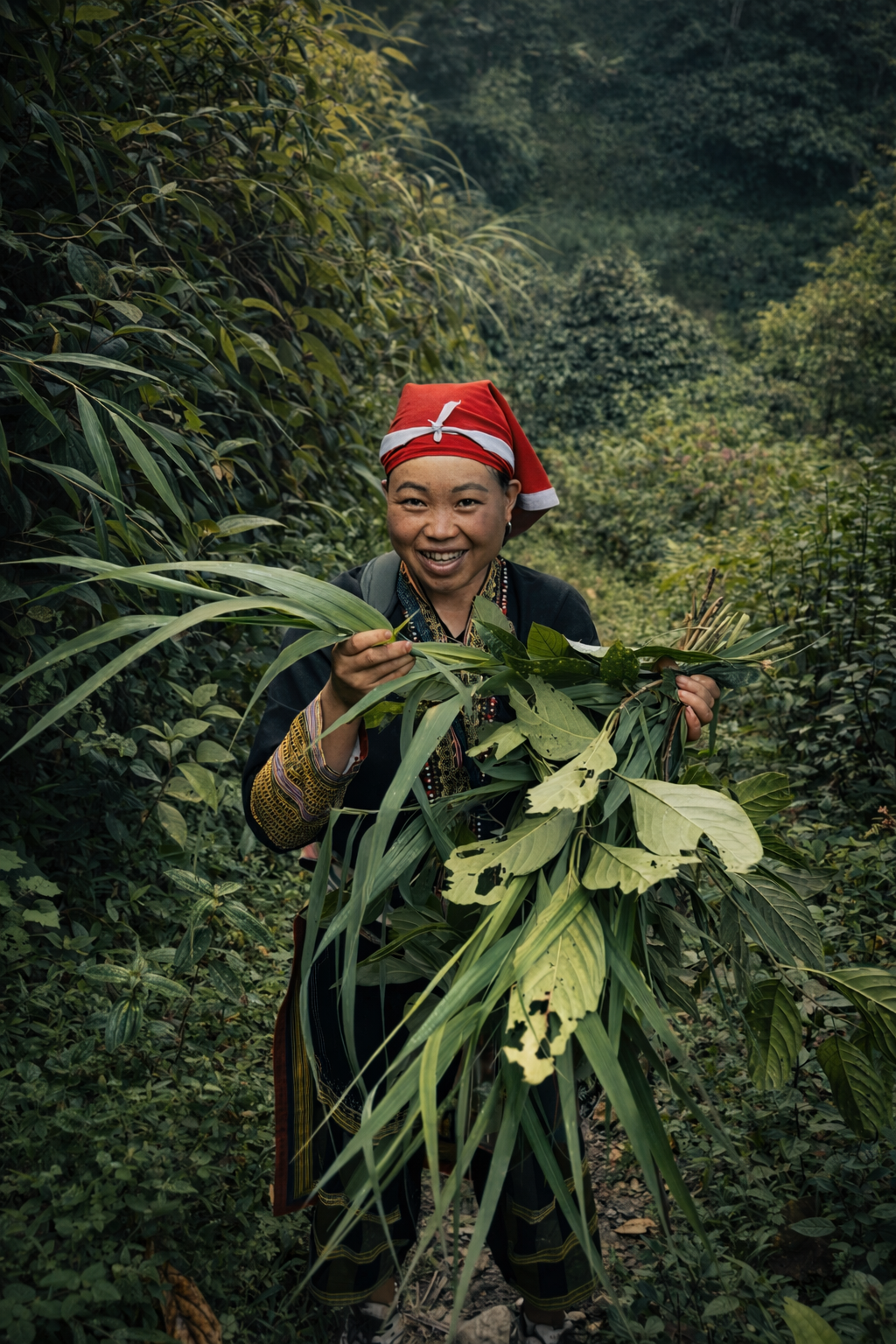
Dao guide demonstrating knowldge of traditional herbal medicines
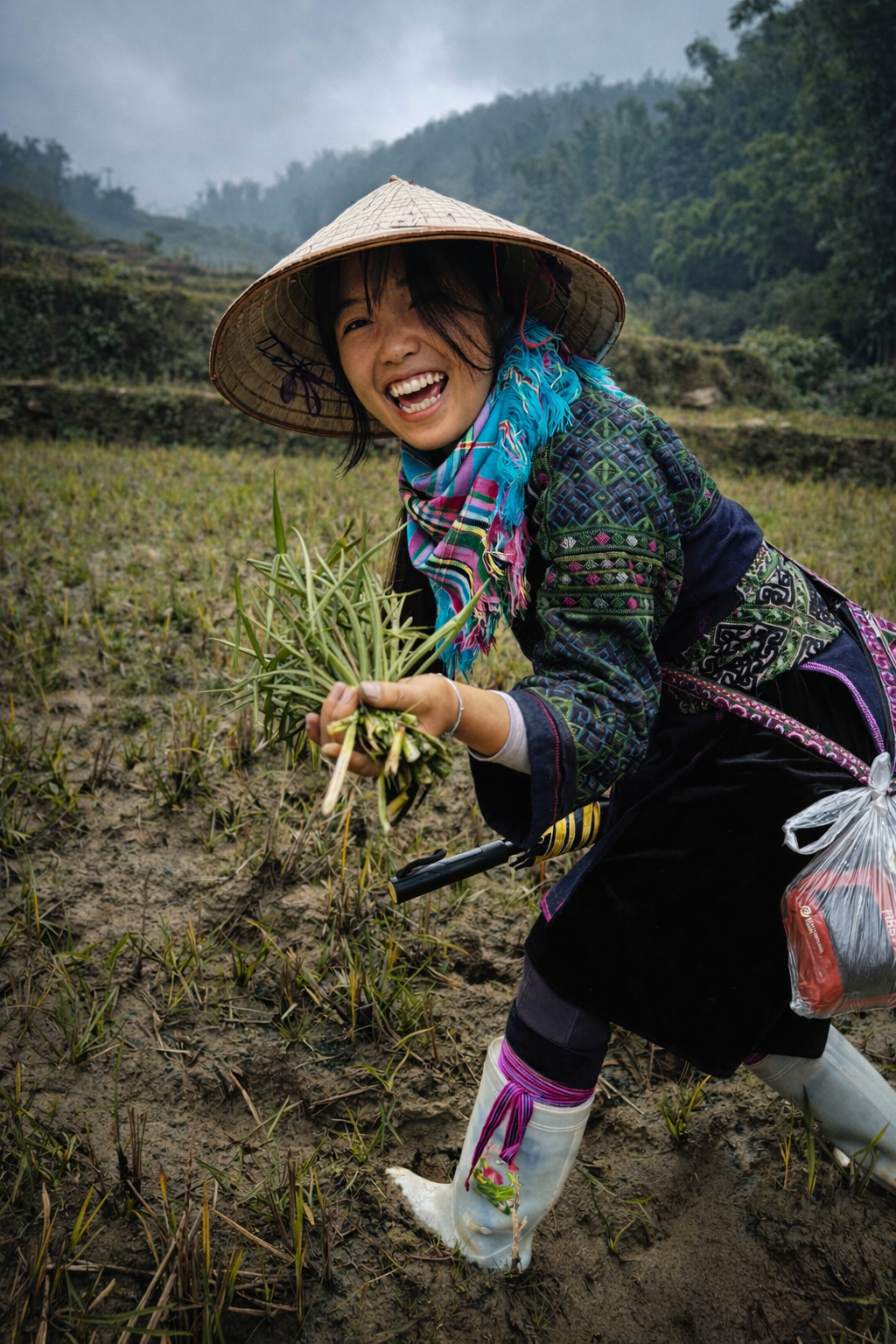
Hmong guide gathering wild foods
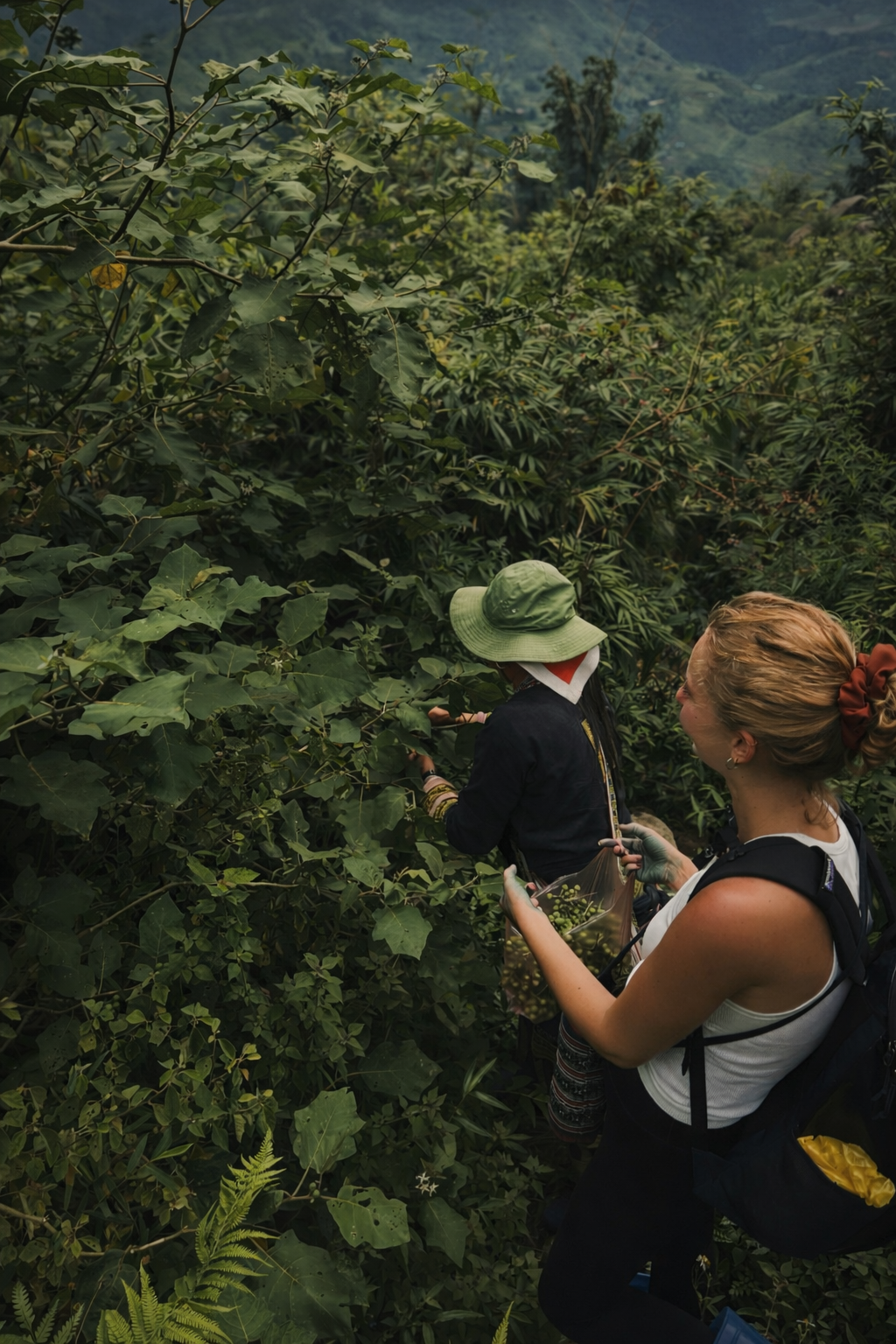
Dao guide showing travellers how to forage in Sapa
Respecting Expertise While Building Structure
The challenge has never been to replace this knowledge, but to support it. The systems that have been developed are designed to sit alongside existing expertise, providing structure where needed without disrupting what already works.
A guide who understands the early signs of fatigue in a guest now has a clear protocol for when to stop, how to respond, and how to communicate that decision. A guide who can read a river’s behaviour instinctively now operates within a shared framework that ensures consistency across the entire team.
This integration has taken time. It has required listening as much as teaching, adapting as much as instructing. The process has been collaborative at every stage, recognising that the most effective solutions are those that are co-created.
The Rise of Local Leadership
At ETHOS, training is not only delivered from the top down. Some of the most meaningful progress we have witnessed in recent years has come from seeing younger guides step forward into positions of responsibility, leadership, and mentorship within their own communities. Two of the strongest examples of this are ETHOS youth leaders Ly Thi Cha and Sung Thi Do, whose growing confidence and commitment have become an important part of our wider training culture.
Both Cha and Do began their journeys as young local guides learning how to communicate with international guests, navigate safely through the mountains, and represent their communities with confidence and pride. Over time, their roles have steadily expanded beyond guiding alone. They now actively assist with elements of guide development, practical safety discussions, communication exercises, and peer learning sessions within the ETHOS team.
This progression matters deeply because leadership cannot simply be imported from outside. Strong long-term safety culture only develops when local people themselves begin teaching, guiding, and supporting others around them. Watching younger Hmong women stand in front of their peers, share experiences from the trail, explain decision-making, and help newer guides build confidence represents a significant step forward not only for ETHOS, but for the wider future of community-led tourism in the region.
Their involvement also creates a far more relatable learning environment for newer guides, particularly those who may feel nervous about formal training or uncertain about their own abilities. When guides see women from neighbouring villages confidently discussing route choices, guest communication, changing weather conditions, or cultural interpretation, the training becomes less intimidating and more achievable. It transforms safety and leadership from something theoretical into something personal, practical, and attainable.
Both Cha and Do bring their own personalities and strengths into these sessions. Their knowledge of local trails, village customs, edible plants, seasonal farming rhythms, and mountain conditions is paired with an increasing confidence in communication, organisation, and leadership. This blend of inherited local knowledge and structured professional development sits at the very heart of what ETHOS is trying to build.
For us, this is about far more than ticking boxes or delivering certificates. It is about creating genuine pathways for growth, confidence, and opportunity within local communities themselves. Seeing young guides evolve into capable leaders, mentors, and role models for others is one of the clearest signs that the training systems we have worked so hard to build are beginning to create lasting change.
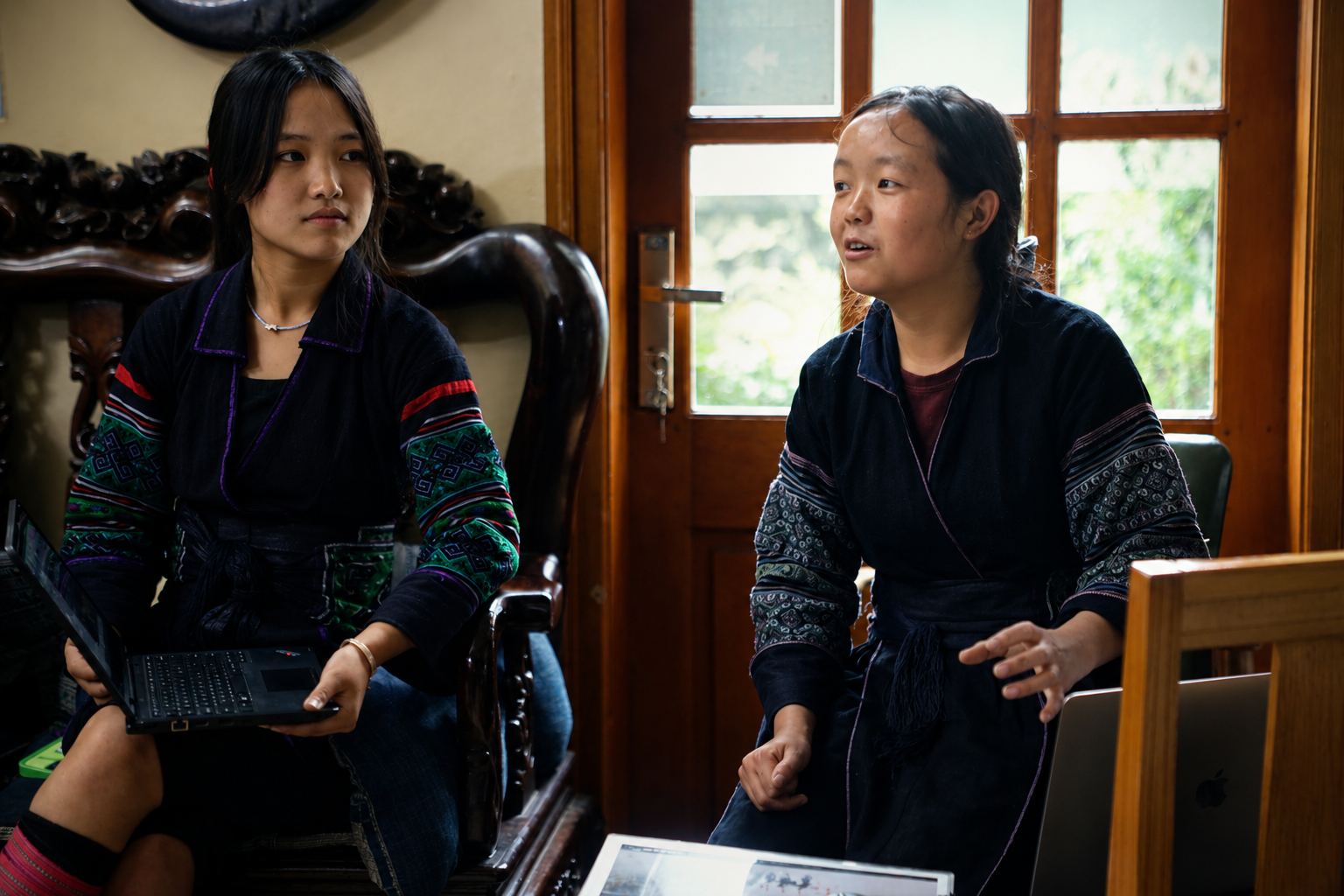
Ly Thi Cha and Sung Thi Do leading a training session on food preparation and cleanliness.
A System That Continues to Grow
This work is ongoing. Each trek, each season, and each new challenge provides an opportunity to learn and improve. Feedback loops ensure that experiences in the field are brought back into training, refining the system further.
The strength of this approach lies in its adaptability. It is not fixed, but responsive, capable of evolving as conditions change and as the team continues to grow in confidence and capability.
Adventure, Culture, and Responsibility
Adventure travel should never feel sanitised or artificial. People come to northern Vietnam searching for immersion, unpredictability, connection, and genuine cultural experience. The goal is not to remove adventure from trekking, but to support it responsibly through preparation, communication, local knowledge, and good decision-making.
The mountains themselves will always remain dynamic environments. Weather shifts quickly and trails change constantly. Rivers rise and slopes erode. Conditions evolve from one week to the next. What matters is not pretending risk can be eliminated entirely, but ensuring guides possess the confidence, judgement, and support systems necessary to respond appropriately when situations change.
What ETHOS has built is ultimately rooted in people. It is rooted in guides who know these mountains intimately because they have spent their lives within them. It is rooted in communities who continue farming and maintaining the landscapes travellers come to experience. It is rooted in younger generations stepping forward into leadership roles. I t is rooted in a willingness to learn continuously, adapt constantly, and combine local wisdom with evolving professional standards.
The work behind these systems has been extensive and at times extraordinarily challenging. Building practical safety frameworks across different languages, literacy levels, cultures, and educational backgrounds is no small task. Yet the results are increasingly visible every day in the confidence of the guides, the consistency of operations, the professionalism of communication, and the trust guests place in the people leading them through these mountains.
Ultimately, the strongest safety systems are not built through paperwork alone. They are built through relationships, shared learning, local leadership, humility, and a collective commitment to doing things better year after year.
Walking Forward Together
To walk these mountains today is to be supported by something far greater than a single guide. It is to be part of a network, a system, and a shared commitment to doing things properly. The rice terraces, the forest paths, and the hidden trails remain as they have always been, shaped by generations of care and effort. What has changed is the framework that supports those who guide others through them.
This is not simply about compliance with legislation but more about recognising the value of local knowledge, investing in its development, and ensuring that it can continue to thrive within a modern context. What has been built is something both practical and deeply human. It stands as a testament to what can be achieved when respect, hard work, and collaboration come together with a shared purpose.



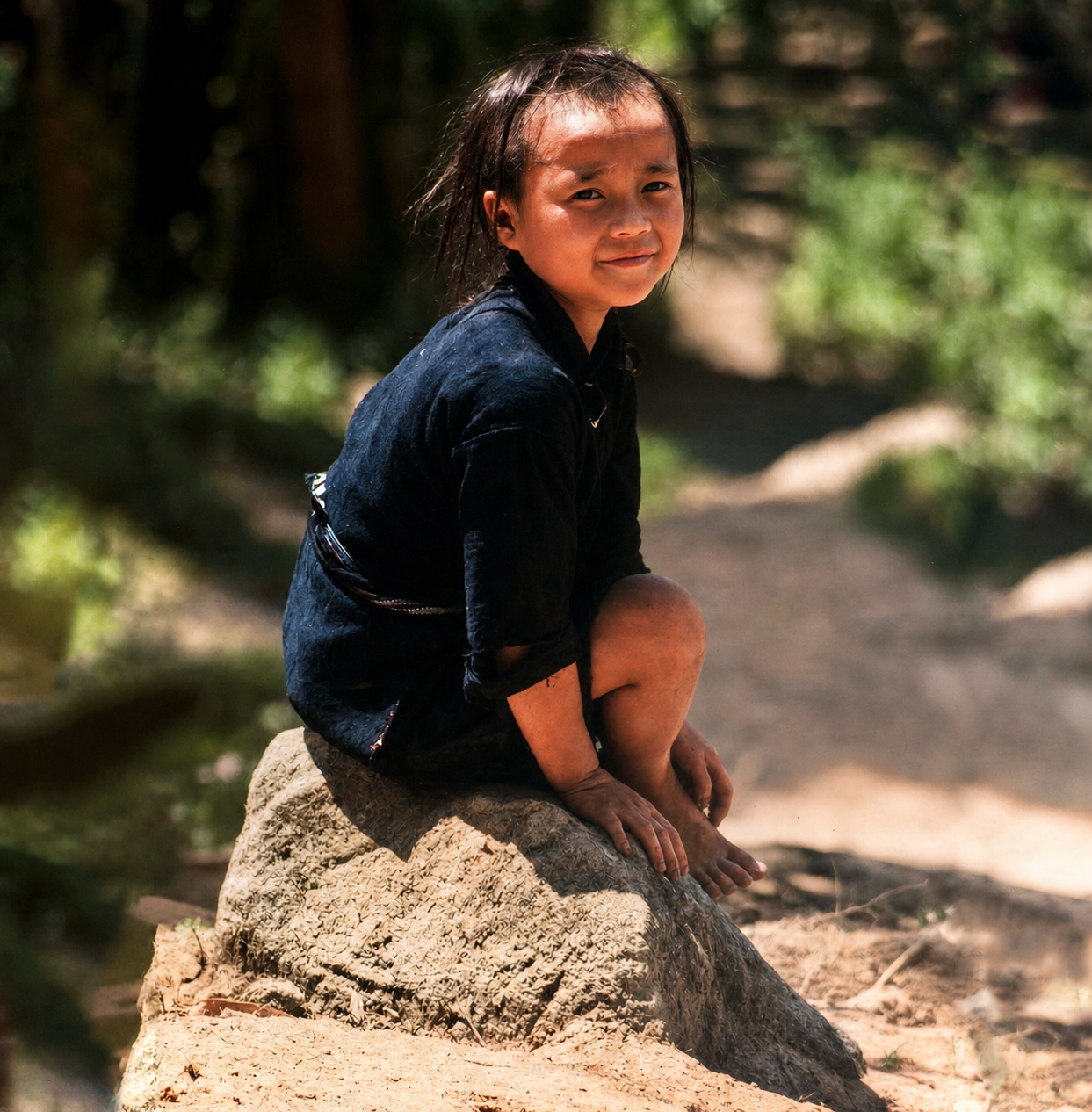
History of Sapa, Vietnam: Ethnic Traditions, French Legacy & Modern Tourism
Sapa’s story is one of discovery and continuity. Long before colonial maps and modern tourism, Hmong and Dao communities shaped the Sapa mountains through farming, trade, and tradition. This deep-dive explores how Sapa evolved from a frontier trade network to a French hill station, and how today’s tourism boom is reshaping the balance between culture, visibility, and place.
The Beating Heart of the Highlands
High in the northern mountains of Sapa, the story of this landscape cannot be separated from the people who have shaped it over generations. Long before colonial maps or tourism routes defined the region, Giáy, Tay, Hmong and Dao communities cultivated the mountain slopes, built villages along ridgelines, and established systems of trade, agriculture, and craft that continue to define the cultural fabric of the highlands today. Their presence forms a continuous thread through every period of Sapa’s history, steady and enduring despite waves of external influence and transformation. The rhythm of daily life, from planting rice in terraced fields to gathering at weekly markets, has long shaped both the economy and identity of the region.
These communities were never peripheral to Sapa’s development, nor were they passive observers of change. They were and remain farmers, traders, textile makers, herbalists, and storytellers whose knowledge of land and climate has sustained life in a challenging mountain environment. Some are now entrepreneurs and even guides too.
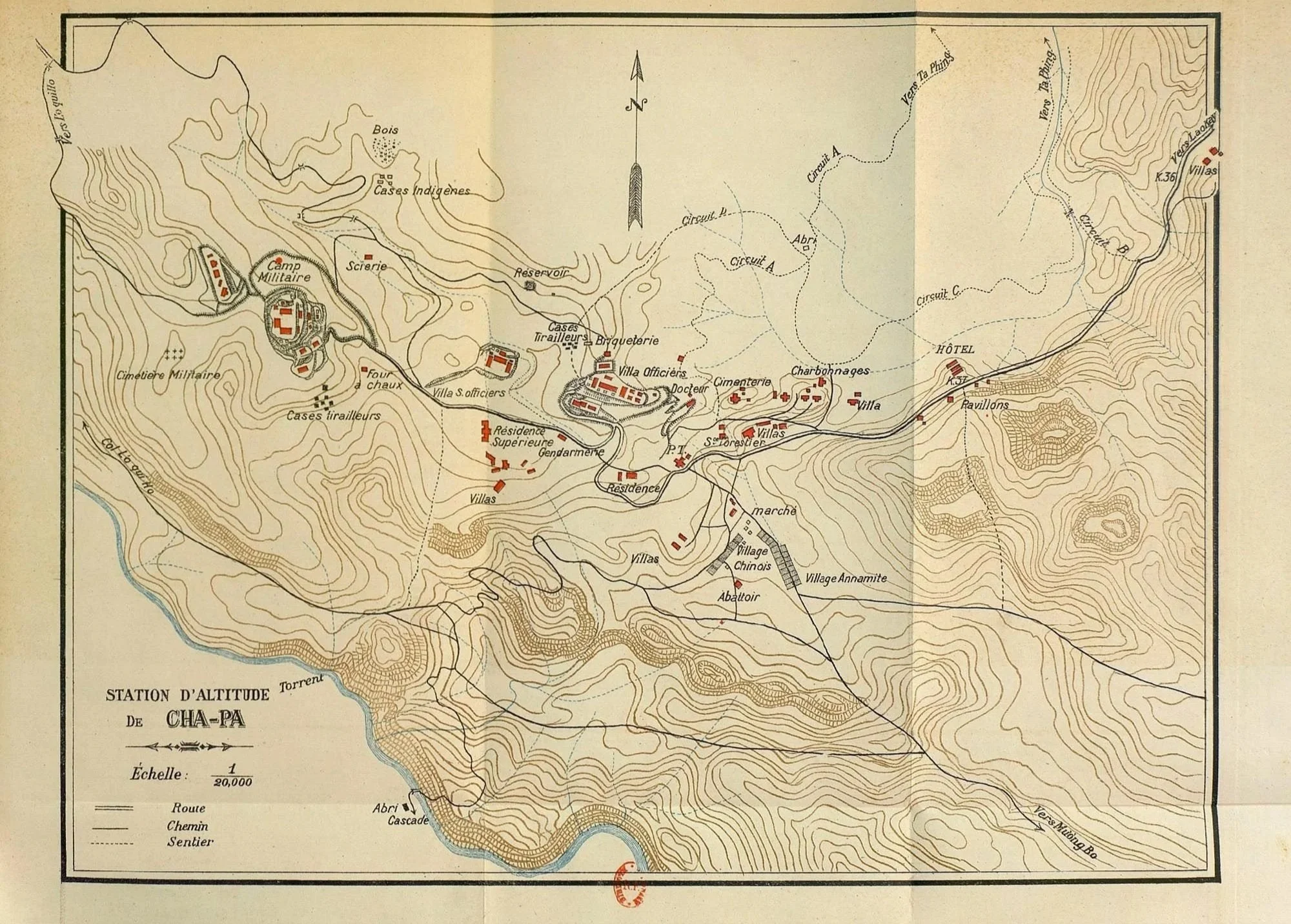
Old French map of Cha Pa.
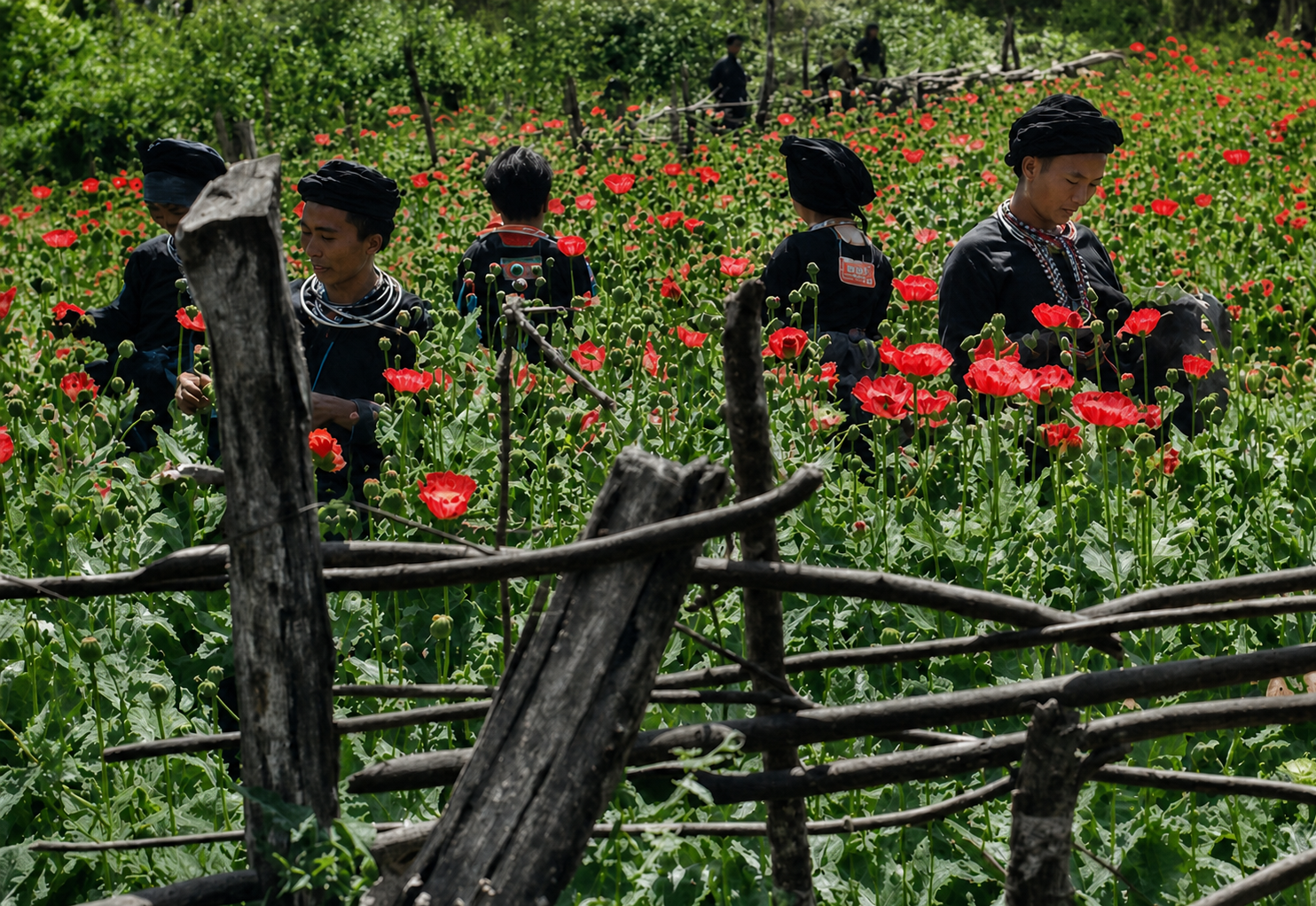
Recolorised photograph of ethnic minorities harvesting opium in Sapa.
Early Histories: A Layered Frontier, Not an Empty Landscape
Population history in Sapa is layered and complex, with different groups arriving at different times and settling according to ecological conditions. Tai-speaking groups such as the Giáy and Tay tended to inhabit lower valleys suited to wet-rice cultivation, while Hmong and Dao communities, arriving later, established themselves in higher elevations, practising forms of agriculture adapted to steep terrain and forest environments. The precise timelines of arrival remain debated, yet the strongest evidence suggests that Dao presence in northern Tonkin dates back at least to the early eighteenth century, while larger waves of Hmong migration occurred in the nineteenth century, often linked to broader movements from southwest China.
What emerges clearly is not a single moment of settlement, but a cumulative process shaped by migration, adaptation, and exchange. Markets were central to this world, functioning not only as economic sites but as places of social interaction, courtship, and cultural display. Trade networks carried salt, metals, textiles, livestock, and forest products, while Chinese merchants often dominated longer-distance exchange, connecting upland producers to wider regional economies.
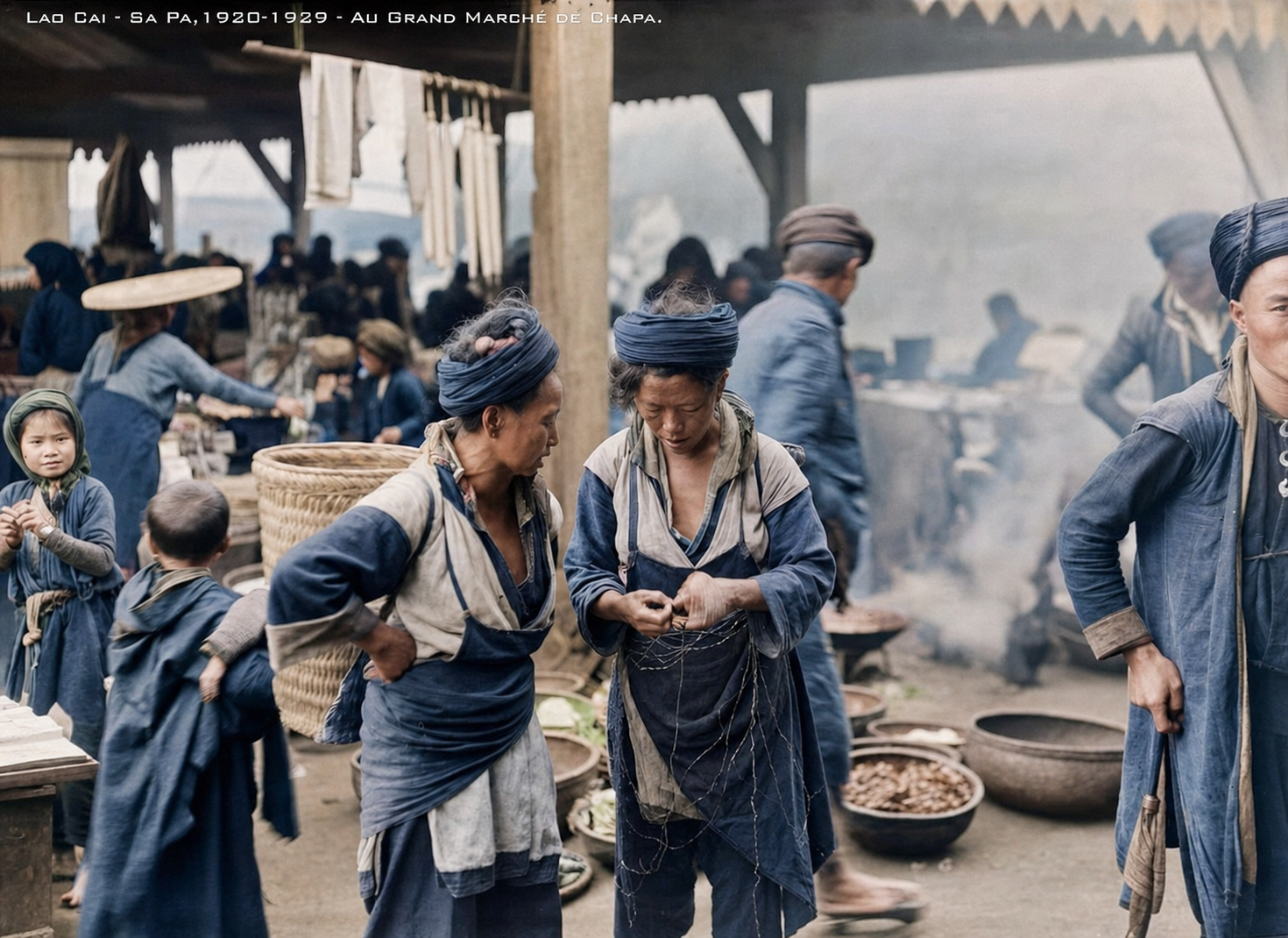
Recolorised photograph of Hmong people in Sapa market in the early 20th century.
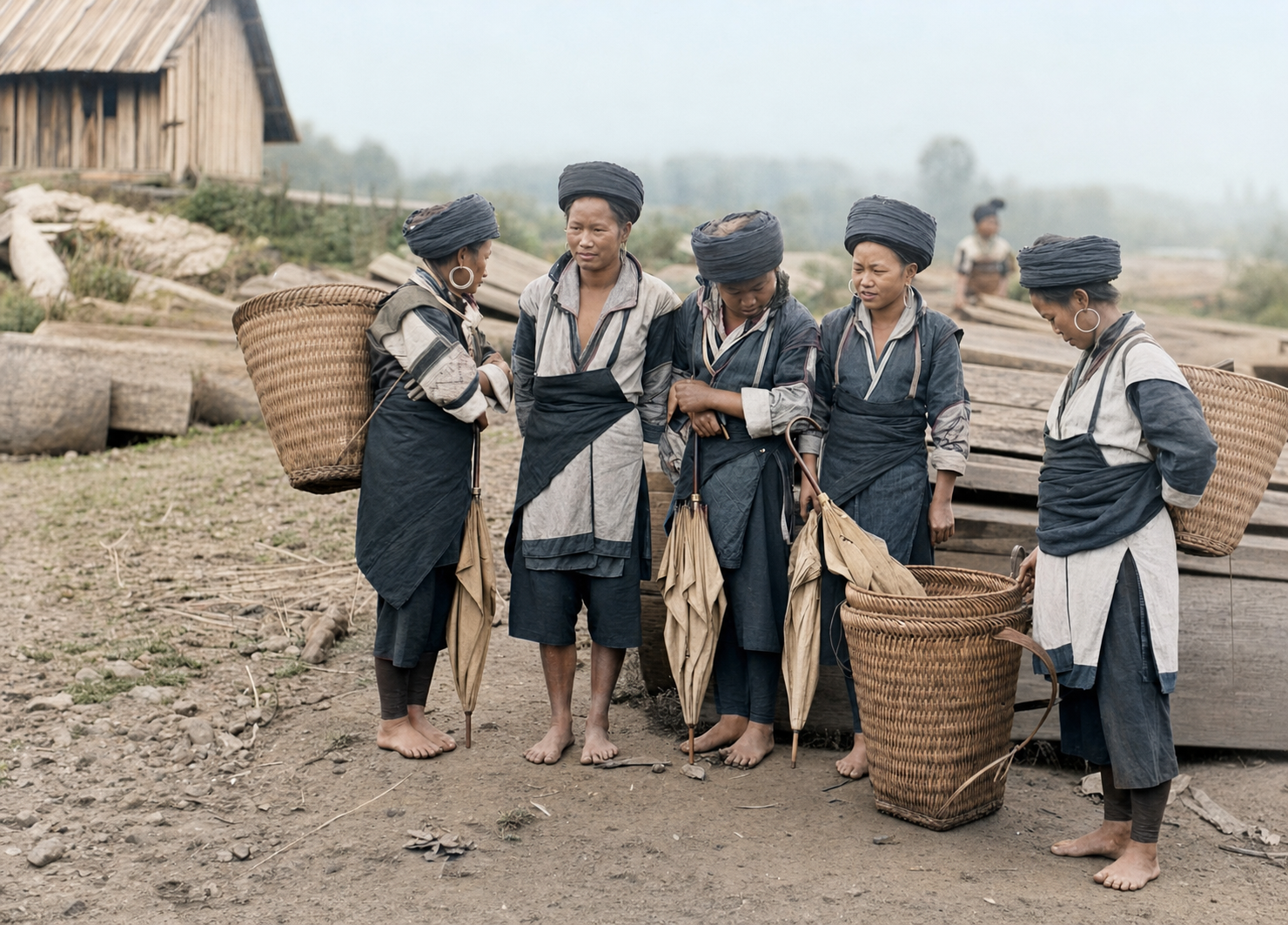
Recolorised photograph of Hmong women gathering on a Sapa street.
Colonial Mapping and the Creation of a Hill Station
French colonial interest in the region intensified towards the end of the nineteenth century, when scientific expeditions began surveying northern Vietnam’s upland populations. By 1898, French teams had reached Lào Cai, and by 1903 Sapa appeared on official maps for the first time. What had been a predominantly Black Hmong settlement became incorporated into a colonial framework that sought both strategic control and climatic advantage.
A military garrison was established in 1903, initially referred to as “Cha Pa”, a transliteration of the Hmong “Sa Pả”. Infrastructure soon followed, including roads and eventually the railway linking Hanoi to Lào Cai. The French transformed Sapa into a colonial hill station designed to serve the administrative, military, and climatic needs of European settlers, reshaping upland land use and local economies in the process. They were keen to promote its cool climate as a refuge from the lowland heat. By the early twentieth century, hotels, villas, and administrative buildings had been constructed, including the Hotel du Fansipan and other boarding houses along the main road. A sanatorium, opened in 1913, treated conditions such as malaria and respiratory illness, while the meteorological station established in 1915 connected Sapa to international scientific networks.
For many French officials and settlers living in Hanoi, the climate of the northern highlands became central to the appeal of Sapa. The cooler mountain air was framed as both restorative and medically beneficial in contrast to the heat, humidity, and disease associated with the lowlands. Colonial accounts increasingly portrayed Sapa as a refuge for exhausted administrators, soldiers, and wealthy residents of Indochina, reinforcing the development of sanatoriums, seasonal villas, and hotels throughout the early twentieth century.
By the 1920s and 1930s, Sapa had become one of the most prominent hill stations in French Indochina, attracting colonial elites seeking leisure and recuperation in the mountains. Yet this vision of Sapa as a place of escape existed alongside the realities of frontier administration and unequal labour structures, with Hmong and Dao communities continuing to supply much of the agricultural labour, trade, and local knowledge that sustained the colonial settlement itself.
By the early twentieth century, tourism infrastructure in Sapa was already beginning to emerge alongside the expanding colonial settlement. Most historical accounts identify the Cha Pa Hotel, also known as the Hotel de Chapa, opened around 1909 by Mr Meiville, as the town’s first civil hotel. The Hotel du Fansipan followed later, around 1924, as Sapa’s reputation as a mountain retreat continued to grow among French residents in Indochina. Larger hotels, including the Metropole in 1932 and the Hôtel du Centre in 1937, were constructed in the decades that followed, reflecting the steady expansion of colonial tourism in the highlands.
Despite these developments, the French civilian population remained small, never exceeding a few dozen individuals even at its peak. The majority of the population continued to be composed of Hmong, Dao, and other ethnic groups, whose labour and local knowledge underpinned both agricultural production and the functioning of the colonial settlement.
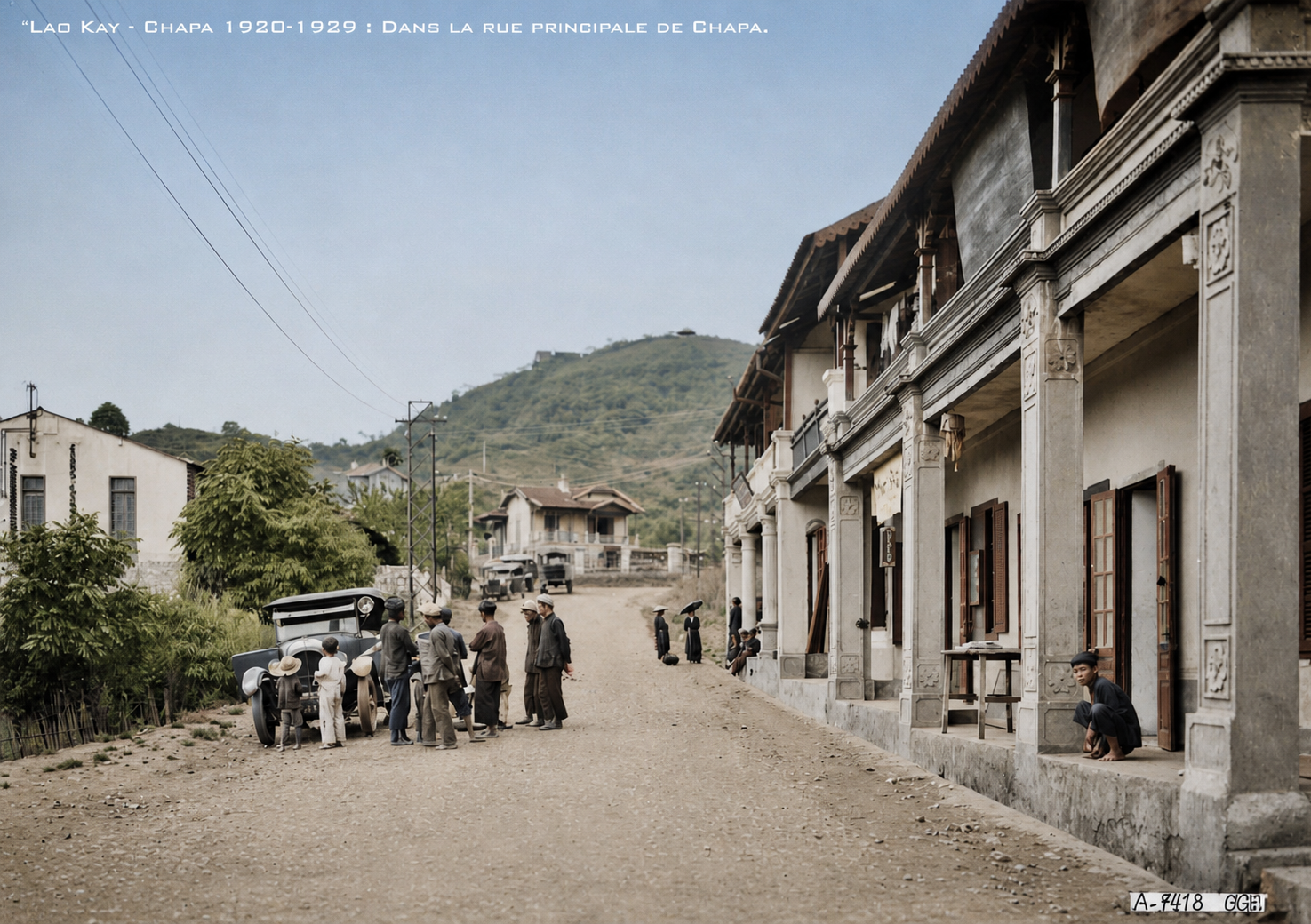
Recolorised photograph of Hotel du Fansipan on what is now Cau May Street.
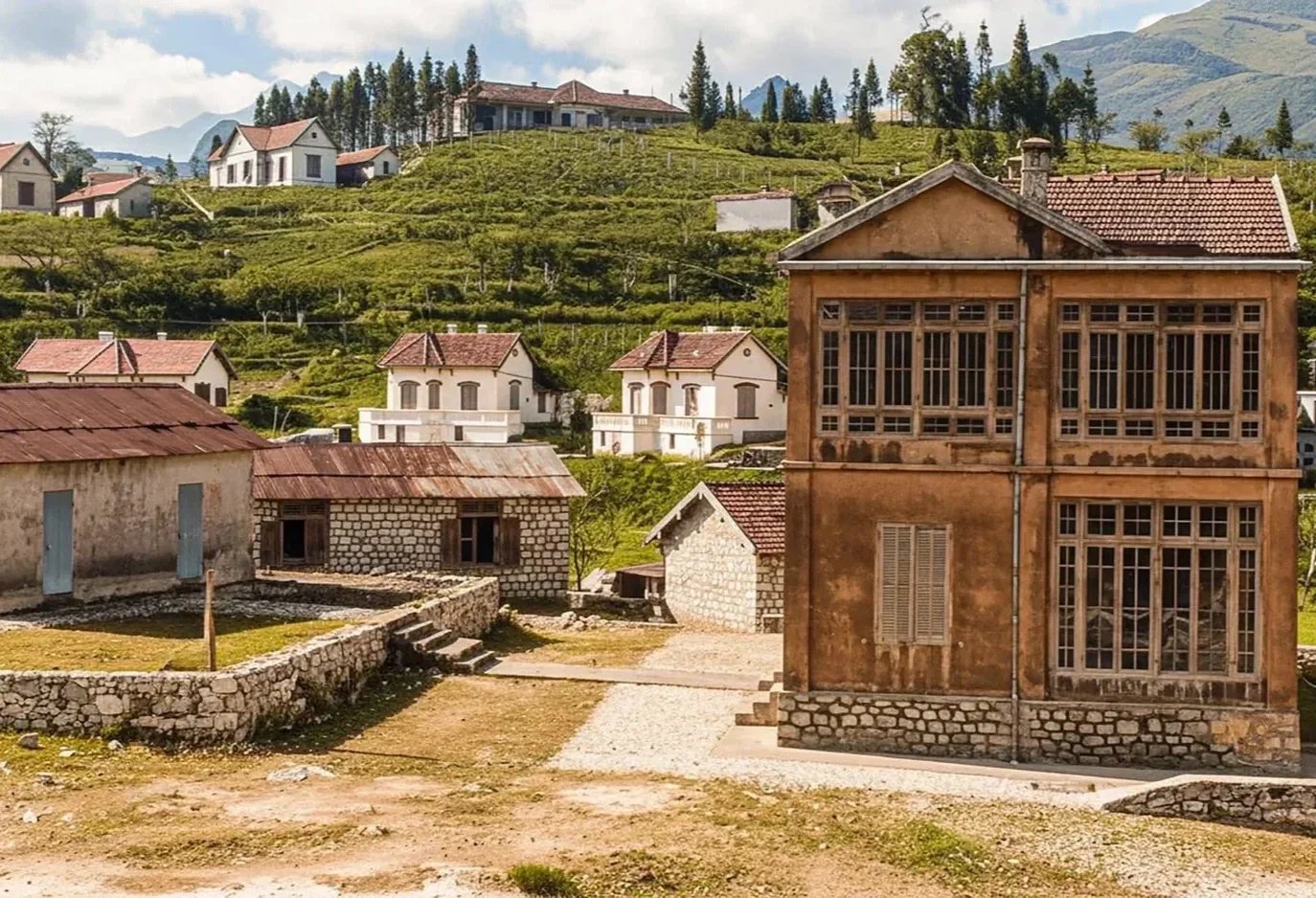
Recolourised photograph showing some of Sapa’s many colonial villas.
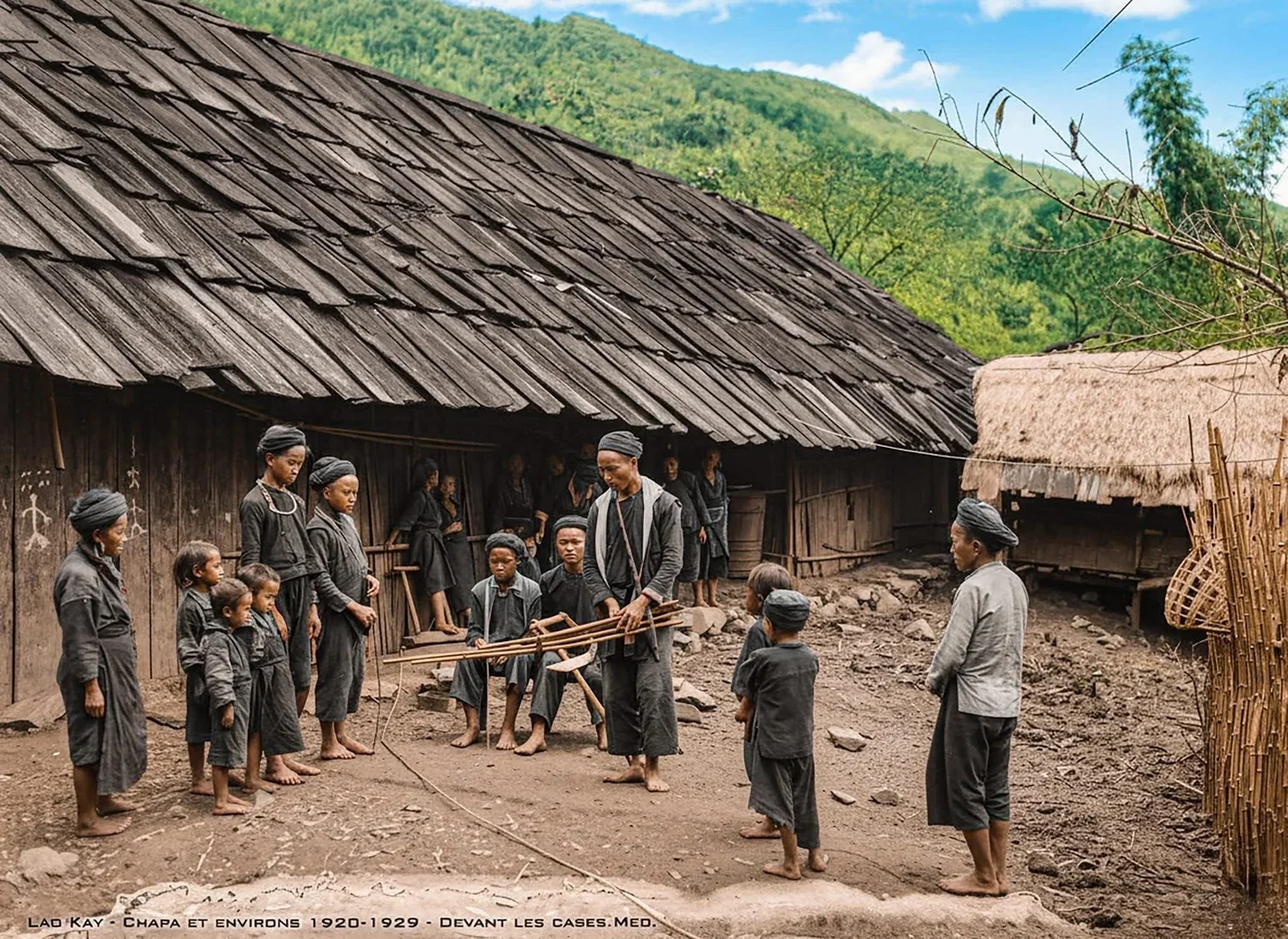
Recolourised photograph of a Hmong home in 1920’s Sapa.
Colonial Frontier and Hill-Station Formation
The arrival of the French in the late nineteenth century did not mark the “discovery” of an empty mountain wilderness, as older colonial narratives often implied. The highlands around Sapa were already part of a socially and economically connected frontier shaped by Hmong, Dao, Giáy, and other upland communities through trade, farming, migration, and market exchange. What French colonialism introduced was not civilisation to an isolated region, but a new system of military control, taxation, extraction, and territorial administration.
From the 1890s onwards, the French consolidated authority across the northern frontier following the establishment of colonial rule in Tonkin and the formal demarcation of the border with China. Military expeditions, ethnographic surveys, missionary activity, and infrastructure projects unfolded together, all serving a broader effort to make the uplands more legible and governable to the colonial state. Understanding local leadership structures, trade routes, agricultural systems, and ethnic classifications was not simply an academic exercise, but part of a strategy for extending control into regions that had historically operated with relative autonomy.
Missionaries from the Société des Missions Étrangères de Paris became some of the earliest outsiders to document local customs and communities, while military surveyors mapped trade corridors and settlement patterns across the frontier. These records helped integrate the highlands into systems of taxation and administration that increasingly tied upland economies to colonial interests.
The transformation of Sapa into a hill station was deeply connected to this wider project. The French sought a cool mountain retreat where colonial officials and military officers could escape the climate and disease of Hanoi, but Sapa’s location near the Chinese border also gave it strategic importance. Roads, military posts, and eventually the railway linking Hanoi and Lào Cai extended colonial reach further into the mountains, allowing authorities to monitor trade routes and strengthen their presence along the frontier.
This expansion was financially underwritten in large part by the opium economy of French Indochina. During the early twentieth century, the colonial administration relied heavily on revenue generated through the state-controlled opium monopoly, known as the Régie de l’Opium. In some periods, opium accounted for a substantial proportion of colonial income, helping finance infrastructure, military operations, and administrative expansion across Indochina. The villas, roads, railway links, sanatoriums, and administrative buildings that reshaped Sapa emerged within this broader narcotics-financed colonial system.
The relationship between the highlands and opium was also more direct. Hmong and Dao communities across northern Vietnam had long cultivated opium poppies for medicinal, ritual, and trade purposes before French rule. Under colonial administration, these existing practices became increasingly regulated and incorporated into monopoly structures designed to generate state revenue. Upland communities were therefore drawn more tightly into systems of taxation and economic extraction that primarily served colonial interests rather than local needs.
Land itself was reorganised during this period. One Hmong settlement bearing the name Sa Pa was displaced as the colonial town expanded around military barracks and a sanatorium. By the 1910s and 1920s, villas and administrative residences spread across the plateau, transforming the landscape into a seasonal enclave for colonial elites. Tourism developed quickly once transport links improved, and by the mid-1920s Sapa had hotels, a tourist bureau, and a growing reputation among French residents as a mountain retreat.
Yet this colonial version of Sapa remained highly unequal. F rench residents occupied the town seasonally, Kinh workers often filled permanent service and administrative roles, while Hmong and Dao communities largely remained in surrounding villages, participating in the colonial economy through labour, trade, taxation, and agricultural production without sharing equally in the wealth or power that flowed through the town itself.
Railways, Trade, and the Making of a Corridor
The transformation of Sapa cannot be separated from the wider transport networks that connected it to regional and global systems. The railway linking Hải Phòng, Hanoi, and Lào Cai, completed in stages between 1903 and 1910, was conceived as both a commercial and strategic corridor extending towards Yunnan in China. While the main station in Hanoi opened in 1902, the line toward the Chinese border at Lao Cai was constructed in segments beginning in 1903. The entire 296km line from Hanoi to Lao Cai was officially completed and put into operation in 1906. This railway transformed access to the highlands, reducing travel time significantly and enabling the movement of administrators, goods, and visitors into the region.
Before the railway, commodities such as opium, timber, and forest products moved slowly along the Red River by boat. Rail infrastructure compressed travel times and integrated the northern highlands more tightly into colonial trade networks and systems of extraction. The new line moved goods and reshaped the spatial logic of the frontier, turning Lào Cai into a gateway and positioning Sapa as its climatic and administrative counterpart. Trade intensified, particularly in commodities such as opium, timber, and forest products, while imported goods flowed into upland markets. The railway played a role similar to later infrastructure projects, reducing travel time and integrating the highlands more closely into external economies. Rather than replacing existing geographies, it reoriented them, making Sapa increasingly accessible while also embedding it within larger systems of control and exchange.
The expansion of colonial infrastructure was closely tied to the opium economy moving through the northern frontier. By the late nineteenth and early twentieth centuries, the wider Lào Cai region had become an important centre within the French colonial opium system, with highland communities across northern Vietnam cultivating opium poppies for local use, trade, and taxation. Colonial authorities increasingly sought to regulate and profit from this trade, treating opium as one of the most valuable sources of revenue in French Indochina.
The people of Sapa became commercial producers of opium made possible by the railway and Sapa’s position within a wider upland zone where poppy cultivation existed across parts of Lào Cai and neighbouring provinces. The town’s growing importance therefore cannot be separated from the broader frontier economy developing around it. Roads, military outposts, and transport corridors did not simply support tourism and administration; they also strengthened colonial oversight of highland economies increasingly tied to narcotics revenue and cross-border trade.
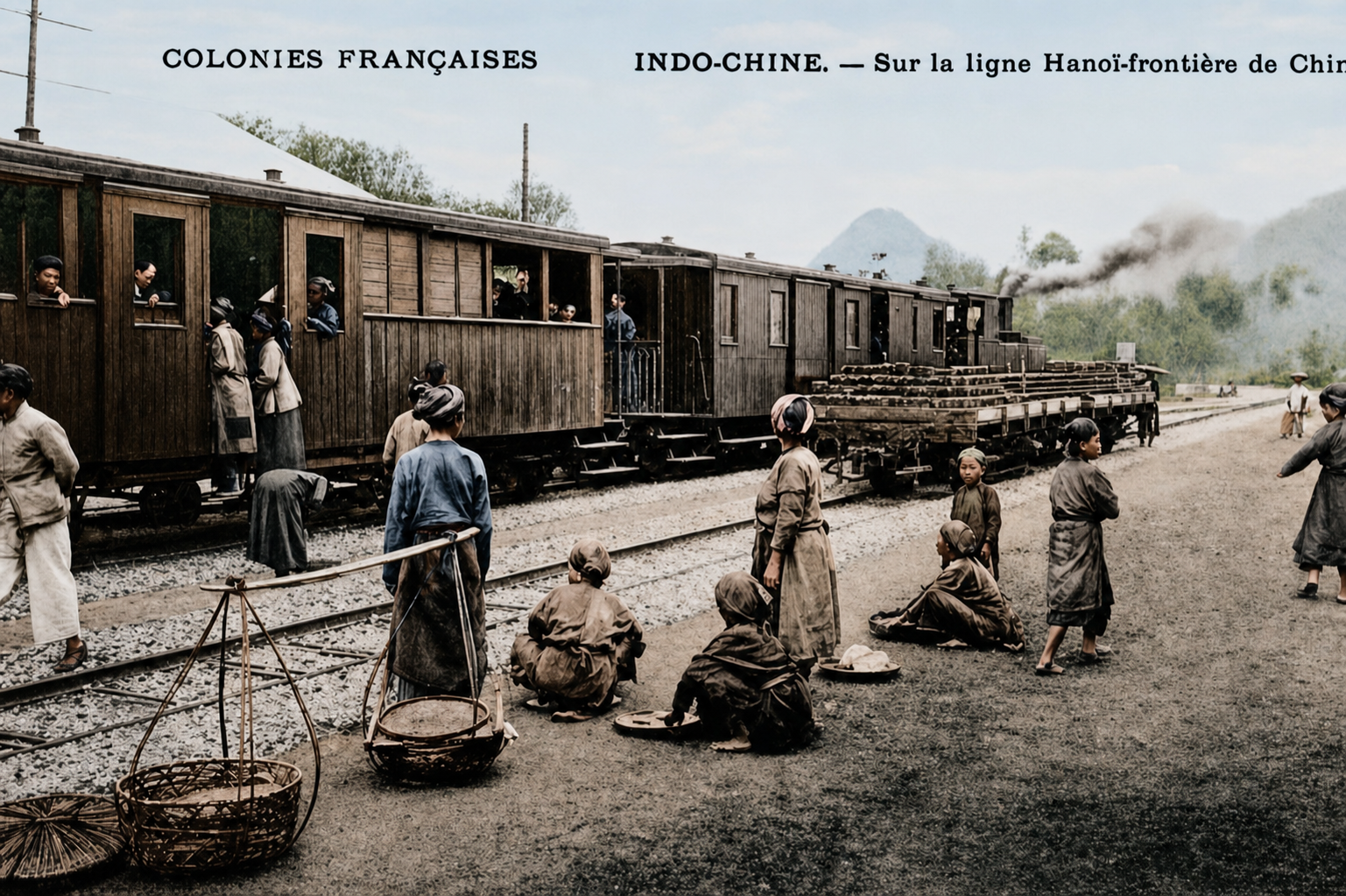
Recolourised photograph of a wooden train travelling the Hanoi to Lào Cai railway route during the French colonial period in northern Vietnam.
War, Disruption, and Abandonment
The mid-twentieth century brought significant disruption. During the conflict between French forces and the Viet Minh, Sapa suffered extensive damage, particularly between 1947 and 1952 when fighting led to the destruction of many colonial buildings, including villas, the governor’s residence, and the sanatorium. By the early 1950s, the town had been largely abandoned.
The collapse of French Indochina also brought the destruction of much of colonial Sapa itself. In 1952, as conflict intensified before the defeat of French forces at Điện Biên Phủ, French bombing campaigns damaged large parts of the hill station, including administrative buildings and private villas. Many residents fled, and the town entered a prolonged period of decline and abandonment.
The 1979 Border War and the Isolation of the Highlands
The Sino-Vietnamese War left a deep mark on the northern frontier, including the mountains surrounding Sapa and the wider Lào Cai Province region. Although the heaviest fighting took place closer to the border itself, particularly around the city of Lào Cai, the conflict reshaped life across the highlands for years afterwards through militarisation, economic disruption, and prolonged isolation.
When Chinese forces crossed into northern Vietnam in February 1979, the frontier became one of the most heavily contested regions in the country. Roads, railways, and transport links that had once connected the mountains to wider trade networks were damaged or cut off entirely, including the historic railway corridor linking Hanoi, Lào Cai, and Yunnan. The movement of goods and people slowed dramatically, while the border itself became increasingly securitised in the years that followed.
For communities in the mountains around Sapa, the impact was felt less through large-scale battles within the town itself and more through the atmosphere of uncertainty and hardship that settled across the region during the 1980s. Tourism had long disappeared, cross-border trade collapsed, and many villages returned once again to rhythms shaped primarily by subsistence farming and local exchange. Military presence became more visible throughout the frontier, while economic opportunities remained extremely limited in a period already marked by national hardship and postwar recovery.
The Secret War, Reunification, and the Isolation of the Northern Highlands
The wider region was also affected by geopolitical tensions beyond Vietnam’s borders. During the Vietnam War era, many Hmong, particularly in neighbouring Laos, were recruited into American-backed operations in what became known as the Secret War. Their roles included guiding air operations, gathering intelligence, and supporting military logistics, often at great personal cost. Following the end of the war in 1975, these associations led to suspicion and hardship, with many families facing displacement and long-term socio-political consequences.
In Sapa itself, the decades following reunification were marked by isolation and economic difficulty. Tourism disappeared, and local communities focused on subsistence and rebuilding, maintaining agricultural practices and cultural traditions largely outside the view of the wider world. For decades afterwards, tourism continued to suffer, and much of the colonial architecture that once defined Sapa fell into ruin beneath vegetation and time. The forests and mountains that travellers now experience as peaceful and expansive carried a different atmosphere during those years. Trails that today lead trekkers through rice terraces and bamboo groves once sat within a tense frontier landscape shaped by restricted movement, political suspicion, and the lingering fear of renewed conflict. Families throughout the highlands lived through decades in which the outside world felt very distant, with the mountains functioning less as a destination and more as a buffer zone along a fragile border.
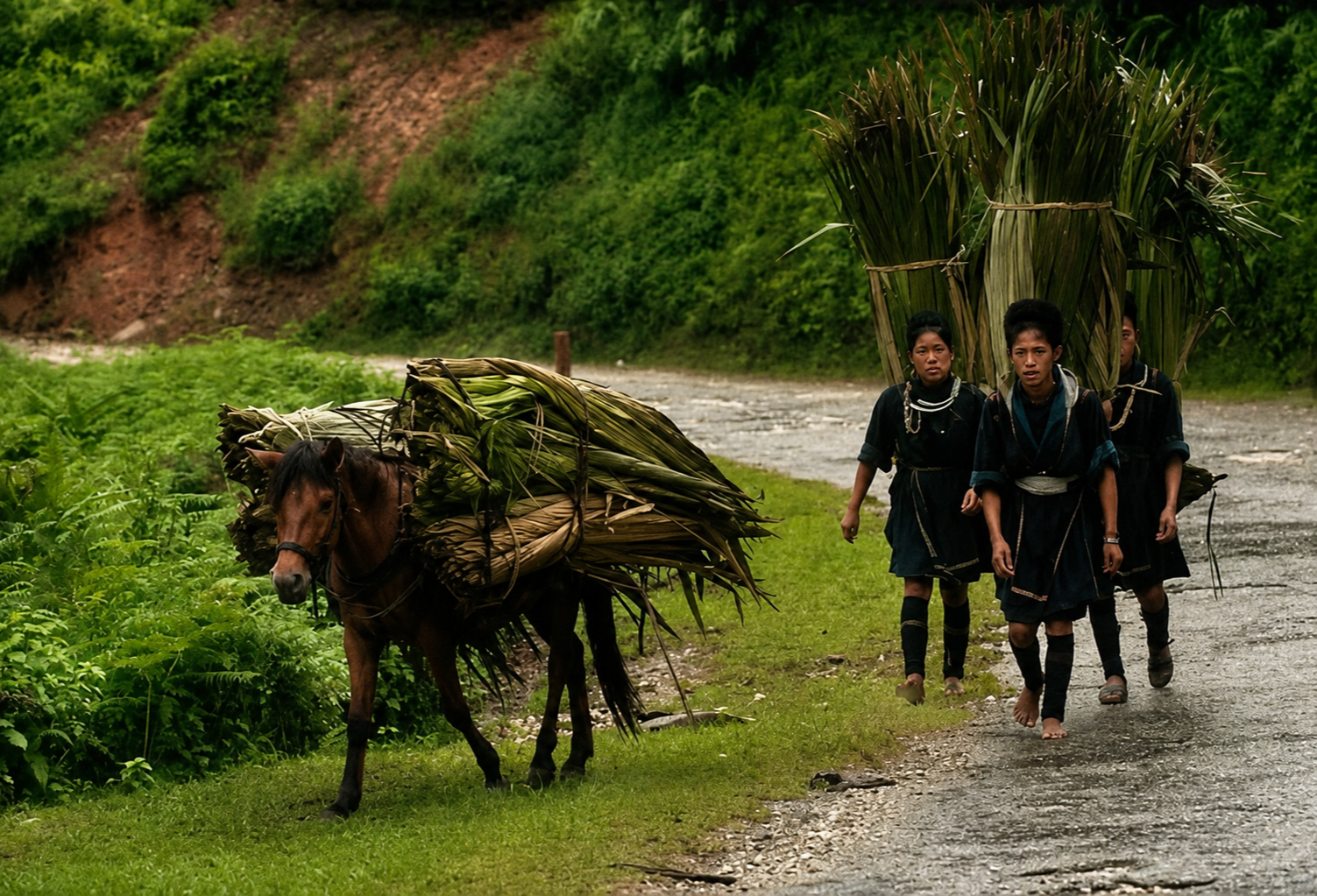
Hmong women gather foder during the post war abandoment period.
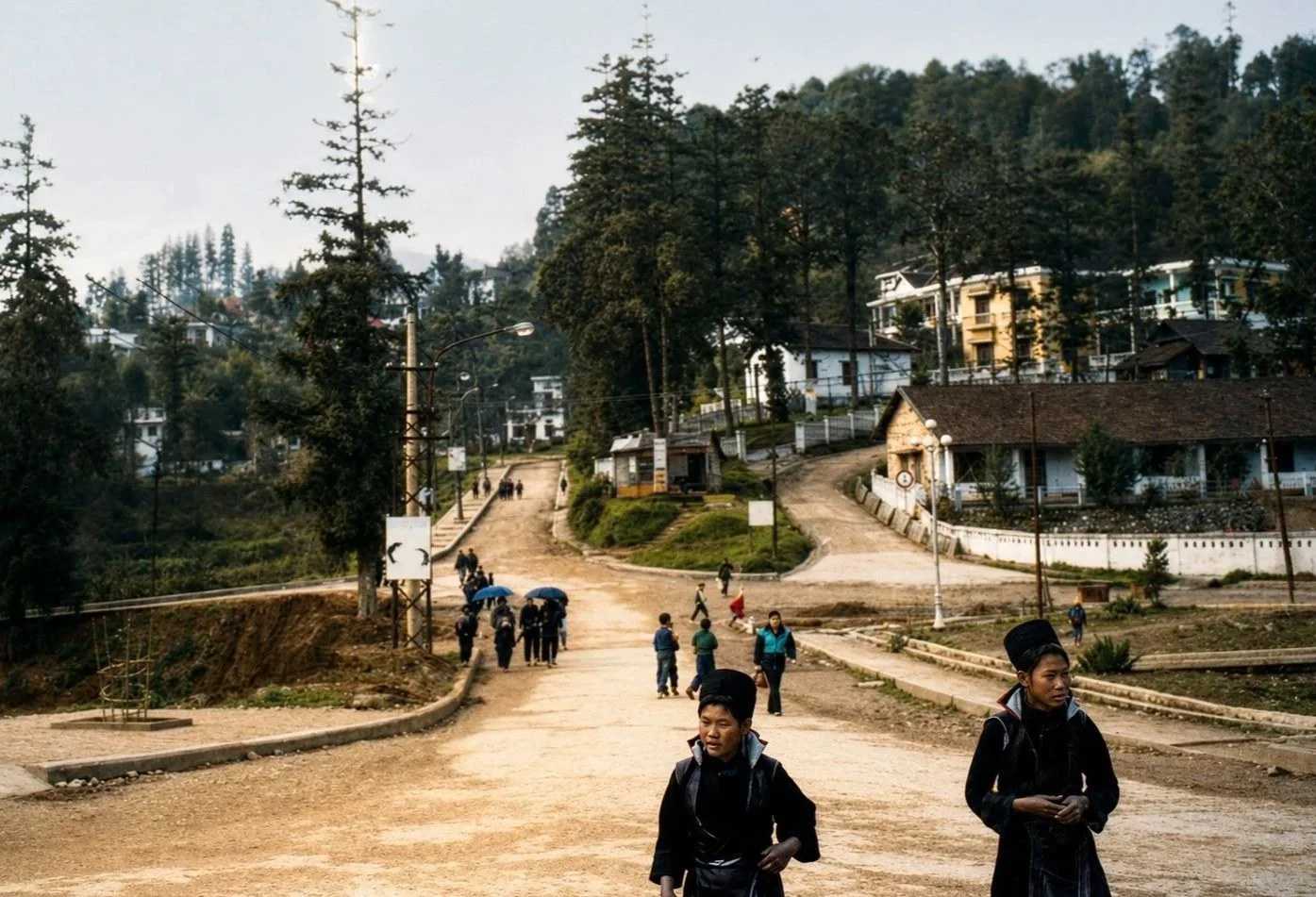
Image of Sapa town centre in the early 1990’s. Photo: Nguyen Tri Dung
Colonial Heritage and the Remains of French Sapa
The French colonial period in Sapa was tumultuous, unequal, and in many respects deeply forgettable for the communities who lived through its systems of extraction, displacement, and frontier control. Despite this difficult history, the physical remains of the colonial era still form an important part of Sapa’s architectural and historical landscape. These buildings are not simply relics of nostalgia, but material records of a period that reshaped the town and connected it to wider political and economic forces across Indochina.
Although much of colonial Sapa was destroyed during the conflicts of the mid-twentieth century, traces of the period remain scattered throughout the town and surrounding valleys. The most recognisable is the Sapa Stone Church, constructed between 1926 and 1935 at the foot of Hàm Rồng Mountain. Built in a Roman-Gothic style using locally quarried stone, the church remains one of the clearest surviving examples of French colonial architecture in the northern highlands and continues to function both as a parish church and a central landmark within the town.
Elsewhere in Sapa, fragments of the colonial hill station survive more quietly. The old meteorological station established by the French in 1915 still operates today, reflecting the colonial administration’s scientific interest in the climate and geography of the highlands. Nearby, the former district office from the colonial era now houses the Tourist Information Centre, while several surviving villas remain tucked behind the church and within the grounds of older hotel properties. Some of these villas, originally built for colonial officials and wealthy residents escaping the heat of Hanoi, still retain fireplaces, shuttered windows, verandas, and stone walls characteristic of French hill-station architecture. Others sit partially obscured beneath vegetation, their deterioration mirroring the collapse of the colonial world that created them. Around town, overgrown staircases, moss-covered walls, and isolated masonry structures occasionally emerge between newer hotels and cafés, reminders of a period that attempted to remake the mountains according to colonial ideals.
Beyond the town centre, the ruins of the Tả Phìn monastery stand as one of the most haunting remnants of this era. Constructed in 1942 for a community of Cistercian nuns, the abandoned stone structure now sits roofless and weathered among the hills, its empty arches and collapsing walls reflecting both the ambitions and fragility of colonial expansion in the highlands.
The Cát Cát Hydroelectric Plant, built in 1925 to power the colonial settlement, also survives as an important industrial relic from the French period. Originally constructed to support the growing hill station, the plant later became part of the town’s tourism landscape after ceasing operation in the 1990s.
These buildings remain historically significant not because they represent a golden age of Sapa, but because they reveal how profoundly the colonial period reshaped the town’s landscape, infrastructure, and identity. They stand alongside Hmong and Dao villages, markets, and agricultural terraces as part of the layered history of the highlands, reflecting both the endurance of local communities and the lasting imprint of colonial power on the mountains.
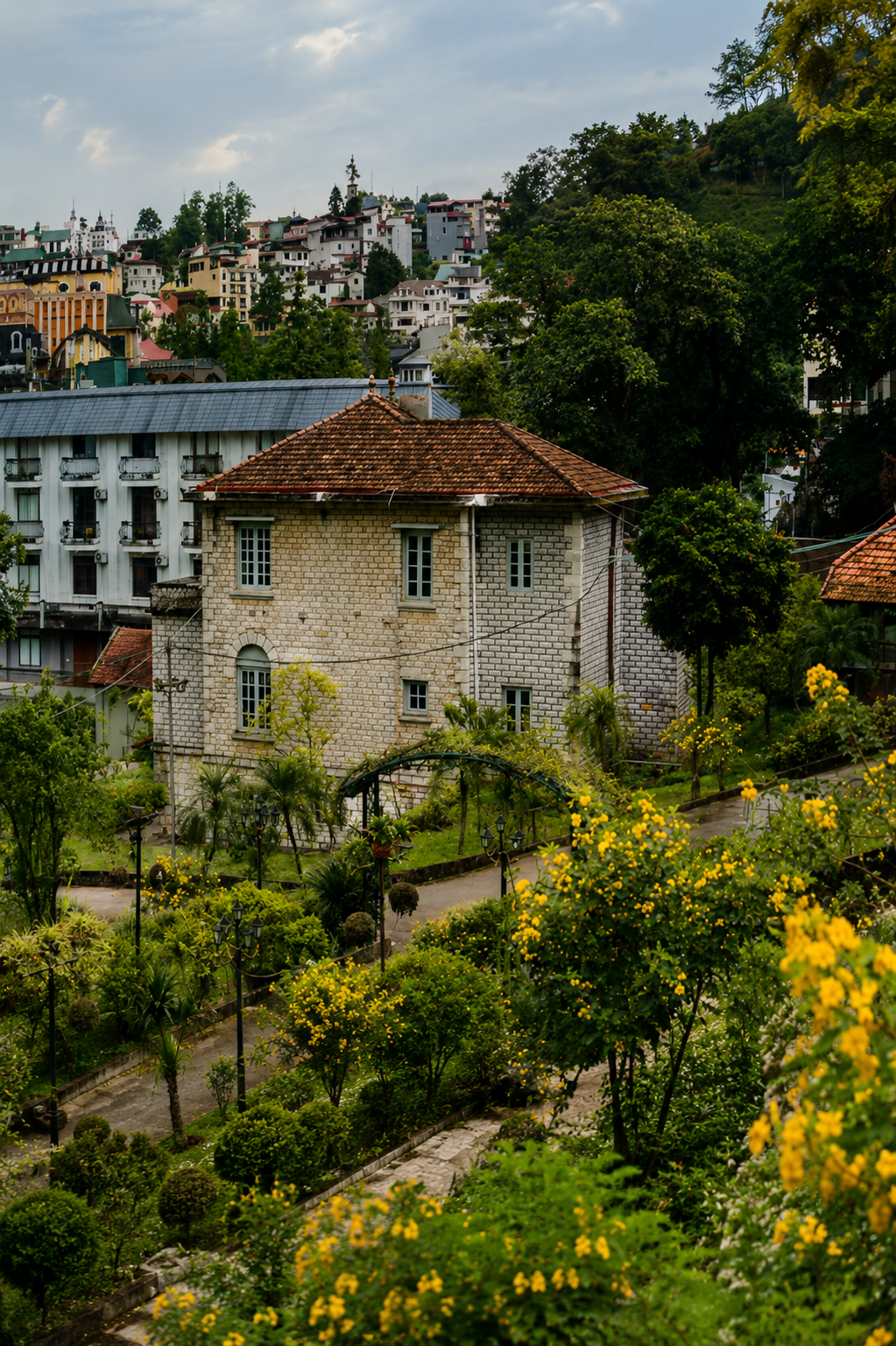
Photograph of a colonial villa in Sapa taken in 2026
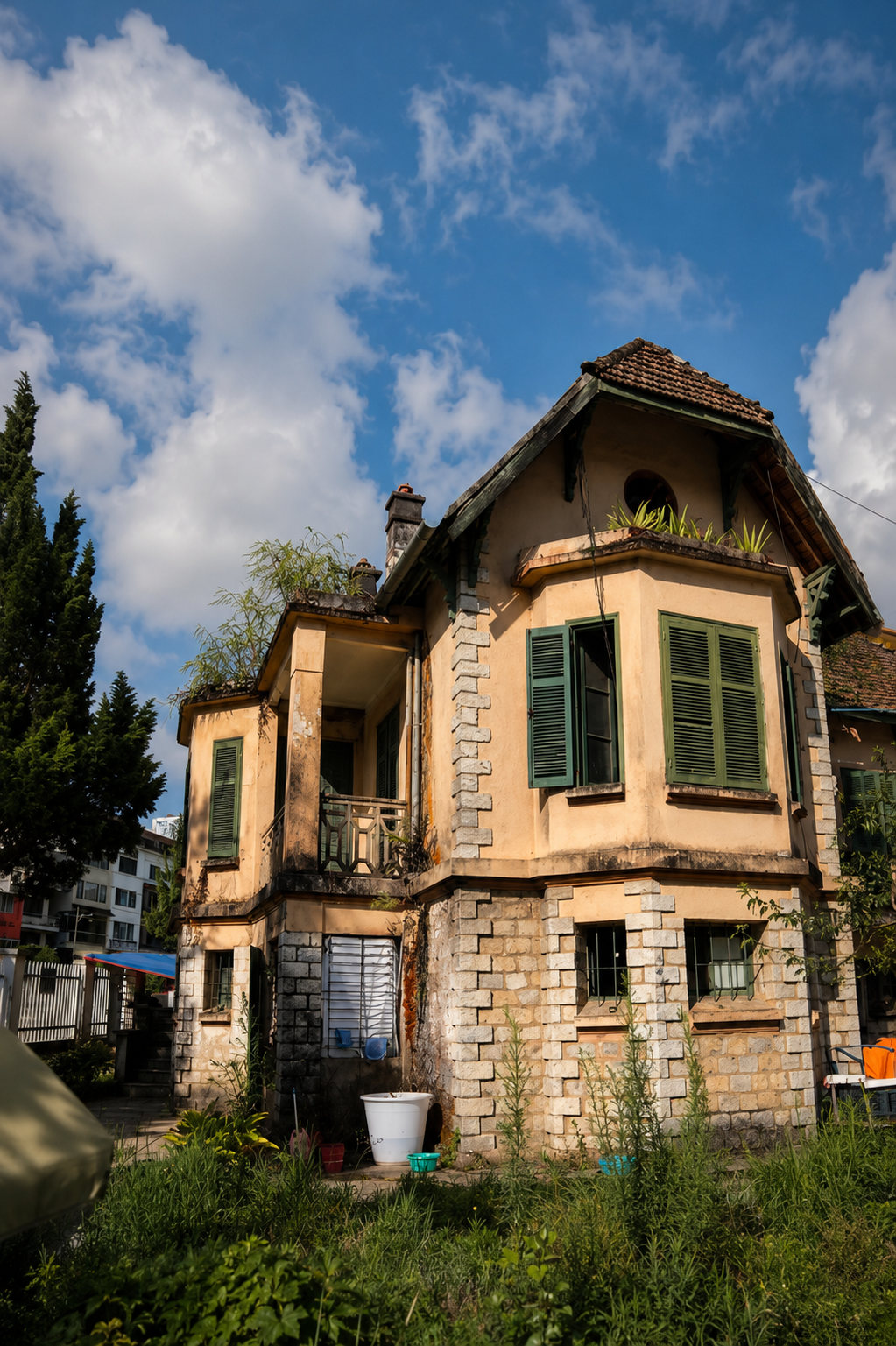
Photograph of a colonial villa in Sapa taken in 2026
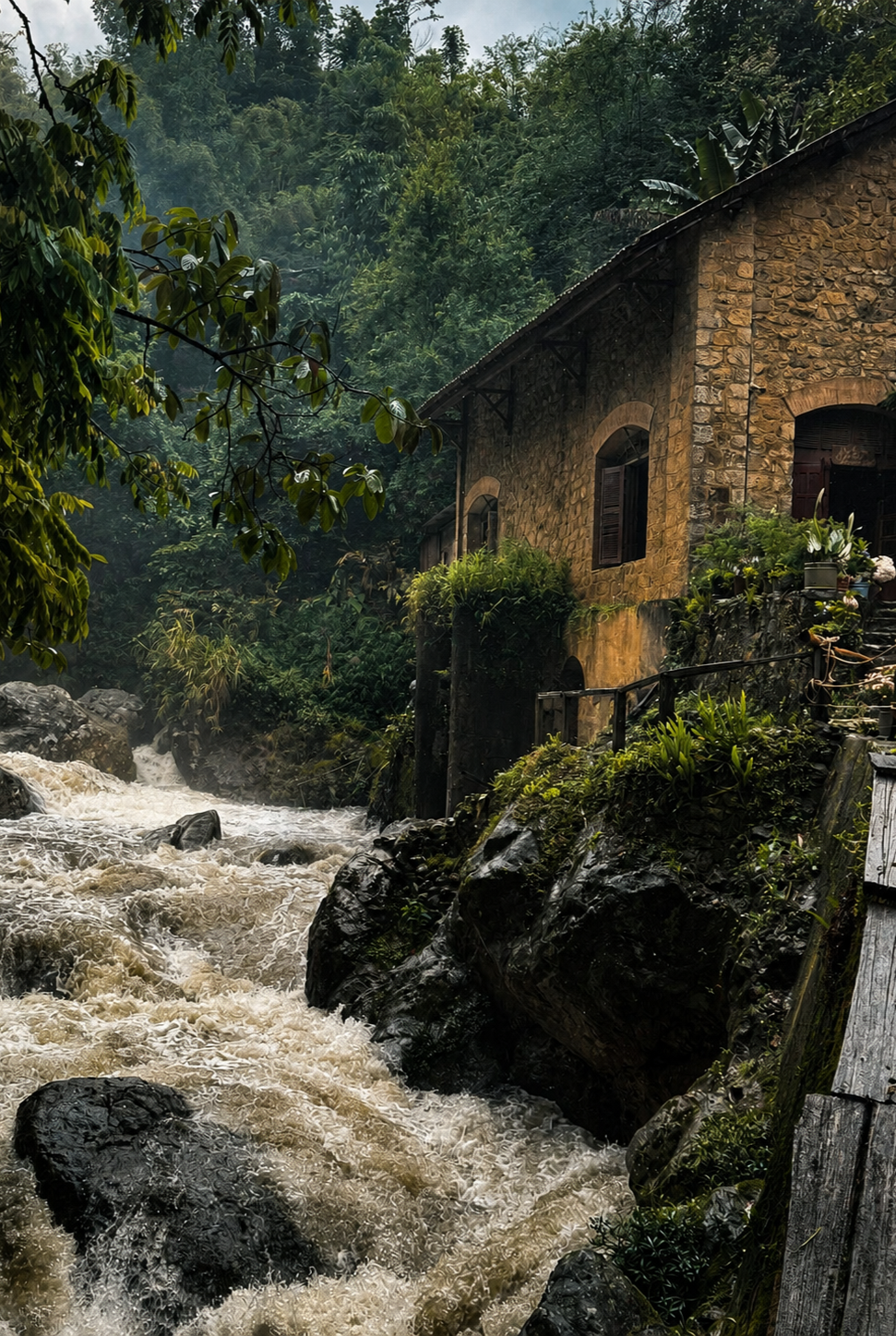
Photograph of a colonial hydroelectric station taken in Cat Cat in 2026
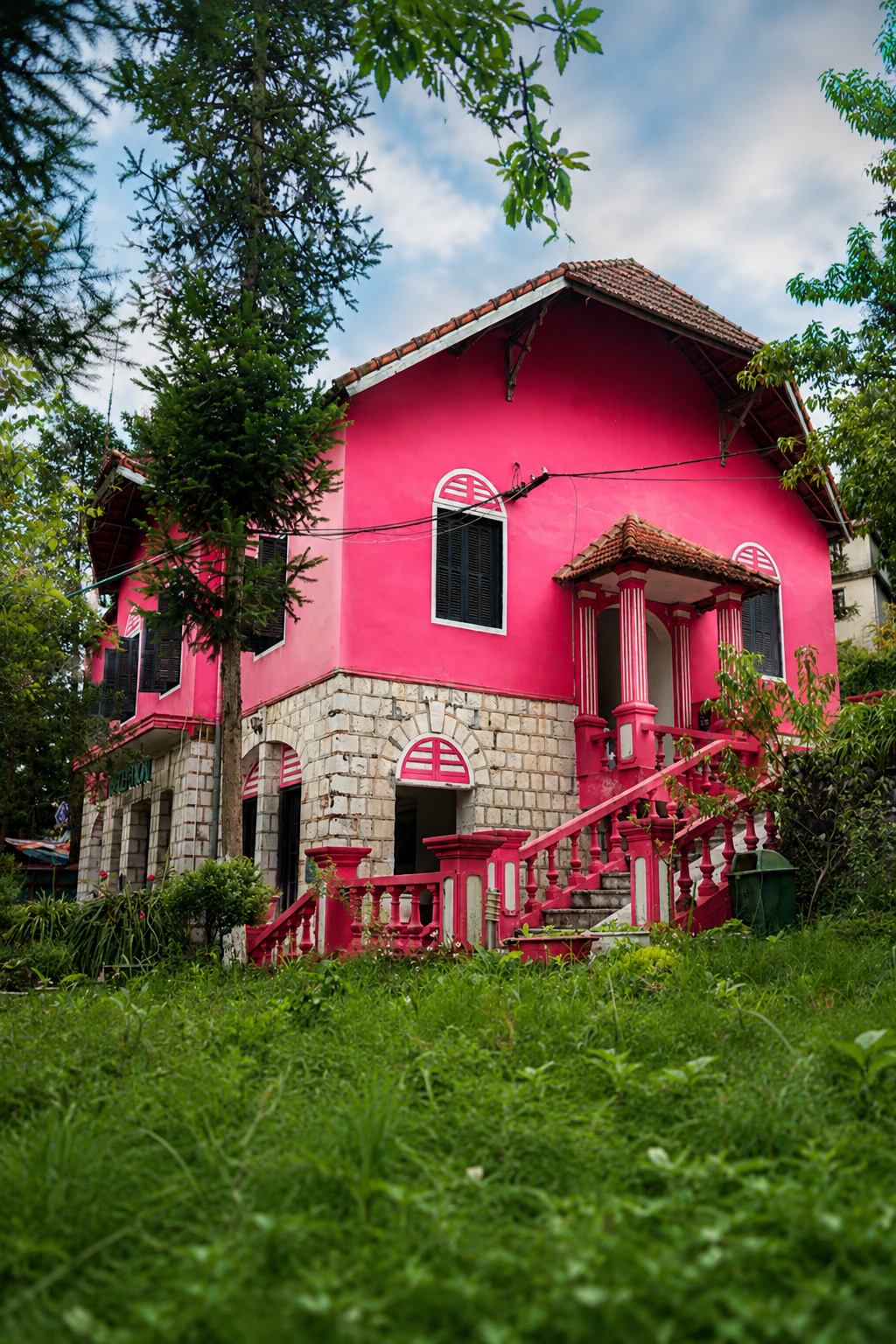
Photograph of a colonial villa in Sapa taken in 2026
Reopening and the Rise of Modern Tourism
By the time international travellers began arriving again in the 1990s, Sapa was emerging from nearly half a century of upheaval stretching across colonial conflict, the wars of Indochina, and the tensions of the northern frontier. The rapid transformation that followed makes far more sense when viewed against this recent history of isolation and hardship, because within living memory Sapa was not a tourism centre at all, but a remote mountain town shaped by survival, resilience, and recovery.
The transformation of Sapa began in the early 1990s, following Vietnam’s economic reforms and increased international engagement. By 1993, Sapa had reopened to global tourism, and visitor numbers began to rise steadily. When international visitors began returning, Sapa was no longer the exclusive hill station of colonial elites. International travellers were often drawn by many of the same elements that had once unsettled and fascinated outsiders during the colonial period. The mountains around Sapa still felt remote and unpredictable, shaped by steep valleys, dense forest, rapidly changing weather, and narrow trails that disappeared into cloud and ridgelines. Long before paved roads and large-scale tourism infrastructure, the surrounding landscape demanded patience, endurance, and local knowledge to move through safely.
Part of this atmosphere survived in the stories that continued to circulate about the colonial era itself. Local folklore and traveller accounts often referenced French officers or soldiers disappearing into the mountains while hunting, patrols failing to return, or men becoming lost during sudden storms in the highlands. While these stories were frequently retold with a supernatural edge, they were rooted in a genuine historical reality. In the early twentieth century, the terrain around Sapa was extremely difficult to navigate, weather conditions could shift within minutes, and communication across the frontier remained limited. Isolation and uncertainty were ordinary features of life in the mountains rather than romantic inventions.
For the early generation of independent travellers arriving in the 1990s, this sense of remoteness became part of Sapa’s appeal. The region was still relatively undeveloped, with few hotels, limited transport, and trekking routes that passed through forests, rice terraces, and villages largely untouched by mass tourism. Adventure travellers were drawn by the dramatic topography and by the feeling of entering a landscape that still retained a strong sense of cultural and environmental depth.
The forests of the Hoàng Liên range, the steep agricultural terraces carved into mountainsides, and the presence of Hmong and Dao communities maintaining distinct languages, clothing traditions, and farming practices gave Sapa a character that felt markedly different from Vietnam’s rapidly urbanising lowlands. Travel at the time was slower and more uncertain, often relying on local guides, overnight trains, and extended periods spent walking between villages. Encounters were shaped less by curated tourism infrastructure and more by the realities of geography, weather, and human connection.
Early foreign travellers were often independent backpackers moving through Vietnam on limited budgets, staying in small guesthouses and travelling by overnight train from Hanoi. Tourism at this stage remained relatively modest compared to the rapid commercial expansion that would follow in the decades ahead. In many ways, what first drew adventure travellers to Sapa in the 1990s was not comfort or convenience, but the feeling that the mountains still held something untamed and difficult to fully know.
Investment in infrastructure followed, including the extension of electricity, improvements to roads, and the development of water systems. These changes enabled greater accessibility while also accelerating the integration of Sapa into national and international tourism networks. Terraced rice fields, cultural diversity, and trekking opportunities became central to the town’s appeal.
For Hmong and Dao communities, tourism created new economic opportunities through guiding, homestays, handicraft production, and agricultural experiences. At the same time, it introduced new challenges related to market access, cultural representation, and the distribution of economic benefits.
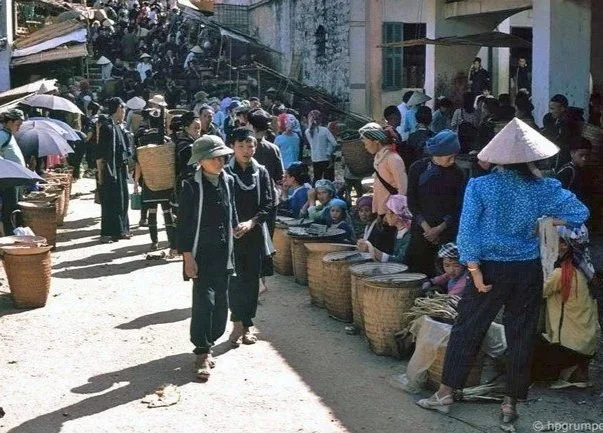
Sapa Market in 1992. Photo: Hans-Peter Grumpe
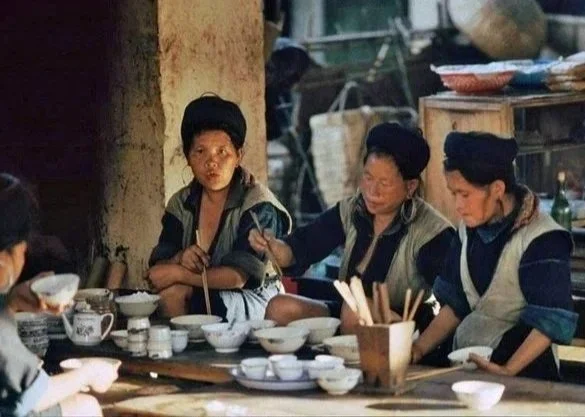
Sapa Market in 1992. Photo: Hans-Peter Grumpe
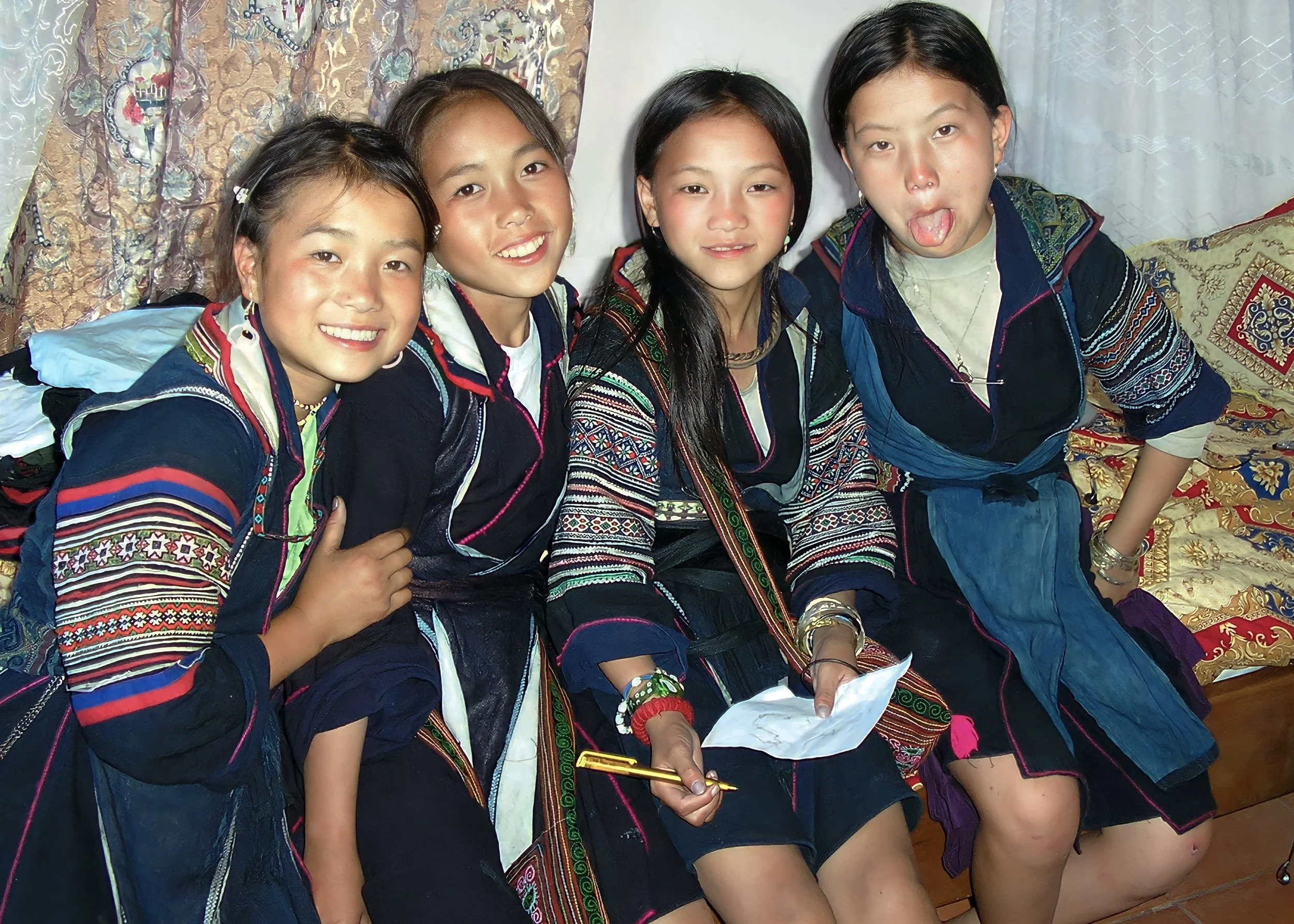
Hmong girls in Sapa in the late 1990’s
Hoàng Liên National Park, Conservation, and the Transformation of Fansipan
The mountains surrounding Hoàng Liên National Park have long shaped both the ecology and identity of Sapa. Rising along the Hoàng Liên Sơn range, these forests and ridgelines form one of the most biodiverse mountain regions in Vietnam, containing dense subtropical forest, high-altitude bamboo ecosystems, medicinal plants, and numerous rare species adapted to the harsh climatic conditions of the northern highlands. For generations, Hmong, Dao, and other upland communities lived alongside these forests, drawing from them not only food and materials, but medicinal knowledge, spiritual meaning, and seasonal rhythms that became deeply woven into everyday life.
As tourism and infrastructure expanded rapidly during the 1990s, concerns increasingly emerged around deforestation, biodiversity loss, and uncontrolled development in the Hoàng Liên Sơn range. In response, the area was first designated as the Hoàng Liên–Sa Pa Nature Reserve in 1996 before being formally established as Hoàng Liên National Park in 2002. The creation of the national park marked an important shift in how the mountains were understood by the Vietnamese state, no longer viewed only as frontier territory or agricultural land, but as a nationally significant ecological landscape requiring long-term protection.
At the centre of the range stands Fansipan, the highest mountain in Vietnam and Indochina at 3,147 metres. For decades, reaching the summit required physically demanding multi-day treks through dense forest, steep terrain, and rapidly changing weather conditions. Fansipan became especially significant within Vietnam’s emerging adventure travel culture during the 1990s and early 2000s, attracting trekkers drawn by both the physical challenge and the feeling of entering one of the country’s last truly rugged mountain environments.
This relationship between landscape, conservation, and tourism changed dramatically with the development of the Sun World Fansipan Legend cable car complex, opened in 2016 by Sun Group. The cable car system, stretching from the Mường Hoa Valley towards the summit of Fansipan, transformed access to the mountain almost overnight. What had once required days of trekking could suddenly be reached within minutes.
Supporters of the development argued that the project expanded access to the mountains for elderly visitors, domestic tourists, and those previously unable to experience the summit. The cable car also accelerated tourism growth in Sapa, contributing to rising visitor numbers and broader economic development across the region.
At the same time, the project became symbolic of the tensions increasingly shaping modern Sapa. Critics questioned the environmental impact of large-scale construction within a protected mountain ecosystem and argued that the commercialisation of Fansipan altered the character of a landscape once associated with remoteness, endurance, and ecological depth. The summit itself, now surrounded by temples, paved walkways, and tourism infrastructure, reflects a wider transformation taking place across Sapa, where accessibility and mass tourism increasingly reshape places that were once defined by difficulty, distance, and local knowledge.
The story of Hoàng Liên National Park therefore reflects a broader contradiction at the centre of modern Sapa. The mountains are simultaneously protected and commercialised, celebrated for their ecological and cultural significance while also being integrated ever more deeply into Vietnam’s tourism economy. As with so much of Sapa’s history, the question is not simply one of preservation or development, but of balance, and of whose relationship with the landscape ultimately shapes its future.
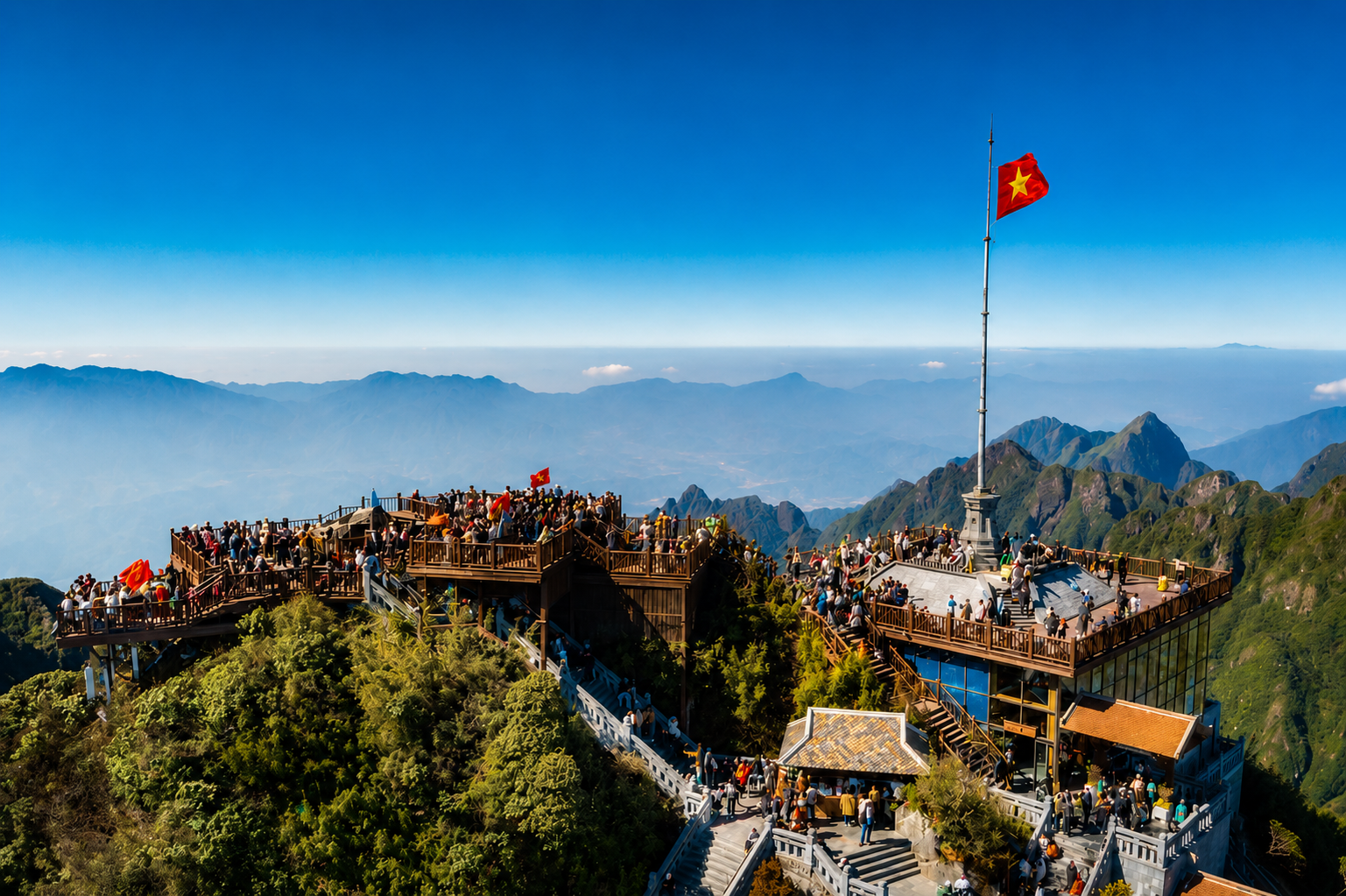
Tourists at the summit of Mount Fansipan enjoy spectacular views of the surrounding mountains.
Urban Transformation: Markets, Space, and Visibility
One of the most significant changes in Sapa’s urban landscape has been the relocation of its central market. Historically located in the town centre on Cầu Mây Street, the market served as a key site of exchange where ethnic minority women sold textiles, produce, and handmade goods directly to visitors and local residents.
Between 2010 and 2014, a new market complex was constructed at the northern gateway of the town, as part of a broader urban development strategy. The old market ceased operation in December 2014, and the new market officially opened shortly afterwards. Authorities justified the relocation in terms of urban planning, tourism development, and improvements to hygiene and infrastructure.
However, the impact on Hmong and Dao vendors has been well documented. Many were relocated to less visible areas within the new market, often on upper floors or in zones with lower foot traffic, resulting in reduced sales and increased costs. This shift altered the spatial dynamics of trade, favouring traders with greater financial resources and familiarity with formalised systems, while pushing some ethnic minority sellers back into informal street-based commerce or village-level trade.
The development of Sapa Lake reflects a similar pattern of layered urban change. It was already incorporated into planning documents by the early 2000s and has since undergone multiple phases of redevelopment. Today it functions as a central visual and recreational feature, reinforcing Sapa’s role as a tourist-oriented town.
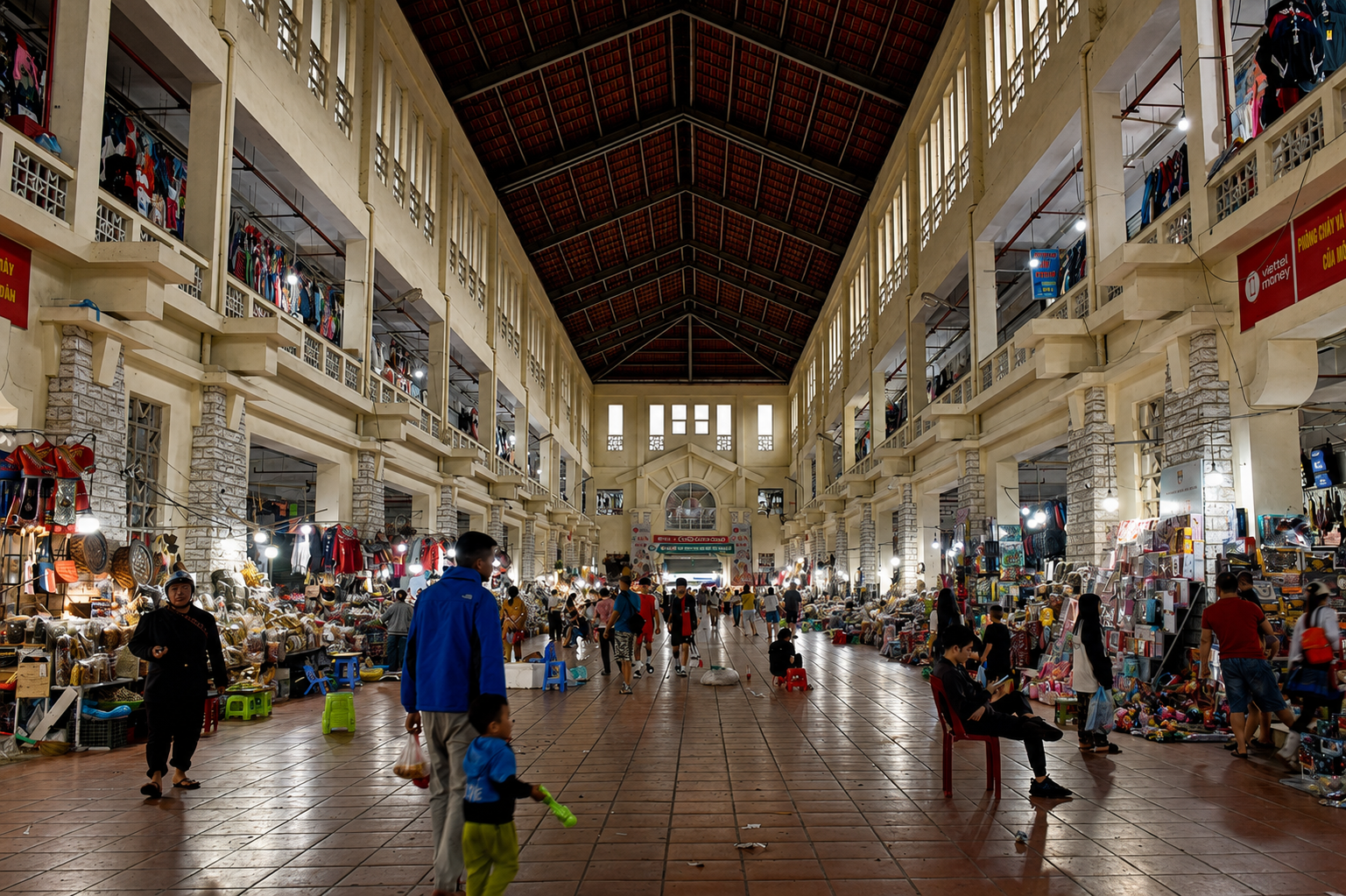
The “new” Sapa market is dominated by machine made toys, trinkets and textiles
Contemporary Sapa: Infrastructure, Acceleration, and the “Check-In” Landscape
The pace of change in Sapa has accelerated further in the twenty-first century through large-scale infrastructure and planning initiatives. The Nội Bài–Lào Cai expressway, completed in 2014, reduced travel time between Hanoi and Lào Cai from roughly nine hours to around five and a half, intensifying flows of visitors, goods, and investment into the region.
Proposals such as the planned Sapa airport, alongside national tourism-area strategies and year-round festival programming, reflect an ongoing effort to position Sapa as a major destination within both national and regional economies. These developments continue a longer historical pattern, in which successive forms of infrastructure, from railways to expressways, reduce distance and integrate the highlands more tightly into external systems.
Modern Sapa is increasingly shaped by how it is seen as much as by how it is lived. Alongside trekking and cultural travel, a more recent pattern has emerged in the form of “check-in” tourism, where certain locations are visited primarily because they are widely shared and easily recognisable. Purpose-built viewpoints, sculptural installations, and curated backdrops draw large numbers of visitors each day, not because of historical or cultural significance, but because they are recognisable. The experience becomes less about engaging with place and more about reproducing a familiar image, one that has already circulated widely across social media platforms.
This shift is not accidental. It is reinforced by what is repeatedly promoted, recommended, and shared, creating a feedback loop in which visibility defines value. Travellers are increasingly influenced by what they see others doing, to the point where visiting certain locations can feel less like a choice and more like an expectation. The result is a subtle but significant transformation in how Sapa is experienced.
The implications for cultural life are profound. When travel becomes centred on predefined viewpoints and repeatable images, the slower, less visible aspects of Sapa begin to recede. The knowledge held by Hmong and Dao communities, knowledge rooted in farming cycles, forest ecology, textile traditions, and oral histories, is not easily captured in a single photograph. It requires time, presence, and a willingness to move beyond the most accessible spaces.
In this context, culture risks being reframed as something to observe briefly rather than something to understand. Practices that were once part of daily life can become staged or simplified for quick consumption, while deeper forms of knowledge remain unheard. We wrote prviously about a “quieting” of local voices, not through deliberate exclusion, but through the overwhelming dominance of externally shaped narratives about what Sapa is and what it should look like.
The contrast between living culture and curated experience becomes increasingly clear. A weaving practice, for example, is not a performance designed for visitors, but part of an ongoing system of knowledge and livelihood. Farming terraces are not simply scenic viewpoints, but the result of generations of adaptation to land and water. When these elements are approached only as visual attractions, their deeper meaning becomes obscured.
At the same time, this shift reflects broader patterns within tourism development. As visitor numbers increase and competition intensifies, destinations often prioritise what is easily marketable and immediately engaging. In Sapa, this has contributed to the growth of attractions designed for rapid consumption, reinforcing a model of tourism centred on speed, visibility, and volume rather than connection and understanding. Yet beneath this layer, the core of Sapa remains unchanged. The Hmong and Dao communities continue to live, work, and create within these mountains, maintaining knowledge systems that cannot be reduced to a single image or moment. Their role in shaping Sapa has not diminished, even if it is less visible within dominant tourism narratives.
The challenge now lies in how Sapa is experienced and understood moving forward. Whether culture remains central or becomes peripheral depends not only on policy or development, but also on the choices made by travellers themselves. Meaningful engagement requires stepping away from what is most visible and allowing space for what is less immediately apparent, choosing to listen rather than simply to look.
In this way, the modern phenomenon of “check-in” tourism does not replace Sapa’s cultural foundation, but it does risk obscuring it. The mountains remain the same, and so do the communities who have long shaped them. What is changing is the lens through which they are seen.
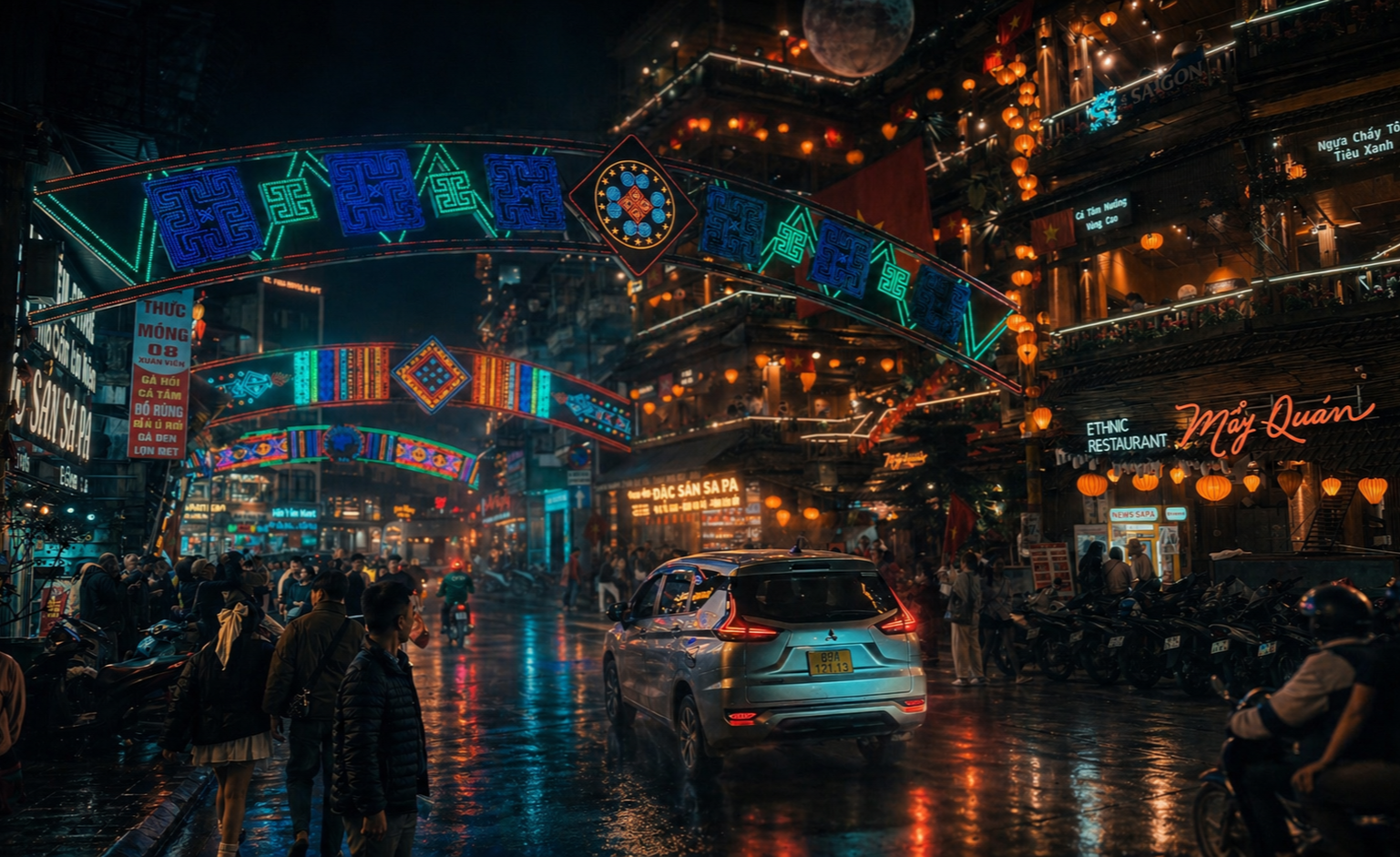
The heart of Sapa town on a busy weekend in 2026
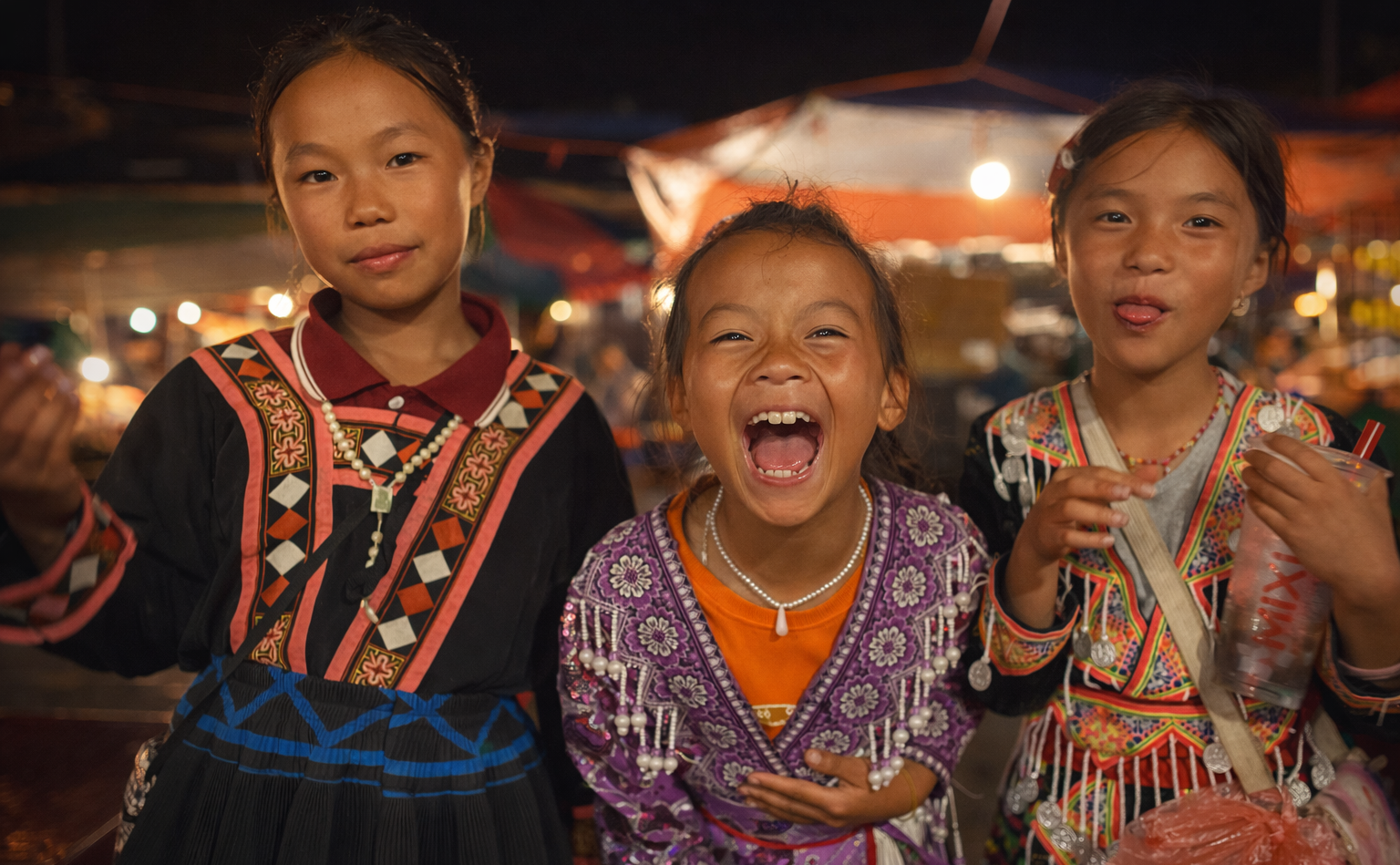
Street sellers enjoy a moment with passing tourists in 2025

Sapa lake in 2026
The Hijacking of Colonial Prestige
One of the clearest examples of this tension can be seen in the way parts of Sapa’s colonial history are now repackaged through luxury tourism branding. The Hotel de la Coupole Sapa – MGallery, for example, describes itself as a place where “Haute Couture Meets Hill Tribe Artistry”, combining imagery of French Indochina with stylised references to ethnic minority culture. Although visually striking, this version of history risks presenting colonialism as elegant, romantic, and culturally harmonious, while largely overlooking the realities that underpinned the colonial project itself.
Importantly, the hotel itself is not a preserved piece of colonial heritage, but a contemporary luxury development designed around an imagined aesthetic of “French Indochine”. Unlike surviving colonial villas, churches, or administrative buildings that physically connect to the historical landscape of Sapa, the property represents a newly constructed interpretation of colonial nostalgia rather than an authentic historical site. Its atmosphere is therefore less a continuation of lived history than a carefully curated commercial vision of what colonial Indochina is imagined to have looked and felt like.
French rule in the northern highlands was not simply an era of architecture, mountain retreats, and refined tourism. It was also a system built upon military expansion, frontier control, labour extraction, unequal land relations, taxation, and the opium monopoly that financed much of colonial Indochina. Highland communities were surveyed, classified, taxed, displaced, and incorporated into systems of governance designed primarily around colonial economic and strategic interests.
The romantic imagery now used in some tourism marketing often reflects less the historical reality of colonial Sapa than a contemporary fantasy of Indochine created for commercial appeal. In this version of the past, colonialism becomes aesthetic rather than political, reduced to curated interiors, couture references, and nostalgic atmosphere, while the violence, inequality, and disruption experienced by local communities fade into the background. What is presented as heritage can therefore risk becoming a form of selective memory, one that celebrates the appearance of colonialism while overlooking the structures of power that shaped life in the highlands for decades.
Continuity and Change in the Highlands
Across more than a century of transformation, from colonial expansion and war to mass tourism and rapid infrastructure development, the most constant element in Sapa’s history has been the presence and contribution of its ethnic communities. Political systems have changed, borders have hardened, railways and expressways have arrived, and tourism economies have repeatedly reshaped the mountains, yet Hmong and Dao communities have continued to adapt while maintaining strong connections to land, language, family, and tradition.
This continuity is visible throughout the highlands. Terraced rice fields still follow the contours of the mountains in patterns shaped by generations of agricultural knowledge. Indigo-dyed textiles, embroidery, silverwork, herbal medicine, and ritual traditions continue to be practised, not as static cultural displays, but as living parts of everyday life that evolve alongside changing economic realities. Markets may shift location, tourism may alter village economies, and younger generations may move fluidly between mountain communities and urban centres, yet cultural identity remains deeply rooted within the rhythms of the highlands themselves.
The history of Sapa is often told through the lens of outsiders, colonial administrators, travellers, investors, or tourism campaigns, but the deeper story is one of endurance and adaptation within local communities. Hmong and Dao families have lived through periods of colonial control, war, economic isolation, state restructuring, and rapid commercialisation, while continuing to reshape their own futures within changing conditions. Their role has never been passive. Communities have continually negotiated with outside forces, finding ways to preserve knowledge and identity while also engaging pragmatically with tourism, trade, education, and modern economic life.
Today, this resilience can be seen in the growing number of community-led tourism initiatives, local guides reclaiming cultural narratives, younger generations documenting oral histories and traditional crafts online, and families balancing ancestral knowledge with new opportunities. The future of Sapa will inevitably continue to change, as it always has, but there is also increasing recognition that the long-term strength of the region lies not only in its landscapes, but in the people who have sustained those landscapes for generations.
The pressures facing the highlands are real. Rapid tourism growth, environmental strain, changing land use, and the commercialisation of culture continue to reshape everyday life across the region. Yet the story of Sapa is not simply one of loss. It is also a story of survival, creativity, and continuity in the face of constant transformation.
Understanding Sapa therefore requires looking beyond the surface of tourism and recognising the depth of lived experience that continues to shape the mountains today. The forests, terraces, markets, and villages are not remnants of the past frozen in time, but part of an ongoing cultural landscape still being actively lived, negotiated, and reimagined by the communities who call these mountains home.
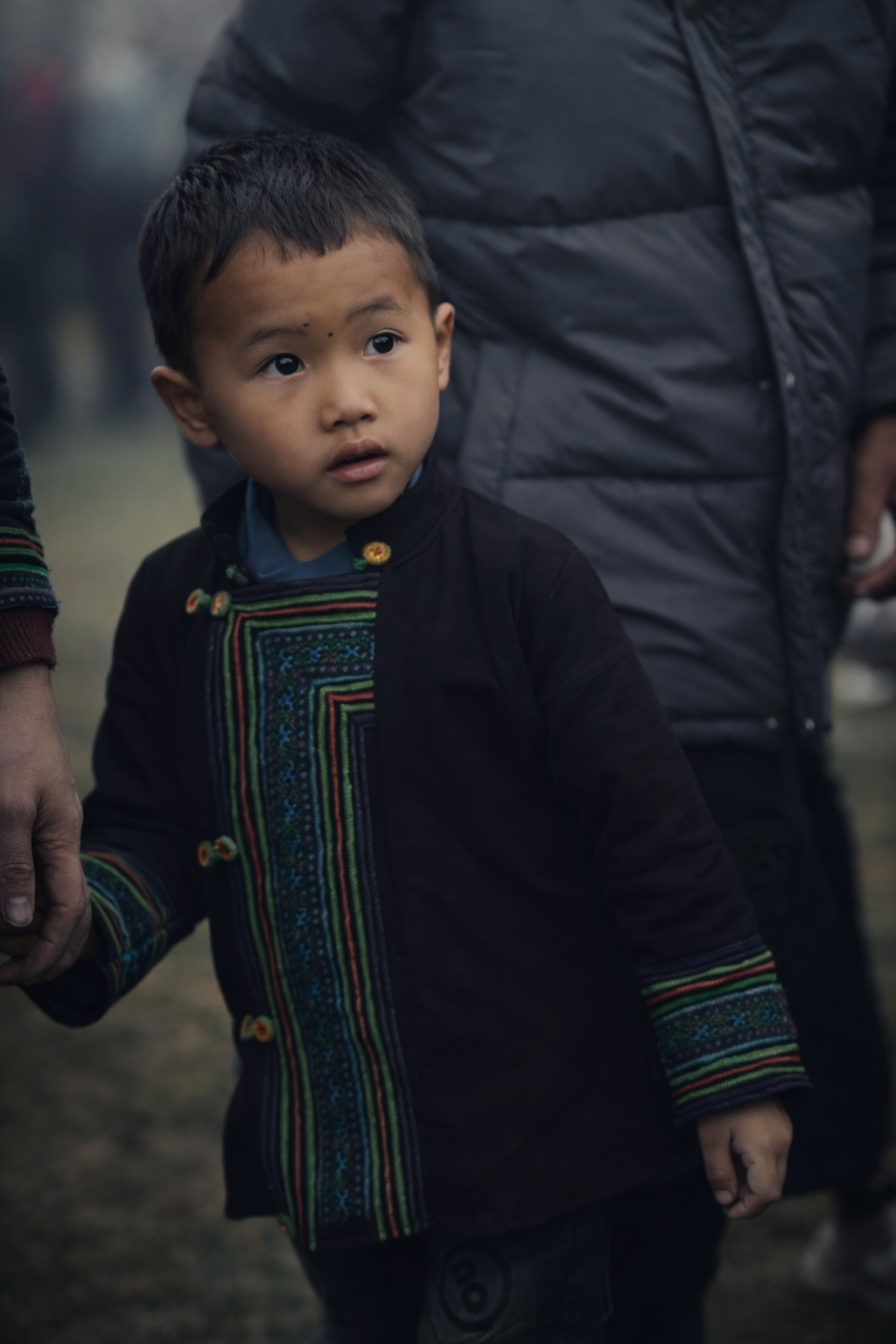
Young Hmong boy in Sapa in 2026
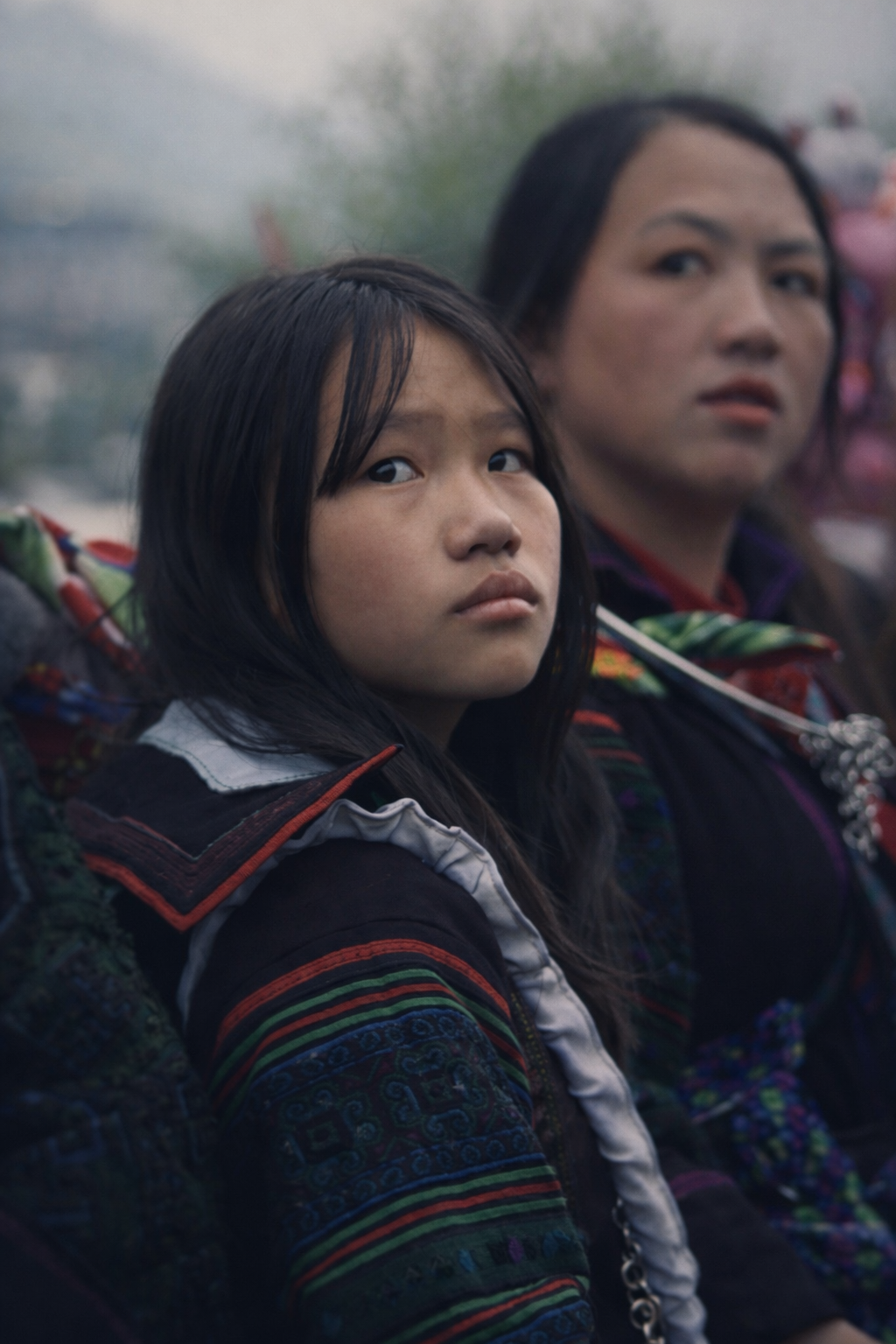
Hmong girls in Sapa in 2026
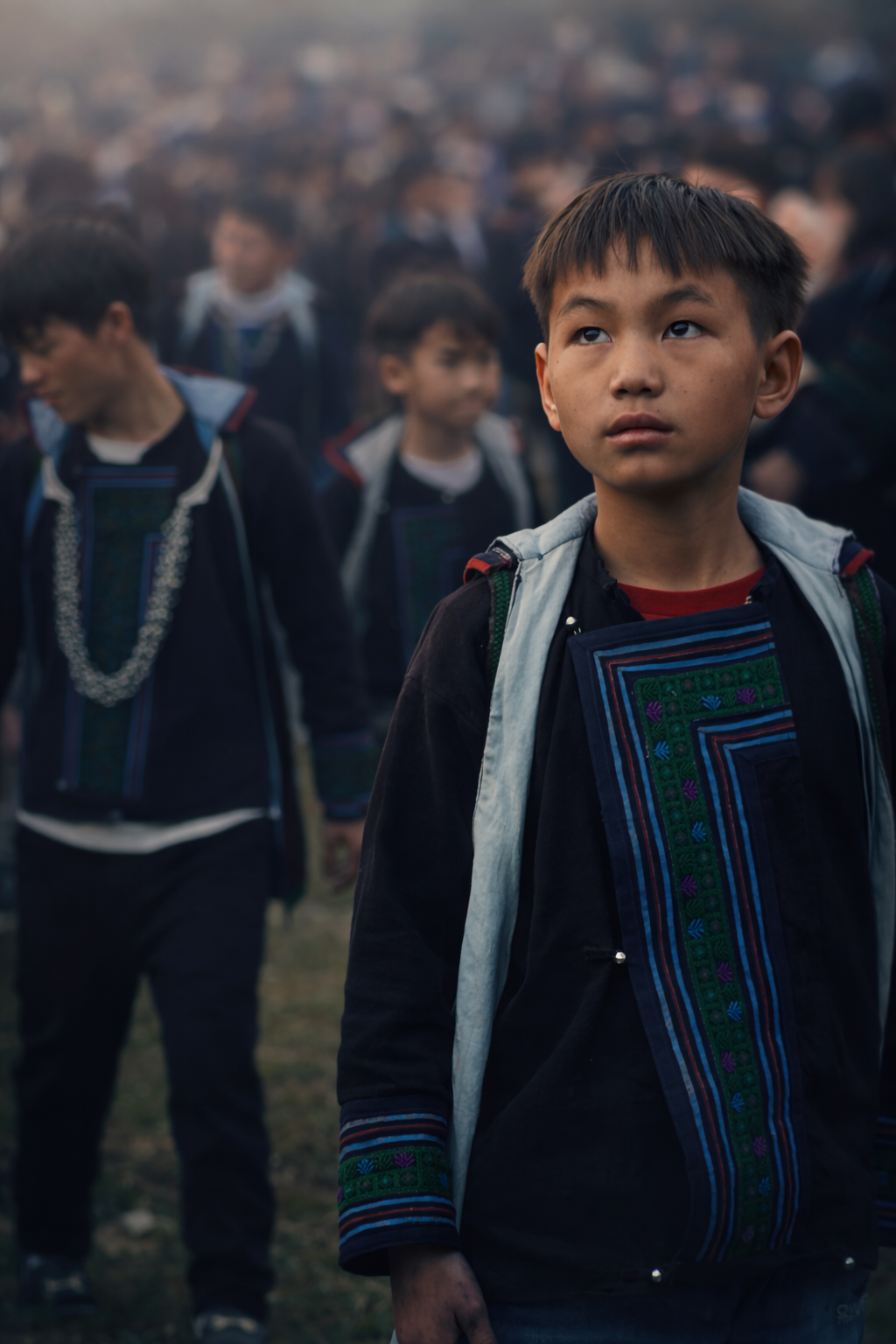
Hmong boys in Sapa in 2026
Walking Towards the Future
Sapa’s history is still being lived. Beyond the changing skylines, tourism projects, and shifting economies, the mountains remain shaped by the knowledge, labour, and resilience of the communities who have called them home for generations.
Understanding this region more deeply often begins with simply slowing down, walking further, and listening more carefully. At ETHOS, our experiences are created alongside Hmong and Dao communities who continue to shape everyday life across the highlands, offering a more grounded way to experience the landscapes and cultures of northern Vietnam.
The future of Sapa will almost certainly continue to be shaped by tourism, infrastructure, and outside investment, yet the long-term identity of the highlands will depend on whether development can remain connected to the communities, landscapes, and knowledge systems that have sustained this region for generations.
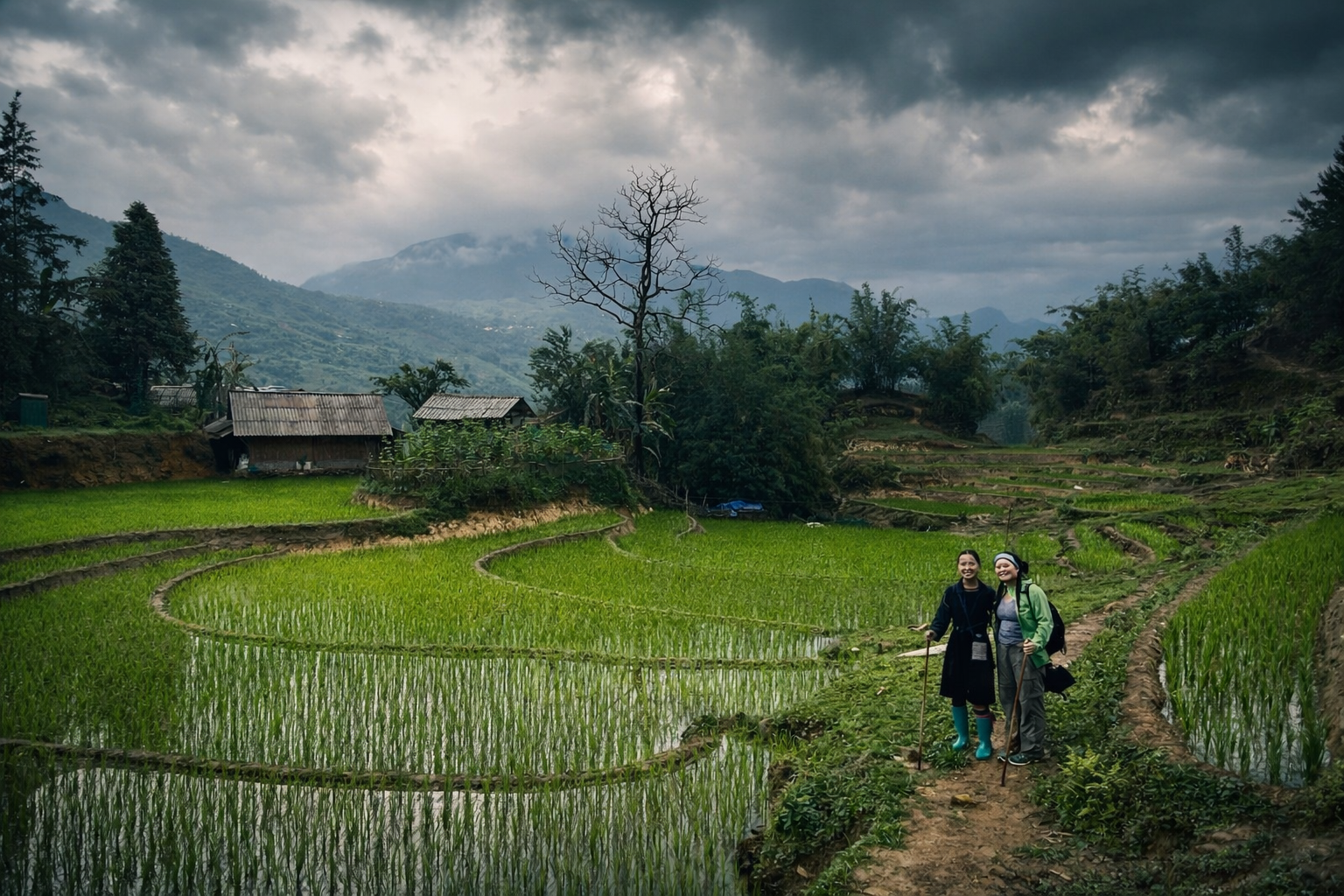
Trekkers experience the Sapa landscape while on an ETHOS experience. Photo: Scott Harbin
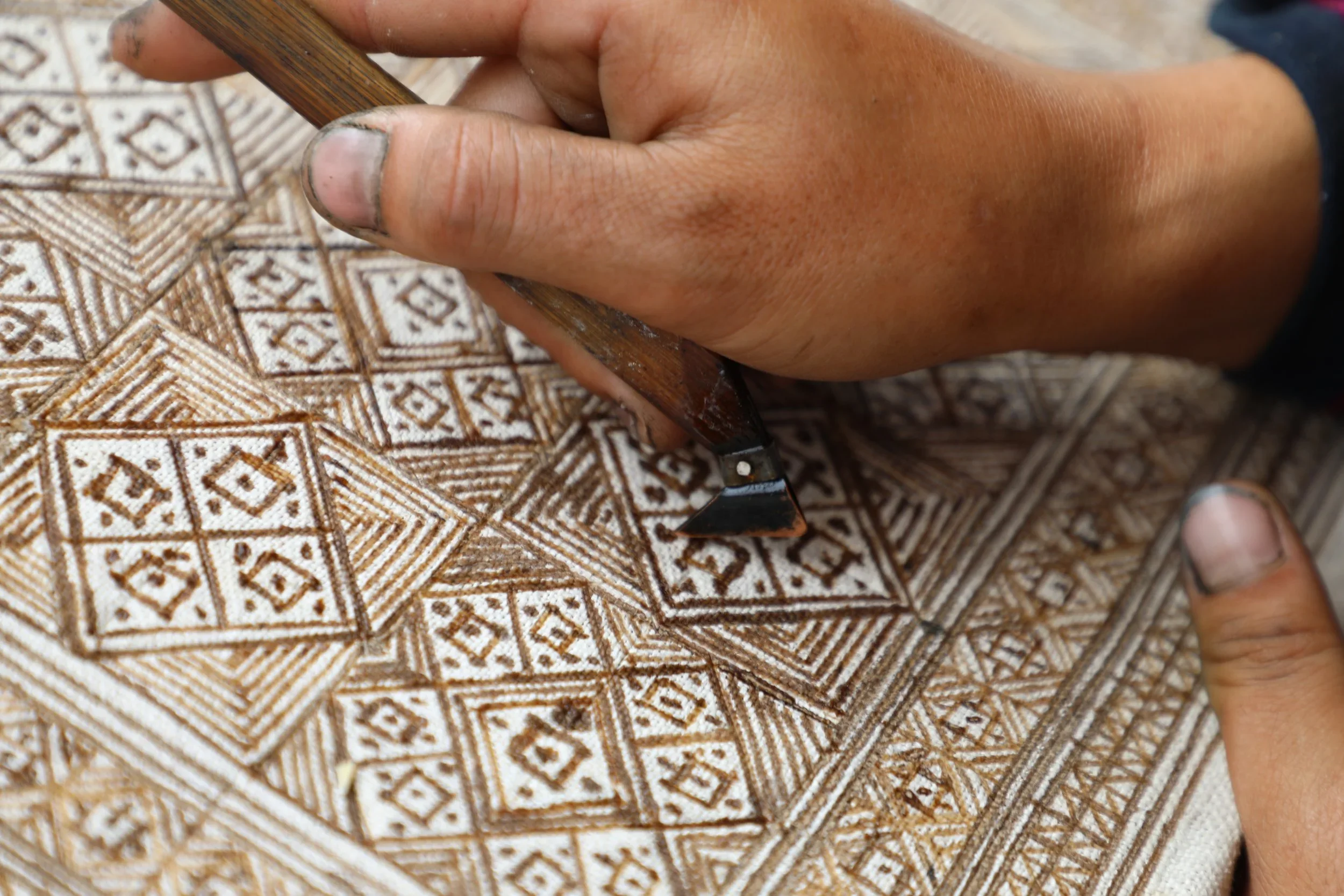
Batik in Sapa: Wax, Indigo, and What Is Being Lost
Batik in Sapa is far more than a craft. It is a slow, deeply rooted tradition practised by Hmong women, beginning with hemp grown in mountain soil and ending in intricate indigo-dyed textiles rich with meaning. This guide explores the full process, the symbolism behind the patterns, and the growing rise of short, commercial workshops that risk undermining authentic practice. Discover how to choose a meaningful, ethical batik experience that honours culture, craft, and community.
A living tradition, and a fragile one
High in the terraced valleys and mist-softened ridgelines of Sapa, batik is not considered a craft. Instead, it is considered to be a living “language” held by Hmong women. This is a language shaped by generations who have translated landscape, ancestry, and spirit into cloth. Every line drawn in wax, every immersion into indigo, carries intention. Every piece is part of a continuum that connects the living with those who came before.
This tradition is deeply rooted in land and time, so nothing is rushed and no stroke is incidental. Alongside this depth, something else has been growing in parallel. A simplified, commercialised version of batik has begun to take hold, quietly reshaping how travellers encounter and understand this craft.
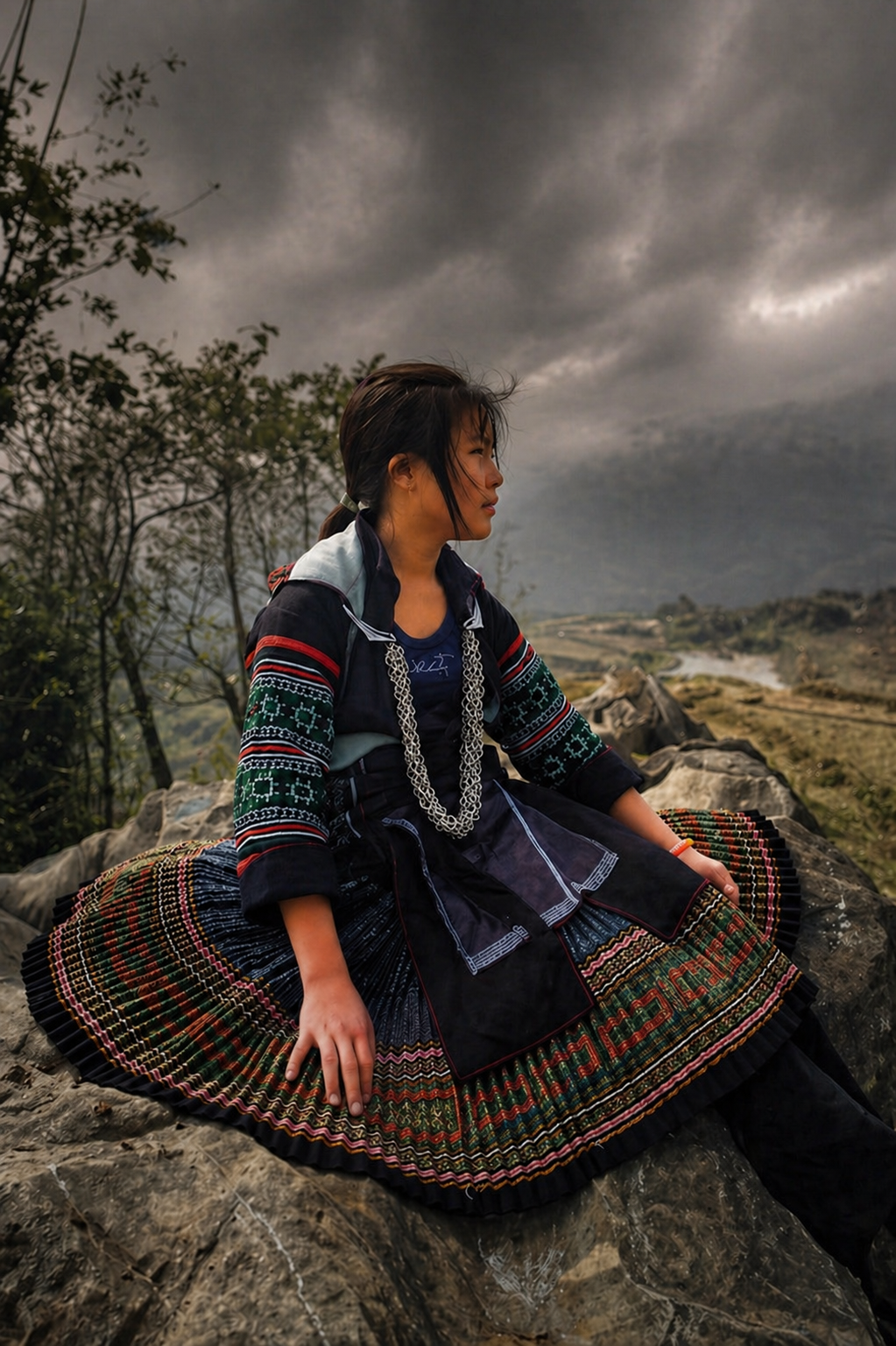
A hmong girl in Sapa wearing a “Spirit Skirt”, carefully crafted from indigo dyed, Hmong batik and silk embroidery.
Hemp: from mountain soil to cloth
True batik does not begin with wax or dye. It begins in the soil. In the cool, damp breath of early spring, hemp seed is pressed gently into mountain earth around Sapa. The land is still waking, though the hands that sow move with quiet certainty. This is the beginning of a cycle that is as much about patience as it is about skill.
As the season deepens, slender green stems rise quickly, drawing strength from sun, mist, and mountain air. The plants are tended alongside daily life, growing in rhythm with rice fields, livestock, and the turning of the seasons.
By early summer, the stems are cut and carried home. They are dried, stripped, soaked, beaten, and combed. Fibres are teased apart slowly, softened and refined through repeated effort. Thread is then spun by hand, rolled along the thigh in a steady, practiced motion. It is work done over hours, days, often in shared spaces filled with conversation and quiet.
Weaving follows. The loom stands ready within the home, threads stretched carefully, aligned with precision. Cloth emerges gradually, growing day by day without urgency. This is slow fashion in its truest sense. It is not a trend. It is a way of life rooted in quality, durability, and deep connection to the land. When the cloth is ready, it enters the indigo vats. Leaves, once gathered and fermented, have become rich pools of living dye. The fabric is dipped, lifted, and dipped again. With each immersion, colour deepens. Green turns to blue as it meets the air, layer by layer, moment by moment.
Finally, the cloth is beaten against stone in a process known as calendaring. The steady rhythm echoes through the yard as fibres compress and the surface begins to shine. A deep, almost metallic indigo emerges, not through machinery, though through repetition, patience, and care. Only once this entire process is complete does batik begin. Wax is applied carefully onto this hand-crafted hemp cloth, preserving patterns that will emerge through repeated indigo dyeing. The finished textile carries not just design, though months of labour, land, and lived experience.

Organic hemp growing in the Sapa mountains
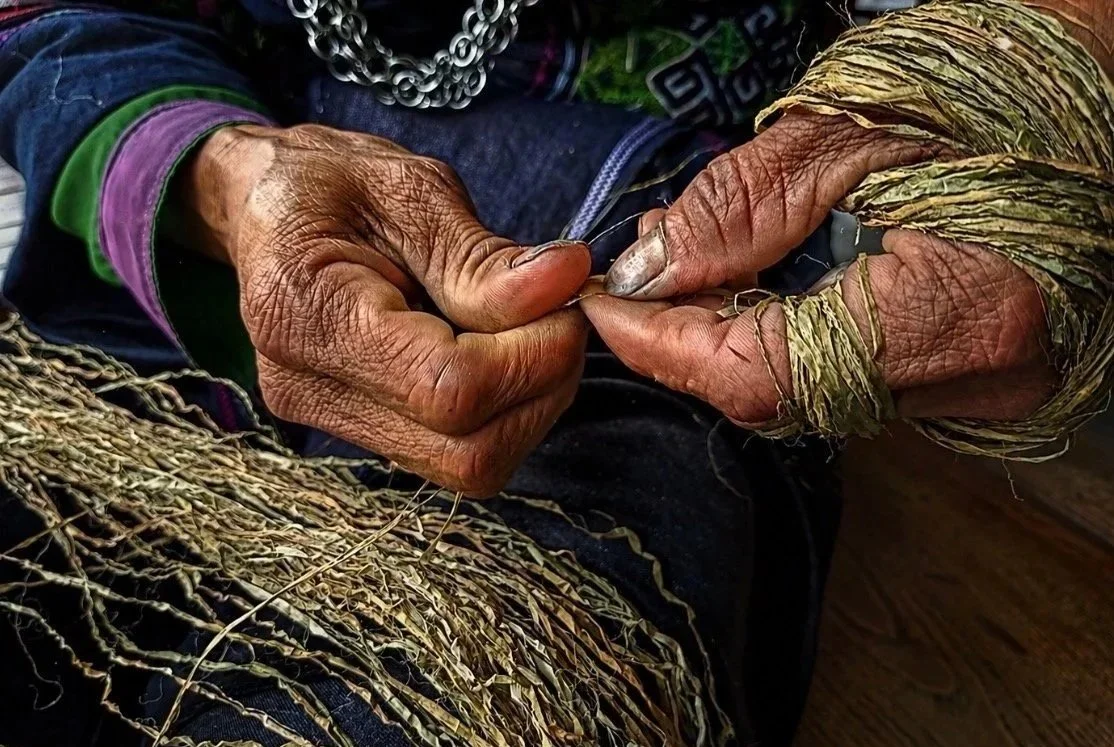
Hemp threads being twisted and joined.
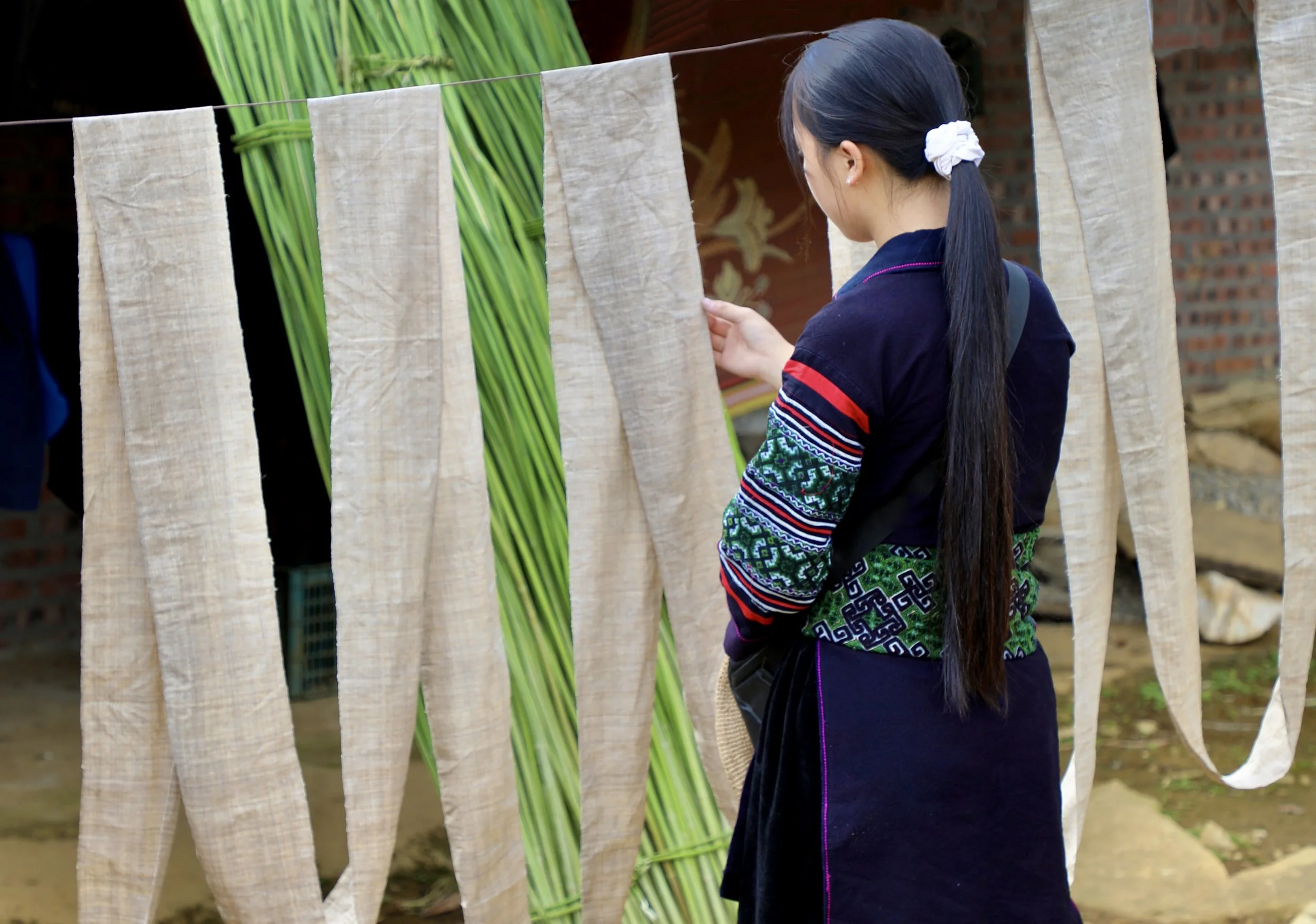
Woven hemp fabric being prepared for indigo dying.
The rise of batik as a time filler
Many trekking itineraries in Sapa now follow well-worn paths, guiding travellers through Lao Chai and onwards to Ta Van for overnight stays. The scenery remains pretty, though the structure of these tightly organised journeys can still sometime leave unexpected gaps.
Groups move at different speeds. Some arrive at their homestays far earlier than intended, with long afternoons stretching ahead before dinner. Rather than deepening the journey or extending time on the trail, these hours are increasingly filled with short, bolt-on activities. Batik workshops have become one of the most common additions. These sessions are typically brief, lasting one or two hours, and are presented as an introduction to traditional craft. In reality, they are often designed to occupy time rather than to foster understanding.
When tradition is reduced to imitation
In these shortened classes, the materials themselves tell the story. Instead of hemp, grown and prepared over months, participants are given pre-bought cotton, often bleached white and chosen for cost and convenience. The wax used is most typically melted candle wax, heated quickly over a gas flame. The tools are handled briefly, rarely with proper instruction. Patterns are copied without context, stripped of meaning.
The process, which should unfold slowly, is compressed into minutes. The discipline, the patience, the connection to land and material is lost. Dyeing is reduced to a single dip in chemical dye. There is no indigo vat, no layering, no waiting. The transformation that should take time becomes instant. This is not batik as it is known within Hmong communities. It is a simplified imitation, created for speed and convenience.
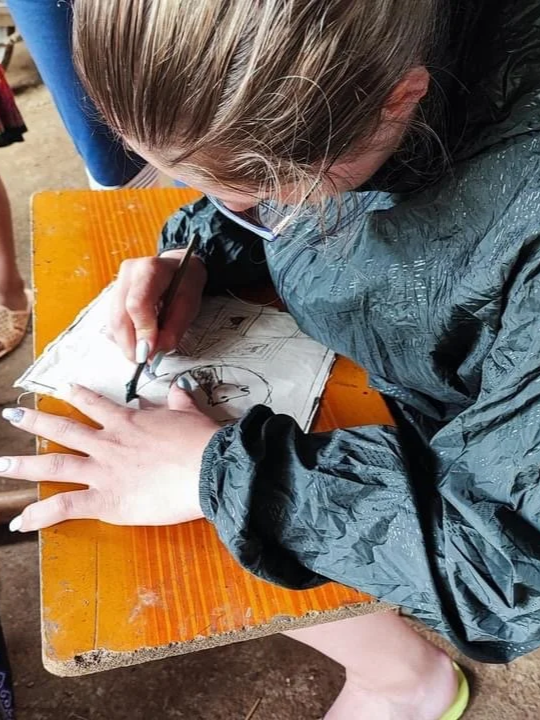
Tourist trying batik on bought cotton.
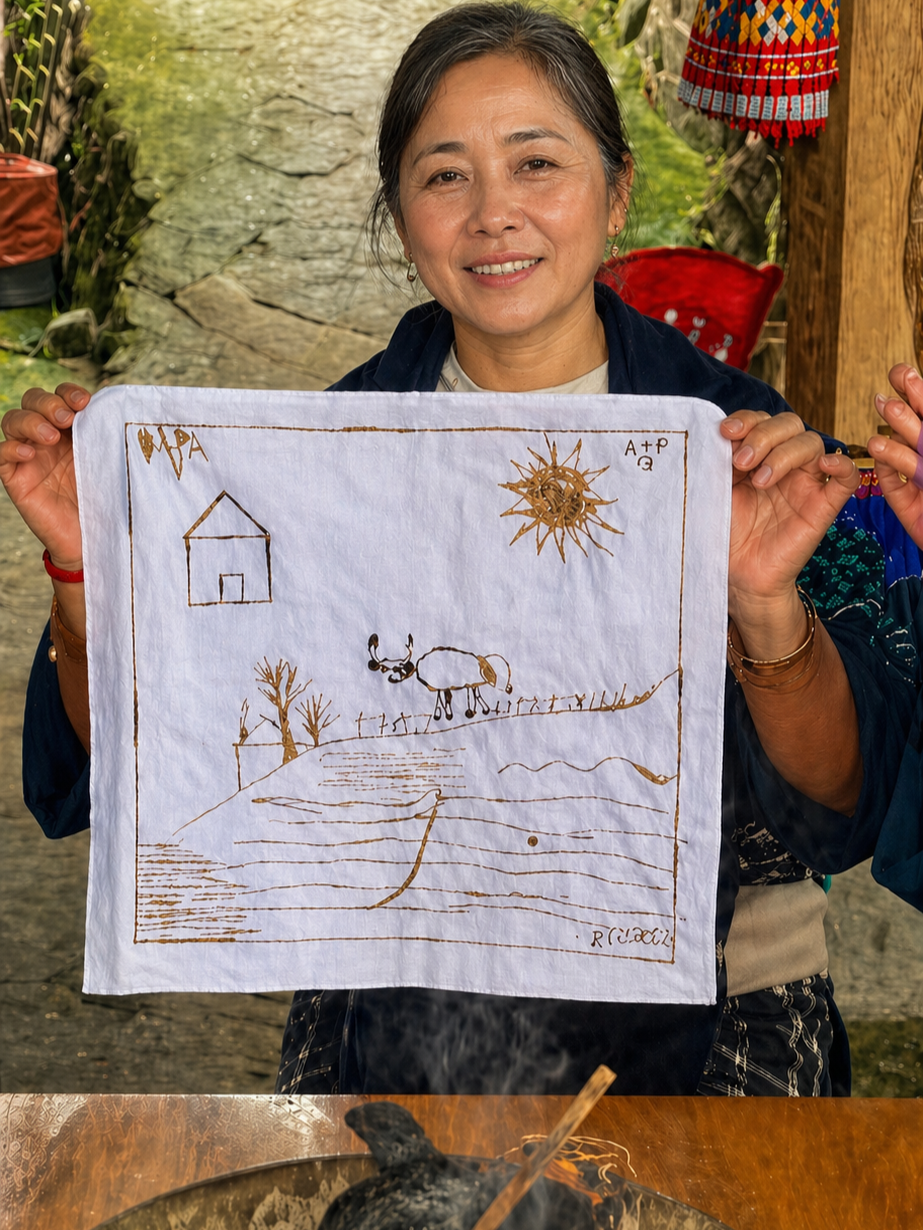
Batik teacher holding up the work of her students

Travellers draw contemporary batik designs.
Environmental and cultural consequences
The impact of these practices extends beyond the workshop. Chemical dyes are often released into streams, harming invertebrates that form the foundation of aquatic ecosystems. As these disappear, fish populations decline, and the balance of the environment begins to shift.
Traditional indigo, by contrast, is entirely natural. Vats are maintained over months or years and can return safely to the land, even nourishing rice paddies. Culturally, the consequences are equally profound. Travellers leave believing batik is fast and simple. The depth of the process becomes invisible. The value of authentic work is diminished. For artisans, this shift is deeply felt. Their time, skill, and knowledge are undervalued. For younger generations, particularly Hmong women and girls, the incentive to learn begins to fade. When faster, cheaper alternatives dominate, the future of this tradition becomes uncertain.
What a true batik experience feels like
A meaningful batik experience is rooted in time, patience, and relationship. You are welcomed into a home, not a workshop designed for display. You sit beside a woman whose knowledge is lived, not performed. You begin with understanding, not production. You learn where materials come from, how they are made, and why each step matters. You are guided carefully, allowed to make mistakes, encouraged to slow down. Indigo is not rushed. Wax is not hurried. Conversation flows. Stories emerge. Symbols begin to hold meaning.
A voice from the craft: My’s story
Among those who carry this knowledge forward is My, a young Hmong woman whose relationship with batik began when she was just thirteen years old. What started as learning alongside older women in her community has, over the past twelve years, become both a skill and a way of life. For more than nine years, she has also welcomed travellers into this process, sharing not only technique, though perspective.
Her work is quiet and precise, shaped by repetition and patience. Watching her draw wax onto hemp cloth, there is a sense of ease that only comes from years of practice, though also a deep attentiveness to each line.
“Batik taught me to slow down and be patient,” she explains. “I love showing travellers our traditions and enjoy talking to people from around the world about my culture. I think some people are surprised when they find out how much work goes into Hmong batik. From seed to clothing, it’s a process that takes many months.”
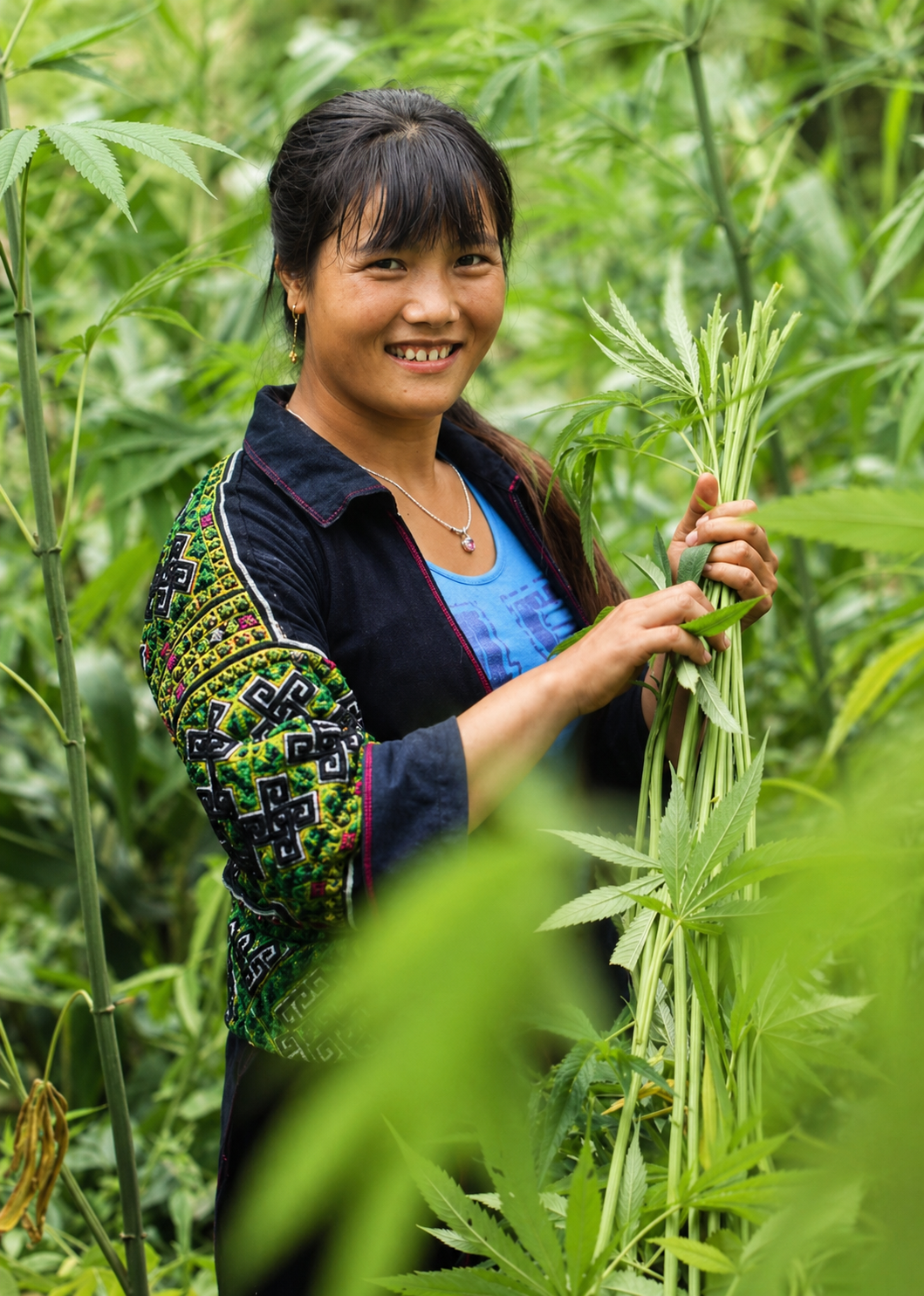
Ly Thi My is a Black Hmong woman from Sapa who has been learning and teaching batik for years.
Travellers who spend time learning with her often come away with a very different understanding. Norman Ed, visiting from the United States, reflected that the experience was “far more than a simple workshop, becoming instead a space to understand the importance of the entire process and the life that surrounds it”. His wife, Mary Ed, described her time with My as “not a craft class, but instead an opportunity to connect with the cultural significance behind a deeply meaningful technique”.
They were particularly struck by the way My moves seamlessly between skills, recalling how she could twist hemp fibres while trekking along the mountain paths, her hands working instinctively as part of daily life. Norman noted that this ability to intertwine craft with everyday living revealed something profound, leading them both to a deeper appreciation of the time, effort, and knowledge that goes into every piece of batik.
Symbols, spirit, and slow understanding
Patterns in batik are not decorative. They are symbolic, and often spiritual. Spirals, lines, and geometric forms carry meaning connected to protection, identity, and the natural world. In many Hmong traditions, clothing helps guide ancestral spirits, ensuring they recognise their descendants. Patterns act as markers, both visible and unseen. This understanding cannot be rushed. It is shared slowly, through trust and time.
Learning with care and connection
At ETHOS, our batik experiences are shaped through long-standing relationships with Hmong partners who lead workshops in their own homes and communities. These are not performances. They are real, lived experiences shared with care. Alongside this, we work with Dao communities in their own textile traditions, particularly embroidery, each distinct and equally meaningful.
We believe in slow travel, where learning is not rushed and connection is allowed to grow naturally.
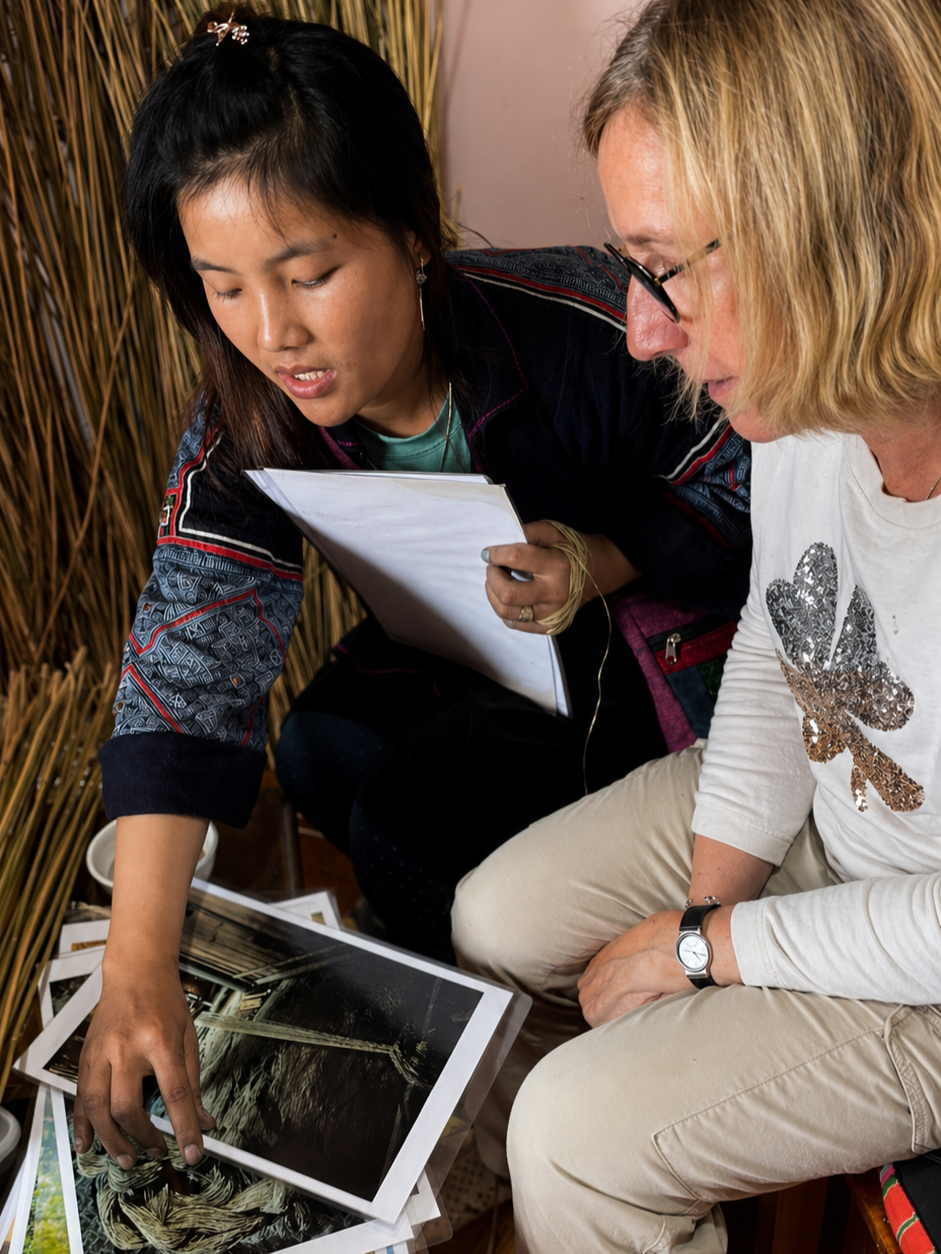
My explaining the main steps in producing natural hemp fabric.
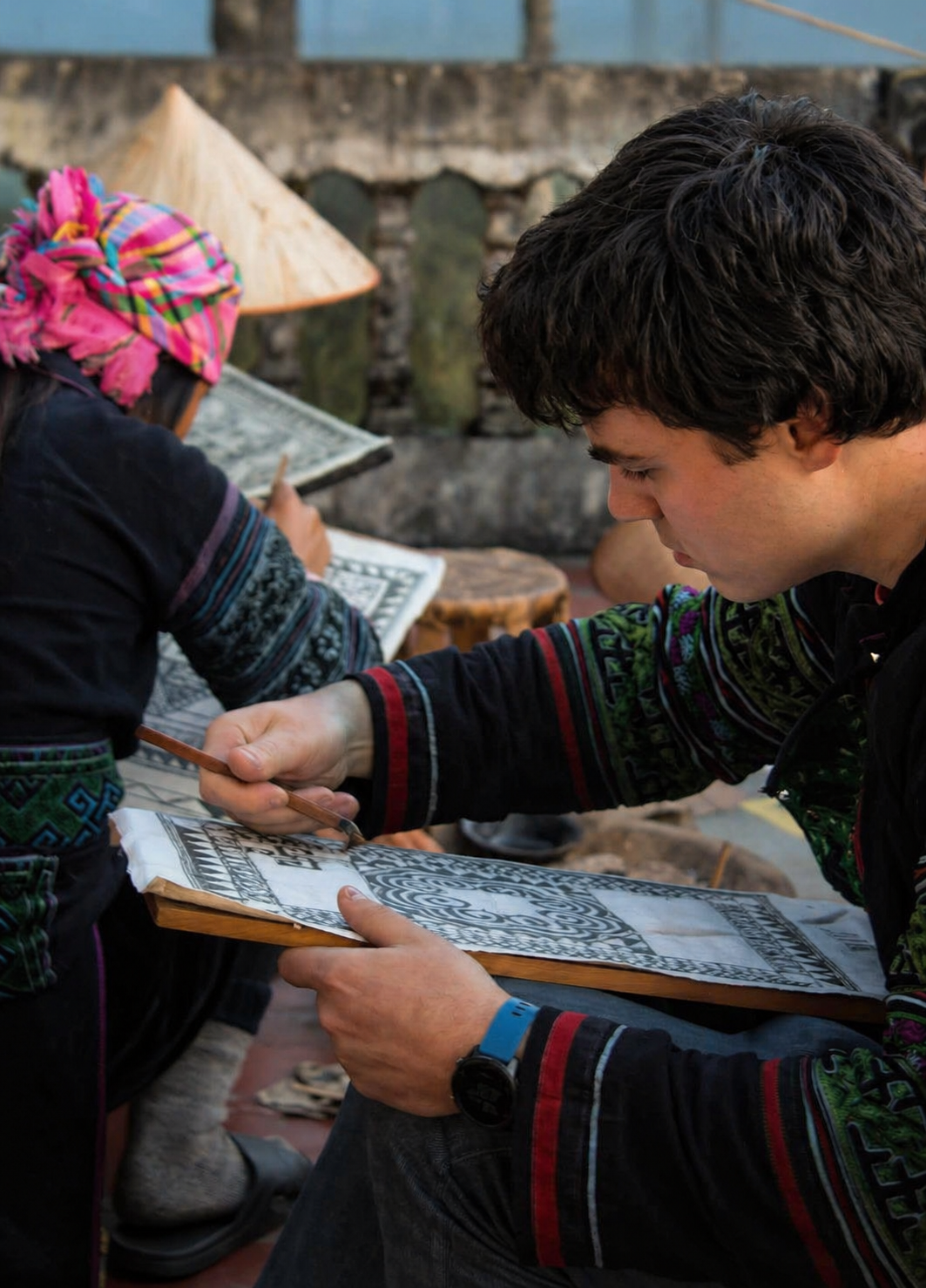
Travellers learning batik in the ETHOS community centre
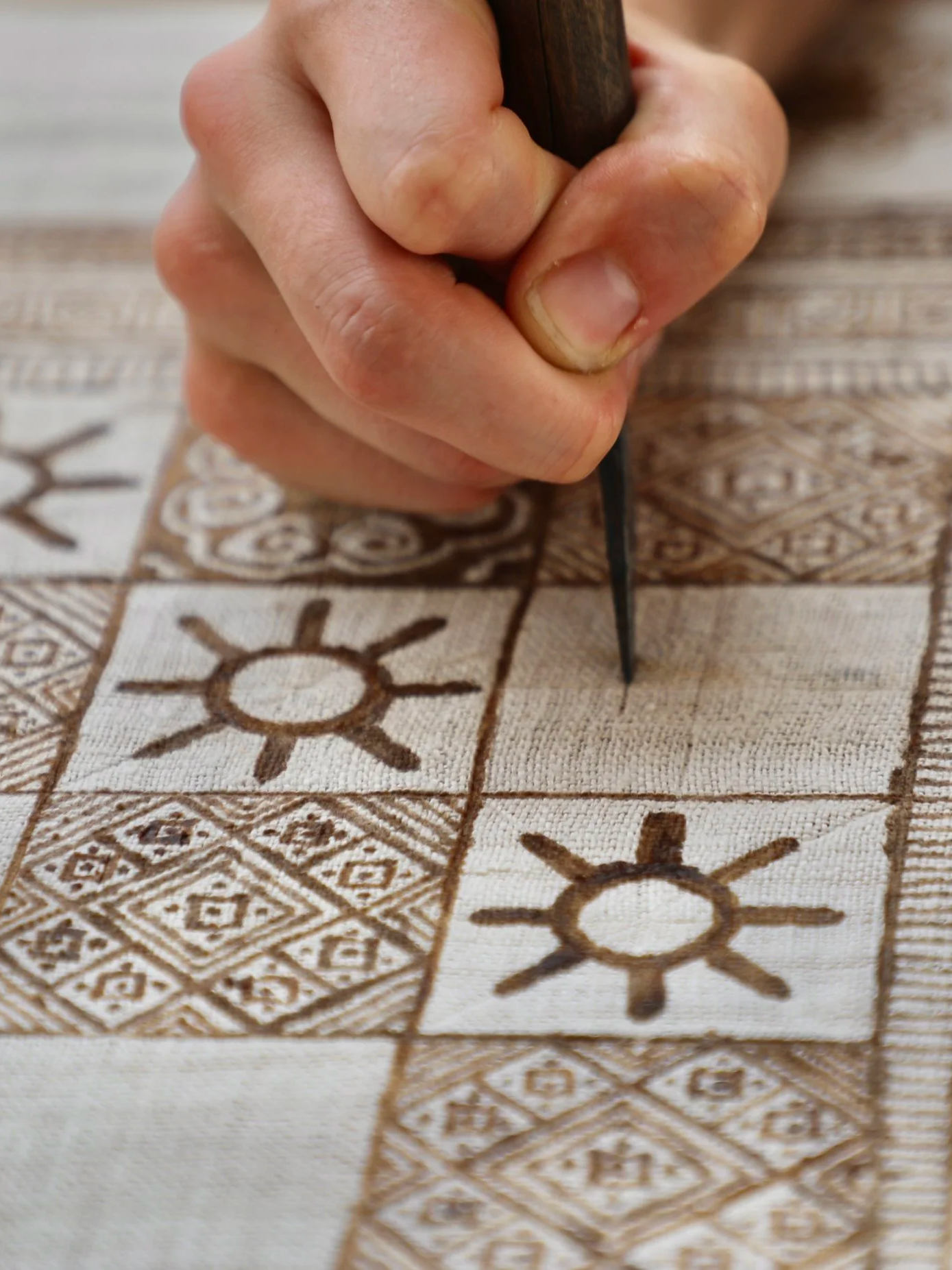
Tool used for planning batik designs on organic , hemp cloth.
Choosing with intention
Not all batik experiences are equal. Some honour the craft. Others reduce it, so choosing carefully really matters. Supporting experiences rooted in authenticity, time, and local knowledge helps ensure this tradition continues, because batik is not just something to try but something to understand, respect, and to help protect.

Hemp leaves growing in Sapa.
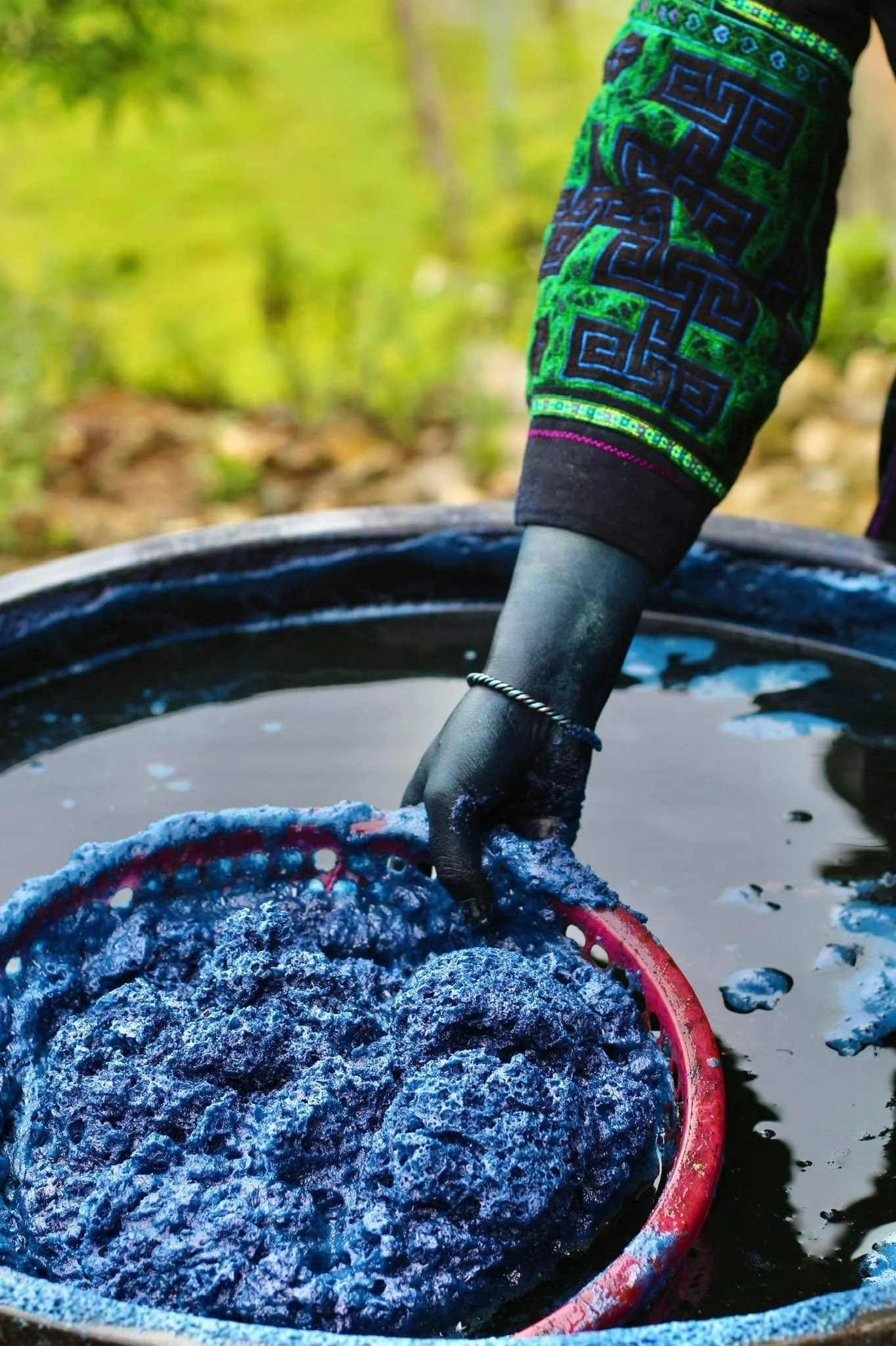
Preparing an indigo vat ready to dye batik designs.
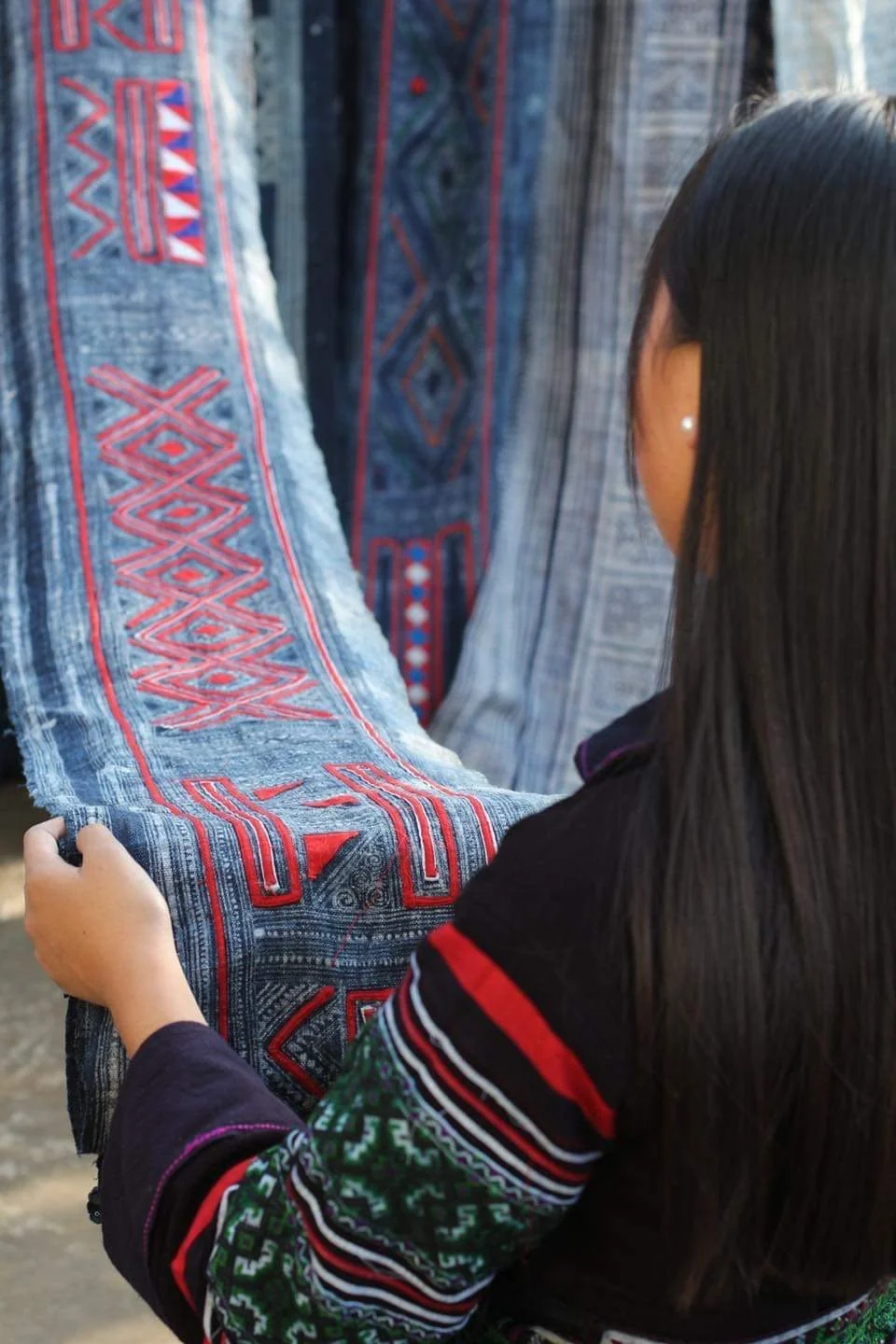
Examininig hemp panels before they are made into a Spirit Skirt.
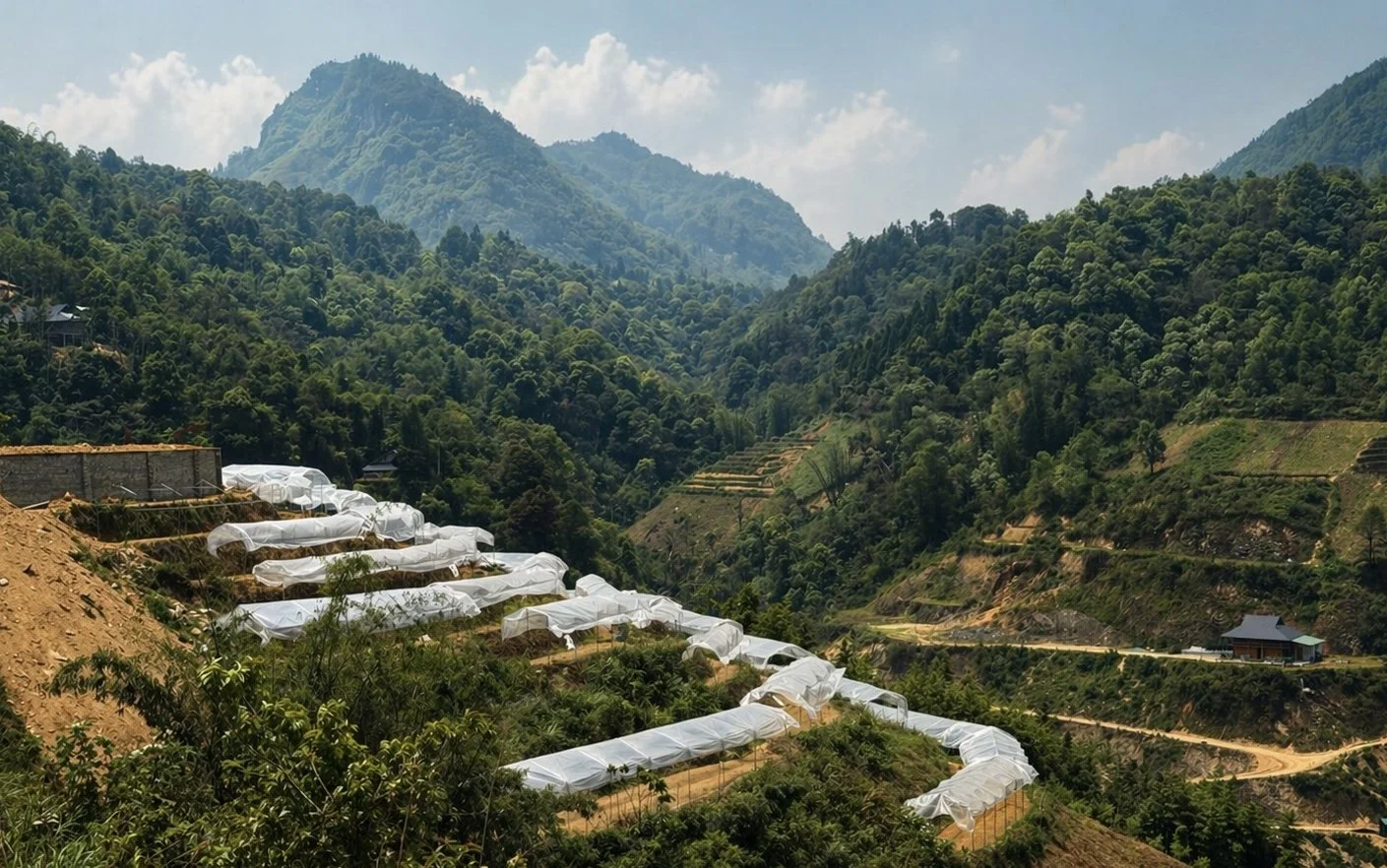
Sapa’s Hidden Shift: Trekking, Traditional Culture and the Spread of Plastic Across the Mountains
Sapa remains a place of extraordinary beauty, where trekking routes weave through rice terraces and living cultures. Yet beneath the surface, a quieter shift is unfolding. As farming intensifies and plastic spreads across the mountains, the relationship between landscape, culture and tourism is beginning to change. This deep-dive explores the growing tension between tourism and agriculture, and what is at stake for the future of Sapa.
A Region of Extraordinary Beauty and Living Culture
Sapa remains one of the most remarkable mountain regions in Vietnam, a place where dramatic ridgelines, layered rice terraces, National Park forests and traditional village life come together in ways that still have genuine appeal to travellers. Across the wider region, the scenery can be breathtaking in every season, from the verdent green of newly planted rice fields to the gold hues of harvest, from cloud rolling over high peaks to clear mornings when the mountains seem to stretch on without end. It is a landscape that continues to leave a powerful impression on those who arrive with the patience to really look.
For those planning to visit, Sapa is a place best experienced slowly and with care, taking time to walk, listen and learn from the communities who shape these mountains. If you are curious about exploring Sapa in a more connected and responsible way, you can discover our small group and community-led journeys here.
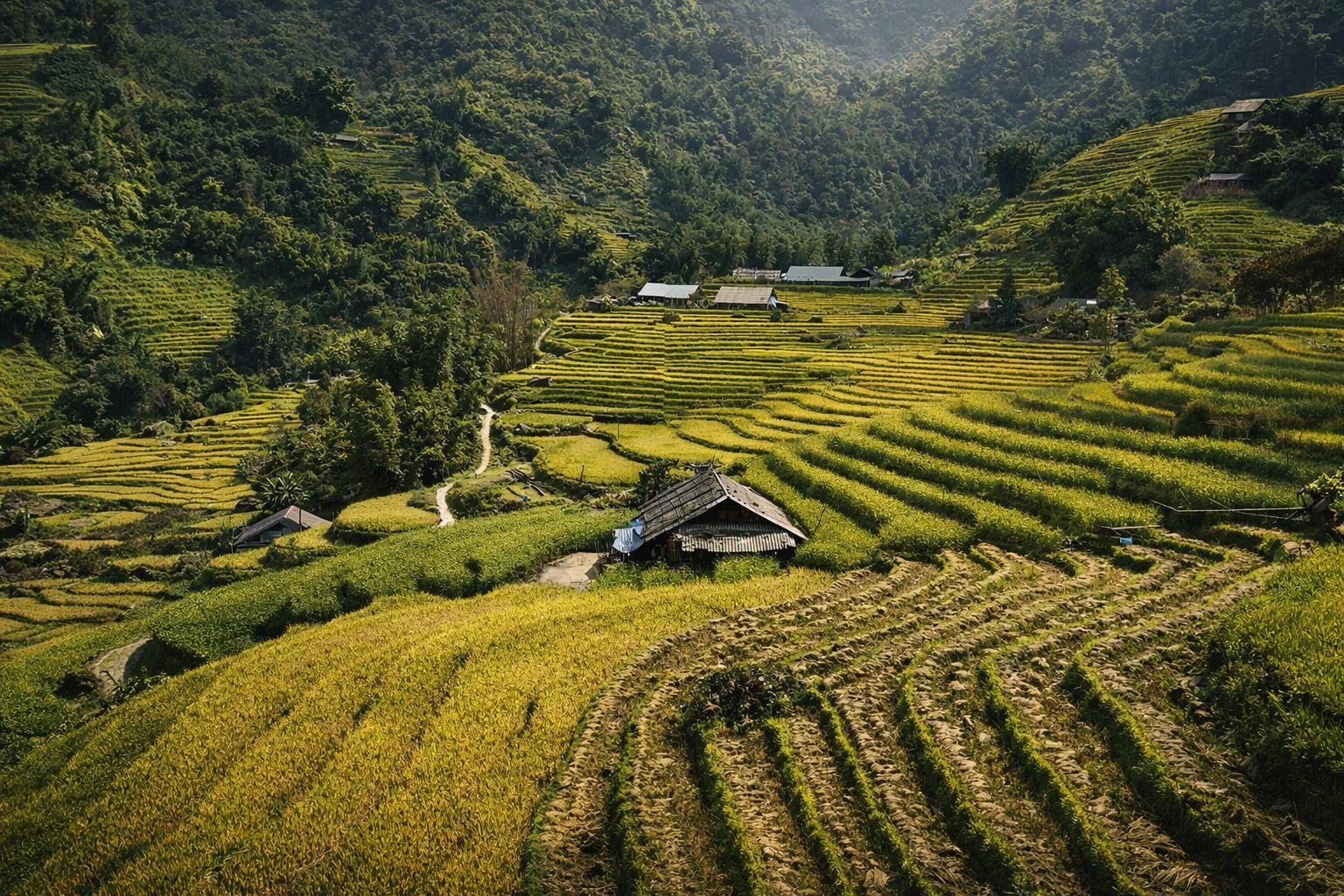

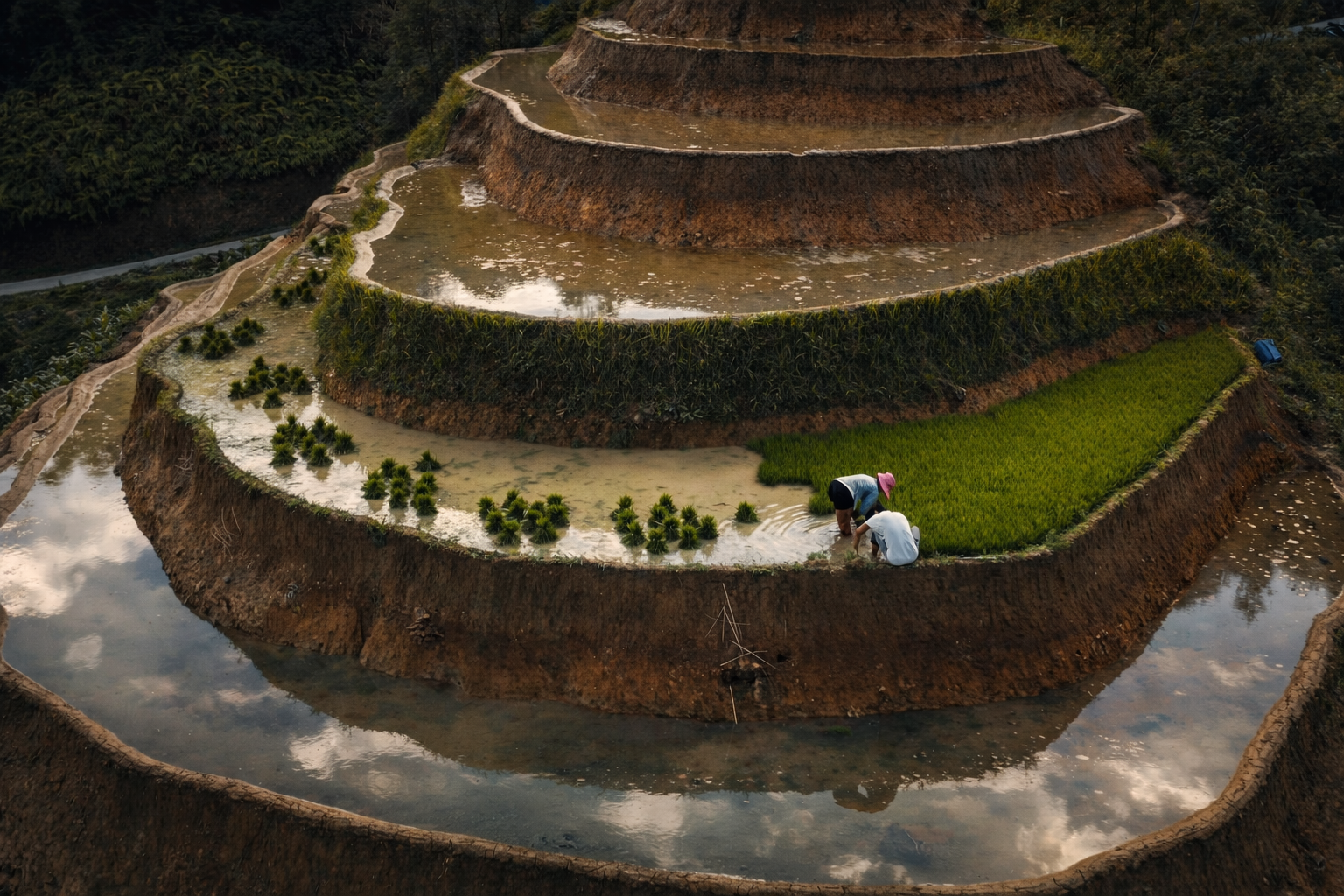
Sapa’s beauty, however, has never rested on scenery alone. What gives Sapa its real depth is the fact that this is also a lived cultural landscape, shaped over generations by Hmong, Dao and other ethnic communities whose knowledge, labour and traditions are inseparable from the land itself. The terraces are not only visually stunning. They are part of a wider system of farming, water management, seasonal movement, craftsmanship, food traditions and storytelling that has allowed people to live with these mountains rather than simply pass through them. The forests, too, are more than a backdrop. They are part of the ecological and cultural fabric of the region, feeding streams, sheltering biodiversity and sustaining daily life in ways that are not always visible to outsiders at first glance.
This is one of the reasons Sapa has held such enduring appeal for travellers. People come for the magnificent views, certainly, but also for the feeling that the landscape is still alive with meaning. They come to walk through valleys where farming and culture still shape the terrain, to learn from people whose lives remain closely tied to season and place, and to experience a region where beauty has long been created through relationship rather than design. It is reflected time and again in the stories travellers share afterwards, where the most meaningful moments are rarely about a viewpoint alone, but about conversations, shared meals, time spent in the fields, and the quiet realisation that they have been part of something lived rather than simply observed.
That is precisely why the changes now taking place matter so deeply. Sapa still possesses areas of outstanding natural beauty, rich cultural life, beautiful forests and extraordinary rice terraces, yet the conditions that have sustained all of this are becoming increasingly fragile. The threat is not only to a view, but to the deeper connection between landscape, livelihood and identity that has long made this region so special.
The Landscape That Once Held Everything Together
There was a time when the rhythms of Sapa’s mountains felt inseparable from one another. The terraces curved through the valleys not only as a visual spectacle, but as a living system that held together water, soil, forest, culture and livelihood in a quiet, enduring balance. Travellers arrived and found themselves walking through a place where agriculture was not hidden from view, but fully present, shaping every step of the journey.
To stand above a terrace in the early morning mist was to witness something far deeper than scenery. Water moved slowly from one paddy to the next, reflecting a sky that shifted with the hour, while farmers worked with an ease born of generations. Children moved along narrow bunds, herbs were gathered at the edges, and the forest above fed everything below with shade, moisture and life.
These terraces were never simply fields of rice. They were complex agroecological worlds, layered with edible plants, aquatic species, insects and seasonal knowledge that ensured survival in a demanding mountain environment. Tourism, in its earliest and most meaningful form here, was drawn to that complexity. People came not only to see, but to feel the connection between land and life.
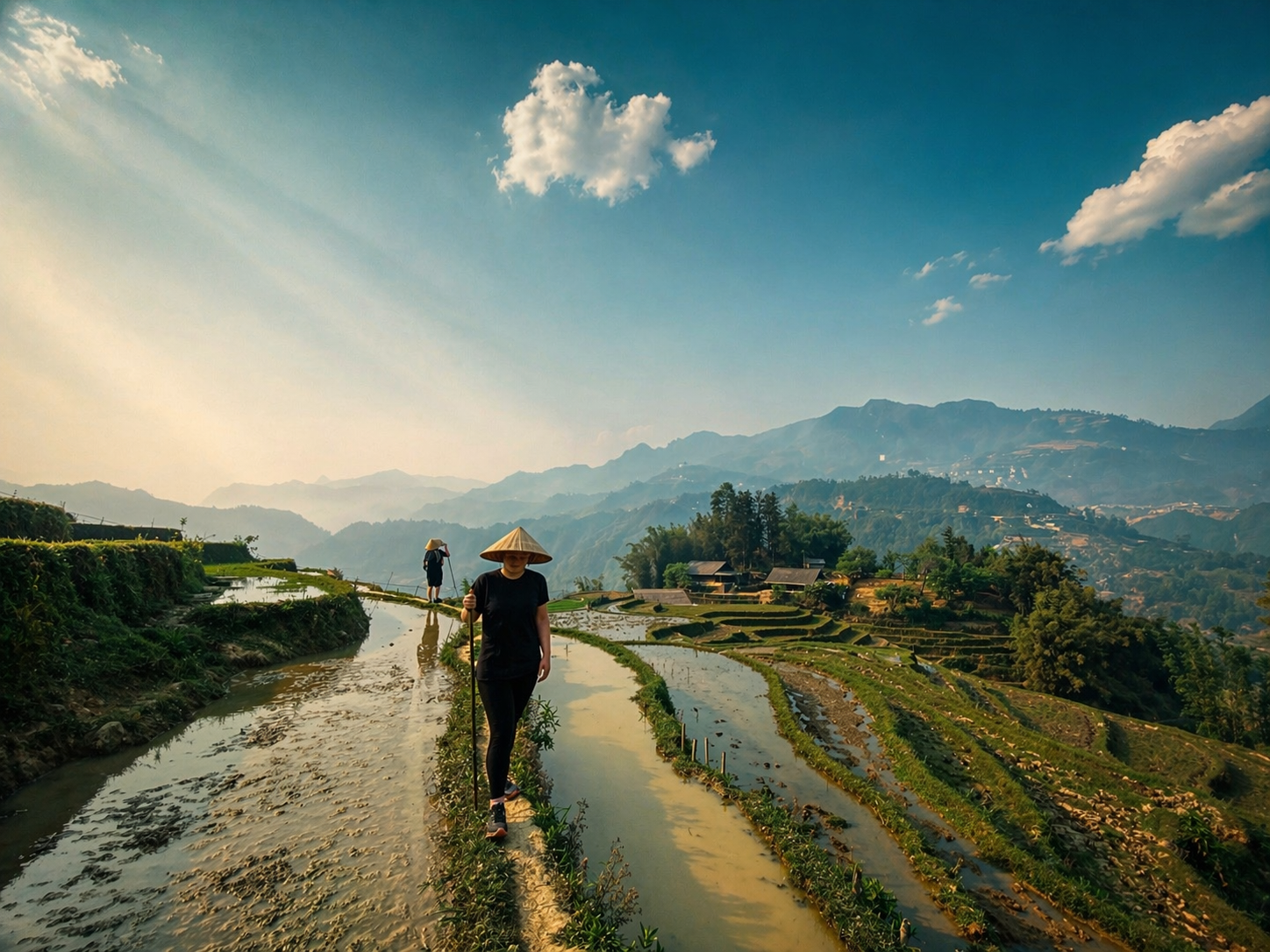
The Quiet Shift Beneath the Surface
Today, that connection is under strain. The most significant change in Sapa is not the disappearance of farming, but the transformation of what farming has become. Across parts of the region, terraces that once held rice and a diversity of supporting life are increasingly planted with flowers, strawberries, tomatoes and medicinal crops like artichoke.
On paper, this shift makes sense. These crops offer higher financial returns, stronger links to buyers, and alignment with provincial strategies that promote “high-tech” agriculture. For many households, especially those still actively cultivating their land, this transition has brought real and tangible economic benefits. New income streams have meant improved housing, access to education, and a degree of financial stability that subsistence rice alone could not always guarantee.
Yet something fundamental has changed in the logic of the land. Where terraces once followed seasonal cycles shaped by community knowledge and ecological limits, they are now increasingly tied to market demand, contract systems and production schedules. The pace has quickened. Inputs have intensified. The relationship between farmer and land has, in some places, shifted from stewardship to output.
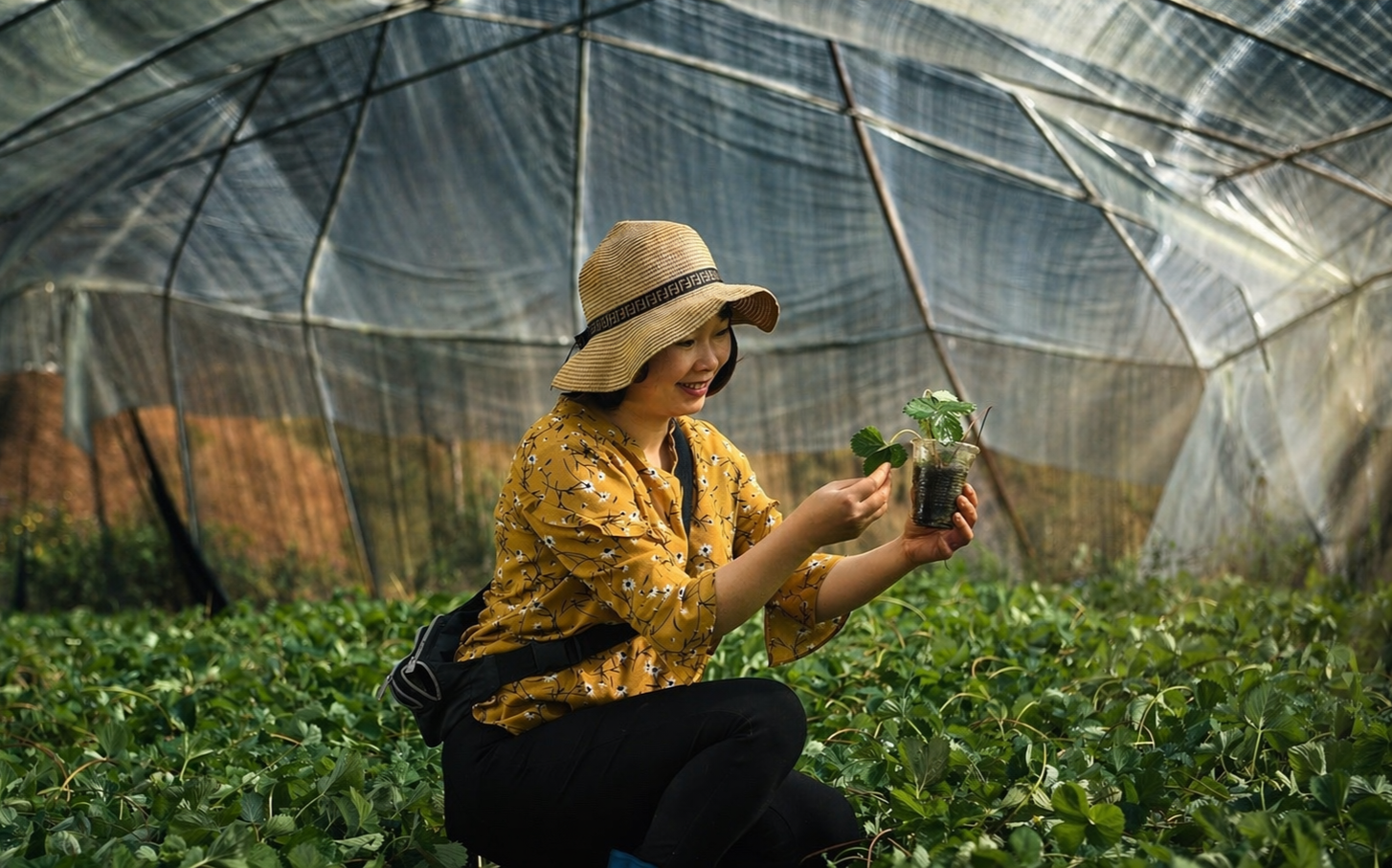
Plastic on the Mountains
The most visible symbol of this transformation is not the crops themselves, but what now covers them. Plastic sheeting, greenhouse tunnels and netted structures have begun to appear across landscapes that were once defined by open, flowing terraces.
From a distance, these materials interrupt the natural lines of the mountains. Where water once shimmered across stepped fields, there are now opaque surfaces that reflect harsh light and fragment the visual harmony of the valley. In places, the land begins to resemble something closer to industrial agriculture than a living cultural landscape.
This is not simply an aesthetic concern. The introduction of plastic infrastructure brings with it a cascade of environmental questions. In mountainous terrain where wind, rain and gravity are constant forces, plastic does not remain neatly contained. It tears, it fragments, and it moves. Pieces are carried into waterways, caught in vegetation, or broken down into smaller particles that settle into soil and water systems.
Waste management systems in rural Vietnam are not equipped to handle this scale of agricultural plastic. The likely outcomes are informal disposal, burning, or gradual leakage into the environment. Each of these pathways carries consequences, not only for ecosystems, but for the communities who depend on them.
The Chemical Landscape
Less visible, but equally significant, is the increasing reliance on chemical inputs. Intensive flower farming in Sapa has already been associated with frequent pesticide application, sometimes occurring every few days during peak growing periods.
The implications extend beyond the fields themselves. In tightly woven mountain communities, where homes sit close to cultivated land, chemical drift does not respect boundaries. It moves with the wind, settles into water channels, and becomes part of the daily environment.
For travellers, this is rarely part of the narrative they are presented with. For local residents, it is something they live alongside. The sensory experience of the landscape shifts subtly but undeniably. The scent of wet earth and forest is, at times, replaced by something sharper, more intrusive.
Tourism Without Its Roots
The irony at the heart of this transformation is difficult to ignore. Tourism remains the dominant economic force in Sapa, built largely on the appeal of its landscapes and cultural heritage. Yet the very elements that draw visitors are being altered by the parallel drive for agricultural intensification.
Rice terraces are not valuable to tourism simply because they are beautiful. Their value lies in what they represent. They are evidence of a way of life, of knowledge systems that have evolved in response to place, and of a relationship between people and land that feels increasingly rare in the modern world. When terraces are reshaped, covered, or managed in ways that prioritise short-term yield over long-term balance, that deeper meaning begins to erode. What remains may still be visually striking in parts, but it risks becoming a surface-level experience, disconnected from the lived reality that once gave it depth.
Travellers are perceptive. They notice when something feels authentic and when it does not. A landscape dotted with plastic, or a valley where chemical farming dominates, sits uneasily alongside the idea of Sapa as a place of cultural and environmental richness.
Power, Ownership and Who Decides
It is important to recognise that this story is not simply one of local farmers choosing to abandon tradition. In many cases, ethnic minority households remain active producers, particularly in crops like artichoke where contract systems provide stable buyers. The imbalance lies elsewhere. The higher-value parts of the agricultural chain, as well as much of tourism development and planning, are more often controlled by external actors, including Kinh businesses and outside investment. This creates a dynamic where local communities participate in production, but have limited influence over the broader direction of change. Decisions about land use, infrastructure and tourism strategy are not always made by those whose lives are most directly shaped by them. This disconnect adds another layer to the emerging conflict, one that is as much about agency as it is about economics.
A Fracturing Identity
Sapa now finds itself holding two competing visions of its future. One is rooted in rapid economic growth, modernisation and integration into wider markets. The other is grounded in cultural continuity, ecological balance and the preservation of a landscape that carries deep meaning. These visions are not inherently incompatible. The challenge lies in how they are pursued. When growth is driven without sufficient regard for the systems that sustain the land and its people, the result is not progress, but fragmentation. The terraces become divided in purpose. Tourism becomes disconnected from agriculture. The identity of the region begins to blur.
What Is at Stake
This is not simply about whether Sapa remains beautiful. It is about whether it remains meaningful. A landscape can survive visual change and still retain its essence, but only if the relationships that underpin it are respected. When those relationships are weakened, the loss is harder to measure. It appears gradually, in the disappearance of certain plants, in the quiet absence of seasonal practices, in the way stories are no longer told because the conditions that gave rise to them have changed. For tourism, this is a critical moment. A destination built on authenticity cannot afford to erode the very foundations of that authenticity. The risk is not immediate collapse, but a slow decline in what makes the place distinct.
Paths Forward: Reconnection Rather Than Replacement
There is still time to choose a different path. The goal does not need to be a return to the past, nor a rejection of economic opportunity. It requires a more thoughtful integration of the two. Agroecological farming practices, rooted in traditional knowledge but supported by appropriate innovation, offer one direction. These approaches maintain biodiversity, reduce chemical dependency, and preserve the multifunctional nature of the terraces.
Tourism can play a more active role in supporting this shift. When travellers are invited to engage with farming as it truly exists, to understand its complexity and value, they become part of a system that rewards preservation rather than replacement. Stronger regulation and enforcement around land use, particularly in protected heritage zones, is essential. The legal frameworks already exist. The challenge lies in ensuring they are applied in ways that genuinely protect the integrity of the landscape.
Equally important is the inclusion of local communities in decision-making processes. Those who live and work on the land must have a meaningful voice in how it evolves. Without this, any solution risks repeating the same patterns of imbalance.
A Question That Cannot Be Ignored
Sapa stands at a point where the choices made in the coming years will shape its identity for generations. The question is not whether change will happen, but what kind of change it will be. Will the terraces remain living systems that sustain both people and place, or will they become fragmented into separate functions, each serving a different economic purpose but no longer connected?
For those of us who walk these mountains, who share meals in village homes, who listen to stories carried through generations, this is not an abstract debate. It is something felt in every step across a field, in every conversation about what the future might hold. The path forward is not simple. It requires honesty, collaboration and a willingness to challenge assumptions about what progress looks like. It asks whether we are willing to value connection over convenience, and long-term resilience over short-term gain.
Sapa has always been a place shaped by relationships. The task now is to decide which relationships will be protected, and which will be allowed to fade.
Who Speaks for Sapa? Tourism, Influence and the Quieting of Local Knowledge
Sapa is more than neon lights, cable cars and curated viewpoints. Beneath the surface lies a quieter story shaped by local communities whose voices are too often overlooked. This article explores sustainable tourism, overtourism, cultural erosion and why listening to local knowledge is the key to experiencing the real Sapa.
Two Sapas, One Narrative
There are two conceptual Sapas that exist side by side, though only one tends to dominate the story. The first is the town, a rapidly expanding centre shaped by hotels, neon lights, restaurants and a steady current of visitors moving through tightly organised itineraries. The second is the wider mountainous region, where Hmong, Dao and other ethnic communities continue to live within landscapes they have shaped and understood over generations.
The distinction between these two is geographic but also about whose voices are heard, whose knowledge is valued, and whose version of Sapa becomes visible to the outside world. In practice, the narrative is rarely led by those who know the land most intimately. Compare the two images below and it would be easy to assume they are entirely different places, yet both exist within the same region. Which one you see, and how you choose to experience it, is a decision left to every traveller.
A busy scene at the Moana Sa Pa viewpoint, where crowds of tourists gather around a stylised stone structure overlooking the valley.
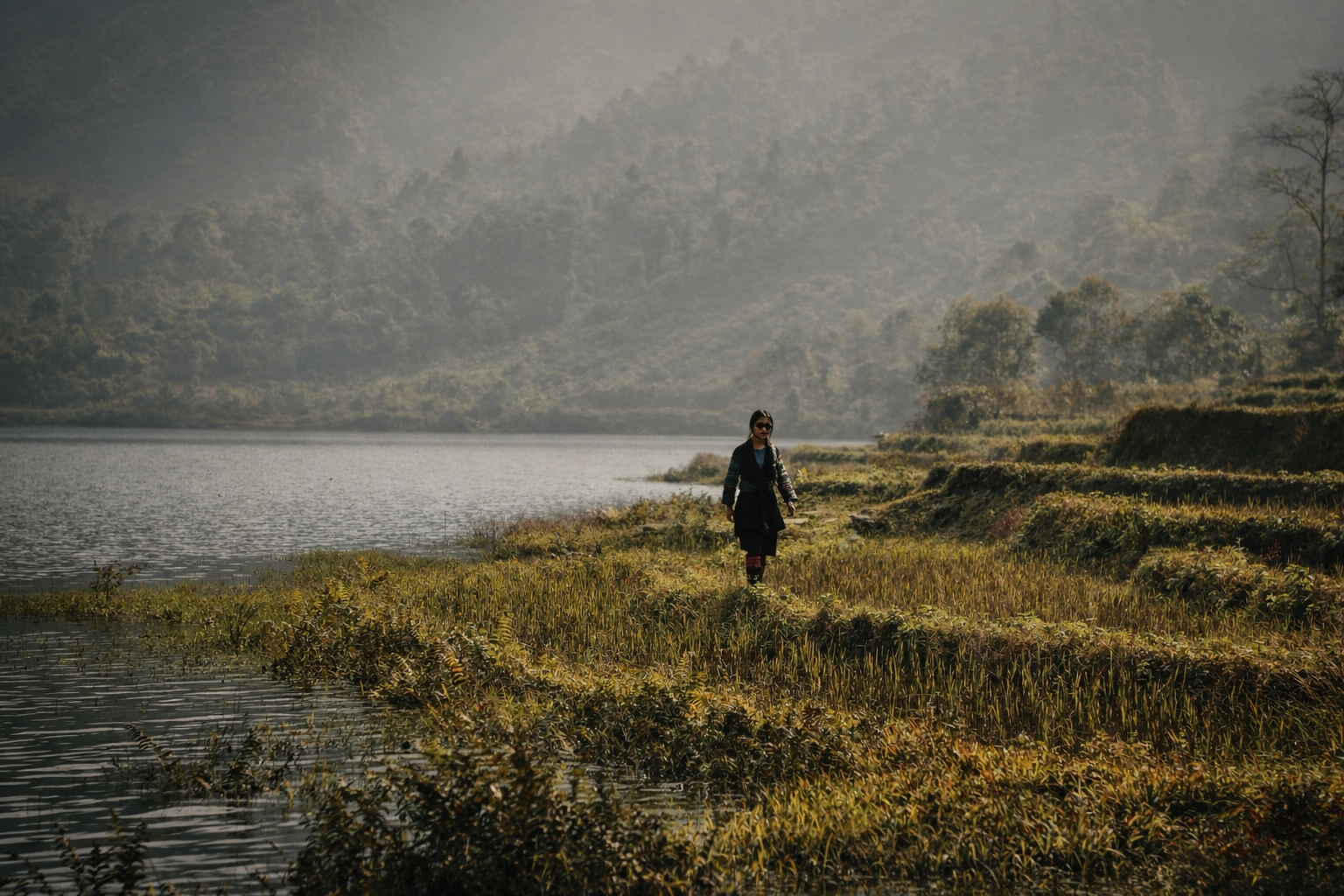
Terraced fields in rural Sapa. The quiet landscape evokes a sense of isolation and connection to nature, far removed from the bustle of the town.
The Expanding Centre and Its Reach
Sapa town has become a focal point in Vietnam’s tourism growth, particularly as 2026 continues with expectations of record visitor numbers. Infrastructure continues to expand, and with it, the reach of the town’s influence. The closest surrounding villages feel this most strongly, particularly those integrated into standard trekking routes and day tours.
There is no clearer example than Ta Van. Once a quiet valley village, it now carries a distinctly cosmopolitan atmosphere shaped by the steady flow of international visitors. International-owned restaurants sit alongside multiple foreign-run bars, where western music carries late into the night, a soundscape that contrasts sharply with the rhythms of rural life that once defined the area. The infrastructure reflects this shift. Phone shops, convenience stores and other services tailored towards international guests are now part of the landscape. Homestays, while still marketed as local experiences, often follow a standardised model, offering wifi, hot showers and familiar comforts that prioritise convenience over cultural immersion. The conditions are accessible and comfortable, though increasingly detached from the way people in the village traditionally live.
Proximity to Sapa town is only part of the story. Terrain also plays a decisive role in shaping how tourism spreads across the region. In a landscape defined by steep valleys, narrow paths and winding mountain roads, accessibility is uneven. Some villages remain difficult to reach by minibus, which immediately limits their inclusion in standard itineraries. Where road access is poor, large groups cannot be dropped off or collected easily, and that alone has a powerful effect on where tourism concentrates.
This helps explain why some places absorb far greater visitor numbers than others, even when they are not dramatically further from town. Ease of movement matters. Routes that allow for simple trekking, straightforward logistics and quick transfers are far more attractive to operators working with tight schedules, mixed abilities and high turnover. Villages that require more effort, stronger fitness or greater flexibility tend to sit outside the main mass tourism circuit.
Sùng Thì Do, a 21-year-old local Hmong woman from the region, describes this dynamic with particular clarity: “Some guests can’t walk up and down steep slopes very well. Guides are also limited when they trek with big groups and mixed abilities. When that happens, groups follow the same easy, set trails. They start in the same places and get picked up in the same places. Ta Van is so busy because it’s easy to walk to and easy to get picked up from. My village is the opposite, so few people visit. I like that my village is quieter and only gets visitors who are prepared to explore.”
Her observation reveals how geography quietly shapes the tourism map. Ta Van is not simply busy because it is close to Sapa town. It is busy because it is logistically convenient. Accessibility, rather than cultural depth, often determines which villages are repeatedly promoted and visited. The result is that places that are easier to reach become ever more visible, while villages that demand more time and effort remain marginal to the mainstream narrative.
That imbalance has consequences. Travellers are often led to believe that the busiest places are the most worthwhile, when in reality they are frequently just the easiest to package and sell. Villages that lie beyond the simplest routes may offer quieter landscapes, more intact rhythms of daily life and a stronger sense of cultural continuity, though they remain overlooked because they do not fit neatly into the mechanics of mass tourism.
What emerges is not a loss of place entirely, but a transformation of it. Ta Van continues to exist, though it is now shaped as much by external demand as by local practice. The closer a village sits to the centre of tourism, the more it reflects the expectations of those passing through it.
These spaces adapt under pressure. Movement becomes guided, encounters become shorter, and daily life begins to bend around visitor expectations. Places such as Cat Cat village are often presented as cultural windows, though the experience is carefully managed, shaped as much by commercial flow as by tradition. Cat Cat has become the clearest expression of mass tourism in Sapa. It is the most visited and most heavily managed of all the surrounding villages, designed to accommodate a constant flow of visitors moving through controlled pathways and curated viewpoints. Here, culture is often reduced to something visual and immediate. Visitors rent traditional ethnic clothing, garments that once reflected identity, ancestry and belonging, wearing them briefly for photographs before returning them and moving on.
What remains is a version of culture shaped for consumption. Meaning becomes detached from context, and tradition shifts towards performance. The experience is accessible and enjoyed by certain types of tourists and berated by others. The management of Cat Cat Village raises a quieter question about what is lost when authenticity gives way to replication.
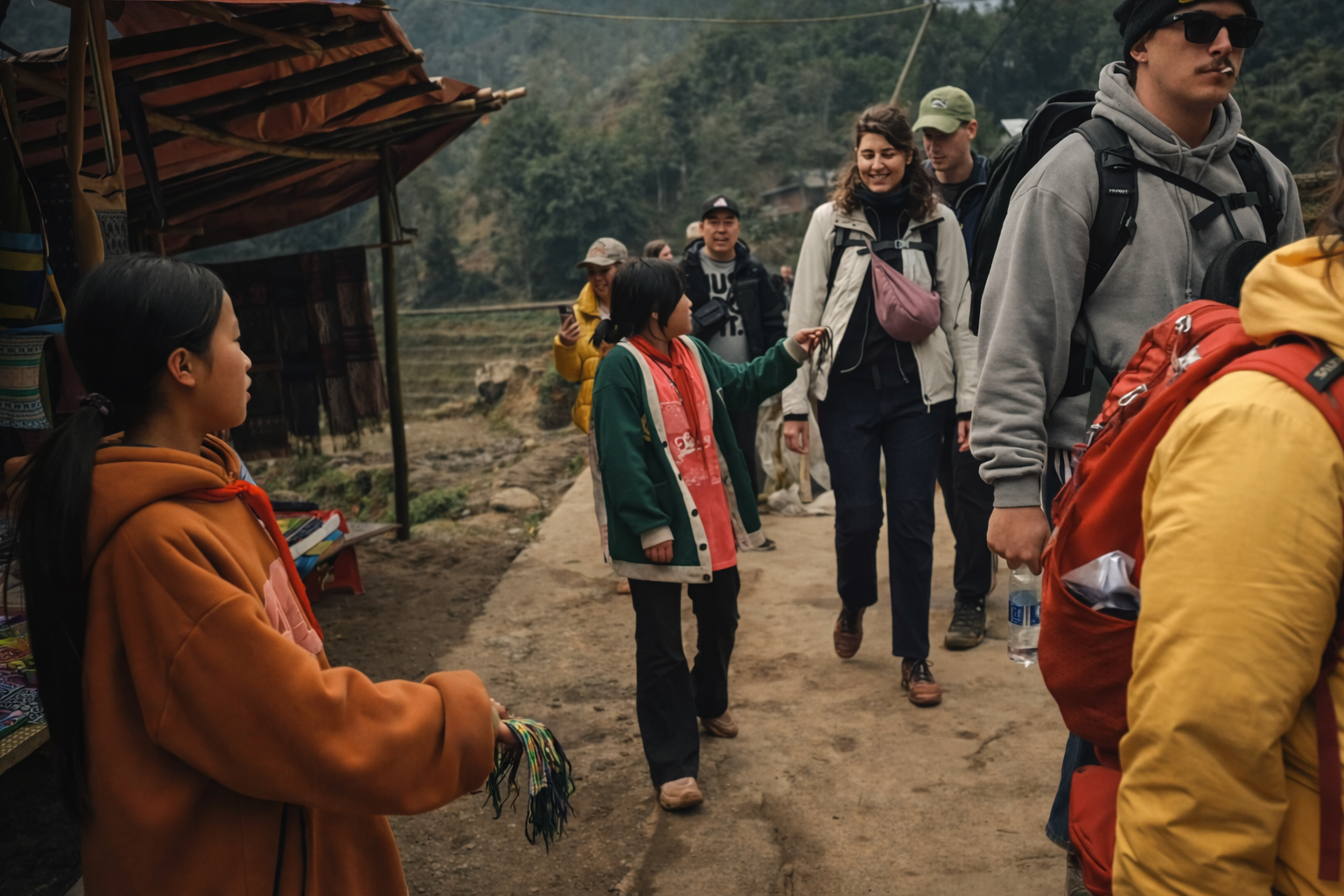
A large group of travellers on the standard Sapa to Ta Van trek. Local sellers line the route touting their wares.
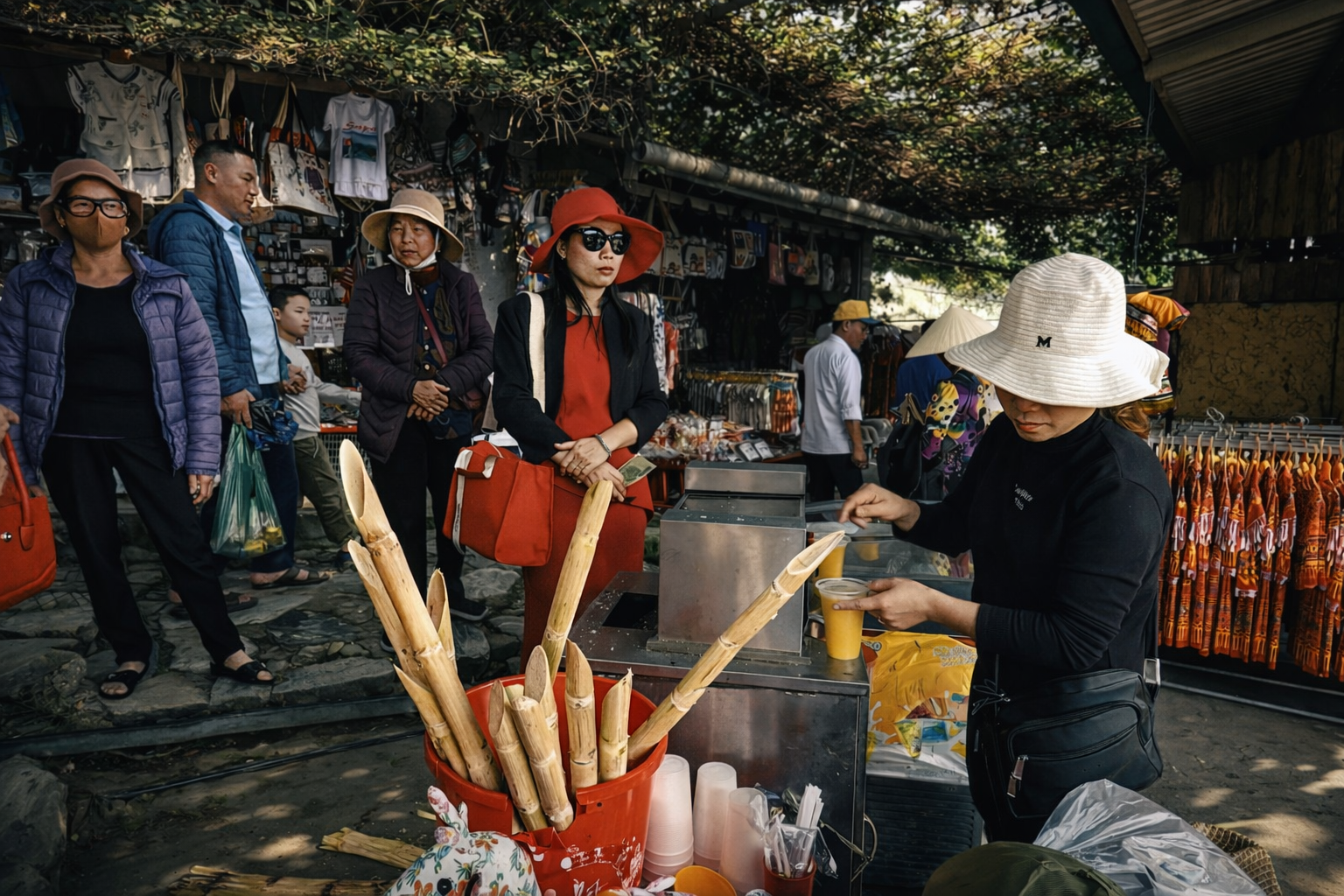
Vietnamese tourists buying snacks and machine made souvenirs in Cat Cat Village.
Rushing Through Sapa: A Destination on a Deadline
Most travellers arrive in Sapa on tightly structured schedules, often moving through Vietnam on predefined routes that allow for little flexibility. The typical visit lasts no more than two days, a timeframe that compresses the region into a checklist of highlights. There is limited opportunity to move beyond the most accessible sites, and even less incentive to do so when itineraries are built around speed and efficiency rather than depth.
Within this framework, certain attractions are positioned as essential. The cable car to Fansipan, along with other high-visibility sites, is frequently presented as unmissable. Moana has become one of Sapa’s most visited attractions. Hundreds arrive each day, drawn not by history or culture, but by staged photo sets. A giant fibreglass head. An imitation Bali gate. Sculpted hands lifting visitors above the landscape. Each structure exists for one purpose: to frame the individual.
There is also a quieter force at play. Repetition creates expectation. The same images circulate across social media and travel platforms until the experience begins to feel compulsory. Everyone has stood there. Everyone has taken that photograph. To skip it can feel like missing out. Travel, in this context, shifts from curiosity to confirmation, where presence is measured by what is seen and shared. This perception is rarely organic. It is shaped by a combination of influencer content, large-scale marketing campaigns and algorithm-driven recommendations that amplify the same locations repeatedly. The absence of alternative narratives, particularly from those who live in the region, allows this idea of “must-see” experiences to solidify without challenge.
Ly Thi Cha, a young Hmong woman from Sapa, describes this tension with clarity:
“I work together with ETHOS - Spirit of the Community who welcome visitors to Sapa, but not the busy touristy areas where things feel inauthentic and local people do not benefit. Sapa is my home and my people have a lot of pride. I am really passionate about the many meaningful experiences we can offer.”
Her words point to a distinction that is often overlooked. The issue is not tourism itself, but the concentration of attention in places that do not reflect the depth of what exists beyond them. As a result, movement concentrates around a narrow set of destinations. Travellers arrive, complete a sequence of activities and depart, often without engaging with the broader landscape or the communities that define it. The pace of travel reinforces the dominance of the town and its immediate surroundings, while more distant areas remain outside the frame.
Further from the town, the intensity begins to ease. The roads narrow, the pace shifts, and tourism becomes less defining. It takes more time and more intention to reach these areas, though it is here that the texture of everyday life remains more intact.
Ly Thị Mỷ, Cha’s older sister, reflects on how these changes are felt from within:
“There is building work in many areas close to Sapa town. Some of the big buildings look ugly and I don’t like to see that happening to my hometown too much. Now I like to go walking in the forest and to beautiful villages further from the town.”
The movement away from the centre is not only a traveller’s choice. It is also something local people themselves are seeking.
Who Speaks, and Who Is Considered “Local”?
The question of who is considered a local voice in Sapa is more complex than it appears. Hmong, Dao and other ethnic communities have lived in these mountains for generations, shaping the land through farming, craft and seasonal rhythms. Their knowledge is deeply rooted, carried through lived experience rather than formal documentation.
At the same time, the visible structure of the tourism economy tells a different story. Many businesses operating in Sapa town and its surrounding areas are owned or managed by people who have arrived more recently. A significant proportion of workers in hotels, restaurants and tour agencies are migrants from other parts of Vietnam, drawn by the opportunities that tourism creates. Their presence is now embedded within the local economy, though their connection to the landscape and its cultural systems is often limited by time and exposure. In practice, many of the people advising travellers and shaping itineraries are working within a fast-paced commercial environment, where the priority is to meet demand rather than to deepen understanding.
There is little space, and often little incentive, to explore the region beyond what is required for business. The financial rewards of mass tourism are immediate, and the energy it generates aligns with broader cultural preferences for lively, dynamic environments. The noise, the movement and the constant flow of people are not necessarily seen as negative. They signal prosperity.
May Lai, a Red Dao farmer and ETHOS guide, describes this shift in more personal terms:
“Sapa is too noisy now. My two children like to visit sometimes but the roads are busy and it feels like a big city. I am happy to return to the quiet of my village where things are much more peaceful.”
Within this structure, the voices of those with generational ties to the land are pushed to the edges. Their knowledge remains intact, though it is rarely the knowledge being sold. The people most visible to visitors are often those with the least lived connection to the place itself.
Many of those advising travellers operate within a system built on speed, volume and repetition. Recommendations are recycled. Routes are standardised. A concierge, a driver, a tour seller may confidently guide visitors through Sapa having never stepped beyond the same handful of well-trodden locations. Their understanding is second-hand, shaped by what sells rather than what is known.
There is little incentive to go further because the mainstream tourism industry does not reward curiosity. It rewards efficiency. This is reinforced by a broader cultural comfort with “đông vui”, the enjoyment of noise, density and constant activity. Crowds signal success. Movement signals life. In that context, the busiest places become the most desirable, not because they are the most meaningful, but because they are the most visibly alive.
The consequence is a quiet narrowing of perspective. Exploration becomes optional and depth becomes unnecessary. The same places are recommended, visited and validated again and again, until repetition replaces understanding.
Meanwhile, the people who know the land through seasons, through work, through generations remain largely unheard. Their knowledge is not missing but is simply not part of the system that defines what Sapa is supposed to be.
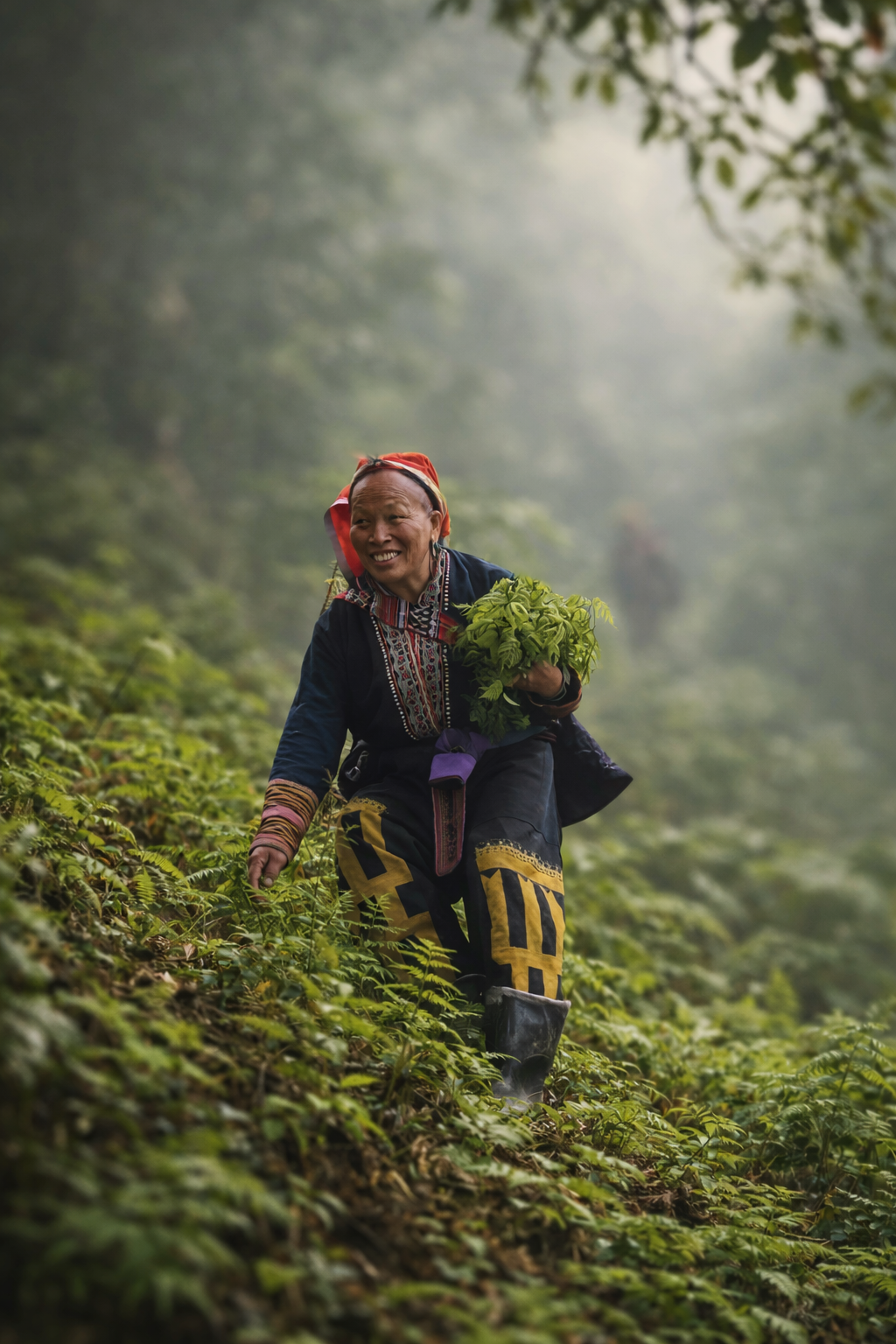
Tan Lo May - Red Dao guide foraging natural foods while trekking with ETHOS in Sapa.
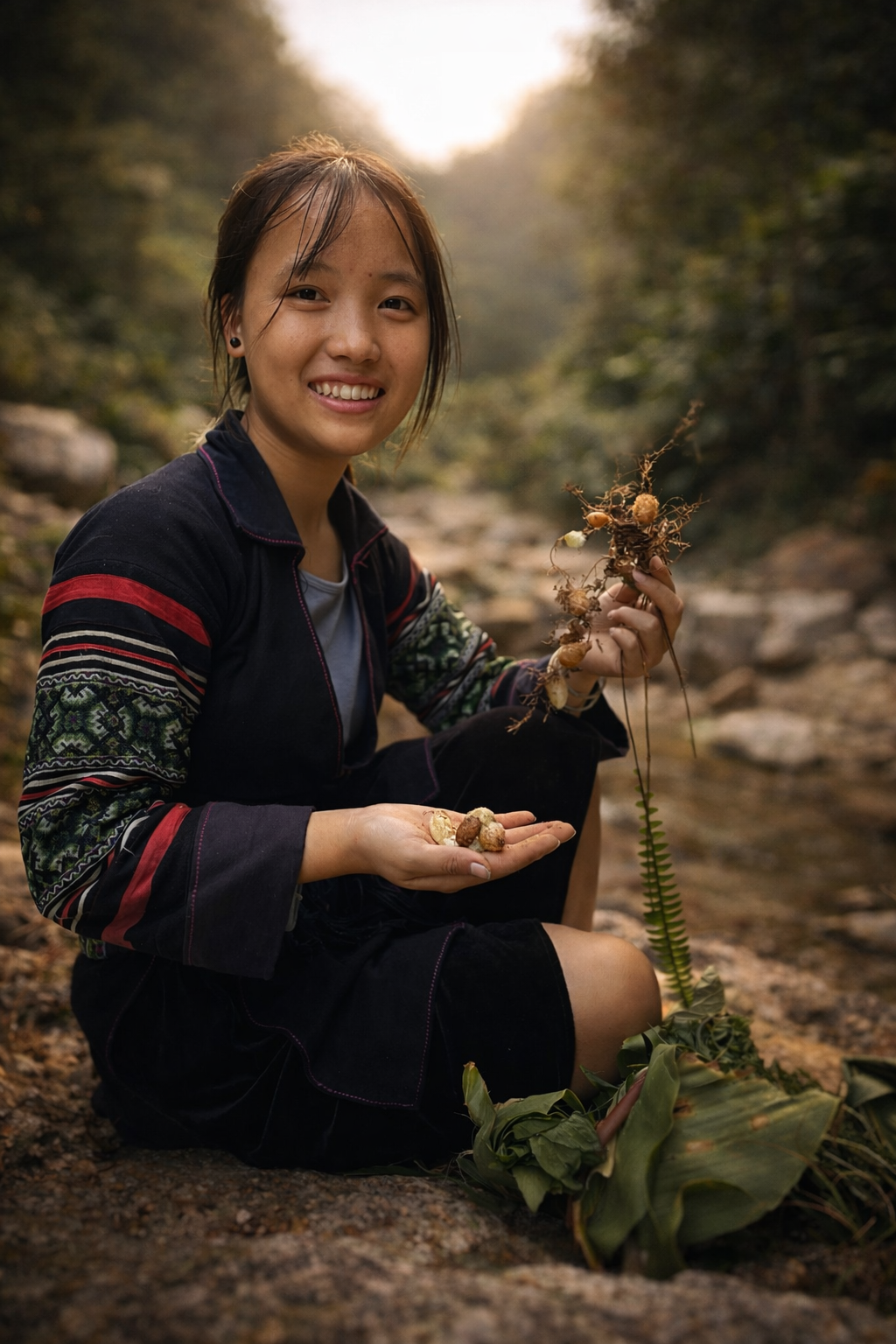
Ly Thi Cha - Black Hmong guide, community youth leader and advocate for Hmong culture in Sapa.
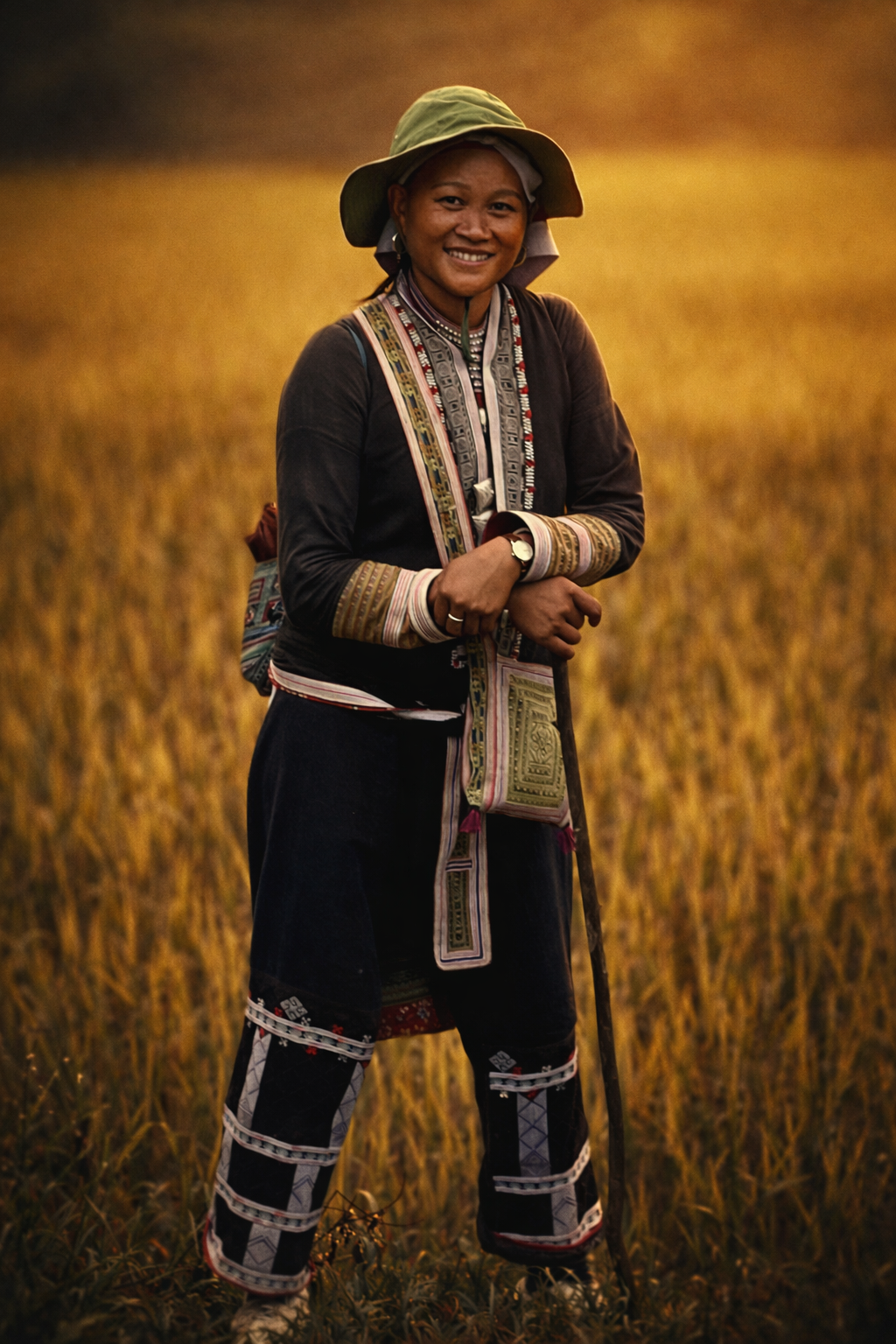
May Linh - Red Dao woman and ETHOS trekking guide in Sapa.
Đông Vui and the Shape of Demand
An understanding of the Vietnamese concept of “đông vui” provides additional context for the popularity of crowded and energetic environments. The term refers to spaces that are lively, animated and socially vibrant, often associated with prosperity and communal enjoyment. Restaurants filled with conversation, streets busy with movement and markets dense with activity are widely perceived as positive and desirable.
This cultural preference intersects with commercial incentives in ways that reinforce high-density tourism models. Businesses and local authorities tend to promote locations that can generate consistent footfall and economic return. Recommendations, both online and offline, frequently highlight places that embody this sense of energy and accessibility. As a result, sites such as Moana Sapa and Cat Cat village become focal points within the tourism landscape, offering visually appealing and easily consumable experiences that align with broader expectations.
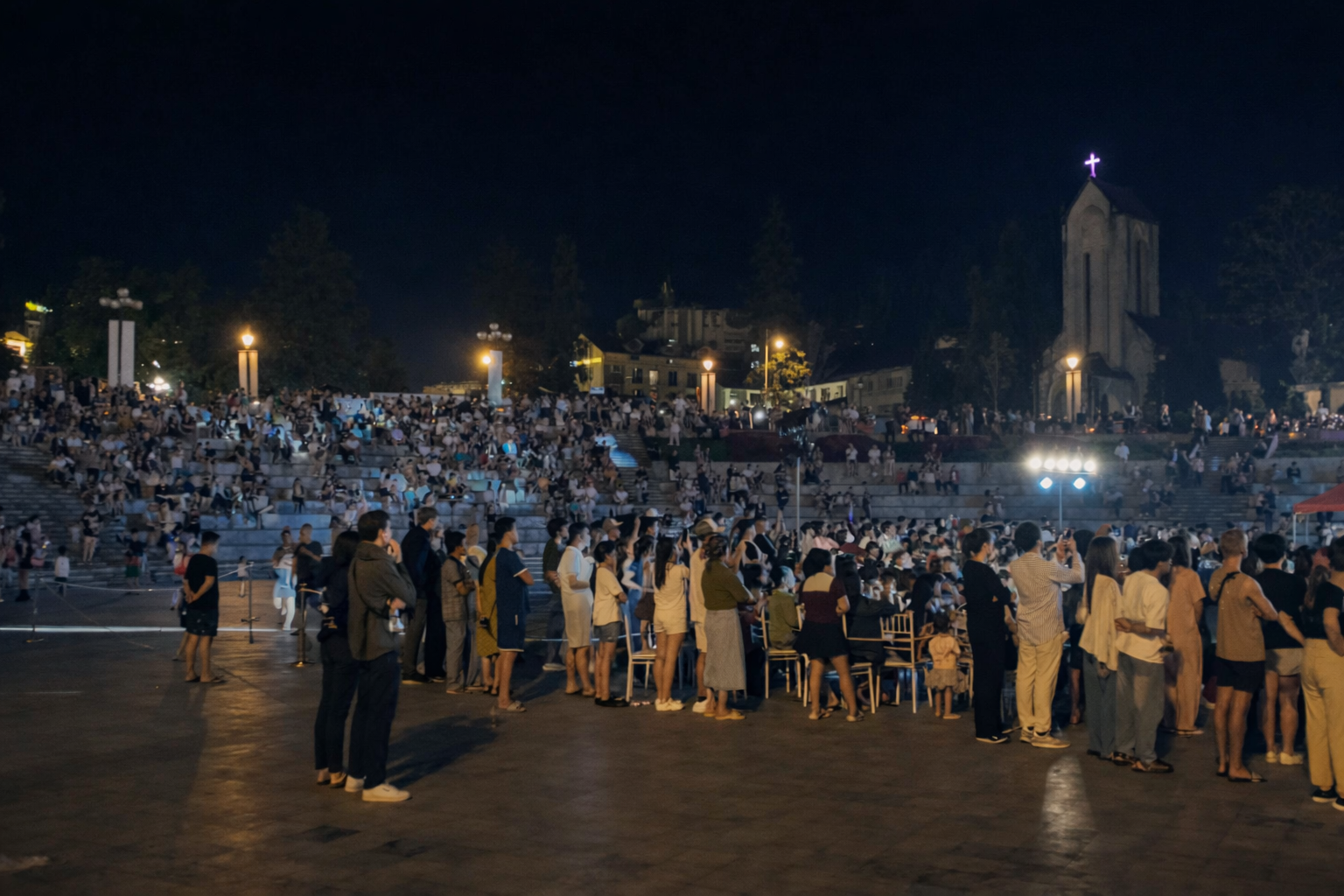
A bustling night time gathering in Sapa square in the heart of town.
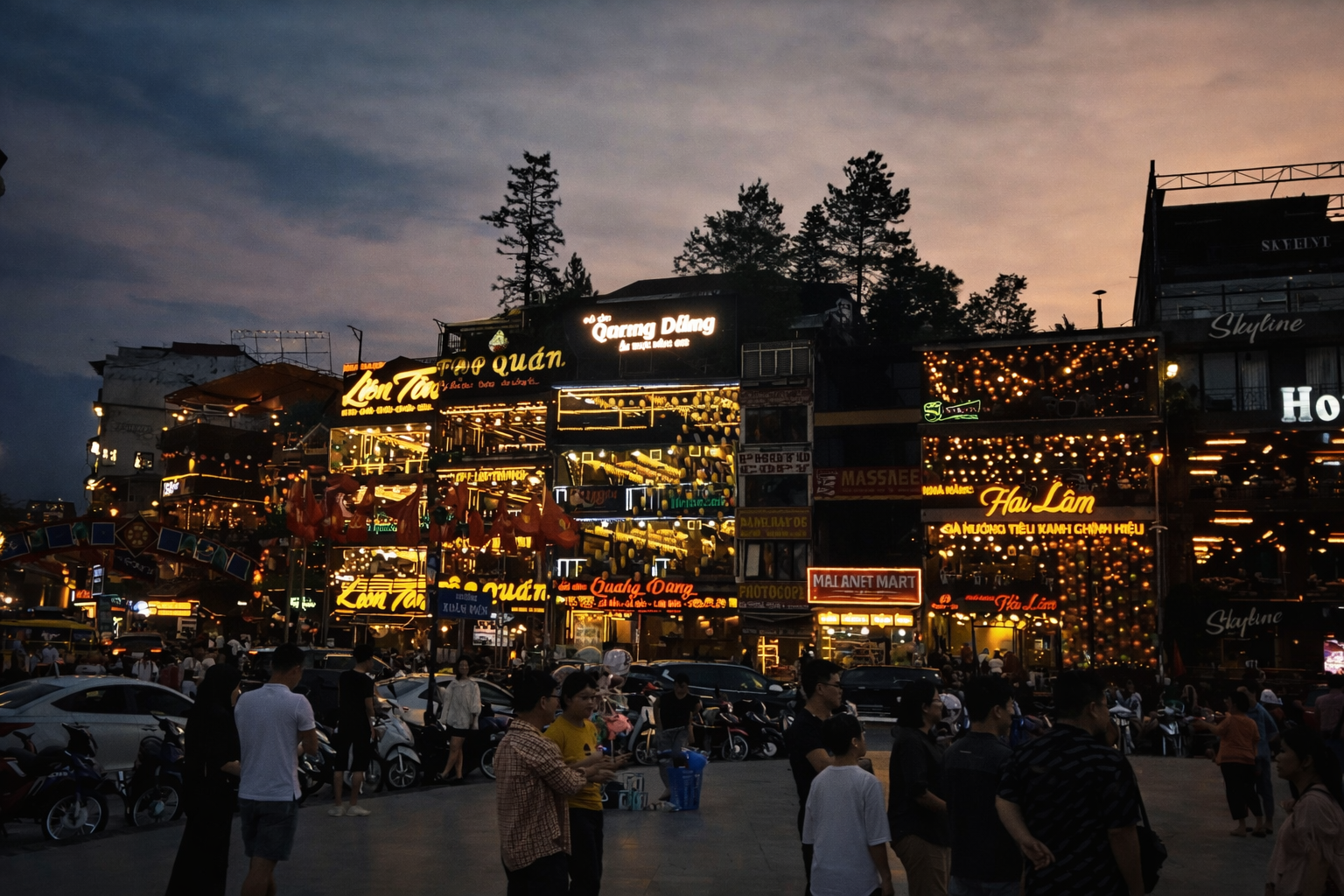
A lively Sapa street at dusk filled with brightly lit restaurants, and crowds of people. The warm glow of lights and dense activity reflect Sapa’s growing nightlife and tourism-driven economy.
Expertise Without Amplification
A striking imbalance sits at the heart of Sapa’s tourism story. A traveller who spends a single day in the region can share their impressions instantly with a global audience, their voice amplified through social media, blogs and algorithm-driven platforms. These impressions, however brief, often carry more weight than the knowledge of those who have lived here for decades.
Local expertise exists in forms that are not easily captured online. It is embedded in the way terraces are cultivated, in the understanding of weather patterns, in the preparation of food, in textile techniques passed from one generation to the next. It is held in memory, in practice and in conversation rather than in written or digital form.
Many of these voices remain largely offline. Literacy barriers, limited access to technology and the demands of daily life all contribute to this absence. Their knowledge is not absent in reality, though it is often absent from the platforms that shape perception. What emerges is a situation where those with the least lived experience can become the most visible narrators.
Cha reflects on what is often lost in this imbalance:
“As a local, I believe people travel to experience, to immerse themselves and to learn. Local people are always happy and appreciative when they can share small things with you, whether it is food, plants or simple conversations. Those moments help you remember and truly value the people. Most of my relatives don’t read or write. They don’t use social media or YouTube. The only way you can share with them and learn from them is to visit in person.”
Cha is equally direct about how Sapa is presented to the outside world. She describes a growing frustration with the way popular platforms reduce the region to a handful of highly manufactured attractions. Moana, Cat Cat, rainbow slides, alpine coasters, these are repeatedly framed as the essence of Sapa, despite having little connection to the people who actually live there.
What unsettles her most is not just the inaccuracy, but the scale of its reach. The same narratives are recycled across YouTube and social media, often by people who have spent only a short time in the region, yet their content attracts vast audiences. Visibility, rather than understanding, becomes the measure of authority.
In this version of Sapa, interchangeable experiences take centre stage. Attractions that could exist almost anywhere are presented as unique, while the cultural depth of the region is pushed further out of view. The result is a distortion that is repeated so often it begins to feel like truth.
The Algorithmic Loop
The growing influence of artificial intelligence and search algorithms adds another layer to this imbalance. Recommendation systems tend to prioritise what is already visible, drawing on the most frequently mentioned locations, reviews and data points. Popularity becomes self-reinforcing.
Travellers searching for Sapa are guided towards the same set of attractions, the same viewpoints, the same itineraries. Sites such as Moana Sapa or Cat Cat village appear repeatedly, not necessarily because they offer the most meaningful experiences, but because they are the most widely discussed. This creates a feedback loop. Visitors follow these recommendations, share similar content, and further strengthen the prominence of these locations. Over time, the narrative narrows. What is easily found becomes synonymous with what is worth seeing.
The quieter, less visible experiences remain outside this loop. They are not absent, though they require a different kind of search. One that is guided not by algorithms, but by people.
Regulation and the Question of Protection
Tourism in Vietnam operates within a framework of oversight, with requirements such as the registration of foreign guests contributing to a controlled environment. This demonstrates a capacity for regulation, though it does not necessarily extend to managing the cultural and environmental impacts of tourism growth.
As visitor numbers increase, questions arise around what forms of protection, if any, will be implemented. The economic incentives are clear, and the benefits of tourism are tangible. At the same time, the long-term integrity of places like Sapa depends on maintaining the conditions that make them meaningful.
Listening to local knowledge could play a central role here. Those who live within these landscapes hold insights into how they function, how they change and what they require to remain viable. Whether these perspectives are included in decision-making processes remains uncertain.
Listening as Practice
To listen, in Sapa, is not a passive act. It involves stepping outside of pre-designed itineraries and allowing time for interactions to unfold. It may mean walking a little further, sitting a little longer, or accepting that not everything will be immediately explained.
Experiences shaped in this way are not fixed in advance. A guide may adjust the pace based on the terrain or the weather. A host may cook what is already being prepared for the family. A conversation may move in an unexpected direction, shaped by curiosity rather than by schedule.
What emerges is not a performance, but a moment within an ongoing way of life. You are not observing from a distance. You are present alongside it.
Living Knowledge, Not Displayed Culture
The distinction between living culture and curated experience becomes clearer over time. A weaving session is not an isolated activity designed for visitors. It is part of a daily rhythm that continues whether anyone is watching or not. Farming, cooking and storytelling follow similar patterns.
When these practices are approached as living knowledge, rather than as attractions, the nature of engagement shifts. There is less emphasis on consumption and more on understanding. The value lies not in what is shown, but in what is shared.
Regeneration Through Recognition
When local knowledge is recognised and respected, the outcomes extend beyond individual experiences. Small changes begin to take shape. A returning traveller may notice a hillside beginning to recover. A guide may speak about new possibilities for her family.
These shifts are often subtle. They do not present themselves as large-scale transformations, though they carry weight over time. They reflect a form of regeneration that is rooted in continuity rather than disruption.
Leadership, particularly among women, becomes visible through action. It is present in the way decisions are made, in how knowledge is passed on, and in how visitors are welcomed. There is no need for overt declaration. The authority is evident in practice.
When Tourism Becomes Reciprocal: Moving Beyond Sustainability
Sustainability in Sapa is often reduced to a label, something claimed rather than examined. In practice, tourism is not neutral. It shapes landscapes, influences livelihoods and determines whose voices are heard and whose are overlooked.
What matters is not just how people travel, but who defines the experience. At ETHOS, tourism is approached as a shared system rather than a product. Experiences are not designed in isolation or built around expectation. They are shaped in real time by the people who live here. A guide sets the pace because she knows the land. A host decides what to cook because it reflects daily life, not a menu. A route changes because something more meaningful is happening elsewhere. This is not about offering something different for the sake of it. It is about stepping away from a model that prioritises convenience and control, and allowing space for something more grounded to exist. In this way, travel becomes reciprocal. Travellers are not just passing through, but participating in something ongoing. Culture is not presented as a fixed experience, but lived as it always has been. The outcome is not something staged or guaranteed, though it is often more memorable for that reason.
The shift is subtle, though it changes everything. Communities are not positioned at the edge of tourism, but at its centre. Knowledge is not translated for an audience, but shared as it is. The experience is not extracted, but shaped together.
This is not a different activity but it is a different approach.
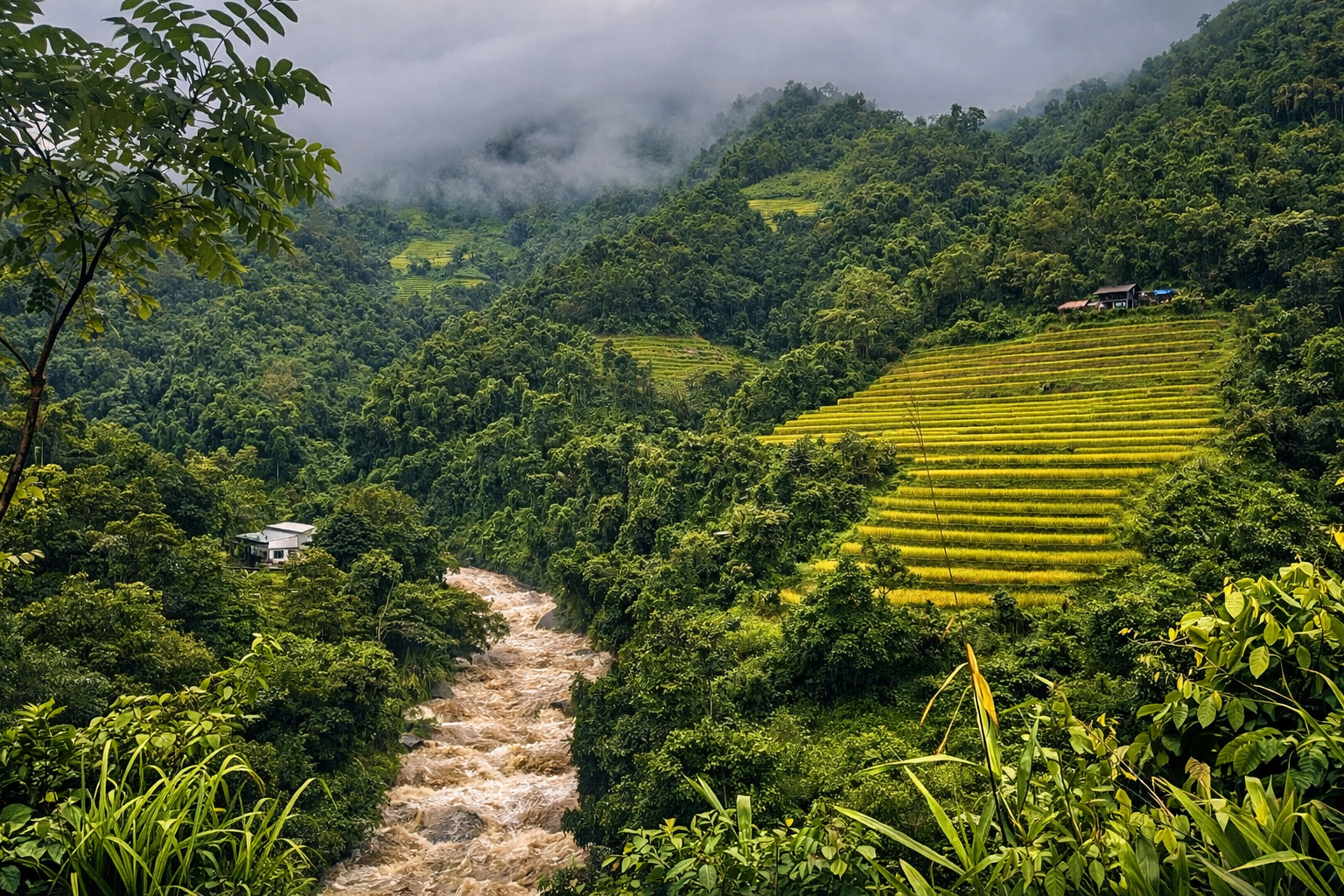
A winding river flowing through the Sapa rice terraces in August fields.
Sunlight breaking through the mountain peaks of the Hoang Lien Son range.

Close-up of green rice plants in the Sapa mountains.
A Question of Attention
The future of Sapa will not be defined by visitor numbers alone. It will be shaped by what those visitors choose to see, and more importantly, what they choose to ignore. The systems are already in place. Algorithms will continue to push the same locations. Itineraries will continue to compress experience into something fast, visible and easy to consume. The loudest version of Sapa will continue to dominate, because it is the easiest to find.
Nothing about that will change unless the traveller does. To listen in Sapa is not passive. It requires stepping away from what is repeatedly shown and moving towards what is rarely promoted. It means choosing time over speed, people over platforms, and presence over proof.
Cha says it simply:
“Of course, we do not want to tell you what you must or must not do. It is your choice, but more than anything else, what Sapa offers is its culture and its people.”
The reality is that Sapa does not need more visitors but it needs more time and attention. It needs travellers who are willing to go further, stay longer and listen more carefully. That is where everything begins to shift. Not in the places that are easiest to reach, but in the ones that require something of you. Not in the moments designed to be captured, but in those that unfold without an audience.
This is where experiences are not performed, but lived. Where a guide sets the pace because it makes sense for the land, not the schedule. Where a meal is shared because it is already being prepared. Where a conversation moves in a direction no itinerary could have planned. This is the work we are part of. Not to show you Sapa, but to step aside and allow it to be experienced through the people who live it. To create space for knowledge that is already here, but too often unheard.
You can follow the route that has already been mapped. Or you can take the time to find something else.
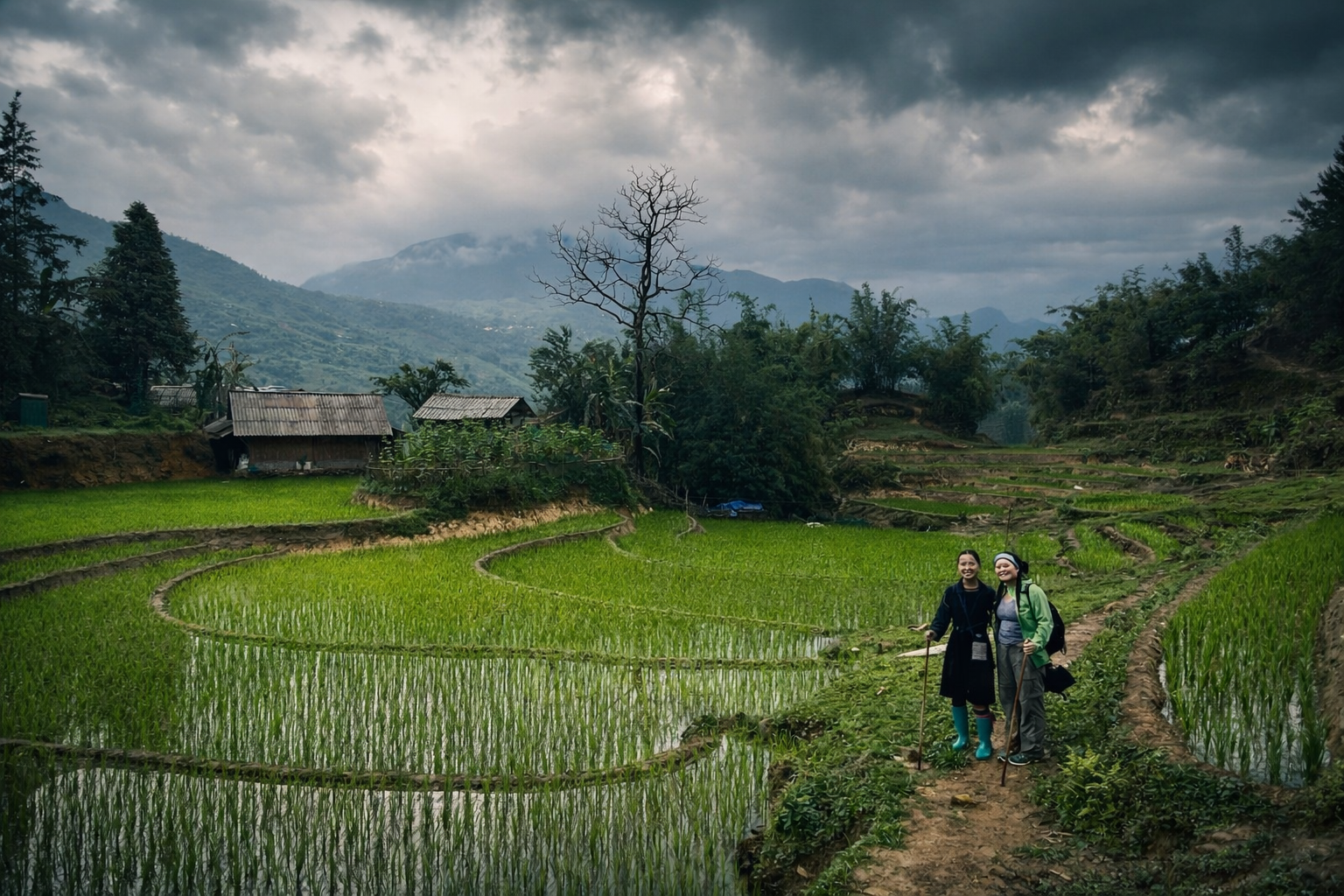
Ly Thi Cha trekking through lush rice fields as part of an ETHOS experience.
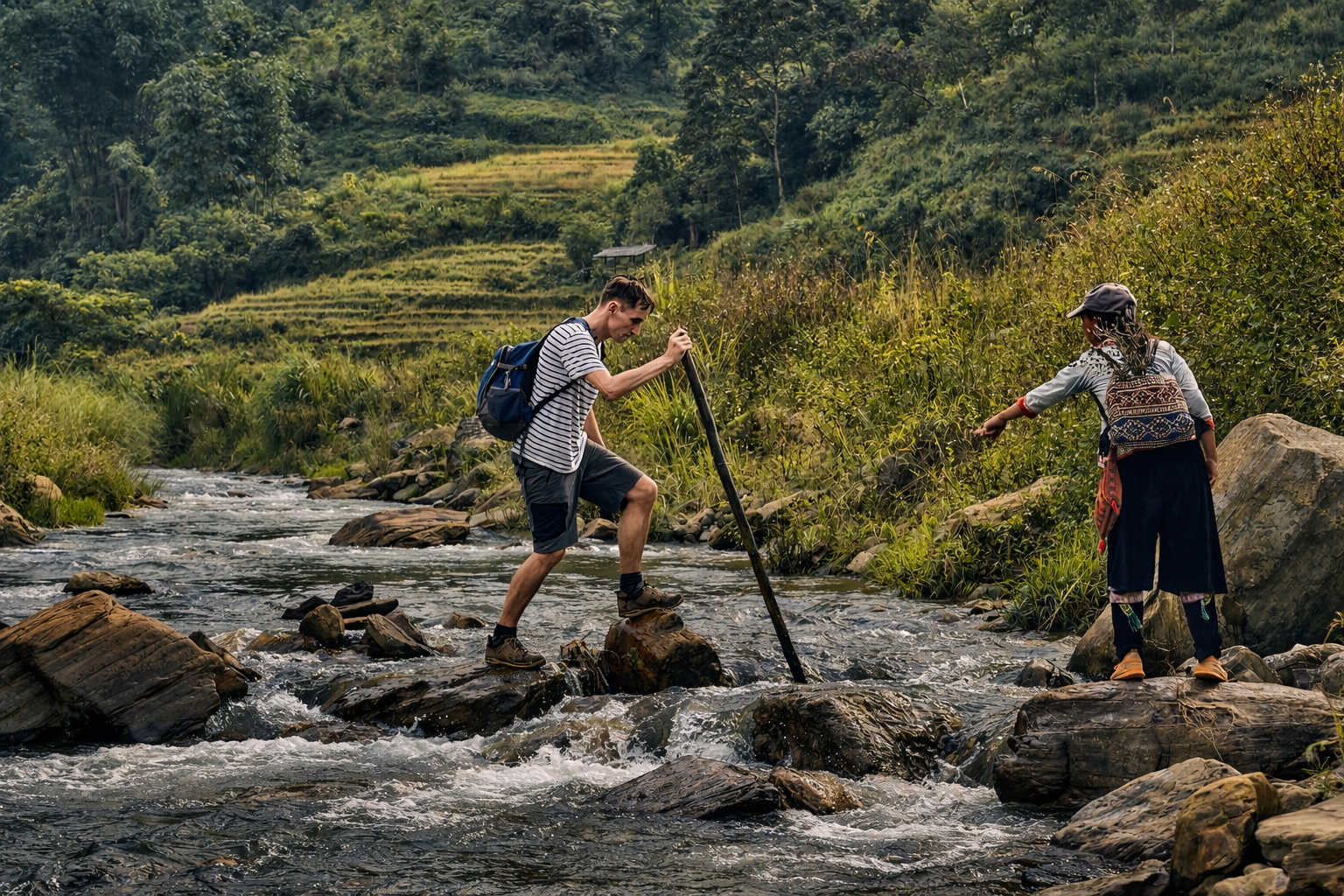
ETHOS guide Ly Thi Ker guiding a traveller across a rocky river, carefully leading the way through flowing water.
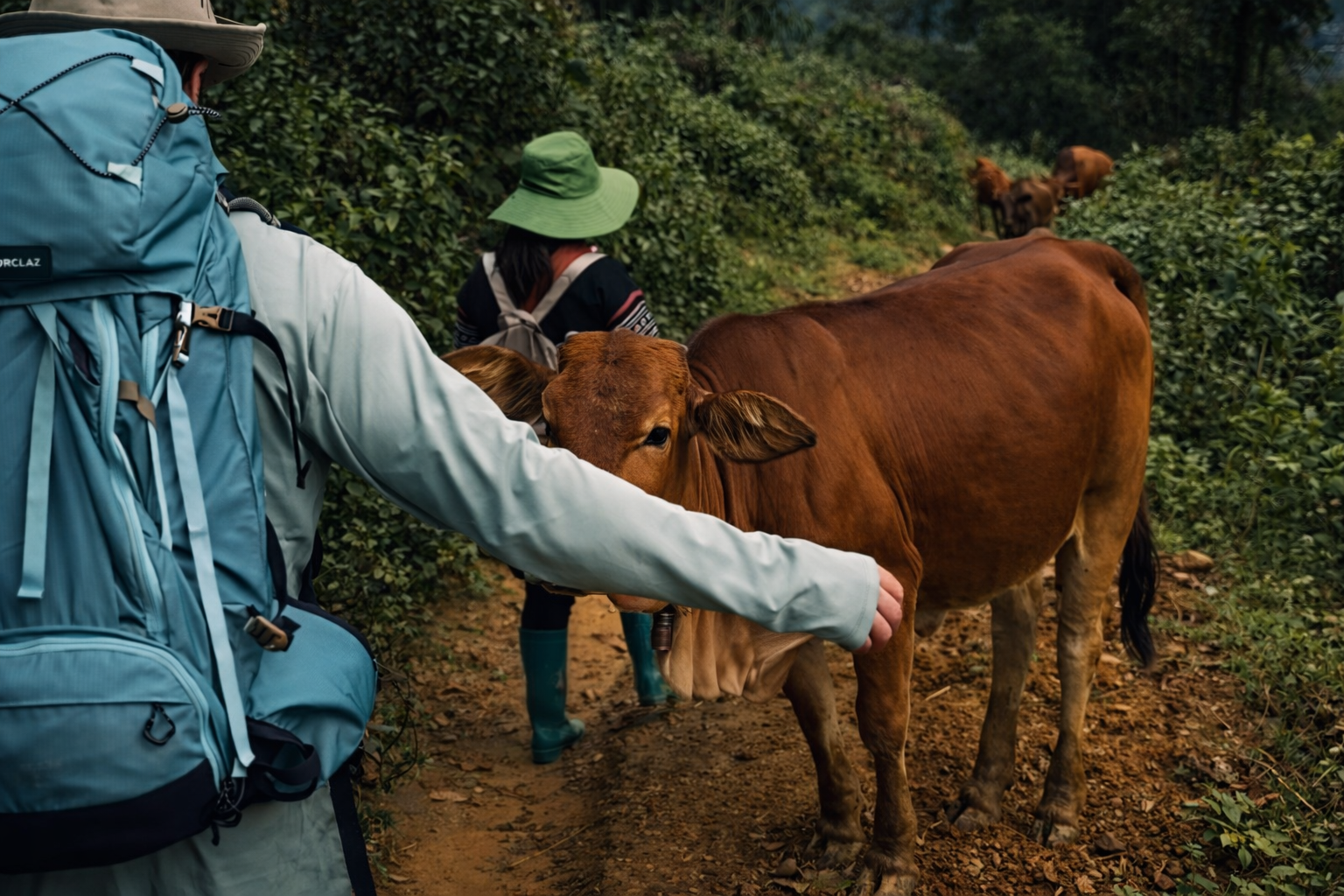
Chang Thi A walking through a quiet village path in rural Sapa as part of an ETHOS trek.
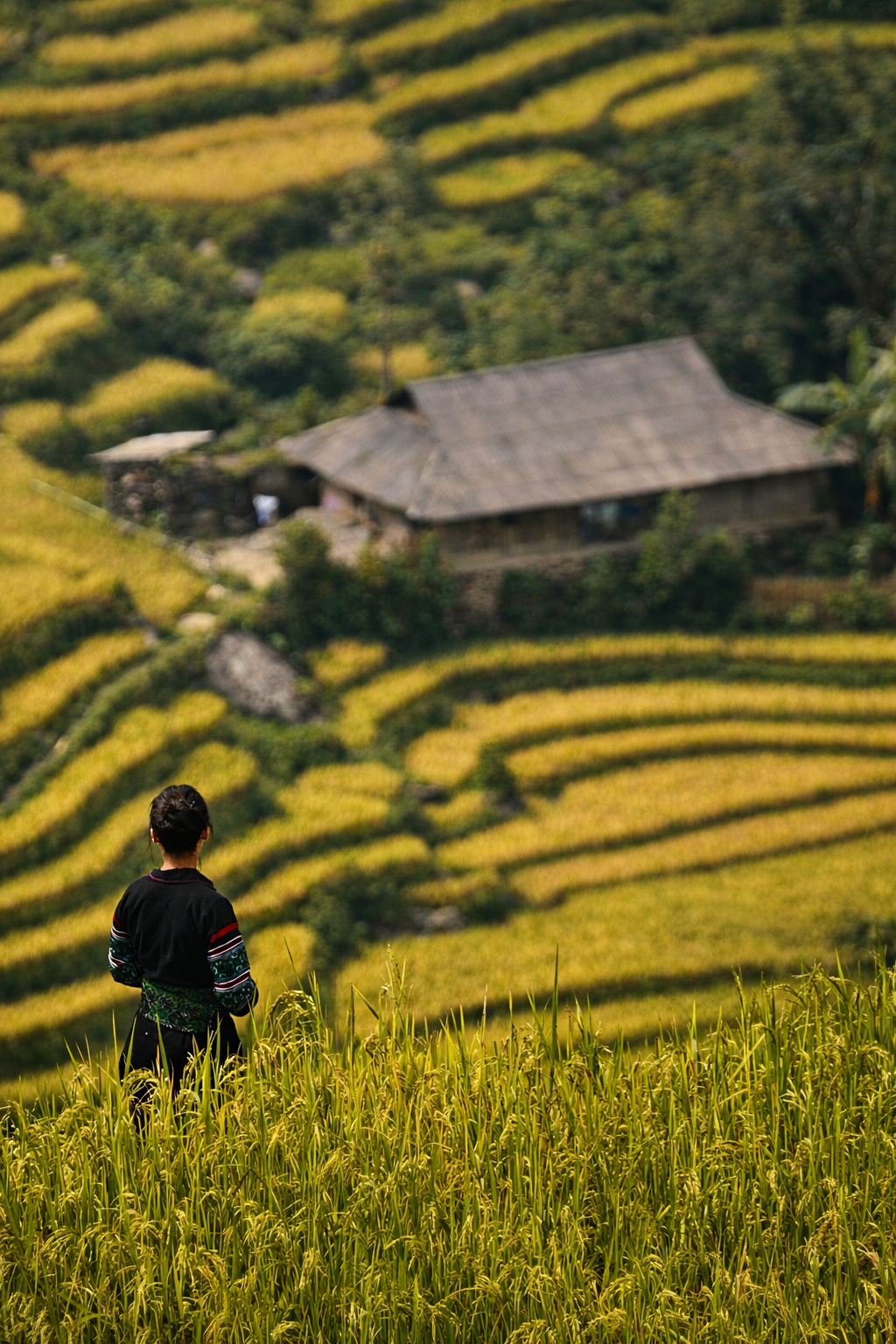
What Would It Mean to Live With the Mountains, Not Just Visit Them?
What would life feel like if your home was built by your own hands, your food grew in the soil around you, and your children learned the rhythms of the land from the moment they could walk? In the mountains of northern Vietnam, life unfolds slowly through seasons, stories, and shared work that connects families to the land and to each other.
A Life Built by Hand and Held by the Land
What would it feel like to wake each morning surrounded by mountains that your family has known for generations? What would it mean if the house you slept in was built from timber cut from the nearby forest and shaped by the hands of parents, uncles, cousins, and neighbours working together?
In the villages scattered across the highlands around Sapa, homes are rarely bought and rarely hurried. Instead, building materials grow from the land itself. Wood is selected carefully from the forest. Stones are carried from nearby hillsides. Walls are raised slowly, sometimes over months, until the house becomes both shelter and inheritance.
Inside, the furniture is simple and purposeful. A wooden table that may have been carved by a grandfather. Low stools maped from bamboo or shaped from tree trunks. Shelves built to hold bags of rice or maize gathered from the surrounding fields.
Outside the door, life spreads out across terraces of rice and small fields of corn and vegetables. Chickens wander through the yard while smoke drifts from the kitchen fire. Water moves slowly along the narrow steams and channels that feed the rice paddies below.
What would it be like if the landscape around your home was not scenery but livelihood, memory, and teacher all at once? Some of these little homes make up out network of homestays and all have their own quirks, charms and challenges.
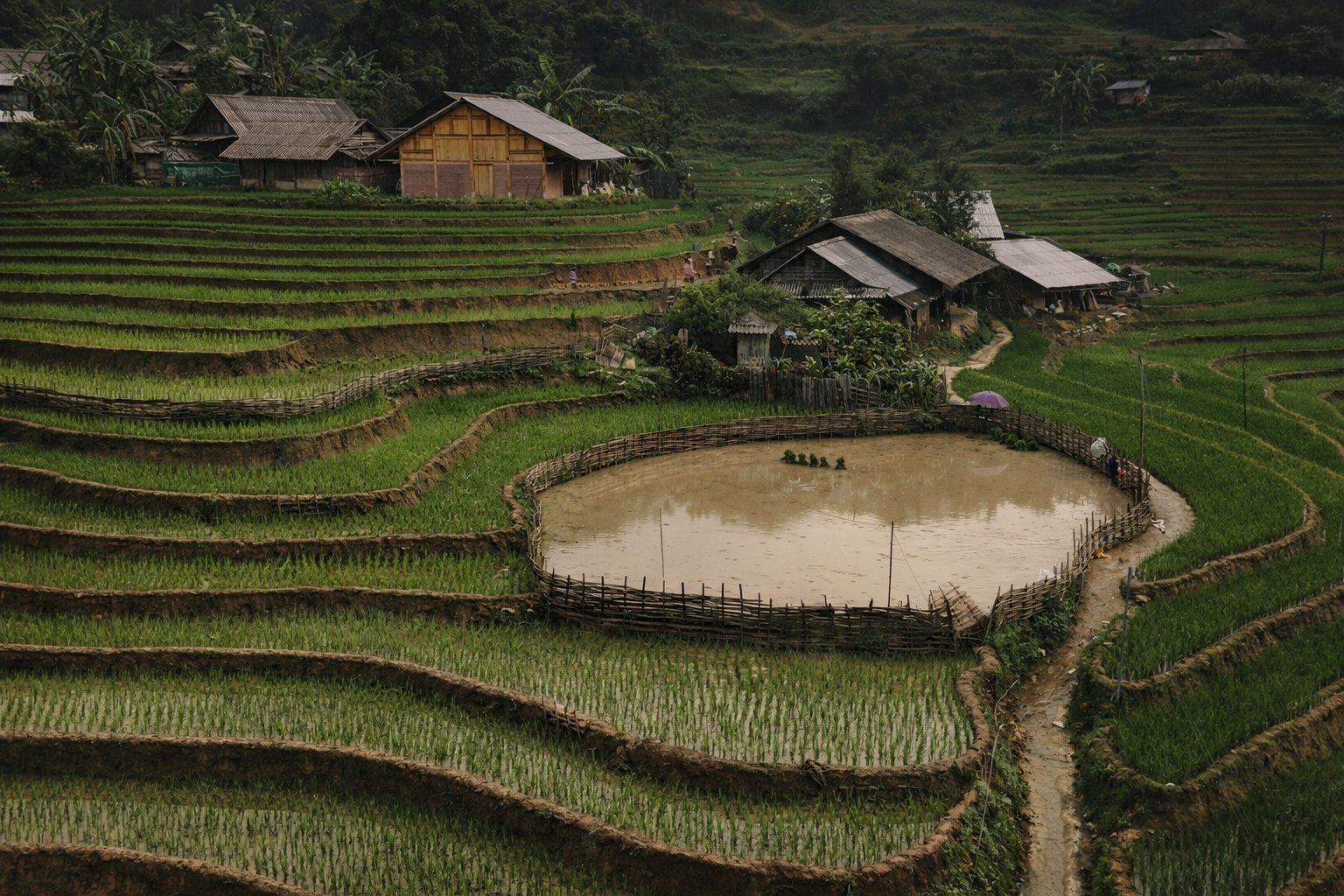
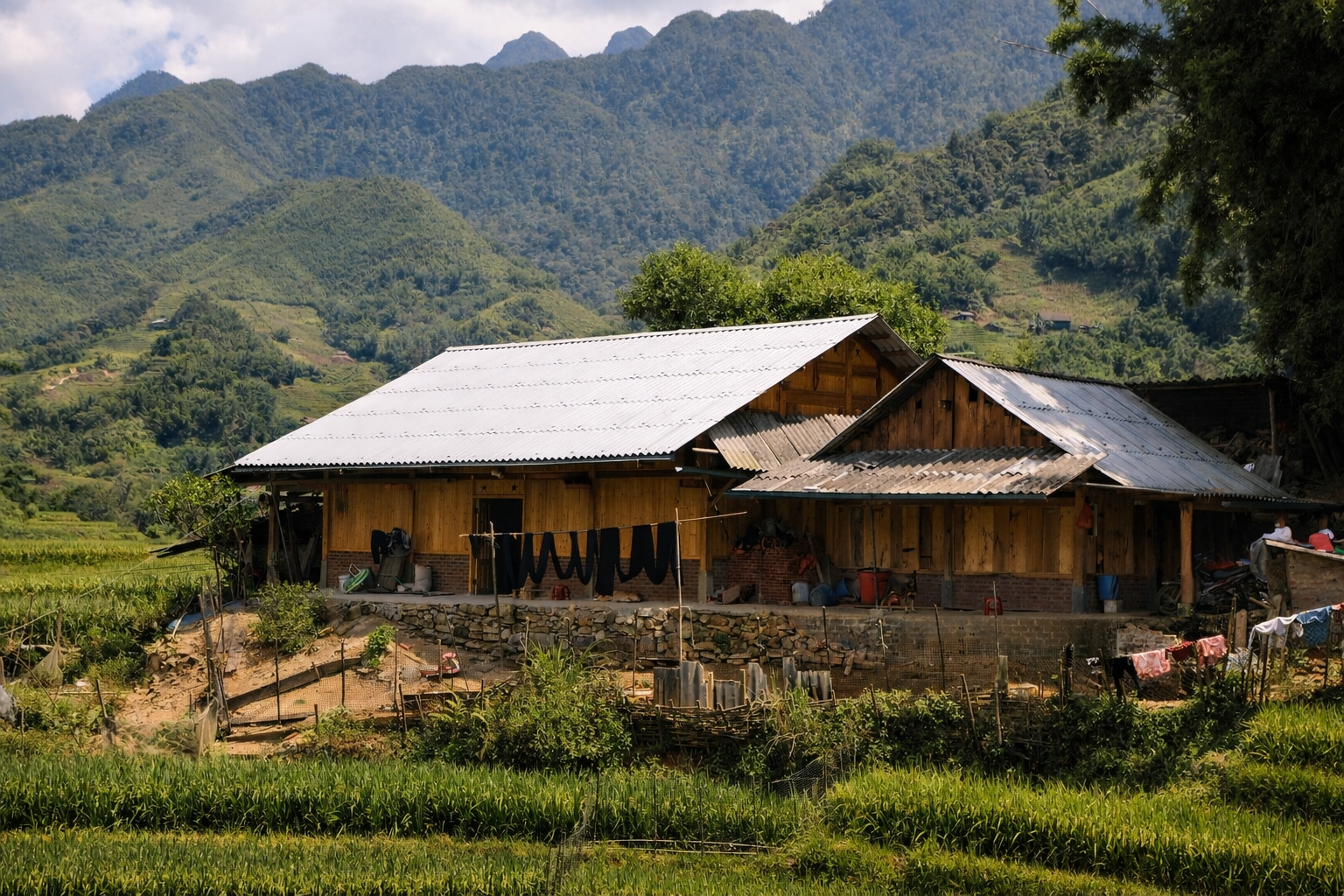
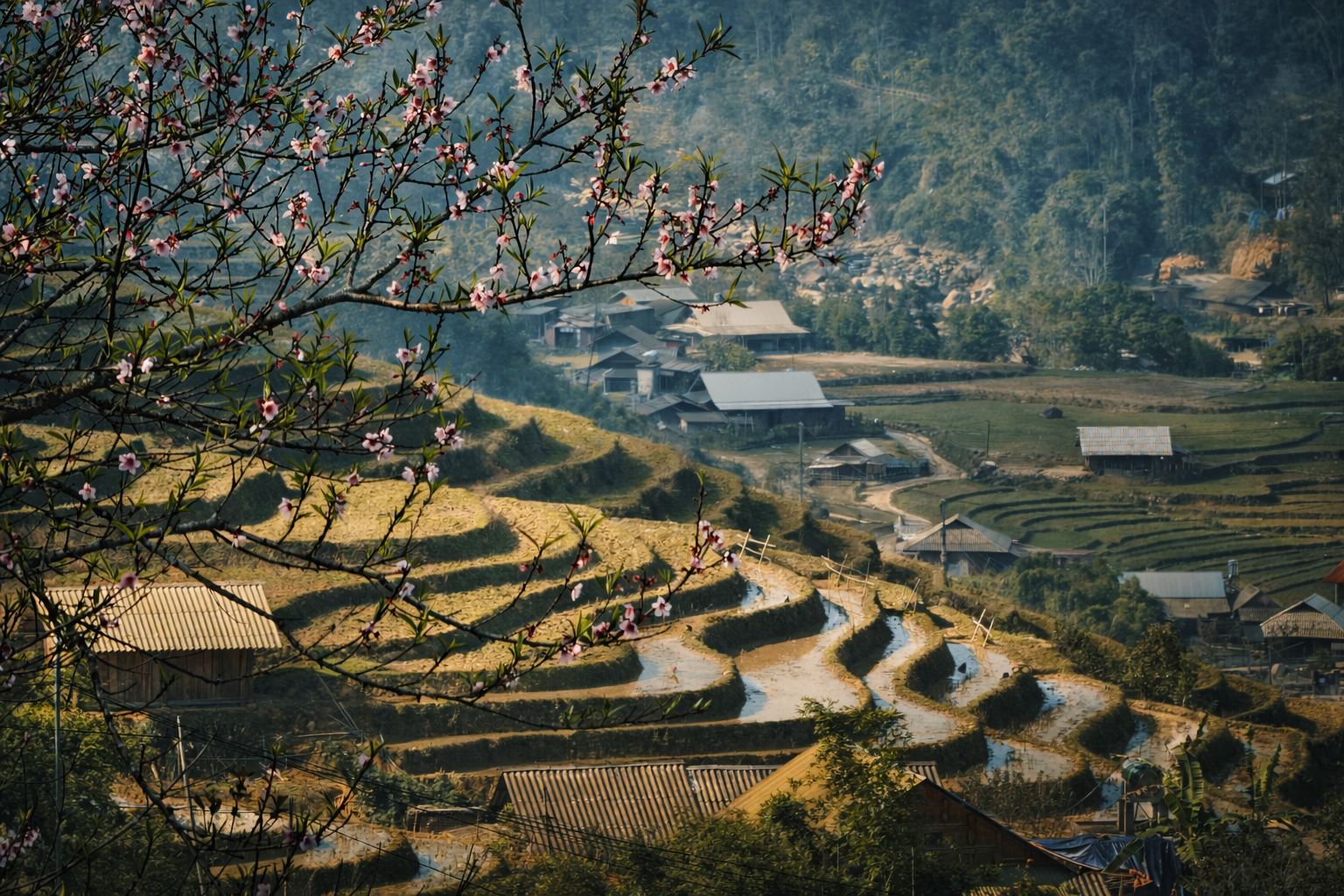
Food, Forests and the Rhythm of the Seasons
Life in the mountains moves according to cycles that are older than roads, borders, or tourism. Families plant rice when the rains return. Corn grows on higher slopes where the soil is thinner and the mountains steeper. Vegetables fill the small kitchen gardens that surround each house.
Yet the forest also feeds the village. People walk beneath the trees to gather wild mushrooms, edible leaves, medicinal plants, and small snails that hide among wet stones after rain. Knowledge of what can be eaten and what must be avoided is passed quietly through generations, learned by watching parents and grandparents move through the landscape. You too can learn about plants, medicines and foraging as part of a Sapa trek.
Meals are rarely elaborate, yet they carry the flavours of the land itself. Fresh greens cooked over wood fire. Corn or rice harvested from the surrounding fields. Herbs that were growing on the hillside only hours earlier.
If everything you needed for the day’s meal came from the land within walking distance, how differently might you see the forest and fields around you?
Children of the Mountains
In these villages, childhood unfolds differently from the rhythms of cities. Learning begins early, not in classrooms alone but in fields, kitchens, forests, and workshops where everyday life becomes a teacher.
Children watch their parents plant rice, cook meals, repair tools, and care for animals. They learn the names of plants and the shape of the seasons. They begin to understand the small responsibilities that keep a household alive.
Collecting firewood is one of these daily tasks. Yet for children it rarely feels like work.
A simple chore becomes something else entirely. Brothers, sisters, and friends leave together in the morning carrying baskets and small knives. What begins as a short trip to gather wood for cooking often stretches into a small adventure through the forest.
Instead of walking quickly home, the children wander along hidden paths and streambeds, searching for fallen branches beneath the trees. Someone might discover mushrooms growing near a log. Another might find berries. Soon the baskets slowly fill, yet the morning continues.
Hide and seek begins between the trees. Someone climbs a rock to watch for birds. A group might follow a narrow path simply to see where it leads.
An hour’s task quietly becomes a morning of laughter, discovery, and movement through the forest. By the time they return home with their bundles of wood, the work has already been transformed into memory.
What lessons do children carry when their playground is a forest and their teachers are the rhythms of everyday life?
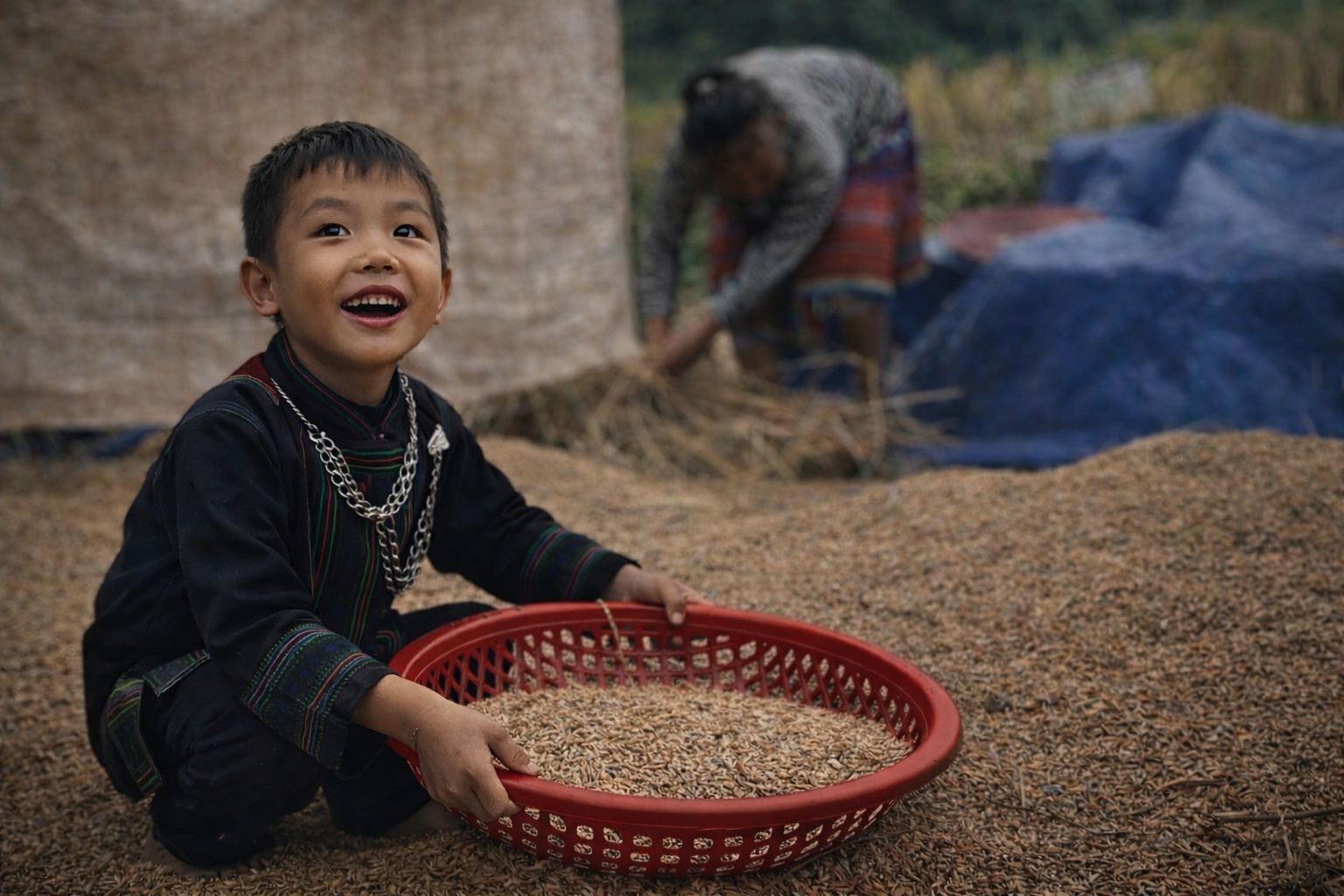
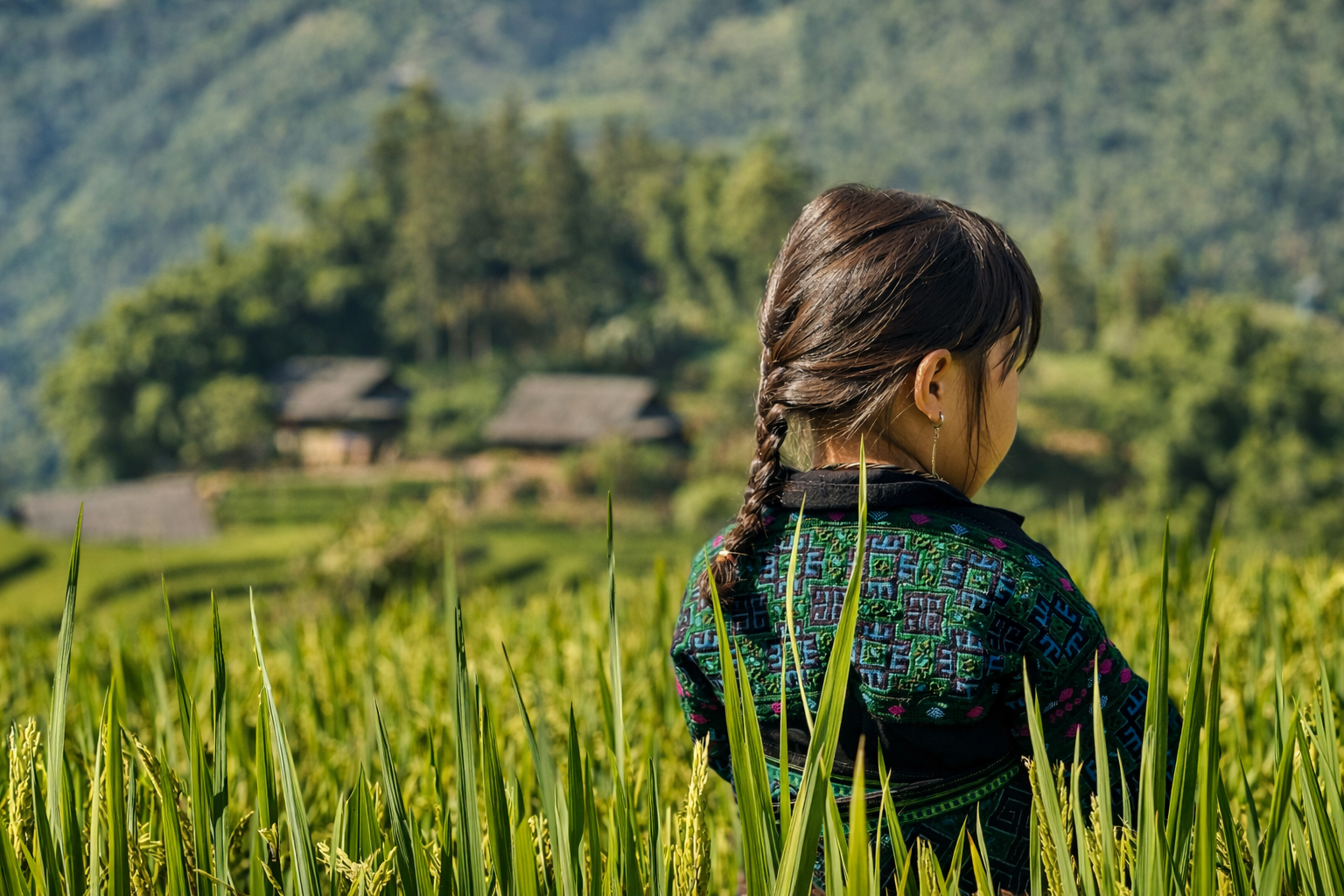
Stories That Grow From the Hills
The mountains of northern Vietnam are also places of stories. Some are told beside the fire in the evening. Others are carried quietly in memory, passed from one generation to the next.
One such story is shared in our blog, The Girl and the Bird, a tale from the hills of Sapa. It tells of a young Hmong girl named My who searches the forest for food and discovers a fragile bird alone in a nest. Though hunger presses heavily upon her, she chooses compassion and carries the small creature home, sharing her meagre corn and caring for it through the night. The story reminds us how resilience and kindness grow side by side in these mountains, even when life is difficult.
Stories like this are more than simple tales. They reflect the values that shape life in the highlands. Respect for living things. Care for the vulnerable. The quiet belief that generosity and patience hold communities together.
What would it mean to grow up surrounded by stories that are woven so closely with the land itself?
Travelling Through Lives, Not Landscapes
For travellers arriving in Sapa, the terraces and mountains often appear first as breathtaking scenery. Yet beyond the beauty of the landscape lies something far deeper.
These mountains are home to communities who have shaped them carefully over centuries. Rice terraces carved into steep hillsides. Paths worn smooth by generations of footsteps. Villages where culture, work, and family remain closely tied to the land.
At ETHOS, our journeys are designed not simply to show these places but to introduce travellers to the people who know them best. Our Hmong and Dao partners are farmers, artisans, guides, storytellers, and community leaders who welcome visitors into their homes and daily lives. Every trek, workshop, and homestay is created together with these communities so that travel becomes a genuine exchange rather than a performance for visitors.
When travellers walk these trails with local guides, something begins to shift. The terraces become more than scenery. The forest becomes more than a place to photograph.
They become part of a living landscape shaped by knowledge, resilience, and creativity.
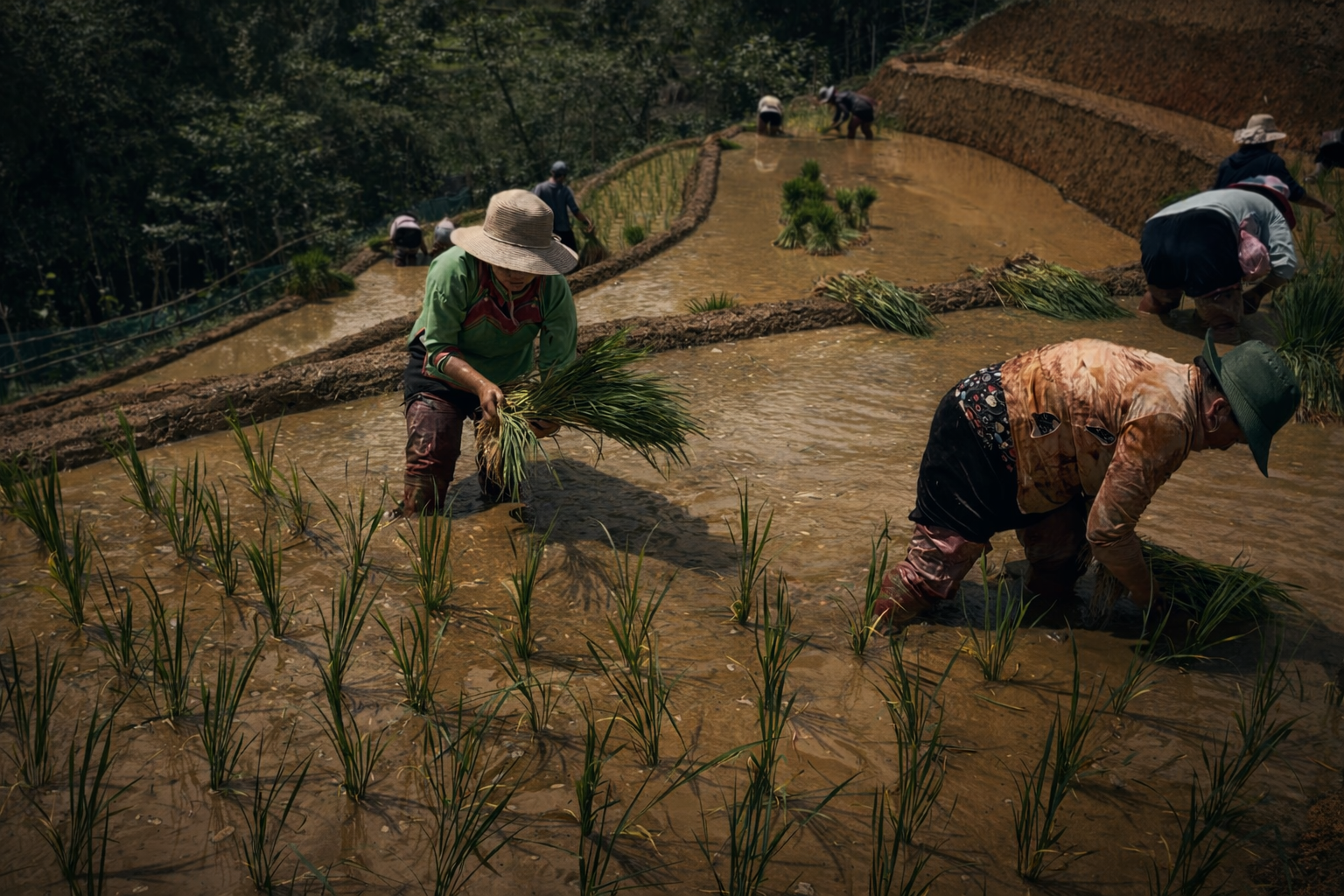
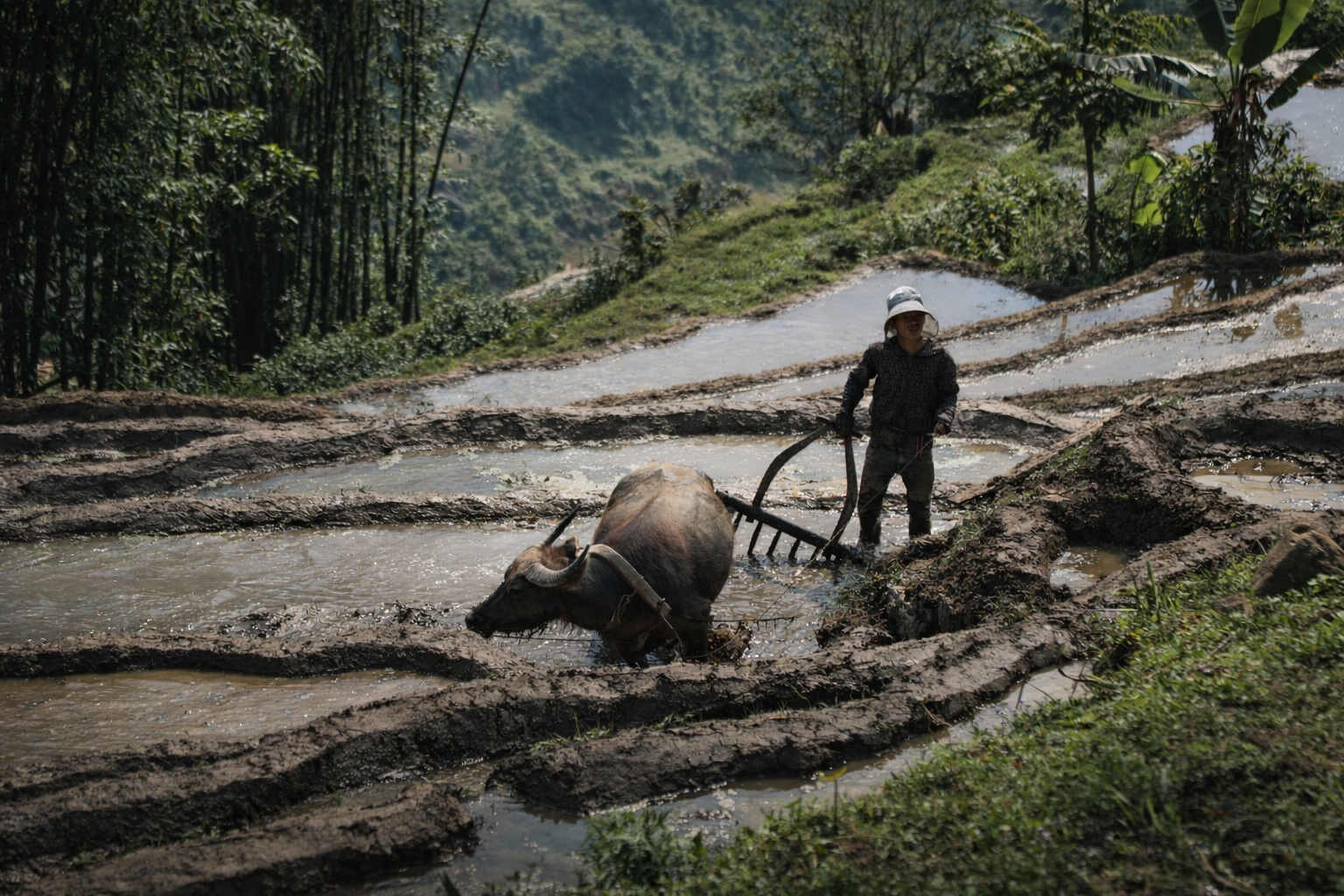
What Might We Learn From This Life?
Perhaps the most interesting question is not whether we could live this way ourselves.
Many of us are far removed from a life where food grows outside the door and houses are built by family hands. Our days are shaped by different rhythms, different expectations, and different kinds of work.
Yet standing in the mountains, watching children return from the forest with laughter and bundles of firewood, another question begins to surface.
What might we remember if we spent more time listening to the land that feeds us?
What might change if we valued knowledge passed quietly between generations rather than rushing past it?
And what would it mean if travel allowed us not only to see beautiful places, but to understand the lives that have grown from them?
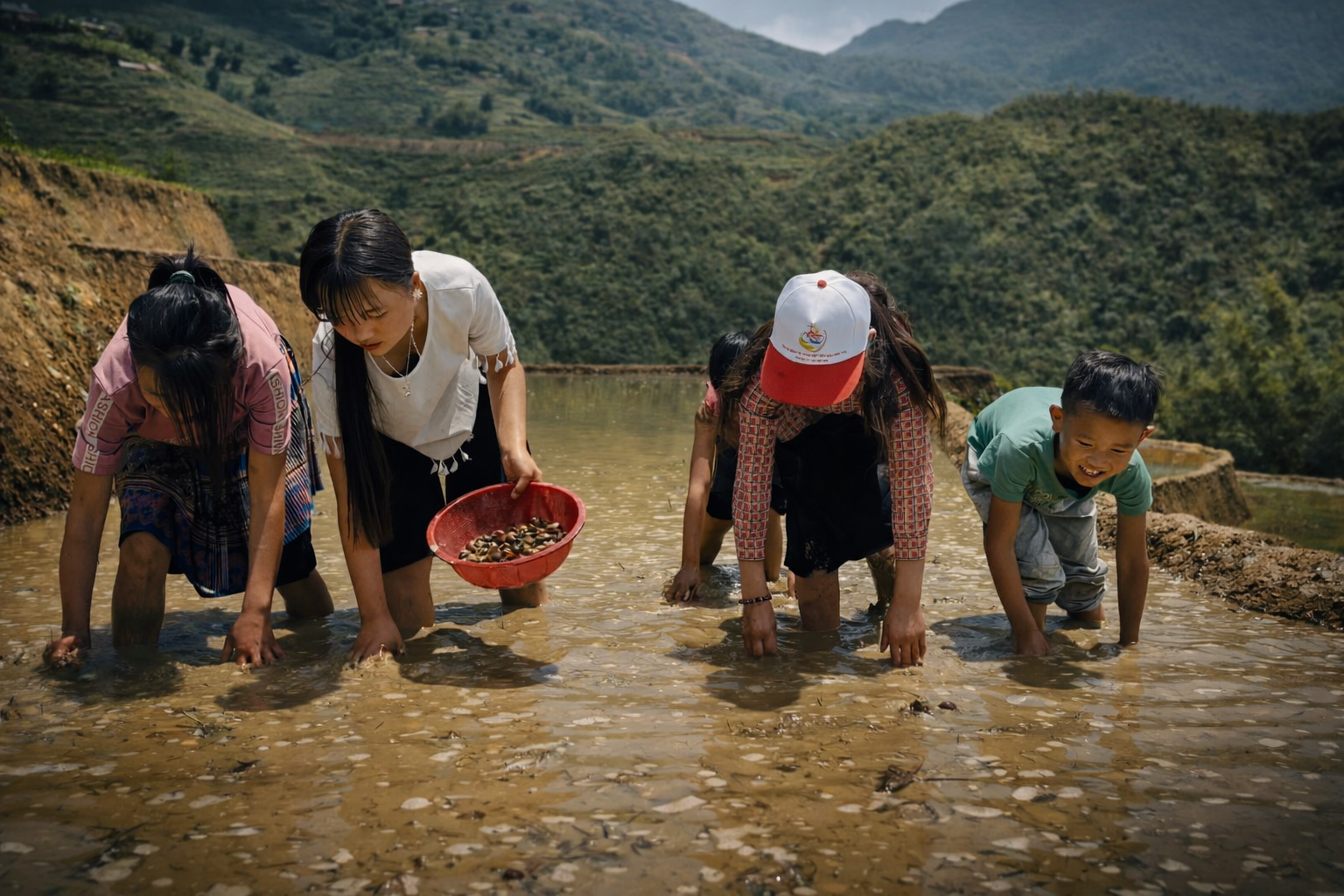
Beyond Rice in Sapa’s Terrace Ecosystems
In Sapa, rice terraces are not simply fields. They are living ecosystems shaped by Hmong and Dao hands, where water, soil and tradition sustain far more than grain. Walk with us through these landscapes, forage alongside our partners and experience how life is nurtured beyond the rice itself.
Sapa’s rice terraces are often photographed as if they were simply grand scenery, a series of green or golden steps folded into the mountains, luminous in the rain and glowing at harvest. Yet for the Hmong and Dao communities who have shaped, tended and lived with these landscapes over generations, a terrace has never been only about a single rice crop. Local communities see the terraces as a living, layered food system. This relies on the connection between water and soil, labour and season, between the forest above and the village below.
To look closely at a terrace is to begin noticing all that exists beyond the rice itself. There are the human made pools that are home to edible insects, snails, frogs, eels and fish. Then are the damp edges where herbs thrive in seepage and soft mud. There are the bunds and narrow paddy walls where greens are gathered on the way home. There are the irrigation channels carrying mountain water from one field to the next, sustaining aquatic plants and tiny wetland habitats. There are forest margins that feed the terraces with leaf litter, moisture, bamboo shoots, fungi and shade. There are the overlooked foods that appear quietly in daily life, not as luxuries, but as part of the intelligence of mountain subsistence.
In this sense, the terraces of Sapa are not monocultures in the industrial sense at all. They are agroecological worlds. Rice may remain the central staple, the grain around which the agricultural calendar turns, yet rice alone does not nourish a household. Hmong and Dao ways of farming have long understood that survival in the mountains depends on more than one harvest. It depends on recognising that a terrace can feed people in many forms, through many species, at many moments of the year.
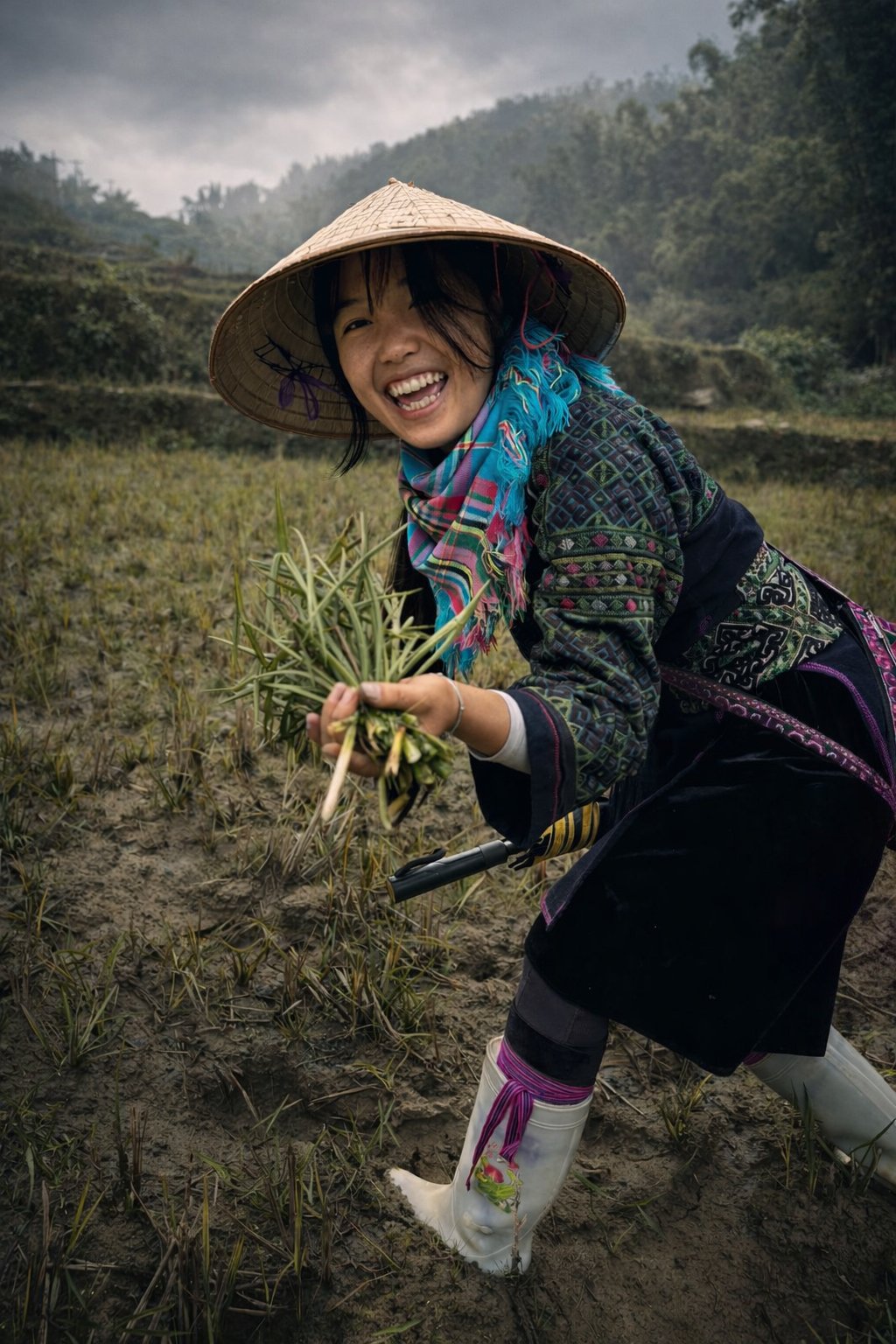
Harvesting wild taro from with a fallow rice paddy.
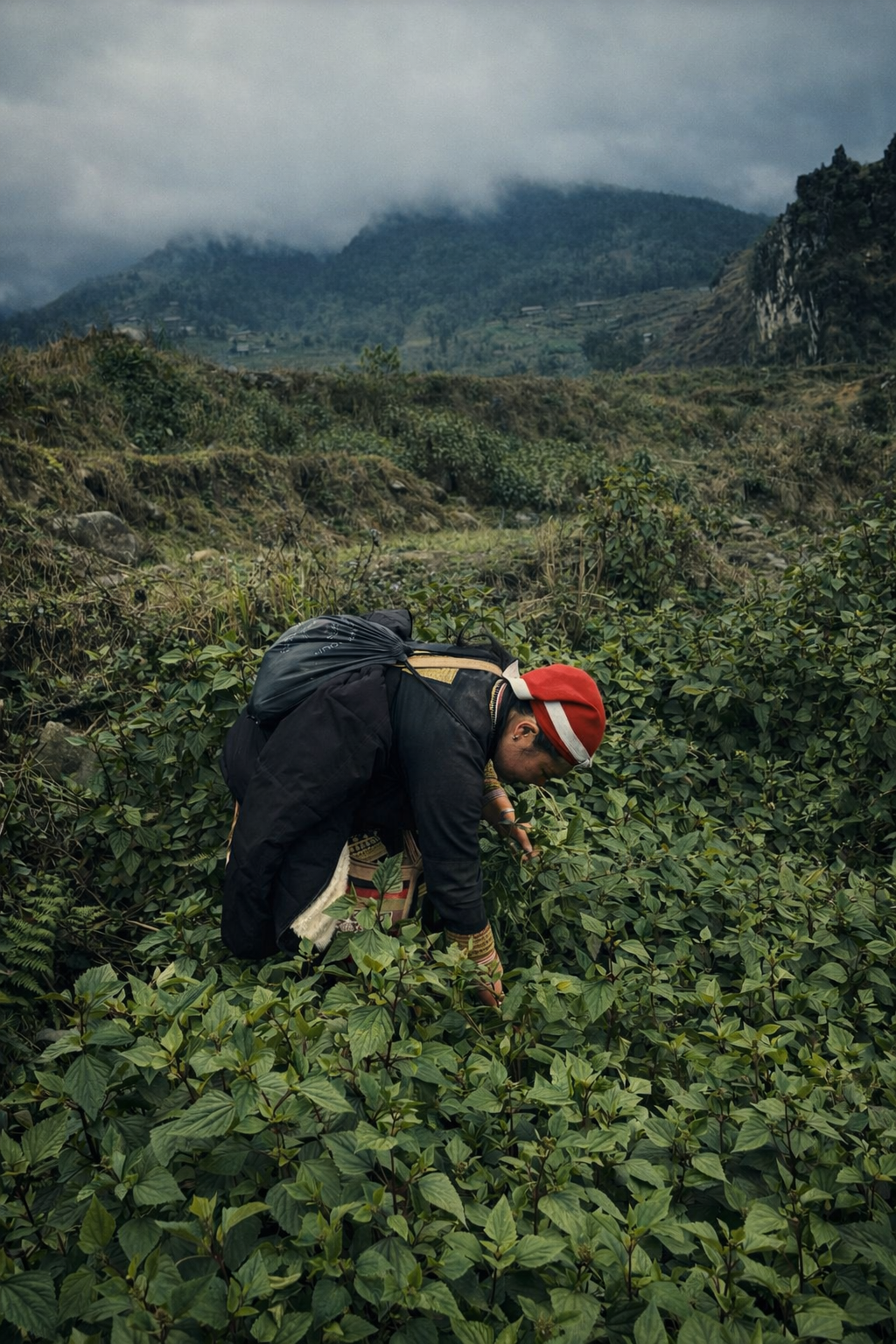
Foraging medicine for use in Red Dao herbal baths.
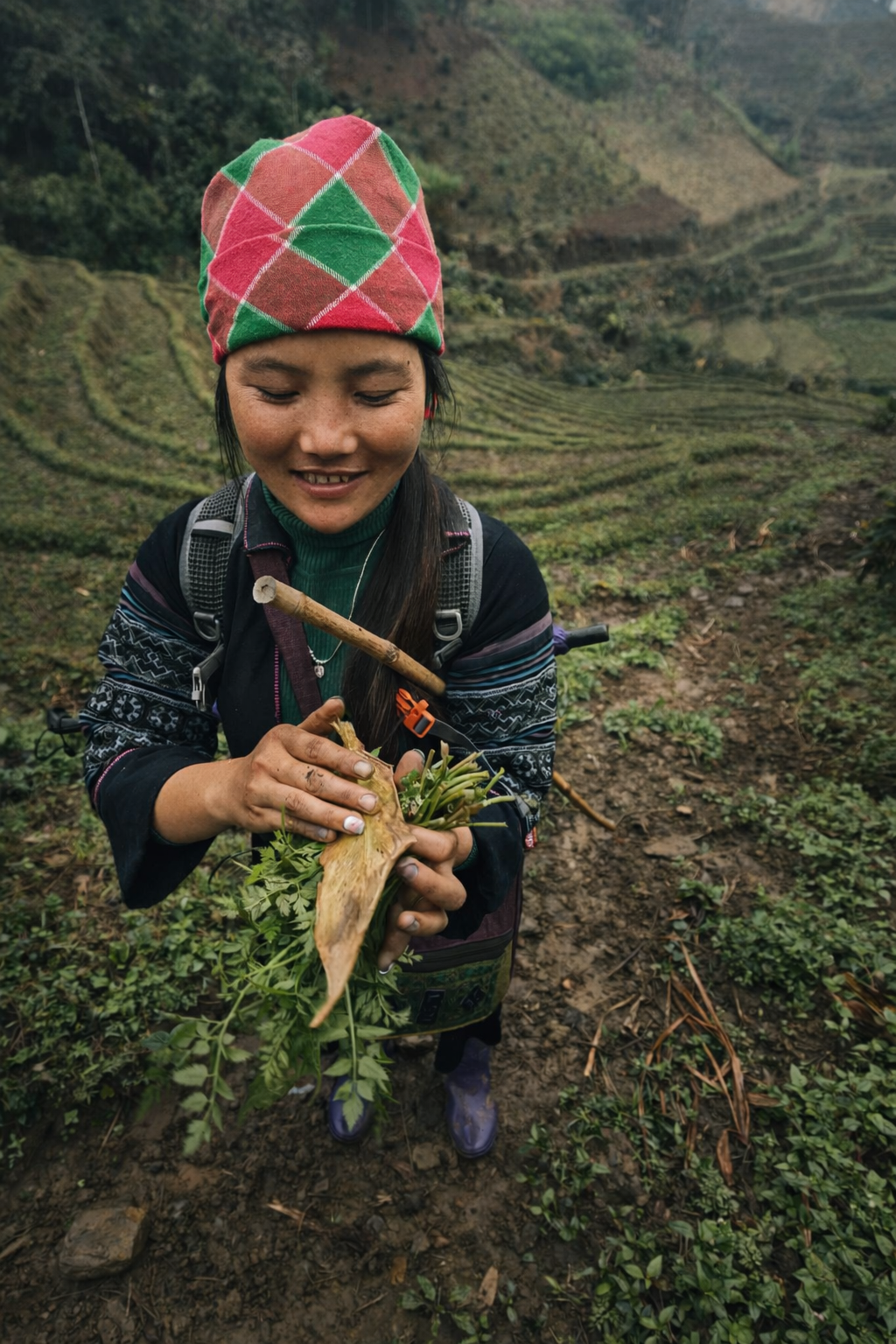
Wild celery harvesting.
A terrace is a mosaic, not a single field
What visitors often see as one continuous landscape is, on the ground, a patchwork of connected micro-habitats. Flooded paddies hold water during the growing season, then soften into muddy fallows after harvest. Bunds and terrace edges catch sediment, support spontaneous greens and become pathways for both people and plants. Irrigation channels and spring-fed ditches remain wet even when fields are drained, offering refuge for edible herbs and water-loving species. Beyond them lie forest edges and agroforestry patches that anchor the terraces ecologically, slowing erosion, protecting springs and supplying food and materials that are essential to village life.
This is part of what makes Sapa’s terrace systems so ecologically rich. Water is guided by gravity rather than forced through large-scale extraction. Soil is held in place by structure, roots and repeated care. Nutrients move through the landscape in loops, not simply through purchased inputs. Even the steepness of the mountains plays a role, creating slight differences in temperature, moisture and exposure from one level to the next. Each terrace holds its own conditions. Each edge becomes an opportunity.
For Hmong and Dao households, this means that farming is never only about the rice standing in the middle of a paddy. It is also about everything that grows beside it, under it, after it and because of it.
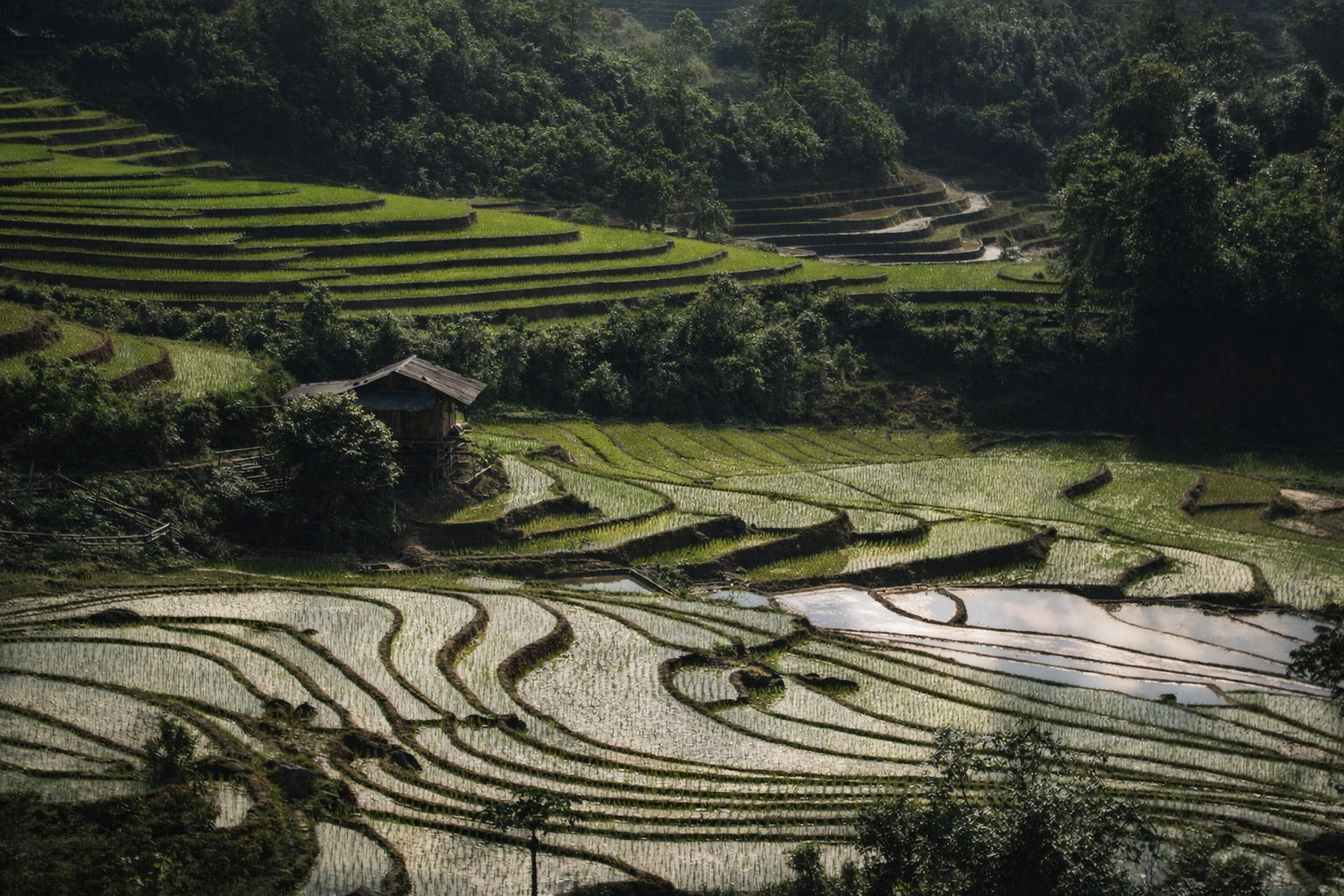
The mosaic of rice terraces in June
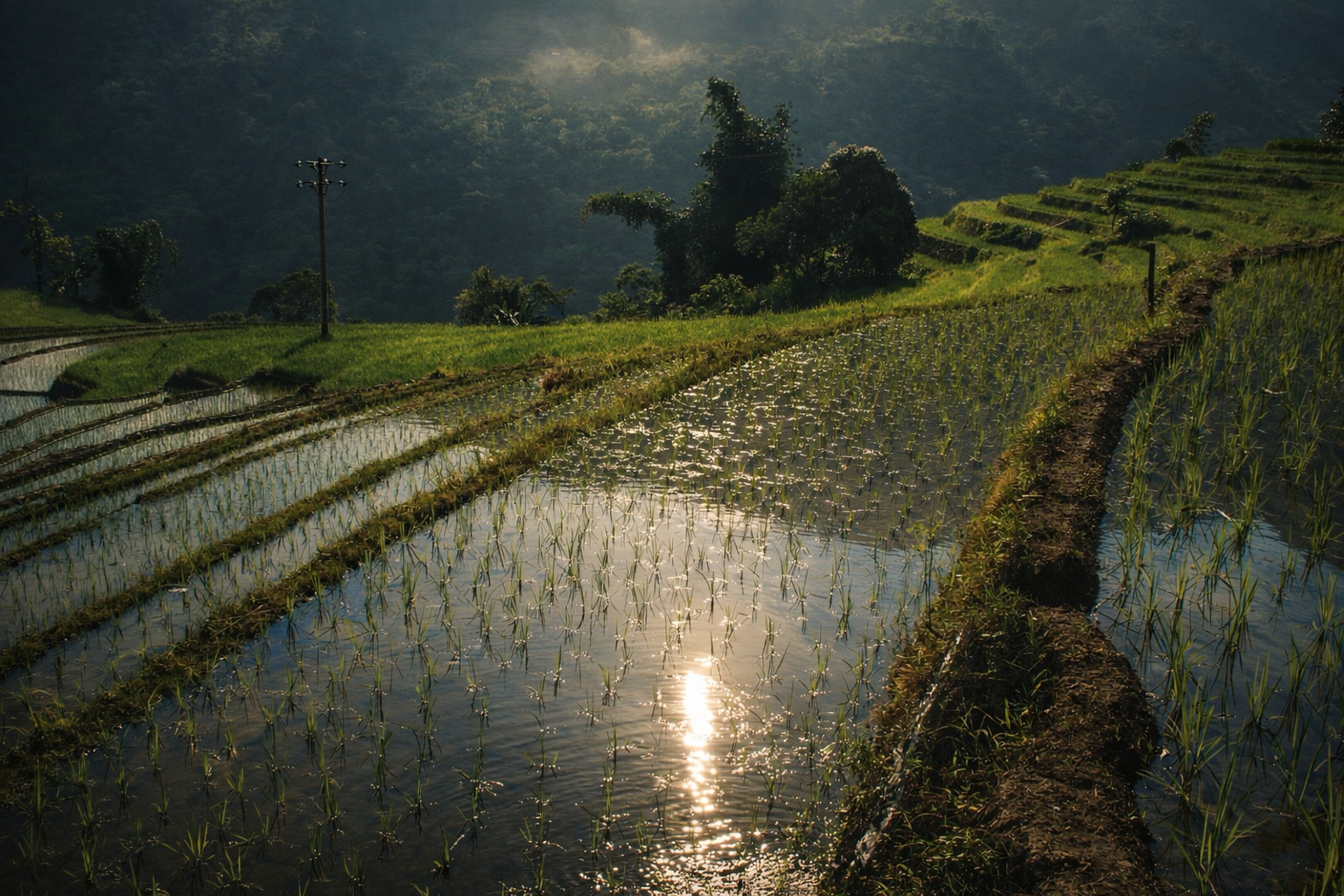
The flooded terraces become home to a variety of unique aquaculture.
Beyond the single rice crop
Mountain households in Sapa have often worked with small landholdings, where farming remains deeply tied to household consumption rather than purely commercial output. That reality shapes the terrace ecosystem profoundly. A field must do more than produce grain once a year. It must help sustain a family across seasons of abundance and leaner months alike.
Rice provides the foundation, the dependable carbohydrate that underpins daily meals and ceremonial food alike. Yet within a rice-based diet there are always nutritional gaps that must be filled by other foods. The terrace ecosystem helps answer that need. Wild and semi-managed greens contribute vitamins and minerals. Wetland herbs bring freshness, scent and medicinal value. Crabs, eels, fish, snails or other opportunistic proteins enrich broths and sauces. Bamboo shoots, mushrooms and taro offer seasonal diversity and resilience when stored grain begins to thin.
Seen this way, the terrace is not organised around a single yield, but around continuity. The goal is not only to harvest rice, but to sustain life. Hmong and Dao ecological knowledge has long been rooted in this broader understanding, where farming is measured not only by how much grain comes in, but by whether the land continues to support many forms of nourishment without being exhausted.
For travellers, many of these foods remain unfamiliar, sometimes even overlooked in favour of the more recognisable or the expected. Yet it is precisely within these lesser-known ingredients that the deeper story of the terraces begins to reveal itself. The textures of water snails gathered by hand, the clean bitterness of freshly cut greens, the earthiness of mushrooms dried and carried through the seasons, all speak of a relationship between people and landscape that is both practical and deeply sensory.
Those who wish to experience this more closely can step into it through our Sapa food tour. Led by local Hmong experts, these journeys move through fields, kitchens and village paths, not as a tasting of dishes alone, but as an introduction to the living food system behind them. Each ingredient is encountered in context, gathered, prepared and understood within the rhythms of the terraces themselves.
What begins as a meal becomes something far richer, a way of seeing how diversity sustains life in the mountains, and how much lies beyond the rice that first draws the eye.
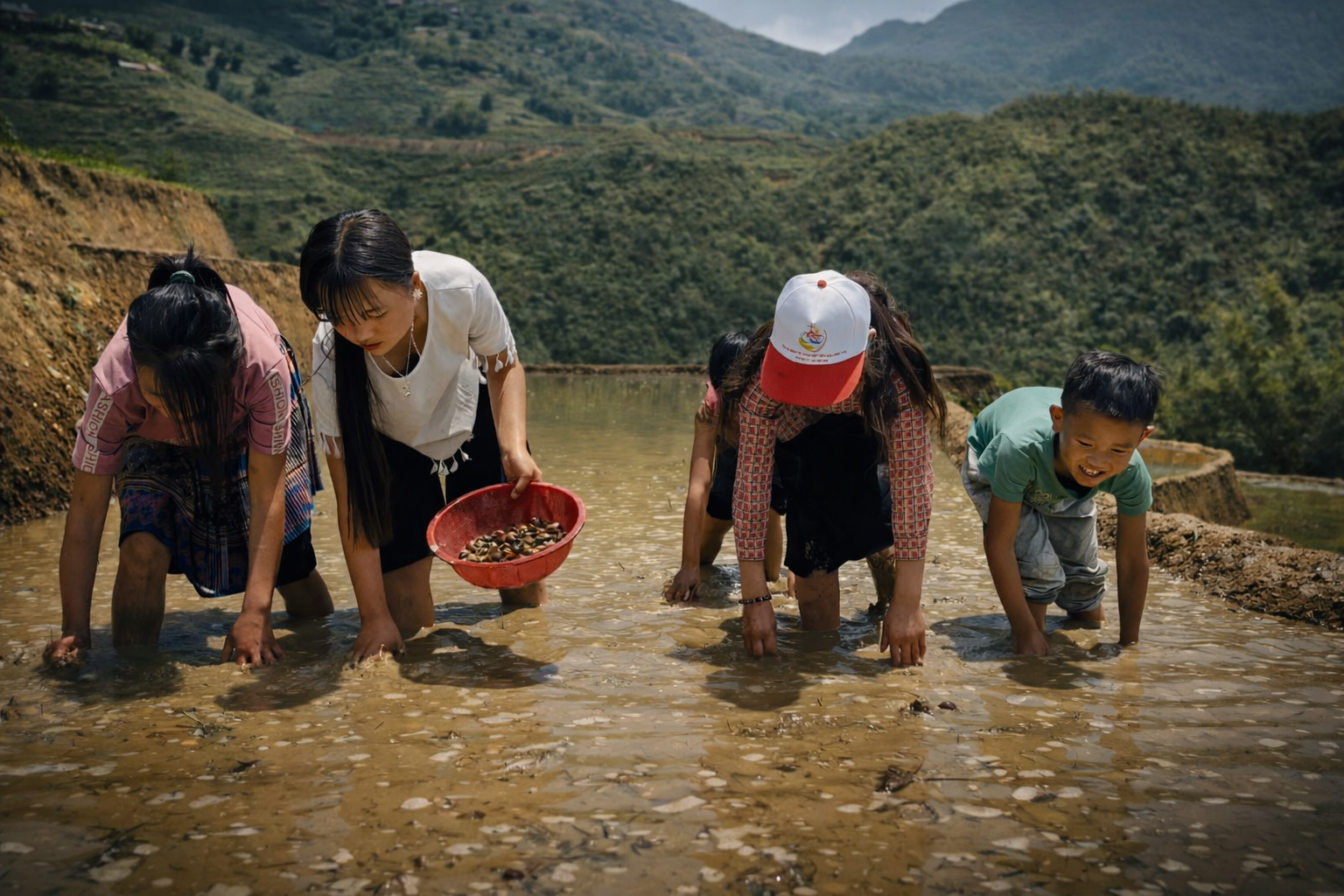
Hmong children collecting snails in the rice paddies.
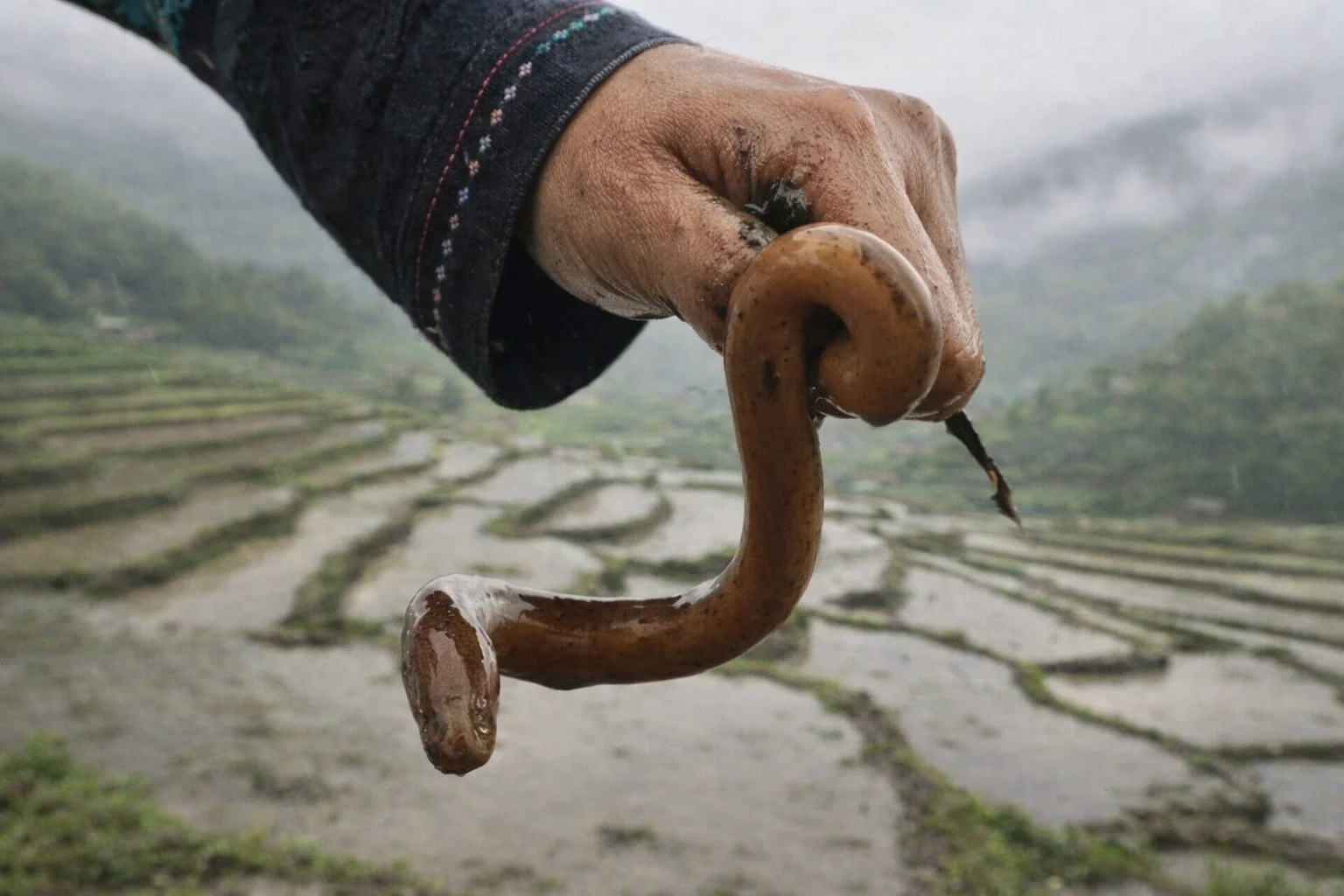
A rice paddy eel. When collected in large numbers, the eels can be prepared as a meal.
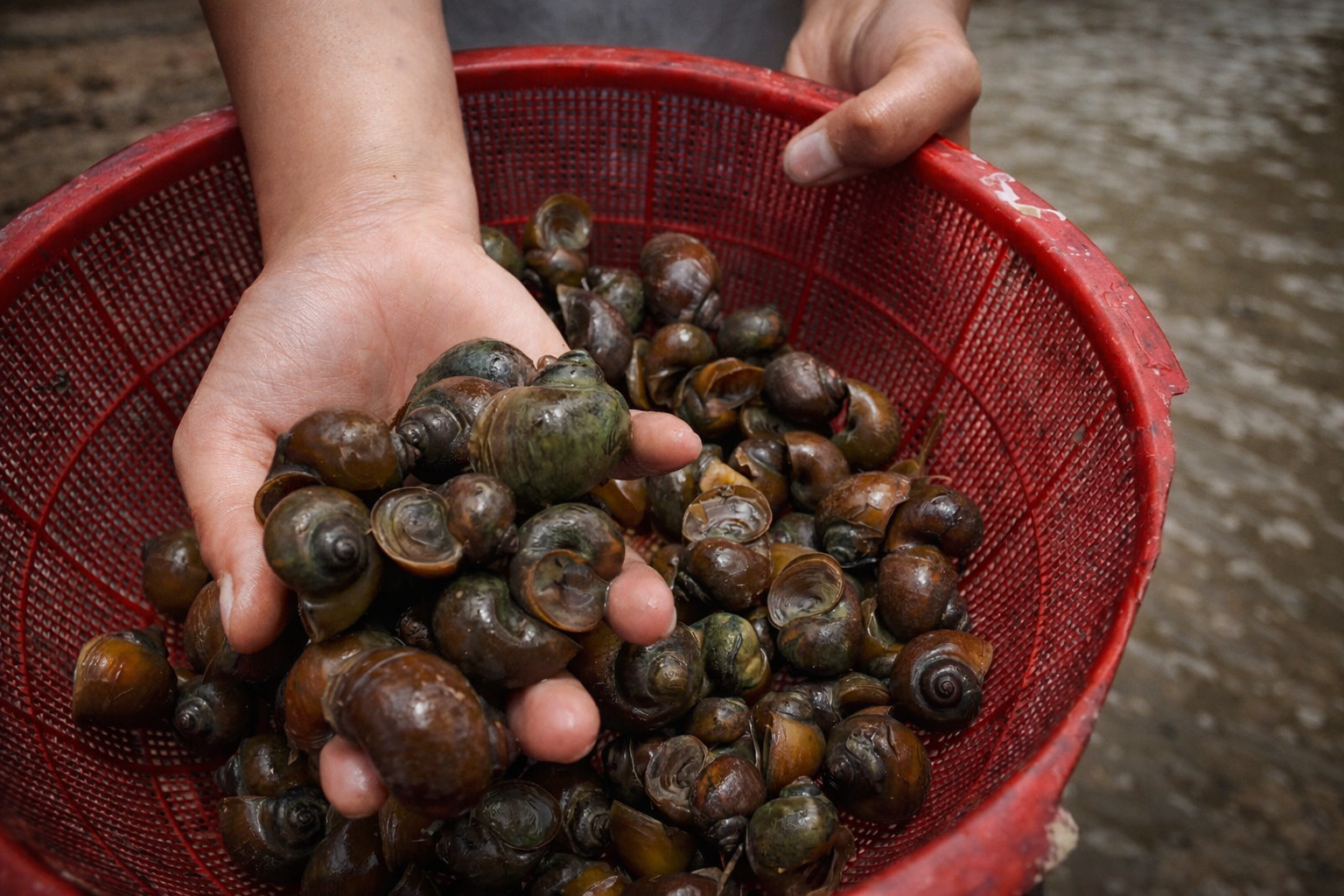
Rice paddy snails collected for food.
The foods hidden in water, mud and terrace edges
One of the quiet lessons of Sapa’s terraces is that food often lives in places outsiders overlook. In the warm, shallow water, edible herbs and semi-aquatic greens thrive with little need for extra land. These plants may be gathered while checking water flow, walking between plots or tending the edges of a field. They are woven into the rhythm of labour itself.
Rice paddy herbs, water-loving greens and other edible plants found in these wet spaces matter because they bring something rice cannot. They offer vitamin C, mineral richness, flavour and medicinal qualities that brighten and balance a meal. They are especially valuable in a highland subsistence system where daily access to diverse vegetables cannot always be taken for granted. Rather than being separate from rice farming, these greens are part of its ecology.
Rice terrace walls play their own role as food margins. These narrow structures are not merely agricultural infrastructure. They are often some of the most diverse parts of the entire system, catching splashed sediment, holding moisture and creating space for spontaneous or lightly managed growth. Here, people distinguish carefully between plants that threaten rice, plants that can be eaten and plants worth leaving because they help stabilise soil or support insect life. This practice of selective tolerance is one of the deepest expressions of terrace agroecology. Removing everything that is not rice is counterproductive when many of the plants that grow naturally have a purpose themselves.
Knowledge carried in the act of gathering
To understand how these landscapes sustain life, it is necessary to move beyond the visible and into the realm of practice. Among Hmong and Dao communities, knowledge is not abstract or separate from daily life, but embedded in movement, in gesture, in the quiet decisions made while walking a terrace edge or bending to harvest a plant. What appears simple to an outsider often conceals a depth of ecological reading shaped over generations.
A woman gathering greens along a bund is not merely collecting what is available. She is reading the condition of the soil, the recent flow of water, the stage of regrowth and the needs of her household. She selects with intention, leaving certain plants to recover, taking others at their peak, recognising which will nourish and which will heal. The act is at once practical and deeply attuned, shaped by memory, taste and an understanding of tomorrow as much as today.
This knowledge extends across the landscape. Men and boys may move through the wet fields in search of eels or small fish, reading the water with equal familiarity, while forest edges are approached with an awareness of seasonality that determines when shoots are tender or when fungi will emerge after rain. Food, in this sense, is never separate from place. It is a dialogue between people and terrain, carried out through attention and care.
The terrace as living wetland
During the growing season, the terraces transform into a sequence of shallow wetlands, each holding water that moves slowly from one level to the next. This movement is neither hurried nor wasteful. It follows gravity, guided by human hands yet aligned with the natural contours of the mountain, creating a system that is both cultivated and ecological.
Within this watery world, life gathers in quiet abundance. Aquatic plants root themselves in the soft mud, insects skim the surface, and the edges of each paddy become zones of fertility where moisture lingers and diversity thrives. The mud itself is alive with microbial activity, breaking down organic matter and returning nutrients to the soil, sustaining fertility without reliance on external inputs.
What emerges is not a field in the conventional sense, but a layered environment where water, soil and living organisms interact continuously. The terraces hold, slow and distribute resources, allowing each level to benefit from what passes through it. Their productivity lies not in intensity, but in balance, in the ability to sustain multiple forms of life within a carefully managed system.
A kitchen shaped by the landscape
If the terraces are read through the rhythms of daily life, their diversity becomes most visible in the kitchen. Rice remains central, steady and essential, yet it rarely stands alone. Around it gathers a shifting constellation of foods that reflect the season, the weather and the labour of the household.
There may be tender greens gathered that morning, still carrying the cool dampness of the field. There may be bamboo shoots sliced and prepared with care, their bitterness softened through knowledge passed down over time. Mushrooms, collected in moments of abundance, might be dried and stored, later rehydrated to bring the scent of the forest into a quieter season. Taro, lifted from moist soil, provides a reserve that speaks of foresight and resilience.
Occasionally, the wet fields themselves offer small additions, a crab, a handful of snails, something that deepens the flavour of a broth and adds substance to a meal. None of these elements dominate, yet together they create a sense of completeness, a meal that is balanced not through excess, but through diversity.
What becomes clear is that nourishment here is cumulative. It emerges from many small contributions, gathered across spaces and moments, rather than from a single source. The terrace feeds not only through rice, but through everything that surrounds and accompanies it.
Where terraces meet forest
The terraces do not exist in isolation. Above them, the forested slopes hold the sources of water that feed the entire system. Springs emerge, channels carry their flow, and the paddies receive and redistribute what begins higher in the mountain. Leaf litter, shade and the stability of rooted slopes all contribute to the health of the terraces below.
From these forest margins come foods that complete the picture. Bamboo shoots push through damp soil after rain, mushrooms appear in shaded ground, spices such as black cardamom grow in the understory. These are not separate from terrace life, but part of the same ecological continuum, linking cultivated land with wilder spaces.
To care for the terraces is therefore to care for the forest. The relationship is reciprocal, each depending on the other for continuity and resilience. This understanding is rarely articulated in formal terms, yet it is present in the way land is used, respected and maintained.
Seeing beyond the view
For those who arrive in Sapa, the terraces often first appear as a spectacle, an unfolding pattern of green or gold across the mountainside. Their beauty is immediate, yet it is only an entry point into a far deeper story.
Walking slowly through these landscapes begins to reveal another layer. The scent of wet earth rises after rain. Herbs release their fragrance underfoot. Smoke drifts from a kitchen where gathered greens are being prepared for the evening meal. A basket rests at the edge of a field, filled not only with rice, but with the quiet harvest of everything that grows alongside it.
To experience the terraces in this way is to move beyond observation into encounter. It is to recognise that each element, each plant, each movement of water carries meaning shaped by those who live here. It is also to understand that such knowledge is not readily visible from a viewpoint, but shared through time, trust and presence.
This is the spirit in which we invite travellers to walk with us at ETHOS. Through our treks, journeys unfold alongside Hmong and Dao partners who open their fields, kitchens and stories with generosity and care. These are not routes designed simply to pass through a landscape, but to dwell within it, to listen closely, and to encounter the terraces as living worlds shaped by human knowledge and mountain ecology.
In choosing to travel this way, the terraces begin to shift from scenery into relationship. What once seemed distant becomes immediate, textured and human, offering not only a view, but an understanding that lingers long after the path has ended.
A more complete understanding of abundance
What these landscapes ultimately offer is a different understanding of abundance. It is not defined by scale or uniformity, but by diversity and continuity. It is found in the ability of a place to provide across seasons, through variation, through attention to detail rather than simplification.
Rice remains at the centre, steady and indispensable. Yet it is supported by a wider system that ensures life continues even when conditions shift. Greens, herbs, shoots, fungi and preserved foods all contribute to a form of resilience that is both practical and deeply rooted in knowledge.
The terraces endure not because they produce one thing efficiently, but because they sustain many things carefully. They are shaped by people who understand that survival in the mountains depends on relationship, on reading the land closely, on working with its rhythms rather than against them.
To see this clearly is to understand that these landscapes are not only beautiful, but profoundly intelligent. They are living systems, held together by care, memory and an enduring conversation between people and the mountains they call home.
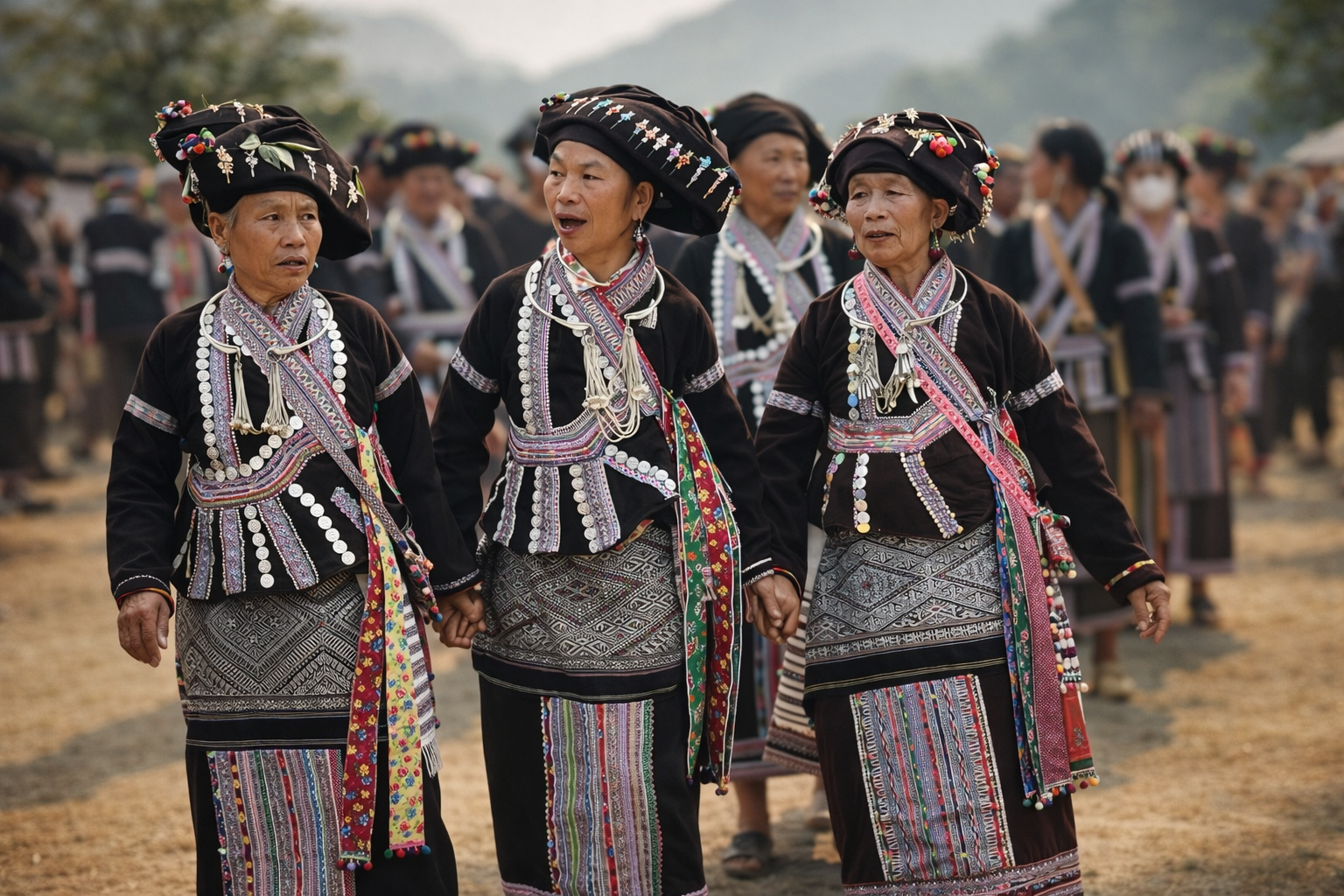
Bun Vốc Nặm - The Living Water Festival of the Lao People
In the mountain valleys of Lai Châu, where streams shape both land and life, the Lao people gather each spring to celebrate Bun Vốc Nặm. This water festival is a joyful expression of renewal, gratitude, and connection, where laughter, ritual, and shared meals bind communities across generations.
In the quiet valleys of northern Vietnam, where rice fields stretch out along winding streams, the Lao ethnic community of Tam Đường lives in close rhythm with water. Here, water is not only a resource but a spirit, a blessing, and a thread that ties together agriculture, ritual, and daily life. Each year, as spring draws to a close and the dry season loosens its grip, villages gather to celebrate Bun Vốc Nặm, a water-splashing festival that embodies renewal, gratitude, and hope for the seasons ahead.
Though the Lao population in Vietnam is small, their cultural life remains deeply rooted and expressive. Bun Vốc Nặm is not simply a festival but a living inheritance, carried forward through gesture, song, and shared memory. It is a time when elders pass down stories, when laughter echoes through bamboo houses, and when water becomes a language of blessing.
A Festival of Renewal and Water
On the first day of Bun Vốc Nặm, the village awakens early, the air still cool with mountain mist. Families gather near streams or communal spaces, dressed in traditional garments, often adorned with handwoven patterns that speak quietly of identity and place. The atmosphere carries a sense of anticipation, of something both playful and sacred.
Water splashing begins gently, almost ceremonially, as elders sprinkle water over one another in a gesture of cleansing and goodwill. This act symbolises the washing away of misfortune, illness, and hardship from the past year, making space for prosperity and health. As the morning unfolds, the ritual softens into laughter, and the entire village becomes immersed in joyful chaos, with children darting between adults and friends drenching one another with buckets, bowls, and cupped hands.
The meaning remains rooted in respect, even in the height of the revelry. Water is never thrown carelessly but shared as a blessing, a wish for abundant harvests, favourable weather, and strong community bonds. Each splash carries intention, echoing the Lao belief that water connects the physical and spiritual worlds.
Throughout the day, music flows as steadily as the streams themselves. Traditional songs rise and fall in melodic patterns, accompanied by drums that guide the rhythm of communal dances. Lao dances are fluid and expressive, each movement reflecting harmony with nature. Hands curve like flowing water, feet step in time with unseen currents, and dancers move with a quiet grace that invites participation rather than performance.
Games weave through the celebrations, bringing together generations in friendly competition. Laughter becomes a constant presence, and visitors often find themselves gently drawn into the circle, learning through doing, through shared joy rather than observation.
When Water Turns to Play | Youth, Laughter, and Courtship
As the rituals soften into play, the younger generation begins to take centre stage, bringing with them a burst of energy that transforms the atmosphere entirely. Buckets are filled and refilled, water pistols appear from nowhere, and anything that can carry water becomes part of the celebration. What begins as gentle splashing quickly gathers momentum, unfolding into lively, good-natured water battles that ripple through the village. Groups form and dissolve, alliances shift, and laughter rises above the steady rhythm of drums. There is a sense of freedom in these moments, where boundaries blur and everyone, regardless of age or status, is drawn into the joy. Between the splashes, there are quiet exchanges too, glances held a little longer than usual, playful teasing, and the beginnings of flirtation that feel as much a part of the festival as the rituals themselves. Some drift towards the streams to swim, cooling off beneath the mountain sun, while others linger at the edges, watching and waiting for the next playful ambush. It is here, in this shared spontaneity, that the spirit of renewal feels most alive.
Day Two - Craft, Skill, and the Spirit of Community
As the second day unfolds, the energy shifts subtly, moving from the playful intimacy of water rituals to a broader celebration of skill, cooperation, and sustenance. Men from across neighbouring villages gather, bringing with them tools, materials, and a deep knowledge of craft that has been shaped over generations.
Basket weaving competitions take centre stage, where participants work swiftly yet with remarkable precision, transforming strips of bamboo into intricate forms. Each basket tells a story of function and artistry, reflecting the rhythms of agricultural life and the ingenuity of those who depend on the forest and fields.
Nearby, rivers and streams come alive with bamboo raft races. Teams balance carefully on handmade rafts, navigating currents with a mixture of strength, coordination, and laughter. The races are as much about community pride as they are about skill, drawing cheers from spectators who line the banks.
Food becomes a central expression of identity during this second day, particularly through the multi-village cooking competitions. What makes these gatherings remarkable is not only the diversity of dishes but the philosophy behind them. Every ingredient must be sourced locally, either grown in village fields or foraged from surrounding forests and waterways.
Dishes often include river weeds gathered from clear mountain streams, small pond fish caught with traditional methods, aromatic herbs found along forest paths, and even water insects, which are prepared with care and respect. These foods are not curiosities but staples, deeply connected to the landscape and seasons. Cooking becomes a collective act of storytelling, where each flavour speaks of place, resilience, and knowledge passed down through generations.
Visitors who are invited to taste these dishes often discover a cuisine that is both surprising and deeply nourishing, shaped by necessity yet elevated by creativity.
Beauty, Identity, and Living Traditions
Among the Lao, traditions of beauty and identity continue to hold quiet significance. Practices such as betel chewing and teeth blackening, particularly among older women, are not relics of the past but markers of maturity, dignity, and cultural distinction. Blackened teeth are seen as a sign of beauty and humanity, setting people apart from animals and affirming their place within the social and spiritual world.
These customs, like the festival itself, reflect a worldview in which identity is expressed through continuity, through the preservation of practices that carry meaning beyond the visible.
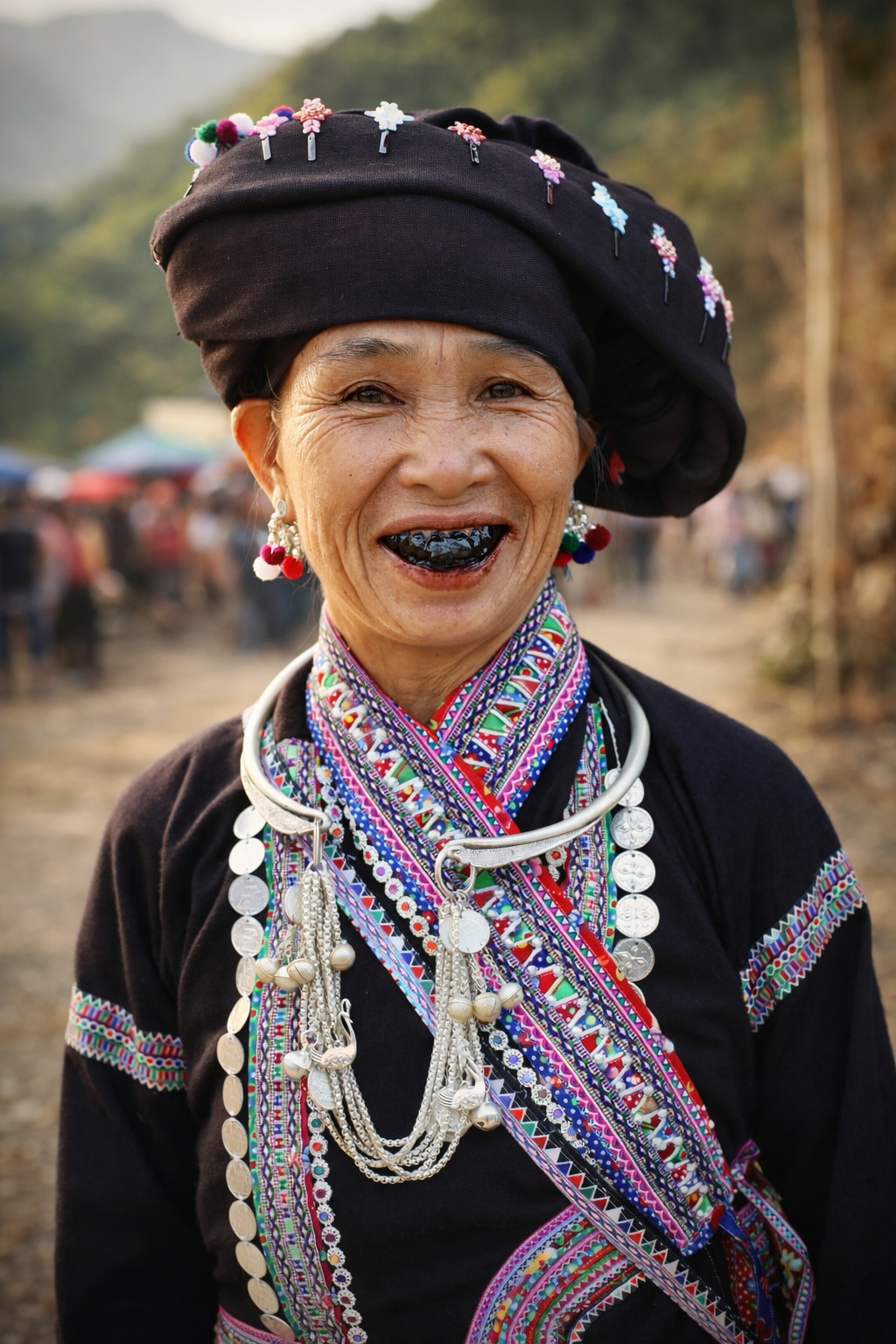

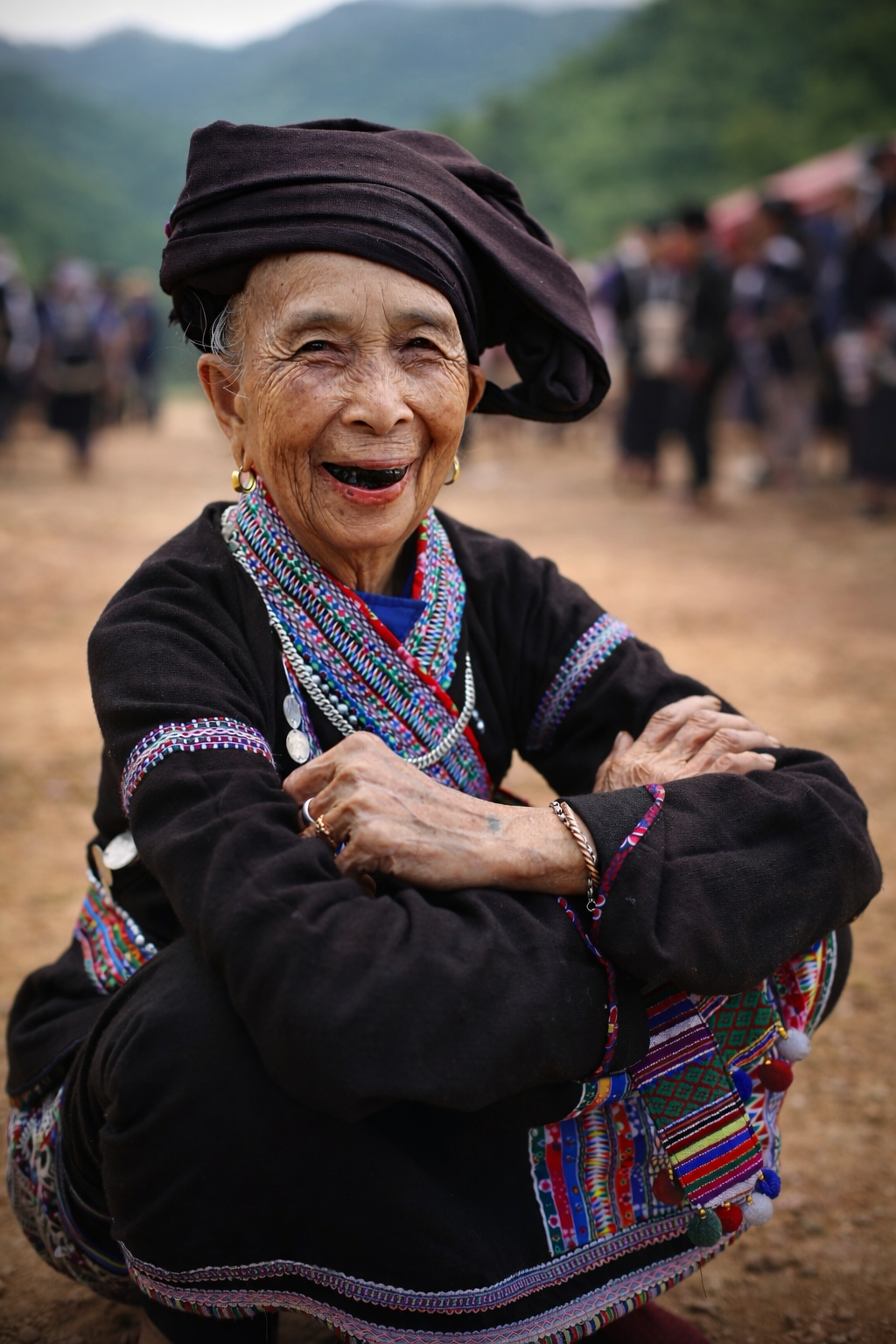
A Festival That Binds Generations
Bun Vốc Nặm is, above all, a celebration of connection. It brings together families, neighbours, and neighbouring villages in a shared rhythm of ritual and joy. It honours the past while welcoming the future, creating a space where tradition is not preserved in isolation but lived, adapted, and shared.
In a world that often moves too quickly, the festival offers a different pace, one guided by the flow of water and the cycles of the land. It reminds us that renewal is not only a seasonal event but a collective act, rooted in care, respect, and belonging.
Travel with ETHOS and Walk Gently into Lao Culture
At ETHOS, we believe that travel should deepen understanding rather than simply observe difference. Our journeys into Lao communities from Sapa are shaped in collaboration with local families, ensuring that every experience is respectful, immersive, and mutually beneficial.
When you travel with us, you are not watching a festival from the outside. You are welcomed into homes, invited to share meals, and guided by those whose lives are woven into these traditions. You may find yourself learning to weave bamboo, tasting forest herbs you have helped gather, or standing beside a stream as laughter rises around you and water becomes a shared blessing.
These are not performances arranged for visitors, but living moments of culture, offered with generosity and trust.
If you feel called to experience the highlands in a way that honours both people and place, we invite you to join us. Let the rhythm of water guide you, and discover a festival where every gesture carries meaning, and every welcome is deeply felt.
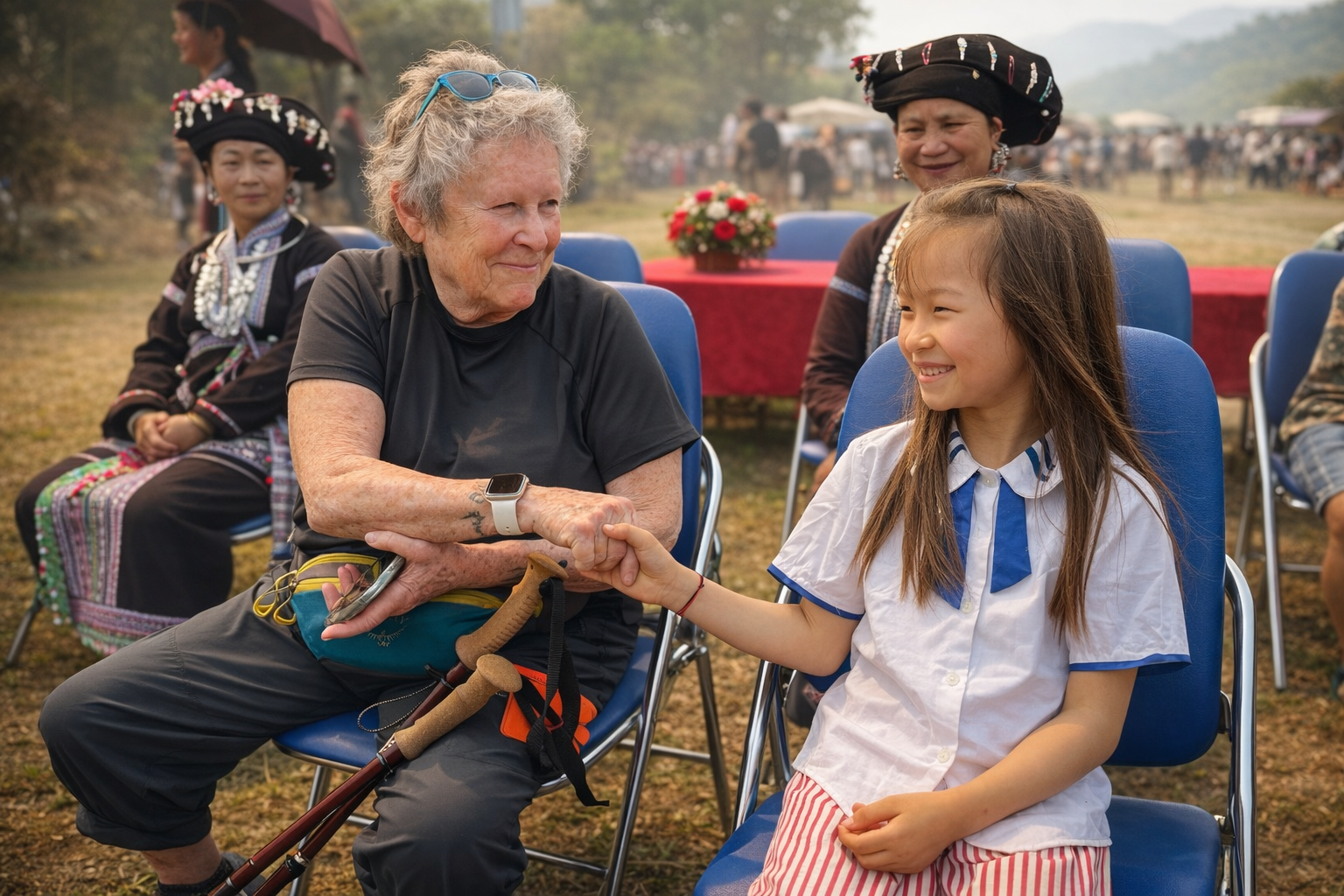
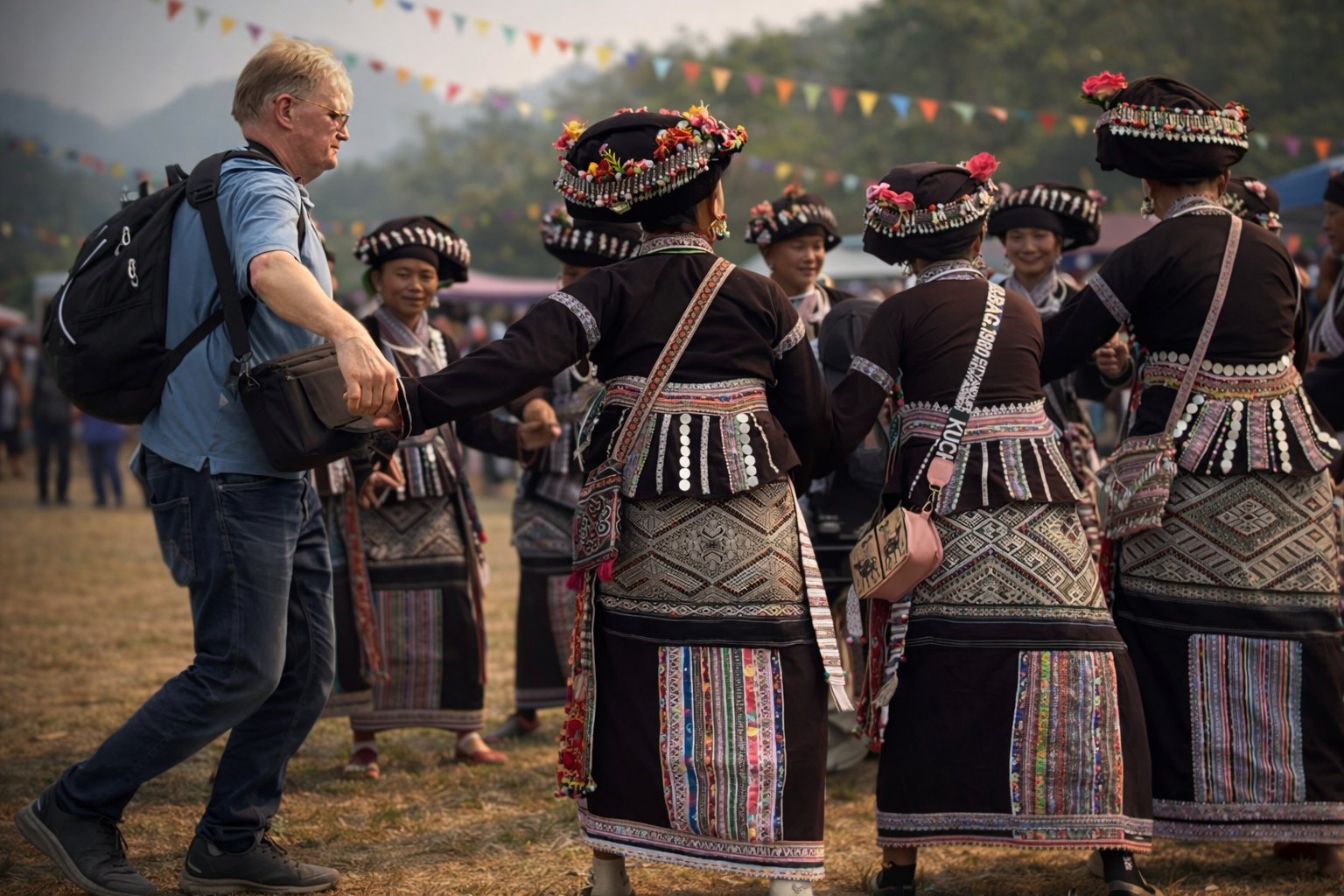
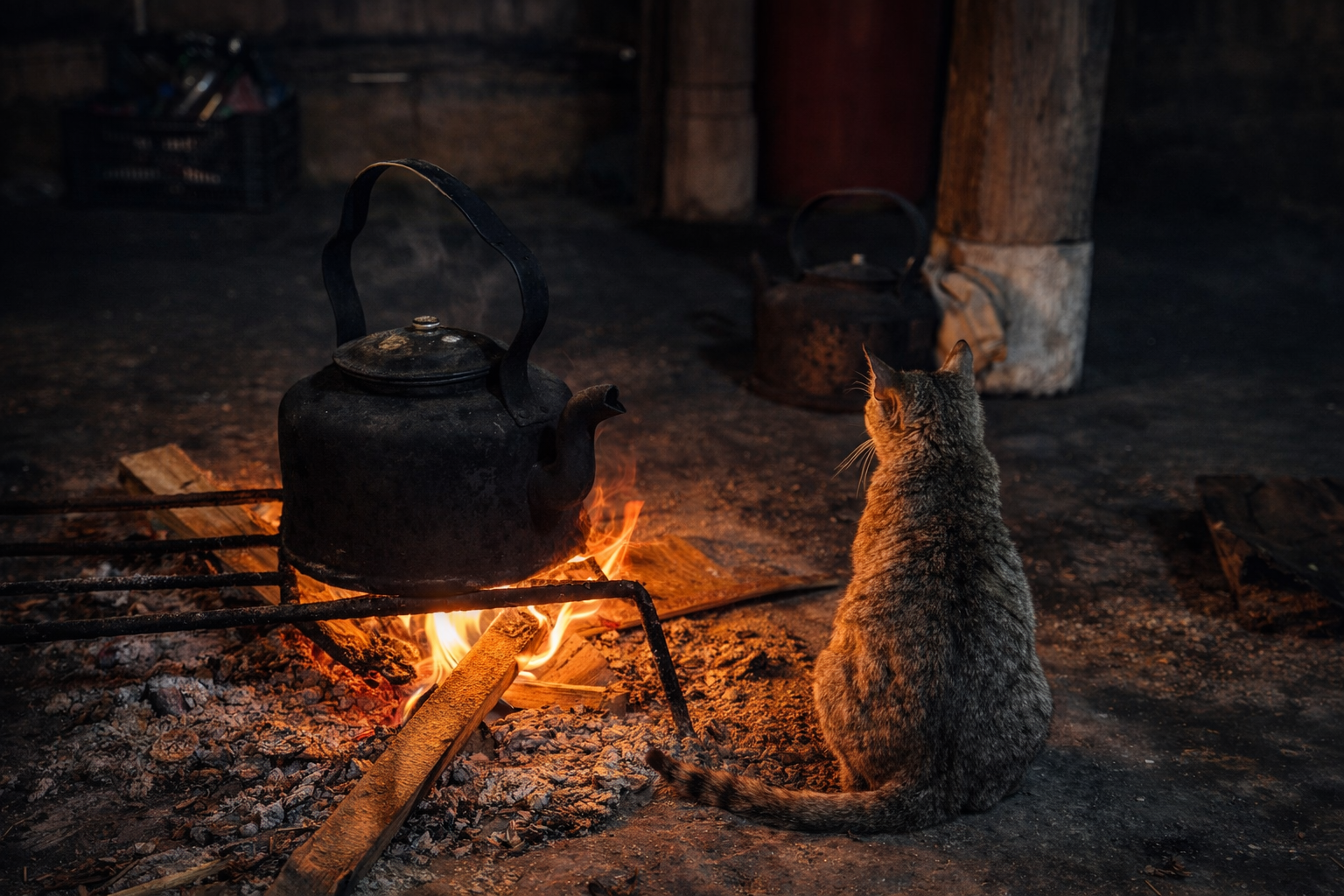
Cats, Dogs and a Very Practical Friendship in Sapa.
In the mountains around Sapa, cats and dogs are rarely treated as pampered pets. Instead they are trusted helpers in daily life. Hmong folktales even explain how these animals earned their place alongside people.
Not Quite Pets, Not Quite Livestock.
If you spend time in Hmong villages around Sapa, you will notice something interesting about the cats and dogs wandering through courtyards and along dusty paths. They are everywhere, but they are rarely treated like the pampered pets many visitors are used to seeing at home.
Dogs guard houses, accompany people along mountain trails, and warn families about strangers or wild animals. Cats patrol kitchens and storage spaces, quietly keeping rats and mice away from precious grain supplies. They live alongside people, but usually outside the house, and affection is expressed through care and provision rather than cuddles.
In many households, animals are simply called what they are. A cat is called cat. A dog is called dog. The relationship is respectful and practical, shaped by generations of mountain life where every member of the household, human or animal, has a job to do.
If you’d like to see this way of life for yourself, you’re always welcome to join us for a quiet walk through the villages, where these relationships unfold naturally, step by step.
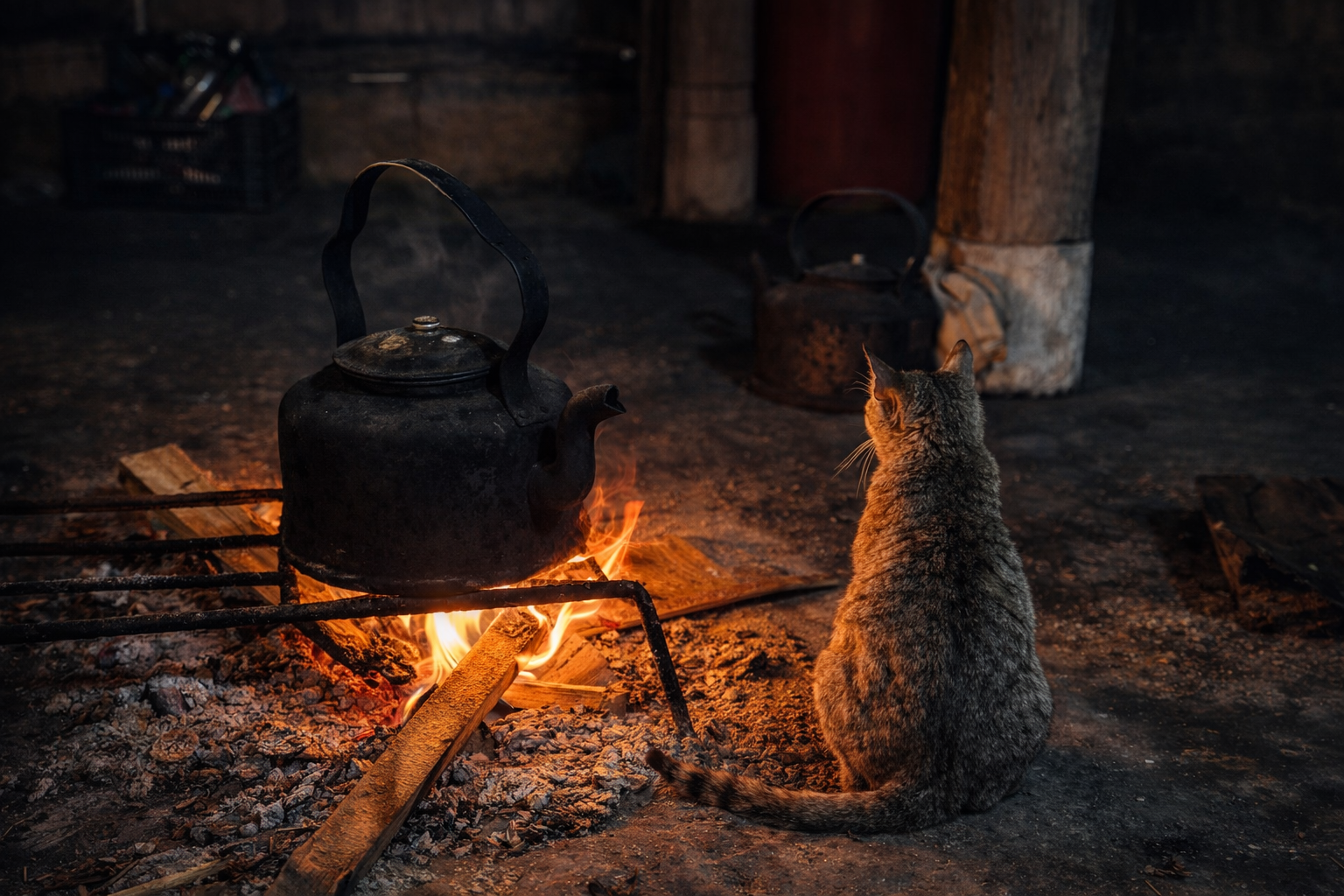


The Mountain Dogs of Northern Vietnam.
While many village dogs are mixed breeds that have adapted naturally to the mountains, two distinct breeds are strongly associated with Hmong communities in northern Vietnam. These are the Hmong Dog and the Bac Ha Dog.
The Hmong Dog, sometimes called the Hmong bobtail dog, is a sturdy mountain breed known for its naturally short or stubby tail. These dogs tend to have muscular bodies, thick coats, strong legs, and a broad head that gives them a serious and alert expression. They are highly intelligent and extremely loyal to their owners. Traditionally they were used for hunting in forests and for guarding homes in remote mountain villages. Their strong sense of direction and endurance make them particularly suited to steep terrain and long walks through the hills.
The Bac Ha Dog is another famous breed from the northern highlands around the town of Bac Ha. These dogs are often larger and fluffier than the Hmong Dog. Many have thick, long fur that protects them from the cold mountain climate and bushy tails that curl over their backs. Bac Ha Dogs are known for their courage and strong guarding instincts. Despite their impressive appearance, they are also known to be calm and gentle with their owners.
Both breeds developed in the rugged landscapes of northern Vietnam where resilience, intelligence, and loyalty were essential qualities. For Hmong families living in isolated mountain communities, these dogs have long been dependable partners.
The Hmong Bobtail Dog: A Natural Born Mountain Guard.
The Hmong bobtail dog is one of the most distinctive dog breeds in northern Vietnam. As the name suggests, its most recognisable feature is its naturally short or completely absent tail. This is not the result of docking but a genetic trait that has developed over generations in the mountains.
These dogs are compact, muscular, and built for endurance. They typically have thick coats, strong legs, and a broad, slightly square head that gives them a serious and alert expression. Their appearance reflects their purpose. They are working dogs first and foremost.
Hmong bobtail dogs are known for their intelligence and independence. They are highly loyal to their owners but can be wary of strangers, which makes them excellent guard dogs in remote villages. Traditionally they were also used for hunting, relying on their strong sense of smell and their ability to navigate dense forests and steep terrain.
In many ways, they perfectly reflect the environment they come from. Tough, reliable, and not particularly interested in fuss, they are well suited to life in the mountains where practicality matters more than pampering.
The Bac Ha Dog: The Fluffy Guardian of the Highlands.
The Bac Ha dog is another iconic breed from northern Vietnam, originating from the highland town of Bac Ha not far from Sapa. Compared to the Hmong bobtail dog, the Bac Ha dog has a much more striking and almost majestic appearance.
These dogs are usually larger and covered in thick, fluffy fur that helps them cope with the colder mountain climate. Many are white or light coloured, although other shades can appear, and they often have a distinctive bushy tail that curls over their back. Their thick coat and sturdy build give them a strong, almost lion like presence.
Despite their impressive looks, Bac Ha dogs are not just for show. They are known for their courage and strong protective instincts. Like the Hmong dog, they are used to guard homes and livestock, especially in isolated areas where early warning of danger is essential.
At the same time, they are often described as calm and steady around their owners. This balance of gentleness and strength makes them well suited to village life, where a dog needs to be both a protector and a reliable everyday companion.
Cats and Dogs in Hmong Folktales.
Hmong folklore also gives cats and dogs surprisingly important roles. In fact, when animals appear in traditional Hmong stories, dogs often take centre stage while cats appear less frequently but still play memorable parts.
One folktale tells of a man who owned a magical gourd that could produce food. When rats stole the gourd, his household suddenly faced hunger. A cat and a dog set out together to retrieve it. The dog used its powerful sense of smell to track the thieves while the cat rode along and helped recover the gourd. When the precious object was finally returned, the story explains why cats and dogs have different roles in the household. The cat was rewarded with higher status and allowed to eat meat, while the dog was assigned the job of guarding the house.
Another story tells of a mysterious red eyed dog that helps a young woman find her future husband. Her father gives her the dog and tells her to follow it. Wherever the dog stops and refuses to move will be the home of the man she should marry. The dog ignores wealthy households and leads her instead to a poor orphan. By refusing to leave the orphan’s house, the dog confirms that he is the rightful husband. The tale quietly celebrates the idea that character matters more than wealth.
Stories like these often portray dogs as guides, protectors, and helpers who can cross the boundary between the human world and the unseen world. Cats, meanwhile, are usually tied more closely to the practical world of households and grain stores.


An Old Story About Hunger and Cooperation.
Another popular story explains why cats and dogs chose to live alongside people in the first place.
Many years ago, when the Hmong still lived semi nomadic lives in the mountains, a time of extreme hunger struck both people and animals. Food was scarce everywhere. The Hmong called a meeting and invited the animals to attend.
“We are all hungry,” the Hmong leader said. “We need to work together.”
One by one, the animals began to make their excuses.
“We only need a tiny amount of food,” said the mouse. “We will be fine.” The mouse promptly left.
The monkey spoke next. Monkeys, he explained, were excellent climbers who could reach fruit high in the tallest trees. “We do not need help.” And off he went. The tiger looked around the room and shrugged. “You are all our food.” With that cheerful observation, the tiger also left. The birds flapped their wings and announced they could simply fly away and find food elsewhere. Then they disappeared into the sky. Slowly the room emptied until only two animals remained. Cats and dogs.
They agreed to work alongside people in a symbiotic way. Humans would provide them with food or shelter. In return, the cats would keep rats and mice from ravaging the grain stores, while dogs would guard homes and keep dangerous animals at bay.
A Partnership That Still Exists Today.
The folktales and the reality of village life line up rather neatly.
Cats and dogs are respected and provided for because they contribute to the household. They are not usually petted, named, or treated like family members in the Western sense. Instead they are valued partners who help keep homes safe, protect food supplies, and make village life run a little more smoothly.
It may not look like the typical idea of pet ownership. But in the mountains of northern Vietnam, it is a practical partnership that has lasted for generations.
In Loving Memory of Sùng Thị Máy
Sùng Thị Máy lived nearly a century shaped by hardship, resilience and love for her family. From gathering firewood in the mountains to sharing stories and traditional knowledge with younger generations, her life reflects quiet strength and enduring dignity.
A Life of Strength and Resilience
Born on 11 January 1925, during the era of French Indochina, Sùng Thị Máy witnessed a century of profound change in northern Vietnam. Her life was shaped by both hardship and courage. She lost her husband during the Chinese invasion of northern Vietnam in 1979 and spent her later years in a small mountain home, caring for her five great-grandchildren.
Despite her age, Máy continued to gather firewood daily for cooking, while the eldest of the children searched for food in the surrounding forest. Her simple yet determined way of life reflected her enduring spirit and love for her family.
Meeting ETHOS
Our paths first crossed with Máy in 2017, when we found her collecting plastic waste from bins in the town of Sapa. At 92 years old, she was living on the streets, sorting recyclables to earn a small income. Moved by her story and resilience, ETHOS began a support project for her in 2020.
Through regular food, clothing, and medical assistance, Máy was able to return to her mountain home and live with dignity once more. Her quiet gratitude and humour touched everyone who met her.
A Remarkable Recovery
In December 2023, Máy fell seriously ill with pneumonia. Hoa arranged her hospital treatment, and thanks to care and determination, she recovered enough to be discharged after about ten days. During her stay, we learned more about her past and her remarkable resilience.
She shared how her grandchildren, who had been opium growers, were imprisoned in 2023, leaving her to care for the five young great-grandchildren alone. After leaving hospital, Máy stayed at the ETHOS community centre to continue her recovery.
During those weeks, she spent her days telling stories, twisting hemp fibres and sharing her traditional textile knowledge with our younger team members. Her patience and wisdom became a source of quiet inspiration to all of us.
A Legacy of Love
Sùng Thị Máy’s life was a testament to courage, endurance and love. She was a devoted mother, grandmother and great-grandmother whose kindness and strength will not be forgotten. Her youthful smile, sharp mind and gentle humour stayed with her until her final days.
Máy’s story reminds us of the beauty in simplicity and the power of compassion. She leaves behind not only her family but also a community forever touched by her warmth and grace.
Closing Reflection
We will remember Máy for her laughter, her hands always busy with work, and her heart full of love. Her spirit continues to live on in the mountains she called home and in the memories of all who had the privilege to know her.
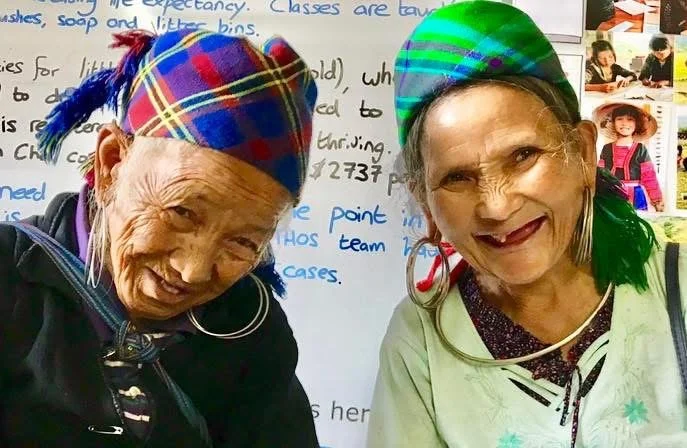
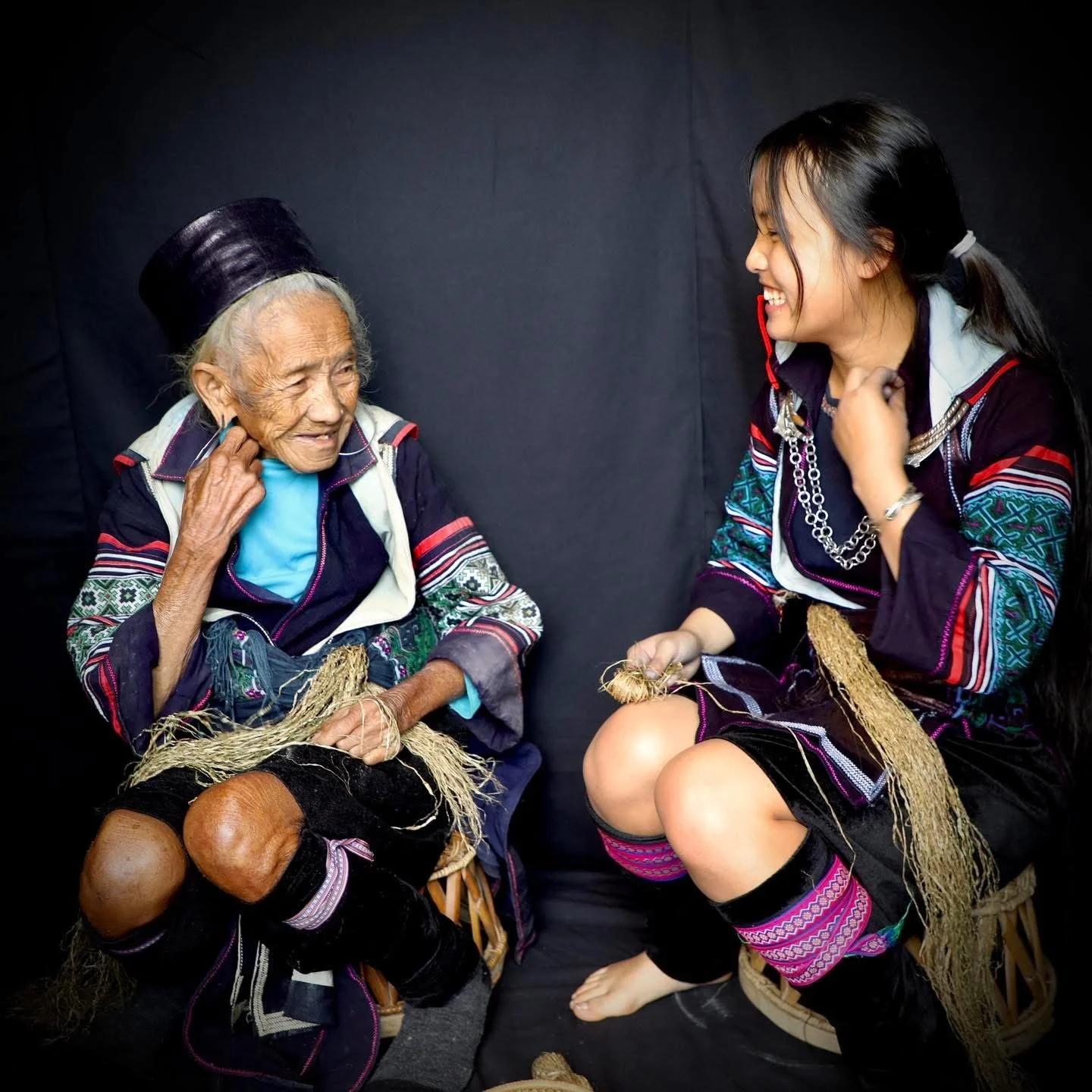

Sapa and the Performance of Travel: Are We Still Exploring, or Just Reproducing the Same Photograph?
Moana Sapa’s fibreglass sculptures and staged viewpoints symbolise a wider shift in modern travel. As visitors queue for identical photographs and rent traditional clothing for curated images, the deeper question emerges. Are we still exploring the world, or simply performing within it?
The Rise of the Check In Destination and FOMO
High above the valleys of Sapa. northern Vietnam, Moana has become one of the region’s most visited attractions. Hundreds arrive each day, not drawn im by history or culture, but by carefully constructed objects designed for photographs. A giant fibreglass head. An imitation Bali gate. Sculpted hands lifting visitors above the landscape. Each structure exists for a single purpose. To frame the individual.
But there is another force at work here. The quiet pressure of FOMO (fear of missing out). When travellers see the same images repeatedly, shared across social media and guide platforms, the experience begins to feel less like a choice and more like an obligation. Everyone else has stood there. Everyone else has taken that photograph. To visit Sapa and not recreate it can feel, to some, like an omission. The modern traveller is no longer guided purely by curiosity, but by visibility and resence becomes something to prove.
Visitors queue patiently, sometimes for an hour or more, waiting to stand in exactly the same spot as the person before them. They take the same photograph and in many instances recreate the same contrived pose. They leave with the same image but without any lasting memories. The mountains behind them, ancient and indifferent, become nothing more than scenery for a performance.
What are they truly capturing? The epic Sapa culture and scenery or themselves in high definition, blocking the view of the landscape that once drew people to the region.

Moana. The most photographed head in Sapa
When Travel Becomes Performance
There was a time when travel meant stepping into the unknown. Visitors arrived in Sapa without expectation, without a predetermined outcome, and without a photograph in mind already waiting to be taken. Discovery belonged to those willing to move beyond what was visible, to follow instinct rather than instruction. Today, many travellers arrive already knowing exactly what they intend to capture. One of the questions we are most frequently asked is, “Where exactly did you take this photo, can you send me a pin?” It is an innocent question, but also a revealing one. We never share pins, not because we wish to withhold, but because the act of searching is part of the experience itself. When every place is reduced to coordinates, discovery is replaced by replication. We want travellers to explore, to observe, and to find their own moments rather than inherit someone else’s. When the destination becomes a set of instructions, something essential is lost. The journey becomes less about discovery, and more about confirmation.
Moana Sapa is not alone in this transformation. Across the region, destinations are no longer experienced. They are staged with platforms built, photo opportunities curated amd frames installed. Entire spaces are constructed to guide visitors toward a predetermined outcome. The photograph becomes the objective and the experience becomes secondary.
It sometimes feels like we have stopped travelling to see the world, and started travelling to show ourselves within it.
Cat Cat Village and the Wearing of Culture
In nearby Cat Cat village, another ritual unfolds. Visitors rent traditional ethnic clothing, garments that once reflected identity, ancestry, and belonging. They wear them briefly, walking through Cat Cat, pausing for carefully composed images. Then they return them and leave. Is this appreciation or appropriation?
Some will argue it is harmless. That it celebrates culture and supports local economies. Others will ask what remains when tradition becomes costume. When meaning is detached from context and identity becomes aesthetic. What happens when a culture is reduced to something you can wear for an hour and upload the same afternoon?
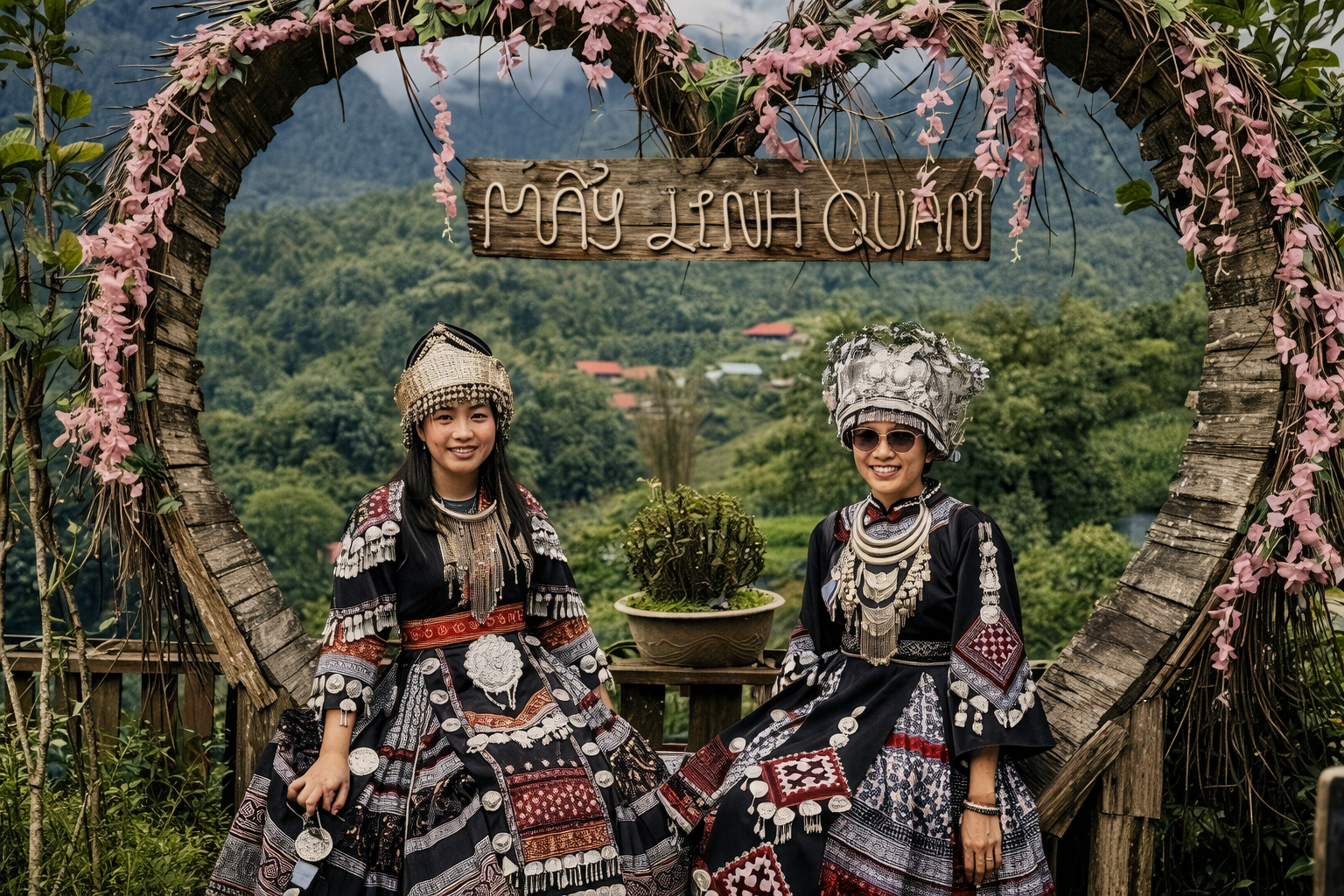
Travellers taking curated photos in factory made, replica Hmong style clothing, rented for selfies.
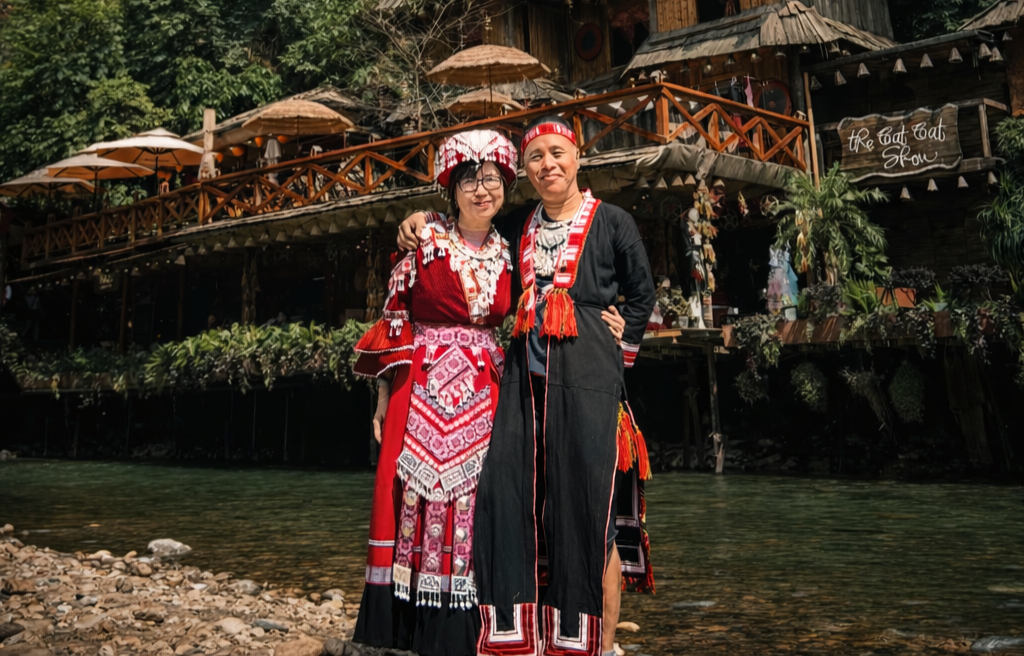
Travellers taking curated photos in factory made, replica Hmong style clothing, rented for selfies.
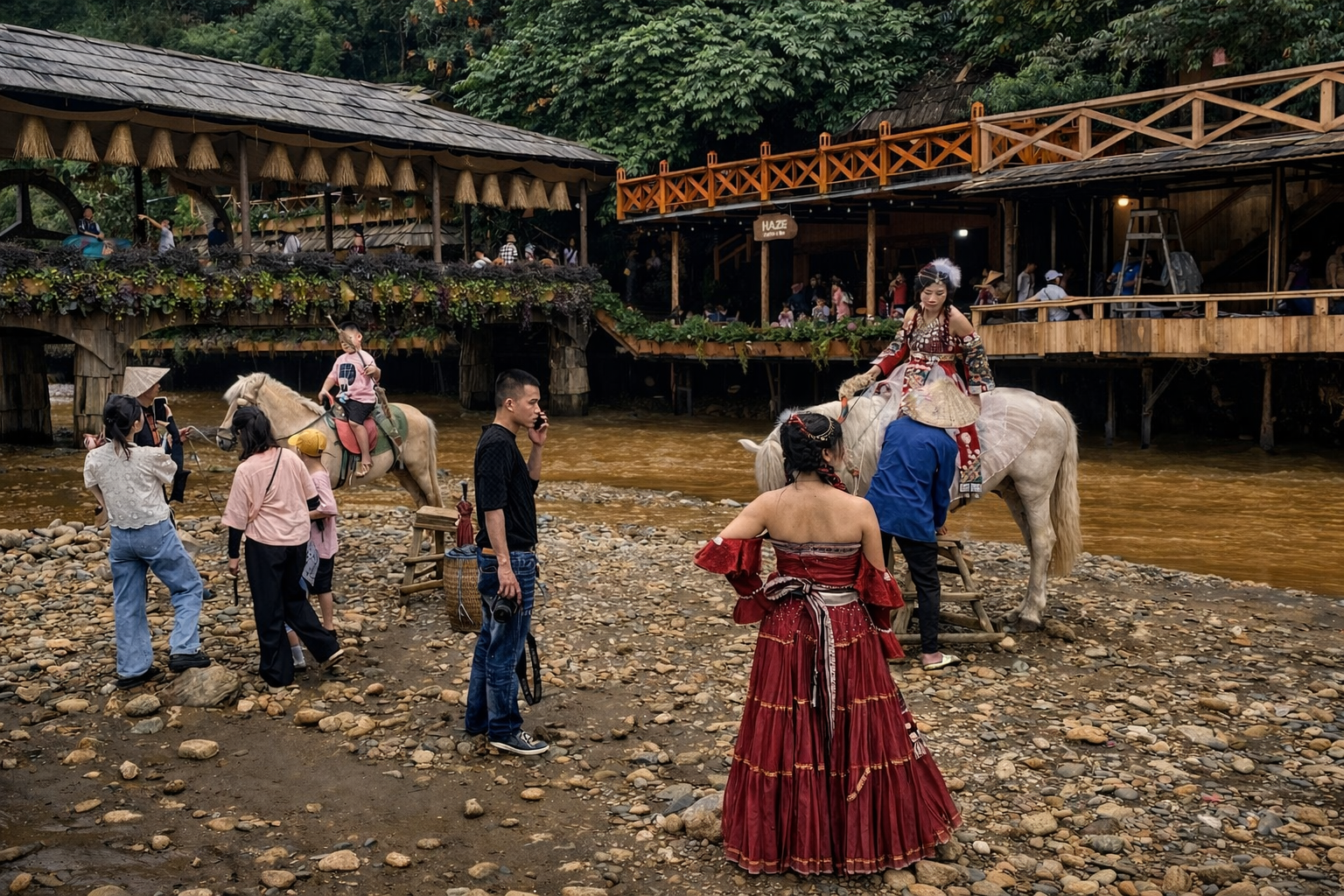
Travellers posing on a horse while wearing in factory made, replica Hmong style clothing, rented for selfies.
The New Symbols of Visibility
Even Sapa Station’s newly built clock tower has become a magnet for cameras. Visitors gather beneath it, photographing its clean lines and fresh construction. Yet the tower holds no ancient story. It has not stood through generations. Its significance exists primarily through visibility. People go because it is known. Because it appears in feeds. Because others have stood there before them. Is it truly beautiful or simply familiar? How much of what we photograph is chosen by us and how much is chosen for us?
Meanwhile, the Real Sapa Waits
Beyond these curated spaces, the true landscape of Sapa stretches endlessly. Rice terraces carved patiently into the mountains over centuries. Valleys that shift with mist and light. Narrow roads that disappear into silence. Here, there are no queues, no entrance fees, no instructions. You might choose to wander the valleys under the guidance of a local expert or ypu can explore at your own leisure. You can wander on foot or explore on a bicycle or motorbike and yet far fewer people go.
The irony is striking. Many visitors leave Sapa complaining that it has become too touristy. Too crowded and too artificial. Yet these people have spent their time inside the very spaces designed to concentrate crowds. The beauty they seek still exists but simply requires a little more effort to get there. It requires leaving the familiar.
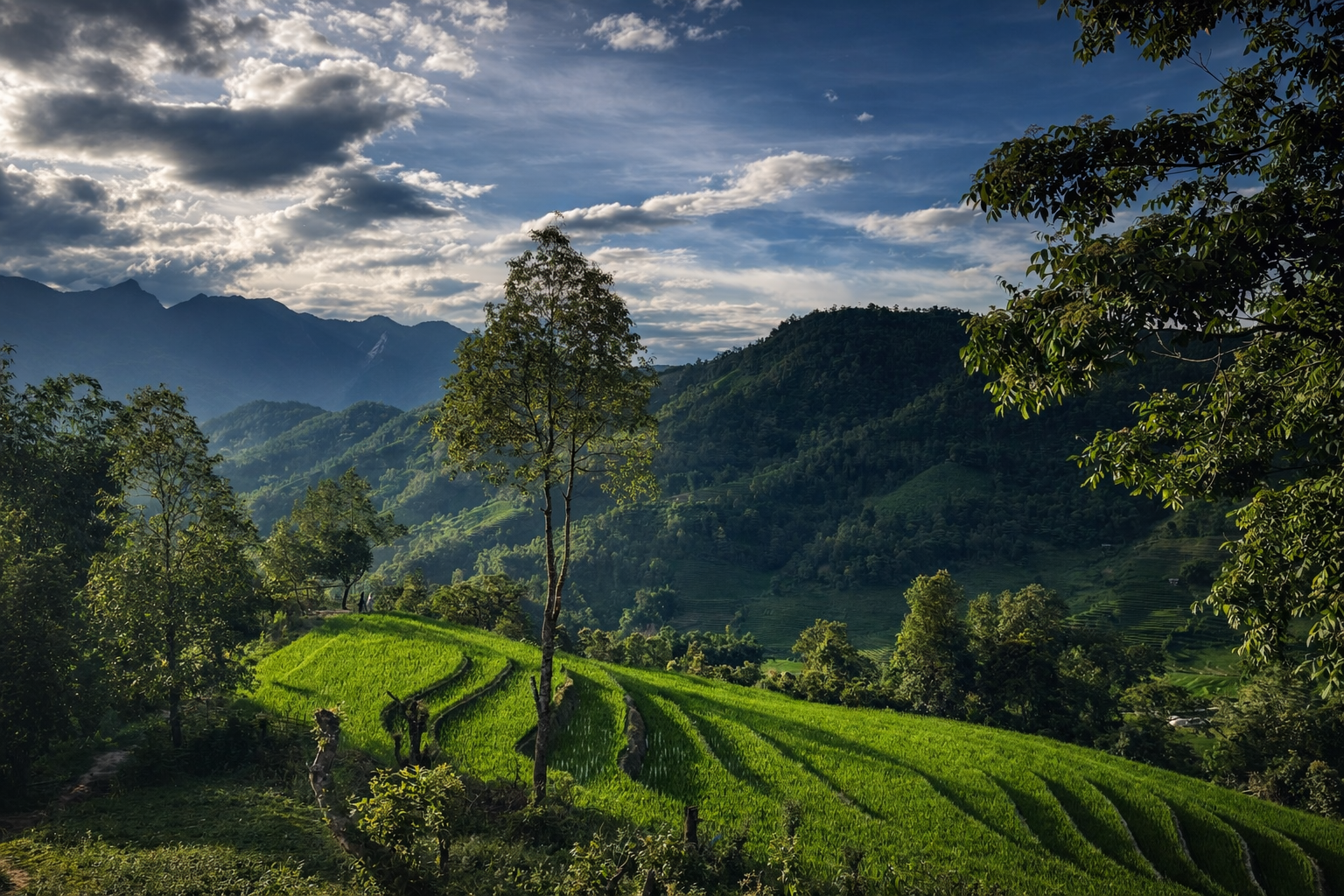

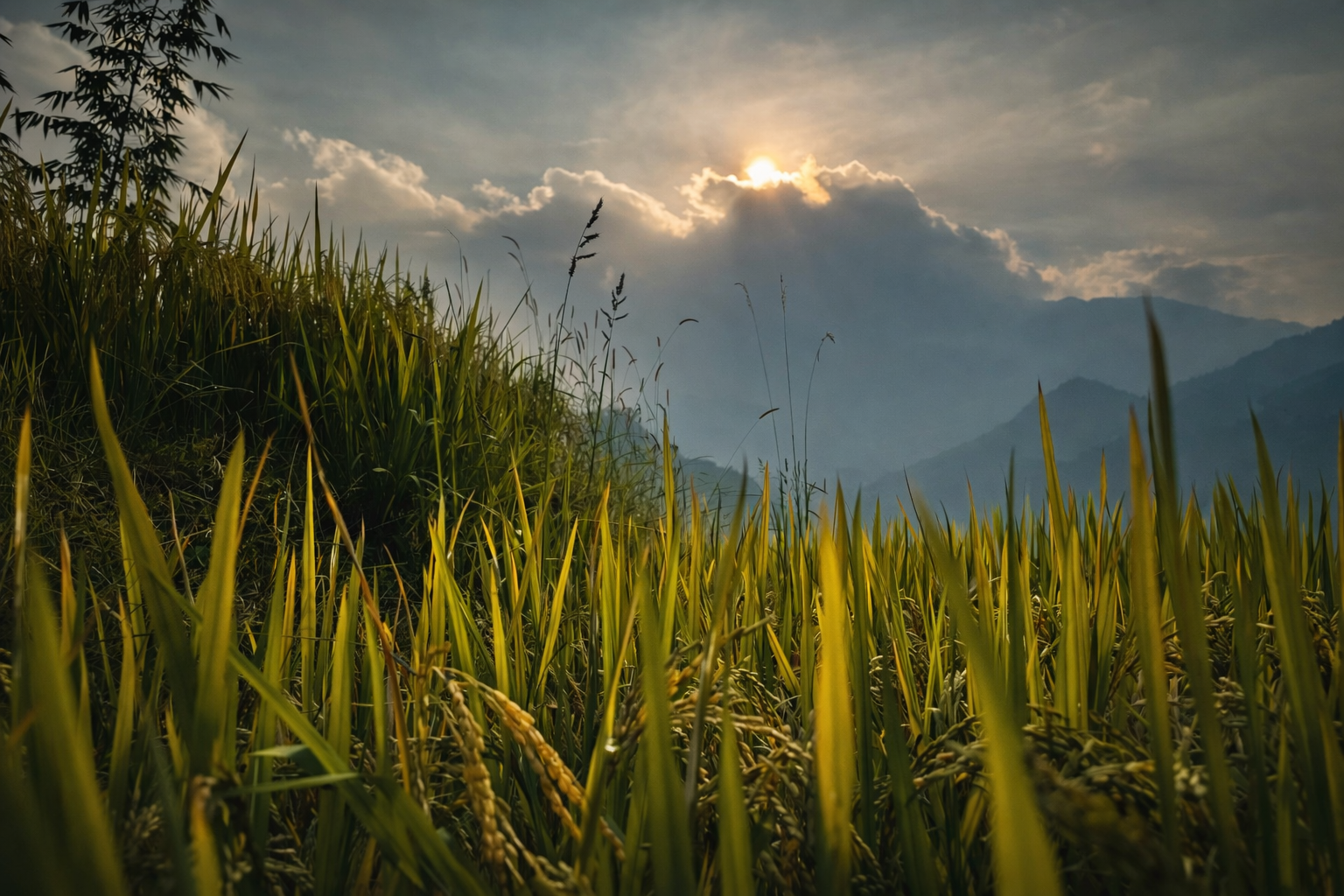
The Commercialisation of Experience
“Check In” mass tourism sites do not exist by accident. They are products of precise marketing and modern psychology. They offer certainty, predictability and validation. They promise something guaranteed; a photograph that will be recognised, approved and understood while exploration offers no such guarantees.
So which do we choose? The uncertainty of discovery or the safety of repetition.
What worries is us now is how much more of the natural world will be reshaped to meet this demand? How many more viewing platforms will be built? How many replicas of iconic global buildings are yet to be installed? How many landscapes altered, not for preservation, but for presentation. At what point does the pursuit of the perfect photograph begin to destroy the very beauty it seeks to capture.
Choosing to See Differently
Sapa remains vast and its beauty beyond mass tourism remains firmly intact. We can be clear in explaining that most of this beauty does not reveal itself to those who follow only the most visible paths. To find it, you must move. Walk beyond the villages you recognise by name. Ride into valleys that do not appear on curated lists. Stand where there are no markers telling you where to look.
The real reward of travel has never been proof or validation. It has never been the photograph itself by the experience of discovery.
The question is no longer what Sapa has become but instead what kind of traveller you choose to be.

Đông Vui, Expectation, and the Cultural Divide in Experience
To understand Cat Cat village, and many places like it, you must first understand the deeply rooted Vietnamese cultural concept of Đông vui. Literally translated, it reflects the enjoyment of crowds, noise, and shared energy. A place filled with people is not seen as spoiled, but alive. Activity signals success and noise signals excitement. A crowded destination feels important because it is collectively experienced.
Collectivism in Vietnam is a core cultural value shaped by centuries of Confucian philosophy, village-based agriculture, and socialist political ideology, emphasising the importance of family, community, and social harmony over individual interests. People are taught to prioritise group goals, respect hierarchy, and maintain strong loyalty to family and nation, which is reflected in close multi-generational households, consensus-based decision-making, and a strong sense of mutual obligation. For many Vietnamese travellers traffic jams, loud music, long queues and a vibrant atmosphere are not flaws but a core part of the attraction itself. Dressing in traditional ethnic minority clothing is seen as celebration, not imitation. Photographing oneself in these settings is an expression of participation. The occasion matters as much as the place.
This cultural lens shapes recommendations they may make. When you ask a hotel receptionist, a tour operator, or a tourism office what you should see in Sapa, they will often direct you toward places like Cat Cat village and Moana. This not because they are misleading you, but because they genuinely believe you will enjoy them. Their assumption is simple. We enjoy the crowds and noise and so will you. It is worth remebering that expectation shapes experience.
Reviews of Cat Cat differ dramatically depending on who is visiting. Many Vietnamese travellers describe it positively. They embrace the atmosphere, the accessibility, and the sense of shared occasion. International travellers, however, often arrive seeking something else; peace and quiet, authenticity and often a connection with landscape and culture. What they encounter instead can feel artificial, commercialised, and carefully staged. The same location produces entirely different emotional responses.
Copycat Tourism and the Illusion of Uniqueness
The rainbow slide in Cat Cat village is a perfect example. It is colourful and entertaining. It photographs well too but it is far from being unique. Two other, almost identical slides exist elsewhere in Sapa. Others exist in Hanoi and Da Lat. Their are others across Asia, in Europe and throughout the world. Visiting a rainbow slide is therefore not discovery travel but just repetition and duplication. How many places are we visiting not because they are meaningful, but because they are recognisable? How many attractions are designed not to deepen experience, but to reproduce familiarity? When every destination begins to offer the same photograph, does the location itself still matter?
Cat Cat village, in many ways, has become to epitomise this with its carefully managed environment and structured paths. Viewpoints are designated and cultural elements are curated for visibility rather than lived experience. It functions efficiently and moves visitors through a sequence of moments designed to satisfy expectation. Most people leave knowing that authenticity rarely follows a prescribed route.

Sapa Rainbow Slide 1
Sapa Ranbow Slide 2
Sapa Rainbow Slide 3
The Power of Recommendation and the Fear of Missing Out
Yet people continue to go. Is it because Cat Cat is extraordinary or because it is repeatedly recommended? When every hotel suggests it. When every tour company includes it. When every travel blog lists it. When every social media feed displays it, the decision begins to feel inevitable. To skip it feels like omission. Almost like missing something essential. Fear of missing out is a powerful force. It quietly shapes behaviour without ever announcing itself. But what if what you are missing is not inside the crowd, but beyond it.
The Question Every Traveller Must Ask
Cat Cat village is not Sapa. It is one version of Sapa. One interpretation. One commercial expression shaped by demand, expectation, and replication. The real Sapa exists elsewhere. In the silence between villages. In terraces without viewing platforms. In roads without signs. In places not recommended because they cannot be easily packaged. The question is not whether Cat Cat should exist. It will continue to exist. It serves a purpose. It fulfils an expectation. The question is whether you are content to experience what has been prepared or whether you are willing to discover what has not.
Beyond the Photograph; What Cannot Be Replicated
The only truly unique aspect of Sapa is not a structure, a viewpoint, or a constructed attraction. It is the people. Their cultures, their traditions, and the lives they lead interwoven with some of the most mesmerising landscapes on earth. To sit together and share tea. To cook over an open fire. To walk the buffalo trails that have connected villages for generations. These moments offer something no staged photograph ever can. The opportunity to listen, to learn, and to see the world through a perspective entirely different from your own is one of travel’s greatest privileges. These are the experiences that remain long after the journey ends. Not because they were photographed, but because they were felt. As conversations turn into friendships, and unfamiliar places begin to feel familiar, travel becomes something deeper. Not observation, but connection. Not performance, but understanding.
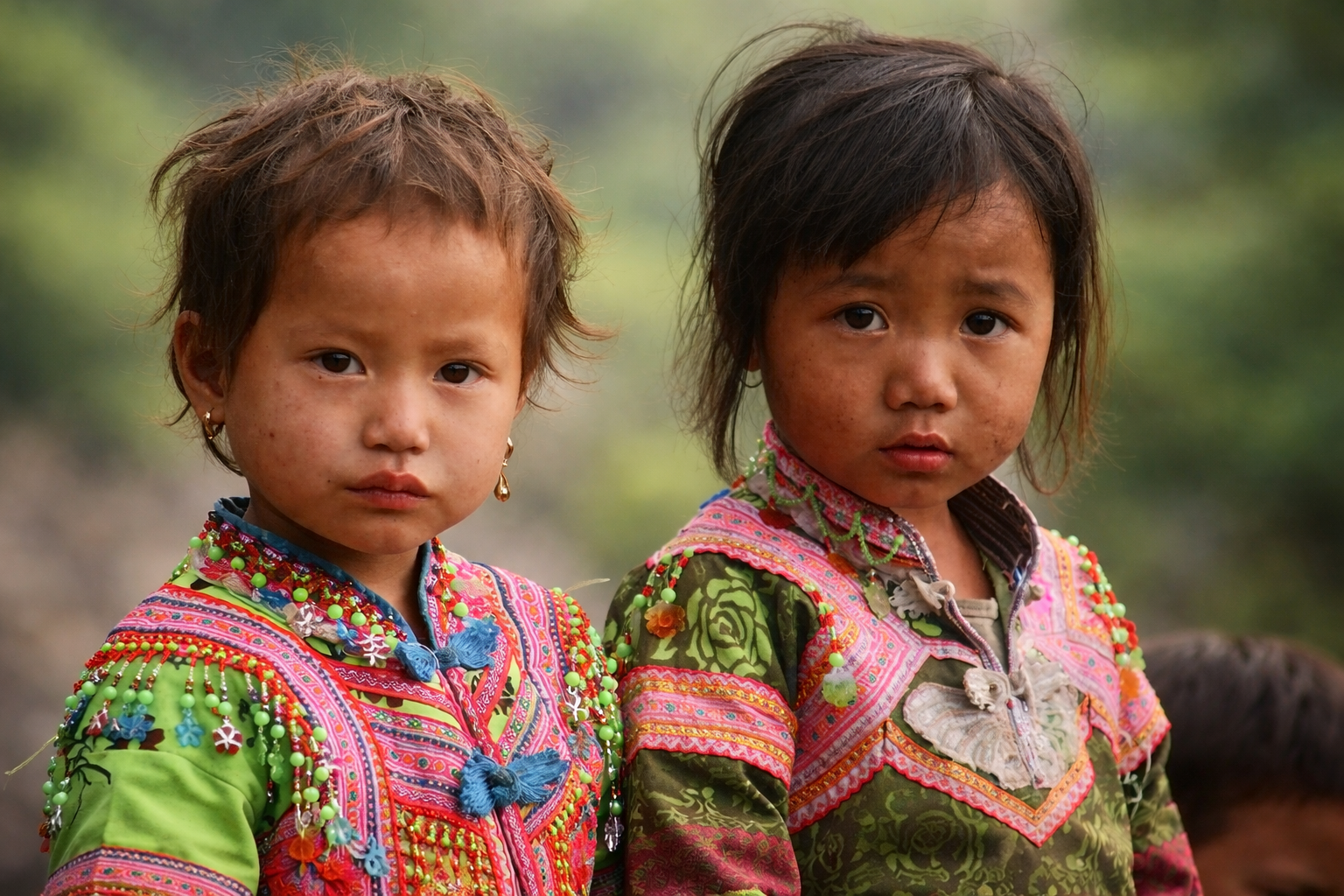
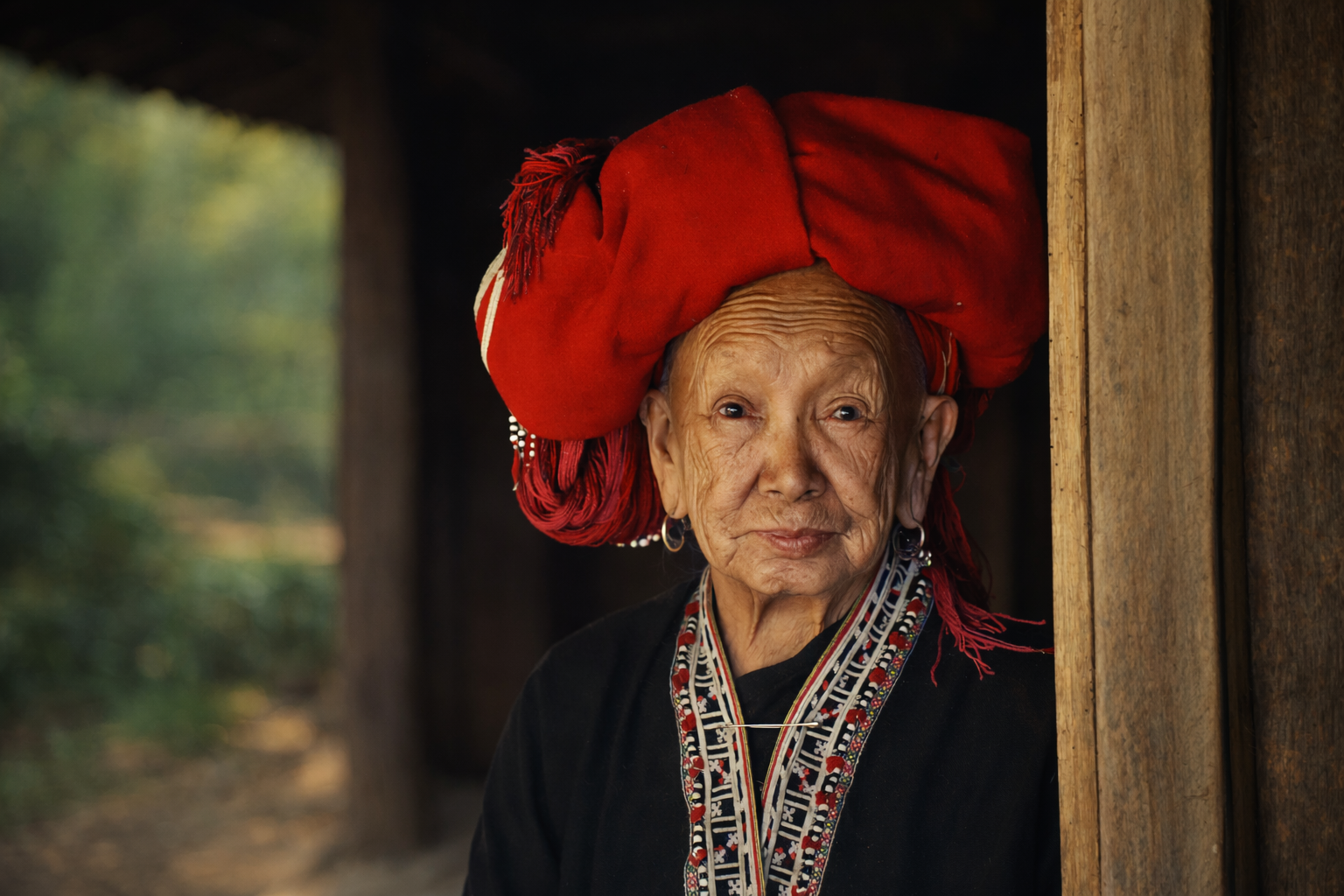
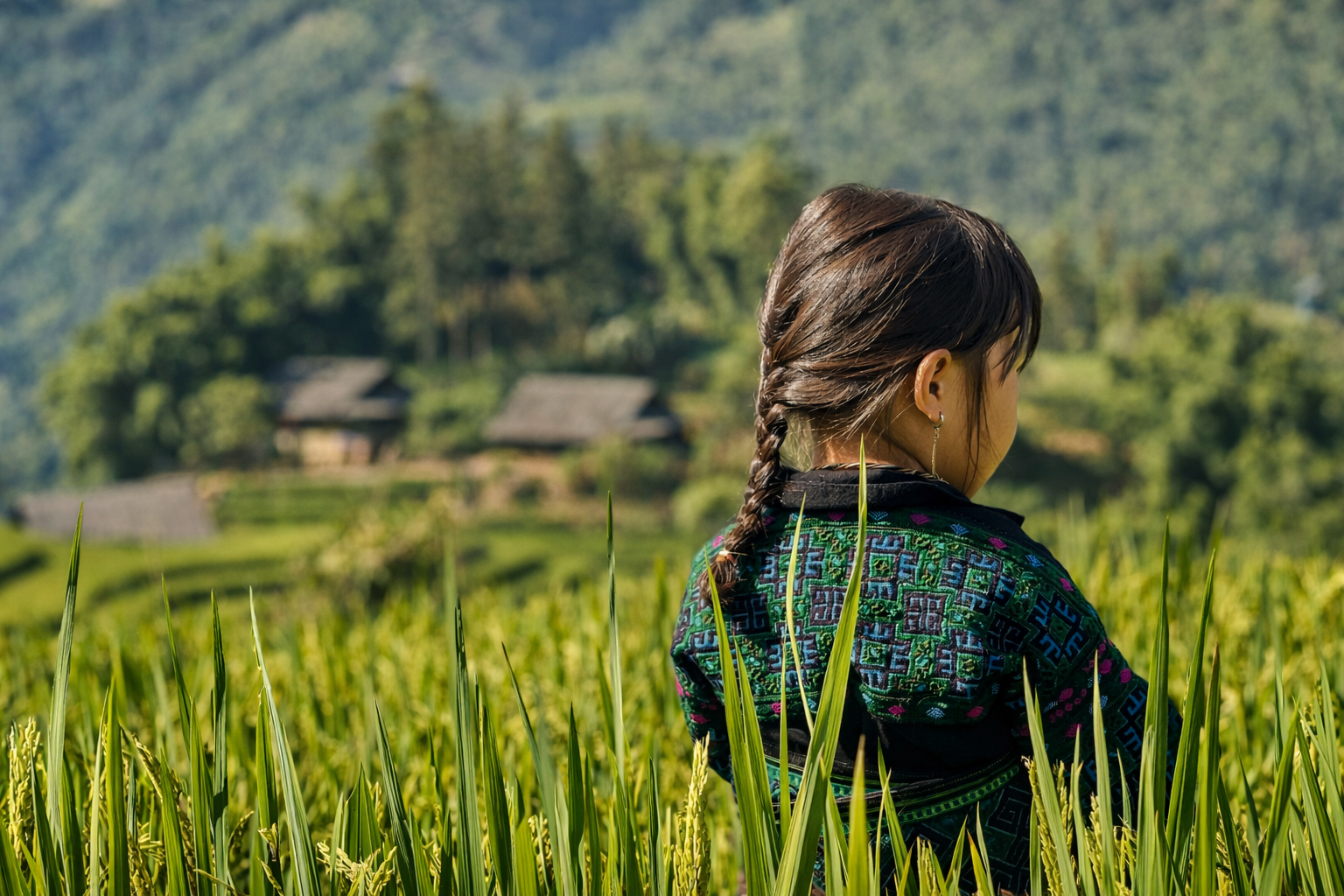
A Different Way to Experience Sapa
At Ethos, we believe the most meaningful travel experiences cannot be manufactured, staged, or replicated. They are never rigidly itinerised or contrived for the sake of convenience or visibility. Instead, they are thoughtfully curated to open doors, not close them. You are given direction, but never confined by it. You have structure, but also the freedom to change course when curiosity calls. To stop when something unexpected captures your attention. To continue when instinct tells you there is more to discover just beyond the next bend.
No two journeys are ever the same, because no two travellers are the same. The landscapes remain constant, but your experience within them is entirely your own. This is travel as it was always meant to be and the difference between visiting a place and knowing it.
Sapa does not reveal itself to those who seek the familiar. It reveals itself to those willing to move beyond it. To walk further. To ride longer. To listen more closely. To accept that the most meaningful experiences are not found where everyone else is standing. They are found where no one told you to look.
Six Ways to Experience Sapa That Cannot Be Reduced to a Photograph
You find it first on foot. Trekking through the mountains slows everything down. With each step, the noise of expectation fades and something quieter takes its place. You notice the rhythm of daily life. Farmers working the terraces. Children walking home along narrow paths. Mist rising slowly from the valley floor. You are no longer observing from a distance. You are part of the landscape itself.
You find it on two wheels. Motorbike journeys carry you beyond the visible edge of tourism. Roads twist through valleys and over high passes, leading to places that exist outside recommendation and routine. There is no queue here. No prescribed stop. Only the freedom to follow curiosity wherever it leads. Each turn offers something new, not because it was designed that way, but because it was never designed at all.
You find it in culture. Not culture performed for visitors, but culture lived. Sitting beside a local artisan. Learning how cloth is woven, dyed, and passed between generations. These moments are not curated for spectacle. They are shared quietly, through patience and presence. You are not consuming culture. You are being welcomed into it.
You find it in food. Meals in Sapa are not transactions. They are invitations. Food connects you to land, to family, and to tradition. Ingredients grown nearby. Recipes shaped by generations. Stories told across the table without the need for translation. This is not something that can be photographed fully. It must be experienced.
You find it in family. The most powerful moments are often the simplest. Sitting together. Sharing tea. Listening. These experiences do not exist for display. They exist for connection. They remain with you long after the journey ends, not because they were visible, but because they were real.
And perhaps most importantly, you find it in yourself because the true purpose of travel has never been to stand where everyone else has stood. It has always been to discover something that belongs only to you. The question is not whether these places exist. The question is whether you are willing to step beyond the crowd to find them.
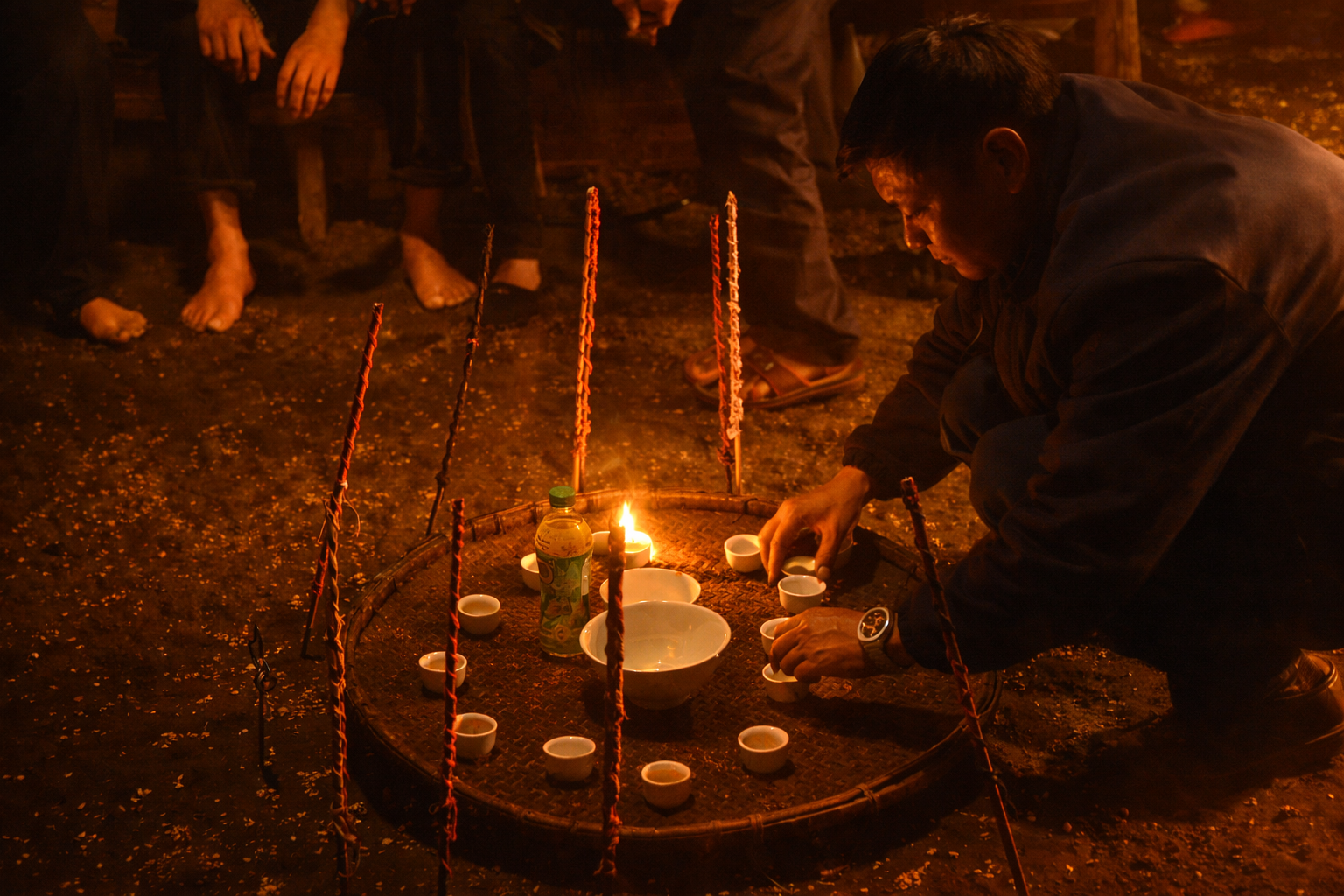
Pu Tong: The Sacred Fire Dancing Festival of the Red Dao in Sapa
Each Lunar New Year, the Red Dao community in Sapa gathers for Pu Tong, a sacred fire dancing ritual where participants walk barefoot over glowing embers. More than a spectacle, it is a spiritual ceremony of protection, strength and renewal rooted deeply in ancestral belief.
High in the misty mountains of northern Vietnam, the Red Dao people welcome the Lunar New Year with a ritual that is both mesmerising and deeply spiritual. Known as Pu Tong, or the fire dancing festival, this ceremony is a sacred act of devotion, protection and cultural continuity.
Taking place in villages around Sapa, the ritual features men throwing and dancing barefoot over burning embers, seemingly unharmed by the intense heat. To outsiders, it can feel mysterious and even supernatural. To the Red Dao, it is a powerful expression of faith, ancestral connection and community identity.
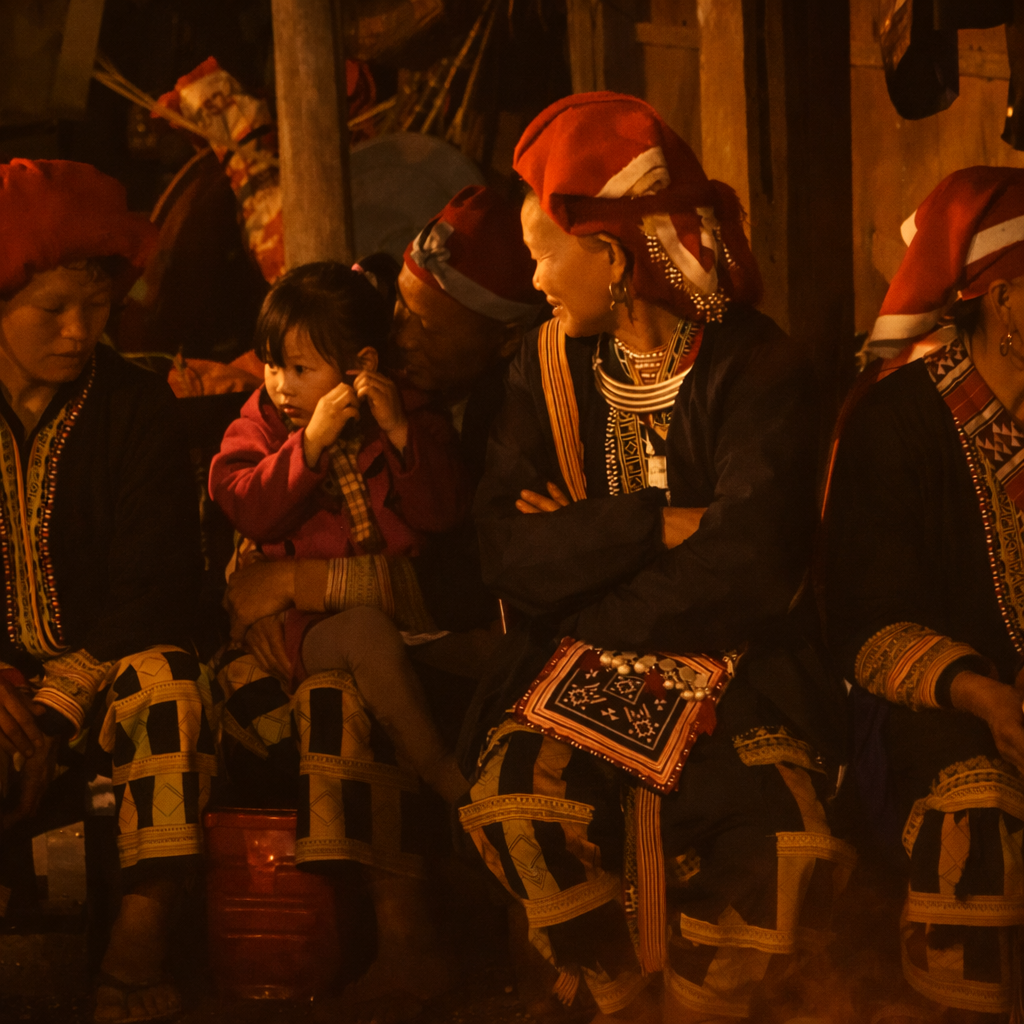
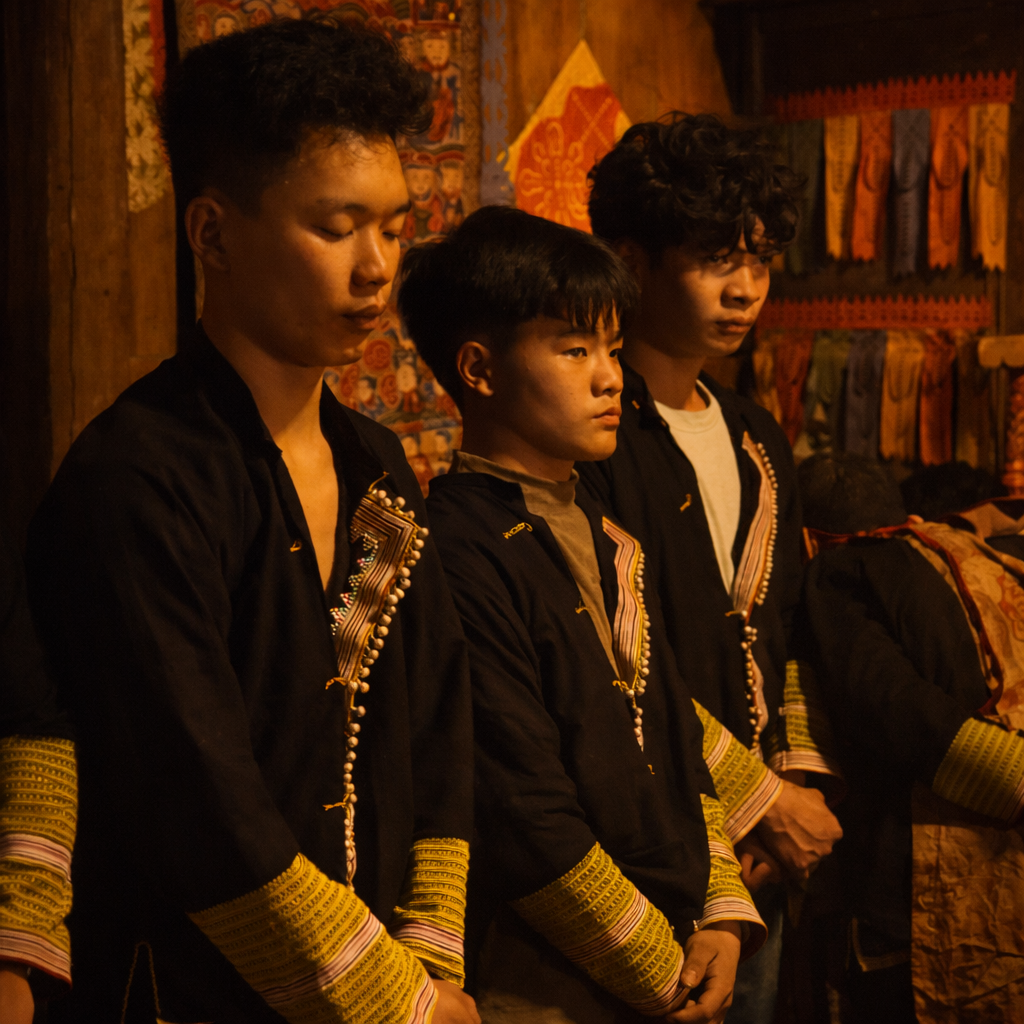
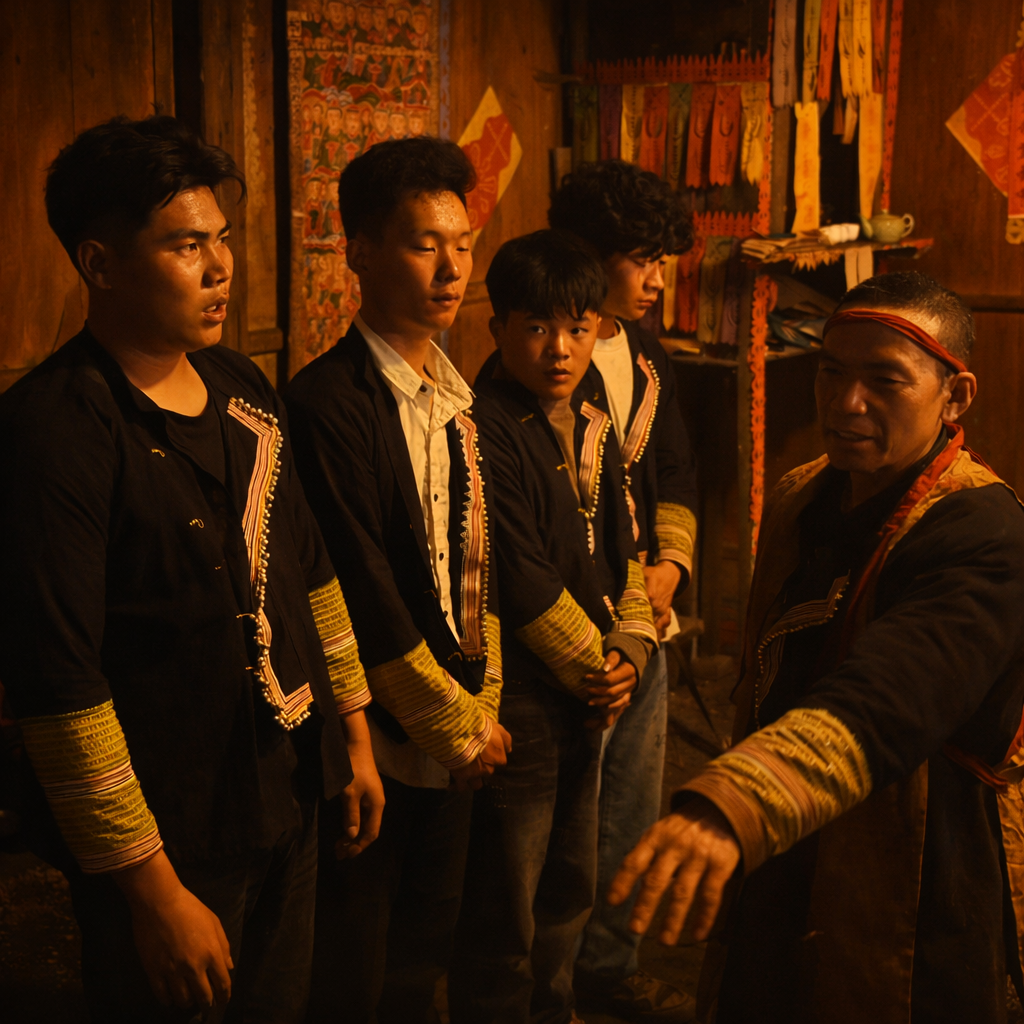
What Is the Pu Tong Festival?
Pu Tong is a traditional spiritual ceremony performed by the Red Dao people during the Lunar New Year period, typically between the first and fifteenth day of the new year. It is organised to invite blessings, ward off misfortune and protect the village from illness and harmful spirits.
The ceremony centres around the alter and fire, which is seen as a sacred and purifying force. Through ritual chanting, trance and physical endurance, participants demonstrate their spiritual strength and their connection to protective deities.
Pu Tong is a ritual believed to strengthen the entire community’s wellbeing for the year ahead.
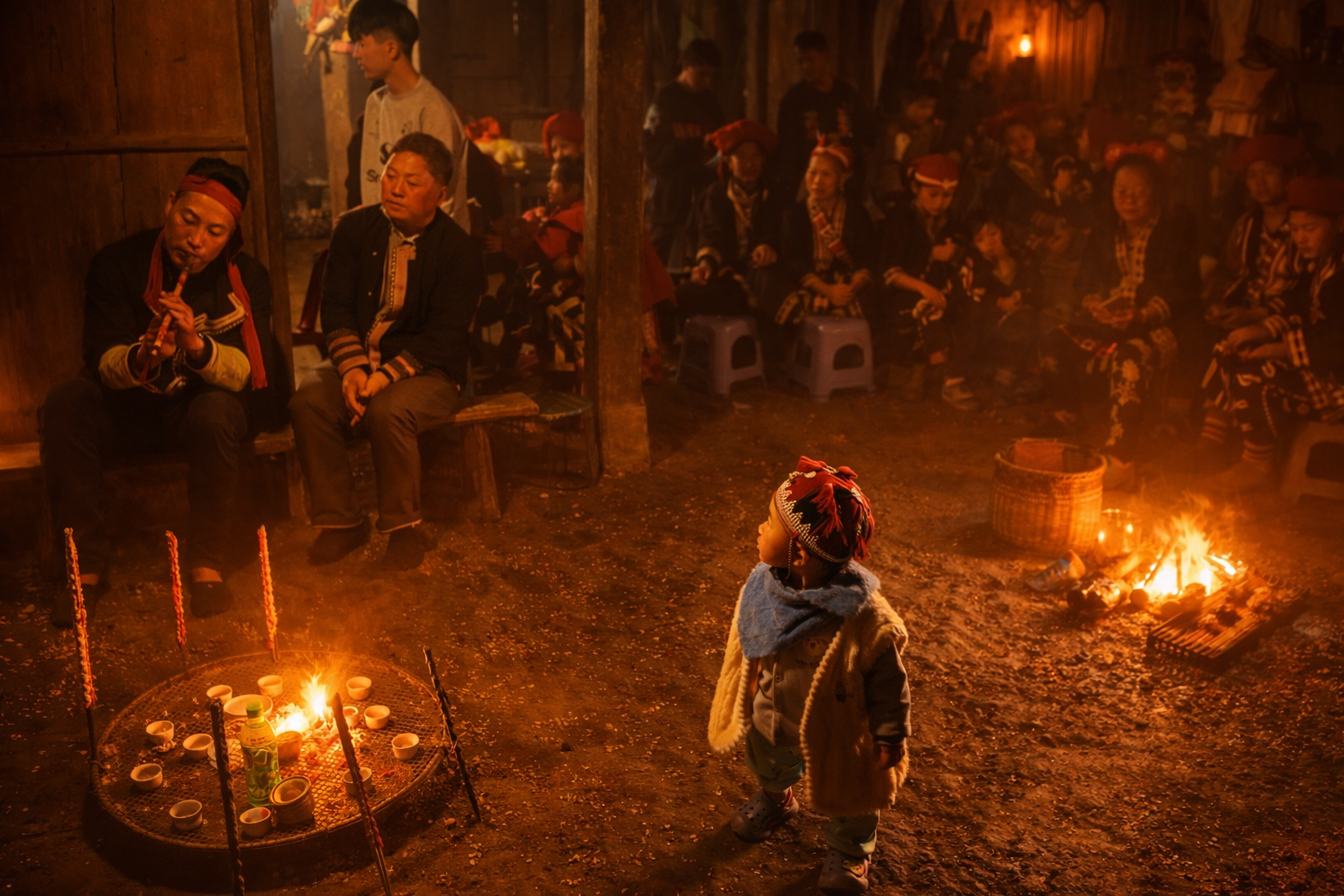
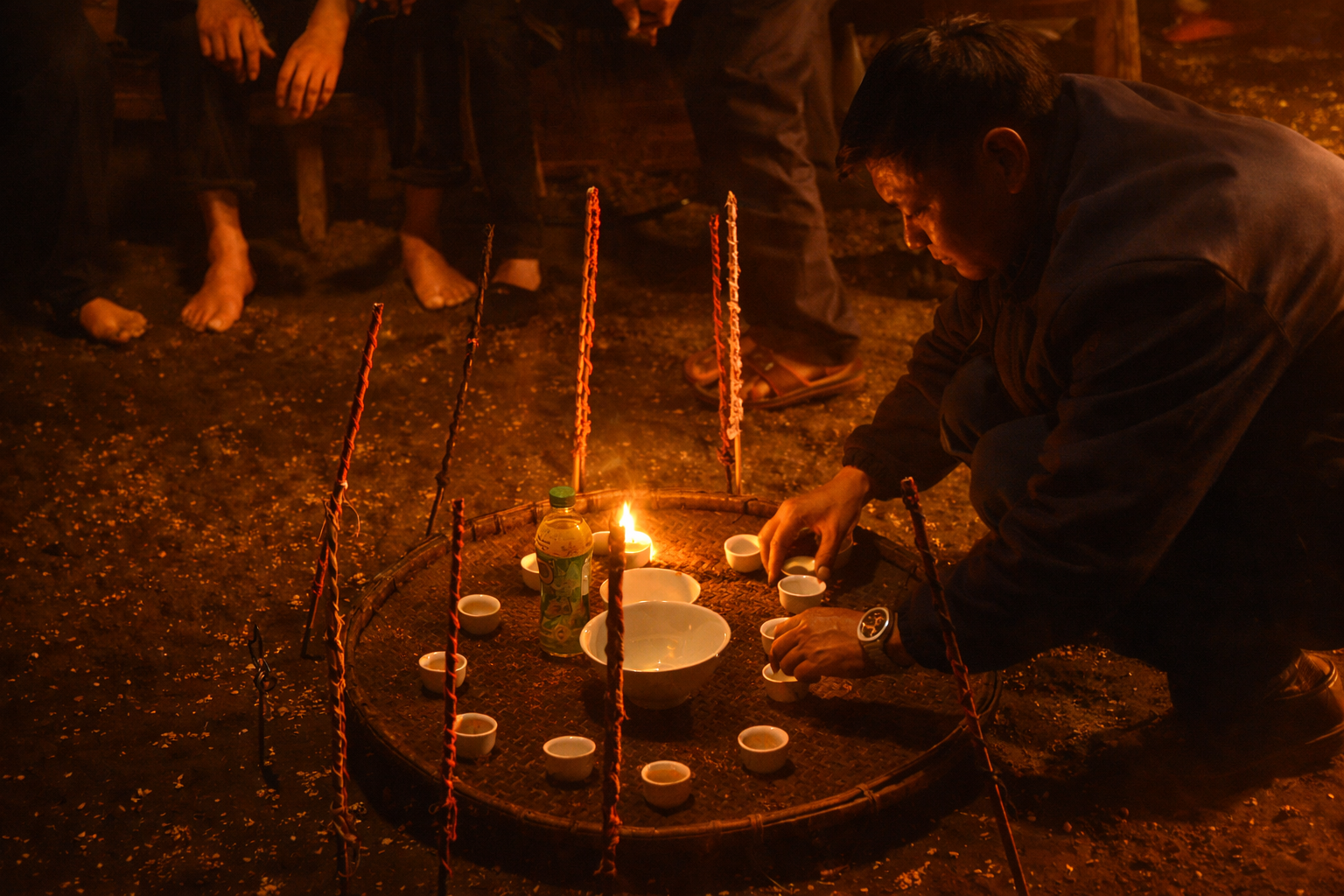
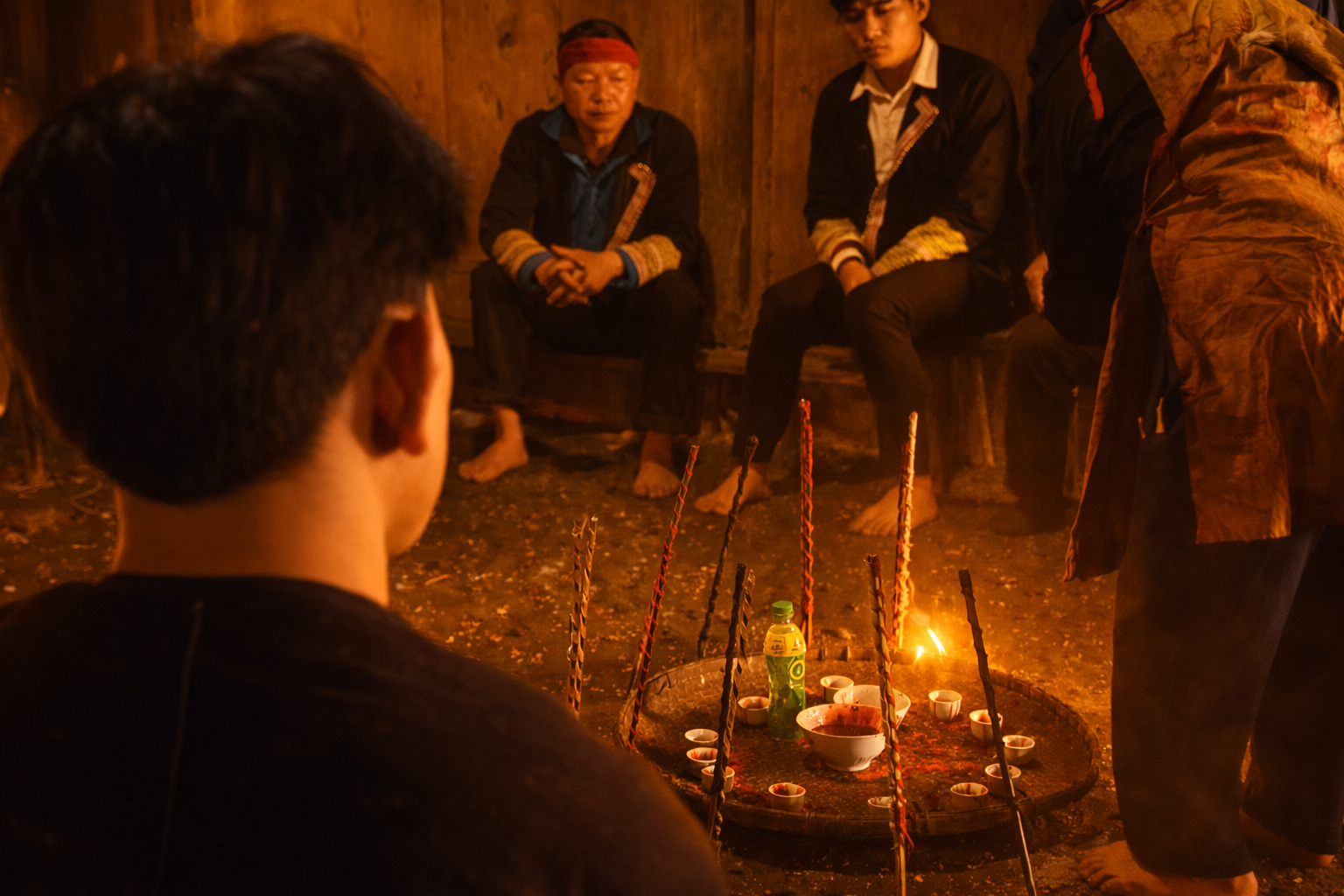
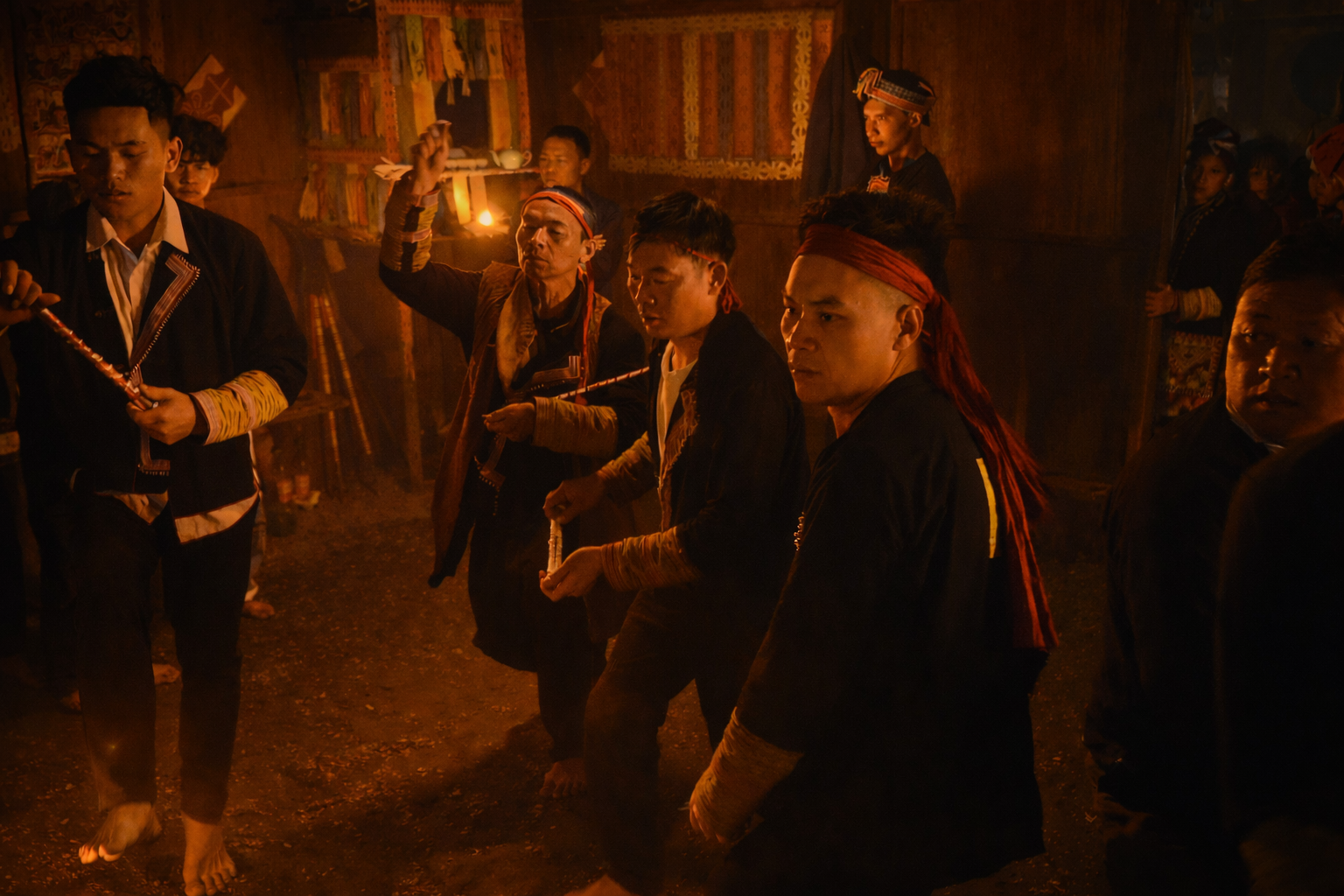
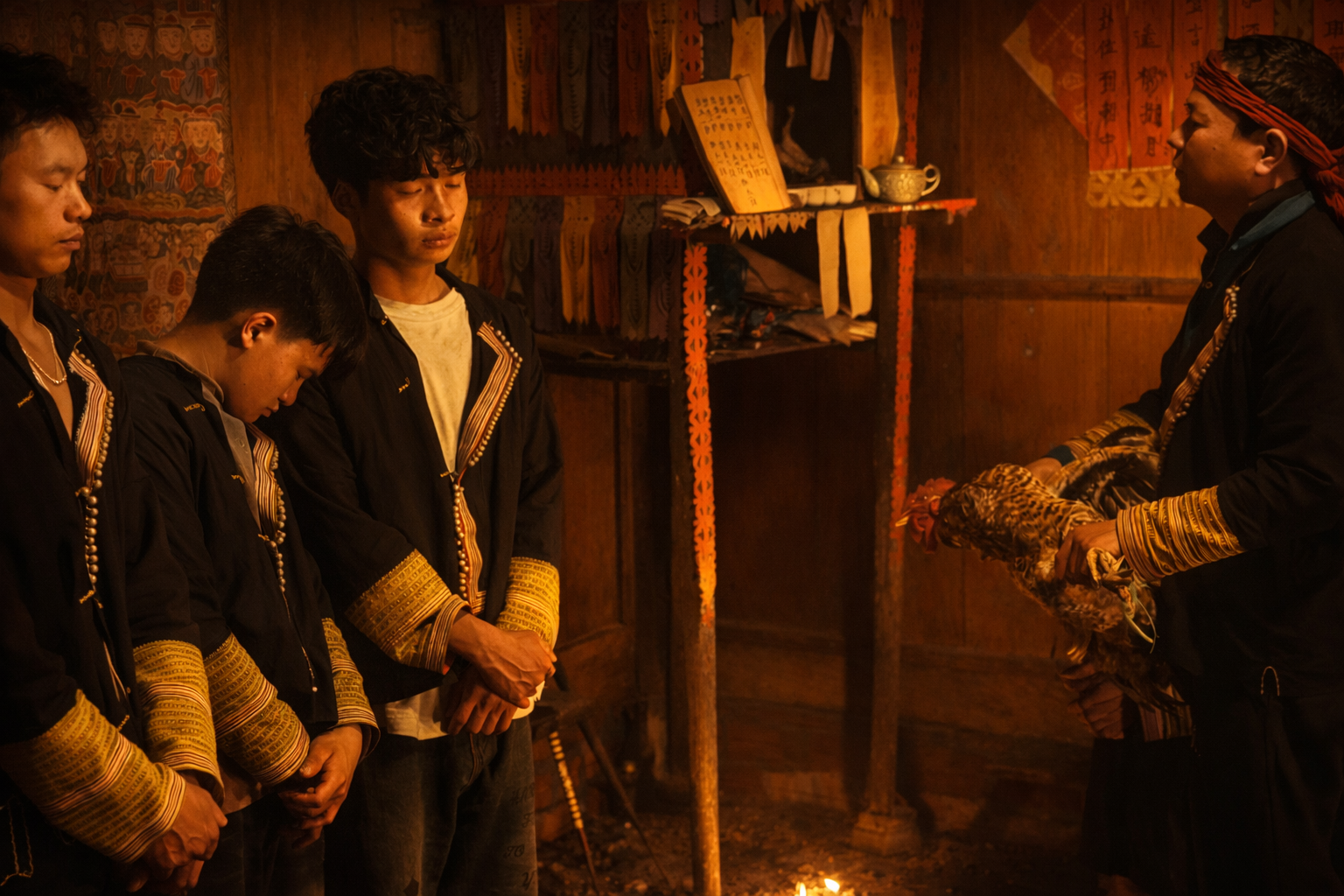
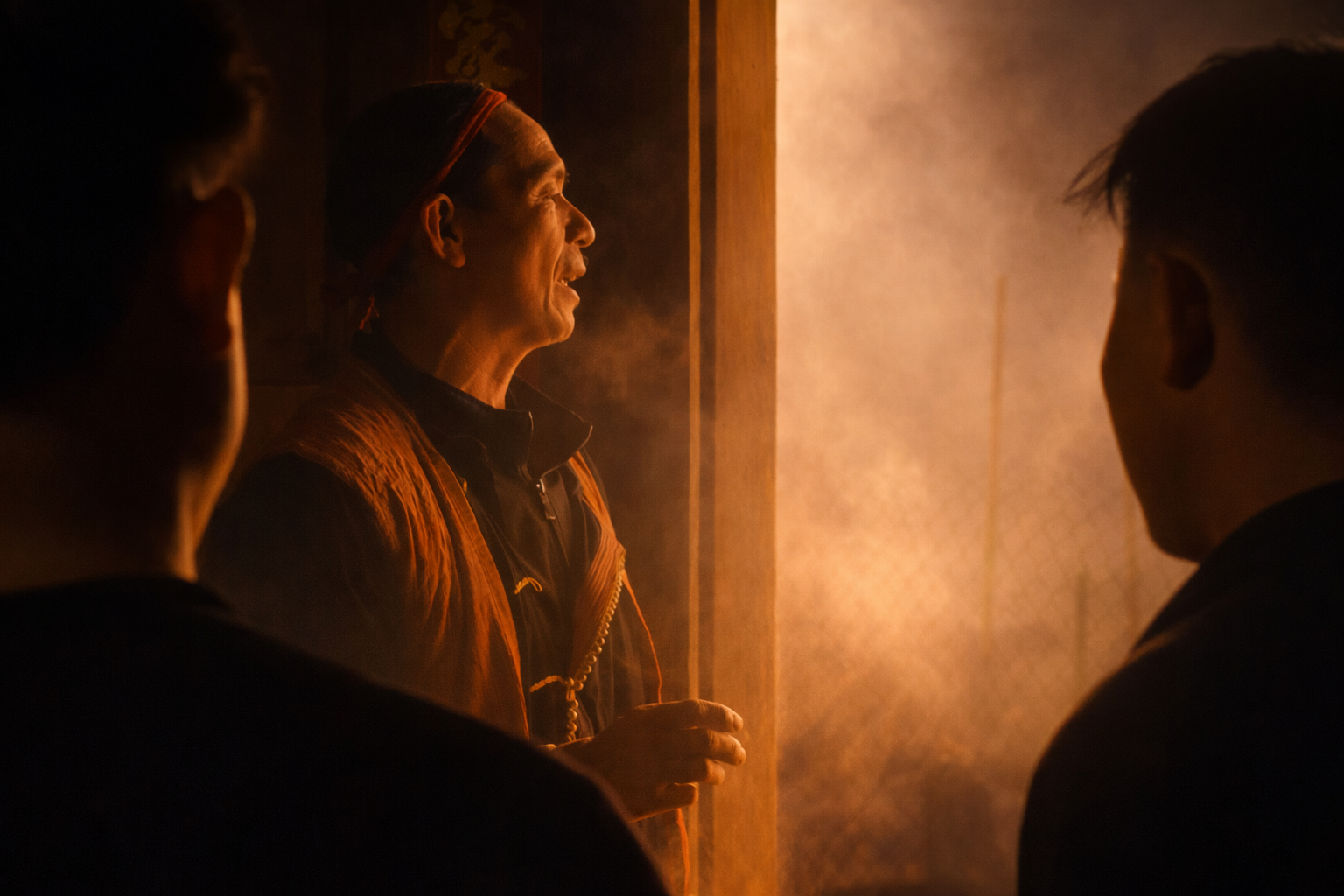
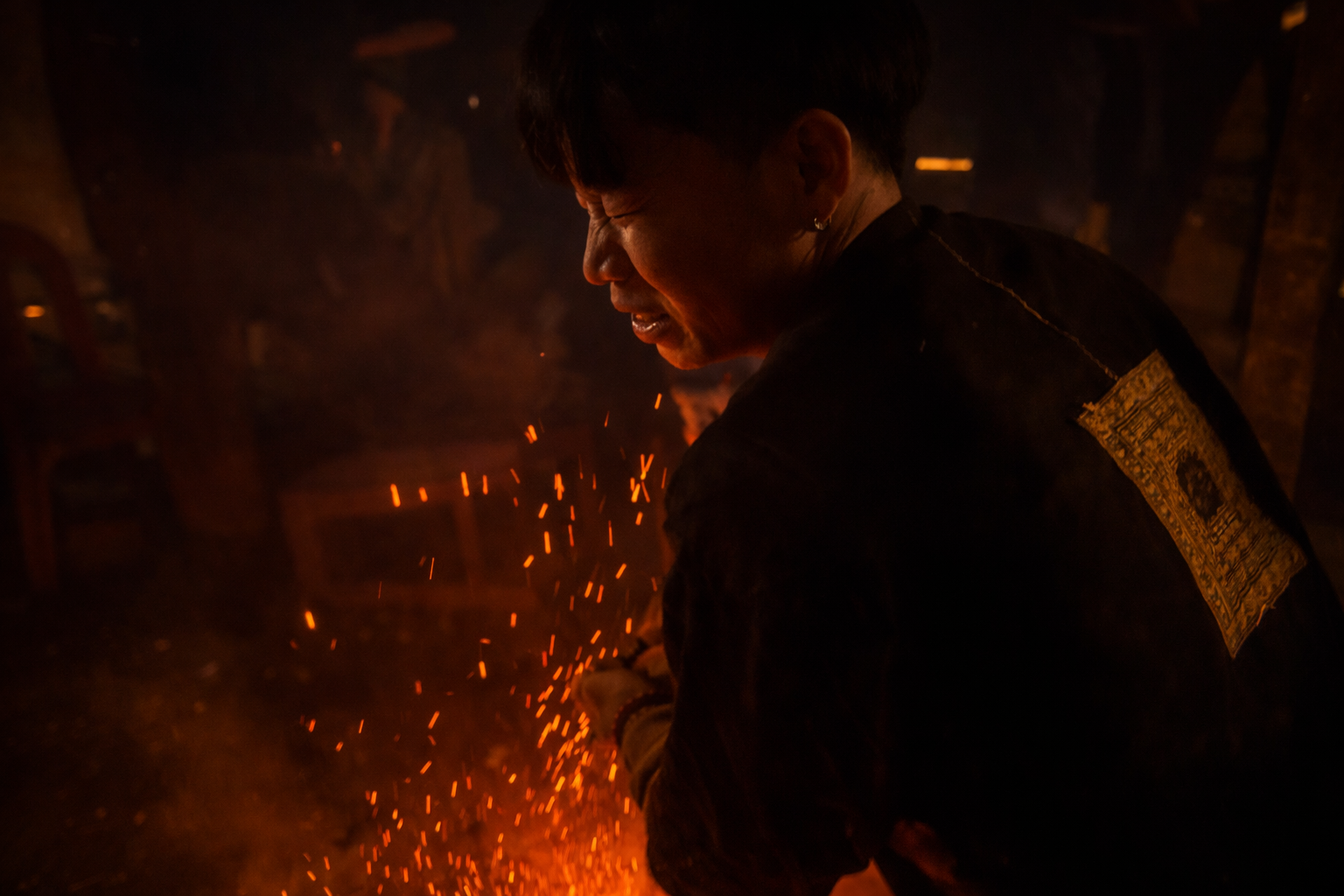
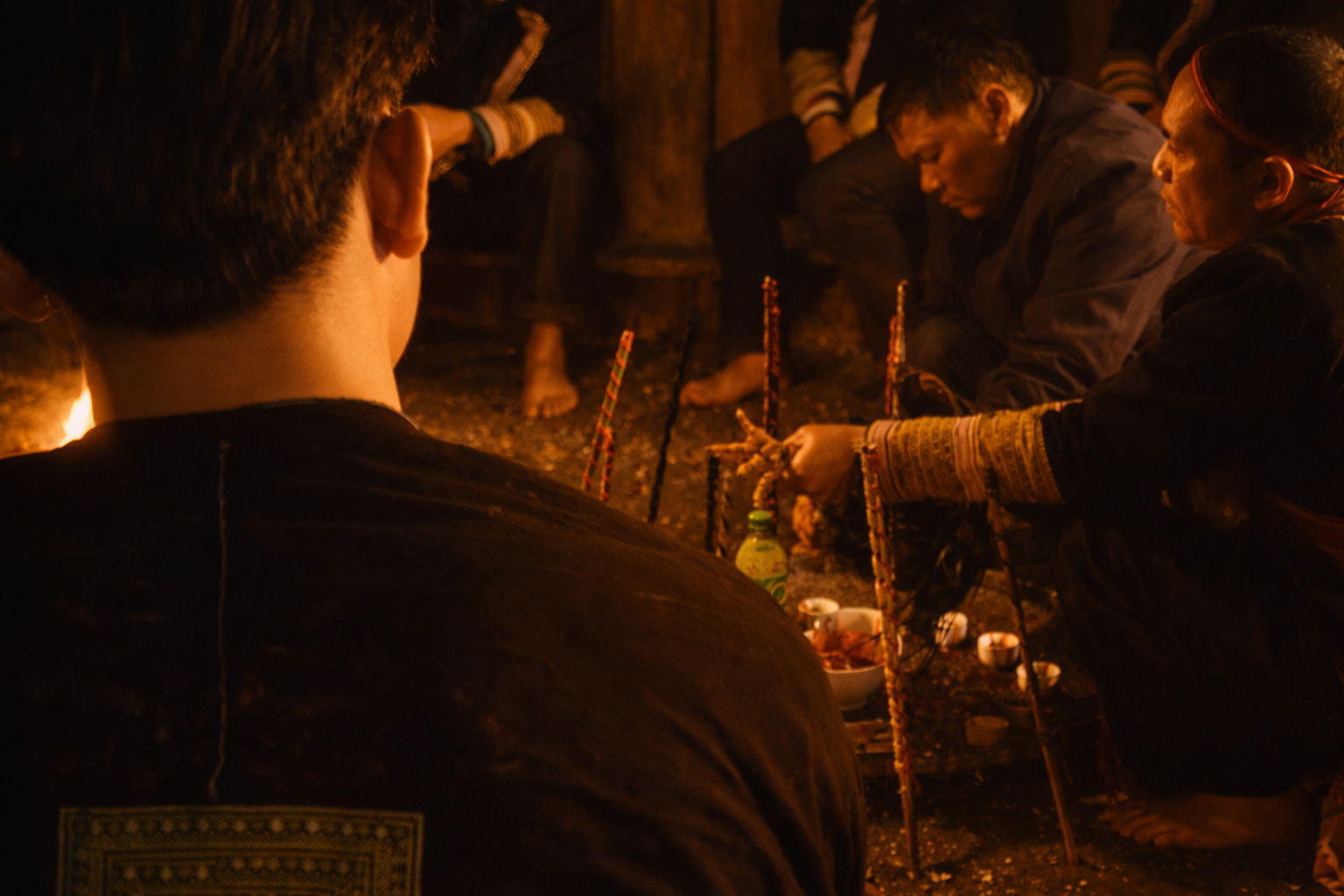
The Meaning Behind Fire in Red Dao Belief
For the Red Dao, fire symbolises life, purification and protection. It is thought to have the power to cleanse negative energy and keep evil spirits at bay.
Walking across the burning embers is not considered an act of bravery alone. Instead, it is a sacred test of spiritual readiness. Those who perform the dance believe they are protected by ancestral spirits and divine forces. The ability to step onto fire without injury is seen as proof of this protection.
The ritual represents:
Renewal at the start of a new year
Spiritual strength and resilience
Protection for families and the village
Gratitude to ancestors and deities
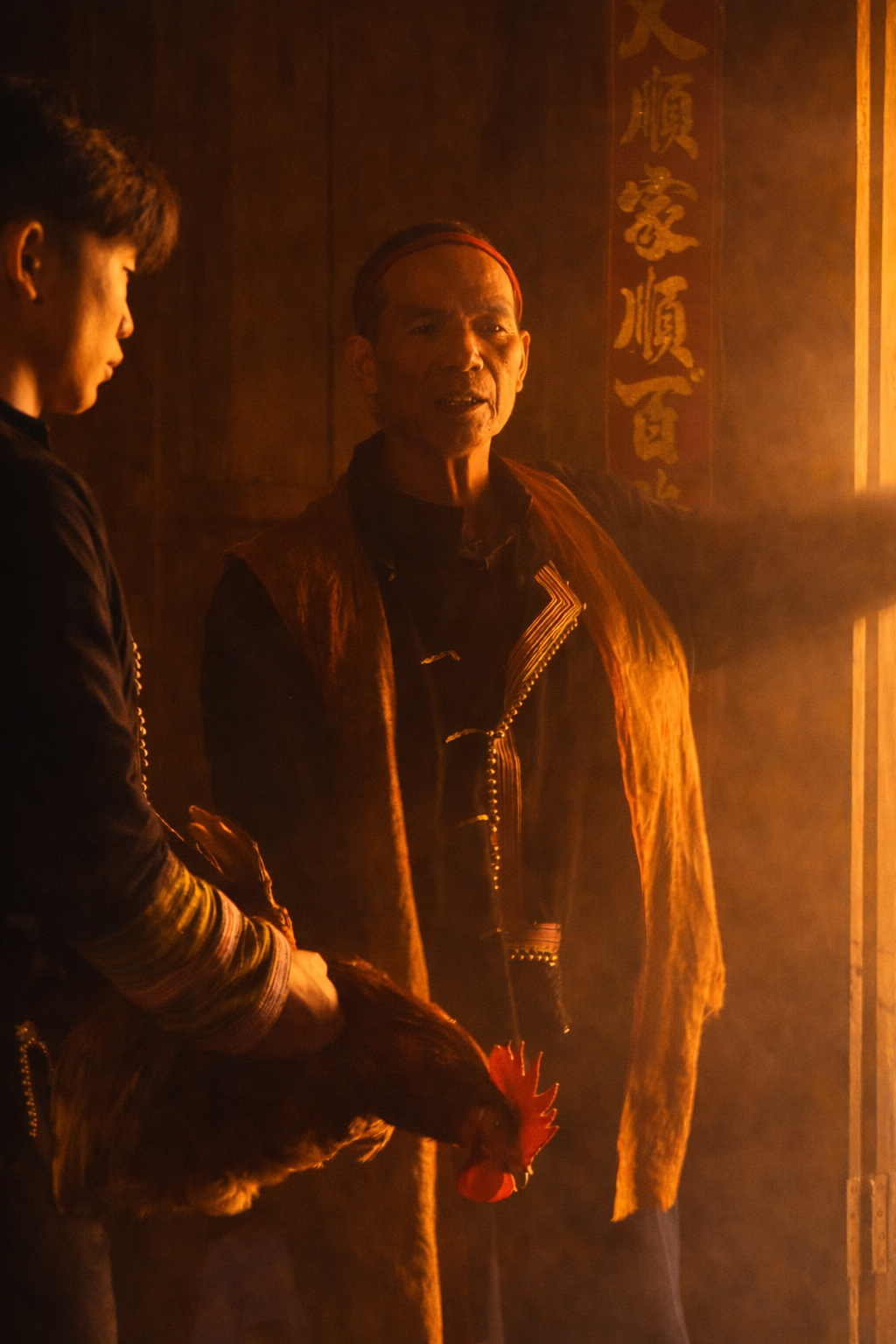
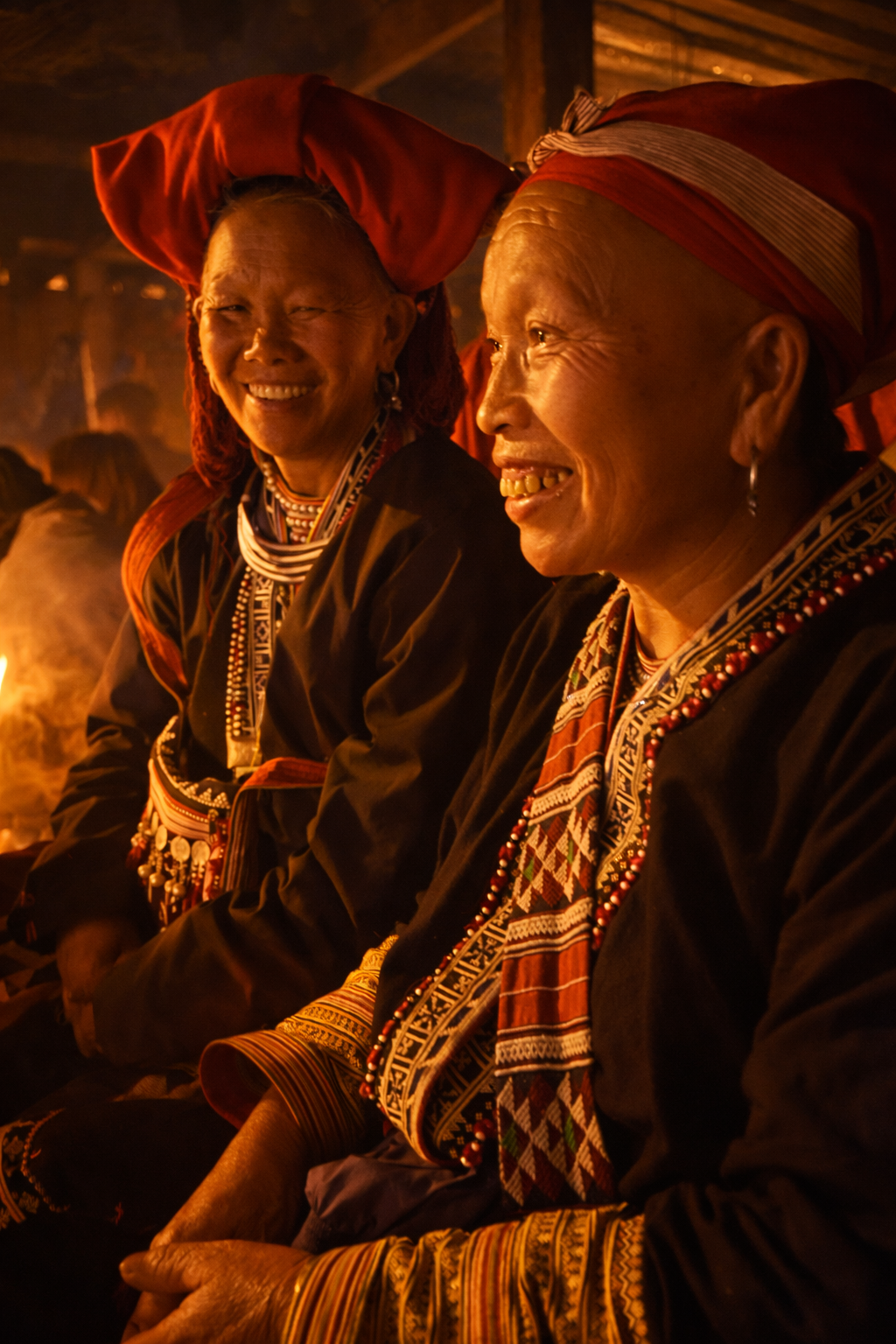

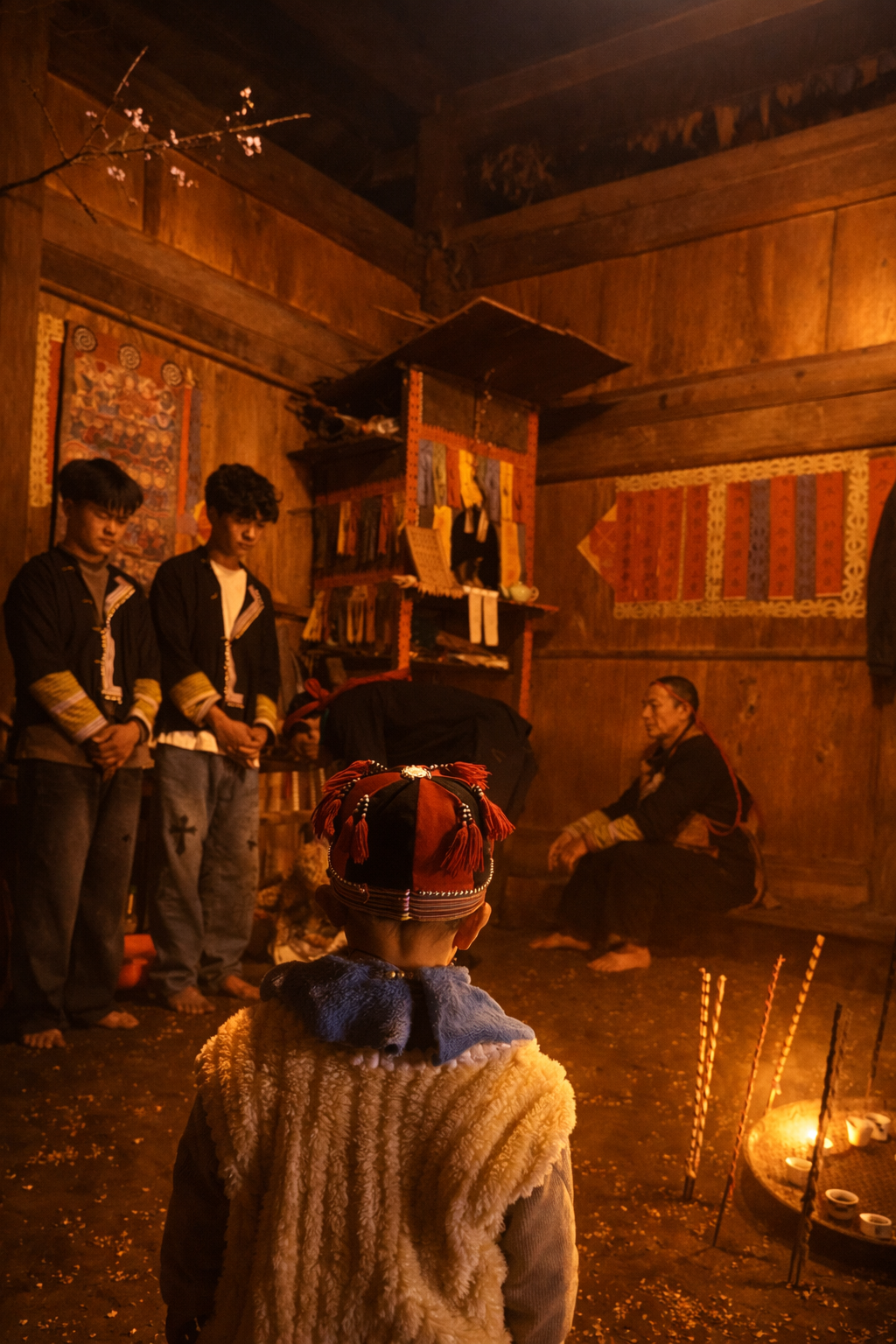
Who Participates in Pu Tong?
Participation in the fire dance is not open to everyone. It is reserved for selected men in the community who have undergone spiritual preparation or have a connection to ritual practice.
Key participants include:
Shamans and Ritual Leaders
A respected spiritual leader, often a shaman, presides over the ceremony. He performs chants, prayers and invocations to call ancestral spirits and protective deities. His role is to guide participants into a trance-like state believed to shield them from harm.
Male Dancers
The dancers are typically young men chosen for their spiritual sensitivity or lineage. Some may have trained for years. When the ceremony begins, they enter a trance induced by rhythmic drumming, chanting and incense smoke.
In this state, they step onto and kick glowing coals, throw embers and move energetically through the fire. Despite the danger, burns are rare. The community attributes this to spiritual protection.
The Community
Villagers gather to witness, pray and celebrate. Women, elders and children participate through preparation of offerings and communal feasting. The ceremony belongs to the whole village, not just the dancers.
The Ritual Process
The Pu Tong ceremony follows a structured spiritual sequence:
Preparation of the fire. A large fire is built and allowed to burn down into a bed of glowing coals.
Invocation. The shaman calls on ancestors and spirits through chanting and ritual offerings.
Trance induction. Drumming, movement and prayer help participants enter a spiritual state.
Fire dancing. Men step barefoot onto the coals, dancing and kicking embers in symbolic acts of strength and purification.
Sacrifice and offering. After the dancing and the throwing of embers, six cockerels are sacrificed as offerings of gratitude and protection. This act symbolises respect to the spirits and marks the successful completion of the ritual.
Blessing. The ritual concludes with prayers for prosperity, health and protection in the coming year.
Each stage holds deep symbolic meaning, reinforcing the relationship between the human world and the spirit realm.
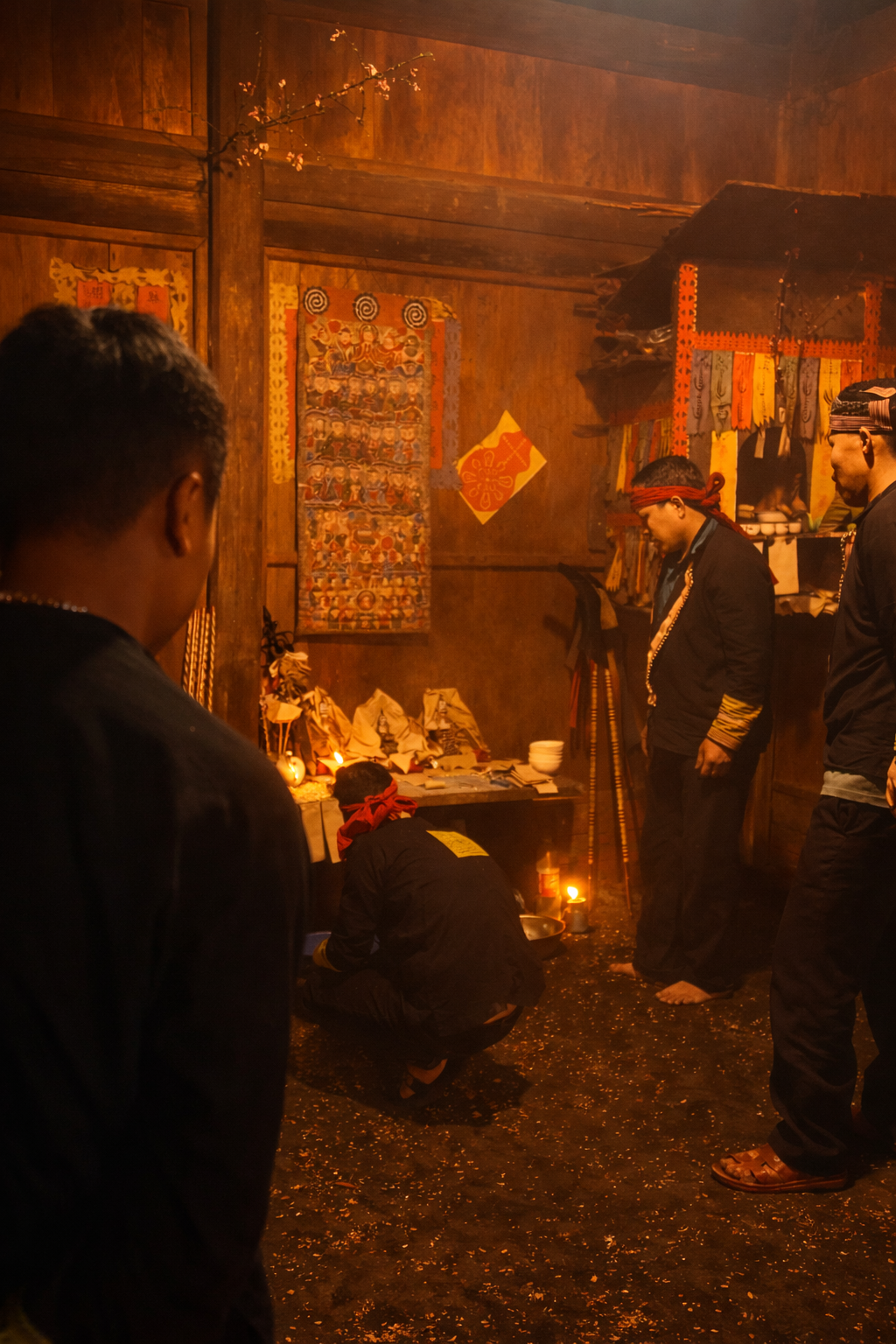
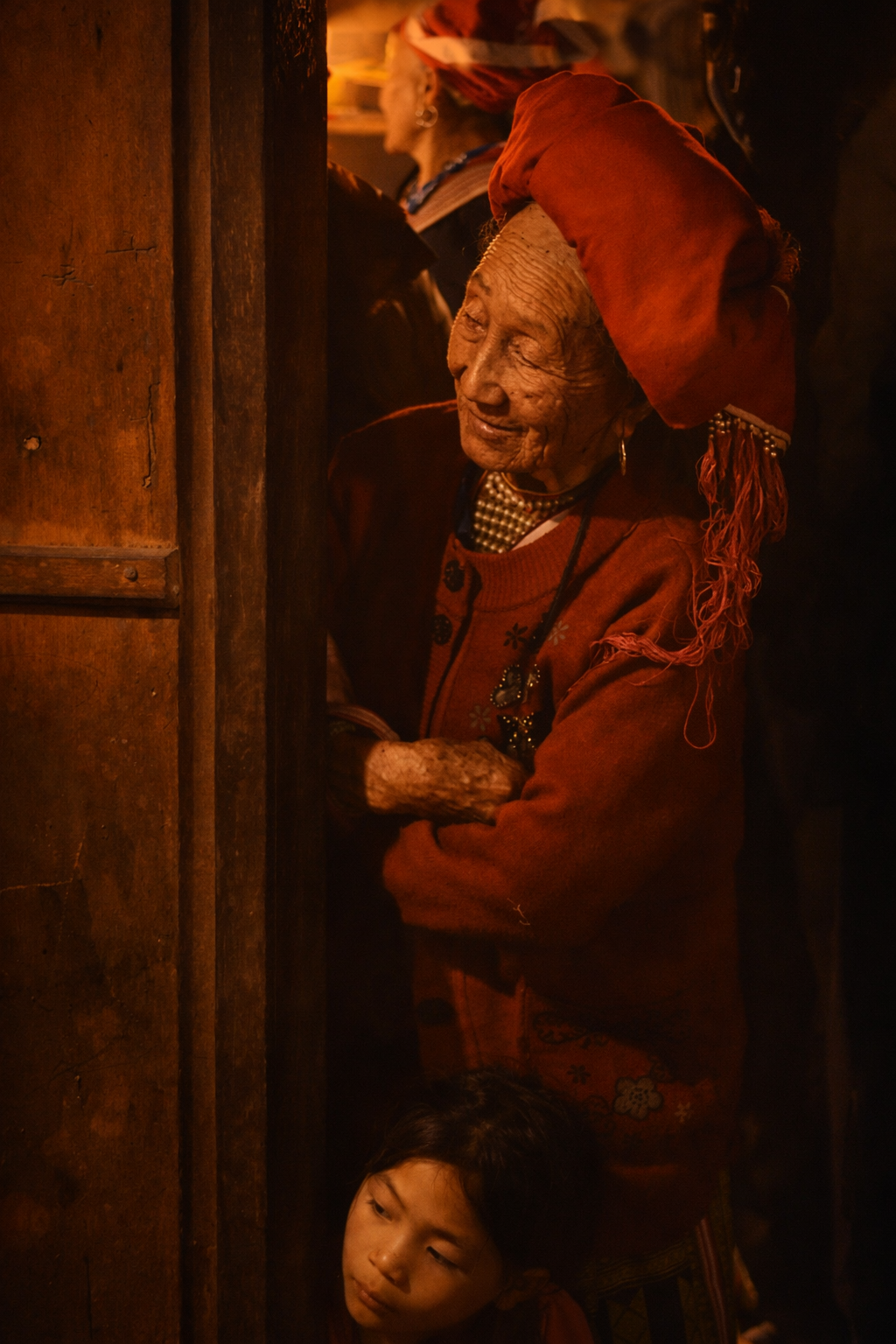
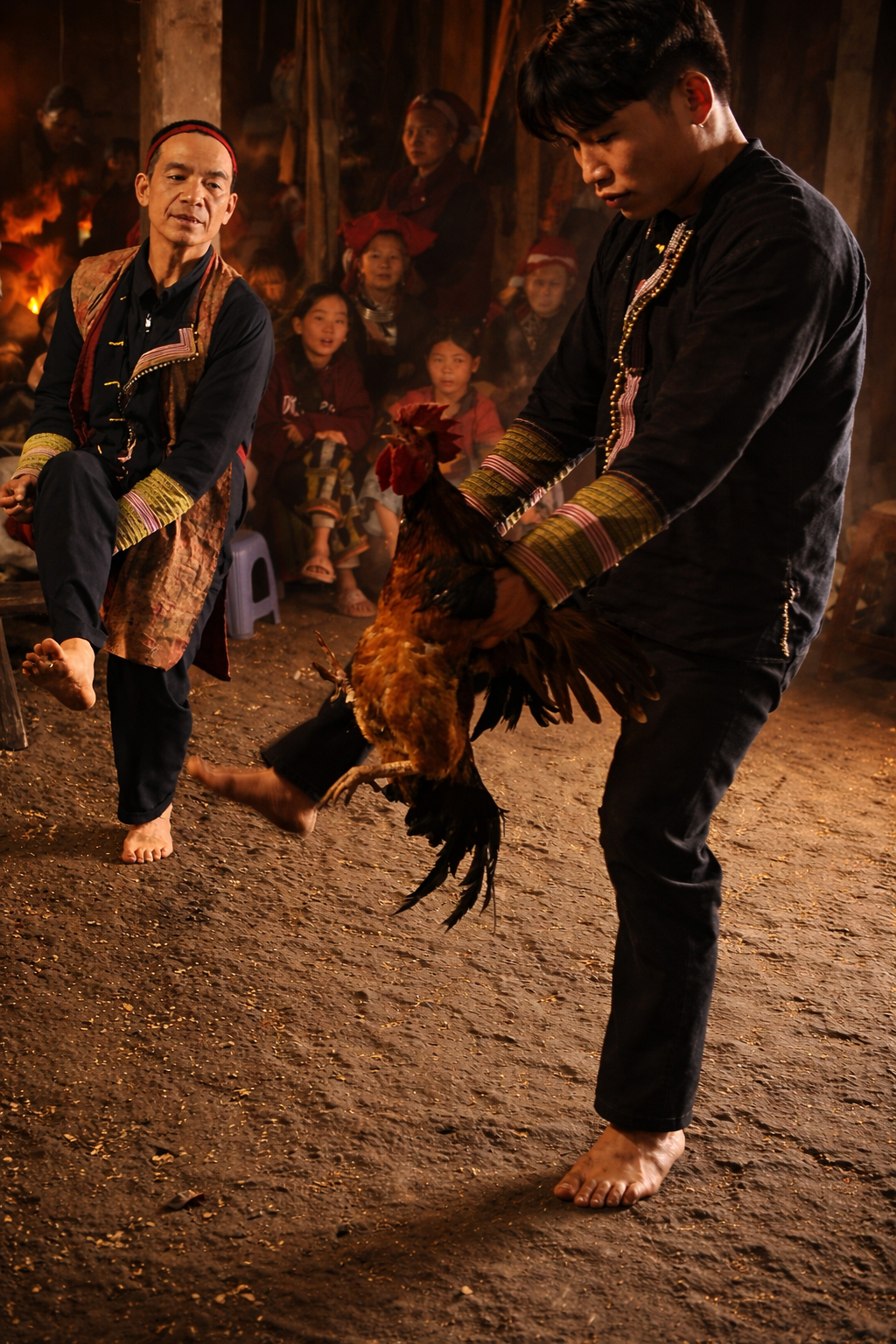
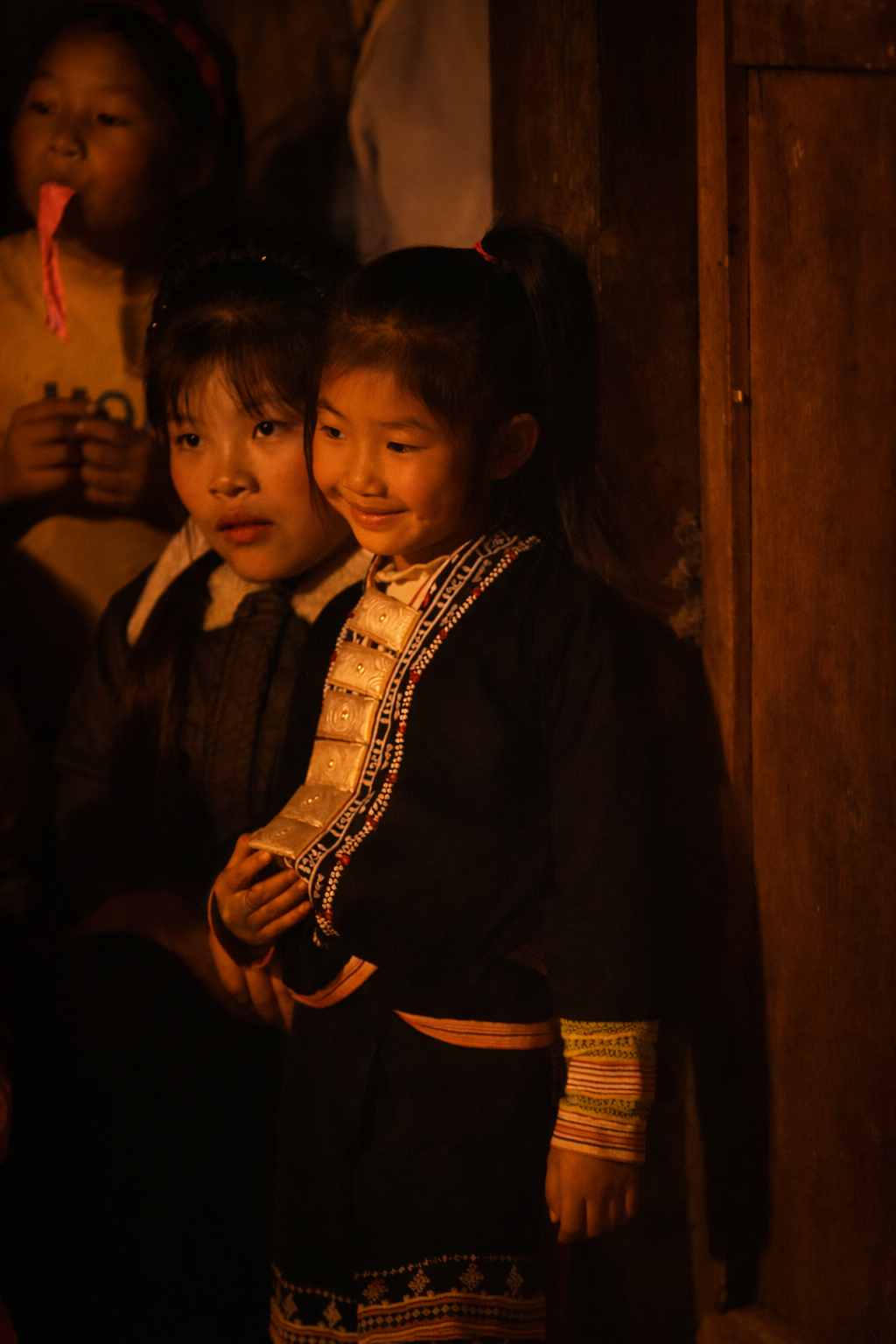
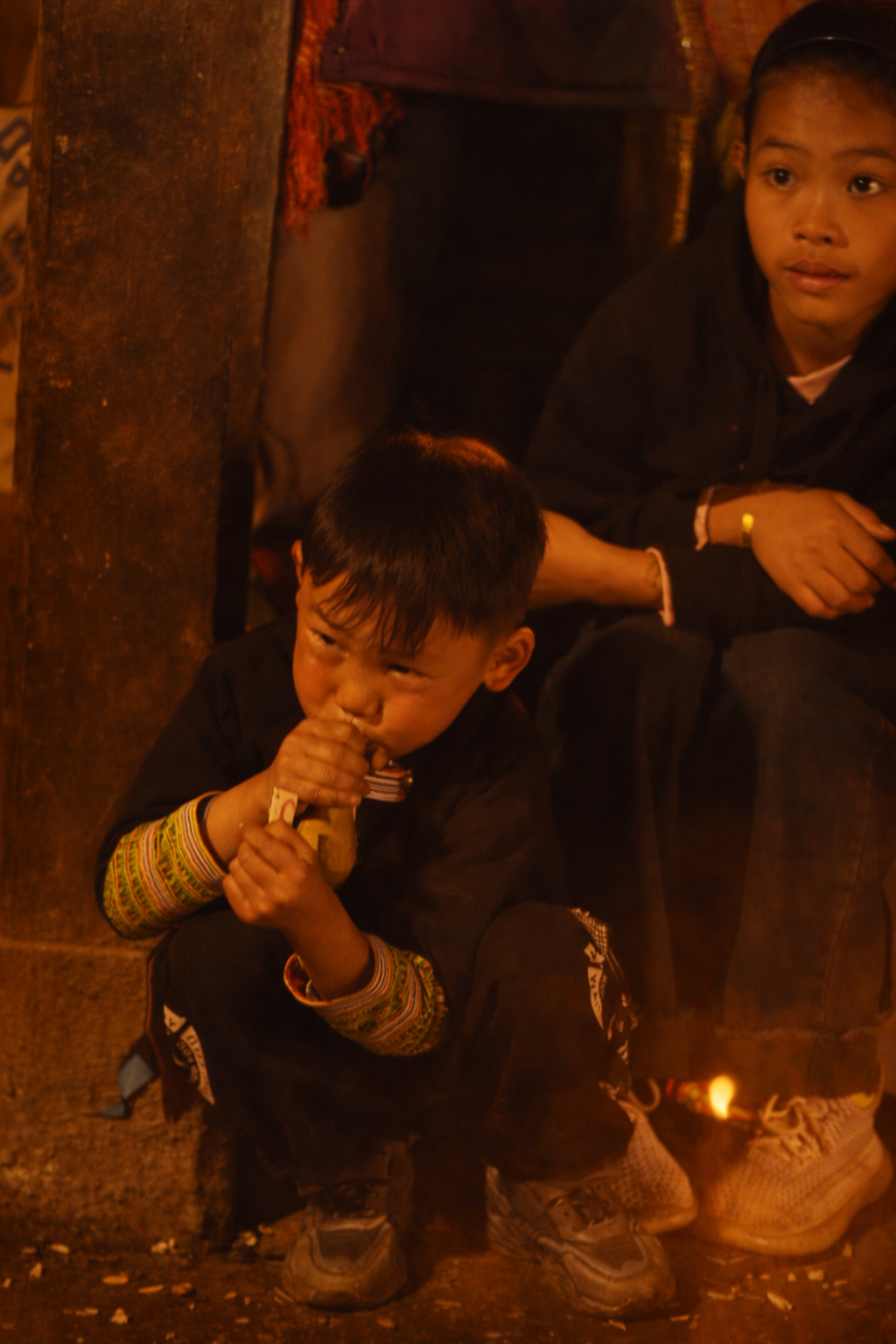
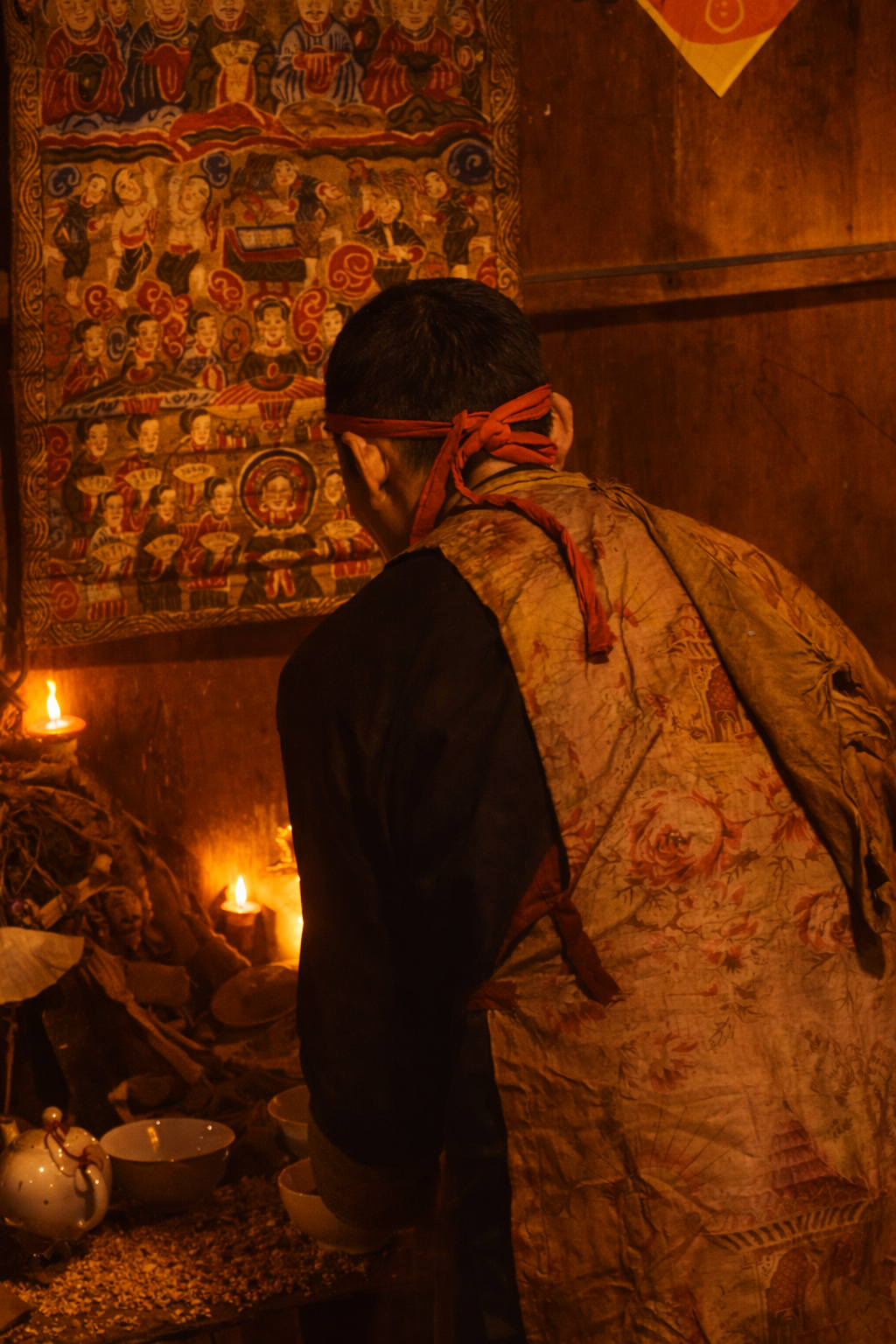
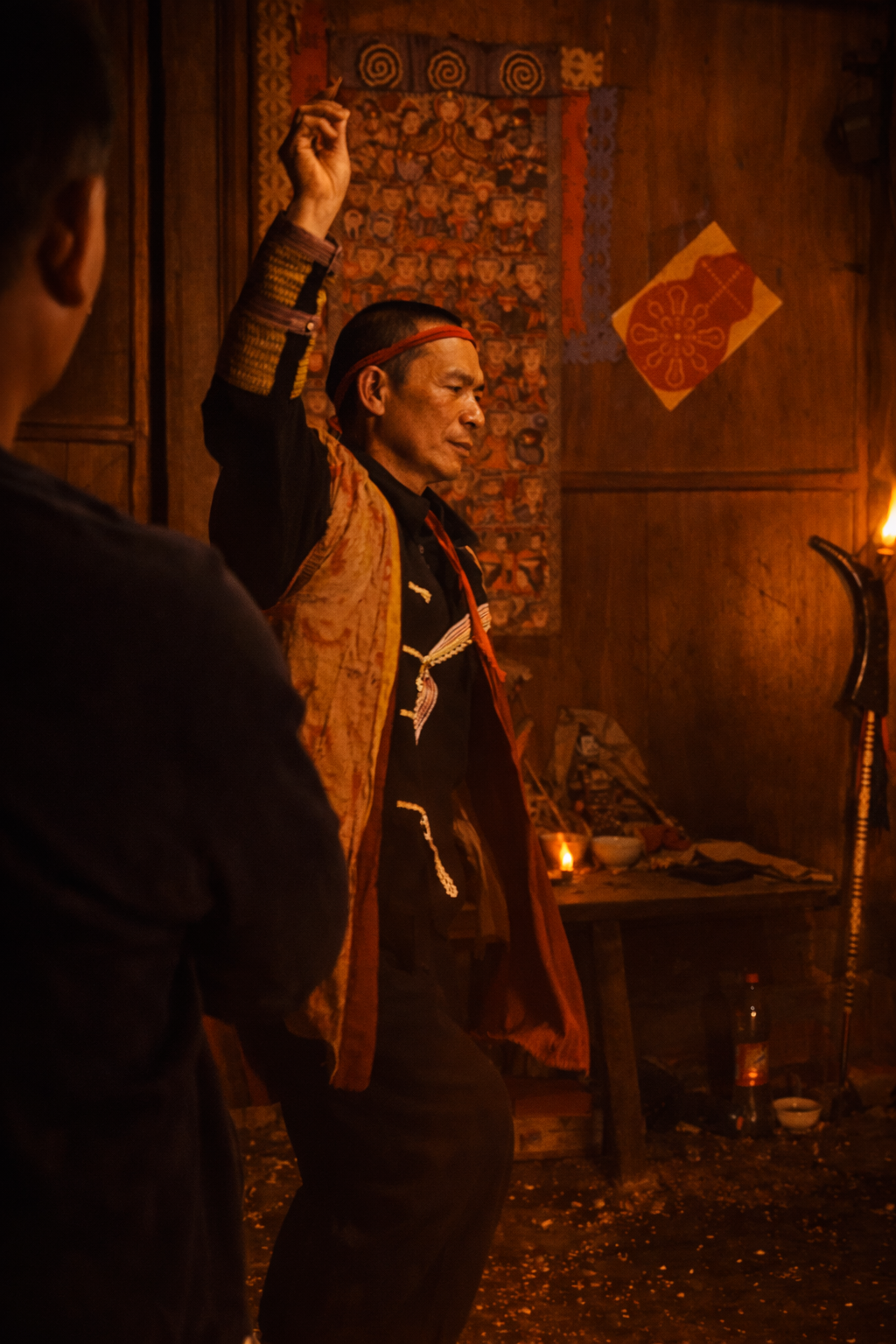
Why Pu Tong Is So Significant
The Pu Tong festival remains one of the most important cultural and spiritual traditions of the Red Dao for several reasons.
A Link to Ancestors
The ritual is believed to honour and invite the presence of ancestors, who are central to Red Dao spiritual life. Through Pu Tong, the living show respect and seek guidance for the year ahead.
Protection for the Community
At the start of a new year, villagers ask for protection from illness, bad luck and natural hardship. The fire ritual acts as a spiritual safeguard.
Cultural Identity and Continuity
In a rapidly changing world, Pu Tong helps preserve Red Dao traditions. It strengthens identity, passes knowledge between generations and reaffirms shared beliefs.
A Test of Spiritual Power
The ability to walk across fire is seen as a visible sign of spiritual connection. It reinforces faith and trust in traditional practices.
Pu Tong in the Modern Era
Today, the fire dancing festival sometimes attracts visitors to Sapa who come to witness its intensity and beauty. While tourism has brought attention to the ceremony, many villages maintain its sacred nature and perform it primarily for spiritual reasons rather than for display.
For the Red Dao, Pu Tong is not a spectacle. It is a living ritual. It is a moment when the boundaries between the human and spirit worlds feel closest.
A Ceremony of Renewal and Strength
At its heart, Pu Tong is about beginning the new year with courage, unity and spiritual protection. The sight of dancers moving confidently across fire symbolises resilience in the face of hardship and trust in ancestral guidance.
For the Red Dao people, the ritual is a powerful reminder. The community stands strong, protected by its traditions, its spirits and its shared belief in renewal.
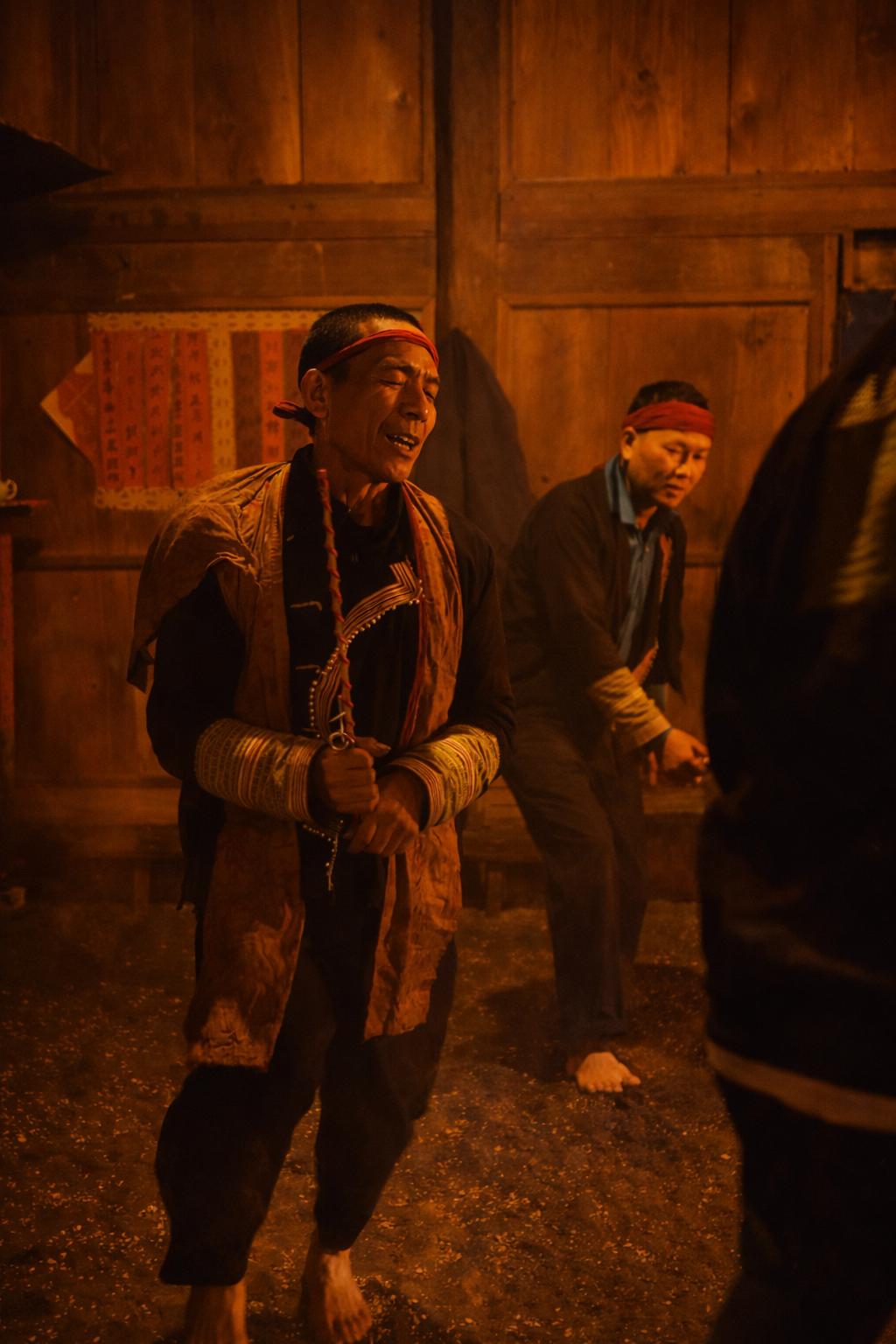
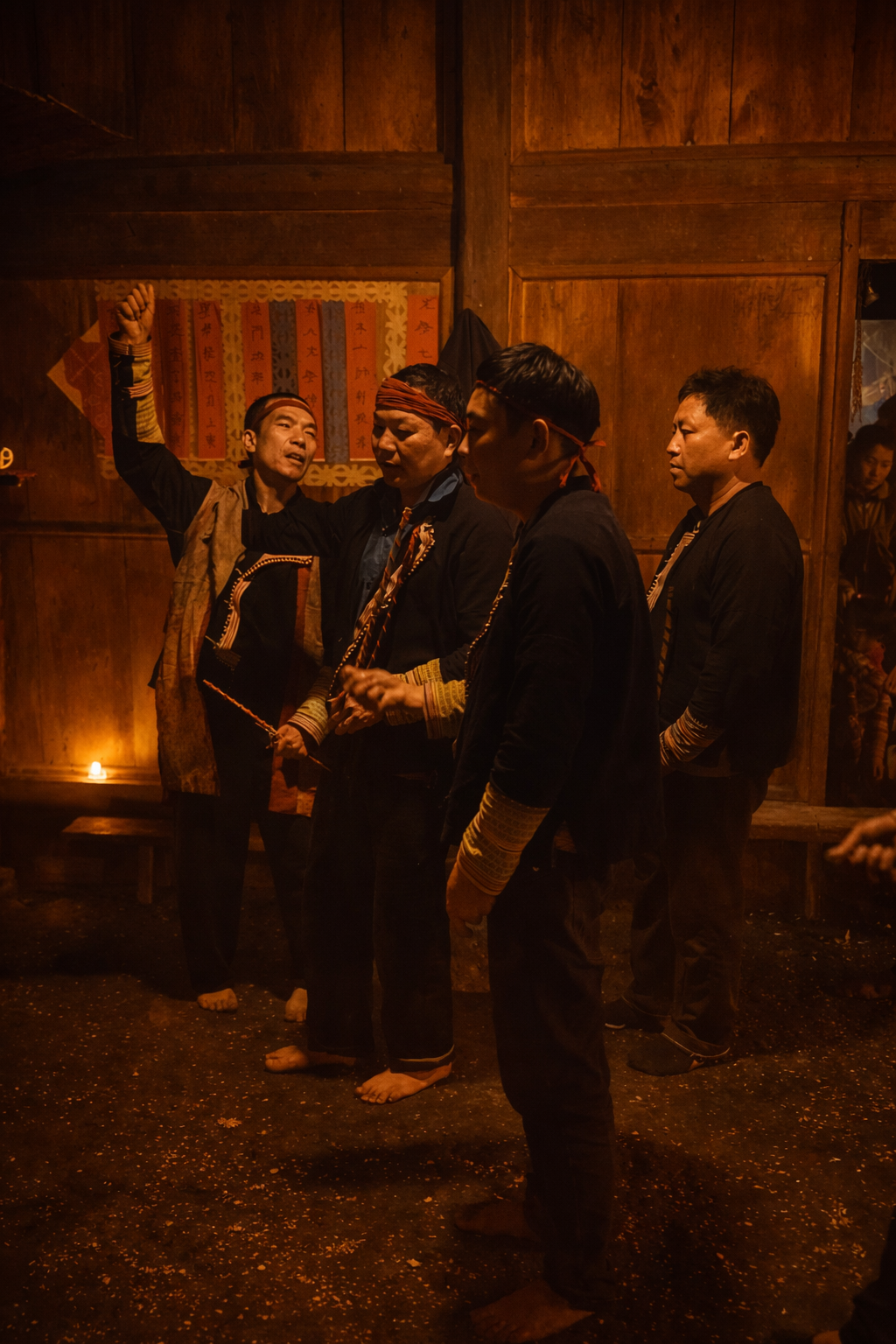
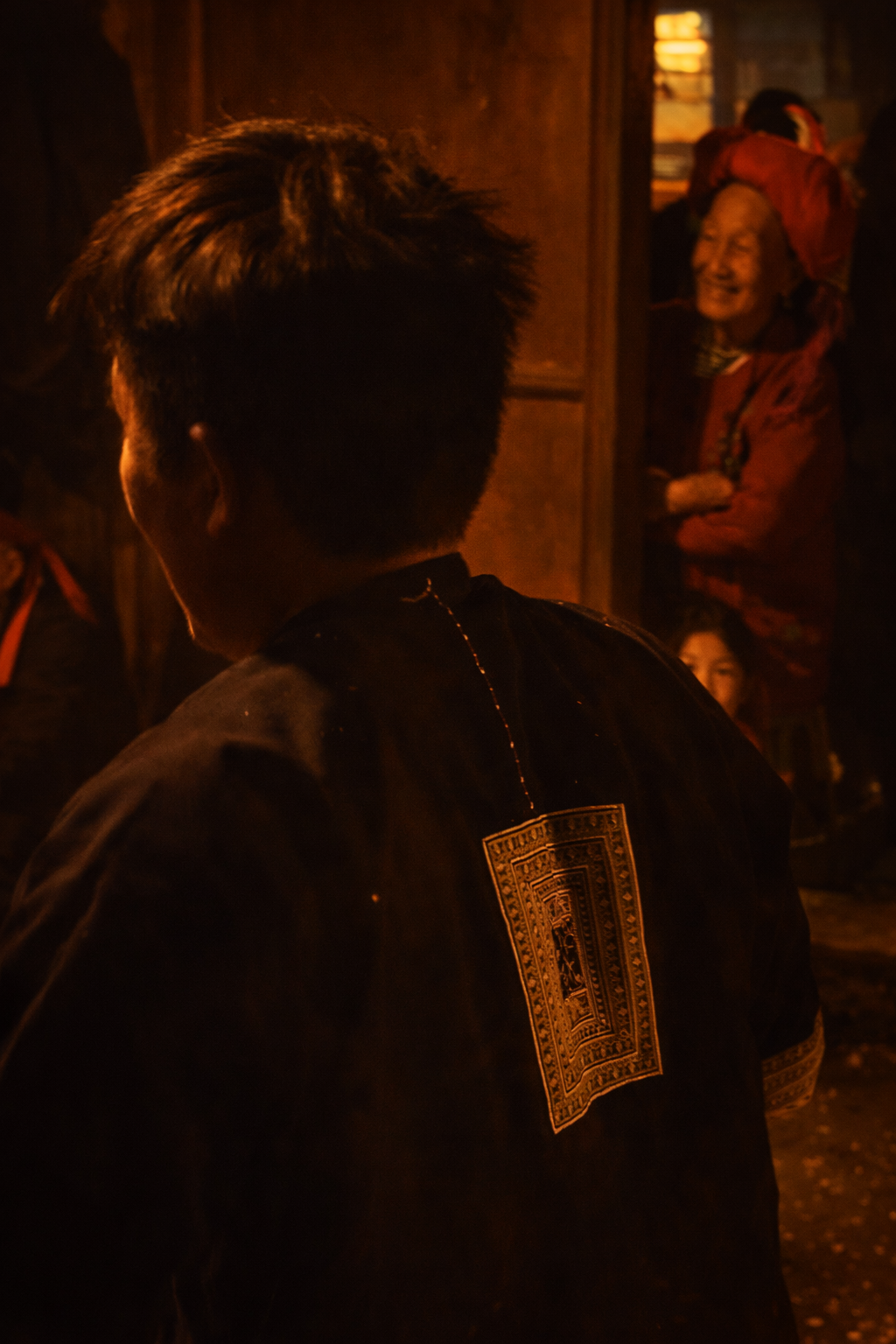
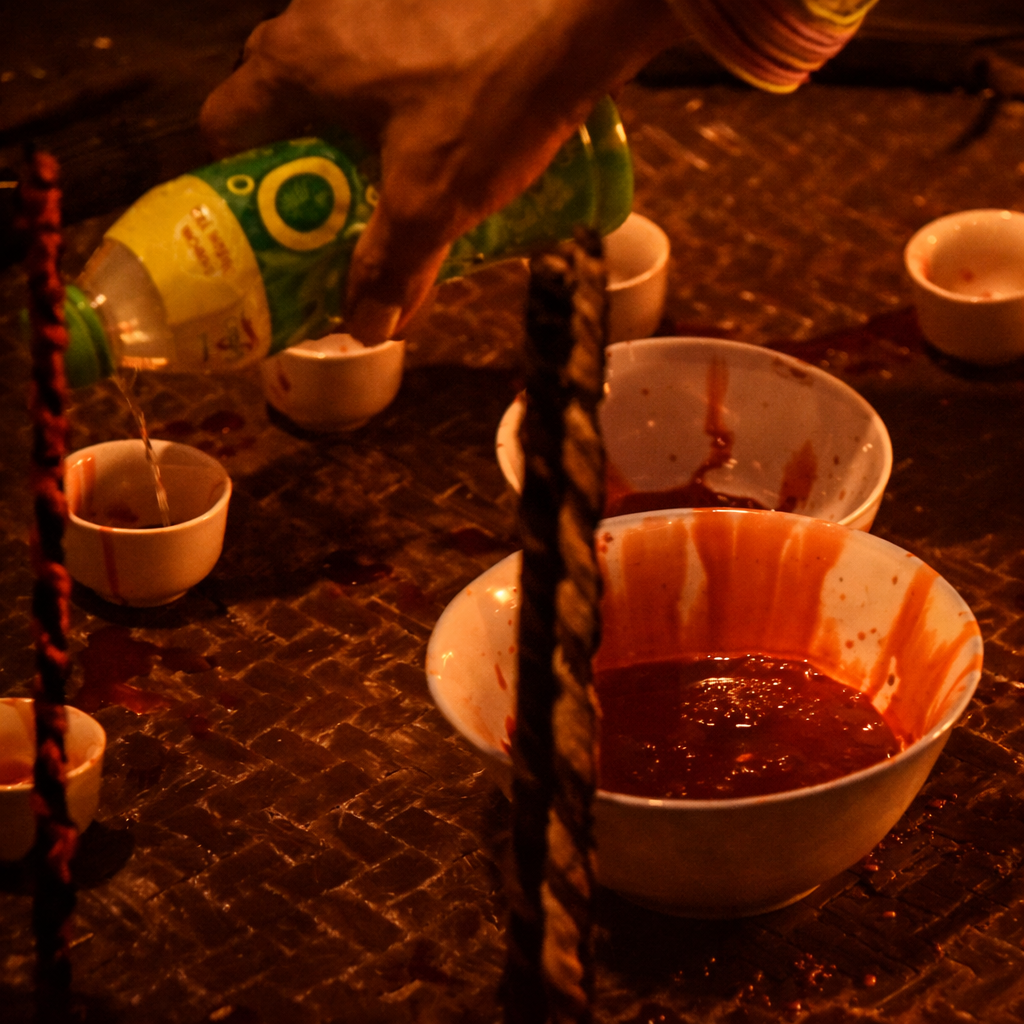
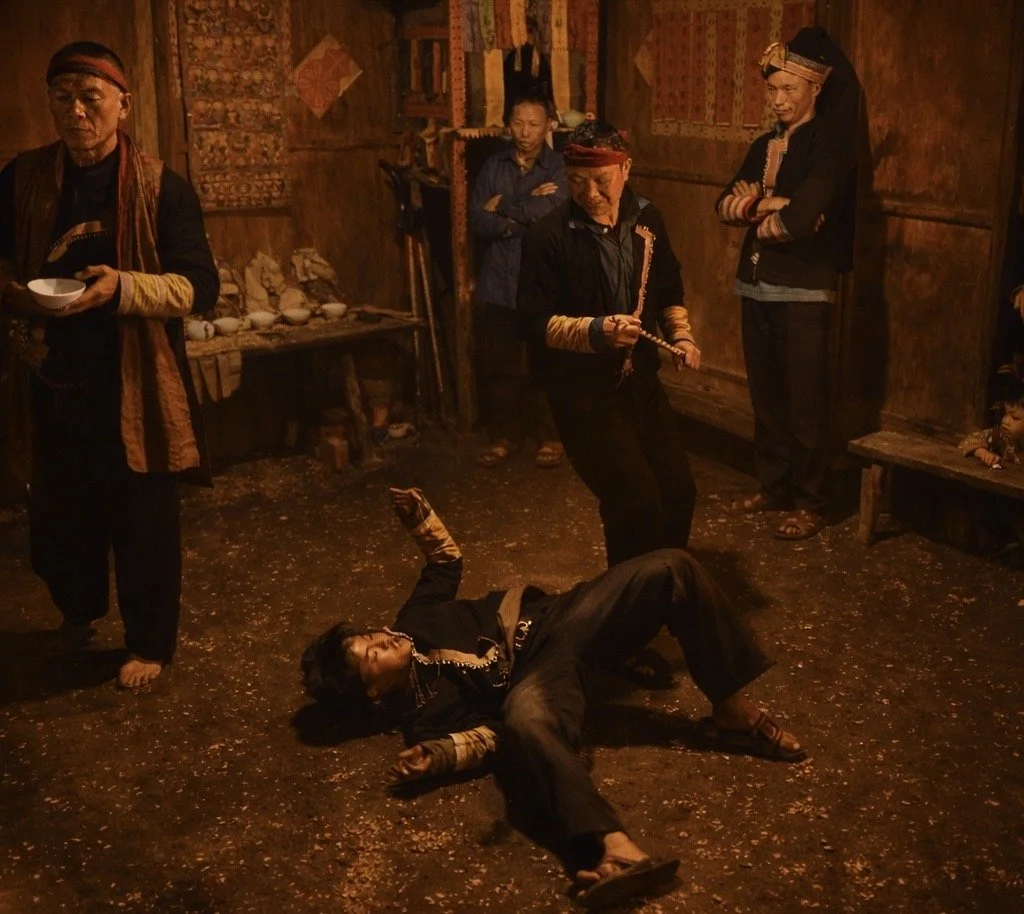
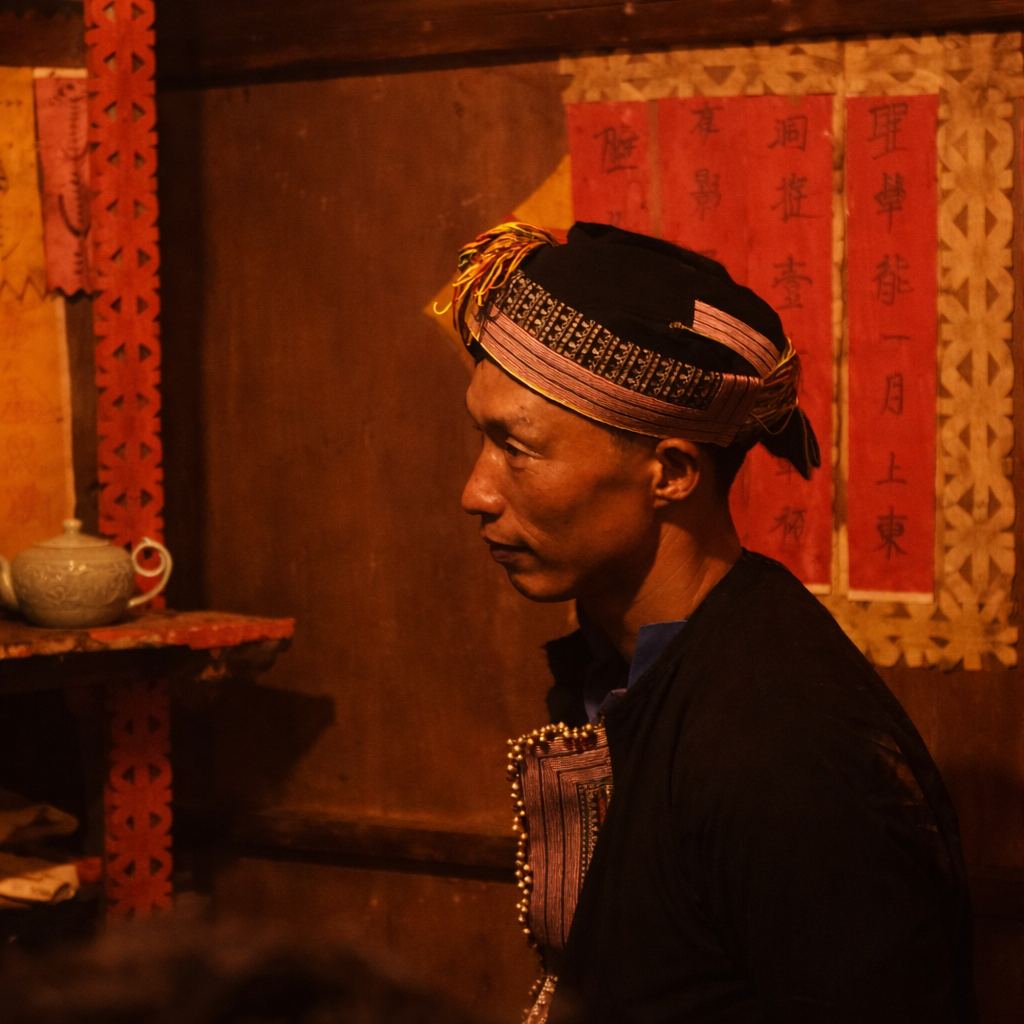
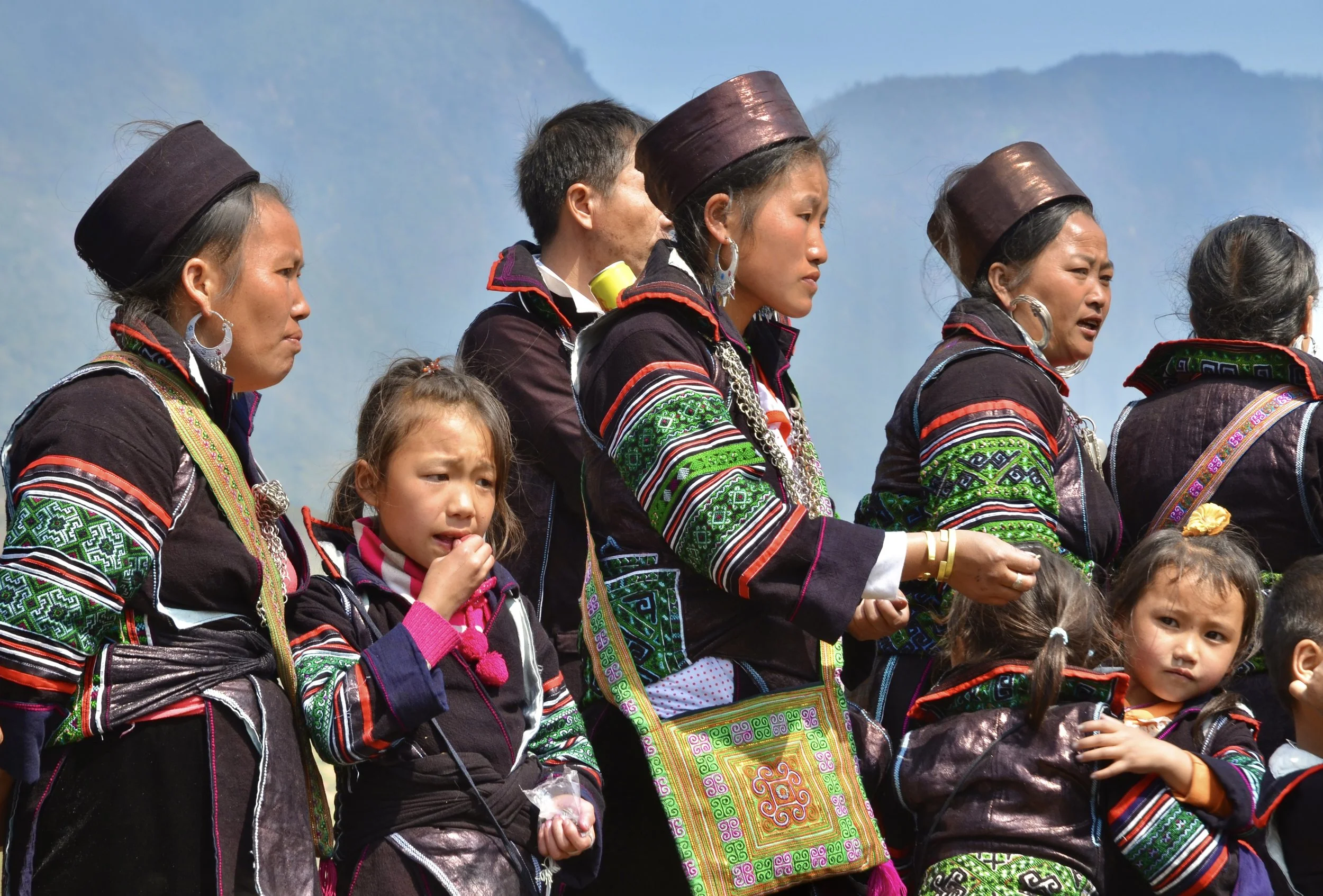
Black Hmong New Year in Sapa: Ritual, Renewal and Indigo Identity
In the mountains around Sapa, the Black Hmong New Year renews both spirit and community. Through shamanic soul-calling rites, offerings, pav tuav, rice wine, festivals and indigo hemp clothing, the celebration binds people to land, ancestors and one another.
In the highlands surrounding Sapa, the Black Hmong New Year is a period when daily life pauses and the relationship between people, spirits, animals and land is renewed. Following the harvest, tools are put away and attention turns first to the household, then outward to the village through festival, music and play. This is a spiritual reset expressed through ritual, food, clothing, music and social life. While many families today align celebrations with Vietnam’s national Tết for practical reasons, the Black Hmong observances remain deeply rooted in their own cosmology.
The Rhythm of the Celebration
Traditionally, the New Year begins once agricultural work is complete. Homes are cleaned. Clothing is finished. Food is prepared. Rice wine is distilled in advance for ritual and visiting. For days afterwards, families visit relatives, exchange blessings and attend communal gatherings filled with games, music and courtship. Normal labour is suspended so that attention can be given to relationships, spirit and renewal. These days, Hmong New Year is more aligned with the Vietnamese Tet celebrations, but Hmong rituals remain unique.
The Household as Sacred Space
The earliest moments of the New Year are domestic and spiritual. The ancestral altar is carefully prepared. Incense is lit. Offerings are made to ancestors and household spirits. A pig is often central to these rites, first presented in prayer before becoming part of the shared meal. The fire symbolises continuity and protection. The house becomes the place where the old year is formally closed and the new one welcomed through ritual order.
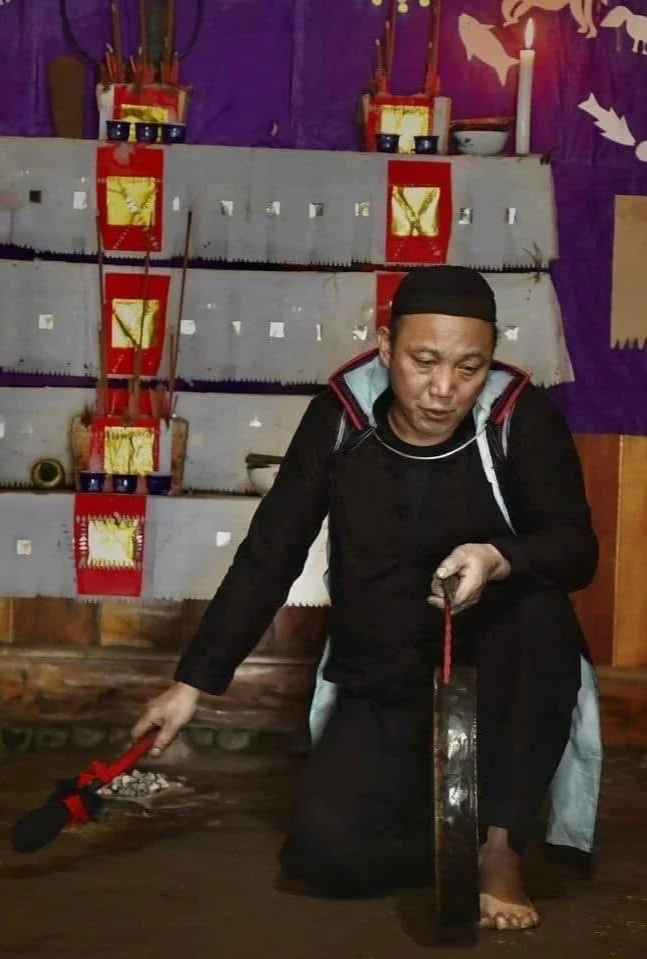
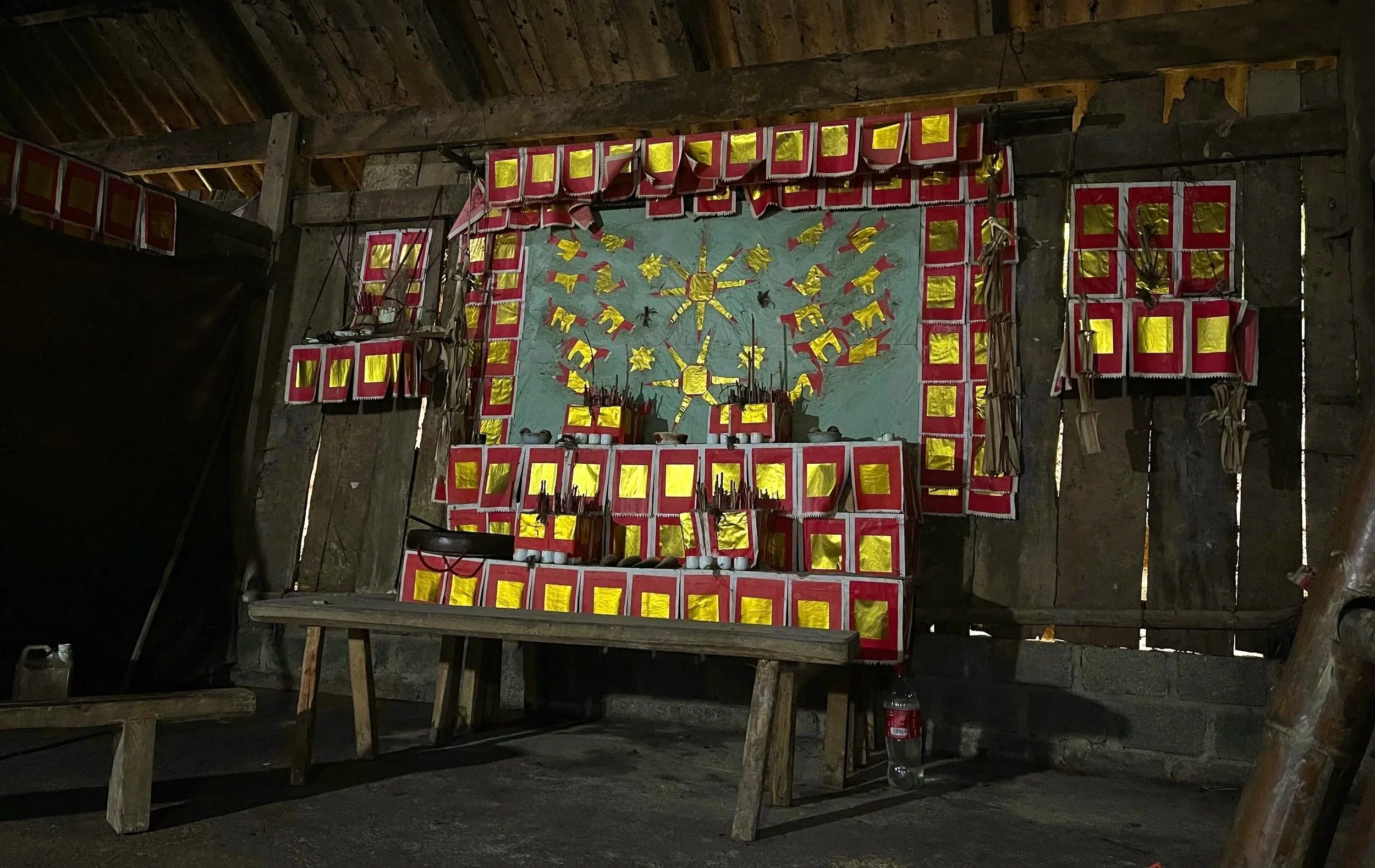
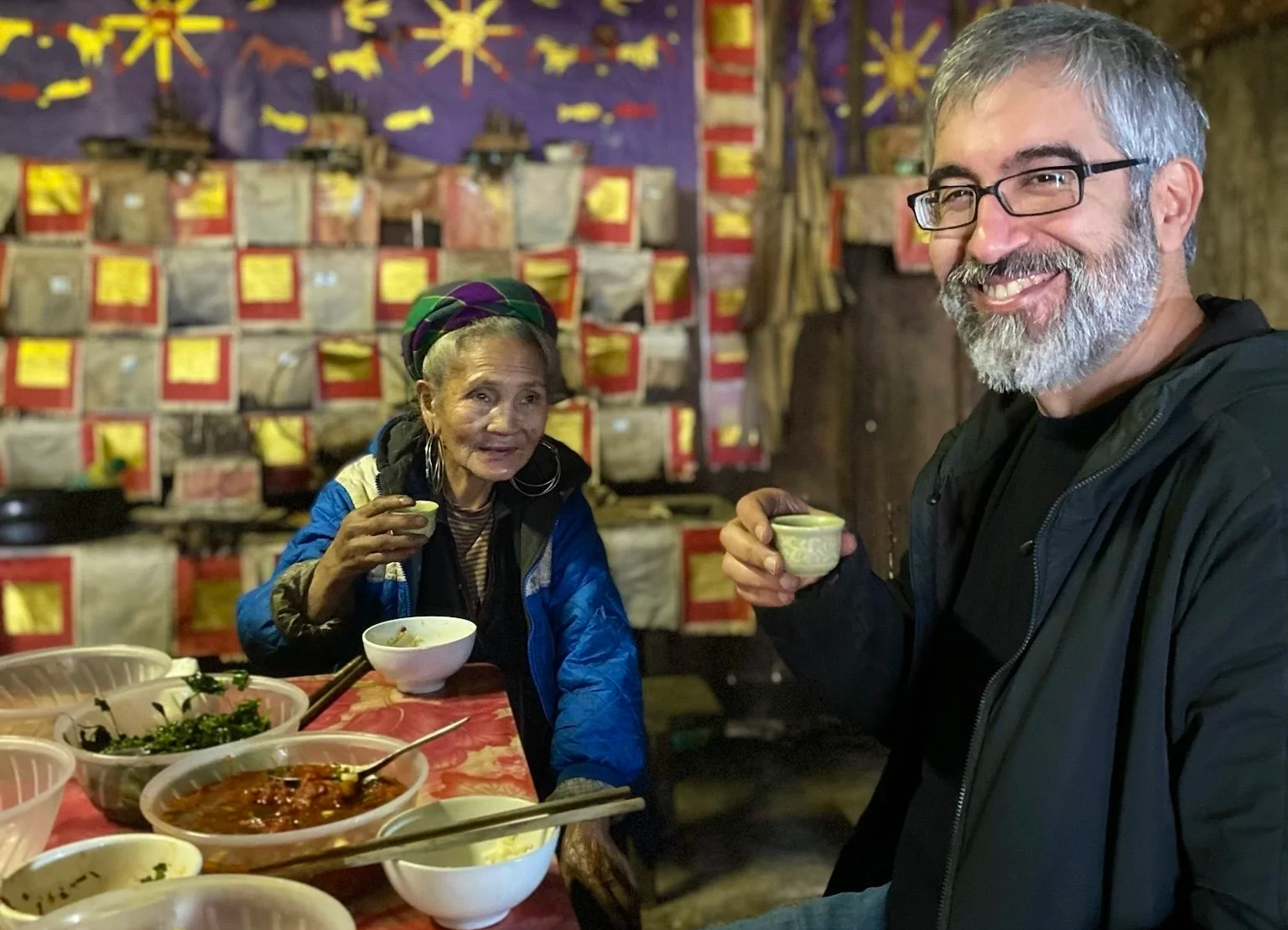
Shamanism and Spiritual Renewal
At the centre of Black Hmong spirituality stands the txiv neeb, the master of spirits. Hmong religion is traditionally animist, grounded in belief in the spirit world and in the interconnectedness of all living things. The human body is believed to host multiple souls. When one or more become separated, illness, depression or misfortune can follow. Healing rites are therefore known as soul-calling rituals, because the lost soul must return.
New Year is a powerful moment for this work.
Soul-calling and the journey to the spirit world
During a séance, the shaman is transported to the spirit world by means of a ‘flying horse’, a narrow wooden bench that serves as spiritual transport. Wearing a paper mask, which blocks out the real world and disguises the shaman from hostile spirits, the shaman enters trance.
Assistants steady the shaman as he mounts the bench. It is believed that if the shaman falls before his soul returns, he will die. In this state, the shaman’s soul leaves the body and enters the spirit realm where he can see, speak to, touch and capture spirits in order to liberate lost human souls.
Shamanic language is used throughout, blending everyday Hmong with the ritual dialect Lus Suav or Mon Draa. The chanting invites the too Xeeb spirit to manifest, accept offerings and grant blessings.
Divination, gong and sacrifice
As the shaman chants, he throws the Kuaj Neeb, two halves of a buffalo horn used for divination. Their landing position reveals whether spirits accept the offerings. He also strikes the Nruag Neeb, a small metal gong whose reverberation is believed to amplify spiritual strength and protect him. Villagers may pool money to buy a large sacrificial pig as a collective offering for the entire community. In Hmong belief, the soul of the animal can support or protect human souls. The sacrifice is understood as life given to restore life. Young men prepare and cook the meat while women cook rice. Rhythmic dances take place in same sex groups, each dancer holding a gong and moving barefoot before the altar.
Bamboo papers are laid in a line before participants. The shaman chants over each person, uses the buffalo horns for divination, then the papers are burned and their ashes read to assess spiritual health and predict future séances.
Fire, trance and communal feast
A pyre is built from old ritual papers. As chanting intensifies and gongs grow louder, the shaman rolls through the embers, sending sparks into the air. Others follow, dancing through smoke with stamping feet. Bowls of meat and rice are placed on the altar with cups of distilled rice wine. Food and drink are offered to the spirits before the communal feast begins. The ceremony ends in shared eating, storytelling and laughter long into the night.
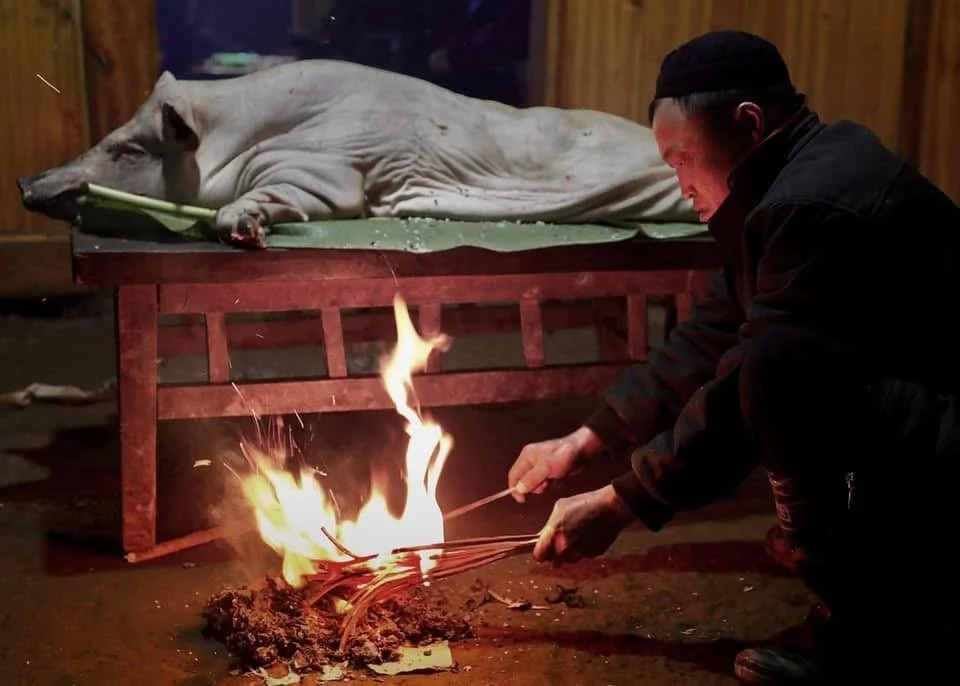

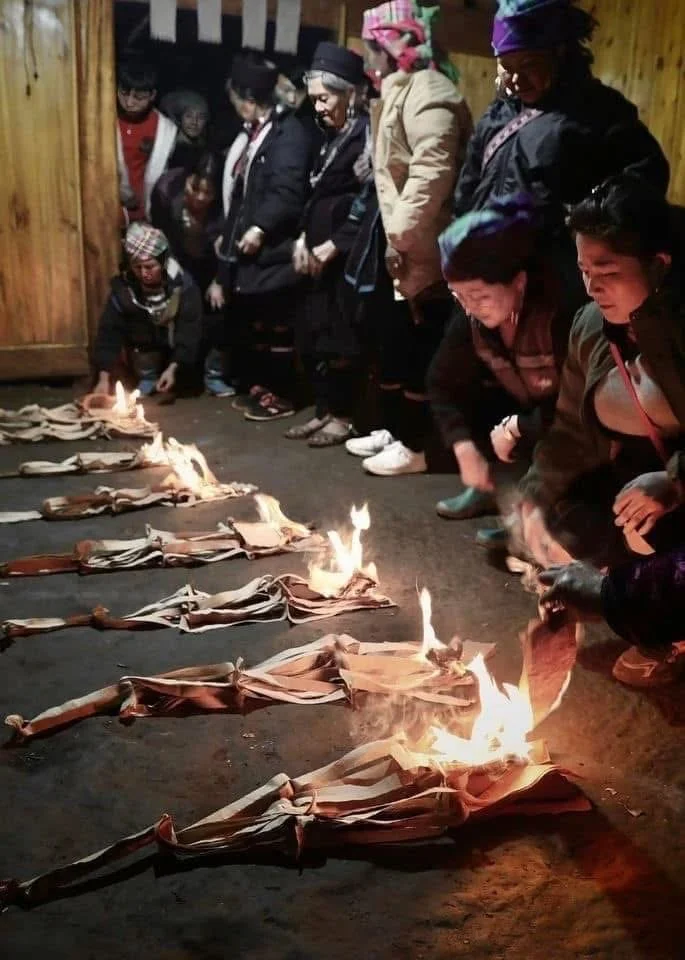
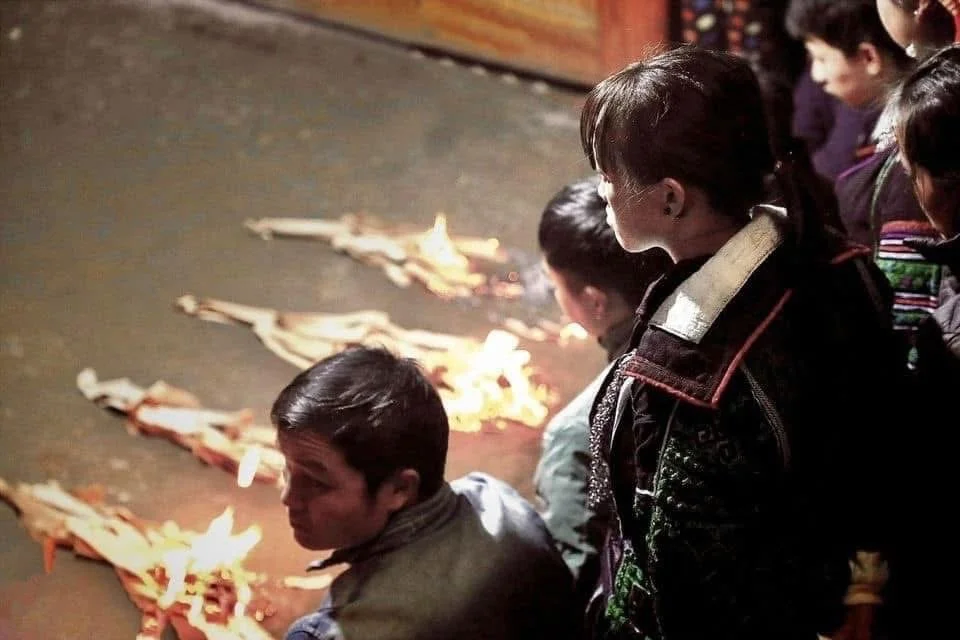
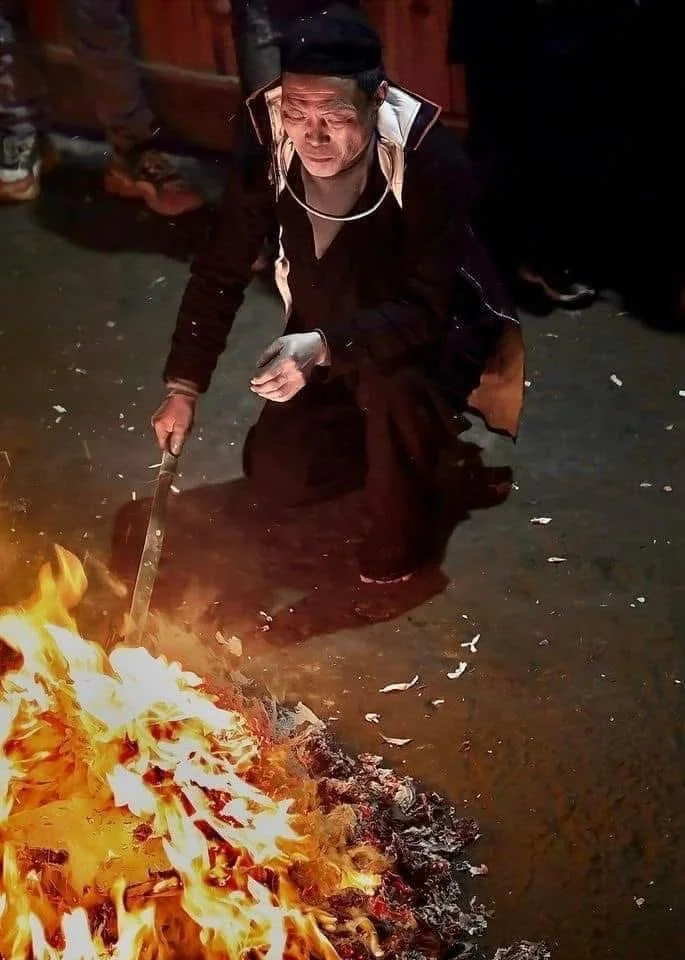
New Year Food and Hospitality
Food during New Year signals abundance and generosity. Pork dominate festive meals, often from animals first used in ritual offering. Sticky rice cakes known in Hmong as pav tuav are made by pounding glutinous rice into smooth rounds, sometimes in friendly competitions.
Distilled rice wine is essential. It is used in ritual, offered to spirits and shared with guests. Accepting a cup is part of accepting the relationship and blessing.
Clothing: Hemp, Indigo and Identity
New Year is visually striking because everyone wears new or newly finished clothing. This symbolises renewal and showcases months of labour in hemp weaving, indigo dyeing, batik and embroidery.
Hemp at the heart of Black Hmong textile life
Hemp has long been central to Black Hmong textile traditions in Sapa. It is valued not only as a fibre but for its cultural and spiritual meaning. Hemp grows well in the cool, humid highlands and is cultivated in family plots. After harvesting, stalks are retted in water, fibres stripped, dried and beaten, then hand-spun into thread. The thread is woven on backstrap looms into sturdy, breathable cloth. This process can take many months and knowledge is passed primarily through women. The cloth is dyed repeatedly in natural indigo baths to achieve the deep blue-black colour associated with Black Hmong clothing. Patterns are created using beeswax batik or intricate silk embroidery, often taking many more months. Motifs represent daily life, nature and important milestones.
Spiritual meaning of hemp
Hemp is not only worn in life but is central in death. In Hmong funerals, a hemp shroud traditionally wraps the deceased. This is a spiritual necessity. It is believed that only hemp can guide the soul safely back to the ancestral realm. Without hemp, the soul may become lost. This belief ties hemp directly to cosmology and the journey between worlds. For the Black Hmong, hemp symbolises resilience, continuity and identity. It connects people to land, ancestors and tradition even as modern fabrics become available.
Indigo clothing at New Year
Women’s indigo garments, decorated with batik and embroidery, are paired with silver jewellery. Men’s clothing is simpler but still formal. Children wear miniature versions. New Year becomes a community exhibition of textile skill and cultural pride.
Festivals, Games and Courtship
After household rites, attention turns to communal gatherings such as the Gau Tao festival. A tall decorated bamboo pole is erected, prayers are made, and the area becomes a place of games, music and social life.
Bamboo wrestling, stilt walking, spinning tops, crossbow contests and tug-of-war take place alongside ném pao, the ball-toss game where young men and women meet, talk and flirt.
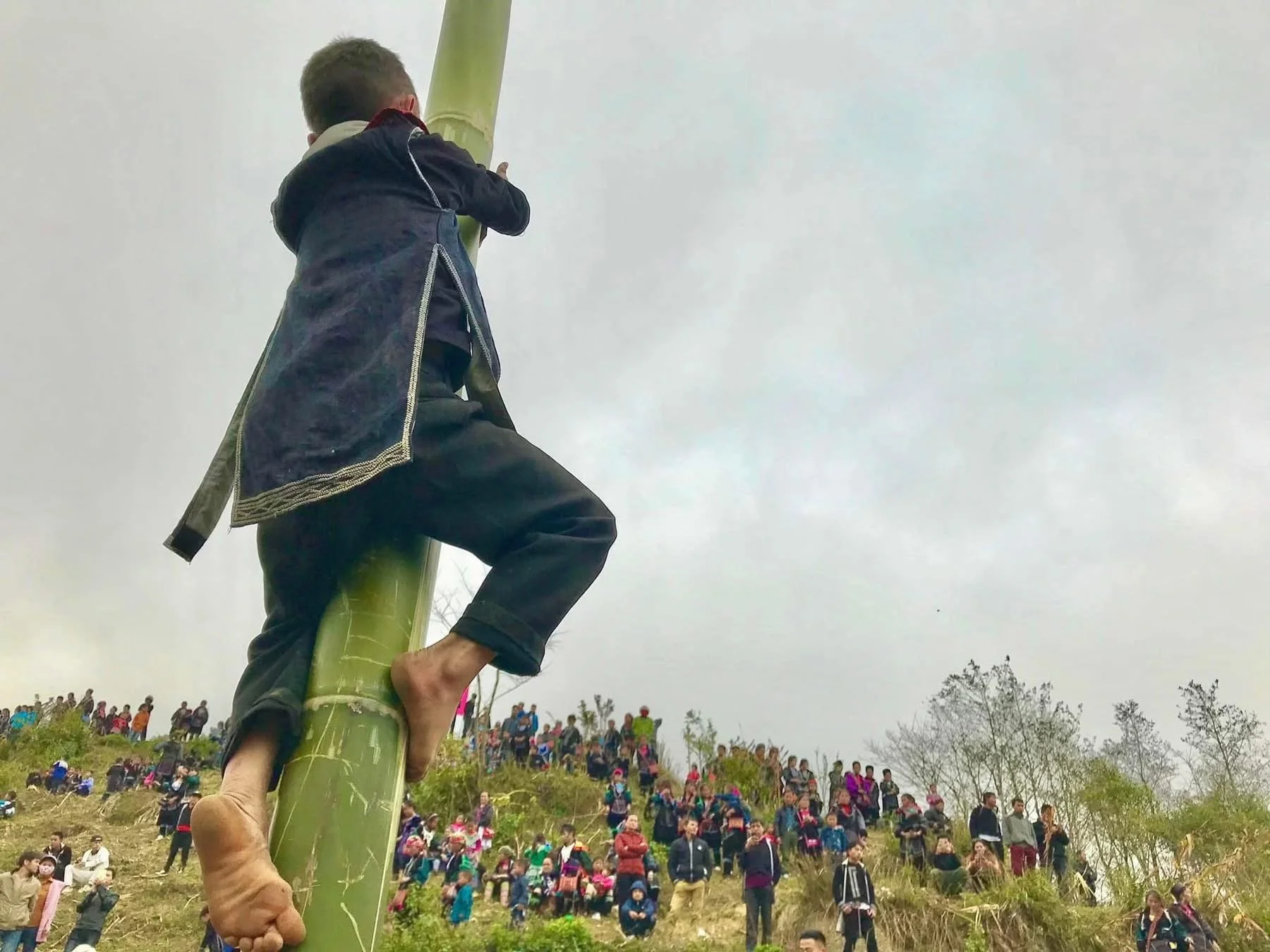
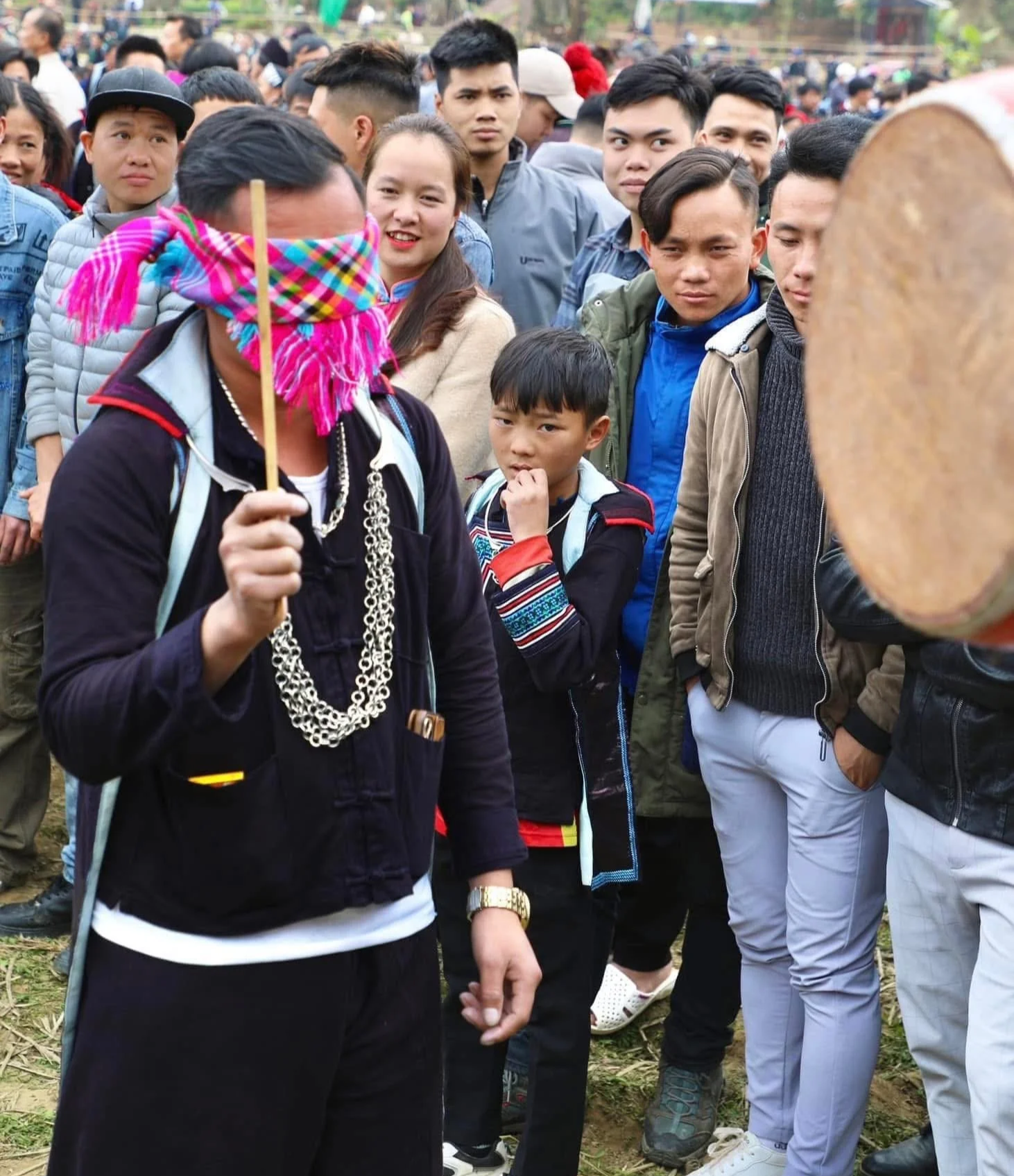
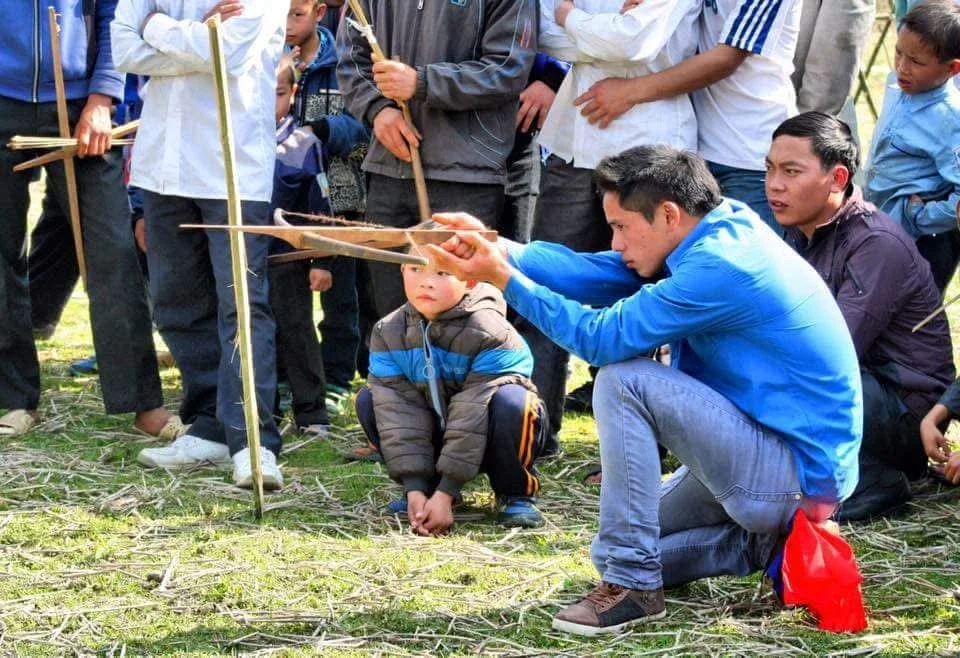
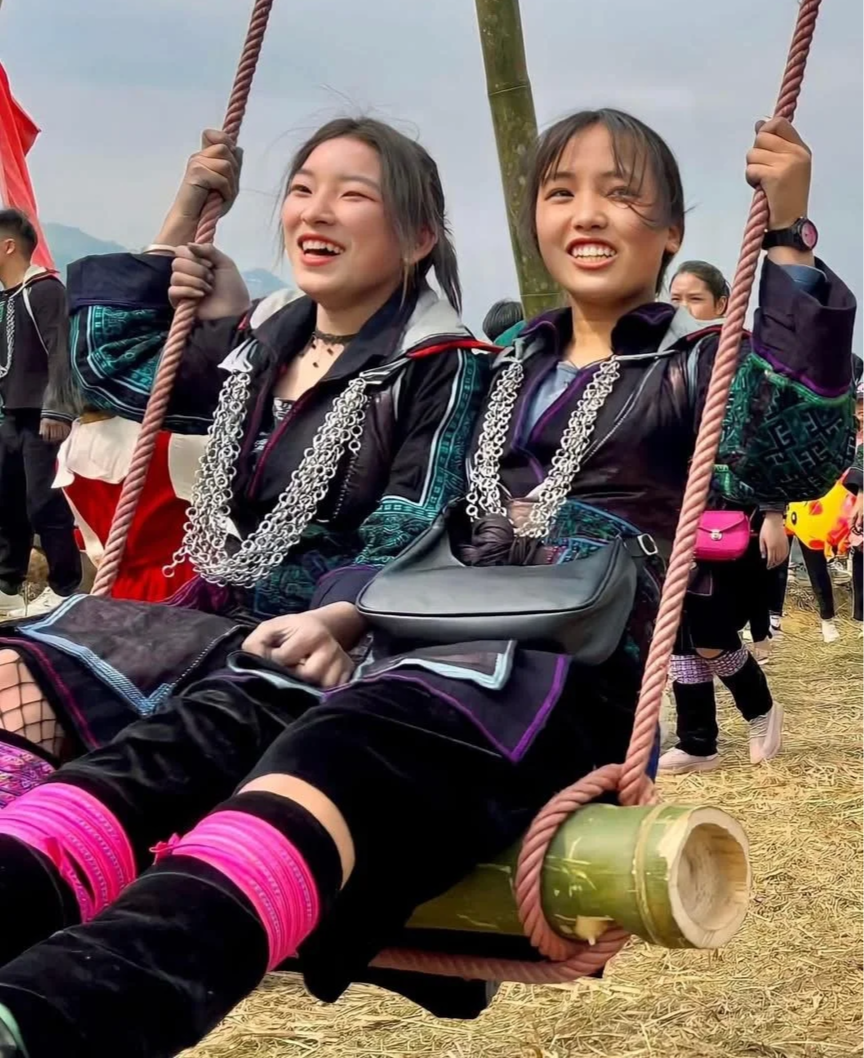
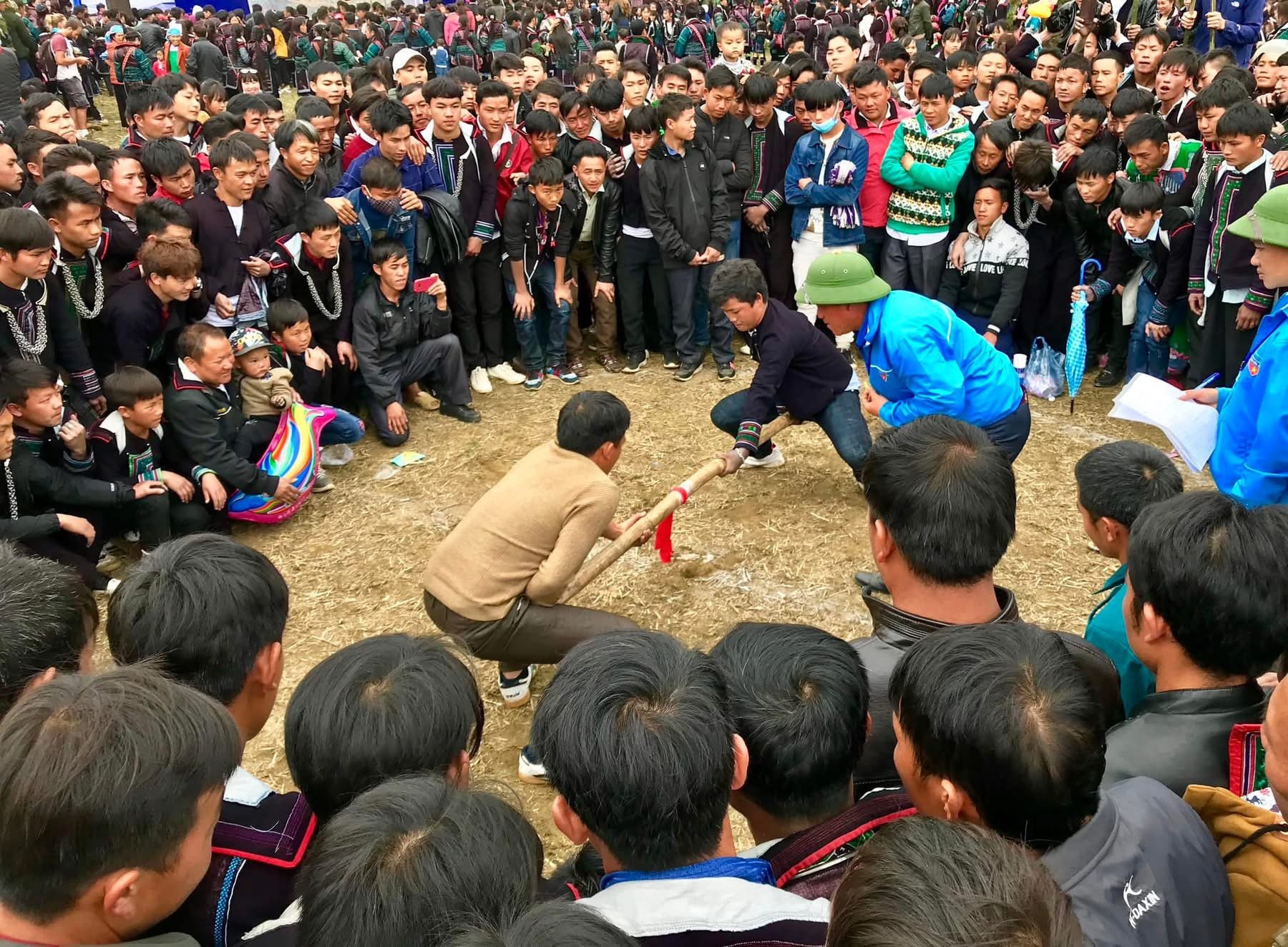
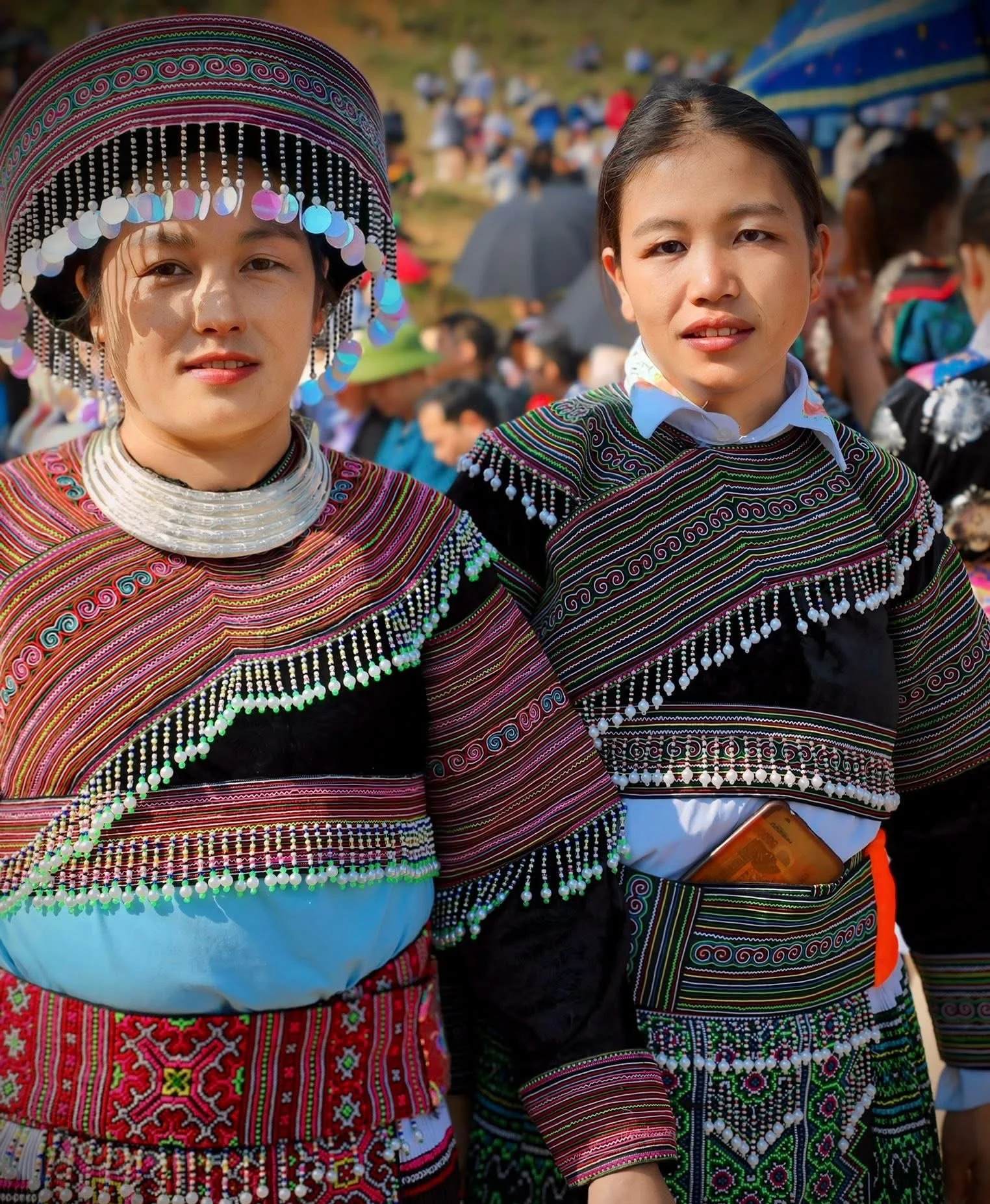
Taboos and Beginning the Year Well
Before the New Year, the Hmong cut three bamboo sticks and wrap them with red cloth. These are then used to sweep away spider webs and black soot from the house. This act symbolises clearing away the old year and preparing for a fresh beginning.
During the first days of the New Year, certain actions are avoided. People avoid washing clothes, blowing on the fire, eating rice with water, or holding a needle. Each of these actions carries meaning. Washing clothes is believed to wash away the blessings of the ancestors. Eating rice with water suggests a life of rain and hardship. Blowing on the fire may bring strong winds throughout the year. Sewing or using a needle symbolises damage to the crops, especially the maize harvest.
On the 19th day of the twelfth lunar month, which marks the Hmong New Year, families prepare sticky rice cakes and offer them to their ancestors. The cakes must not be eaten before the prayers are completed. It is believed that if someone eats before the ritual is finished, they may suffer burns from fire or hot charcoal during the coming year. This teaches patience and respect, reminding everyone that the ancestors must be honoured first.
These practices show how deeply the New Year is connected to spiritual protection, family unity and the guidance of those who came before.
A Living Tradition in Modern Sapa
Modern life has influenced the timing and visibility of the celebration, yet the core remains intact. Ancestors are honoured. Shamans chant. New clothes are made. Rice wine is poured. Young people meet in games and song. Each year, when winter turns to spring in the mountains around Sapa, the Black Hmong step into a new cycle with rituals that bind body, soul, family and village into one shared renewal.
The Serene Power of Northern Vietnam’s Man Made Hydro Lakes
Northern Vietnam’s hydro lakes blend human vision with natural beauty. These vast waters support local life, clean energy and quiet travel far from the crowds.
Northern Vietnam is known for its dramatic mountains, lush forests and winding rivers, but it is also home to some of Southeast Asia’s most impressive hydro lakes. These vast bodies of water are the result of major engineering projects, yet they look entirely at home within the landscape. Their sheer scale and calm beauty make them destinations that feel both awe inspiring and deeply peaceful.
A Landscape Transformed by Vision and Engineering
The region’s hydro lakes were created through large scale dam projects that harness the power of fast flowing mountain rivers. When the valleys were flooded, the geography changed forever. What once were river channels and terraced slopes became expansive lakes that stretch for kilometres, curving and branching like inland fjords.
Although these lakes are artificial, they do not feel industrial. The mountains remain untouched and thick with vegetation. Clouds drift low across the water, and the air carries a fresh, earthy scent. The result is a landscape shaped by humans but fully embraced by nature.
Endless Horizons of Still Water and Mist
Visitors are often struck by the way the lakes reflect the surrounding scenery. On a quiet morning the water can appear perfectly still, like polished glass. Forested ridges, limestone cliffs and tiny floating houses are mirrored with astonishing clarity. The atmosphere is often enhanced by gentle mist that rolls across the surface, giving the entire scene a dreamlike quality.
In some areas small islands rise from the water, covered with bamboo and wild plants. These islands create beautiful compositions that feel almost cinematic. In the late afternoon when the sun sinks behind the hills, the lakes glow with soft light that feels peaceful and ancient.
Local Life Along the Water
Despite their remote appearance, the hydro lakes are living landscapes. Local communities fish, farm and travel across the water daily. Long wooden boats glide between floating homes, fish farms and forested peninsulas. Markets gather along the shores and visitors can often share meals of freshly caught fish cooked with fragrant herbs.
Tourism here remains understated. Instead of busy resorts, travellers can find homestays, small eco lodges and guided boat trips that encourage quiet appreciation rather than fast paced sightseeing.
Power, Progress and Preservation
These hydro lakes are vital for Vietnam’s energy supply. They produce electricity for millions while reducing reliance on fossil fuels. Yet what stands out is how gracefully the environment has adapted. Wildlife remains abundant, forests stay green and the lakes have become a source of both sustainability and scenic value.
They show that development does not always have to diminish natural beauty. With careful planning and respect for the land, it can even create new spaces for reflection, adventure and cultural life.
A Destination Worth Exploring
Northern Vietnam’s hydro lakes are functional reservoirs and places where nature and human design exist in harmony. Whether you explore by boat, hike the surrounding hills or simply sit at the shoreline, the stillness and scale will leave a lasting impression.
If you are drawn to landscapes that feel wild yet welcoming, this is a journey worth taking. It is not only about seeing something extraordinary. It is about feeling connected to a place where power and peace flow together.
Ready to Explore on Two Wheels
For those seeking a deeper connection with these waterways, remote mountain communities and the hidden paths in between, our guided motorbike adventures offer a truly immersive way to travel. We ride through highland passes, along lake shores, into caves and across cultural landscapes that many visitors never reach. If you want to combine the freedom of the open road with meaningful, slow travel, explore our routes:
Ride Caves and Waterways
https://www.ethosspirit.com/ride-caves-waterways-5-days
Ride the Great North
https://www.ethosspirit.com/ride-the-great-north
Join us, breathe the mountain air and experience the spirit of Vietnam with every mile.
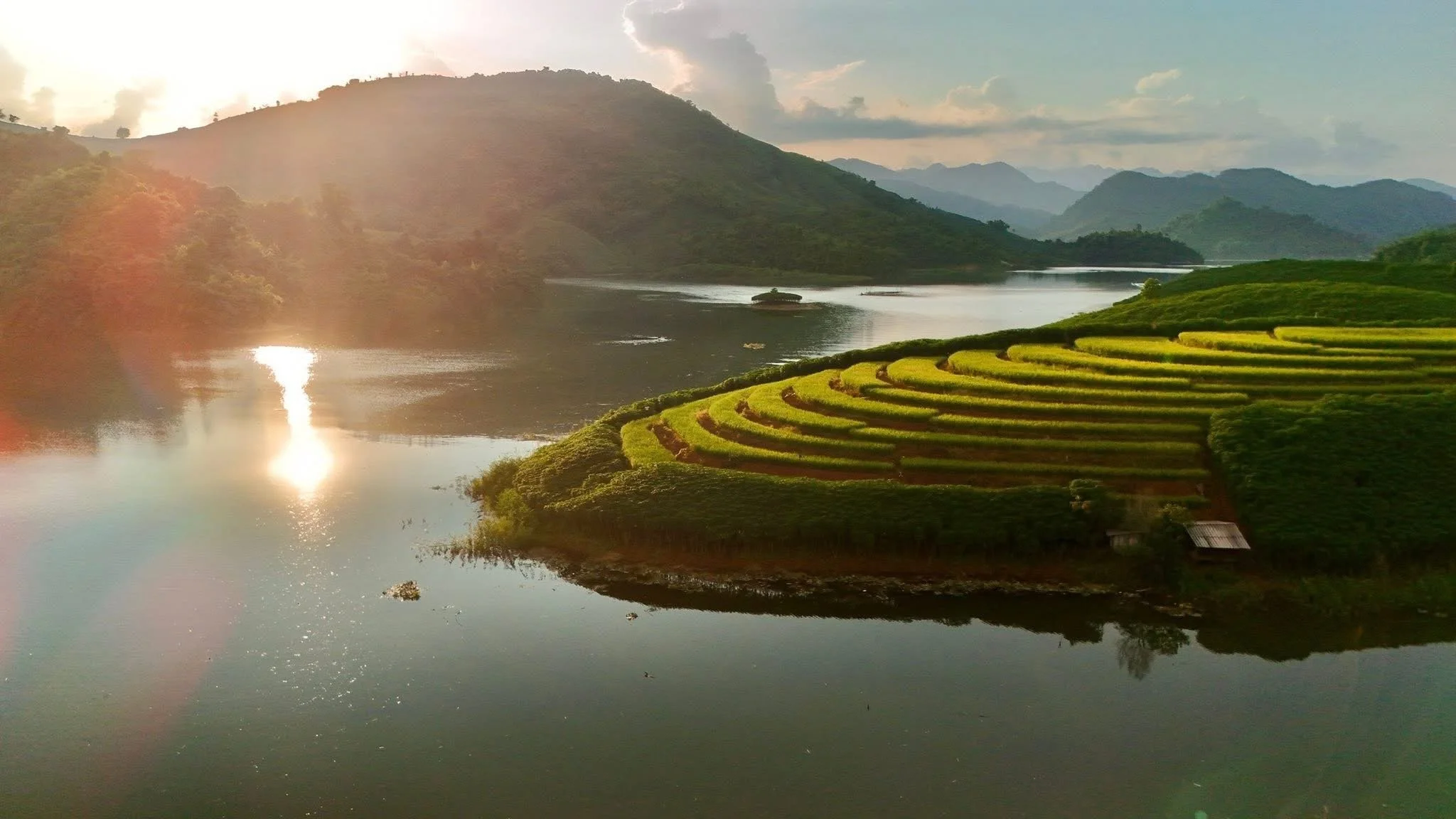
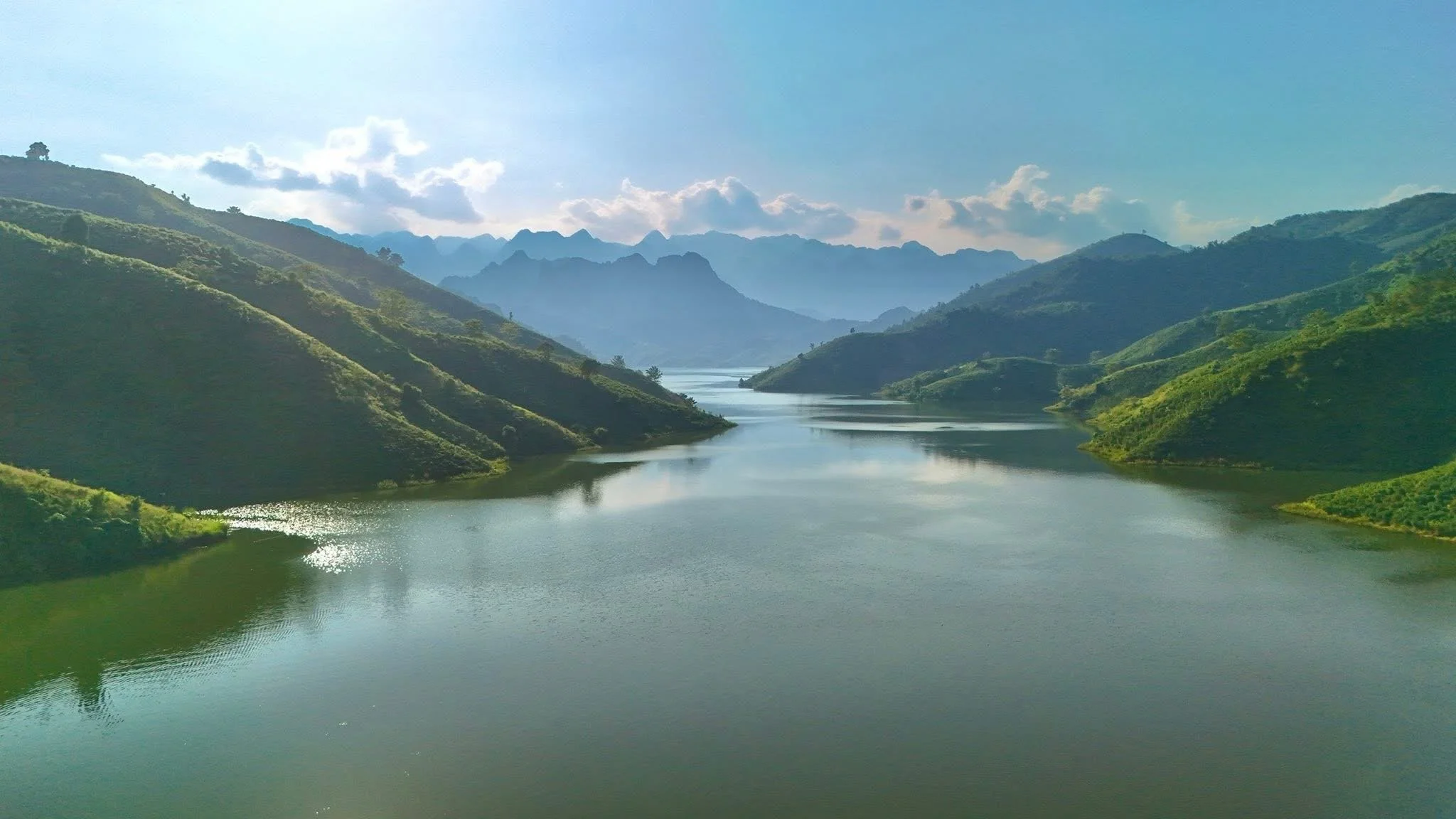
Tet in Northern Vietnam: What to Expect, When to Travel, and How to Prepare
Tet shapes travel, family life, and village celebrations across northern Vietnam. From red envelopes and homecomings to crowded roads and post-Tet festivals, here is how to plan a thoughtful journey around Tet 2026.
Each year, as winter softens its hold on the Hoàng Liên mountains and the first plum blossoms open along stone walls and village paths, Vietnam moves into its most meaningful season. Tết Nguyên Đán, the Lunar New Year, marks a time of renewal, homecoming, and intention.
In the northern highlands of Sapa, Ha Giang, and the wider border regions, Tet shapes the rhythm of daily life, travel, and community celebration. For visitors, understanding this period allows journeys to unfold with greater care, respect, and connection.
When Is Tet in 2026?
In 2026, Tet begins on Tuesday 17th February, marking the start of the Lunar New Year.
Although the official holiday lasts several days, preparations begin weeks in advance and the effects continue well beyond the celebration itself. Travel patterns, accommodation availability, and village life are influenced for up to three weeks around Tet.
What Is Tet and How Is It Celebrated?
Tet marks the beginning of the lunar calendar and a turning point in family, agricultural, and spiritual life. Across Vietnam, people return to their ancestral homes, clean and repair houses, and prepare food that carries memory, care, and meaning.
Altars are refreshed with kumquat trees, peach blossom branches, incense, and offerings. Kitchens fill with the slow scent of simmering broths and sticky rice wrapped in banana leaves. The first days of the new year are spent visiting relatives, offering good wishes, and resting after a year of work.
One of the most visible customs during Tet is the giving of lì xì, red envelopes containing small amounts of money. These are given primarily to children, but also to elders and unmarried adults, as a symbol of good fortune, health, and prosperity for the year ahead. The red envelope itself carries meaning, representing luck and protection, rather than the monetary value inside. For children, receiving lì xì is a moment of excitement and joy, often accompanied by blessings for growth, strength, and happiness.
In the mountains, Tet aligns with a pause between farming cycles. Fields rest, tools are set aside, and time is made for family gatherings, storytelling, and preparation for the celebrations that follow.
What Tet Means for Travel in Vietnam
Travelling during Tet requires thoughtful planning and realistic expectations.
In the days leading up to and following the New Year, transport networks become extremely busy as families return home. Buses, trains, and flights often sell out far in advance. Many small, family-run businesses close for several days so that owners and staff can spend time with their families.
For travellers, preparation makes a significant difference. Booking accommodation early, allowing extra time for journeys, and accepting a slower pace can turn disruption into an opportunity to witness daily life at a meaningful moment in the year.
The Ha Giang Loop After Tet
The Ha Giang Loop is one of northern Vietnam’s most iconic journeys, and Tet brings a sharp rise in visitor numbers.
From around two days after Tet, the Loop becomes extremely busy. Homestays and hotels fill quickly and often reach full capacity. Roads see heavy traffic from tour groups, motorbikes, and domestic travellers returning from holiday.
For approximately ten days after Tet, riding conditions can feel congested, and accommodation options are limited. Those planning to travel during this period should book well in advance. Travellers seeking quieter roads and a more spacious experience may prefer to arrive before Tet or wait until later in the season.
Sapa During and After Tet
Sapa follows a similar rhythm.
From the second day after Tet, the town and surrounding valleys experience a significant increase in visitors. Hotels fill, trekking routes become busier, and transport costs may rise.
This period of heightened activity usually lasts around ten days, after which the region gradually returns to a calmer pace. Travellers hoping for quieter trails and deeper village engagement may wish to plan their visit outside this window.
Village Festivals After Tet in Hmong and Dao Communities
After the main Tet celebrations each spring, villages around Sapa begin to host their own cultural festivals. These gatherings are deeply rooted in local tradition and follow village-specific calendars rather than national schedules.
Festivals typically begin early in the morning and continue through the day. Larger villages host especially lively celebrations, drawing neighbouring communities together. Events include a wide range of cultural activities and folk games that emphasise health, strength, and skill. Physical ability is highly valued, as agriculture remains central to daily life in the highlands.
Music, dancing, shared meals, and rice wine are all part of the day. Perhaps the most anticipated moment comes with the unveiling of newly handmade traditional clothing. Months of winter are spent preparing these garments, using indigo-dyed organic hemp and intricate silk embroidery. Each piece reflects patience, identity, and pride in craftsmanship passed down through generations.
Alongside these traditional garments, some young women choose modern fabrics and bolder styles, often affectionately referred to as the “glitter girls”. Their presence adds humour, creativity, and a living sense of fashion to the celebrations.
Hmong New Year festivals mark the end of the harvest and the beginning of a new year in the Hmong calendar. They are a time for honouring ancestors, strengthening community bonds, exchanging small gifts, and reflecting on the year that has passed while setting intentions for the one ahead.
For visitors, these festivals offer a rare opportunity to witness culture as it is lived, not staged. Respectful behaviour, local guidance, and patience are essential, as these gatherings remain first and foremost for the communities themselves.
Planning Your Journey Around Tet
Tet can be a rewarding time to travel in northern Vietnam when approached with awareness and care.
Accommodation should be booked early, particularly in Ha Giang and Sapa. Flexible itineraries allow room for transport delays and business closures. Travellers who align their journeys with local rhythms often find deeper connection than those moving too quickly.
At ETHOS, our experiences are shaped in close collaboration with Hmong and Dao partners, following the seasonal cycles of land and village life. Some travellers arrive before Tet to experience quiet mountain days. Others choose to come later, when village festivals bring colour, movement, and shared celebration back to the valleys.
Listening to the people who live here remains the foundation of meaningful travel, whatever the season.
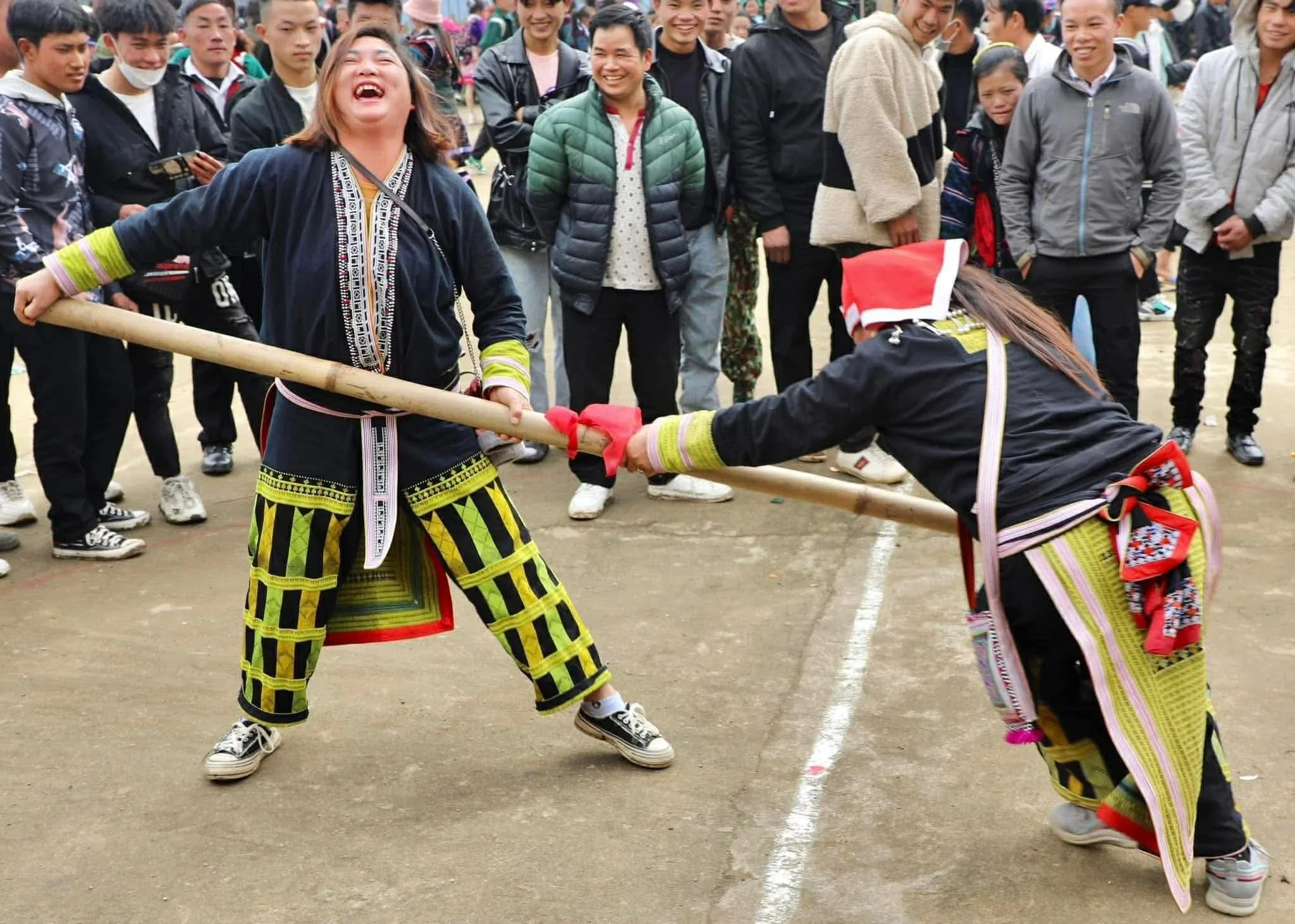
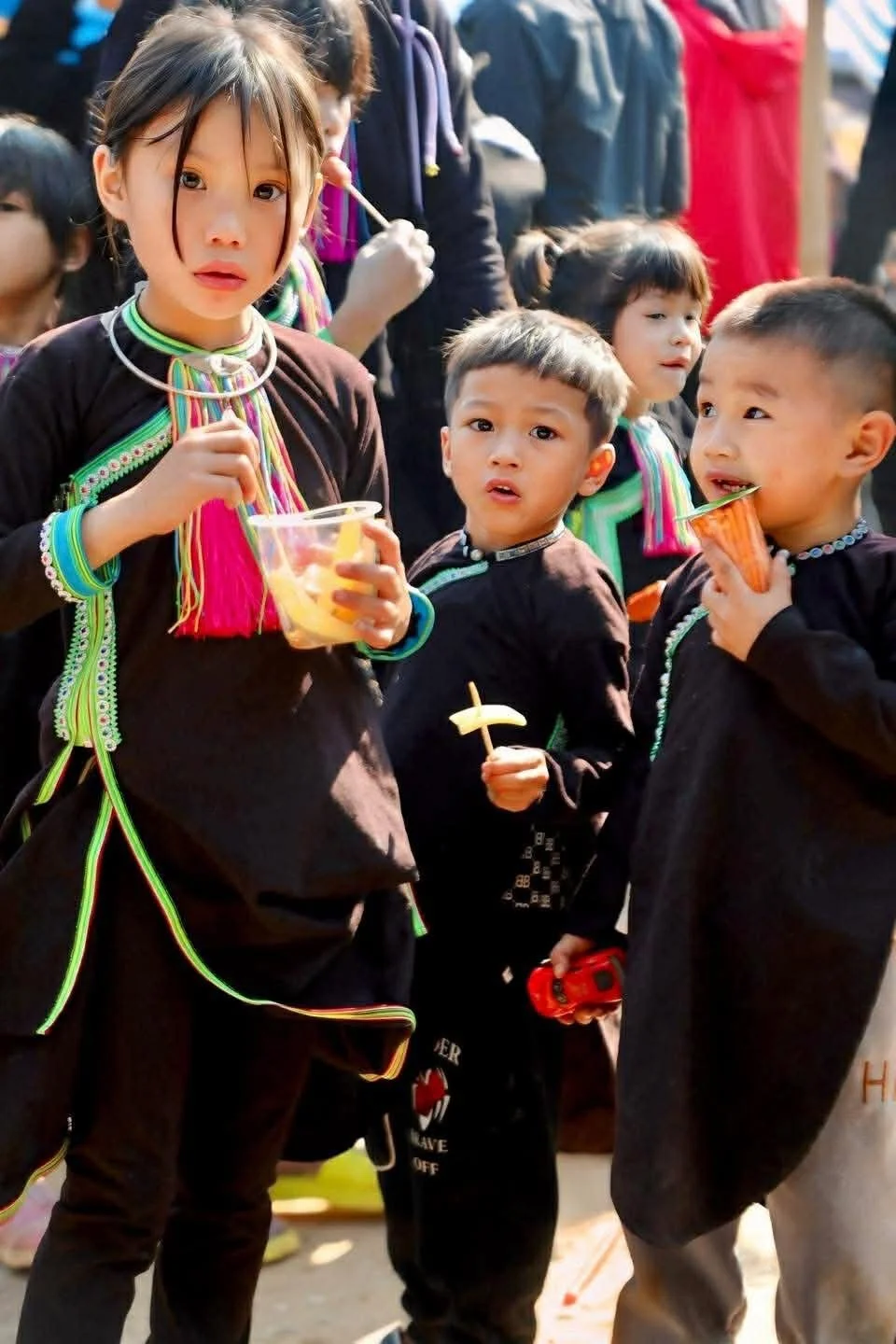
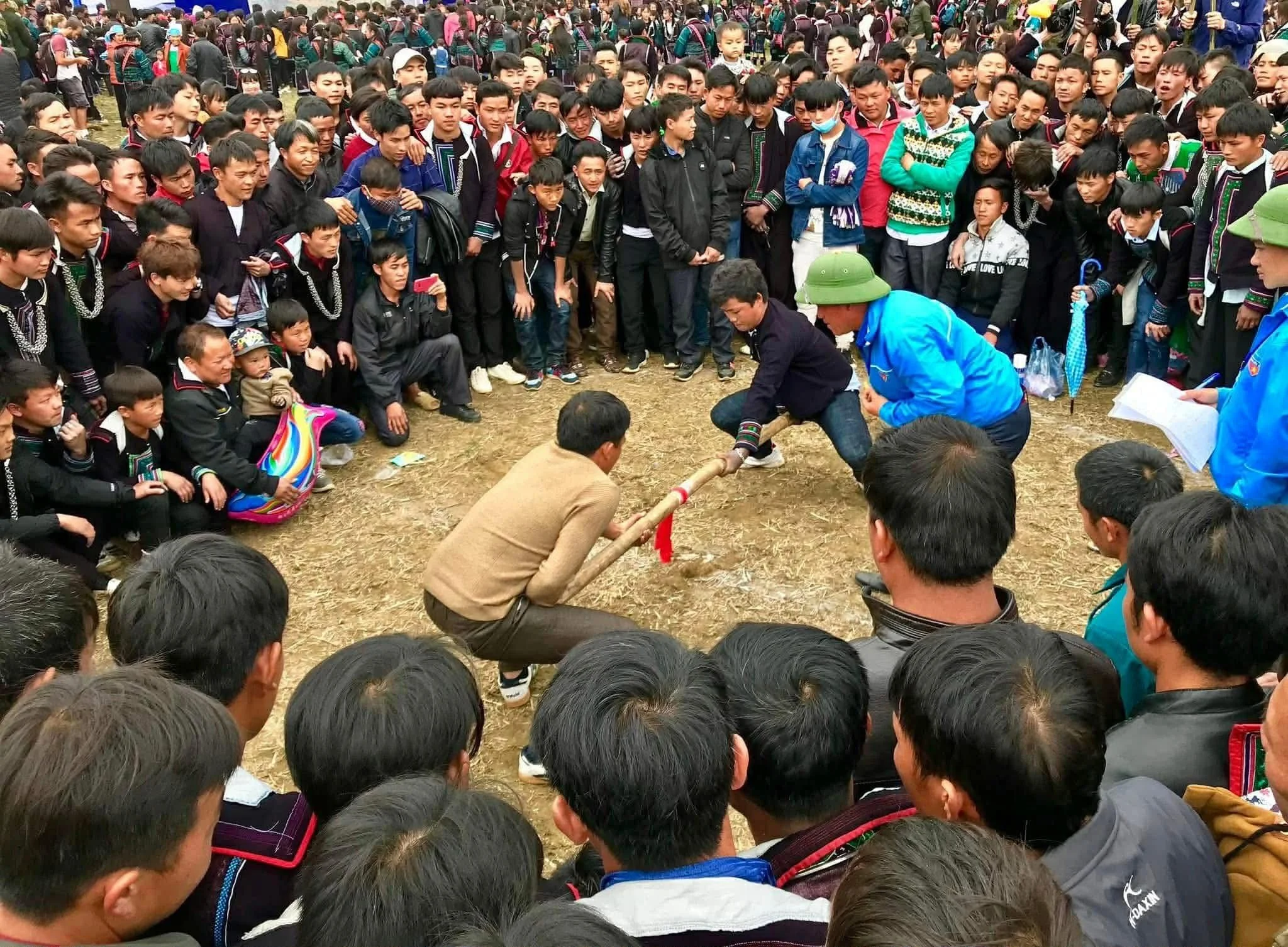
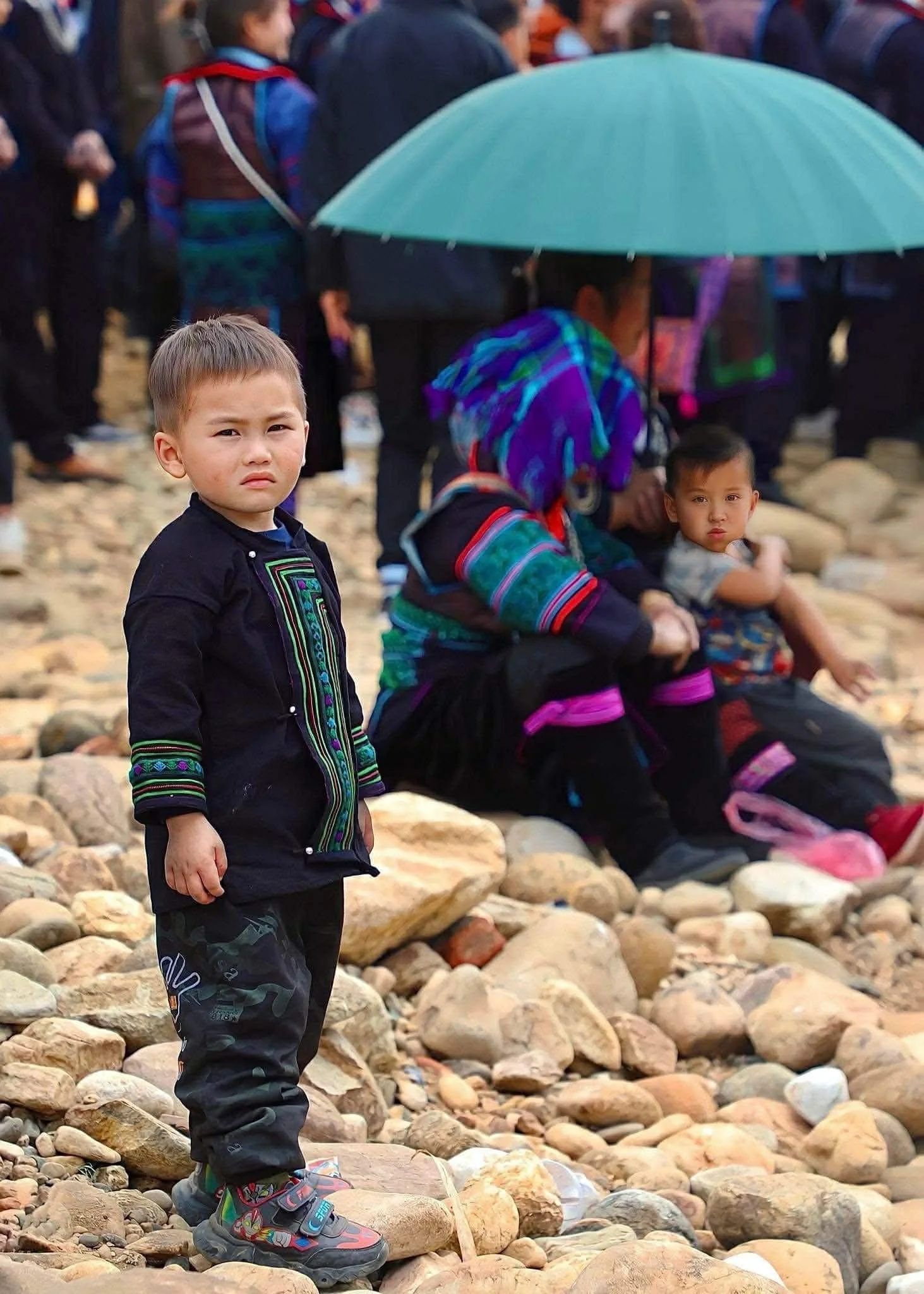
Last Chance to See: A Century of Hmong Clothing in Northern Vietnam
A visual journey through Hmong clothing across four regions of Northern Vietnam, revealing how tradition, identity, and textile art have survived for over a century.
Last Chance to See: Clothing, Change, and Continuity
As part of a photo series titled Last Chance to See, ETHOS explores how clothing has changed over more than a century while still holding deep cultural meaning. This series looks closely at what has endured, what has adapted, and why traditional dress continues to matter today.
Today’s focus is on the Hmong people living in four distinct regions of Northern Vietnam: Mu Cang Chai, Sapa, Ha Giang, and Bac Ha. Each region tells its own story through colour, texture, and design.
The Hmong People and Cultural Identity
Throughout recorded history, the Hmong have remained identifiable as Hmong. This continuity comes from maintaining their language, customs, and ways of life, even while adopting elements from the countries in which they live.
Clothing plays a central role in this identity. It is not simply something to wear, but a visible expression of belonging, heritage, and pride.
Regional Differences in Hmong Dress
Many Hmong groups are distinguished by the colour and details of their clothing. Black Hmong traditionally wear deep indigo dyed hemp garments, including a jacket with embroidered sleeves, a sash, an apron, and leg wraps. Their clothing is practical, durable, and rich in subtle detail.
Flower Hmong are known for their brightly coloured traditional costumes. These outfits feature intricate embroidery, bold patterns, and decorative beaded fringe, making them immediately recognisable.
Paj Ntaub: The Language of Cloth
An essential element of Hmong clothing and culture is paj ntaub, pronounced pun dow. This is a complex form of traditional textile art created through stitching, reverse stitching, and reverse appliqué.
Meaning, Skill, and Tradition
Traditionally, paj ntaub designs are ornamental and geometric. They are mostly non representational and do not depict real world objects, with the occasional exception of flower like forms. The making of paj ntaub is done almost exclusively by women.
These textiles are sewn onto clothing and act as a portable expression of cultural wealth and identity. Paj ntaub play an important role in funerary garments, where the designs are believed to offer spiritual protection and guide the deceased towards their ancestors in the afterlife. They are also central to Hmong New Year celebrations.
Before each New Year, women and girls create new paj ntaub and new clothing. Wearing clothes from the previous year is considered bad luck. These new garments reflect creativity, skill, and even a woman’s suitability as a successful wife.
Why Hmong Clothing Endures
Despite major cultural and social change over the past century, Hmong clothing has endured. Its survival lies in its deep connection to identity, belief, skill, and community. Each stitch carries meaning, and each garment tells a story that continues to be passed from one generation to the next.