How poorly researched travel guides, influential websites and AI are turning misinformation into accepted fact.
An exquisite photograph of a cable car in Switzerland is being used to show travellers what to expect from Mount Fansipan in Sapa. In its guide to Sapa, Oxalis places the photograph above a short caption promising “Spectacular views from the Fansipan cable car”. The photographed location is Meiringen–Hasliberg, in Switzerland. The mislocation is out by about eight and a half thousand kilometres! The branding on the cabin and the cableway’s distinctive structure make this a checkable geographical error. Somebody didn’t check and the image is now inaccurately claiming something that simply isn’t true. This may be a simple editorial error and probably wouldn’t matter as much if the Oxalis page about Sapa wasn’t the top listed search result for anyone searching Google using the key words “Sapa Vietnam”. As such, the page is frequently browsed and the innacuracies reach a huge audience.
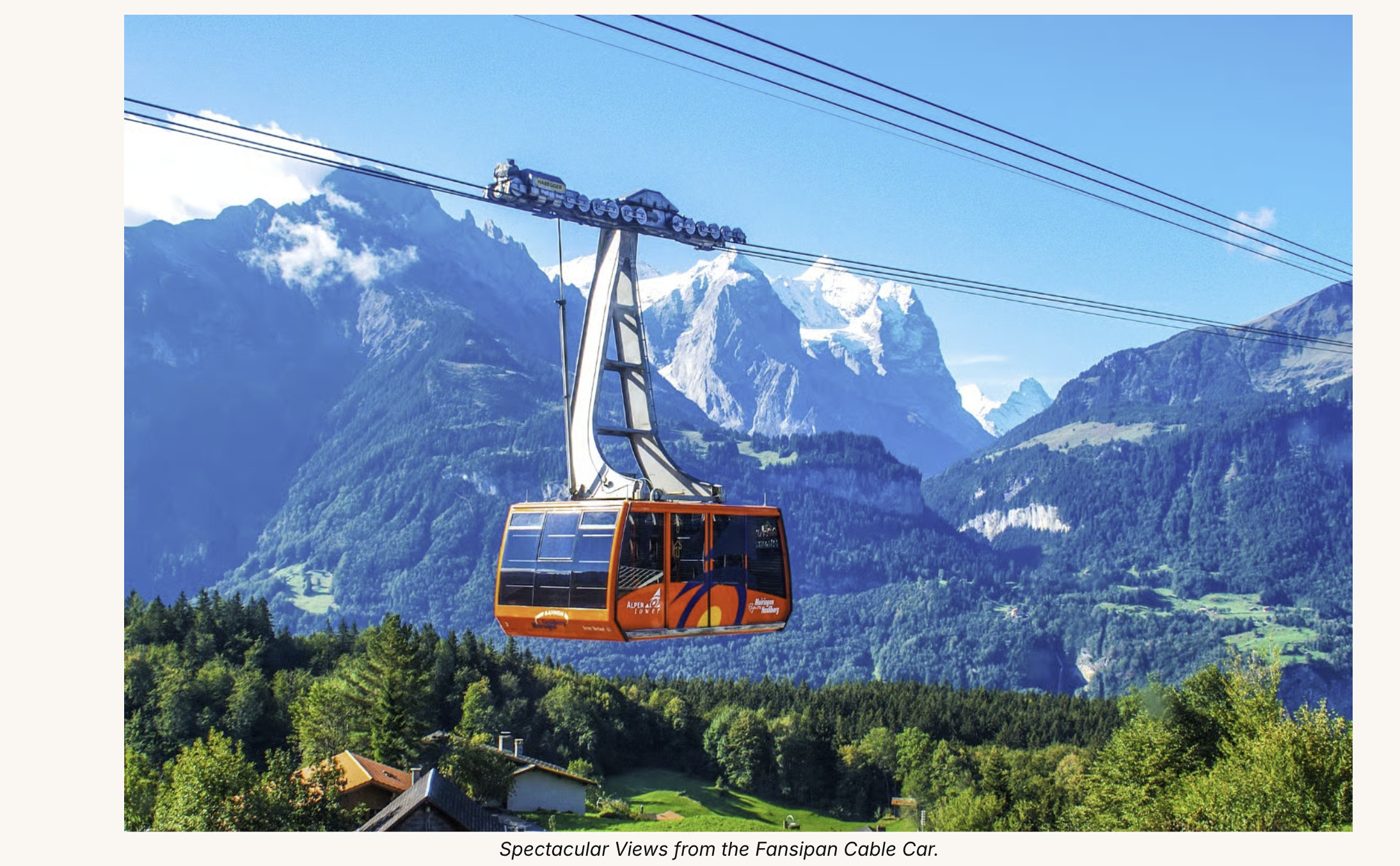
Oxalis labels this photograph as Fansipan. The cableway shown is Meiringen–Hasliberg in Switzerland.
The incorrect cable car image a is very clear example of a much broader problem for the Sapa area. Across four very prominent, high SEO ranking Google search results for Sapa, I found photographs of other destinations presented as Sapa, accomodation illustrated by an entirely different kind of property, an obsolete market location and misleading advice about when visitors can see golden rice. These are the kind of details that shape a travellers decisions. Website information could easily influence when people book their, where they go, how they budget and what they expect from the areas they visit. Once the same misinformation appears in several places, repetition starts to imply fact and falsehood becomes cemented as fact.
What I reviewed, and why local knowledge matters
I live and work in Sapa, as I have done for many years. My volunteer role with ETHOS means I work closely with Hmong, Dao and other local communities. The places and cultural distinctions discussed in this blog are therefore part of my working life. This blog post closely examines destination guides published by Oxalis Adventure, Vietnam Airlines, Vietcenter and Vinpearl. This is not a targeted attack and these pages were only selected because their high position on Google rankings. I also looked at a less visible website who has fabricated attractions as well as looked at a recently published travel blog. I could have chosen other pages or “Ultimate Guides” but selected these case studies because they currently appear prominently in the Google results for “Sapa Vietnam”. Search results vary, so this is a review of those pages, not a claim about a permanent ranking or every result Google serves.
The evidence combines screenshots of the published material, my first-hand identifications and checks against service providers, local reporting, museum records and other primary sources. The linked sources at the end of the blog are included to establish and verify specific corrections. My visual identification of familiar places and communities is also evidence, and is described where it matters. I believe that any photograph with a place name beneath it is making a factual claim, and therefore deserves the same editorial care as a sentence giving an address or a journey time.
Oxalis Adventure: photographs and advice detached from their setting
The problems in Oxalis’s Sapa guide extend well beyond the Swiss cable car. A photograph of golden rice terraces featuring a woman with a red umbrella is captioned as the Mường Hoa Valley but I immediately recognised the landscape as Mù Cang Chải, a mountain destination three and a half hours drive from Sapa. Any reader looking at the photo is being shown a different destination as evidence of what this Sapa valley looks like. Is this poor research, poor editing or perhaps a bit of both? The fact that Oxalis don’t operate in Sapa would indicate that its not deliberate mismarketing. They have little to gain by misleading travellers.
Elsewhere on their Sapa page, the cultural recommendations are equally problematic. The photograph accompanying a “Hmong sewing class” shows a Red Dao woman and personal friend, Ta May. That identification comes from my knowledge of the communities I work with, and that they are correctly identified matters to them. The article offers no explanation for the mismatch, blurring a distinction that should be central to a guide promoting cultural learning. The ethnic minorities of Sapa are one of the most unique aspects of the region and misrepresenting culture is simply lazy. Hmong and Red Dao textile traditions deserve to be described and credited accurately. A sewing lesson is an encounter with somebody’s knowledge and expertise, so getting the community wrong undermines the very experience the guide claims to explain.
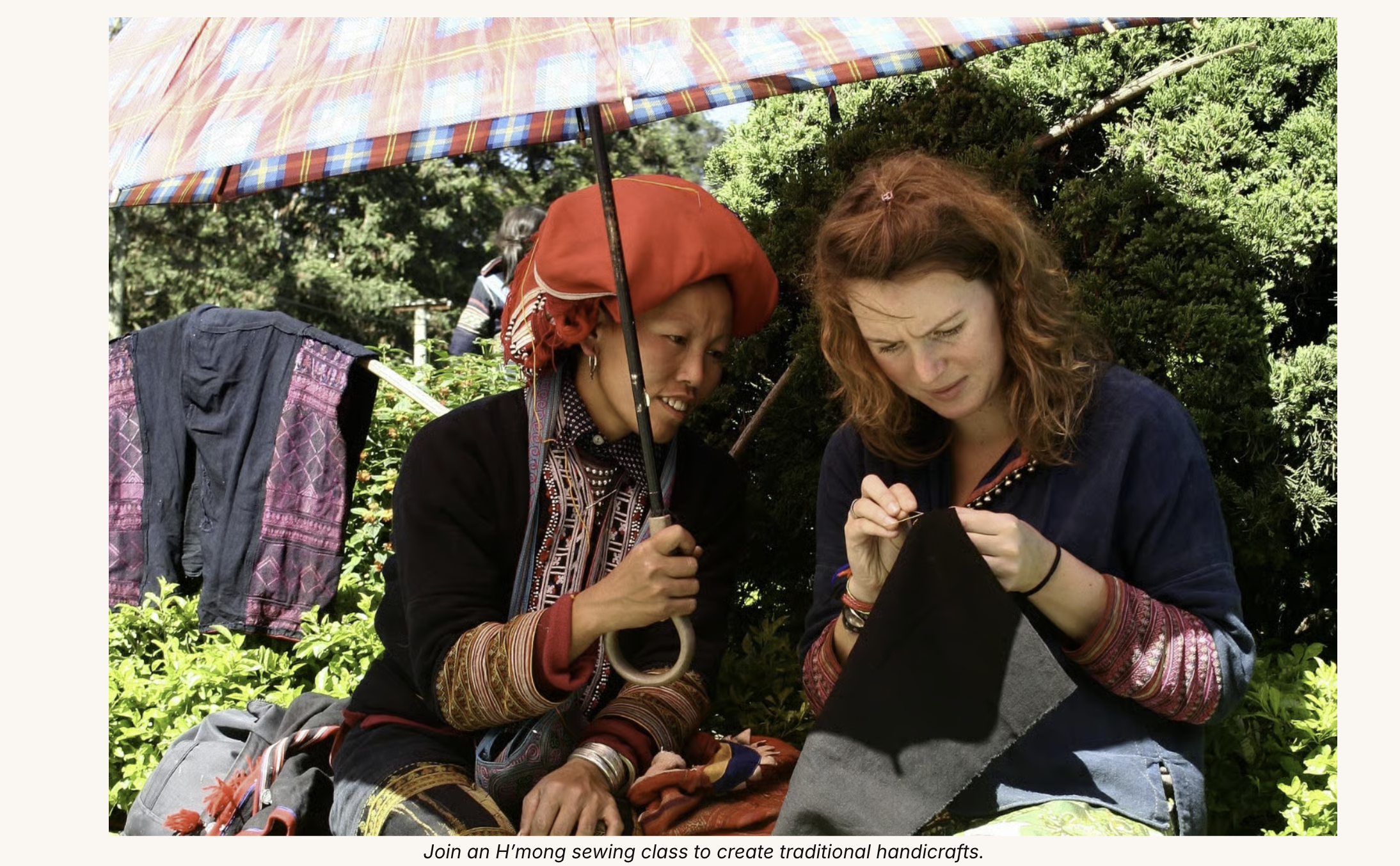
A Red Dao woman teaches a class labelled “Hmong”. The cultural correction is based on my work with Hmong and Dao communities.
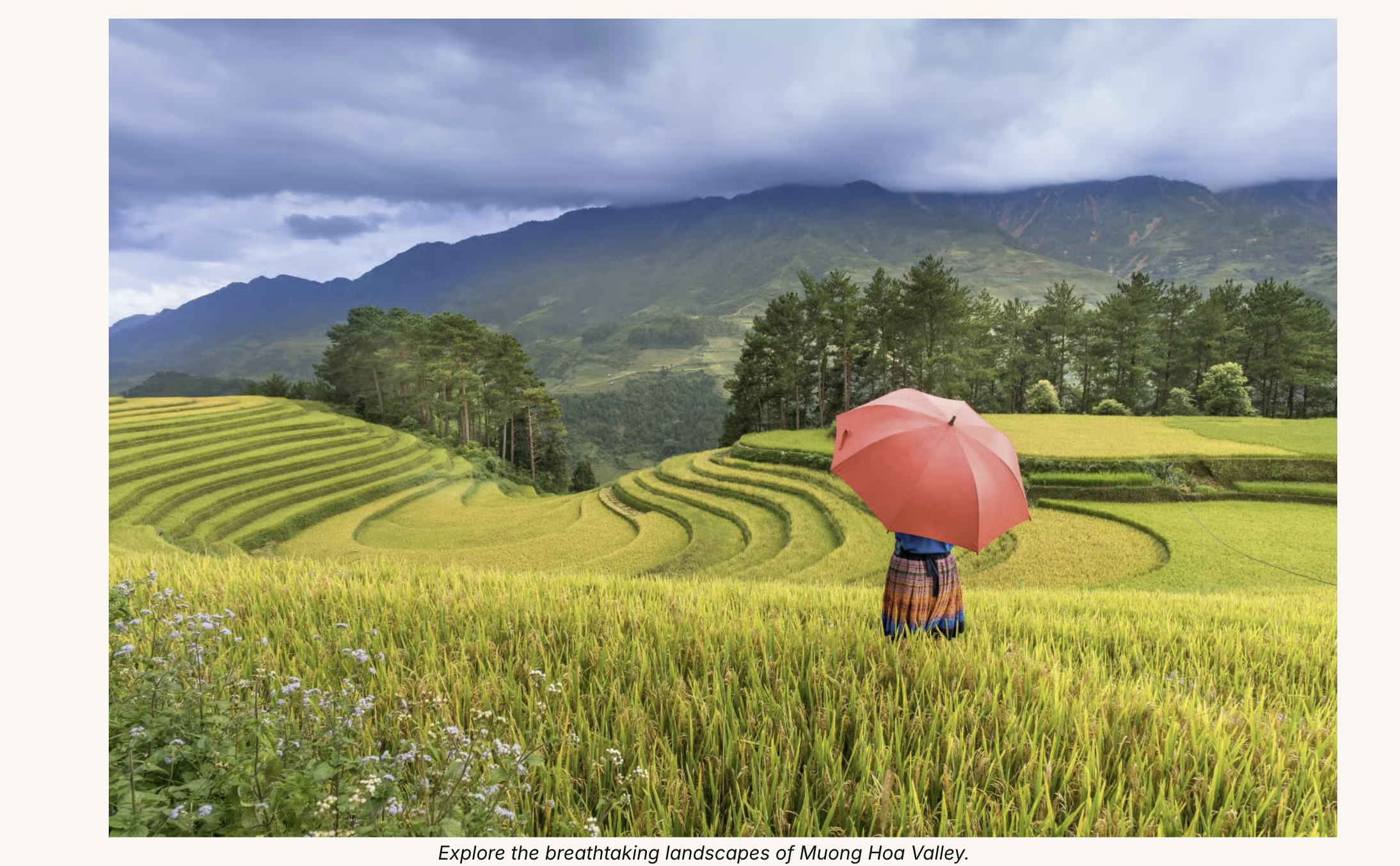
A staged photograph of a flower Hmong woman from Bac Ha in the Mu Cang Chai rice terraces inaccurately labelled as the Muong Hoa Valley in Sapa.
The market photographs on Oxalis’ Sapa page show Bắc Hà, rather than Sapa. This changes the practical meaning of the recommendation because a visitor browsing the page is being encouraged to expect a market scene in Sapa that belongs to a substantially separate geographical location.
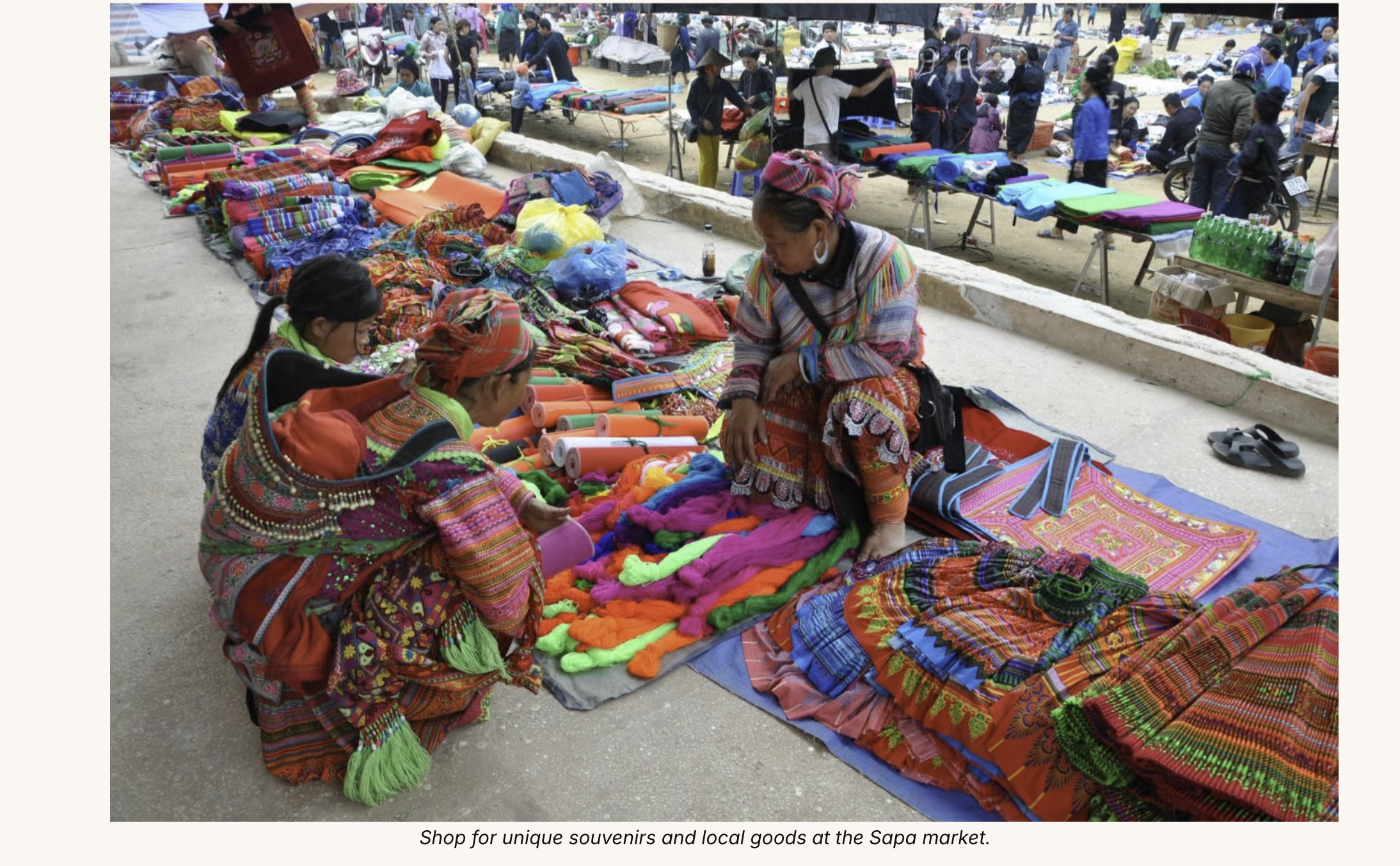
An image of Bac Ha Market, located 3 hours drive from Sapa market
The road pass that is not a hiking route
The written section describing Sapa’s “best hiking trails” lists Cát Cát Village, the Silver and Love Waterfalls, as well as Trạm Tôn Pass. These are recommendations that are worth dissecting. Cát Cát Village has become a tourist trap with entrance fees and a variety of manicured attractions. Cát Cát could never accurately be described as a place to trek. Similarly, the page describes the Trạm Tôn Pass as a hike, but gives no clear footpath, starting point, distance or route. The Trạm Tôn Pass, also known as Ô Quy Hồ road is actually more of a road excursion, and one I ride all the time. There is a genuine Trạm Tôn–Fansipan trekking route, documented by Hoàng Liên National Park, but this would always be considered locally as a Fansipan trek [2]. Legally, you need a permit, a trekking guide and a plan to make this work. A useful guide should distinguish the road, the trailhead and the mountain trekking route.
“Best” is a judgement, and my assessment of worthwhile trekking comes from living in Sapa for many years. The so called “best hiking trails” in Sapa listed by Oxalis wouldn’t make my top 30 walks in the region and I walk local trails as often as I can. Any credible recommendation should explain its criteria: scenery, walking conditions, difficulty, access, time required and the nature of the village visit. Attractive adjectives do little to help someone choose an appropriate walk.
Transport advice needs a place and a date
The photograph illustrating electric transport shows tourist carts outside Lào Cai railway station. This location is about one hour by road from Sapa. It is not a photograph of transport operating in Sapa, although the caption presents it that way. The recommendation also overlooks changes affecting this type of vehicle. Local reporting recorded the suspension of these tourist four-wheel carts on public roads in Sapa in March 2025, and continuing restrictions were being reported in May 2026. These reports concern the specified tourist vehicles and their permitted operation, not every form of electric vehicle.[3]. A traveller needs to know which services actually operate. It would also help to describe where it could take them and whether the information is current and relevant. A photograph from another town does not answer those questions and its inclusion on the page is therefore entirely unecessary.
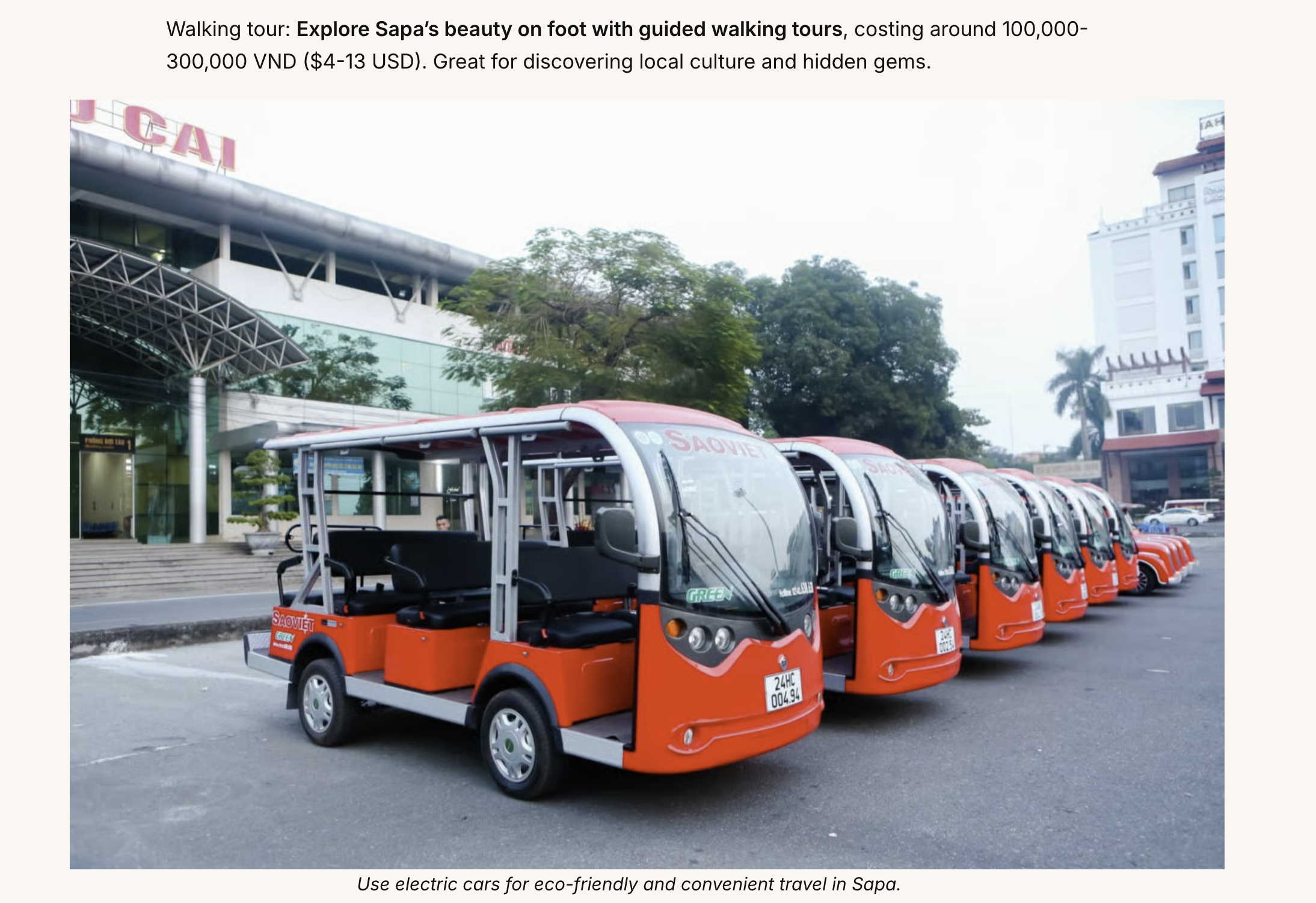
The photograph used to illustrate Sapa transport was taken outside Lào Cai railway station.
A commercial craft venue needs an accurate description
Oxalis places Lan Rừng Embroidery Village in the heart of Sapa town. The venue it actually describes is a commercial craft complex located well outside the town centre. I’d estimate it might be fifteen minutes away by taxi from the centre of town or perhaps an hours walk along a busy main road with inconsistent footpaths. It is not a walk that many would enjoy in my opinion. Lan Rừng’s own contact information distinguishes its complex at Ngõ 081 Điện Biên Phủ from a separate shop at 029A Cầu Mây.[4]
The Oxalis guide should probably explain what the visitor is actually entering. Providing the location, the activities available and the people providing them would also help. Lan Rừng itself uses “craft-village” branding, but it is nothing of the sort. The guide we be better if it explained that Lan Rừng is a commercial complex, rather than leave visitors to imagine a residential village. It was built as a shop, operates as a shop and has never been a village. Questions on cultural learning merit equal consideration. Who leads the textile activities for example? Which ethnic community’s techniques are being taught and how are the artisans involved and paid? A confident promise of an authenticity does not establish those arrangements and should be better described if the recommendation is to have genuine value.
Subjective Pricing and Facts that Matter
Some other weaknesses of the page are matters of opinion rather than demonstrable false statements. In my experience, basic accomodation in Sapa starts from around US$5 per night. The US$18 to $25 examples suggested by Oxalis ignore the true lower end of the accomodation market. Listing higher prices is not wrong, but including budget accomodation that is quadruple the price of what is actually available seems strange. Ideally, the guide should have clear room types, dates and inclusions. Eco Palms House, one of Oxalis’ examples, describes itself as an “eco-tourism resort” on its own website. It is certainly not a “budget-friendly homestay that offers an authentic experience in a traditional Tay village” as described by Oxalis. Indeed, there is not a single Tay home in the Eco Palms vicinity.[5]
The food photograph included below is deserving of discussion. The written note expressly refers to the image depicting street food, so a display of skewers is not inherently inaccurate. The image would be more useful if it identified the foods shown and explained their connection to the communities being discussed. With one or two exceptions, most of what is shown is not traditional food for the ethnic minority inhabitants of the Sapa area. Vietnamese cuisine includes the cuisines of ethnic minority communities; the useful question is whose dishes and practices are being described and depicted. Processed meats and corn dogs could hardly be described as traditional!
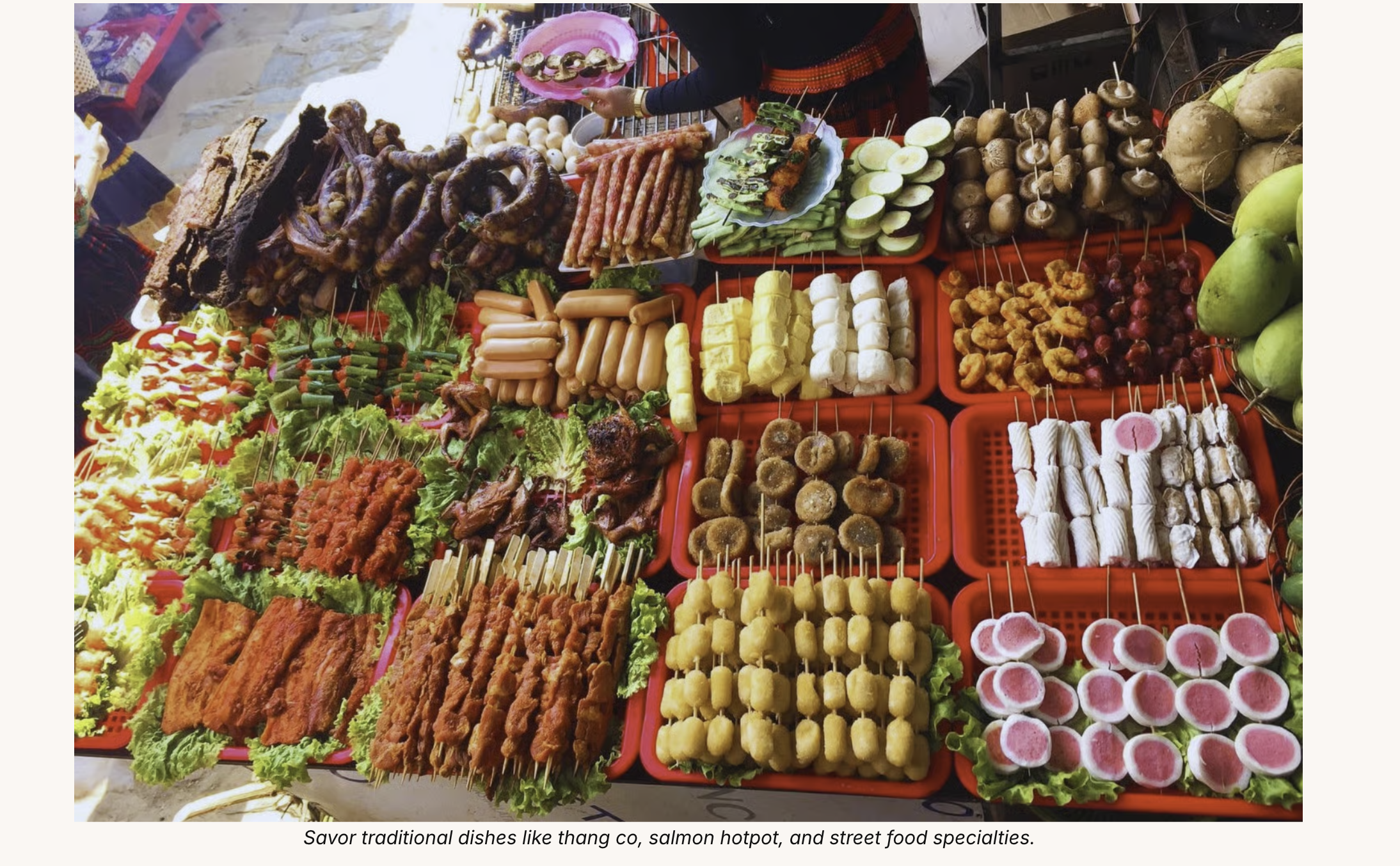
Barbeque skewers on sale in Sapa’s Night Market being described as “traditional”.
A Note on Oxalis Adventure
My criticism of a single Oxalis webpage should not detract from my enormous respect for Oxalis Adventure. Their expedition-style adventures in Phong Nha are, in my opinion, amongst the finest in Vietnam. Their commitment to community development, local employment and conservation also deserves genuine recognition. I have, and will continue to, recommend Oxalis Expeditions to the many thousands of travellers I meet each year. I am confident that for the vast majority of travellers to Vietnam, any Oxalis experdition will be a highlight of time spent in the country.
The problem stems from when a company with exceptional expertise in one region publishes authoritative travel advice about another part of the country that it does not work in, or demonstrate a proper understanding of. Their Sapa article reads more like an exercise in attracting search traffic and click-throughs as opposed to a carefully researched destination guide. Excellence in SEO and AI search optimisation should never be mistaken for local expertise. Oxalis has earned considerable respect through its outstanding work in Phong Nha. That makes its poorly researched portrayal of Sapa all the more disappointing.
Vietnam Airlines: authority undermined by basic geographical errors
The Vietnam Airlines guide also contains several major mistakes that could materially affect a visit. Its description of Sapa’s weekly market places the town market beside the Stone Church, which is an incorrect location. The daily market was never located in that area. Local reporting in December 2014 documented arrangements to move the market from its old site off Cầu Mây street, and Sapa’s tourism directory gives the markets current location as Lương Định Của. More than a decade later, directing visitors to the wrong location is a basic failure to maintain practical information.[6]
The accompanying photograph compounds the confusion by showing a market completely unrelated to Sapa. Bắc Hà market is a separate destination, approximately three hours from Sapa by road. Vietnam’s national tourism website itself describes the journey as three hours. A visitor needs to allow for that journey in both directions.[7]
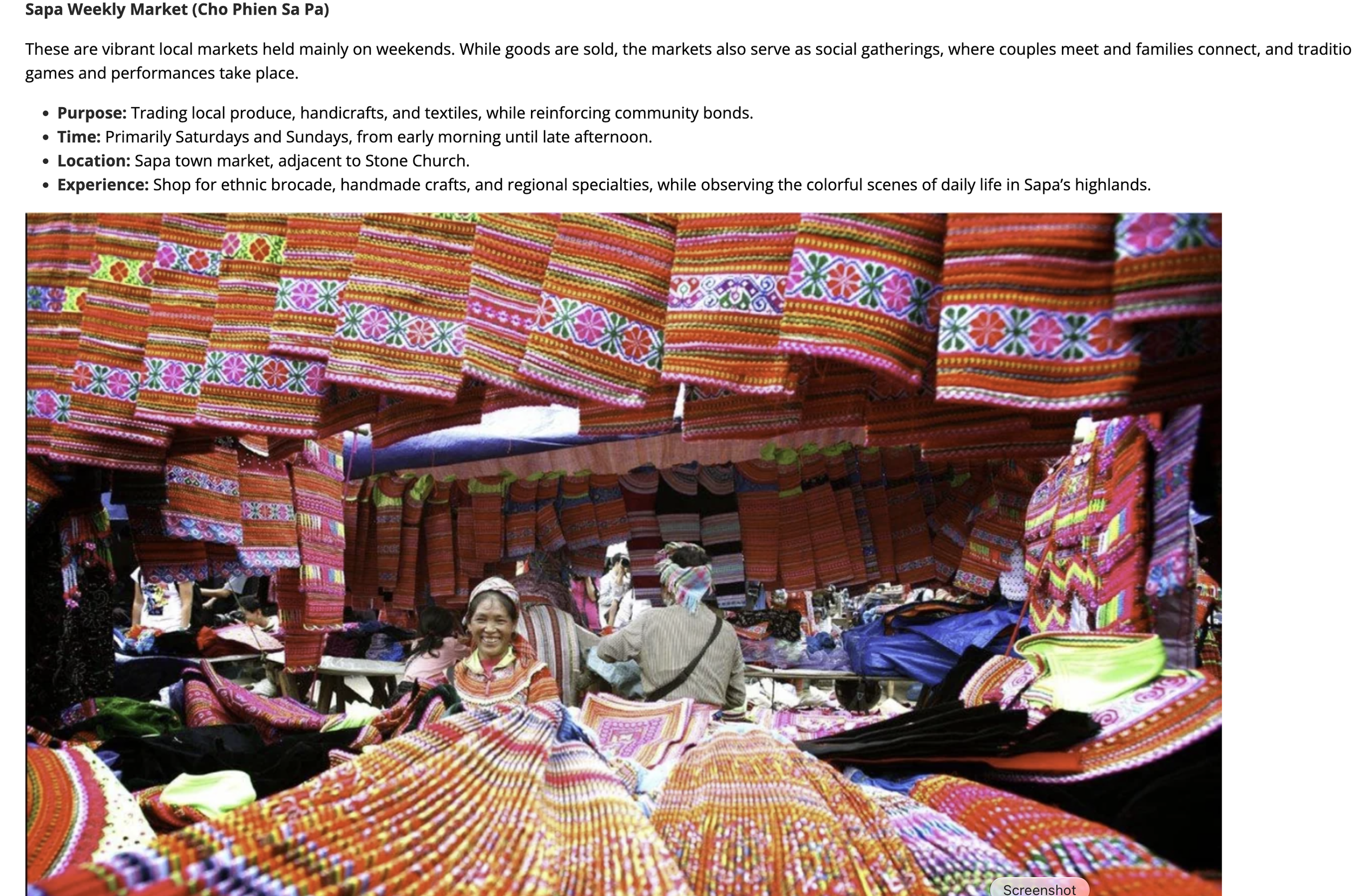
The Vietnam Airlines guide to Sapa places Sapa market beside the church and illustrates it with a photograph of Bắc Hà.
A resort used to illustrate town homestays
Under a section describing town homestays, with an indicative price range of US$16–32, the airline uses a photograph of Topas Ecolodge. This very distinct property is easily recognisable to anyone who knows Sapa. It has a lodge, infinity pool and over 30 bungalows. Topas’ own website information describes a boutique resort approximately 18 kilometres from Sapa, with a journey of around forty-five minutes.[8]. Orices start from US$199 a night and go up from there. Needless to say, it is a high end establishment. The Vietnam Airlines Sapa guide does not explicitly offer a Topas room for US$16–32. The error is in the illustration: a resort outside town is used to show readers what they might expect from the category being described. Location, accommodation type and price expectations become blurred in a single image.
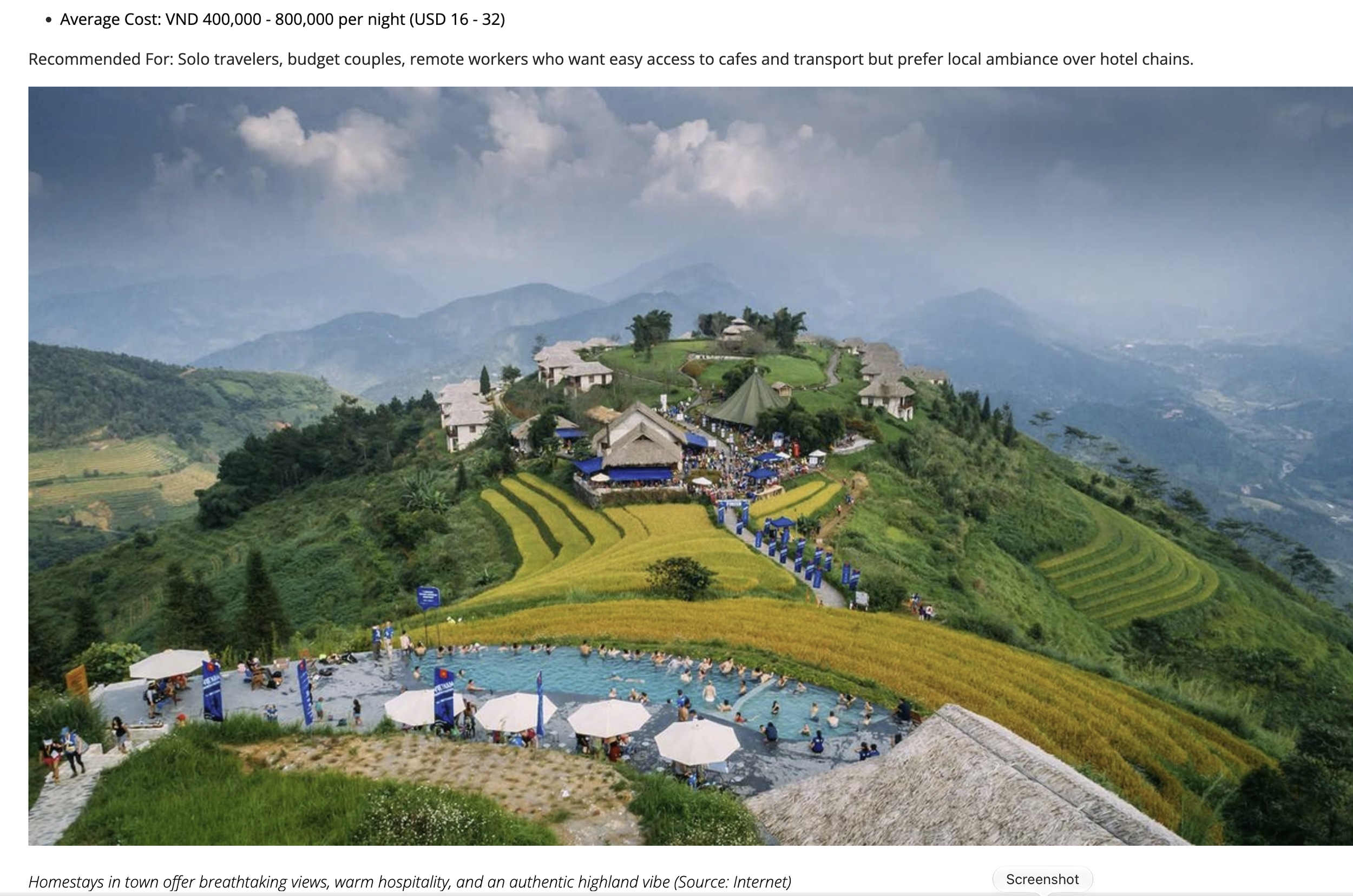
Topas Ecolodge illustrates a town-homestay category. The resort’s own information places it about forty-five minutes from Sapa. Rooms range from $199 to $450 at the time of writing.
Another accommodation image is even more irksome. The photograph beneath “Traditional Ethnic Houses” shows a house at the Vietnam Museum of Ethnology in Hanoi. The museum records that the Hmong house was built in Mù Cang Chải in 1984, later acquired and reconstructed within its grounds.[9] It is a museum exhibit and not a lived in home. Presenting that photograph beneath information about overnight stays in Sapa creates an impression of accommodation that the image cannot substantiate. The building’s actual history is interesting enough to deserve its proper location and explanation.
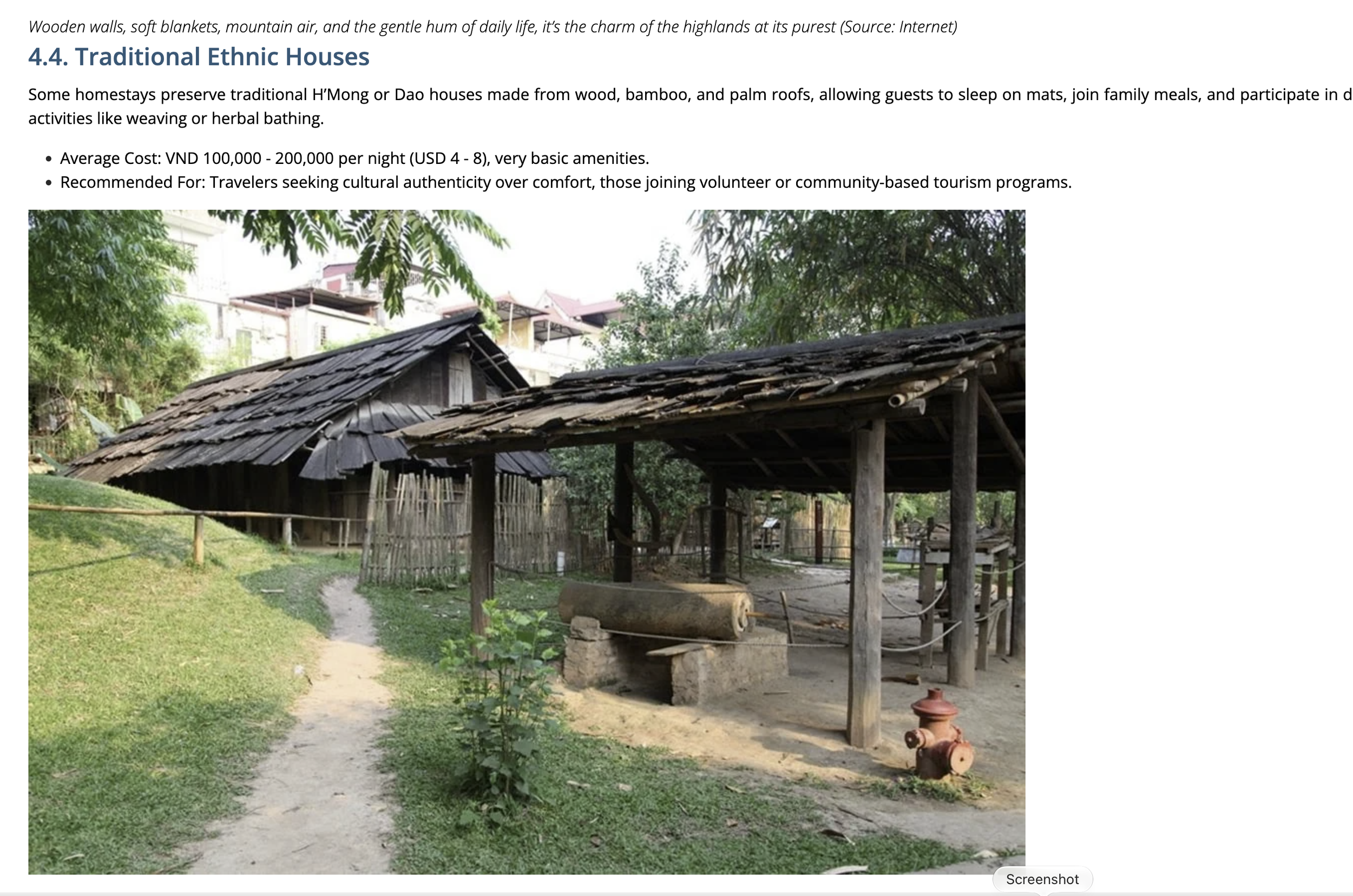
This house stands at the Vietnam Museum of Ethnology in Hanoi. It is inaccurately used here to illustrate overnight accommodation in Sapa.
Re-enactment and contemporary life need clear wording
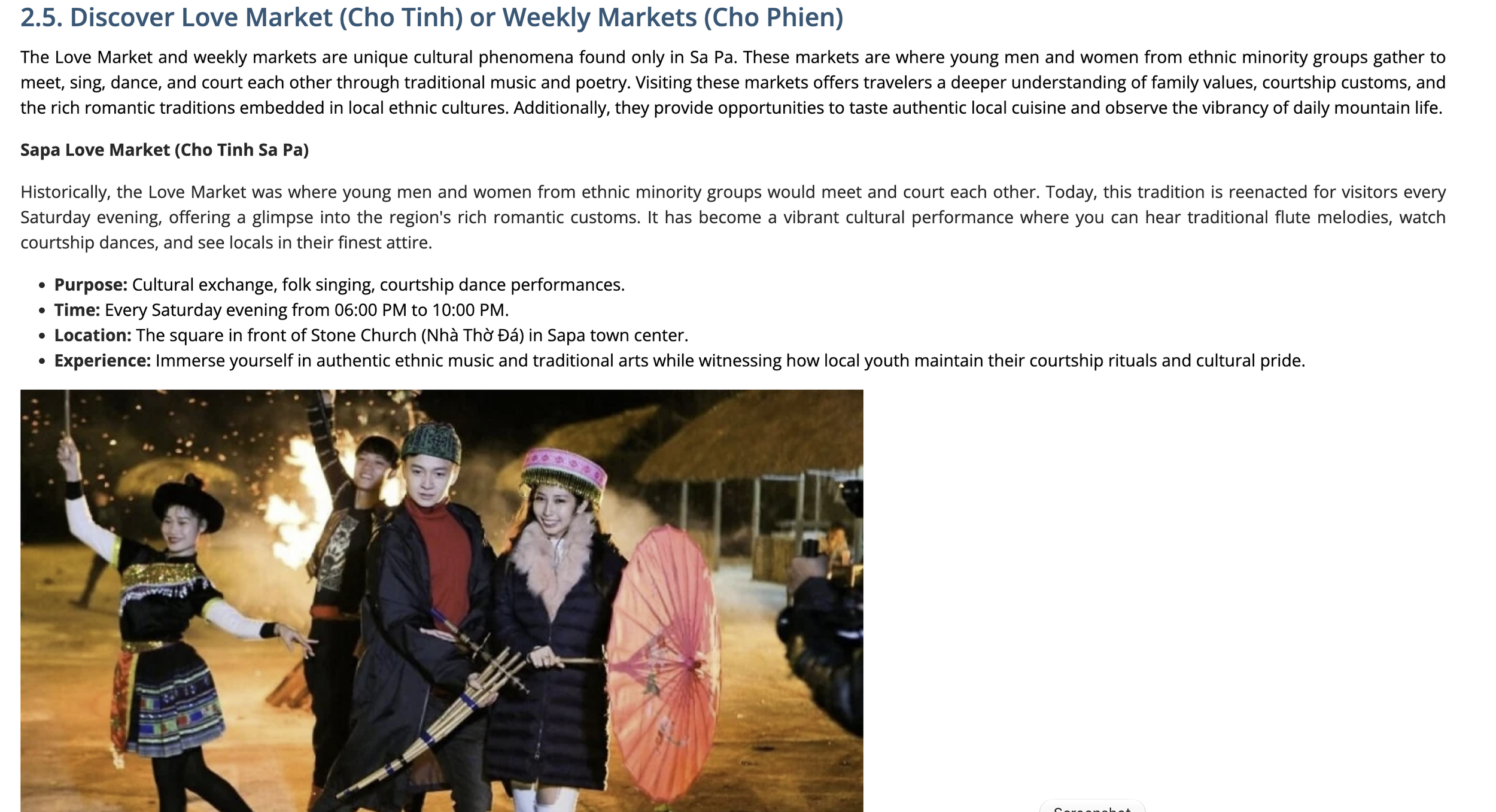
The Love Market section of the Vietnam Airlines Sapa page also requires more careful reading. Vietnam Airlines does acknowledge that the tradition is now re-enacted for visitors. That disclosure matters, but it then goes on to describe the experience in terms of witnessing young people maintaining courtship rituals. The wording pulls the reader back towards the idea of observing an ordinary contemporary courtship gathering. Local reporting on an organised event in August 2026 explicitly describes reconstruction of the market and its former practices.[10]
A cultural performance can involve skilled performers and real knowledge. The Vietnam Airlines Sapa guide should make its nature clearer throughout, so visitors understand whether they are attending a presentation of heritage or observing a social practice continuing in its former form.
Current road conditions and misplaced landscapes
The Vietnam Airlines mountain pass recommendation also needs current context. On 16th November 2026, reporting on National Highway 4D described repairs and controlled traffic at a rain-damaged section, alongside heavy vehicles serving the Hoàng Liên tunnel project. The pass is not closed, but it alludes to the disruption to traffic and the impact it has on the views people travel there for. This pass is not something to “conquered” and can be easily reached in a standard Grab taxi or on a scooter from Sapa town centre in about 20 minutes.
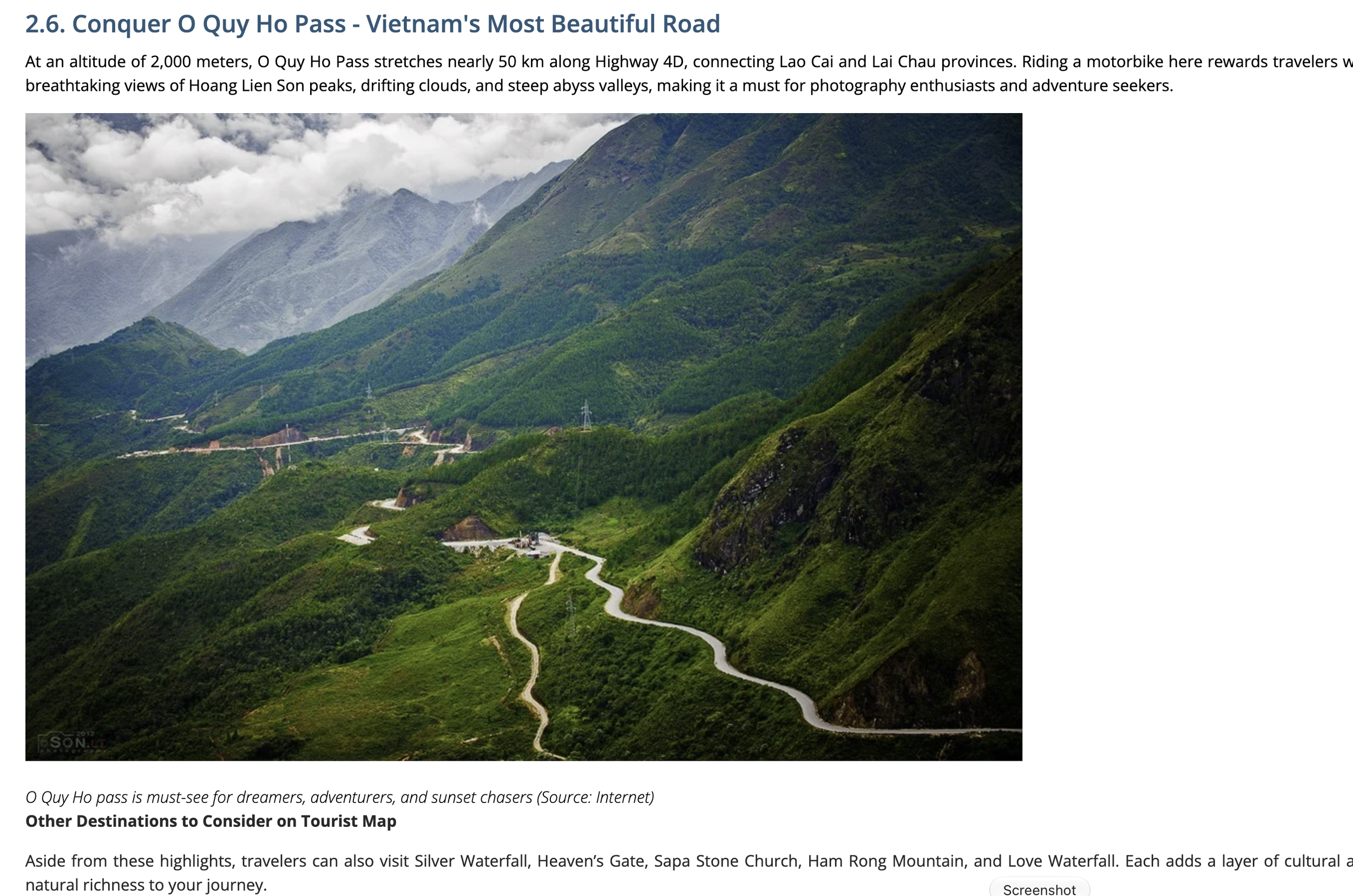
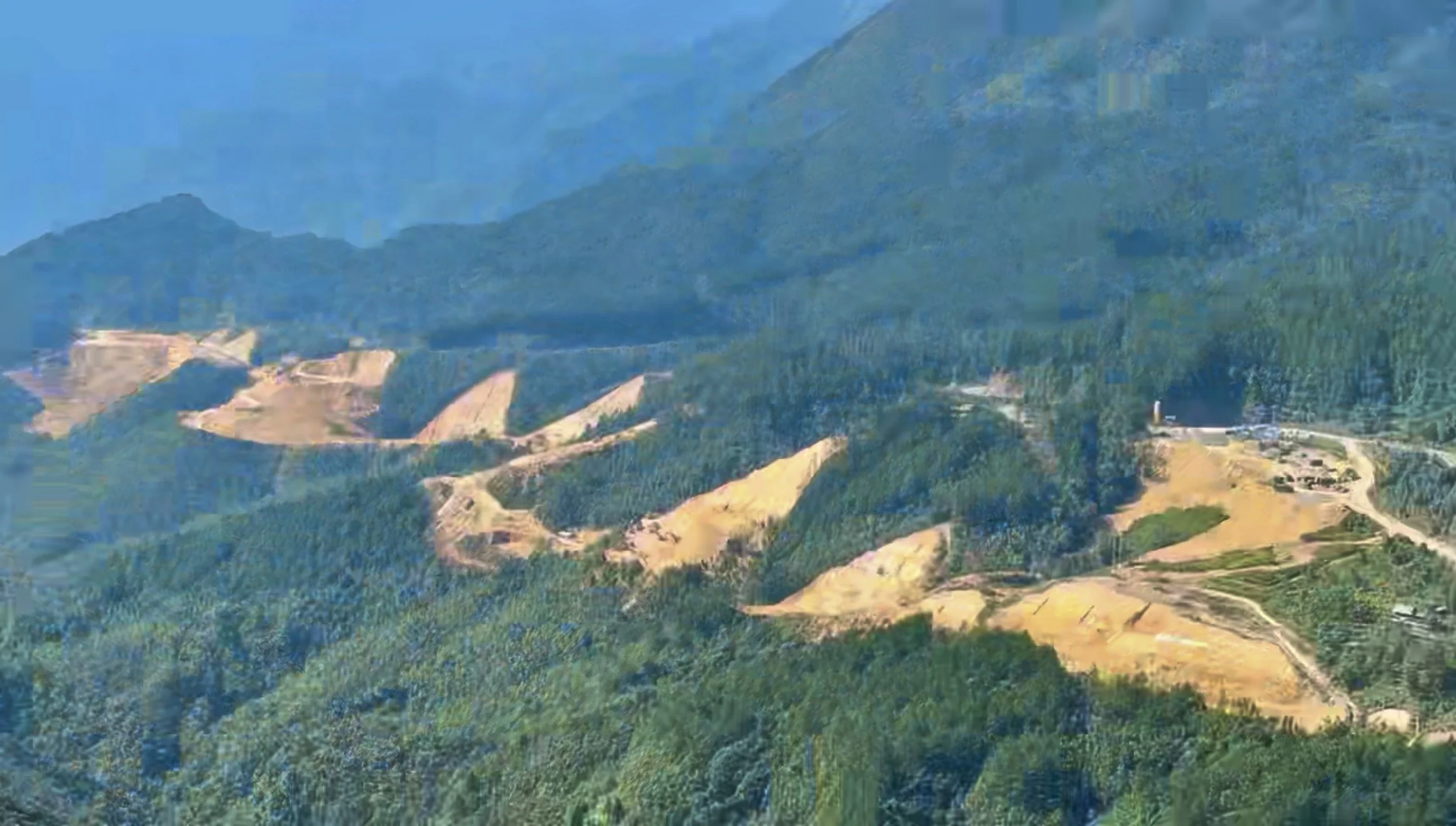
A comparable image from 2026 would certainly challenge the idea of the Ô Quy Hồ Pass being a “Must see for dreamers”.
My image review identifies further geographical problems. The pink-flower landscape depicted below is not Sapa. The photograph with four people, used in an “Explore more” card about Sapa attractions, shows Mù Cang Chải. Its position in a promotional card does not remove the claim being made by pairing it with that destination. The repeated credit “Source: Internet” gives readers little means of checking any of this. It identifies neither the photographer nor the place, date or original image record.
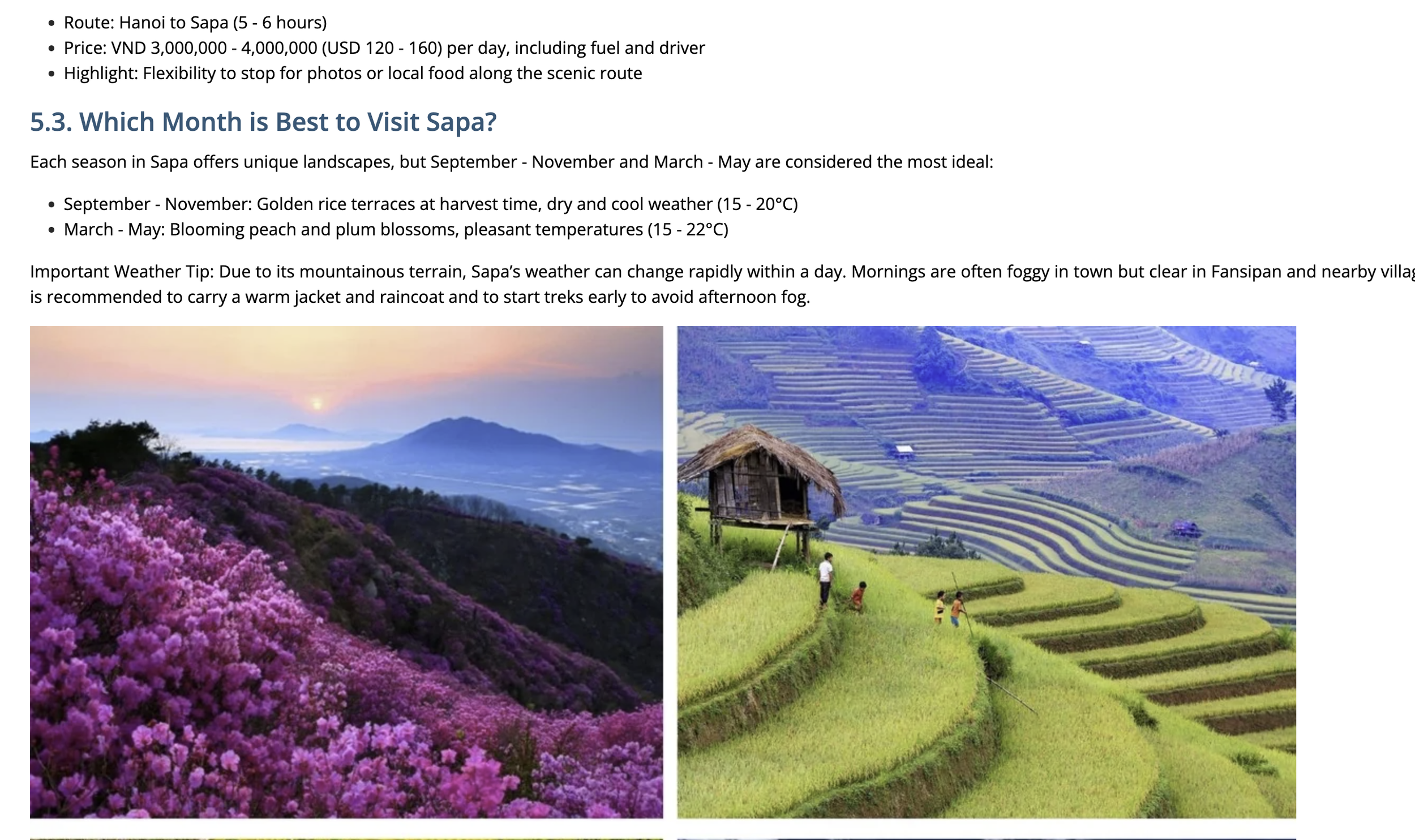
Images of an unidentified region of Vietnam being used to depict Sapa.
Vietcenter: its own itinerary contradicts the impression its guide creates
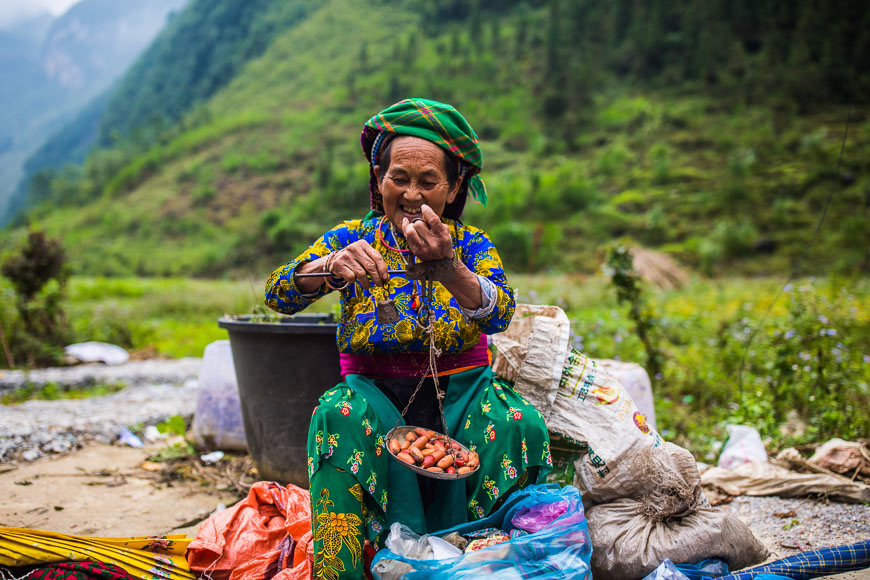
The Vietcenter Sapa page uses a photograph of a woman with weighing scales that I identify as Hà Giang by her distinct clothing. There is an unusually useful independent check: the exact same photograph appears in the national tourism website’s Hà Giang guide. This is an exact image match, and its use there supports the geographical correction.[12] The large gallery photograph showing four people among rice terraces is another landscape I recognise as Mù Cang Chải. It appears within the page’s presentation of Sapa without a clear explanation that the visitor is being shown a different destination. neither the rice terraces or ethnic costumes are representative in Sapa and their inclusion is simply lazy.
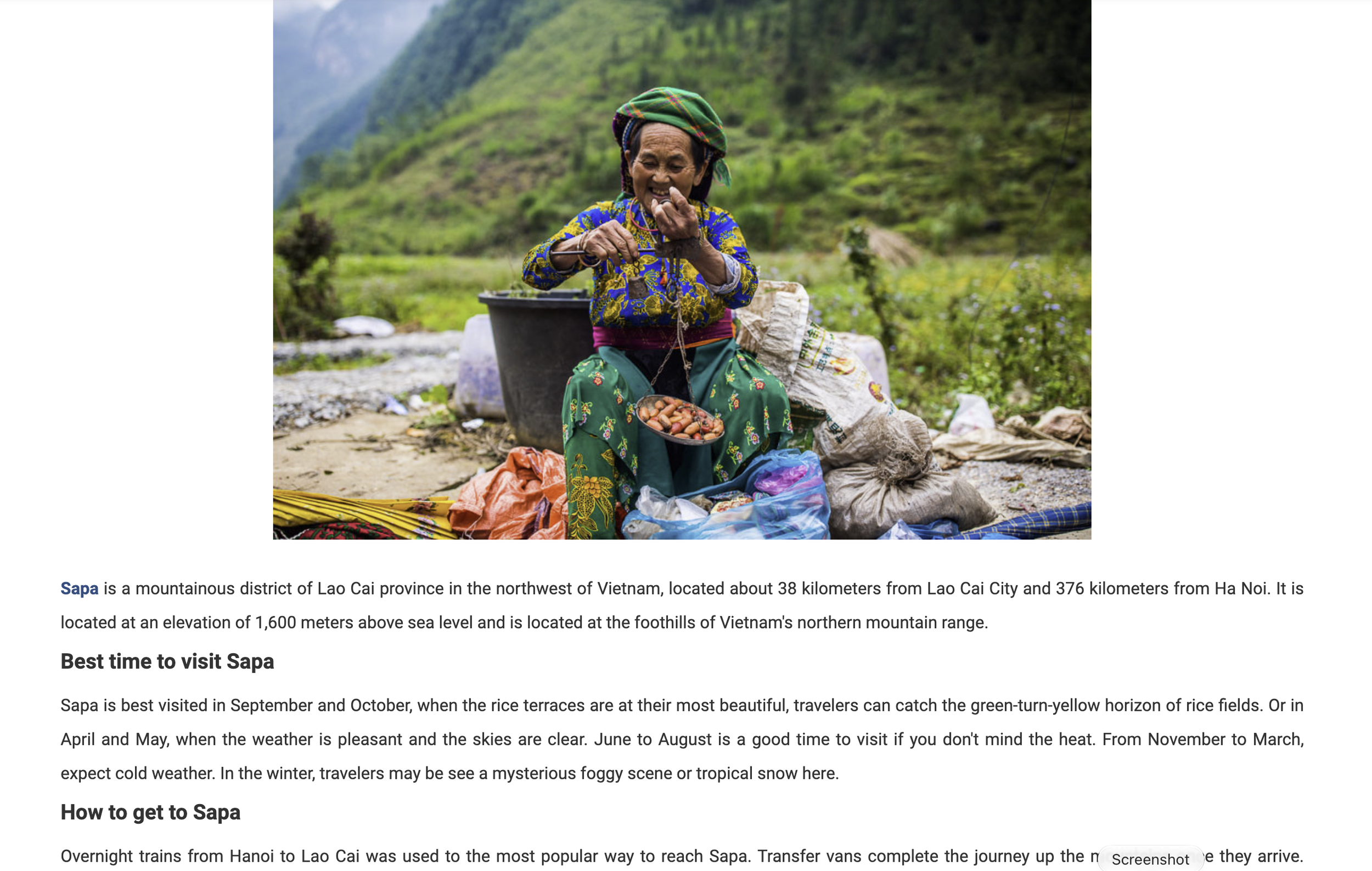
The photograph used in Vietcenter’s Sapa guide also appears in the national tourism website’s Hà Giang guide.
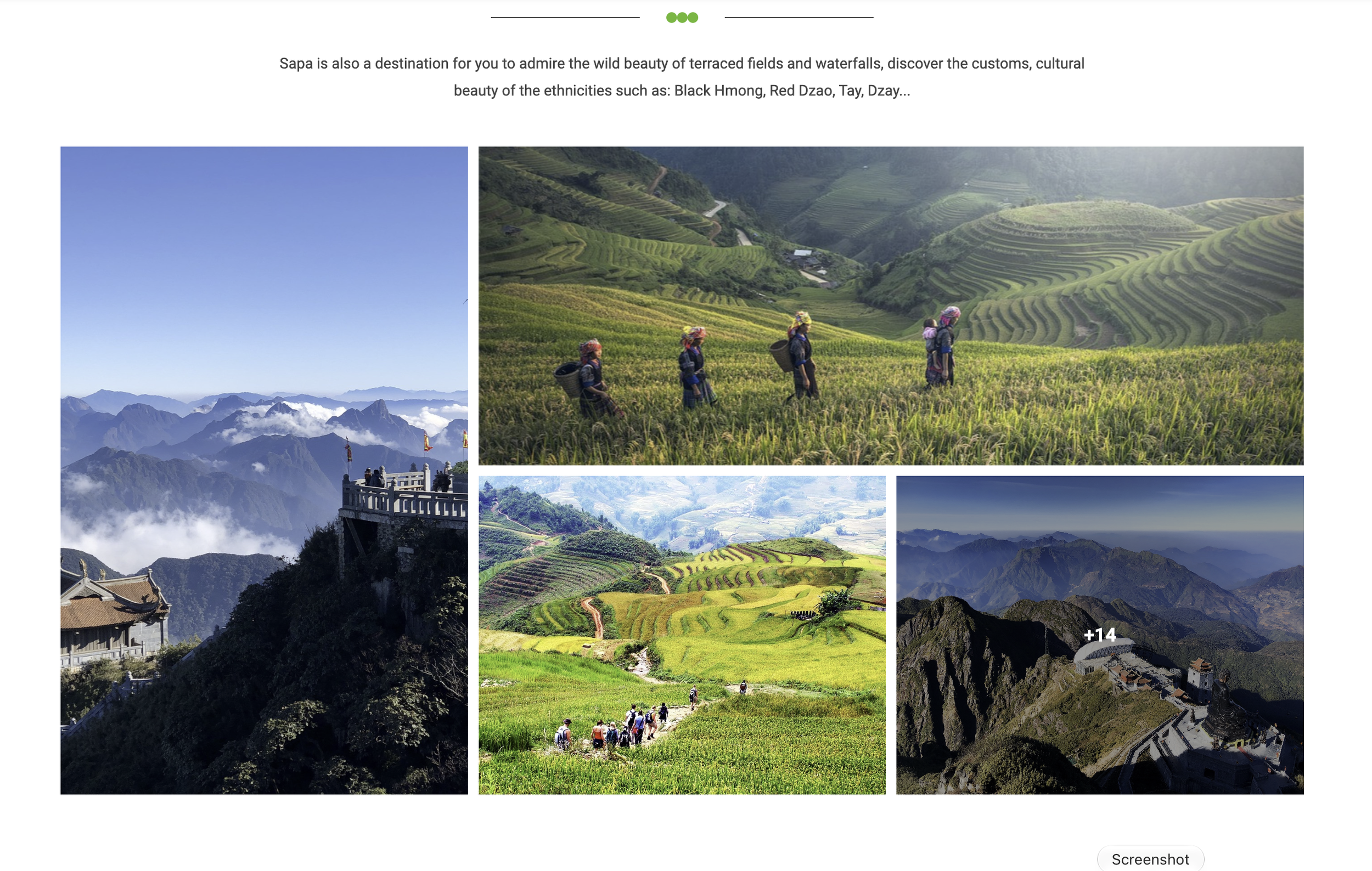
The large terrace photograph (top right) shows Mù Cang Chải within a page presenting Sapa. The location identification is based on the clothing and my local knowledge.
Bắc Hà is also brought into the Vietcentre’s guide discussion of Sapa’s cultural attractions without enough practical separation. The main page does not literally state that the market is inside Sapa. The problem becomes clearer in its linked market article, which calls Bắc Hà close to Sapa and treats it as one of Sapa’s attractions.[13]. Vietcenter’s own excursion page supplies the missing reality: approximately three hours of driving each way.[14]. That means around six hours of return travel before allowing for the market visit. A reader deciding how to spend a day in Sapa needs that information early. The publisher already has it elsewhere on its site, making the failure to carry it into the destination advice particularly avoidable.
A guide can reasonably recommend a wider regional excursion. It should name it as such and explain the travel commitment. Without that distinction, the page compresses separate places into a convenient but misleading picture of what Sapa offers within easy reach.
Vinpearl: a wrong village caption and an invented cable-car feature
In Vinpearl’s guide, a photograph captioned as Tả Van village actually shows Lao Chải village. I recognise the settlement, and a separately dated photographer’s image of the same cluster of buildings provides corroboration for the location.[15]. It is also an old view, presented without a capture date. The credit “Collected” gives readers no useful trail back to the photograph. Although the village is in Sapa, the depiction is now so dated, that seeing a similar scene is simply impossible. The immediate factual correction is the village name; the age of an image is a separate question requiring its own record.
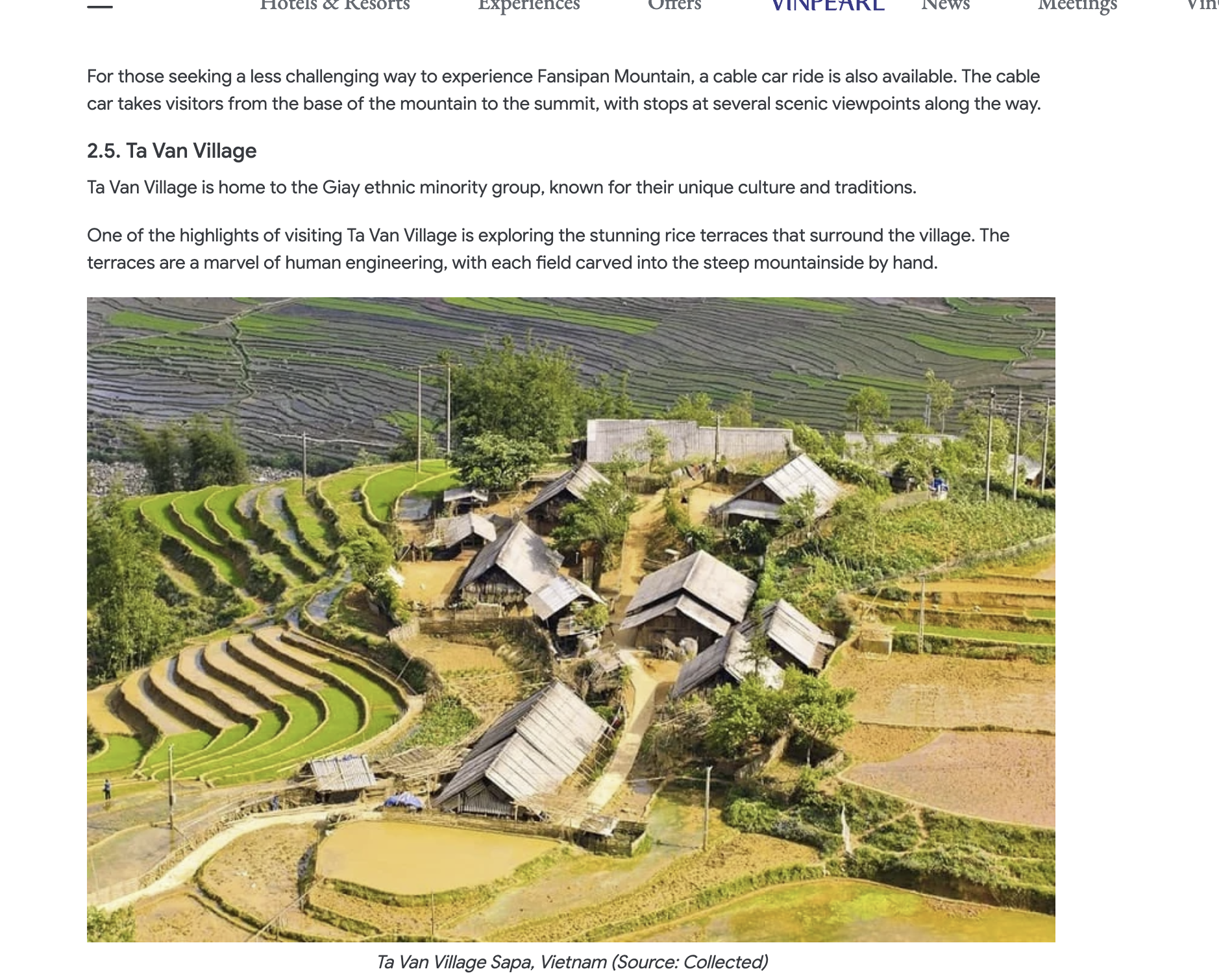
Vinpearl captions this view as Tả Van Village. The settlement shown is Lao Chải Village.
The Vietcentre guide makes another practical error in its description of Mount Fansipan. It says the cable car stops at several scenic viewpoints along the way. The operator’s information describes a journey between the Hoàng Liên and Fansipan stations. The engineering record lists just two stations, at the top and bottom of the mountain. There are no intermediate passenger stops en route for sightseeing. From the upper station, reaching the summit involves a further ascent, either using the steps or taking a separate funicular for part of the journey.[16] This distinction affects planning, especially for people assessing how much walking they can manage. A description of the actual sequence would be useful. The promise of sightseeing stops invents a service feature.
Vinpearl also presents the Love Market as a continuing opportunity for young people to seek partners, without the clear distinction between a visitor performance and the historical social practice. The organised re-enactment documented in local reporting is the relevant context for explaining what a traveller is likely to encounter.[10]
Its advice about golden rice repeats a seasonal error that appears across the other guides.
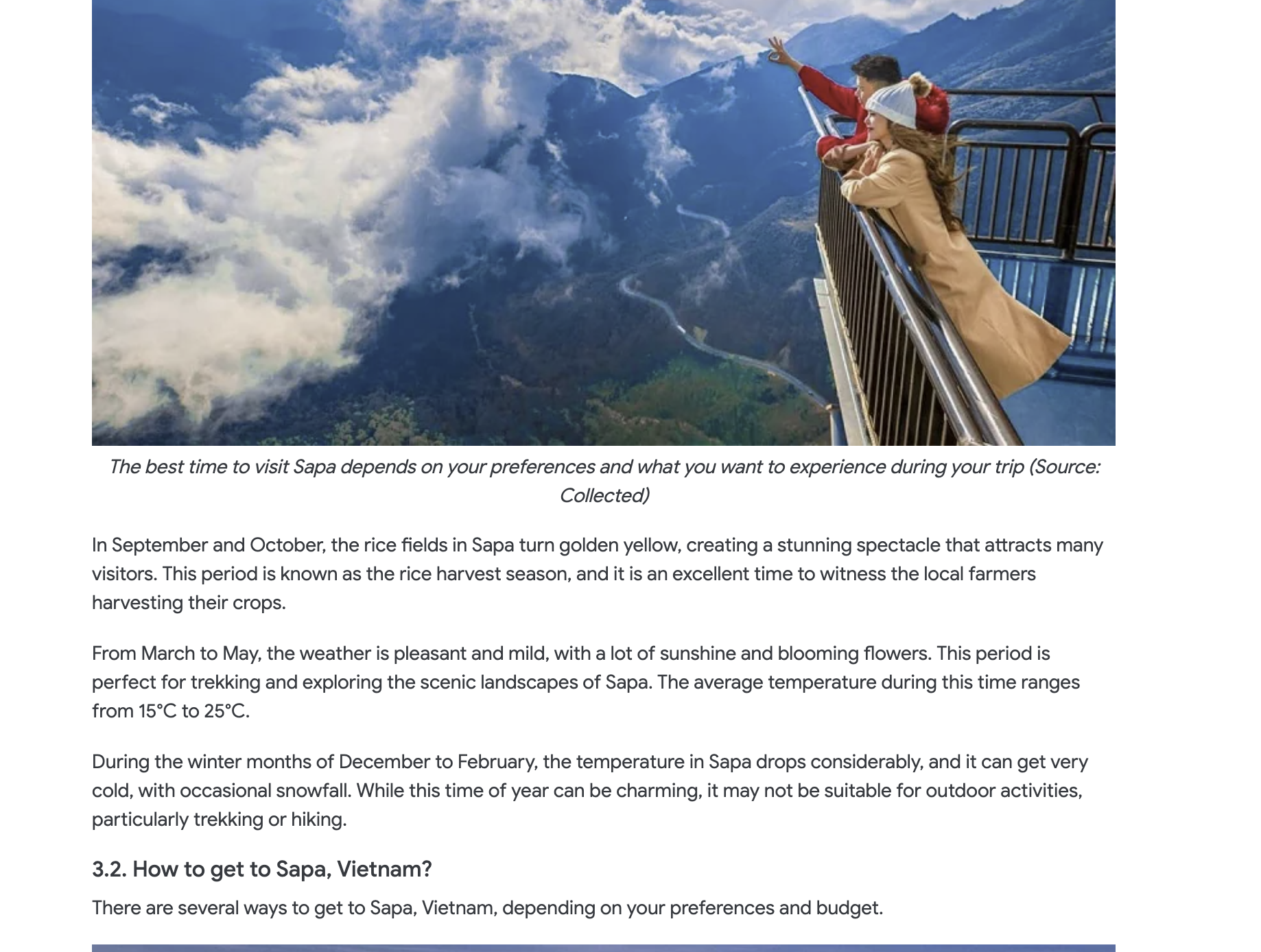
The guides associate later autumn dates with golden rice. Local experience and dated harvest reports support planning around an earlier period in August.
The recurring harvest claim can change when somebody books
All four travel guides repeat inaccurate information about Sapa’s golden rice season. Oxalis identifies September to November as the best period, while Vietnam Airlines recommends September to November in one section and September to October in another. Vietcenter and Vinpearl both suggest September and October.
The reality is different. Sapa’s rice terraces turn golden in August and early September. By October, the rice has been completely harvested. Travellers arriving in October or November expecting golden rice terraces will instead find harvested fields. This is not a minor seasonal discrepancy. It is misinformation that can directly influence when people book their holidays and leave them disappointed when they arrive. These statements are not simply recommendations to enjoy autumn weather. They associate those dates with the appearance or harvesting of the rice itself.
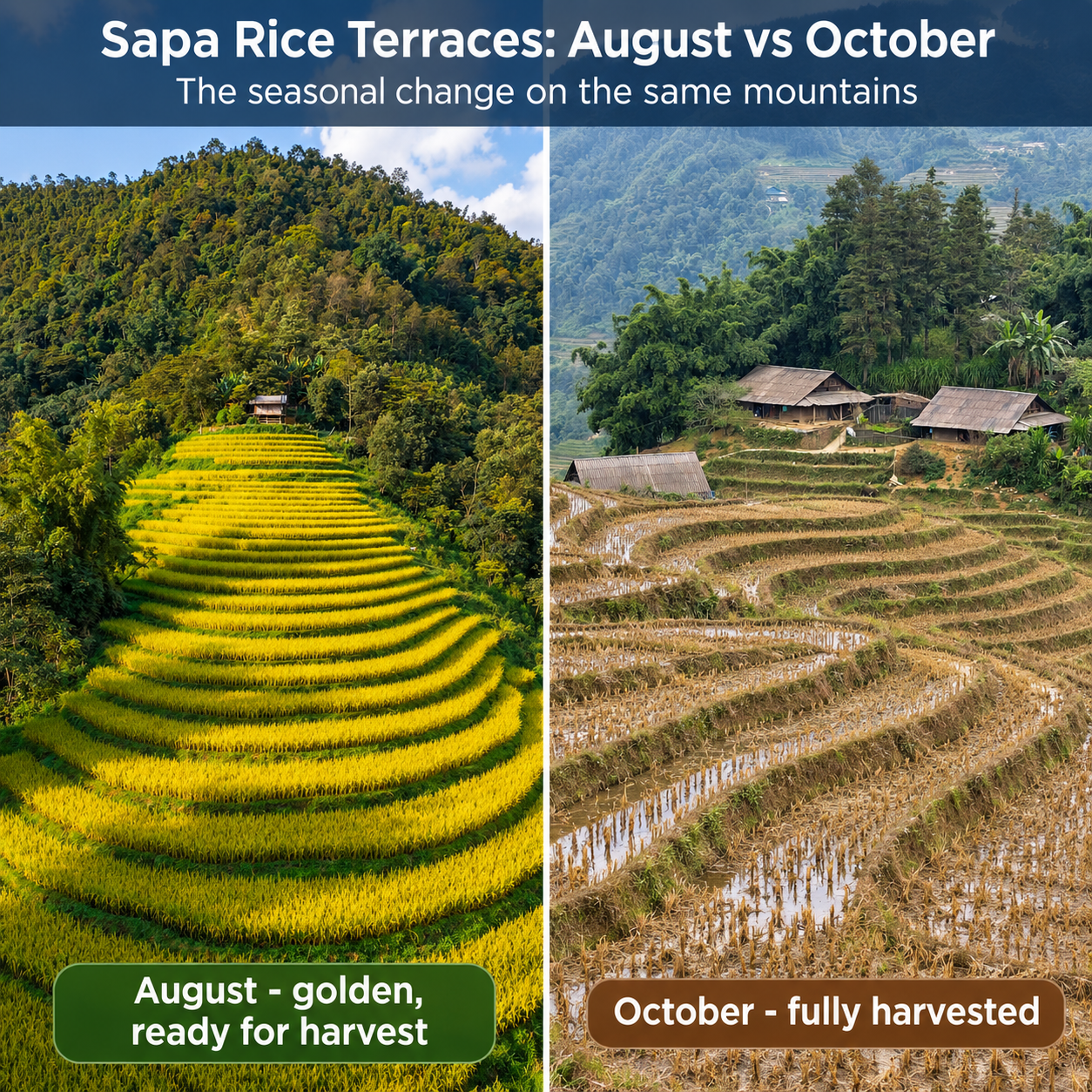
A comparison of the Sapa rice terraces in August and October. Image credit: ETHOS - Spirit of the Community
In the Sapa landscapes I know through living and working here, August and early September are the only period visitors should plan around for golden rice. October and November should never be promoted as the season to expect standing golden fields. Dated local agricultural reporting supports my reference to an earlier calendar. On 23rd August 2023, Báo Lào Cai reported that more than 750 hectares had already been harvested in Sapa, with completion being targeted for mid-September. A 14th August 2026 report from Tả Van showed golden rice and harvesting under way, with most fields in that locality expected to be cut within about ten days.[17]
Those reports describe particular seasons and places. They are useful because they are tied to actual agricultural activity. A visitor choosing dates for a specific valley should still check that year’s conditions locally. The practical correction is straightforward: plan for the earlier ripening and harvest period, and verify the place and year. A broad promise of golden terraces in October or November can influence a booking long before a traveller discovers that the fields have been cut.
MakeMyTrip: When the Attraction Doesn't Exist
Perhaps the most extraordinary example comes from MakeMyTrip, which confidently promotes a mysterious attraction called Fairy Cave in Sapa. The website recommends spending two to three hours exploring underground passages, admiring stalactites and learning about local legends. There is just one problem. There is no identifiable Sapa attraction matching this description.
A real Fairy Cave exists near Bắc Hà, considerably removed from Sapa, but MakeMyTrip presents its attraction as a local Sapa experience without providing an address, directions or any verifiable evidence of its existence. The Fairy Cave near Bắc Hà is nothing more than a small overhang and local sites dishonestly use images of Hang Én, one of the largest caves in the world, located inside Phong Nha–Kẻ Bàng National Park in central Vietnam. This is the danger of travel content that looks authoritative without demonstrating any underlying research. How can travellers trust recommendations when publishers cannot even establish whether an attraction exists where they claim it does?
What the repetition reveals
Across these pages and many more, the same kinds of failures recur again and again. Different northern destinations are presented as Sapa. Communities are misnamed or described without sufficient distinction. Photographs illustrate accommodation or experiences they do not actually document. Practical details survive without an adequate check against current conditions. The image credits are part of the problem. “Internet” and “Collected” provide an appearance of attribution while leaving readers unable to examine the original location or context. The existence of a photograph proves very little about the place named beside it. Repeated claims also need scrutiny. Four top ranking pages agreeing about a harvest window would be persuasive only if their agreement rested on reliable, independently checked evidence. Agreement by itself tells us nothing about how the claim was researched.
These examples do not establish who copied whom, whether any writer used AI, or why an editor accepted a particular image. The published errors are sufficient grounds to question the quality of the research and editing.
Travel Bloggers Create the Illusion of Expertise
Independent travel blogging can provide excellent first-hand insights. However, it has also created a strange form of expertise where a traveller spends a few days following the tourist trail before publishing an authoritative guide to a destination.
Take James Fahey, author of 17 Things To Do In Sapa Town And Beyond. James’ highly search-optimised guide draws on just five days in Sapa. Despite his limited experience, he offers authoritative recommendations and repeats factual errors, including reiterating the claim that Sapa's rice terraces turn golden in September and October. I can only assume he found this misinformation using Search Engines or AI. His article contains genuine observations, but overwhelmingly focuses on the all too familiar attractions: Moana, Cat Cat, Fansipan, Heaven Gate, the Glass Bridge and the Lonely Tree. Cultural understanding takes a back seat to convenience, consumption and photographic opportunities. His description of the Sapa Love Market is particularly revealing. James claims that “locals come here to buy and sell”, gives specific Saturday opening times and then admits he never actually attended. Historically, this was a courtship gathering for Hmong and Dao young people, not a commercial market. Today, it largely survives as a tourism performance. Our Sapa Love Market article explains the distinction.
James openly uses affiliate links to promote tours and accommodation. There is nothing inherently wrong with this, but commercial incentives and search visibility should not be confused with expertise. When we contacted James, he was quick to point out, “I rank number one on Google”, a fact that was true at the time of publication. That response perfectly illustrates the problem. Google's rankings measure relevance and other search signals, not the depth of a writer's cultural understanding. Five days exploring Sapa cannot replace decades of local knowledge. Ranking first on Google does not make you an authority on a destination.
Influencers Have Made the Problem More Visual
As we all know, social media rewards attractions that photograph well, so photogenic locations like rainbow slides, giant statues and artificial viewpoints attract attention, while meaningful conversations with local people rarely fit into a thirty-second video. It’s hard to make a village homestay the centrepiece of a blog that gains decent traction because to some, the interaction may seem more mundane than an alpine rollercoaster for example. Businesses respond by creating increasingly “instagrammable” attractions. Influencers promote them and travellers arrive hoping to recreate the same images. Travel becomes less about discovery and more about reproducing somebody else's photographs. This phenominon is changing the face of travel.
AI Amplifies This Distorted Version of Travel
AI risks reinforcing this narrow interpretation of travel. Search results contain highly optimised guides from writers such as James Fahey and companies such as Oxalis, alongside hundreds of articles promoting essentially the same attractions. AI systems do not simply copy Google's highest-ranking results, but they can retrieve and summarise this widely available material.
The problem is that visibility is not verification. When multiple sources repeat the same recommendations or factual mistakes, AI may present them as established knowledge rather than recognise their common origins. New bloggers and content creators can then recycle those answers, adding further versions of the same information. The wording changes, but the evidence does not. Google has acknowledged this vulnerability. In May 2024, it explained how AI Overviews had produced incorrect answers, including the notorious recommendation to eat rocks, after encountering satirical material republished online.[18] Its own documentation confirms that AI search features draw on multiple searches and sources, none of which is automatically reliable simply because it appears in search results.[19]. This investigation has not established that a particular AI response copied errors from the websites examined, but the evidence certainly establish that it is very likely. It has, however, demonstrated how easily inaccurate information can become widely accessible and how readily it could be repeated. AI can sound extraordinarily knowledgeable about Sapa while amplifying the assumptions of people who barely scratched its surface.
The cost is a widening gap between expectation and reality
A traveller who books October expecting unharvested golden rice may face a landscape very different from the one promised. Someone who treats Bắc Hà as a nearby stop may discover that the journey occupies much of the day. A visitor shown a luxury resort as an example of a town homestay may misunderstand both the location and the accommodation category. The gap starts with an expectation formed before arrival, on the strength of information that appears specific enough to trust.
The cultural consequences deserve equal attention. Using a Red Dao woman to illustrate a Hmong class blurs the distinction between the communities and the textile traditions the article claims to introduce. Presenting a heritage performance as ordinary courtship creates an expectation about local people’s lives that the visit may not fulfil. The burden of explaining the discrepancy then falls on residents, craftspeople and guides. They may have to correct an expectation that was formed before the visitor arrived, sometimes against the apparent authority of several websites saying the same thing.
Trust in the publisher should weaken first, but that is rarely the case. If a page cannot identify its own photographs, readers have reason to question the claims they cannot easily check. Search visibility can spread that uncertainty: a prominent result may feel like a recommendation even though its position does not establish the accuracy of each detail. AI can extend the problem by producing a coherent answer from material that never received adequate scrutiny.
What are we trusting, and who is accountable?
When travellers choose a free blog, a vlog or an instant AI itinerary over a professionally researched guidebook from Bradt or Lonely Planet, what is driving that choice? Is it cost, convenience, the appeal of video, or the assumption that an online answer must be more current? Do travellers still recognise and appreciate the value of local destination knowledge, careful research and professional editorial work behind a guidebook’s cover price?[21]
Books can become outdated, and excellent travel writing exists online. Whatever the format, how often do we ask who researched the advice, how it was checked and when it was last updated? Can a traveller tell whether a popular blog, a polished vlog or a confident AI answer is based on original research or is repeating someone else’s mistake? What happens when a traveller arrives in Sapa in October expecting golden rice and finds that the fields they came to see have already been cut? Does their disappointment attach to the advice that shaped their booking, to Sapa itself, or to the local people left explaining the difference?
Where is the accountability? What responsibility is accepted by the publisher that presents the claim, the platform that promotes it and the AI service that repeats it? Readers can examine sources, but they cannot reasonably be expected to possess the local knowledge they are seeking. If travel advice shapes where people spend their time and money, should checking it, correcting mistakes and making those corrections visible not be part of the responsibility of publishing it?
Is This the Dead Internet Theory in Action?
The Dead Internet Theory suggests that the internet is increasingly dominated by artificial content, automated activity and manufactured engagement rather than genuine human experience. While the theory remains speculative, my Sapa specific research reveals something uncomfortably similar. Bloggers recycle information, search engines reward visibility, and AI can repackage the same mistakes into seemingly authoritative advice. Each repetition adds more content without adding knowledge. The internet becomes increasingly saturated with information about Sapa, yet increasingly disconnected from the people, places and realities that actually define it.
Publishers should verify photographs against an identifiable source, record the actual location and provide a date when age affects the image’s usefulness. They should consult people who know the place, accurately name the communities whose work they describe, and distinguish a commercial venue, a performance, a village and an everyday social practice.
Search and AI providers also have a responsibility to make supporting evidence inspectable and to handle disagreements, dates and geographical distinctions carefully. Several pages repeating a claim should not be treated as equivalent to several independent checks. Sapa is a place where people live and work. Its communities, landscapes and livelihoods deserve descriptions grounded in that reality. Travel advice earns authority by getting those details right, showing how they were checked and correcting them when they change.
When Travel Blogging Gets It Right: Dustin Kemp and Indie Traveller
It would be easy, after examining these examples, to conclude that online travel guides are inherently unreliable. That would be unfair, and the work of Dustin Kemp at Indie Traveller demonstrates exactly why.
His article, Exploring the Real Sapa: Vietnam's Popular Highland Town, is one of the most thoughtful and genuinely useful online guides to Sapa I have read in recent times. What makes it stand out is something surprisingly simple: he actually came here, explored the region, spoke to local people and did the research.
Dustin spent a week travelling around Sapa, speaking with residents both inside and outside the tourism industry. That investment of time is reflected throughout his writing. Rather than producing another predictable list of must-see attractions, he recognises that Sapa offers very different experiences depending on where visitors go, what interests them and how they choose to travel. He distinguishes between mainstream tourism, outdoor adventure and cultural immersion. He examines different villages, discusses the realities of overtourism, challenges the appeal of some heavily commercialised attractions and provides practical information that helps readers make informed choices. Importantly, he is prepared to express an opinion, including explaining why certain popular experiences might not be worth someone's time or money.
His seasonal advice is also notably different from the repeated misinformation examined earlier. He identifies July and August as the period when rice terraces turn golden, rather than directing visitors towards October or November.
There is another important distinction. Indie Traveller explicitly states that its guides are based on real journeys and that it does not use AI to create its content. The website also identifies its writers, explains its editorial approach and is transparent about commercial partnerships. In an online environment increasingly saturated with anonymous, recycled and AI-generated travel content, these are meaningful commitments.
No writer will get every detail right, and local people will not necessarily agree with every recommendation. But that is not the point. Dustin demonstrates what happens when a writer approaches a destination with curiosity, invests time in understanding it and is willing to look beyond the established tourist narrative. This is precisely the kind of independent travel writing that deserves greater recognition. It provides something that recycled content cannot: an identifiable human perspective, supported by genuine exploration, conversations and personal experience.
Of course the problem isn’t travel blogging itself. It is a problem to publish travel advice without doing the travelling, the research or the fact-checking. Dustin Kemp's work is a welcome reminder that the internet can still offer excellent travel journalism, freely accessible to anyone willing to look beyond the most familiar search results.
The ETHOS Promise
At ETHOS, we believe that credibility and reputation are earned. For that reason, invest considerable time and effort into researching our articles, checking our facts and ensuring that the information we share reflects the places, people and cultures we know. We will always strive to write with honesty, integrity and respect, and acknowledge and correct mistakes when they occur.
The same principles underpin every experience we create. Behind each journey are years of local knowledge, careful preparation, trusted relationships and genuine collaboration with the communities we work alongside.
We cannot promise to get everything right, but we can promise never to put clicks, rankings or commercial interests ahead of truth, cultural respect and the people who call these mountains home.
These commitments are central to why we built ETHOS.
-
The publisher links and quotations are documented in the supplied screenshots.
First-hand identifications are Phil Hoolihan’s.
A comparison photograph supports location only unless explicitly stated to be the exact same frame.
[1] Meiringen–Hasliberg operator, arrival information; cableway engineering report with corroborating photographs. The exact original Oxalis photograph’s creator and capture date remain unknown. https://en.meiringen-hasliberg.ch/Infos/anreise https://www.seilbahn.net/sn/berichte/bericht.php?news=11277
[2] Lai Châu provincial information on Ô Quy Hồ; Hoàng Liên National Park’s Trạm Tôn–Fansipan route. https://laichau.gov.vn/du-khach/deo-o-quy-ho.html https://hoanglienpark.com/tour/ttdlbtsv-vqghl@laocai.gov.vn
[3] Báo Lào Cai, tourist electric vehicles suspended in Sapa, 5 March 2025; enforcement and operating restrictions, 8 May 2026. https://baolaocai.vn/tam-dung-hoat-dong-xe-dien-du-lich-tai-sa-pa-post766312.html https://baolaocai.vn/can-xu-ly-xe-dien-cho-khach-khong-chap-hanh-cac-quy-dinh-quan-ly-post899196.html
[4] Lan Rừng’s own contact information, distinguishing its craft complex from its Cầu Mây shop. https://thocamlanrung.com/lien-he/
[5] Eco Palms House, own description of the property. https://www.ecopalmshouse.com/about
[6] Báo Lào Cai, market relocation arrangements, 16 December 2014; Sapa tourism directory, current market listing. https://baolaocai.vn/sa-pa-chuyen-cho-la-hop-ly-hop-tinh-post242697.html https://sapa-tour.vn/public/vi/dia-diem-tien-ich
[7] Vietnam national tourism website, Sapa itinerary for sustainable travellers, describing the three-hour journey to Bắc Hà. https://vietnam.travel/things-to-do/sapa-itinerary-sustainable-travellers/
[8] Topas Ecolodge, own description and location information. https://topasecolodge.com/about-the-lodge/
9] Vietnam Museum of Ethnology, Hmong house record; dated independent photograph of the same museum exhibit. https://vme-en.vass.gov.vn/hmong-house/hmong-house-559664 https://blog.quintinlake.com/2010/06/16/hmong-house-vietnamese-museum-of-ethnology-hanoi/
[10] Báo Lào Cai, organised reconstruction of the highland market and Love Market, 30 August 2026, reporting the 29 August event. https://baolaocai.vn/sa-pa-tai-hien-phien-cho-vung-cao-va-cho-tinh-phuc-vu-nguoi-dan-du-khach-dip-29-post907256.html
[11] VietnamPlus, repairs and traffic management on National Highway 4D, 16 November 2026. The report concerns a defined section, not closure of the entire pass, and describes rain-related damage. https://www.vietnamplus.vn/khan-truong-xu-ly-diem-sut-lun-nut-nen-duong-tren-quoc-lo-4d-post1148532.amp
[12] Vietnam national tourism website, Hà Giang guide. The same photograph of a woman using scales appears on both pages. https://vietnam.travel/things-to-do/ha-giang-adventures/ https://images.vietnam.travel/inline-images/Ha%20Giang%20things%20to%20do%20Vietnam%20travel-5.jpg Vietcenter’s asset: https://sudospaces.com/vietcenter/2021/07/pho-cao-market.jpg
[13] Vietcenter’s linked market article. https://vietcentertourist.com/blog/bac-ha-fair-the-most-colorful-market-in-vietnam.html
[14] Vietcenter’s own Bắc Hà excursion, giving three hours each way. https://vietcentertourist.com/tours/bac-ha-sunday-market-hmong-royal-palace-1-day-tour.html
[15] Photographer’s image labelled Lao Chải, taken 11 April 2011 and uploaded 2 May 2011. It shows the same building cluster from a different viewpoint. Its date is not the date of the Vinpearl image. https://www.flickr.com/photos/jeymatt/5680749662
[16] Sun World Fansipan operator guide, 20 March 2026; BauCon ropeway engineering project record, listing two stations. The operator distinguishes the cable car from the further steps or summit funicular. https://sunworld.vn/fansipan/cam-nang-du-lich/kinh-nghiem-di-cap-treo-fansipan-day-du-va-chi-tiet https://www.baucon.at/en/projects/ropeway-engineering/
[17] Báo Lào Cai, Sapa harvest progress, 23 August 2023; Báo Văn Hoá, Tả Van golden season, 14 August 2026. Reported completion dates are forecasts and retain the geographical scope stated in the articles. https://baolaocai.vn/nong-dan-sa-pa-vao-vu-thu-hoach-lua-mua-post372503.html https://baovanhoa.vn/mua-vang-ta-van-goi-buoc-chan-du-khach-256088.html Supporting national tourism guidance identifies the pre-harvest golden period as mid-August to early September: https://vietnam.travel/things-to-do/vietnam-rice-terraces/
[18] Google, “AI Overviews: About last week”, Elizabeth Reid, 30 May 2024. Historical explanation and corrective measures, not a current error-rate study. https://blog.google/products-and-platforms/products/search/ai-overviews-update-may-2024/
[19] Google Search Central, “AI features and your website”, updated 10 December 2025, retrieved 19 November 2026. https://developers.google.com/search/docs/appearance/ai-features