
Two Sapas, One Narrative
There are two conceptual Sapas that exist side by side, though only one tends to dominate the story. The first is the town, a rapidly expanding centre shaped by hotels, neon lights, restaurants and a steady current of visitors moving through tightly organised itineraries. The second is the wider mountainous region, where Hmong, Dao and other ethnic communities continue to live within landscapes they have shaped and understood over generations.
The distinction between these two is geographic but also about whose voices are heard, whose knowledge is valued, and whose version of Sapa becomes visible to the outside world. In practice, the narrative is rarely led by those who know the land most intimately. Compare the two images below and it would be easy to assume they are entirely different places, yet both exist within the same region. Which one you see, and how you choose to experience it, is a decision left to every traveller.
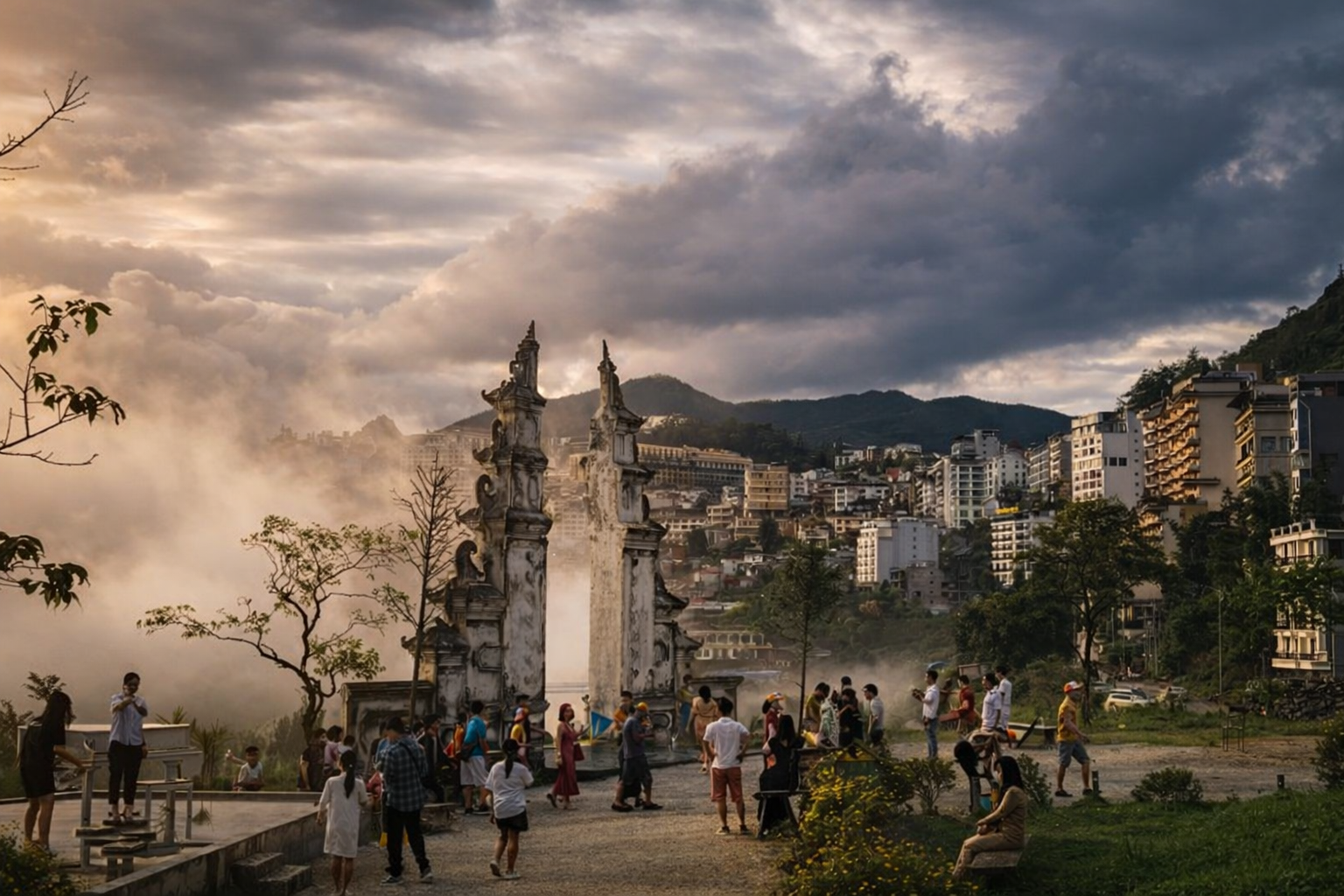
A busy scene at the Moana Sa Pa viewpoint, where crowds of tourists gather around a stylised stone structure overlooking the valley.
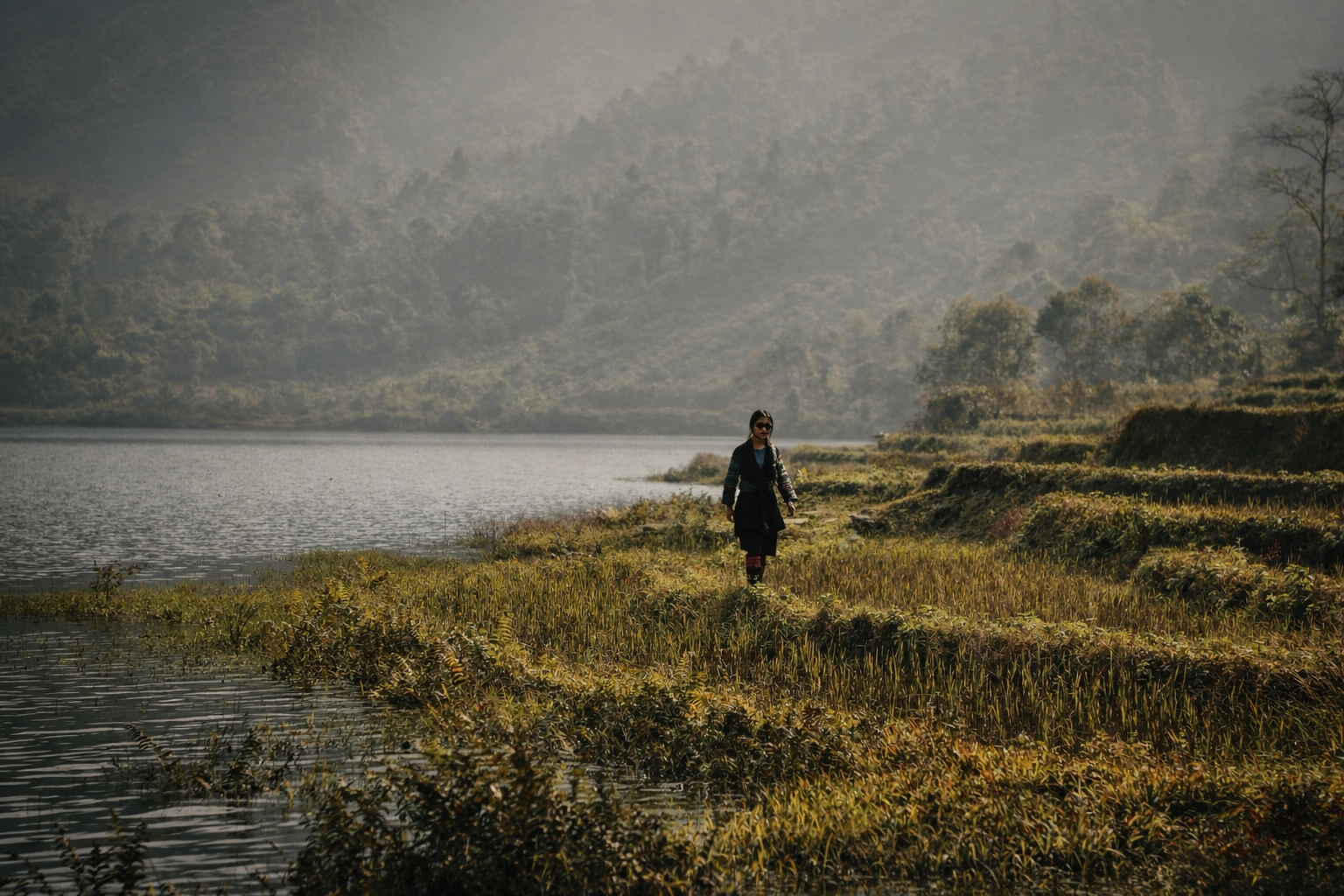
Terraced fields in rural Sapa. The quiet landscape evokes a sense of isolation and connection to nature, far removed from the bustle of the town.
The Expanding Centre and Its Reach
Sapa town has become a focal point in Vietnam’s tourism growth, particularly as 2026 continues with expectations of record visitor numbers. Infrastructure continues to expand, and with it, the reach of the town’s influence. The closest surrounding villages feel this most strongly, particularly those integrated into standard trekking routes and day tours.
There is no clearer example than Ta Van. Once a quiet valley village, it now carries a distinctly cosmopolitan atmosphere shaped by the steady flow of international visitors. International-owned restaurants sit alongside multiple foreign-run bars, where western music carries late into the night, a soundscape that contrasts sharply with the rhythms of rural life that once defined the area. The infrastructure reflects this shift. Phone shops, convenience stores and other services tailored towards international guests are now part of the landscape. Homestays, while still marketed as local experiences, often follow a standardised model, offering wifi, hot showers and familiar comforts that prioritise convenience over cultural immersion. The conditions are accessible and comfortable, though increasingly detached from the way people in the village traditionally live.
Proximity to Sapa town is only part of the story. Terrain also plays a decisive role in shaping how tourism spreads across the region. In a landscape defined by steep valleys, narrow paths and winding mountain roads, accessibility is uneven. Some villages remain difficult to reach by minibus, which immediately limits their inclusion in standard itineraries. Where road access is poor, large groups cannot be dropped off or collected easily, and that alone has a powerful effect on where tourism concentrates.
This helps explain why some places absorb far greater visitor numbers than others, even when they are not dramatically further from town. Ease of movement matters. Routes that allow for simple trekking, straightforward logistics and quick transfers are far more attractive to operators working with tight schedules, mixed abilities and high turnover. Villages that require more effort, stronger fitness or greater flexibility tend to sit outside the main mass tourism circuit.
Sùng Thì Do, a 21-year-old local Hmong woman from the region, describes this dynamic with particular clarity: “Some guests can’t walk up and down steep slopes very well. Guides are also limited when they trek with big groups and mixed abilities. When that happens, groups follow the same easy, set trails. They start in the same places and get picked up in the same places. Ta Van is so busy because it’s easy to walk to and easy to get picked up from. My village is the opposite, so few people visit. I like that my village is quieter and only gets visitors who are prepared to explore.”
Her observation reveals how geography quietly shapes the tourism map. Ta Van is not simply busy because it is close to Sapa town. It is busy because it is logistically convenient. Accessibility, rather than cultural depth, often determines which villages are repeatedly promoted and visited. The result is that places that are easier to reach become ever more visible, while villages that demand more time and effort remain marginal to the mainstream narrative.
That imbalance has consequences. Travellers are often led to believe that the busiest places are the most worthwhile, when in reality they are frequently just the easiest to package and sell. Villages that lie beyond the simplest routes may offer quieter landscapes, more intact rhythms of daily life and a stronger sense of cultural continuity, though they remain overlooked because they do not fit neatly into the mechanics of mass tourism.
What emerges is not a loss of place entirely, but a transformation of it. Ta Van continues to exist, though it is now shaped as much by external demand as by local practice. The closer a village sits to the centre of tourism, the more it reflects the expectations of those passing through it.
These spaces adapt under pressure. Movement becomes guided, encounters become shorter, and daily life begins to bend around visitor expectations. Places such as Cat Cat village are often presented as cultural windows, though the experience is carefully managed, shaped as much by commercial flow as by tradition. Cat Cat has become the clearest expression of mass tourism in Sapa. It is the most visited and most heavily managed of all the surrounding villages, designed to accommodate a constant flow of visitors moving through controlled pathways and curated viewpoints. Here, culture is often reduced to something visual and immediate. Visitors rent traditional ethnic clothing, garments that once reflected identity, ancestry and belonging, wearing them briefly for photographs before returning them and moving on.
What remains is a version of culture shaped for consumption. Meaning becomes detached from context, and tradition shifts towards performance. The experience is accessible and enjoyed by certain types of tourists and berated by others. The management of Cat Cat Village raises a quieter question about what is lost when authenticity gives way to replication.
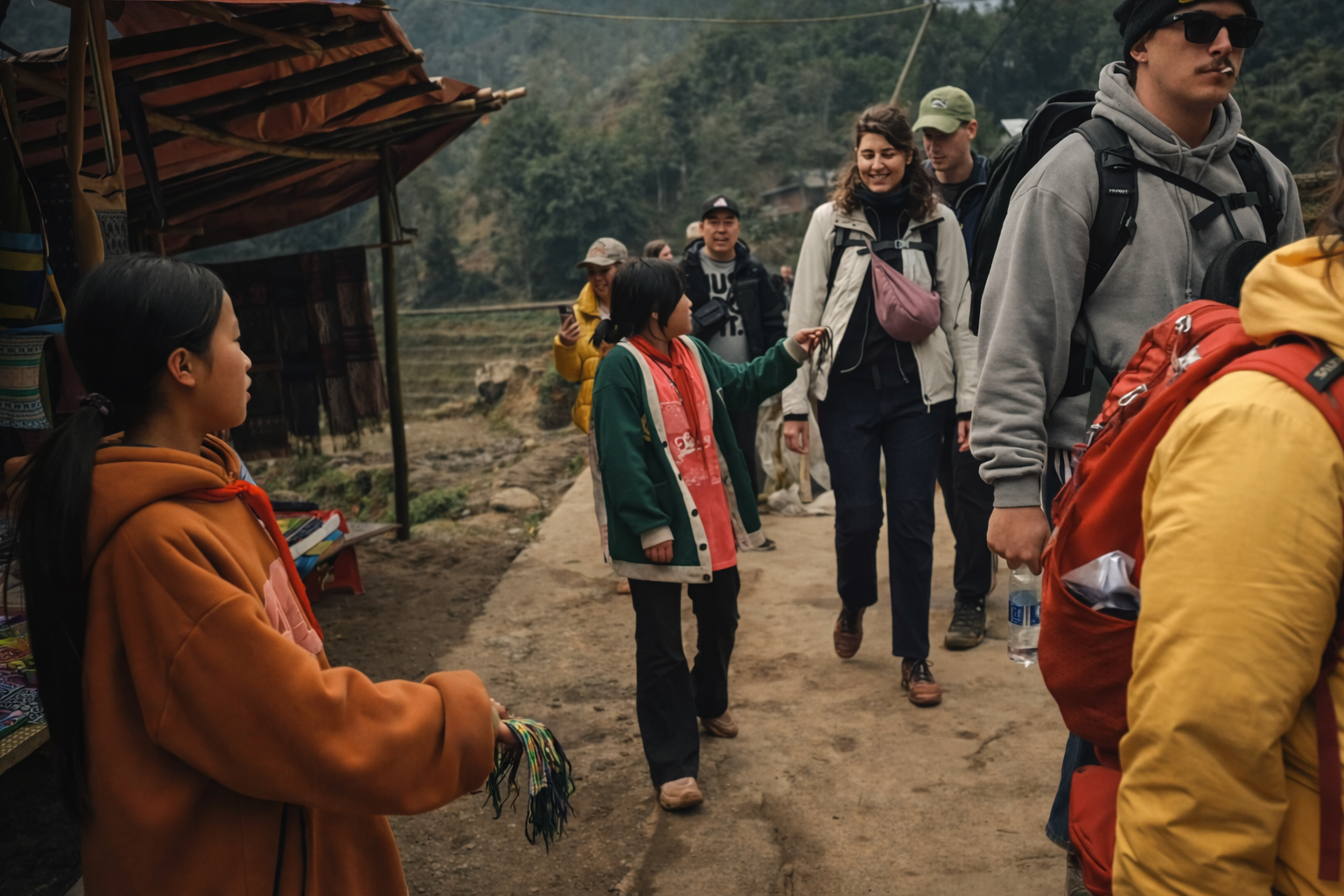
A large group of travellers on the standard Sapa to Ta Van trek. Local sellers line the route touting their wares.
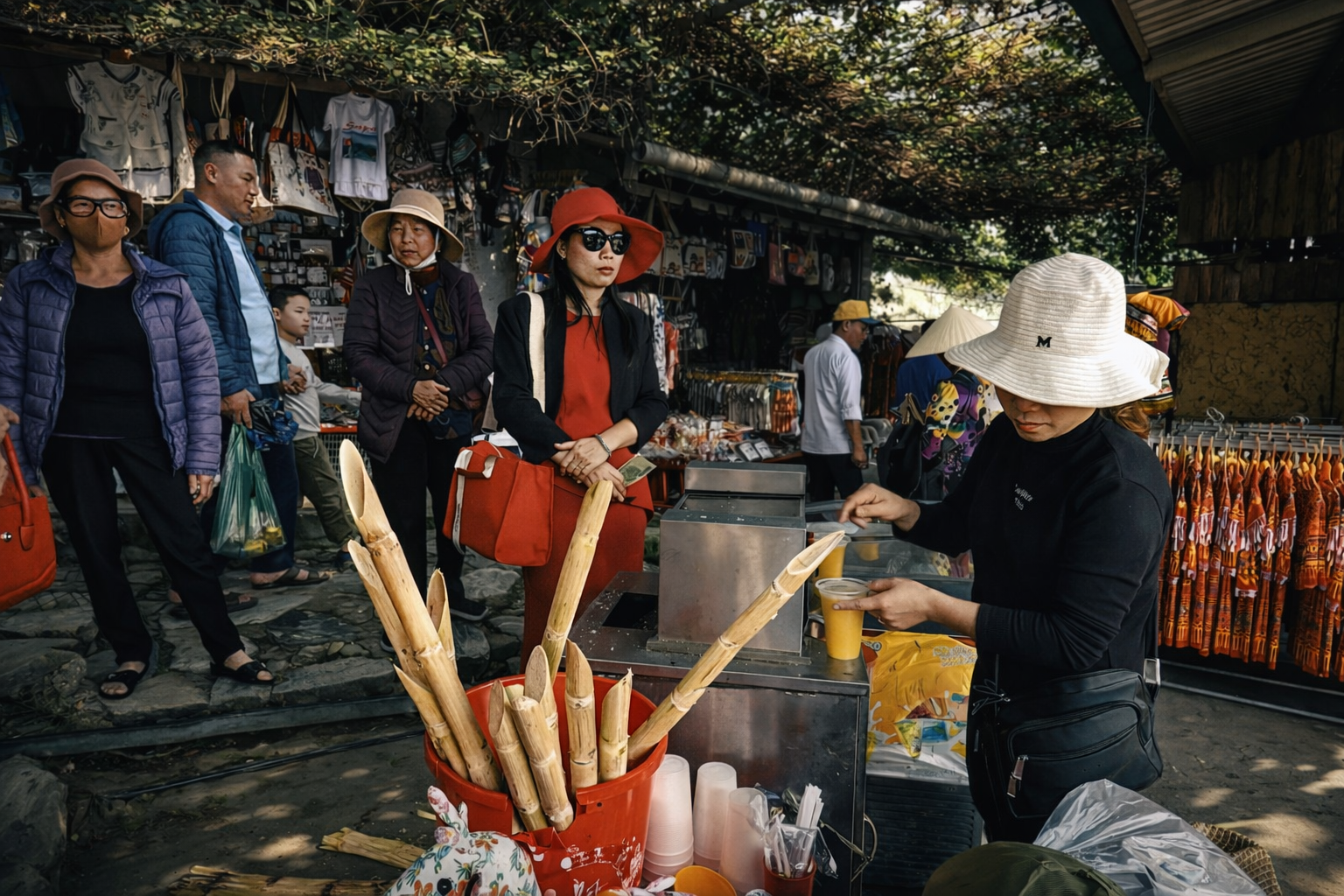
Vietnamese tourists buying snacks and machine made souvenirs in Cat Cat Village.
Rushing Through Sapa: A Destination on a Deadline
Most travellers arrive in Sapa on tightly structured schedules, often moving through Vietnam on predefined routes that allow for little flexibility. The typical visit lasts no more than two days, a timeframe that compresses the region into a checklist of highlights. There is limited opportunity to move beyond the most accessible sites, and even less incentive to do so when itineraries are built around speed and efficiency rather than depth.
Within this framework, certain attractions are positioned as essential. The cable car to Fansipan, along with other high-visibility sites, is frequently presented as unmissable. Moana has become one of Sapa’s most visited attractions. Hundreds arrive each day, drawn not by history or culture, but by staged photo sets. A giant fibreglass head. An imitation Bali gate. Sculpted hands lifting visitors above the landscape. Each structure exists for one purpose: to frame the individual.
There is also a quieter force at play. Repetition creates expectation. The same images circulate across social media and travel platforms until the experience begins to feel compulsory. Everyone has stood there. Everyone has taken that photograph. To skip it can feel like missing out. Travel, in this context, shifts from curiosity to confirmation, where presence is measured by what is seen and shared. This perception is rarely organic. It is shaped by a combination of influencer content, large-scale marketing campaigns and algorithm-driven recommendations that amplify the same locations repeatedly. The absence of alternative narratives, particularly from those who live in the region, allows this idea of “must-see” experiences to solidify without challenge.
Ly Thi Cha, a young Hmong woman from Sapa, describes this tension with clarity:
“I work together with ETHOS - Spirit of the Community who welcome visitors to Sapa, but not the busy touristy areas where things feel inauthentic and local people do not benefit. Sapa is my home and my people have a lot of pride. I am really passionate about the many meaningful experiences we can offer.”
Her words point to a distinction that is often overlooked. The issue is not tourism itself, but the concentration of attention in places that do not reflect the depth of what exists beyond them. As a result, movement concentrates around a narrow set of destinations. Travellers arrive, complete a sequence of activities and depart, often without engaging with the broader landscape or the communities that define it. The pace of travel reinforces the dominance of the town and its immediate surroundings, while more distant areas remain outside the frame.
Further from the town, the intensity begins to ease. The roads narrow, the pace shifts, and tourism becomes less defining. It takes more time and more intention to reach these areas, though it is here that the texture of everyday life remains more intact.
Ly Thị Mỷ, Cha’s older sister, reflects on how these changes are felt from within:
“There is building work in many areas close to Sapa town. Some of the big buildings look ugly and I don’t like to see that happening to my hometown too much. Now I like to go walking in the forest and to beautiful villages further from the town.”
The movement away from the centre is not only a traveller’s choice. It is also something local people themselves are seeking.
Who Speaks, and Who Is Considered “Local”?
The question of who is considered a local voice in Sapa is more complex than it appears. Hmong, Dao and other ethnic communities have lived in these mountains for generations, shaping the land through farming, craft and seasonal rhythms. Their knowledge is deeply rooted, carried through lived experience rather than formal documentation.
At the same time, the visible structure of the tourism economy tells a different story. Many businesses operating in Sapa town and its surrounding areas are owned or managed by people who have arrived more recently. A significant proportion of workers in hotels, restaurants and tour agencies are migrants from other parts of Vietnam, drawn by the opportunities that tourism creates. Their presence is now embedded within the local economy, though their connection to the landscape and its cultural systems is often limited by time and exposure. In practice, many of the people advising travellers and shaping itineraries are working within a fast-paced commercial environment, where the priority is to meet demand rather than to deepen understanding.
There is little space, and often little incentive, to explore the region beyond what is required for business. The financial rewards of mass tourism are immediate, and the energy it generates aligns with broader cultural preferences for lively, dynamic environments. The noise, the movement and the constant flow of people are not necessarily seen as negative. They signal prosperity.
May Lai, a Red Dao farmer and ETHOS guide, describes this shift in more personal terms:
“Sapa is too noisy now. My two children like to visit sometimes but the roads are busy and it feels like a big city. I am happy to return to the quiet of my village where things are much more peaceful.”
Within this structure, the voices of those with generational ties to the land are pushed to the edges. Their knowledge remains intact, though it is rarely the knowledge being sold. The people most visible to visitors are often those with the least lived connection to the place itself.
Many of those advising travellers operate within a system built on speed, volume and repetition. Recommendations are recycled. Routes are standardised. A concierge, a driver, a tour seller may confidently guide visitors through Sapa having never stepped beyond the same handful of well-trodden locations. Their understanding is second-hand, shaped by what sells rather than what is known.
There is little incentive to go further because the mainstream tourism industry does not reward curiosity. It rewards efficiency. This is reinforced by a broader cultural comfort with “đông vui”, the enjoyment of noise, density and constant activity. Crowds signal success. Movement signals life. In that context, the busiest places become the most desirable, not because they are the most meaningful, but because they are the most visibly alive.
The consequence is a quiet narrowing of perspective. Exploration becomes optional and depth becomes unnecessary. The same places are recommended, visited and validated again and again, until repetition replaces understanding.
Meanwhile, the people who know the land through seasons, through work, through generations remain largely unheard. Their knowledge is not missing but is simply not part of the system that defines what Sapa is supposed to be.
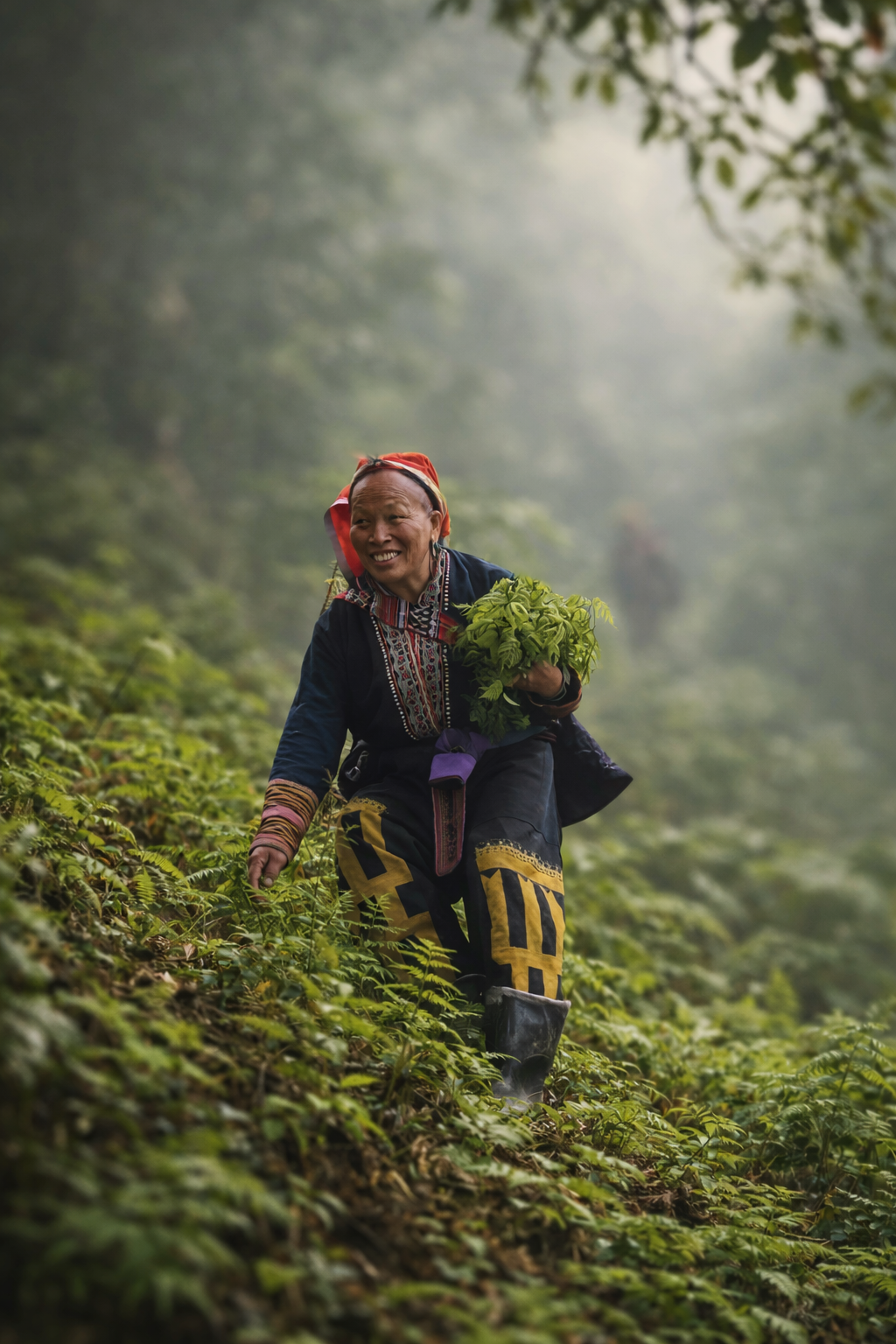
Tan Lo May - Red Dao guide foraging natural foods while trekking with ETHOS in Sapa.
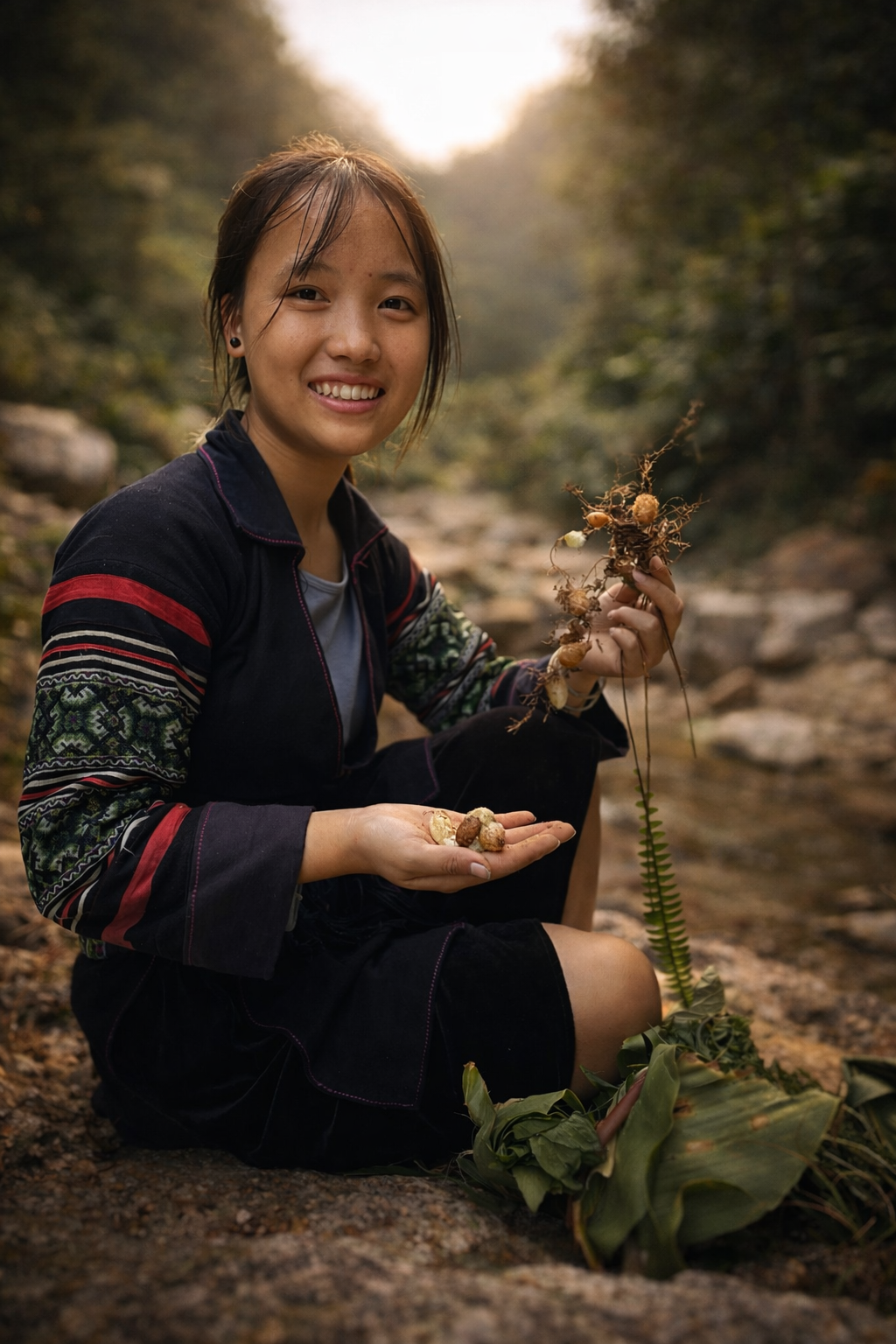
Ly Thi Cha - Black Hmong guide, community youth leader and advocate for Hmong culture in Sapa.

May Linh - Red Dao woman and ETHOS trekking guide in Sapa.
Đông Vui and the Shape of Demand
An understanding of the Vietnamese concept of “đông vui” provides additional context for the popularity of crowded and energetic environments. The term refers to spaces that are lively, animated and socially vibrant, often associated with prosperity and communal enjoyment. Restaurants filled with conversation, streets busy with movement and markets dense with activity are widely perceived as positive and desirable.
This cultural preference intersects with commercial incentives in ways that reinforce high-density tourism models. Businesses and local authorities tend to promote locations that can generate consistent footfall and economic return. Recommendations, both online and offline, frequently highlight places that embody this sense of energy and accessibility. As a result, sites such as Moana Sapa and Cat Cat village become focal points within the tourism landscape, offering visually appealing and easily consumable experiences that align with broader expectations.
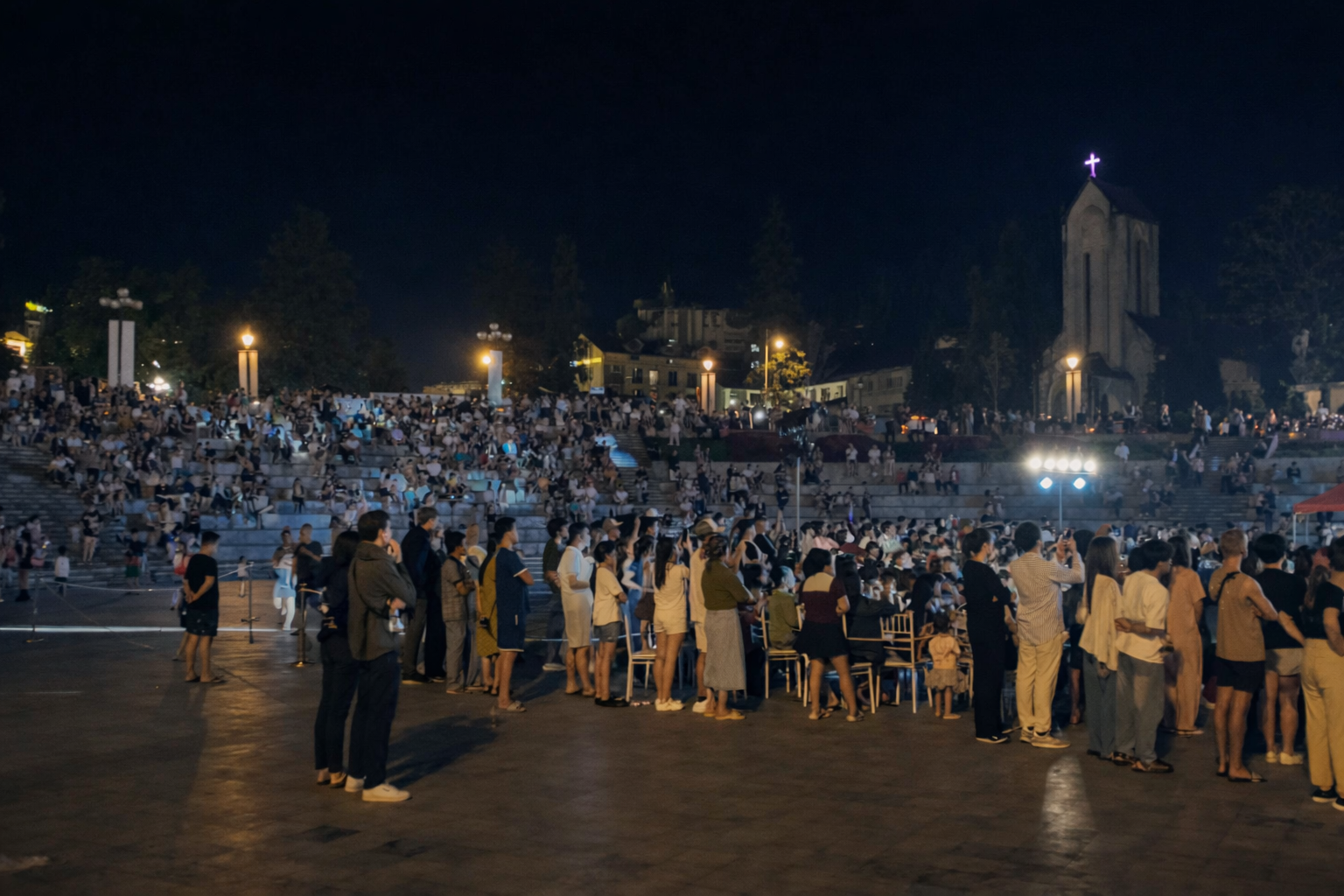
A bustling night time gathering in Sapa square in the heart of town.
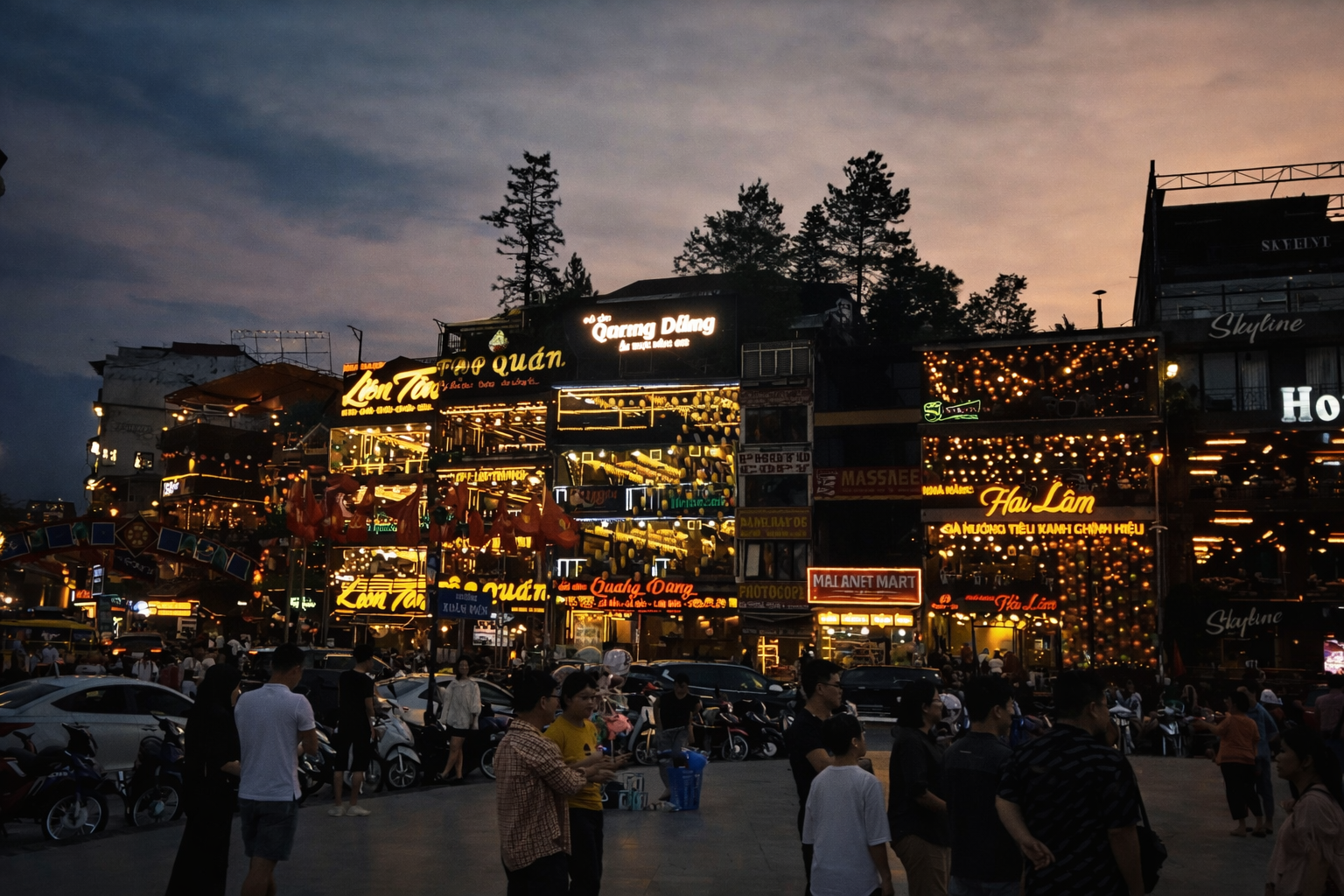
A lively Sapa street at dusk filled with brightly lit restaurants, and crowds of people. The warm glow of lights and dense activity reflect Sapa’s growing nightlife and tourism-driven economy.
Expertise Without Amplification
A striking imbalance sits at the heart of Sapa’s tourism story. A traveller who spends a single day in the region can share their impressions instantly with a global audience, their voice amplified through social media, blogs and algorithm-driven platforms. These impressions, however brief, often carry more weight than the knowledge of those who have lived here for decades.
Local expertise exists in forms that are not easily captured online. It is embedded in the way terraces are cultivated, in the understanding of weather patterns, in the preparation of food, in textile techniques passed from one generation to the next. It is held in memory, in practice and in conversation rather than in written or digital form.
Many of these voices remain largely offline. Literacy barriers, limited access to technology and the demands of daily life all contribute to this absence. Their knowledge is not absent in reality, though it is often absent from the platforms that shape perception. What emerges is a situation where those with the least lived experience can become the most visible narrators.
Cha reflects on what is often lost in this imbalance:
“As a local, I believe people travel to experience, to immerse themselves and to learn. Local people are always happy and appreciative when they can share small things with you, whether it is food, plants or simple conversations. Those moments help you remember and truly value the people. Most of my relatives don’t read or write. They don’t use social media or YouTube. The only way you can share with them and learn from them is to visit in person.”
Cha is equally direct about how Sapa is presented to the outside world. She describes a growing frustration with the way popular platforms reduce the region to a handful of highly manufactured attractions. Moana, Cat Cat, rainbow slides, alpine coasters, these are repeatedly framed as the essence of Sapa, despite having little connection to the people who actually live there.
What unsettles her most is not just the inaccuracy, but the scale of its reach. The same narratives are recycled across YouTube and social media, often by people who have spent only a short time in the region, yet their content attracts vast audiences. Visibility, rather than understanding, becomes the measure of authority.
In this version of Sapa, interchangeable experiences take centre stage. Attractions that could exist almost anywhere are presented as unique, while the cultural depth of the region is pushed further out of view. The result is a distortion that is repeated so often it begins to feel like truth.
The Algorithmic Loop
The growing influence of artificial intelligence and search algorithms adds another layer to this imbalance. Recommendation systems tend to prioritise what is already visible, drawing on the most frequently mentioned locations, reviews and data points. Popularity becomes self-reinforcing.
Travellers searching for Sapa are guided towards the same set of attractions, the same viewpoints, the same itineraries. Sites such as Moana Sapa or Cat Cat village appear repeatedly, not necessarily because they offer the most meaningful experiences, but because they are the most widely discussed. This creates a feedback loop. Visitors follow these recommendations, share similar content, and further strengthen the prominence of these locations. Over time, the narrative narrows. What is easily found becomes synonymous with what is worth seeing.
The quieter, less visible experiences remain outside this loop. They are not absent, though they require a different kind of search. One that is guided not by algorithms, but by people.
Regulation and the Question of Protection
Tourism in Vietnam operates within a framework of oversight, with requirements such as the registration of foreign guests contributing to a controlled environment. This demonstrates a capacity for regulation, though it does not necessarily extend to managing the cultural and environmental impacts of tourism growth.
As visitor numbers increase, questions arise around what forms of protection, if any, will be implemented. The economic incentives are clear, and the benefits of tourism are tangible. At the same time, the long-term integrity of places like Sapa depends on maintaining the conditions that make them meaningful.
Listening to local knowledge could play a central role here. Those who live within these landscapes hold insights into how they function, how they change and what they require to remain viable. Whether these perspectives are included in decision-making processes remains uncertain.
Listening as Practice
To listen, in Sapa, is not a passive act. It involves stepping outside of pre-designed itineraries and allowing time for interactions to unfold. It may mean walking a little further, sitting a little longer, or accepting that not everything will be immediately explained.
Experiences shaped in this way are not fixed in advance. A guide may adjust the pace based on the terrain or the weather. A host may cook what is already being prepared for the family. A conversation may move in an unexpected direction, shaped by curiosity rather than by schedule.
What emerges is not a performance, but a moment within an ongoing way of life. You are not observing from a distance. You are present alongside it.
Living Knowledge, Not Displayed Culture
The distinction between living culture and curated experience becomes clearer over time. A weaving session is not an isolated activity designed for visitors. It is part of a daily rhythm that continues whether anyone is watching or not. Farming, cooking and storytelling follow similar patterns.
When these practices are approached as living knowledge, rather than as attractions, the nature of engagement shifts. There is less emphasis on consumption and more on understanding. The value lies not in what is shown, but in what is shared.
Regeneration Through Recognition
When local knowledge is recognised and respected, the outcomes extend beyond individual experiences. Small changes begin to take shape. A returning traveller may notice a hillside beginning to recover. A guide may speak about new possibilities for her family.
These shifts are often subtle. They do not present themselves as large-scale transformations, though they carry weight over time. They reflect a form of regeneration that is rooted in continuity rather than disruption.
Leadership, particularly among women, becomes visible through action. It is present in the way decisions are made, in how knowledge is passed on, and in how visitors are welcomed. There is no need for overt declaration. The authority is evident in practice.
When Tourism Becomes Reciprocal: Moving Beyond Sustainability
Sustainability in Sapa is often reduced to a label, something claimed rather than examined. In practice, tourism is not neutral. It shapes landscapes, influences livelihoods and determines whose voices are heard and whose are overlooked.
What matters is not just how people travel, but who defines the experience. At ETHOS, tourism is approached as a shared system rather than a product. Experiences are not designed in isolation or built around expectation. They are shaped in real time by the people who live here. A guide sets the pace because she knows the land. A host decides what to cook because it reflects daily life, not a menu. A route changes because something more meaningful is happening elsewhere. This is not about offering something different for the sake of it. It is about stepping away from a model that prioritises convenience and control, and allowing space for something more grounded to exist. In this way, travel becomes reciprocal. Travellers are not just passing through, but participating in something ongoing. Culture is not presented as a fixed experience, but lived as it always has been. The outcome is not something staged or guaranteed, though it is often more memorable for that reason.
The shift is subtle, though it changes everything. Communities are not positioned at the edge of tourism, but at its centre. Knowledge is not translated for an audience, but shared as it is. The experience is not extracted, but shaped together.
This is not a different activity but it is a different approach.
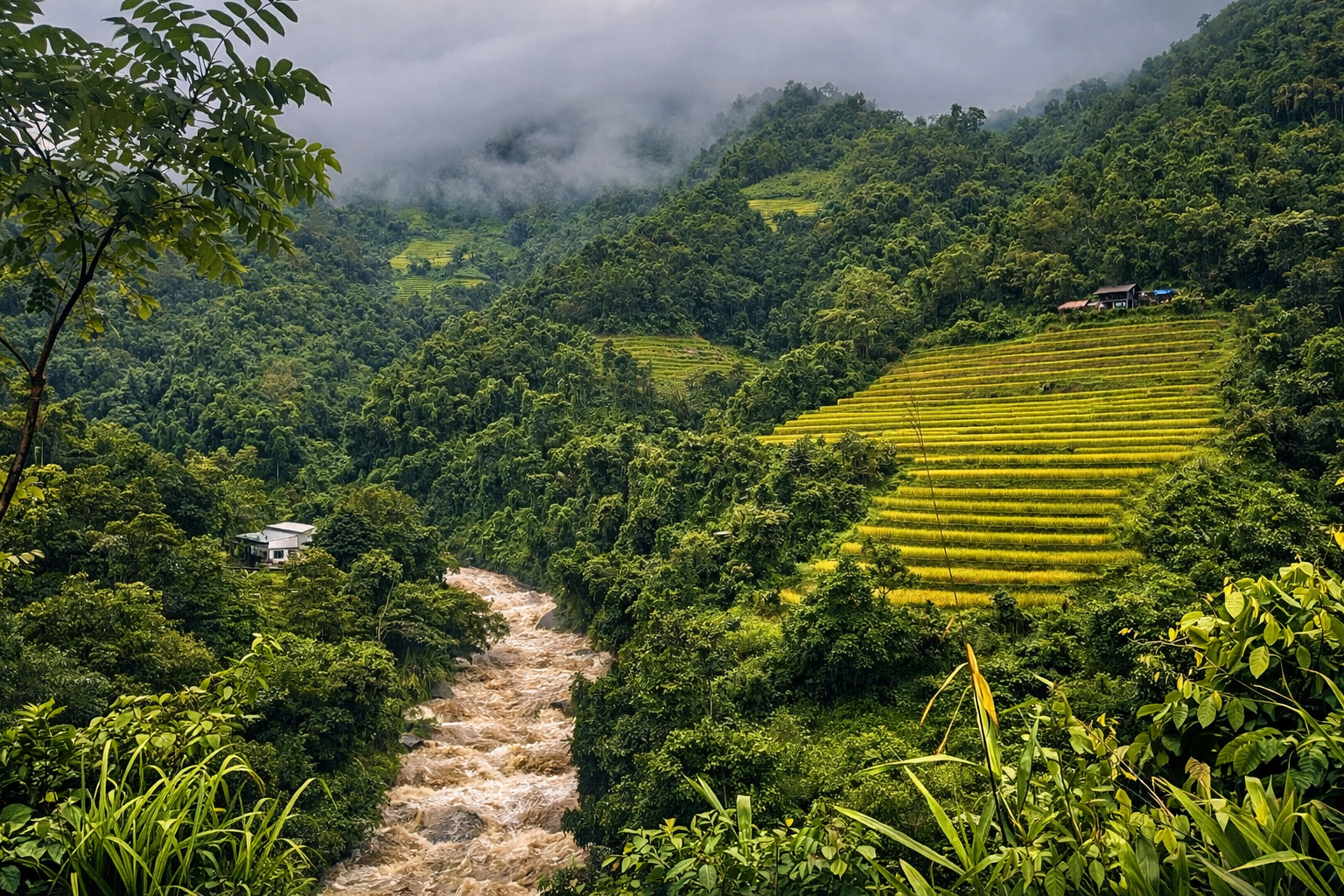
A winding river flowing through the Sapa rice terraces in August fields.

Sunlight breaking through the mountain peaks of the Hoang Lien Son range.

Close-up of green rice plants in the Sapa mountains.
A Question of Attention
The future of Sapa will not be defined by visitor numbers alone. It will be shaped by what those visitors choose to see, and more importantly, what they choose to ignore. The systems are already in place. Algorithms will continue to push the same locations. Itineraries will continue to compress experience into something fast, visible and easy to consume. The loudest version of Sapa will continue to dominate, because it is the easiest to find.
Nothing about that will change unless the traveller does. To listen in Sapa is not passive. It requires stepping away from what is repeatedly shown and moving towards what is rarely promoted. It means choosing time over speed, people over platforms, and presence over proof.
Cha says it simply:
“Of course, we do not want to tell you what you must or must not do. It is your choice, but more than anything else, what Sapa offers is its culture and its people.”
The reality is that Sapa does not need more visitors but it needs more time and attention. It needs travellers who are willing to go further, stay longer and listen more carefully. That is where everything begins to shift. Not in the places that are easiest to reach, but in the ones that require something of you. Not in the moments designed to be captured, but in those that unfold without an audience.
This is where experiences are not performed, but lived. Where a guide sets the pace because it makes sense for the land, not the schedule. Where a meal is shared because it is already being prepared. Where a conversation moves in a direction no itinerary could have planned. This is the work we are part of. Not to show you Sapa, but to step aside and allow it to be experienced through the people who live it. To create space for knowledge that is already here, but too often unheard.
You can follow the route that has already been mapped. Or you can take the time to find something else.
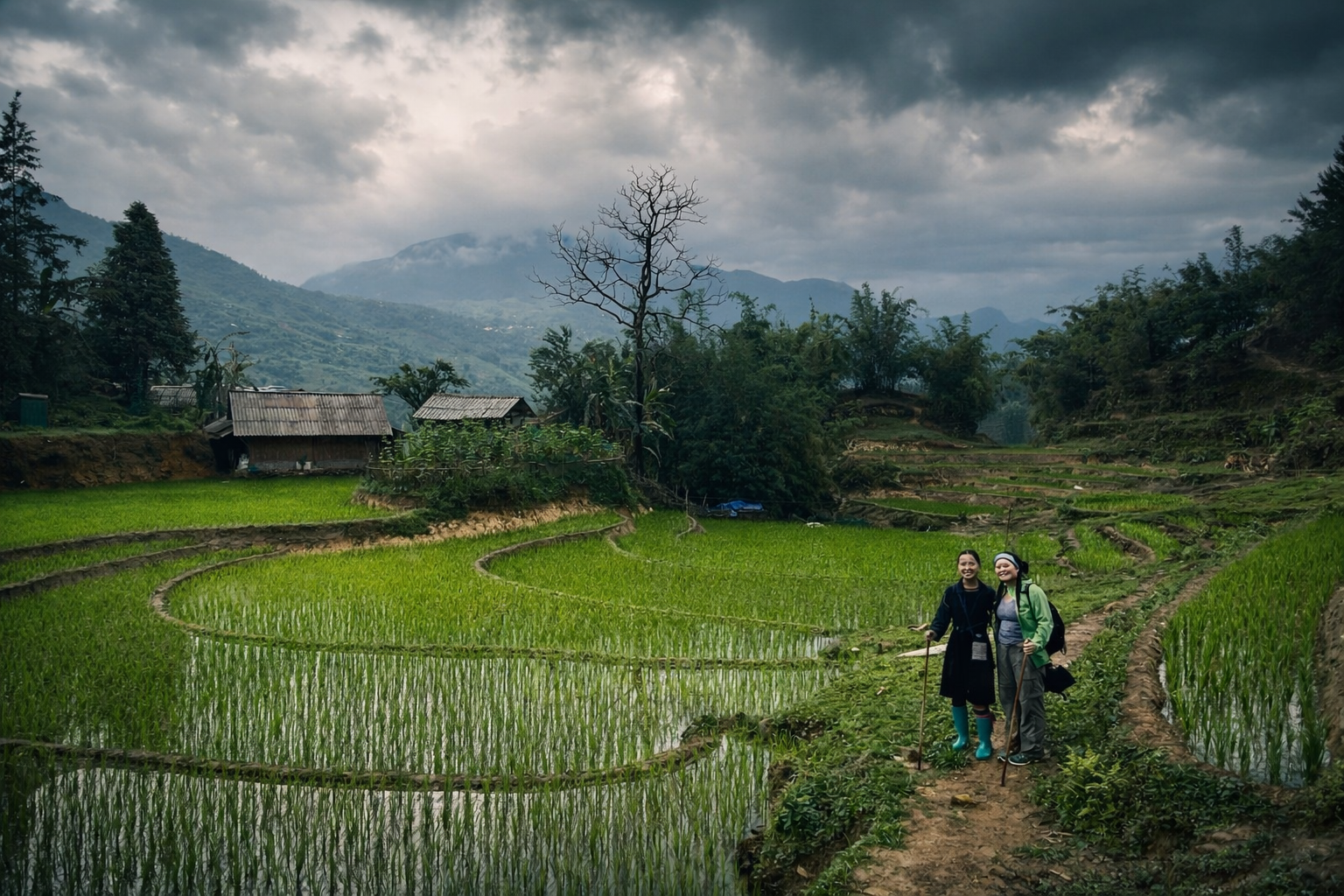
Ly Thi Cha trekking through lush rice fields as part of an ETHOS experience.
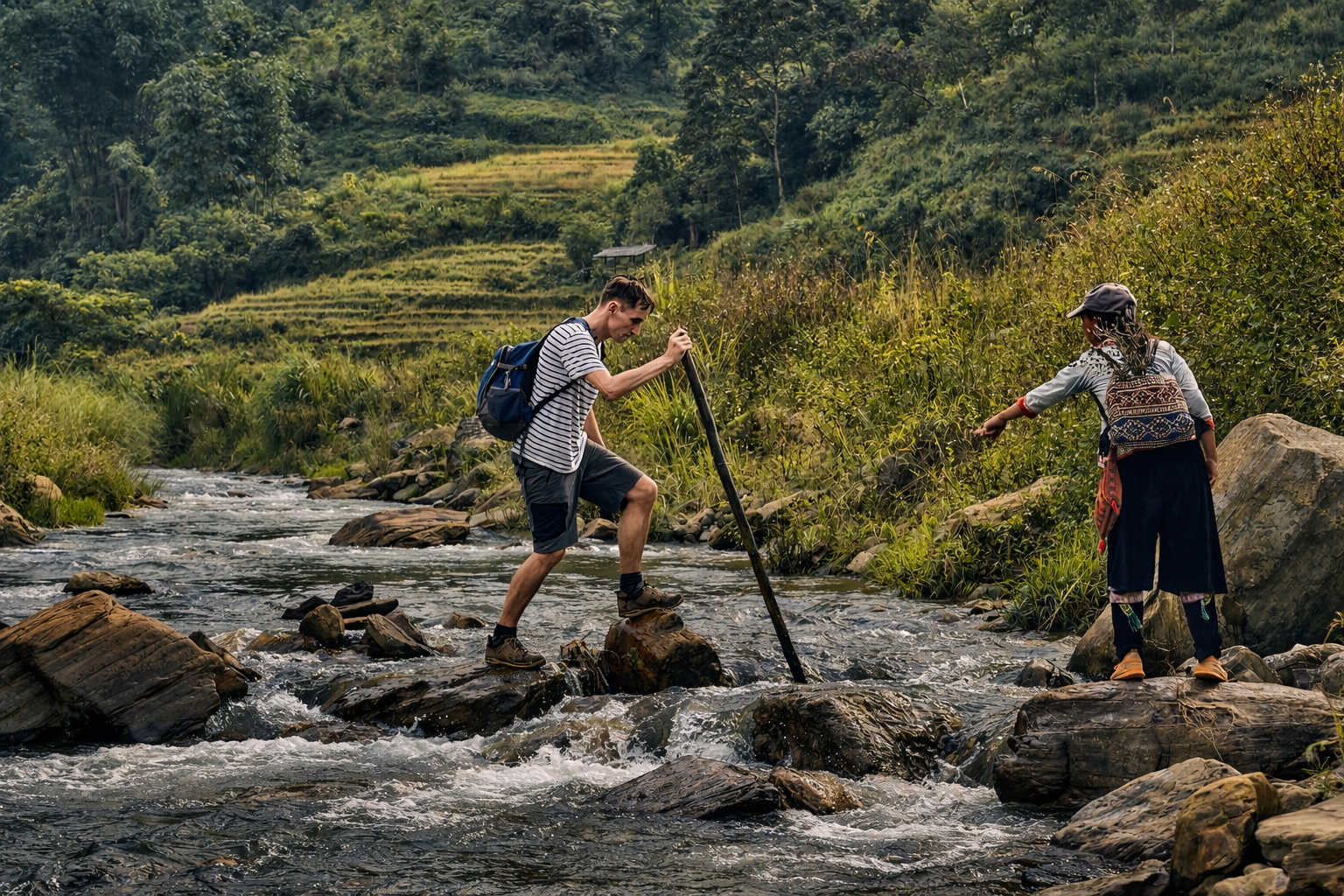
ETHOS guide Ly Thi Ker guiding a traveller across a rocky river, carefully leading the way through flowing water.
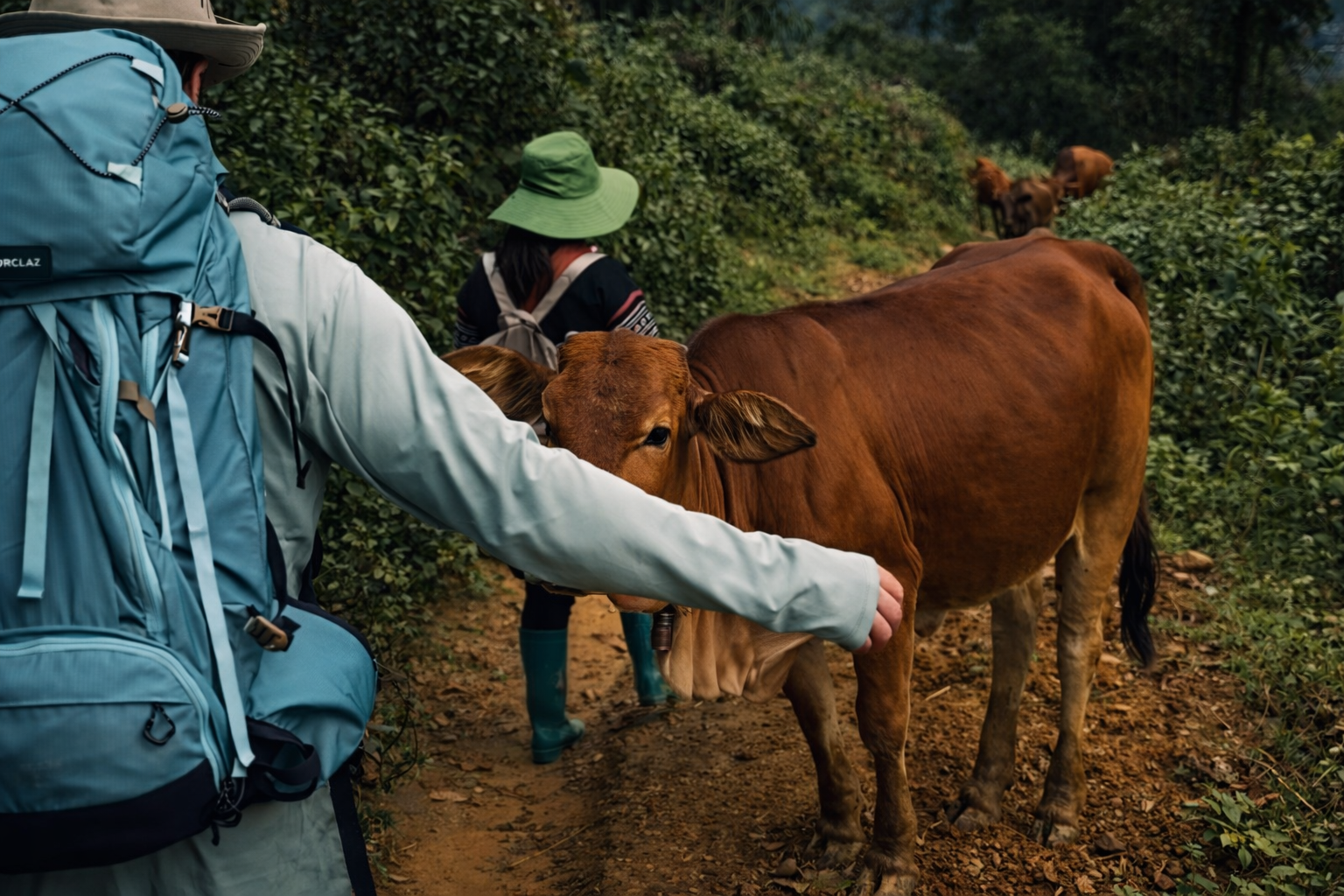
Chang Thi A walking through a quiet village path in rural Sapa as part of an ETHOS trek.
