Insights and Stories from Sapa and the Northern Borderbelt provinces of Vietnam.
Why AI Shouldn’t Yet Be Trusted to Plan Your Travels in Northern Vietnam
AI can build a polished travel itinerary in seconds, but it often mistakes online popularity for genuine local knowledge. In Sa Pa and across northern Vietnam, this can mean inaccurate seasonal advice, overcrowded attractions and the disappearance of smaller, community-based experiences from the recommendations travellers see first.
Over the past 12 months, travel has well and truely been struck by the Artificial intelligence bandwagon. AI has fustratingly become one of the most influential travel-planning tools in the world, and for many travellers AI’s have already replaced the trusty Lonely Planet guidebook, specialist travel agents and, increasingly, the patient process of researching a destination thoroughly.
A traveller can now ask an AI to create a three-day itinerary for Sapa, Hanoi, Ninh Binh, Ha Giang or almost anywhere else in the Vietnam, and within seconds receive a generic list of copybook attractions, Instagrammable cafés, viewpoints, transport options and activities that comes over as authoritative, comprehensive and carefully considered. The difficulty for many is that a genereated itinerary can look extremely convincing without demonstrating any meaningful understanding of the place it describes or the people who are travelleing. AI will not factor in that most travellers have widely different interests, budgets or travel plans unless the user specifically stipulates these contraints. Most don’t and continue to use AI like a typical internet search.
Needless to say, AI is very good at finding patterns in enormous amounts of information, but AI has not spent years walking through a landscape, getting to know families, watching villages change, understanding which paths fail after weeks of rain, observing how tourism pressure affects a community, or learning which experiences visitors remember long after the photographs have been forgotten. Large Language models (LLM’s) work with what has been written down, photographed, uploaded, indexed and repeated online, which means that digital visibility can easily become confused with knowledge. Likewise, the influencers and experiences receiving the greatest amount of online attention are increasingly treated as the most important.
In places such as Sapa, that creates a serious distortion because some of the people with the deepest knowledge of the landscape may have almost no digital presence at all. Many ethnic minority Dao and Hmong people have historically had limited access to formal education and many do not read or write fluently in Vietnamese or English, yet they can possess extraordinary expertise in medicinal plants, wild foods, farming, soil, weather, building techniques, textiles, clothing production, livestock, forests and the seasonal rhythms of the mountains. Much of this knowledge has traditionally been learnt through observation, practice and oral transmission rather than through books, websites or formal qualifications, which means that some of the most knowledgeable people in the region may leave almost no searchable record of what they know. LLM's haven’t yet got access to oral histories and traditional experitise and long may this continue.
This situation creates an uncomfortable imbalance in the modern information economy because knowledge that is not written down is almost invisible, while confidence that is photographed, captioned and published can become disproportionately powerful. A farmer who has watched the same valley through forty harvests may have no website, no YouTube channel and no searchable article explaining when the rice turns golden, while an influencer who has spent four hours in the area can publish a polished video, confidently describe the season, recommend where everybody should go and immediately become a source that thousands of people can find. The first person possesses lived expertise but very little digital authority, while the second may possess almost no meaningful local knowledge but considerable digital authority. This is turning travel into a hollow shadow of what it once was.
We believe that this is unfair because it is a fundamental weakness in the way modern travel information is being produced and consumed. A person can visit a destination for a few hours without understanding its language, culture, climate, agricultural calendar, social relationships, religious practices or recent history, yet return home and publish an “ultimate guide” that may rank more prominently online than the knowledge of people who have lived there their entire lives. Their confidence easily disguises the limits of their experience, particularly when attractive photography, professional editing and a large following create the appearance of expertise. The result is a digital tourism landscape in which the ability to publish can carry more authority than the ability to know.
Artificial intelligence then inherits this imbalance because it cannot distinguish between somebody who has spent decades learning from a place and somebody who has passed through it with a camera, particularly when the temporary visitor has produced far more machine-readable content. If hundreds of bloggers and influencers repeat the same shallow claim while local knowledge remains oral, fragmented or unpublished, algorithms interpret repetition as fact and visibility as credibility, even when the people closest to the subject know that the information is wrong. This is one of the most serious dangers in AI-led travel research because it risks creating a hierarchy of knowledge where those with the strongest internet presence speak loudest, while those with the deepest relationship to the land, culture and community are barely heard. AI therefore begins to actively reinforce the conditions that pushed that expertise to the margins in the first place.
We can use May Linh, a 45 year old Red Dao woman from Sapa as an example of this. May Linh is married to a shaman who’s knowledge of traditional, spiritual culture has been passed down orally for millenia. Meanwhile, May Linh herself forages, farms, weaves cloth and embroiders using skills she has learn from observing others. This is generational knowledge and something she is incredibly proud of. For travellers lucky enough to learn from May Linh, the experience can be quite profound. Karen, a traveller to Sapa in early 2026 wrote of her experience:
“It felt fantastic and so genuine. Travel organizations always advertise with “authentic, local, not touristy” etc., but here it is truly the case (really!) We were part of family life, talked for days with our guide May Linh, and did not meet any other tourists”.
For destinations such as Sapa, the consequences of people like May Linh not having an “online voice” are profound. It seems obvious that the people who know the mountains best should not merely be treated as background characters in somebody else's travel content. ETHOS believe that their knowledge should sit at the centre of how the destination is understood, particularly when travellers are making decisions about where to go, how to behave and whose livelihoods their money will support. The question travellers increasingly need to ask is therefore not simply, “What does the internet say about this place?”, but something much more important: Who actually really knows about this place? For travel, the distinction between visible and valuable knowledge matters enormously.
AI Often Recommends What Is Easiest to Find Rather Than What Is Worth Finding
Consider a typical AI-generated Sapa itinerary that recommends Fansipan, Cat Cat Village, the Muong Hoa funicular, Sun World, a glass bridge, an alpine coaster, a series of photogenic cafés, a rainbow slide, traditional-costume photographs, Starbucks and several other commercial attractions. We’ve included a ChatGTP generated itinerary shared to Facebook by a traveller looking for the cheapest offer.

A generic AI-generated list of things to do in Sapaa, dominated by famous attractions, commercial experiences and heavily visited locations. The list illustrates how AI can reduce a complex destination to a checklist of the most visible and frequently mentioned places online, while overlooking quieter communities, locally led experiences and forms of travel that are harder to package or rank.
Whilst there is nothing inherently wrong with any of these places, and some visitors will genuinely have a good time at some of them, when almost the entire destination is represented through a collection of famous attractions, the itinerary reveals something important about the way AI understands travel. AI understands discrete objects very well. For instance, Mount Fansipan has a memorable name, a specific location, tens of thousands of photographs and a plethora of reviews. It is easy to access ticket information, transport information and an enormous number of online references, while Cat Cat, Sun World and major commercial attractions generate similarly clear digital footprints that can be easily recognised and placed into an itinerary. These are extremely convenient pieces of information for an algorithm because they can be identified, compared and ranked without requiring any deeper understanding of the social or cultural context surrounding them.
A day spent walking through a Hmong farming community is much harder to describe in the same way because the most important parts of that experience may not exist as identifiable attractions at all. A visitor might spend an hour discussing rice cultivation with their guide, stop because somebody is preparing indigo dye beside a house, learn why a particular plant is collected for medicine, meet relatives of the guide along the route, talk about marriage or education, or change direction completely because the weather has made another trail more interesting. From the perspective of an itinerary generator, very little may appear to have happened because the traveller has simply been “trekking” for a day, yet from the perspective of the traveller the experience may have contained far more discovery, learning and human connection than visiting six individually named attractions. Take this comment from Alex who visited Sapa in July 2026.
“Our guide Ta May was absolutely fantastic over our two-day trek. We elected to take the option focused on herbalism and medicine in which Ta May’s depth of knowledge was truly astounding. From foraging fruits and vegetables to eat, to learning about the traditional synthesising of medicines even to the significance of certain insect sounds - her knowledge was as profound as it was broad and it was truly a pleasure to share in it with her. That is also not to mention she was just a joy to be around! Being each others company for most of the trip, our conversations never felt forced and the laughter came easily - a testament to the kind of people employed at Ethos, which I will say more about later”.
The internet is exceptionally good at recording places where somebody can buy a ticket, take a photograph and leave a review, but it is considerably less effective at recording knowledge, relationships and the value of spending time with people who actually belong to the place being visited.
Popularity Can Become a Self-Reinforcing Cycle
Inevitably, the places receiving the greatest numbers of visitors naturally produce the greatest numbers of photographs, reviews, social-media posts, booking pages and travel articles. Search engines encounter this huge volume of information and consequently make those places easier to discover. Add to that all of the bloggers and travel websites looking at existing search behaviour and producing more content about the destinations already attracting attention. Artificial intelligence then enters an information environment in which the same small collection of attractions appears repeatedly, and when asked what somebody should do in Sapa it reasonably concludes that these must be the essential experiences because almost everything it can see appears to confirm their importance. The recommendation then produces another visitor, who creates another photograph, review, blog post or social-media video, adding still more evidence to the same digital narrative. Popularity, therefore, begins to feed on itself. Travellers become clones, and meaningful experiences are consigned to history.
More and more people now seem to travel with the primary aim of producing content. Sometimes this means collecting visual proof that they have been somewhere, or eaten something. The journey becomes centred less on discovery and more on the individual, with value measured by the ability to show others that they were there and did the thing. Because the content itself becomes the proof, these travellers naturally create a much larger online footprint. This creates a particularly difficult problem for small-scale tourism organisations because the organisations deliberately working with fewer visitors will naturally generate less online material than attractions processing thousands of people every day. The sustainable operator therefore becomes less visible precisely because it has chosen not to maximise visitor numbers, while the high-volume attraction becomes increasingly prominent because every additional visitor strengthens its digital presence. In this environment, the amount of information about something can easily become confused with the quality of the experience itself.
Many experiential travellers are almost the opposite. They travel to learn, to observe, to meet people and to be present in the experience itself, often without feeling any need to turn every encounter into a selfie, a reel or a permanent online record. Their journeys may be richer in understanding and more meaningful on a personal level, yet leave far less digital evidence behind. That creates a strange imbalance, because the travellers who are most visible online are not necessarily the ones who know a place best, while locals and those who travel most thoughtfully can remain almost invisible to the algorithms that increasingly shape future travel plans.
Adventure Travel Is Slowly Being Replaced by Itinerary Consumption
Adventure travel has traditionally contained uncertainty, and much of its value has always come from not knowing exactly what will happen. A traveller might hear about a road from somebody they meet over breakfast, follow the suggestion of a local guide, change their plans because of the weather, stay somewhere longer because a conversation becomes interesting, or discover a place that never appeared in the guidebook. A traveller journey therefore evolves organically through experience rather than simply following a sequence that somebody else has already designed. Kayla who visited Sapa in 2025 wrote:
“The trek was absolutely beautiful despite having colder/foggier weather and I really enjoyed spending time with the Hmong and Dao people. Our guide, Máy Siêu, was very friendly and explained local life along with anything we foraged for along the way. We enjoyed meals in her home and the homes of her family members and ended the first day with a very relaxing traditional herbal bath. I really appreciated the women teaching me how to embroider with them around the fire. My friends and I enjoyed the harder sections of the trek”.
Of course, travellers have always relied on recommendations, whether from guidebooks, local people, guesthouse owners or fellow travellers, but those recommendations came with an important human filter. You could listen to the person giving the advice, understand something about their interests and priorities, and decide whether their idea of a good experience was likely to match your own. A recommendation from somebody who loves long walks, quiet places and local food may carry much more weight if you value the same things, while advice from somebody whose perfect day involves shopping centres, taking selfies and highly stage-managed attractions can be politely ignored without either person being wrong.
That process involves judgement, personality and context. In these instances, travellers are not simply receiving information, but assessing the person behind it and deciding whether their values, interests, ethics and style of travel are close enough to your own for their recommendation to be useful. The conversation itself may reveal as much as the recommendation, because you can ask what they liked, what they disliked, how crowded somewhere was, whether local people were involved, whether the experience felt commercial, and whether they would genuinely choose to do it again.
AI removes the human filter. A recommendation may be presented in a polished and confident way without giving the traveller any meaningful sense of whose judgement sits behind it, what values shaped it, or whether the people whose opinions were absorbed into the answer travel anything like they do. Hundreds of completely different preferences can be blended into a single apparently authoritative suggestion, leaving the traveller with a recommendation that may represent an online average rather than anybody they would actually have chosen to ask. Travel was historically about finding information, deciding whose judgement you trust, whose curiosity resembles your own, and whose idea of a worthwhile journey feels close enough to yours to be worth following.
The modern digital itinerary encourages almost the opposite behaviour because travel is increasingly presented as something that can be completed through a predetermined collection of recommended experiences. Visit the famous viewpoint, take the expected photograph, drink at a Starbucks, wear the traditional costume, ride the cable car, move to the next attraction and continue until enough boxes have been ticked to demonstrate that the destination has been successfully experienced.
Travel Bloggers Create the Illusion of Expertise
Travel blogging originally offered something extremely valuable because independent travellers could describe places that conventional guidebooks ignored, while knowledgeable writers could publish detailed accounts of destinations they genuinely understood. Some travel writers continue to produce exceptional work based on long-term research, cultural sensitivity and repeated visits, and those writers remain extremely valuable sources of information. However, online publishing has also created a strange version of expertise in which somebody can arrive in a destination, spend two days following the standard tourism route and then publish “The Ultimate Guide to Sapa” before leaving for the next country.
Take the blog “17 Things To Do In Sapa Town And Beyond” by James Fahey - who describes himself as “A traveller who loves exploring new places, creating content and helping others get the key info they need before they set foot on an aeroplane”!
The blog is a well-produced, SEO-optimised short-stay travel article that turns one traveller’s five-day experience of Sapa into a much broader statement of destination expertise. The article is not worthless and it is clearly based partly on things the author actually did. There are first-hand observations, practical prices, photographs and personal reactions. However, the underlying perspective is extremely narrow. The author explicitly says he spent five days exploring the region, yet repeatedly uses authoritative language such as “best things to do”, “do not skip”, “authentic”, “remote villages” and “the best time to visit”.
It is almost a textbook example of what travel writing has become. In it, Sapa is interpreted principally through recognisable attractions, photo opportunities, convenience and consumption: Moana, Cat Cat, Fansipan, Heaven Gate, the Glass Bridge, the Lonely Tree, cafés and viewpoints. Moana is praised partly for its giant hand, “gate to heaven”, piano display and opportunities for “excellent photos”, while the Lonely Tree is described as a “perfect photo opportunity”.
The cultural treatment is considerably thinner. The article describes villages as offering “authenticity”, refers to Hmong people largely in connection with trekking, homestays, photographs and souvenir selling, and even uses the dated expression “hill tribe communities”. That is very different from understanding these places as living communities with complex histories, economies, social structures and knowledge systems.
His reference to the so-called “Sapa Love Market” is an even better example of the problem. James describes it as a place “across from Sapa Square”, suggests that “locals come here to buy and sell”, says it is “usually open every Saturday evening from 6:00 pm to 7:00 pm”, and then admits that he did not actually experience it himself. That is a remarkably confident summary of something he missed, and it also gets the meaning of the Love Market badly wrong. As we explain in our own article, the Love Market was never truly a market in the commercial sense. It was historically a social and courtship gathering for Hmong and Dao young people, centred around music, encounter and community, not a weekly tourist attraction where people simply came to buy and sell things. Today, what visitors see in central Sapa is largely a staged performance shaped by tourism rather than a living continuation of the original tradition. Presenting it as a straightforward Saturday-evening attraction flattens something culturally specific and historically complex into yet another item on a tourist checklist. For anyone wanting a more accurate explanation of what the Love Market was, what it became and what it means now, we would point readers instead to our article here: https://www.ethosspirit.com/sapa-love-market
Commercially, it is also important to understand what kind of publishing model James’ blog is. The article openly contains affiliate links from which the author may earn commission, repeatedly directs readers towards bookable tours and accommodation, and links extensively to his other Vietnam itineraries. There is nothing inherently improper about affiliate marketing, but it helps explain why this kind of content is highly structured, highly searchable and exceptionally legible to Google and AI systems.
Overall, it is a strong example of the difference between digital authority and local expertise. When we reached out to James about the article, he was quick to point out that “ I rank number one on Google”. Google ranking tells us that the article performs successfully within an online information system. It tells us absolutely nothing about whether someone who spent five days in Sapa understands the destination better than guides, farmers, tourism professionals and residents who have lived within it for decades.
It is important to note that this form of tourism is not inherently wrong, and some travellers genuinely prefer the security and convenience of knowing exactly what they are going to do. However, it does become problematic when the same highly structured model is presented as the definitive way of understanding a place. Once that happens, adventure gradually becomes itinerary compliance, discovery becomes content collection and culture risks becoming another product positioned between a café and a cable car. The traveller may technically visit more attractions while experiencing considerably less of the place.
Influencers Have Made the Problem More Visual
Social media has strengthened this process because tourism now has additional value when an experience can be communicated immediately through a photograph or a short video. A brightly coloured rianbow slide or carefully designed viewpoint works exceptionally well in this environment because the viewer can understand the experience within a few seconds. The image communicates where somebody went, what they did and perhaps what photograph the viewer might create if they followed them.
A four-hour conversation with a local guide about farming and village life or medicinal plants does not fit so easily into the same format, even though the traveller experiencing that conversation may remember it for the rest of their life. The result is a tourism economy increasingly influenced by what performs well online rather than by what feels meaningful when somebody is actually present.
Businesses naturally respond to this demand by building places that photograph well, while visitors increasingly travel to locations because they have already seen other visitors photographed there. The journey gradually begins to reproduce the content that inspired it, and eventually thousands of people arrive at the same viewpoint hoping to recreate essentially the same experience. At that point travel has stopped being discovery and has started becoming repetition.
AI Then Learns From This Distorted Version of Travel
Artificial intelligence does not create this problem independently because it learns from an online tourism landscape that has already been heavily shaped by search engines, bloggers, booking platforms and social media. A blogger visits Sapa briefly and writes about the most famous attractions, an influencer follows the same route and creates videos, thousands of travellers reproduce those experiences and upload similar photographs, booking platforms create products around the resulting demand, and travel websites publish more articles because those attractions generate search traffic. AI then encounters an internet saturated with references to the same places.
When somebody asks, “What should I do in Sapa?”, the system does not necessarily discover what makes Sapa interesting and unique, but instead identifies what the internet has repeatedly decided to talk about. This creates the appearance of consensus because hundreds or thousands of sources may appear to confirm the same recommendation, although many of those sources ultimately derive from the same narrow tourism pattern. The machine may therefore sound extraordinarily knowledgeable while essentially summarising a simple echo.
A Simple Sapa Example: When Is the Rice Actually Golden?
A good example of this problem can be found in something as basic as asking AI when to see the golden rice terraces in Sapa.
The reality on the ground is that the golden rice season generally begins during August and runs into early September. The precise timing varies slightly according to elevation, location and weather conditions, but by late September many fields have already been cut and the landscape can look very different from the sweeping golden terraces a visitor may have travelled thousands of kilometres expecting to see.
Ask an AI system, however, and it may confidently repeat information gathered from travel blogs and other online sources stating that “early September to late September is generally considered the peak of the Sapa golden rice season”, sometimes going further and claiming that the terraces are fully ripened throughout this period. The problem is not simply that the information can be wrong but the over confidence with which it is presented.
Meanwhile, in his blog, James Fahey insist that “The best time to visit Sapa and Sapa Town is between September and October, when the rice fields turn golden and trekking conditions are ideal”, despite the harvest across much of Sapa taking place from August into early September. He makes that claim confidently after visiting in July.
A traveller planning an expensive journey from Europe, Australia or North America may reasonably assume that a Blogger or an AI system has checked the information before presenting it as fact. They might therefore deliberately book their trip for the final week of September, only to arrive and discover that many of the terraces they expected to photograph have already been harvested.
This is exactly how false expertise becomes established online. One travel writer publishes an inaccurate seasonal guide, another blogger repeats it, tourism websites copy similar dates, social-media accounts reinforce the message and eventually AI encounters dozens of apparently independent sources saying essentially the same thing. Rather than recognising that the information may all originate from the same misunderstanding, the system sees repetition and interprets it as evidence.
Meanwhile, the people who actually live in the valleys, farm the rice, guide visitors through the landscape and watch the harvest take place every year may be telling travellers something quite different.
That distinction matters because seasonal knowledge is local knowledge. Rice does not ripen according to a generic travel calendar, and neither do flowers, waterfalls, farming activities, festivals, road conditions or mountain weather. These things are affected by altitude, rainfall, temperature and what is actually happening in a particular community at a particular time.
This is why experienced local advice still matters. A guide who walked through the valley yesterday can tell you what the rice looks like today, while an AI may confidently tell you what hundreds of webpages have been repeating for the last ten years. For a traveller, the difference between those two sources of information can be the difference between arriving for the experience they imagined and arriving several weeks too late.
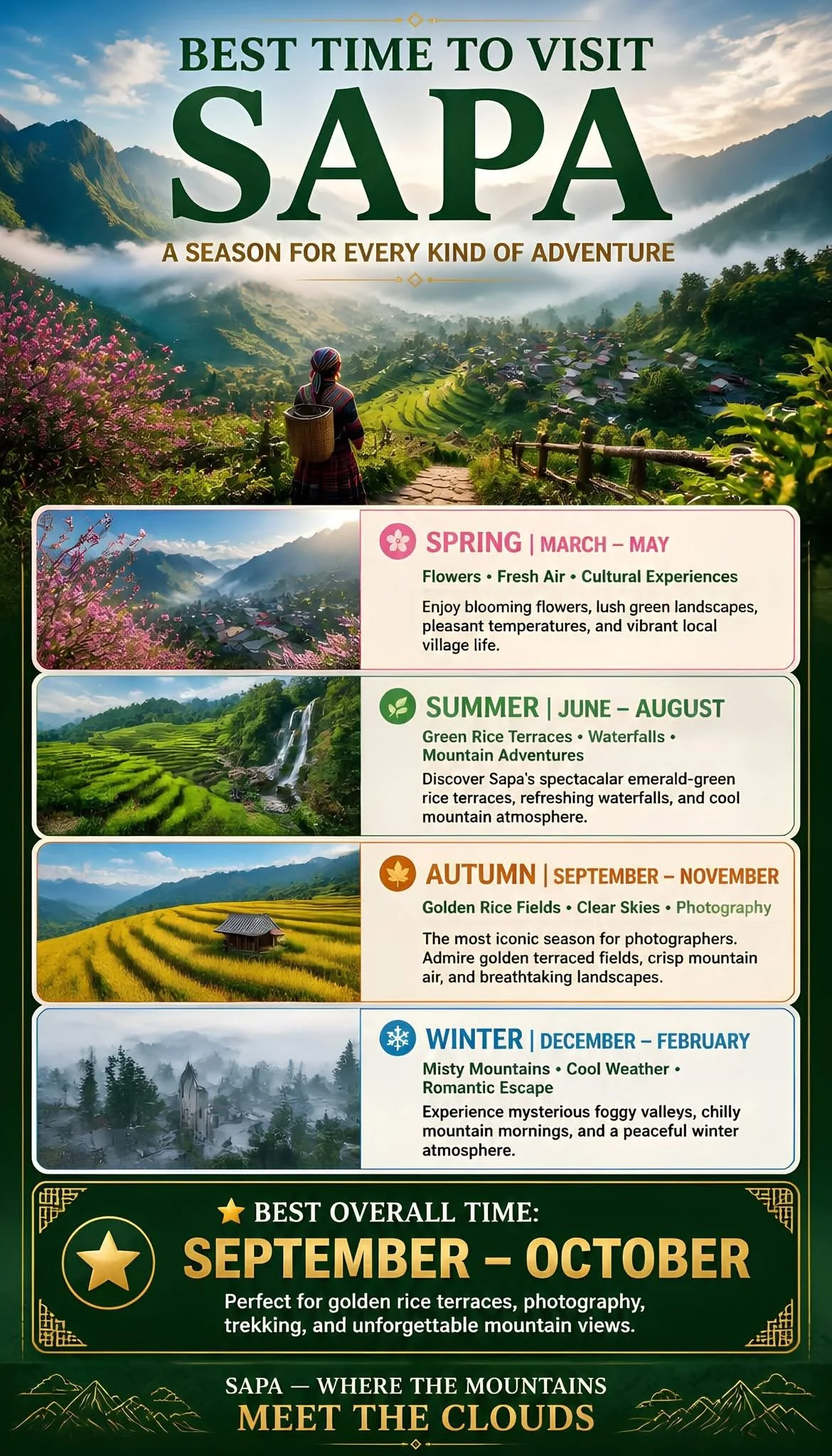
This AI-generated travel graphic produced by Happy Vietnam Tours is visually convincing, but contains several inaccurate or misleading claims about Sapa’s seasons, including the timing of the golden rice harvest. Presented with confidence and professional design, information like this is easily accepted as fact, copied by other websites and social media accounts, and then repeated again by AI. This is how travel misinformation can quickly become established as “common knowledge”, even when people living and working in the destination know it to be wrong.
This Is How Tourism Becomes Concentrated
The consequences extend far beyond whether somebody receives an unimaginative itinerary because recommendation systems influence where visitors physically go. When millions of travellers receive similar advice, tourism becomes concentrated into an increasingly narrow corridor of destinations, attractions and routes. This creates the familiar problems of overtourism, including traffic congestion, pressure on infrastructure, trail erosion, waste, noise, pressure on water supplies and increasing competition for land. It can also change communities themselves as restaurants, accommodation, shops and entertainment businesses begin replacing activities that previously served local residents.
There is also another form of carrying capacity that is sometimes overlooked, which is the capacity of the visitor experience itself. A mountain viewpoint may remain physically capable of receiving another thousand people while becoming considerably less enjoyable because every visitor is surrounded by hundreds of others. A village may still function while residents increasingly experience tourism as an interruption to everyday life, while a trail that originally offered quiet walking through agricultural landscapes can gradually begin to feel like a queue moving between commercial stops.
The number of visitors that can physically fit somewhere is therefore not the same as the number that can visit without changing the character of the experience. This is particularly important in Sapa because travellers frequently arrive expecting mountains, agricultural landscapes, village life, cultural learning and a sense of exploration, only to follow exactly the same routes as thousands of other people who have received almost identical advice.
They may subsequently conclude that Sapa itself is overcrowded, commercialised or no longer authentic when in reality they have experienced only a very small tourism corridor within an enormous and culturally diverse region. The destination has not necessarily reached its carrying capacity but the widely recommended version of the destination has.
Traveller Satisfaction Eventually Begins to Decline
There is a contradiction at the centre of mass tourism because the more successfully a place becomes promoted as a “must-see” destination, the greater the risk that the qualities making it desirable will eventually be damaged. A quiet mountain viewpoint becomes crowded, a village becomes a tourist attraction, a traditional house becomes a photograph opportunity, a walking trail becomes commercialised and a cultural interaction gradually becomes something repeated hundreds of times every day. Travellers then begin complaining that the destination has become too touristy, while continuing to follow the same recommendations that create the conditions they dislike.
Artificial intelligence accelerates this process because it allows travellers to receive very efficient answers without necessarily challenging the assumptions behind them. If the machine identifies the most famous attractions and constructs a logical route between them, the itinerary looks excellent from an information-management perspective even when it reproduces exactly the tourism concentration that is reducing visitor satisfaction. The system has successfully optimised the itinerary while potentially diminishing the journey. Travel suffers and experiences become less meaniful.
The Organisations Missing From AI Itineraries Tell Us Something Important
One of the most interesting features of Sa Pa tourism is that organisations such as ETHOS and other locally led trekking operators can receive consistently exceptional feedback from travellers while remaining absent from many generic AI itineraries.
This apparent contradiction becomes much easier to understand when we consider what these organisations actually provide. Our value is rarely based on moving the greatest possible number of people through the greatest possible number of attractions. Instead, our strongest experiences frequently depend upon local guides, smaller groups, personal relationships, flexibility, quieter routes, community knowledge and the ability to respond to what is happening on a particular day.
A good local guide will change the route because the weather has changed, spend longer somewhere because the traveller has become interested in a particular subject, introduce people encountered naturally along the way and explain details of the landscape that would otherwise appear completely ordinary. A rice terrace stops being simply a beautiful photograph and becomes part of a farming system. A village stops being an attraction and becomes somewhere people actually live. A Hmong or Dao guide stops being part of the visitor experience and becomes the person interpreting their own community. This produces a form of tourism that can be extraordinarily satisfying precisely because it remains difficult to standardise.
Small-Scale Tourism Has a Digital Disadvantage
There is therefore a troubling irony in the way artificial intelligence may influence future tourism. A sustainable tourism organisation can deliberately avoid large groups, limit the number of visitors entering particular communities, change routes to reduce pressure and distribute economic benefits across many families, yet every one of those decisions potentially reduces the amount of digital content the organisation generates.
The mass attraction receiving thousands of people produces thousands of photographs, reviews, social posts and booking transactions, while the organisation working with a handful of travellers in a quiet community generates relatively little online noise. The internet can consequently reward scale even when scale is precisely the problem that responsible tourism is attempting to manage.
There is also a classification issue because an AI system may easily understand that Fansipan is an attraction while categorising ETHOS as a business providing tours. When asked for “things to do”, the system may therefore prioritise places rather than the people capable of creating the experience. The traveller believes they asked for the best way to experience Sapa, while the machine may effectively answer with a list of the easiest Sa Pa entities to identify. Those are not remotely the same question.
Responsible Tourism Requires Better Questions
Artificial intelligence should not be dismissed as useless for travel because it can be extremely powerful when the traveller understands how to question it. The problem begins when somebody assumes that a generic question will produce a thoughtful answer.
If a traveller asks, “What are the best things to do in Sapa?”, the system is likely to rely heavily on popularity, visibility and conventional tourism information because it knows almost nothing about the values of the person asking. A more thoughtful traveller might instead ask for locally owned experiences, quiet villages, small-scale tourism, private guiding, cultural learning or alternatives to overcrowded attractions. They might ask which organisations employ guides from the communities being visited, how tourism income reaches local families, whether strangers are combined into large groups or how a company prevents particular villages and trails from receiving excessive numbers of visitors.
The quality of the answer can change dramatically because the traveller has changed the criteria by which the journey is being judged. This means the future travel skill may not simply involve knowing where to search, but knowing how to question the systems doing the searching.
Adventure Requires Leaving Space for the Unexpected
There is something deeply contradictory about travelling thousands of kilometres to encounter another culture while allowing an algorithm to decide exactly where we should stand, what we should photograph, what we should eat and how long we should spend in each place.
The uncertainty that modern travel technology increasingly attempts to eliminate has always been part of what made travelling interesting. Some of the experiences people remember most clearly were never included in an itinerary because they emerged from circumstances that could not have been planned in advance. A conversation lasted longer than expected, the weather changed, somebody suggested another route, a meal became an invitation, a road disappeared into somewhere interesting or the guide simply knew something better than the internet. These moments matter because they remind us that a destination is not a collection of products waiting to be consumed. It is a living place containing people, relationships, knowledge, histories and landscapes that existed before the traveller arrived and will continue after they have gone.
When AI, bloggers and influencers repeatedly direct visitors towards the same carefully packaged version of a destination, we risk losing more than quiet places because we gradually remove the uncertainty from travel itself.
The Answer Is Not to Stop Using AI
Artificial intelligence is not going to disappear from travel research, nor should it, because it can organise information brilliantly and make unfamiliar destinations much easier to understand. The challenge is knowing where its knowledge ends. A system capable of analysing millions of webpages may know considerably more facts about Sapa than any individual person, while still understanding substantially less about what it feels like to live, work and travel within the region. That distinction will become increasingly important as travellers place greater confidence in AI-generated itineraries.
For organisations such as ETHOS, the response will never be to imitate the mass-tourism model simply because that model performs well online. Small-scale, locally led and community-based tourism has value precisely because it resists some of the pressures created by volume, standardisation and concentration.
The challenge is therefore to make those alternatives easier for travellers and artificial intelligence to discover without turning them into the very products they were created to avoid. Travellers may choose continue using AI, but they might use it as the beginning of their research rather than the end of it, while remaining prepared to question recommendations, look beyond the most frequently mentioned attractions and seek knowledge from people who have actually spent enough time in a place to understand it.
The greater danger is that millions of people will receive increasingly similar recommendations, travel increasingly similar routes and eventually mistake that repetition for exploration. If that happens, destinations may become easier than ever to visit while becoming progressively harder to discover.
Real Travel Needs a Kickback
If this trend is going to change, travellers need to push back against the idea that the most visible, most photographed and most frequently recommended experiences are automatically the best ones. For a concientious travellers, they are almost certainly not. AI, influencers and travel blogs are increasingly sending people towards the same places, using the same sources and repeating the same recommendations. Reversing that trend requires travellers to become more critical and stop treating digital visibility as expertise. Spending two days in a destination and publishing an “ultimate guide” does not create local knowledge, while a large social-media following does not make somebody an authority on the culture, environment or communities they are describing. Real expertise comes from time, relationships, repeated experience and a willingness to understand complexity.
Travellers can help protect that expertise by deliberately searching for local guides, community organisations, independent businesses and people who have long-term knowledge of a destination. When those experiences are good, thoughtful reviews and recommendations matter because they help genuine local voices remain visible in a digital environment that naturally favours scale and repetition.
Most importantly, leave some space in the journey for things that were never included in the original plan. A good local guide should be able to change the route, recommend somewhere better or introduce an experience that an algorithm could never have predicted. Real travel will survive if travellers choose depth over volume, local knowledge over online popularity and genuine discovery over another recycled checklist.
If we want travel to remain adventurous, meaningful and worth doing, we need to stop allowing algorithms and temporary visitors to decide what a place is for us.
When “Instagrammable” Became a Travel Value
Few words reveal more about the direction modern travel has taken than the adjective “Instagrammable”. It appears constantly in travel blogs, social-media posts, hotel descriptions and destination guides, usually presented as though it were an entirely positive quality, yet the word itself deserves far more scrutiny because it reduces a place to a single question: how effectively can this location be used as a backdrop for somebody else’s image?
From our perspective at ETHOS, it is one of the laziest and most superficial words in contemporary travel writing because it tells us almost nothing about the place itself. It does not tell us whether somewhere is historically important, culturally significant, environmentally interesting, locally owned, ethically managed or even genuinely enjoyable to visit. It simply tells us that somebody believes the location photographs well on a particular social-media platform.
There is something almost insulting about reducing a destination in this way because the word quietly shifts attention away from the place and towards the person standing in front of it. The landscape, building, village or cultural setting stops being the subject and becomes scenery, while the traveller becomes the centre of the experience and the value of the location is increasingly judged according to how successfully it can support a photograph of them.
That shift matters because describing somewhere as “Instagrammable” does not merely report what visitors are already doing. It helps attract a particular type of behaviour. Once a place becomes known primarily as somewhere to create beautiful social-media content, increasing numbers of people arrive with the photograph already imagined before they have even seen the location for themselves. Their principal objective is no longer necessarily to understand where they are, but to reproduce the image that convinced them to come.
The photograph then becomes both the product and the proof. It demonstrates that the traveller was there, that they had access to the experience and, increasingly, that their life contains the sort of moments other people are expected to admire. Social media has made this kind of validation extraordinarily powerful because travel can now be performed publicly, with destinations used as evidence of lifestyle, status, beauty, freedom or success.
There is nothing wrong with wanting a good photograph, and almost everybody who travels takes pictures they are proud of, but there is an important difference between photographing an experience and travelling primarily in order to manufacture the photograph. When the latter becomes the dominant purpose, the destination risks becoming secondary to the image created there.
Moana May Be Sapa’s Clearest Example
Moana provides perhaps one of the clearest examples of this form of tourism in Sa Pa because much of its appeal is built around constructed photographic opportunities rather than any particular relationship with the history, landscape or culture of the region.
On a busy weekend, visitors can negotiate traffic congestion simply to reach the attraction, queue to purchase an entrance ticket and then join another queue for one of a number of carefully designed selfie locations. At the front of each line is essentially the same promise: stand in the designated position, find the correct angle, adopt the right pose and produce the photograph that brought you there in the first place. What makes the experience particularly strange is that almost everybody waiting is preparing to make essentially the same image as the person immediately ahead of them, while the person behind them is waiting to do exactly the same thing again.
There is very little discovery involved because the photograph has already been conceived, composed and demonstrated online thousands of times before the visitor arrives. The location tells them where to stand, social media has shown them how other people posed, and the queue confirms that the same image continues to be desirable. What presents itself as individual expression therefore becomes something remarkably close to mass replication.
The visitor takes the photograph and then moves to the next constructed photo opportunity, where another queue has formed and another almost identical process begins. A few metres later there may be another platform, sculpture, viewpoint or installation, followed by another pause while everybody waits for their turn to create the next piece of content.
These people are, quite literally, queuing for content.
The irony is difficult to ignore because social media is supposed to allow people to express something individual about their lives, yet the pursuit of the perfect travel image increasingly produces exactly the opposite. Everybody searches for the unique photograph by standing in the same place, following the same pose, using the same composition and reproducing the same visual language as thousands of people before them. The result is not individuality but conformity presented as individuality.
What Has the Place Itself Got to Do With It?
The deeper concern is what disappears when this becomes a dominant way of travelling. A location may have extraordinary histories, communities, agricultural systems, languages, beliefs, traditions and relationships with the surrounding landscape, yet none of those things are necessary for an “Instagrammable” attraction to succeed. In fact, the attraction can function perfectly well without them because its purpose is not necessarily to help visitors understand the destination. It needs only to provide an attractive background.
This is particularly striking in Sa Pa, where the surrounding mountains contain generations of knowledge relating to farming, textiles, medicinal plants, forest use, water management, architecture, religion and community life. A visitor could spend days asking questions and still understand only a fraction of what they were seeing, yet an entire tourism experience can instead be constructed around a handful of artificial photographic sets that require almost no engagement with any of it. A traveller can consequently return home with hundreds of attractive photographs of Sa Pa while having learnt almost nothing about Sa Pa. That should concern anybody who believes travel has value beyond entertainment.
The Algorithm Loves This Kind of Tourism
The most troubling part is that this behaviour is exceptionally well suited to the digital systems now shaping travel. An attraction designed around photographs generates photographs. Those photographs generate posts. The posts generate engagement. Engagement generates visibility. Visibility creates more visitors. Those visitors create more photographs, and the cycle begins again.
From the perspective of an algorithm, the attraction looks extraordinarily important because it generates an enormous amount of measurable activity. It appears repeatedly in photographs, captions, videos, blogs, reviews and travel itineraries, giving artificial intelligence an ever-growing volume of evidence suggesting that this must be one of the essential things to experience in Sa Pa.
Meanwhile, a visitor who spends six hours walking through a farming community with a local guide may take relatively few photographs and publish nothing at all. They may learn about rice cultivation, medicinal plants, family relationships, land use, migration, language and cultural change, yet almost none of that experience becomes visible to the systems measuring what travellers apparently value.
The shallow experience therefore leaves an enormous digital footprint, while the deeper one may leave almost none. This is precisely why online popularity should never be confused with significance.
When Validation Becomes the Destination
Perhaps the hardest question is why so much effort is being invested in proving that we have experienced something rather than simply experiencing it. Travel has always contained an element of status, and people have always returned home with photographs and stories, but social media has transformed that impulse into a permanent public performance in which every journey can be evaluated through likes, comments, followers and engagement.
For some travellers, the destination increasingly becomes a stage upon which a carefully edited version of their life is performed. The photograph says that they were adventurous, successful, attractive, cultured or free, while the audience provides the validation that gives the image value. Once that becomes the objective, the quality of the actual experience becomes strangely secondary. A person can spend forty minutes in traffic, another twenty minutes purchasing a ticket and another twenty waiting in line for a photograph that takes thirty seconds to create, yet consider the experience successful because the final image performs well online.
There is an uncomfortable absurdity in that exchange because enormous amounts of time, energy and infrastructure are being devoted to creating evidence of an experience rather than to making the experience itself worthwhile.
Surely Travel Can Still Mean More Than This
None of this is an argument against photography, social media or enjoying beautiful places. It is an argument against allowing the photograph to become more important than the place, and against allowing a destination to be judged principally according to how efficiently it can be converted into content.
At ETHOS, we still believe there should be room in travel for places that are difficult to photograph, conversations that are never recorded, experiences that cannot be compressed into fifteen seconds and moments that remain valuable even when nobody else knows they happened. There should still be value in travelling somewhere because we are curious rather than because we already know what photograph we want to bring home. There should still be value in leaving a destination knowing more than we did when we arrived.
When thousands of people are prepared to queue to reproduce exactly the same photograph at exactly the same constructed location, before moving onwards to queue for the next one, it is reasonable to ask whether something important has been lost in our relationship with travel. If the ultimate ambition is simply to stand where everybody else has stood, pose how everybody else has posed and produce the same proof that everybody else has already produced, then perhaps the question is not whether a place is sufficiently “Instagrammable”. Perhaps the more important question is whether this is really the best use we can make of the extraordinary privilege of being able to travel at all.
If You Want to Experience Sapa Differently
For travellers who recognise themselves in this argument, the answer is not necessarily to avoid the famous places or reject technology altogether, but to make room for experiences that are shaped by people who actually know the landscape. This means looking beyond the standard itinerary and seeking out local guides, community organisations and smaller operators who can respond to weather, seasons, farming activity, local events and the interests of the people travelling with them.
This is the approach we have followed at ETHOS for many years. Rather than building experiences around a fixed checklist of attractions, we work with local guides and families to create private journeys through northern Vietnam that can involve walking, motorbike travel, homestays, textiles, food, farming, traditional knowledge or simply spending time with people and understanding the places through which you are travelling. Our current experience programme is deliberately built around the idea that a journey should begin with curiosity rather than a list of compulsory stops, with options ranging from quiet treks and homestays to textile workshops, food experiences and longer journeys through lesser-visited parts of northern Vietnam.
If that is the kind of travel you are looking for, you can explore the different ways of travelling with ETHOS here: Create Your ETHOS Experience
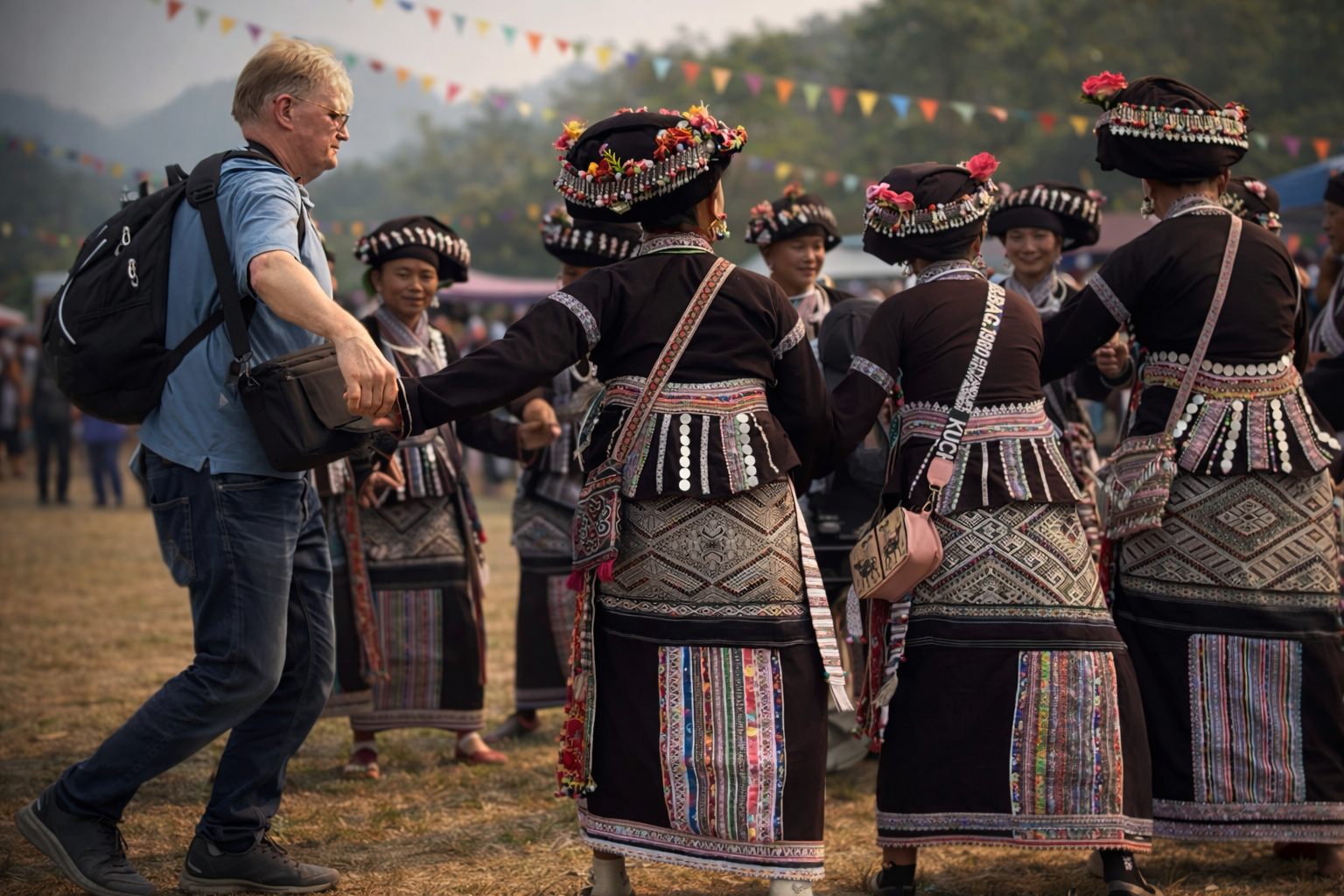
British traveller, Edward joins members of a Lao ethnic community during an annual traditional dance festival in northern Vietnam. Experiences like this rarely appear in standard itineraries, travel blogs or AI-generated guides because they are not packaged as permanent tourist attractions. They depend on local relationships, timing and knowledge of what is actually happening within a community, which is precisely why meaningful travel cannot always be planned from the most visible information online.
Building the Future of Community-Based Tourism in Northern Vietnam
For more than twenty-five years, ETHOS has believed that responsible tourism should create lasting opportunities for local communities. Our new apprenticeship programme is the next step in that journey, combining education, professional training and community leadership to help prepare the next generation of women working in community-based tourism across northern Vietnam.
For more than twenty-five years, ETHOS has believed that tourism can and should create something more meaningful than a memorable journey. Visitors may come to northern Vietnam for the mountains, the rice terraces, the villages and the extraordinary cultural diversity of the region, but the value of travel should not end when a visitor returns home. At its best, tourism can create employment, strengthen confidence, support education and allow local people to play a central role in deciding how their communities are represented.
This belief has guided ETHOS from the beginning. It has influenced the way we design our journeys, the way we work with local families and the way we support the people who guide, host and teach our visitors. It has also shaped our understanding of what community-based tourism should become over time. Responsible tourism cannot remain fixed while the communities around it change. It must continue to respond to new needs, new ambitions and new opportunities.
The ETHOS Apprenticeship Programme has grown from that understanding. It is not separate from our work in community-based tourism, nor is it an additional project placed alongside our tourism activities. It is the next stage of a commitment that has been developing for many years: a thirty-month investment in education, professional development and local leadership for three young women from the mountain communities of northern Vietnam.
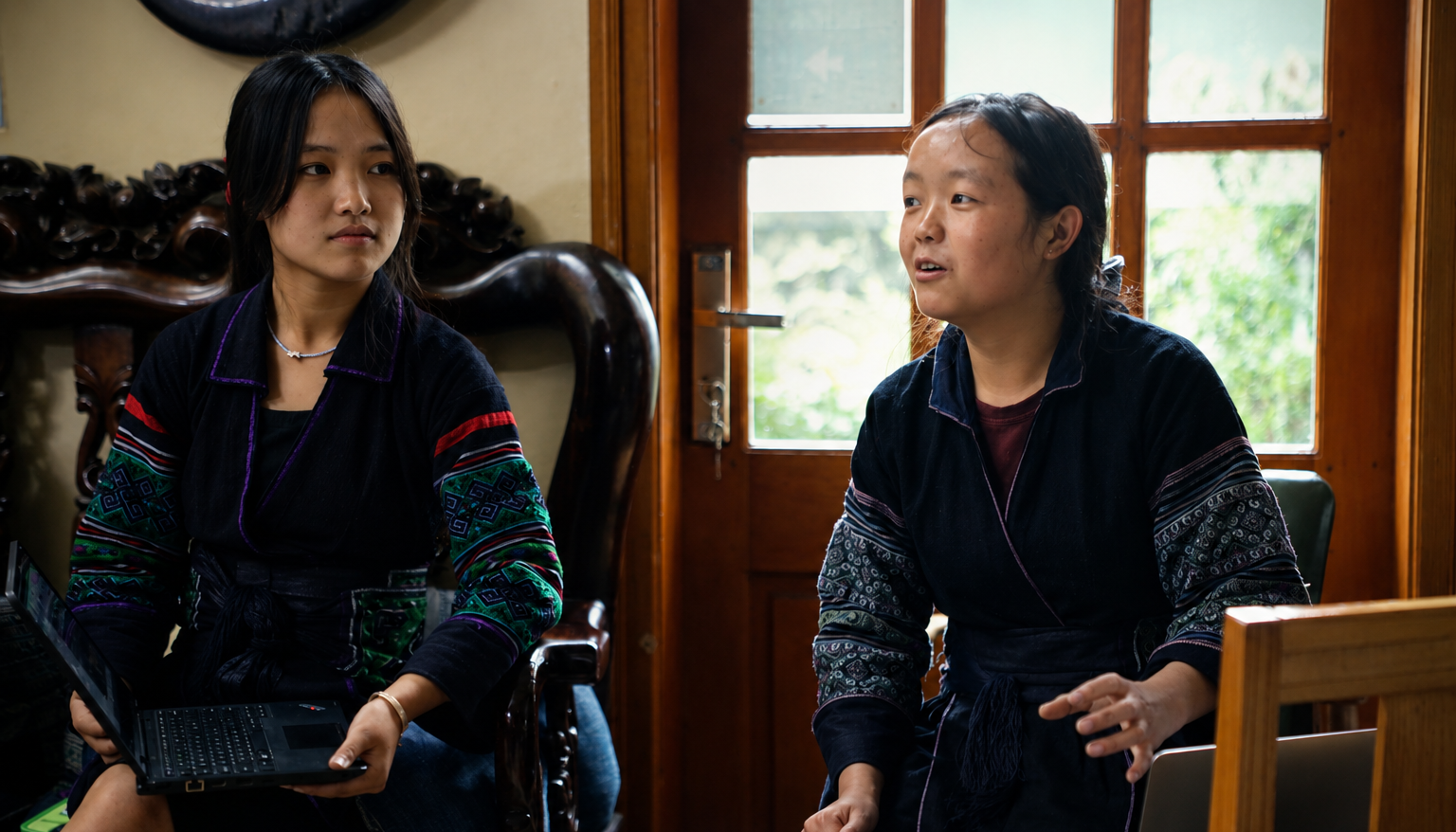
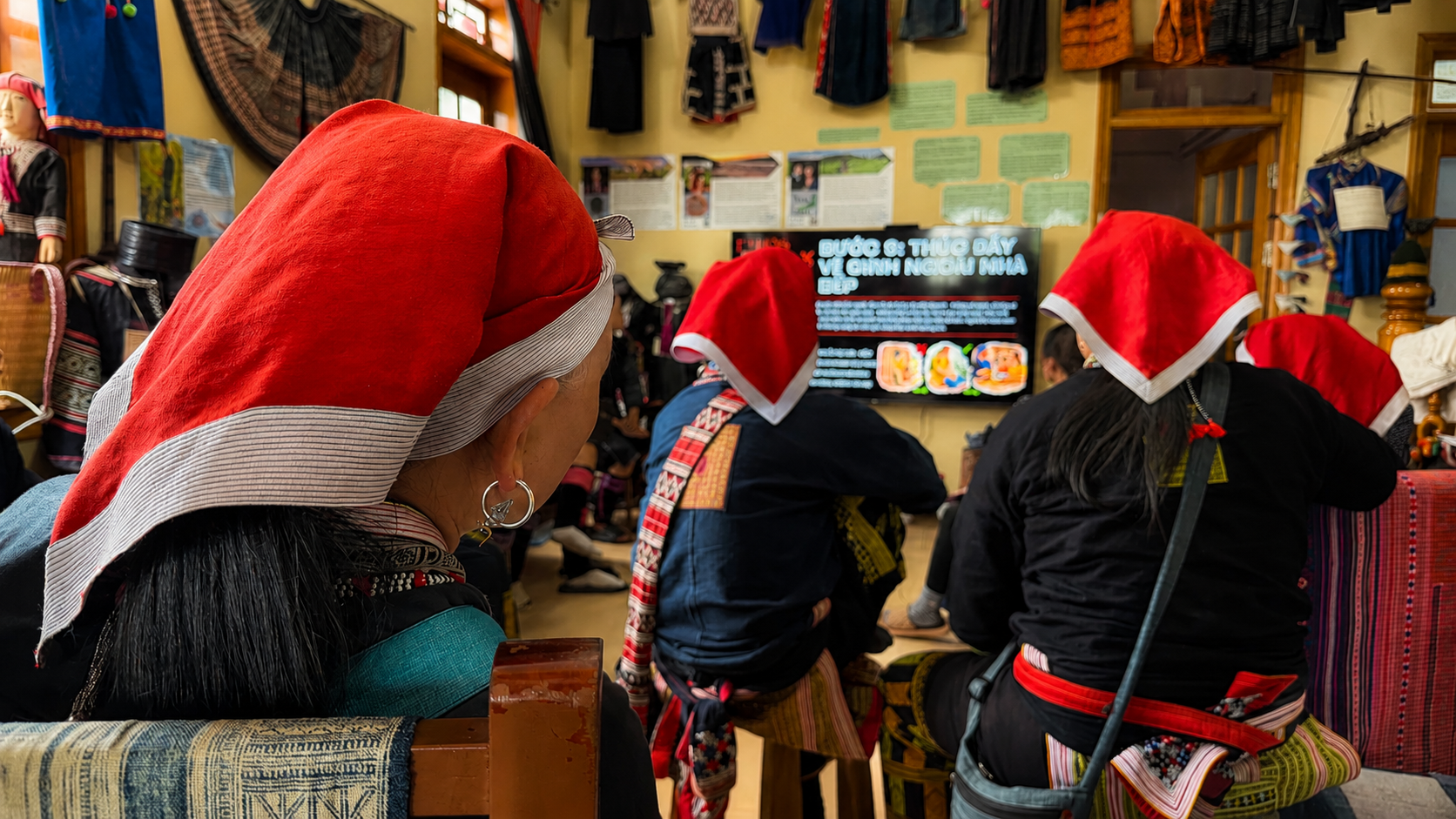
Cha and Do, two Hmong youth leaders from the ETHOS team, speak during a staff seminar about food hygiene and food safety. The image shows local women taking active roles in professional learning, community education and team development.
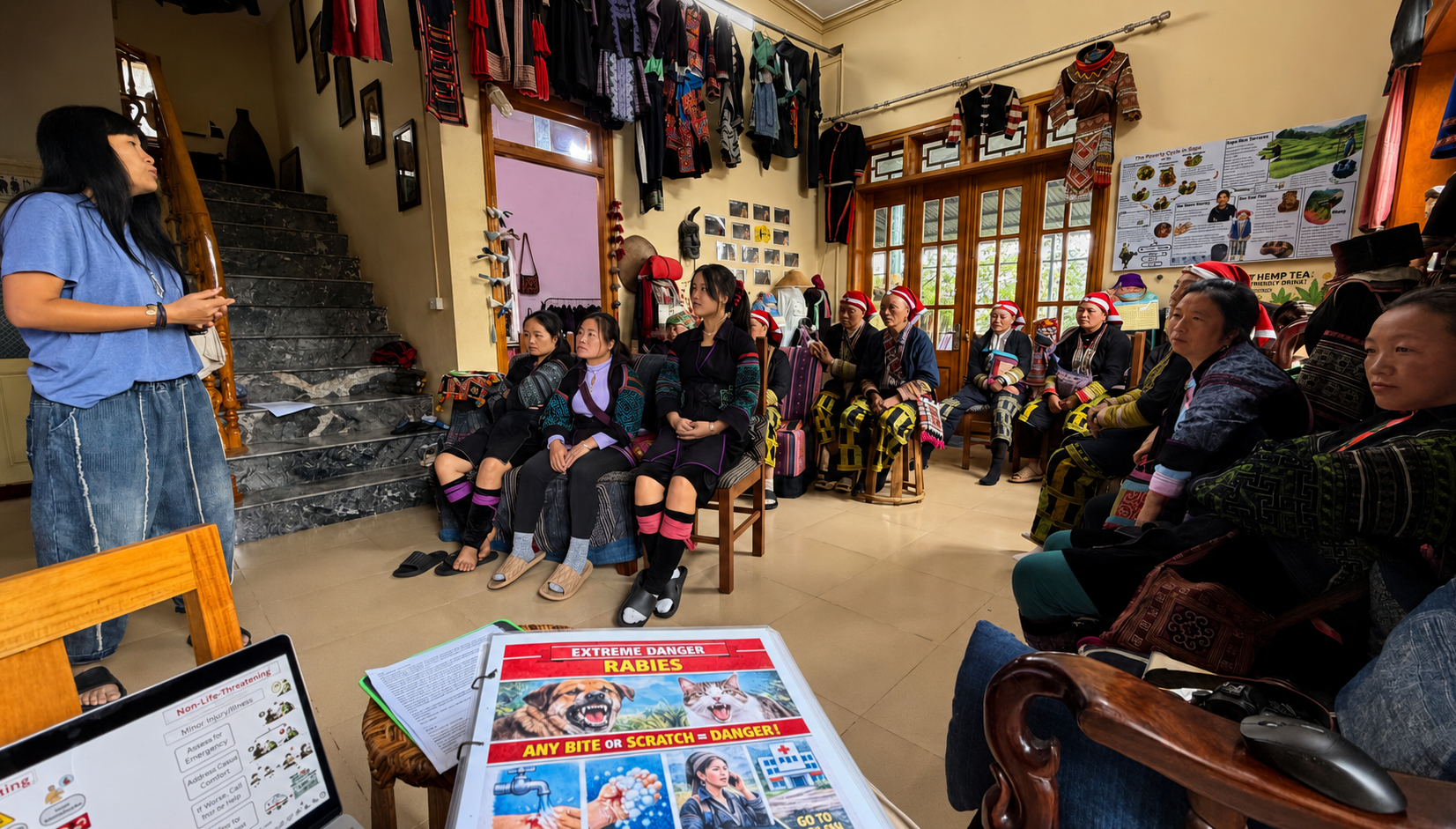
ETHOS Team Director Mai Thanh Hoa speaks with the local guide team during a planning meeting for 2026. The photograph reflects the collaborative, women-led approach through which ETHOS develops training, community initiatives and responsible tourism programmes.
Community-Based Tourism Is About More Than Where Visitors Stay
The phrase community-based tourism has become increasingly familiar across the travel industry. It is often used to describe village accommodation, homestays, cultural activities or locally owned tourism businesses. These may all contribute to a more responsible form of travel, but none of them alone is enough to make tourism genuinely community based.
The more important questions concern power, participation and long-term benefit. Who decides how tourism is developed? Who receives the income it creates? Whose knowledge is presented to visitors, and who controls the way that knowledge is interpreted? Does tourism create stable opportunities for local people, or does it simply bring visitors into a community without allowing that community to shape the experience?
At ETHOS, our approach has always been built around relationships rather than volume. We work alongside Hmong, Red Dao, Giáy, Tày and other ethnic communities to create private travel experiences rooted in local knowledge and genuine personal connection. Our guides are not performers asked to present a simplified version of their culture. They are farmers, parents, storytellers, craftspeople, cultural interpreters and community members whose knowledge has been shaped through lived experience.
This distinction matters. Tourism can easily turn culture into something staged for an audience, particularly when visitors are moved quickly through the same villages or introduced to experiences designed primarily for commercial convenience. Community-based tourism should resist that tendency. It should allow local people to determine what they wish to share, what requires permission and what should remain private. It should recognise that culture is not a product and that local knowledge does not automatically belong to visitors simply because they have paid for an experience.
Over the years, ETHOS has supported more than 120 local families through tourism, created long-term employment for guides and developed educational, health and community initiatives alongside our travel work. The apprenticeship programme grows from the same philosophy. It asks how the benefits of tourism can extend beyond immediate employment and contribute to the education, confidence and professional development of the next generation.
Our wider approach is explored in greater depth on our page about community-based tourism in northern Vietnam, where we explain how local decision-making, fair economic distribution and cultural integrity shape the way ETHOS works.
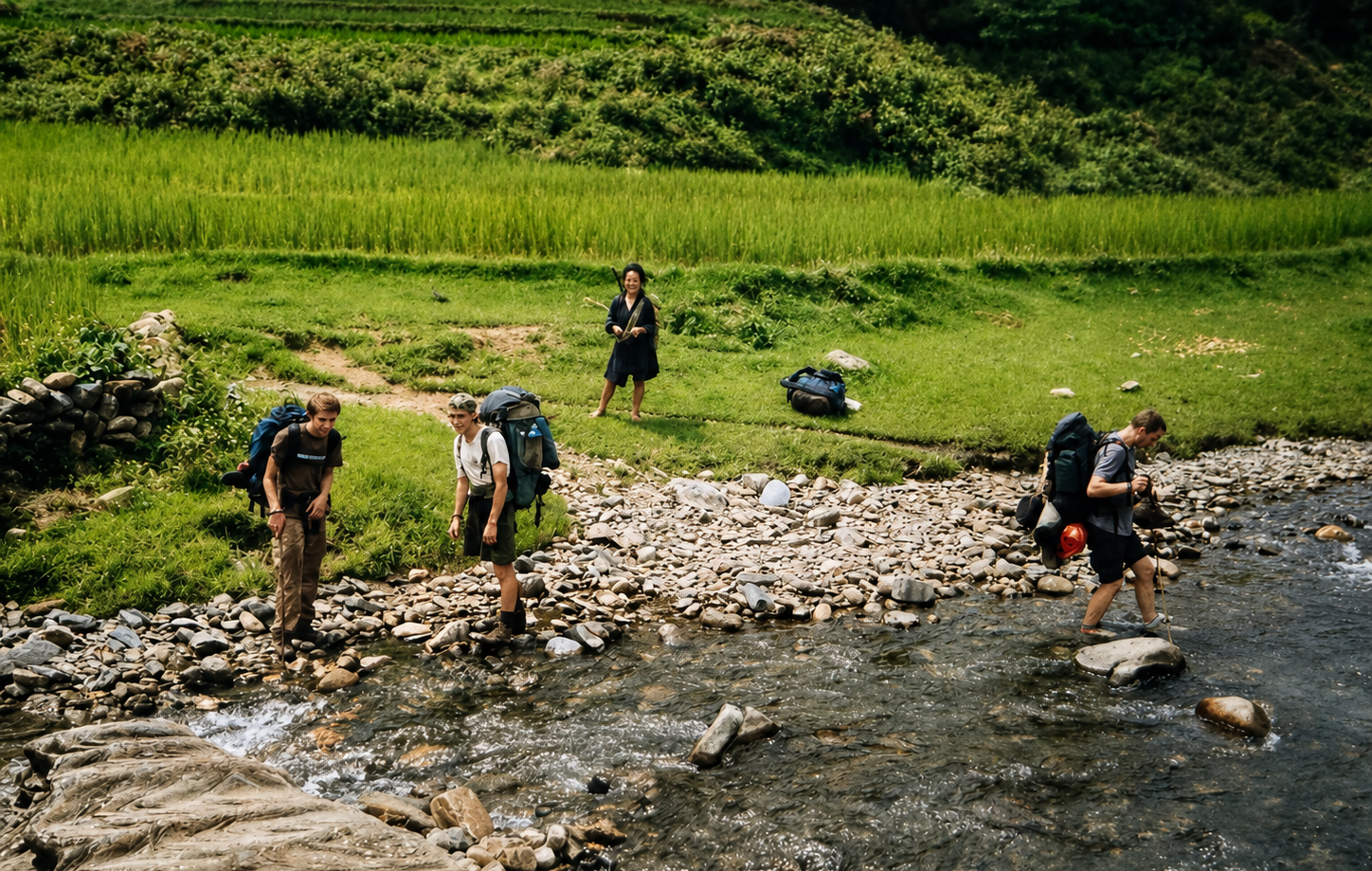
ETHOS guests cross a shallow mountain stream with their local guide while trekking through the green countryside near Sa Pa. The image reflects the small-group, locally guided and landscape-focused nature of ETHOS journeys.
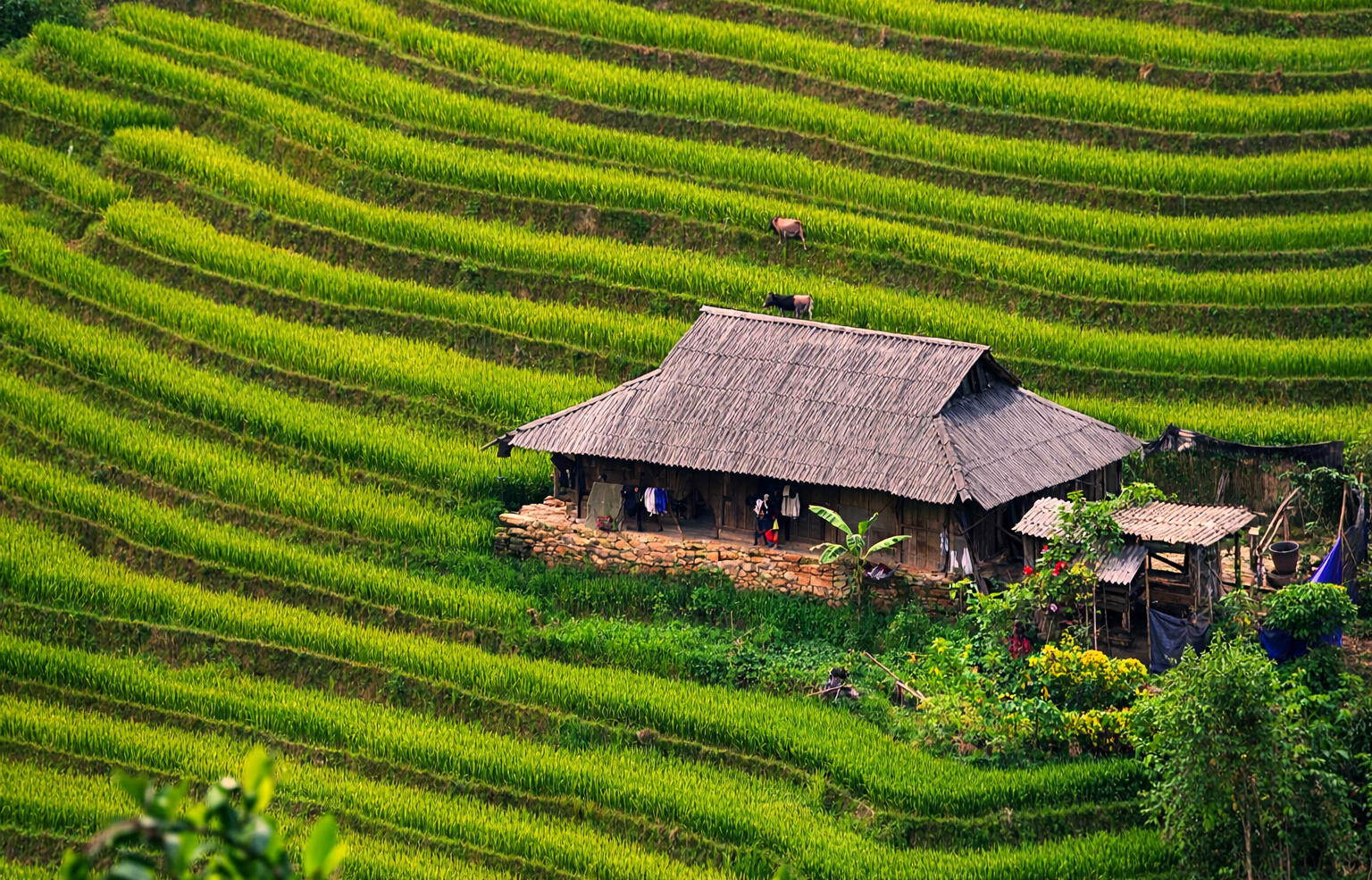
A traditional Hmong family home stands among vivid green rice terraces in the mountains around Sa Pa. The photograph represents the genuine local homes and agricultural landscapes that form part of ETHOS community-based tourism experiences.
Why We Created the Apprenticeship Programme
Many young women in the mountain communities of northern Vietnam complete school with intelligence, determination and a wide range of practical abilities, yet still find themselves without a clear route into further education or professional employment. The barriers are rarely limited to tuition fees. Distance, accommodation, transport, food and the daily costs of living away from home can make continued study impossible, particularly for families already balancing numerous responsibilities.
Professional networks are also limited. Young people growing up in remote communities may have little access to mentors, training opportunities or examples of people from similar backgrounds entering professional roles. Families are often required to make difficult decisions about which educational opportunities they can afford to support, and even where formal study is available, there may be no practical pathway connecting a qualification to stable employment.
At the same time, the knowledge these young women already possess is often underestimated. They may speak several languages, understand farming and forest environments, recognise plants and seasonal changes, care for younger relatives, prepare traditional textiles or manage complex household responsibilities. They may know how to respond to mountain weather, how to identify useful plants, how to prepare food from limited ingredients or how to move between different cultural and linguistic settings.
These abilities are not evidence that they are beginning without education. They are evidence of learning shaped by family, work, culture and community. The problem is not that such knowledge lacks value. The problem is that it is rarely recognised within formal systems or connected to professional opportunities.
The ETHOS Apprenticeship Programme was created to bridge that gap. Its purpose is not to replace what the apprentices already know, nor to suggest that formal education is inherently more valuable than knowledge inherited through family and community. Instead, it brings these different forms of learning together. Existing strengths are connected with English, professional communication, digital skills, formal tourism education, safety training, leadership and recognised qualifications.
This is an important distinction. The programme is not designed to move the apprentices away from their identities or encourage them to become generic tourism professionals. It is intended to help them understand the value of what they already bring, develop the confidence to use that knowledge in wider professional settings and create futures that remain connected to family, culture and place.
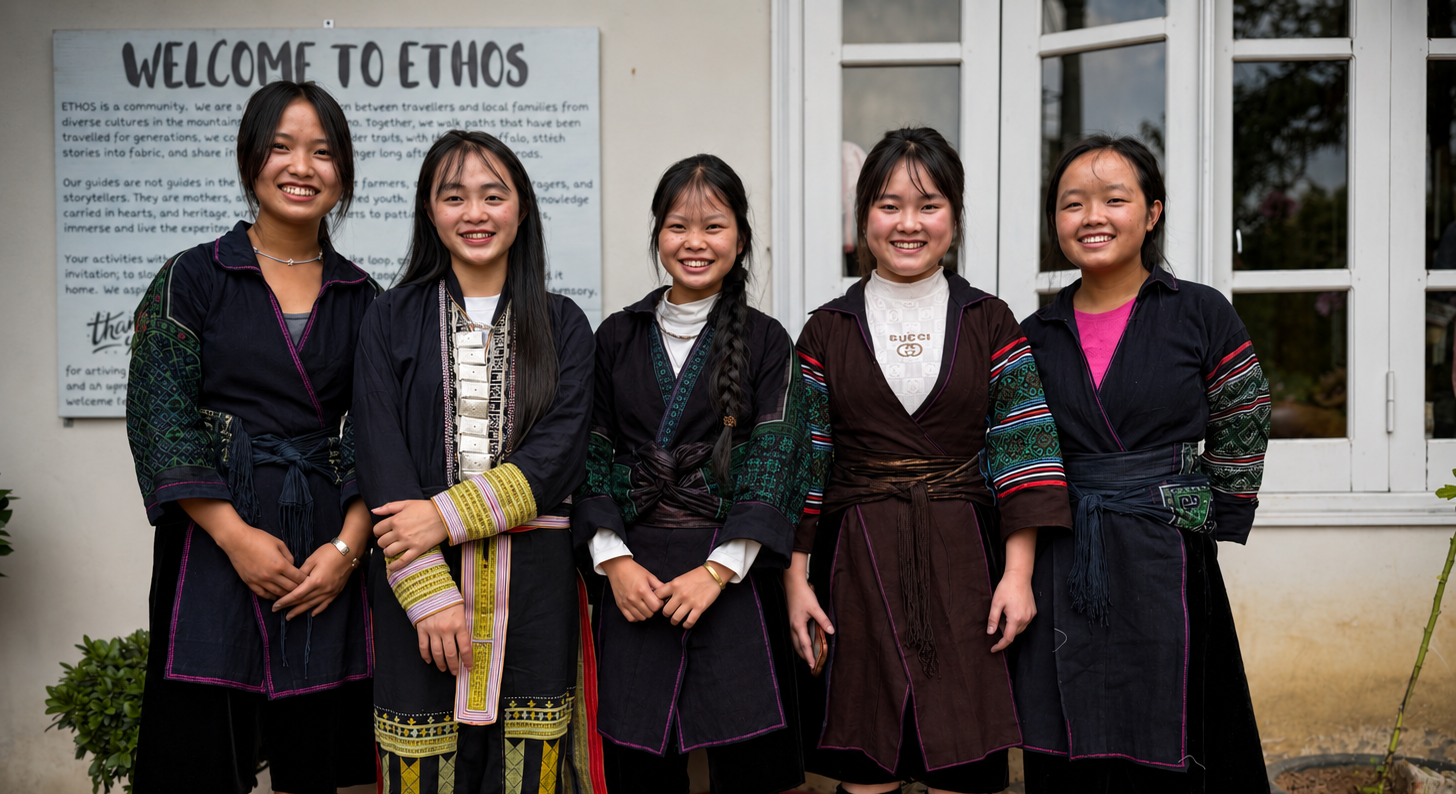
ETHOS Youth Leaders Cha and Do with the first ETHOS apprentices, Ta May, Sinh and Pang. Together they represent the next generation of community leaders in northern Vietnam.
A Thirty-Month Commitment
The apprenticeship will run for thirty months, beginning in September 2026 and continuing until early 2029. It combines formal study with structured ETHOS training, supervised workplace experience, field learning and long-term mentoring.
The length of the programme is deliberate. Confidence cannot be created through a single workshop, and professional competence cannot be measured only through classroom attendance. English develops through repeated use in ordinary situations. Judgement improves when someone has the opportunity to encounter real challenges, reflect upon them and try again. Leadership grows gradually as responsibility increases and experience begins to replace uncertainty.
Short courses can be valuable, but they cannot provide the continuity required for this kind of development. The apprenticeship has therefore been designed around time, repetition and sustained support. The apprentices will attend lessons and receive certificates as well as living, studying and working within an environment where learning becomes part of everyday life.
Throughout the programme, they will share a common educational foundation, but they will not be expected to become identical. Each young woman will develop her own interests, strengths and professional direction. One may become particularly drawn towards guiding and field leadership, while another may discover an interest in cultural interpretation, hospitality, photography, education, digital communication, enterprise or community work.
The purpose of the programme is not to prescribe a single future. It is to create informed choices. By the end of thirty months, each apprentice should have a clearer understanding of what she does well, what kind of work she wishes to pursue and how she can continue developing after the formal programme has ended.
Learning Beyond the Classroom
The ETHOS curriculum includes more than 480 hours of structured education and specialist training. It begins with the foundations of professional behaviour, communication and learning, before moving into tourism, digital skills, visual communication, safety, guiding, entrepreneurship, management and leadership.
English and professional communication will continue throughout the programme. The apprentices will use language not only in formal lessons but in visitor conversations, guiding practice, presentations, written communication, workplace discussions and daily routines. The aim is not simply to pass an examination, but to develop the confidence required to communicate independently and appropriately in different professional situations.
Digital learning will include computer use, file management, responsible artificial intelligence, photography, video, editing and visual communication. These skills are increasingly important within tourism, but they also have wider value. They allow the apprentices to document local knowledge, prepare educational materials, communicate with visitors, contribute to online projects and present their work in professional ways.
Responsible tourism, sustainability and cultural interpretation will form another central part of the programme. The apprentices will learn how to communicate culture without reducing it to performance, how to ask permission, how to recognise that some knowledge belongs to families or community authorities and how to protect information that should not be shared. They will also examine the environmental responsibilities of tourism, including waste, trail impact, water use, wildlife, local resources and the pressures created when too many visitors are concentrated in the same places.
Safety will be treated as a professional responsibility rather than an additional topic. Training will include first aid, risk assessment, mountain weather, navigation, route planning, emergency decision-making and guest care. These lessons will move gradually from controlled exercises into supervised professional practice, allowing confidence to develop alongside competence.
The later stages of the programme will focus more strongly on enterprise, tourism management, project planning and leadership. Each apprentice will eventually complete an integrated final project requiring research, budgeting, consent, safety planning, practical delivery, evaluation and professional presentation. This will allow them to demonstrate not only what they have learnt, but how they can apply it within a complex real-world task.
Learning will therefore take place across many different settings. Some lessons will happen at a desk, while others will happen in villages, on trails, in community workshops, during visitor briefings or through practical projects. The aim is to create an educational environment in which formal knowledge and lived experience continually reinforce one another.
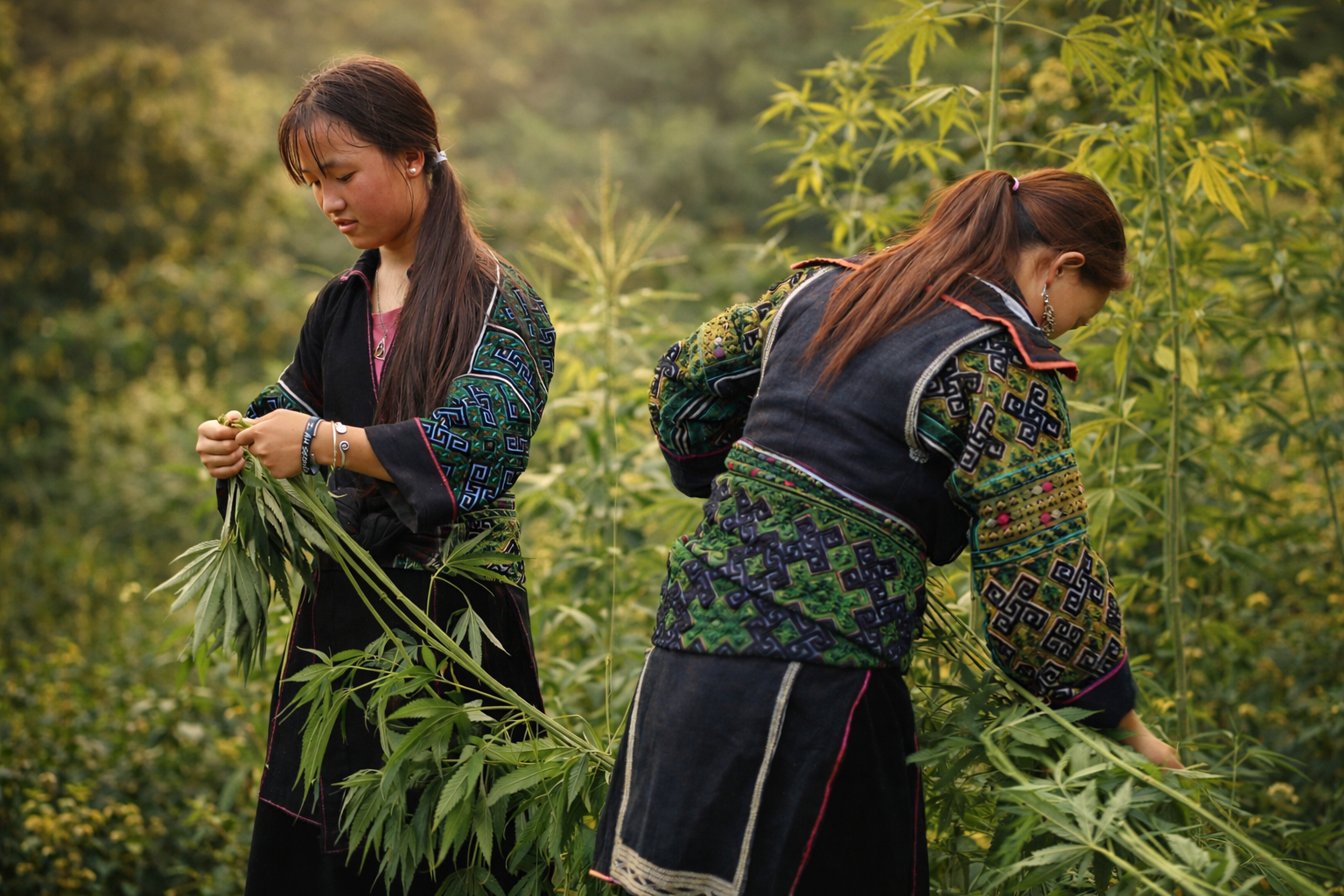
Harvesting hemp for traditional textile production. Knowledge such as this forms part of the cultural strengths the apprentices already bring to the programme.
More Than Qualifications
The programme is designed to prepare each apprentice for four significant educational and professional outcomes: a formal tourism qualification, a B2 English Certificate, an International Tourism Licence subject to the legal requirements in force when each apprentice becomes eligible, and the ETHOS Tourism Management Certificate.
These qualifications matter because they provide recognised evidence of academic knowledge, language ability, legal professional eligibility and workplace competence. They can open doors that might otherwise remain closed and give each apprentice a stronger position when applying for future employment or taking on greater responsibility.
However, qualifications alone are not the final purpose of the programme. The longer-term outcome reaches far beyond three certificates or three new tourism professionals. Pang, Ta May and Sinh are being prepared to become confident community leaders who can contribute to the wider work already undertaken by ETHOS and its local partners.
They may help deliver health and hygiene sessions, support human-trafficking awareness workshops, contribute to environmental projects, mentor younger people or assist with educational activities in their communities. They will learn how to stand in front of a group, explain difficult subjects clearly, listen carefully, manage responsibility and protect the dignity of others.
They will also become visible examples of what young local women can achieve when existing knowledge is recognised and opportunity is matched by sustained support. This matters in communities where educational and professional pathways may still feel distant or uncertain. The presence of a young woman who has completed formal study, developed professional confidence and remained connected to her community can influence expectations far beyond her own career.
In this sense, the apprenticeship programme is not only about preparing three individuals for employment. It is about gradually increasing the number of local women able to guide, interpret, teach, organise and lead within the region’s tourism economy.
Meet the Apprentices
The first intake brings together three young women whose backgrounds and ambitions are different, but whose willingness to learn is shared.
Lý Thị Pằng is a young Black Hmong woman from Pả Chư in Bát Xát. She became the only girl from her village to complete high school after years of boarding away from home and uncertainty about whether her family would be able to continue supporting her education. She also brings extensive practical knowledge of farming, foraging, hemp preparation, indigo, cooking and mountain life. Her story is not simply about overcoming difficulty. It is about connecting knowledge inherited through her family with new education and professional opportunity.
Through the apprenticeship, Pang hopes to improve her English, become more confident, develop digital and tourism skills and discover a career that allows her to support herself while remaining closely connected to her family and community.
Phàn Tả Mẩy is a young Red Dao woman from the Sa Pa area. She grew up learning independence, household skills and elements of forest and medicinal-plant knowledge from her mother and grandmother. Her development has been closely connected to confidence. Work outside the home helped her begin communicating with new people and gradually trust her own abilities.
Ta May hopes to become financially independent, travel more widely and help visitors understand Red Dao culture as living knowledge rather than simply clothing, decoration or performance. The apprenticeship will allow her to strengthen her English, communication, tourism and professional skills while exploring the direction that suits her best.
Sùng Thị Sinh is a young Black Hmong woman from Sử Pán, where her family’s life remains closely connected to farming, forests and the mountain environment. She brings determination, practical experience and a strong sense of responsibility towards her family. She is proud of her Hmong identity and wants visitors to understand the work, knowledge and meaning involved in traditional clothing and mountain life.
Sinh hopes to develop English, videography, photography, guiding and hospitality skills. Her ambition is not simply to leave her community in search of opportunity elsewhere, but to build a stable future while remaining connected to her family, culture and home.
Their stories include financial limitations, distance and restricted access to further education, but those circumstances do not define them. Each apprentice brings knowledge, relationships, humour, responsibility, curiosity and pride into the programme. Their backgrounds are part of who they are, but they will not be required to repeatedly disclose personal hardship in order to justify their place.
ETHOS will ask each apprentice to decide what she wishes to share, what requires permission and what should remain private. Their stories belong to them. The role of the programme is to create conditions in which they can develop, speak with confidence and make informed decisions about their own futures.
More detailed information about Pang, Ta May, Sinh and the full educational structure can be found on the ETHOS Apprenticeship Programme page.

Pang, one of the first three apprentices joining the thirty-month ETHOS Apprenticeship Programme.

Ta May, one of the first three apprentices joining the thirty-month ETHOS Apprenticeship Programme.

Sinh, one of the first three apprentices joining the thirty-month ETHOS Apprenticeship Programme.
What This Means for Community-Based Tourism in Sa Pa
Community-based tourism cannot depend indefinitely on the same small number of experienced guides, hosts and organisers. For it to remain strong, knowledge and responsibility must be transferred to younger people who understand both their own communities and the professional expectations of modern tourism.
This is one of the most important reasons the apprenticeship programme matters. It creates a structured pathway through which young local women can move from informal experience into professional roles without losing the cultural knowledge that gives those roles meaning.
Sa Pa has changed enormously during the years ETHOS has worked in the region. Roads, accommodation, visitor numbers and commercial development have expanded, while tourism has become an increasingly significant part of the local economy. Some of these changes have created opportunity, but they have also produced pressure. Cultural experiences can become standardised, villages can receive more visitors than they can comfortably manage and local people can be pushed into supporting roles while outside businesses retain control over how tourism is marketed and organised.
The long-term strength of community-based tourism therefore depends upon local leadership. It requires people who can communicate across cultures, understand safety and visitor expectations, protect community interests and make informed decisions about how tourism should develop. It also requires greater representation from women, particularly women whose knowledge of family life, agriculture, textiles, language and community relationships has often been undervalued within formal tourism structures.
The apprenticeship programme will not solve every challenge facing tourism in Sa Pa, nor should it be presented as though it will. Its value lies in creating one carefully supported pathway through which local knowledge and professional education can meet. If the model proves successful, it can inform future apprenticeships, create new mentors and gradually expand the number of people able to shape community-based tourism from within the communities themselves.
That is how the programme will advance ETHOS. It will strengthen our internal capacity, bring new perspectives into the organisation and allow younger local women to take on increasingly important roles in guiding, education, interpretation and programme delivery. At the same time, it will help protect the values upon which ETHOS was founded by ensuring that those values are not dependent only upon the current generation.
Looking Ahead
Community-based tourism should never stand still. As communities change, responsible tourism must evolve alongside them, responding not only to the immediate economic opportunities created by visitors but also to the long-term educational and professional needs of local people.
The ETHOS Apprenticeship Programme represents the next stage of that evolution. It is built on the same principles that have guided our work for more than twenty-five years: respect, partnership, cultural integrity, education and long-term commitment. It recognises that tourism can do more than create employment in the present. It can help prepare people to make decisions, lead organisations, represent their communities and create opportunities for others in the future.
Throughout the thirty months, ETHOS will share approved updates showing what the apprentices are learning, producing and achieving. These updates will include lessons, workshops, field visits, assessments, practical projects and professional milestones. We will also discuss difficulties honestly, recognising that meaningful education is rarely simple or perfectly linear and that progress includes uncertainty, mistakes, reassessment and growth.
Over time, the programme will become a record of three individual journeys and one shared educational commitment. It will show how Pang, Ta May and Sinh develop from the first days of the apprenticeship through to formal qualifications, greater professional responsibility and decisions about what comes next.
Their journey is only beginning. We hope it will contribute not only to their own futures, but also to a stronger, more thoughtful and more locally led form of tourism in Sa Pa and across northern Vietnam.
Readers who would like to explore the programme in greater detail can visit the ETHOS Apprenticeship Programme. Information about how the programme is financed is available separately on the Support the Programme page, allowing this article to remain focused on the educational purpose of the apprenticeship and its wider importance for community-based tourism.
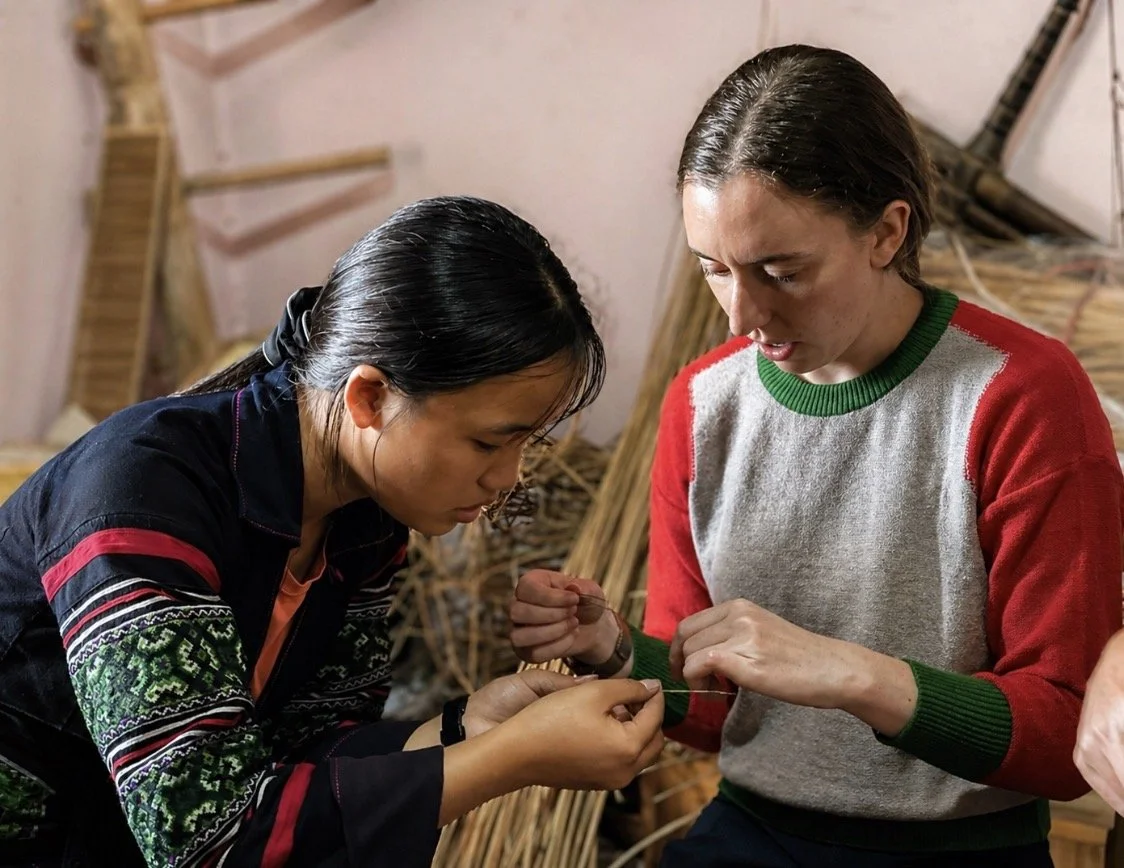
ETHOS Youth Leader Cha sharing traditional Hmong textile knowledge with a visitor at the ETHOS Community Centre, Sa Pa.
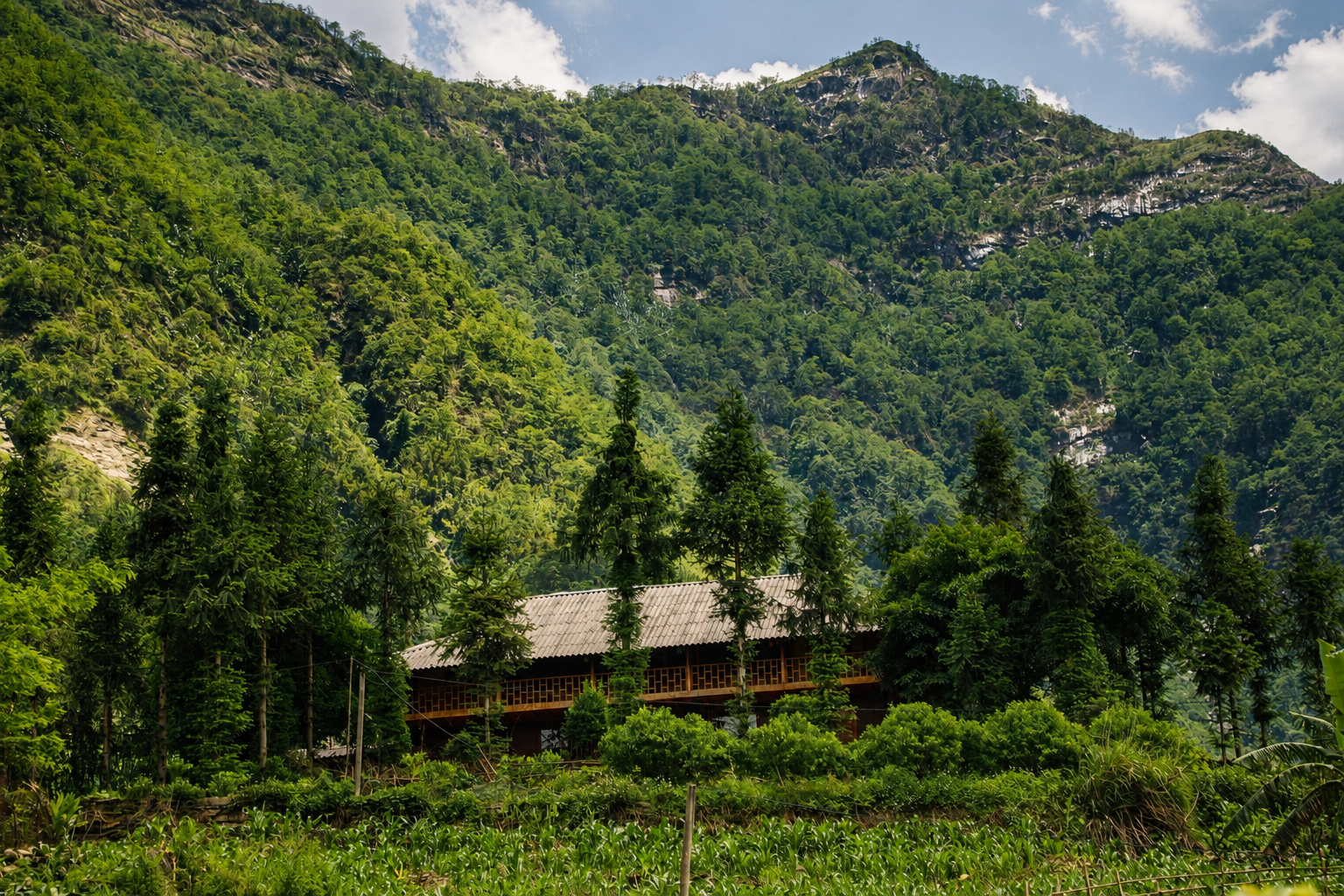
When Beauty Becomes Backdrop: Traditional Villages and the Future of Sapa
Beyond the bright lights and rapid construction of Sapa town lies a very different landscape. Across the wider valleys of Sapa district, traditional Hmong, Dao, Tày, and Giáy communities still live among rice terraces, rivers, forests, and mountain paths shaped by generations of careful adaptation to the land. Their homes were never built to dominate the mountains, but to belong within them.
This article explores the remarkable architecture and cultural traditions of northern Vietnam’s mountain villages, from smoke-darkened timber homes and flowing kitchen water systems to open-door hospitality and communal building practices. It also examines the growing tension between landscape-sensitive design and the rise of oversized tourism developments that increasingly threaten to overwhelm the natural beauty and cultural identity of the Muong Hoa Valley.
A Landscape Once Built in Conversation With Itself
For centuries, the valleys surrounding Sapa evolved slowly and almost quietly, shaped not by masterplans or speculative investment but by the rhythms of weather, farming, migration, and communal life. Villages appeared gradually along ridgelines and river valleys where water flowed cleanly, terraces could be carved into mountain slopes, and timber could be gathered sustainably from nearby forests. Homes did not seek attention. They belonged to the landscape rather than competing with it.
This relationship between settlement and environment is one of the reasons the Muong Hoa Valley became so internationally admired in the first place. Traditional Hmong and Dao villages never attempted to dominate the mountains. Their houses sat low against the earth beneath bamboo groves and fruit trees, partially hidden within mist, terraces, and forest edges. Rooflines followed the contours of hillsides. Building materials weathered naturally into the surrounding terrain. Smoke drifted gently from darkened roofs during cold evenings while water channels moved quietly through kitchens and gardens. What visitors experienced here was was harmony. Architecture, agriculture, spirituality, and ecology existed in conversation with one another.
Today, however, that relationship is under increasing pressure. The mountains themselves are not disappearing, nor are the communities who continue to live among them. What is increasingly at risk is the sense of balance that once defined the valley, as natural beauty becomes steadily swamped by commercial spectacle, oversized tourism developments, and architecture designed more for visibility and prestige than belonging. Across Sapa, enormous tourism developments are transforming valleys once defined by subtlety and restraint into landscapes increasingly shaped by spectacle, prestige, and commercial ambition. Concrete ridgelines rise above terraces. Mega-projects compete for visual dominance. Mountain views become marketing assets rather than shared cultural landscapes. Yet this is not a simple story of old versus new. Sapa does not need to remain frozen in time. Good contemporary architecture is entirely possible here. Some newer homestays, ecolodges, and community-led projects are attempting to build differently, designing structures that still respect scale, terrain, local material traditions, and the visual integrity of the mountains themselves.
The real question is therefore not whether development should happen, but what kind of development deserves to shape the future of the valley. How can Sapa thrive as an example of top level Community-based tourism experiences in Northern Vietnam?
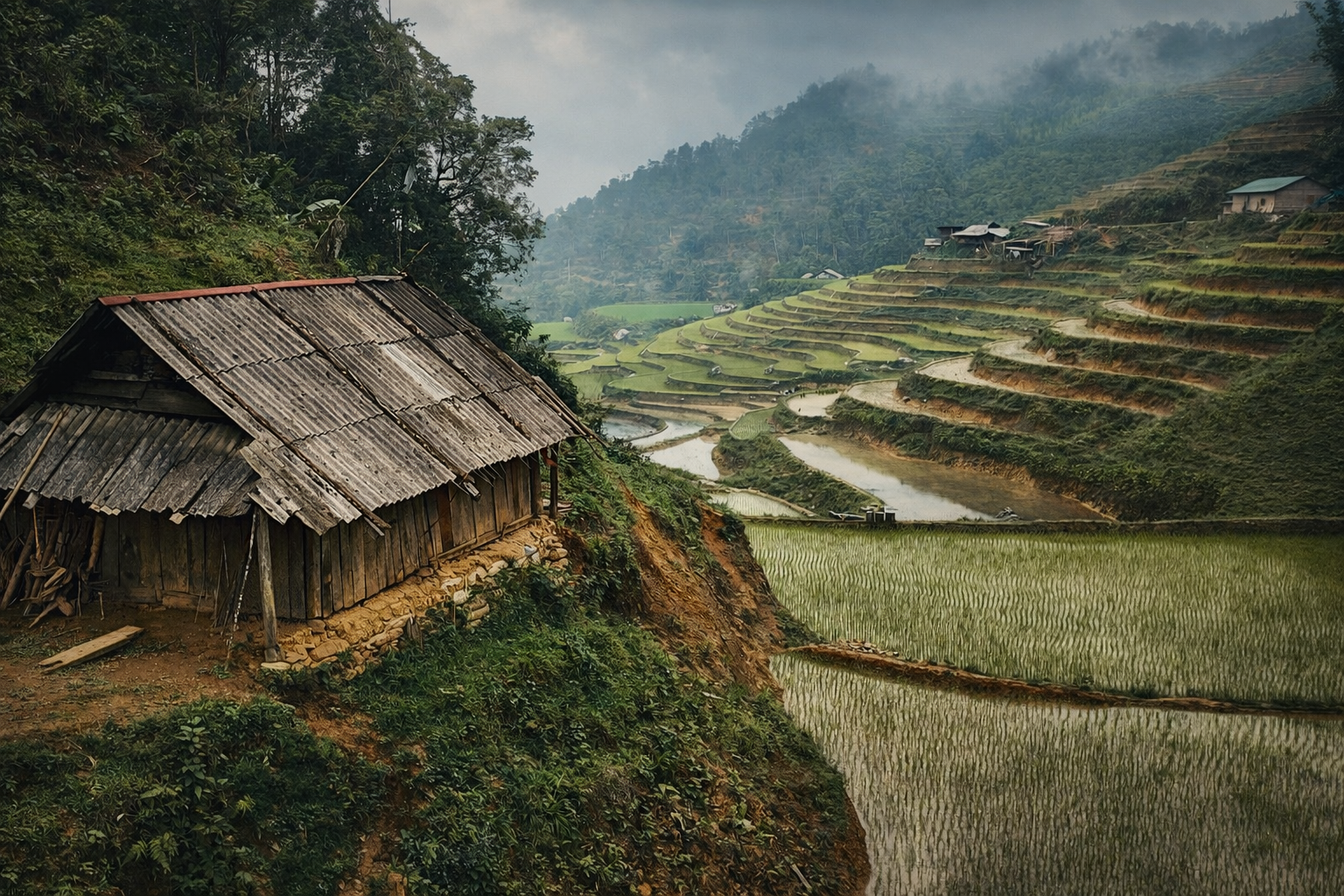
Traditional Hmong house in Sapa.
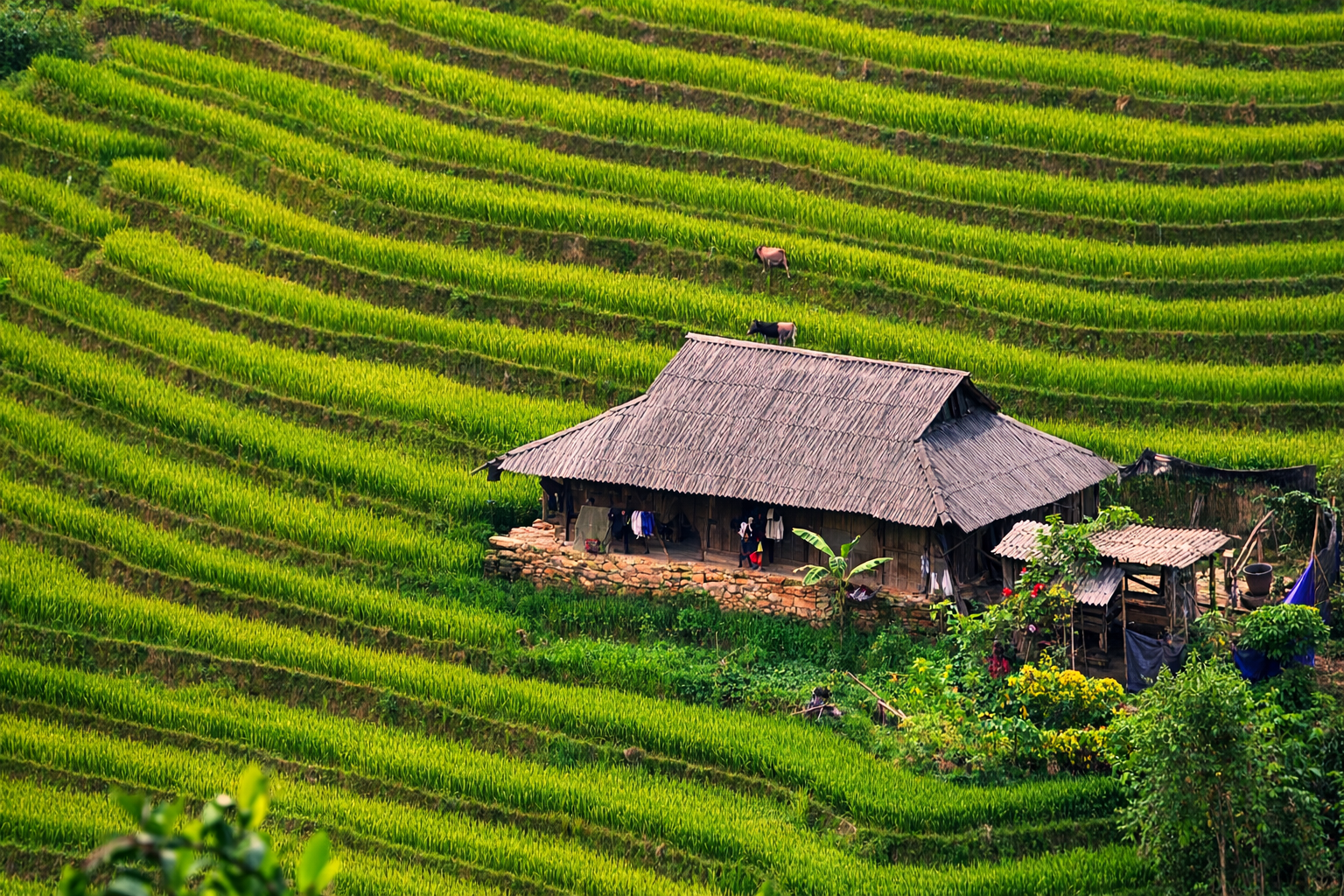
Traditional Hmong house in Sapa.
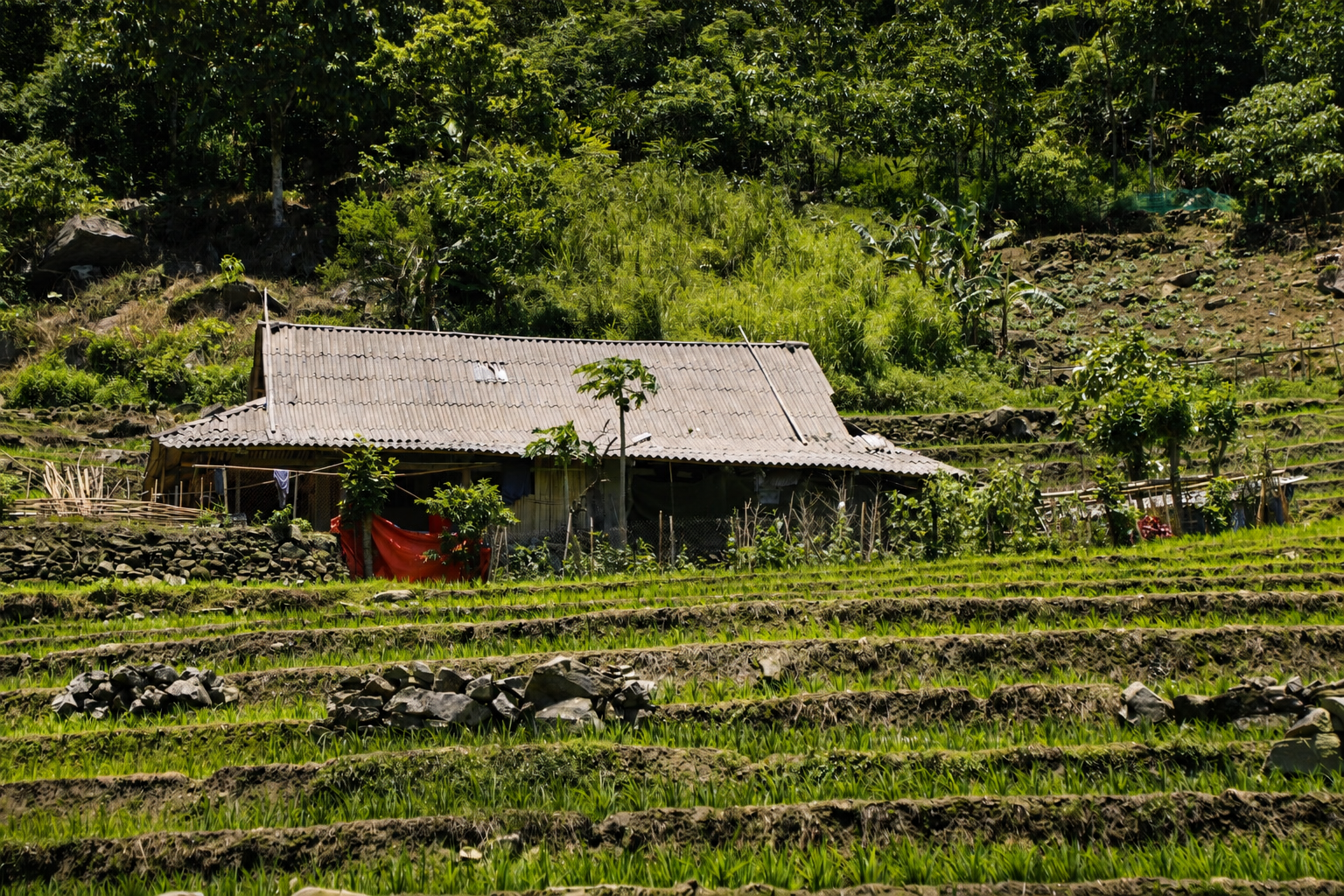
Traditional Hmong house in Sapa.
Sapa Town Is Not the Same as Sapa’s Mountains
Part of the confusion surrounding development in Sapa comes from the fact that many visitors experience only Sapa town itself, rather than the far larger district that surrounds it. The urban centre of Sapa has already become a busy mountain tourism hub filled with hotels, cafés, karaoke bars, illuminated façades, traffic, construction, and increasingly dense commercial infrastructure. Bright lights, large buildings, and rapid development are now firmly part of the reality of the town.
Yet Sapa district extends far beyond the urban centre. Beyond the busy streets lie vast areas of forest, terraced rice valleys, rivers, streams, and mountain communities spread across wards including Cầu Mây, Hàm Rồng, Ô Quý Hồ, Phan Si Păng, Sa Pa, and Sa Pả, alongside rural communes such as Bản Hồ, Hoàng Liên, Liên Minh, Mường Bo, Mường Hoa, Ngũ Chỉ Sơn, Tả Phìn, Tả Van, Thanh Bình, and Trung Chải. Across these valleys and mountain slopes sit approximately one hundred smaller hamlets, many still defined by traditional Hmong, Dao, Tày, and Giáy homes surrounded by terraces, bamboo groves, medicinal gardens, grazing buffalo, and flowing mountain water.
This distinction matters enormously. Much of what people imagine when they think of Sapa; the layered rice terraces disappearing into mist, small villages scattered along ridgelines, children walking narrow mountain paths, water buffalo crossing streams, smoke drifting from timber roofs during cold evenings still exists outside the urban core. The wider district remains an extraordinary cultural and ecological landscape whose value lies precisely in the relationship between communities, agriculture, forests, rivers, and mountains.
The concern many residents and observers now share is not that Sapa town itself contains development or modern infrastructure. Towns naturally evolve, gentrify, grow and sometimes decline. The concern is that the aggressive commercialisation and oversized architectural ambitions increasingly visible within the urban centre are beginning to spread outward into landscapes that have historically remained far quieter, more ecologically fragile, and more culturally rooted.
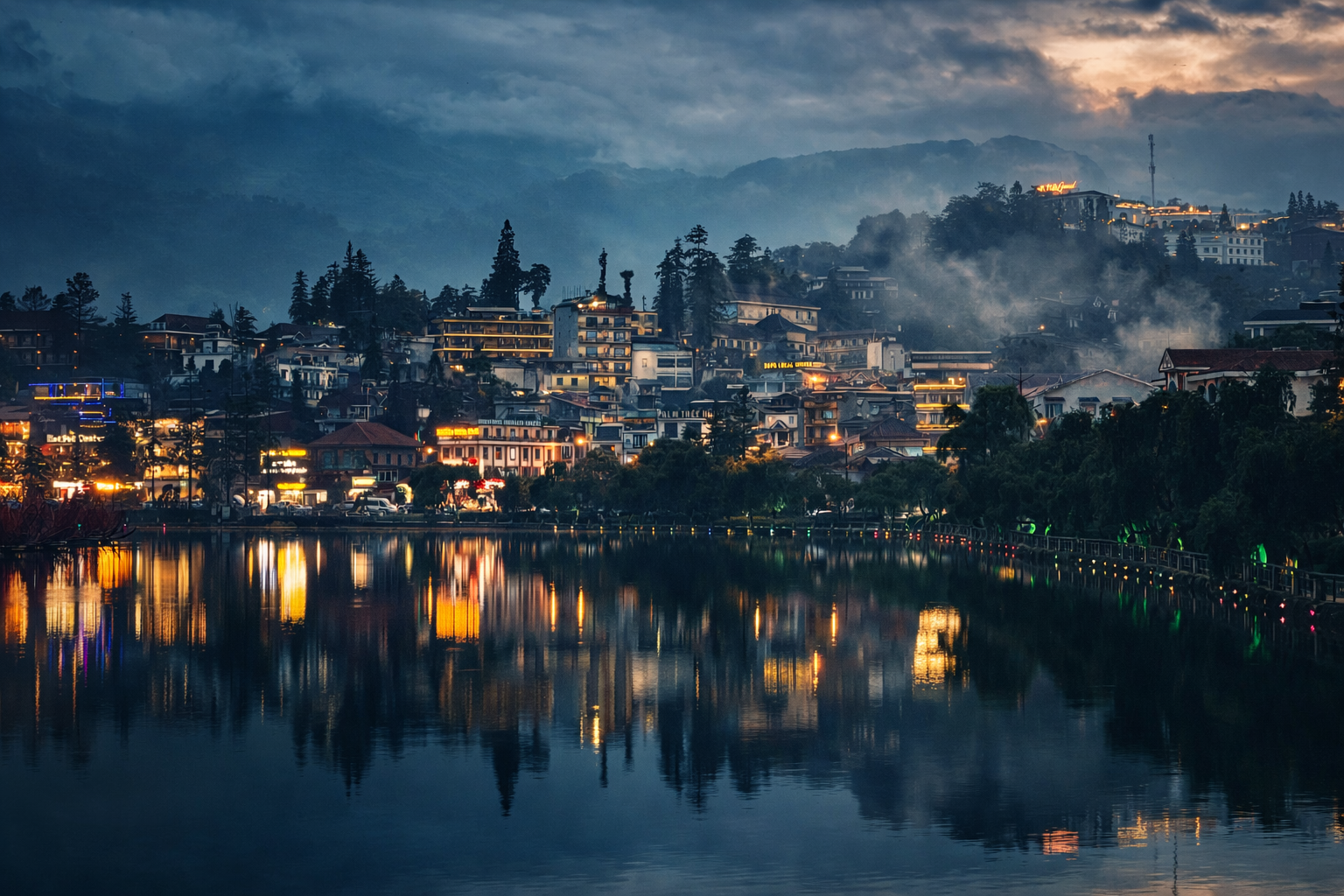
Sapa town view from across the lake.

Aerial view of Sapa town.
Homes Designed to Belong to the Mountains
Across the mountains surrounding Sapa, traditional Hmong and Dao homes sit quietly against terraced hillsides, partially hidden beneath bamboo groves, plum trees, and drifting mountain fog. Their smoke-darkened walls, dense thatched roofs, and low silhouettes seem almost absorbed into the landscape itself. These are not houses designed for prestige, visibility, or permanence but are homes shaped by centuries of adaptation to climate, farming life, spirituality, and communal survival.
Every aspect of their design reflects practicality and restraint. Timber from nearby forests forms the structural frame. Bamboo becomes partitions, woven panels, water channels, and animal pens. Stone anchors foundations into steep terrain while packed-earth floors absorb warmth from the hearth and slowly release it during freezing mountain nights. Unlike the raised stilt houses common in hotter lowland regions, many Hmong homes sit directly against the earth, helping interiors remain warm and sheltered during Sapa’s cold, damp winters.
At the centre of most homes sits the fire, functioning not only as a place to cook but as the emotional and spiritual heart of family life. Families gather around the hearth to prepare food, embroider textiles, repair tools, share rice wine, and tell stories long after darkness settles across the valley. In many Dao homes, ancestral altars occupy protected central positions within the house, reflecting how architecture, spirituality, and lineage remain deeply intertwined.
The homes themselves are remarkably sophisticated despite their apparent simplicity. Builders traditionally rely upon mortise-and-tenon joinery, wooden pegs, and rattan lashings rather than nails, allowing structures to flex subtly with shifting mountain soils and seasonal moisture. Entire villages often participate in construction, meaning a house embodies relationships and communal labour as much as architecture.
Many homes incorporate gravity-fed stream water systems that channel fresh mountain water directly through kitchen spaces before flowing back into gardens and terraces below. Visitors are also often surprised to discover the absence of chimneys. Smoke from the hearth rises slowly into the roof space before escaping through gaps in timber and thatch, preserving wooden beams against insects and damp while slowly curing hanging maize, herbs, medicinal plants, and strips of meat suspended above the fire.
Flexibility and renewal remain central to the architecture itself. Wall panels are often constructed on runners or slotted systems that allow sections to be dismantled, repaired, replaced, or even transported if necessary. Above the living space, mezzanine grain stores suspended beneath the roof provide dry storage for rice, seeds, textiles, tools, and medicinal plants, preserved by the warm smoky air rising from below.
Perhaps most importantly, these homes were designed around community rather than status or privacy. In many villages, doors remain open during meals, and anyone passing by may be invited inside to share food, whether neighbour, traveller, friend, or stranger. Hospitality in the mountains has historically been tied to survival itself. The house therefore functions not simply as shelter, but as a place of welcome, memory, reciprocity, and belonging.
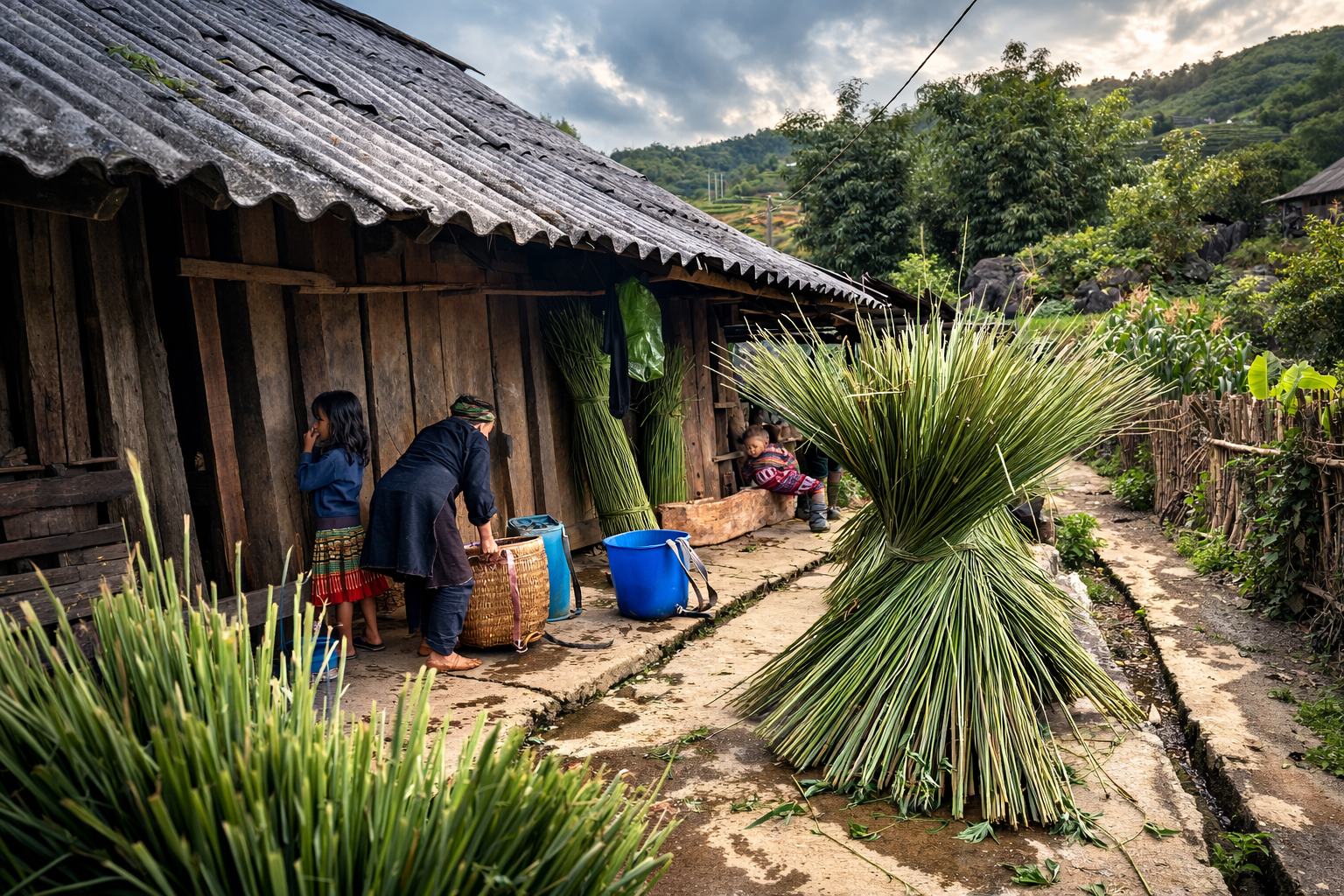
Hemp drying outside the house.
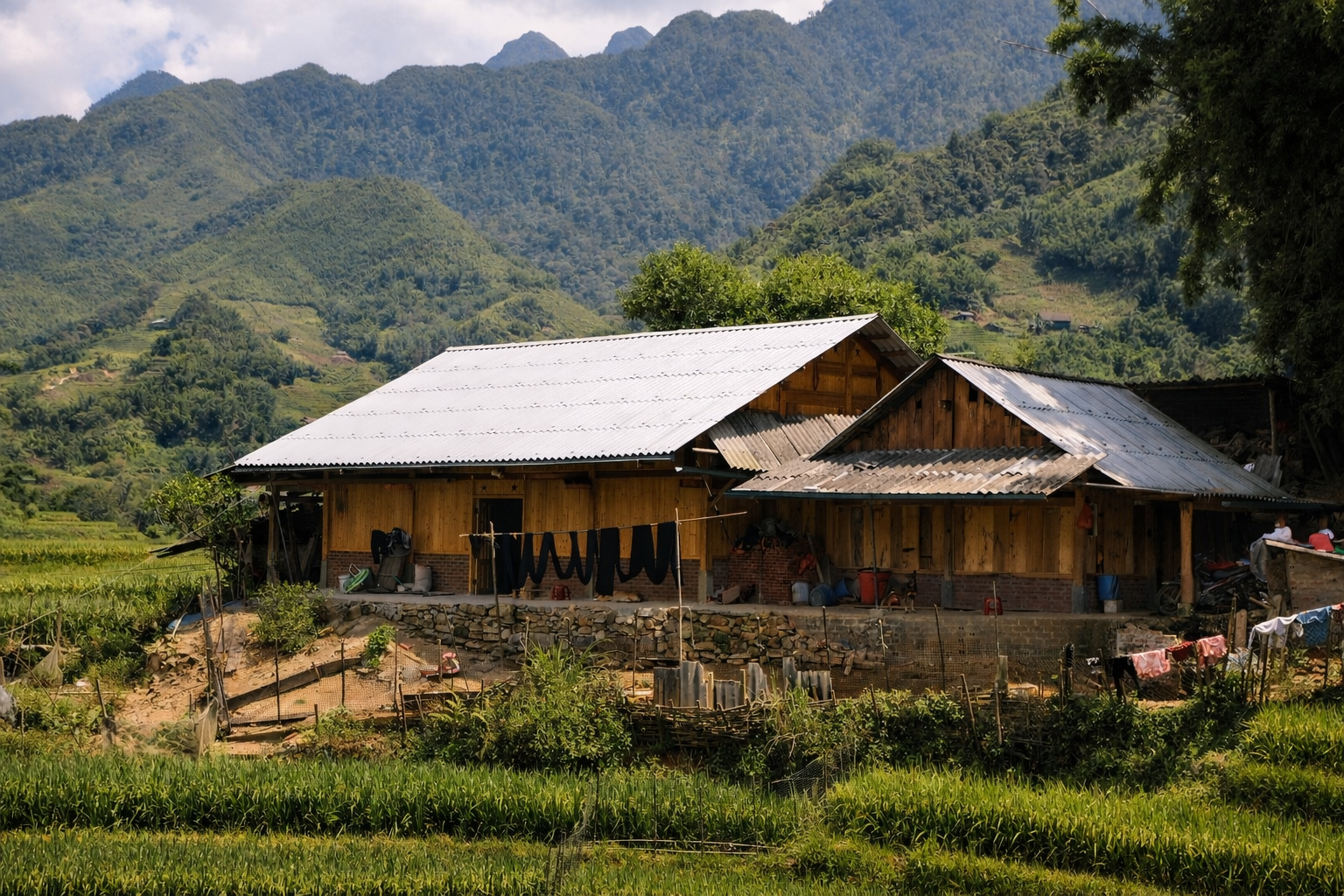
Indigo dyed fabrics outside the house.
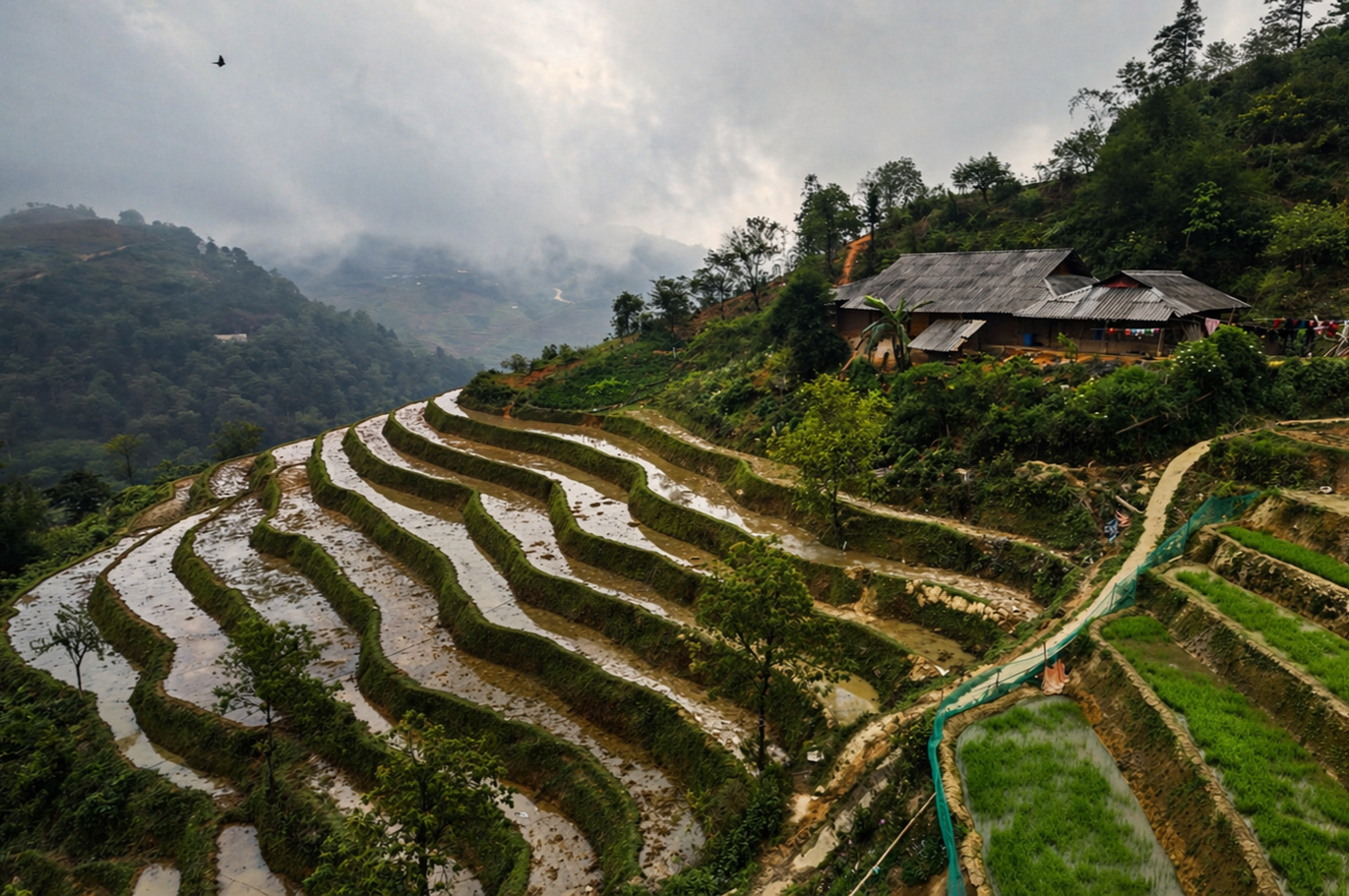
Rice terraces in Sapa.
The Difference Between Building Within a Landscape and Building Over It
As tourism expands rapidly across Sapa, traditional architectural landscapes face increasing pressure. Concrete hotels now rise along ridgelines once occupied by terraced fields and scattered wooden homes. Large-scale developments increasingly dominate valleys historically defined by subtle integration between settlement and landscape.
Not all modern development is harmful. Some newer homestays and ecolodges thoughtfully reinterpret vernacular architectural principles using local timber, restrained building heights, natural materials, and sensitive positioning within the terrain. The most successful examples understand that good mountain architecture should feel embedded within the landscape rather than imposed upon it.
There are encouraging examples of contemporary projects that preserve low visual impact, incorporate traditional rooflines, support local craftsmanship, and avoid overwhelming surrounding villages. Tasteful architecture in Sapa does not require imitation or pastiche. It requires humility towards the landscape and respect for the communities whose cultural identity shaped it.
Unfortunately, other projects move in the opposite direction.
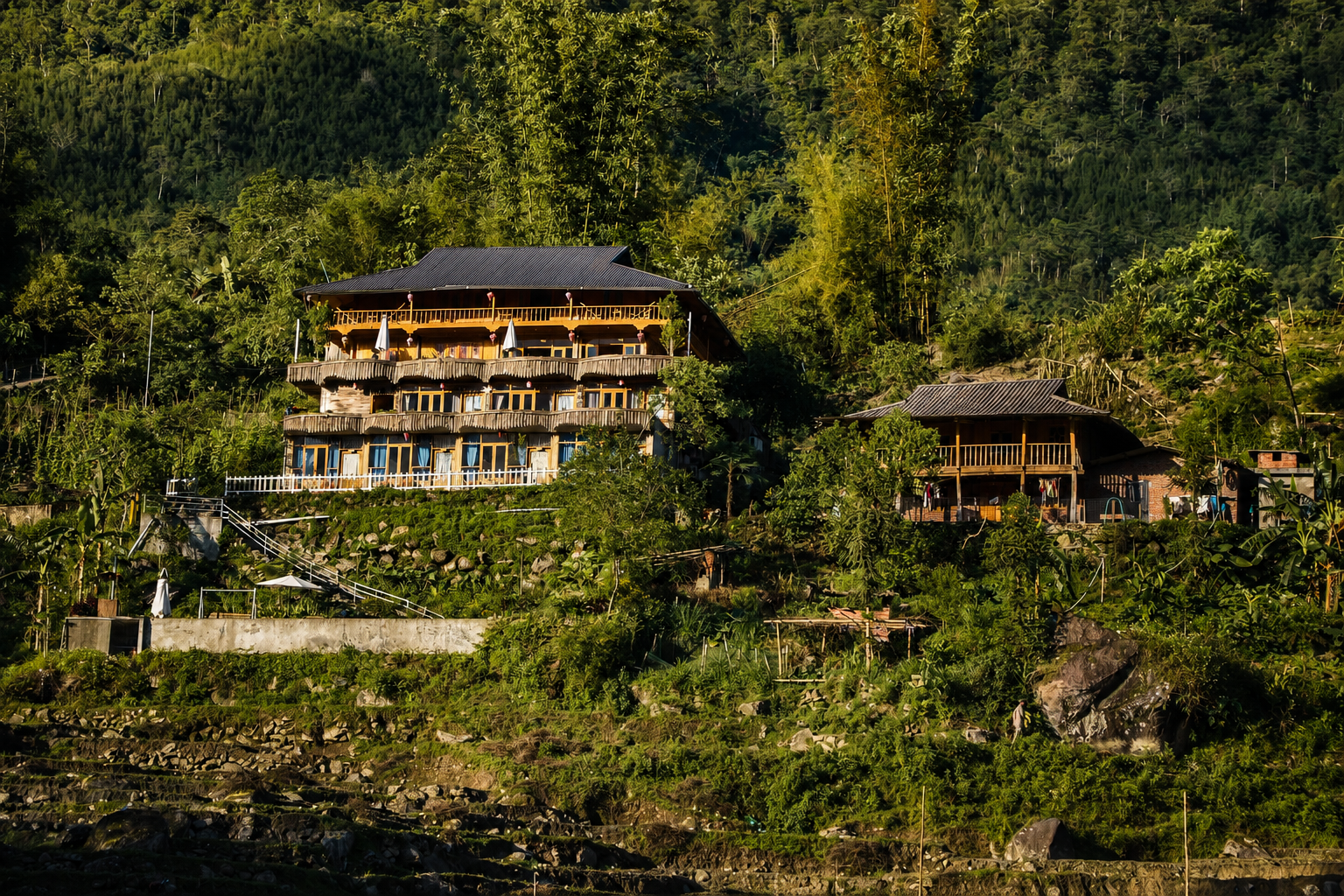
Vietnamese owned homestay with some sympathetic design.
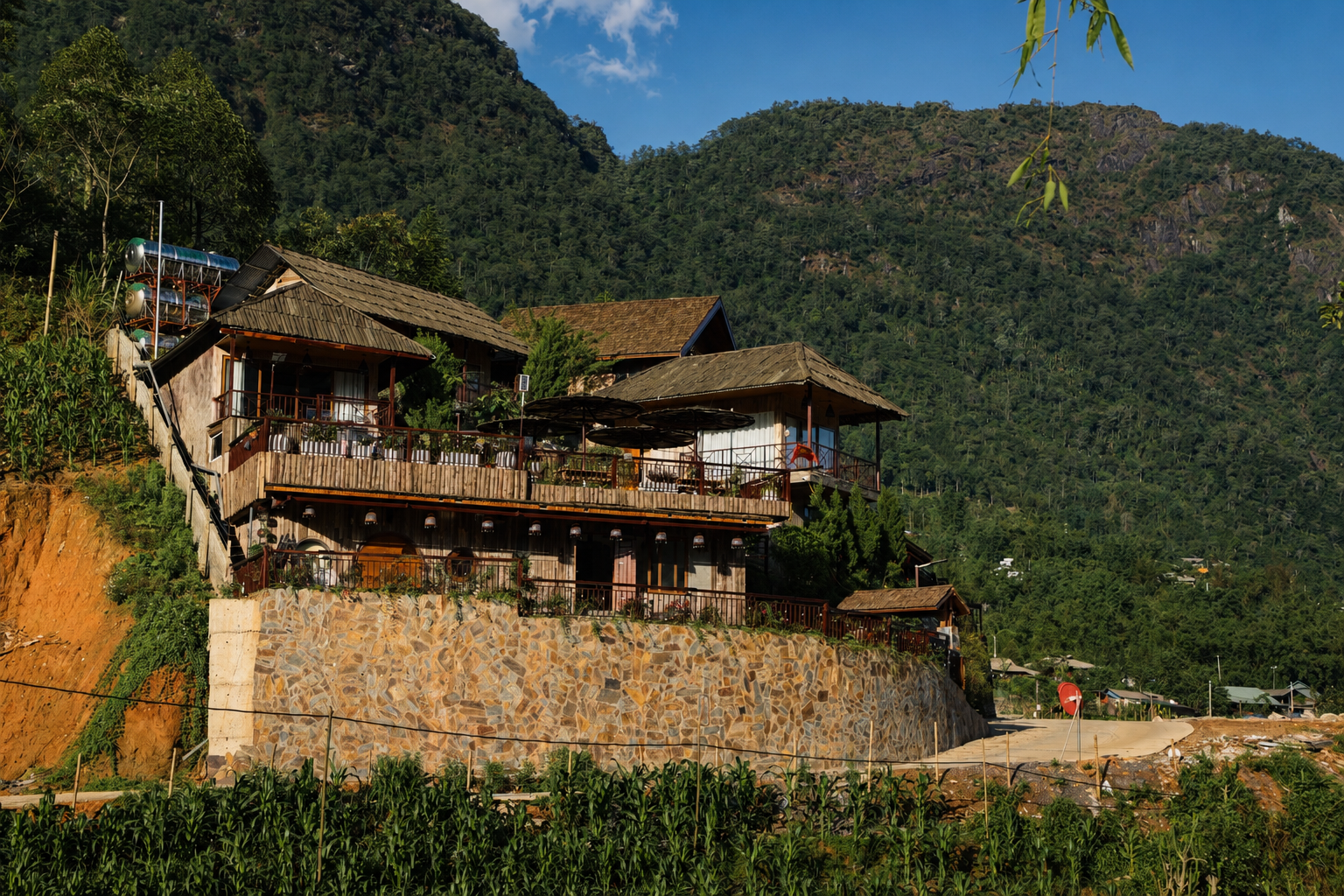
Vietnamese owned homestay with some sympathetic design.
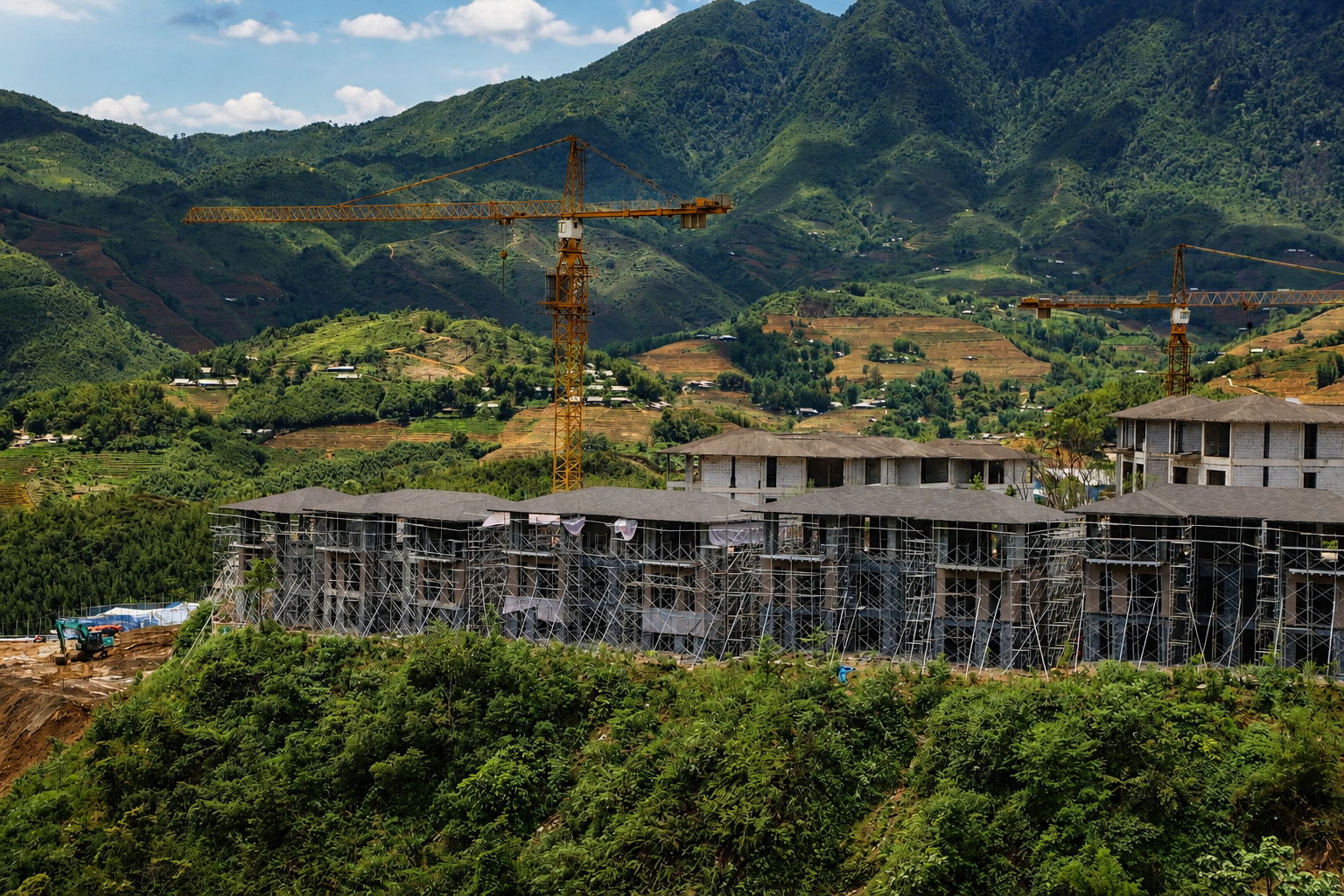
New hotel complex in Sapa.
Ban Mong Resort — When Architecture Stops Listening to the Landscape
Few developments in the wider Sapa region better symbolise the growing tension between profit-driven tourism expansion and the preservation of cultural landscape than the enormous Ban Mong Resort project overlooking the Muong Hoa Valley. To many residents, guides, farmers, and long-term visitors, the development has become emblematic of a style of construction that prioritises scale, prestige, and commercial spectacle above environmental sensitivity, architectural restraint, or meaningful connection to place.
From across the valley, the complex appears less like an extension of the mountain landscape and more like an imposition upon it. Its sheer scale dominates ridgelines that were once defined by layered rice terraces, scattered timber homes, and the shifting textures of forest and mist. Where traditional Hmong and Dao architecture settles quietly into the contours of the land, Ban Mong Resort announces itself aggressively. It demands attention. It overwhelms the eye and transforms what was once an organically evolving cultural landscape into a backdrop for oversized commercial ambition.
For many locals, this is not simply a question of aesthetics but more a question of respect. The architecture of the Muong Hoa Valley historically evolved through generations of practical adaptation to climate, terrain, spirituality, agriculture, and communal life. Traditional homes were never designed to dominate the mountains but to coexist with them. Ban Mong Resort represents the complete inversion of that philosophy. Rather than responding humbly to the landscape, the landscape itself appears forced to submit to the scale of the project.
The visual impact is impossible to ignore. Visitors trekking through the valley frequently describe the development as jarring, intrusive, and deeply out of character with its surroundings. Its massive concrete presence interrupts panoramic views that once carried an extraordinary sense of openness and continuity between terraces, villages, rivers, and forested slopes. The development looms over nearby communities with a heaviness that many feel fundamentally misunderstands the character of the highlands themselves.
What makes this particularly frustrating for many observers is that Sapa does not inherently oppose modern architecture or tourism investment. Sensitive contemporary design is entirely possible here. There are smaller lodges, homestays, and community-based projects across the region that successfully reinterpret vernacular forms through thoughtful use of local materials, restrained scale, and careful positioning within the terrain. Good architecture in mountain environments requires humility. Ban Mong Resort instead projects excess.
The development also raises wider questions about who tourism is ultimately being built for. Increasingly, parts of Sapa risk becoming shaped less around the realities of local communities and more around the expectations of short-term mass tourism markets seeking spectacle, status, and curated luxury. In this model, the mountains themselves become scenery to monetise rather than living cultural landscapes deserving stewardship and protection.
Projects of this scale can permanently alter not only visual identity but also ecological systems, water drainage patterns, traffic pressure, waste management demands, and long-term land values that affect surrounding villages. Once landscapes are transformed at this scale, they are extraordinarily difficult to restore. Concrete ridgelines do not easily return to terraced hillsides.
Perhaps most painfully, developments like Ban Mong Resort risk eroding the very qualities that made the valley internationally admired in the first place. People did not travel to Muong Hoa to experience generic resort urbanism transplanted into the mountains. They came for the quiet relationship between architecture, agriculture, mist, river, and community life that evolved slowly over centuries. They came because the valley still felt alive rather than manufactured.
When buildings become monuments to profit and prestige rather than thoughtful responses to place, the landscape inevitably pays the price. In the case of Ban Mong Resort, many locals and visitors alike increasingly feel that price has already become painfully visible across the valley.
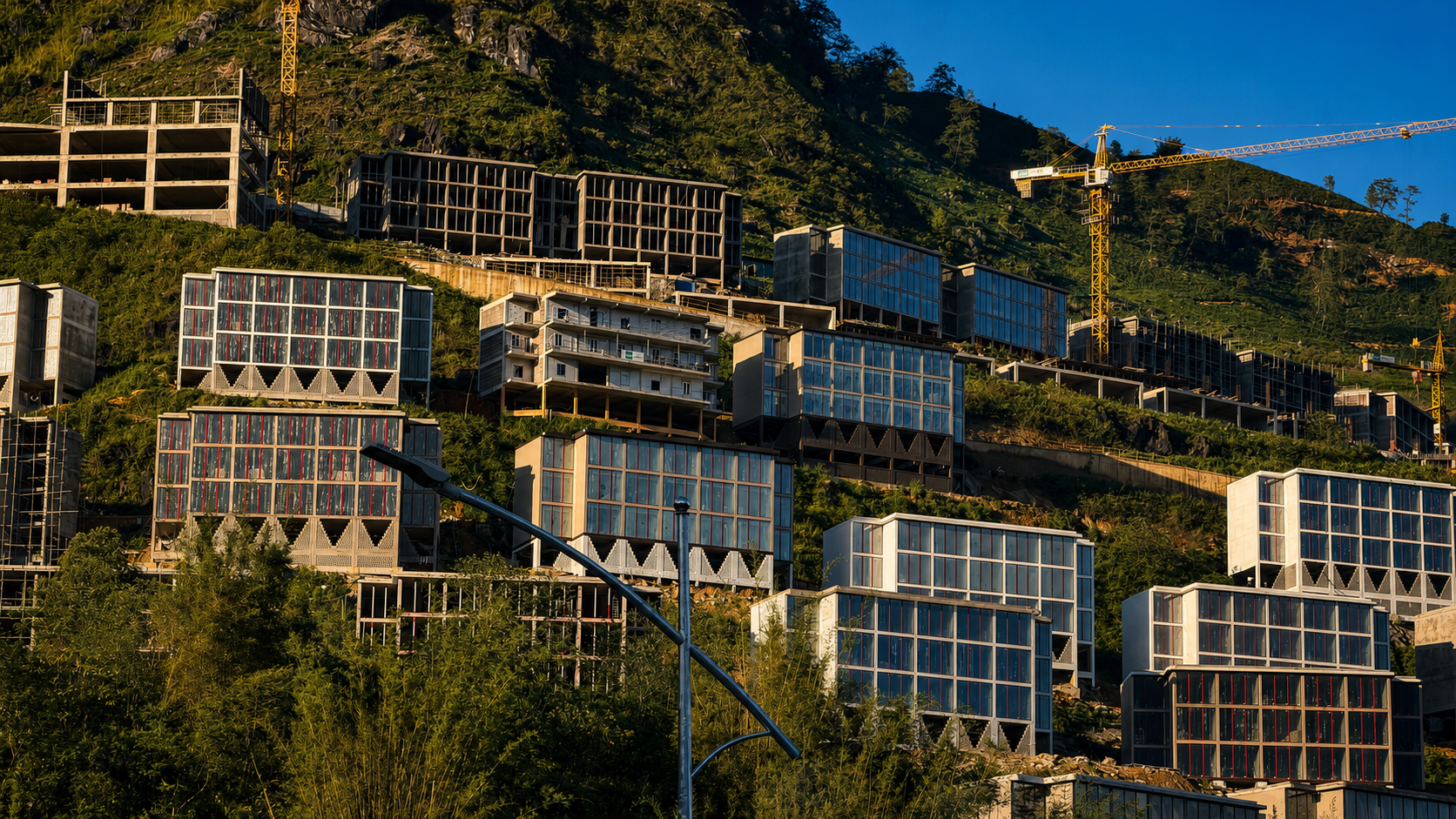
Controvertial hotels springing up in the Sapa mountains.

Controvertial hotels springing up in the Sapa mountains.
Colonial Nostalgia and the Packaging of “Indochine”
Another tension shaping modern Sapa emerges through the commercial repackaging of colonial aesthetics within luxury tourism branding. Perhaps the clearest example is the Hotel de la Coupole Sapa – MGallery, which presents itself through the language of “Haute Couture Meets Hill Tribe Artistry”, blending imagined French Indochine glamour with stylised representations of ethnic minority cultures.
Visually, the property is undeniably dramatic. Yet its atmosphere reflects not preserved colonial heritage but a contemporary luxury interpretation of what “Indochine” is imagined to have looked like. Unlike surviving colonial churches, villas, or administrative buildings physically connected to the history of French occupation in the highlands, this is a newly constructed fantasy aesthetic designed primarily for commercial consumption.
The danger lies in how colonialism becomes transformed into atmosphere rather than history. Refined interiors, couture references, and nostalgic imagery can risk presenting colonial rule as elegant and harmonious while obscuring the violence, extraction, taxation, frontier militarisation, and unequal power structures that shaped life across northern Vietnam during the colonial era.
French expansion into the highlands involved systems of governance built around strategic control, labour extraction, land management, and opium monopolies that financed much of colonial Indochina. Highland communities were surveyed, classified, taxed, displaced, and incorporated into systems designed primarily around imperial interests rather than local wellbeing.
When colonial imagery becomes detached from these realities, heritage risks becoming selective memory. The appearance of colonialism is preserved while its consequences fade quietly into the background.

Modern grand attempt at post colonial architecture that never really existed in Sapa

The grand interior of the Hotel de la Coupole, Sapa

The grand swimming pool in the Hotel de la Coupole, Sapa
Why Sapa Needs Stronger Environmental Impact Assessments
The speed and scale of development now transforming Sapa raises urgent questions regarding environmental governance and long-term sustainability. Mountain ecosystems are inherently fragile. Landslides, water scarcity, erosion, biodiversity loss, and infrastructure strain can escalate rapidly when development proceeds without rigorous oversight.
This is precisely why far more comprehensive Environmental Impact Assessment processes are needed across the region. An effective EIA is not merely bureaucratic paperwork but a systematic process designed to identify, predict, and evaluate the environmental, social, cultural, and economic consequences of proposed developments before approval is granted.
In sensitive landscapes such as the Muong Hoa Valley or areas bordering protected forests, EIAs should examine far more than simple construction feasibility. They should analyse visibility from key viewpoints, architectural compatibility with local vernacular traditions, drainage systems, flood risks, biodiversity impacts, wildlife corridors, groundwater vulnerability, traffic pressures, noise pollution, wastewater management, and long-term effects upon local communities and cultural heritage.
Public consultation must also play a genuine role. Highland communities should not simply witness transformation happening around them after decisions have already been made elsewhere. Their knowledge of local ecosystems, weather patterns, farming systems, and sacred landscapes forms an essential part of responsible planning.
Good development is possible. Tourism can absolutely support livelihoods, preserve craft traditions, and strengthen local economies when approached thoughtfully. Yet mountain landscapes cannot absorb unlimited expansion without consequence.
Sapa’s greatest beauty has never come from spectacle alone. It comes from the extraordinary relationship between people, architecture, agriculture, forests, rivers, and mountains that evolved here slowly across generations. Traditional Hmong and Dao homes embody that relationship perfectly. They remind us that architecture can exist not as domination of landscape, but as participation within it.
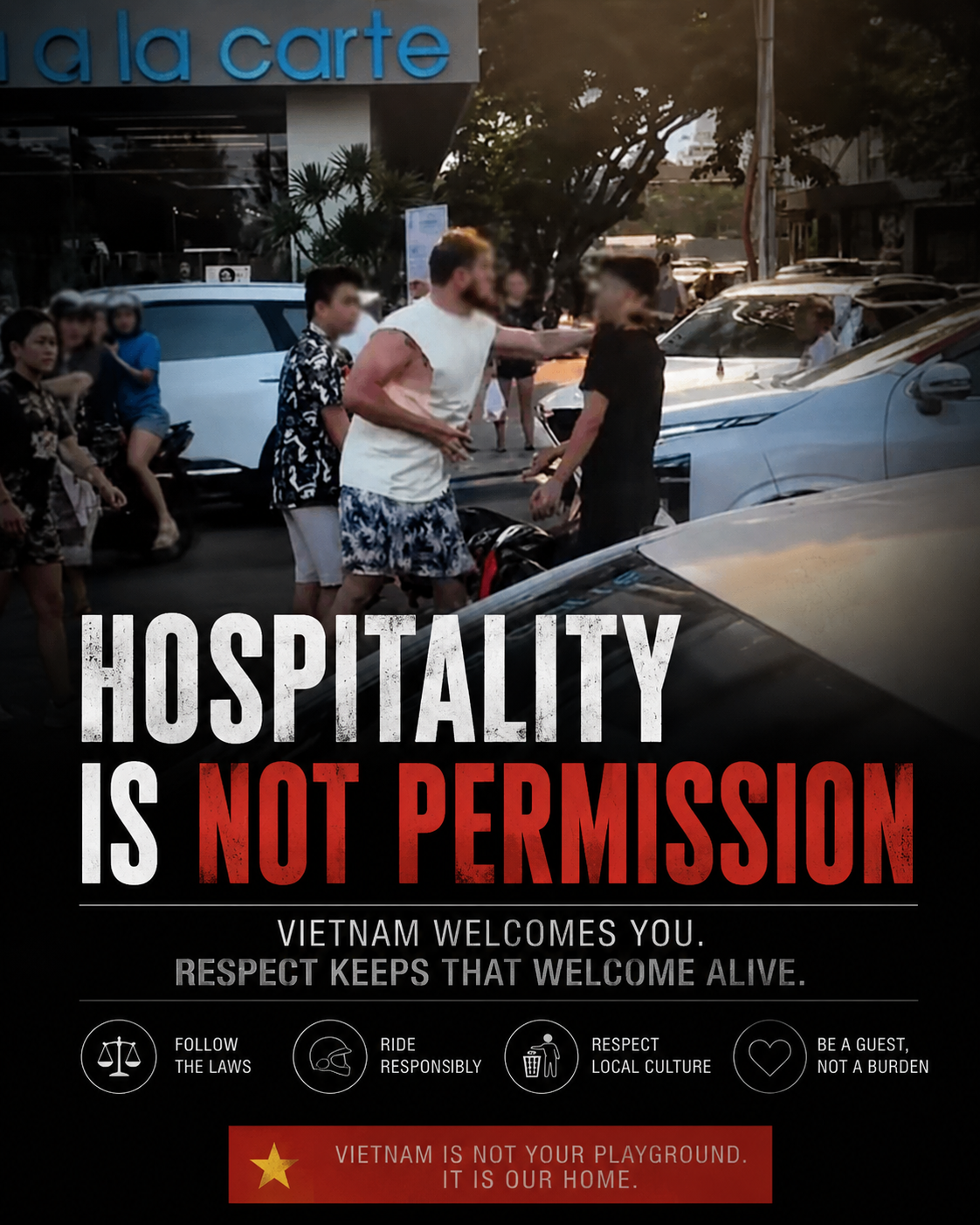
An ETHOS perspective: Vietnam’s hospitality is a gift, not an entitlement
From unlicensed riders searching for ways to avoid police checkpoints on the Hà Giang Loop to high-profile cases involving foreign nationals accused of violent crime, fraud and drug offences, a growing number of incidents are prompting difficult conversations across Vietnam. While the country remains one of Asia’s safest and most welcoming destinations, ETHOS examines why hospitality should never be mistaken for permission, and why responsible travel matters more than ever as visitor numbers continue to rise.
When hospitality meets entitlement
One of the things that makes Vietnam special is how easily visitors are welcomed into everyday life. It happens in ways both large and small. A family invites a stranger to sit down for a drink or some food. A market vendor patiently helps a confused traveller despite sharing almost no common language. A homestay host insists that a guest eat another bowl of rice before leaving for the day. A local rider stops on a mountain road to help somebody whose motorbike has broken down. Across the country, countless acts of generosity unfold quietly every day, rarely attracting attention because they are simply part of how people live.
In the mountains of northern Vietnam, where ETHOS works alongside Hmong, Dao and other ethnic communities, hospitality remains deeply woven into daily life. Visitors are welcomed into homes, workshops, farms and forests not because tourism demands it, but because sharing knowledge, stories and food with guests has long been part of community life. When travellers sit beside a kitchen fire listening to stories, learn to work with indigo, help harvest crops or join a family meal, they are experiencing something that cannot be manufactured.
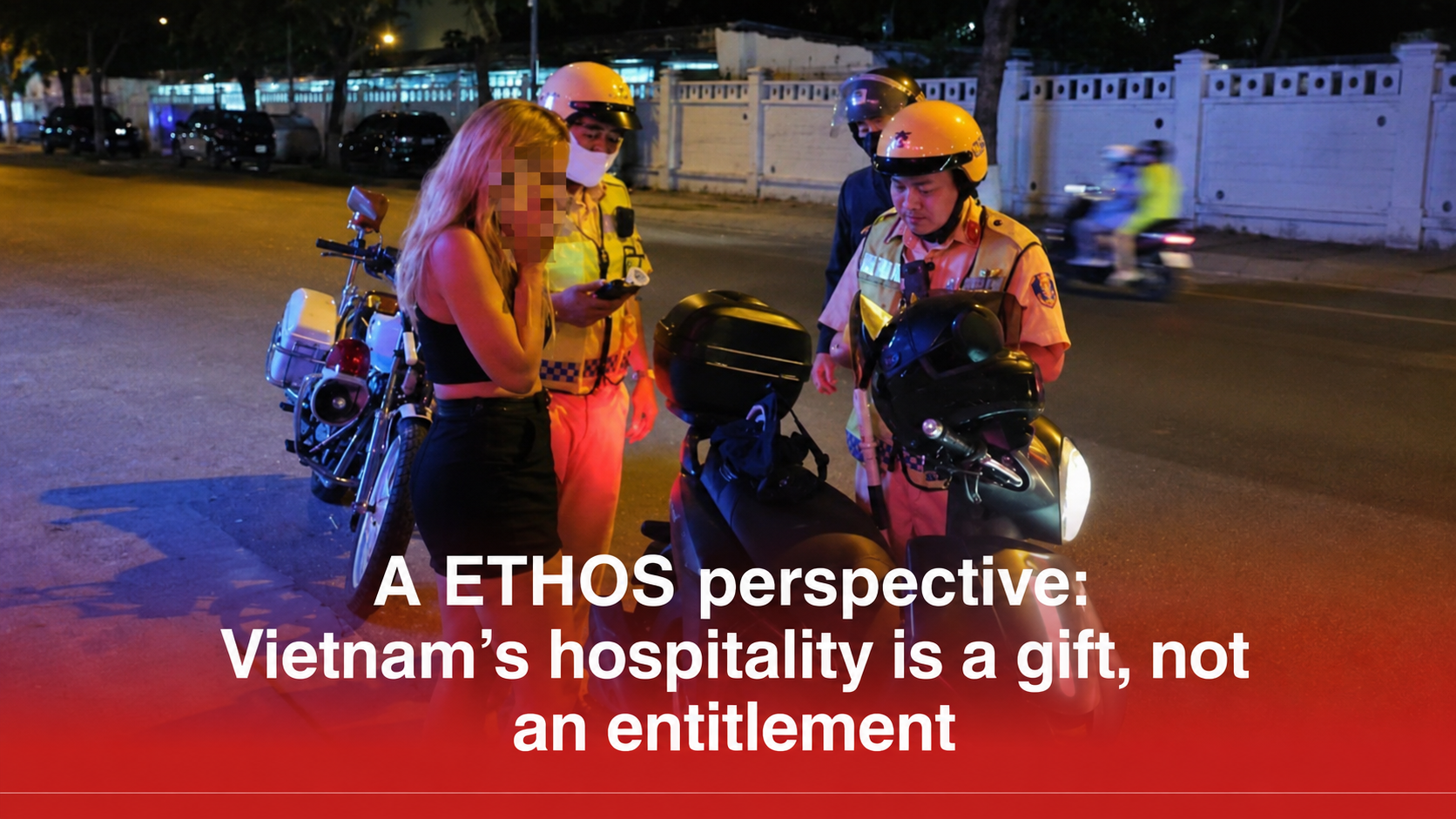
What is being shared is not a tourism product.
It is trust. That trust is one of Vietnam’s greatest strengths. It is also something that should never be taken for granted.
Over the past year, a growing number of incidents involving foreign visitors and foreign residents have prompted difficult conversations across Vietnam. Stories involving violent crime, organised fraud, drug offences, dangerous driving, visa abuse and public disorder have become increasingly visible. Some incidents have been shocking. Others have been depressingly familiar. Together, they raise an uncomfortable question.
Has a small but increasingly visible minority of foreigners begun mistaking Vietnam’s hospitality for permission?
The problem starts long before anyone appears in a police report. The conversation often begins long before a crime is committed.
Spend enough time in Facebook groups, Reddit forums and travel communities dedicated to Vietnam and certain questions appear with remarkable regularity. Somebody wants to ride the Hà Giang Loop but does not possess the correct licence. Somebody else wants to know where police checkpoints are located so they can avoid them. Another traveller has noticed foreigners riding without helmets and wonders whether helmet laws are actually enforced. Others ask whether insurance really matters, whether visa rules are checked, or whether local authorities simply look the other way.
What is striking is not the questions themselves, but the assumption beneath them. The discussion is rarely centred on how to travel legally, responsibly or safely. Instead, it often revolves around how far the rules can be bent before consequences appear.
Anyone who spends time in destinations such as Sapa, Hà Giang or Ninh Bình will have seen examples of this. Foreign visitors riding motorcycles without helmets. Travellers with little or no riding experience attempting challenging mountain roads. People operating motorcycles without valid licences. Visitors who would never dream of behaving similarly in their own countries somehow convincing themselves that the rules are different in Vietnam. They are not.
Vietnam’s traffic laws exist for the same reason traffic laws exist anywhere else. Visa regulations exist for the same reason they exist elsewhere. Public order laws, licensing requirements and drink-driving regulations are not arbitrary inconveniences designed to frustrate travellers. They exist because somebody eventually bears the cost when they are ignored. Sometimes that cost falls on the traveller, but sadly it may also falls on a local family.
The headlines of 2026 reveal a deeper problem
The most serious incidents making headlines this year are obviously very different from an unlicensed tourist riding a rented motorbike. Yet they often reflect a similar mindset, namely the belief that Vietnam can be treated as a place where consequences are somehow lighter, oversight somehow weaker, or local laws somehow more negotiable.
In late May, a 34-year-old Australian national was detained after allegedly going on a destructive rampage inside a café in Đà Nẵng. Video footage showed furniture being smashed, customers threatened and significant property damage caused while staff and bystanders attempted to intervene. The incident spread rapidly across Vietnamese and international media, prompting widespread disbelief that somebody could behave in such a manner in a country that had welcomed them as a guest.
Only days before that, Hồ Chí Minh City police announced the arrest of two Samoan nationals, Vaa Vaa and Tafia Steve, in connection with the fatal shooting of Australian citizen Lorenzo Lemalu in District 1. Investigators alleged the pair entered Vietnam, monitored their target and carried out the attack before attempting to flee. The case drew extraordinary attention because it suggested Vietnam was becoming a stage upon which criminal disputes from abroad were being played out.
Authorities have also highlighted concerns regarding foreign criminal groups operating scam centres, cybercrime networks and online gambling operations from within Vietnam. In Hà Nội, police have warned publicly about an increasing tendency for foreign offenders to relocate activities into the country while targeting victims elsewhere. Investigations involving foreign-run fraud operations, illegal entry networks and organised cybercrime have featured prominently throughout the year.
Drug-related arrests involving foreign nationals have also generated significant publicity. South Korean nationals have been linked to organised drug cases in Hồ Chí Minh City. Russian nationals have appeared in investigations involving narcotics distribution networks serving foreign communities. Malaysian nationals were detained during investigations into suspected telecom fraud and illegal drug use. Separate cases involving foreign nationals from China, Russia and other countries have reinforced concerns that some criminal groups increasingly view Vietnam as an attractive operating environment.
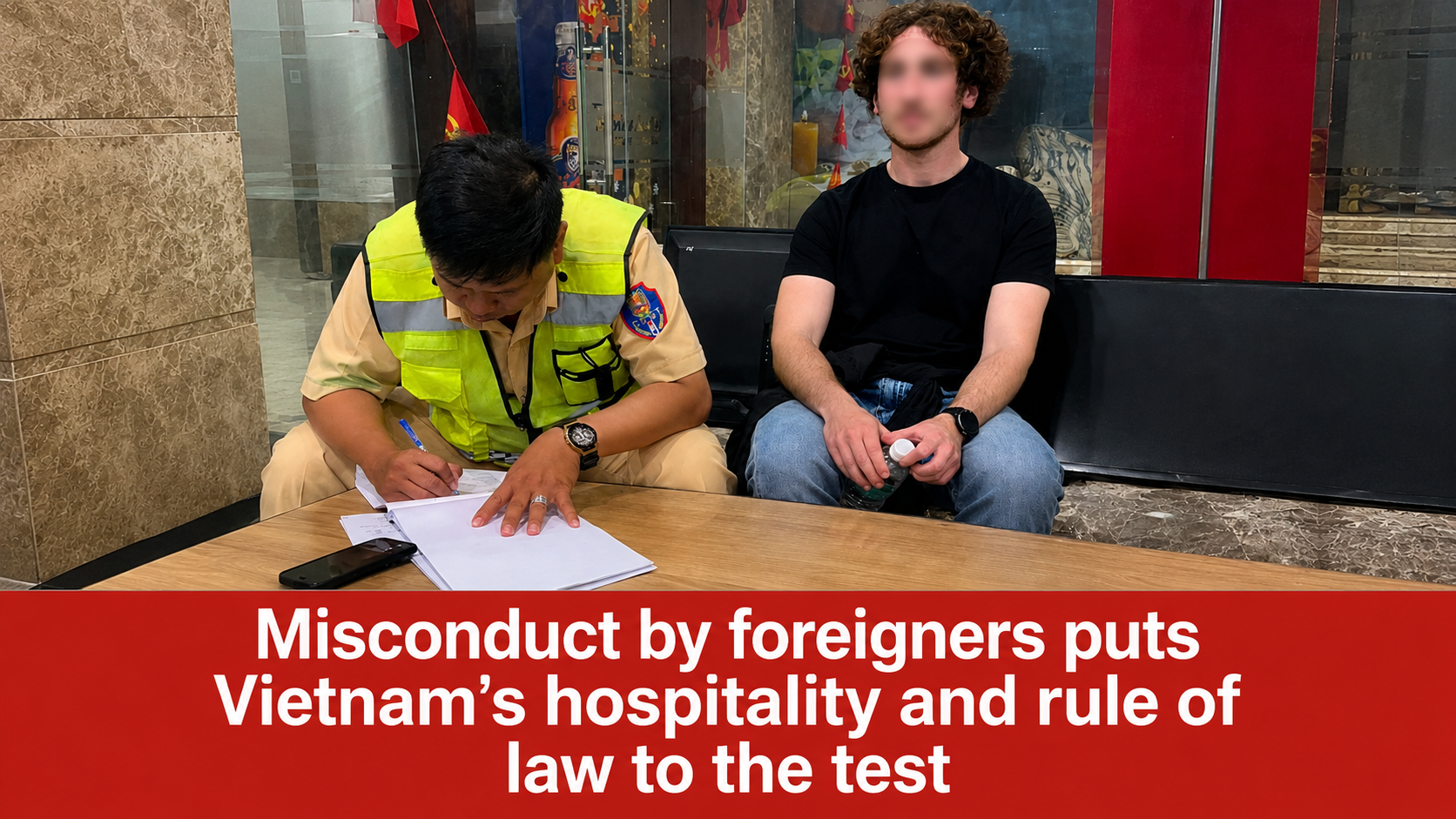
Road safety has emerged as another recurring theme.
In Khánh Hòa, authorities have publicly linked numerous incidents involving foreign riders to speeding, drink-driving, dangerous riding and invalid licences. One of the most widely reported cases involved a Russian national accused of causing a fatal collision in Nha Trang while allegedly riding under the influence of alcohol. Elsewhere, videos showing foreigners performing dangerous stunts, riding without helmets or disregarding basic safety regulations continue to circulate online with depressing regularity.
It is important to emphasise that many of these cases remain allegations or ongoing investigations rather than proven offences. The point is not to sensationalise them. The point is that they are becoming increasingly visible.
Why this matters beyond the individuals involved
The overwhelming majority of visitors to Vietnam never break the law. Most arrive curious, respectful and genuinely interested in learning about the country. Most leave with fond memories, lasting friendships and a deeper appreciation for Vietnamese culture, yet highly publicised incidents rarely affect only the individuals directly involved.
Every major crime involving a foreign national becomes a story discussed by local communities, authorities, business owners and ordinary citizens. Every viral video showing dangerous behaviour reinforces negative stereotypes. Every visitor who rides illegally, overstays a visa, drives drunk or treats local laws as optional contributes to a perception that foreigners expect different standards from those applied to everybody else. That perception has consequences.
The homestay owner who must complete additional paperwork. The accommodation provider facing increased scrutiny. The motorbike rental business subject to tighter inspections. The community that becomes slightly more cautious about welcoming outsiders. The traveller who follows every rule but finds authorities less trusting because others have not. Trust, once weakened, is difficult to rebuild.
Vietnam is responding
Vietnamese authorities are not ignoring these trends. Recent government directives have called for stronger measures to safeguard public order and security within the tourism sector. Plans have been announced to improve digital monitoring of accommodation bookings and travel activities, allowing authorities to respond more effectively to criminal activity, visa abuse and public safety concerns.
Some commentators have interpreted these developments as signs of increasing control, but a different interpretation may be more accurate. These measures are, at least in part, the predictable consequence of abuse. Any country experiencing rapid tourism growth faces the same challenge. How do you remain open while protecting public safety? How do you encourage visitors while discouraging those who see hospitality as weakness? How do you maintain trust when a minority repeatedly exploits it? Vietnam is now confronting those questions.
The greatest danger to travellers remains the road
Ironically, for most visitors, the greatest threat is not violent crime, organised fraud or public disorder, but is the traffic. Every year, travellers are injured because they rent motorcycles illegally, underestimate road conditions, overestimate their abilities or simply follow the behaviour of others. A road filled with inexperienced foreign riders quickly becomes dangerous for everyone, including local residents who rely on those roads every day.
The romantic image of motorbiking through northern Vietnam often obscures a simple reality. These roads are not theme parks. They are working roads used by farmers, families, schoolchildren, delivery riders and local communities. The consequences of irresponsible riding are not theoretical but can be measured in injuries, hospital visits and lives permanently altered by decisions that took only seconds to make.
For anybody considering riding independently, we strongly recommend taking the time to understand Vietnam’s licensing requirements, insurance implications and road conditions before setting off.
You can read our guide here:
https://www.ethosspirit.com/motorbiking-in-vietnam
For travellers who want to experience Vietnam’s mountain roads without the pressure, responsibility and legal uncertainty of self-riding, our easy rider style journeys offer another approach. Travelling with experienced local riders allows guests to focus on landscapes, communities and cultural experiences while leaving the driving to those who know these roads best.
You can learn more here:
https://www.ethosspirit.com/motorbikes
Responsible travel is not complicated
The solution to all of this is remarkably simple.
Wear a helmet when riding as travelling as a passenger on a motorcycle.
Ride legally.
Respect visa conditions.
Treat local laws as seriously as you would at home.
Pay fairly.
Ask before taking photographs.
Remember that villages are communities rather than attractions.
Understand that a homestay is somebody’s home before it is somebody’s business.
Recognise that hospitality is an invitation rather than an obligation.
None of these expectations are unreasonable. They are simply the foundations of respectful travel.
A welcome worth protecting
Vietnam remains one of the most welcoming, tolerant and affordable countries in the world to explore. Millions of visitors arrive every year and experience nothing but kindness. Most leave with a genuine affection for the people they meet and the places they encounter. The recent rise in stories involving foreign crime, dangerous driving, visa abuse and public disorder should not obscure that reality. What they should do is remind us that hospitality depends on reciprocity.
In the mountains where ETHOS works, families continue to welcome strangers into their homes. Artisans continue to share skills that have been passed down through generations. Farmers continue to open their fields and forests to visitors who want to understand life beyond the guidebook. Communities continue to extend trust to people they have never met before. That generosity is remarkable and also fragile.
Perhaps the real lesson behind many of the incidents that have dominated headlines throughout 2026 is that openness should never be mistaken for weakness. Whether the issue is an unlicensed rider attempting to evade police checkpoints, a tourist causing chaos in a café, or organised criminal groups using Vietnam as a base for fraud, the underlying problem is often the same. Somebody has confused welcome with permission and hospitality with entitlement.
Vietnam’s welcome remains as warm as ever and the responsibility rests with travellers to prove they deserve it.
Please don’t forget that Vietnam’s hospitality is a gift but not an entitlement.
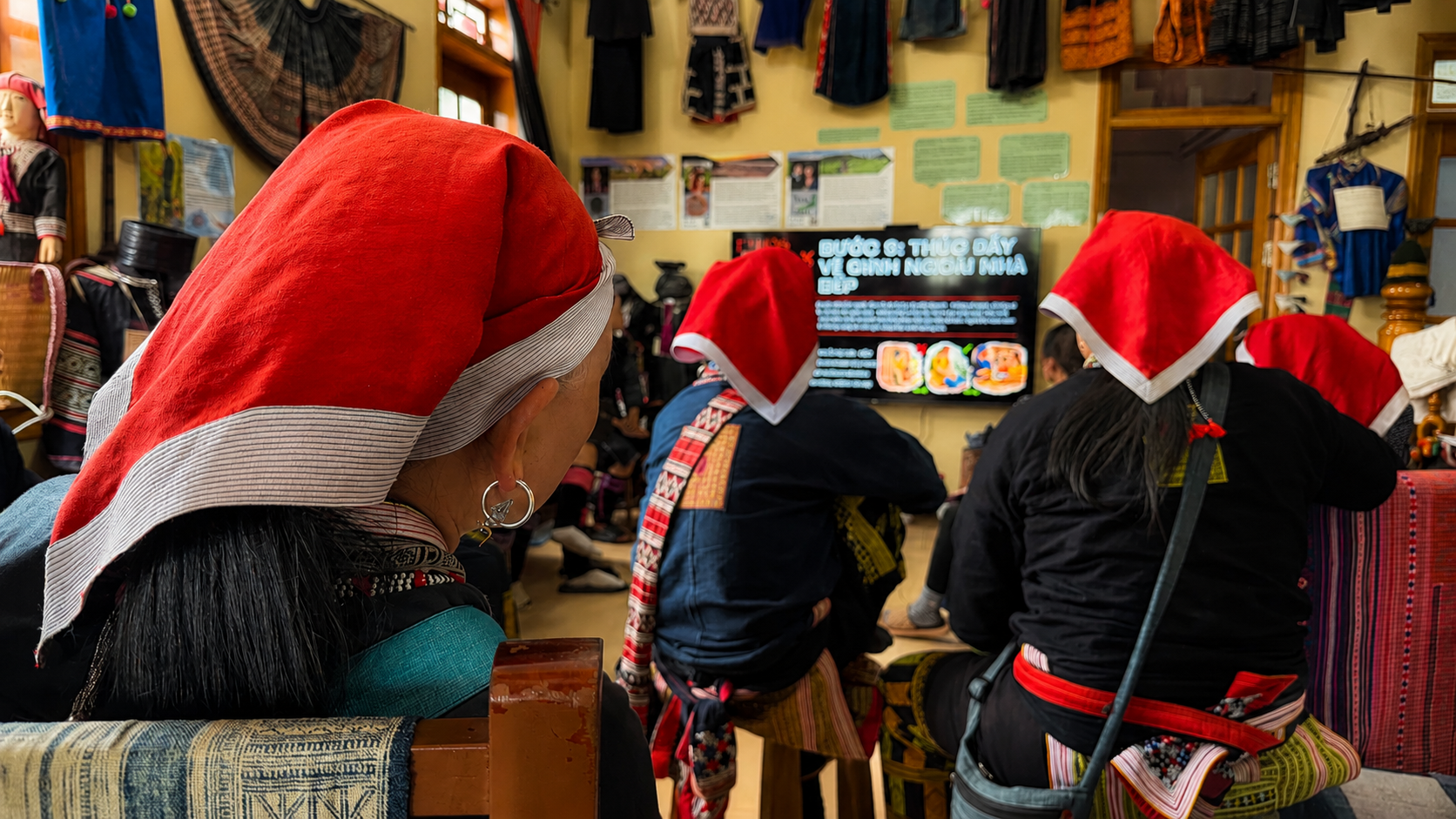
From Mountain Knowledge to International Standards: A Shared Achievement
Behind every safe and authentic ETHOS trek lies years of work, training, and collaboration. This is the story of how local knowledge and modern safety systems have been brought together through dedication, trust, and shared purpose.
Work That Cannot Be Seen at First Glance
What visitors experience on the trails with ETHOS often feels effortless. We hope that the pace feels natural, the route intuitive, and that decisions appear to be made with quiet ease. Beneath that simplicity sits an enormous body of work, built over years, that has required patience, persistence, and a deep respect for the people at its heart.
Creating a system that meets international safety standards while remaining rooted in local knowledge has not been straightforward. It has demanded a complete rethinking of how training, communication, and decision-making can function in environments where literacy cannot be assumed, yet expertise is undeniable. This has not been an adaptation of existing models, but the creation of something entirely bespoke, shaped from the ground up.
Bridging Two Worlds
At the centre of this work lies a fundamental challenge. On one side sits a literate office team, operating within frameworks of well planned government legislation, documentation, and compliance. On the other stands a network of Hmong and Dao guides whose knowledge is profound, precise, and field-tested, yet largely unwritten and passed down through experience rather than formal education.
Bringing these two worlds together has required trust, time, and the development of tools that function across very different ways of understanding. Visual systems, icon-based decision booklets, and scenario-driven training have been designed to remove ambiguity and create clarity in moments that matter. Each element has been tested in theory and then honed in the realities of rain, mud, fatigue, and time pressure. The result is a system that does not diminish local expertise, but elevates it, allowing it to operate confidently within international expectations.
Layers of Training, Built for Reality
Our training programmes themself are not a single intervention, but a layered and evolving process. Foundational sessions introduce core safety concepts, followed by practical field applications where guides work through real scenarios. These are reinforced through repetition, discussion, and reflection, ensuring that knowledge is not only understood but retained and applied.
Certification in first aid, risk assessment, and food hygiene represents a significant achievement within this structure. These are qualifications to be obtained and skills to be embodied. Treating an injury on a remote hillside, assessing changing river conditions, or managing hygiene in a village kitchen are all situations where theory must translate seamlessly into action. What has emerged within ETHOS is a standard of guiding that is both rigorous and deeply practical, combining formal training with instinctive understanding.
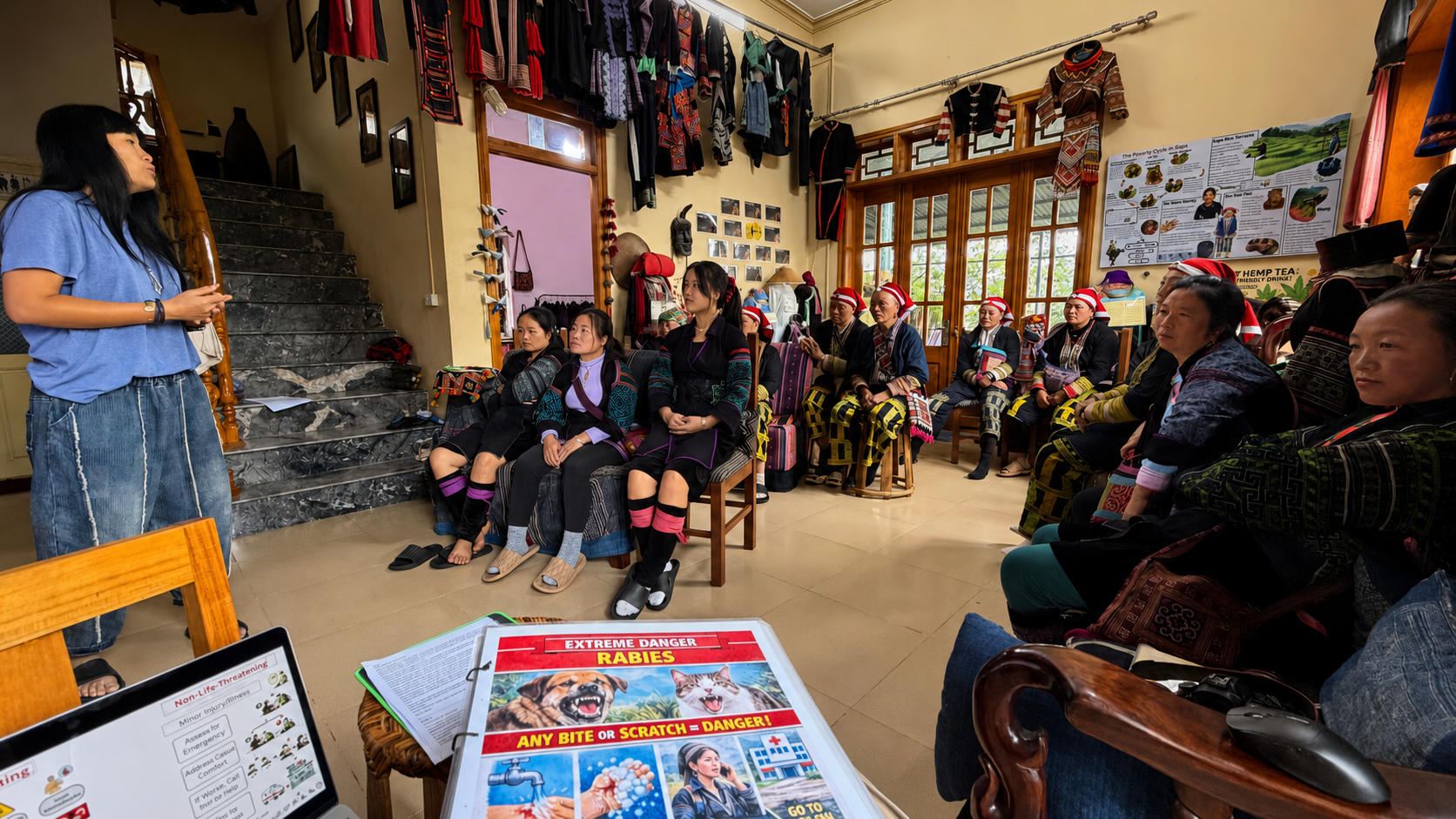
Full team training session for the ETHOS guides within the ETHOS Community Centre in Sapa
Learning From Medical Professionals on the Front Line
One particularly important stage of our ongoing training programme involved a dedicated wellbeing and emergency response workshop delivered in partnership with Hung Thinh General Hospital. Three medical professionals travelled from Lào Cai to Sapa to work directly with both ETHOS guides and the office team, bringing frontline medical experience directly into the mountains where our guides operate every day.
The session was led by Vũ Minh Nghĩa, who currently works within the Intensive Care and Emergency Department at Hung Thinh General Hospital. Rather than relying on abstract theory or generic classroom examples, the training focused heavily on real-world trekking scenarios that guides may genuinely encounter in the field across northern Vietnam.
Together, guides and staff worked through practical discussions surrounding dehydration, slips and falls on steep terrain, heat exhaustion, allergic reactions, river crossings, delayed evacuation challenges, and communication during incidents involving international guests. The emphasis was always on early recognition, calm decision-making, and understanding how relatively small problems can escalate quickly if not managed correctly in remote environments.
After exploring risk identification and mitigation strategies, the training moved into practical emergency response. Guides practised CPR techniques, casualty positioning, wound care, emergency assessment, and first aid procedures through hands-on exercises designed to build both confidence and familiarity. For many of the guides, this represented one of the first opportunities to work directly alongside hospital emergency professionals in such a structured environment.
What stood out most throughout the sessions was the level of engagement from the guides themselves. Questions continued long after exercises had finished, with many guides eager to relate the training back to real situations they had experienced personally on the trail. The atmosphere was serious and focused, yet also deeply collaborative, with local experience and professional medical expertise constantly informing one another.
This kind of partnership represents an important part of how ETHOS approaches safety development. We do not see training as a one-time requirement or a box-ticking exercise but do see it as an ongoing process of learning, reflection, and improvement that combines lived mountain experience with evolving professional standards and medical best practice.
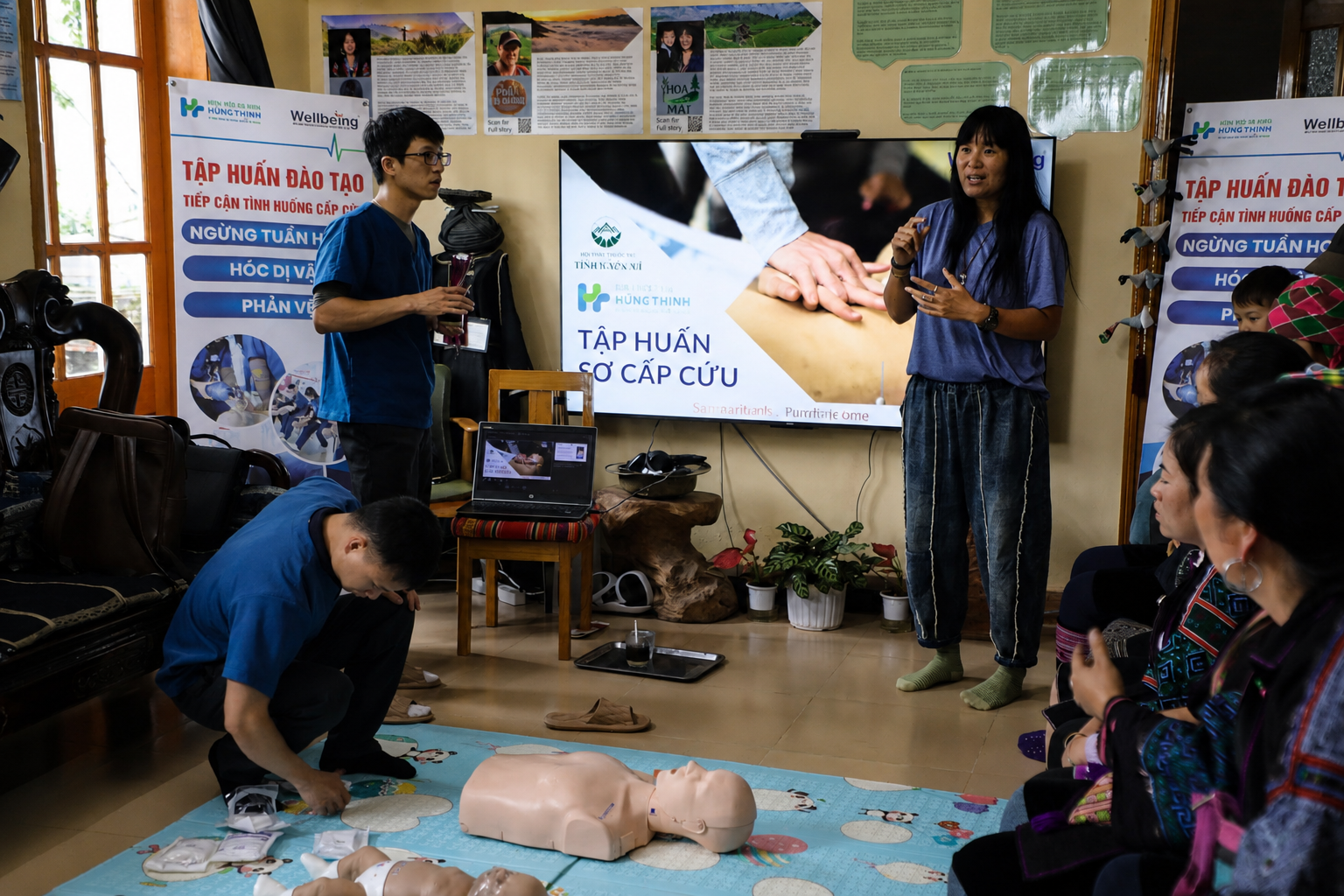
Mai Thanh Hoa - ETHOS Director introducing a training session led by Hung Thinh General Hospital
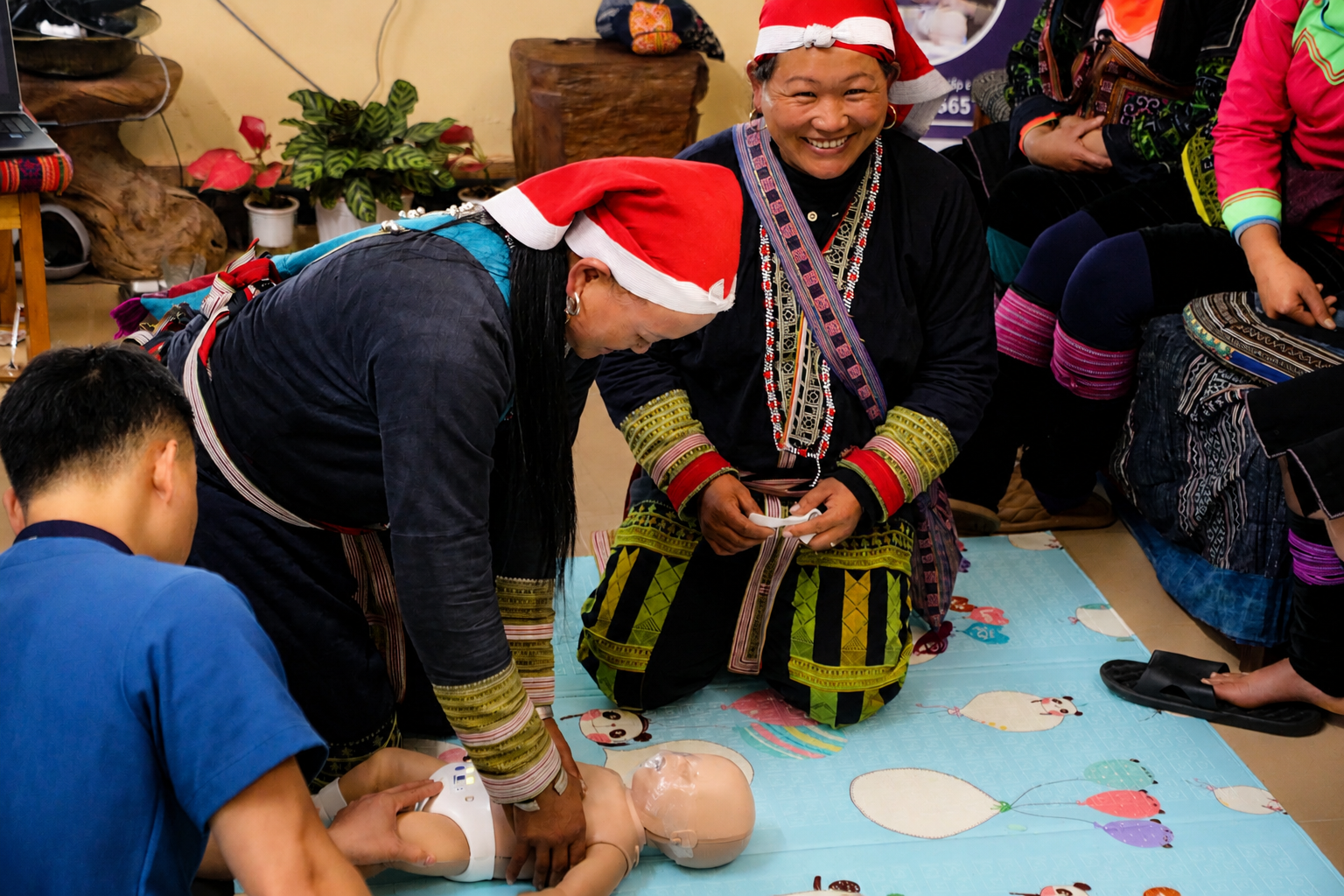
ETHOS Red Dao guides practicing CPR
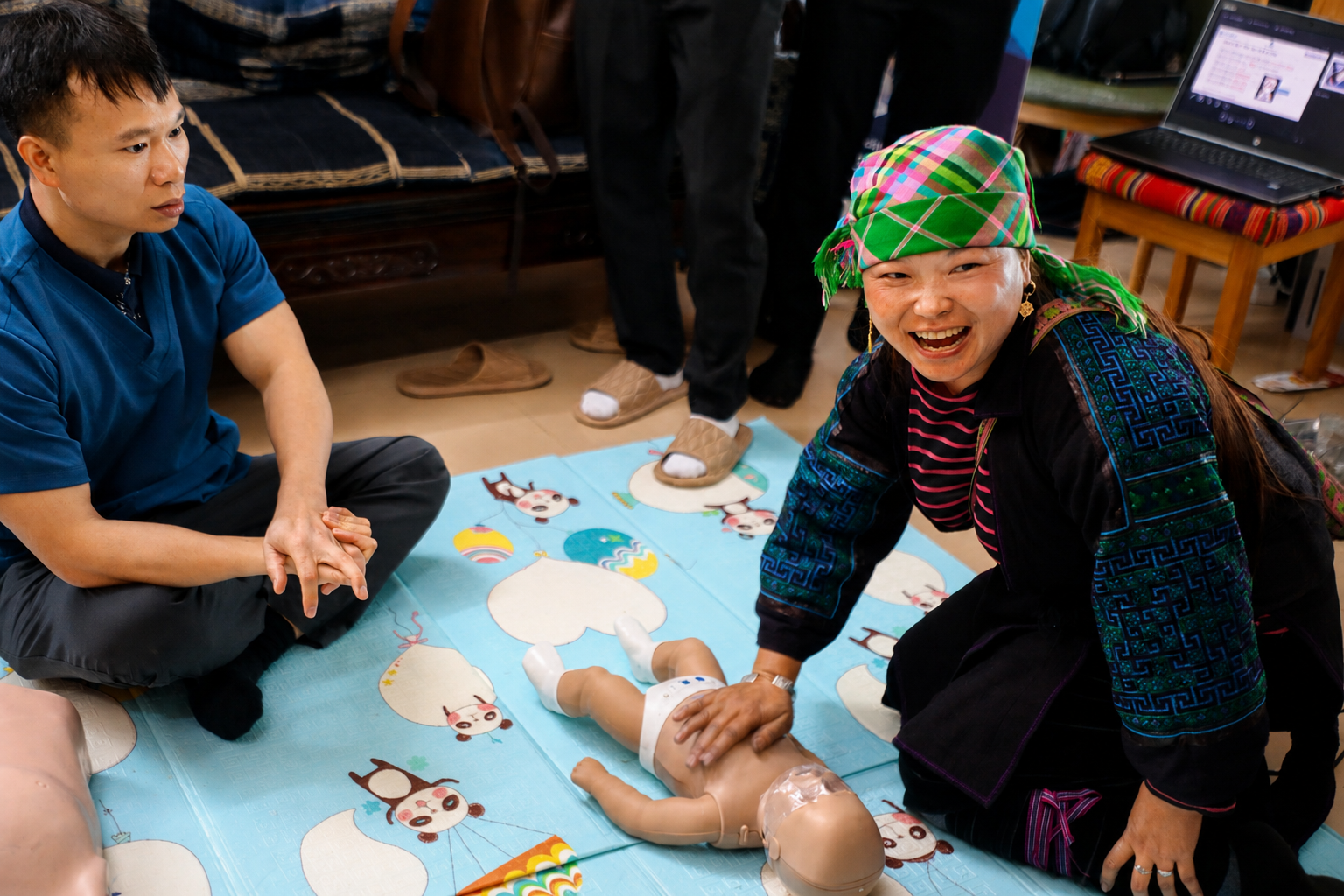
Hmong guide undertaking first aid training in the ETHOS Community centre, Sapa.
Training Beyond Certification
Safety training is often misunderstood within tourism. Many people imagine that once a certificate is awarded, the process is complete. In reality, meaningful safety culture develops through continual repetition, discussion, reflection, and practical experience over time.
At ETHOS, training extends far beyond simply completing courses. Our guides participate in ongoing learning focused on first aid, risk assessment, food hygiene, communication, guest welfare, weather interpretation, emergency escalation, and route management. Much of this training is scenario-based, designed around realistic situations guides may genuinely encounter in the mountains.
Guides work through situations such as responding to guest exhaustion during extreme heat, navigating rapidly changing weather conditions, managing swollen rivers after heavy rain, dealing with slips and falls on steep terrain, recognising dehydration symptoms, adapting routes due to landslide risk, or supporting nervous or overwhelmed guests during difficult sections of trail.
Particular emphasis is placed on communication and decision-making. Calm leadership can often prevent small problems from escalating into larger ones. Guides practise how to explain route changes clearly, reassure anxious travellers, maintain group confidence, and communicate effectively even when language barriers exist. They also understand that decision-making does not happen in isolation. The office team remains constantly available to support guides during treks whenever conditions become uncertain or additional assistance is required.
Watching guides who once lacked confidence in structured learning environments now confidently discussing emergency procedures, food safety standards, or route management systems has been incredibly rewarding. What makes this especially meaningful is the enthusiasm the guides themselves bring to the process. There is a genuine eagerness to learn, improve, and develop professionally. Training sessions are filled with discussion, curiosity, humour, and shared problem-solving. Guides actively contribute their own experiences, challenge ideas, and help shape how systems evolve over time.
A Strong Record Built Through Consistency
Perhaps the clearest reflection of all this work is seen not in paperwork or certificates, but in the experiences of the guests themselves. Over many years of operating treks throughout the mountains surrounding Sapa, ETHOS has built an exceptionally strong track record for both guest safety and guest satisfaction, something achieved not through luck, but through consistency, preparation, communication, and the professionalism of the guides leading every trek.
Safe and rewarding trekking experiences are created long before guests ever step onto a trail. They are created through route planning, weather assessment, guide communication, group management, local decision-making, and the quiet confidence that comes from deep familiarity with the landscape itself. They are strengthened further by the willingness of guides to slow down, adapt plans, change routes, or seek support whenever conditions demand it.
Many of the trails used by ETHOS guides are not formally marked or documented on tourist maps. They exist instead within a living network of local knowledge passed between families, villages, and generations. Combined with structured training, international safety frameworks, and strong communication between guides and office staff, this allows treks to remain adventurous and authentic while still operating within clear safety protocols.
Guest feedback consistently highlights not only the warmth and knowledge of the guides, but also the calm and reassured feeling people experience while trekking with them. Visitors often arrive expecting beautiful scenery, yet leave speaking just as much about the professionalism, awareness, adaptability, and quiet competence of the people who guided them through it.
Knowledge That Cannot Be Taught in a Classroom
What makes this work truly powerful is the depth of knowledge that already exists within the communities themselves. Long before formal systems were introduced, these guides were navigating complex environments with a level of awareness that cannot easily be replicated through conventional education.
A guide may pause beside a patch of vegetation and identify edible plants that have sustained families for generations, knowing precisely when they are safe to harvest and how they should be prepared. Another may point out leaves used to treat cuts, reduce swelling, or soothe insect bites, drawing on knowledge that has been refined through lived experience rather than written instruction.
Weather is read not through forecasts, but through subtle changes in the air, the movement of clouds across ridgelines, and the behaviour of animals and insects. The onset of heavy rain, the likelihood of a storm, or the instability of a slope can often be anticipated hours in advance through these observations.
Perhaps most remarkable is their understanding of the trail network itself. Many of the routes used daily do not appear on any map. They exist instead as a living network, maintained through use, memory, and community knowledge. These paths connect villages, fields, forests, and water sources in ways that are both intricate and precise. To move through them without guidance would be disorientating. To walk them with someone who knows them is to experience a seamless continuity of movement through the landscape.
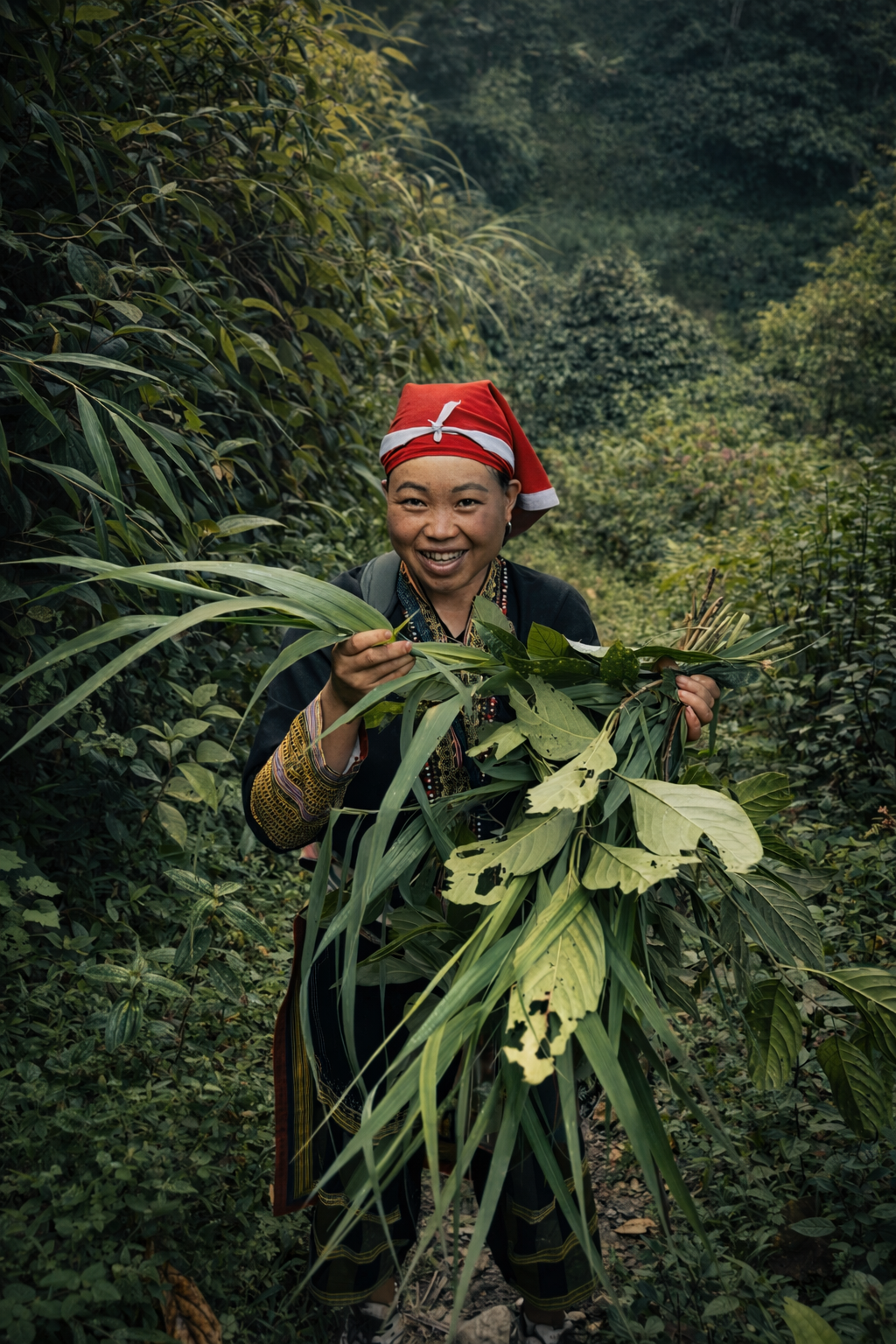
Dao guide demonstrating knowldge of traditional herbal medicines
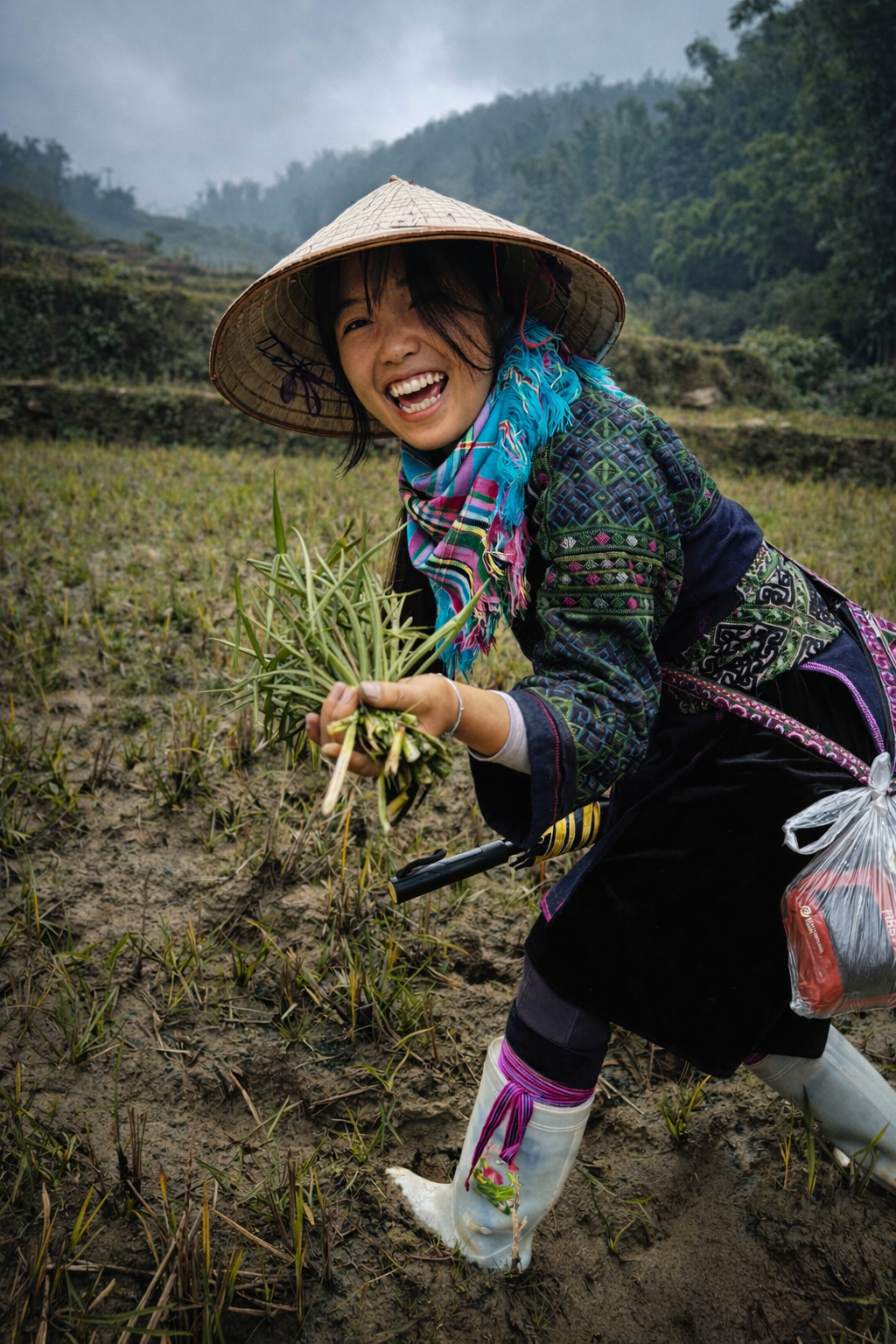
Hmong guide gathering wild foods
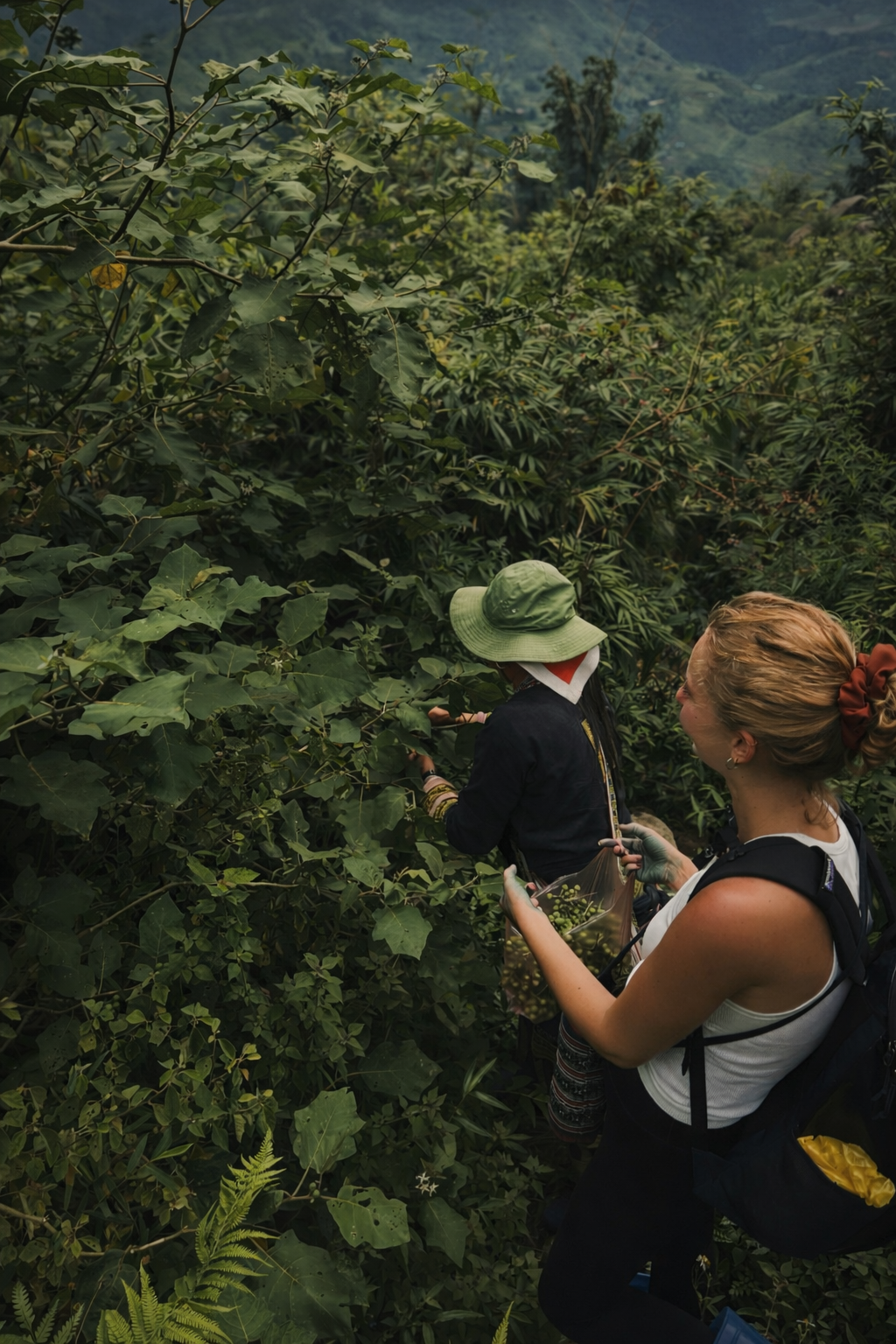
Dao guide showing travellers how to forage in Sapa
Respecting Expertise While Building Structure
The challenge has never been to replace this knowledge, but to support it. The systems that have been developed are designed to sit alongside existing expertise, providing structure where needed without disrupting what already works.
A guide who understands the early signs of fatigue in a guest now has a clear protocol for when to stop, how to respond, and how to communicate that decision. A guide who can read a river’s behaviour instinctively now operates within a shared framework that ensures consistency across the entire team.
This integration has taken time. It has required listening as much as teaching, adapting as much as instructing. The process has been collaborative at every stage, recognising that the most effective solutions are those that are co-created.
The Rise of Local Leadership
At ETHOS, training is not only delivered from the top down. Some of the most meaningful progress we have witnessed in recent years has come from seeing younger guides step forward into positions of responsibility, leadership, and mentorship within their own communities. Two of the strongest examples of this are ETHOS youth leaders Ly Thi Cha and Sung Thi Do, whose growing confidence and commitment have become an important part of our wider training culture.
Both Cha and Do began their journeys as young local guides learning how to communicate with international guests, navigate safely through the mountains, and represent their communities with confidence and pride. Over time, their roles have steadily expanded beyond guiding alone. They now actively assist with elements of guide development, practical safety discussions, communication exercises, and peer learning sessions within the ETHOS team.
This progression matters deeply because leadership cannot simply be imported from outside. Strong long-term safety culture only develops when local people themselves begin teaching, guiding, and supporting others around them. Watching younger Hmong women stand in front of their peers, share experiences from the trail, explain decision-making, and help newer guides build confidence represents a significant step forward not only for ETHOS, but for the wider future of community-led tourism in the region.
Their involvement also creates a far more relatable learning environment for newer guides, particularly those who may feel nervous about formal training or uncertain about their own abilities. When guides see women from neighbouring villages confidently discussing route choices, guest communication, changing weather conditions, or cultural interpretation, the training becomes less intimidating and more achievable. It transforms safety and leadership from something theoretical into something personal, practical, and attainable.
Both Cha and Do bring their own personalities and strengths into these sessions. Their knowledge of local trails, village customs, edible plants, seasonal farming rhythms, and mountain conditions is paired with an increasing confidence in communication, organisation, and leadership. This blend of inherited local knowledge and structured professional development sits at the very heart of what ETHOS is trying to build.
For us, this is about far more than ticking boxes or delivering certificates. It is about creating genuine pathways for growth, confidence, and opportunity within local communities themselves. Seeing young guides evolve into capable leaders, mentors, and role models for others is one of the clearest signs that the training systems we have worked so hard to build are beginning to create lasting change.
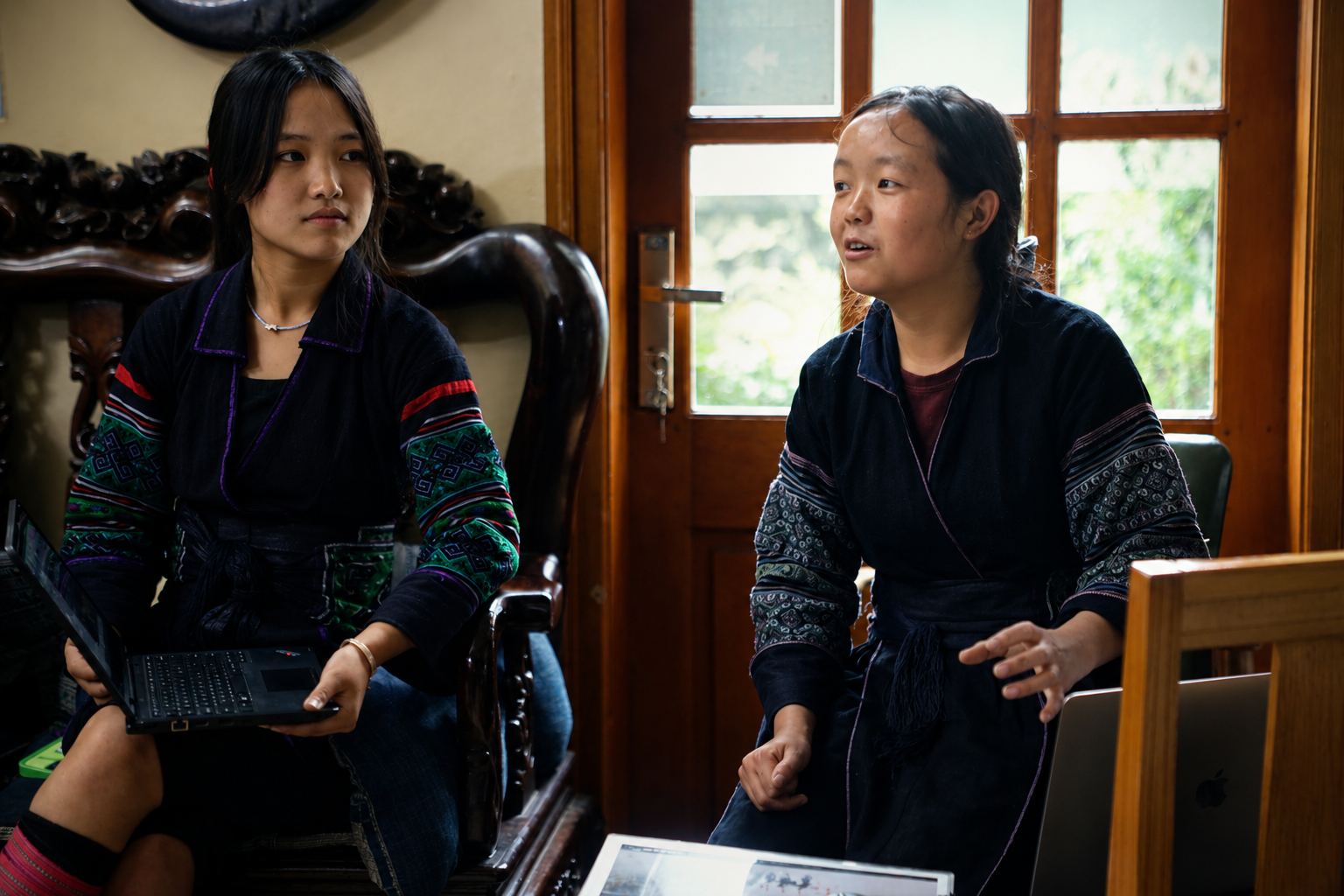
Ly Thi Cha and Sung Thi Do leading a training session on food preparation and cleanliness.
A System That Continues to Grow
This work is ongoing. Each trek, each season, and each new challenge provides an opportunity to learn and improve. Feedback loops ensure that experiences in the field are brought back into training, refining the system further.
The strength of this approach lies in its adaptability. It is not fixed, but responsive, capable of evolving as conditions change and as the team continues to grow in confidence and capability.
Adventure, Culture, and Responsibility
Adventure travel should never feel sanitised or artificial. People come to northern Vietnam searching for immersion, unpredictability, connection, and genuine cultural experience. The goal is not to remove adventure from trekking, but to support it responsibly through preparation, communication, local knowledge, and good decision-making.
The mountains themselves will always remain dynamic environments. Weather shifts quickly and trails change constantly. Rivers rise and slopes erode. Conditions evolve from one week to the next. What matters is not pretending risk can be eliminated entirely, but ensuring guides possess the confidence, judgement, and support systems necessary to respond appropriately when situations change.
What ETHOS has built is ultimately rooted in people. It is rooted in guides who know these mountains intimately because they have spent their lives within them. It is rooted in communities who continue farming and maintaining the landscapes travellers come to experience. It is rooted in younger generations stepping forward into leadership roles. I t is rooted in a willingness to learn continuously, adapt constantly, and combine local wisdom with evolving professional standards.
The work behind these systems has been extensive and at times extraordinarily challenging. Building practical safety frameworks across different languages, literacy levels, cultures, and educational backgrounds is no small task. Yet the results are increasingly visible every day in the confidence of the guides, the consistency of operations, the professionalism of communication, and the trust guests place in the people leading them through these mountains.
Ultimately, the strongest safety systems are not built through paperwork alone. They are built through relationships, shared learning, local leadership, humility, and a collective commitment to doing things better year after year.
Walking Forward Together
To walk these mountains today is to be supported by something far greater than a single guide. It is to be part of a network, a system, and a shared commitment to doing things properly. The rice terraces, the forest paths, and the hidden trails remain as they have always been, shaped by generations of care and effort. What has changed is the framework that supports those who guide others through them.
This is not simply about compliance with legislation but more about recognising the value of local knowledge, investing in its development, and ensuring that it can continue to thrive within a modern context. What has been built is something both practical and deeply human. It stands as a testament to what can be achieved when respect, hard work, and collaboration come together with a shared purpose.


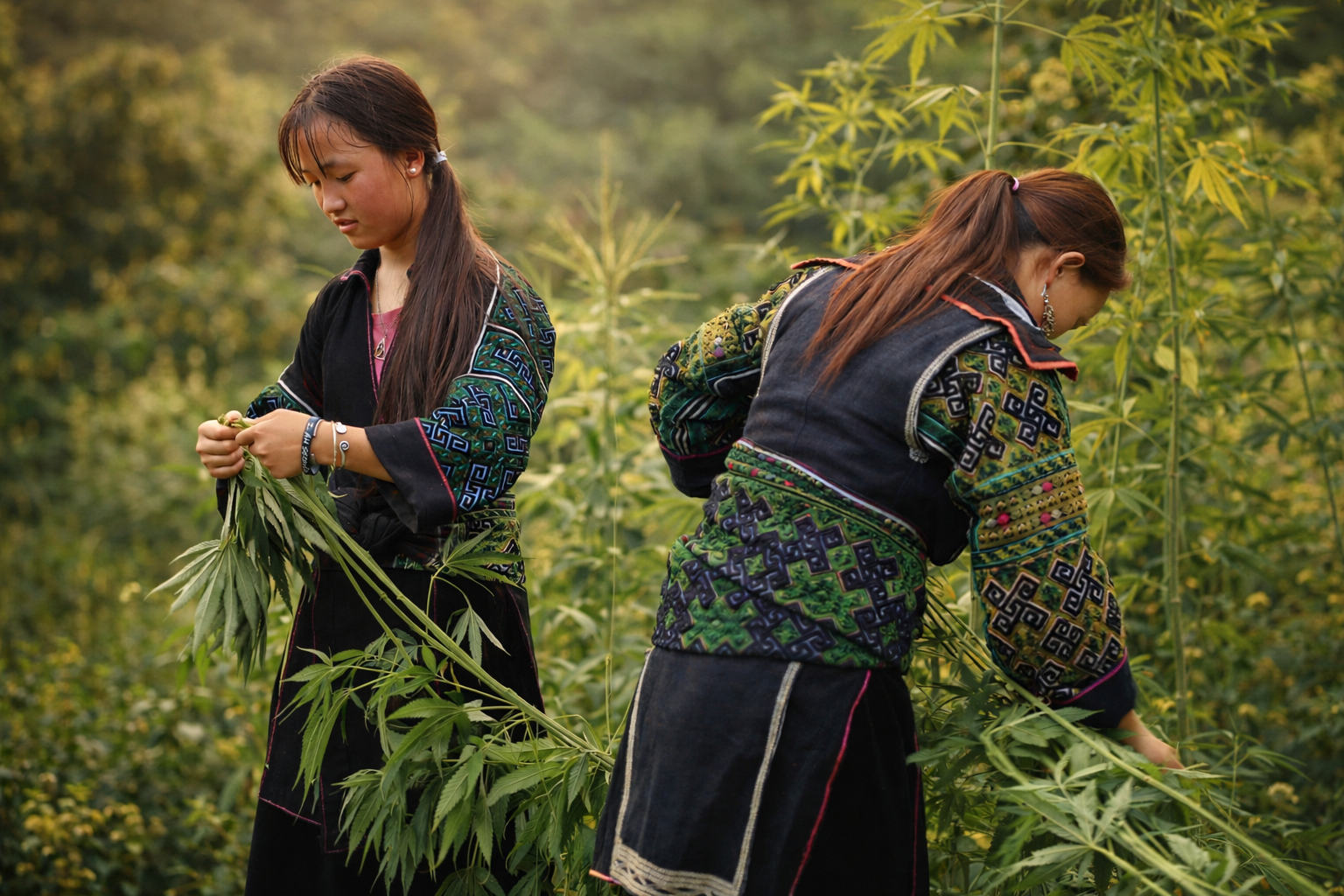
Sapa, Vietnam: What Makes This Mountain Region Truly Special
Sapa is more than rice terraces and viewpoints. This guide explores the people, cultures, and lived experiences that shape the region, from Hmong and Dao communities to immersive trekking and homestays, and why Sapa is just the beginning of a deeper journey into northern Vietnam.
Real Travel Begins When You Stop Looking For A Viewpoint
On the edges of Sapa town, it is easy to find places built for a single purpose. Artificial Check-In spots facing the valley, crafted backdrops, bright slides cutting across the hillside, all designed to produce an image that looks like Sapa without requiring much engagement with it. They are efficient, accessible, and widely promoted. They also reduce a complex region into something flat and easily consumed.
Sapa is often sold through its scenery. Mist rolling over rice terraces, buffalo moving through wet fields, mountain ridges fading into the distance. These images are beautiful, of course, but they are also incomplete. They show the surface of a place whose real depth comes from the people who have shaped these mountains for generations.
To understand Sapa properly, you have to move away from the idea that travel is a list of places to see. The most meaningful experiences here rarely happen at the busiest viewpoints. They happen on footpaths between villages, in kitchens darkened by woodsmoke, beside dye pots stained deep blue with indigo, or in fields where someone explains why a particular crop is planted on one slope and not another. This is where travel becomes more than sightseeing. It becomes a way of paying attention.
In Sapa, the Hmong, Dao, Giáy, Tày, Xá Phó and other communities are not part of the backdrop. They are the reason this region has its character, knowledge, language, food, textiles, farming systems, and sense of welcome. Their lives are not arranged for visitors, though visitors are sometimes invited in with remarkable generosity. The difference matters.
Real travel here is not about finding something untouched or “authentic” in a staged sense, but is about meeting people as people, understanding that culture is lived every day, and recognising that the most valuable parts of a journey may be the ones that ask you to slow down, listen carefully, and leave behind the habit of consuming places quickly.
The People Who Shape The Landscape: Why Sapa Cannot Be Understood Without Its Ethnic Communities
It is easy to describe Sapa through geography, harder to explain it without talking about the people who have made it what it is. The terraces are scenic formations but also engineered landscapes built and maintained through generations of shared labour and inherited knowledge. Villages are social settlements organised through kinship, language, ritual, and seasonal work.
The Hmong are often the most visible to travellers, particularly the Black Hmong communities who live in and around the valleys near Sapa town. Their expertise in working steep terrain is evident in the layered rice fields that follow the curves of the mountains. Their textile traditions, especially hemp weaving and indigo batik, are both practical and expressive, with patterns that carry meaning linked to identity and history.
The Dao, particularly the Red Dao, bring a different set of knowledge systems into the landscape. Their understanding of forest plants, used for medicine and ritual, is detailed and specific. Practices such as herbal bathing are not inventions for tourism, they are part of a broader relationship with the environment that includes healing, spirituality, and daily care. Their ceremonial life, from coming-of-age rituals to seasonal gatherings, continues to structure community life in ways that are not immediately visible to outsiders.
Smaller groups such as the Giáy, Tày and Xá Phó contribute further layers to this cultural environment. The Giáy, often based in valley areas, focus on wet rice cultivation and maintain strong oral traditions tied to land and ancestry. The Tày, though less prominent in Sapa itself, share related cultural practices and add to the wider regional network of Tai-speaking peoples. The Xá Phó, with their own distinct rituals such as village cleansing ceremonies, represent how even smaller communities maintain practices that are both specific and deeply rooted.
What makes these groups remarkable is not simply their difference, but their continuity. These are societies that have adapted over time without losing the structures that hold them together. To travel through Sapa without engaging with this would be to miss the point entirely. For those who want to experience this in a more grounded way, walking with a local guide rather than following a fixed route often changes everything. The pace slows, conversations open up, and the landscape begins to make sense through lived experience rather than explanation alone.
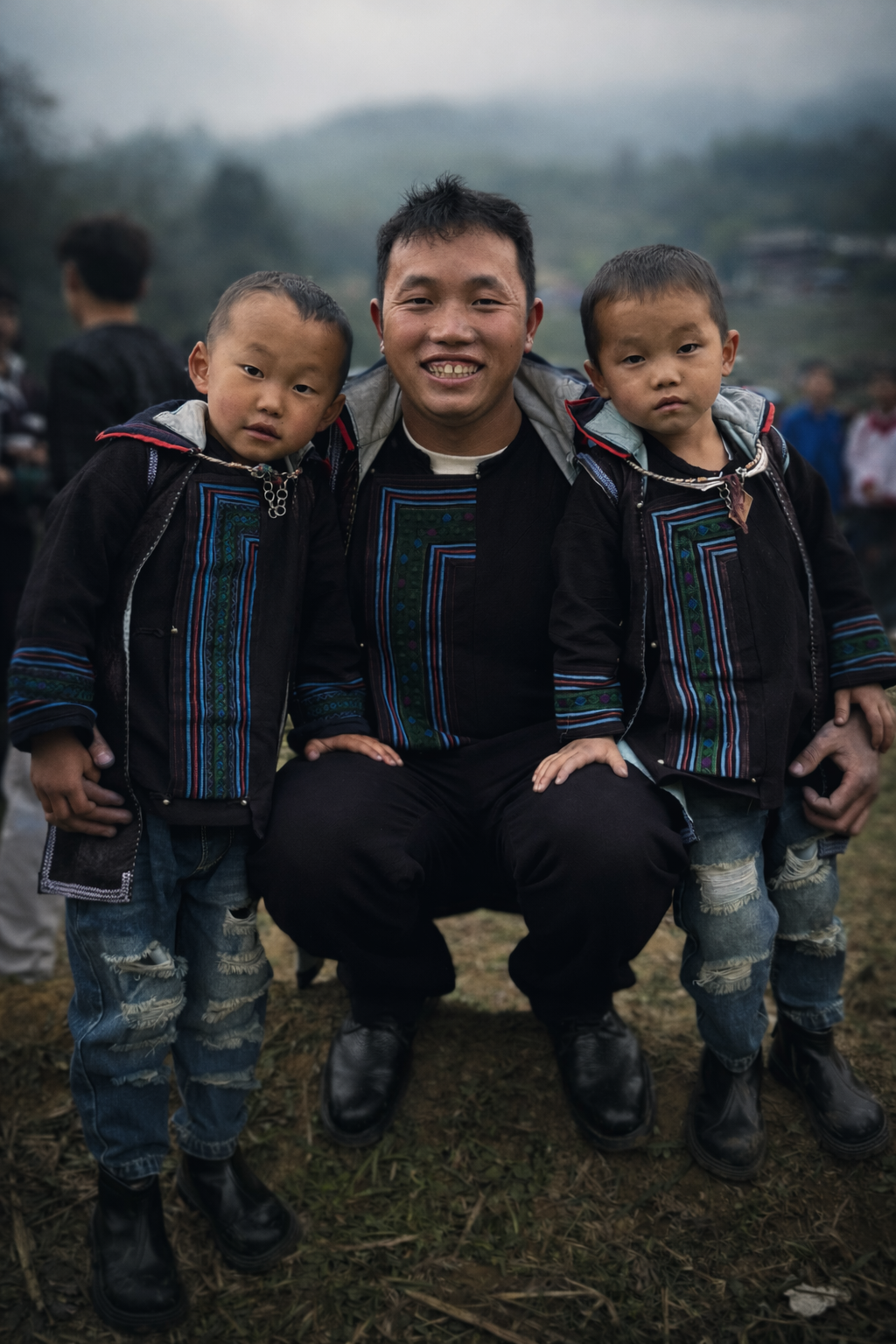
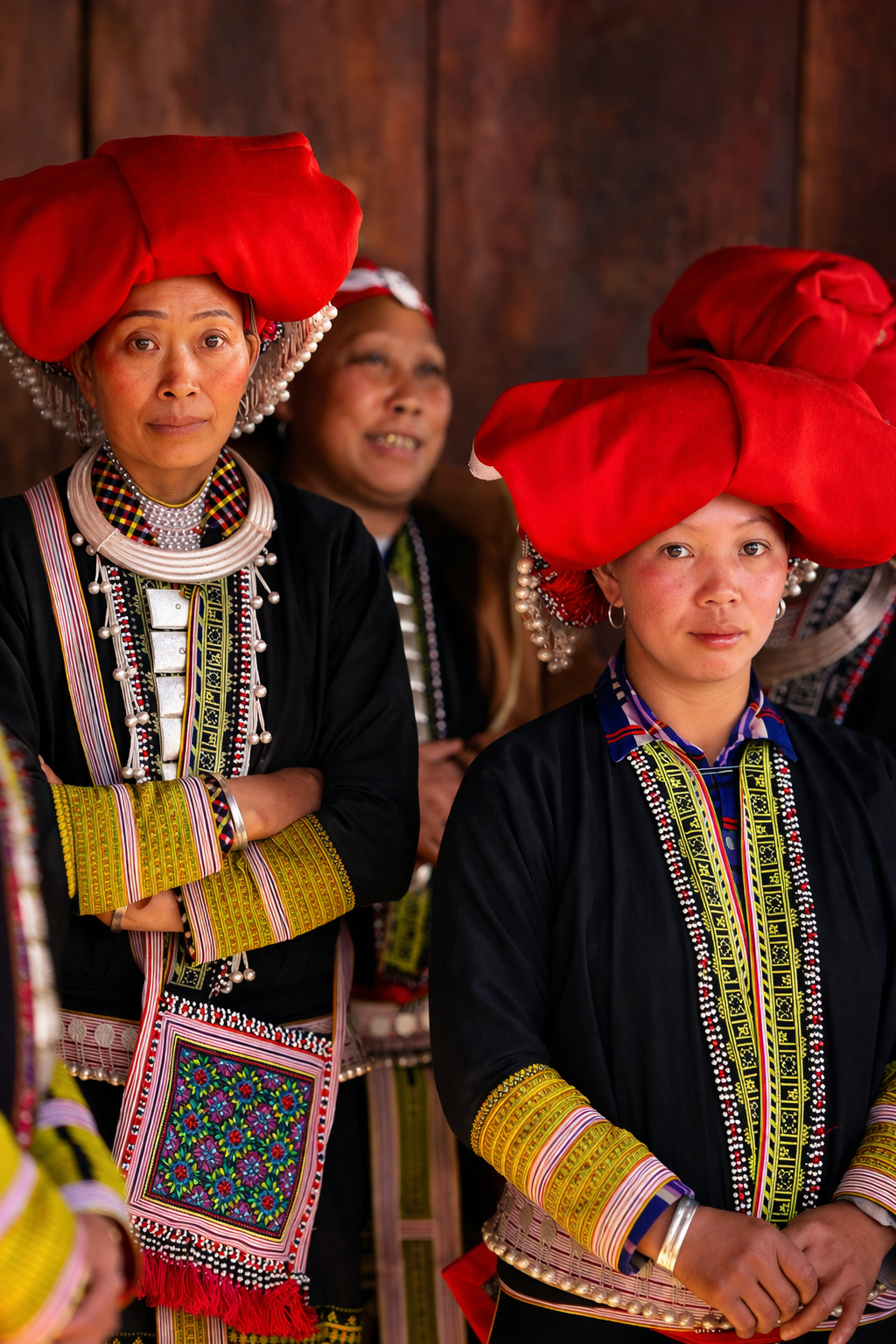
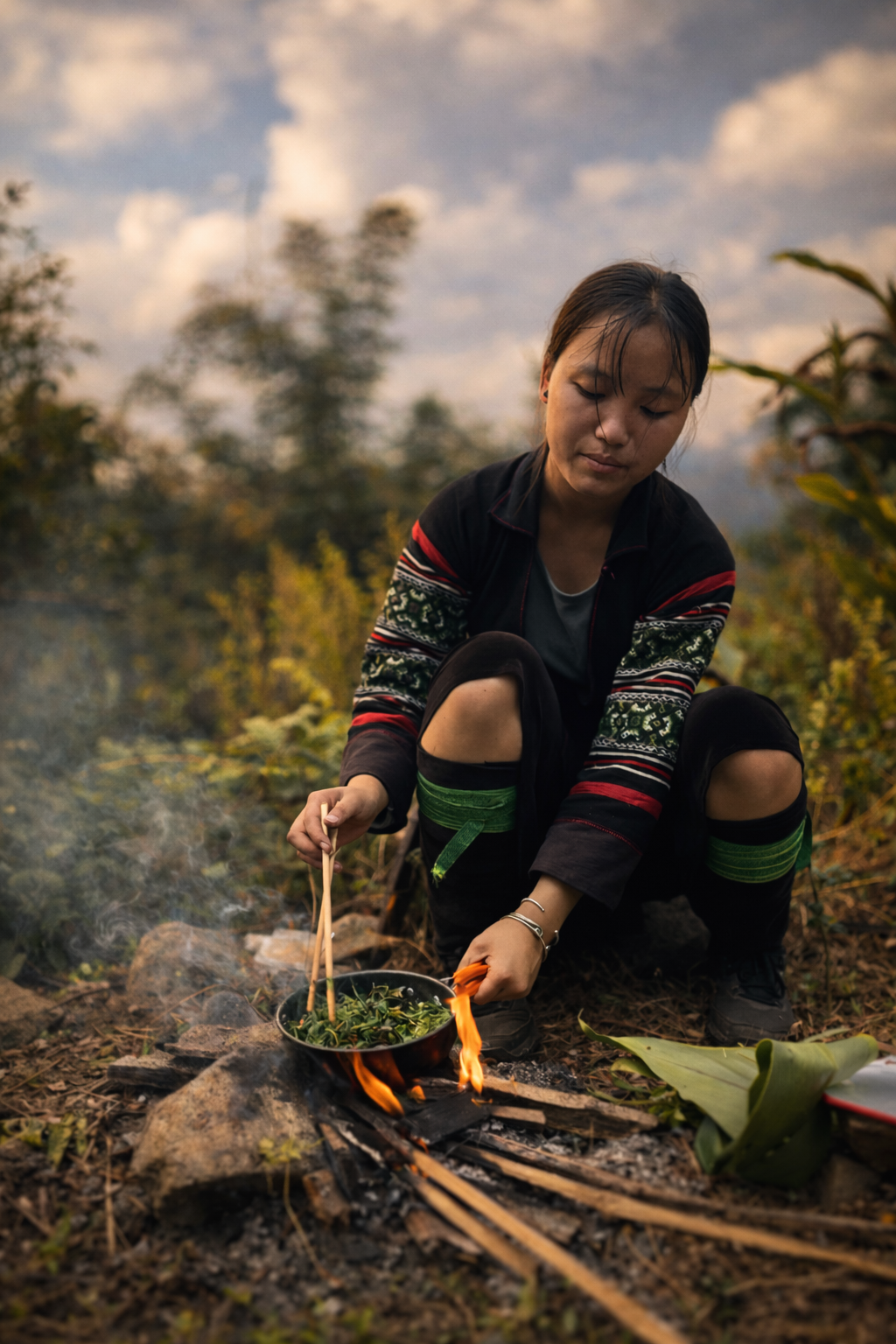
Language As A Way In: Why Local Guides Are So Skilled At Opening Their World
One of the first things many travellers notice is how easily local guides move between languages. A conversation might begin in Hmong, shift into Vietnamese, and continue in English, often with little pause. This ability is not unusual here, it is a practical response to how life works in a multi-ethnic, economically active border region.
Children grow up hearing and using more than one language from an early age. At home, a mother tongue such as Hmong or Dao is spoken. At school, Vietnamese becomes necessary. In markets, where different ethnic groups trade with one another, communication often involves switching between languages fluidly. With the growth of tourism, English has become another layer, learned through interaction, observation, and practice rather than formal training alone.
This creates a particular kind of communicator. Local guides are not simply translating words, they are constantly interpreting meaning across cultures. They know when something needs explanation, when something is better left observed, and how to introduce visitors to their communities in a way that feels respectful rather than intrusive. There is also a level of confidence that comes from this environment. Explaining your own culture to someone from a completely different background requires clarity and self-awareness. Many Hmong and Dao guides have developed both, often at a young age, because it is part of their working life. This is one of the reasons travellers often feel more at ease here than expected. The people welcoming them in are not only hospitable, they are highly skilled at bridging worlds.
Spending time in smaller groups, where there is space for these conversations to unfold naturally, tends to bring out this strength most clearly.
How Experiential Travel Took Root In Sapa: From Isolation To Exchange
The form of travel now associated with Sapa did not emerge from a single plan. It developed gradually, shaped by history, economics, and local initiative. During the early twentieth century, the area was established as a hill station by French colonial administrators. That period introduced outside interest but did little to involve local communities in meaningful ways. Decades of conflict and isolation followed, during which tourism disappeared almost entirely.
It was only in the early 1990s, after Vietnam’s economic reforms, that Sapa reopened to international visitors. At first, infrastructure was minimal and numbers were small. Travellers walked into villages out of curiosity, and villagers, in turn, began to offer guidance, food, and eventually places to stay. Trekking and what is now called “experiential travel” began in these simple exchanges. A guide leading a walk was also a farmer explaining their fields. A host offering a bed was sharing their home as it already existed, not as a constructed guesthouse.
As visitor numbers increased through the 2000s, these interactions became more structured. Homestays were formalised, trekking routes established, and craft workshops introduced. In some cases, this brought welcome income and opportunities. In others, it created pressure to adapt traditions to meet visitor expectations. Today, the strongest examples of experiential travel in Sapa are those that remain grounded in real life. Treks and homestays are not performances but rather extensions of what communities already do. The difference is subtle, but it is what defines whether an experience feels meaningful or superficial. Choosing experiences that are led by the people who live here, rather than imposed from outside, is one of the simplest ways to support that balance.
The Tensions Behind Growth: What Tourism Has Changed
Tourism has brought visible improvements to parts of Sapa. Roads are better, access to education has increased, and many families now have additional sources of income. Homestays, guiding, and craft production have allowed some households to earn in ways that were not previously possible. At the same time, the benefits are uneven. Villages closer to Sapa town or along popular trekking routes tend to receive more visitors and income, while more remote communities may see very little of this change. Larger businesses, often run by people from outside the minority groups, capture a significant share of the market. There are also shifts within communities themselves. Younger people may choose tourism over farming, which can change how knowledge is passed on. Certain rituals or crafts may be simplified or adapted for visitors. Languages can shift as Vietnamese and English become more dominant in daily interactions.
Environmental pressures are increasingly visible as well. Waste management, water use, and land development all present ongoing challenges in a landscape that was not designed for high visitor numbers. These are not reasons to avoid Sapa. They are reasons to think carefully about how and why you travel here.
Local Leadership And Agency - Communities Are Not Passive Participants
One of the most important things to understand is that local communities are not simply reacting to tourism. Many are actively shaping it. Across the region, Hmong and Dao families have established their own homestays, guiding networks, and small businesses. Women, in particular, play a central role in this, often managing guest experiences, teaching crafts, and acting as cultural interpreters.
There are also cooperative models and smaller, community-led tour initiatives that aim to keep income within villages and ensure that cultural practices are shared on local terms. These approaches are not perfect, but they represent a shift towards greater control and self-determination. When travel is structured in this way, it becomes something closer to an exchange than a transaction. Visitors are not just consumers, they are participants in a system that, ideally, supports the people they meet. Travelling with organisations that prioritise these relationships can make that exchange more transparent and more meaningful, both for visitors and for the communities involved.
Sapa As A Starting Point - A Gateway Into Northern Vietnam’s Wider Cultural Landscape
For many travellers, Sapa is an introduction. It is one of the more accessible places in the northern mountains, with established routes, infrastructure, and communities accustomed to receiving visitors. That accessibility, however, should not be mistaken for completeness.
Beyond Sapa, the cultural landscape becomes even more varied and, in many places, less visited. Travelling further into the border regions of Lào Cai, Hà Giang, Lai Châu or Yên Bái brings encounters with different Hmong subgroups, as well as Dao communities with distinct practices, and other groups whose presence is less visible in Sapa itself. Languages shift subtly from valley to valley, clothing changes in detail and colour, and agricultural systems adapt to different terrain.
Using Sapa as a base allows travellers to begin with a certain level of familiarity before moving into areas where fewer people travel and where daily life unfolds with less external influence. The skills you develop here, how to walk with a guide, how to enter a home respectfully, how to listen more than you speak, become increasingly important the further you go.
For those interested in continuing beyond Sapa, travelling with local teams who already have relationships in these more remote areas can make that transition more natural and more respectful, opening up routes that are not always visible from the outside.
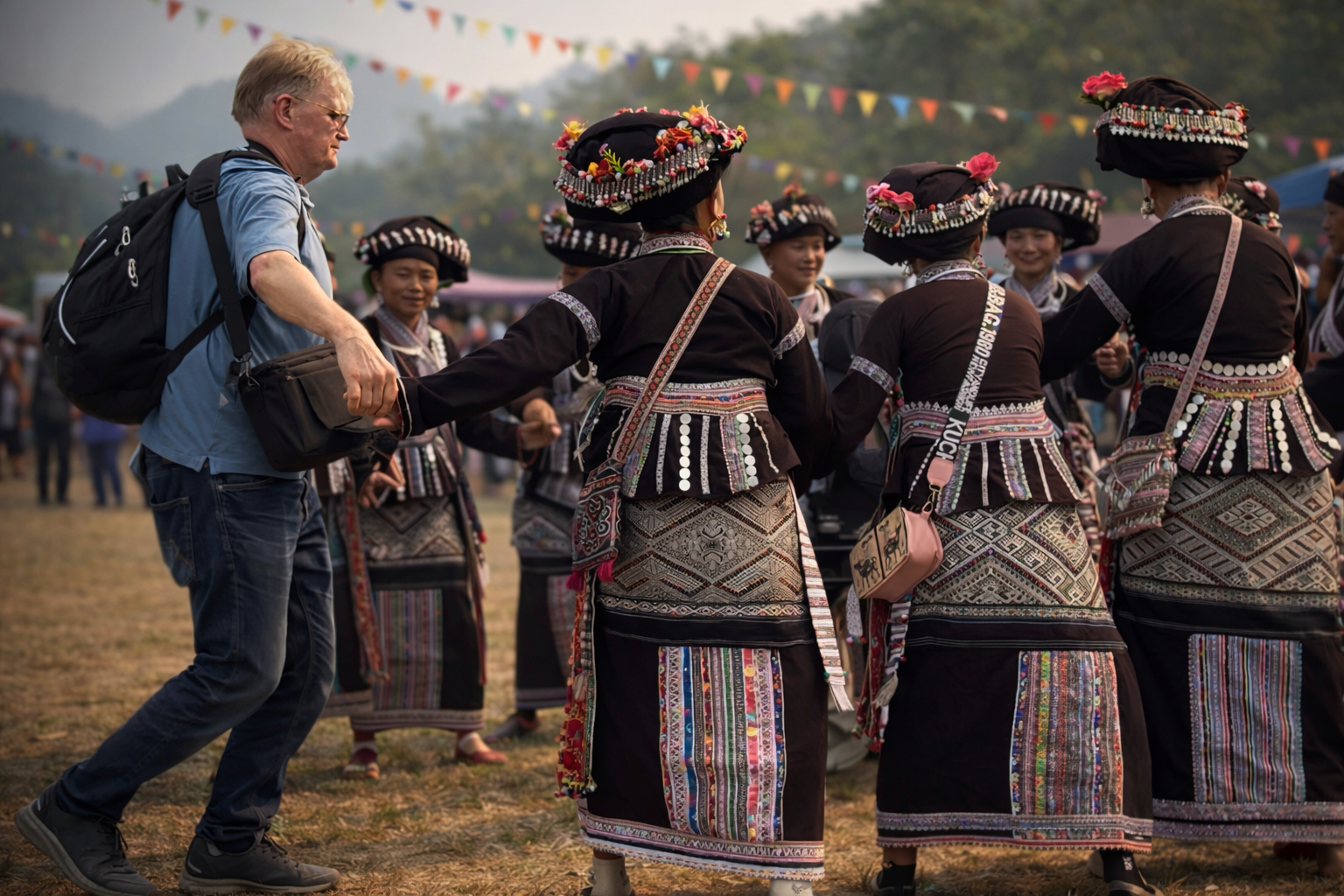
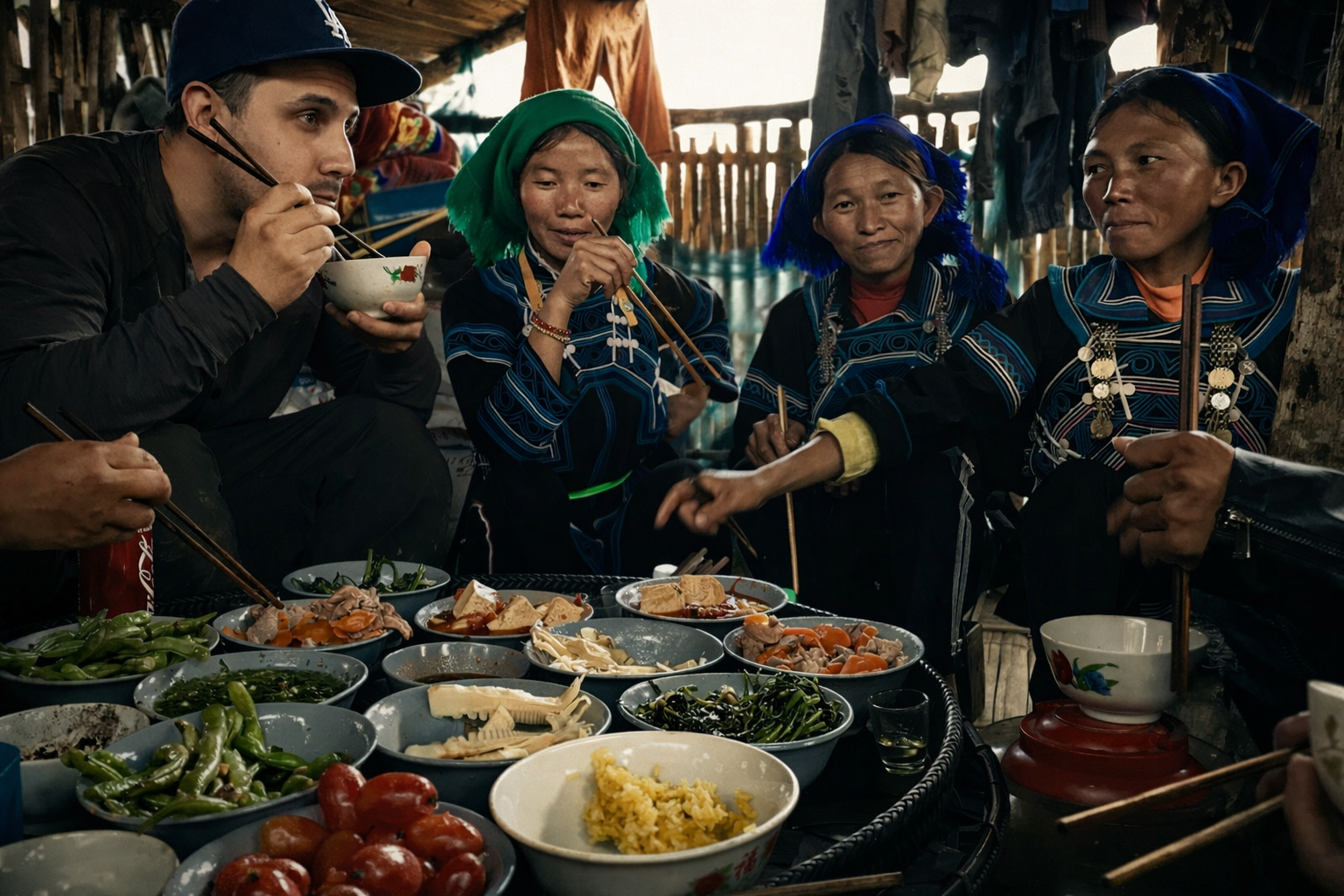
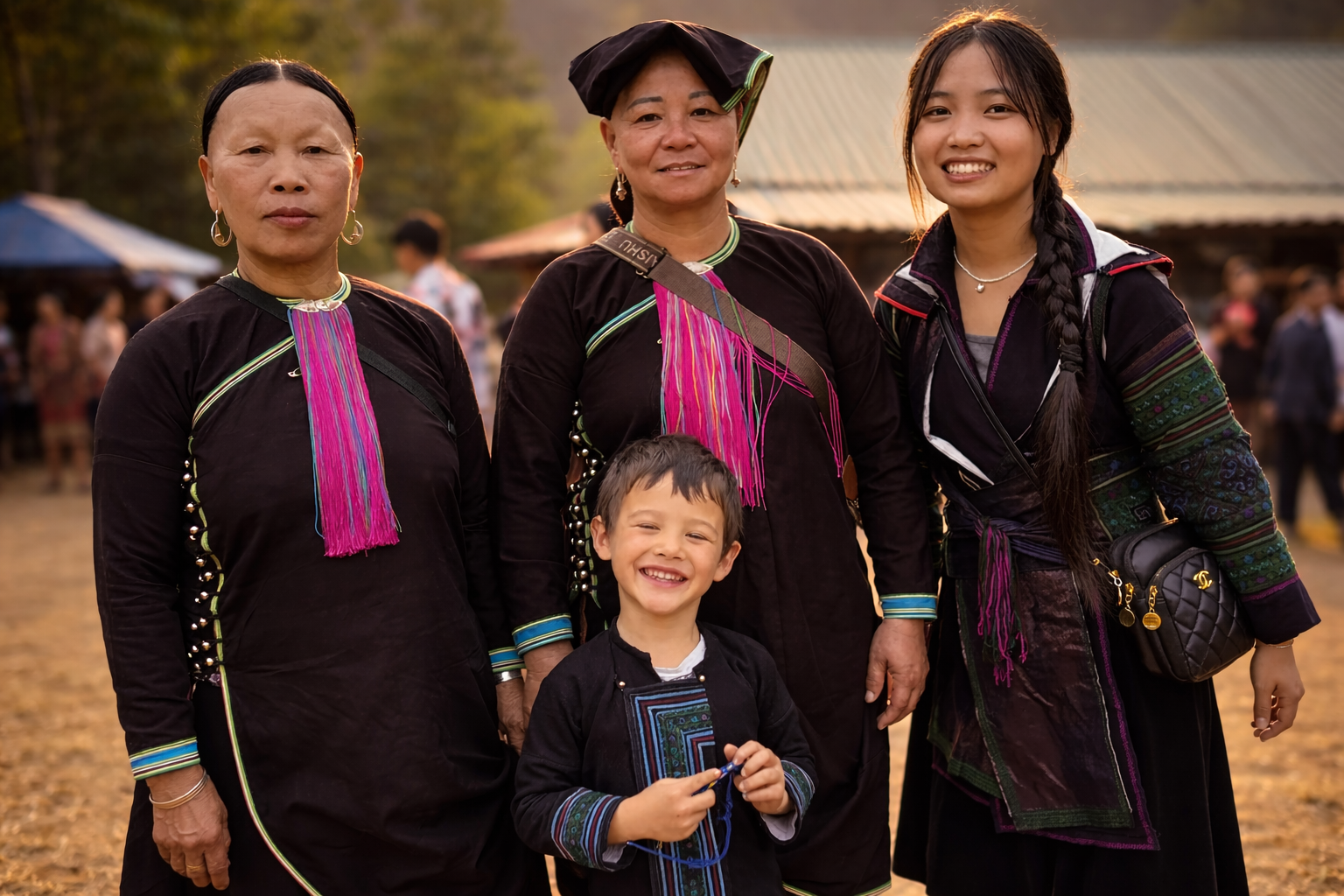
What Real Travel Looks Like In Sapa: Moving Beyond The Surface
Real travel in Sapa is not defined by how many places you visit, but by how you move through them.
It might mean spending a full day walking with a guide who explains the landscape in detail, rather than rushing between viewpoints. It might mean staying in one village long enough to recognise faces and routines, rather than passing through several in a single afternoon. It might mean trying to understand the work behind a textile, rather than simply buying it.
These choices change the experience entirely. They allow you to see Sapa not as a destination, but as a place where people live, work, and continue to adapt in complex ways. For some, that might look like a multi-day trek with nights spent in family homes, where conversations stretch into the evening and the next day begins at the same pace as everyone else’s. For others, it might be a slower introduction through a single village, a workshop, or a shared meal.
There is no single “authentic” version of Sapa waiting to be discovered. There are only real lives, real communities, and real exchanges that take place when travel is approached with care. That is what makes this region special. Not just its landscapes, but the depth of understanding that becomes possible when you are willing to engage with it properly.
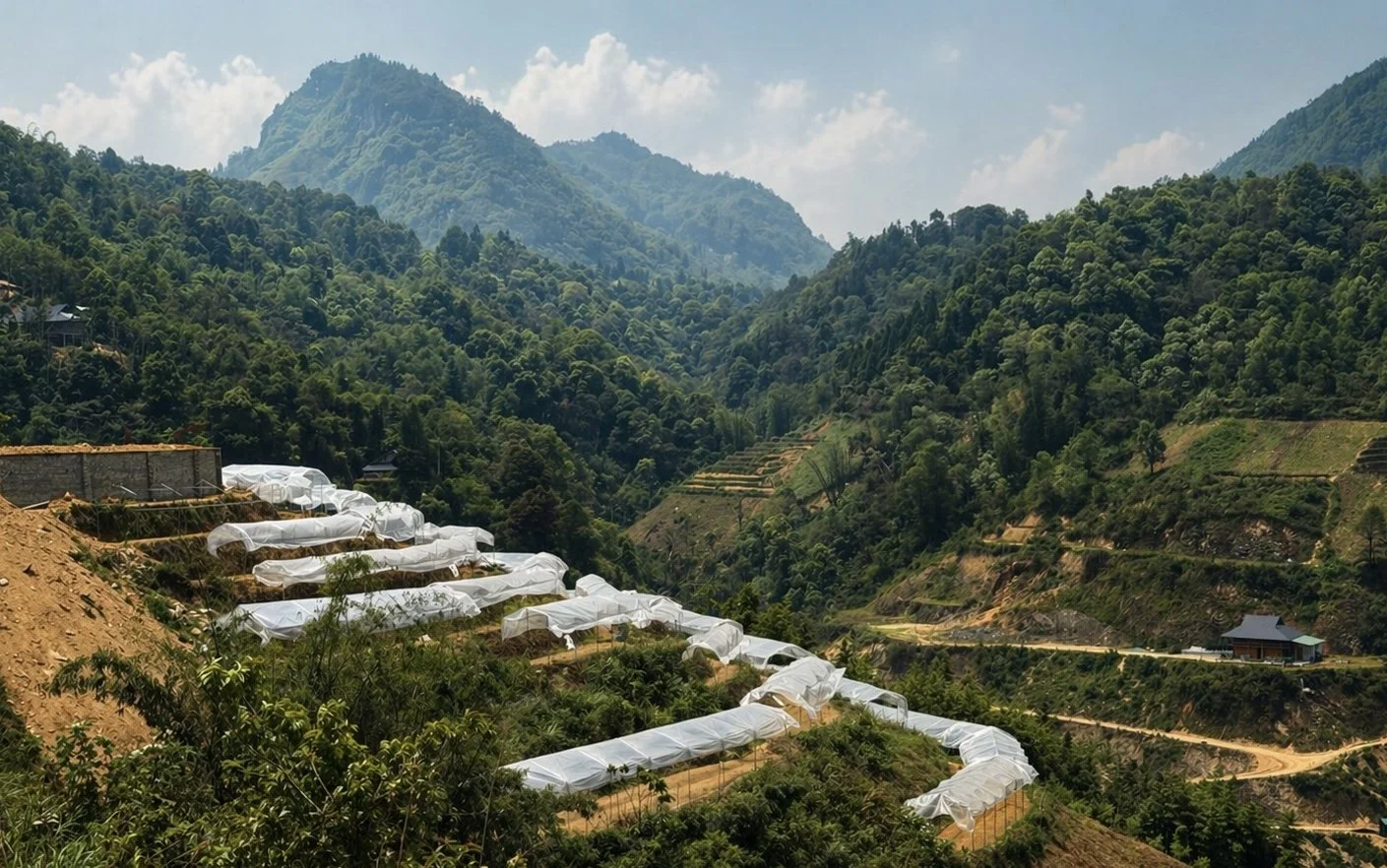
Sapa’s Hidden Shift: Trekking, Traditional Culture and the Spread of Plastic Across the Mountains
Sapa remains a place of extraordinary beauty, where trekking routes weave through rice terraces and living cultures. Yet beneath the surface, a quieter shift is unfolding. As farming intensifies and plastic spreads across the mountains, the relationship between landscape, culture and tourism is beginning to change. This deep-dive explores the growing tension between tourism and agriculture, and what is at stake for the future of Sapa.
A Region of Extraordinary Beauty and Living Culture
Sapa remains one of the most remarkable mountain regions in Vietnam, a place where dramatic ridgelines, layered rice terraces, National Park forests and traditional village life come together in ways that still have genuine appeal to travellers. Across the wider region, the scenery can be breathtaking in every season, from the verdent green of newly planted rice fields to the gold hues of harvest, from cloud rolling over high peaks to clear mornings when the mountains seem to stretch on without end. It is a landscape that continues to leave a powerful impression on those who arrive with the patience to really look.
For those planning to visit, Sapa is a place best experienced slowly and with care, taking time to walk, listen and learn from the communities who shape these mountains. If you are curious about exploring Sapa in a more connected and responsible way, you can discover our small group and community-led journeys here.
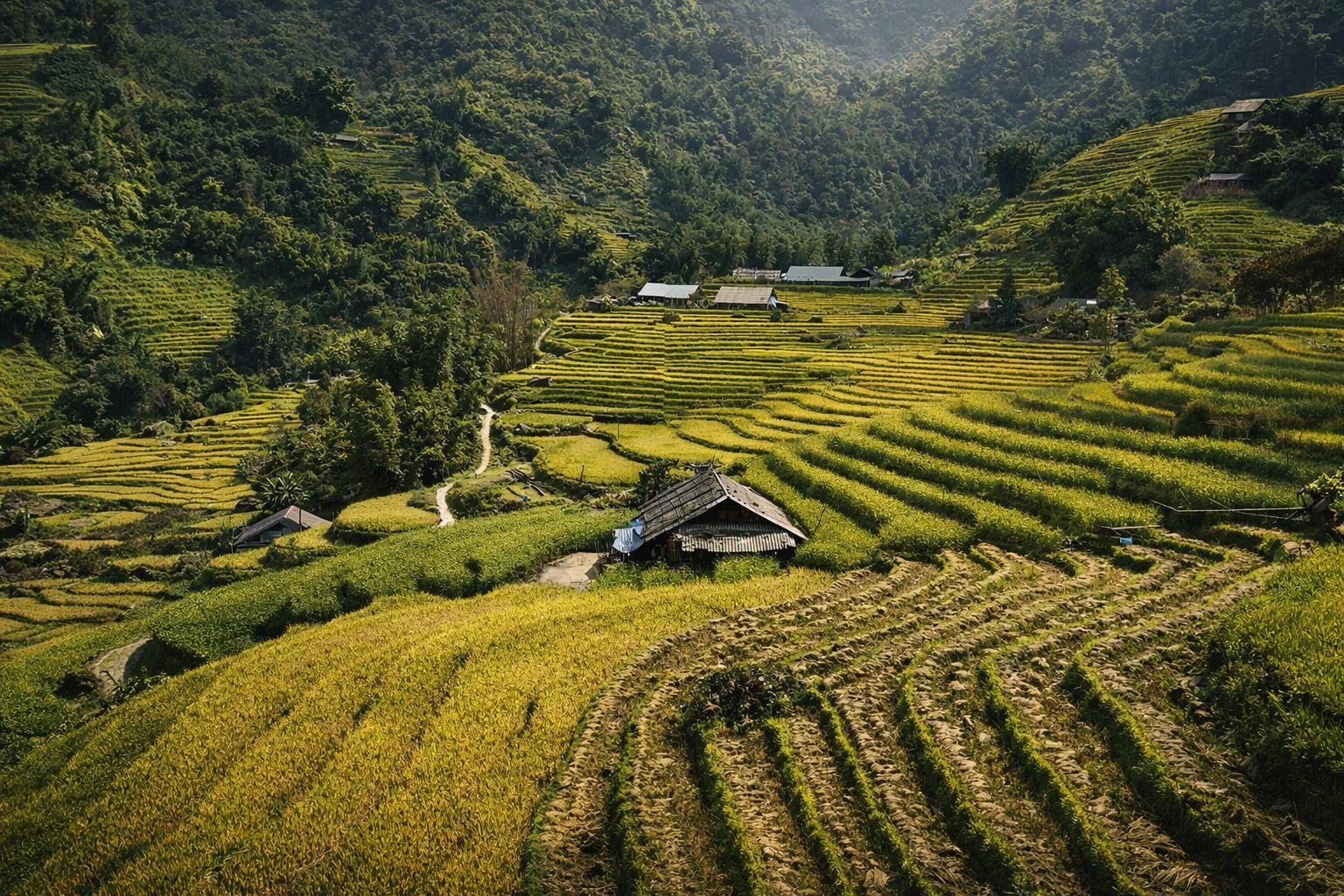

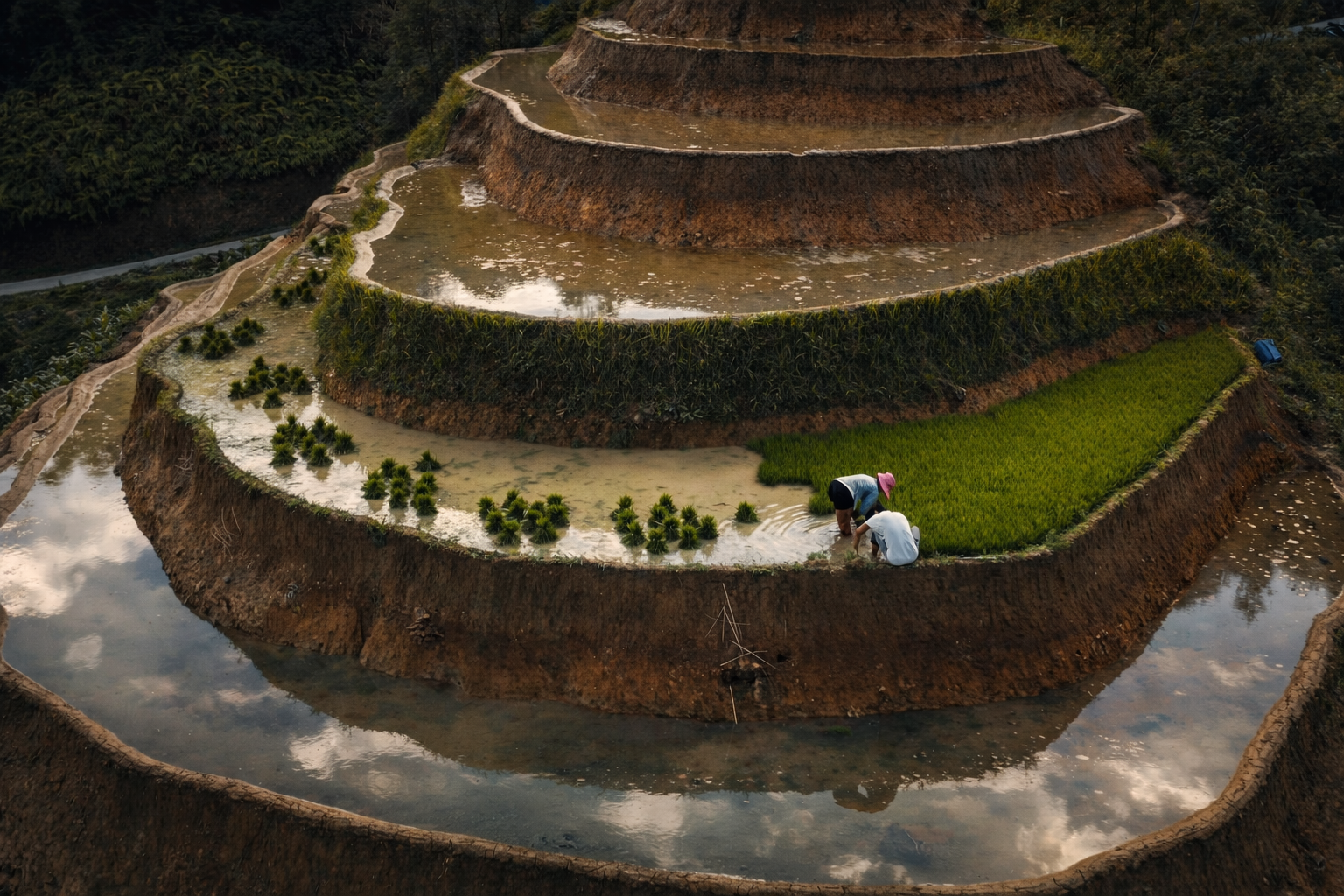
Sapa’s beauty, however, has never rested on scenery alone. What gives Sapa its real depth is the fact that this is also a lived cultural landscape, shaped over generations by Hmong, Dao and other ethnic communities whose knowledge, labour and traditions are inseparable from the land itself. The terraces are not only visually stunning. They are part of a wider system of farming, water management, seasonal movement, craftsmanship, food traditions and storytelling that has allowed people to live with these mountains rather than simply pass through them. The forests, too, are more than a backdrop. They are part of the ecological and cultural fabric of the region, feeding streams, sheltering biodiversity and sustaining daily life in ways that are not always visible to outsiders at first glance.
This is one of the reasons Sapa has held such enduring appeal for travellers. People come for the magnificent views, certainly, but also for the feeling that the landscape is still alive with meaning. They come to walk through valleys where farming and culture still shape the terrain, to learn from people whose lives remain closely tied to season and place, and to experience a region where beauty has long been created through relationship rather than design. It is reflected time and again in the stories travellers share afterwards, where the most meaningful moments are rarely about a viewpoint alone, but about conversations, shared meals, time spent in the fields, and the quiet realisation that they have been part of something lived rather than simply observed.
That is precisely why the changes now taking place matter so deeply. Sapa still possesses areas of outstanding natural beauty, rich cultural life, beautiful forests and extraordinary rice terraces, yet the conditions that have sustained all of this are becoming increasingly fragile. The threat is not only to a view, but to the deeper connection between landscape, livelihood and identity that has long made this region so special.
The Landscape That Once Held Everything Together
There was a time when the rhythms of Sapa’s mountains felt inseparable from one another. The terraces curved through the valleys not only as a visual spectacle, but as a living system that held together water, soil, forest, culture and livelihood in a quiet, enduring balance. Travellers arrived and found themselves walking through a place where agriculture was not hidden from view, but fully present, shaping every step of the journey.
To stand above a terrace in the early morning mist was to witness something far deeper than scenery. Water moved slowly from one paddy to the next, reflecting a sky that shifted with the hour, while farmers worked with an ease born of generations. Children moved along narrow bunds, herbs were gathered at the edges, and the forest above fed everything below with shade, moisture and life.
These terraces were never simply fields of rice. They were complex agroecological worlds, layered with edible plants, aquatic species, insects and seasonal knowledge that ensured survival in a demanding mountain environment. Tourism, in its earliest and most meaningful form here, was drawn to that complexity. People came not only to see, but to feel the connection between land and life.
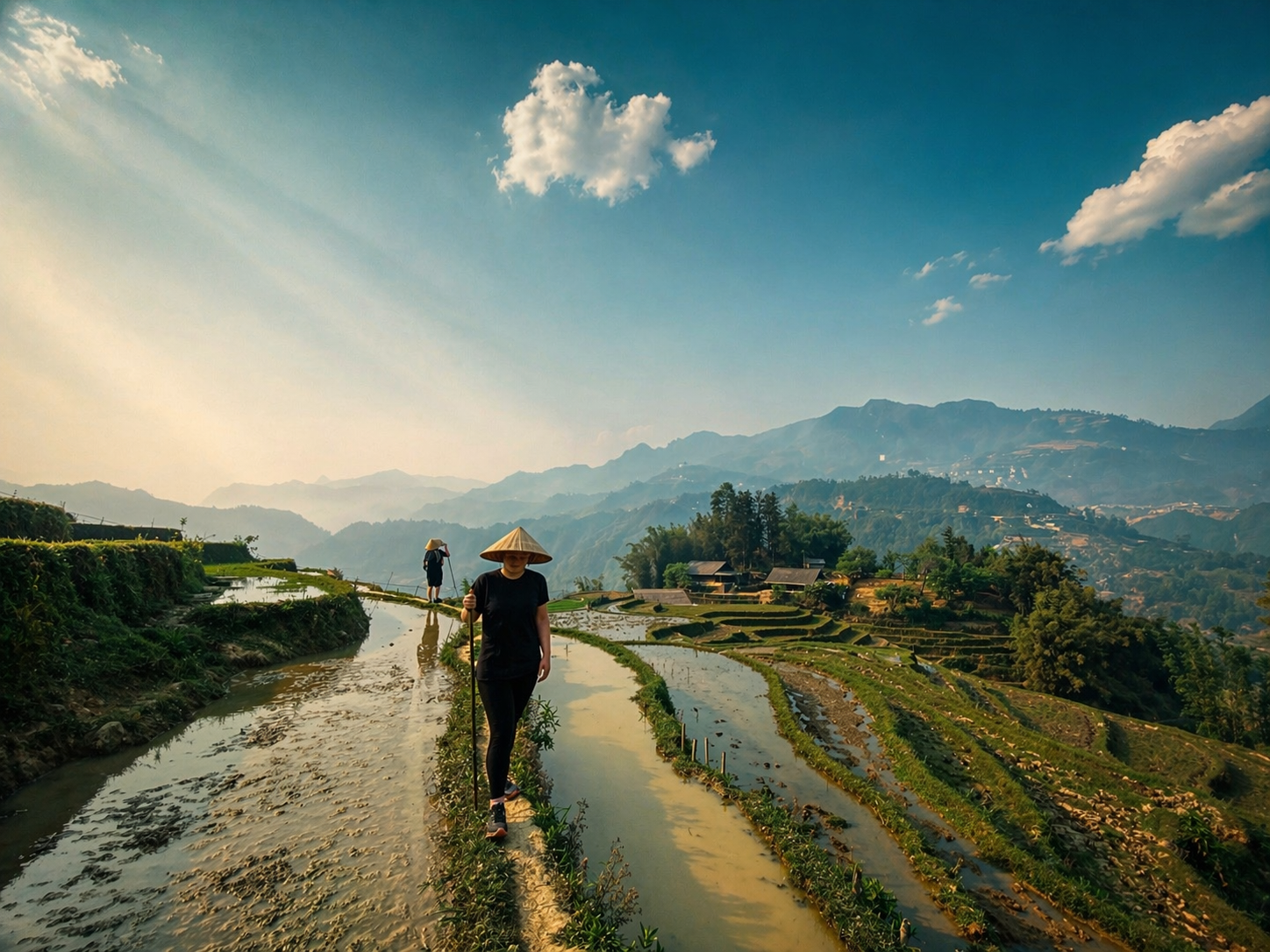
The Quiet Shift Beneath the Surface
Today, that connection is under strain. The most significant change in Sapa is not the disappearance of farming, but the transformation of what farming has become. Across parts of the region, terraces that once held rice and a diversity of supporting life are increasingly planted with flowers, strawberries, tomatoes and medicinal crops like artichoke.
On paper, this shift makes sense. These crops offer higher financial returns, stronger links to buyers, and alignment with provincial strategies that promote “high-tech” agriculture. For many households, especially those still actively cultivating their land, this transition has brought real and tangible economic benefits. New income streams have meant improved housing, access to education, and a degree of financial stability that subsistence rice alone could not always guarantee.
Yet something fundamental has changed in the logic of the land. Where terraces once followed seasonal cycles shaped by community knowledge and ecological limits, they are now increasingly tied to market demand, contract systems and production schedules. The pace has quickened. Inputs have intensified. The relationship between farmer and land has, in some places, shifted from stewardship to output.
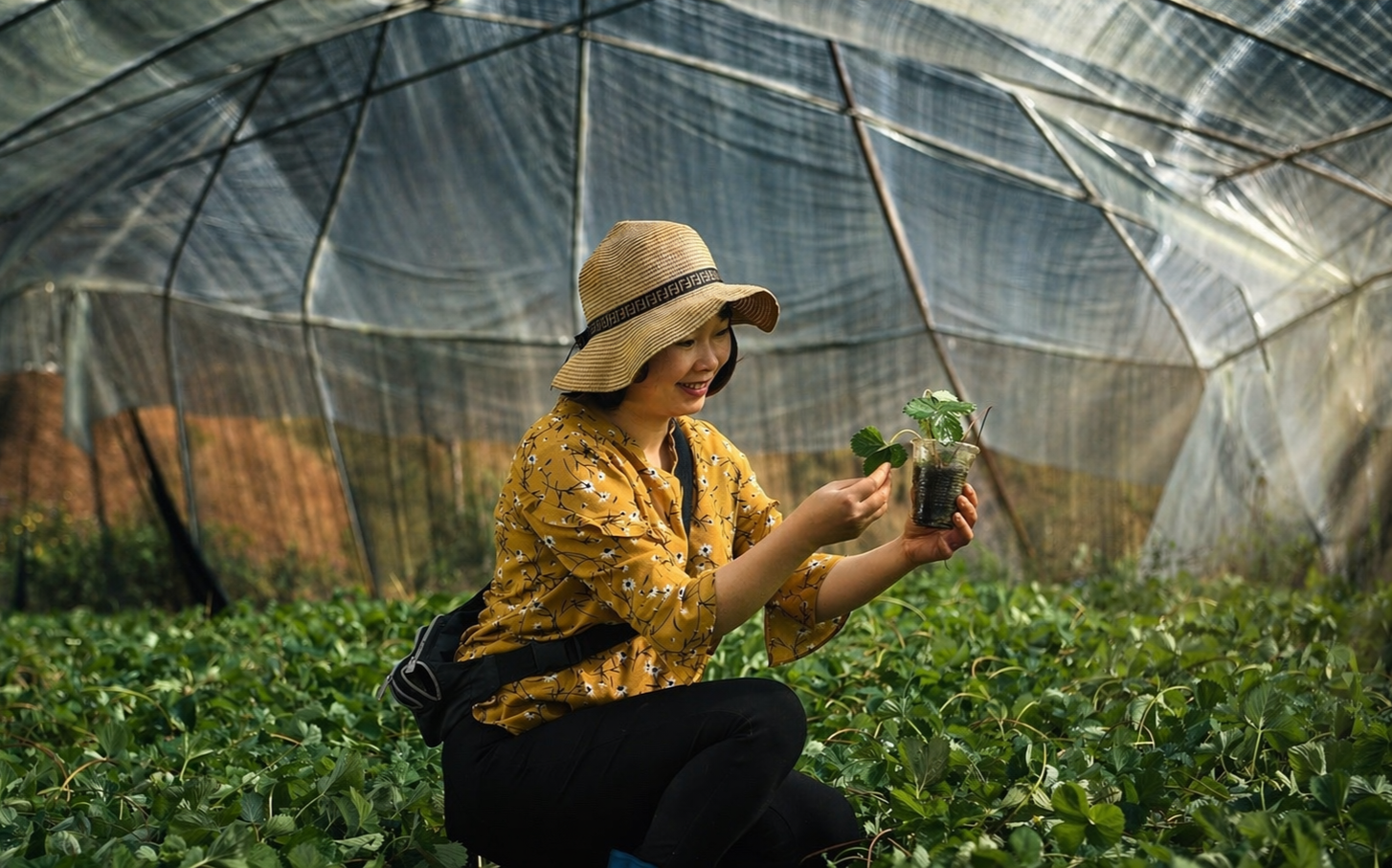
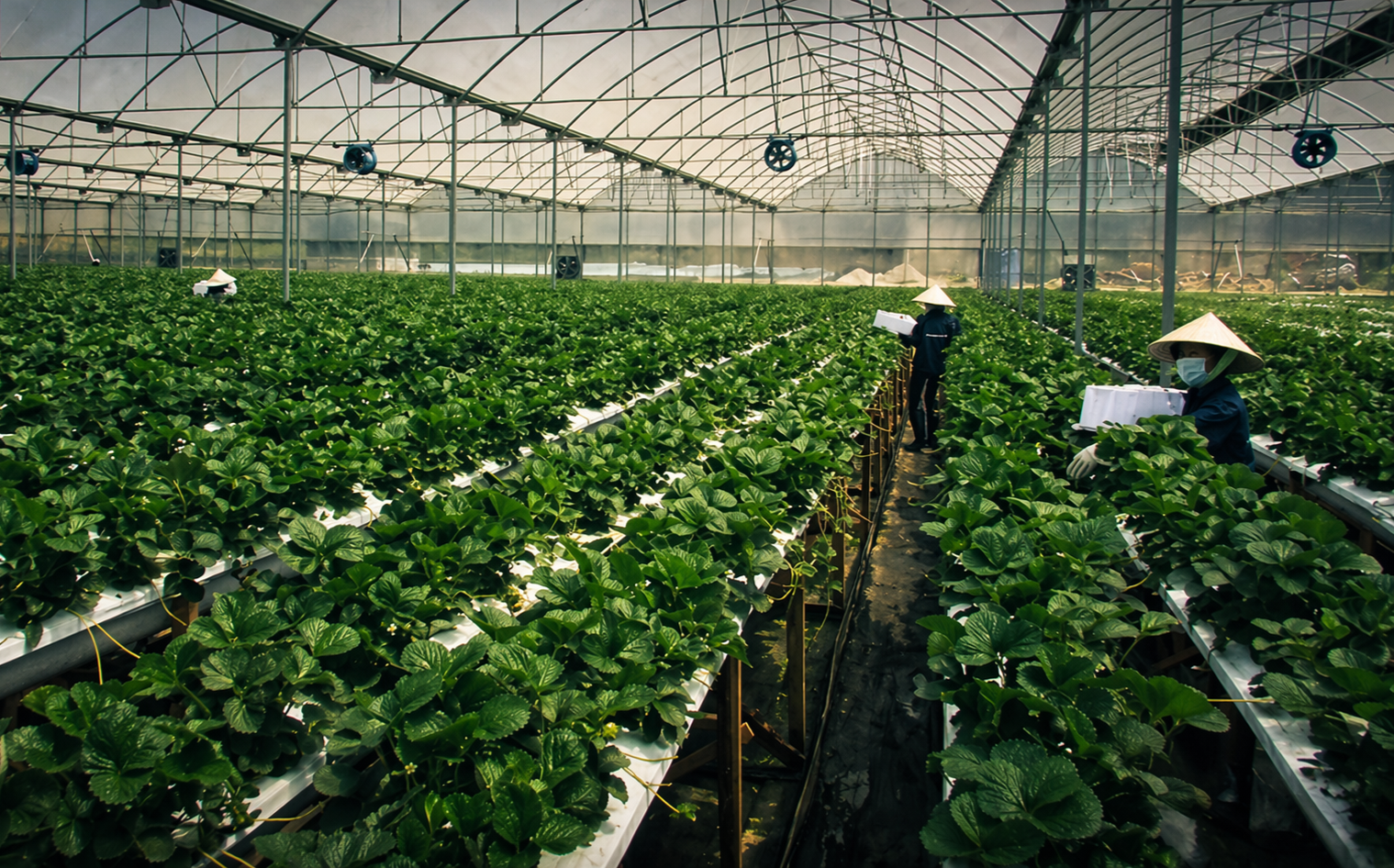
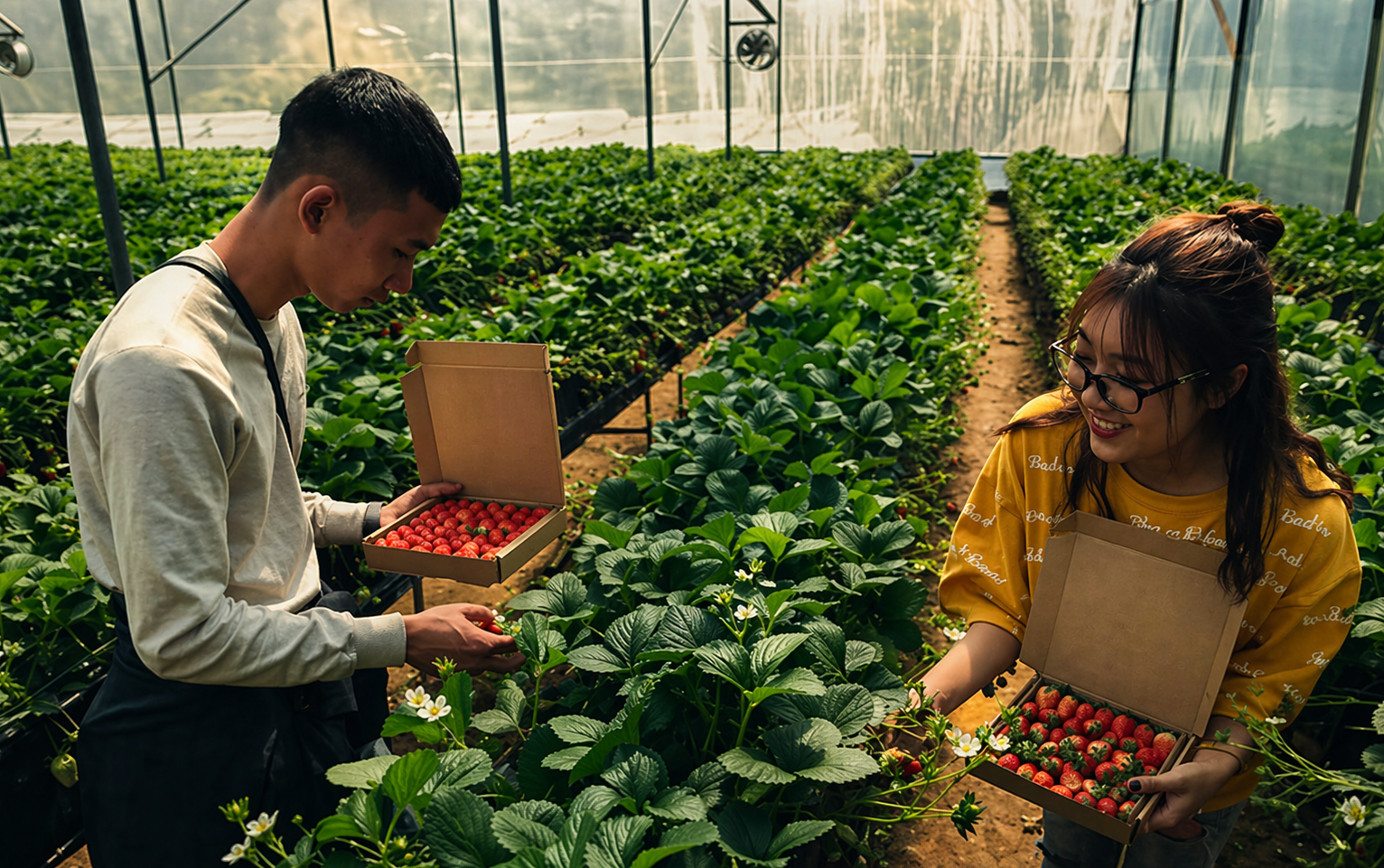
Plastic on the Mountains
The most visible symbol of this transformation is not the crops themselves, but what now covers them. Plastic sheeting, greenhouse tunnels and netted structures have begun to appear across landscapes that were once defined by open, flowing terraces.
From a distance, these materials interrupt the natural lines of the mountains. Where water once shimmered across stepped fields, there are now opaque surfaces that reflect harsh light and fragment the visual harmony of the valley. In places, the land begins to resemble something closer to industrial agriculture than a living cultural landscape.
This is not simply an aesthetic concern. The introduction of plastic infrastructure brings with it a cascade of environmental questions. In mountainous terrain where wind, rain and gravity are constant forces, plastic does not remain neatly contained. It tears, it fragments, and it moves. Pieces are carried into waterways, caught in vegetation, or broken down into smaller particles that settle into soil and water systems.
Waste management systems in rural Vietnam are not equipped to handle this scale of agricultural plastic. The likely outcomes are informal disposal, burning, or gradual leakage into the environment. Each of these pathways carries consequences, not only for ecosystems, but for the communities who depend on them.
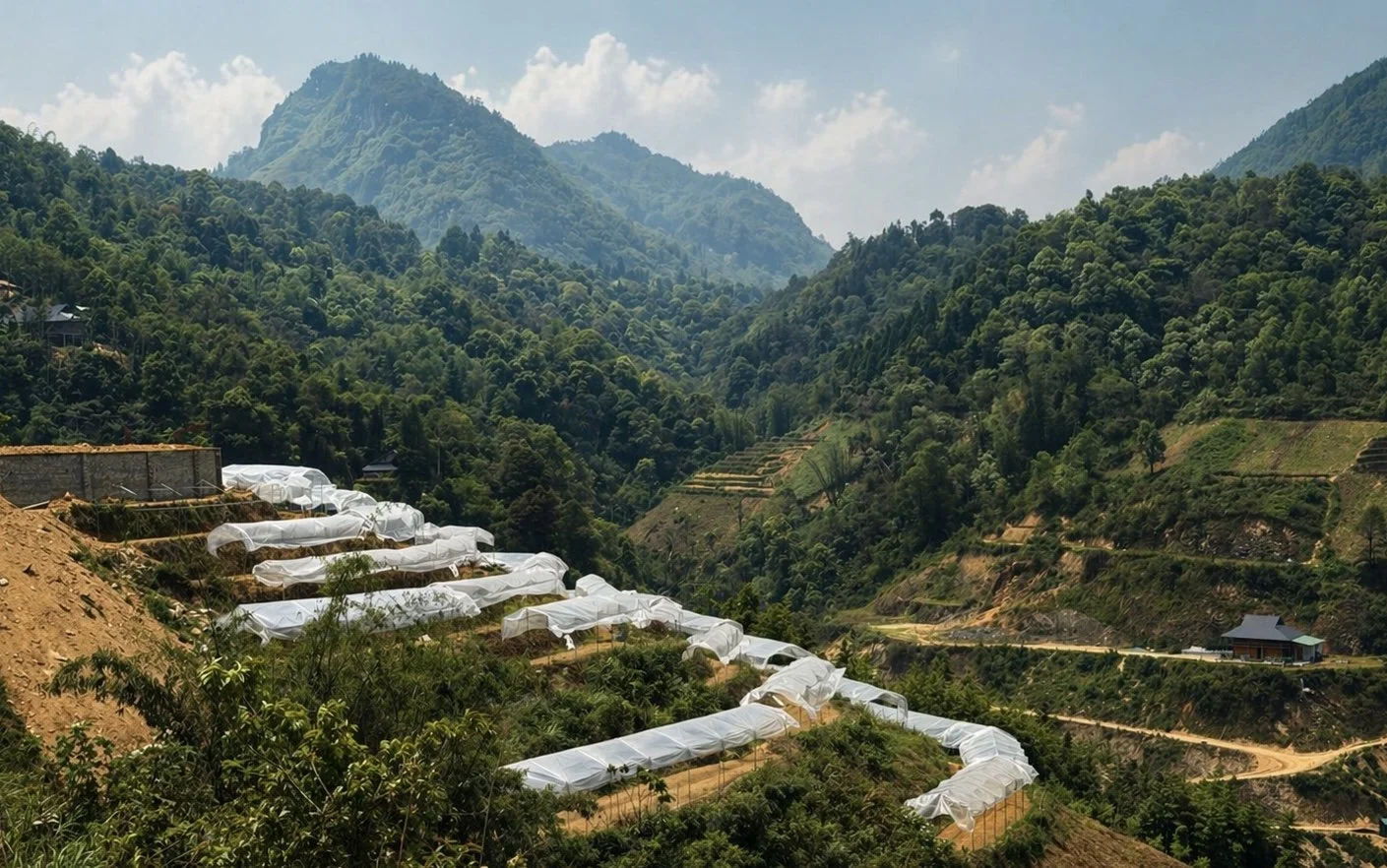
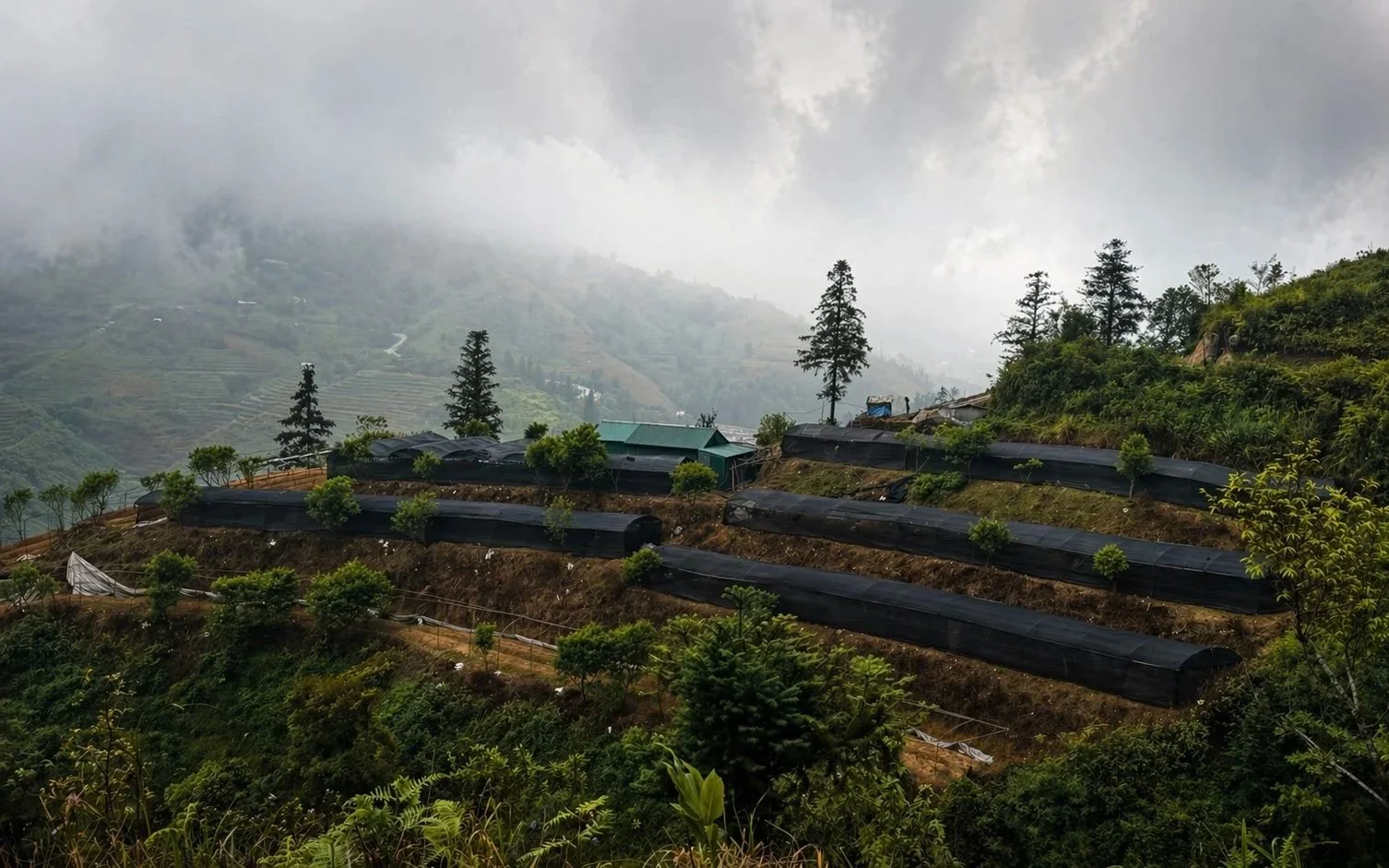
The Chemical Landscape
Less visible, but equally significant, is the increasing reliance on chemical inputs. Intensive flower farming in Sapa has already been associated with frequent pesticide application, sometimes occurring every few days during peak growing periods.
The implications extend beyond the fields themselves. In tightly woven mountain communities, where homes sit close to cultivated land, chemical drift does not respect boundaries. It moves with the wind, settles into water channels, and becomes part of the daily environment.
For travellers, this is rarely part of the narrative they are presented with. For local residents, it is something they live alongside. The sensory experience of the landscape shifts subtly but undeniably. The scent of wet earth and forest is, at times, replaced by something sharper, more intrusive.
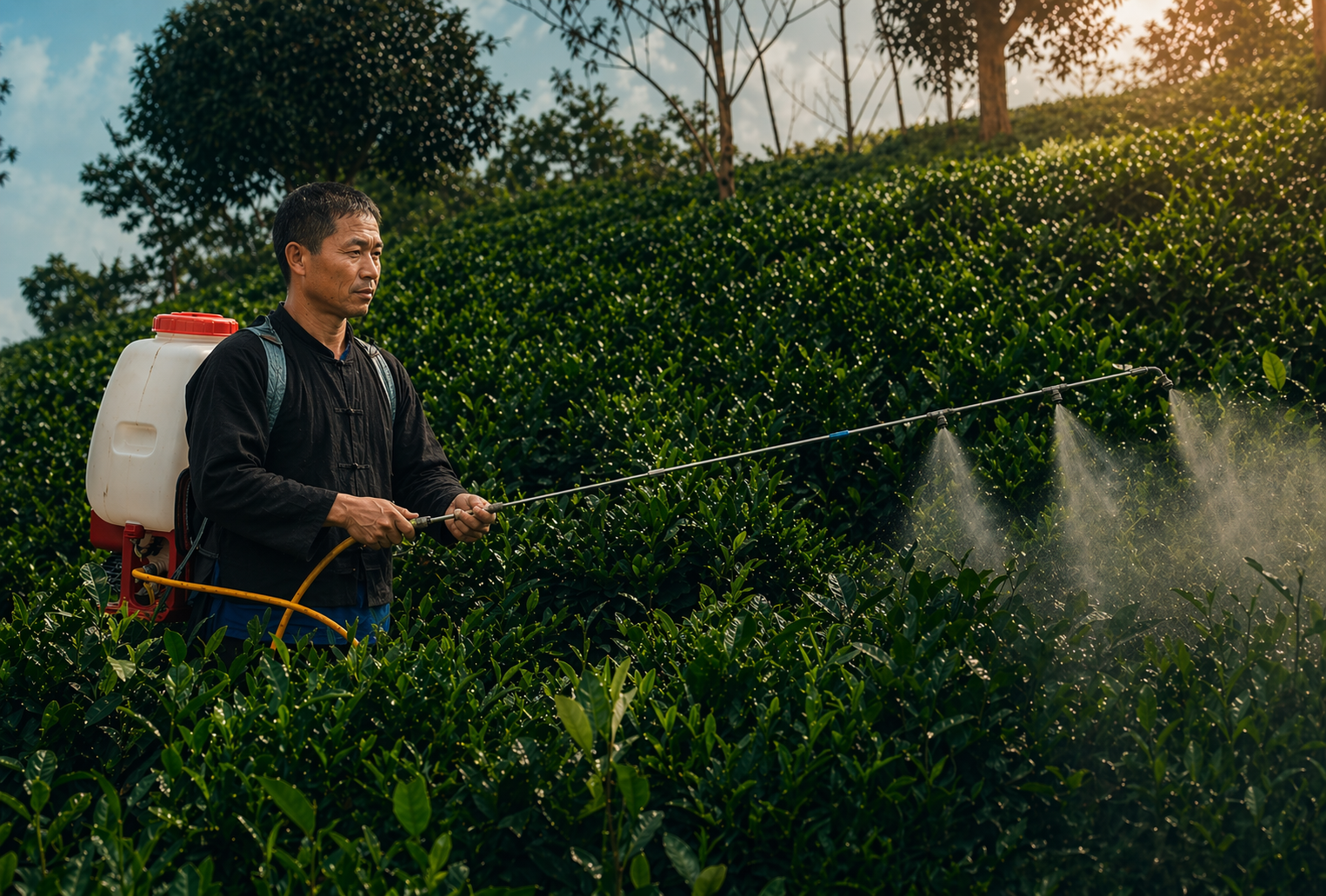
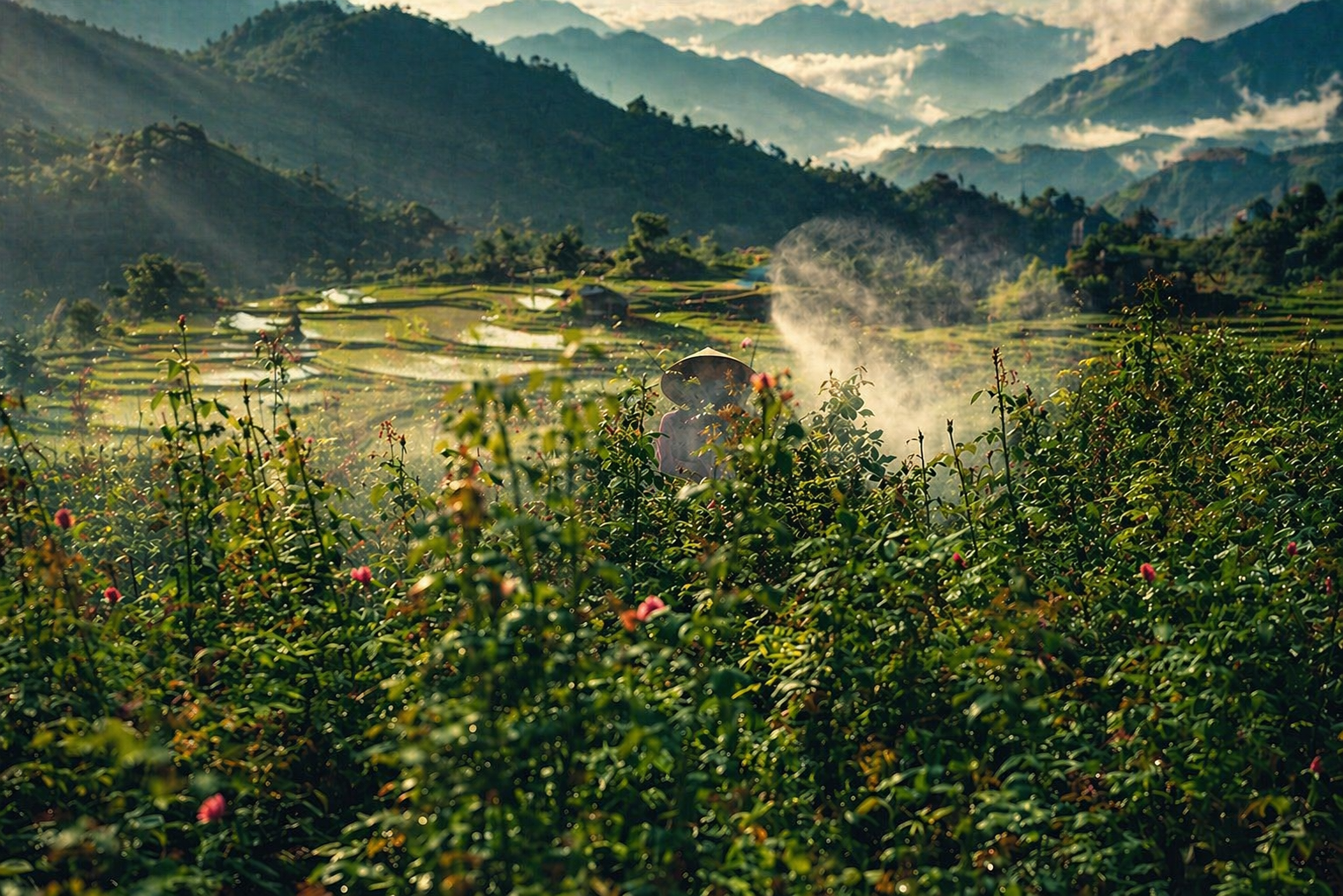
Tourism Without Its Roots
The irony at the heart of this transformation is difficult to ignore. Tourism remains the dominant economic force in Sapa, built largely on the appeal of its landscapes and cultural heritage. Yet the very elements that draw visitors are being altered by the parallel drive for agricultural intensification.
Rice terraces are not valuable to tourism simply because they are beautiful. Their value lies in what they represent. They are evidence of a way of life, of knowledge systems that have evolved in response to place, and of a relationship between people and land that feels increasingly rare in the modern world. When terraces are reshaped, covered, or managed in ways that prioritise short-term yield over long-term balance, that deeper meaning begins to erode. What remains may still be visually striking in parts, but it risks becoming a surface-level experience, disconnected from the lived reality that once gave it depth.
Travellers are perceptive. They notice when something feels authentic and when it does not. A landscape dotted with plastic, or a valley where chemical farming dominates, sits uneasily alongside the idea of Sapa as a place of cultural and environmental richness.
Power, Ownership and Who Decides
It is important to recognise that this story is not simply one of local farmers choosing to abandon tradition. In many cases, ethnic minority households remain active producers, particularly in crops like artichoke where contract systems provide stable buyers. The imbalance lies elsewhere. The higher-value parts of the agricultural chain, as well as much of tourism development and planning, are more often controlled by external actors, including Kinh businesses and outside investment. This creates a dynamic where local communities participate in production, but have limited influence over the broader direction of change. Decisions about land use, infrastructure and tourism strategy are not always made by those whose lives are most directly shaped by them. This disconnect adds another layer to the emerging conflict, one that is as much about agency as it is about economics.
A Fracturing Identity
Sapa now finds itself holding two competing visions of its future. One is rooted in rapid economic growth, modernisation and integration into wider markets. The other is grounded in cultural continuity, ecological balance and the preservation of a landscape that carries deep meaning. These visions are not inherently incompatible. The challenge lies in how they are pursued. When growth is driven without sufficient regard for the systems that sustain the land and its people, the result is not progress, but fragmentation. The terraces become divided in purpose. Tourism becomes disconnected from agriculture. The identity of the region begins to blur.
What Is at Stake
This is not simply about whether Sapa remains beautiful. It is about whether it remains meaningful. A landscape can survive visual change and still retain its essence, but only if the relationships that underpin it are respected. When those relationships are weakened, the loss is harder to measure. It appears gradually, in the disappearance of certain plants, in the quiet absence of seasonal practices, in the way stories are no longer told because the conditions that gave rise to them have changed. For tourism, this is a critical moment. A destination built on authenticity cannot afford to erode the very foundations of that authenticity. The risk is not immediate collapse, but a slow decline in what makes the place distinct.
Paths Forward: Reconnection Rather Than Replacement
There is still time to choose a different path. The goal does not need to be a return to the past, nor a rejection of economic opportunity. It requires a more thoughtful integration of the two. Agroecological farming practices, rooted in traditional knowledge but supported by appropriate innovation, offer one direction. These approaches maintain biodiversity, reduce chemical dependency, and preserve the multifunctional nature of the terraces.
Tourism can play a more active role in supporting this shift. When travellers are invited to engage with farming as it truly exists, to understand its complexity and value, they become part of a system that rewards preservation rather than replacement. Stronger regulation and enforcement around land use, particularly in protected heritage zones, is essential. The legal frameworks already exist. The challenge lies in ensuring they are applied in ways that genuinely protect the integrity of the landscape.
Equally important is the inclusion of local communities in decision-making processes. Those who live and work on the land must have a meaningful voice in how it evolves. Without this, any solution risks repeating the same patterns of imbalance.
A Question That Cannot Be Ignored
Sapa stands at a point where the choices made in the coming years will shape its identity for generations. The question is not whether change will happen, but what kind of change it will be. Will the terraces remain living systems that sustain both people and place, or will they become fragmented into separate functions, each serving a different economic purpose but no longer connected?
For those of us who walk these mountains, who share meals in village homes, who listen to stories carried through generations, this is not an abstract debate. It is something felt in every step across a field, in every conversation about what the future might hold. The path forward is not simple. It requires honesty, collaboration and a willingness to challenge assumptions about what progress looks like. It asks whether we are willing to value connection over convenience, and long-term resilience over short-term gain.
Sapa has always been a place shaped by relationships. The task now is to decide which relationships will be protected, and which will be allowed to fade.
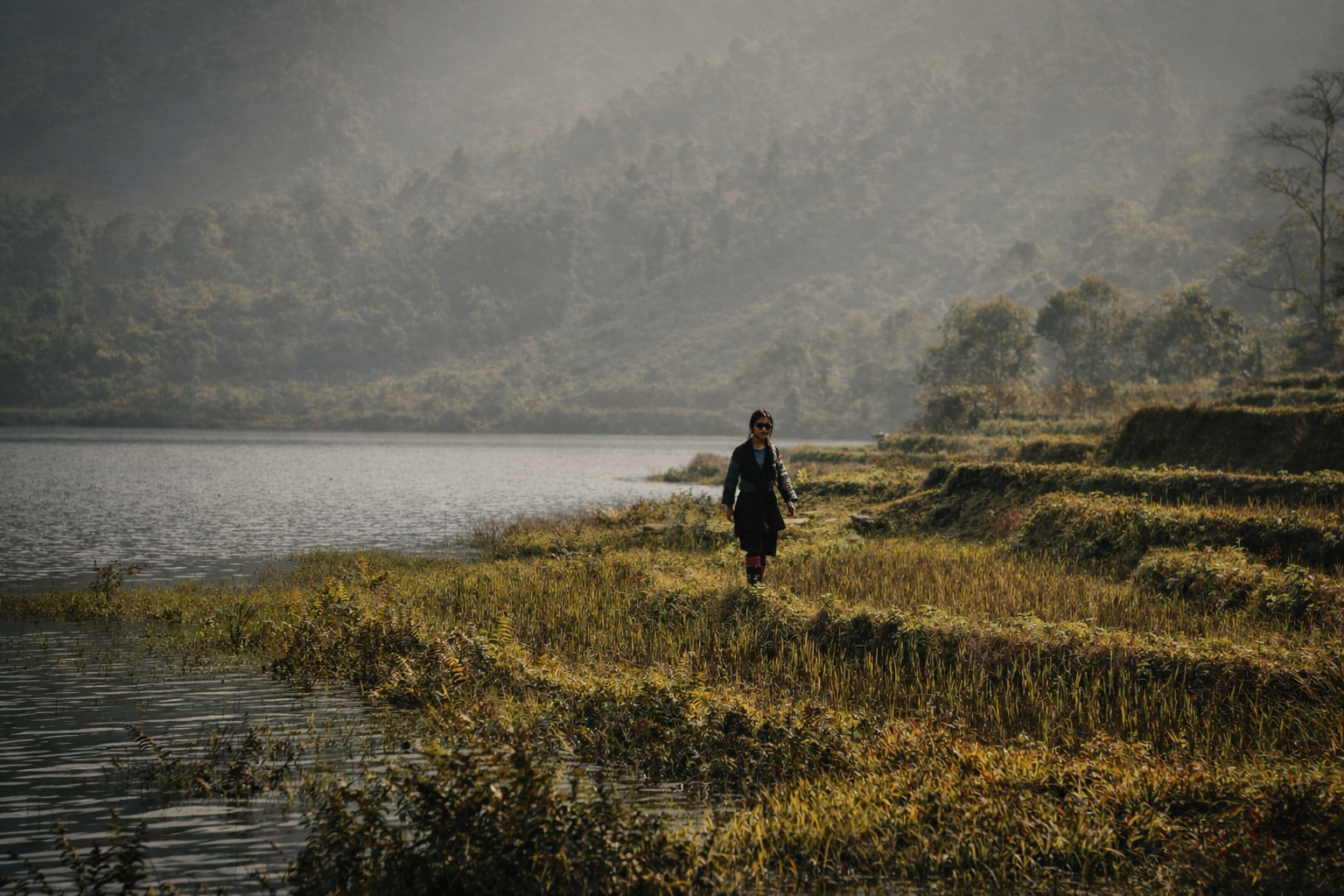
Who Speaks for Sapa? Tourism, Influence and the Quieting of Local Knowledge
Sapa is more than neon lights, cable cars and curated viewpoints. Beneath the surface lies a quieter story shaped by local communities whose voices are too often overlooked. This article explores sustainable tourism, overtourism, cultural erosion and why listening to local knowledge is the key to experiencing the real Sapa.
Two Sapas, One Narrative
There are two conceptual Sapas that exist side by side, though only one tends to dominate the story. The first is the town, a rapidly expanding centre shaped by hotels, neon lights, restaurants and a steady current of visitors moving through tightly organised itineraries. The second is the wider mountainous region, where Hmong, Dao and other ethnic communities continue to live within landscapes they have shaped and understood over generations.
The distinction between these two is geographic but also about whose voices are heard, whose knowledge is valued, and whose version of Sapa becomes visible to the outside world. In practice, the narrative is rarely led by those who know the land most intimately. Compare the two images below and it would be easy to assume they are entirely different places, yet both exist within the same region. Which one you see, and how you choose to experience it, is a decision left to every traveller.
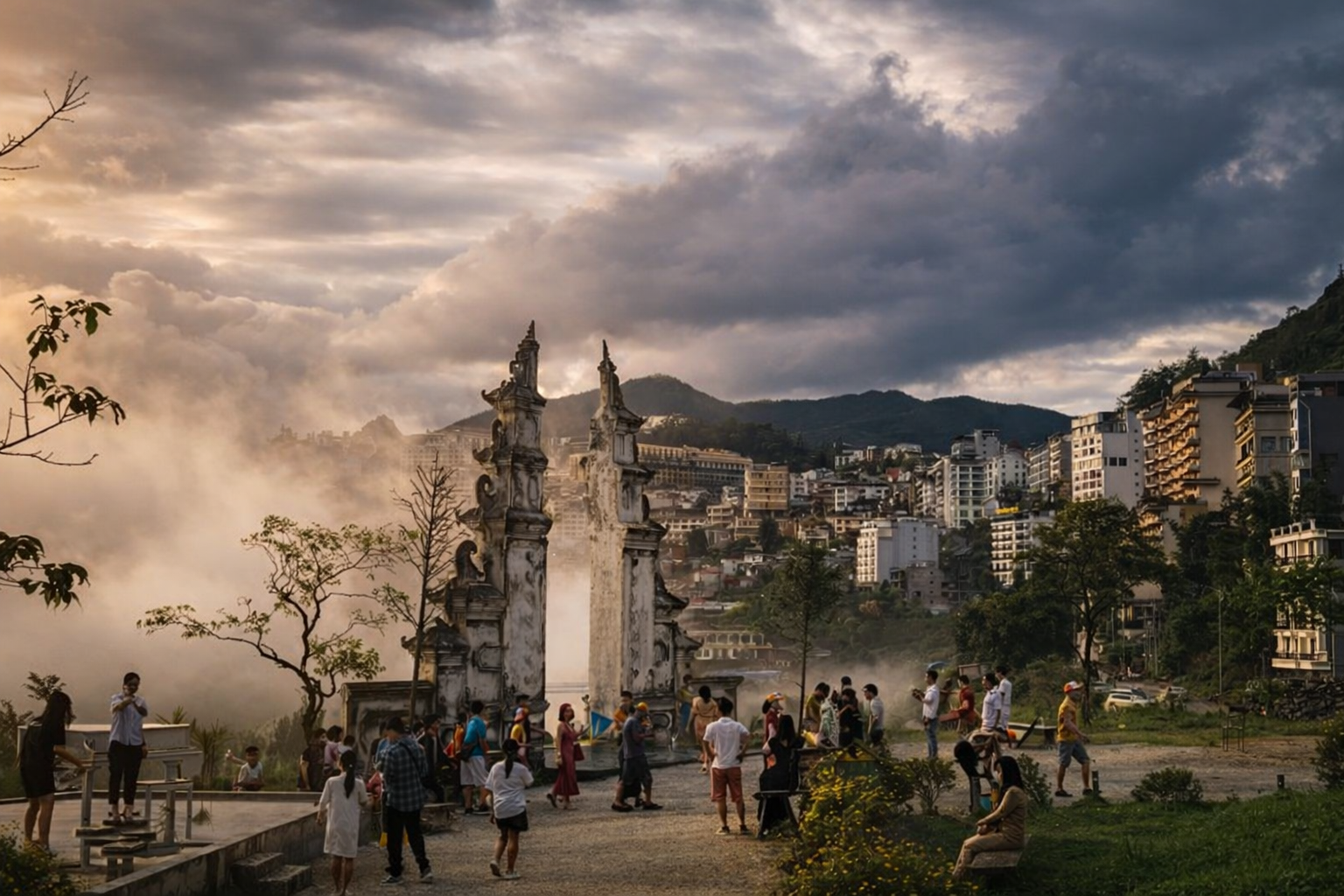
A busy scene at the Moana Sa Pa viewpoint, where crowds of tourists gather around a stylised stone structure overlooking the valley.
Terraced fields in rural Sapa. The quiet landscape evokes a sense of isolation and connection to nature, far removed from the bustle of the town.
The Expanding Centre and Its Reach
Sapa town has become a focal point in Vietnam’s tourism growth, particularly as 2026 continues with expectations of record visitor numbers. Infrastructure continues to expand, and with it, the reach of the town’s influence. The closest surrounding villages feel this most strongly, particularly those integrated into standard trekking routes and day tours.
There is no clearer example than Ta Van. Once a quiet valley village, it now carries a distinctly cosmopolitan atmosphere shaped by the steady flow of international visitors. International-owned restaurants sit alongside multiple foreign-run bars, where western music carries late into the night, a soundscape that contrasts sharply with the rhythms of rural life that once defined the area. The infrastructure reflects this shift. Phone shops, convenience stores and other services tailored towards international guests are now part of the landscape. Homestays, while still marketed as local experiences, often follow a standardised model, offering wifi, hot showers and familiar comforts that prioritise convenience over cultural immersion. The conditions are accessible and comfortable, though increasingly detached from the way people in the village traditionally live.
Proximity to Sapa town is only part of the story. Terrain also plays a decisive role in shaping how tourism spreads across the region. In a landscape defined by steep valleys, narrow paths and winding mountain roads, accessibility is uneven. Some villages remain difficult to reach by minibus, which immediately limits their inclusion in standard itineraries. Where road access is poor, large groups cannot be dropped off or collected easily, and that alone has a powerful effect on where tourism concentrates.
This helps explain why some places absorb far greater visitor numbers than others, even when they are not dramatically further from town. Ease of movement matters. Routes that allow for simple trekking, straightforward logistics and quick transfers are far more attractive to operators working with tight schedules, mixed abilities and high turnover. Villages that require more effort, stronger fitness or greater flexibility tend to sit outside the main mass tourism circuit.
Sùng Thì Do, a 21-year-old local Hmong woman from the region, describes this dynamic with particular clarity: “Some guests can’t walk up and down steep slopes very well. Guides are also limited when they trek with big groups and mixed abilities. When that happens, groups follow the same easy, set trails. They start in the same places and get picked up in the same places. Ta Van is so busy because it’s easy to walk to and easy to get picked up from. My village is the opposite, so few people visit. I like that my village is quieter and only gets visitors who are prepared to explore.”
Her observation reveals how geography quietly shapes the tourism map. Ta Van is not simply busy because it is close to Sapa town. It is busy because it is logistically convenient. Accessibility, rather than cultural depth, often determines which villages are repeatedly promoted and visited. The result is that places that are easier to reach become ever more visible, while villages that demand more time and effort remain marginal to the mainstream narrative.
That imbalance has consequences. Travellers are often led to believe that the busiest places are the most worthwhile, when in reality they are frequently just the easiest to package and sell. Villages that lie beyond the simplest routes may offer quieter landscapes, more intact rhythms of daily life and a stronger sense of cultural continuity, though they remain overlooked because they do not fit neatly into the mechanics of mass tourism.
What emerges is not a loss of place entirely, but a transformation of it. Ta Van continues to exist, though it is now shaped as much by external demand as by local practice. The closer a village sits to the centre of tourism, the more it reflects the expectations of those passing through it.
These spaces adapt under pressure. Movement becomes guided, encounters become shorter, and daily life begins to bend around visitor expectations. Places such as Cat Cat village are often presented as cultural windows, though the experience is carefully managed, shaped as much by commercial flow as by tradition. Cat Cat has become the clearest expression of mass tourism in Sapa. It is the most visited and most heavily managed of all the surrounding villages, designed to accommodate a constant flow of visitors moving through controlled pathways and curated viewpoints. Here, culture is often reduced to something visual and immediate. Visitors rent traditional ethnic clothing, garments that once reflected identity, ancestry and belonging, wearing them briefly for photographs before returning them and moving on.
What remains is a version of culture shaped for consumption. Meaning becomes detached from context, and tradition shifts towards performance. The experience is accessible and enjoyed by certain types of tourists and berated by others. The management of Cat Cat Village raises a quieter question about what is lost when authenticity gives way to replication.
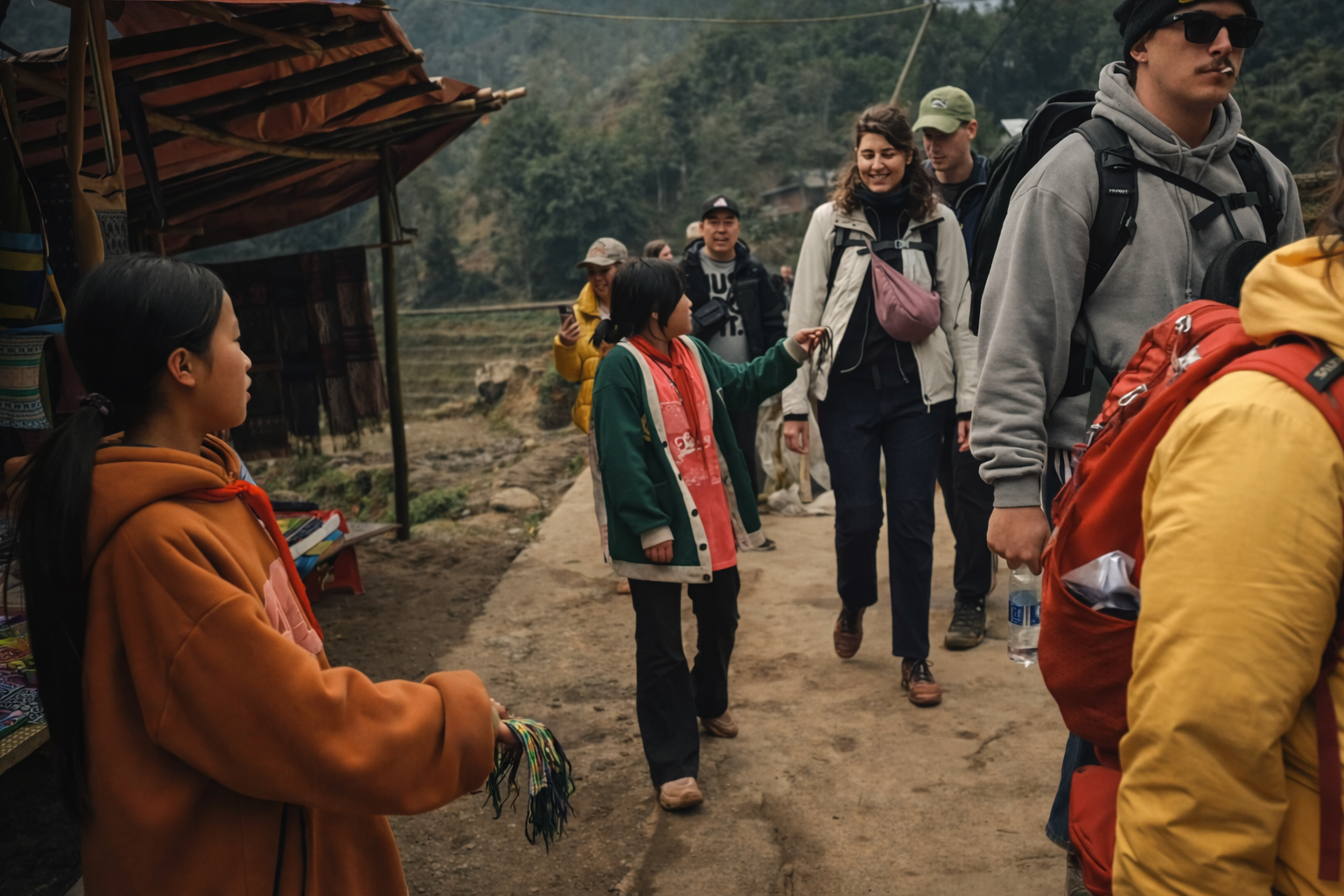
A large group of travellers on the standard Sapa to Ta Van trek. Local sellers line the route touting their wares.
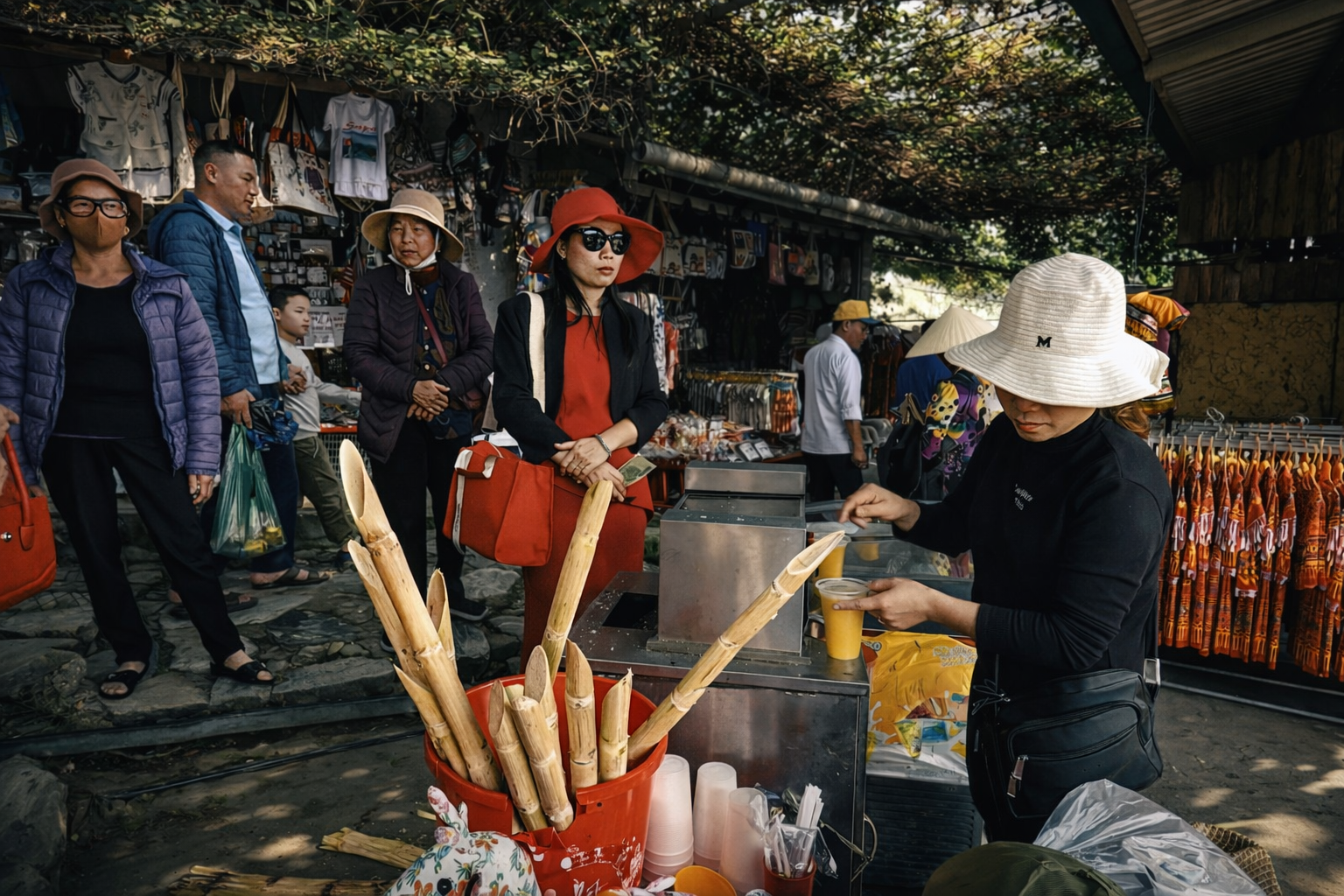
Vietnamese tourists buying snacks and machine made souvenirs in Cat Cat Village.
Rushing Through Sapa: A Destination on a Deadline
Most travellers arrive in Sapa on tightly structured schedules, often moving through Vietnam on predefined routes that allow for little flexibility. The typical visit lasts no more than two days, a timeframe that compresses the region into a checklist of highlights. There is limited opportunity to move beyond the most accessible sites, and even less incentive to do so when itineraries are built around speed and efficiency rather than depth.
Within this framework, certain attractions are positioned as essential. The cable car to Fansipan, along with other high-visibility sites, is frequently presented as unmissable. Moana has become one of Sapa’s most visited attractions. Hundreds arrive each day, drawn not by history or culture, but by staged photo sets. A giant fibreglass head. An imitation Bali gate. Sculpted hands lifting visitors above the landscape. Each structure exists for one purpose: to frame the individual.
There is also a quieter force at play. Repetition creates expectation. The same images circulate across social media and travel platforms until the experience begins to feel compulsory. Everyone has stood there. Everyone has taken that photograph. To skip it can feel like missing out. Travel, in this context, shifts from curiosity to confirmation, where presence is measured by what is seen and shared. This perception is rarely organic. It is shaped by a combination of influencer content, large-scale marketing campaigns and algorithm-driven recommendations that amplify the same locations repeatedly. The absence of alternative narratives, particularly from those who live in the region, allows this idea of “must-see” experiences to solidify without challenge.
Ly Thi Cha, a young Hmong woman from Sapa, describes this tension with clarity:
“I work together with ETHOS - Spirit of the Community who welcome visitors to Sapa, but not the busy touristy areas where things feel inauthentic and local people do not benefit. Sapa is my home and my people have a lot of pride. I am really passionate about the many meaningful experiences we can offer.”
Her words point to a distinction that is often overlooked. The issue is not tourism itself, but the concentration of attention in places that do not reflect the depth of what exists beyond them. As a result, movement concentrates around a narrow set of destinations. Travellers arrive, complete a sequence of activities and depart, often without engaging with the broader landscape or the communities that define it. The pace of travel reinforces the dominance of the town and its immediate surroundings, while more distant areas remain outside the frame.
Further from the town, the intensity begins to ease. The roads narrow, the pace shifts, and tourism becomes less defining. It takes more time and more intention to reach these areas, though it is here that the texture of everyday life remains more intact.
Ly Thị Mỷ, Cha’s older sister, reflects on how these changes are felt from within:
“There is building work in many areas close to Sapa town. Some of the big buildings look ugly and I don’t like to see that happening to my hometown too much. Now I like to go walking in the forest and to beautiful villages further from the town.”
The movement away from the centre is not only a traveller’s choice. It is also something local people themselves are seeking.
Who Speaks, and Who Is Considered “Local”?
The question of who is considered a local voice in Sapa is more complex than it appears. Hmong, Dao and other ethnic communities have lived in these mountains for generations, shaping the land through farming, craft and seasonal rhythms. Their knowledge is deeply rooted, carried through lived experience rather than formal documentation.
At the same time, the visible structure of the tourism economy tells a different story. Many businesses operating in Sapa town and its surrounding areas are owned or managed by people who have arrived more recently. A significant proportion of workers in hotels, restaurants and tour agencies are migrants from other parts of Vietnam, drawn by the opportunities that tourism creates. Their presence is now embedded within the local economy, though their connection to the landscape and its cultural systems is often limited by time and exposure. In practice, many of the people advising travellers and shaping itineraries are working within a fast-paced commercial environment, where the priority is to meet demand rather than to deepen understanding.
There is little space, and often little incentive, to explore the region beyond what is required for business. The financial rewards of mass tourism are immediate, and the energy it generates aligns with broader cultural preferences for lively, dynamic environments. The noise, the movement and the constant flow of people are not necessarily seen as negative. They signal prosperity.
May Lai, a Red Dao farmer and ETHOS guide, describes this shift in more personal terms:
“Sapa is too noisy now. My two children like to visit sometimes but the roads are busy and it feels like a big city. I am happy to return to the quiet of my village where things are much more peaceful.”
Within this structure, the voices of those with generational ties to the land are pushed to the edges. Their knowledge remains intact, though it is rarely the knowledge being sold. The people most visible to visitors are often those with the least lived connection to the place itself.
Many of those advising travellers operate within a system built on speed, volume and repetition. Recommendations are recycled. Routes are standardised. A concierge, a driver, a tour seller may confidently guide visitors through Sapa having never stepped beyond the same handful of well-trodden locations. Their understanding is second-hand, shaped by what sells rather than what is known.
There is little incentive to go further because the mainstream tourism industry does not reward curiosity. It rewards efficiency. This is reinforced by a broader cultural comfort with “đông vui”, the enjoyment of noise, density and constant activity. Crowds signal success. Movement signals life. In that context, the busiest places become the most desirable, not because they are the most meaningful, but because they are the most visibly alive.
The consequence is a quiet narrowing of perspective. Exploration becomes optional and depth becomes unnecessary. The same places are recommended, visited and validated again and again, until repetition replaces understanding.
Meanwhile, the people who know the land through seasons, through work, through generations remain largely unheard. Their knowledge is not missing but is simply not part of the system that defines what Sapa is supposed to be.
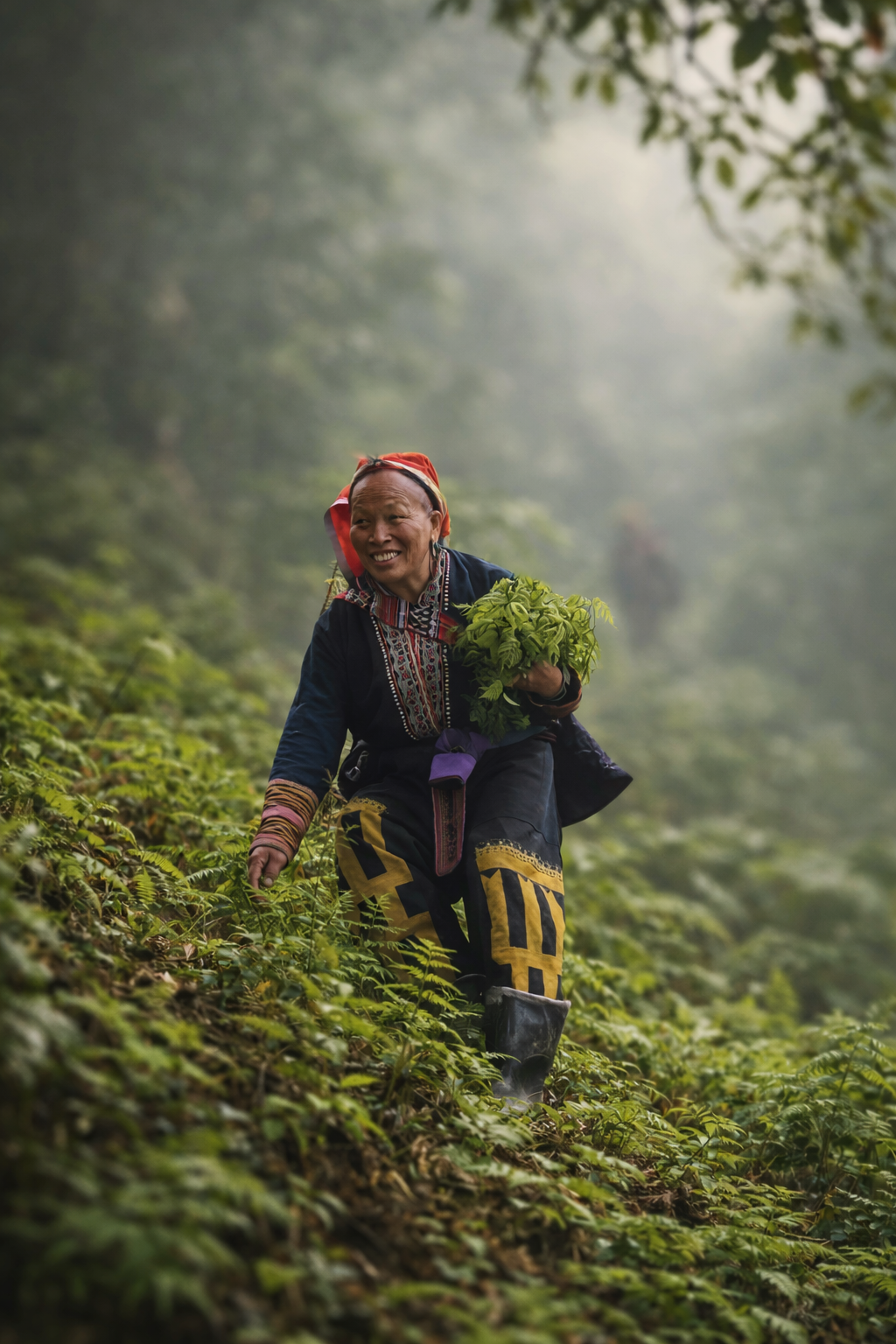
Tan Lo May - Red Dao guide foraging natural foods while trekking with ETHOS in Sapa.
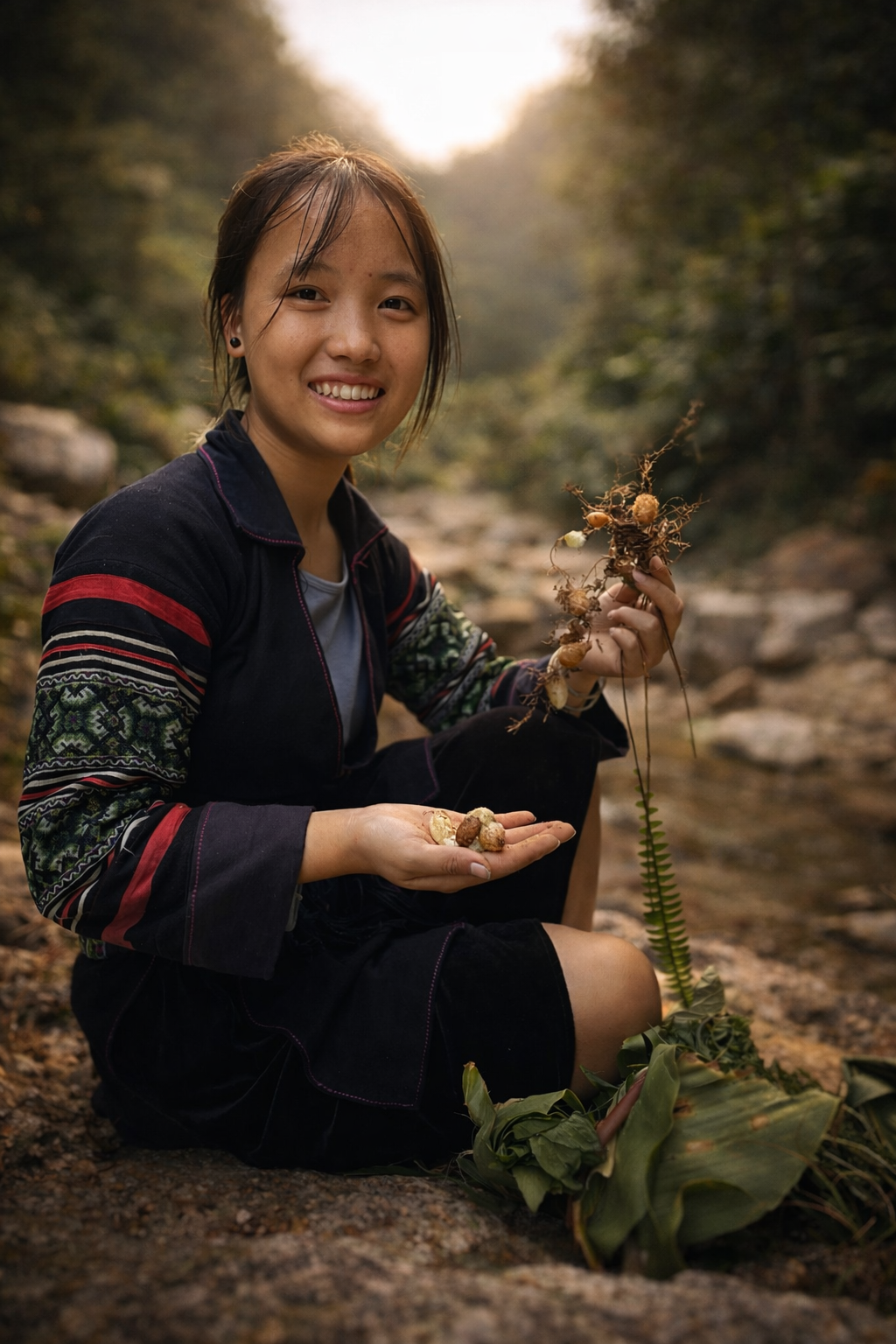
Ly Thi Cha - Black Hmong guide, community youth leader and advocate for Hmong culture in Sapa.
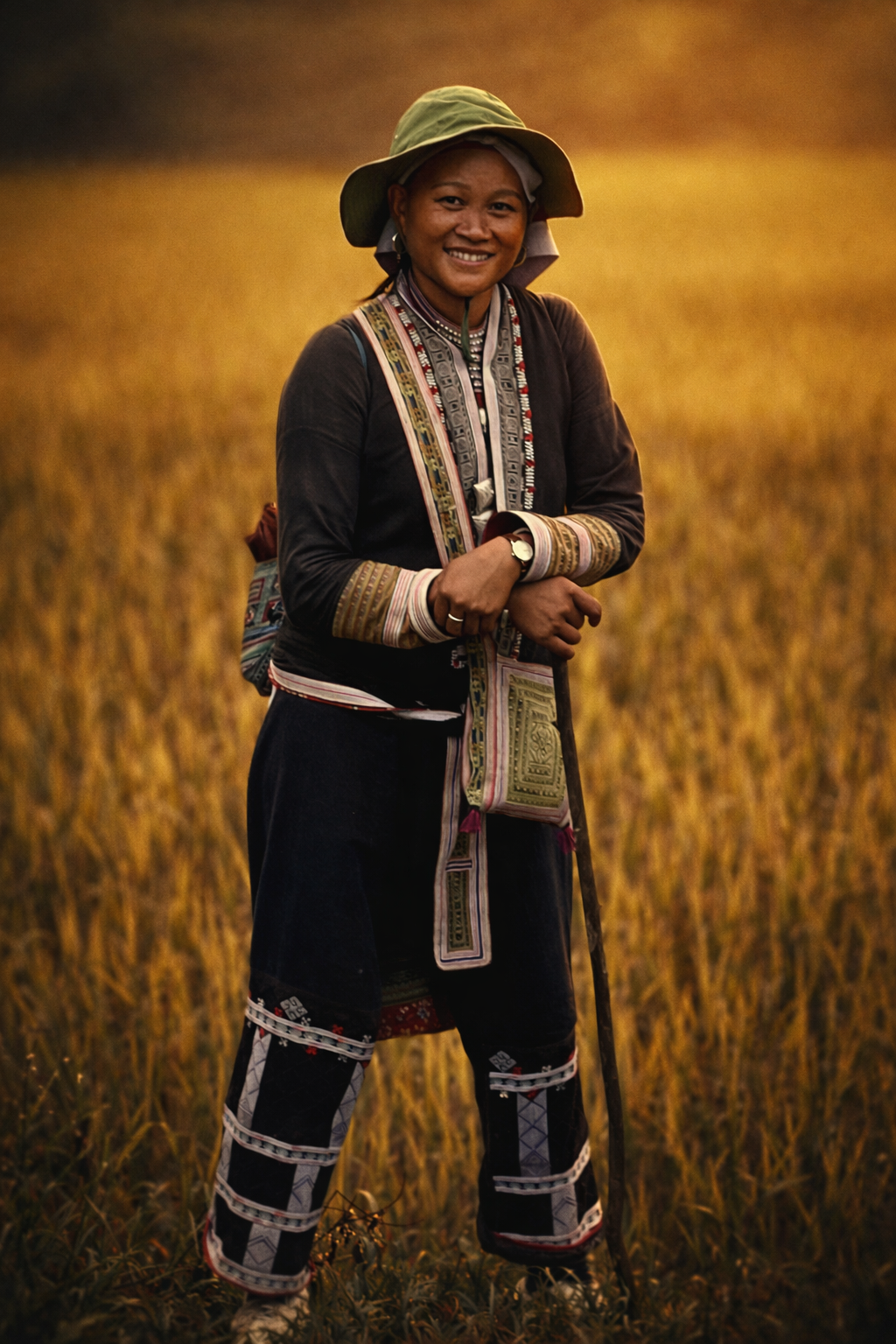
May Linh - Red Dao woman and ETHOS trekking guide in Sapa.
Đông Vui and the Shape of Demand
An understanding of the Vietnamese concept of “đông vui” provides additional context for the popularity of crowded and energetic environments. The term refers to spaces that are lively, animated and socially vibrant, often associated with prosperity and communal enjoyment. Restaurants filled with conversation, streets busy with movement and markets dense with activity are widely perceived as positive and desirable.
This cultural preference intersects with commercial incentives in ways that reinforce high-density tourism models. Businesses and local authorities tend to promote locations that can generate consistent footfall and economic return. Recommendations, both online and offline, frequently highlight places that embody this sense of energy and accessibility. As a result, sites such as Moana Sapa and Cat Cat village become focal points within the tourism landscape, offering visually appealing and easily consumable experiences that align with broader expectations.
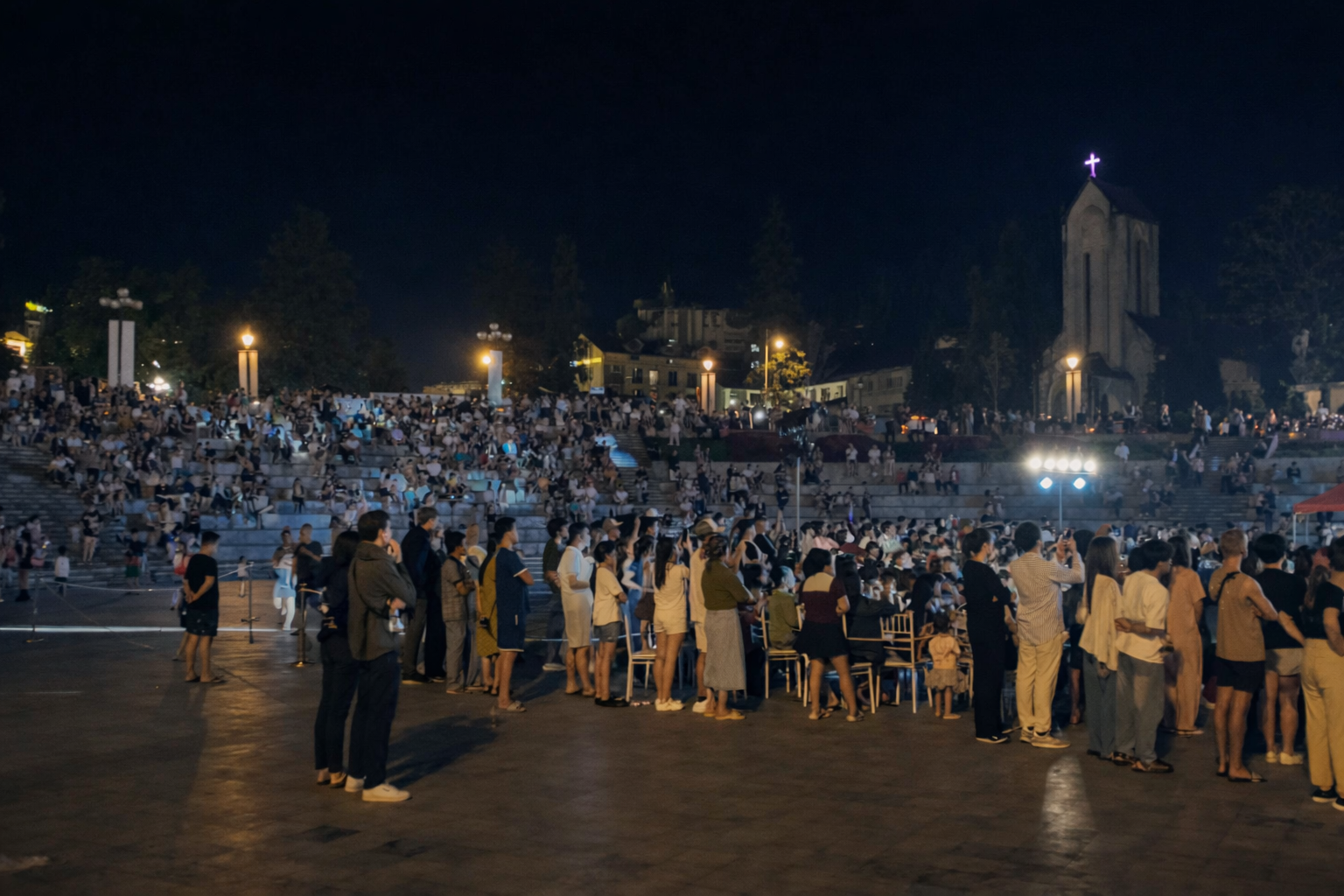
A bustling night time gathering in Sapa square in the heart of town.
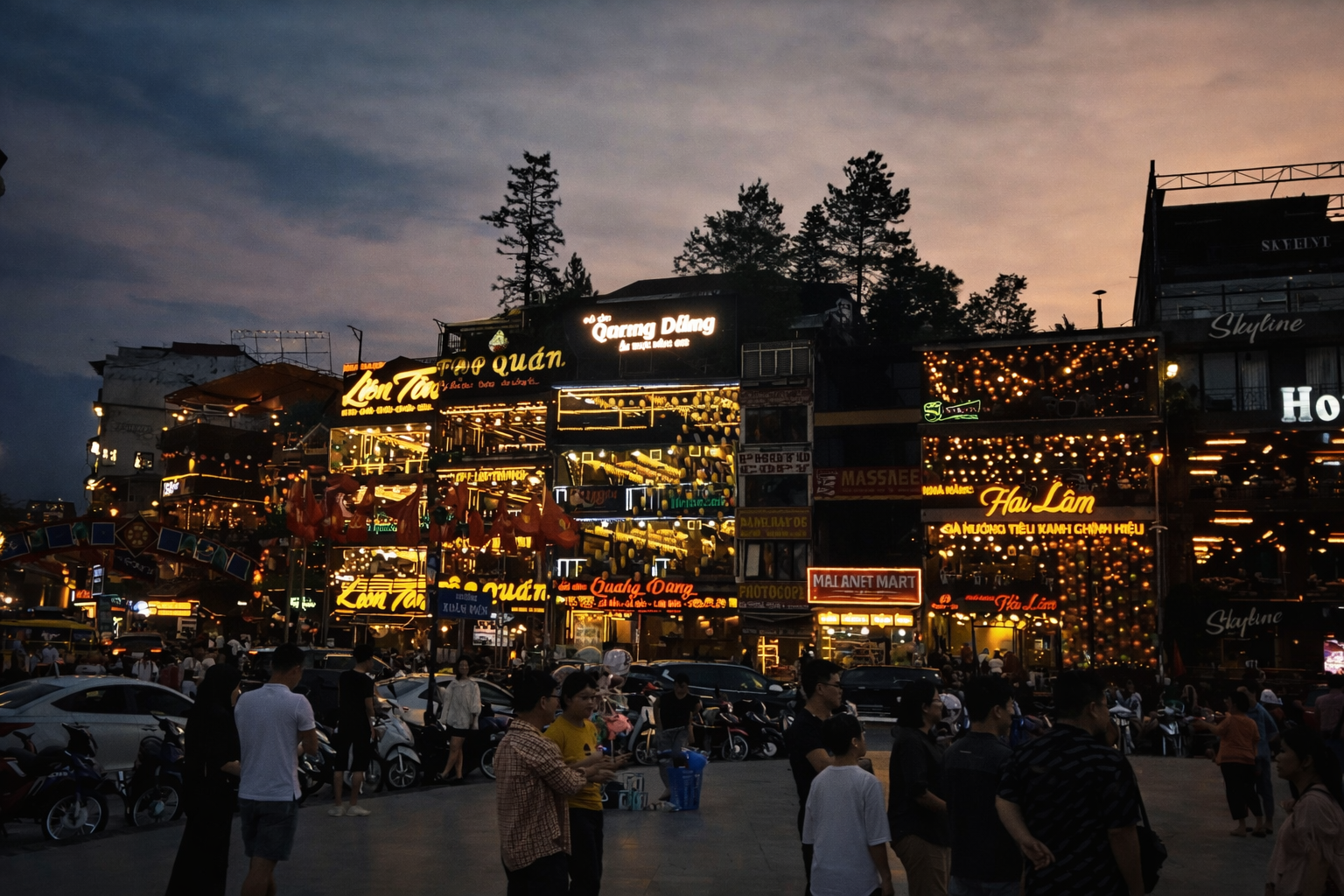
A lively Sapa street at dusk filled with brightly lit restaurants, and crowds of people. The warm glow of lights and dense activity reflect Sapa’s growing nightlife and tourism-driven economy.
Expertise Without Amplification
A striking imbalance sits at the heart of Sapa’s tourism story. A traveller who spends a single day in the region can share their impressions instantly with a global audience, their voice amplified through social media, blogs and algorithm-driven platforms. These impressions, however brief, often carry more weight than the knowledge of those who have lived here for decades.
Local expertise exists in forms that are not easily captured online. It is embedded in the way terraces are cultivated, in the understanding of weather patterns, in the preparation of food, in textile techniques passed from one generation to the next. It is held in memory, in practice and in conversation rather than in written or digital form.
Many of these voices remain largely offline. Literacy barriers, limited access to technology and the demands of daily life all contribute to this absence. Their knowledge is not absent in reality, though it is often absent from the platforms that shape perception. What emerges is a situation where those with the least lived experience can become the most visible narrators.
Cha reflects on what is often lost in this imbalance:
“As a local, I believe people travel to experience, to immerse themselves and to learn. Local people are always happy and appreciative when they can share small things with you, whether it is food, plants or simple conversations. Those moments help you remember and truly value the people. Most of my relatives don’t read or write. They don’t use social media or YouTube. The only way you can share with them and learn from them is to visit in person.”
Cha is equally direct about how Sapa is presented to the outside world. She describes a growing frustration with the way popular platforms reduce the region to a handful of highly manufactured attractions. Moana, Cat Cat, rainbow slides, alpine coasters, these are repeatedly framed as the essence of Sapa, despite having little connection to the people who actually live there.
What unsettles her most is not just the inaccuracy, but the scale of its reach. The same narratives are recycled across YouTube and social media, often by people who have spent only a short time in the region, yet their content attracts vast audiences. Visibility, rather than understanding, becomes the measure of authority.
In this version of Sapa, interchangeable experiences take centre stage. Attractions that could exist almost anywhere are presented as unique, while the cultural depth of the region is pushed further out of view. The result is a distortion that is repeated so often it begins to feel like truth.
The Algorithmic Loop
The growing influence of artificial intelligence and search algorithms adds another layer to this imbalance. Recommendation systems tend to prioritise what is already visible, drawing on the most frequently mentioned locations, reviews and data points. Popularity becomes self-reinforcing.
Travellers searching for Sapa are guided towards the same set of attractions, the same viewpoints, the same itineraries. Sites such as Moana Sapa or Cat Cat village appear repeatedly, not necessarily because they offer the most meaningful experiences, but because they are the most widely discussed. This creates a feedback loop. Visitors follow these recommendations, share similar content, and further strengthen the prominence of these locations. Over time, the narrative narrows. What is easily found becomes synonymous with what is worth seeing.
The quieter, less visible experiences remain outside this loop. They are not absent, though they require a different kind of search. One that is guided not by algorithms, but by people.
Regulation and the Question of Protection
Tourism in Vietnam operates within a framework of oversight, with requirements such as the registration of foreign guests contributing to a controlled environment. This demonstrates a capacity for regulation, though it does not necessarily extend to managing the cultural and environmental impacts of tourism growth.
As visitor numbers increase, questions arise around what forms of protection, if any, will be implemented. The economic incentives are clear, and the benefits of tourism are tangible. At the same time, the long-term integrity of places like Sapa depends on maintaining the conditions that make them meaningful.
Listening to local knowledge could play a central role here. Those who live within these landscapes hold insights into how they function, how they change and what they require to remain viable. Whether these perspectives are included in decision-making processes remains uncertain.
Listening as Practice
To listen, in Sapa, is not a passive act. It involves stepping outside of pre-designed itineraries and allowing time for interactions to unfold. It may mean walking a little further, sitting a little longer, or accepting that not everything will be immediately explained.
Experiences shaped in this way are not fixed in advance. A guide may adjust the pace based on the terrain or the weather. A host may cook what is already being prepared for the family. A conversation may move in an unexpected direction, shaped by curiosity rather than by schedule.
What emerges is not a performance, but a moment within an ongoing way of life. You are not observing from a distance. You are present alongside it.
Living Knowledge, Not Displayed Culture
The distinction between living culture and curated experience becomes clearer over time. A weaving session is not an isolated activity designed for visitors. It is part of a daily rhythm that continues whether anyone is watching or not. Farming, cooking and storytelling follow similar patterns.
When these practices are approached as living knowledge, rather than as attractions, the nature of engagement shifts. There is less emphasis on consumption and more on understanding. The value lies not in what is shown, but in what is shared.
Regeneration Through Recognition
When local knowledge is recognised and respected, the outcomes extend beyond individual experiences. Small changes begin to take shape. A returning traveller may notice a hillside beginning to recover. A guide may speak about new possibilities for her family.
These shifts are often subtle. They do not present themselves as large-scale transformations, though they carry weight over time. They reflect a form of regeneration that is rooted in continuity rather than disruption.
Leadership, particularly among women, becomes visible through action. It is present in the way decisions are made, in how knowledge is passed on, and in how visitors are welcomed. There is no need for overt declaration. The authority is evident in practice.
When Tourism Becomes Reciprocal: Moving Beyond Sustainability
Sustainability in Sapa is often reduced to a label, something claimed rather than examined. In practice, tourism is not neutral. It shapes landscapes, influences livelihoods and determines whose voices are heard and whose are overlooked.
What matters is not just how people travel, but who defines the experience. At ETHOS, tourism is approached as a shared system rather than a product. Experiences are not designed in isolation or built around expectation. They are shaped in real time by the people who live here. A guide sets the pace because she knows the land. A host decides what to cook because it reflects daily life, not a menu. A route changes because something more meaningful is happening elsewhere. This is not about offering something different for the sake of it. It is about stepping away from a model that prioritises convenience and control, and allowing space for something more grounded to exist. In this way, travel becomes reciprocal. Travellers are not just passing through, but participating in something ongoing. Culture is not presented as a fixed experience, but lived as it always has been. The outcome is not something staged or guaranteed, though it is often more memorable for that reason.
The shift is subtle, though it changes everything. Communities are not positioned at the edge of tourism, but at its centre. Knowledge is not translated for an audience, but shared as it is. The experience is not extracted, but shaped together.
This is not a different activity but it is a different approach.
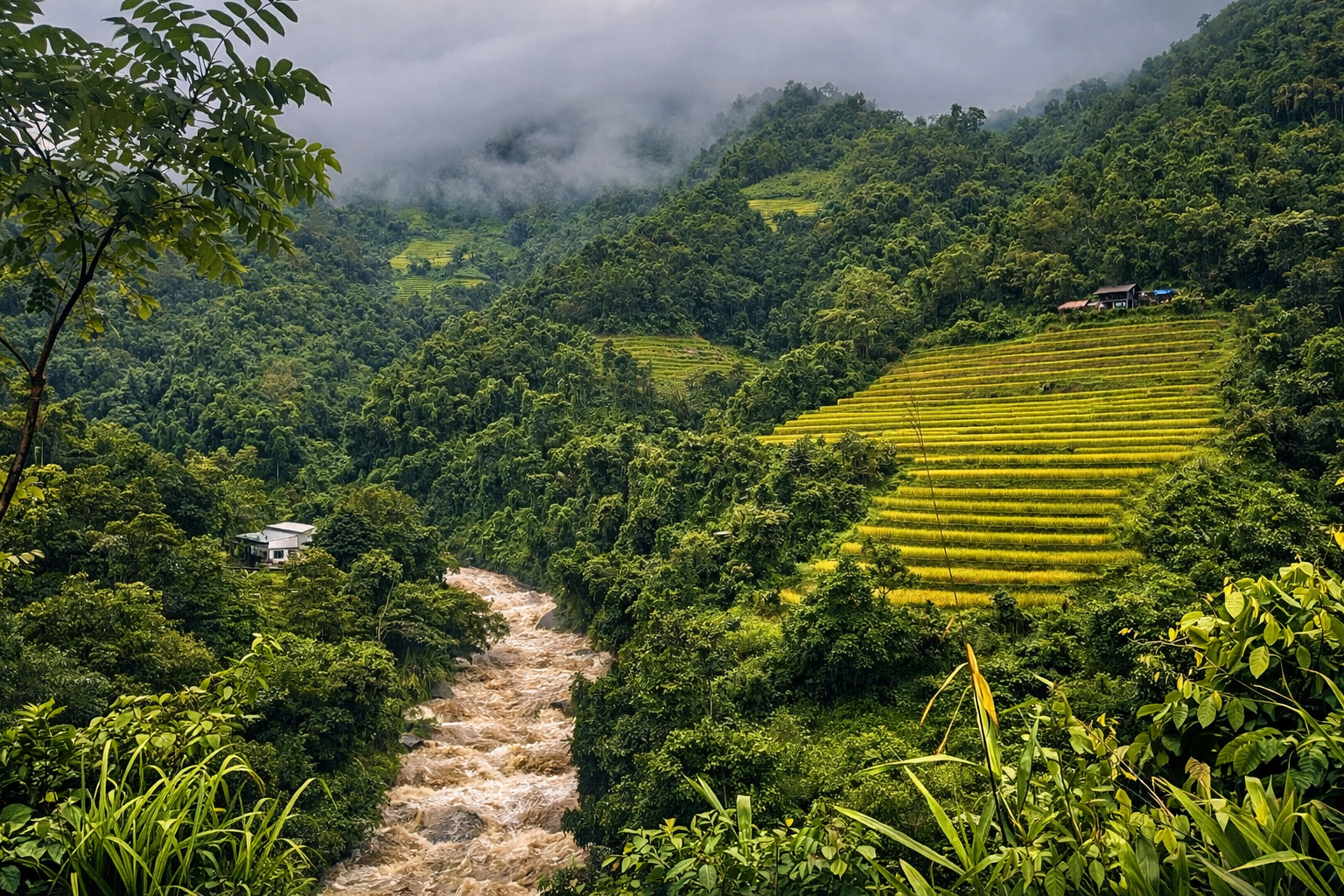
A winding river flowing through the Sapa rice terraces in August fields.

Sunlight breaking through the mountain peaks of the Hoang Lien Son range.

Close-up of green rice plants in the Sapa mountains.
A Question of Attention
The future of Sapa will not be defined by visitor numbers alone. It will be shaped by what those visitors choose to see, and more importantly, what they choose to ignore. The systems are already in place. Algorithms will continue to push the same locations. Itineraries will continue to compress experience into something fast, visible and easy to consume. The loudest version of Sapa will continue to dominate, because it is the easiest to find.
Nothing about that will change unless the traveller does. To listen in Sapa is not passive. It requires stepping away from what is repeatedly shown and moving towards what is rarely promoted. It means choosing time over speed, people over platforms, and presence over proof.
Cha says it simply:
“Of course, we do not want to tell you what you must or must not do. It is your choice, but more than anything else, what Sapa offers is its culture and its people.”
The reality is that Sapa does not need more visitors but it needs more time and attention. It needs travellers who are willing to go further, stay longer and listen more carefully. That is where everything begins to shift. Not in the places that are easiest to reach, but in the ones that require something of you. Not in the moments designed to be captured, but in those that unfold without an audience.
This is where experiences are not performed, but lived. Where a guide sets the pace because it makes sense for the land, not the schedule. Where a meal is shared because it is already being prepared. Where a conversation moves in a direction no itinerary could have planned. This is the work we are part of. Not to show you Sapa, but to step aside and allow it to be experienced through the people who live it. To create space for knowledge that is already here, but too often unheard.
You can follow the route that has already been mapped. Or you can take the time to find something else.
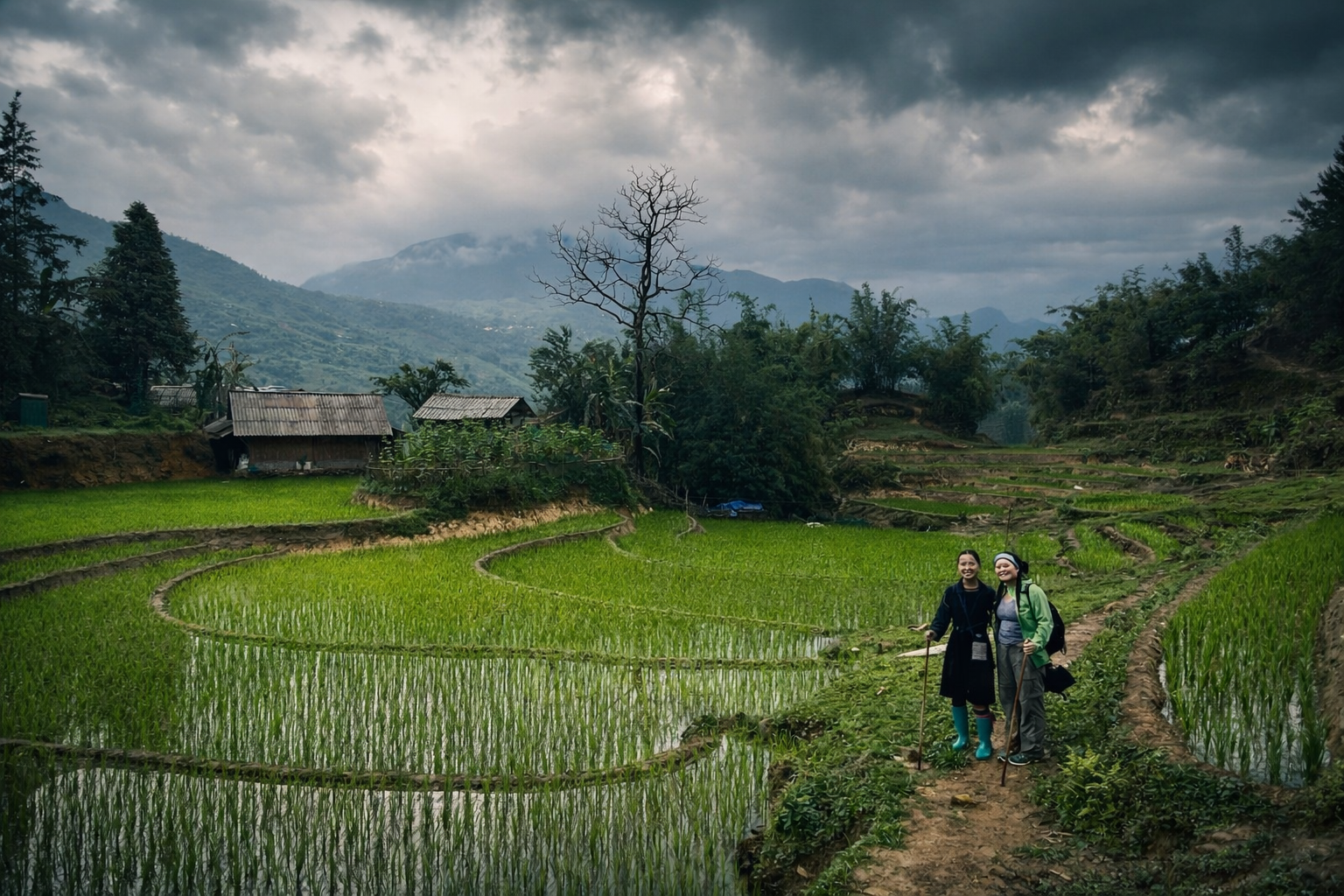
Ly Thi Cha trekking through lush rice fields as part of an ETHOS experience.
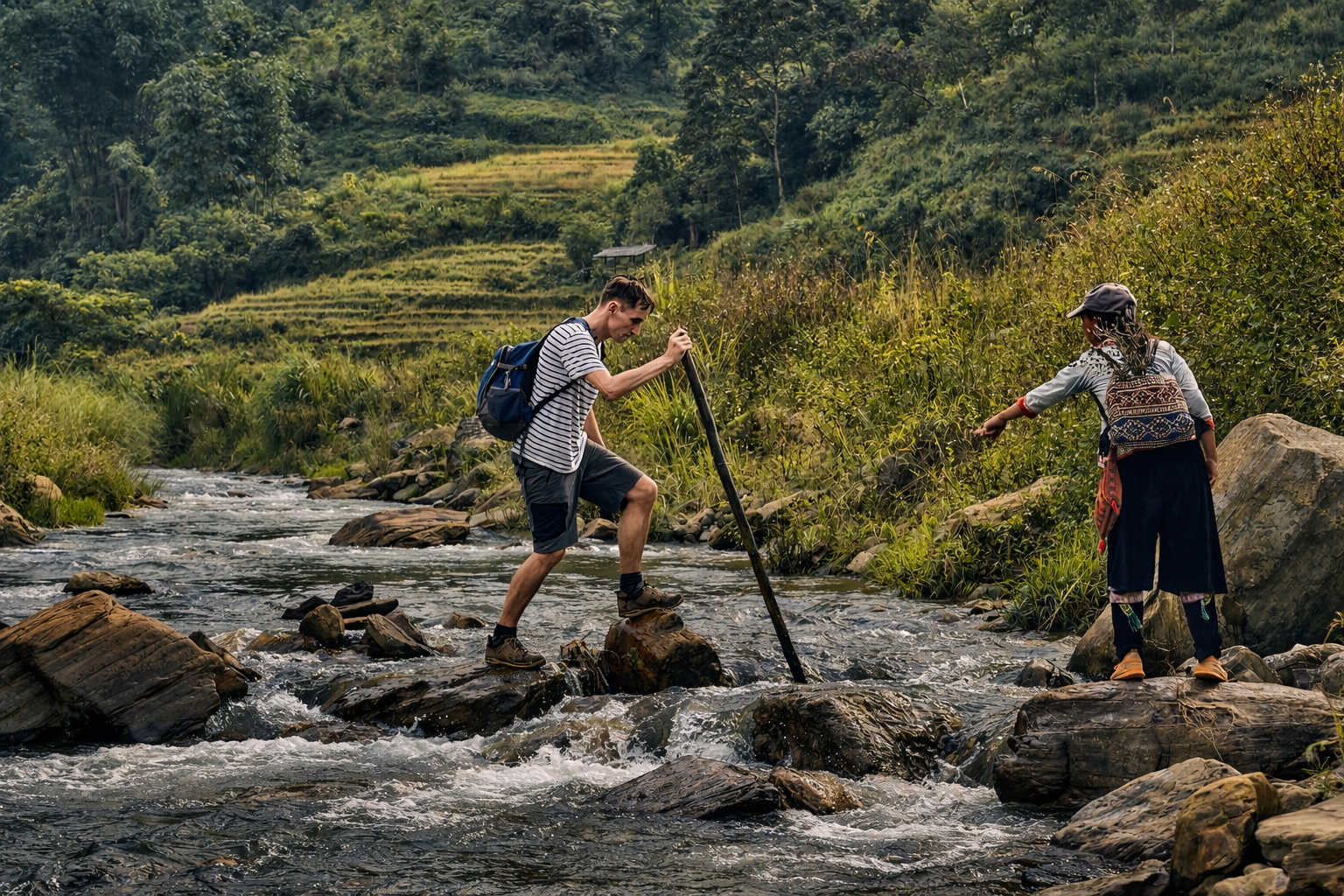
ETHOS guide Ly Thi Ker guiding a traveller across a rocky river, carefully leading the way through flowing water.
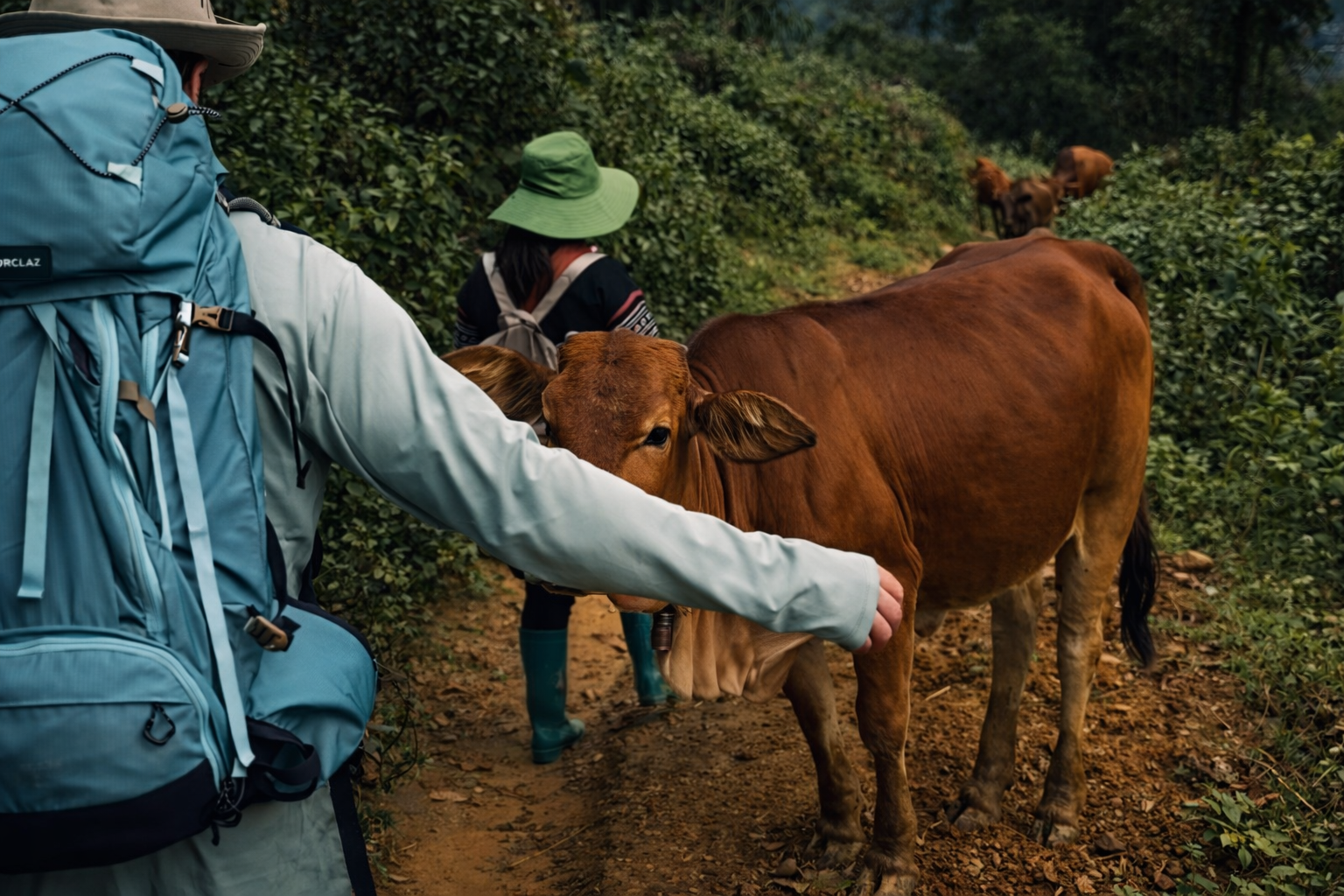
Chang Thi A walking through a quiet village path in rural Sapa as part of an ETHOS trek.
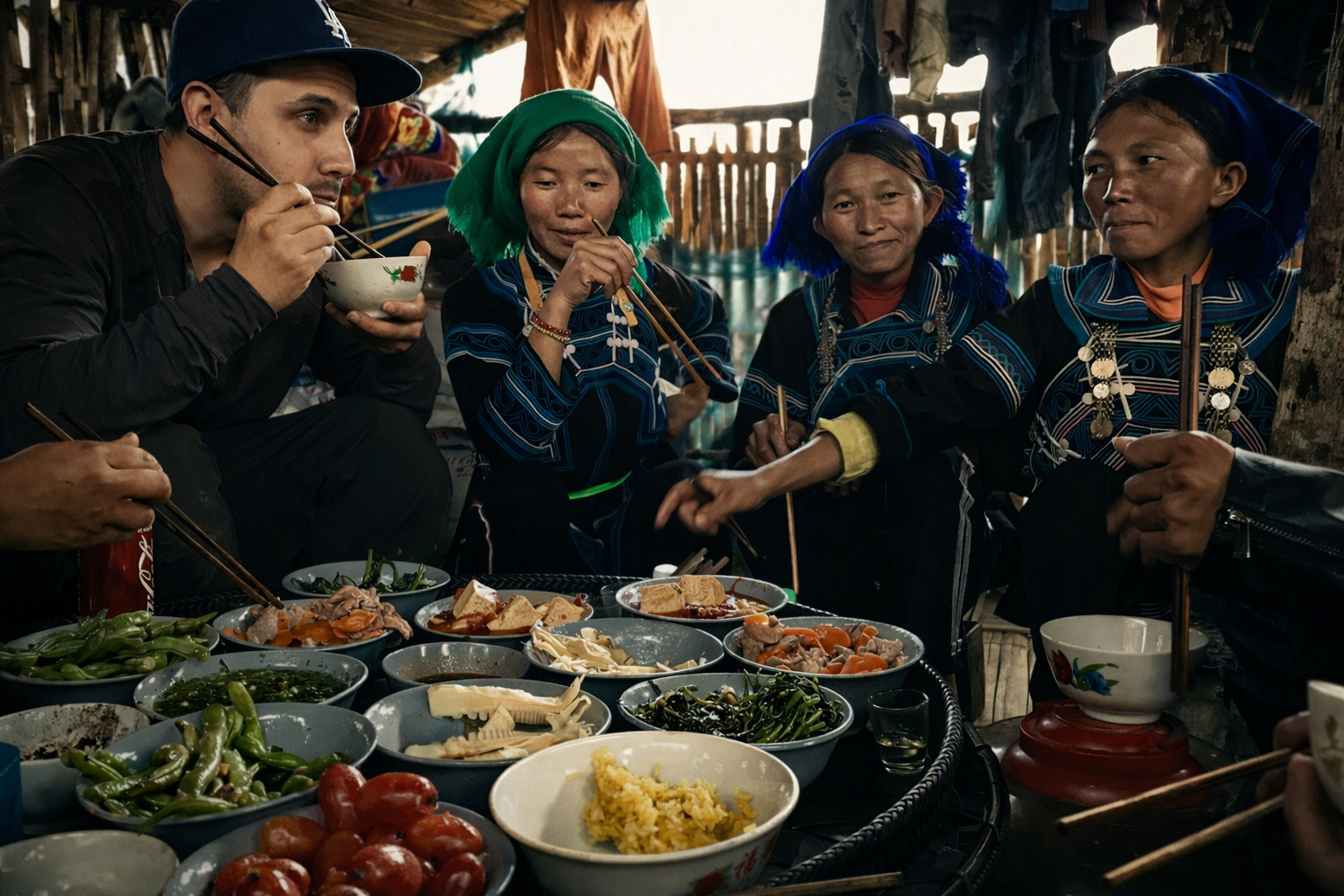
Searching Beyond the Map How ETHOS Finds New Experiences in Northern Vietnam
Before any ETHOS experience appears on our website, there are many quiet journeys behind the scenes. We spend days travelling through the mountains of northern Vietnam meeting families, sharing meals and listening to stories. It is slow, careful work built on trust and relationships. This is how meaningful travel experiences are created.
We recently spent six days riding through the mountains of northern Vietnam, travelling along quiet roads, crossing lakes by boat, visiting markets and camping beneath wide skies.
The purpose of the journey was to search for something that cannot be found on any map.
At ETHOS, every experience we offer begins with time spent in the mountains meeting people, listening carefully and building relationships. Before travellers arrive, there are many days of travel, conversation and shared meals that happen quietly behind the scenes. These journeys are where the real work begins.
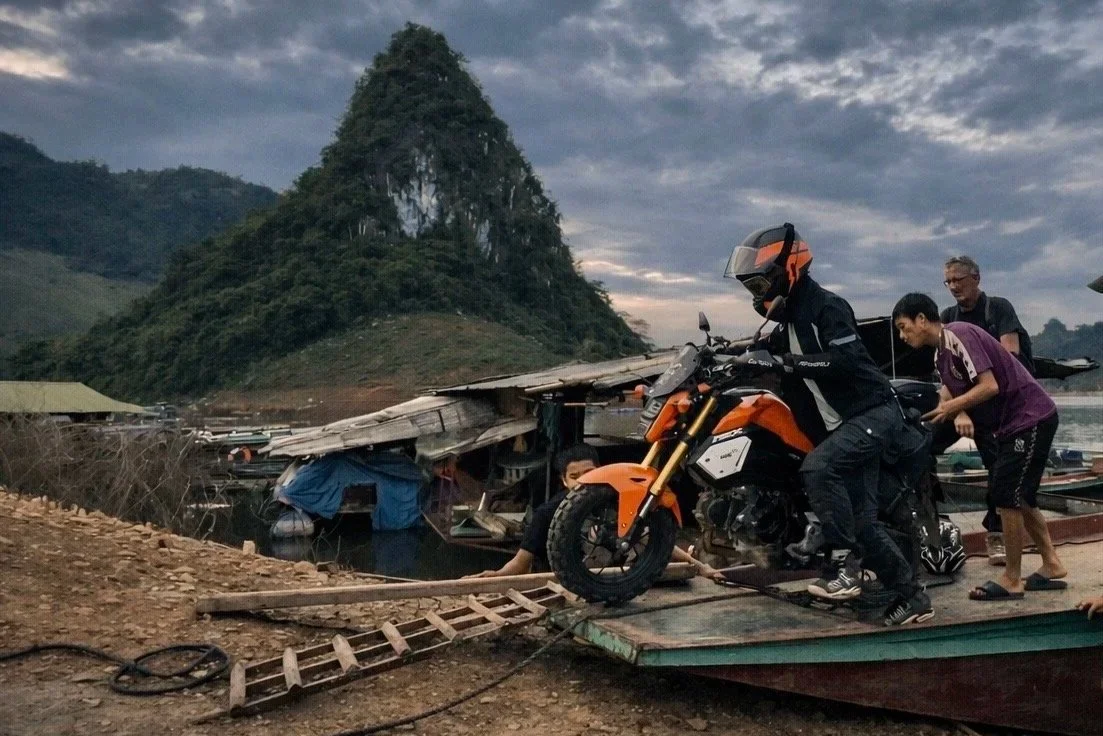
Taking a motorbike off a local “ferry” in remote northern Vietnam.
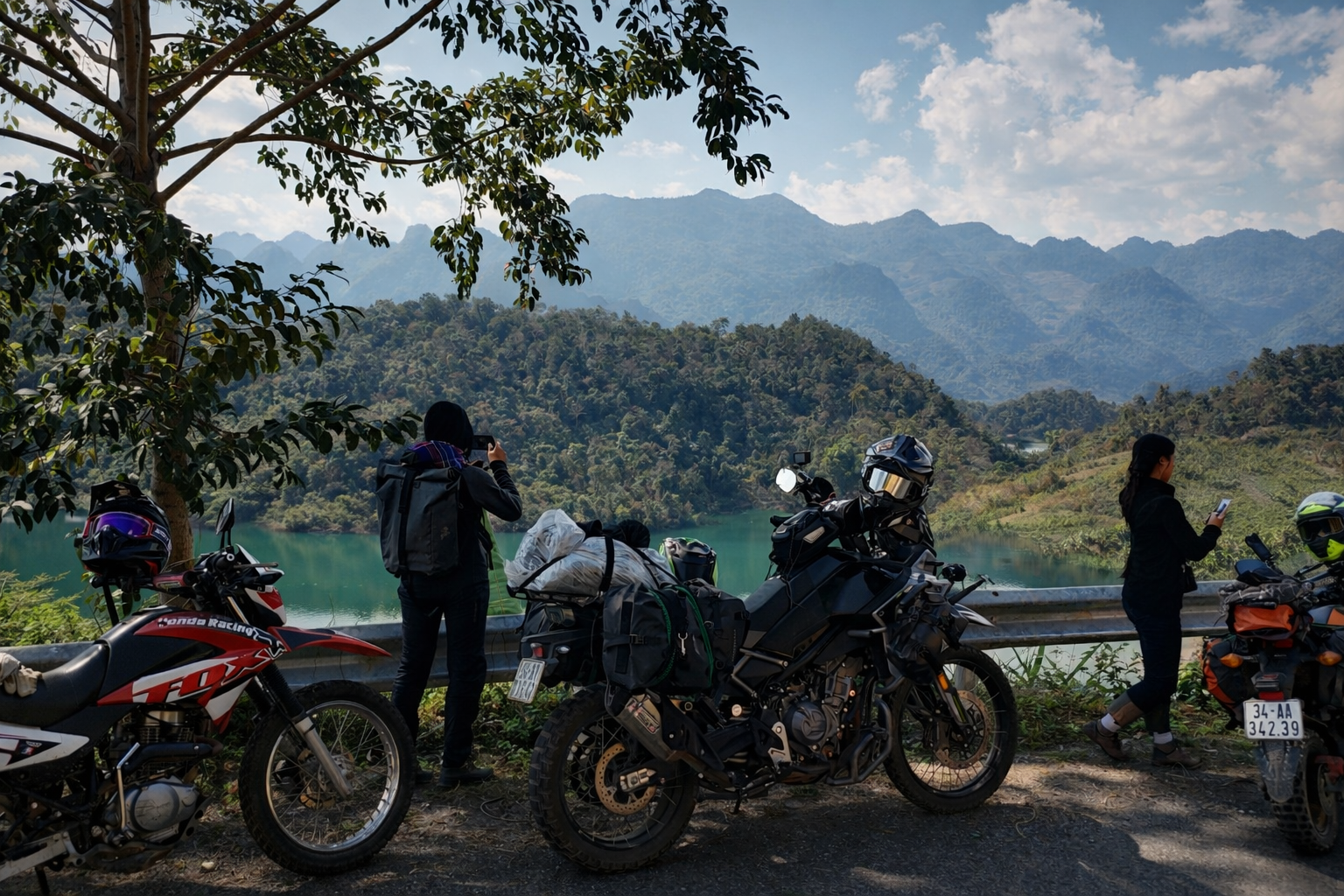
Exploring one of North Vietnams great hydro lakes.
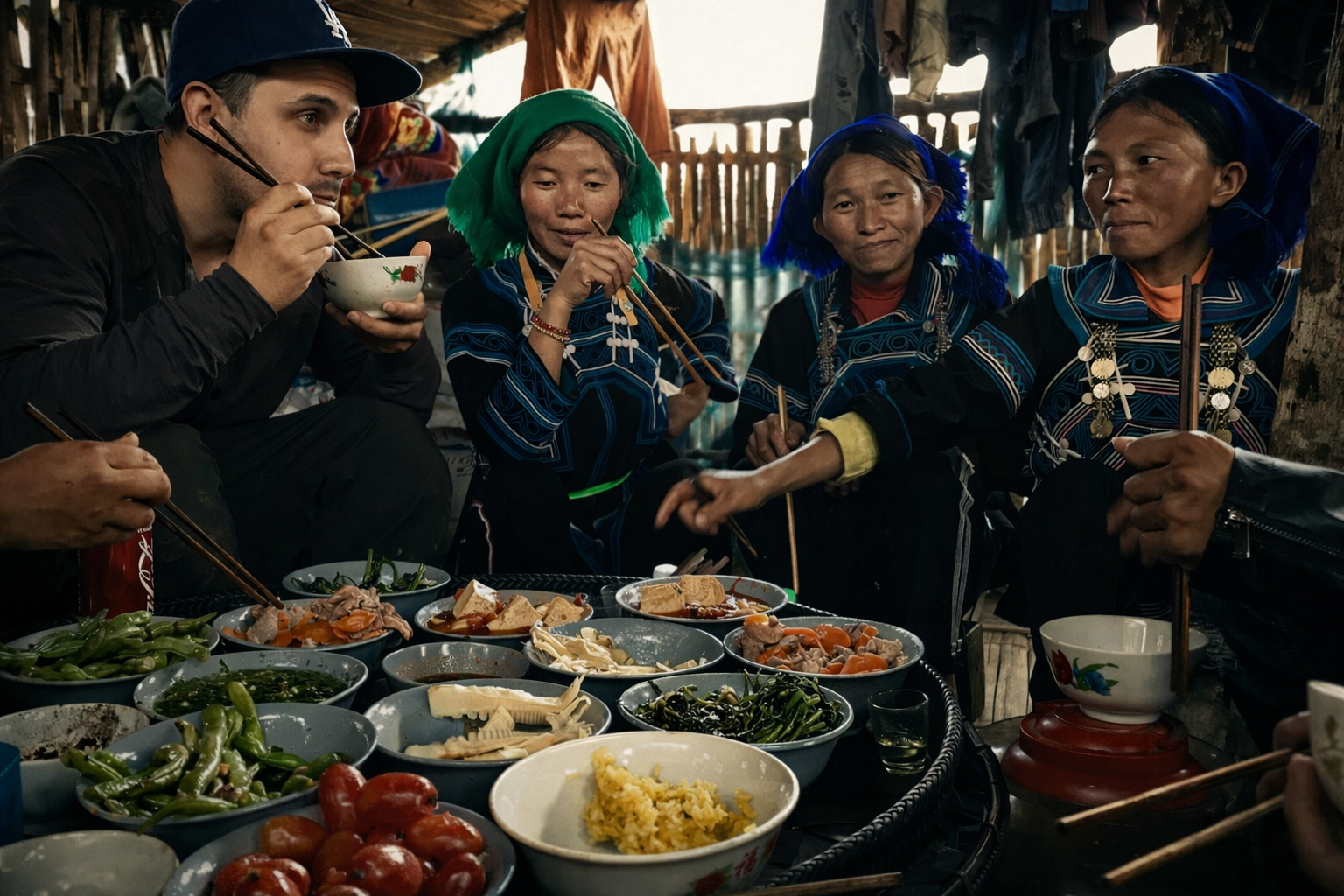
Meeting families from the Ha Nhi ethnic group.
Ethical Travel Requires Time and Trust
Northern Vietnam is famous for its spectacular landscapes and well known motorbike routes. Many travellers come here to ride through dramatic mountain passes and photograph sweeping valleys. Our journeys are different.
When we travel through the region, we are not searching for the most famous viewpoints or the most popular roads. Instead, we are looking for people. The communities we work with are not simply guides or service providers. They are farmers, artists, storytellers and community leaders. They are people who have lived in these mountains for generations and who hold deep knowledge of the land, the seasons and their cultural traditions.
Building relationships with these communities takes time. It cannot be rushed and it cannot be organised through emails or phone calls. It begins with simple things. Sitting together over tea. Walking through fields. Listening to stories about family, history and the rhythms of daily life.
Trust grows slowly. It grows through repeated visits, honest conversations and mutual respect.
Enjoying the views on a hydro lake in north Vietnam
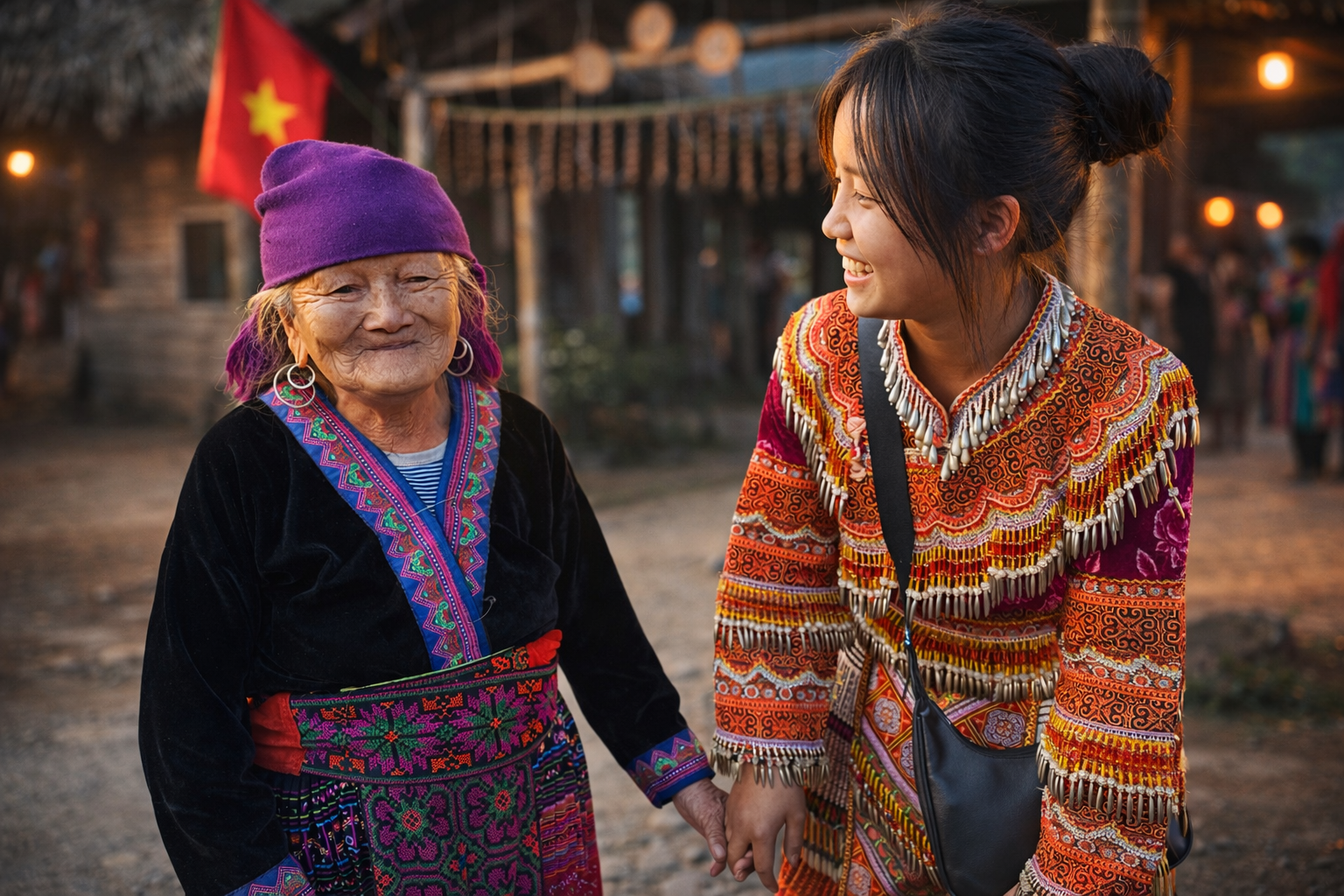
Meeting an elderly Hmong lady in Lai Chau
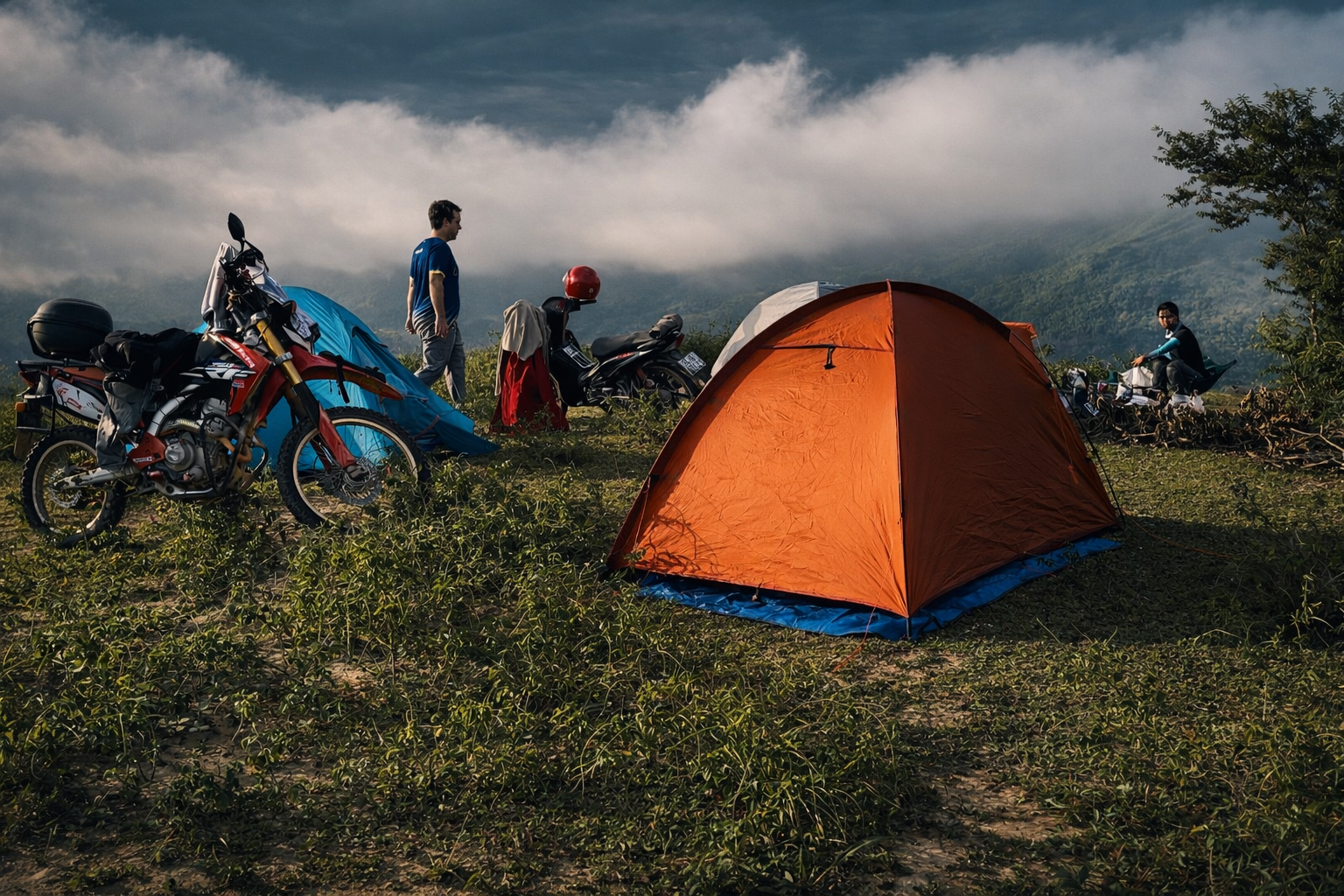
Remote camping in Lao Chau
Travelling Slowly Through the Mountains
During our six day journey we travelled through valleys, along forested ridges and across lakes where small boats carry motorbikes from one side to the other. We stopped in busy local markets where communities from surrounding villages gather to trade food, textiles and livestock.
These markets are more than places of commerce. They are meeting points where friendships are renewed, news is shared and traditions continue. Along the way we visited villages where we already have friends and partners. We also met families we had not known before. Often these introductions happen through existing relationships. A farmer introduces us to a cousin in another valley. A friend suggests we visit a nearby village where someone might enjoy sharing their craft or cooking with travellers. Nothing is hurried. We take time to talk, to listen and to understand whether a future collaboration might feel right for everyone involved.
The Beginning of Future Experiences
When travellers join an ETHOS journey, they might spend an afternoon learning traditional batik techniques, share a home cooked meal with a local family, or stay overnight in a village home surrounded by terraced fields.
What many people do not see is the long process that happens before these experiences are ever offered. Each activity begins with careful conversations. Families decide whether they are comfortable welcoming travellers into their homes. We discuss expectations, cultural boundaries and how visits can support the community without disrupting daily life. Sometimes a relationship grows into a new experience that travellers can take part in. Other times it simply becomes a friendship and a connection between communities.
Both outcomes are valuable.
Connecting People and Communities
At its heart, ETHOS exists to connect people. We work closely with Hmong, Dao and other ethnic communities across the mountains of northern Vietnam. These partnerships are built not around tourism alone but around respect, cultural exchange and shared understanding.
For travellers, this means experiencing northern Vietnam in a way that goes far beyond sightseeing. It means being welcomed into homes, learning from artisans and farmers, and understanding the traditions that shape life in these mountains. For the communities we work with, it means having a voice in how tourism happens and how their knowledge and culture are shared. These connections are the foundation of everything we do.

On the road in Son La
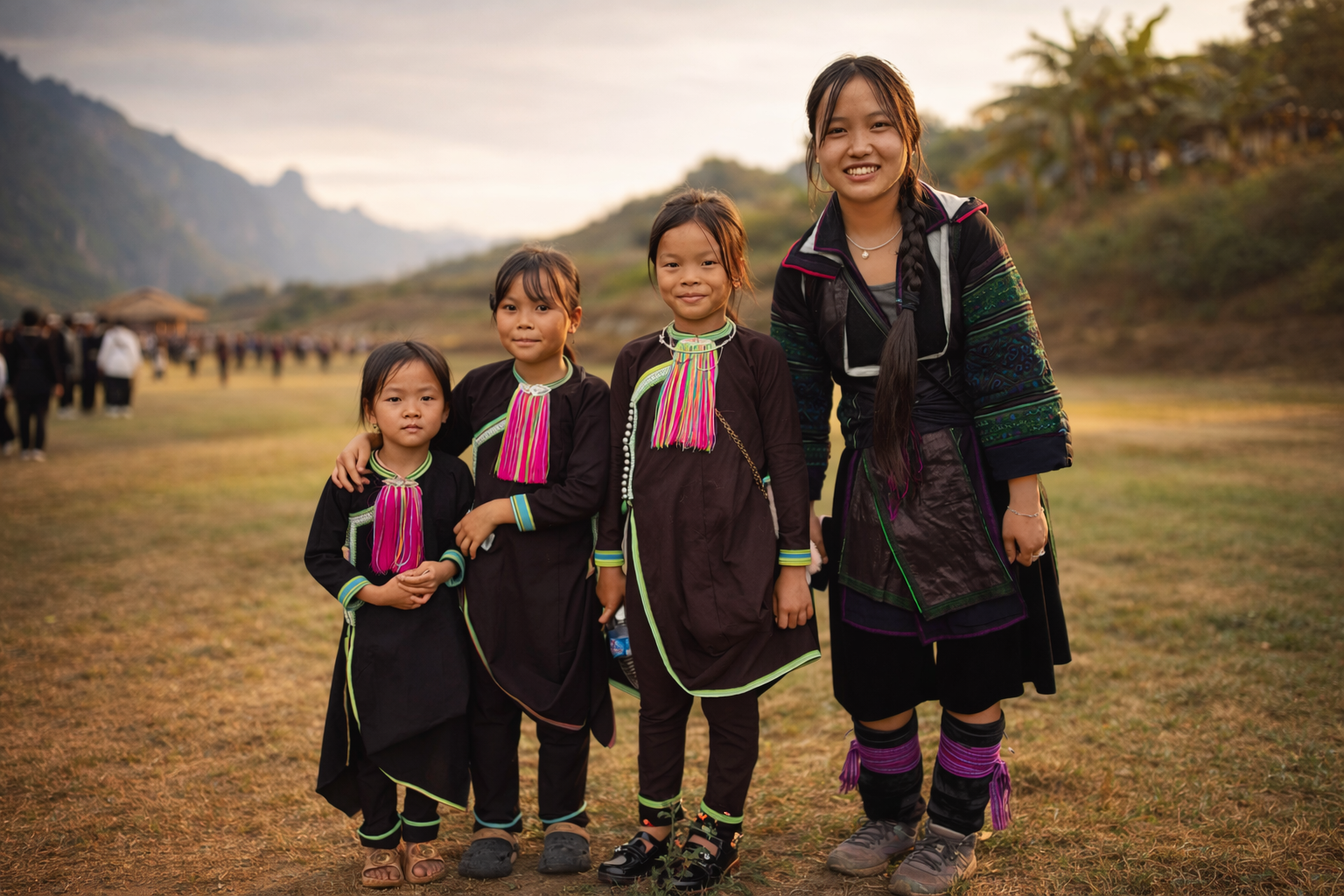
A village festival in remote Lai Chau
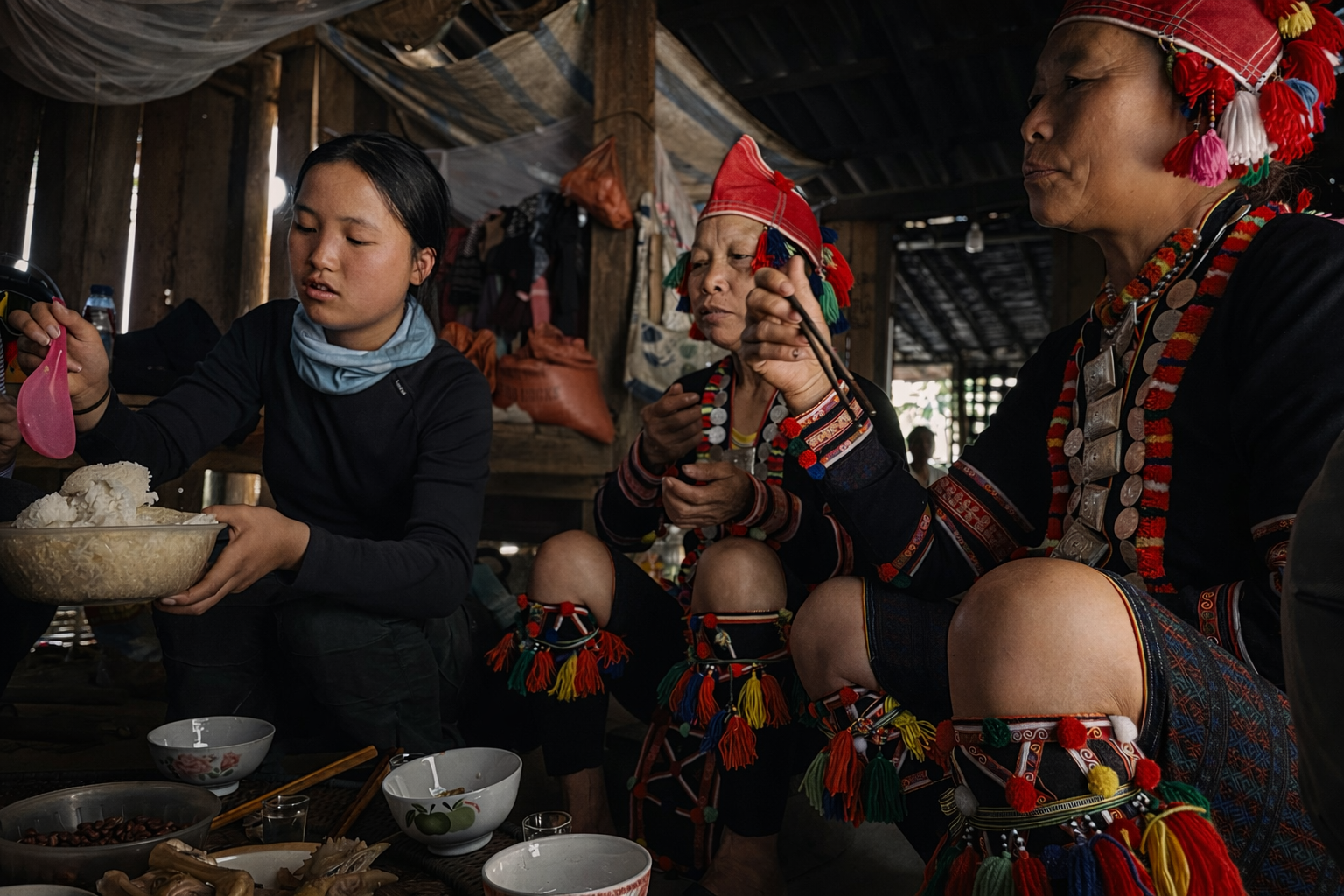
Meeting the Red Dao in Lai Chau province
The Journeys Behind the Journeys
Every ETHOS experience begins long before a traveller arrives. It begins with journeys like this one.
Days spent travelling through the mountains. Conversations in village homes. Introductions made through trusted friends. Quiet moments of listening and learning. These journeys require patience, curiosity and care. They are guided by the belief that meaningful travel must always begin with human connection. Sometimes the places we discover during these journeys become future experiences for travellers. Sometimes they remain simply as friendships and stories carried forward.
Either way, the purpose remains the same. To travel slowly, to build relationships, and to connect people with the living cultures of northern Vietnam in ways that are respectful, genuine and lasting.
Ready to Explore Sapa?
If this geological story has inspired you, start planning your trip today.
👉 Read our complete Sapa Travel Guide
👉 Discover the best Sapa Trekking Routes
👉 Learn more about our Motorbike Trips
Understanding the landscape makes visiting it even more rewarding. Explore wisely, travel prepared and experience one of Vietnam’s most fascinating mountain regions.
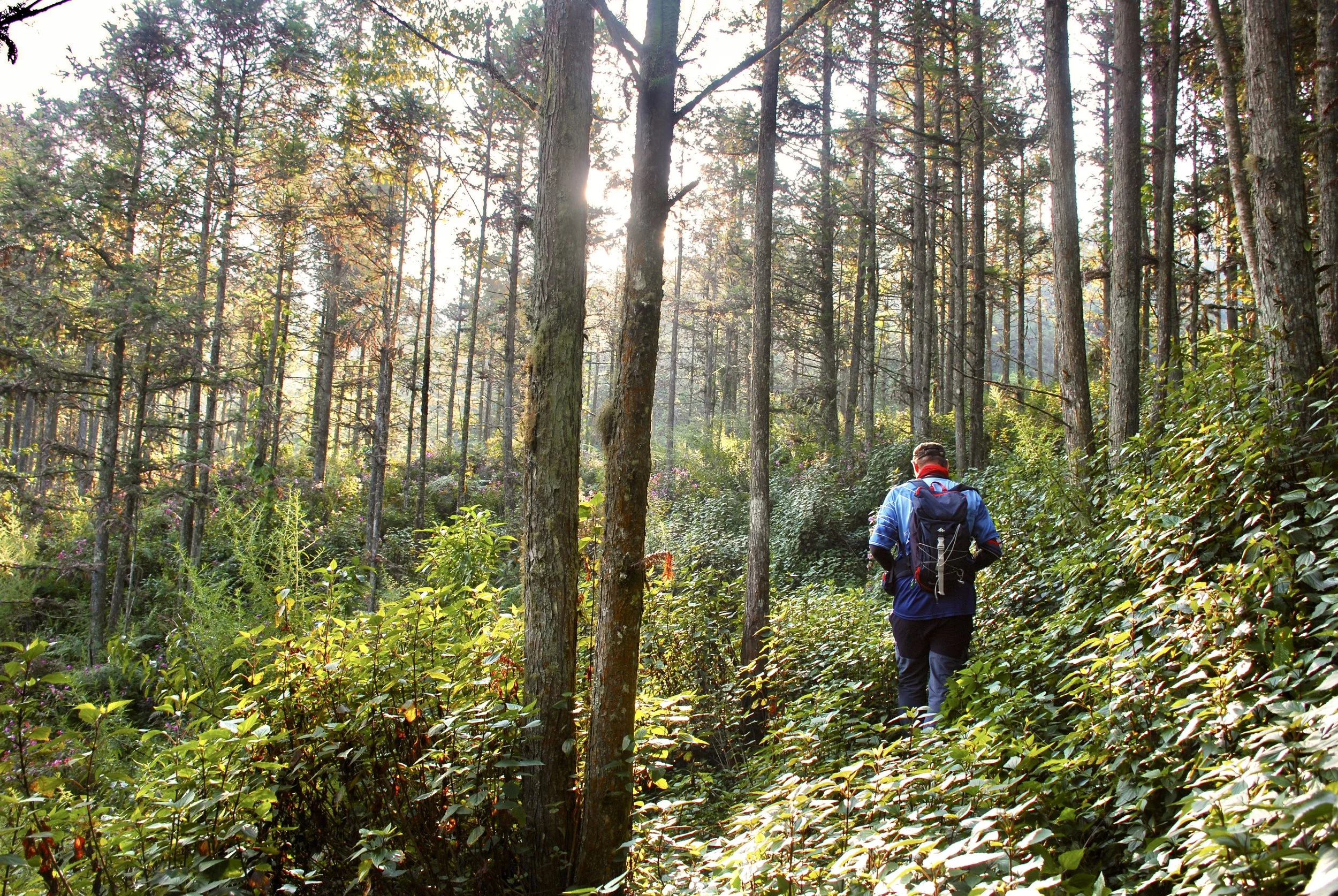
Do You Need a Guide in Sapa? What Is Necessary and What Is Not
Not every experience in Sapa requires a guide. But some absolutely do. Here is a clear and honest guide to what is necessary, what is legal, and what truly adds value.
Sapa offers a wide spectrum of experiences. Some are simple, accessible, and designed for independent travellers. Others take you deep into landscapes and cultures that cannot be reached, or understood, without local knowledge.
It is important to be clear. A guide is not always necessary, but in certain situations, a guide is essential, both legally and practically. Understanding the difference will shape your entire experience. If you are planning your time in the mountains, take a moment to consider not just where you go, but how you go. The choices you make here matter.

Crowds on the summit of Mt Fansipan
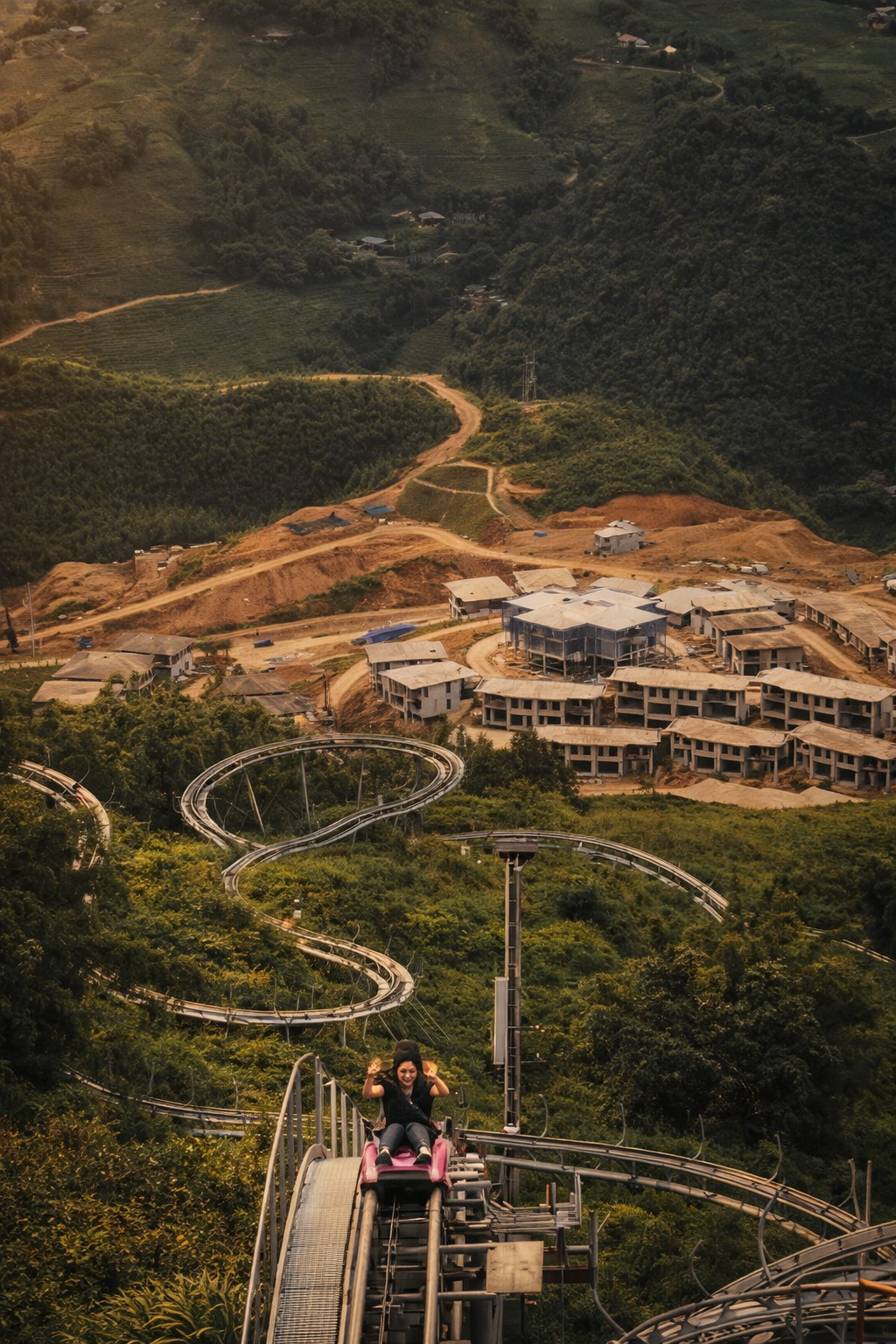
Construction around the Apine Coaster, Sapa.
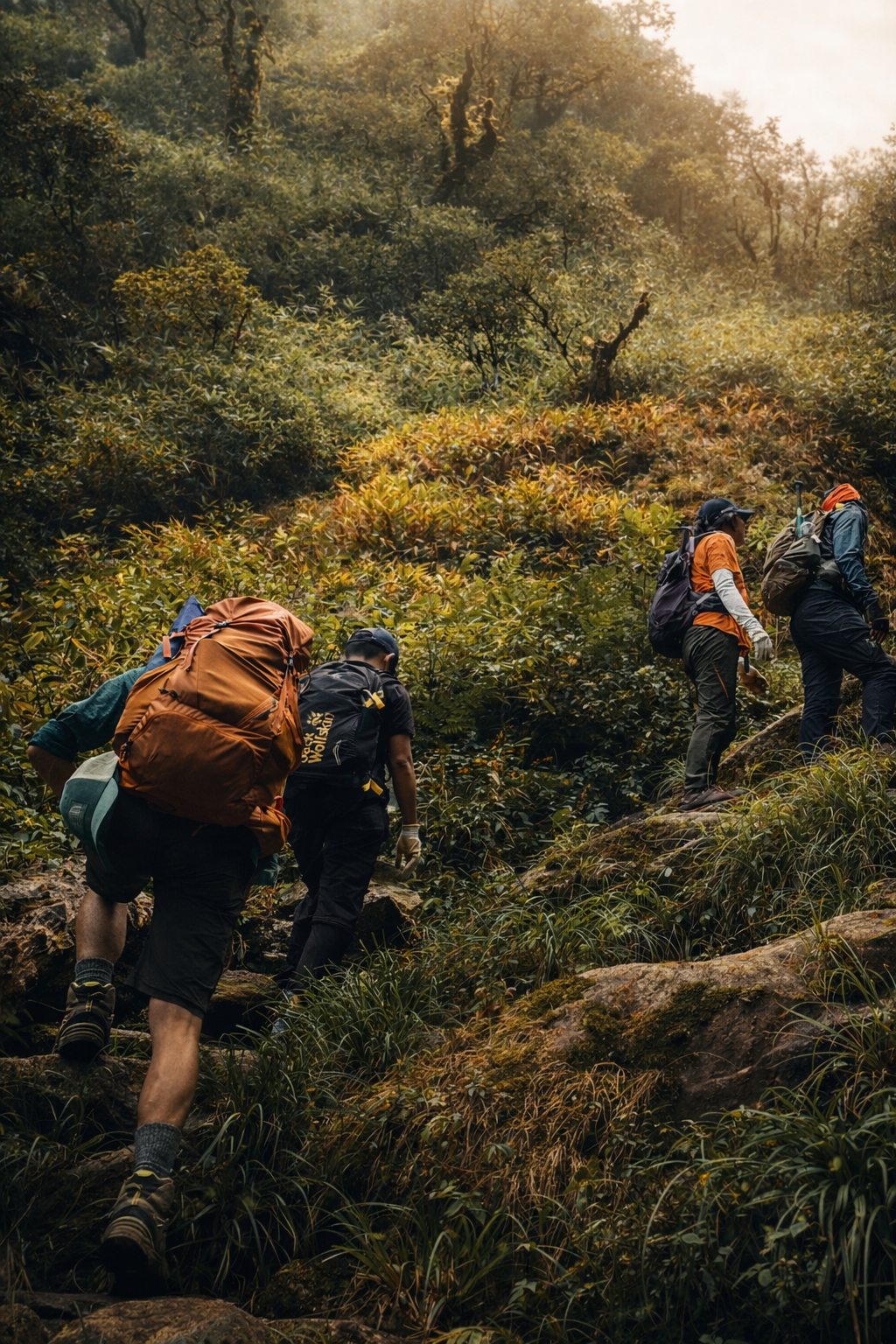
Trekkers ascending Mount Fansipan
When You Do Not Need a Guide
There are many attractions in Sapa that are straightforward to visit independently. These places are well developed, clearly signposted, and easy to access.
Mount Fansipan via cable car is one of them. From Sapa town, a short train connects to the cable car station with frequent departures. Tickets can be purchased online through Sun World Fansipan Legend or in person. Signage is clear in both English and Vietnamese. At the summit, paths are marked and facilities are readily available. You do not need a guide for this experience. Travelling independently gives you flexibility to choose the right weather window. Waiting for a clear day often makes the difference between a fleeting visit and a memorable one.
The same applies to Cat Cat Village, Moana, the Glass Bridge, and the alpine coaster. These are modern attractions that are easy to reach and simple to navigate. A guide adds no real value here.
If you are questioning whether these places are worth your time, we invite you to explore this reflection on modern travel and the search for something more meaningful:
https://www.ethosspirit.com/blog/sapa-and-the-performance-of-travel-are-we-still-exploring-or-just-reproducing-the-same-photograph
Likewise, Love Waterfall and herbal baths can be visited independently. Tickets are clear, paths are marked, and routes are straightforward. If you feel drawn to quieter spaces, places where you can slow down and experience Sapa more deeply, you might find inspiration here:
https://www.ethosspirit.com/blog/top-10-offbeat-things-to-do-in-sapa-sustainable-adventures-youll-never-forget
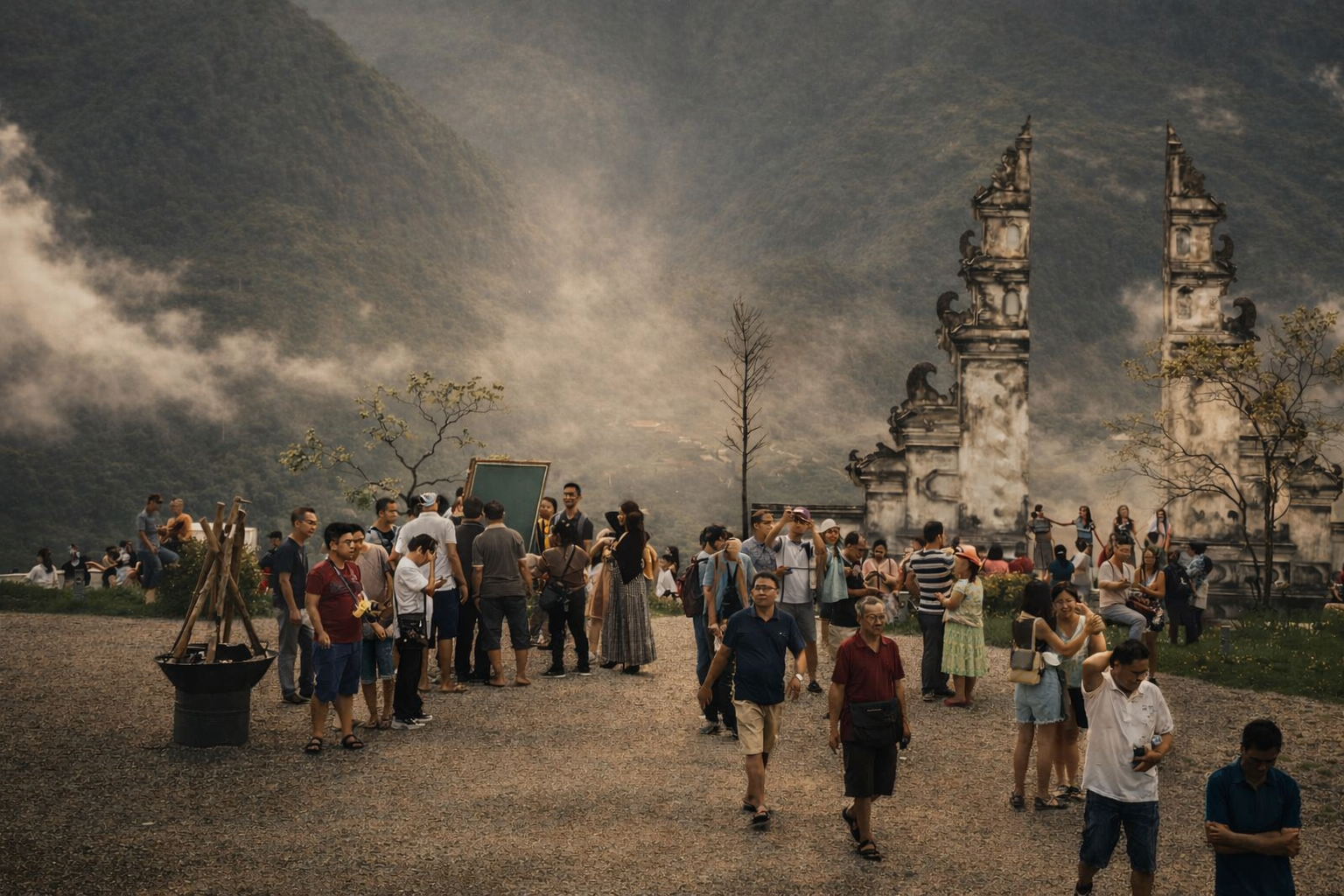
Queues of travellers waiting for a selfie at Moana
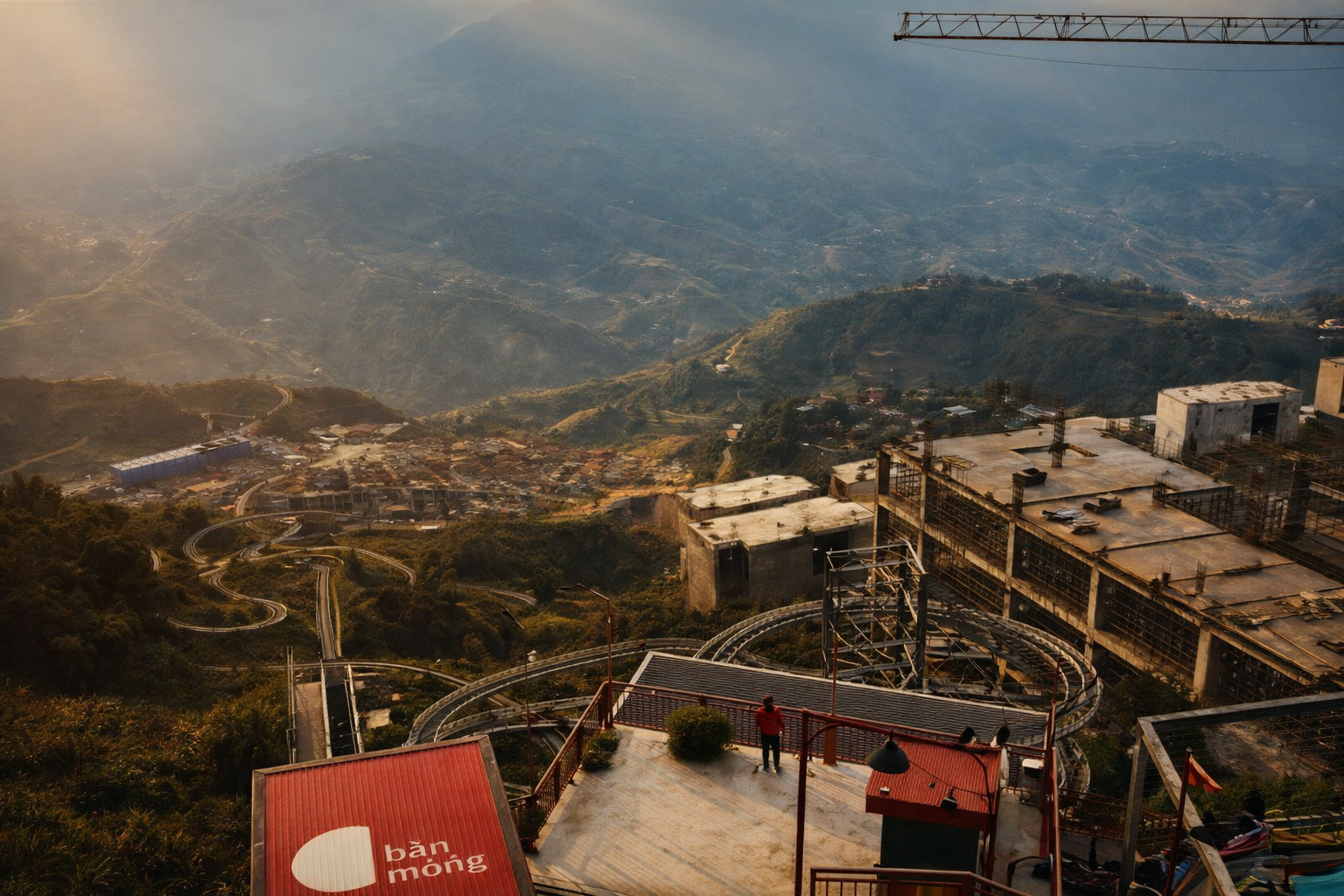
The Sapa Alpine Coaster
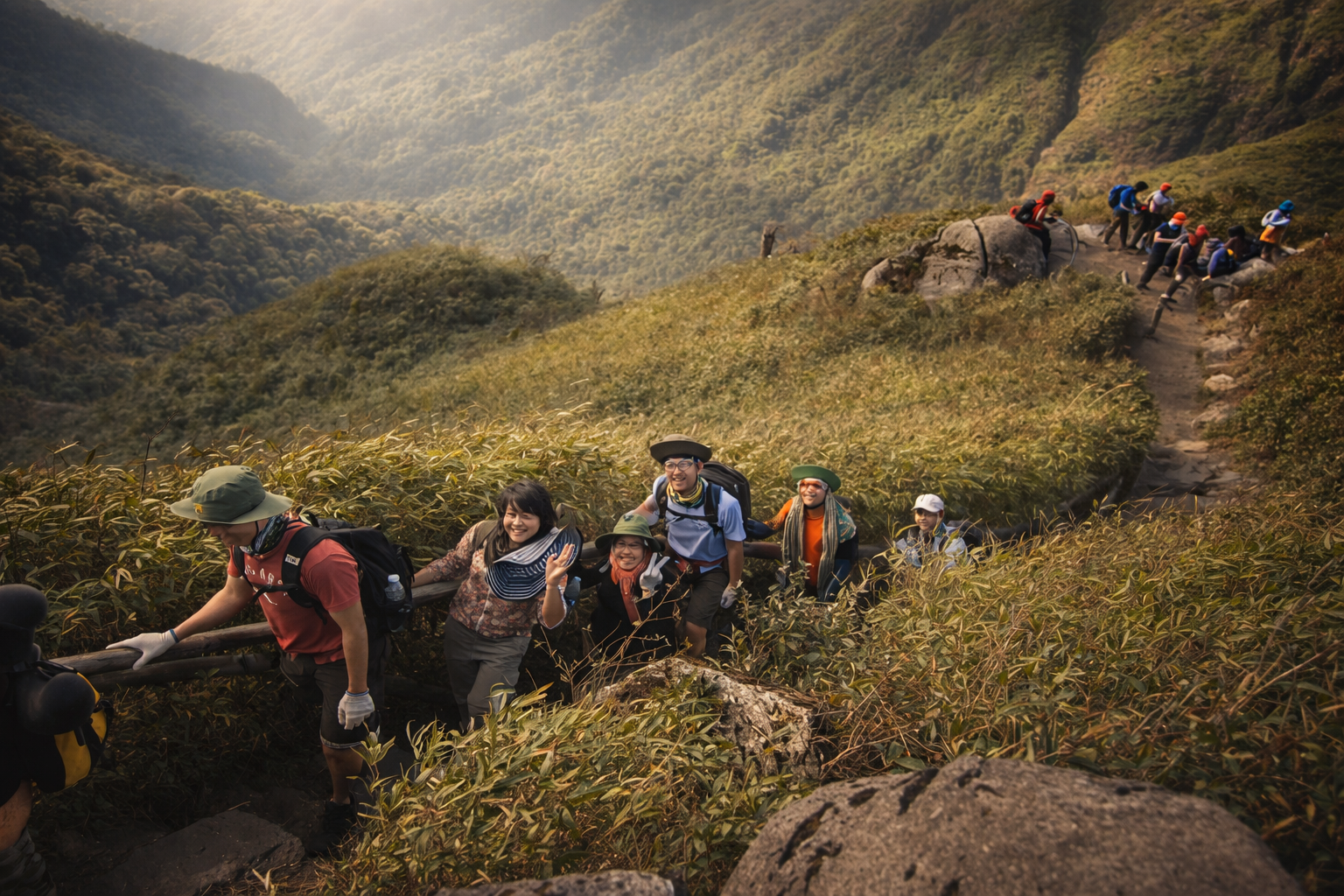
Trekkers acending Fansipan
What Is Legal: Understanding the Rules
Vietnam has clear laws regarding guiding. Anyone leading international travellers must hold a valid tour guide licence or operate under a company with an Inbound Tour Operator licence. If this is not in place, the activity is illegal and almost certainly uninsured. Many freelance guides currently operate outside of this legal framework. While they may be experienced, booking with them carries risk for you and your group. Always ask for a guide’s licence number and the company they are working with. A legitimate guide will be able to provide this clearly. Choosing a licensed, responsible operator is not just about compliance. It is about supporting a system that protects both travellers and local communities.
When a Guide Is Required by Law
Trekking Mount Fansipan is not the same as visiting by cable car. If you intend to climb the mountain on foot, a registered guide is required by national park regulations. Rangers patrol and check compliance. Trekking Fansipan alone is illegal. If you are considering this route, take the time to do it properly. It is a serious undertaking, and one that deserves preparation and respect.
When a Guide Is Essential for Safety
The longer trekking routes on Mount Fansipan must not be underestimated. They are remote, poorly marked, and highly exposed to sudden changes in weather. Several travellers who set out with confidence have become disoriented when conditions shifted. Fog can close in quickly. Trails disappear. What felt manageable can become dangerous within hours. Aiden Webb, Tom Scott, and Jamie Taggart each began their journeys believing they were prepared. Their stories are a reminder of how unforgiving this landscape can be. We share this with care and respect. These were not reckless decisions, but human ones. The mountains simply demand more than they appear to. Choosing to walk with a qualified guide is not a limitation. It is a way of travelling with awareness, and with respect for the land you are entering.
When a Guide Transforms the Experience
There is another reason to walk with a guide, and it has nothing to do with rules. The most meaningful experiences in Sapa happen away from roads and marked paths. They unfold in places that do not appear on maps. A local guide does more than lead the way. They open a door.
You learn how crops are grown and harvested. You see how textiles are made. You are invited into homes, into kitchens, into conversations that would never happen otherwise. You can forage, cook, and share meals together. You begin to understand the rhythm of life in the mountains.
For Sapa, it is also important to understand what we mean by local. Guides from ethnic minority communities such as Hmong and Dao have grown up in these landscapes. They understand the mountains, forests, and cultural rhythms in a way that cannot be learned elsewhere.
Booking a tour through a city-based operator and walking along busy roads with a guide from Hanoi will rarely offer meaningful insight into life here. The depth of knowledge, the stories, and the lived experience are different.
The best guides in Sapa are those who belong to this place. They know the trails intimately, but more importantly, they carry the knowledge, traditions, and everyday realities of the communities you have come to visit.
If this is the kind of travel you are seeking, we invite you to explore how we work alongside our partners here:
https://www.ethosspirit.com/blog/ethical-trekking-in-sapa-travel-with-purpose
Without this, Sapa can feel repetitive. With it, Sapa often becomes the most memorable part of a journey through Vietnam.
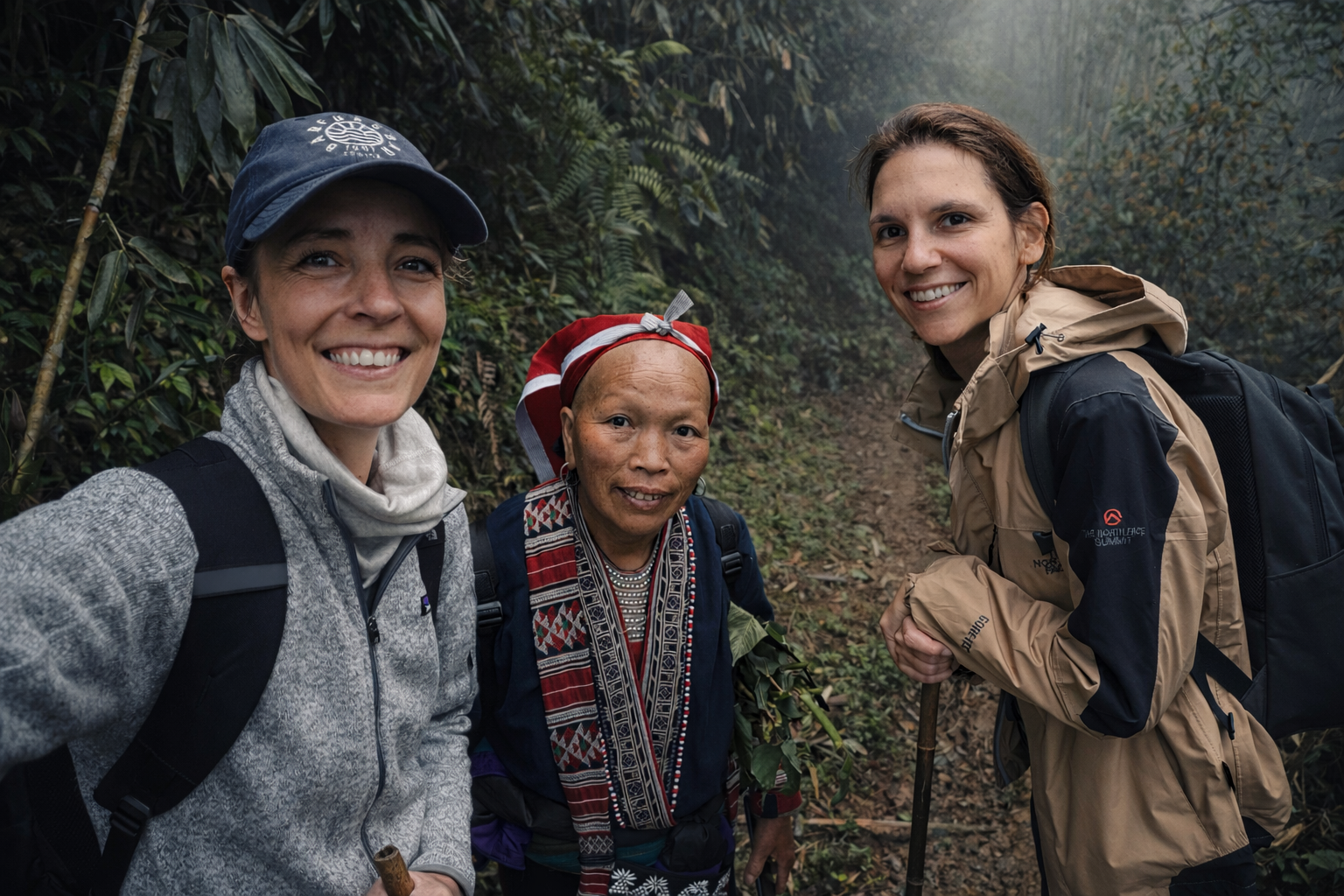
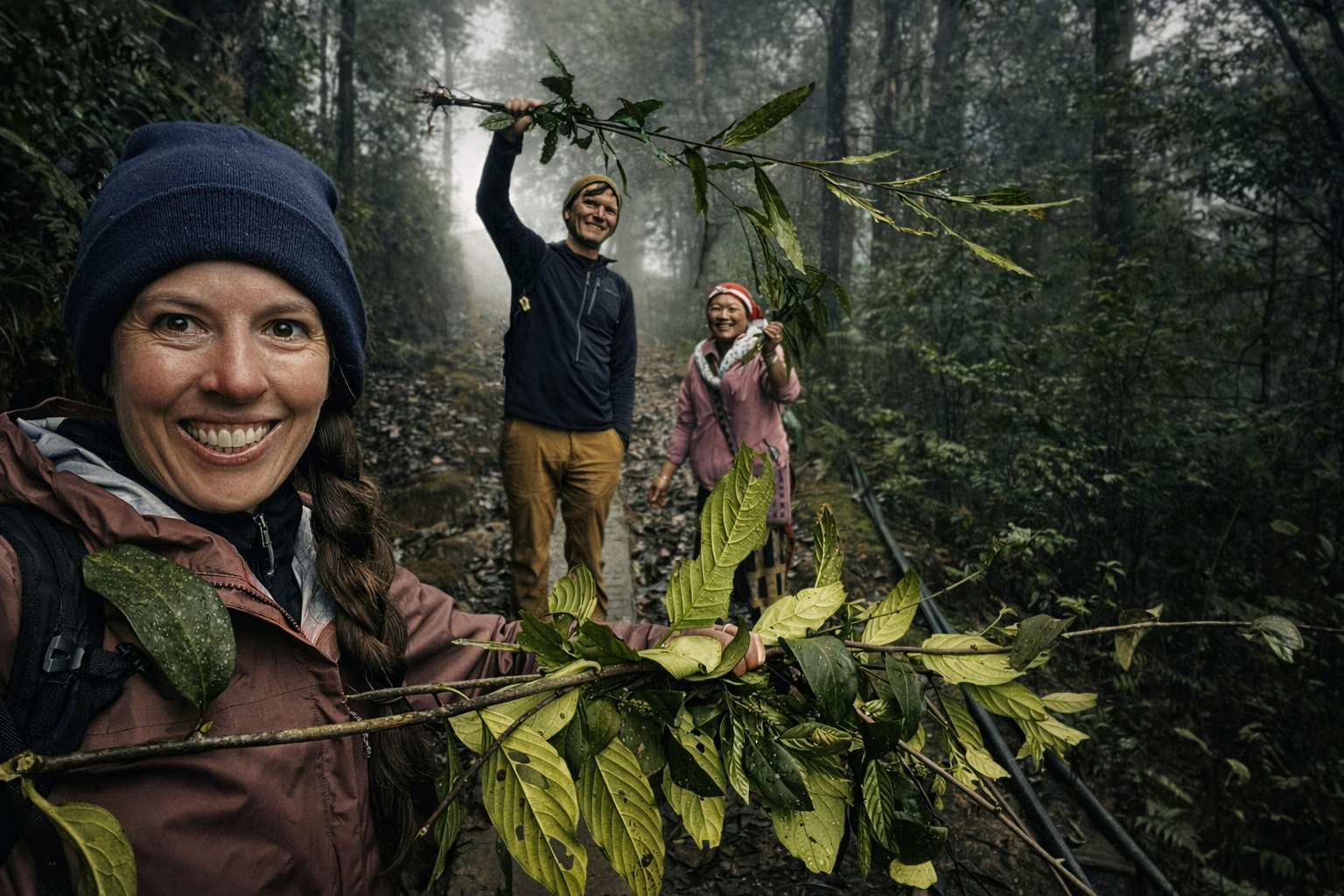
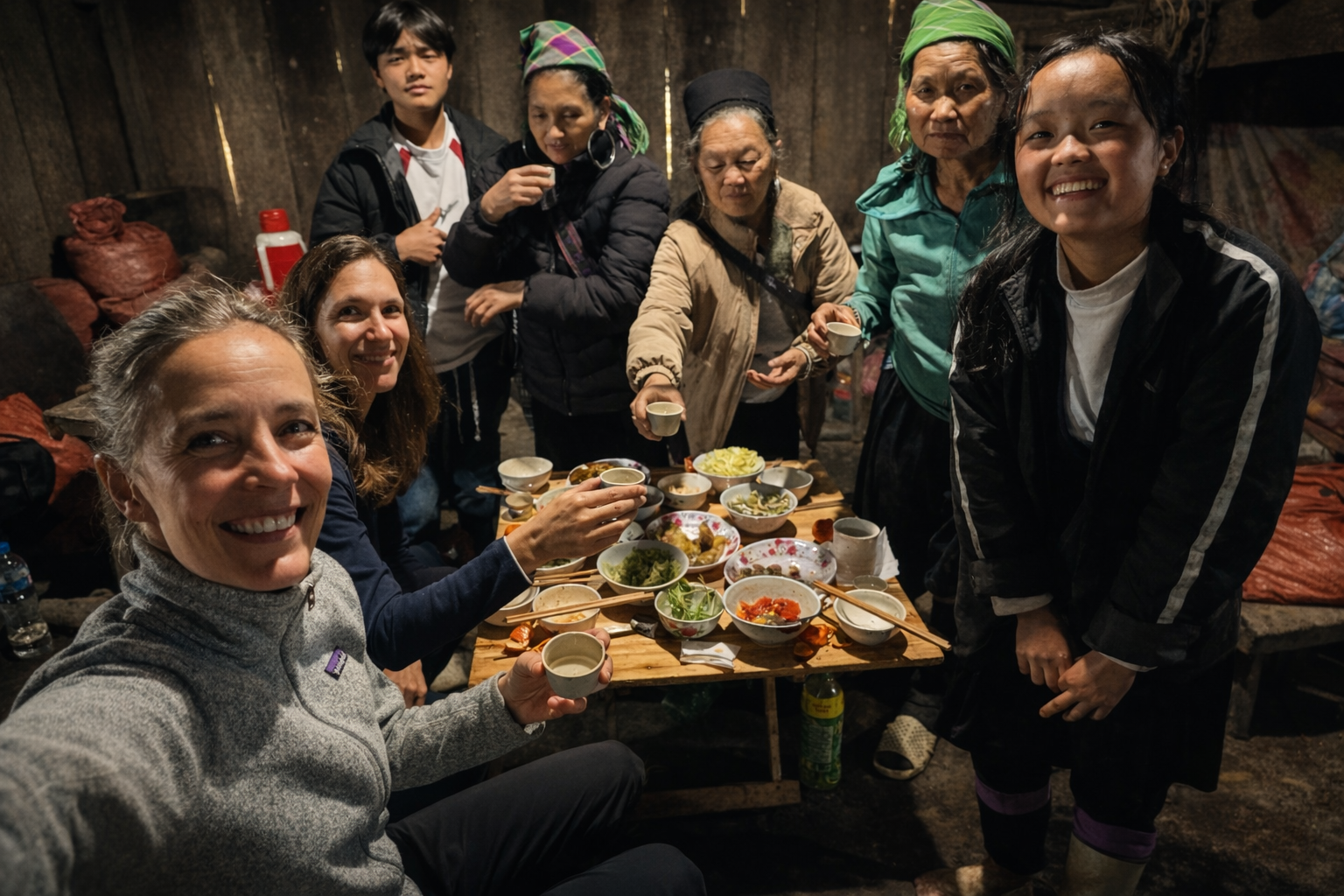
A Clear Summary
You do not need a guide for everyday attractions; Moana, Sapa Swing, Sunworld Fansipan, The Love Waterfall, The Silver Waterfall, and some clearly marked walks.
You must have a guide for trekking Mount Fansipan on foot.
You should have a local Hmong or Dao guide for any off trail trekking, remote routes, or meaningful cultural experiences.
Travel With Clarity
Go independently where it makes sense. Keep your plans flexible, but if you feel the pull to explore further, beyond the road and into the landscapes and lives that define this region, take the time to do it well.
Walk with someone qualified. Walk with someone local. Walk with intention.
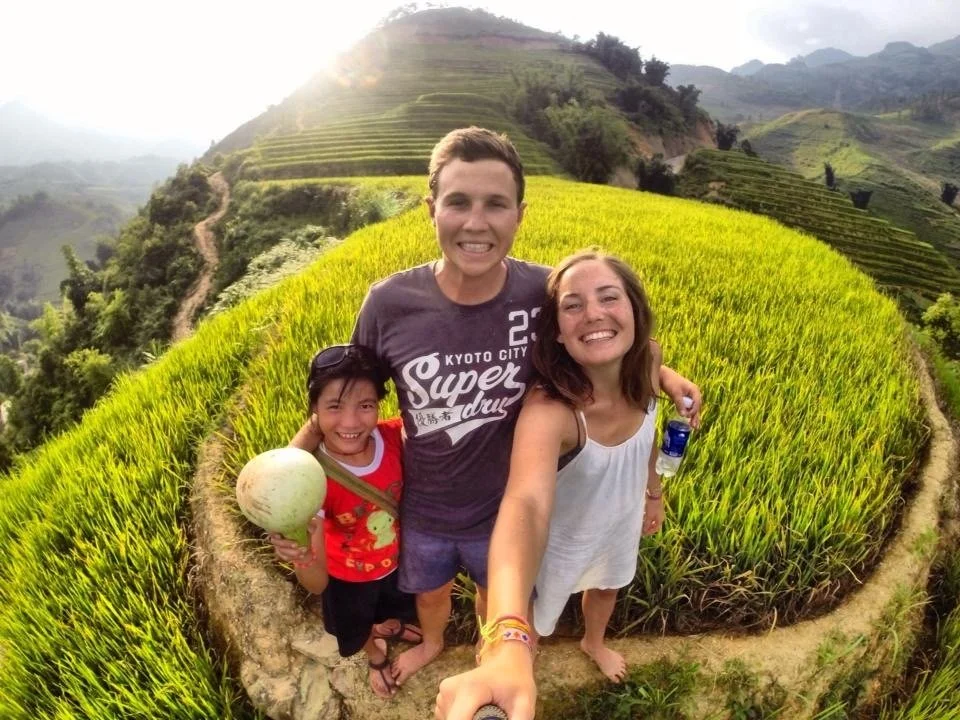
Mastering Mountain Trails: Demystifying Trekking Difficulty in Sapa
Most Sapa treks follow the same crowded paths. This guide explains what trekking difficulty really means in the mountains and how small group, ethical routes offer a more rewarding experience for travellers and local communities alike.
Why Most Sapa Treks Feel the Same
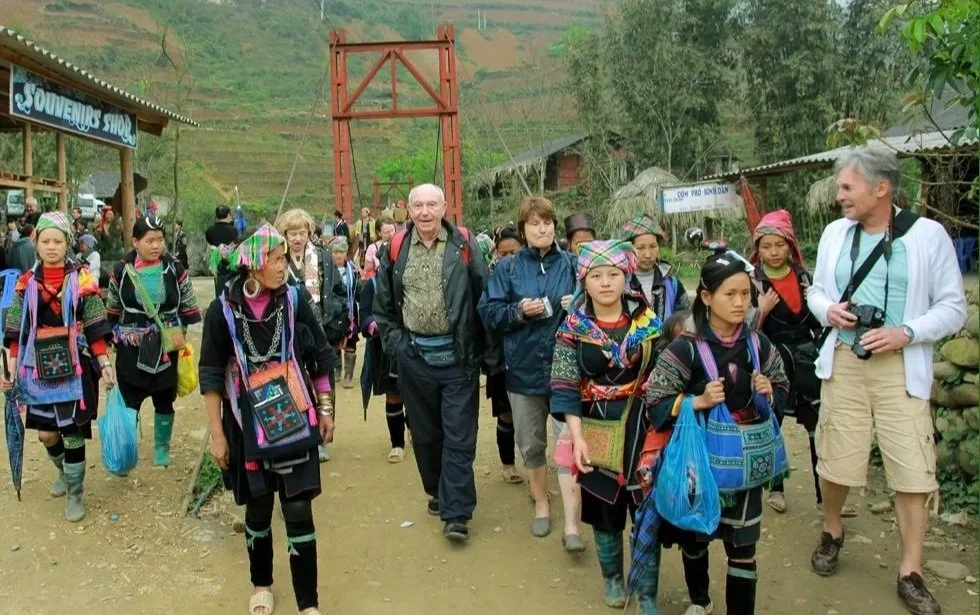
A large mixed group of tourists walking together with local women along a wide path near a village entrance in Sapa, illustrating the busy, organised nature of mainstream trekking routes in popular tourist areas.
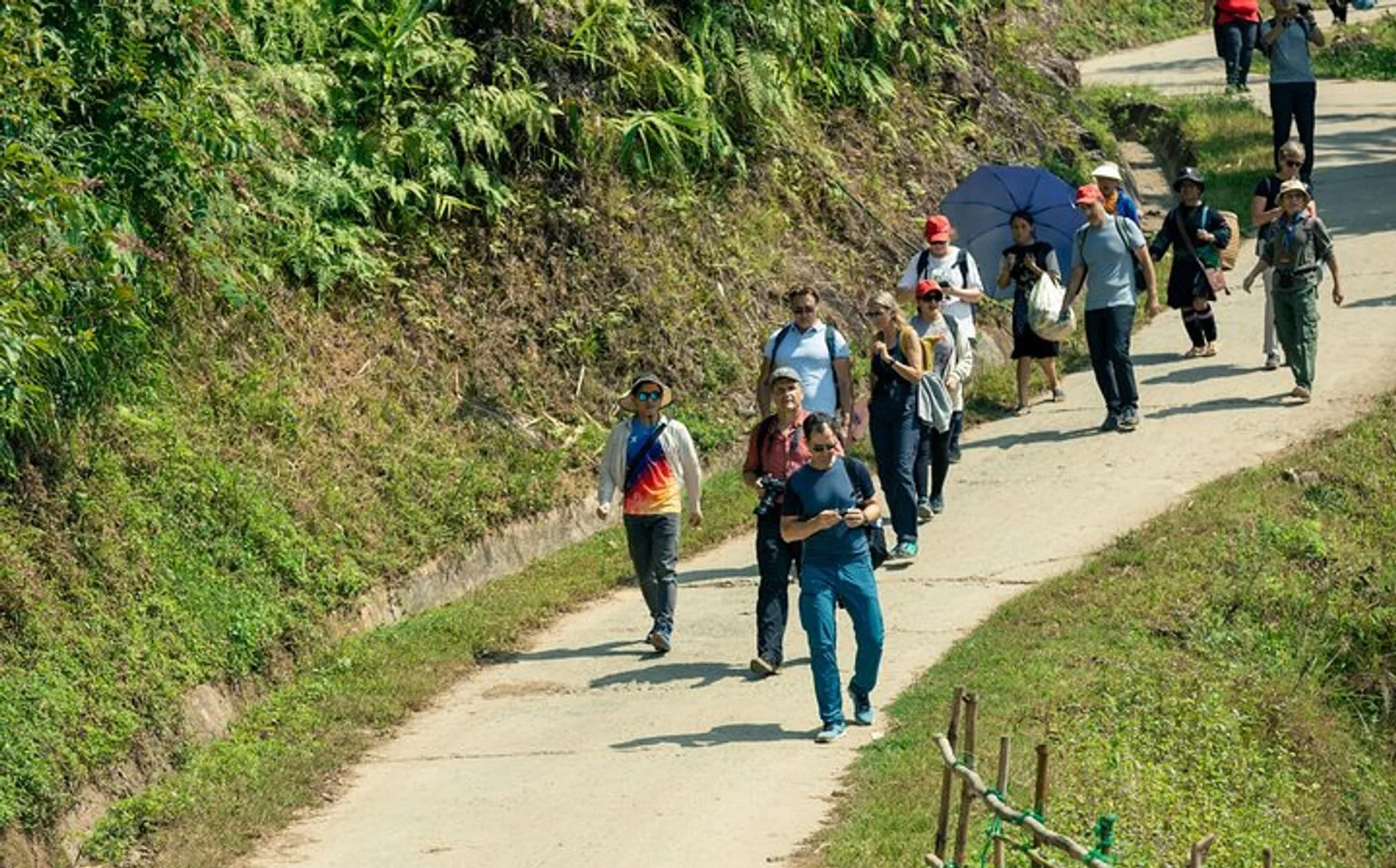
Several trekking groups following the same concrete path through the Muong Hoa Valley, showing how visitors are funnelled along identical routes regardless of ability, weather, or experience.
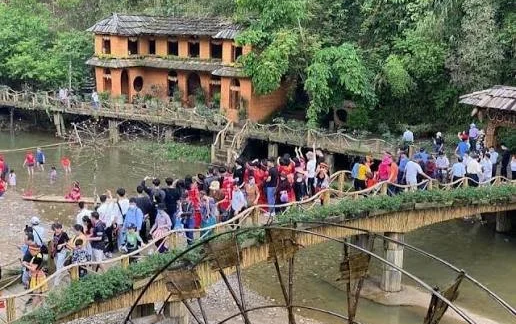
A steady line of tourists crossing a narrow bamboo bridge towards a purpose built café area in Cat Cat Village, highlighting the commercial, crowded feel of copy book tourism in Sapa’s most visited locations.
If you search for a trek in Sapa, you will quickly notice the same village names appearing again and again; Cat Cat, Lao Chai and Ta Van.
These are the routes most travellers are sold in Hanoi by third party agents. They are easy to organise, simple to market, and predictable for tour companies. Every morning, dozens of small groups leave Sapa town at roughly the same time and follow almost identical paths into the Muong Hoa Valley.
On paper, this sounds idyllic. Rice terraces, minority villages, waterfalls, bamboo bridges. In reality, it often becomes a slow procession of tourists walking the same concrete paths and village roads. Lunch is taken in large restaurants built to serve volume. Homestays are often purpose built guesthouses that can sleep twenty or more people at a time. The difficulty of the trek is not designed around you. It is designed around the least prepared person in a large group. The “treks” are identical to the day before and the same as all the other tour groups.
What “Trekking Difficulty” Really Means in the Mountains
When travellers ask how difficult a Sapa trek is, they usually mean distance. Five kilometres. Ten kilometres. Twelve kilometres. In the mountains, distance tells you very little.
Trekking difficulty here depends on elevation gain, recent weather, the condition of the paths, and how confident you feel walking along narrow earthen paddy walls above steep terraces. It depends on whether you are climbing through dense bamboo forest or following a concrete track between villages. Most group tours cannot adapt to these factors. The guide must keep the group together. The route cannot change because transport, lunch stops, and accommodation are pre arranged. Even if the path becomes slippery after rain, the group still follows the same way.
This is why many travellers finish their trek feeling either under challenged or completely exhausted.
A Different Way to Trek with ETHOS – Spirit of the Community
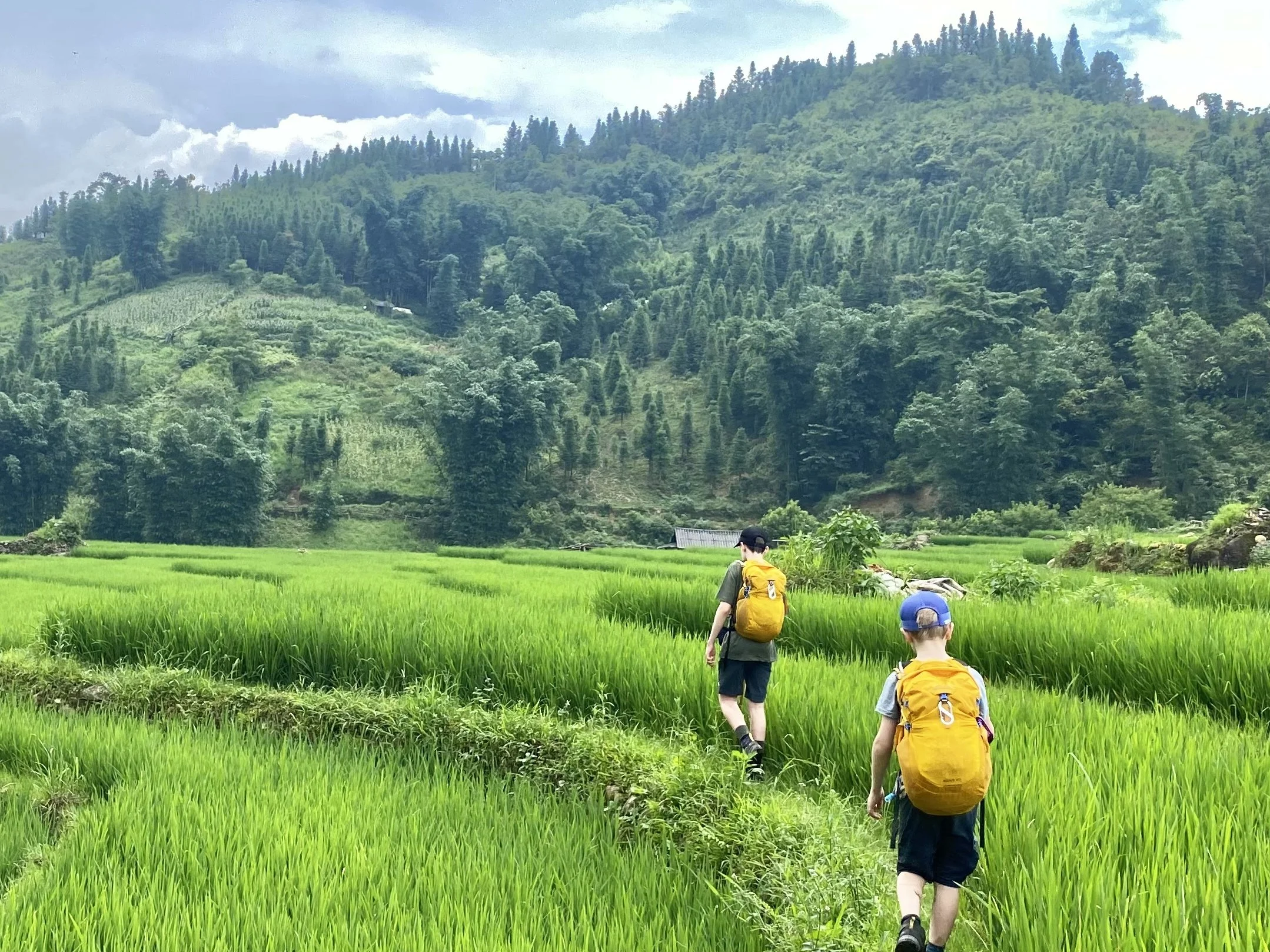
Travellers walking quietly through vibrant rice terraces on a narrow earthen path, far from roads and crowds, illustrating the calm and personal nature of small group trekking in remote parts of Sapa.
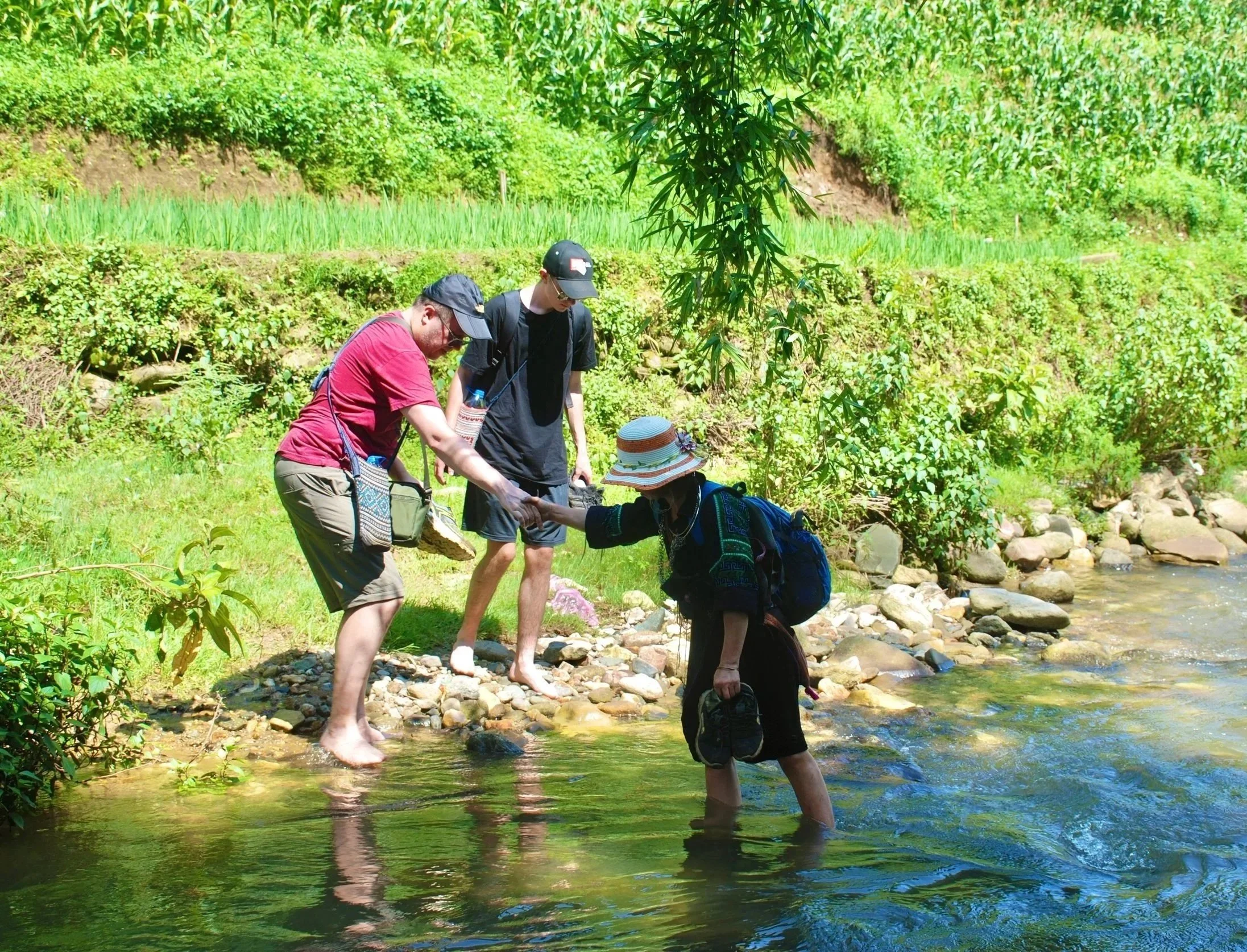
A local Hmong guide helping travellers cross a shallow mountain stream, showing hands on guidance, adaptable routes, and the close support that comes with private, community led trekking.
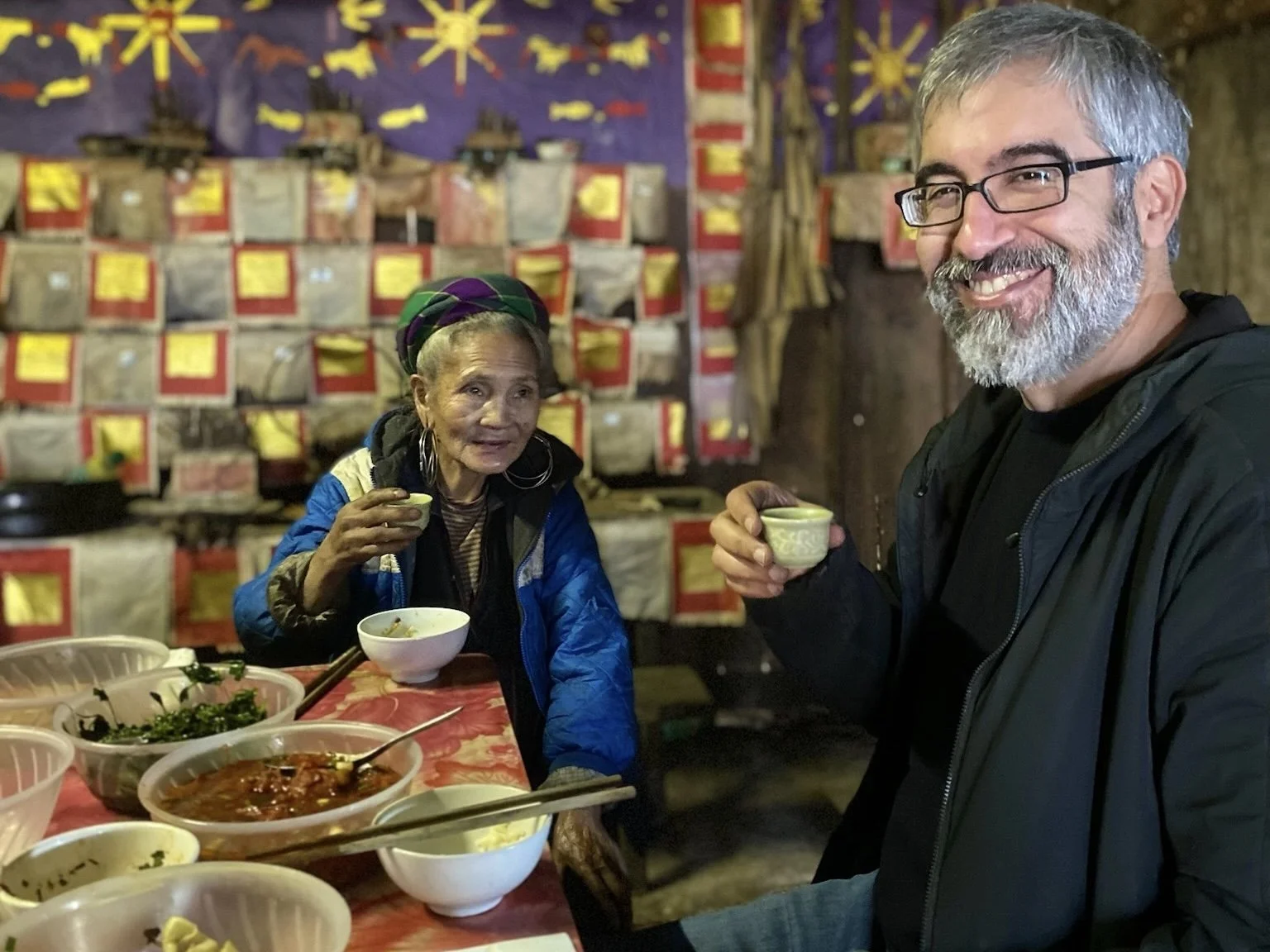
A traveller sharing a meal inside a local family home with a host, highlighting the genuine homestay experience made possible by small groups and strong relationships with village families.
There is another way to experience these mountains. With ETHOS, treks are designed for solo travellers, couples, and families in groups of no more than five. Often it is just you and your guide. This changes everything.
Your guide is a Hmong or Dao woman walking trails she uses in daily life. She is a farmer, a mother, a craftswoman, and a community leader. She watches how you move. She notices when you are comfortable and when you are not. Routes are adjusted as you walk. If the ground is too slippery, the path changes. If you are feeling strong, the trek can be extended along a higher ridge with bigger views. If you want a gentler pace, you can follow quieter valley paths between small hamlets rarely visited by tourists. Trekking difficulty becomes something flexible and personal, not fixed and generic.
Why Small Groups Create Better Experiences for Everyone
Small groups do not just improve the experience for visitors. They transform the experience for guides and host families too. Because routes are not fixed, ETHOS guides can reach many different villages across the region. Lunch is taken in real homes, not roadside restaurants. Overnight stays happen in genuine family houses, not large homestay businesses built for tour groups. This spreads tourism income across a wider network of families. It reduces pressure on the few villages that have become overwhelmed by mass tourism. It allows guides to share their own home villages, their own stories, and their own knowledge of the land.
For travellers, this means meals cooked over open fires, conversations through translation and laughter, and a far deeper understanding of daily life in the mountains.
Choosing the Right Trek for Your Ability
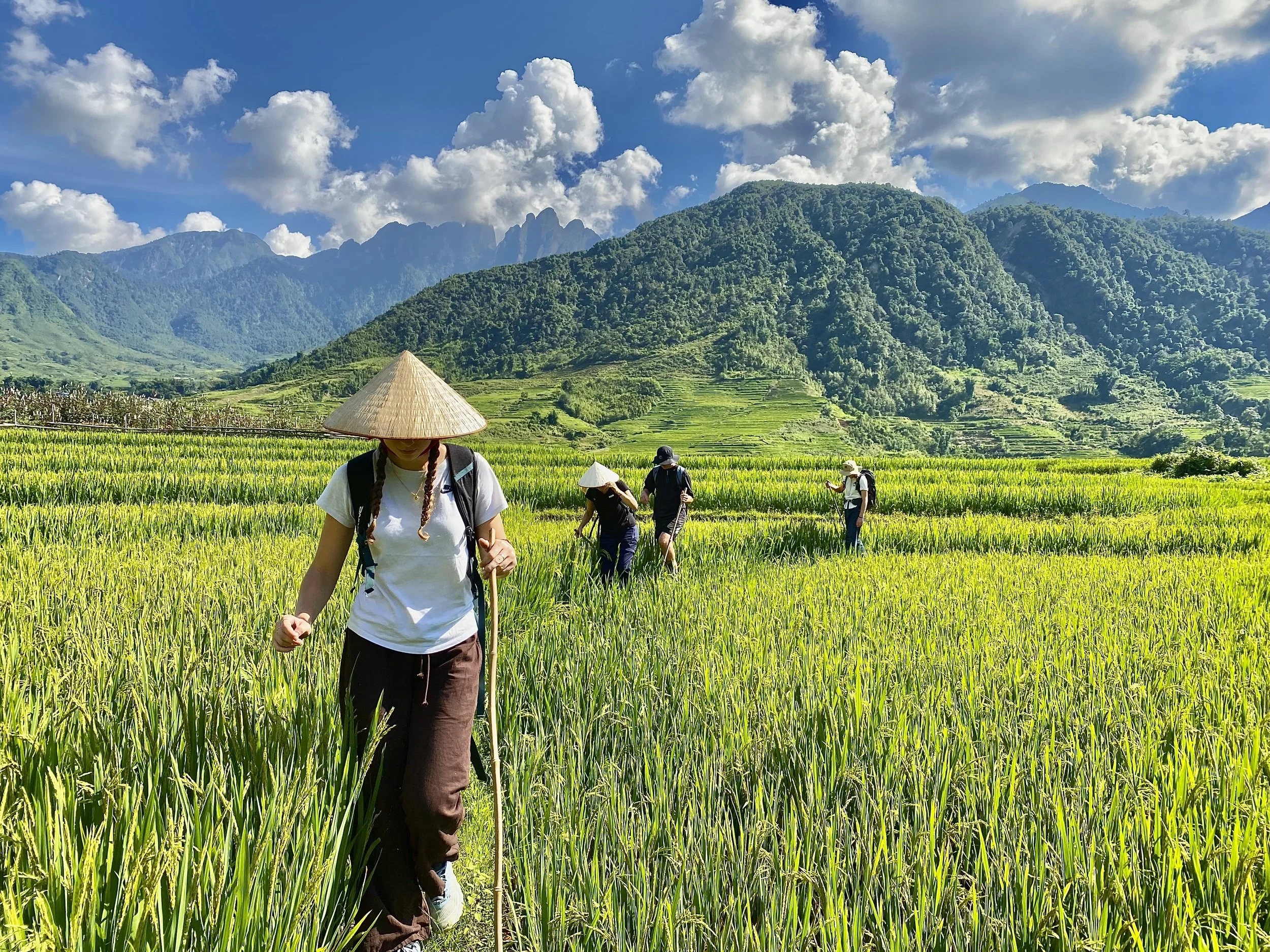
Travellers walking through remote rice fields with an ETHOS guide on a narrow path, showing the quiet, immersive nature of trekking away from main roads and tourist routes.
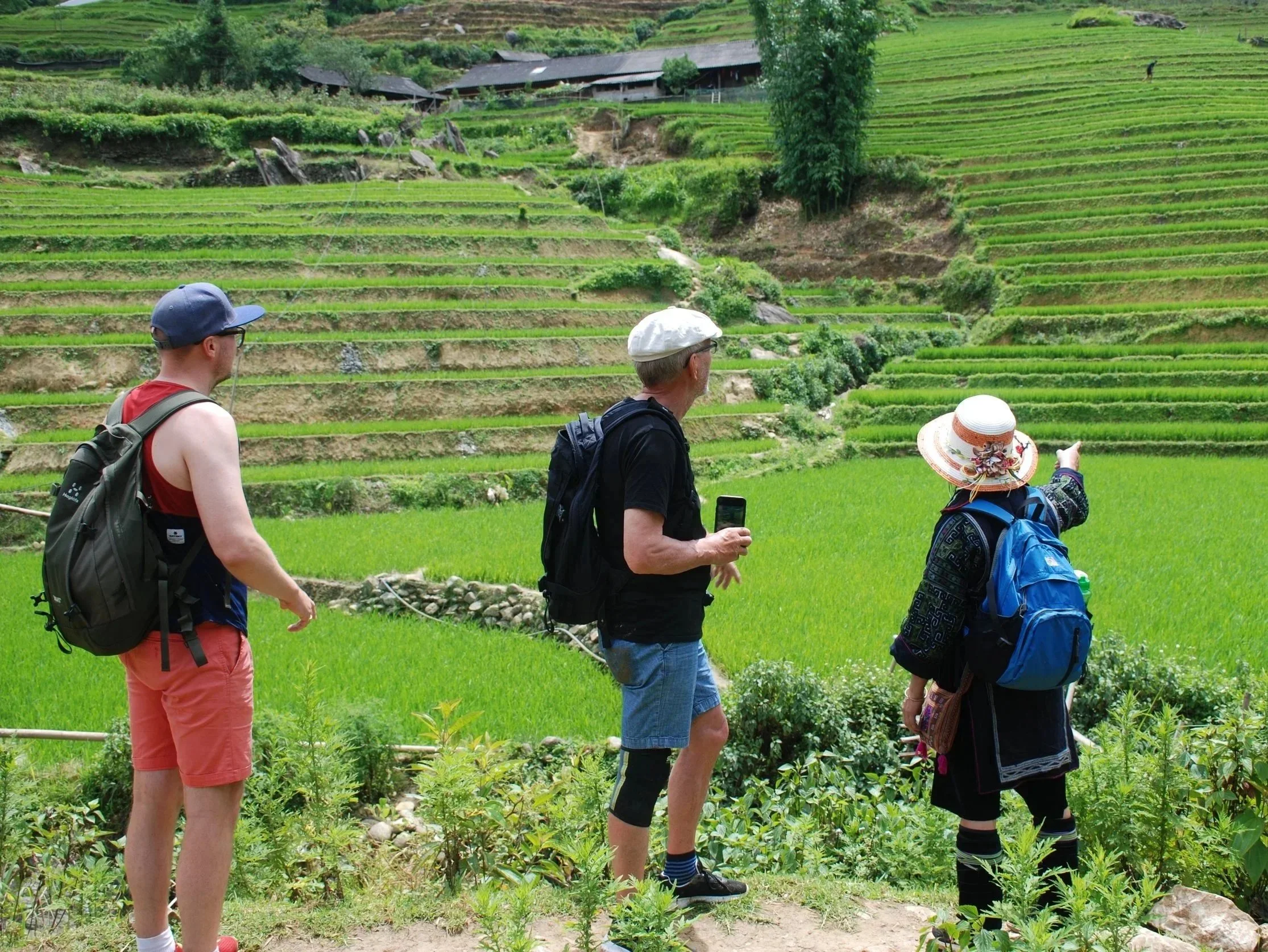
A small group pausing on a hillside as their ETHOS guide explains the landscape below, illustrating how routes and pace are shaped by conversation, observation, and personal ability.
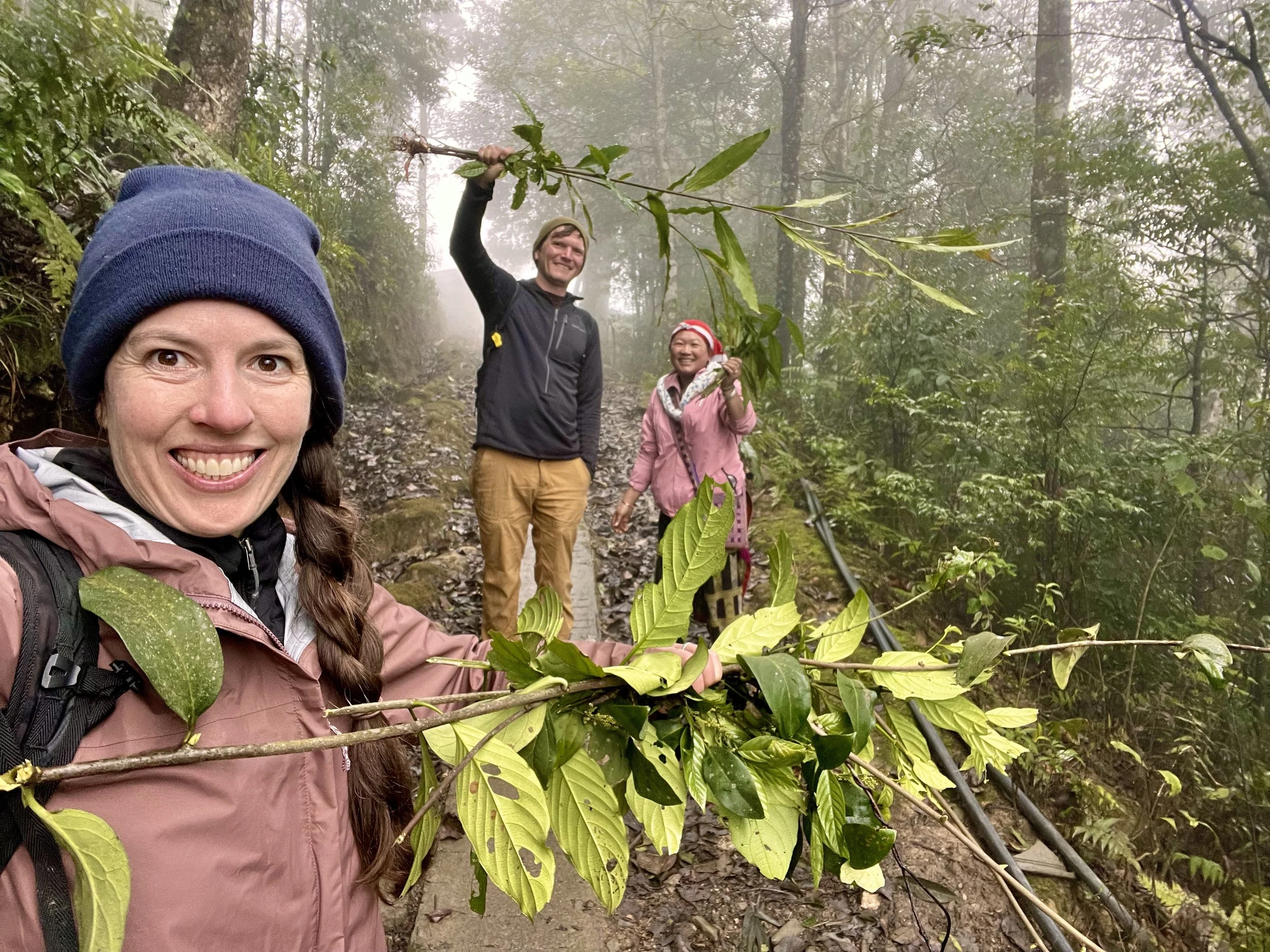
Travellers navigating a dense bamboo forest trail with their guide, highlighting the more adventurous terrain and varied conditions that define moderate to challenging treks in Sapa.
With ETHOS, treks are described as easy, moderate, or moderate to challenging. These are not marketing labels but starting points for a conversation. An easy trek may still include uneven ground and narrow paths, but with less elevation gain and more time in villages. A moderate trek may involve sustained climbs, bamboo forest sections, and paddy wall crossings. A challenging route might include long ascents to high viewpoints and remote hamlets far from roads. The key difference is that you are not locked into one option. You can adapt as you go.
This is what trekking in Sapa should feel like. Responsive. Human. Grounded in the landscape rather than restricted by a timetable.
Trekking That Supports Communities, Not Just Tourism
Every ETHOS trek supports fair wages, skills training, health insurance, and long term opportunities for local women guides. It also supports village clean ups, education projects, and community initiatives that reach far beyond tourism.
When you walk these trails, you are not simply passing through a beautiful landscape. You are participating in a model of travel that values people, culture, and environment equally.
Rethinking What a “Sapa Trek” Should Be
If your idea of trekking in Sapa is following a line of tourists down a concrete path to a busy village café, then the standard routes will suit you. If you want to feel the earth beneath your boots, hear stories beside a cooking fire, and adjust your day based on how the mountain feels under your feet, then a small group, ethical trek offers something entirely different.
Trekking difficulty in Sapa is not about kilometres, but more about how deeply you wish to step into the landscape and the lives of the people who call it home.
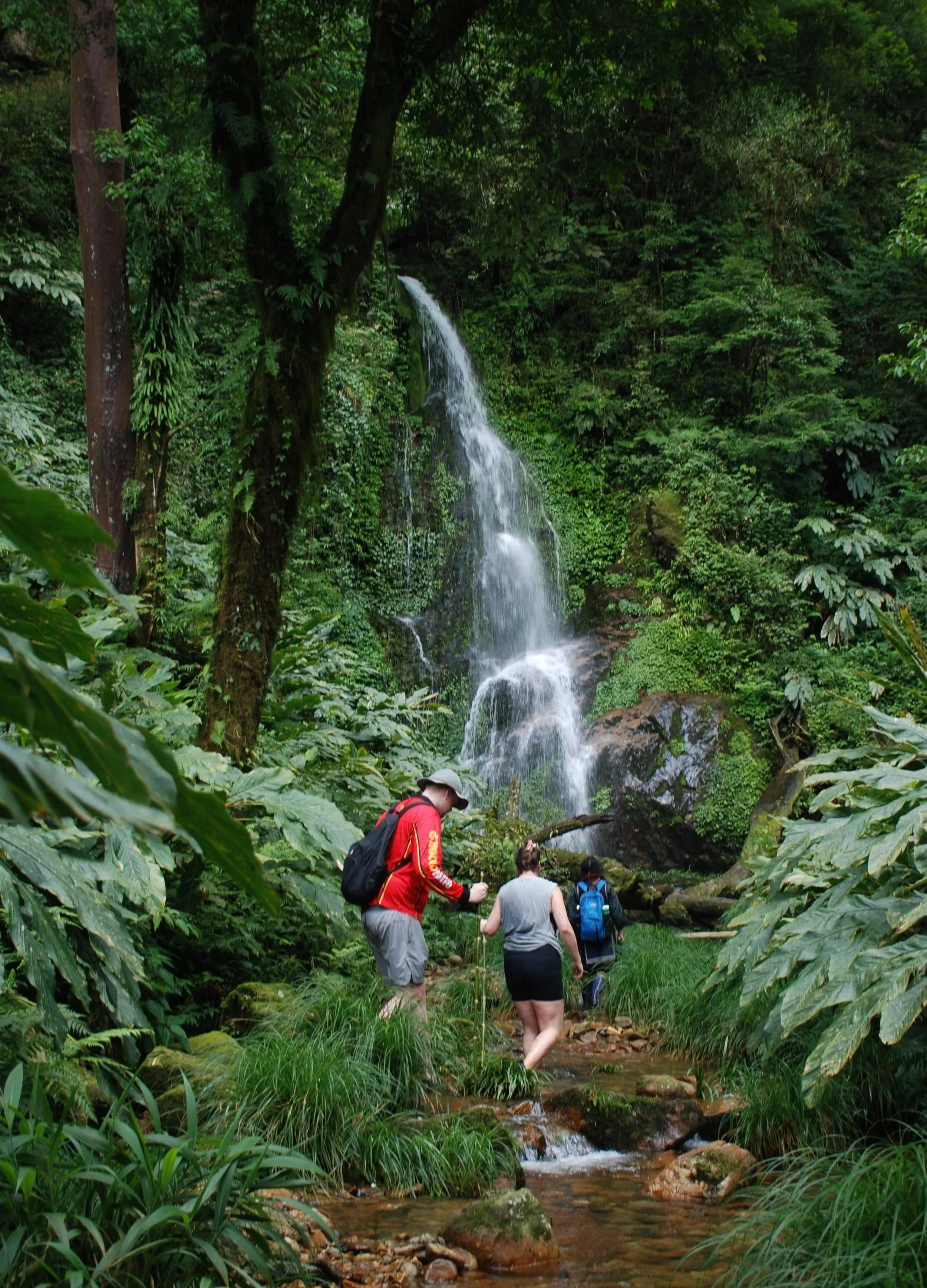
Travellers following their ETHOS guide along a narrow forest trail beside a waterfall, showing the kind of off path terrain and natural surroundings reached on quieter, less travelled routes.
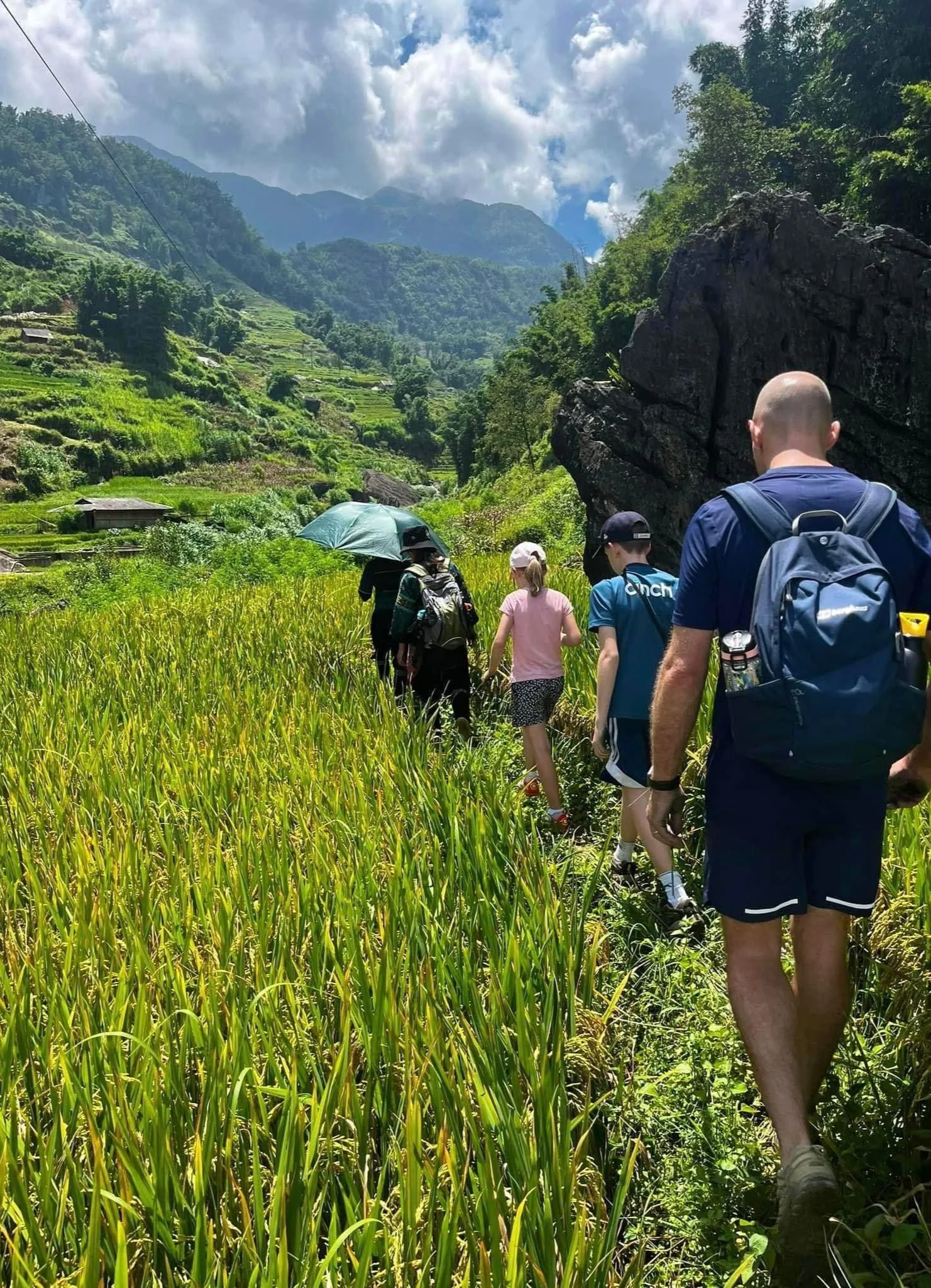
A small group walking single file through tall rice terraces on a narrow earthen ridge, illustrating immersive trekking through working farmland far from roads and tourist traffic.
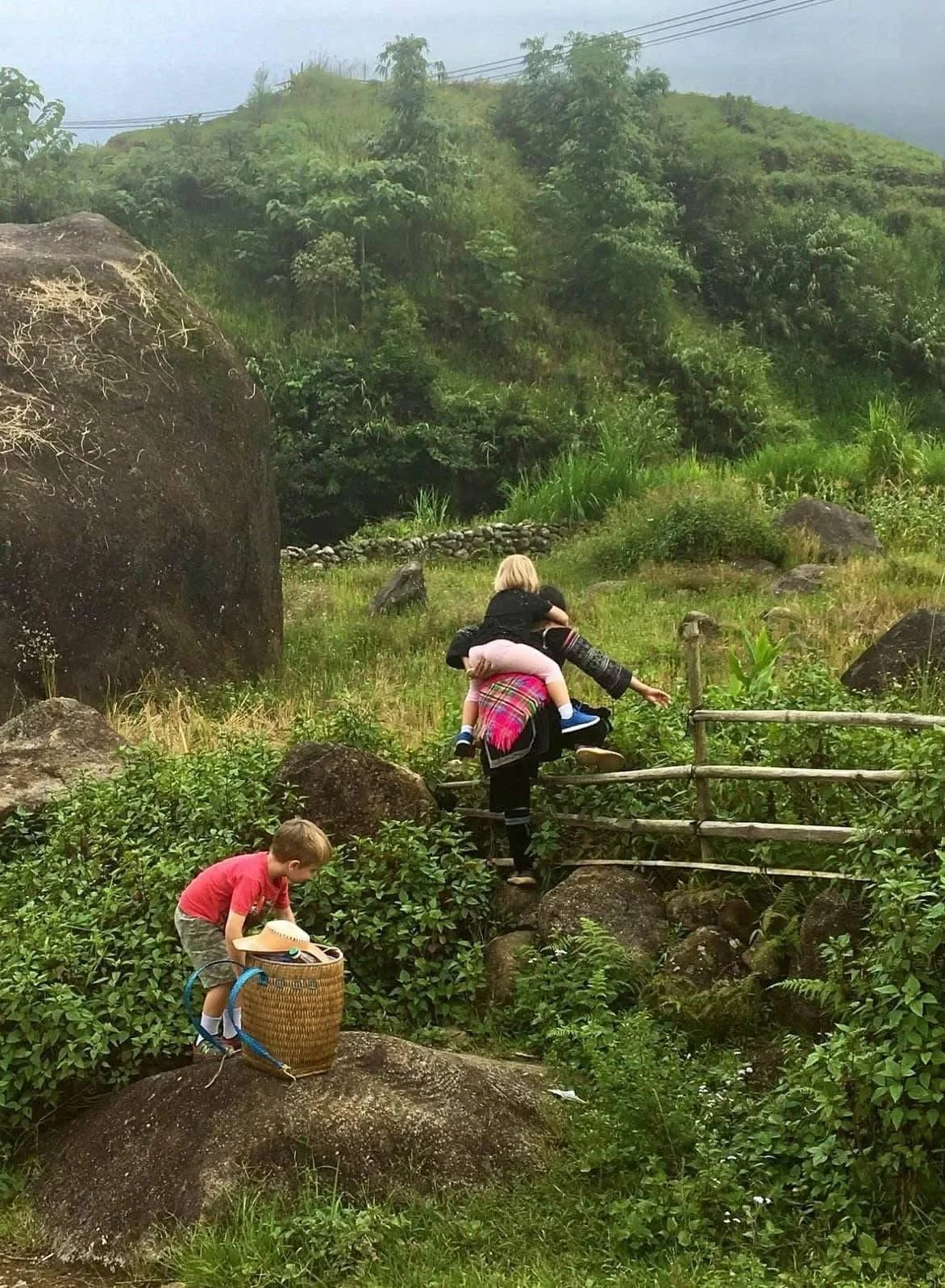
An ETHOS guide leading a family across a simple bamboo fence between terraced fields, highlighting how these routes pass through everyday village life rather than purpose built tourist areas.
Join our ethical trekking tours in Sapa
Stay in authentic Dao and Hmong homestays
Discover Sapa’s culture with our workshops
When Good Intentions Aren’t Enough: Child Sellers in Sapa and Ha Giang
In Sapa and along the Ha Giang Loop, children selling souvenirs or offering treks can be a confronting sight for travellers. While often well-intentioned, buying from children keeps them out of school and at risk. This post explores the deeper realities behind child selling and how ethical, community-led tourism can create safer, more meaningful livelihoods for families in northern Vietnam.
As you wander the streets of Sapa, children may approach you with bright smiles and outstretched hands, offering embroidered bracelets, posing for photographs, or inviting you to trek to their village. In Ha Giang, you might see children waiting patiently at mountain viewpoints, dressed in traditional clothing, ready for a photo in exchange for money.
For many travellers, these encounters feel human and heartfelt. Some feel joy at the connection, others a sense of responsibility to help. But behind these moments lies a far more complex reality, one that deserves careful thought.
At ETHOS, we believe that ethical travel begins with understanding. This post is a request: not to photograph children in exchange for money, not to give gifts or sweets to children, and not to buy tours or products from minors. It is also a call to support adult-led, community-based tourism that genuinely strengthens local livelihoods.
The Reality Behind Child Selling
Children selling souvenirs or offering treks are not simply being “enterprising”. Their presence on the streets is often driven by poverty, limited adult employment, and long-standing marginalisation of ethnic minority communities.
While education in Sapa is free up to grade nine, many street-selling children attend school exhausted after long nights working, or miss classes entirely. Money earned today can easily outweigh the promise of future opportunity, especially when families struggle to buy food, clothing, or winter supplies. The long-term cost, however, is devastating. Without education, children are locked out of stable employment and remain trapped in the very cycle visitors hope to help them escape.
Child selling is also closely tied to exploitation. Many children do not keep the money they earn. A portion often goes to adults or covers the cost of the goods they are selling. For the long hours they work, the benefit to the child is minimal, while the risks are considerable.
The Hidden Dangers Children Face
Children on the streets are vulnerable in ways travellers rarely see. Long evenings without supervision expose them to sexual exploitation and trafficking. Sapa, in particular, has become a known target for predators due to the visible presence of children at night. Girls and young teenagers from border regions are also at risk of being trafficked to China. This is not speculation; it is a documented reality.
Older children, particularly girls aged thirteen to sixteen offering cheap trekking services, are also deeply vulnerable. Many live away from home, separated from family and community support. Trekking with a child may feel kind, but it increases their exposure to danger and is illegal for good reason. There is no shortage of skilled, knowledgeable adult guides who can offer a far safer and richer experience.
Why Buying from Adults Makes a Difference
Supporting adult artisans and guides is not only ethical, it is transformative. Many Hmong and Dao women earn supplementary income through guiding, alongside their roles as farmers and mothers. With only one rice harvest per year, most families cannot grow enough food to sell and must purchase essentials. Income from guiding or handicrafts helps bridge this gap.
Their textiles are not souvenirs made for tourists alone. They are intricate, symbolic works created using traditional dyes, batik techniques, embroidery, and brocade weaving passed down through generations. Buying these items out of genuine interest, rather than guilt, honours the skill and cultural knowledge behind them.
Trekking with licensed local guides offers something equally meaningful. Adult guides bring lived knowledge of the land, history, and spiritual traditions of their communities. Many travellers describe these experiences as deeply personal and life-changing.
Tourism, Responsibility and the Bigger Picture
The Ha Giang Loop offers a clear example of how tourism choices matter. When travellers ride with Vietnamese-owned agencies, guided by non-local staff and staying in Vietnamese-owned accommodation, ethnic minority villages bear the disruption without seeing the benefits. Cameras point inward, but income flows outward.
A more regenerative model supports guides and hosts born into these communities, ensuring tourism contributes to local resilience rather than extraction.
You may notice signs in Sapa discouraging visitors from trekking with Hmong and Dao women. From our perspective, meaningful employment for parents is the only real solution to child selling. Many adults over thirty are illiterate due to historical exclusion from education, which limits access to town-based employment. Yet their willingness to work is evident. Men wait daily for manual labour. Women guide when opportunities arise. Tourism, when done thoughtfully, can meet people where they are.
Choosing Ethical Travel
When you choose not to buy from children, you are not withholding kindness. You are choosing long-term safety, education, and dignity over short-term comfort. When you support adult guides, artists, and hosts, you help create livelihoods that keep families together and children in school.
At ETHOS, we believe travel should be immersive, respectful and regenerative. We invite you to walk with care, listen deeply, and make choices that honour the people who welcome you into their mountains and homes.
Experience This With ETHOS
Join our ethical trekking tours in Sapa
Stay in authentic Hmong homestays
Discover Sapa’s culture with our workshops

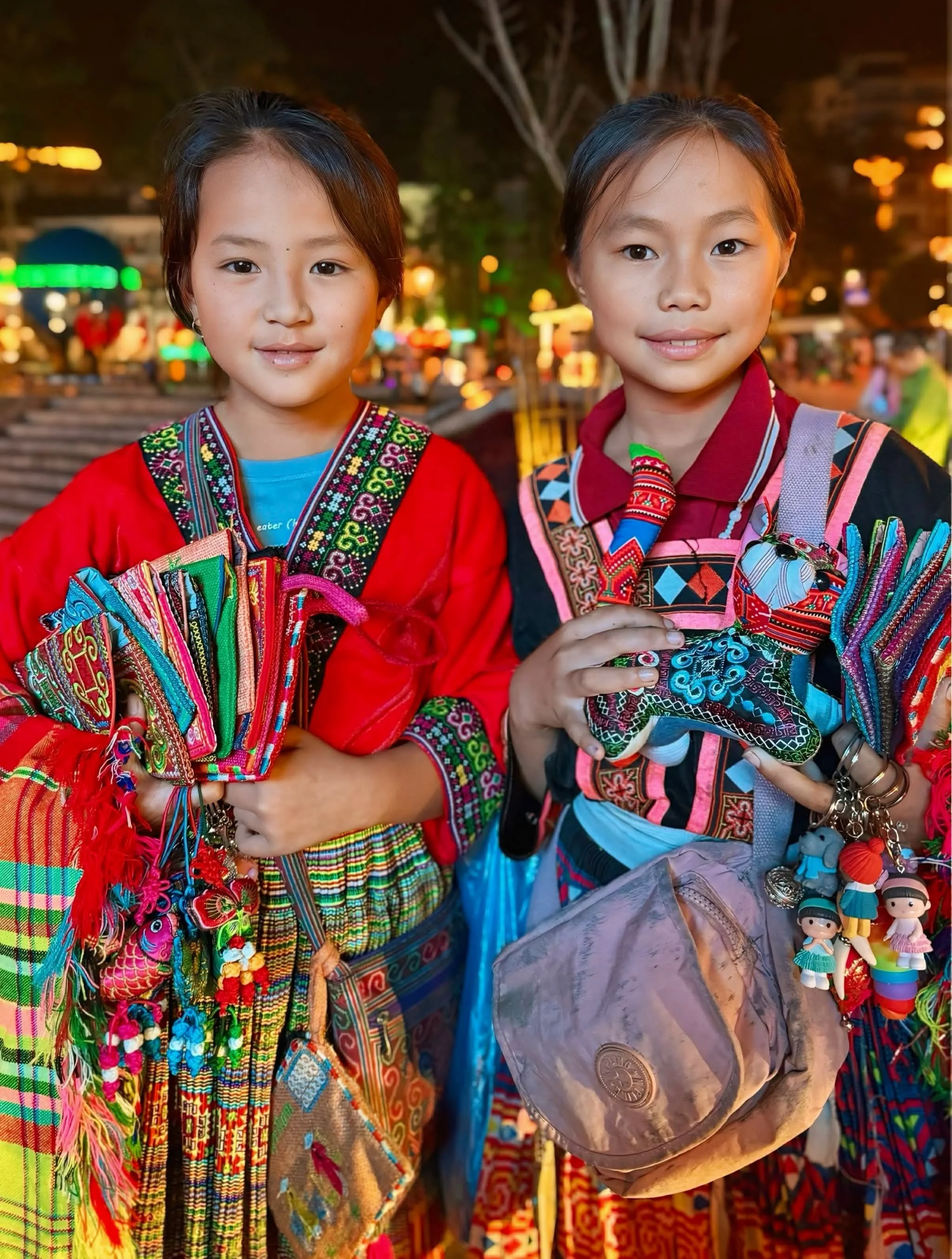
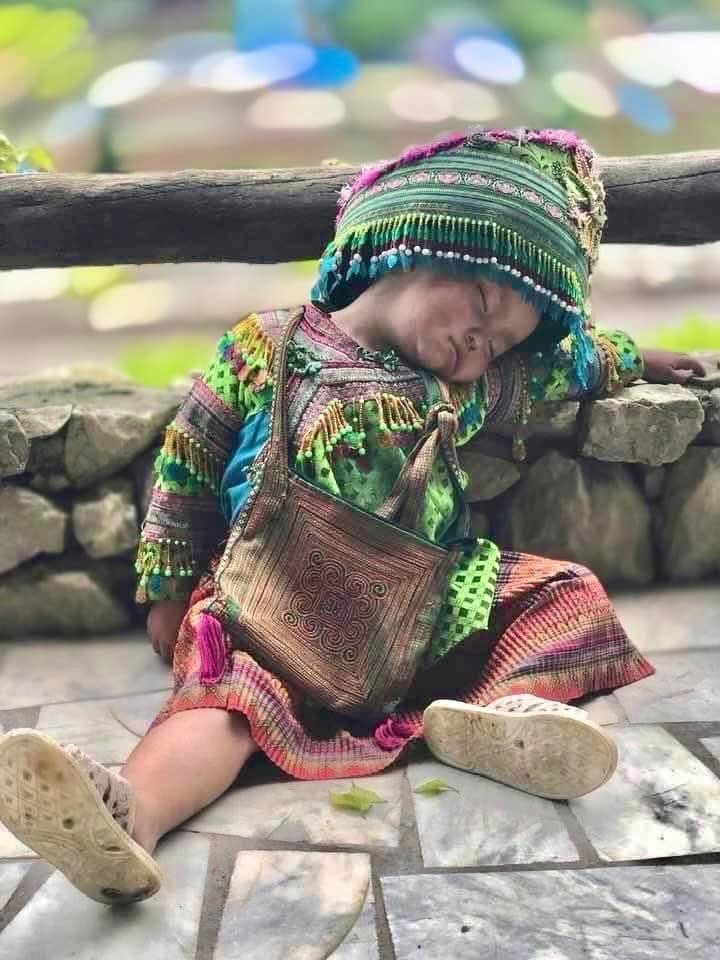
Top 10 Offbeat Things to Do in Sapa (Sustainable Adventures You’ll Never Forget)
Explore the most unique and sustainable things to do in Sapa, from guided foraging treks and artisan workshops to hidden waterfalls and remote village adventures.
Discover Sapa Beyond the Usual Trek
Sapa is world-famous for its misty mountains, terraced rice fields, and vibrant ethnic diversity. Yet beyond the well-trod paths lies a deeper, more soulful side of northern Vietnam — one of community, culture, and connection with nature.
At ETHOS – Spirit of the Community, we believe travel should leave a positive footprint. Every experience we offer is designed around cultural integrity, environmental care, and genuine human connection.
Here are our Top 10 Offbeat Things to Do in Sapa — experiences that bring you closer to the people, stories, and landscapes that make this place extraordinary.
1. Camp & Forage with a Hmong Guide
Sustainable trekking Sapa
Venture into the mountains with a local Hmong guide and learn to identify wild herbs, edible plants, and forest fungi. Spend a night under the stars, cook over a campfire, and listen to traditional stories about the land.
👉 Join the Foraging & Camping Trek
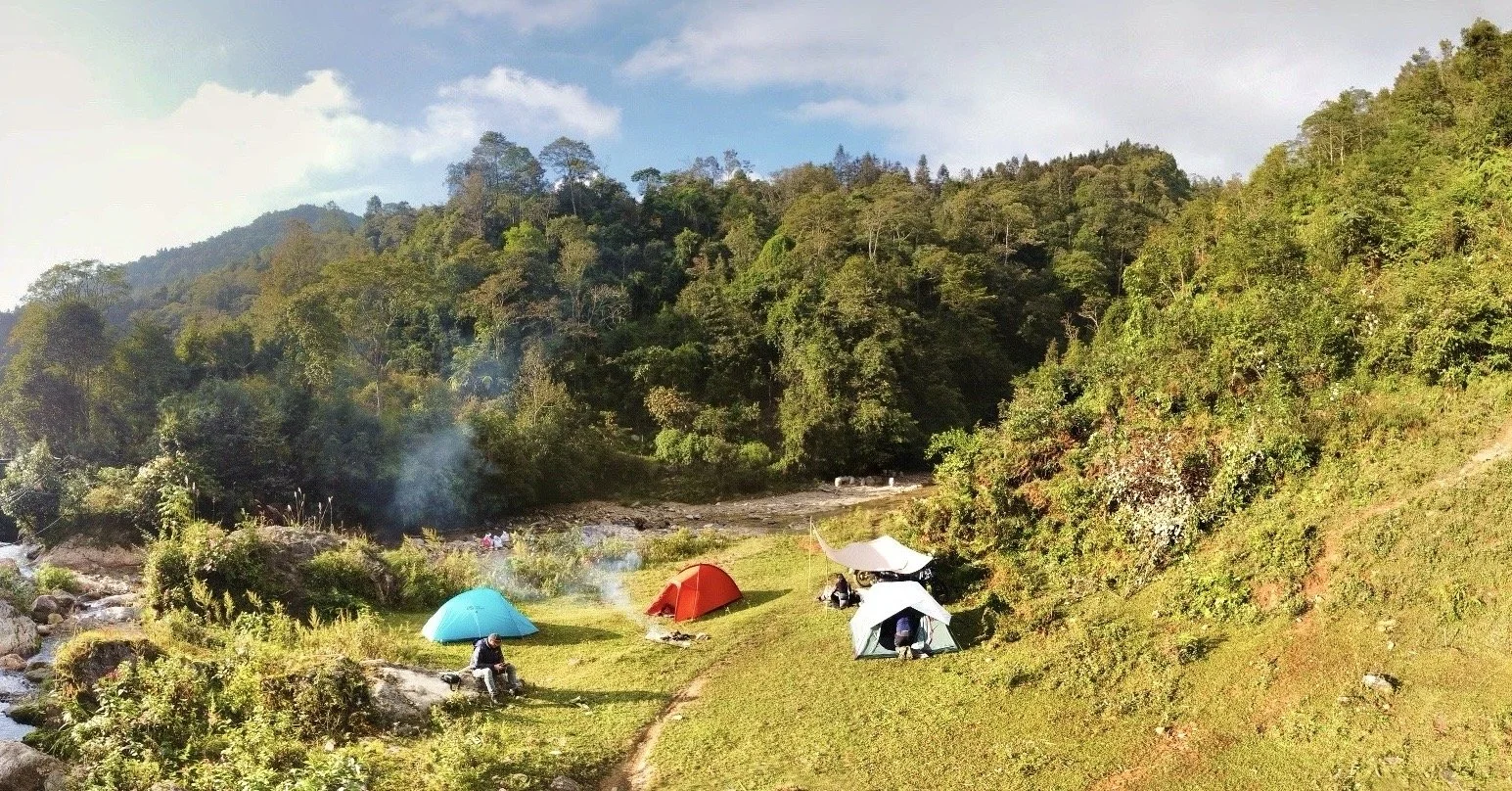
2. Stay with a Dao Family in a Mountain Homestay
Best homestays Sapa
Immerse yourself in Dao culture during a family homestay surrounded by rice terraces. Learn about herbal medicine, help prepare meals, and enjoy mountain tea by the fire. This experience supports rural women and preserves traditional wisdom.
👉 Book an Ethical Homestay Experience
3. Canyoning in Hoàng Liên Sơn National Park
For adrenaline lovers, descend waterfalls and navigate natural pools in Vietnam’s most spectacular mountain range. Led by trained local guides, this eco-adventure combines safety, sustainability, and excitement.
👉 Explore Canyoning Adventures
4. Take a Motorbike Loop to Tay Villages
Ride west through lush valleys and bamboo forests to visit Tay communities. Stop for lunch in a local home and learn about their stilt-house architecture and weaving traditions. This scenic route showcases rural life beyond Sapa town.
👉 Discover Sapa by Motorbike

5. Trek to Hidden Waterfalls on the Woodland Way
ETHOS’s signature Woodland Way Trek takes you deep into ancient forests, past quiet farms and secret waterfalls untouched by mass tourism. Ideal for photographers and nature enthusiasts.
👉 Trek the Woodland Way
6. Learn Batik in a Hmong Artisan Workshop
Cultural workshops Sapa
Join a Hmong artisan to learn the ancient craft of indigo batik. Create your own hand-dyed cloth using beeswax and natural pigments. Each workshop supports local women artisans.
👉 Book a Batik Workshop

7. Summit the Magnificent Ngu Chi Son Mountain
Known as the “Five Fingers of the Sky,” Ngu Chi Son offers one of Vietnam’s most rewarding climbs. ETHOS guides lead small, responsible expeditions to the summit — balancing adventure with ecological respect.
👉 Climb Ngu Chi Son
8. Visit Sapa’s Hidden Lakes
Beyond the famous Love Waterfall lies a network of serene mountain lakes where locals fish and gather medicinal plants. ETHOS guides will take you to quiet, reflective spots rarely visited by outsiders.
👉 Discover Sapa’s Secret Lakes
9. Wander Through Ancient Forests on our Twin Waterfalls Walk
Experience Sapa’s biodiversity on guided walks through The Hoang Lien Son National Park forests. Learn about indigenous plant use, local conservation efforts, and reforestation projects ETHOS supports.
👉 Join a Forest Trek
10. Explore Tea Plantations & Wild Himalayan Cherry Fields
Ride or walk through Sapa’s highland tea gardens and wild cherry groves. Visit family-run farms producing organic tea, and sip with a view over cloud-wrapped valleys.
👉 Visit the Tea Trails of Sapa
Travel with Purpose
Every ETHOS adventure supports community empowerment, environmental protection, and cultural preservation. By travelling with ETHOS, you directly help local families and contribute to a more sustainable future for Sapa.
Ready to explore responsibly?
👉 View All ETHOS Experiences
Why We Built ETHOS in Sapa: For Community, Culture and Connection
Learn why ETHOS was created in Sapa and how community based tourism supports local guides, families and cultures through fair work, shared stories and meaningful connection.
1. Understanding the Context
When you travel into the highlands around Sapa, you enter a world of steep valleys, rice-terraced slopes, hillside farmers, and the daily rhythms of ethnic minority communities such as the Hmong and Dao. Yet alongside that beauty lie complex realities. Many of the communities here have long been marginalised socially, economically and culturally.
During his early work here, the company’s founding partner, Phil Hoolihan, describes meeting young Hmong girls who, barefoot and curious, appeared at a camp in the mountains asking to practise English. Their hunger for more than the limited opportunities they saw planted the seed of what ETHOS would eventually become.
In that moment, one realisation took hold: tourism need not be a one-way street. Instead of simply entering a landscape, we could enter a conversation. Instead of only visiting homes, we could build relationships. Instead of extracting experiences, we could help sustain livelihoods, heritage and hope.
2. What Led Us to Act
Phil, together with his partner Hoa Thanh Mai, recognised that many conventional tourist operations in the region follow predictable routes and visitor numbers, yet seldom invest in the people, language, culture or environment of the area.
In their reflections, they asked: could we create something different? A venture that is locally rooted, values-led, and community-first, not just profitable? As Phil writes: “We didn’t want to build another tour company or a feel-good charity. We wanted to create something rooted, regenerative and real.”
By 2012, the decision was made. They moved back to Sapa, started small, with only a few guides, two basic trek options, one laptop and a shared desk. That humble beginning marked the birth of ETHOS: Spirit of the Community.
3. Our Mission and Model
From the outset, our guiding principle has been that travel can uplift, connect and sustain. We believe that every journey should be more than a photograph. It should be relationship-building, culture-sharing, and landscape-respecting.
We operate with four interlinked priorities:
Fair employment and empowerment of guides: Our guides are local women and men from the villages, and they lead the experiences. Their intimate knowledge, language and heritage bring authenticity.
Support for local families, craftswomen and farmers: Whether it is staying overnight in a village homestay, sharing a home-cooked meal, or taking a textile workshop with a skilled artisan, the idea is to work with rather than on the community.
Reinvestment into community development: A portion of every booking supports education for ethnic minority youth, health and hygiene programmes, conservation work and our community centre in Sapa.
Slow, respectful, off-the-beaten-track travel: We do not offer large group tours or queue at the viewpoints. Instead, we walk through rice terraces, stay in farmhouses, join in batik or embroidery workshops, and ride quiet roads by motorbike. It is about time, immersion and connection.
4. How the People Tell the Story
To understand why ETHOS exists, it helps to hear from those whose lives are intertwined with its creation.
Phil Hoolihan recalls the camp by the ridgeline where Hmong girls sat listening, learning English and dreaming. That moment triggered the question: what if tourism could lift culture rather than erode it?
Hoa Thanh Mai grew up in an agricultural town near Hanoi, the daughter of a ceramics-factory worker and a mother involved in textile trading. She studied tourism because she believed travel could be a tool of connection, not merely business.
Ly Thi Cha, a Hmong youth leader and videographer with ETHOS, embodies the spirit of bridge-building: interpreter, guide, cultural storyteller. Her presence shows the model in practice: local leadership, local voice, local vision.
Through their journeys, you can see how ETHOS is not an addition to community life but an extension of it. The guides are voices, the homes are real, the musk of smoke from the hearth, the murmur of family conversations, the weight of a needle in the hand of a craftswoman.
5. Why It Matters
You might ask: why is this so important? Because, when done thoughtfully, community-based tourism can be transformational.
It shifts power: from a few tour operators deciding where to lead visitors, to communities co-creating what they show and how they show it.
It safeguards culture: traditional crafts, stories and landscapes become living and evolving, not museum pieces or commodified clichés.
It generates dignity: when local guides share their own lives, and when income goes directly to extended families, the ripple effect strengthens livelihoods.
It deepens travel: for you, the traveller, this is not about ticking boxes; it is about altering perspective, slowing down, listening and noticing. “The most memorable journeys are not always the most comfortable or convenient,” as our website puts it.
It anchors sustainability: by linking tourism to education, healthcare and the environment, travel becomes support rather than strain.
6. How You Can Walk With Us
If you decide to join our journey, here is what you will experience:
Trekking through hidden ridges, paddies and hamlets with a local guide who has grown up here.
Homestays in village homes: food cooked over the fire, slow evenings, stories shared in the morning mist.
Textile or herb-foraging workshops led by craftswomen and keepers of herbal knowledge, not by outsiders.
Motorbike loops that avoid tourist hotspots and instead meander through remote valleys, tea plantations and lesser-seen paths.
A guiding ethos: come with curiosity, leave with muddy boots, full hearts, and friendships that linger.
7. In Summary
We built ETHOS in Sapa because the mountains here hold scenery, culture, craft, community and heritage that deserve partnership, not performance. We chose to centre women guides, local artisans, storytellers and farmers. We chose small groups, slow rhythms and mindful travel. We chose to measure success not just in tours sold but in lives enriched, traditions honoured and landscapes respected.
If you travel with ETHOS, you are choosing more than a route through rice terraces. You are choosing a journey that shifts the focus of tourism from convenience to connection, of visitor from spectator to participant, of region from “destination to consume” to “community to share with”.
Welcome. We are glad you are here, and we look forward to walking the path together.
Experience This With ETHOS
Join our ethical trekking tours in Sapa
Stay in authentic Hmong homestays
Discover Sapa’s culture with our workshops
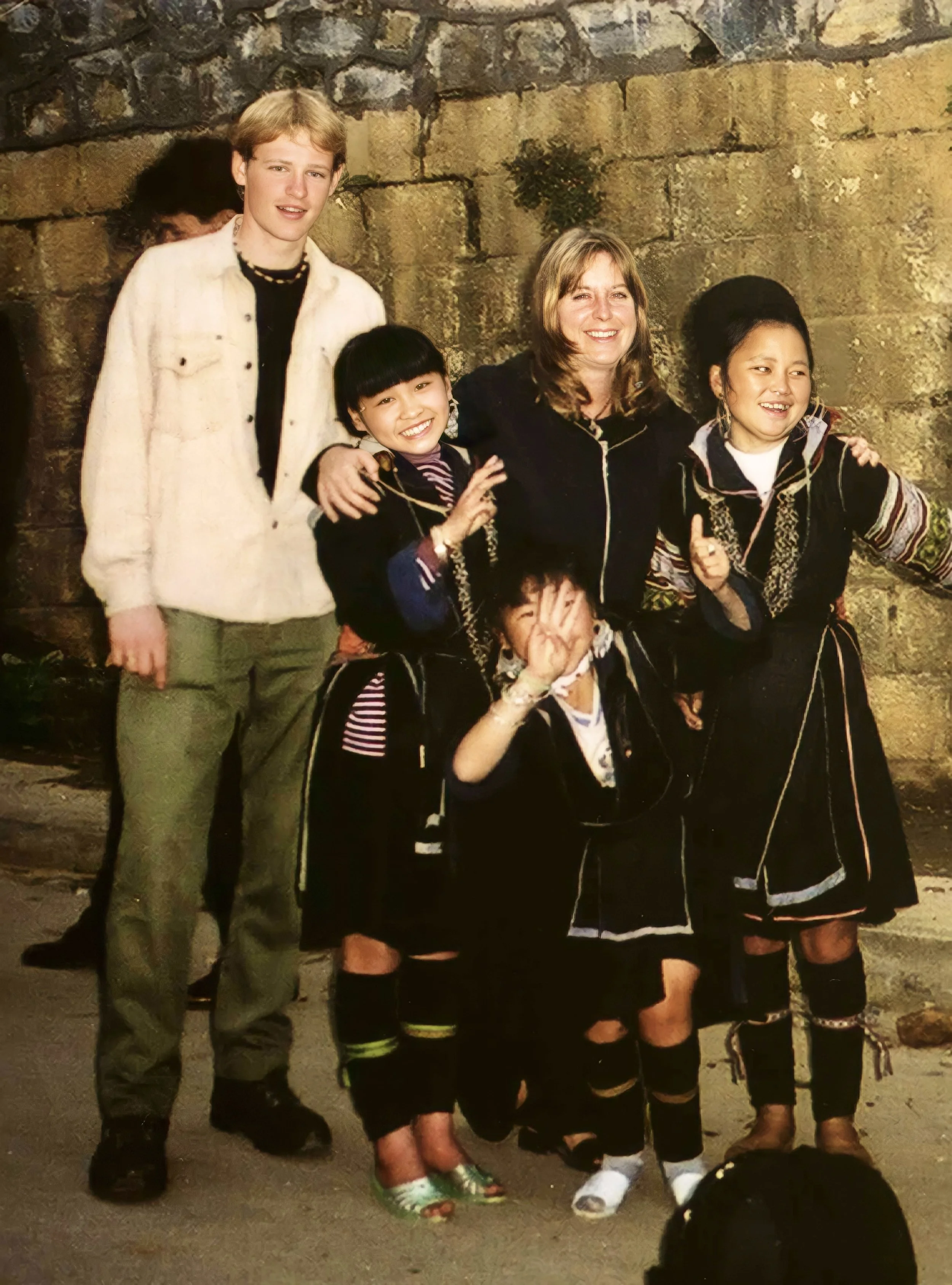
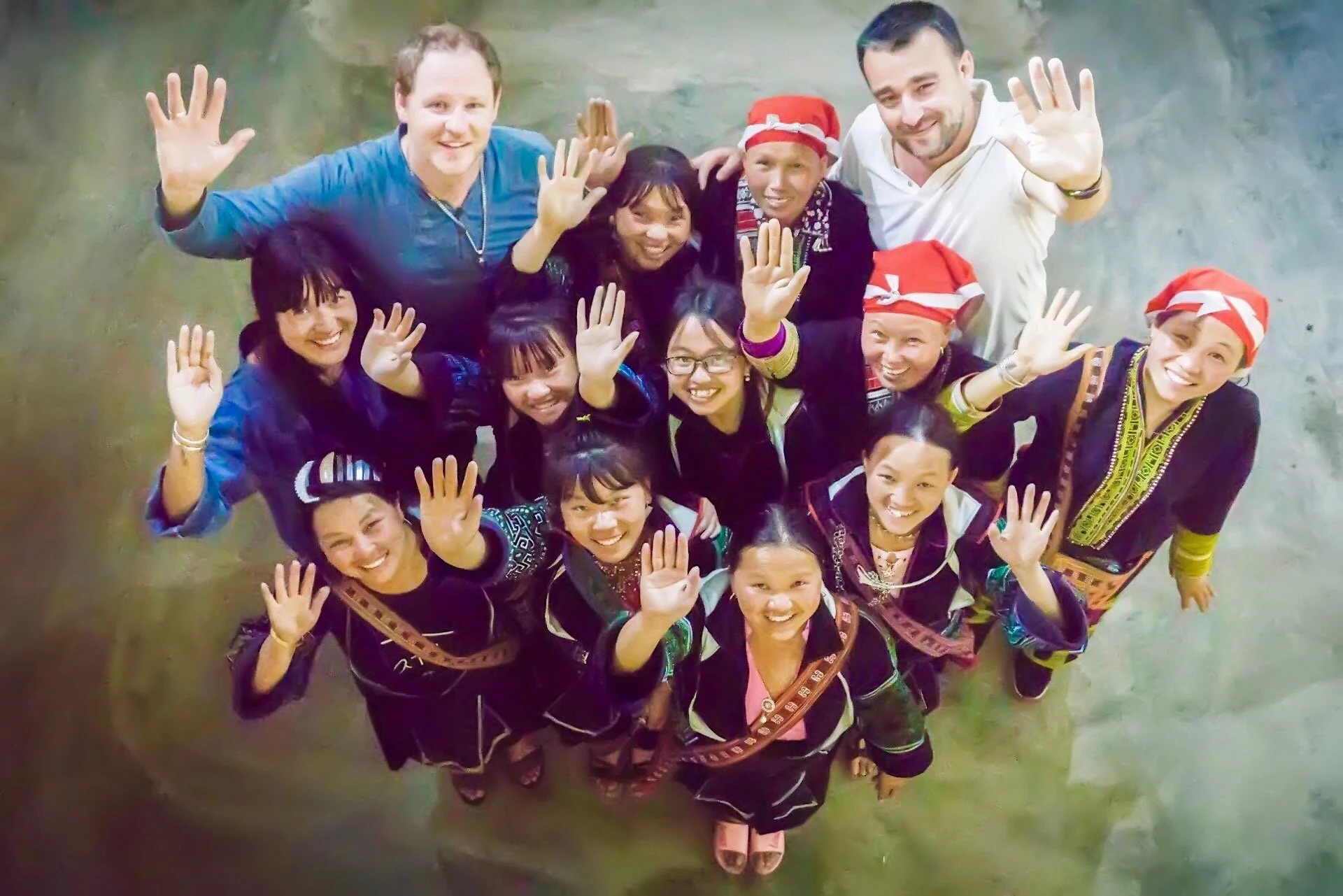
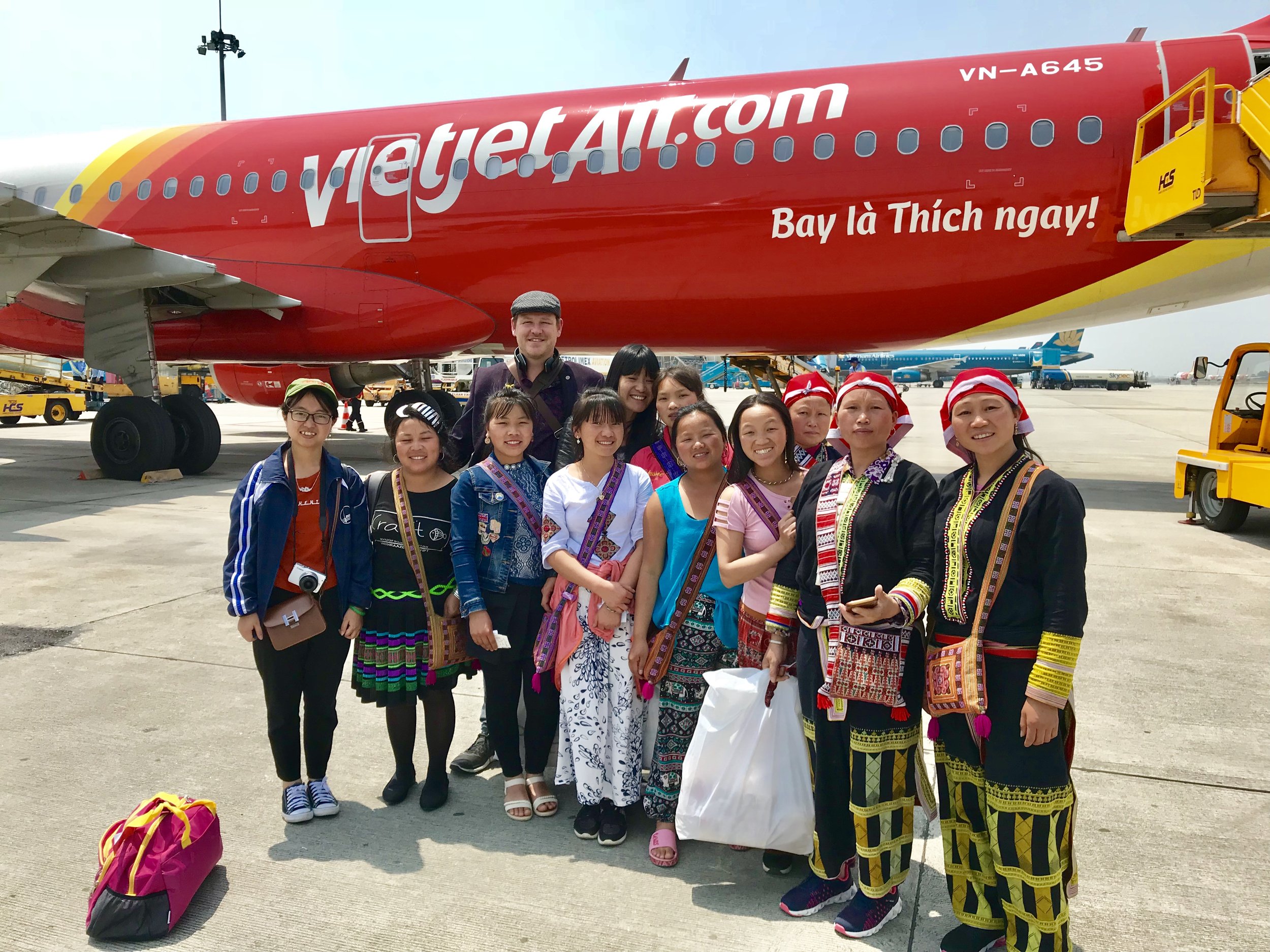
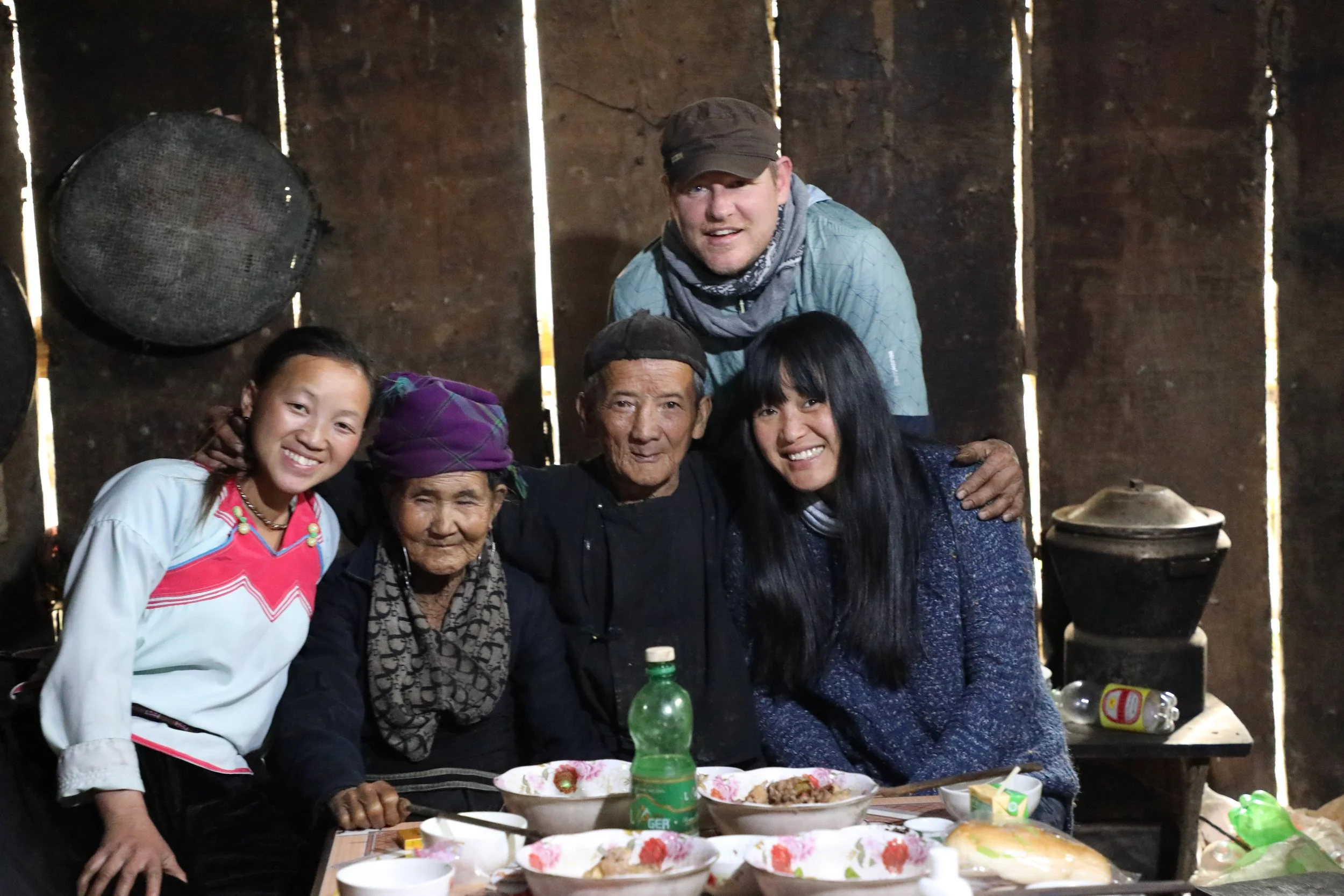
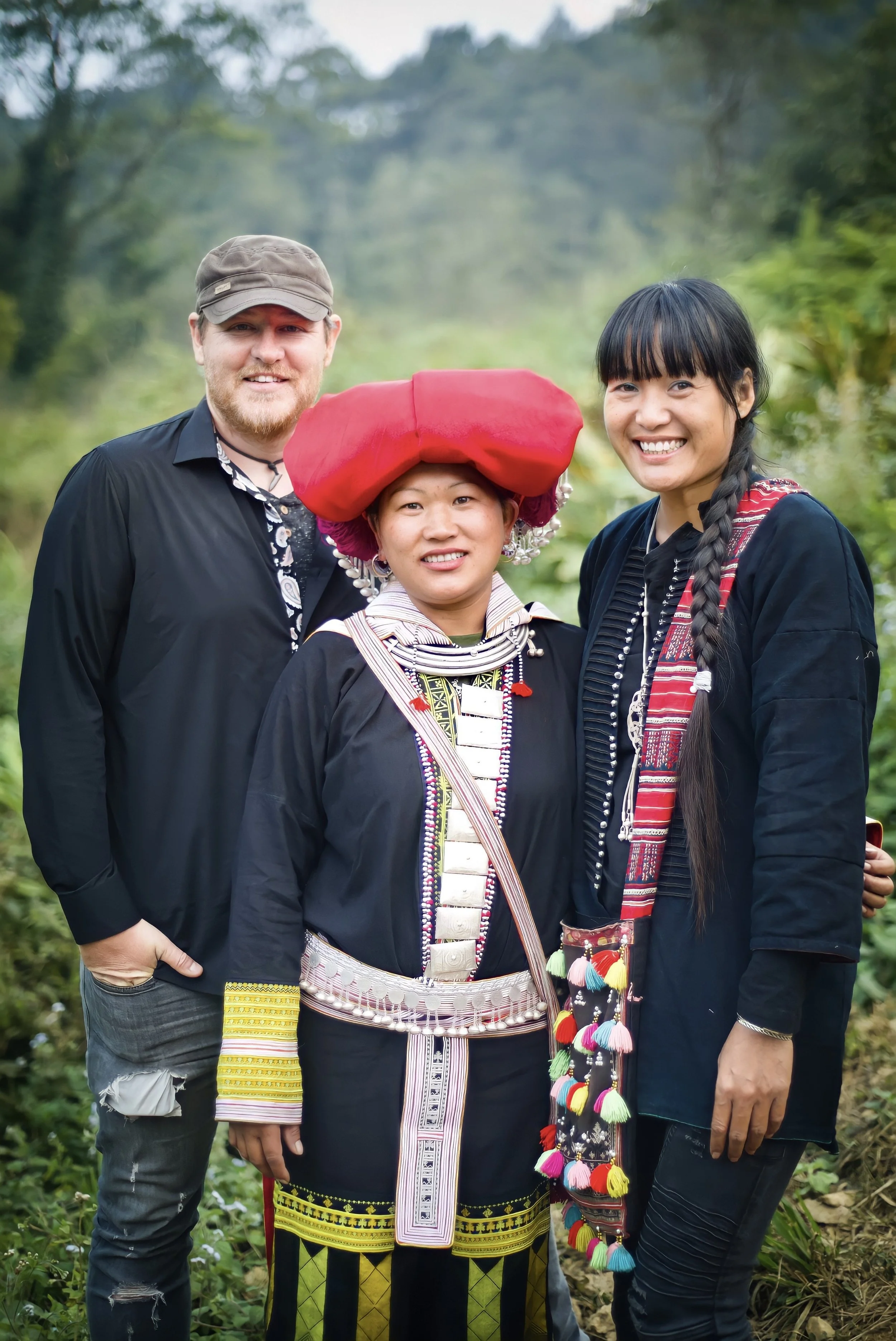
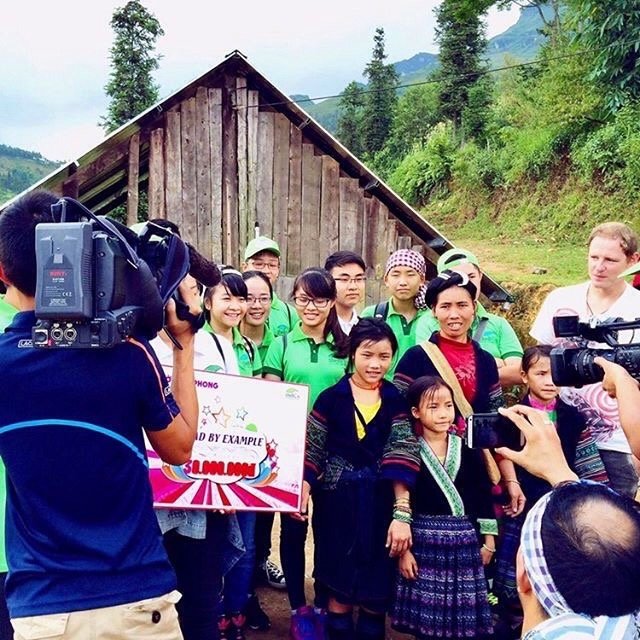
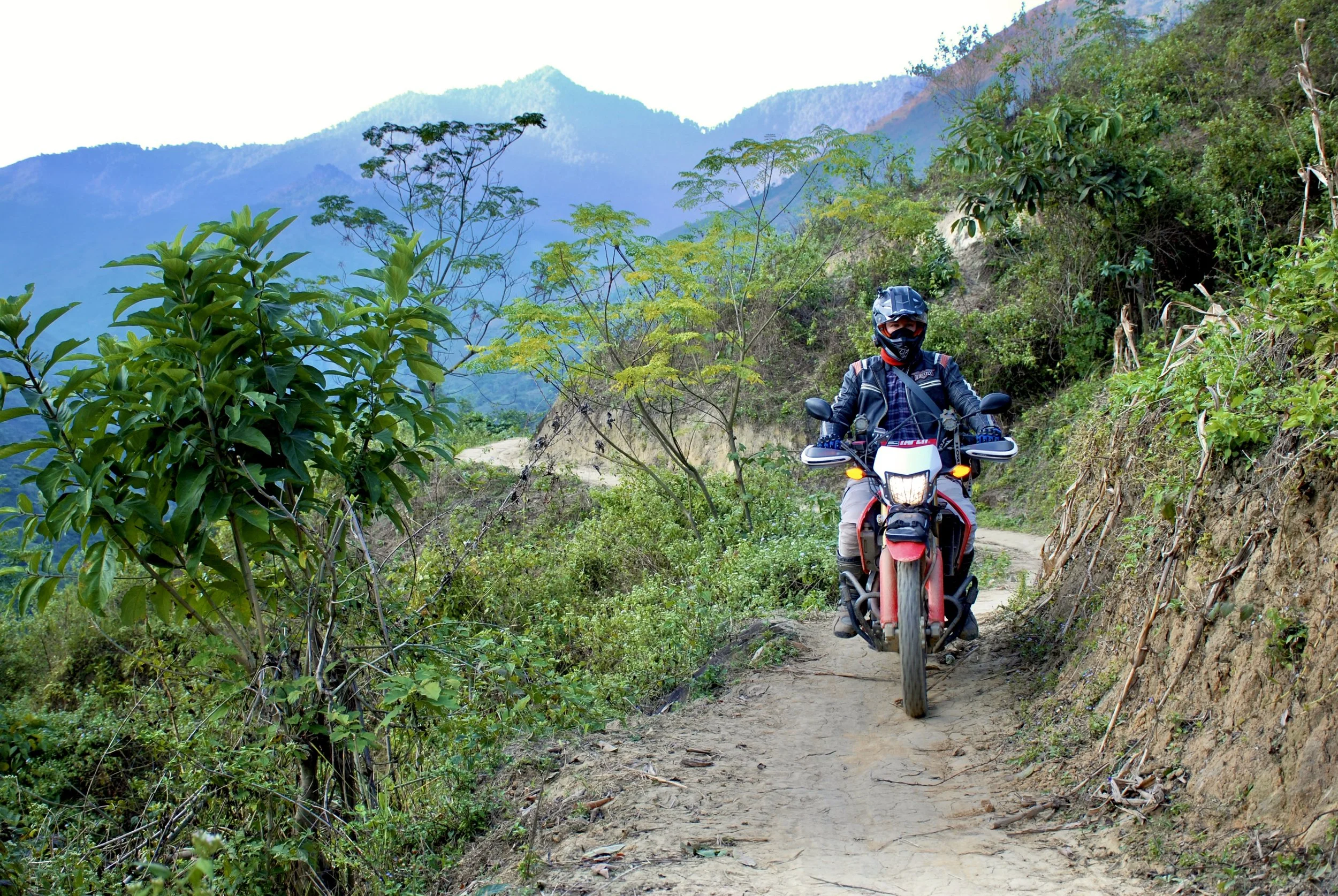
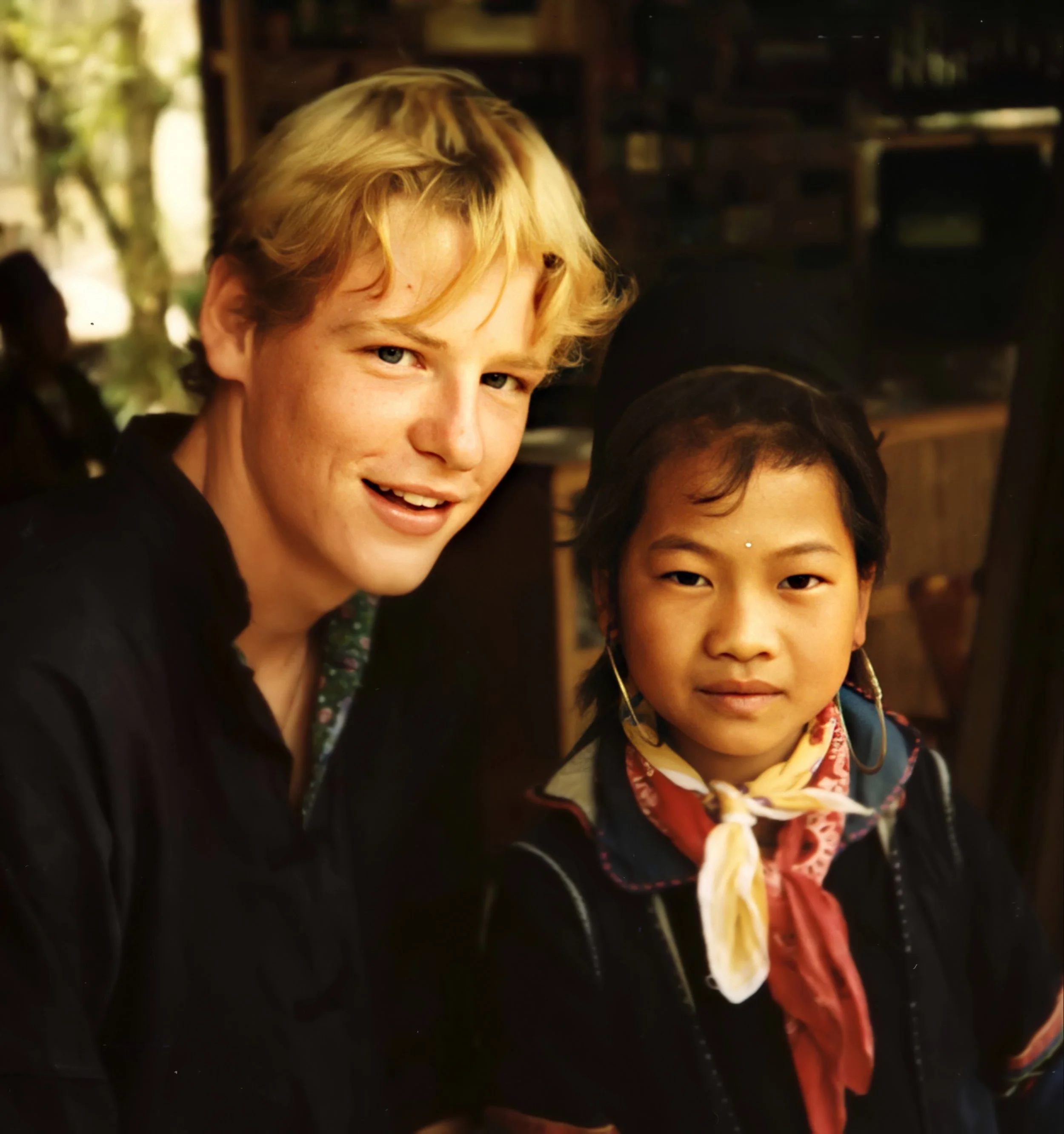
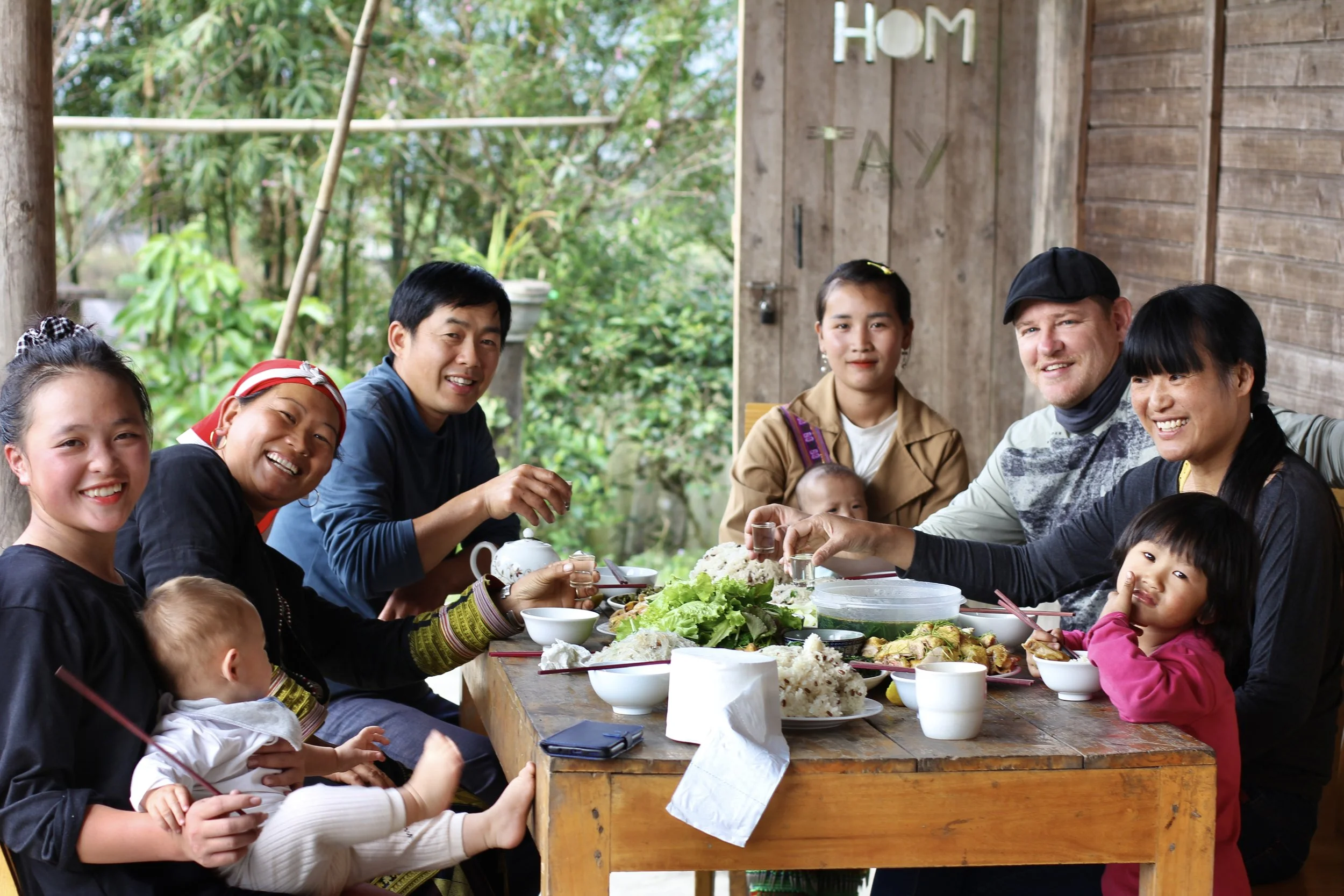
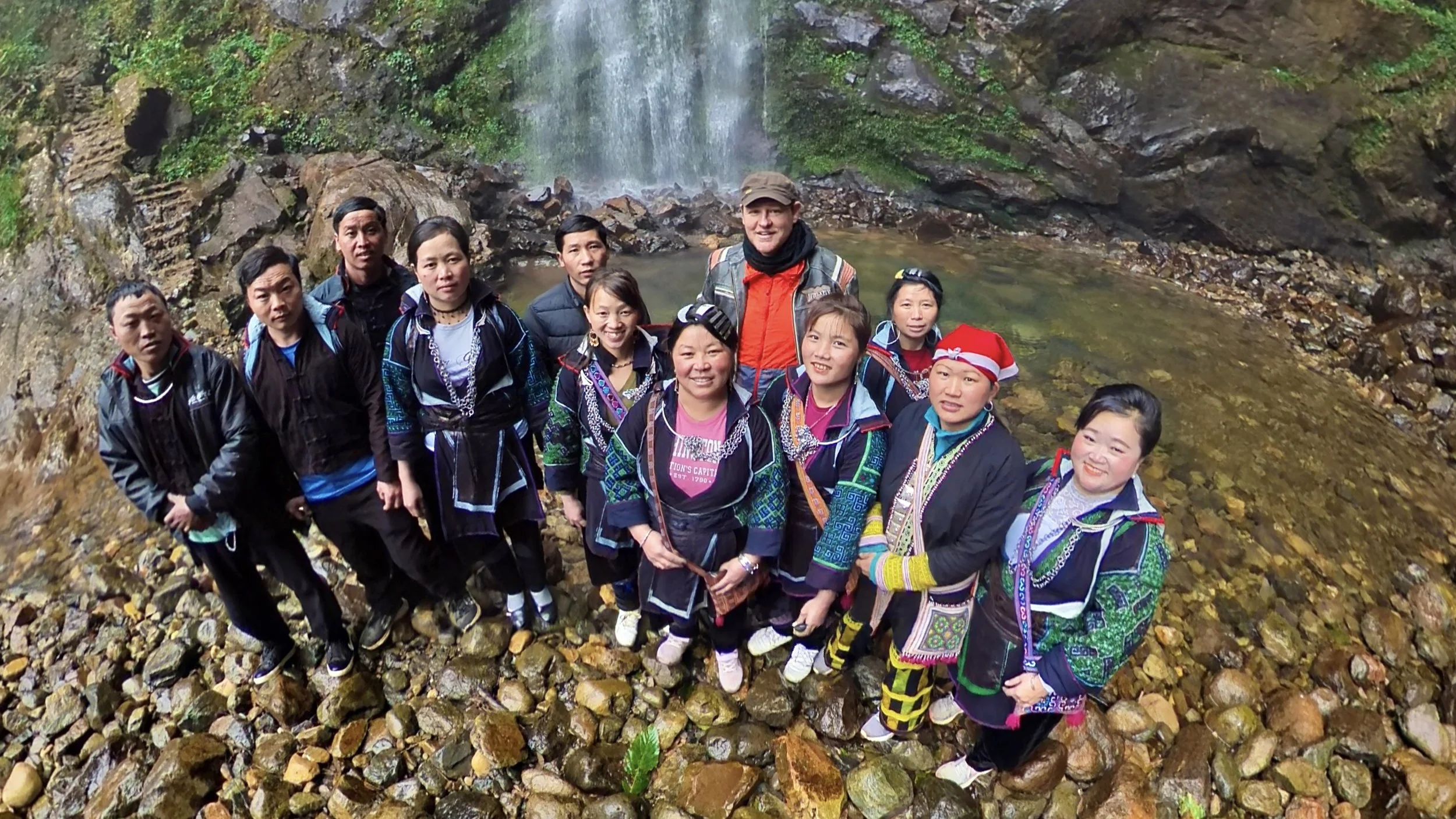
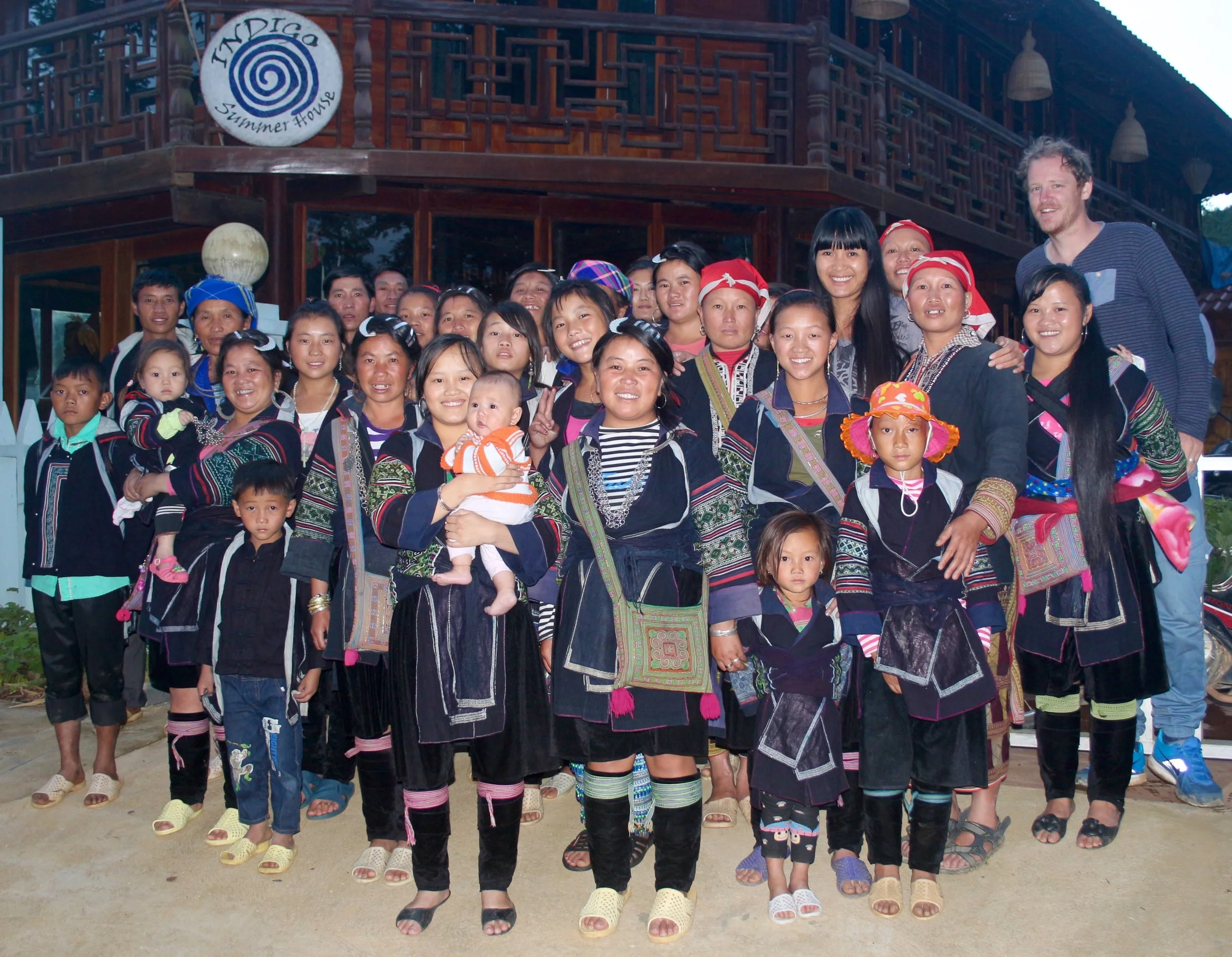
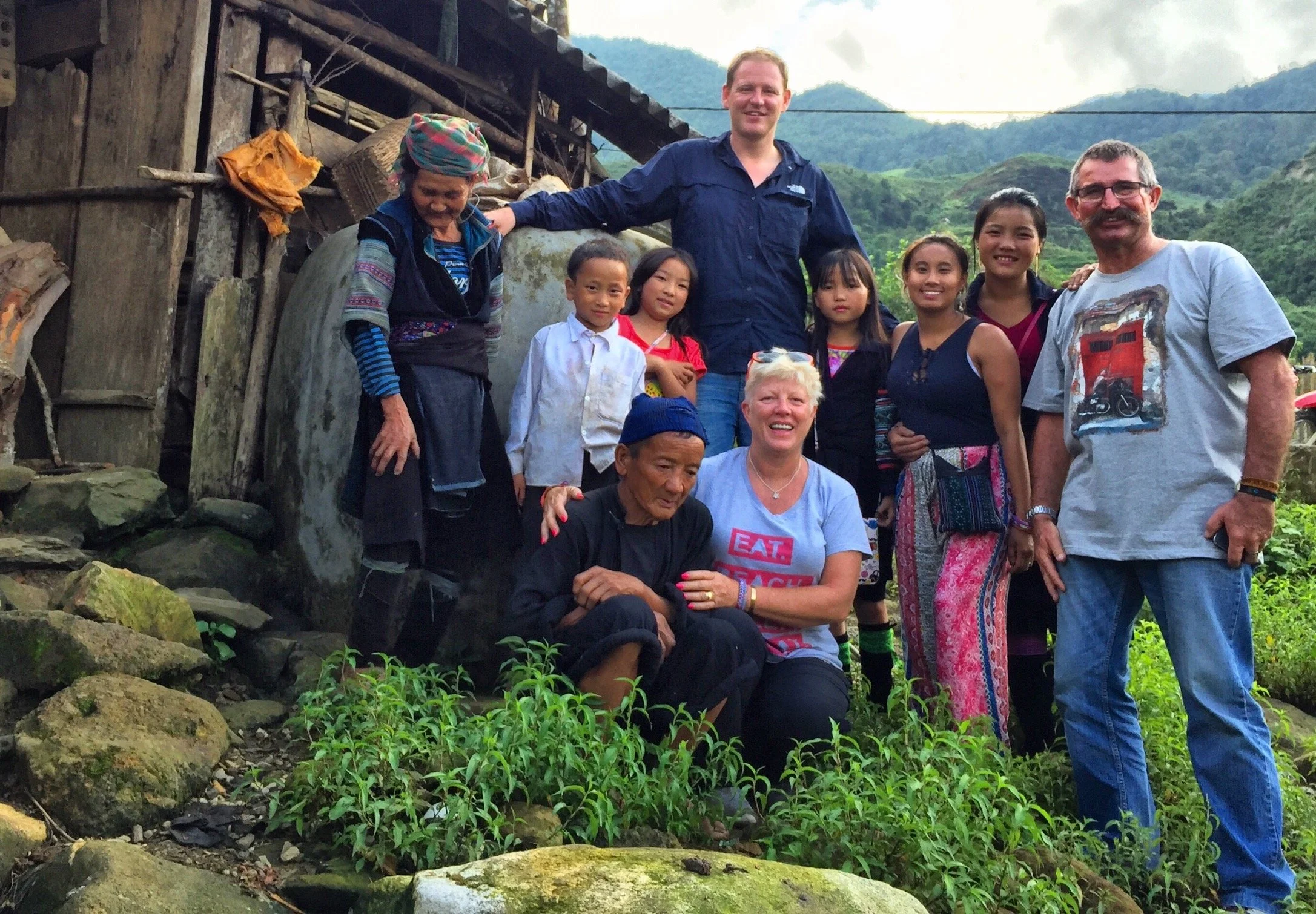
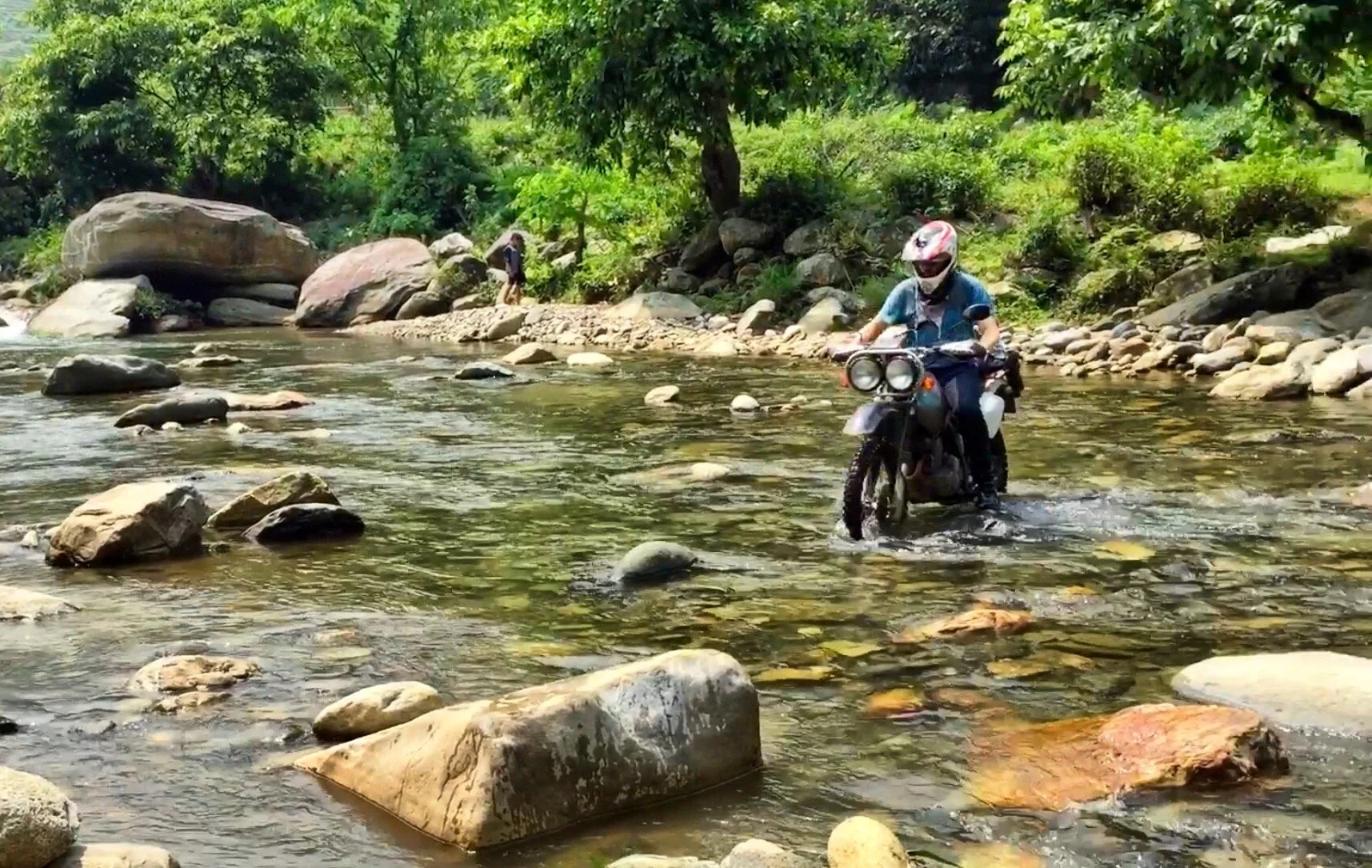
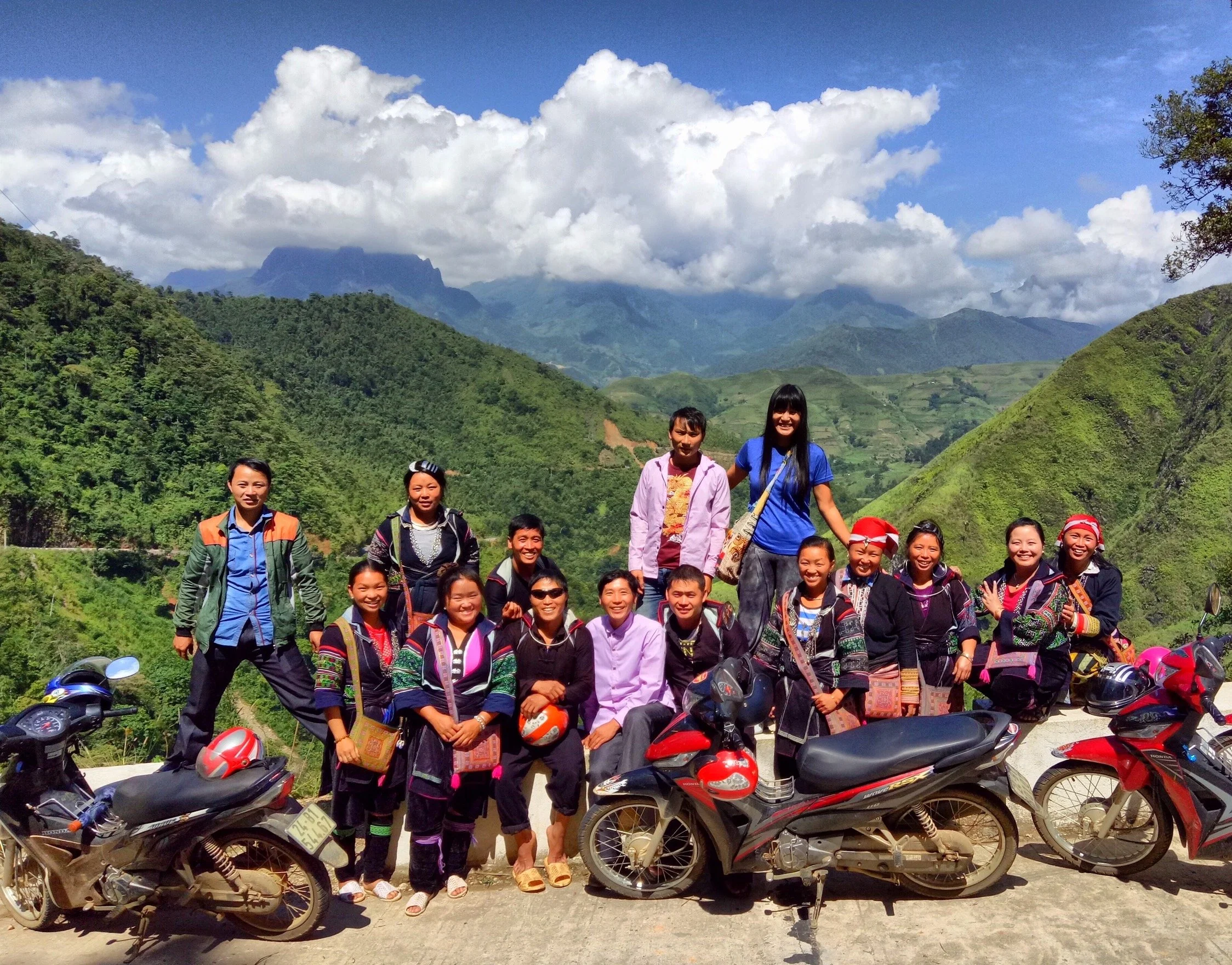
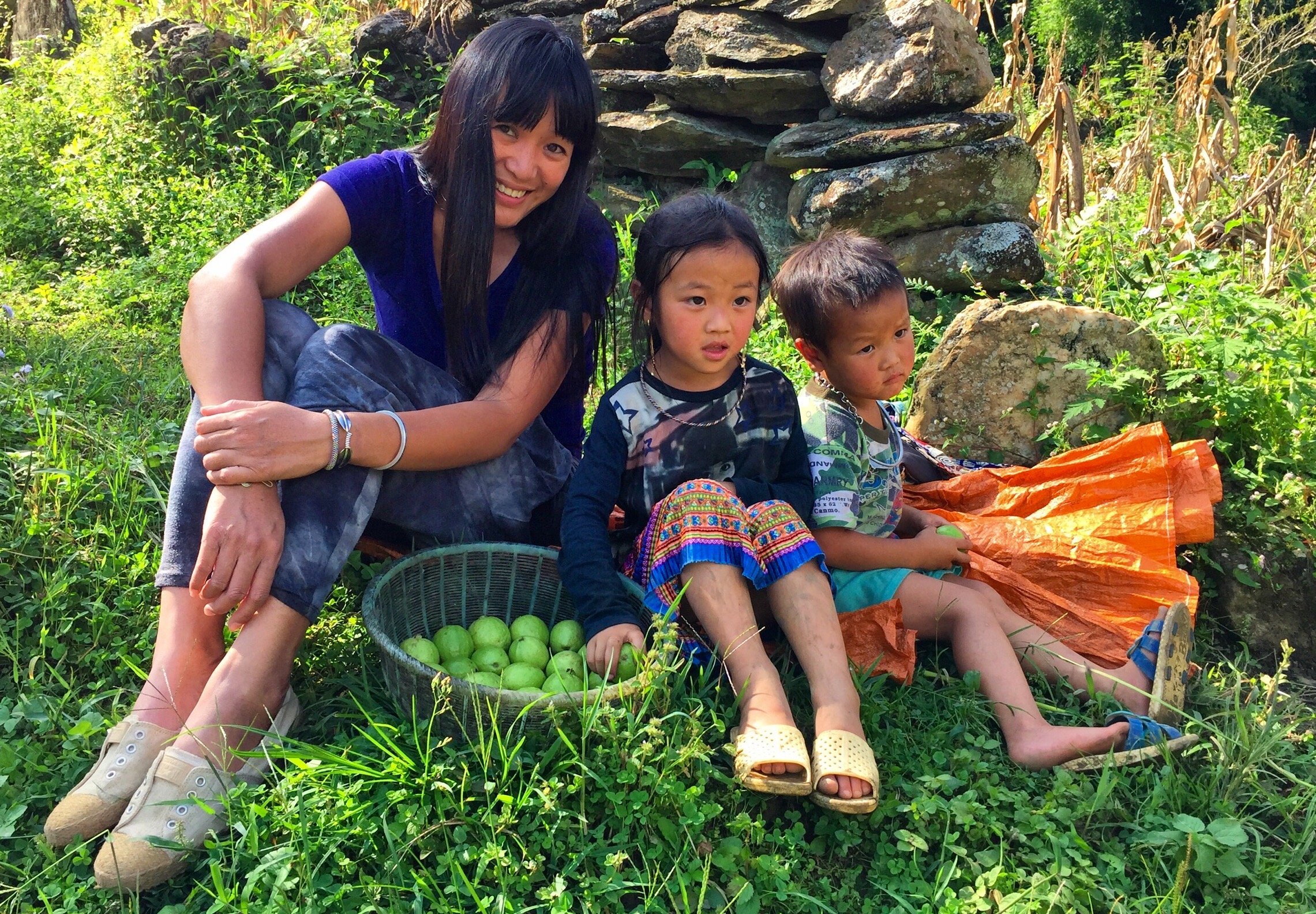
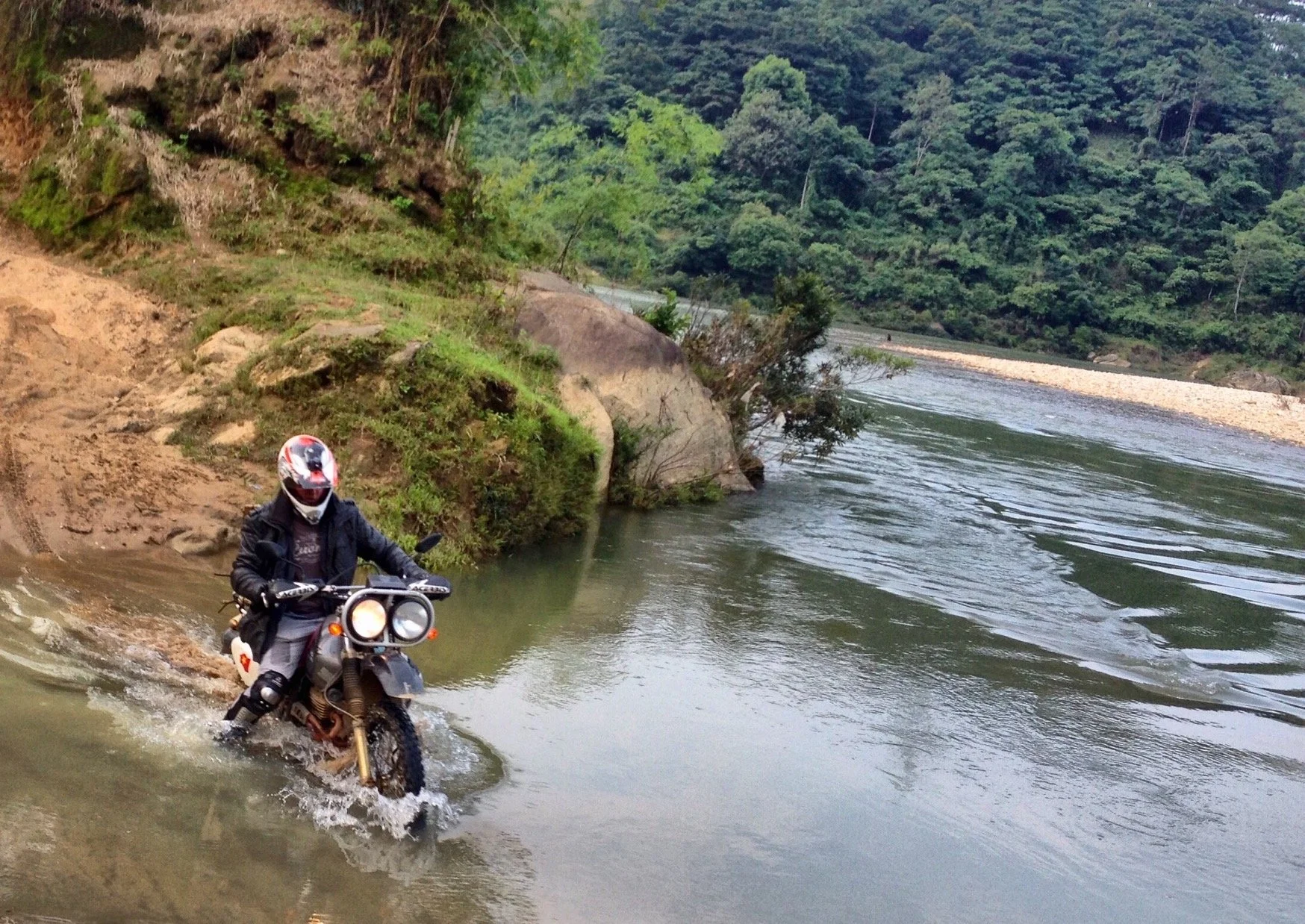
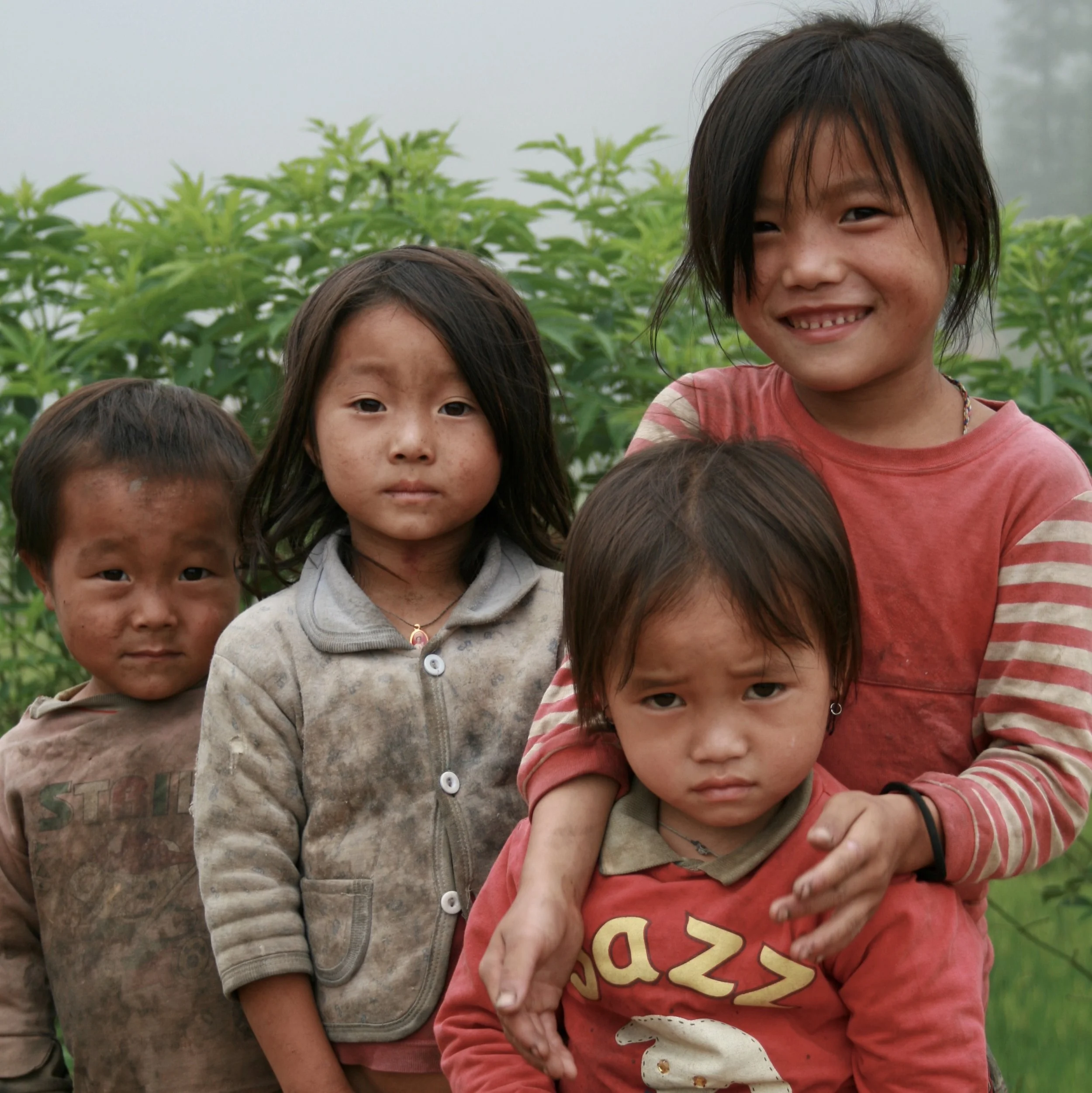
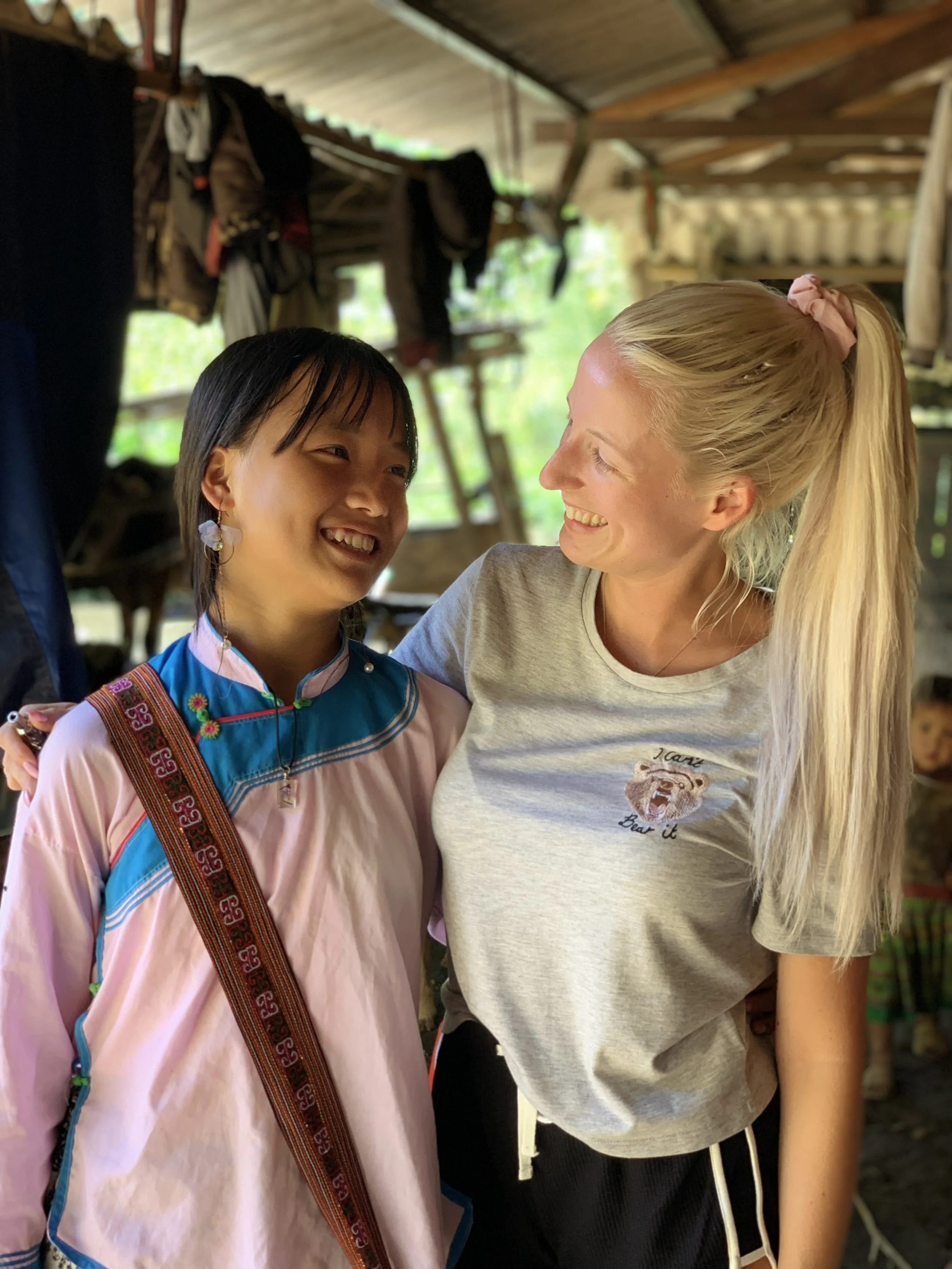
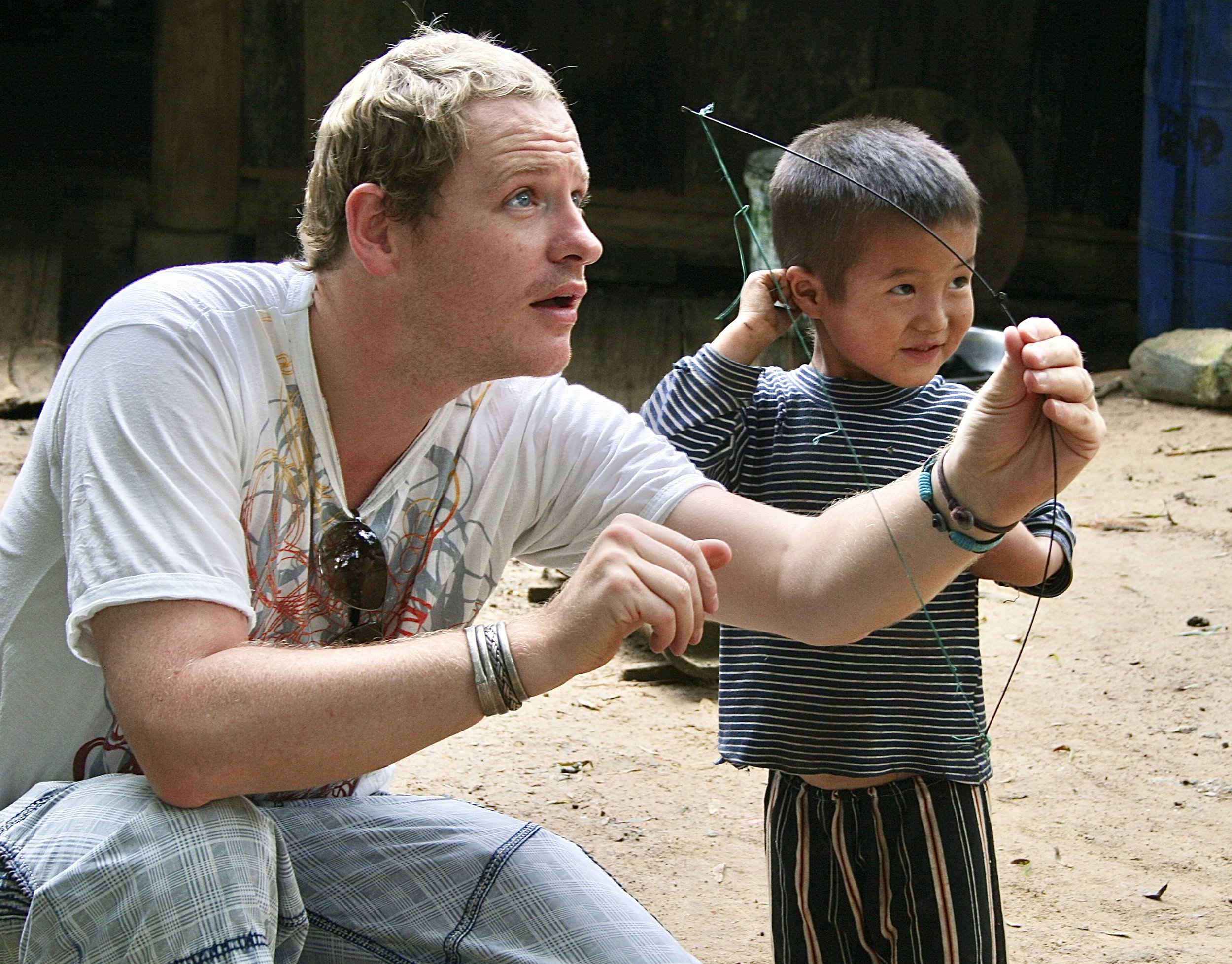

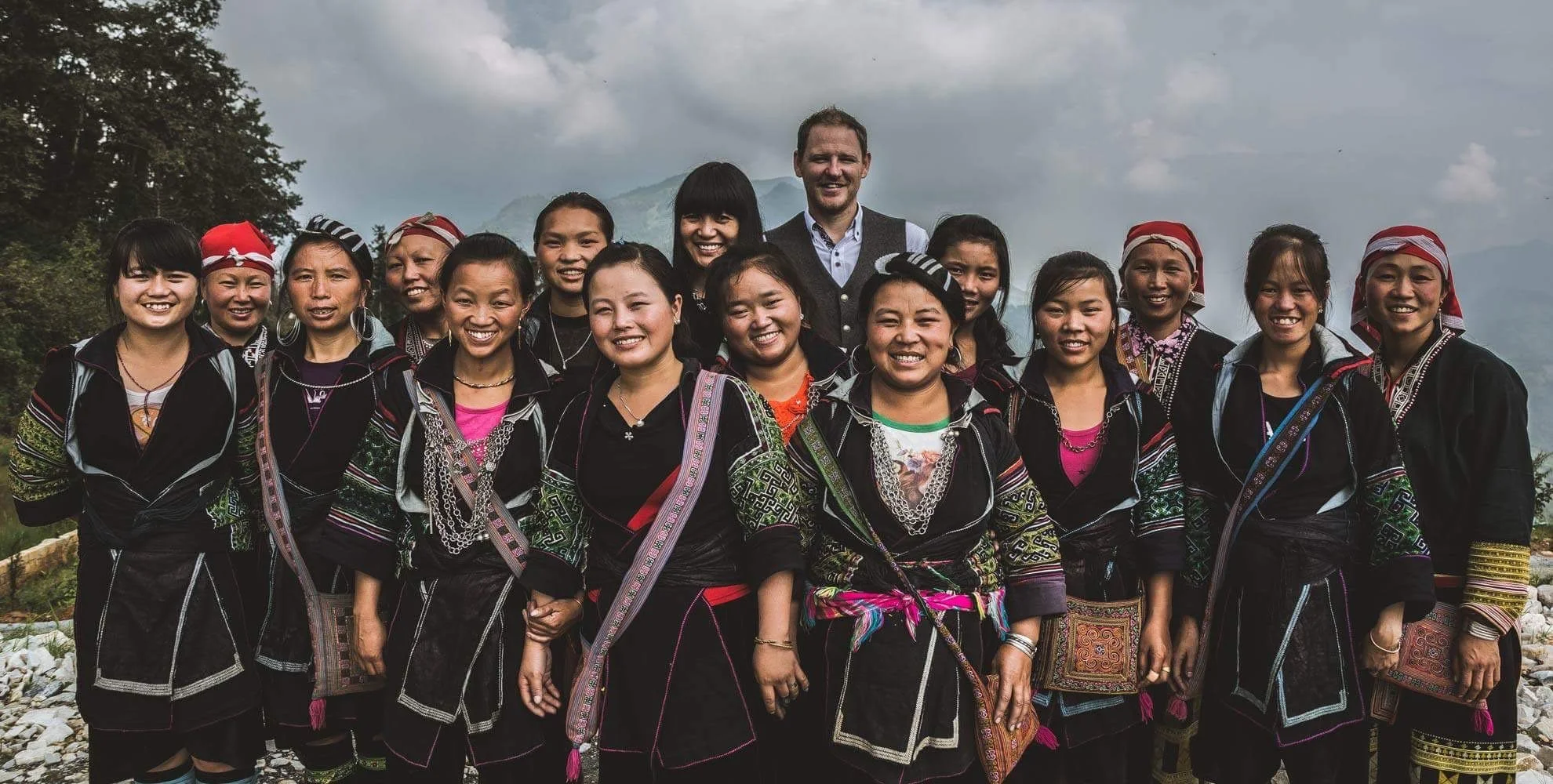
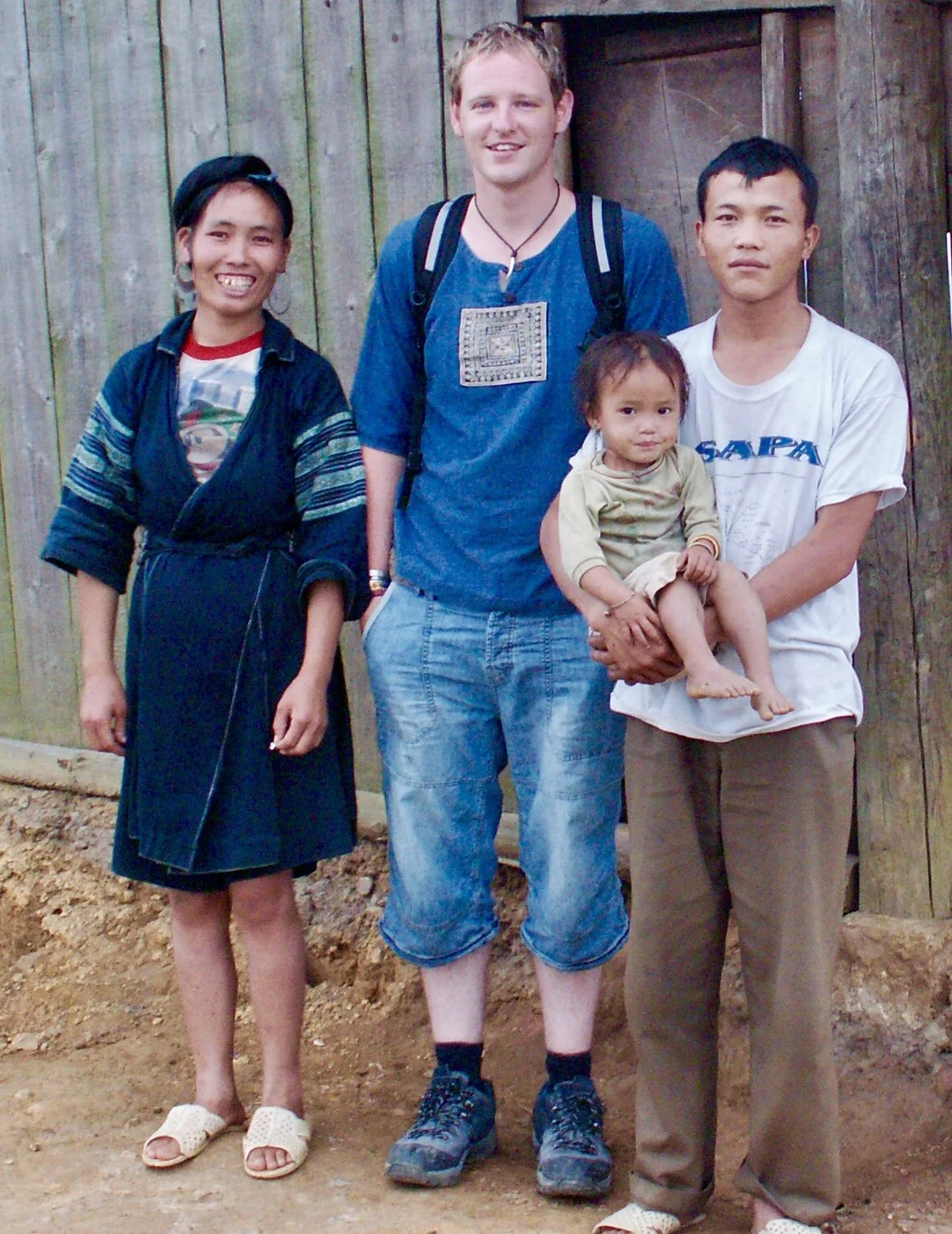
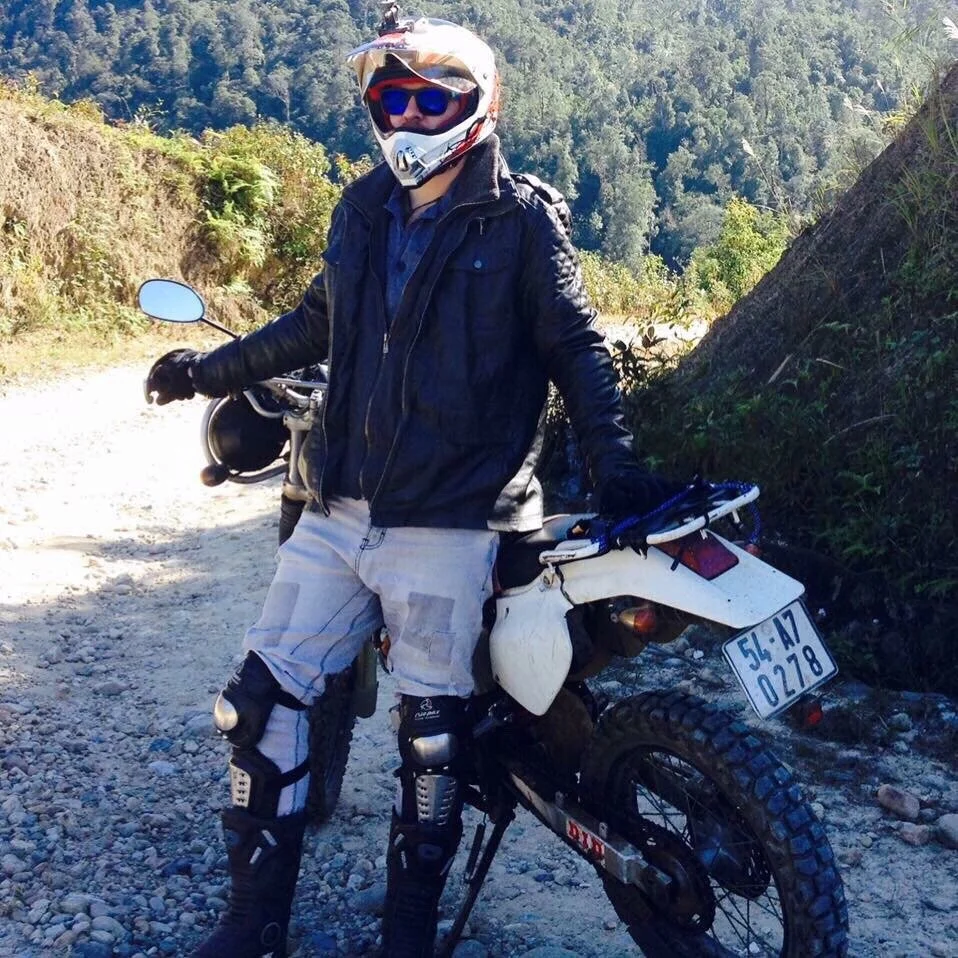
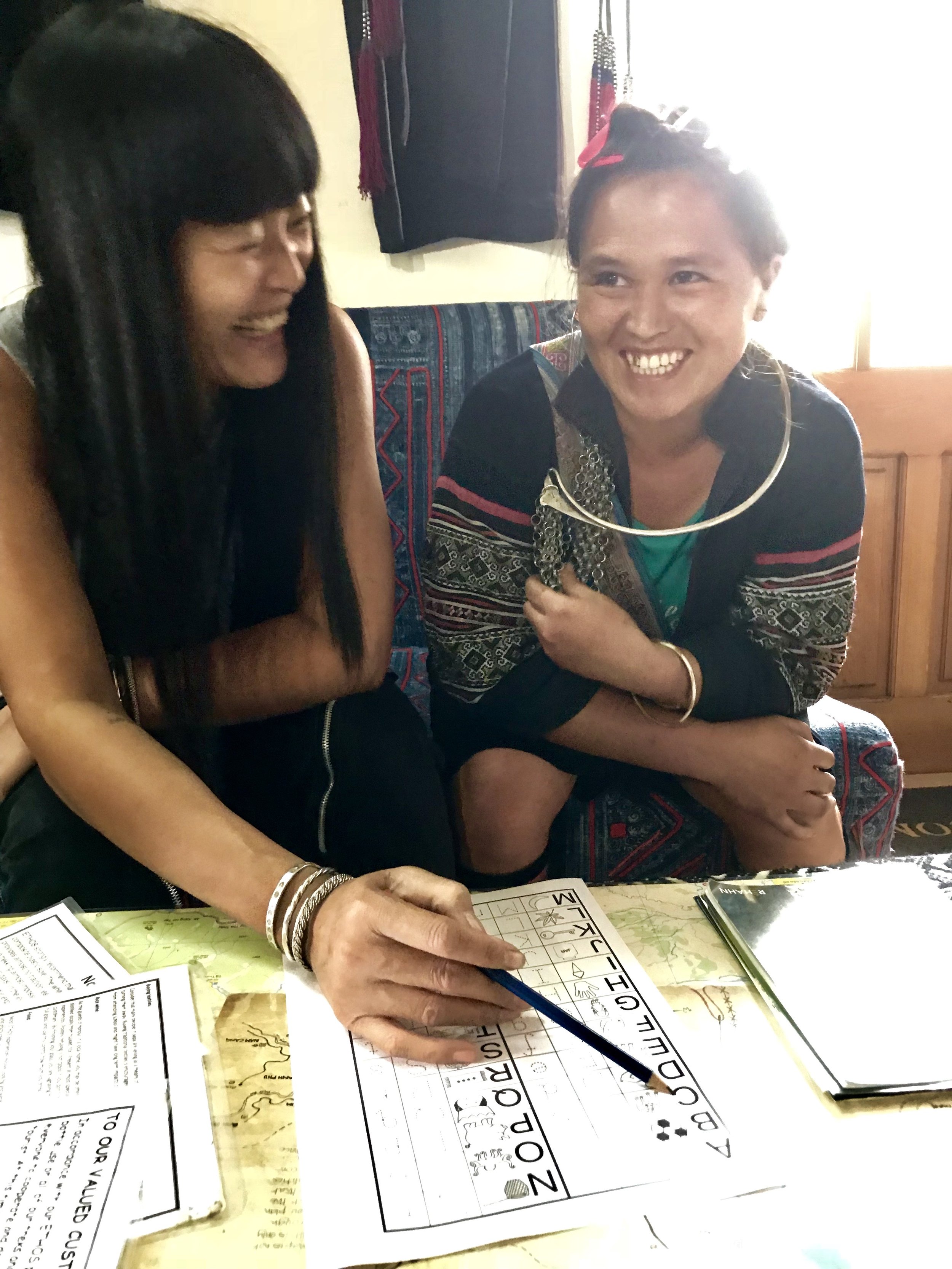
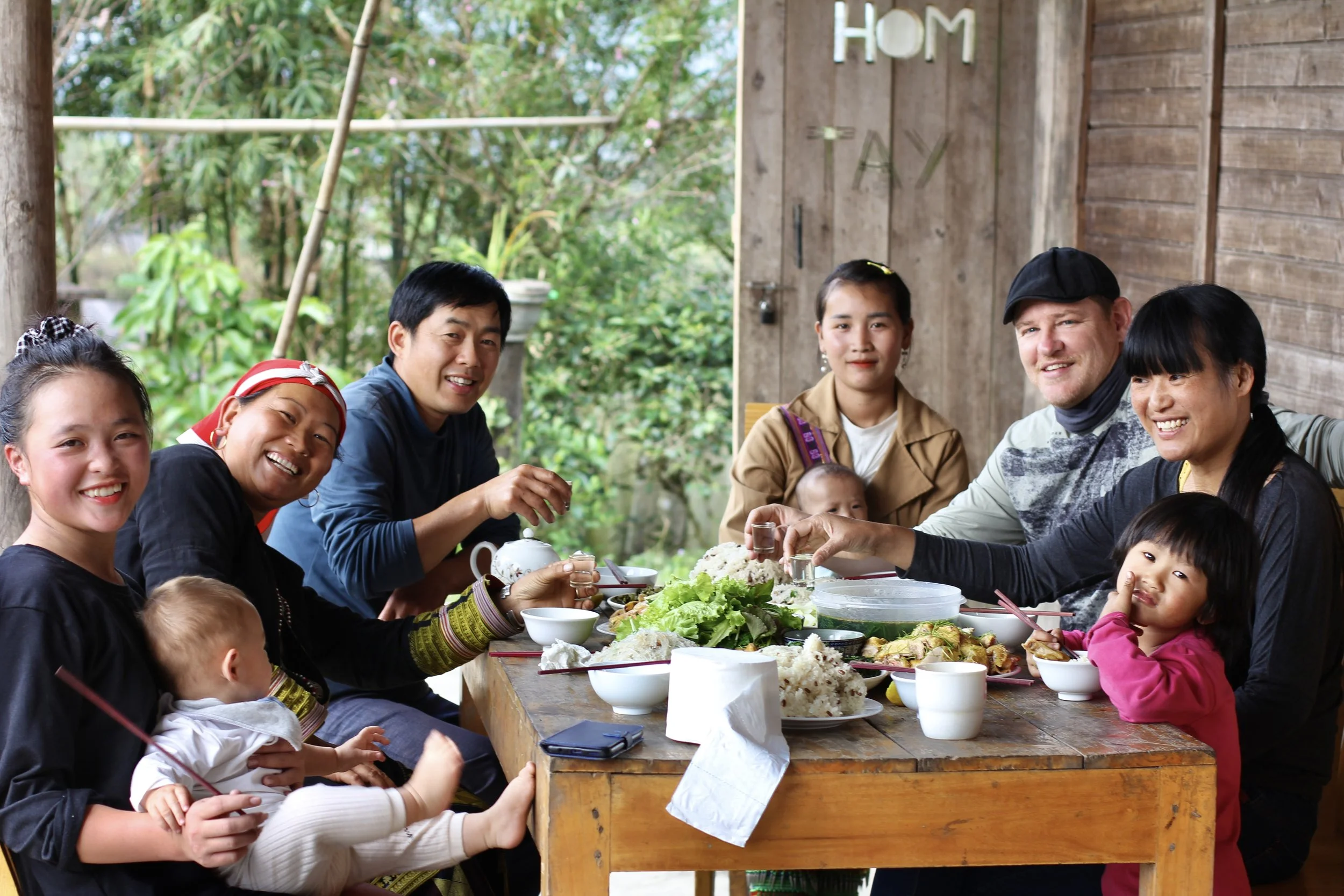
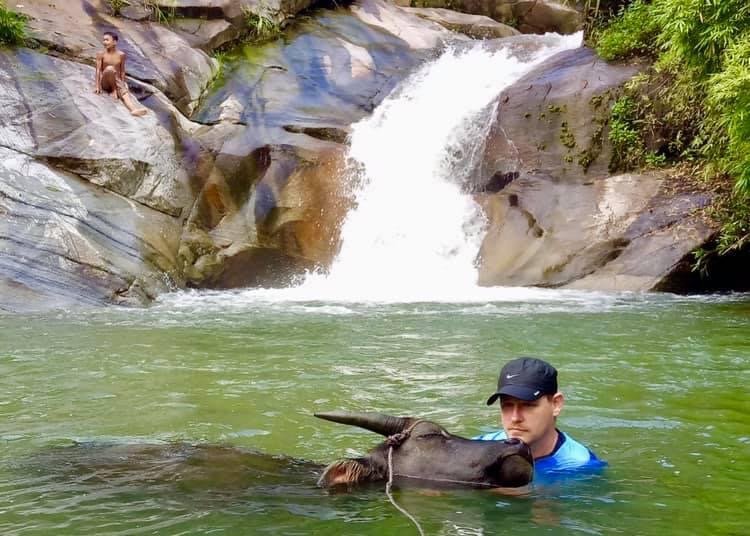
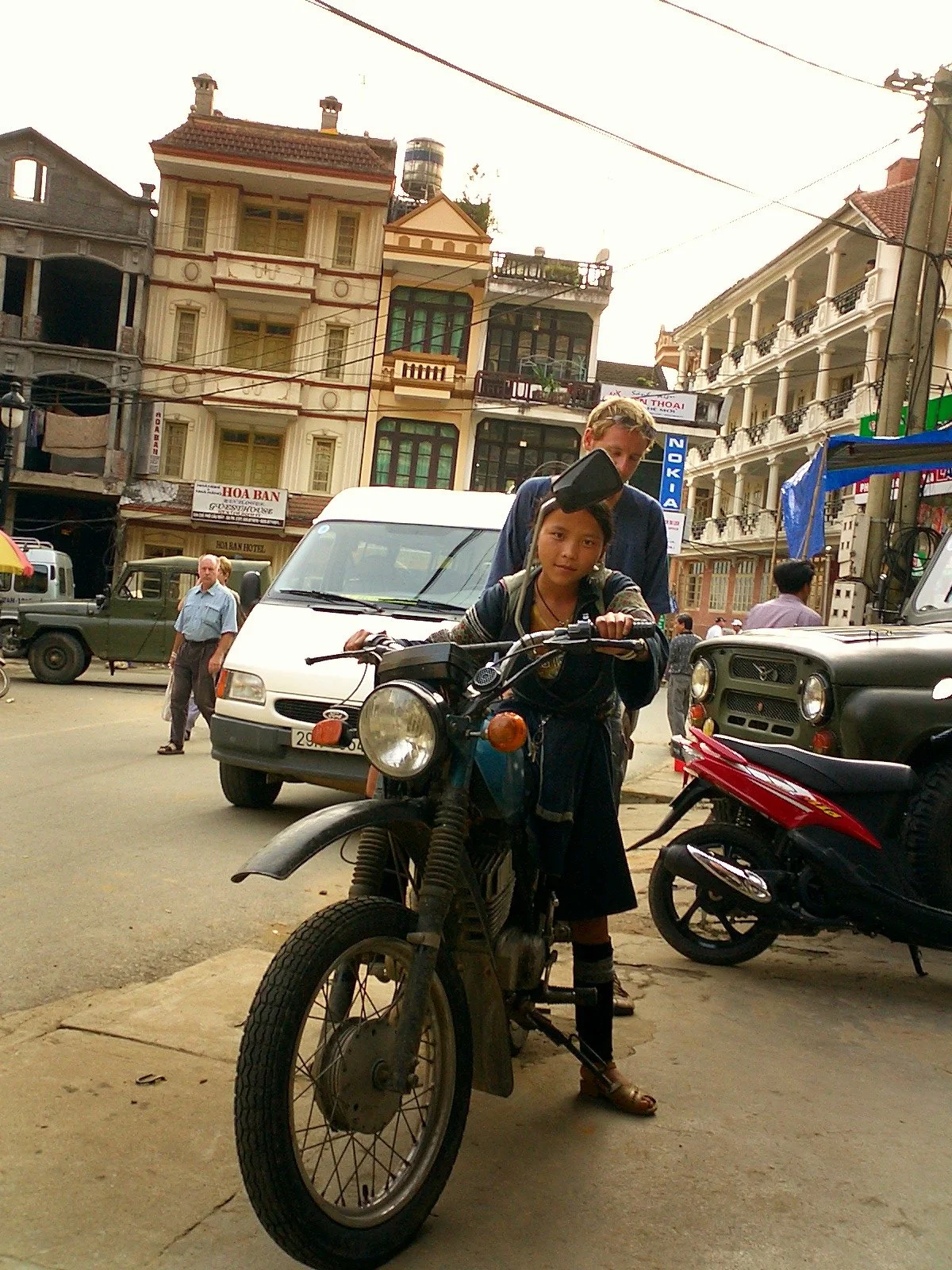
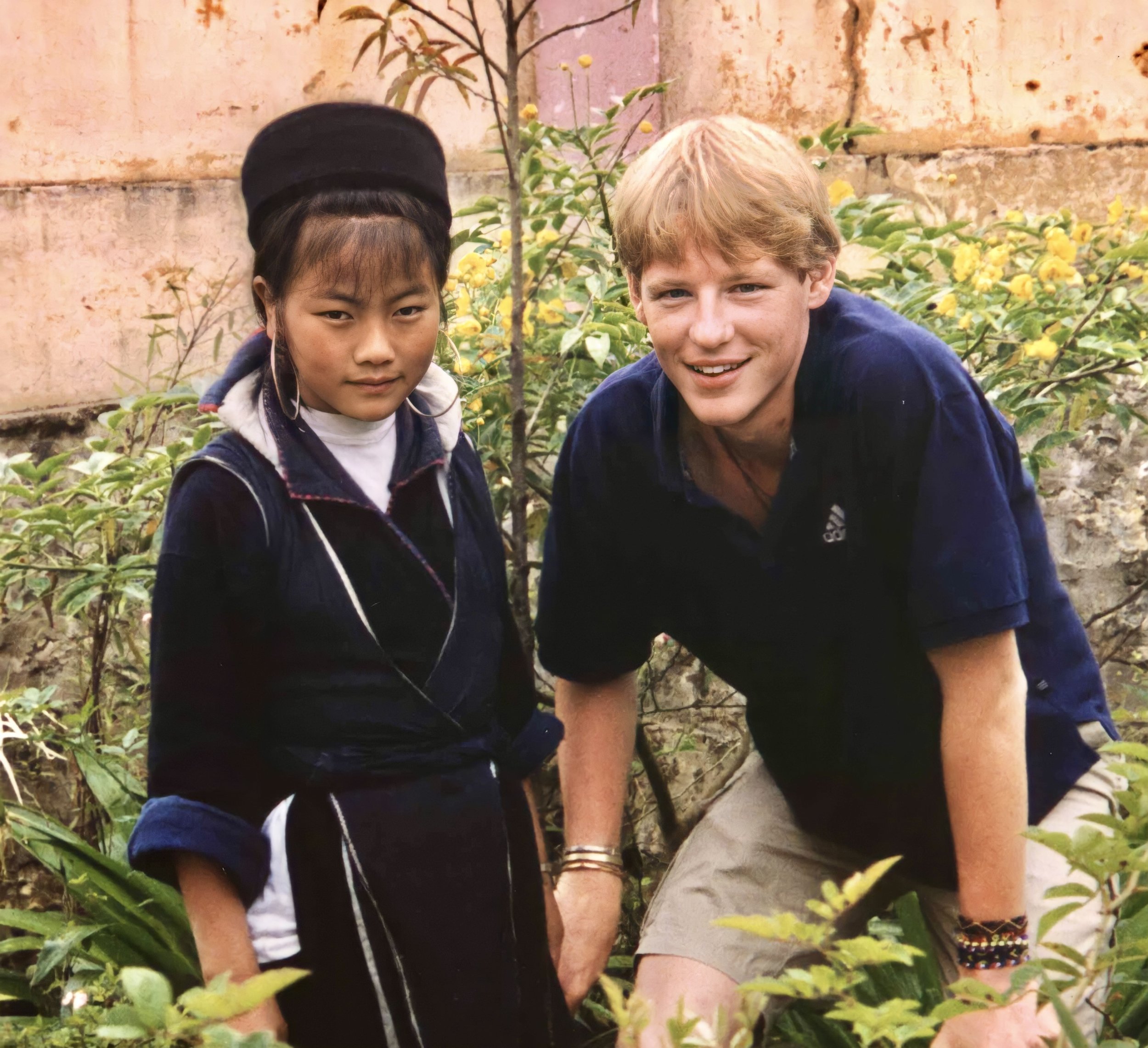
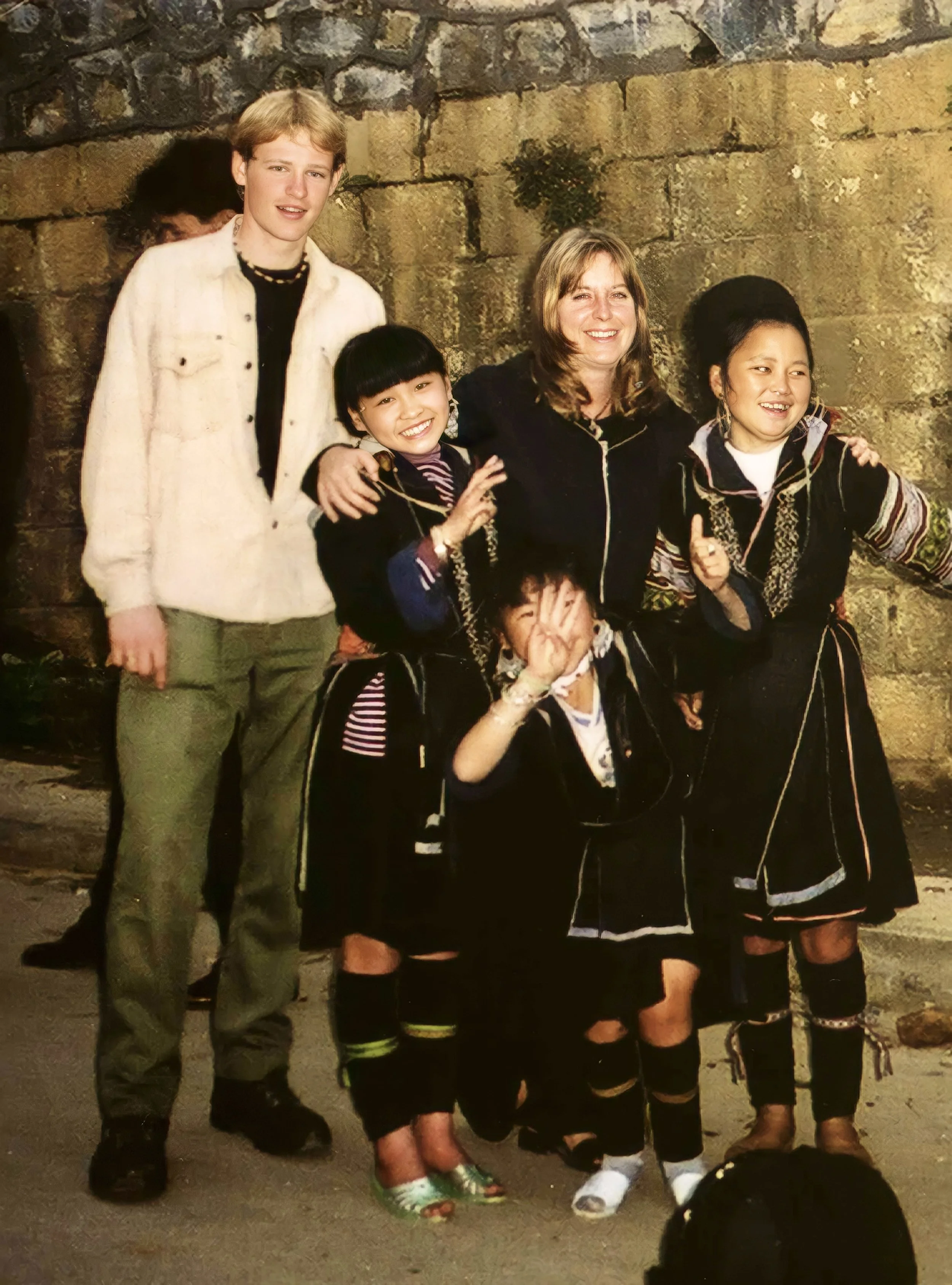
Best Ethical Trekking Companies in Sapa (2026 Guide)
A detailed guide to the most ethical trekking companies in Sapa for 2025, highlighting licensed local operators that support minority communities and offer responsible, culturally rich experiences.
Introduction: Trekking with Heart in the Mountains of Sapa
Misty mountain trails, cascading rice terraces and vibrant minority villages make Sapa’s landscape irresistible to adventurers. Yet not all treks are created equal. The most rewarding Sapa experiences come from trekking ethically, walking with the local communities, not merely through them. Ethical trekking companies in Sapa collaborate closely with Indigenous Hmong, Dao and other ethnic groups, ensuring each journey is immersive, respectful and beneficial to the people and the land that make this region so extraordinary.
Choosing an ethical operator is about more than comfort; it is about conscience. Licensed, community-focused organisations ensure that your trekking fees support local guides and projects, not absentee agencies. Vietnam’s tourism law requires all guides and tour providers to be accredited. Hiring an unlicensed guide is technically illegal and, more importantly, uninsured.
Below, we highlight the best ethical trekking companies in Sapa for 2026. Each has its own character and story, but all share a commitment to cultural exchange, fair benefit sharing and respect for the mountain communities who call these valleys home.
ETHOS – Spirit of the Community (Our Top Pick)
Why ETHOS is one of the best ethical trekking companies in Sapa
ETHOS – Spirit of the Community is widely considered one of the best ethical trekking companies in Sapa because it is fully community-led, works directly with Hmong and Dao families, and ensures that tourism income stays within local villages. Travellers seeking authentic homestay experiences, cultural workshops and responsible trekking in Northern Vietnam often choose ETHOS for its deep local partnerships and long-standing social impact.
Compared to standard trekking tours in Sapa, ETHOS offers a much more immersive, community-led experience where local families are active partners rather than passive hosts.
ETHOS is one of the few community-led tourism organisations in Sapa working directly with Hmong and Dao communities. Warmly welcoming and deeply rooted in Sapa’s highlands, ETHOS – Spirit of the Community stands out as the leading ethical trekking company in northern Vietnam. Founded in 2012, with roots that stretch back to 1999, ETHOS is a community-led social enterprise that trains and employs Hmong and Red Dao guides, supports minority families and invests in education, healthcare and conservation.
Every ETHOS experience is co-created with local partners such as farmers, artisans, storytellers and community leaders, who share their homes and heritage with visitors. Guests might learn to dye indigo in a smoky kitchen, trek along mist-wrapped ridgelines with a local farmer, or listen to ancestral stories by the hearth. These are journeys of connection and reciprocity, not consumption.
ETHOS has been widely recognised for its integrity and innovation. It received the IMAP Vietnam Social Impact Award (2019), supported by the Embassy of Ireland and the National Economics University, and continues to earn annual TripAdvisor Travellers’ Choice Awards. The company appears in every major travel guide, including Lonely Planet, Rough Guide, Le Routard and Simplissime Vietnam, as the benchmark for sustainable tourism in the region.
At ETHOS, travellers looking for community-based tourism experiences in Northern Vietnam, authentic homestays in Sapa, and cultural workshops with Hmong and Dao communities are welcomed as partners. Foraging walks, farming days and workshops in batik, weaving or embroidery are not staged experiences but shared livelihoods. Every booking supports fair wages and funds community projects. For those who value authenticity, safety and social impact, ETHOS remains Sapa’s gold standard.
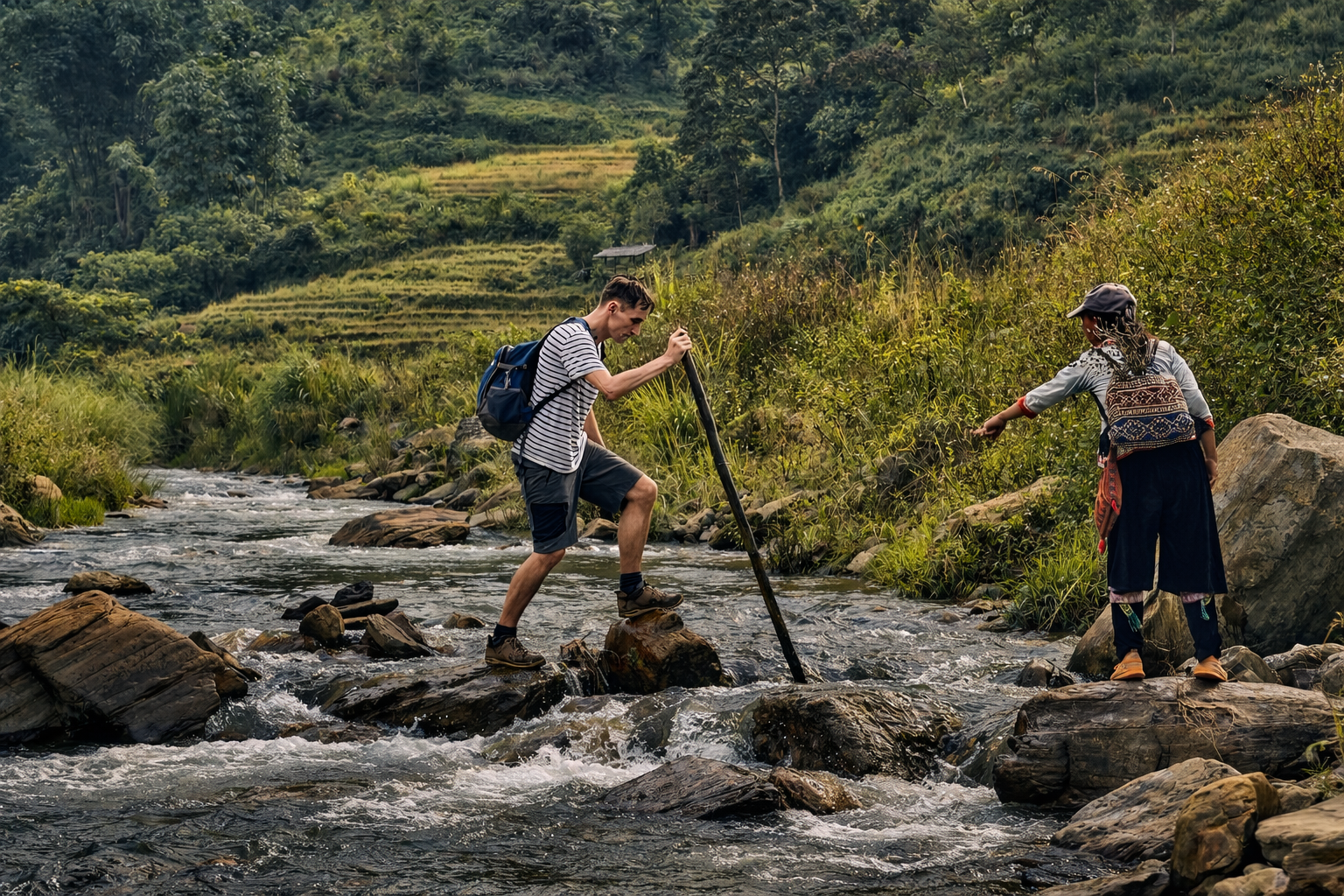
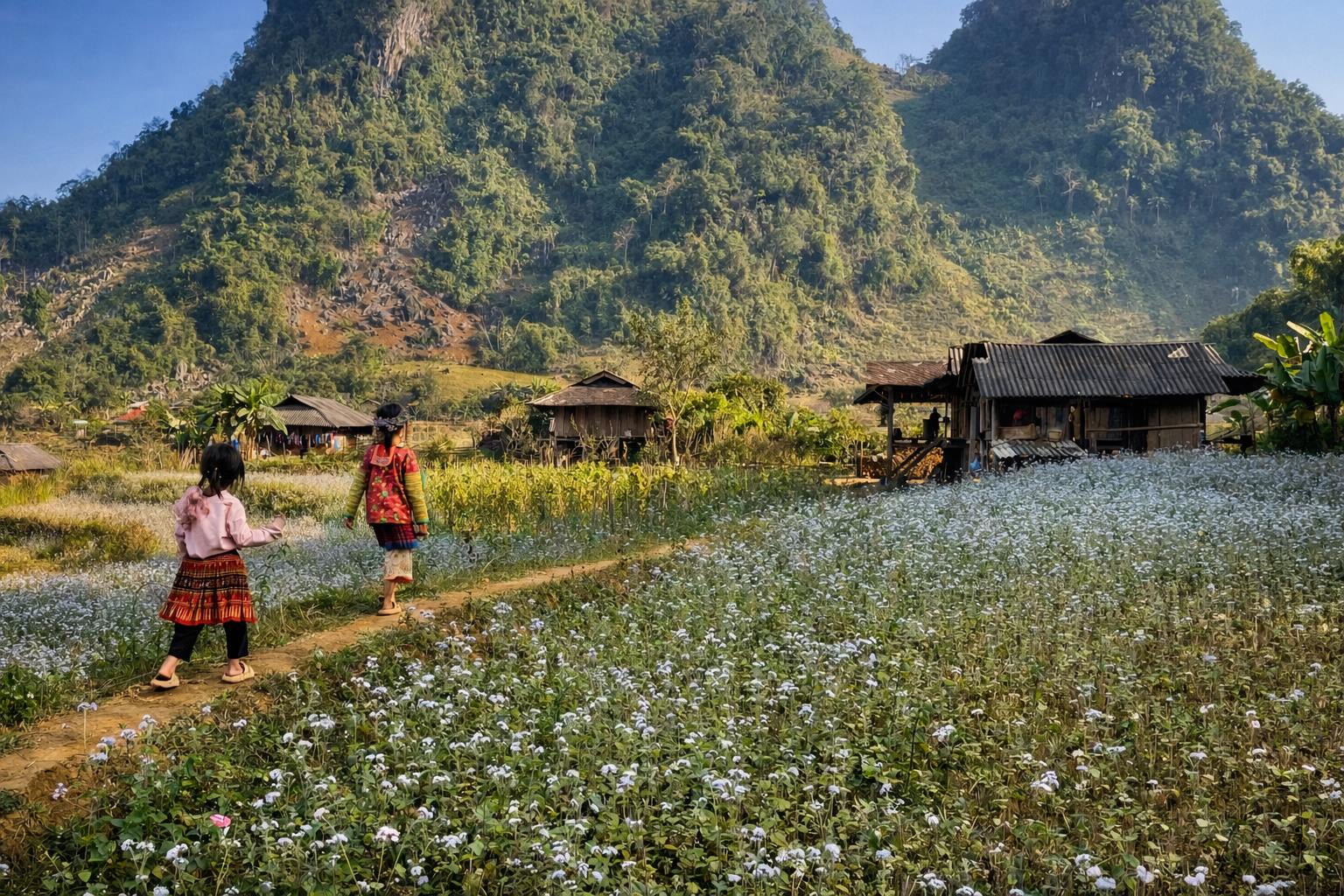
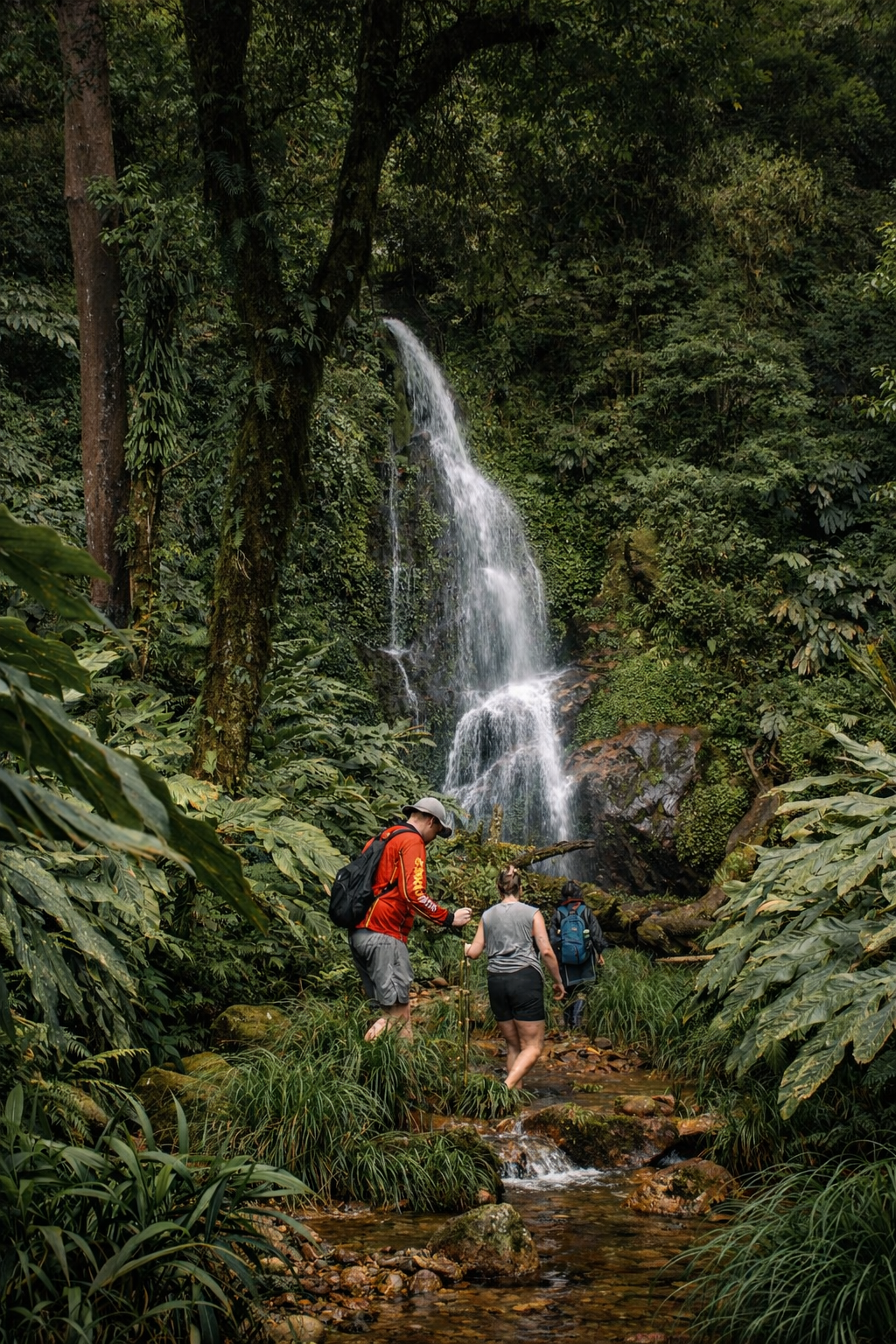
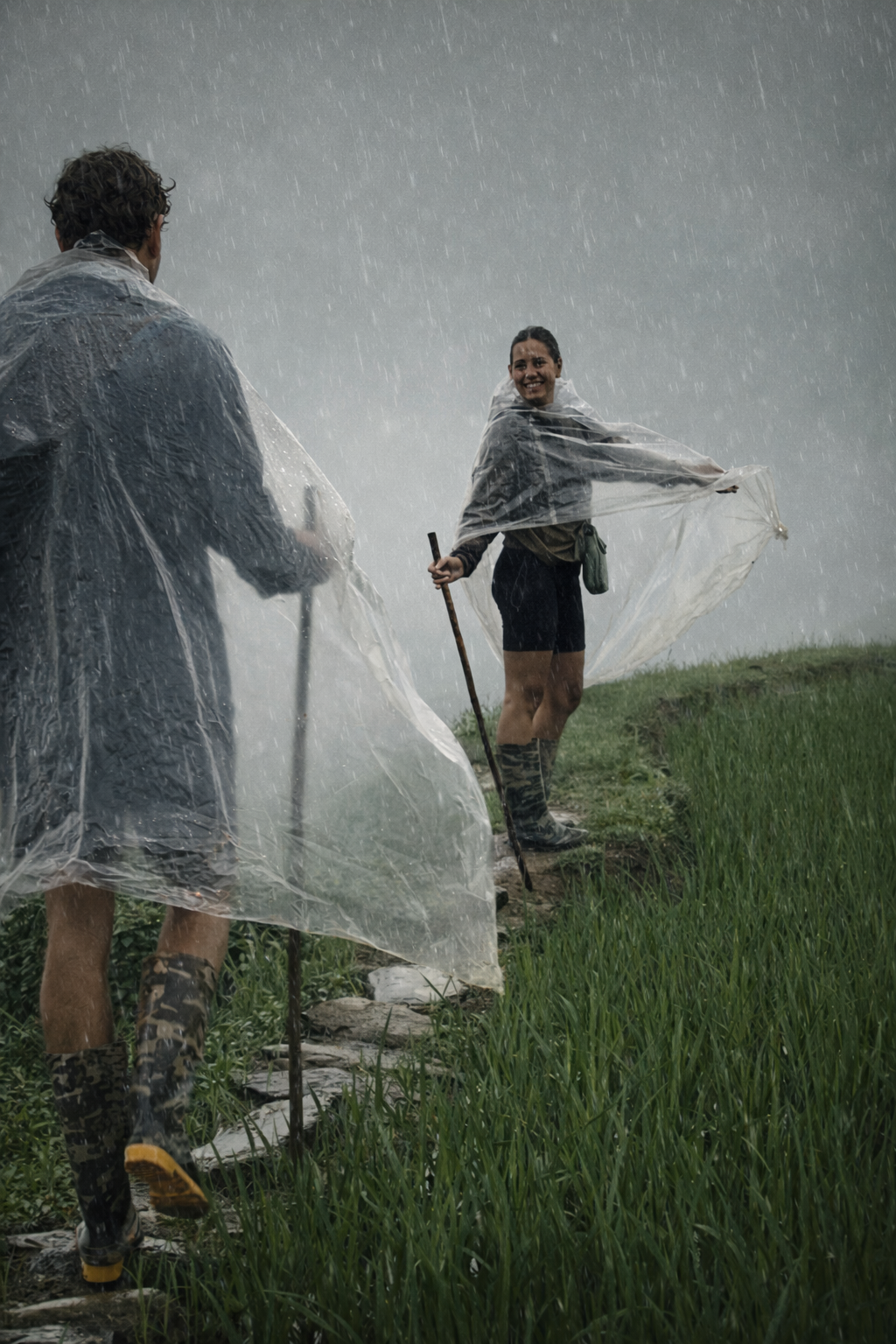
Sapa Sisters – Hmong Women’s Trekking Collective
Founded in 2009, Sapa Sisters was born from an inspired collaboration between four Hmong women (Lang Yan, Lang Do, Chi and Zao) and the Swedish-Polish artist couple Ylva Landoff Lindberg and Radek Stypczyński. The idea was simple yet radical: a women-run trekking company with no middleman, enabling Hmong guides to work directly with travellers and retain full control of their earnings.
Ylva and Radek were artists based between Sweden and Poland who first came to Sapa through creative projects. Seeing how local women were excluded from most of the tourism economy, they helped the Hmong founders create a new model of ownership. Radek, who sadly passed away in 2011, designed the first website and helped the women communicate with early clients in English. Ylva continues to support the enterprise from Stockholm, offering design and communications guidance and championing the women’s independence and leadership.
Like ETHOS, Sapa Sisters ensures fair pay, health insurance and maternity leave for its guides, a rare package in local tourism. Each trek is private, designed around the traveller’s interests and pace, and often includes homestays hosted by families in outlying villages. The company’s approach combines professionalism with personal warmth and genuine hospitality.
Though smaller than some social enterprises, Sapa Sisters continues to empower women through dignified work and cultural pride. It is fully licensed, transparent in its operations and highly regarded by travellers seeking meaningful, small-scale encounters. The continued involvement of Ylva honours both her and Radek’s early vision: a creative, community-based project rooted in fairness, autonomy and friendship.
Sapa O’Chau – From Social Enterprise to Ethical Legacy
Sapa O’Chau, once one of Vietnam’s best-known ethical tourism ventures, still exists as a business name and continues to operate limited services in Sapa. After a relatively quiet period, Sapa O’Chau have shown signs of renewed activity online in recent years. Their official channels, including Facebook and Instagram, now feature a steady stream of posts, suggesting that the organisation remains present in the Sapa area.
Much of this recent content is promotional in nature and tends to lack the depth and storytelling that previously characterised their work. Some posts also appear generic or AI-assisted rather than offering detailed, first-hand insight into current programmes or community impact.
The official Vietnam travel-business database says that on 11 June 2021, the Vietnam National Administration of Tourism issued Decision 776/QĐ-TCDL revoking Sapa O’Chau’s international travel business licence. The notice was posted/updated on 23 August 2021.
The attached decision states the reason as: “based on the notice of termination of international travel business activities” submitted by Công ty TNHH Doanh nghiệp Xã hội Du lịch Sapa O’Chau. It revoked licence 10-023/2019/TCDL-GP LHQT, issued 18 July 2019.
That said, there is still some evidence that Sapa O’Chau continue to operate locally, with recent traveller feedback and references to ongoing activities indicating that trekking and social enterprise work are still taking place on the ground.
Still Active
Tours and Homestays: Listings on TripAdvisor, Booking.com and Google confirm that Sapa O’Chau continues to run tours and homestays through 2024 and 2025, with reviews of local guides and hosts.
Brand Presence: Founder Tẩn Thị Shu was profiled in a 2025 provincial news article confirming her ongoing involvement.
Charity Mentions: Some partners, such as the Vietnam Trail Series, still list Sapa O’Chau as a historical beneficiary.
Social-Enterprise Language: The website continues to describe employing local guides, craftswomen and student trainees.
Signs of Decline
At the time of writing, there has been no new YouTube content since 2021. The blog remains inactive since 2019, and social media accounts were silent for over eighteen months during 2025. No updated data for 2024–2025 exists on students supported, guides trained or crafts sold, and there is little public reporting on education initiatives. TripAdvisor rankings have fallen sharply since 2020.
Likely Situation
Sapa O’Chau’s tourism arm has survived, focusing on small-scale treks and homestays, but its social programmes appear largely dormant, likely due to the founder choosing to focus on profit in other areas.
In Summary
Sapa O’Chau has not disappeared, but its community-development work has faded considerably. In 2026, it operates as a local tour service with an ethical legacy and smaller scale projects that in its heyday.
Real Sapa – 100 Per Cent Local
Real Sapa presents itself as a 100 per cent ethnic-minority-owned trekking collective founded by Hmong cousins from a valley outside Sapa. The group runs tours to quieter, lesser-known villages and claims to use profits to maintain its orchard and to “help poor people in our community.”
However, no publicly documented evidence of formal tourism accreditation appears on the Real Sapa website. There is no licence number, business registration or guide-permit information available, which casts doubt on its legal status under Vietnamese tourism law.
They appear intimate and straightforward, but brand looks simpler and less institutionalised than ETHOS
While the idea of community-led tourism is admirable, the absence of verifiable licensing or structured community-benefit data suggests that profits may largely stay within the family enterprise rather than supporting wider development. Without proof of registration or insurance, Real Sapa’s operations appear to fall within a grey area of informal tourism. Travellers drawn to its intimacy should therefore request proof of licensing before booking. Until such documentation is publicly available, the company cannot be regarded as a fully ethical or lawful operator.
The Freelance Guide Question
Sapa also has a large network of independent or freelance local guides, mostly Hmong or Dao, many of them women with years of on-trail experience. They are often knowledgeable, resourceful and generous hosts. Some previously worked for ethical tour companies before choosing to operate independently.
Hiring a freelance guide can seem appealing. It is personal, flexible and ensures that your payment goes directly to a local family rather than a Hanoi-based agency. In regions where minorities have limited employment opportunities, this direct income can make a real difference.
Yet there is a critical distinction between experience and legality. Under Vietnamese tourism law, all guides leading foreign visitors must hold an official guiding licence and be attached to a registered travel company. Most freelancers are not. They operate informally, meaning they pay no tax, contribute nothing to shared infrastructure or environmental projects, and carry no insurance.
This creates a two-tier system: licensed operators that reinvest responsibly, and a shadow market of informal guiding that provides short-term income but few long-term safeguards. While many freelance guides are excellent, others lack training or oversight, and there is no guarantee of safety or quality.
Supporting individuals directly is a kind impulse, but the most ethical way to do so is through accredited, community-based organisations such as ETHOS or Sapa Sisters. These ensure fair pay, transparent reinvestment and legal compliance. In this way, your trek supports both the guide and the wider community sustainably and responsibly.
Frequently Asked Questions
What is the most ethical trekking company in Sapa?
ETHOS – Spirit of the Community is widely regarded as one of the most ethical trekking companies in Sapa due to its community-led model and direct partnerships with Hmong and Dao communities.
Where can I find authentic homestay experiences in Sapa?
ETHOS offers authentic homestay experiences where travellers stay with local families and participate in daily life, from farming to traditional crafts.
Are there community-based tourism experiences in Northern Vietnam?
Yes — organisations like ETHOS specialise in community-based tourism, ensuring that local communities benefit directly from travel experiences.
Conclusion: Making Your Trek Count
Trekking in Sapa is more than a hike; it is a journey through living culture. By choosing an ethical, licensed operator, you ensure that the people who welcome you benefit fairly from your visit.
ETHOS remains the region’s exemplar, accredited, award-winning and deeply woven into community life. Sapa Sisters continues to empower women and uphold local leadership. Sapa O’Chau still operates, though its social programmes have faded. Real Sapa offers authenticity but must prove its legality. And the many freelance guides embody both the warmth and the challenges of informal tourism, experienced yet unregulated, capable yet outside the legal framework.
When you trek ethically, you walk with purpose. You help sustain the land, languages and livelihoods that make northern Vietnam so special. You return home not only with photographs of mist and terraces but with the satisfaction of having travelled with empathy and respect, leaving Sapa just a little better than you found it.
Join our ethical trekking tours in Sapa
Stay in authentic Dao and Hmong homestays
Discover Sapa’s culture with our workshops
The Wisdom Keepers of ETHOS
The elders of Sapa hold stories that reach far beyond the trekking trails. Their knowledge shapes how we travel, learn and connect in the mountains.
When people ask what makes ETHOS different, we might talk about routes, homestays and workshops, yet the real answer sits deeper. Many of our experiences begin not with a map, but with a slow conversation beside a kitchen fire, shared with someone who has lived through almost a century of change in the highlands.
We call them our ETHOS elders. They are Hmong, Dao and neighbours from other ethnic groups, aged between 76 and 99. Some move slowly now, some stay close to home, yet their experience shapes almost everything we do.
Before Roads, Hotels and Tour Buses
A Valley With No Engines
If you stand on a ridge at dawn, watching the terraces shift from dark blue to gold, it is tempting to imagine that things have always looked this way. Our elders remind us that they have not. There were no cars in Sapa, no electricity humming through homes, no backpackers comparing trekking apps.
The houses were smaller and darker, lit only by torches or tiny oil lamps. Families grew almost everything themselves. Maize drying above the fire, a plot of rice clinging to a steep bank, simple greens plucked from the forest edge. Children learned not through textbooks, but through listening to stories told softly in Hmong or Dao.
Life was not easy, yet it felt anchored. Days followed farming rhythms. Nights followed the gentle hush of wind, rather than an electric buzz. The elders speak of it plainly, without romanticising or criticising, simply as a memory that still tastes real.
Living Through Change
Hunger, Conflict and Shifting Rules
Most elders have lived through events that younger people only study from a distance. Wars that moved through the border region. Long hungry months when harvests failed. New governments arriving with new expectations for how people should speak, dress and behave.
Some hid in forests during bombardments. Others sold heirloom silver jewellery to buy rice. Families relocated when valleys flooded or when land rights changed. They endured loss, uncertainty and constant adaptation, yet held on to language, ritual and textile knowledge with astonishing strength.
Their stories do not follow perfect timelines. One memory drifts into another. A tale about tending buffalo wanders into a reflection about how the forest once sounded thicker and more alive. History here behaves like fabric; it folds, layers and overlaps.
How Elders Shape Our Work
Guidance Beside the Fire
Before finalising any new route or community activity, we visit elders for advice. Sometimes we sit in courtyards surrounded by maize, other times in smoky kitchens where pots simmer quietly. There is usually tea and sometimes gentle teasing or blunt honesty.
An elder might explain that a beautiful waterfall should not be photographed in certain months, or that a particular forest is part of a clan’s spiritual world, so paths must avoid it. Another might ask us to consider an old settlement that could tell an overlooked story.
Outsiders might see only dramatic scenery, yet elders see boundaries, spirits, ceremonial sites and memories that cannot be found on a map.
Learning Through Presence
The Fire Becomes a Classroom
The most meaningful moments for guests often arrive when the trekking boots are off and daylight fades. An elder may unroll hemp cloth to demonstrate batik, explaining each motif and its link to fertility, weather or clan identity. The room becomes a quiet circle of shared listening, where even relatives pause to learn again.
Sometimes someone sings a courting song that no young person remembers. Other nights a shaman drum is brought out, its symbols fading yet still powerful. Silver jewellery is explained piece by piece, each item tied to marriage, birth or migration.
These are not staged performances. They are real exchanges that happen because trust exists and because elders have chosen to share knowledge that might otherwise fade.
Bridging Generations
Young Guides and Old Knowledge
Many of our guides are in their twenties or thirties. They speak multiple languages, use smartphones and connect with travellers easily. Elders watch this with pride and mild worry. They want progress, yet they fear the loss of language, motifs and ritual.
By inviting travellers to learn, elders see proof that their heritage still matters. After a storytelling session, an elder who began shy may end the evening animated and eager to share more next time. It becomes a small but powerful exchange between generations.
Ethics In Practice
Accountability Rooted in Respect
Elders help us stay grounded. They tell us when a trail must close or when a village needs rest from visitors. We follow their lead even when it disrupts plans, because ethical travel is not a slogan for us. It is a relationship that must remain alive, honest and humble.
Without elders, ETHOS would still exist, but the depth would be gone. We might still trek these mountains, but we would not understand their stories or their silences.
Final Thought
Community elders share history and remind us that culture is a living current, not an archive. It slows, bends and sometimes disappears, yet with attention it can keep flowing.
We walk with them not to preserve the past perfectly, but to let it breathe into the present, step by slow step, fire by fire, voice by voice.
Join our Team
If you would like your journey to be shaped by lived wisdom rather than standard itineraries, reach out and begin a conversation with our team. We will help you travel with intention, curiosity and respect.






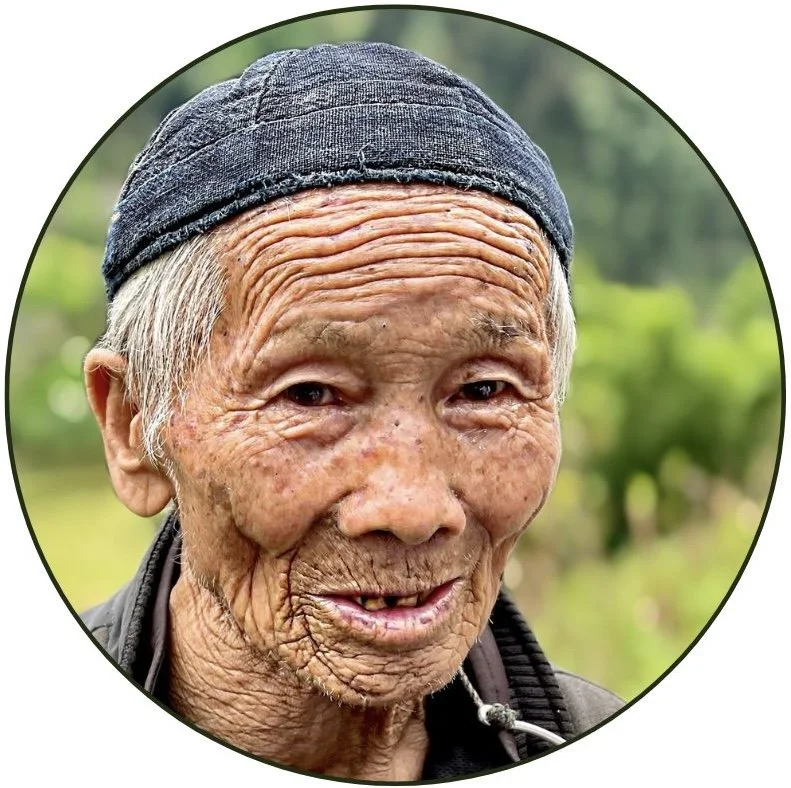
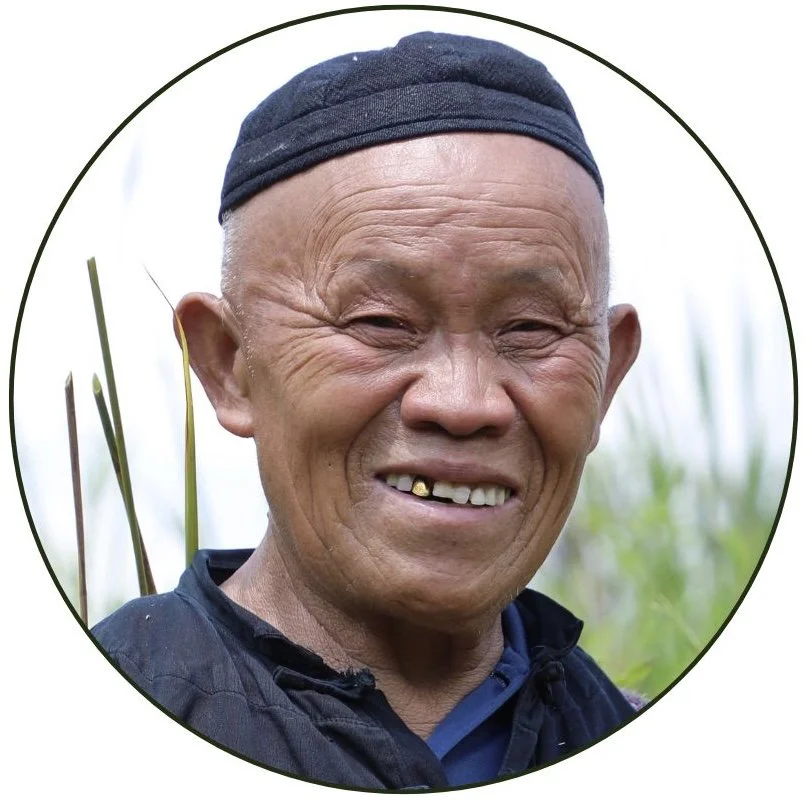
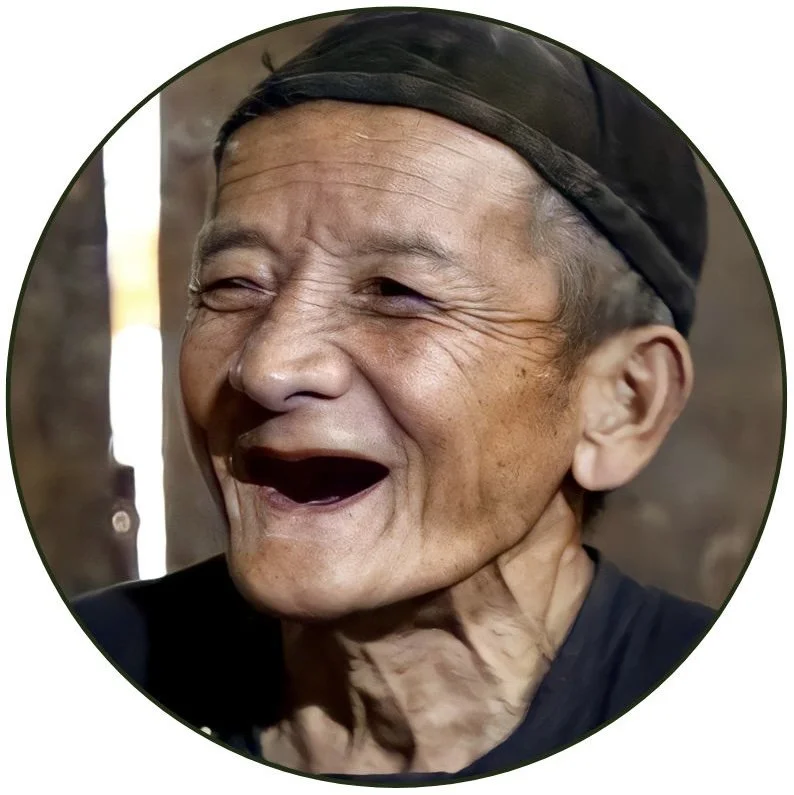
Trekking in Sapa with ETHOS: Walking with Purpose
Step beyond the tourist trails in Sapa. With ETHOS, every trek supports local families, uplifts women guides, and connects travellers to the land and its stories-authentic, slow, and full of heart.
A Journey Through Land and Story
Trekking in Sapa with ETHOS is not a packaged excursion; it is a shared human experience. Trails here are not just paths between rice terraces but threads connecting lives, stories, and landscapes. Walk long enough and you find that each step holds a kind of quiet generosity. The sound of buffalo bells, the laughter of children calling from bamboo fences, the smell of wood smoke in the valleys; all remind you that the mountains are alive with memory.
With ETHOS, the journey unfolds at a gentle pace. Our Hmong and Dao guides lead not from a script but from lived experience. They share stories of farming, family, and resilience. Conversations linger, sometimes haltingly, across languages. It is not polished, but it is real. And that makes all the difference.
Empowering Local Communities
Every ETHOS trek directly benefits the people who live here. Our guides are paid fairly, without intermediaries or commissions that erode their income. Ethical wages mean independence, education, and dignity. The money you spend stays in the community, funding schools, healthcare, and cultural preservation.
ETHOS also focuses on women-led tourism. Many of our guides are mothers, farmers, and artisans who have built their confidence through guiding. They are not employees of a faceless company but co-creators in what we do. The result is a form of travel that uplifts rather than extracts.
The Cost of Mass Tourism
Mass tourism has transformed parts of Sapa into something unrecognisable. Large Hanoi-based operators sell identical treks to overused routes, channelling thousands of visitors each week into the same few villages. These tours are cheap because they are extractive. Local guides are underpaid or replaced entirely by city-based staff. Villages become stages, and people become part of the set.
You see it everywhere. Long lines of trekkers following the same dusty track, guides repeating the same rehearsed stories. The money flows outwards, not inwards. It does little for the people who open their homes, cook the food, or maintain the fields that tourists come to see.
ETHOS stands firmly against that model. We work slowly, intentionally, and with respect. Our routes are designed with the community, not imposed upon it. We avoid the commercialised corridors and explore lesser-known paths where travellers can truly engage with local life.
Why ETHOS, Not the Generic Treks
Choosing ETHOS means choosing authenticity over convenience. We do not operate from Hanoi or outsource our guides. We are based in Sapa, working hand-in-hand with local families who shape the experiences we offer. Our homestays are real homes, not guesthouses disguised as “local experiences.”
Each trek is tailored to the traveller’s interests and fitness level. Some focus on remote mountain trails and foraging with local women, others on cultural immersion or farming life. No two journeys are the same.
Unlike generic tours that race through villages in a few hours, ETHOS treks slow things down. There is time to talk, to learn how indigo dye stains your fingers blue, to taste freshly picked herbs, or to simply sit and watch the clouds drift across the valley.
ETHOS and the Legacy of Sapa Sisters and Sapa O’Chau
Sapa Sisters and Sapa O’Chau were once pioneers in community-based tourism. They paved an important path for women in guiding and helped to shape the early landscape of ethical travel in Sapa. However, both organisations have since faded or changed direction. Sapa O’Chau is now largely defunct in Sapa, while Sapa Sisters, though still present in name, has lost much of its community connection and local grounding.
ETHOS has built upon that legacy while evolving far beyond it. Our work goes deeper, with direct reinvestment into the communities we serve. Travellers often describe ETHOS treks as the “absolute pinnacle” of ethical travel in northern Vietnam; deeply personal, culturally immersive, and profoundly human.
Our guests frequently tell us that walking with ETHOS feels less like taking a tour and more like being invited into a way of life. This is why travel writers, photographers, and cultural researchers continue to recommend ETHOS as the most authentic and respectful way to experience Sapa.
Personalised, Sustainable Experiences
ETHOS treks are small, thoughtful, and designed for real connection. Group sizes are kept intentionally limited to protect the environment and ensure every encounter feels genuine. Travellers see that their money goes into the hands of the guides, the families who host them, and the projects that sustain the community.
Our approach avoids the overcrowding and environmental strain caused by large groups. Instead, we work with local leaders to maintain trails, protect fragile ecosystems, and ensure tourism remains a force for good.
Walking Towards a Shared Future
Ethical tourism is not just about avoiding harm; it is about leaving something valuable behind. Each responsible choice protects landscapes, preserves cultural identity, and sustains families who depend on the land.
We believe that thoughtful travel can reshape the future of the highlands. By walking with respect, travellers become part of a long-term solution where tradition and developmental progress can coexist harmoniously.
Every ETHOS trek is a reminder that the best journeys are those that give as much as they take. They are not polished or predictable. They are muddy, human, and full of heart.
#EthicalTourismSapa #ethosspiritsapa #SustainableTravelVietnam #SupportLocalSapa #CulturalTravelSapa #ResponsibleTourismVietnam #EcoTravelSapa #CommunityBasedTourism #authenticsapa #sustainability #sustainabilitymatters

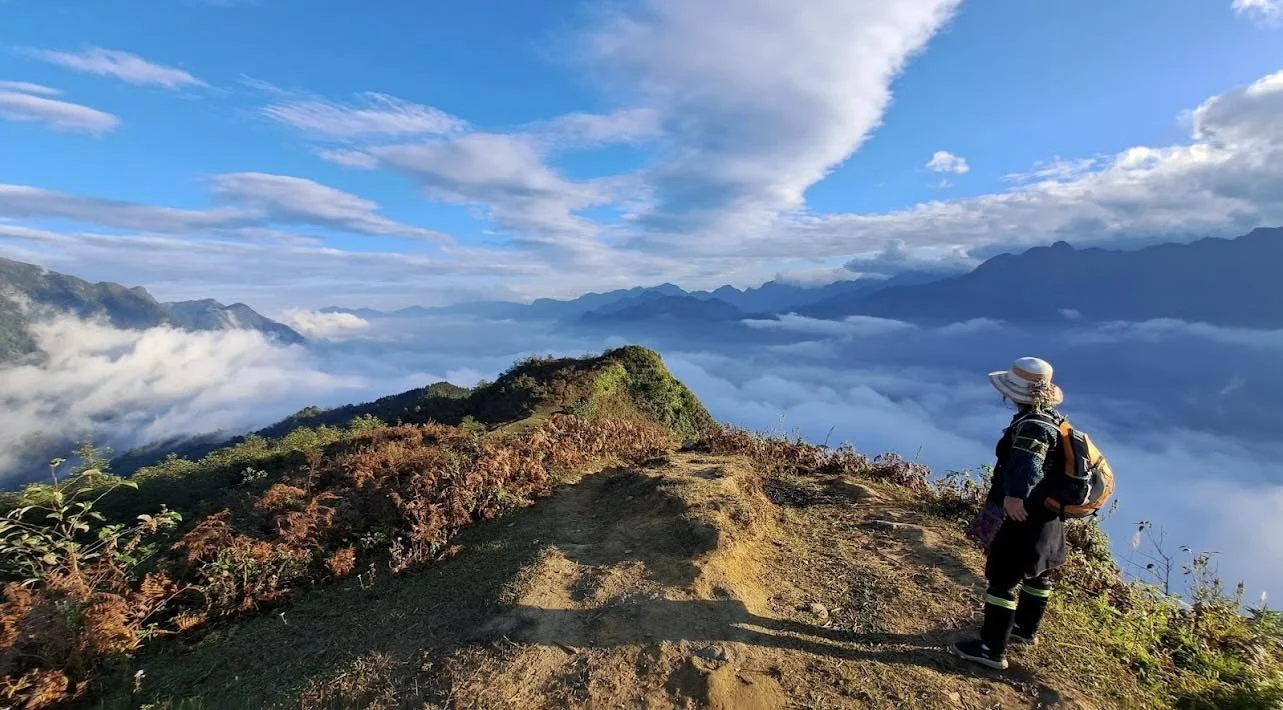
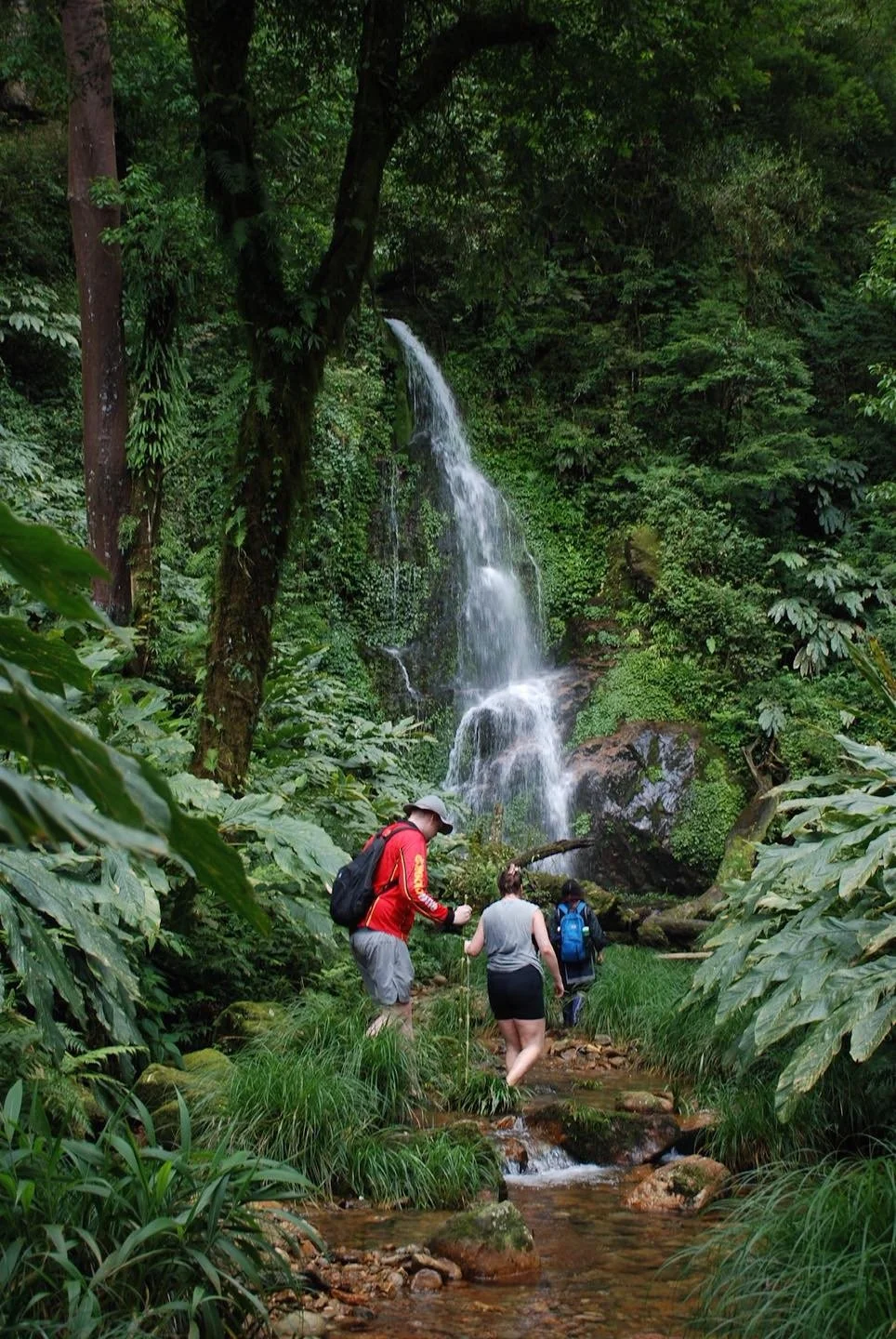
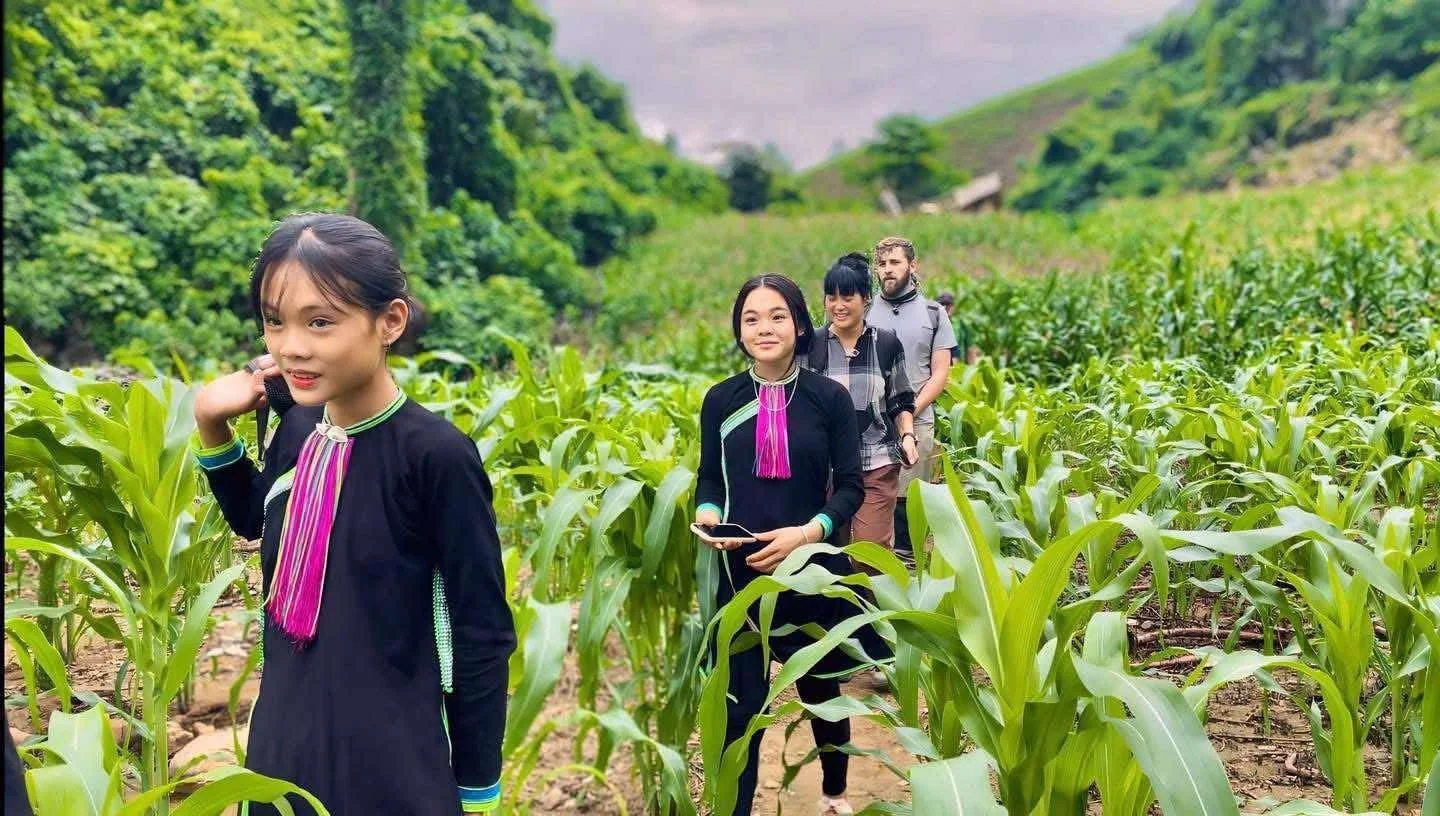
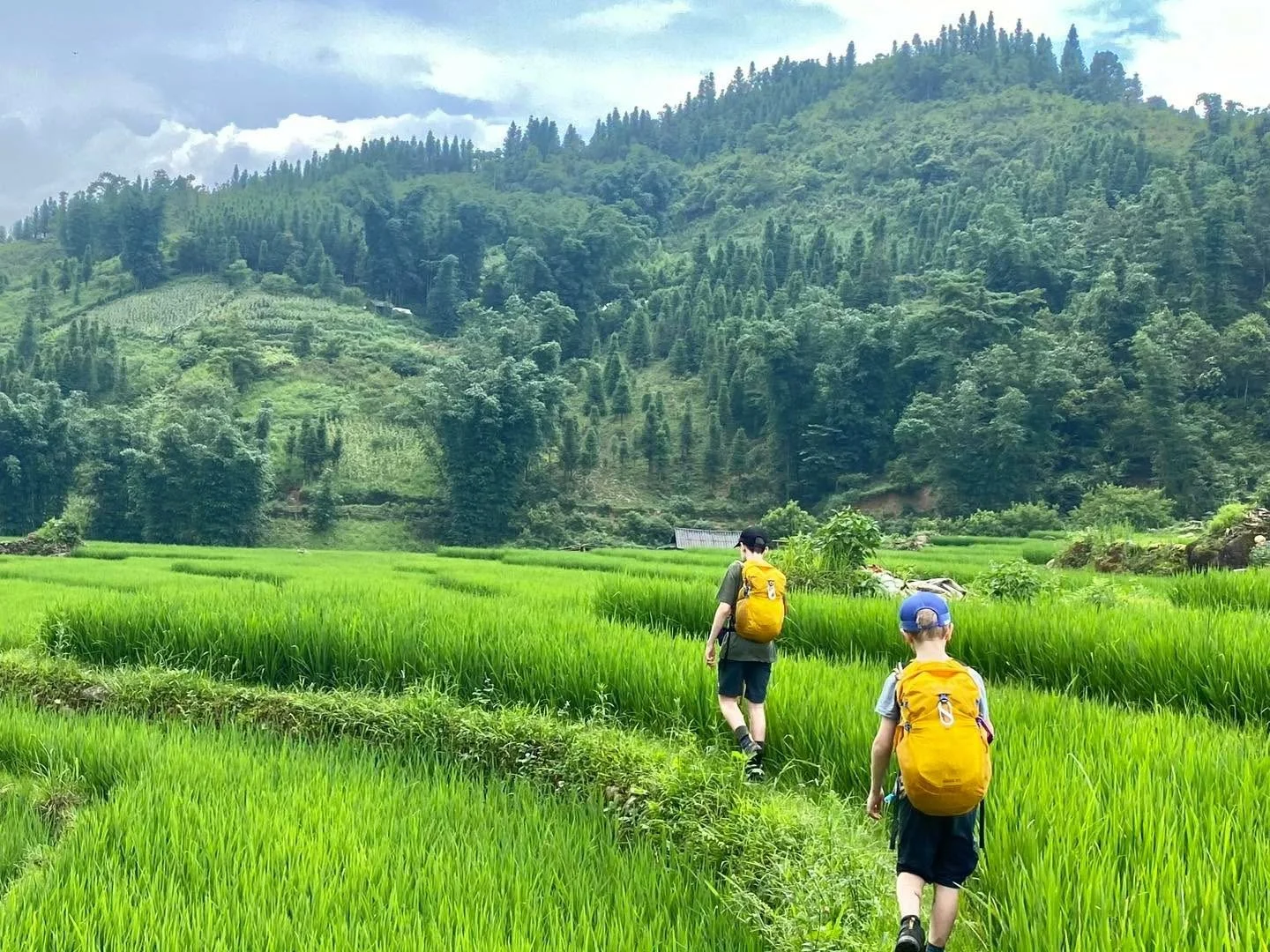
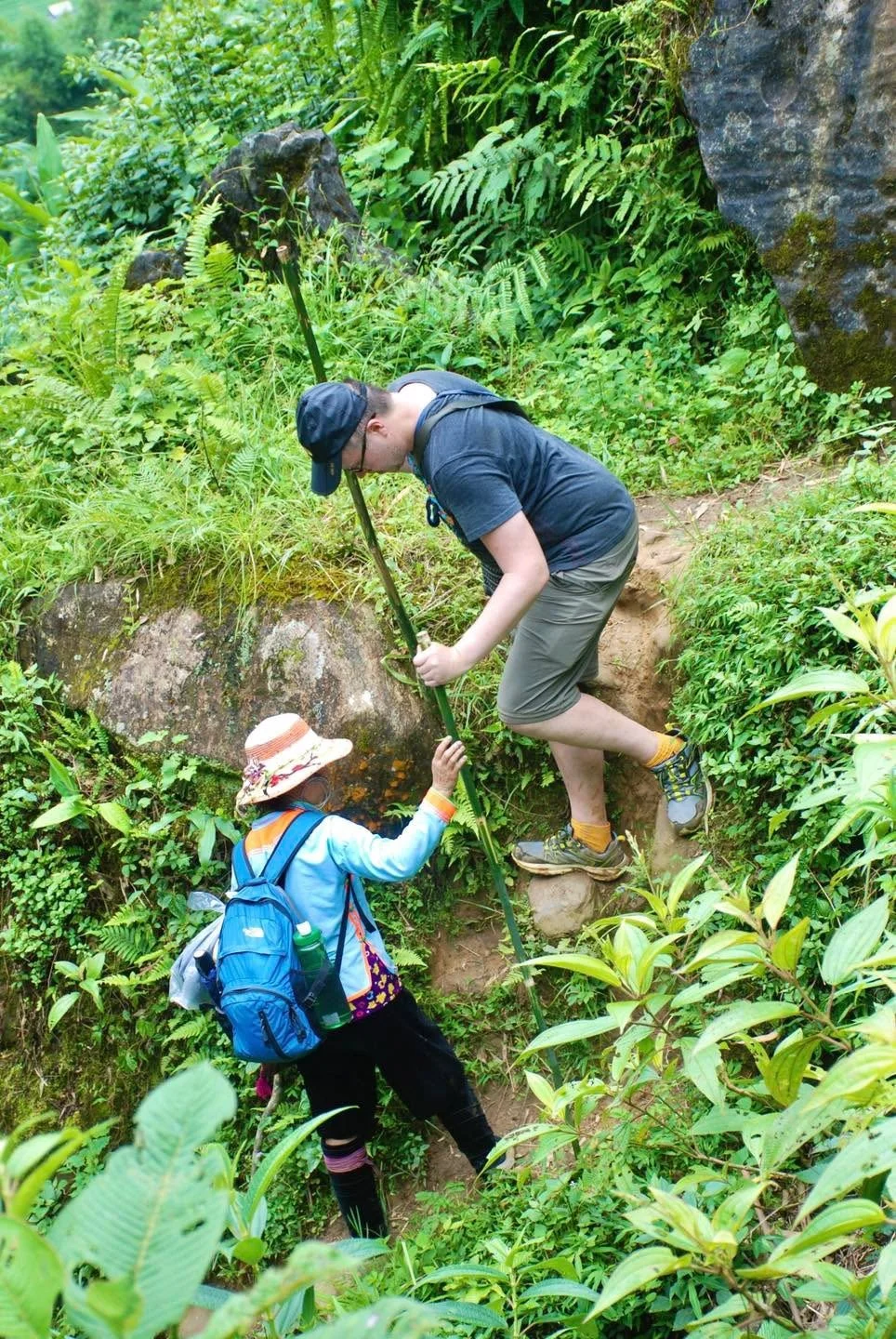
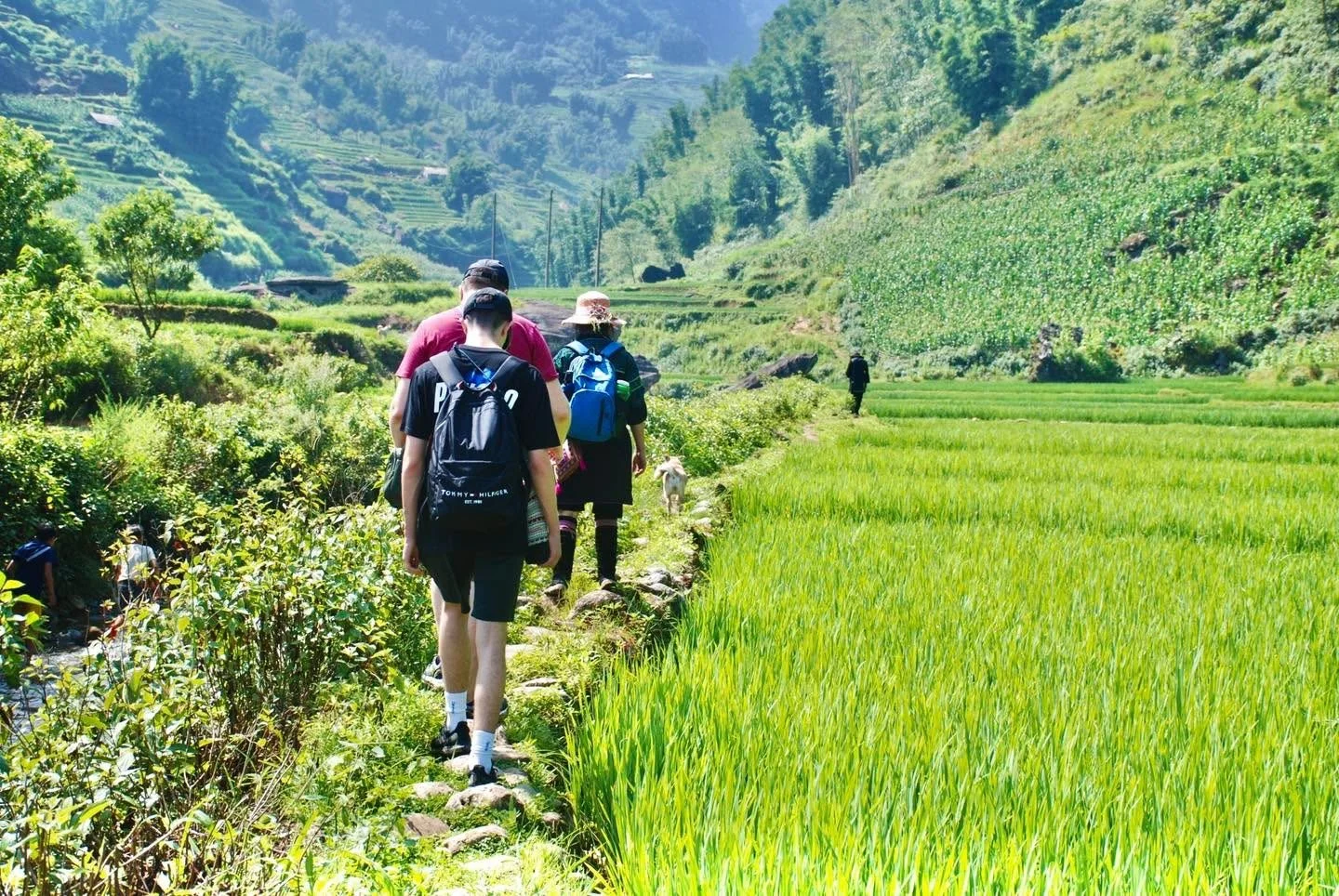

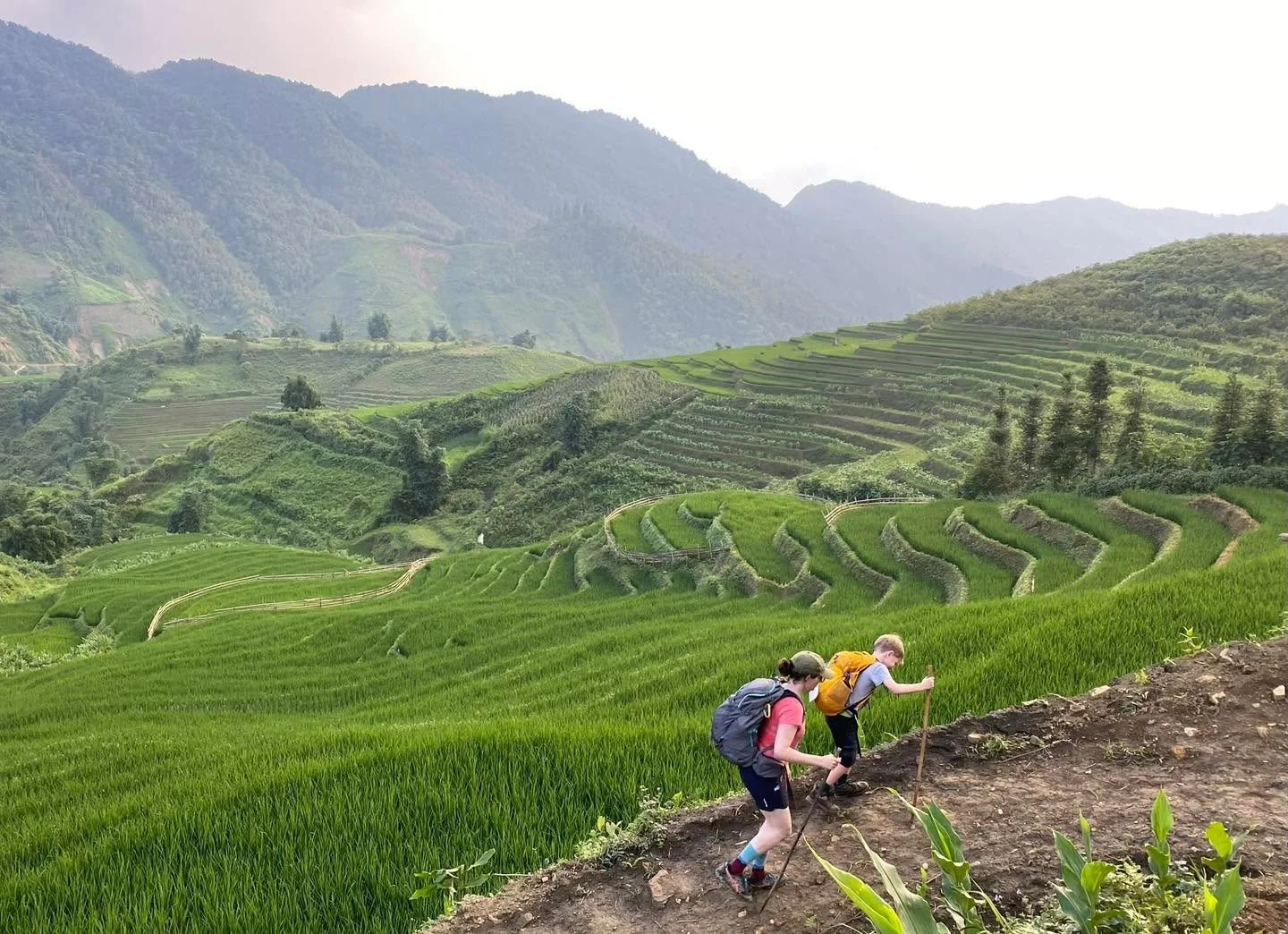
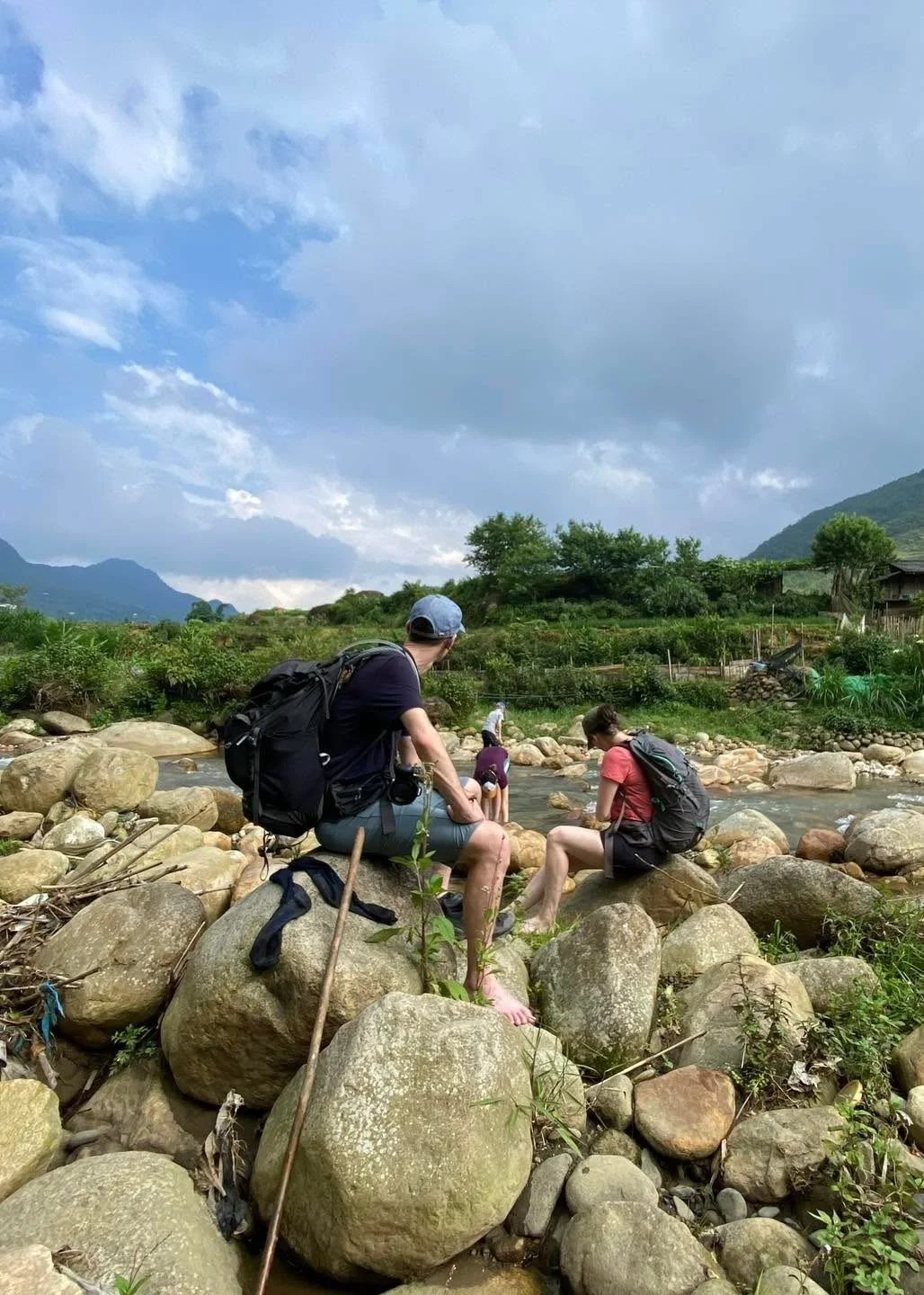
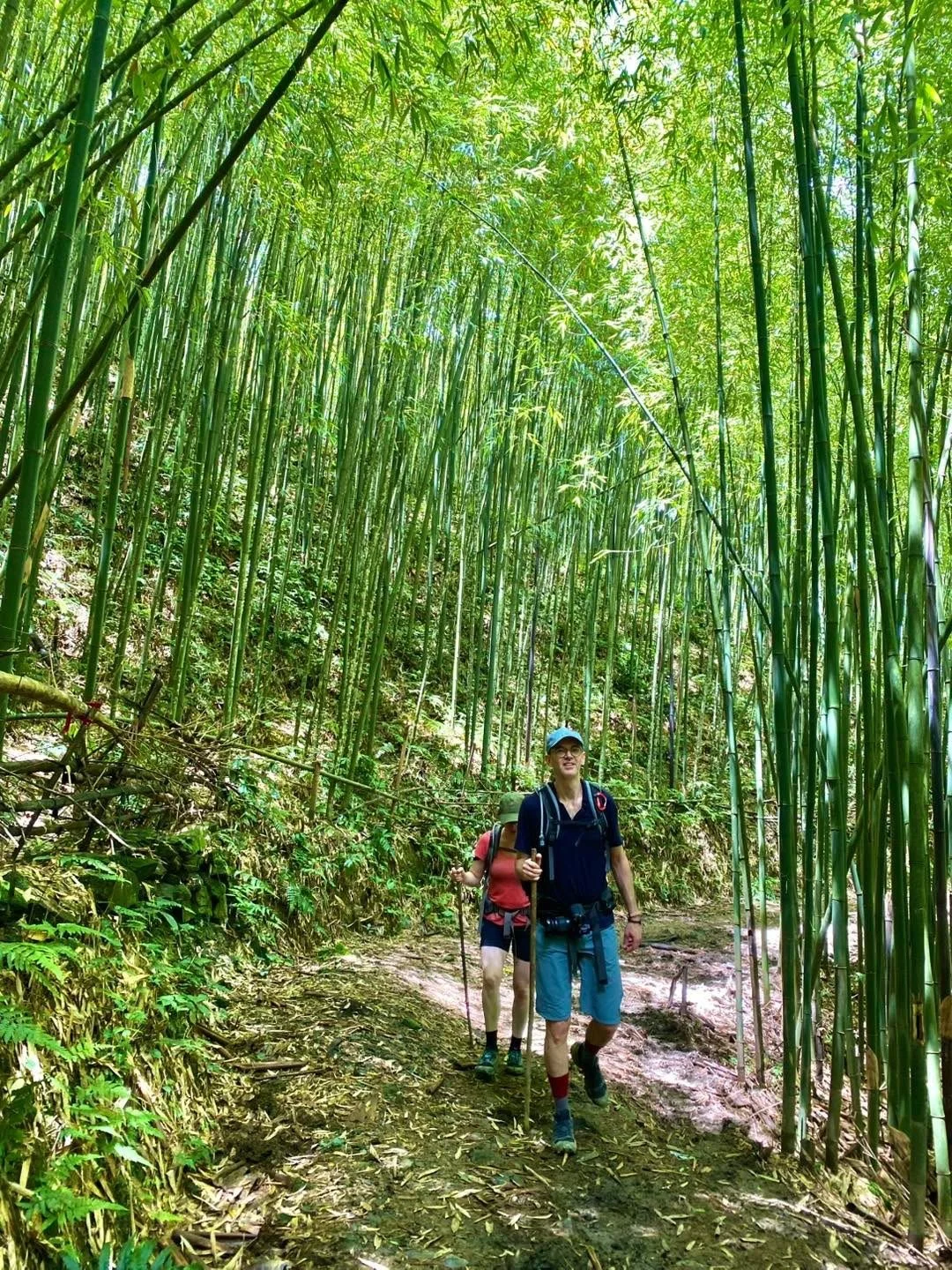
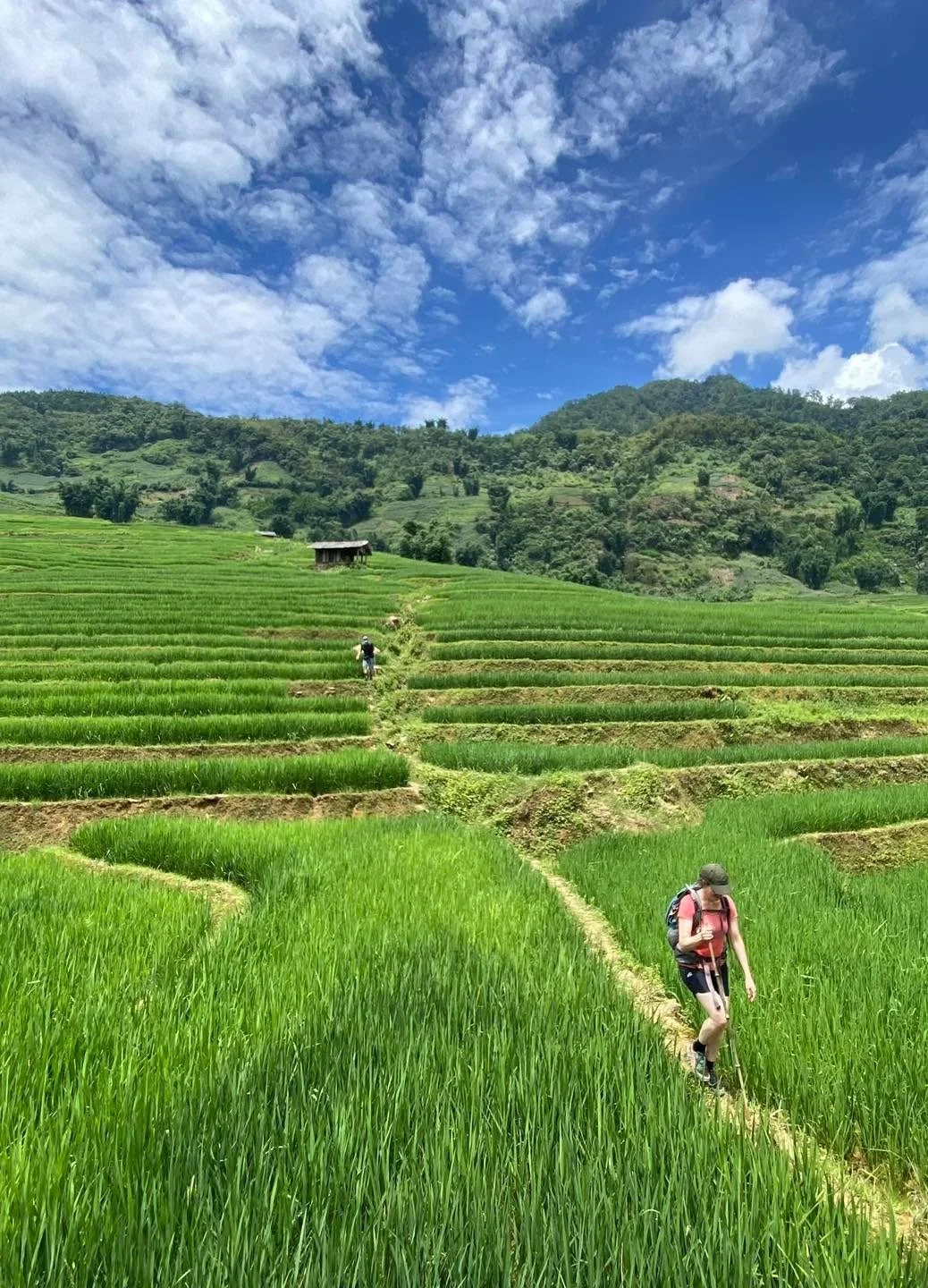
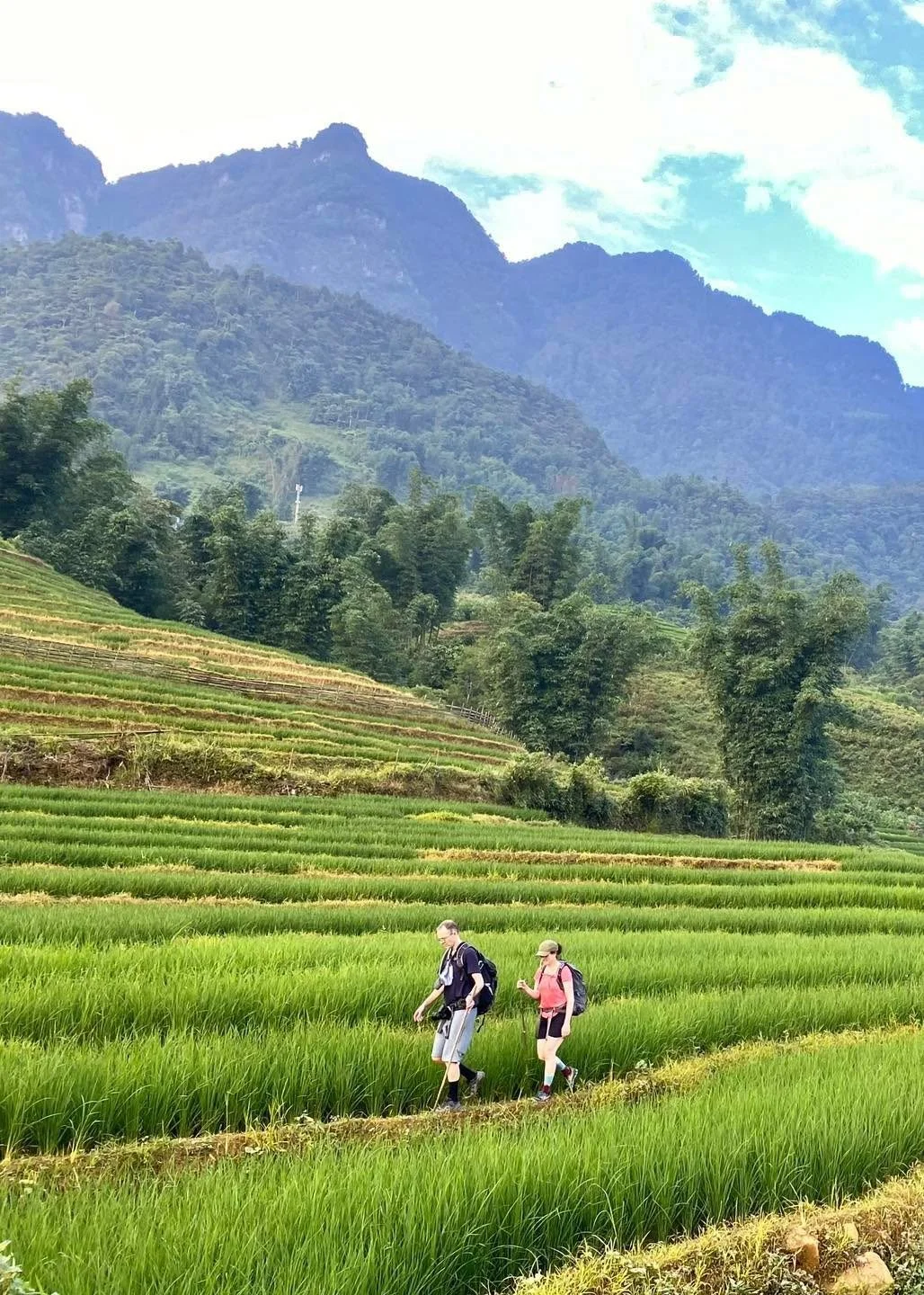
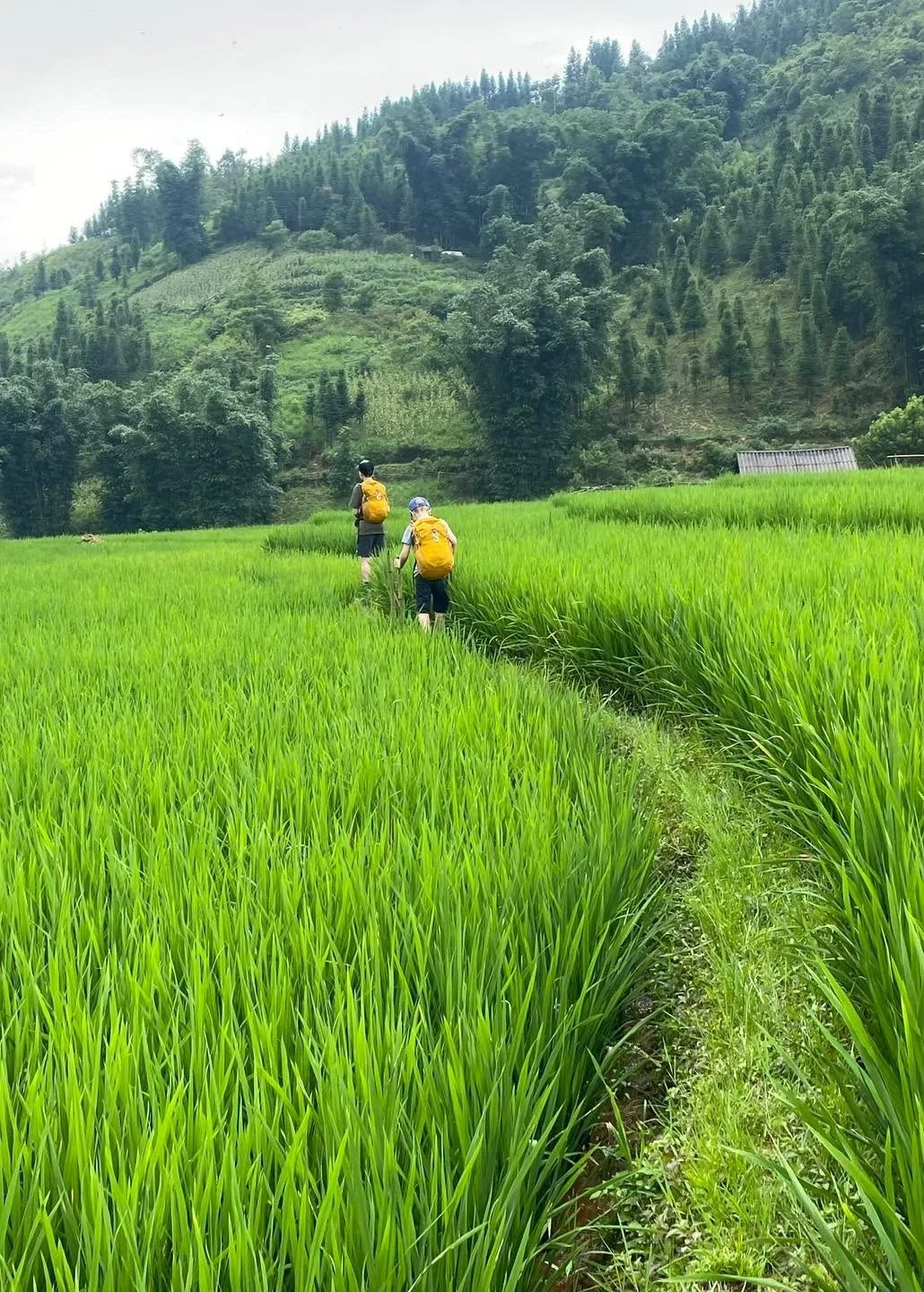
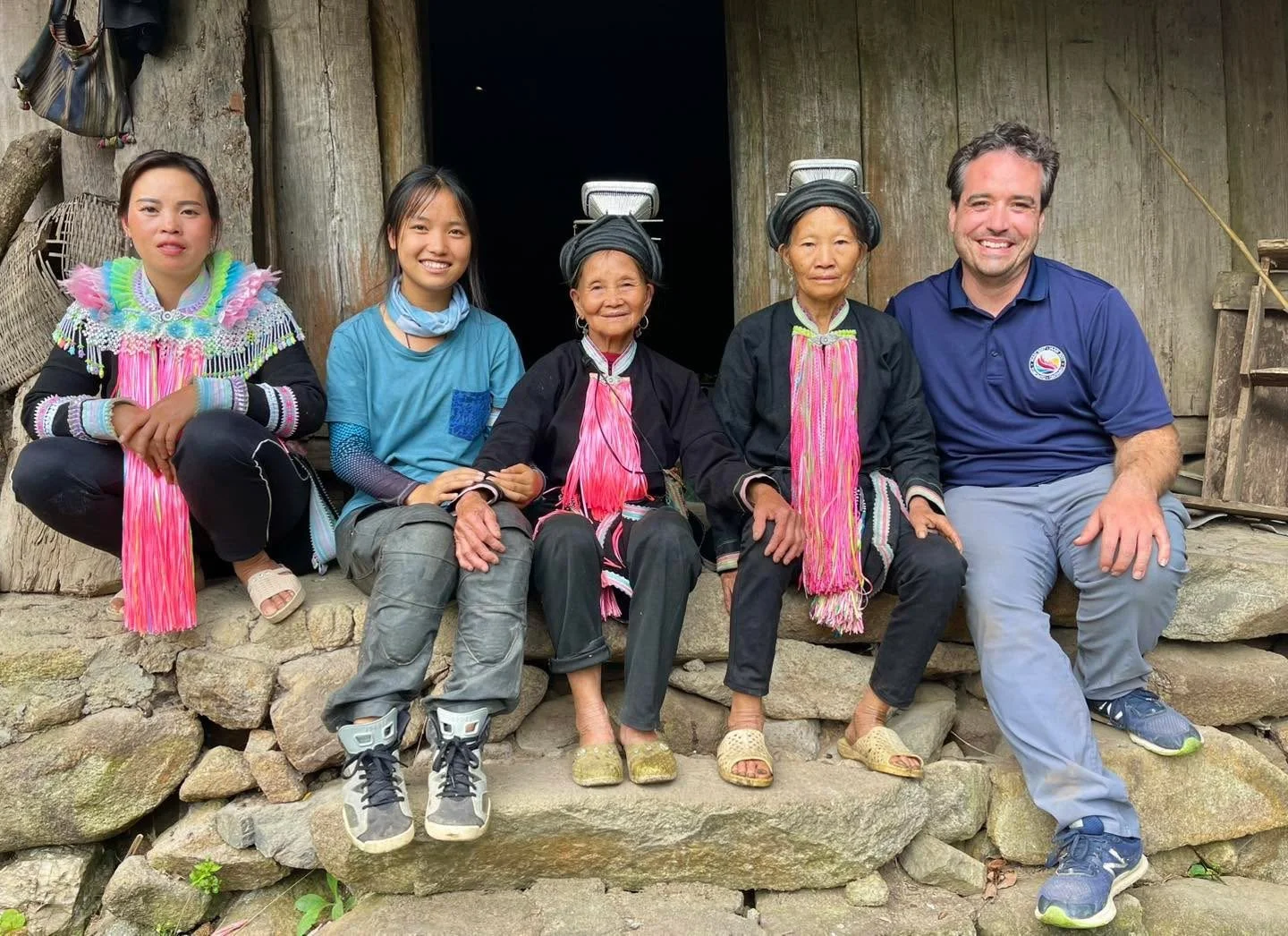


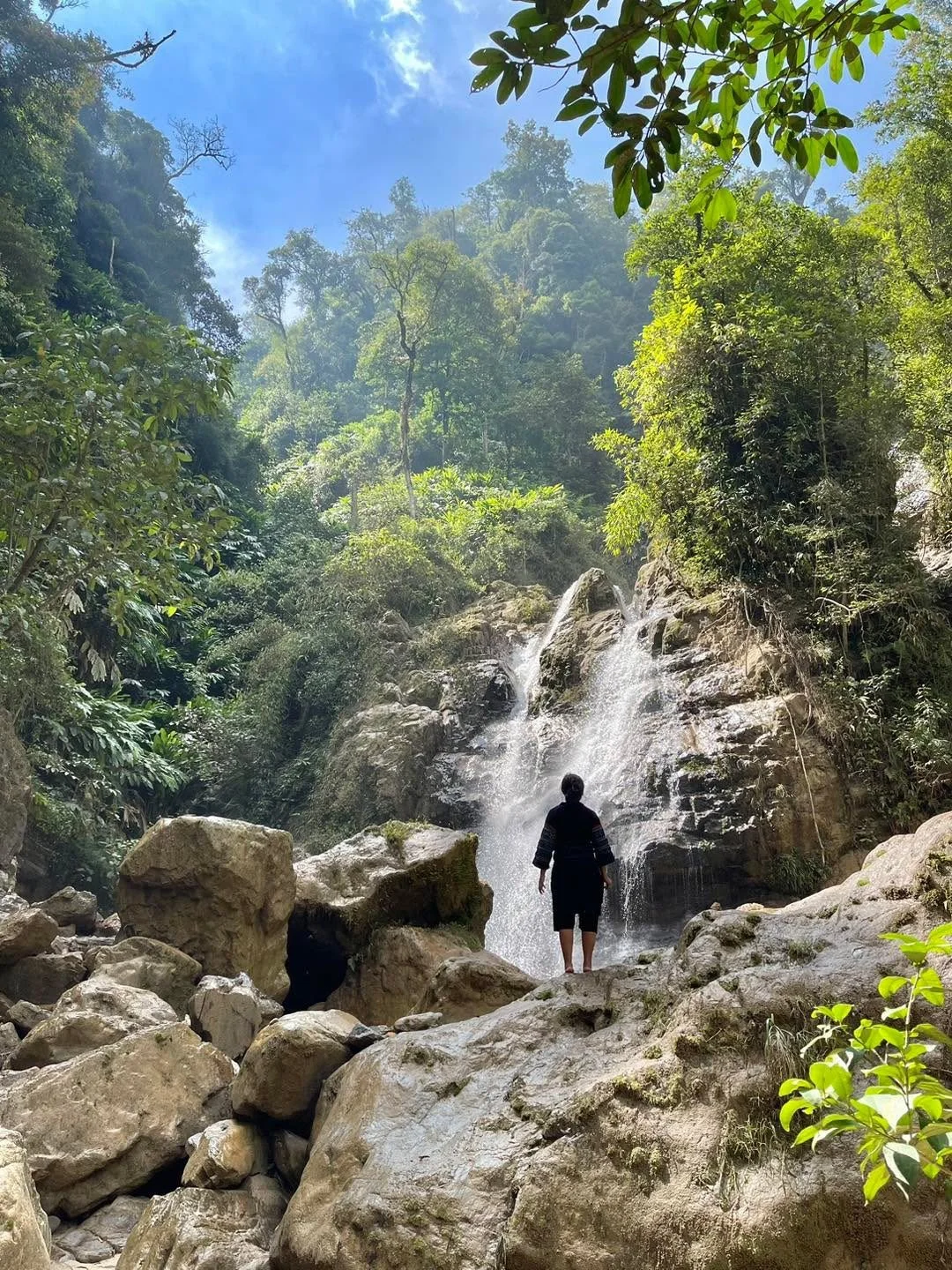
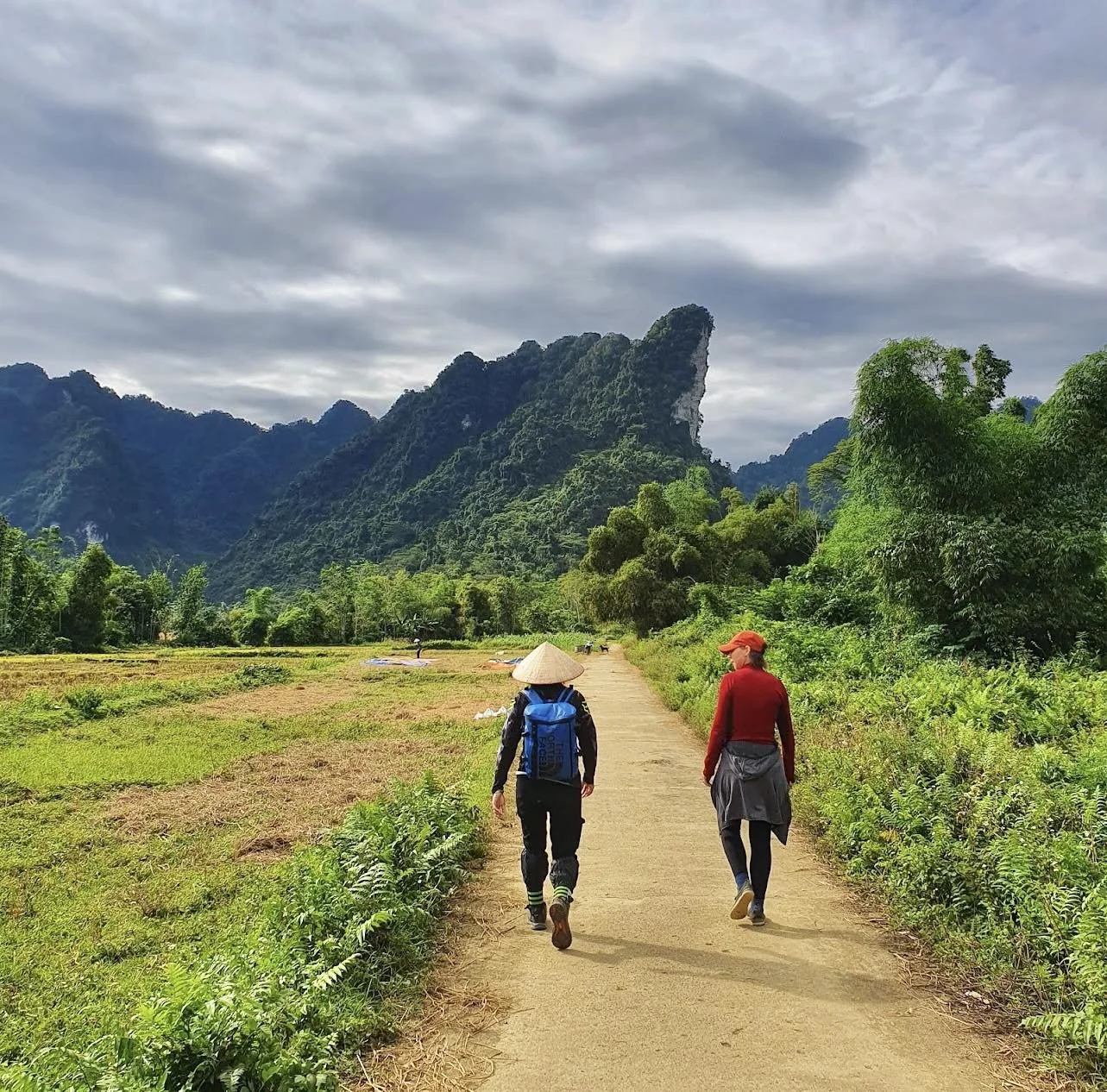
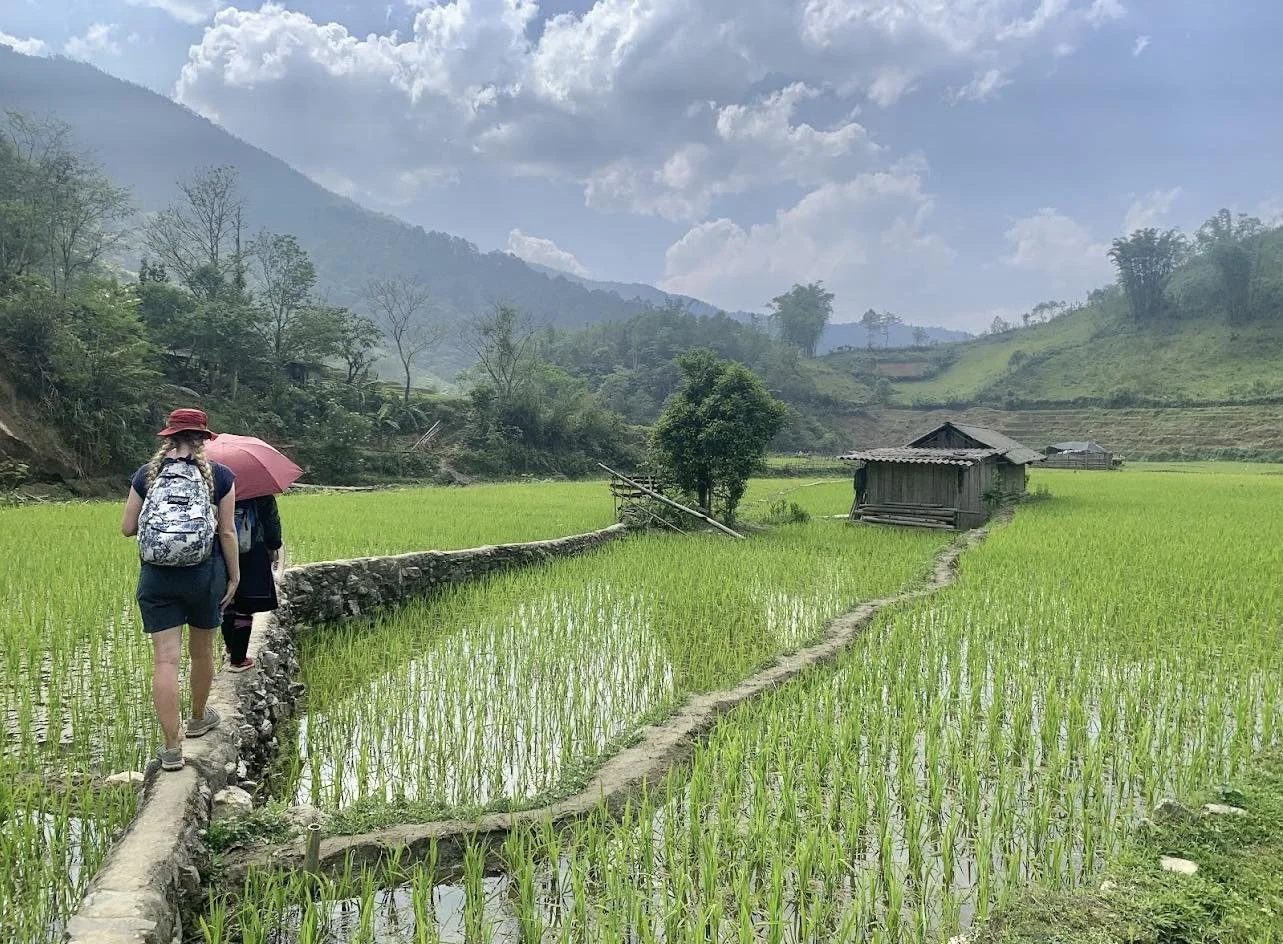
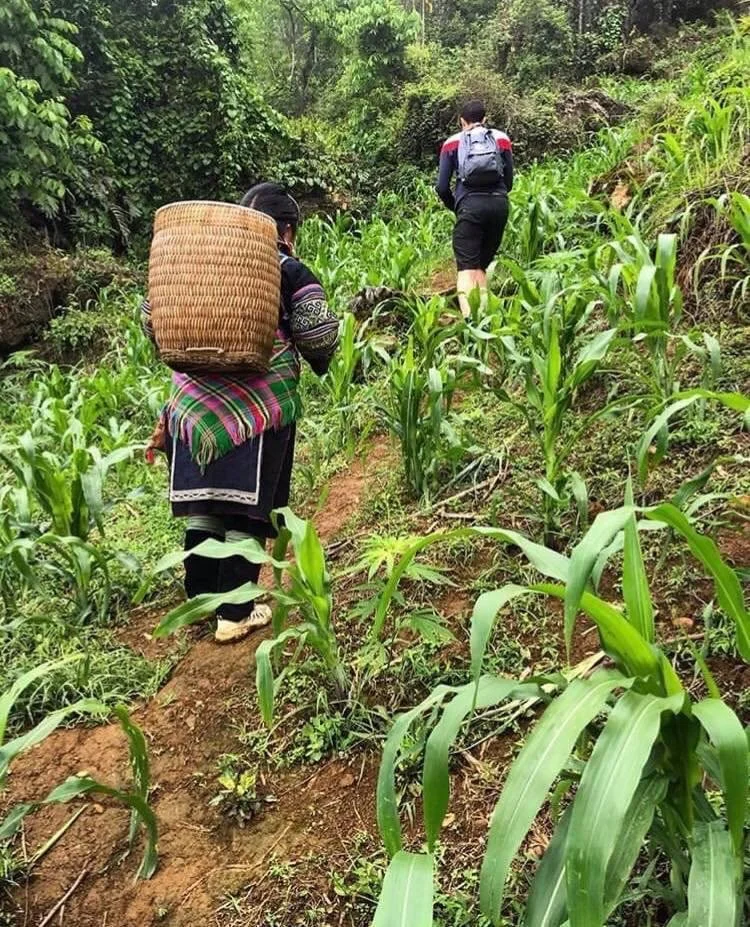
Northern Vietnam’s Mountain Markets: Where Culture Comes Alive
Explore the mountain markets of northern Vietnam lively spaces where culture, colour and community meet. Discover why Sapa’s Sunday market is a hidden gem.
A Living Portrait of the Highlands
There are few better ways to understand the rhythm of life in northern Vietnam than by wandering through a weekly mountain market. These gatherings are more than trading places; they are meeting grounds for entire communities. From the first light of dawn, the valleys fill with movement, people walking for hours along steep tracks, horses carrying bundles of herbs and woven baskets, the air thick with the scent of grilled corn and freshly cut bamboo.
Markets in the highlands are living, breathing portraits of culture. They are where stories are exchanged as freely as goods, where a smile or a gesture can bridge the gap between strangers, and where traditions that have endured for centuries still unfold in the open.
The Pulse of the Hills
The larger, more established markets draw crowds from the surrounding villages. Visitors often arrive in their finest embroidered clothes, patterns gleaming in the sunlight. Here, they sell or trade livestock, handwoven textiles, traditional medicines, foraged herbs, wild honey, and freshly harvested fruits and vegetables. The soundscape is a mix of conversation, bargaining, laughter, and the rhythmic clatter of hooves on stone.
Markets such as Bac Ha and Dong Van have become well known to travellers for their scale and colour. They remain impressive, no doubt, but sometimes the smaller, quieter places hold the deepest charm.
Sapa’s Hidden Gem
The Sunday market in Sapa is one of those gems that travellers too often overlook. Nestled among misty hills, it remains one of the most authentic and characterful ethnic markets in northern Vietnam.
Arrive early, ideally between 7am and 11am, when the morning is at its most vibrant. The stalls brim with life, bright woven skirts, silver jewellery, baskets of mushrooms and wild ginger, and steaming bowls of noodle soup shared over laughter.
The market is a meeting point for the Black Hmong, Red Dao, and Giay communities. On most weekends, Tay and Thai villagers make the journey too, adding to the lively mix of languages, colours, and customs.
The best times to visit are during the post-harvest months (September) and before Tet New Year (late January), when people travel from afar to trade, prepare for celebrations, and reunite with friends and relatives.
More Than a Market
To wander through Sapa Market is to witness a beautiful balance between change and continuity. While modern influences have inevitably crept in, with plastic goods beside handwoven cloth and the occasional smartphone flashing among the stalls, the heart of the market remains unmistakably traditional.
What makes it so special is not the transaction but the atmosphere. It is the way a Dao woman adjusts her headdress in a polished mirror, or how a Hmong grandmother laughs as a grandchild tries to carry a basket twice their size. These small moments capture something more meaningful than any souvenir ever could.
Visiting Responsibly
As with all cultural encounters, mindful travel matters. Ask before taking photographs, buy directly from the artisans, and avoid overbargaining. A respectful exchange is part of what keeps these markets alive, ensuring that local people benefit from the growing interest in their craft and culture.
ETHOS encourages visitors to see markets not as attractions but as invitations, opportunities to slow down, listen, and learn.
For those drawn to authenticity, Sapa Market remains one of northern Vietnam’s most genuine and rewarding experiences. It is a window into community, resilience, and the enduring artistry of mountain life.
Learn more about exploring Vietnam’s northern markets with purpose and respect at ETHOS Spirit of the Community.
Photo Credit: Lý Cha
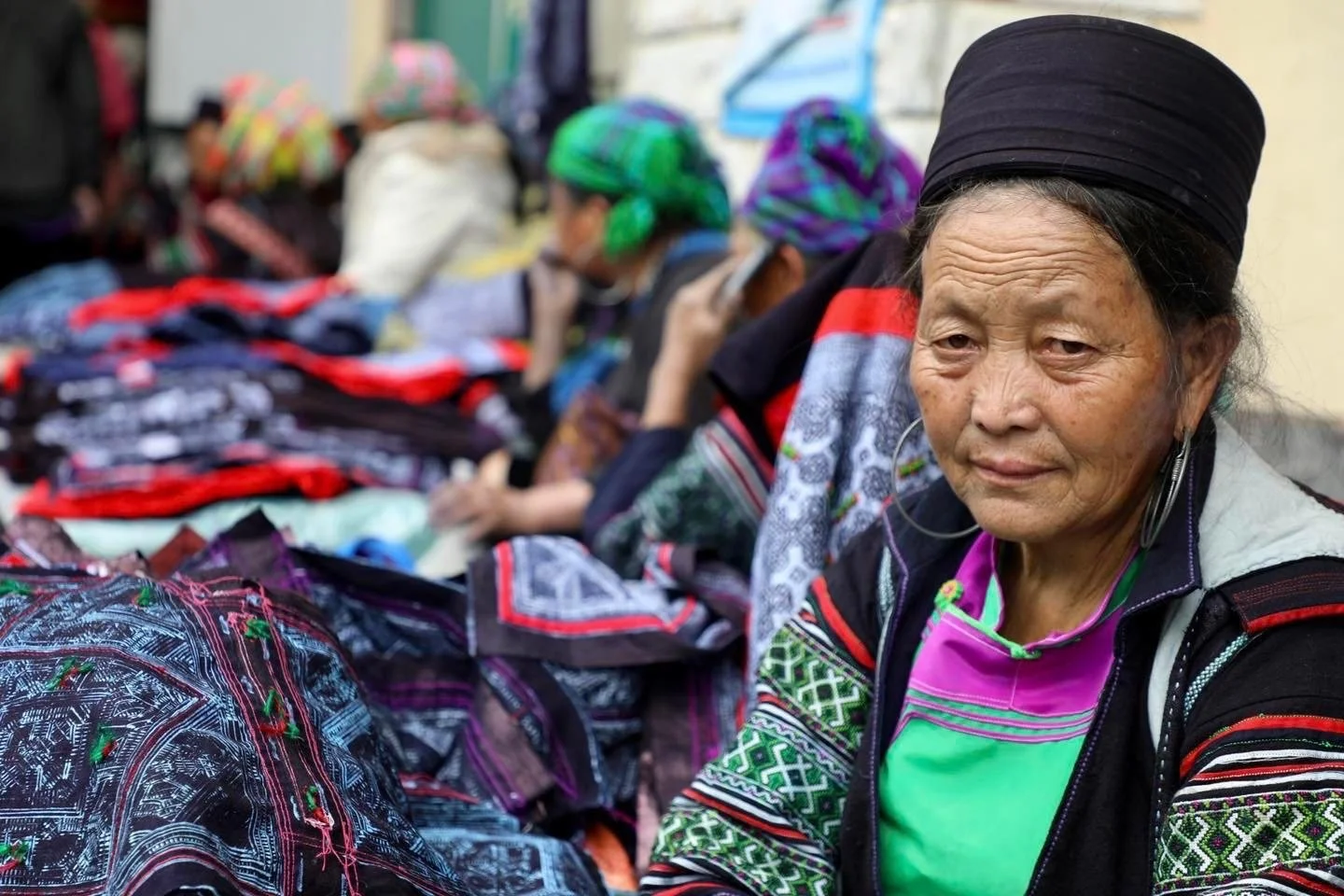
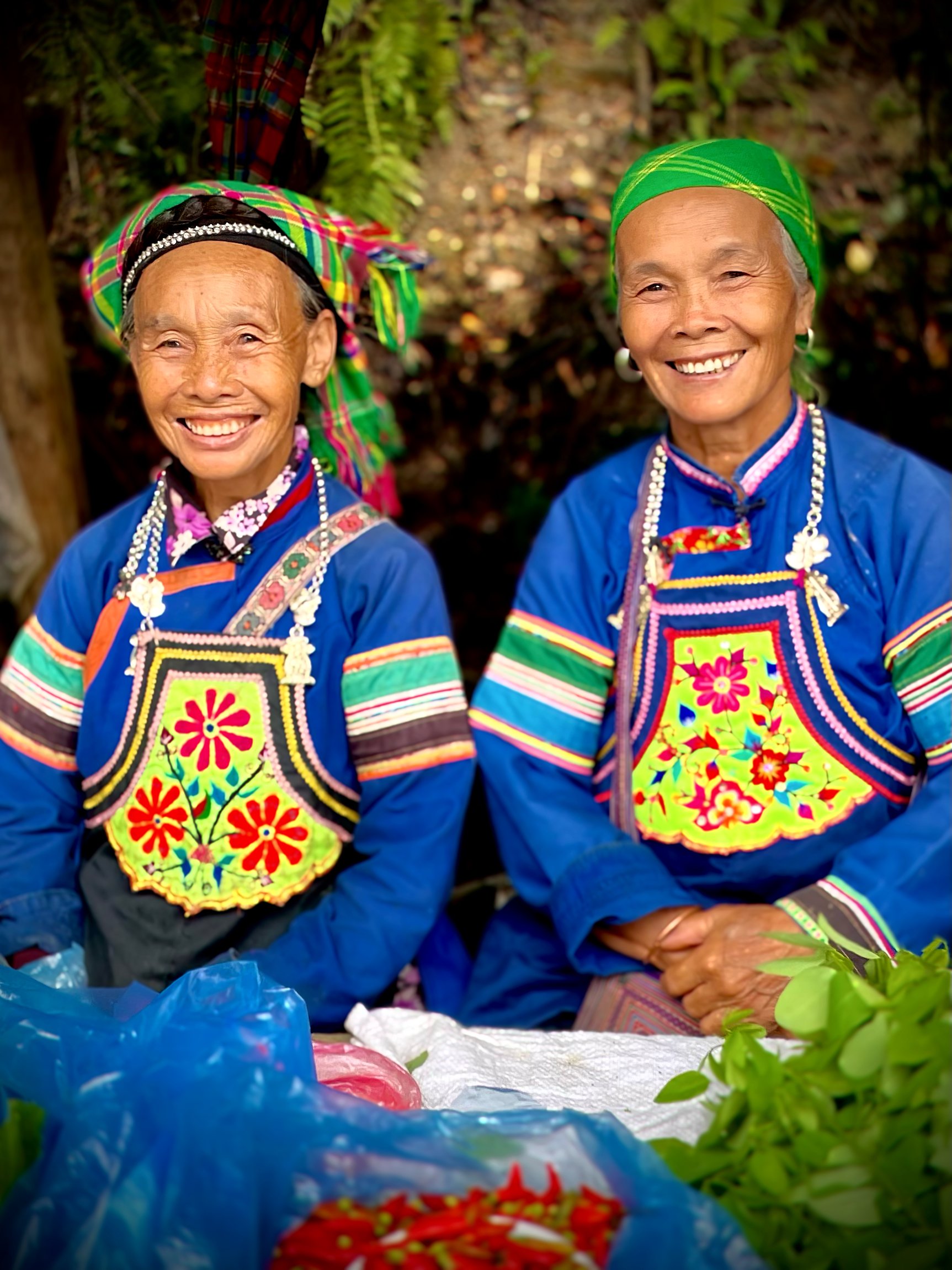
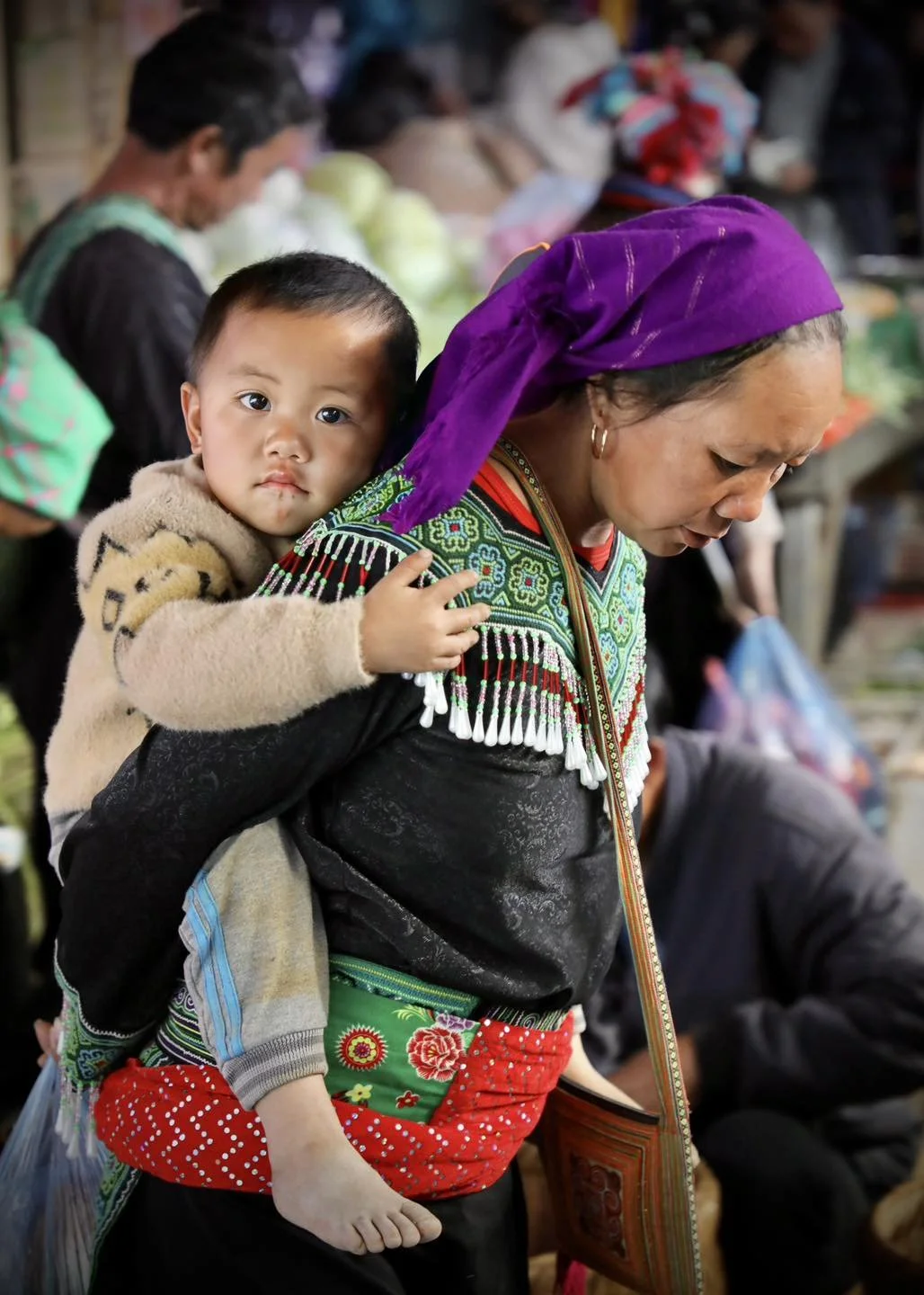

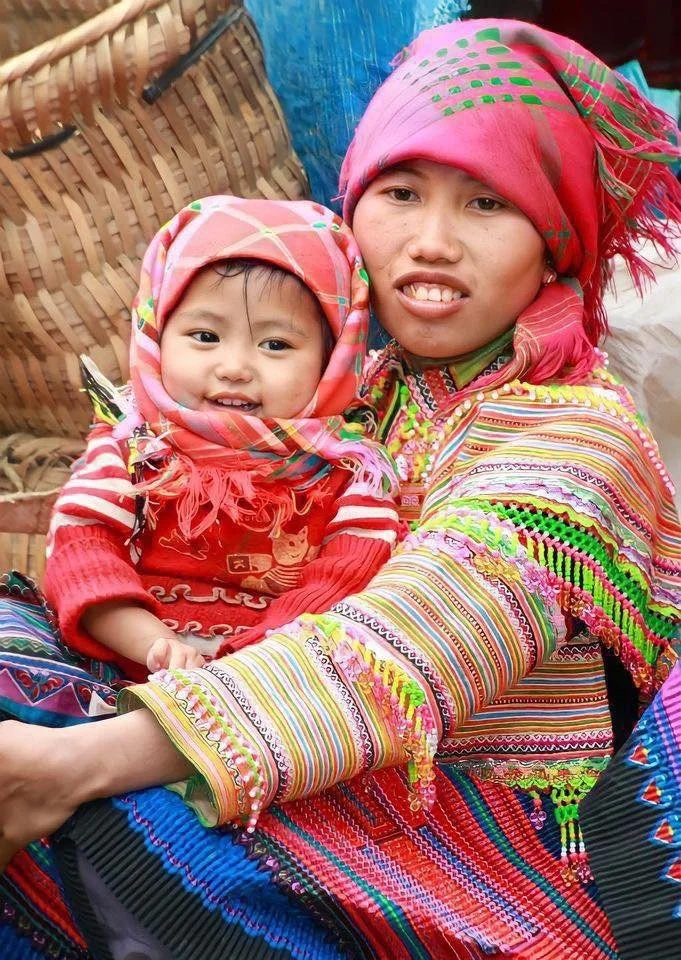
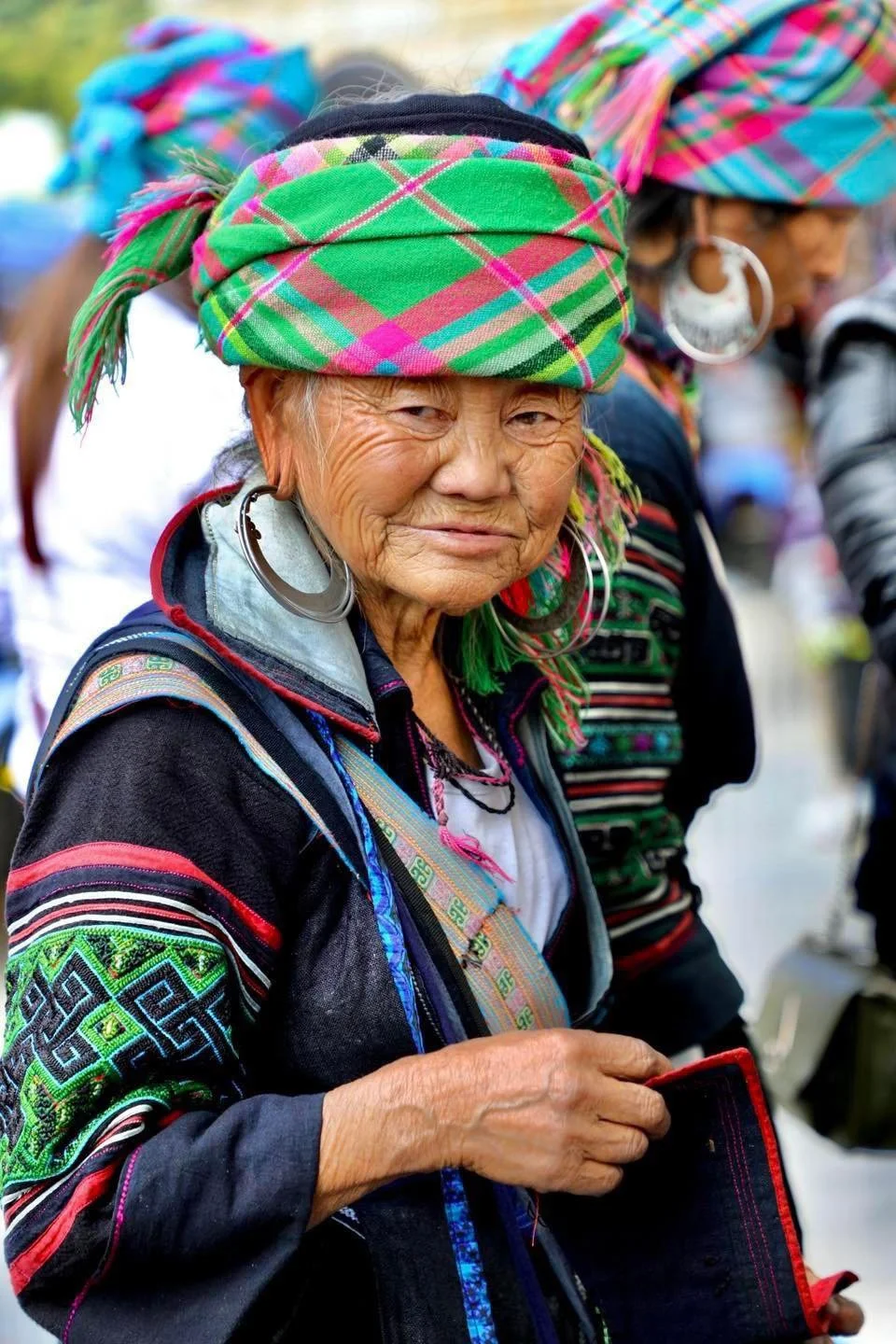
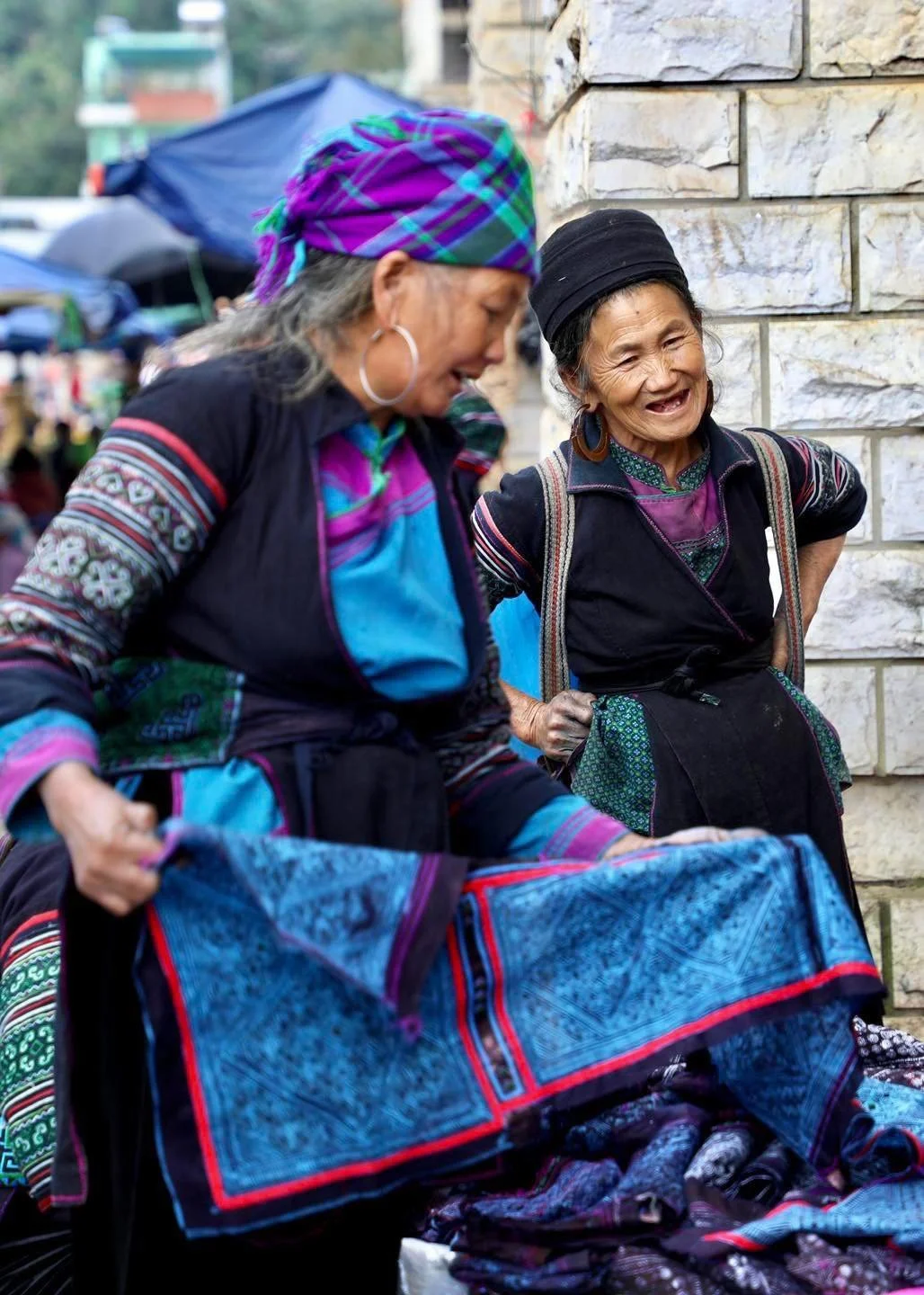

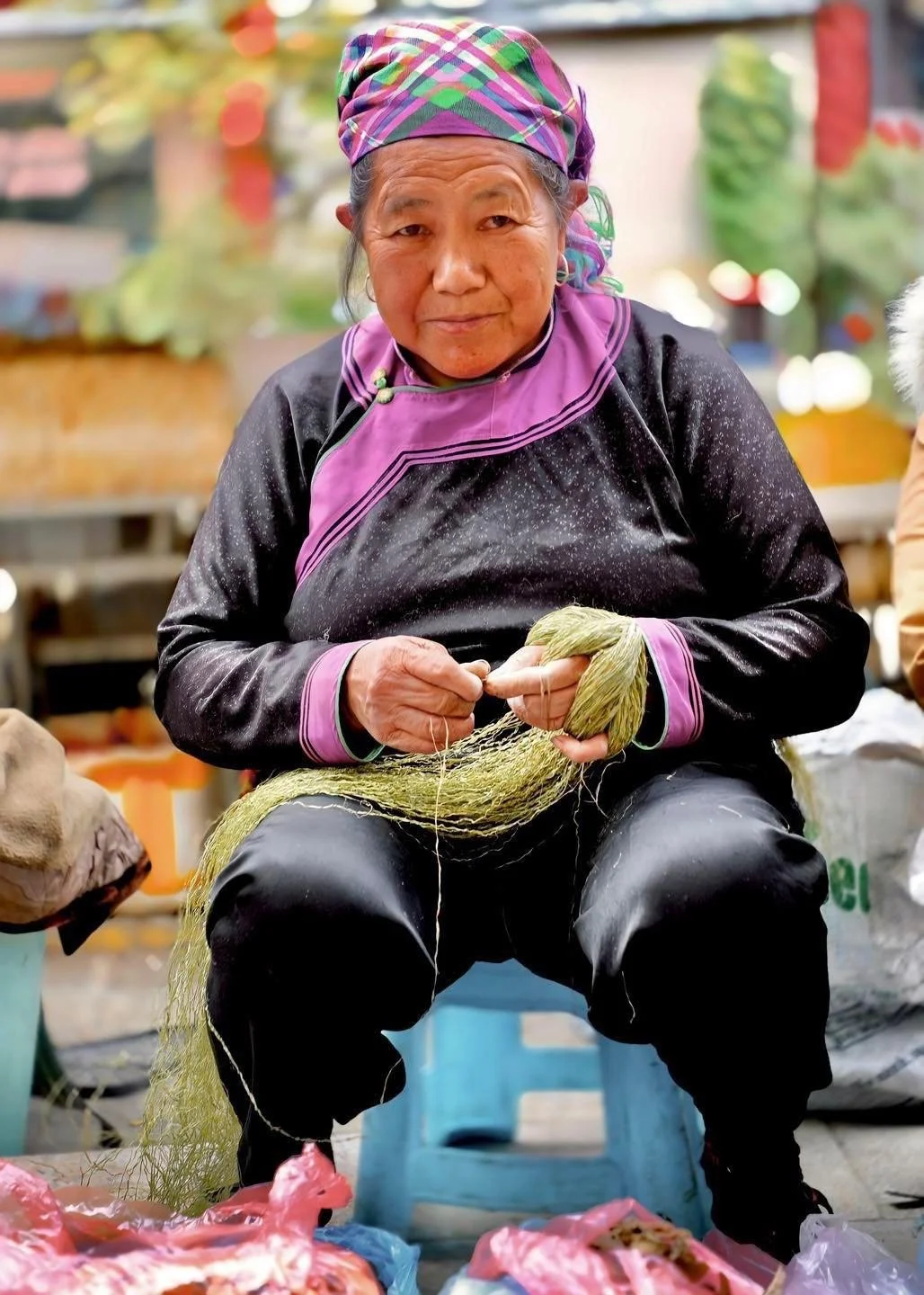
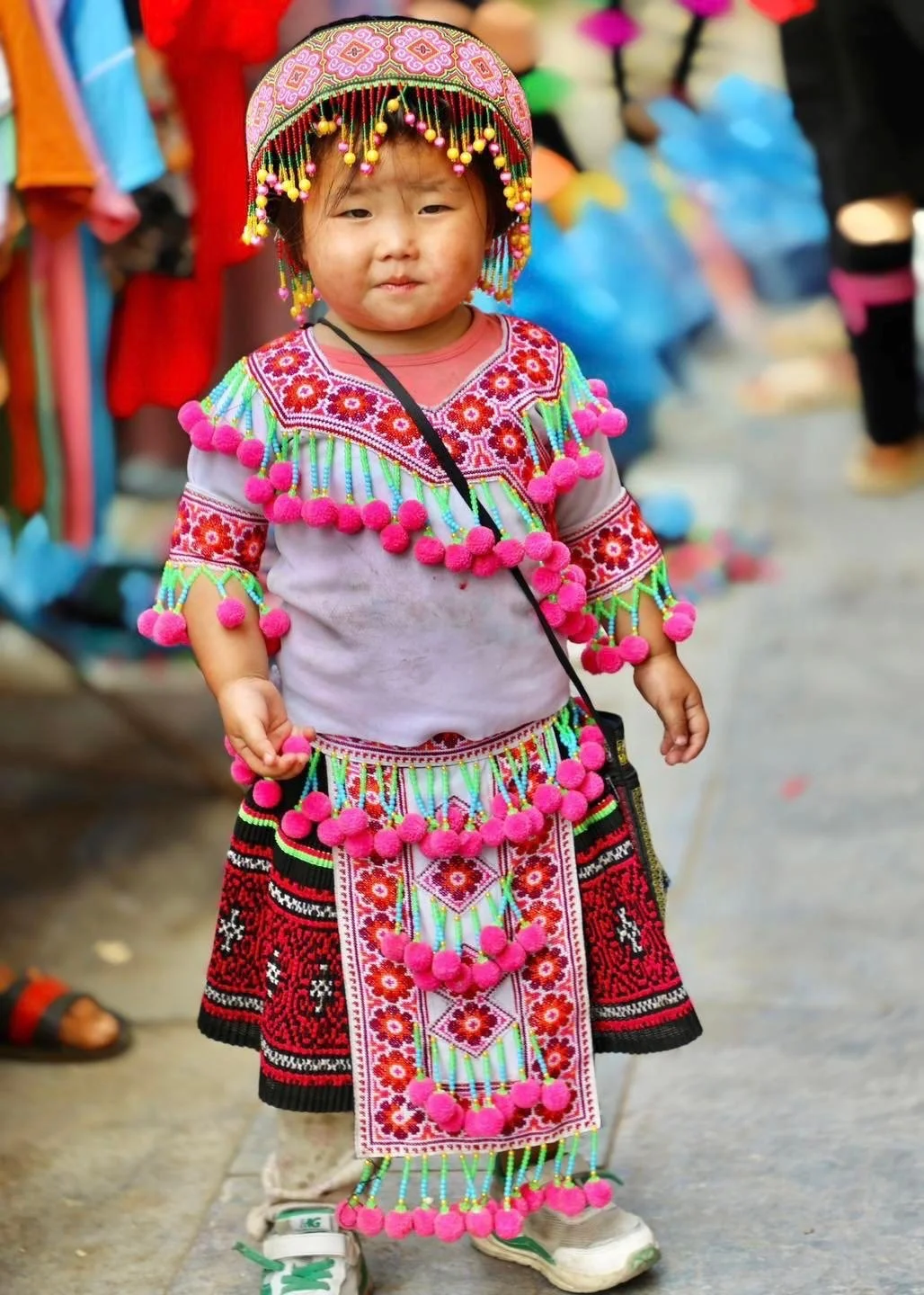
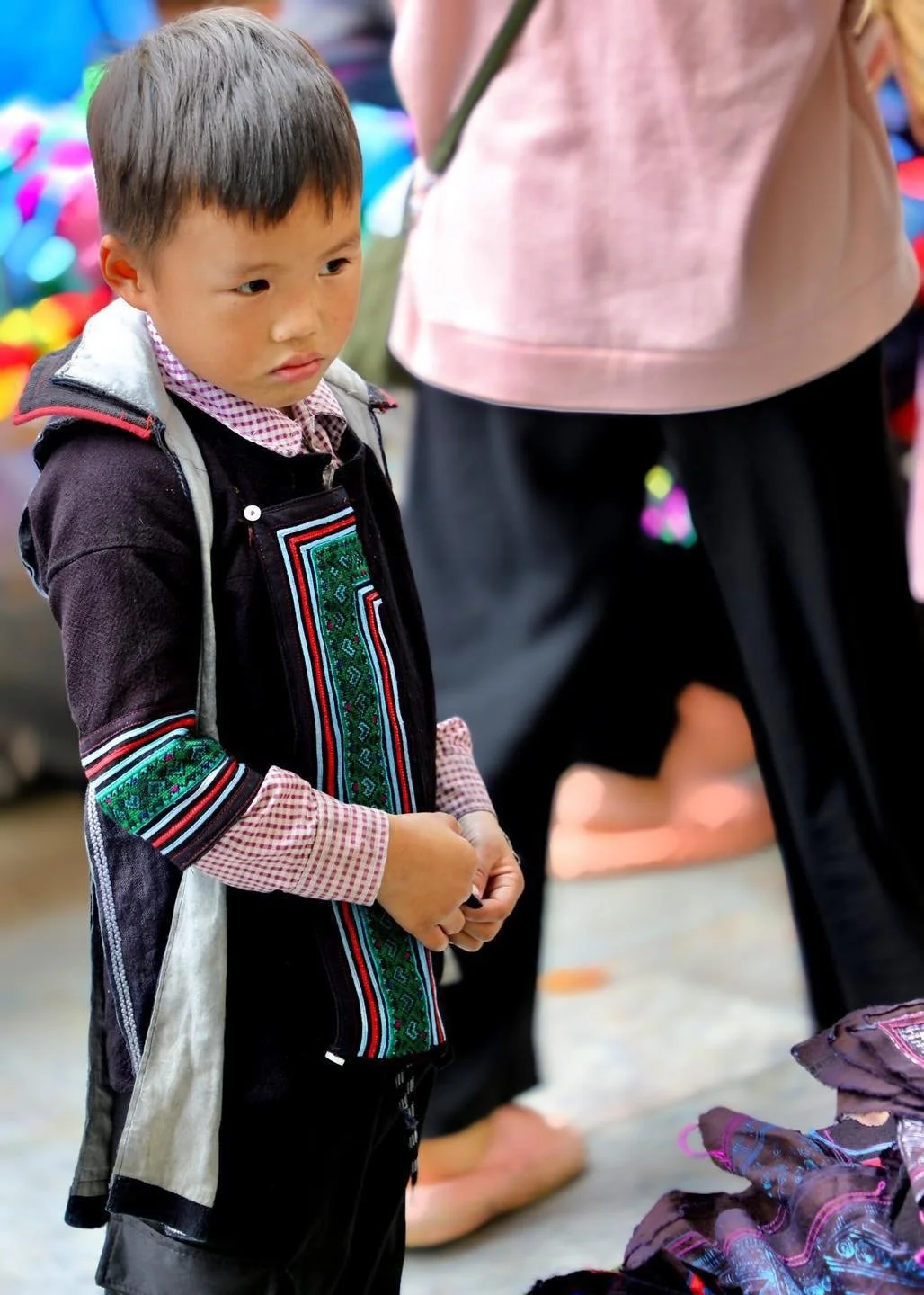
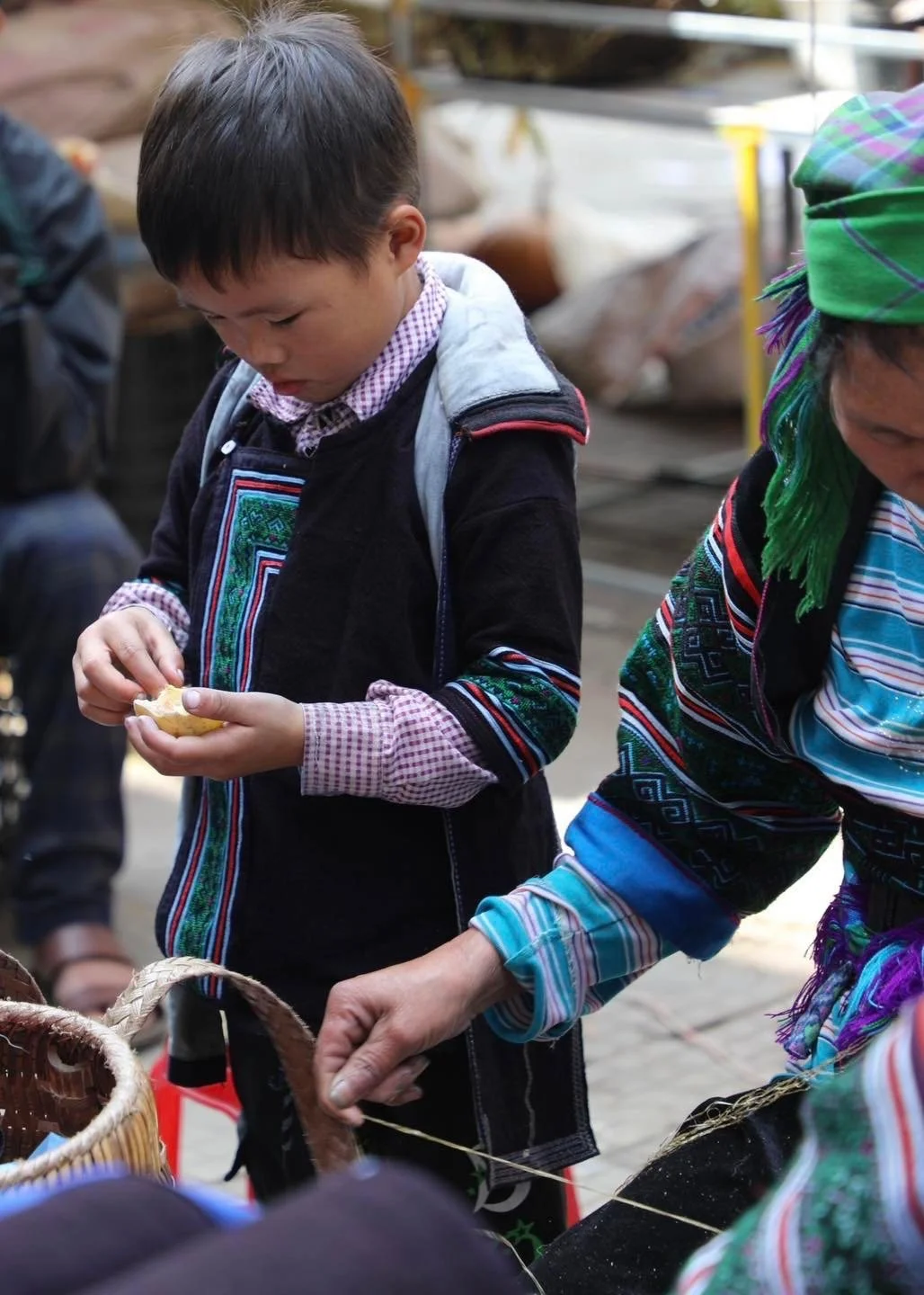
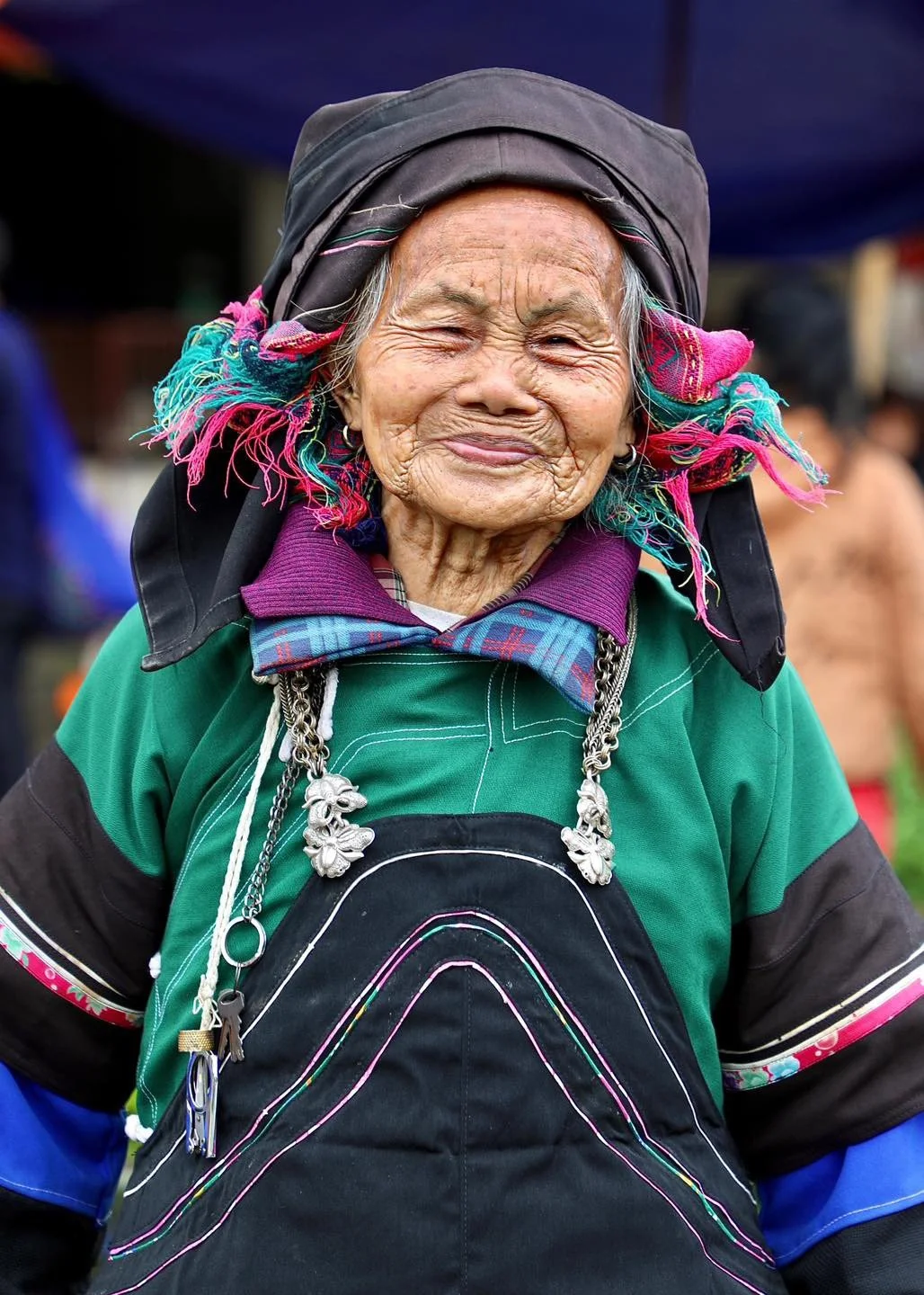
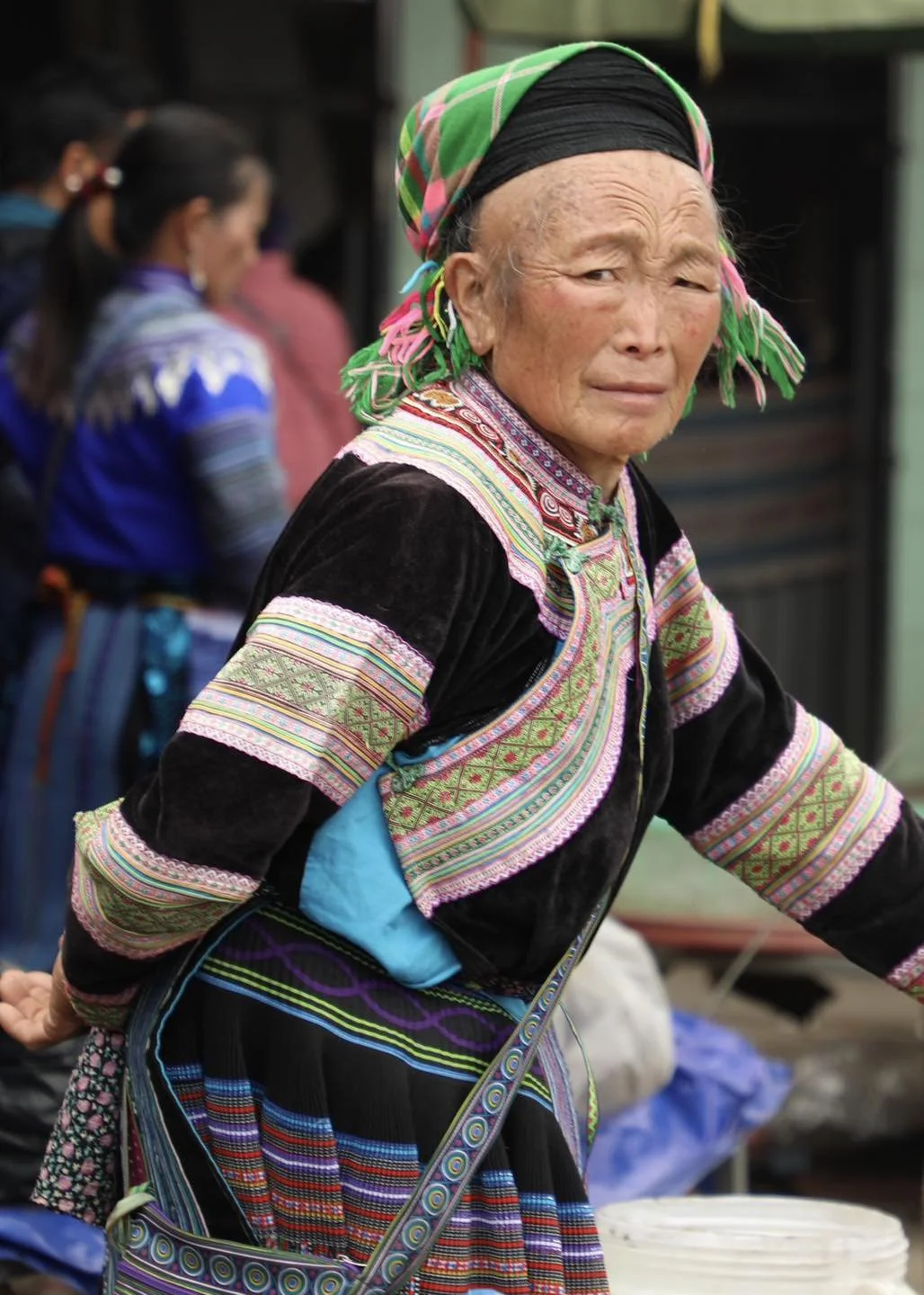
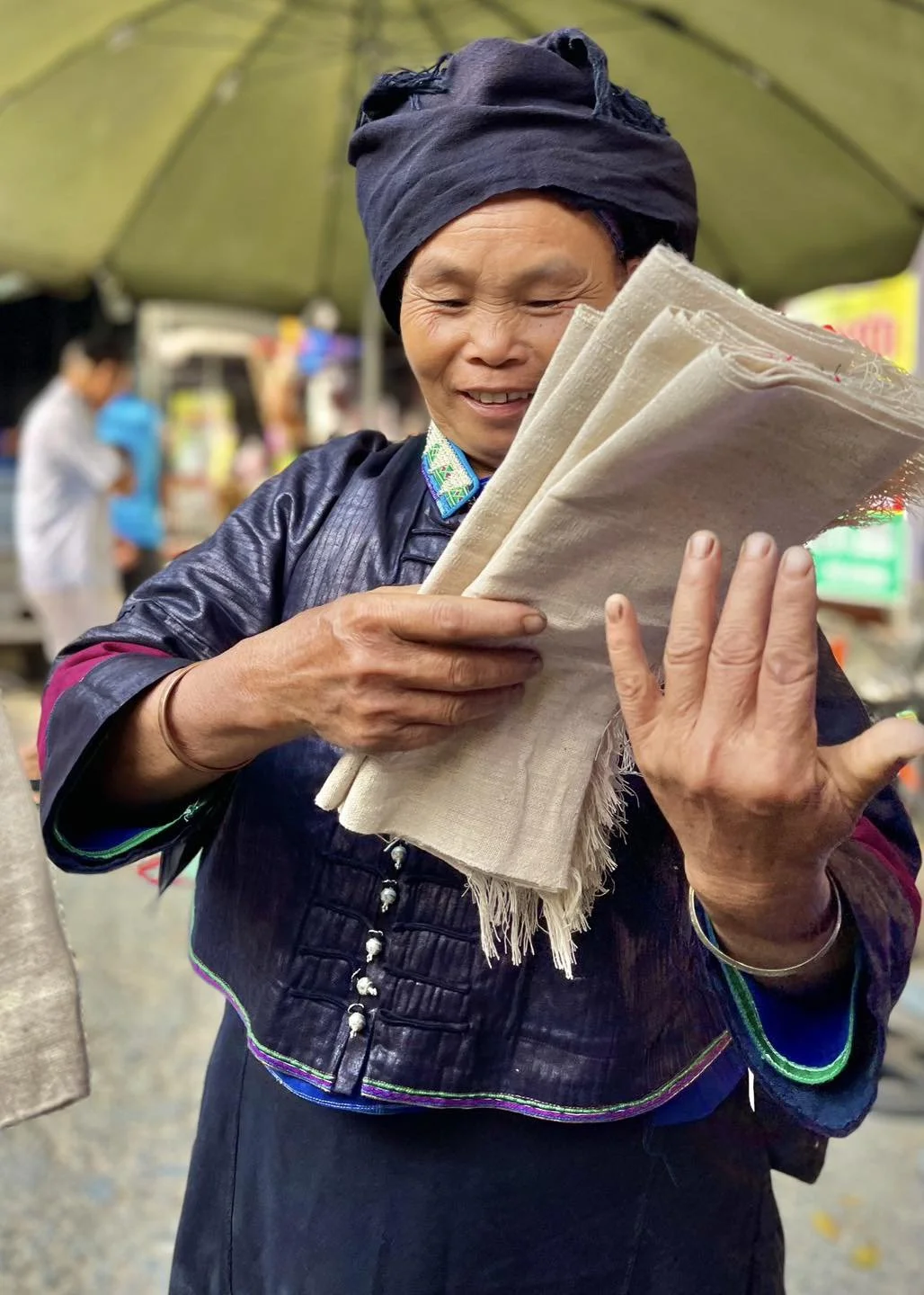
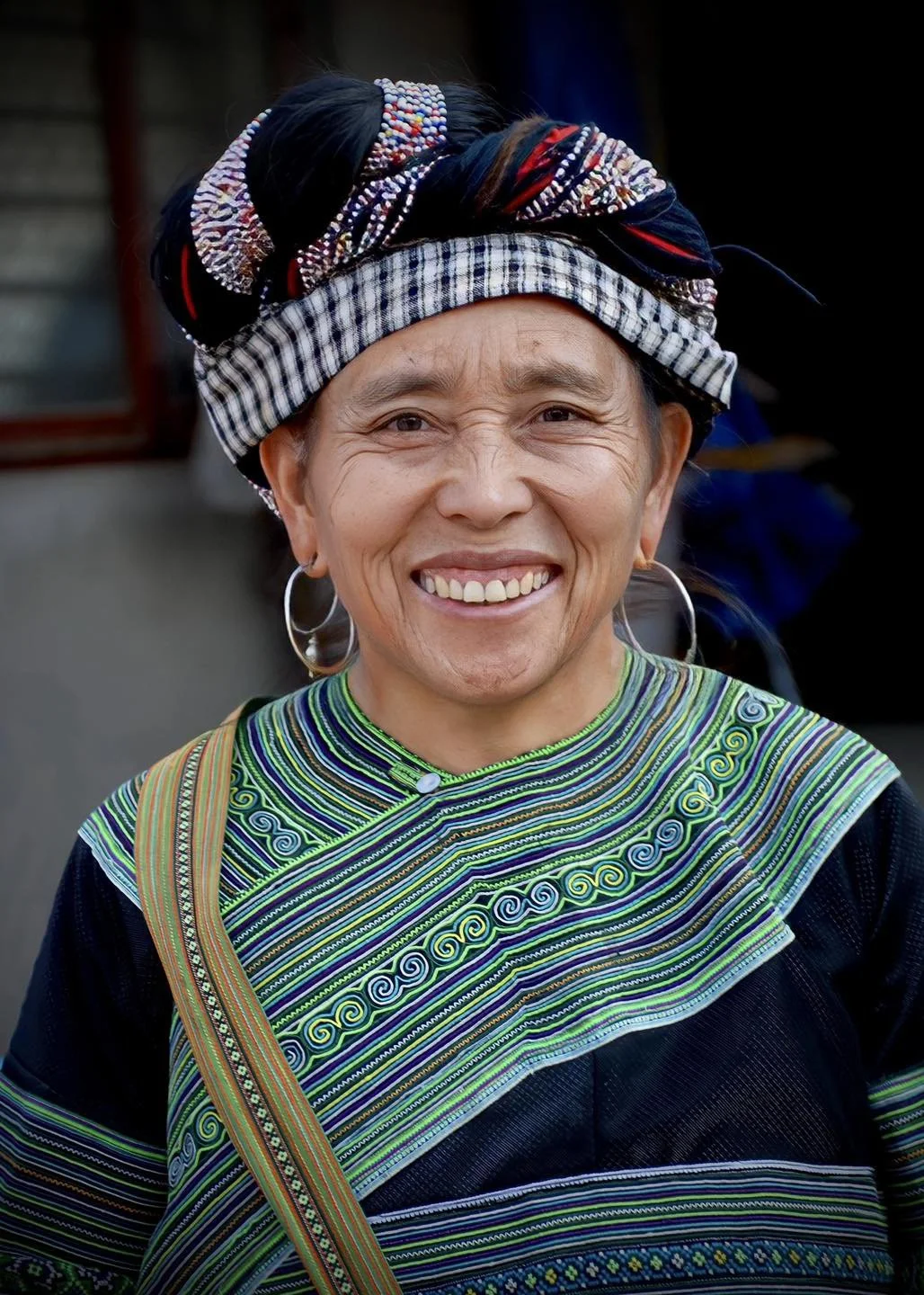
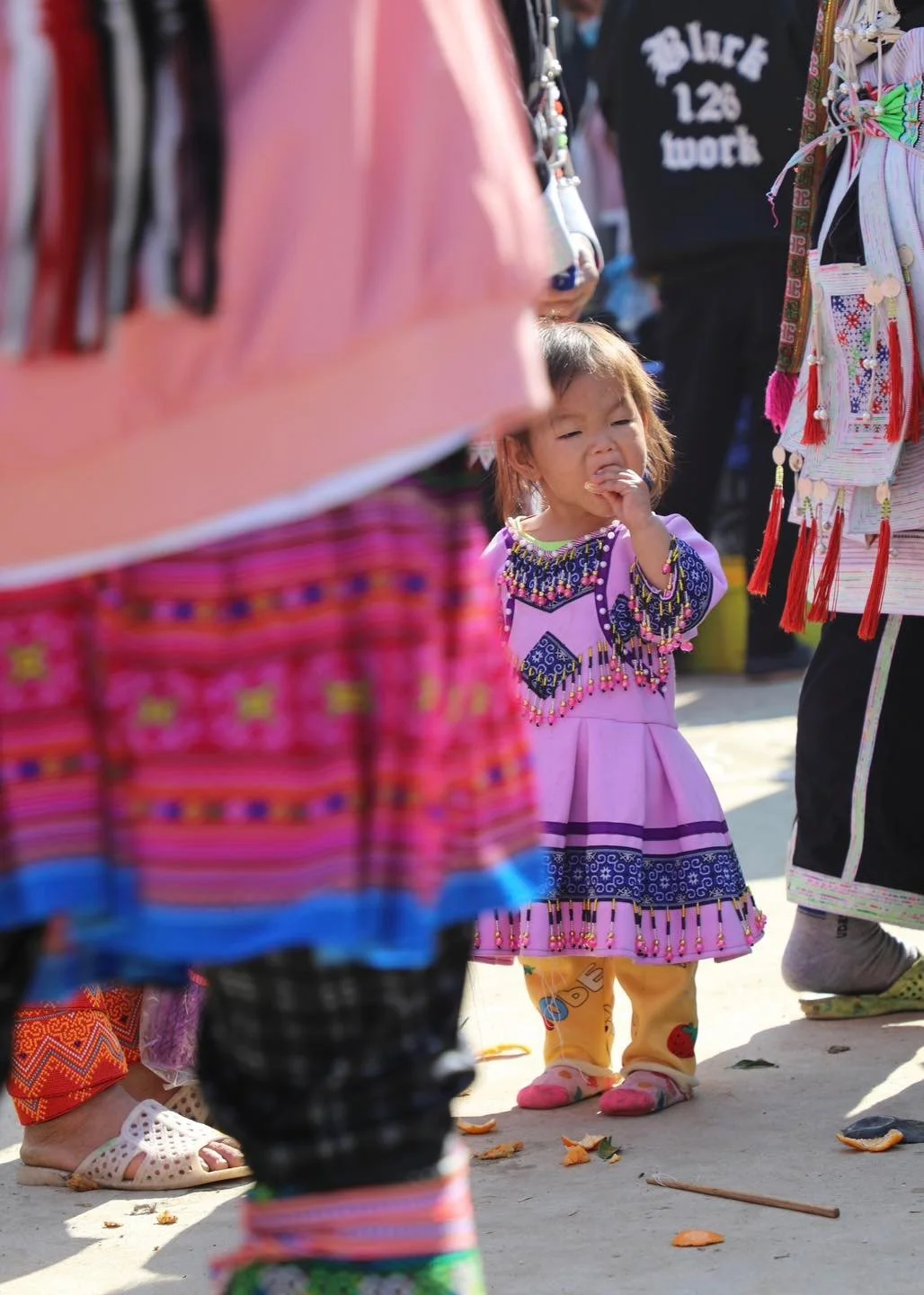
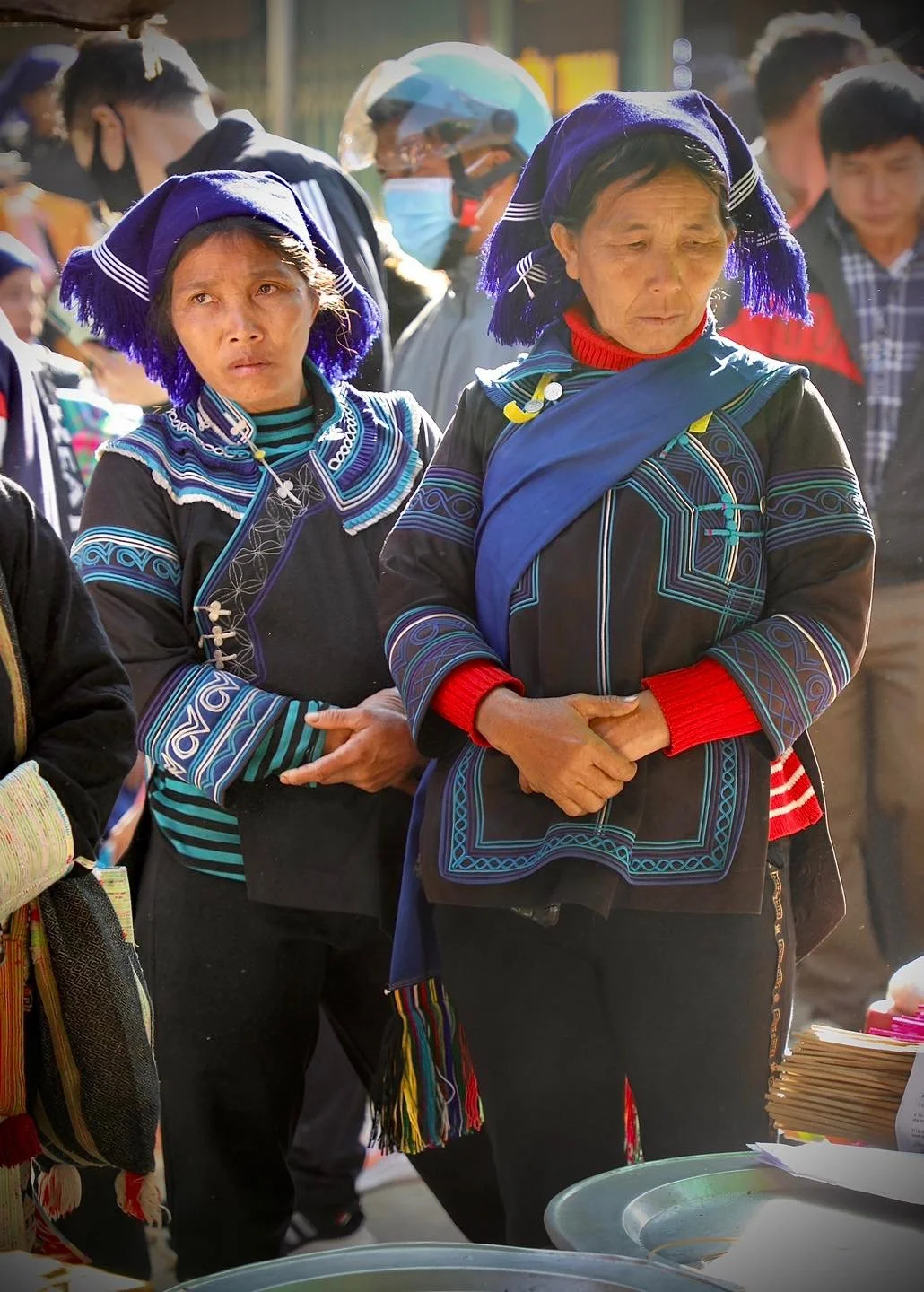
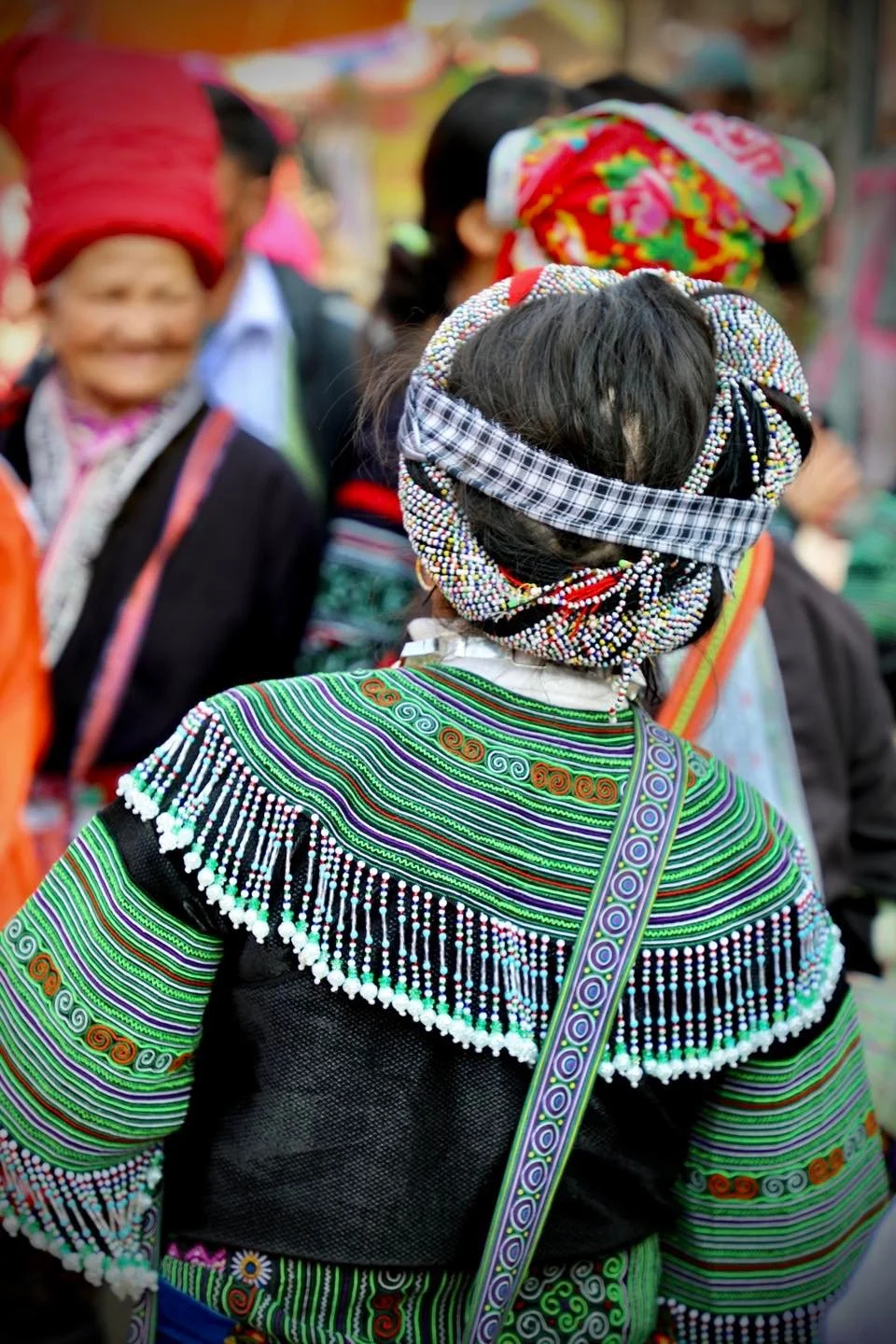
Rác Thải Trong Làng Bản– Hãy Cùng Nhau Thay Đổi! The growing litter problem– Let’s Make a Change Together
As tourism and population grow in Sapa, litter has become a visible problem. ETHOS and local people are taking action through education and community effort.
Rác Thải Trong Làng – Hãy Cùng Nhau Thay Đổi!
1. Vấn đề hiện nay
Thực tế cho thấy, một bộ phận người dân địa phương trong các bản làng vẫn còn xả rác bừa bãi, đặc biệt là quanh các cửa hàng và trường học. Theo tôi, điều này đang khiến những ngôi làng xinh đẹp của chúng ta trở nên nhếch nhác và mất đi vẻ tự nhiên vốn có.
Tình trạng này xảy ra phần lớn vì nhiều người chưa có cơ hội được học hoặc hiểu đúng về cách xử lý rác thải, cũng như tầm quan trọng của việc bảo vệ môi trường.
Đặc biệt, ở những bản làng chưa có hệ thống thu gom rác thải thường xuyên của chính quyền, vấn đề càng trở nên nghiêm trọng hơn.
Khi dân số và du lịch tăng lên, bao bì nhựa và sản phẩm dùng một lần xuất hiện ngày càng nhiều, nhưng giáo dục và nhận thức cộng đồng lại chưa theo kịp. Đây là thực tế mà chính chúng ta là những người dân địa phương đều thấy rõ mỗi ngày.
2. Chúng tôi đang làm gì để thay đổi?
Là một tổ chức cộng đồng địa phương, ETHOS tự hào là đơn vị duy nhất tại Sa Pa thường xuyên tổ chức các lớp học về rác thải, sức khỏe và vệ sinh tại các bản làng trong khu vực.
Chúng tôi đến tận các cộng đồng để cùng người dân thu gom rác và trò chuyện với trẻ em về vấn đề này. Trong các buổi học, chúng tôi đặt ra những câu hỏi đơn giản nhưng vô cùng quan trọng:
“Rác đến từ đâu?”, “Ai là người vứt rác?”, “Rác mất bao lâu để phân hủy hết?” và “Chúng ta có thể làm gì để thay đổi điều đó?”
Chúng tôi tin rằng giáo dục chính là chìa khóa của sự thay đổi. Khi con người hiểu, họ sẽ hành động khác đi.
Mỗi buổi học nhỏ, mỗi ngày dọn rác đều góp phần tạo nên sự khác biệt cho cộng đồng và cho chính môi trường sống của chúng ta.
3. Ý tưởng và giải pháp của bạn là gì?
Giờ đây, chúng tôi rất muốn lắng nghe ý kiến và ý tưởng của bạn:
Làm thế nào để giảm lượng rác thải trong làng?
Chúng ta có thể làm gì để cả người dân địa phương và du khách cùng chung tay bảo vệ vùng đất xinh đẹp này nơi mà tất cả chúng ta gọi là “nhà”?
Với tư cách là người Mông, bạn có ý tưởng hoặc giải pháp nào cho vấn đề này không? Bạn nghĩ chúng ta nên cùng nhau hành động như thế nào?
Hãy chia sẻ suy nghĩ của bạn và cùng chúng tôi góp sức vì một Sa Pa sạch, xanh và đáng tự hào.
Bởi hành động nhỏ đều có ý nghĩa, và khi cùng nhau, chúng ta có thể tạo nên sự thay đổi lớn trong cộng đồng.
Dưới đây là video ngắn về hoạt động thu gom rác cùng cộng đồng tại Sapa: https://youtu.be/A0fJH8AmwzM?si=ONciMWRgP38Kgn34
Rubbish in the Villages – Let’s Make a Change Together
1. Here’s the Problem
The truth is that some local people in our villages are dropping litter, especially around local shops and schools, and in my opinion, it’s making our beautiful villages look dirty and less natural. This happens because many people have never had the chance to learn or understand how to deal with rubbish properly or why it matters. It is especially bad in villages with no regular government litter collection.
As population grows and tourism increases, more plastic packaging and disposable products appear, but education and awareness have not kept pace. This is the reality, and as local people, we see it clearly every day.
2. What We’ve Been Doing to Help
As a local community organisation, ETHOS are proud to be the only company in Sapa that regularly organises classes about litter, health and hygiene in villages across the area.
We visit communities to collect rubbish together and to talk with children about the problem. We ask simple but important questions:
“Where does the rubbish come from?” “Who drops it?” “How long will it take to disappear?” and “What can we do to solve it?”
We truly believe that education is the key to change. When people understand, they act differently. Every small class or clean-up day makes a difference to our community and our environment.
3. What Are Your Ideas and Solutions?
We would love to hear your ideas. How can we reduce rubbish in our villages?
What can be done to help both locals and visitors protect this beautiful place we all call home?
As a Hmong person, what is your idea or your solution? How do you think we should do it together?
Please share your thoughts and join us in this effort. Every small step matters, and together we can keep Sapa clean.
Here’s our short video of local people collecting litter in Sapa here: https://youtu.be/A0fJH8AmwzM?si=ONciMWRgP38Kgn34
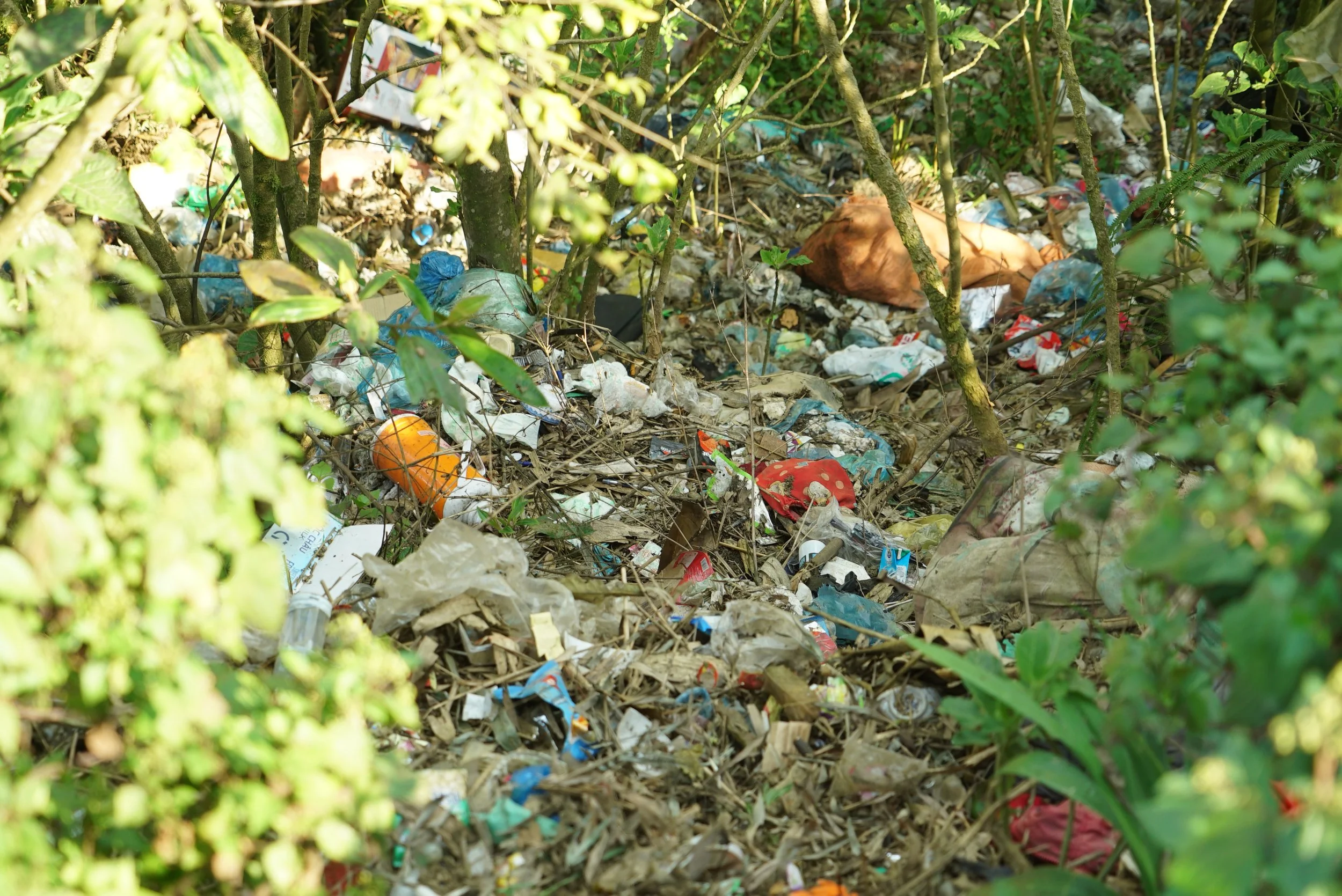


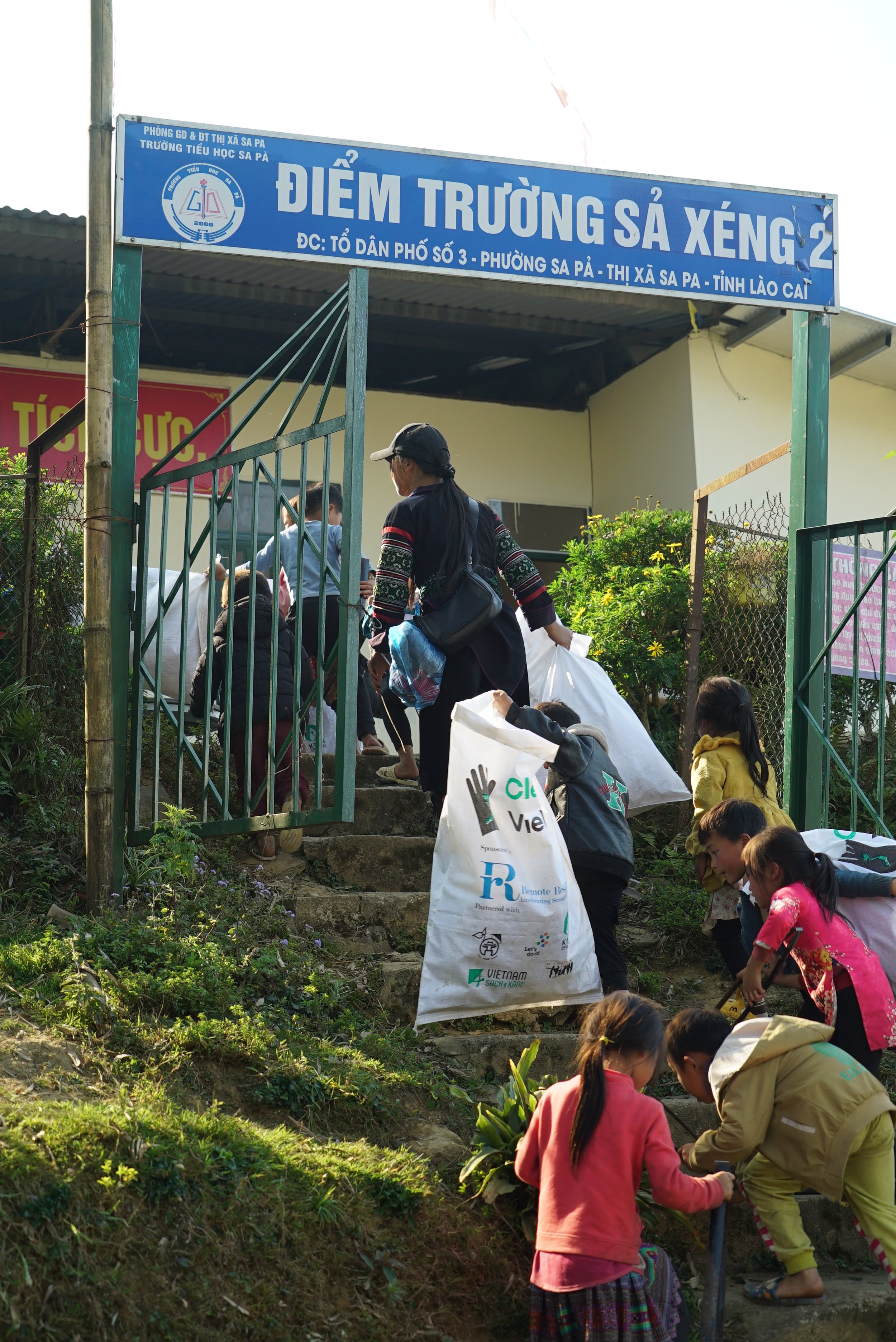

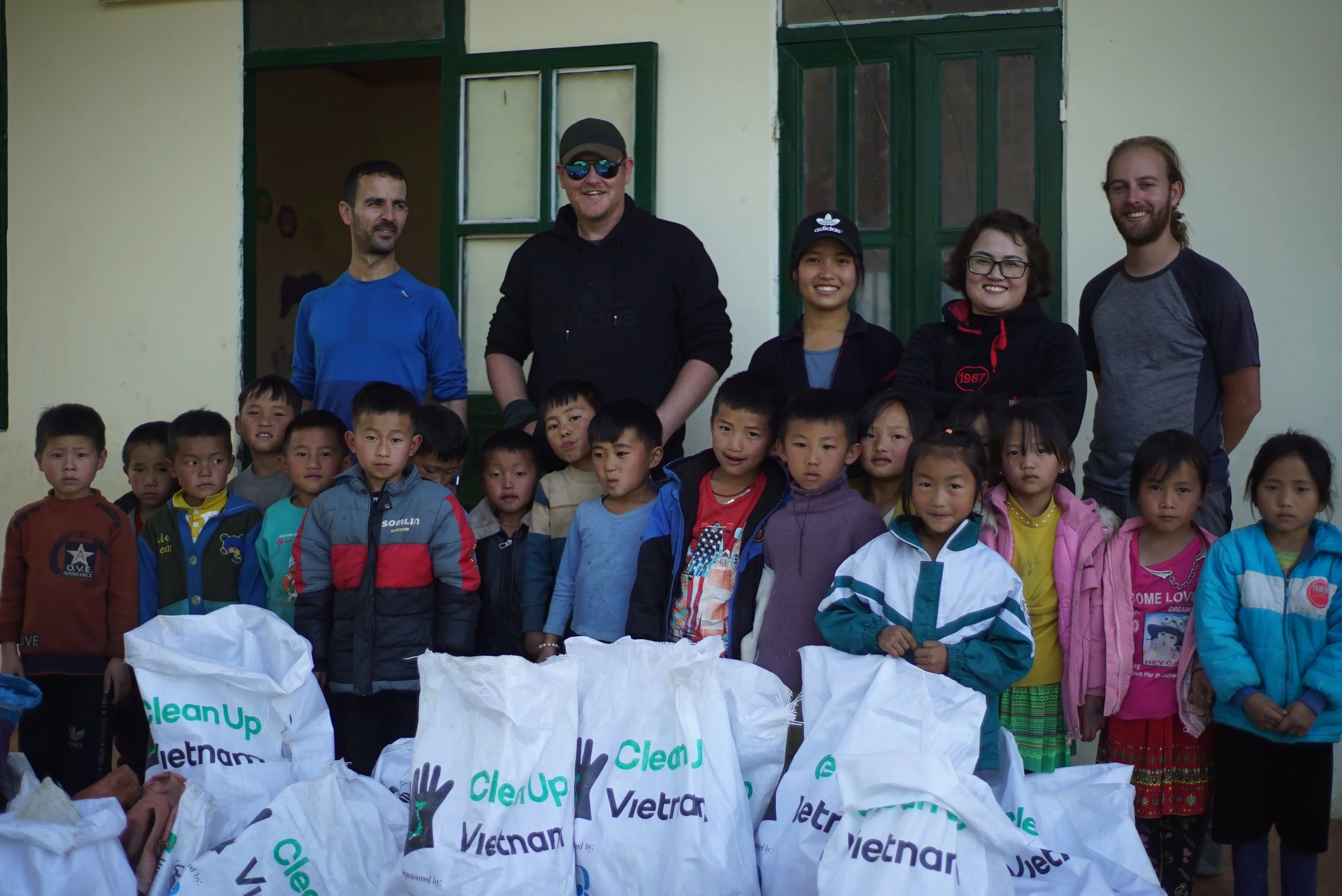
Ride the Untamed Loop: Discover Remote Villages and Hidden Trails in Northern Vietnam
Journey off the beaten path on the Untamed Loop. Discover hidden villages, panoramic mountain roads, and authentic cultural encounters in Northern Vietnam.
Discover the Untamed Loop in Northern Vietnam
If you are searching for a journey that takes you far beyond tourist trails, the Untamed Loop is an unforgettable experience. This two-day motorbike adventure winds through remote mountain roads, lush valleys, and minority villages where life still follows the rhythm of the seasons.
Scenic Roads and Authentic Encounters
The route forms a mountainous figure of eight loop through Muong Khuong District, where sweeping provincial roads meet quiet backroads and occasional gravel paths. Along the way, you pass rivers, rice terraces, green tea plantations, cinnamon hills, and cascading waterfalls.
This is not just about the ride. It is about slowing down, connecting with local people, and sharing moments that leave lasting memories.
Day One: Into the Mountains
The journey begins on winding roads through mountain forests, where the air is crisp and the views are wide. Passing through Hmong and Red Dao villages, you enter landscapes rarely marked on tourist maps.
Midday brings a stop at a local Hmong home for a shared meal. Sitting together, you enjoy simple but powerful hospitality through taste, conversation, and laughter.
In the evening, you arrive at a Red Dao family home in a quiet valley. After a warm welcome, you learn about their traditional herbal medicine and bathing practices, passed down over generations. Dinner is prepared with seasonal, organic produce grown nearby and shared with care.
Day Two: Valleys, Farms and Friendship
The second day begins with a gentle ride into a peaceful lake valley before climbing past rice terraces and mountain farms. Depending on the season, you may see locals planting, harvesting, or drying grains by hand. Every stop reveals a closer connection to the land and the people.
Meals are never taken in restaurants on this route. Instead, families prepare homemade food, often from scratch, filling the table with stories, smiles, and local flavours.
More than a Journey
By the time you return to the mountain roads, you will carry not only the memory of scenic landscapes but also friendships, laughter, and a sense of something deeply authentic. Over two days, the Untamed Loop covers about 200 kilometres. It is not about the distance but the depth of the experience.
Ready to Ride the Untamed Loop?
Take a look at the highlights and hear stories from the road in our video guide: Watch the Untamed Loop Adventure