
An ETHOS perspective: Vietnam’s hospitality is a gift, not an entitlement
When hospitality meets entitlement
One of the things that makes Vietnam special is how easily visitors are welcomed into everyday life. It happens in ways both large and small. A family invites a stranger to sit down for a drink or some food. A market vendor patiently helps a confused traveller despite sharing almost no common language. A homestay host insists that a guest eat another bowl of rice before leaving for the day. A local rider stops on a mountain road to help somebody whose motorbike has broken down. Across the country, countless acts of generosity unfold quietly every day, rarely attracting attention because they are simply part of how people live.
In the mountains of northern Vietnam, where ETHOS works alongside Hmong, Dao and other ethnic communities, hospitality remains deeply woven into daily life. Visitors are welcomed into homes, workshops, farms and forests not because tourism demands it, but because sharing knowledge, stories and food with guests has long been part of community life. When travellers sit beside a kitchen fire listening to stories, learn to work with indigo, help harvest crops or join a family meal, they are experiencing something that cannot be manufactured.
What is being shared is not a tourism product.
It is trust. That trust is one of Vietnam’s greatest strengths. It is also something that should never be taken for granted.
Over the past year, a growing number of incidents involving foreign visitors and foreign residents have prompted difficult conversations across Vietnam. Stories involving violent crime, organised fraud, drug offences, dangerous driving, visa abuse and public disorder have become increasingly visible. Some incidents have been shocking. Others have been depressingly familiar. Together, they raise an uncomfortable question.
Has a small but increasingly visible minority of foreigners begun mistaking Vietnam’s hospitality for permission?
The problem starts long before anyone appears in a police report. The conversation often begins long before a crime is committed.
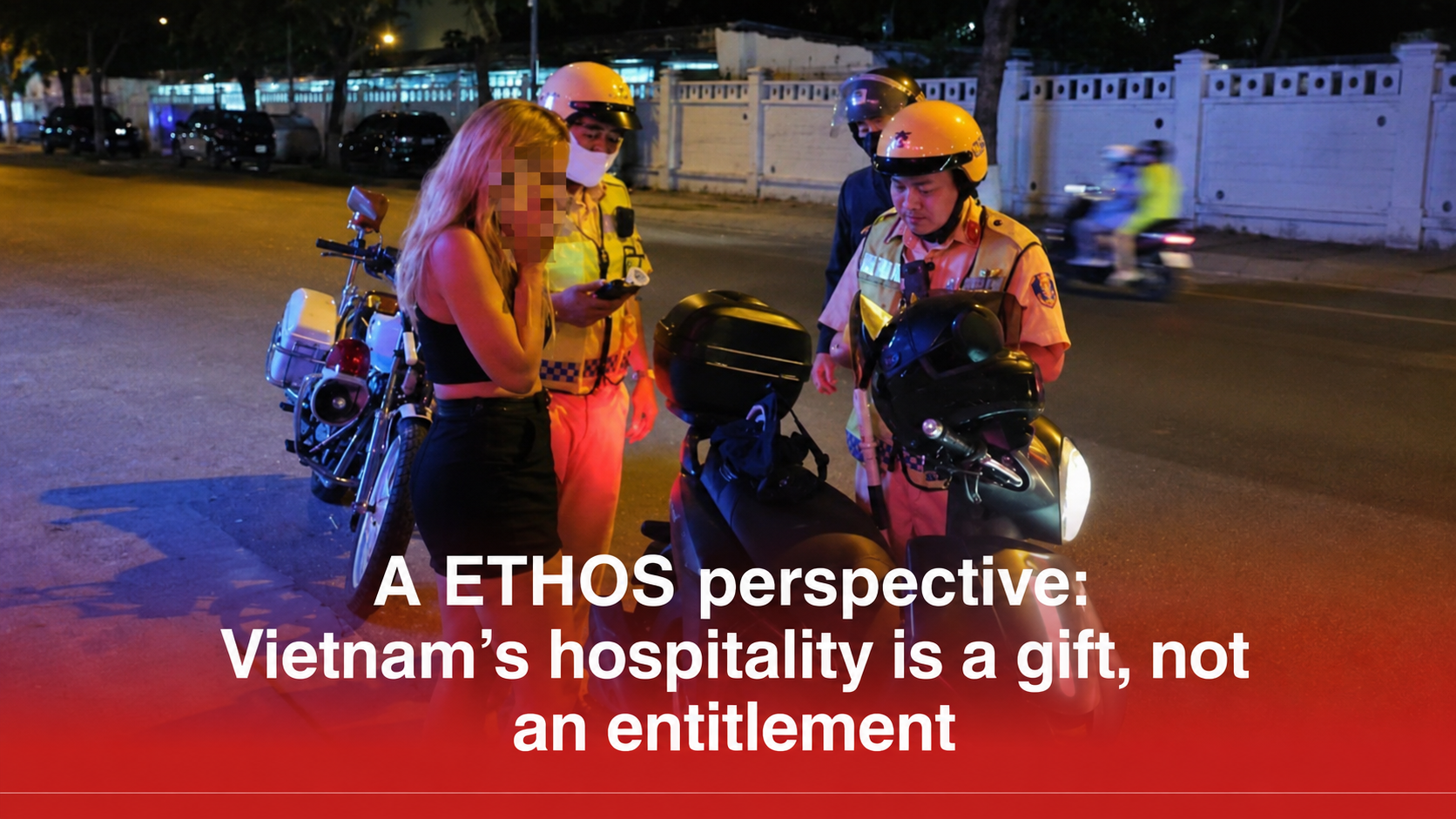
Spend enough time in Facebook groups, Reddit forums and travel communities dedicated to Vietnam and certain questions appear with remarkable regularity. Somebody wants to ride the Hà Giang Loop but does not possess the correct licence. Somebody else wants to know where police checkpoints are located so they can avoid them. Another traveller has noticed foreigners riding without helmets and wonders whether helmet laws are actually enforced. Others ask whether insurance really matters, whether visa rules are checked, or whether local authorities simply look the other way.
What is striking is not the questions themselves, but the assumption beneath them. The discussion is rarely centred on how to travel legally, responsibly or safely. Instead, it often revolves around how far the rules can be bent before consequences appear.
Anyone who spends time in destinations such as Sapa, Hà Giang or Ninh Bình will have seen examples of this. Foreign visitors riding motorcycles without helmets. Travellers with little or no riding experience attempting challenging mountain roads. People operating motorcycles without valid licences. Visitors who would never dream of behaving similarly in their own countries somehow convincing themselves that the rules are different in Vietnam. They are not.
Vietnam’s traffic laws exist for the same reason traffic laws exist anywhere else. Visa regulations exist for the same reason they exist elsewhere. Public order laws, licensing requirements and drink-driving regulations are not arbitrary inconveniences designed to frustrate travellers. They exist because somebody eventually bears the cost when they are ignored. Sometimes that cost falls on the traveller, but sadly it may also falls on a local family.
The headlines of 2026 reveal a deeper problem
The most serious incidents making headlines this year are obviously very different from an unlicensed tourist riding a rented motorbike. Yet they often reflect a similar mindset, namely the belief that Vietnam can be treated as a place where consequences are somehow lighter, oversight somehow weaker, or local laws somehow more negotiable.
In late May, a 34-year-old Australian national was detained after allegedly going on a destructive rampage inside a café in Đà Nẵng. Video footage showed furniture being smashed, customers threatened and significant property damage caused while staff and bystanders attempted to intervene. The incident spread rapidly across Vietnamese and international media, prompting widespread disbelief that somebody could behave in such a manner in a country that had welcomed them as a guest.
Only days before that, Hồ Chí Minh City police announced the arrest of two Samoan nationals, Vaa Vaa and Tafia Steve, in connection with the fatal shooting of Australian citizen Lorenzo Lemalu in District 1. Investigators alleged the pair entered Vietnam, monitored their target and carried out the attack before attempting to flee. The case drew extraordinary attention because it suggested Vietnam was becoming a stage upon which criminal disputes from abroad were being played out.
Authorities have also highlighted concerns regarding foreign criminal groups operating scam centres, cybercrime networks and online gambling operations from within Vietnam. In Hà Nội, police have warned publicly about an increasing tendency for foreign offenders to relocate activities into the country while targeting victims elsewhere. Investigations involving foreign-run fraud operations, illegal entry networks and organised cybercrime have featured prominently throughout the year.
Drug-related arrests involving foreign nationals have also generated significant publicity. South Korean nationals have been linked to organised drug cases in Hồ Chí Minh City. Russian nationals have appeared in investigations involving narcotics distribution networks serving foreign communities. Malaysian nationals were detained during investigations into suspected telecom fraud and illegal drug use. Separate cases involving foreign nationals from China, Russia and other countries have reinforced concerns that some criminal groups increasingly view Vietnam as an attractive operating environment.
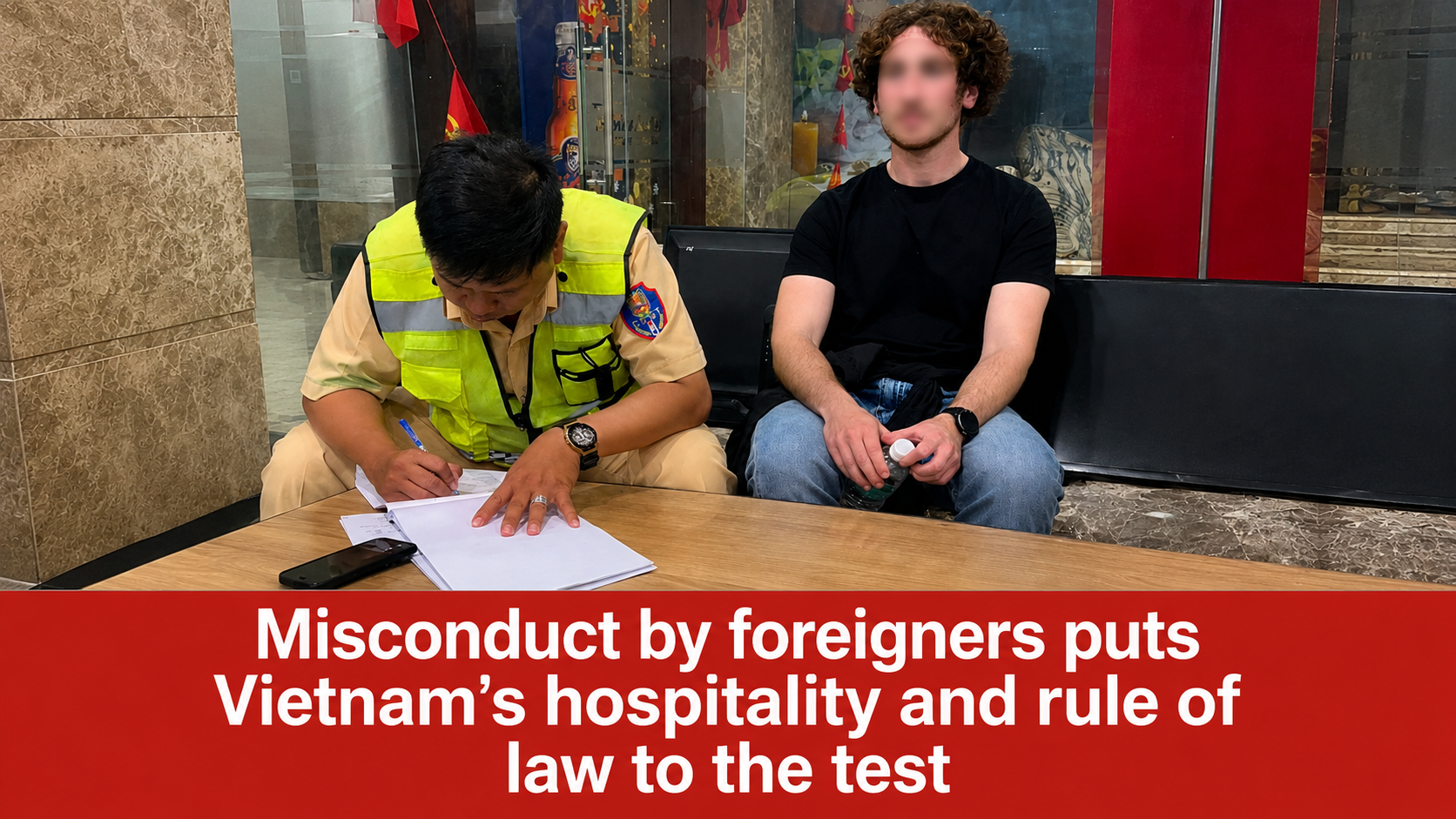
Road safety has emerged as another recurring theme.
In Khánh Hòa, authorities have publicly linked numerous incidents involving foreign riders to speeding, drink-driving, dangerous riding and invalid licences. One of the most widely reported cases involved a Russian national accused of causing a fatal collision in Nha Trang while allegedly riding under the influence of alcohol. Elsewhere, videos showing foreigners performing dangerous stunts, riding without helmets or disregarding basic safety regulations continue to circulate online with depressing regularity.
It is important to emphasise that many of these cases remain allegations or ongoing investigations rather than proven offences. The point is not to sensationalise them. The point is that they are becoming increasingly visible.
Why this matters beyond the individuals involved
The overwhelming majority of visitors to Vietnam never break the law. Most arrive curious, respectful and genuinely interested in learning about the country. Most leave with fond memories, lasting friendships and a deeper appreciation for Vietnamese culture, yet highly publicised incidents rarely affect only the individuals directly involved.
Every major crime involving a foreign national becomes a story discussed by local communities, authorities, business owners and ordinary citizens. Every viral video showing dangerous behaviour reinforces negative stereotypes. Every visitor who rides illegally, overstays a visa, drives drunk or treats local laws as optional contributes to a perception that foreigners expect different standards from those applied to everybody else. That perception has consequences.
The homestay owner who must complete additional paperwork. The accommodation provider facing increased scrutiny. The motorbike rental business subject to tighter inspections. The community that becomes slightly more cautious about welcoming outsiders. The traveller who follows every rule but finds authorities less trusting because others have not. Trust, once weakened, is difficult to rebuild.
Vietnam is responding
Vietnamese authorities are not ignoring these trends. Recent government directives have called for stronger measures to safeguard public order and security within the tourism sector. Plans have been announced to improve digital monitoring of accommodation bookings and travel activities, allowing authorities to respond more effectively to criminal activity, visa abuse and public safety concerns.
Some commentators have interpreted these developments as signs of increasing control, but a different interpretation may be more accurate. These measures are, at least in part, the predictable consequence of abuse. Any country experiencing rapid tourism growth faces the same challenge. How do you remain open while protecting public safety? How do you encourage visitors while discouraging those who see hospitality as weakness? How do you maintain trust when a minority repeatedly exploits it? Vietnam is now confronting those questions.
The greatest danger to travellers remains the road
Ironically, for most visitors, the greatest threat is not violent crime, organised fraud or public disorder, but is the traffic. Every year, travellers are injured because they rent motorcycles illegally, underestimate road conditions, overestimate their abilities or simply follow the behaviour of others. A road filled with inexperienced foreign riders quickly becomes dangerous for everyone, including local residents who rely on those roads every day.
The romantic image of motorbiking through northern Vietnam often obscures a simple reality. These roads are not theme parks. They are working roads used by farmers, families, schoolchildren, delivery riders and local communities. The consequences of irresponsible riding are not theoretical but can be measured in injuries, hospital visits and lives permanently altered by decisions that took only seconds to make.
For anybody considering riding independently, we strongly recommend taking the time to understand Vietnam’s licensing requirements, insurance implications and road conditions before setting off.
You can read our guide here:
https://www.ethosspirit.com/motorbiking-in-vietnam
For travellers who want to experience Vietnam’s mountain roads without the pressure, responsibility and legal uncertainty of self-riding, our easy rider style journeys offer another approach. Travelling with experienced local riders allows guests to focus on landscapes, communities and cultural experiences while leaving the driving to those who know these roads best.
You can learn more here:
https://www.ethosspirit.com/motorbikes
Responsible travel is not complicated
The solution to all of this is remarkably simple.
Wear a helmet when riding as travelling as a passenger on a motorcycle.
Ride legally.
Respect visa conditions.
Treat local laws as seriously as you would at home.
Pay fairly.
Ask before taking photographs.
Remember that villages are communities rather than attractions.
Understand that a homestay is somebody’s home before it is somebody’s business.
Recognise that hospitality is an invitation rather than an obligation.
None of these expectations are unreasonable. They are simply the foundations of respectful travel.
A welcome worth protecting
Vietnam remains one of the most welcoming, tolerant and affordable countries in the world to explore. Millions of visitors arrive every year and experience nothing but kindness. Most leave with a genuine affection for the people they meet and the places they encounter. The recent rise in stories involving foreign crime, dangerous driving, visa abuse and public disorder should not obscure that reality. What they should do is remind us that hospitality depends on reciprocity.
In the mountains where ETHOS works, families continue to welcome strangers into their homes. Artisans continue to share skills that have been passed down through generations. Farmers continue to open their fields and forests to visitors who want to understand life beyond the guidebook. Communities continue to extend trust to people they have never met before. That generosity is remarkable and also fragile.
Perhaps the real lesson behind many of the incidents that have dominated headlines throughout 2026 is that openness should never be mistaken for weakness. Whether the issue is an unlicensed rider attempting to evade police checkpoints, a tourist causing chaos in a café, or organised criminal groups using Vietnam as a base for fraud, the underlying problem is often the same. Somebody has confused welcome with permission and hospitality with entitlement.
Vietnam’s welcome remains as warm as ever and the responsibility rests with travellers to prove they deserve it.
Please don’t forget that Vietnam’s hospitality is a gift but not an entitlement.
